A Two-Level Relative-Entropy Theory for Isotropic Turbulence Spectra: Fokker–Planck Semigroup Irreversibility and WKB Selection of Dissipation Tails

Abstract
1. Introduction
2. Dynamical Modeling of the Turbulent Cascade
2.1. Lin Equation and the Energy-Spectrum Budget
2.2. Unified Spectral Representation Including the Dissipation Range
2.3. Log-Wavenumber Space and the Definition of Probability Densities
2.4. Coarse-Graining: From a Jump Process to the Fokker–Planck Equation
2.4.1. Assumptions for the Jump Process and the Master Equation
2.4.2. Kramers–Moyal Expansion and the Diffusion Limit: Reduction to the FP Equation
2.5. Summary of Section 2
3. Fokker–Planck Description and Monotonicity of Relative Entropy (H-Theorem)
3.1. Conservative Fokker–Planck Equation and Stationary Distribution
3.2. Definition of Relative Entropy
3.3. H-Theorem and a General Identity for Open Systems
3.3.1. Gradient Form of the Probability Current (Consequence of the Zero-Flux Reference Distribution)
3.3.2. Time Derivative of the Relative Entropy
3.3.3. Integration by Parts and a Quadratic Dissipation Representation
3.3.4. H-Theorem for a Closed System
3.3.5. Open Systems: General Identity with Boundary Terms
3.4. Summary of Section 3
4. Asymptotic Structure of the Dissipation-Range Spectrum via WKB Analysis
4.1. Formulation: Stationary Fokker–Planck Equation with Killing
4.2. Boundary-Value Formulation and Asymptotic Regime
4.3. WKB Structure and Dominant Balance
4.4. Asymptotic Scaling in the Dissipation Range
4.5. Dissipation-Range Energy Spectrum
4.6. Interpretation of the Exponent Selection
4.7. Summary of the Dissipation-Range Selection Mechanism
5. Two-Level Entropy Principle and Determination of the Dissipation-Tail Exponent
5.1. Dynamical Level: Autonomous Conservative FP Semigroup and the H-Theorem
5.2. Consequence of the WKB Analysis and the Stretched-Exponential Tail
5.3. Formulation of the Two-Level Principle and Parameter Identification
5.4. Construction of the Reference Distribution and a Global Model
5.5. Fixing Parameters by Dissipation-Rate Consistency
5.6. Optimization of and the Admissible Range of the Tail Exponent
5.7. Verification of the Exponent
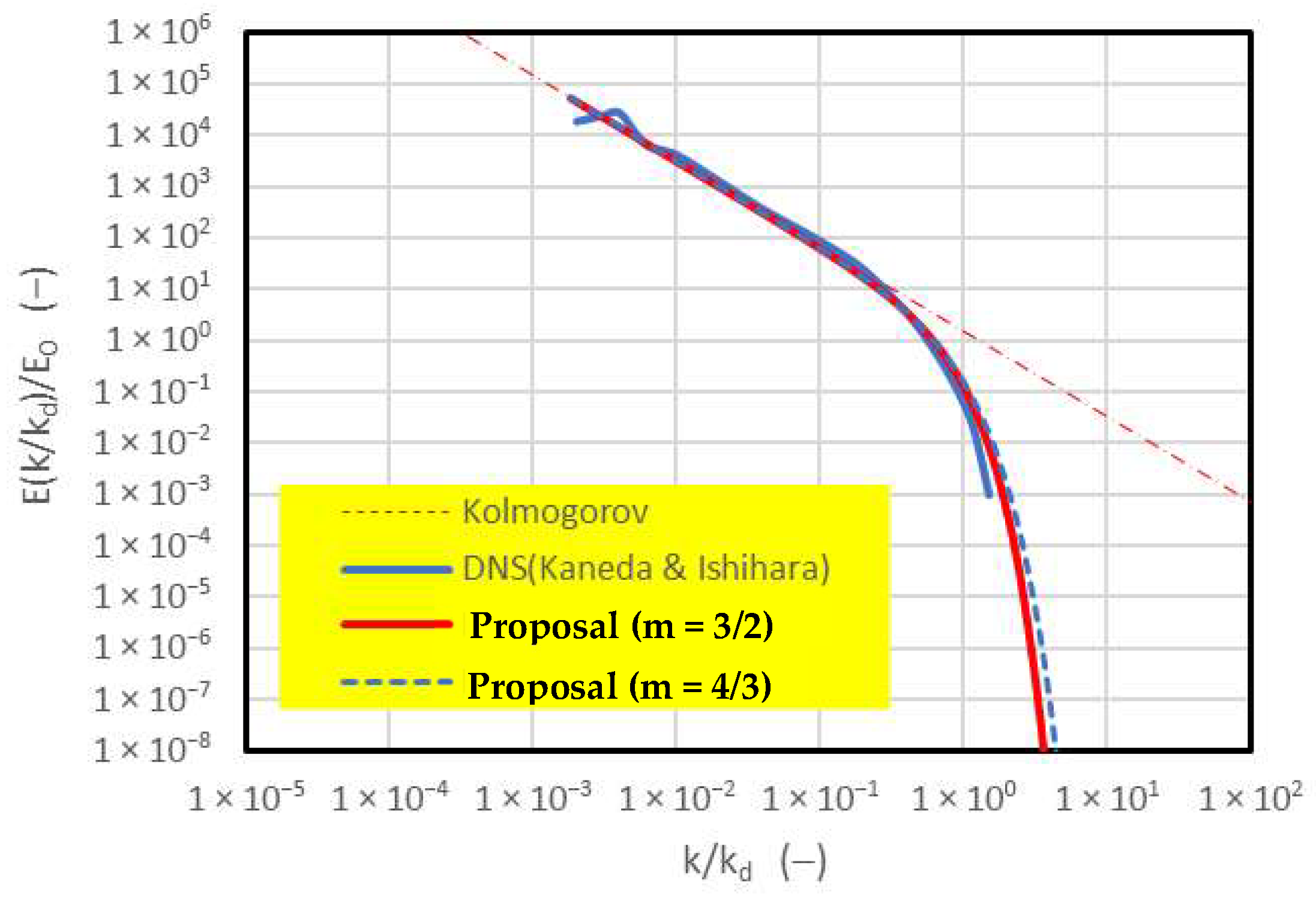
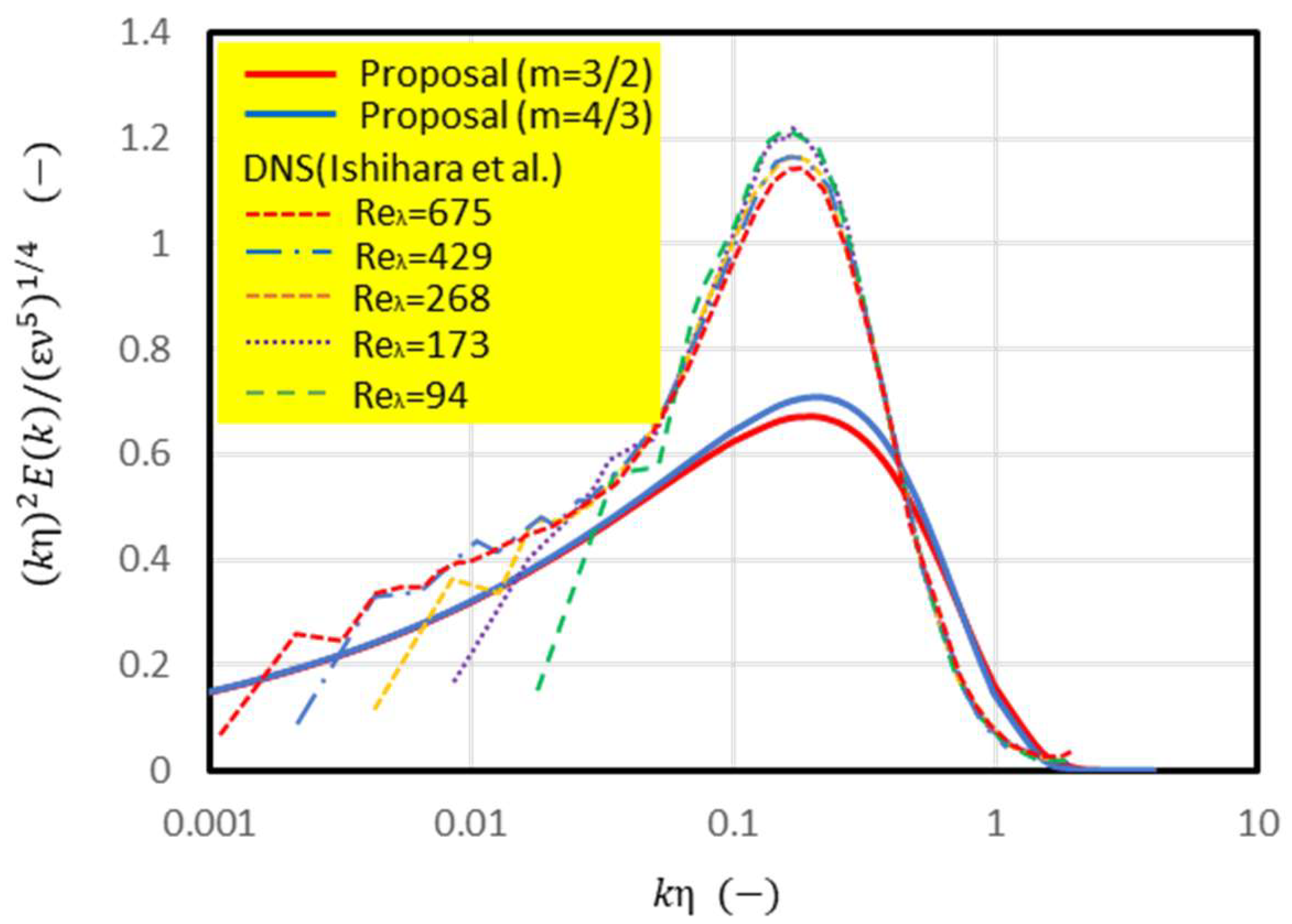
5.8. Physical Validity of the Proposed Model and Its Application Across a Wide Range of Reynolds Numbers
5.9. Summary: Connecting the First and Second Stages
6. Conclusions
Funding
Data Availability Statement
Conflicts of Interest
Appendix A. Differential Expansions in the WKB Approximation
Appendix A.1. First and Second Derivatives of
Appendix A.2. Expansion of
Appendix A.3. Expansion of and the Killing Term
Appendix A.4. Role in the Main Text
Appendix B. Mathematical Derivations for Section 4
Appendix B.1. From the Killing-Modified Stationary FP Equation to the Second-Order ODE
- decay/integrability: Equation (69),
- boundary-value closure: Equations (80) and (81).
Appendix B.2. WKB Bookkeeping, Scaling, and the WKB Ansatz
Appendix B.3. Differential Expansions Used in the WKB Substitution
Appendix B.4. Substitution into the Governing Equation and Order-by-Order Decomposition
- Order : eikonal equation
- Order : transport equation
- Order : residual equation
Appendix B.5. Dissipation-Range Branch Selection and Absorption-Dominant Asymptotics
Appendix B.6. Conversion to a Stretched-Exponential Cutoff and the Exponent Relation
Appendix B.7. Amplitude Equation (Transport) and Its Integral Form
Appendix C. Mathematical Derivations Supporting Section 5 (Selection-Level Construction)
Appendix C.1. H-Theorem for the Autonomous Conservative FP Semigroup (Supports Section 5.1)
Appendix C.1.1. Zero-Flux Stationary Reference Distribution
Appendix C.1.2. Relative Entropy, Its Time Derivative, and Boundary Conditions
Appendix C.1.3. Gradient-Flux Structure and Quadratic Dissipation
Appendix C.2. From Killing FP to the Stationary Boundary-Value Problem and Its WKB Tail (Supports Section 5.2)
Appendix C.2.1. Unnormalized Density and Total Energy
Appendix C.2.2. Killing Equation, Stationarity, and the Forced-to-Unforced Reduction
Appendix C.2.3. Reduction to a Second-Order ODE
Appendix C.2.4. WKB Consequence (Logical Connection, Not Re-Deriving Section 4)
Appendix C.3. Candidate Family, Domain Restriction, and KL Functional (Supports Section 5.3)
Appendix C.3.1. Two-Level Schematic and Candidate Spectral Family
Appendix C.3.2. Corresponding Unnormalized Density and Its Explicit Form
Appendix C.3.3. Domain Restriction and Normalized Density on
Appendix C.3.4. KL Divergence Against a Reference Distribution
Appendix C.3.5. WKB Coupling and Reduction to One Parameter
Appendix C.4. Construction of and Global Models (Supports Section 5.4)
Appendix C.4.1. General Integral Form from the Zero-Flux Condition
Appendix C.4.2. Global Models and Dissipation-Range Scaling
Appendix C.4.3. Explicit Expression for
Appendix C.4.4. Integrability Condition
Appendix C.5. Fixing by Dissipation-Rate Consistency (Supports Section 5.5)
Appendix C.5.1. Starting Definition and Substitution
Appendix C.5.2. Change of Variables
Appendix C.5.3. Change of Variables and Incomplete Gamma Function
Appendix C.5.4. Implicit Definition of , then
Appendix C.6. WKB Coupling, Admissible Set, and the Final 1D Optimization (Supports Section 5.6)
Appendix C.6.1. WKB Coupling Between and
Appendix C.6.2. Parameterization by and Construction of
Appendix C.6.3. Objective Functional and Admissible Set
Appendix C.6.4. Final Identification and Optimality Conditions
Appendix C.6.5. Admissible Exponent Range
Appendix C.7. Limit, Closed-Form , and Representative Spectra (Supports Section 5.7)
Appendix C.7.1. Restating the Admissible Range
Appendix C.7.2. Simplification and Closed-Form
Appendix C.7.3. Two Representative Spectra (m = 4/3 and 3/2)
Appendix C.8. (Optional but Included for Completeness) Final Summary Relations (Supports Section 5.9)
References
- Kolmogorov, A.N. The local structure of turbulence in incompressible viscous fluid for very large Reynolds numbers. Dokl. Akad. Nauk. SSSR 1941, 30, 301–305. [Google Scholar] [CrossRef]
- Batchelor, G.K. The Theory of Homogeneous Turbulence; Cambridge University Press: Cambridge, UK, 1953. [Google Scholar]
- Frisch, U. Turbulence: The Legacy of A. N. Kolmogorov; Cambridge University Press: Cambridge, UK, 1995. [Google Scholar]
- Davidson, P.A. Turbulence: An Introduction for Scientists and Engineers, 2nd ed.; Oxford University Press: Oxford, UK, 2015. [Google Scholar]
- Sagaut, P.; Cambon, C. Homogeneous Turbulence Dynamics, 2nd ed.; Springer: Berlin/Heidelberg, Germany, 2018. [Google Scholar]
- Kovasznay, L.S.G. Spectrum of Locally Isotropic Turbulence. J. Aeronaut. Sci. 1948, 15, 745–753. [Google Scholar] [CrossRef]
- Kraichnan, R.H. The Structure of Isotropic Turbulence at Very High Reynolds Numbers. J. Fluid Mech. 1959, 5, 497–543. [Google Scholar] [CrossRef]
- Pao, Y.H. Structure of turbulent velocity and scalar fields at large wavenumbers. Phys. Fluids 1965, 8, 1063–1075. [Google Scholar] [CrossRef]
- Pope, S.B. Turbulent Flows; Cambridge University Press: Cambridge, UK, 2000. [Google Scholar]
- Verma, M.K.; Kumar, A.; Kumar, P.; Barman, S.; Chatterjee, A.G.; Samtaney, R.; Stepanov, R.A. Energy spectra and fluxes in dissipation range of turbulent and laminar flows. Fluid Dyn. 2018, 53, 862–873. [Google Scholar] [CrossRef]
- dos Santos, F.L.; Botero-Bolívar, L.; Venner, C.; de Santana, L.D. Modeling the Turbulence Spectrum Dissipation Range for Leading-Edge Noise Prediction. AIAA J. 2022, 60, 3581–3592. [Google Scholar] [CrossRef]
- Buaria, D.; Sreenivasan, K.R. Dissipation range of the energy spectrum in high Reynolds number turbulence. Phys. Rev. Fluids 2020, 5, 092601. [Google Scholar] [CrossRef]
- Gorbunova, A.; Balarac, G.; Canet, L.; Eyink, G.; Rossetto, V. Spatio-temporal correlations in three-dimensional homogeneous and isotropic turbulence. Phys. Fluids 2021, 33, 045114. [Google Scholar]
- Verma, M.K. Energy Transfers in Fluid Flows: Multiscale and Spectral Perspectives; Cambridge University Press: Cambridge, UK, 2019. [Google Scholar]
- Solsvik, J.; Jakobsen, H.A. Development and application of population balance models for dispersed turbulent two-phase flow: A review. AIChE J. 2016, 62, 1933–1953. [Google Scholar]
- Solsvik, J.; Jakobsen, H.A. Development of fluid particle breakup and coalescence closure models for the complete energy spectrum of isotropic turbulence. Ind. Eng. Chem. Res. 2016, 55, 6201–6230. [Google Scholar] [CrossRef]
- Verma, M.K.; Chatterjee, A.G. An Introduction to Multiscale Analysis in Turbulence; Springer: Singapore, 2022. [Google Scholar]
- Tanogami, T.; Araki, K. Information-thermodynamic structure of the turbulent energy cascade. Phys. Rev. Res. 2024, 6, 043261. [Google Scholar] [CrossRef]
- Yatomi, G.; Nakata, M. Quantum-inspired information entropy in multifield turbulence. Phys. Rev. Res. 2025, 7, 023212. [Google Scholar] [CrossRef]
- Hinch, E.J. Perturbation Methods; Cambridge University Press: Cambridge, UK, 1991. [Google Scholar]
- Edwards, S.F.; McComb, W.D. Generalized Taylor–Kármán Momentum Transfer Theory of Isotropic Turbulence. J. Phys. A Gen. Phys. 1969, 2, 157–171. [Google Scholar] [CrossRef]
- Risken, H. The Fokker–Planck Equation: Methods of Solution and Applications, 2nd ed.; Springer: Berlin/Heidelberg, Germany, 1996. [Google Scholar]
- Gardiner, C.W. Stochastic Methods: A Handbook for the Natural and Social Sciences, 4th ed.; Springer: Berlin/Heidelberg, Germany, 2009. [Google Scholar]
- Lin, C.C. On the Law of Decay and Spectra of Isotropic Turbulence. Proc. Sympos. Appl. Math. 1947, 1, 81–90. [Google Scholar]
- Eyink, G.L. Locality of turbulent cascades. Phys. D Nonlinear Phenom. 2005, 207, 91–116. [Google Scholar] [CrossRef]
- Eyink, G.L.; Aluie, H. Localness of energy cascade in hydrodynamic turbulence. I. Smooth coarse-graining. Phys. Fluids 2009, 21, 115107. [Google Scholar] [CrossRef]
- McComb, W.D. The Physics of Fluid Turbulence; Clarendon Press (Oxford University Press): Oxford, UK, 1990; 572p. [Google Scholar]
- Alexakis, A.; Mininni, P.D.; Pouquet, A. Shell to shell energy transfer in hydrodynamic turbulence. Phys. Fluids 2005, 17, 095103. [Google Scholar]
- Van Kampen, N.G. Stochastic Processes in Physics and Chemistry, 3rd ed.; North-Holland: Amsterdam, The Netherlands, 2007. [Google Scholar]
- Kolmogorov, A.N. On the analytic methods in the theory of probability. Math. Ann. 1931, 104, 415–458. [Google Scholar]
- Kullback, S.; Leibler, R.A. On Information and Sufficiency. Ann. Math. Stat. 1951, 22, 79–86. [Google Scholar] [CrossRef]
- Kullback, S. Information Theory and Statistics; Wiley: New York, NY, USA, 1959. [Google Scholar]
- Lebowitz, J.L.; Spohn, H. A Gallavotti–Cohen-Type Symmetry in the Large Deviation Functional for Stochastic Dynamics. J. Stat. Phys. 1999, 95, 333–365. [Google Scholar] [CrossRef]
- Seifert, U. Stochastic Thermodynamics, Fluctuation Theorems and Molecular Machines. Rep. Prog. Phys. 2012, 75, 126001. [Google Scholar] [CrossRef]
- Spohn, H. Entropy Production for Quantum Dynamical Semigroups. J. Math. Phys. 1978, 19, 1227–1230. [Google Scholar] [CrossRef]
- de Groot, S.R.; Mazur, P. Non-Equilibrium Thermodynamics; Dover: New York, NY, USA, 1984. [Google Scholar]
- Ishihara, T.; Gotoh, T.; Kaneda, Y. Study of High–Reynolds Number Isotropic Turbulence by Direct Numerical Simulation. Annu. Rev. Fluid Mech. 2009, 41, 165–180. [Google Scholar] [CrossRef]
- Kaneda, Y.; Ishihara, T. High-resolution direct numerical simulation of turbulence. J. Turbul. 2006, 7, N20. [Google Scholar] [CrossRef]
- Hebishima, H.; Inage, H. A unified turbulence model bridging low and high Reynolds numbers: Integrating shell models with two-scale direct interaction approximation. Chaos Solitons Fractals 2025, 198, 116535. [Google Scholar] [CrossRef]
- Sreenivasan, K.R. On the universality of the Kolmogorov constant. Phys. Fluids 1995, 7, 2778–2784. [Google Scholar] [CrossRef]
- Ishihara, T.; Kaneda, Y.; Yokokawa, M.; Itakura, K.; Uno, A. Energy Spectrum in the Near Dissipation Range of High Resolution Direct Numerical Simulation of Turbulence. J. Phys. Soc. Jpn. 2005, 74, 1464–1471. [Google Scholar] [CrossRef]
- Lohse, D.; Müller-Groeling, A. Bottleneck effects in turbulence. Phys. Rev. Lett. 1995, 74, 4647–4650. [Google Scholar] [CrossRef] [PubMed]
- Yakhot, V.; Orszag, S.A. Renormalization group analysis of turbulence. I. Basic theory. J. Sci. Comput. 1986, 1, 3–51. [Google Scholar] [CrossRef]
- Yoshizawa, A. Statistical analysis of the deviation of the Reynolds stress from its eddy-viscosity representation. Phys. Fluids 1984, 27, 1377–1387. [Google Scholar] [CrossRef]
- Yamada, M.; Ohkitani, K. Lyapunov spectrum of a chaotic model of three-dimensional turbulence. J. Phys. Soc. Jpn. 1987, 56, 4210–4213. [Google Scholar] [CrossRef]


Disclaimer/Publisher’s Note: The statements, opinions and data contained in all publications are solely those of the individual author(s) and contributor(s) and not of MDPI and/or the editor(s). MDPI and/or the editor(s) disclaim responsibility for any injury to people or property resulting from any ideas, methods, instructions or products referred to in the content. |
© 2026 by the author. Licensee MDPI, Basel, Switzerland. This article is an open access article distributed under the terms and conditions of the Creative Commons Attribution (CC BY) license.
Share and Cite
Inage, S.-i. A Two-Level Relative-Entropy Theory for Isotropic Turbulence Spectra: Fokker–Planck Semigroup Irreversibility and WKB Selection of Dissipation Tails. Mathematics 2026, 14, 620. https://doi.org/10.3390/math14040620
Inage S-i. A Two-Level Relative-Entropy Theory for Isotropic Turbulence Spectra: Fokker–Planck Semigroup Irreversibility and WKB Selection of Dissipation Tails. Mathematics. 2026; 14(4):620. https://doi.org/10.3390/math14040620
Chicago/Turabian StyleInage, Shin-ichi. 2026. "A Two-Level Relative-Entropy Theory for Isotropic Turbulence Spectra: Fokker–Planck Semigroup Irreversibility and WKB Selection of Dissipation Tails" Mathematics 14, no. 4: 620. https://doi.org/10.3390/math14040620
APA StyleInage, S.-i. (2026). A Two-Level Relative-Entropy Theory for Isotropic Turbulence Spectra: Fokker–Planck Semigroup Irreversibility and WKB Selection of Dissipation Tails. Mathematics, 14(4), 620. https://doi.org/10.3390/math14040620