1. Introduction
The timely supply of pharmaceuticals is a core bottom line for safeguarding public health [
1]. Surges in pharmaceutical demand during public health emergencies [
2] often leave pharmaceutical enterprises struggling to expand capacity. Additionally, transportation disruptions from force majeure (e.g., extreme weather, traffic interruptions) directly delay deliveries of essential drugs (emergency medications, chronic disease treatments), compromise the storage environments of temperature-sensitive pharmaceuticals, trigger potency degradation, and endanger patient safety. Worse, pharmaceutical enterprises’ passive responses to insufficient capacity and logistics enterprises’ conservative-scheduling post-delivery delays further exacerbate supply chain vulnerability. For example, a 2025 China Times report noted that Alzheimer’s disease-specific drugs included in medical insurance faced soaring demand, but pharmaceutical enterprises delayed capacity expansion due to forecasting biases, and logistics enterprises failed to pre-reserve cold-chain capacities to avoid risks, leading to drug shortages. In the U.S., Drug Store News reported 214 commonly used drugs in short supply (classified as a “public health emergency”), amplified by the delayed coordination between pharmaceutical enterprises and logistics enterprises’ overly conservative scheduling due to historical extreme weather delays. Clearly, pharmaceutical supply delays stem from mismatched capacity–transportation coordination, a lack of collaborative mechanisms, and the overlapping psychological tendencies of both parties. Ensuring timely supply requires information-sharing platforms and, more critically, risk-sharing and incentive mechanisms to break cold-chain bottlenecks and secure public health supply.
Against this backdrop, the core research question is how to integrate decision-makers’ disappointment aversion, cross-link delay effects, and pharmaceutical value attenuation over time to construct a multi-agent collaborative decision mechanism between pharmaceutical and logistics enterprises, achieving the dual optimization of the cold-chain transportation efficiency and total supply chain profit. To address this, this study adopts dynamic differential game methods to build four models (decentralized decision-making, government subsidies for logistics enterprises, cost-sharing collaboration, centralized decision-making), solving for enterprises’ optimal effort levels, transportation efficiency, and profits under each model. It also introduces a system dynamics model (Vensim) to integrate supply–demand variables and external environmental factors, forming a multi-dimensional dynamic research system to provide theoretical and practical support for ensuring timely pharmaceutical supply.
The paper is structured as follows:
Section 2 reviews the relevant literature;
Section 3 sets six core assumptions to support model derivation and equilibrium solution;
Section 4,
Section 5,
Section 6 and
Section 7 address the four governance models, solving for optimal efforts, deriving transportation efficiency and profit expressions, and providing theoretical proofs for research inferences;
Section 8 horizontally compares the core indicators across models to clarify ranking relationships and inherent mechanisms;
Section 9 uses Matlab for numerical simulations, sensitivity analysis, and validity verification;
Section 10 builds a Vensim-based system dynamics model, integrating delay effects and weather fluctuations to reveal the evolutionary laws of the cold-chain efficiency and total profit;
Section 11 summarizes the conclusions, explains the management implications, analyzes the limitations, and outlines future research directions.
2. Literature Review
The relevant literature mainly includes the following three aspects: collaboration and performance optimization in the pharmaceutical logistics supply chain, supply chains with delay effects, and supply chains incorporating disappointment aversion.
2.1. Collaboration and Performance Optimization in the Pharmaceutical Logistics Supply Chain
The efficient collaboration and performance optimization of the pharmaceutical logistics supply chain is the core path to addressing the supply–demand imbalance and overlapping risks in the pharmaceutical field [
3,
4,
5]. Related to pharmaceutical enterprises’ core competitiveness and public health security, this issue has become a key research direction concern of scholars and industries at home and abroad, with the existing studies explored from multiple dimensions: Namweseza et al. [
6] focused on pharmaceutical supply chains in developing countries and examined the impacts of four reverse logistics capabilities: logistics information systems, process formalization, flexibility, and top management support. Wang et al. [
7] constructed a tripartite evolutionary game model comprising the government, pharmaceutical enterprises, and logistics enterprises to analyze strategic equilibrium and interaction mechanisms. Qin and Lan [
8] integrated characteristic state modeling, using the analytical control methods of logistics distribution centers, with system dynamics simulation to optimize the operation and control of distribution centers. Zhu et al. [
9] designed an evaluation system for pharmaceutical supply chain resilience factors based on the influence of the factor–capability–resilience theoretical framework and conducted simulation research using system dynamics. Li et al. [
10] built a cooperation–competition model between pharmaceutical and logistics enterprises to explore game strategies under information asymmetry. Yuan and Gao [
11] developed a multi-center location and route optimization model for pharmaceutical logistics companies under dynamic uncertainty. Xue and Xiong [
12] investigated blockchain-empowered supply chain decision-making and the application of the collaborative transportation of epidemic materials through evolutionary game theory, system dynamics models, and numerical simulation methods.
2.2. Supply Chains with Delay Effects
As a core link in the pharmaceutical logistics supply chain, the operational efficiency of pharmaceutical transportation directly determines the overall performance of the supply chain [
13,
14,
15,
16], attracting extensive research attention. However, in practice, the exertion of logistics enterprises’ high-efficiency transportation capacity is subject to a significant lag effect: constrained by multi-link factors, such as pharmaceutical manufacturers’ production efficiency, business initiation processes, as well as logistics enterprises’ route planning, resource allocation timeliness, and storage equipment configurations, the positive measures taken by pharmaceutical manufacturers (e.g., production efficiency improvement) and logistics enterprises (e.g., pharmaceutical value maintenance) show an obvious time lag in their promotional effects on transportation efficiency. The existing studies mostly explore the lag effect in the marketing field, leaving relevant research in the supply chain context, with notable limitations: Li et al. [
17] focused on the delay effect of improvement in product quality and explored its influence mechanisms on the strategic investment, overall profit, and operational performance of supply chain members under two decision-making modes: decentralized and centralized. Jiang et al. [
18] targeted the supplier–retailer–logistics supply chain and employed optimal control and Stackelberg game theory to analyze the effects of advertising delays on the inventory management, product reputation, and supply chain performance. XIE et al. [
19] explored the impacts of logistics delays on the strategic behavior of supply chain stakeholders and system convergence by means of a dynamic evolutionary game model. Based on the above literature, it is clear that few of the existing studies have incorporated the delay effect into the analytical framework of the pharmaceutical logistics supply chain to investigate its role within the supply chain.
2.3. Supply Chains Incorporating Disappointment Aversion
The disappointment aversion theory provides a new analytical perspective for research on supply chain decision-making. Bell [
20] and Loomes & Sugden [
21] first defined its core connotation: in deterministic scenarios, individuals experience disappointment when their actual returns fall short of ex ante expectations, which, in turn, shapes their decision-making preference for avoiding similar situations. At present, disappointment aversion has been initially applied in the supply chain field, yet the relevant research still suffers from scenario limitations and methodological monotony: Bian and Xiao [
22] explored the influence of consumers’ disappointment aversion on the core operational decisions of the supply chain through a game model; Qu [
23] incorporated manufacturers’ disappointment aversion into the decision-making framework of a two-echelon green supply chain, analyzed equilibrium strategies based on wholesale price contracts, and revealed the effectiveness of coordination mechanisms under non-cooperative and cooperative game scenarios. Ye et al. [
24] constructed a model for the software manufacturer–retailer supply chain to investigate the effect of consumers’ disappointment aversion on manufacturers’ channel introduction strategies and found that manufacturers select deterrence, competition, or substitution strategies based on the level of disappointment aversion and associated costs. In addition, Kontosakos et al. [
25] focused on investor decision-making and analyzed the impact of the degree of disappointment aversion on risky asset holding strategies; Zhang and Li [
26] discuss the comprehensive effects of consumers’ loss aversion on enterprises’ high-quality disclosure decisions, as well as corporate profits, consumer surplus, and social welfare. Therefore, few of the existing studies have integrated the factor of disappointment aversion into the analytical framework of the pharmaceutical logistics supply chain, and most relevant discussions rely on the differential game method.
In summary, the existing research on pharmaceutical logistics optimization has significant gaps: first, most studies are confined to single-factor or two-factor analysis, failing to construct a collaborative transportation decision-making model integrating disappointment aversion, delivery delay, and pharmaceutical value attenuation, nor have they deeply revealed the interaction mechanism among these three factors; second, a small number of relevant studies (e.g., Refs. [
27,
28,
29]) simply apply general logistics models, ignoring the inherent characteristics of the pharmaceutical industry and failing to fully consider value attenuation and multiple uncertainties, resulting in the weak practicality of the research conclusions; third, most studies adopt static or single-agent analysis frameworks and lack differential game models suitable for multi-agent dynamic interactive decision-making under triple constraints, which restricts the research depth and practical guiding value. To address these gaps, this study incorporates the characteristic of pharmaceutical value attenuation, considers the disappointment aversion psychology and delay effect of both pharmaceutical manufacturers and logistics companies, systematically analyzes their impacts on the logistics transportation efficiency and overall profit of the supply chain, and constructs four types of dynamic differential game models. This study not only explores the mechanisms of disappointment aversion and delay effects on the four types of models but also discusses the equilibrium strategies of supply chain members and their selection logic. Importantly, aiming at the deficiency in the existing literature in its failure to comprehensively consider the joint impact of multiple uncertain factors, such as public health emergencies, on the collaborative operation of the pharmaceutical supply chain, this study further introduces a system dynamics model. Taking the patient consumption rate and the inventory of pharmaceutical purchasers as the core influencing factors, this study fully incorporates the aforementioned multiple uncertainties to improve the research and analysis framework. The differences between this study and the related literature are shown in
Table 1.
3. Basic Description of the Model
3.1. Problem Description and Symbol Definition
This paper constructs a three-echelon supply chain system comprising pharmaceutical enterprises, logistics companies and pharmaceutical purchasers. By establishing four models (decentralized decision-making, government subsidies for logistics companies, cost sharing, and centralized decision-making), it explores the evolution of the logistics transportation efficiency and profit changes of each participant under different modes. To clarify the essential differences among the four modes, this paper decomposes them from three core dimensions: the decision-making subject, execution sequence and information structure. Specifically, under decentralized decision-making, the two parties make independent parallel decisions on production and value maintenance efforts, with “dual-island” information non-sharing; the government subsidy mode follows the sequence of “government determines subsidy intensity first–logistics companies adjust efforts–pharmaceutical enterprises adapt passively”, with one-way and semi-open information transmission; the cost-sharing mode features “logistics companies lead in determining sharing ratios and their own efforts–pharmaceutical enterprises follow to adjust production inputs”, sharing only core costs without disclosing long-term plans; centralized decision-making takes the supply chain alliance as a unified entity, integrates full data to formulate joint strategies, and achieves full information sharing and collaborative execution.
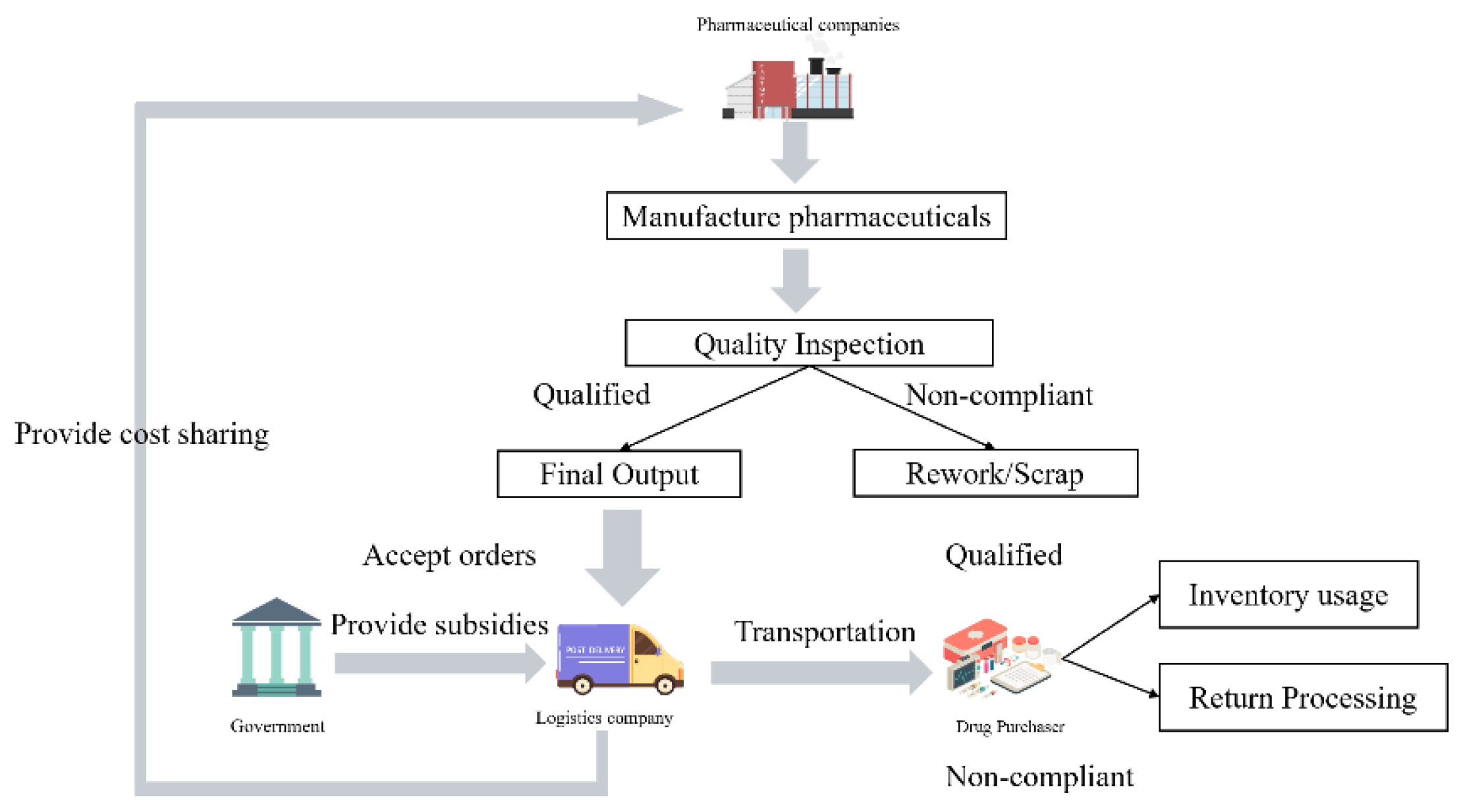
The supply chain’s operation process is shown in
Figure 1: pharmaceutical enterprises produce, sort and deliver qualified drugs to logistics companies and dispose of unqualified ones; after multi-dimensional evaluation and screening by pharmaceutical enterprises, logistics companies complete transportation as contracted and deliver drugs to purchasers, forming a closed-loop distribution. To stimulate cooperation and ensure drug value, the government and enterprises collaborate: the government provides special subsidies to logistics companies, and the two enterprises implement cost sharing. Under normal conditions, the supply chain initially operates independently; with market expansion and rising costs, it gradually transforms into efficient modes, such as cost sharing and centralized collaboration. In special scenarios, government subsidies can further help logistics companies reduce costs and improve efficiency, ensuring supply chain stability. In practice, the system faces the dual impacts of multiple risks and decision-making psychology: pharmaceutical enterprises may delay delivery due to raw material or technical issues, logistics companies may experience delivery delays caused by transportation, equipment and other factors, purchasers may receive unqualified drugs, and the drug value depreciates with time and environmental changes. In addition, decision-makers of both enterprises are affected by the disappointment effect—disappointment from unmet cooperative expectations and external uncertainty leads to strategy adjustments that directly impact the supply chain’s overall profit.
The definitions of the relevant parameters in this paper are shown in
Table 2.
3.2. Model Assumptions
Assumption 1: The cost structure of pharmaceutical logistics has industry uniqueness, and its core inputs (such as quality inspection by pharmaceutical enterprises and cold-chain monitoring by logistics companies) exhibit the characteristic of increasing marginal costs [30]. This stems from the special attributes of pharmaceuticals and strict regulatory requirements: the improvement in the quality inspection accuracy on the production side and the enhancement of cold-chain and traceability guarantees on the logistics side both lead to an accelerated increase in unit additional costs. Drawing on the research of Reference [31], this study adopts the assumption of the convexity characteristic of costs, setting , , , and , where denotes the pharmaceutical effort level of pharmaceutical enterprises, and denotes the effort level of logistics companies for maintaining drug value. The effort costs of pharmaceutical enterprises and logistics companies at time (t) are defined as and , respectively. Here, and represent the effort cost coefficients of pharmaceutical enterprises and logistics companies, respectively [31]. Assumption 2: Delay is a high-frequency risk in pharmaceutical logistics [32]: imported special APIs are prone to delays due to customs clearance obstacles, and delays in cold-chain drug transportation may also cause drug efficacy attenuation and threaten patient safety. Additionally, pharmaceutical enterprises’ production quality, supply capacity, and other factors directly affect the logistics and transportation efficiency [33]. Based on Ref. [
19], in view of the characteristics of the pharmaceutical logistics of stringent timeliness requirements and high-quality sensitivity, enterprise effort input is the key to mitigating delays. Drawing on the differential delay model, this paper incorporates the effort levels of both parties and depicts the dynamic changes in the supply chain transportation efficiency with differential equations in response to the full-process delay effect [
34]:
represents the time-varying rate of change of the supply chain transportation efficiency. It is directly correlated with the effort levels of pharmaceutical enterprises and logistics companies in maintaining drug quality, as well as factors like the decay rate. Additionally, it may be influenced by variables such as drug characteristics and weather conditions and is thus constrained by delay time. denotes the initial value of the supply chain transportation efficiency.
Assumption 3: Against the backdrop of intensifying competition in the pharmaceutical industry and the deepening of policies such as volume-based procurement, the logistics service capability has become a key element of pharmaceutical enterprises’ differentiated competition. Leading pharmaceutical enterprises, by establishing in-depth, cost-sharing partnerships with professional pharmaceutical logistics companies, can access differentiated services, such as customized cold-chain transportation, multi-temperature-zone warehousing, and visualized pharmaceutical traceability, which directly enhance their cooperation stickiness with terminal hospitals and retail channels. For example, in the distribution of COVID-19 vaccines, the two parties shared the additional costs of temperature-controlled containers and GPS monitoring in proportion, which not only ensured the safety of the vaccine distribution but also enabled pharmaceutical enterprises to stand out in bidding due to their reliable logistics performance capabilities. Therefore, the two parties dynamically negotiate the cost-sharing ratio () based on cooperative benefits, with 0 < < 1.
Assumption 4: Based on [35,36], the demand of pharmaceutical purchasers is directly related to the production effort level of pharmaceutical enterprises and the cold-chain transportation efficiency of logistics companies. The production effort of pharmaceutical enterprises determines the drug quality and supply stability, which are core indicators for purchasers when selecting partners; the cold-chain transportation efficiency of logistics companies ensures delivery timeliness and efficacy preservation, especially for special drugs such as biological agents, where insufficient transportation efficiency directly affects purchasers’ willingness to cooperate. This assumption aligns with the core requirement of pharmaceutical logistics that emphasizes both “quality assurance” and “timeliness control”, and it also complies with the regulatory standards of the Good Supply Practice for Pharmaceutical Products (GSP). Therefore, the demand of pharmaceutical purchasers is expressed as follows: Assumption 5: At present, many drugs requiring cold-chain transportation are extremely sensitive to temperature. For example, alprostadil injection requires a temperature of 0–5 °C during transportation. Under normal room-temperature conditions, experiments have confirmed that the temperature-controlled time of specific packaging can be maintained for more than 72 h. If this time is exceeded, the value of the drug may be affected. This paper assumes that at time (t), the marginal value decay rate of the drug is , where
. Here,
represents the value loss of the drug, and its value is positively correlated with the value loss of the drug. That is to say, the larger the value of
, the more serious the value loss of the drug.
reflects the stable state of the drug value. The larger its value, the slower the loss rate of the drug value; that is, the drug can maintain a relatively high value for a long time.
Based on the above assumptions, the profit functions of pharmaceutical enterprises and logistics companies can be obtained as follows:
Assumption 6: In the context of pharmaceutical logistics, the decision-making behaviors of pharmaceutical enterprises and logistics companies are often influenced by deviations between actual and expected returns: when actual profits fall short of expectations, enterprises exhibit a strong tendency toward disappointment aversion due to issues such as drug quality risks and cold-chain disruptions; when actual profits exceed expectations, they experience an excitement effect driven by stable supply and efficient transportation. Therefore, this study introduces the disappointment theory utility model proposed by Bell [21] to characterize the profit perception of both parties under disappointment aversion:where is the total utility of person i; and represent the expected value and actual value, respectively; is the disappointment aversion coefficient, reflecting the decision-maker’s degree of aversion to disappointment—the larger the value, the more the decision-maker dislikes disappointment; can be understood as the excitement coefficient, which is used to measure the impact of the decision-maker’s excitement degree on the result when the actual value () is higher than the expected value (). The decision-maker’s internal reference benefit is the expected value of the actual benefit; that is,
[
37,
38]. In light of the operational realities of pharmaceutical logistics—where the profits of pharmaceutical enterprises are influenced by the production effort levels and fluctuations in the market demand, and the profits of logistics companies are affected by cold-chain transportation investments and timeliness assurance capabilities—the internal reference benefits of both parties can be derived as follows:
It is easy to know that there exists
such that
. Furthermore, based on [
37,
38], the utility functions of pharmaceutical enterprises and logistics companies can be further simplified as follows:
where
,
indicates that the supply chain participant is more sensitive to disappointment;
indicates neutrality;
indicates that the supply chain participant is more sensitive to joy. This paper assumes
, a setting that aligns with the realities of the pharmaceutical logistics industry: since drugs are tied to patients’ lives and health, enterprises are typically more averse to profit losses caused by quality incidents and transportation delays than they are motivated to pursue excess returns, thereby enhancing the practical guiding value of the model.
4. Decentralized-Decision-Making Model (D)
As one of the world’s top five generic pharmaceutical enterprises, India’s Lupin initially adopted a decentralized-decision-making model: both the pharmaceutical enterprise and the logistics company formulated optimal strategies with maximizing their own benefits as the core goal, and the decisions of both parties were dominated by the profit function under disappointment aversion—the enterprises tended to be more conservative in decision-making due to concerns that risks such as demand fluctuations and logistics delays would lead to actual returns falling short of expectations. Based on this case, the corresponding profit functions of pharmaceutical enterprises and logistics companies under disappointment aversion are as follows:
Since pharmaceutical enterprises and logistics companies have the same discount rate (
), the optimal objective functions of pharmaceutical enterprises and logistics companies are, respectively:
Proposition 1. In the decentralized-decision-making mode, the optimal effort levels of pharmaceutical enterprises and logistics companies are, respectively:where .
The optimal profit functions of pharmaceutical enterprises and logistics companies are, respectively:
The optimal trajectory of supply chain transportation efficiency is as follows:
Proof. Assume that the profits of pharmaceutical enterprises and logistics companies are discounted with the same discount factor (ρ) over an infinite time, and there exists continuous and bounded optimal profit functions (
,
), which satisfy the HJB (Hamilton–Jacobi–Bellman) equation for any
:
Taking the first-order partial derivative of Equation (17) with respect to
and setting it equal to zero, we can obtain:
Based on [
39], it is known that:
Substituting Equation (19) into Equation (18), we can derive the optimal effort level of the pharmaceutical enterprise, which is:
According to the definition of the inverse function, we have integrating both sides of Formula (19), we get:
when
,
, so
, and we can obtain:
Taking the first-order partial derivative of Equation (17) with respect to
and setting it equal to zero, we can obtain:
Substituting Equations (20)–(23) into Equations (16) and (17), we can get:
where
,
.
Then, let the expressions of the functions be
,
, where
are all unknown constants. Then,
,
. Substituting them into the formula, we can obtain:
By solving the system of equations, the values of
and
can be obtained, namely:
Proposition 1 is proved. □
The optimal profit of the entire supply chain is:
The optimal trajectory of the supply chain transportation efficiency is as follows:
Corollary 1. Under the decentralized-decision-making mode, the optimal pharmaceutical effort level () of the pharmaceutical enterprise is negatively correlated with its own disappointment aversion degree () and marginal benefit attenuation rate () but positively correlated with its effort delay time (). The optimal maintenance effort level () of the logistics company has the same effect, so it will not be elaborated here.
Corollary 1 has a clear practical orientation. When decision-makers of pharmaceutical enterprises or logistics companies have a disappointment aversion mentality, their decision-making may not be completely rational and is affected. The stronger this mentality is, the more cautious the decision-makers are when choosing the level of effort, and the lower their willingness to make efforts. If the delay time of maintenance efforts is long and the short-term results are not obvious, both parties will increase their effort inputs to achieve the expected results and stabilize the value of the drugs.
Proof. When
, taking the derivative of the relevant variables in Equations (12) and (13), we can obtain:
□
Corollary 2. Under the decentralized-decision-making mode, the optimal profit () of the pharmaceutical enterprise is positively correlated with the delay times (
and
) of the maintenance efforts of both the pharmaceutical enterprise and the logistics company and negatively correlated with the marginal benefit attenuation rate () of the drugs and the disappointment aversion degrees (
and
) of the pharmaceutical enterprise and the logistics company. The optimal profit () of the logistics company follows a similar influence logic, so it will not be repeated here.
Corollary 2 shows that when there is a delay effect in maintenance efforts, pharmaceutical enterprises and logistics companies need to increase their maintenance investments to ensure drug efficacy, enhance social reputation, and achieve profit growth. The faster the drug value decays, the more it wastes resources, compresses corporate profits, and affects overall benefits. The stronger the decision-makers’ disappointment aversion mentality, the more they worry that the actual benefits will not meet expectations, and the more conservative they are in investment, R&D, and other decisions: pharmaceutical enterprises tend to develop low-risk generic drugs and avoid high-risk innovative drug projects, making it difficult to build core competitiveness; logistics companies reduce the purchase of advanced cold-chain equipment, and the continued use of outdated equipment is prone to drug loss, which harms corporate reputation and competitiveness in the long run.
The proof idea is similar to that of Corollary 1, so it is omitted.
Corollary 3. 1. The optimal trajectory () of the logistics company’s transportation efficiency is related to time (t). It initially grows continuously with time, but it reaches a peak after a certain period and then slowly decays. In the initial stage, the maintenance investments of pharmaceutical enterprises and logistics companies are continuously converted into improvements in the transportation capacity, driving efficiency to grow over time. However, as time progresses, factors such as equipment aging and diminishing marginal returns on maintenance gradually become prominent. When the marginal benefits of new investments are insufficient to offset the decline in efficiency, the transportation efficiency reaches its peak and begins to slowly decrease.
2. is positively correlated with the delay time (t1) of pharmaceutical enterprises’ maintenance efforts and inversely proportional to the delay time (t2) of logistics companies’ maintenance efforts. The underlying mechanism is as follows: The maintenance investments of pharmaceutical enterprises (such as drug quality assurance and packaging optimization) require a certain period of time to translate into improvements in transportation efficiency. The longer the delay time (t1), the more concentrated the release of the cumulative effect of early-stage investments, resulting in a more significant positive driving effect on the transportation efficiency. In contrast, if there is a delay (t2) in the maintenance investments of logistics companies themselves (such as vehicle maintenance and facility upgrades), it will lead to a lag in the transportation capacity supply relative to the demand, directly restricting the improvement in the transportation efficiency. Therefore, the longer the delay time (t2), the lower the transportation efficiency.
Proof. When
and
, taking the derivative of the relevant variables in Equation (28), we can obtain:
Combining the above formula, we can see that the numerical value of the part is greater than 0 and has no relation to variable t. Taking the derivative of with respect to t, we find that its second derivative is always negative. Therefore, according to the function extreme value determination theorem, it can be inferred that there exists a specific t value that makes the first derivative equal to 0. This implies that the change trajectory of the logistics company’s transportation efficiency exhibits a characteristic of first rising and then falling. In the initial stage, the transportation efficiency continuously improves as time passes; when time reaches the critical value, the efficiency reaches its peak; thereafter, as time further increases, the transportation efficiency begins to gradually decline. Additionally, since Corollary 3 is proved. □
5. Government Subsidy Mode for Logistics Companies (G)
Under the guidance of the “dual carbon” strategy and the concept of green development, the government actively utilizes fiscal subsidy policies to systematically promote the transformation of the cold-chain transportation industry towards low-carbon and professional development. Through financial incentives, logistics enterprises are guided to accelerate the phase-out of high-energy-consuming equipment and vigorously promote green equipment, such as new energy cold-chain transportation vehicles, intelligent temperature control systems, and high-efficiency thermal insulation technologies. This reduces energy consumption and carbon emissions throughout the cold-chain transportation process from the source, helping to achieve national energy conservation and emission reduction goals. Moreover, the subsidy policy serves as an important guarantee for building a defense line for drug safety. By providing financial support for the construction and technological upgrading of cold-chain infrastructure, a rigorous cold-chain logistics network is established, covering the entire process from the low-temperature storage of drugs after production to their long-distance transportation and terminal delivery with full-process temperature control. This effectively prevents drug deterioration and failure due to temperature fluctuations and practically ensures the public’s drug safety and health. This policy is not only a concrete practice of implementing the sustainable development strategy but also a key measure to improve people’s livelihood security and maintain public safety. For example, Mengniu China’s “2000-km hydrogen energy refrigerated truck trunk line from Inner Mongolia to the Yangtze River Delta”, which benefits from the special subsidy for the “Green Logistics Demonstration Project” of the Ministry of Transport of the People’s Republic of China, is a typical practice of the policy’s dual goals of “low carbon + safety”.
Assume that the government subsidy is
, which satisfies
. Therefore, the disappointment-averse profit functions of the pharmaceutical enterprise and the logistics company in this mode are, respectively:
At this time, the optimal objective functions of the government and enterprises are, respectively:
Proposition 2. In this mode, the optimal effort levels of the pharmaceutical enterprise and the logistics company are, respectively: The optimal profit functions of the pharmaceutical enterprise and the logistics company are, respectively: The optimal profit of the entire supply chain is expressed as follows: The optimal trajectory of the supply chain transportation efficiency is as follows: Corollary 4. In this mode, the government provides a subsidy () to the logistics company. After receiving this subsidy, the logistics company maintains the drug value more proactively. From the perspective of actual operation, the government subsidy () injects more resources into the logistics company. Although the logistics company needs to bear higher effort costs, benefiting from the strong support of the subsidy, these cost inputs are more feasible.
Proof. When and , . □
6. Cost-Sharing Decision Model (S)
In this model, to establish strategic partnerships with pharmaceutical enterprises and secure long-term cooperation and stable orders, logistics companies often take the initiative to share part of the logistics costs of pharmaceutical enterprises. A typical example is the cooperation between Novartis and DHL Supply Chain, a global benchmark in pharmaceutical logistics: DHL proactively shared logistics costs, such as those for the upgrading of cold-chain facilities, and it pledged to “prioritize quality and share costs” in order to secure the exclusive long-term general contracting rights for Novartis’ core logistics business covering global innovative drugs and biological agents. This act drives the two parties to form a two-stage Stackelberg differential game master–slave relationship: as the leading party responsible for safeguarding pharmaceutical quality, the logistics company first determines its own effort level and the proportion of cost sharing for the pharmaceutical enterprise, and then the pharmaceutical enterprise formulates its own effort level based on this decision. Correspondingly, the disappointment aversion profit functions of pharmaceutical enterprises and logistics companies under this model are as follows:
Proposition 3. Under the cost-sharing model, the optimal effort levels of the pharmaceutical enterprise and the logistics company are, respectively: The cost-sharing coefficient is: The optimal profits of the pharmaceutical enterprise, logistics company, and entire supply chain constructed by both parties are: The optimal trajectory of the supply chain transportation efficiency is as follows: Corollary 5. The underlying logic of cost-sharing decisions between pharmaceutical firms and logistics providers under this model is as follows: When , the potential returns from pharmaceutical firms’ maintenance investments exceed the threshold cost of collaboration, triggering a logistics provider-specific psychological threshold (). Only when both parties exhibit disappointment aversion () will the logistics provider perceive cooperation as sufficiently low-risk to share the pharmaceutical firm’s production costs. The optimal sharing ratio () is negatively linked to the logistics provider’s own disappointment aversion (), as greater aversion to losses drives more conservative cost sharing to mitigate risk. Conversely,
correlates positively with the pharmaceutical firm’s disappointment aversion (), since lower tolerance for drug value erosion motivates the pharmaceutical firm to invest more heavily in maintenance, making the logistics provider more willing to increase its share to capture joint gains. The relationship between the pharmaceutical firm’s maintenance delay () and
hinges on the relative strength of both parties’ disappointment aversion: If
, the pharmaceutical firm’s higher risk aversion means longer delays increase uncertainty, prompting the logistics provider to reduce its share (
and
are negatively correlated). If
, the logistics provider’s higher risk aversion means longer delays signal greater commitment from the pharmaceutical firm, encouraging a higher share (
and
are positively correlated). When
, aligned risk preferences neutralize delay effects, leaving
independent of
. This finding aligns with real-world dynamics: cost sharing is conditional on psychological thresholds, and the logistics provider will only bear drug value maintenance costs if its risk expectations are met. Furthermore, the logistics provider’s share increases when its own disappointment aversion weakens, or the pharmaceutical firm’s disappointment aversion strengthens.
From an economic perspective, the inequality 2B > A is not only the feasibility boundary for cost sharing but is also one of the core conditions to ensure the uniqueness of equilibrium. Specifically, 2B represents the total premium generated by collaboration (including benefits from resource integration and risk sharing), while A corresponds to the sum of opportunity costs and collaboration losses under unilateral operation. Combined with the convexity of the objective function, when 2B > A, collaborative benefits cover associated costs, making the cost-sharing model feasible and improving the overall efficiency of the supply chain. At this point, the convexity of the objective function can ensure the existence and uniqueness of the equilibrium strategy. If 2B ≤ A, collaborative benefits fail to compensate for losses, reducing cost sharing to a negative-sum game with no feasible solution for the optimal sharing ratio. In this case, logistics enterprises return to decentralized decision-making, and the uniqueness of equilibrium is out of the question.
Proof. When
, taking the first-order derivatives of Equation (46) with respect to
and
, respectively, we can obtain:
□
Corollary 6. The optimal effort level of pharmaceutical enterprises in drug manufacturing () is inversely related to their own disappointment aversion degree () and marginal benefit attenuation rate () but positively related to the delay time (). When the pharmaceutical enterprise’s disappointment aversion psychology is stronger, it is more sensitive to the uncertainty of returns after investment and will take the initiative to reduce its pharmaceutical effort level to avoid potential losses; a higher marginal benefit attenuation rate means that the growth in returns brought by each additional unit of effort is more limited, so the enterprise will reduce investment to avoid falling into the dilemma of diminishing returns; the longer the delay time (), the greater the risk of the value loss of drugs before delivery, and the enterprise needs to invest more effort to ensure drug quality, thereby increasing its effort level. For logistics companies, their optimal effort level for maintaining drug value () is negatively correlated with their own disappointment aversion degree () and marginal benefit attenuation rate () but positively correlated with the delay time (). The internal logic of this pattern is identical to that of pharmaceutical enterprises: the higher the disappointment aversion degree and the faster the marginal benefit attenuation, the more they will reduce maintenance investment; the longer the delay time, the more maintenance effort is needed to offset the erosion of the drug value over time.
Corollary 7. The optimal profit of a pharmaceutical enterprise () is positively correlated with the delay times (
and
)
of the maintenance efforts made by both the pharmaceutical enterprise and the logistics company to preserve drug value; conversely, it is inversely correlated with the marginal benefit attenuation rate ()
and the disappointment aversion degrees (
and
)
of the pharmaceutical enterprise and logistics company, respectively. The underlying mechanism is as follows: longer delay times prompt both parties to proactively increase their effort levels to safeguard drug value, and these investments ultimately translate into profit growth through higher delivery value; a higher marginal benefit attenuation rate slows the growth of returns from both parties’ efforts, compressing the overall profit margin; stronger disappointment aversion leads both parties to adopt more conservative investment strategies, resulting in insufficient overall effort levels, inadequate preservation of the drug value, and ultimately, reduced profits. For the optimal profit of the logistics company (), the mechanism by which it is influenced by these factors is identical to that of
and thus will not be repeated here.
The proof method is similar to that of Corollary 1, so it is omitted.
7. Centralized-Decision-Making Model (C)
As the market demands for pharmaceutical quality rise, patients and medical institutions are increasingly concerned about pharmaceutical storage and transportation conditions. Against this backdrop, logistics and pharmaceutical enterprises opt for collaborative cooperation to improve the pharmaceutical logistics service quality and meet the market’s high value requirements for pharmaceuticals, a prime example being the cold-chain collaboration for vaccines between Pfizer and UPS Healthcare. In this model, the two parties form a community, and the profit function of the entire community under disappointment aversion is as follows:
At this time, the optimal objective function of the entire supply chain is:
Proposition 4. Under the centralized-decision-making model, the optimal effort levels of the pharmaceutical enterprise and the logistics company are, respectively: The optimal profit of the supply chain constructed by the pharmaceutical enterprise and the logistics company is: The optimal trajectory of the supply chain transportation efficiency is as follows: Corollary 8. Under the centralized-decision-making model, the optimal pharmaceutical effort level () of the pharmaceutical enterprise, the optimal value maintenance effort level () of the logistics company, and the optimal profit () of the entire supply chain transportation system all exhibit specific quantitative relationship characteristics. Specifically, they are positively correlated with the sum of the marginal profits of both the pharmaceutical enterprise and the logistics company
and negatively correlated with
. In addition, the optimal efficiency () of the entire supply chain transportation is positively correlated with the delay times (
and
) of the pharmaceutical enterprise and the logistics company.
Corollary 9. Under the centralized-decision-making model, the optimal trajectory of the logistics company’s transportation efficiency is positively correlated with the sum of the marginal benefits of both the pharmaceutical enterprise and the logistics company .
The proof idea is similar to that of Corollary 1 and Corollary 2, so it is omitted.
It can be seen from Corollary 8 and Corollary 9 that under the centralized-decision-making model, the optimal value maintenance effort levels of pharmaceutical enterprises and logistics enterprises are no longer limited to the consideration of their respective marginal benefits but take the overall marginal profit of the supply chain system as the decision-making benchmark. This collaborative decision-making mechanism breaks the traditional mindset of maximizing unilateral benefits, transforming the disappointment aversion behaviors of both parties into a joint response to the overall risks of the supply chain. This decision-making model highly aligns with the inherent demand for the collaborative development of the pharmaceutical logistics supply chain. By building an interest community with consistent goals, it can not only stimulate the collaborative innovation momentum of both parties, significantly improving the level of value maintenance investment, but also effectively optimize the efficiency of the supply chain resource allocation, achieving significant growth in the overall benefits of the system. This decision-making model provides a theoretical basis and practical guidance for the high-quality development of the pharmaceutical supply chain.
8. Comparative Analysis
This paper constructs four differentiated decision-making models: the decentralized-decision-making model, the government subsidy model for logistics companies, the cost-sharing decision-making model, and the centralized-decision-making model. Through systematic comparative analysis, we focus on exploring the optimal effort levels for the drug value maintenance of pharmaceutical enterprises and logistics companies, the optimal profit of the supply chain system, and the optimal trajectory of the transportation efficiency of logistics companies under different decision-making models. The aim is to reveal the inherent logical connections among various decision-making paradigms and explore their driving mechanisms and collaborative evolution laws for the synergistic development of the pharmaceutical supply chain.
Comparisons of the optimal effort levels for pharmaceutical value maintenance (of pharmaceutical and logistics enterprises), the optimal trajectory of logistics enterprises’ transportation efficiency, and the optimal profit of the supply chain system under the four models are shown in
Table 3 and
Table 4.
8.1. Comparative Analysis of Optimal Effort Levels
Proposition 5. When
and
, the relationship of the optimal value maintenance effort levels of logistics companies under the four models satisfies:
① When , .
② When , .
The relationship of the optimal pharmaceutical effort levels of pharmaceutical enterprises satisfies .
Proof. For the optimal value maintenance effort level of logistics companies, since , .
, and the rest can be proved similarly, so they will not be repeated here.
It can be concluded that with regard to the value preservation effort level of logistics companies, the incentive effects of the decentralized-decision-making and cost-sharing models are consistently the lowest and equivalent, while those of the government subsidy and centralized-decision-making models adjust with the variation in the interval of parameter n. In contrast, the ranking of incentive effects for the pharmaceutical production effort level of pharmaceutical enterprises is fixed: the decentralized-decision-making and government subsidy models yield the lowest and equivalent incentive effects, the cost-sharing model ranks the second, and the centralized-decision-making model achieves the strongest incentive effect. □
8.2. Optimal Profit Analysis
Proposition 6. When
,
,
, and
, the comparative relationship of the optimal profits of the supply chain system under the four models satisfies:
① When , .
② When , .
where
, Proof. , and the rest can be proved similarly.
It can be concluded that there exists a clear ranking rule for the optimal profits of the supply chain system under the four decision-making models: the profit under the decentralized-decision-making model is consistently the lowest, followed by that under the cost-sharing model, while the profit ranking between the centralized-decision-making model and the government subsidy model adjusts with the variation in the interval of parameter n. □
8.3. Supply Chain Transportation Efficiency Analysis
When , , , and , the relationship between the supply chain transportation efficiency under the four modes satisfies the following:
When and , .
① When and , .
② When and , .
The proof is the same as above, so it will not be repeated.
It can be found that the transportation efficiency under decentralized decision-making is consistently the lowest; the efficiency ranking of the centralized-decision-making, government subsidy and cost-sharing models changes dynamically with parameter n, which serves as the key moderating factor influencing the efficiency advantages of each model.
In summary, the four decision-making models exhibit clear and interrelated regularities in terms of the supply chain transportation efficiency, system profit and enterprise effort levels: decentralized decision-making always performs the poorest, featuring the lowest transportation efficiency and system profit, as well as the weakest incentive effects on the effort levels of both logistics companies and pharmaceutical enterprises; the cost-sharing model ranks in the middle tier across all dimensions, with its profit and enterprise effort levels superior to those of the decentralized-decision-making model but inferior to those of the centralized-decision-making and government subsidy models; the advantages of the centralized-decision-making and government subsidy models adjust dynamically with parameter n—when n is relatively high, the government subsidy model demonstrates greater advantages in the logistics companies’ effort levels and transportation efficiency; when n is relatively low, the centralized-decision-making model surpasses it and becomes the optimal choice in terms of enterprise effort incentives, system profit and transportation efficiency. By contrast, the ranking of pharmaceutical enterprises’ effort levels remains fixed and unaffected by parameter n.
9. Numerical Example Analysis
To conduct an in-depth study on the impacts of the disappointment aversion effects of pharmaceutical enterprises and logistics companies, as well as of the delay time of their respective efforts, on relevant decisions, including the supply chain system profit and supply chain transportation efficiency under the decentralized-decision-making model, the government subsidy model for logistics companies, the cost-sharing decision-making model, and the centralized-decision-making model, this study assigned values to each parameter in the study and used Matlab (2021) to perform simulation analysis on the changes in the supply chain transportation efficiency and overall profit under different models.
Based on the literature [
39] and combined with the actual situation of drug sales and logistics transportation, it is assumed that the social public’s preference (λ) for supply chain transportation efficiency follows a uniform distribution (
). The marginal profit of the pharmaceutical enterprise is set as
, the marginal profit of logistics companies is
, and
,
,
,
,
,
,
,
,
,
,
,
,
,
.
9.1. Impact of Disappointment Aversion Degree on Sharing Ratio () Under Cost-Sharing Decision-Making
From the corollaries and the values of each parameter, , . Under the cost-sharing decision, when , the logistics company will share the cost with the pharmaceutical enterprise at the ratio . At this time, when , the logistics enterprise will not choose to share the cost with the pharmaceutical enterprise, and, at this time, .
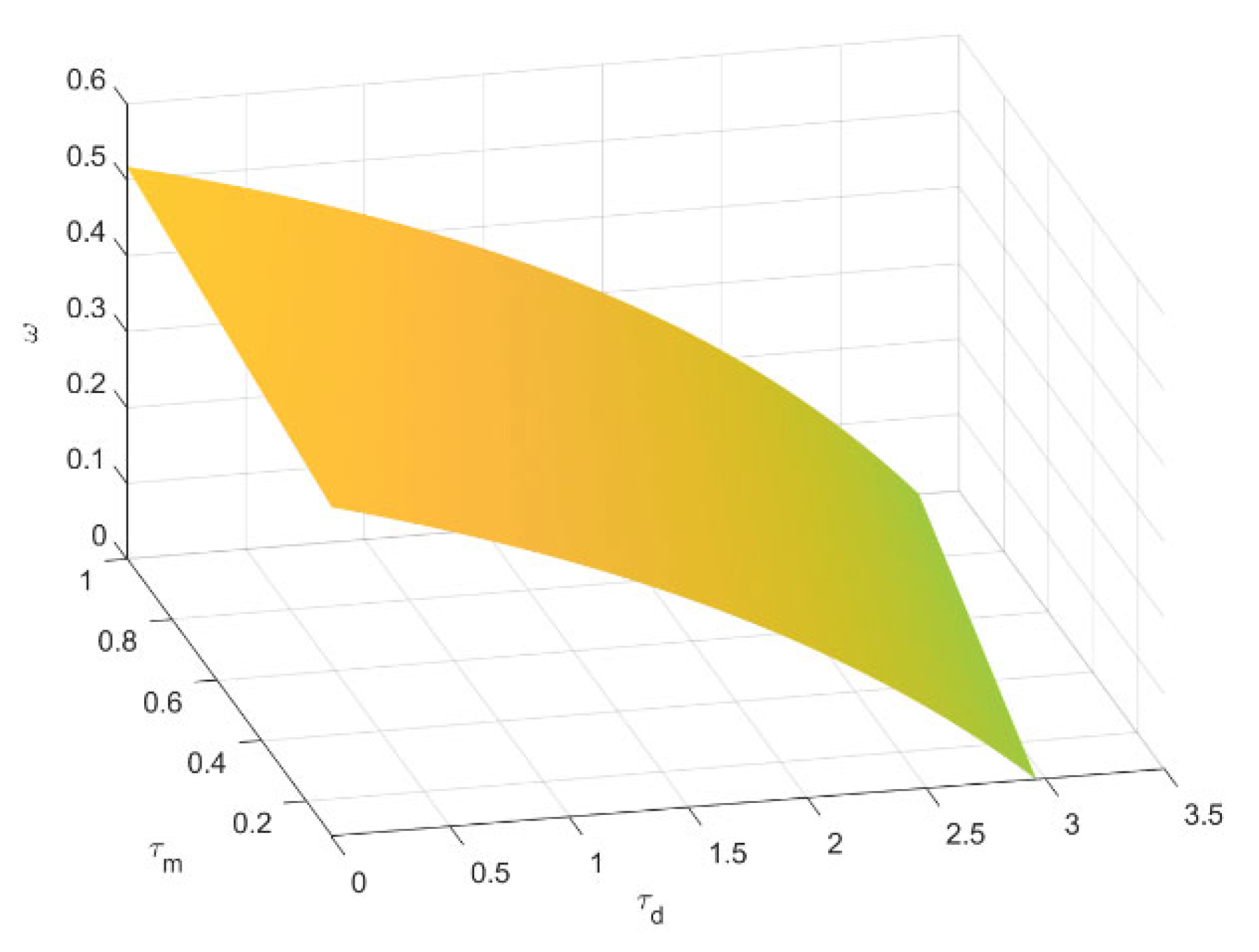
As shown in
Figure 2, the lower the logistics company’s disappointment aversion and the higher the pharmaceutical enterprise’s disappointment aversion, the narrower the feasible region for cost sharing; meanwhile, the sharing ratio decreases as the logistics company’s disappointment aversion increases and increases as the pharmaceutical enterprise’s disappointment aversion rises. This pattern essentially reflects the “risk perception difference-dominated cost-sharing game” in supply chain cooperation when the impact of the cold-chain transportation efficiency on the demand is uncertain—logistics companies with lower disappointment aversion demonstrate higher tolerance for cooperation risks and are more willing to share costs to secure long-term partnerships; in contrast, pharmaceutical enterprises’ high disappointment aversion stems from the severe consequences of risks in the pharmaceutical industry, leading them to transfer costs to reduce their own risk exposure, thereby requiring logistics companies to bear a higher proportion. Enterprises should abandon static cost-sharing mindsets and establish a differentiated mechanism of “dynamic adaptation to risk preferences”: the concerns of logistics companies with low disappointment aversion should be alleviated through long-term agreements and data sharing, the cost pressure from pharmaceutical enterprises with high disappointment aversion should be balanced by demonstrating risk management capabilities, and both parties’ disappointment aversion levels should be incorporated into the dynamic adjustment clauses of cooperation agreements, calibrating the sharing ratio based on actual operational data to strike a balance between risk prevention and win-win cooperation and maximize the overall efficiency of the supply chain.
9.2. Impacts of Time on Supply Chain Transportation Efficiency and Total Supply Chain Profit
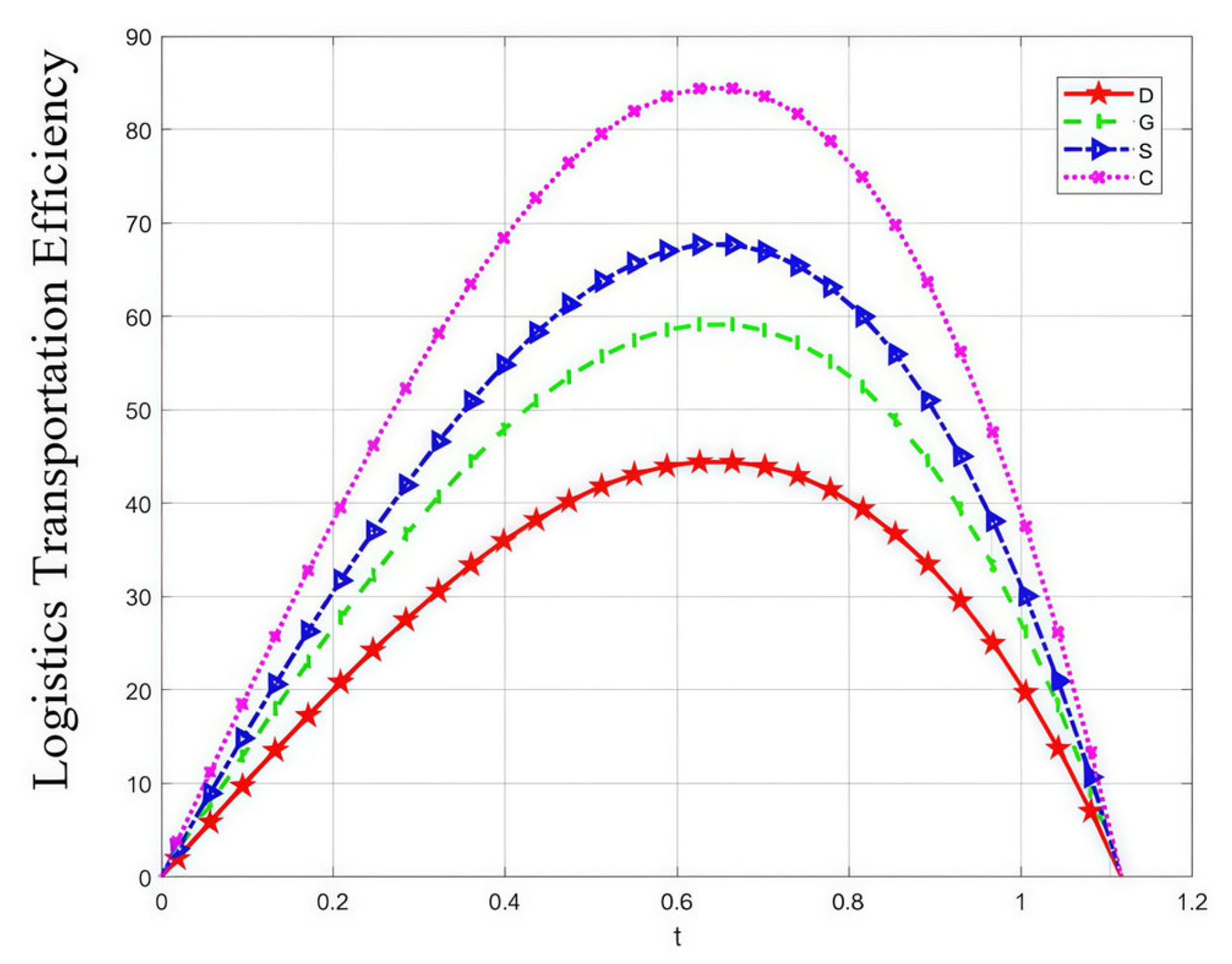
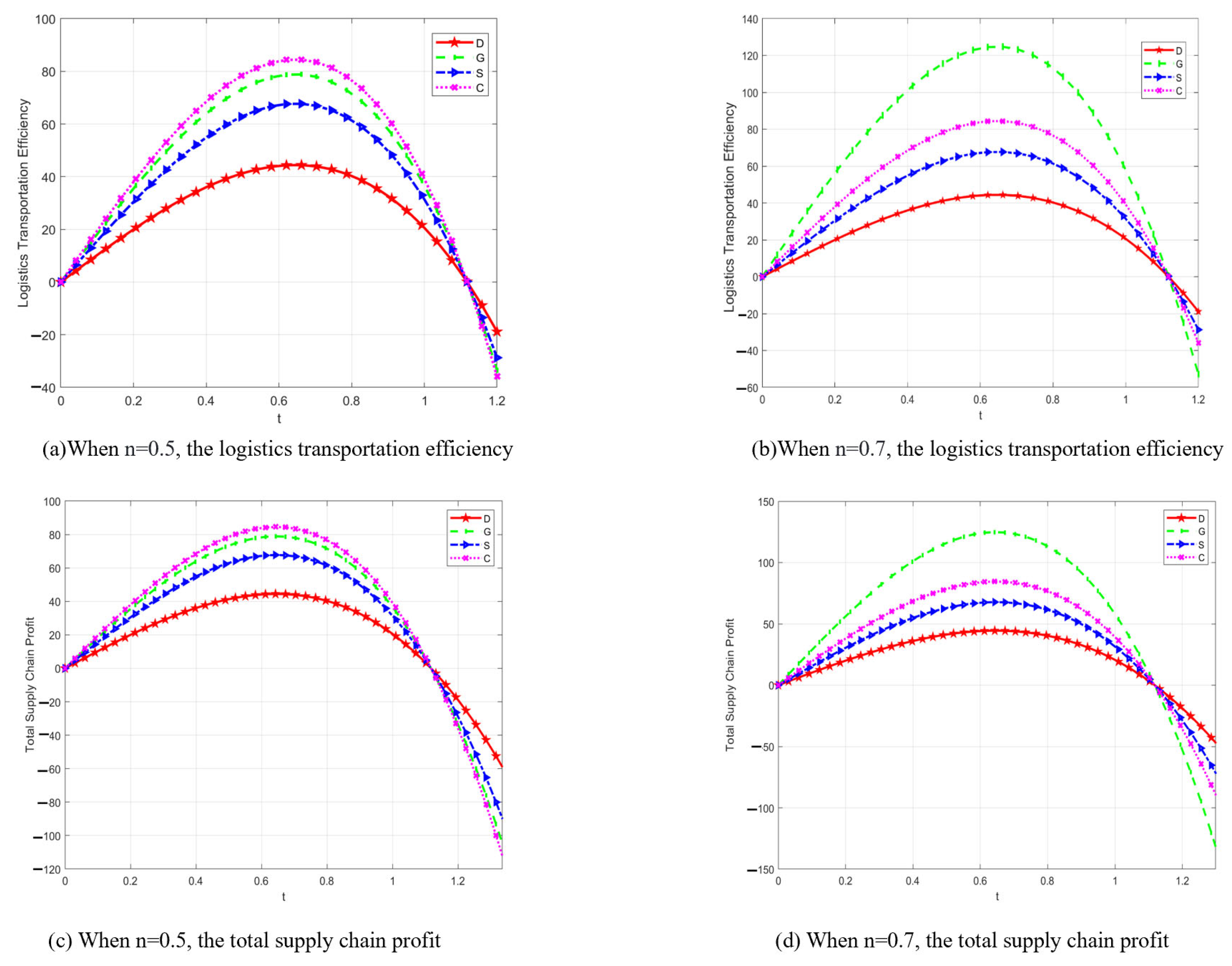
During the pharmaceutical value preservation cycle, the cold-chain transportation efficiency of logistics companies rises to a peak with an increase in the initial preservation input—driven by the stable transportation environment guaranteed by preservation measures. However, as time elapses, the efficiency declines gradually and slowly due to the expiration of pharmaceuticals, equipment aging, the diminishing marginal effects of preservation, and the lower transportation efficiency expectations of pharmacies for low-value pharmaceuticals, with the trend shown in
Figure 3.
Based on the information presented in
Figure 3, the conclusion (1) in Corollary 3 and Proposition 6 can be effectively and conclusively verified. Through a detailed analysis of the relevant data under different decision-making modes in the figure, it can be clearly observed that, in sharp contrast to the decentralized-decision-making mode, the centralized-decision-making mode demonstrates significant advantages in improving supply chain transportation efficiency, and the decentralized-decision-making mode is undoubtedly the decision-making form that results in the lowest level of supply chain transportation efficiency.
In the case of centralized decision-making, pharmaceutical enterprises and logistics companies can reach a high degree of strategic consensus. Based on a common goal, both parties will proactively and actively increase their efforts to maintain drug value. This collaborative cooperation method enables key factors such as temperature control and transportation time planning in all aspects of cold-chain transportation to be handled more properly, thereby effectively promoting the improvement in the transportation efficiency. Conversely, in the decentralized-decision-making mode, due to the fact that both parties act independently and exert excessive efforts in maintaining drug value, not only is it difficult to form an effective synergistic effect but it also makes the logistics company face greater pressure in terms of costs and resources, thereby leading to a significant decline in its willingness to maintain the drug value. This situation is directly reflected in the transportation efficiency, resulting in a situation of low efficiency.
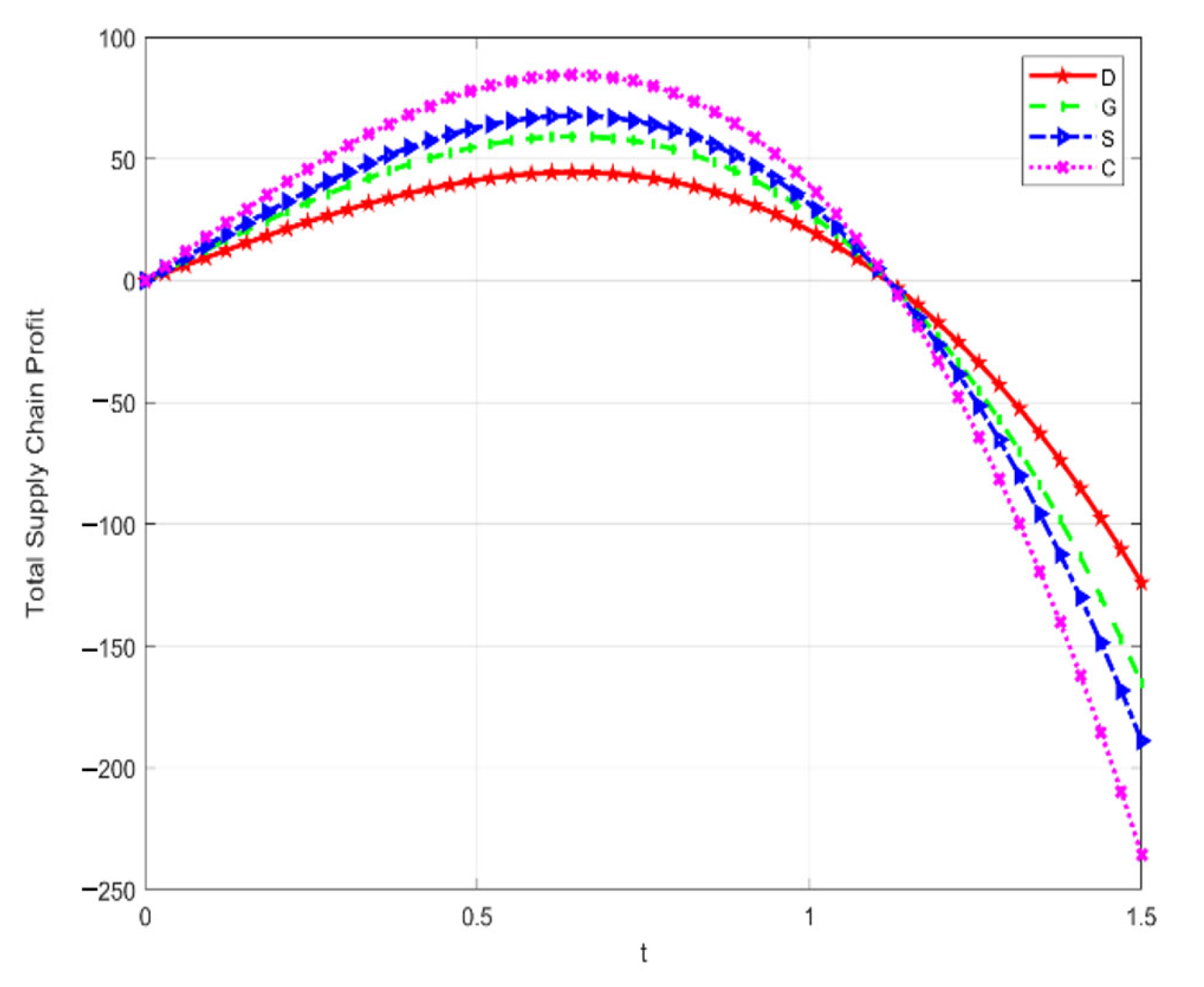
Figure 4 indicates that the value of pharmaceutical products attenuates gradually over time, and the total profit of the supply chain shows a characteristic of “slow growth in the early stage and rapid decline in the later stage”. Under the centralized-decision-making model, all participants in the supply chain form an in-depth collaborative linkage. Through the overall allocation of resources and the integrated optimization of transportation processes, it can not only maximize profits in the early operation stage but also effectively mitigate the amplitude of profit decline in the later stage. From the perspective of management science, the core value of this model lies in breaking the interest barriers of decentralized decision-making, replacing the local optimization of individual participants with the maximization of overall interests, and realizing the Pareto optimal allocation of supply chain resources. Meanwhile, it dynamically adapts to the time-varying characteristics of pharmaceutical value fluctuations by virtue of global planning, which accurately meets the dual requirements of timeliness and stability for the pharmaceutical supply chain. This model provides an efficient and feasible optimization solution for the operation of pharmaceutical supply chains with high timeliness, and it also offers a decision-making basis at the level of management practice for improving the overall operational efficiency of the supply chain and strengthening its value retention and anti-risk capabilities.
9.3. Impacts of Delay Time and Disappointment Aversion Effect on Transportation Efficiency and Overall Profit of Pharmaceutical Logistics Supply Chain
As a core timeliness deviation indicator, an extended delay time reduces the delivery efficiency of pharmaceutical logistics, narrows the commodity value window, impairs the transportation efficiency through the superposition of explicit and implicit costs, and erodes the overall profit of the supply chain. The disappointment aversion effect drives decision-makers to adopt conservative strategies, which reduces risk probability in the short term but restricts transportation efficiency and squeezes supply chain profits in the long run due to resource idleness and increased collaborative costs. The specific impacts of both factors on the supply chain transportation efficiency and overall profit are detailed in
Figure 5,
Figure 6,
Figure 7 and
Figure 8.
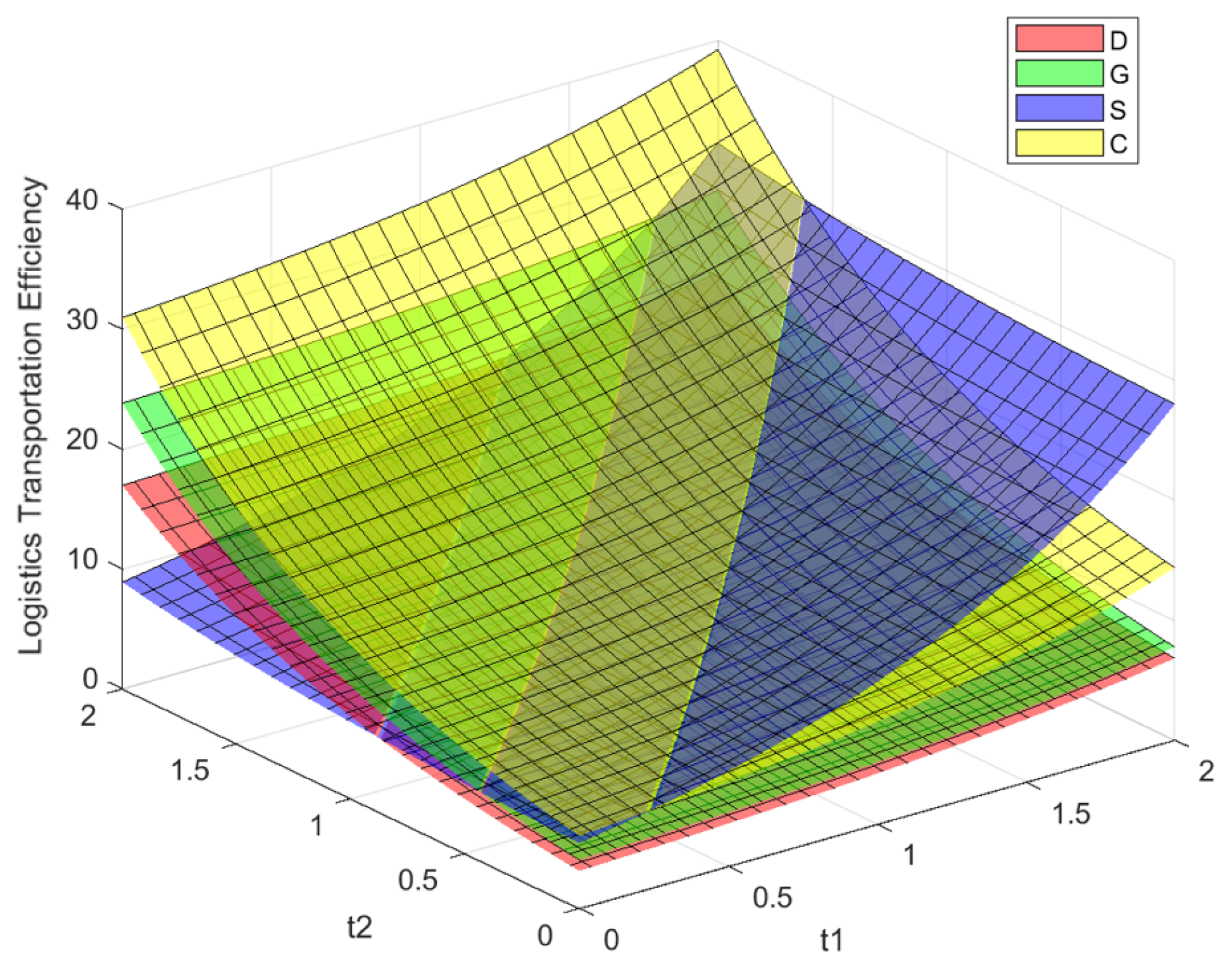
As shown in
Figure 5, the cold-chain transportation efficiency (
F(t)) of logistics companies is significantly and stably positively correlated with the effort input delay times (
t1,
t2) of both pharmaceutical and logistics enterprises, embodying the dynamic optimization logic of collaborative supply chain decision-making. With the extension of
t1 and
t2, the transportation efficiency surfaces under the three decision-making modes all rise along the vertical axis, and the efficiency improvement under centralized decision-making is slightly higher than that under decentralized decision-making, confirming the amplification effect of the collaborative mechanism on the delay value. Mechanistically, the particularity of pharmaceutical cold chains requires sufficient time buffers for enterprise efforts. Extended
t1 and
t2 provide adequate pre-planning windows, helping optimize stock preparation and capacity allocation, reduce operational risks, and improve efficiency, which echoes the theoretical assumptions of the differential game model and verifies its rationality. This result directly validates Conclusion (2) of Corollary 3 and Proposition 6, filling the research gap of overemphasizing immediate response while neglecting delay optimization. It confirms that reasonable effort input delay in pharmaceutical cold chains can form a positive efficiency cycle, providing new empirical support for dynamic decision-making theory. In practice, enterprises should reasonably set delay cycles based on cold-chain characteristics and establish a “delay–planning–optimization” closed-loop mechanism. Both parties can reduce costs and improve the overall supply chain efficiency by dynamically adjusting delays and building information-sharing platforms.
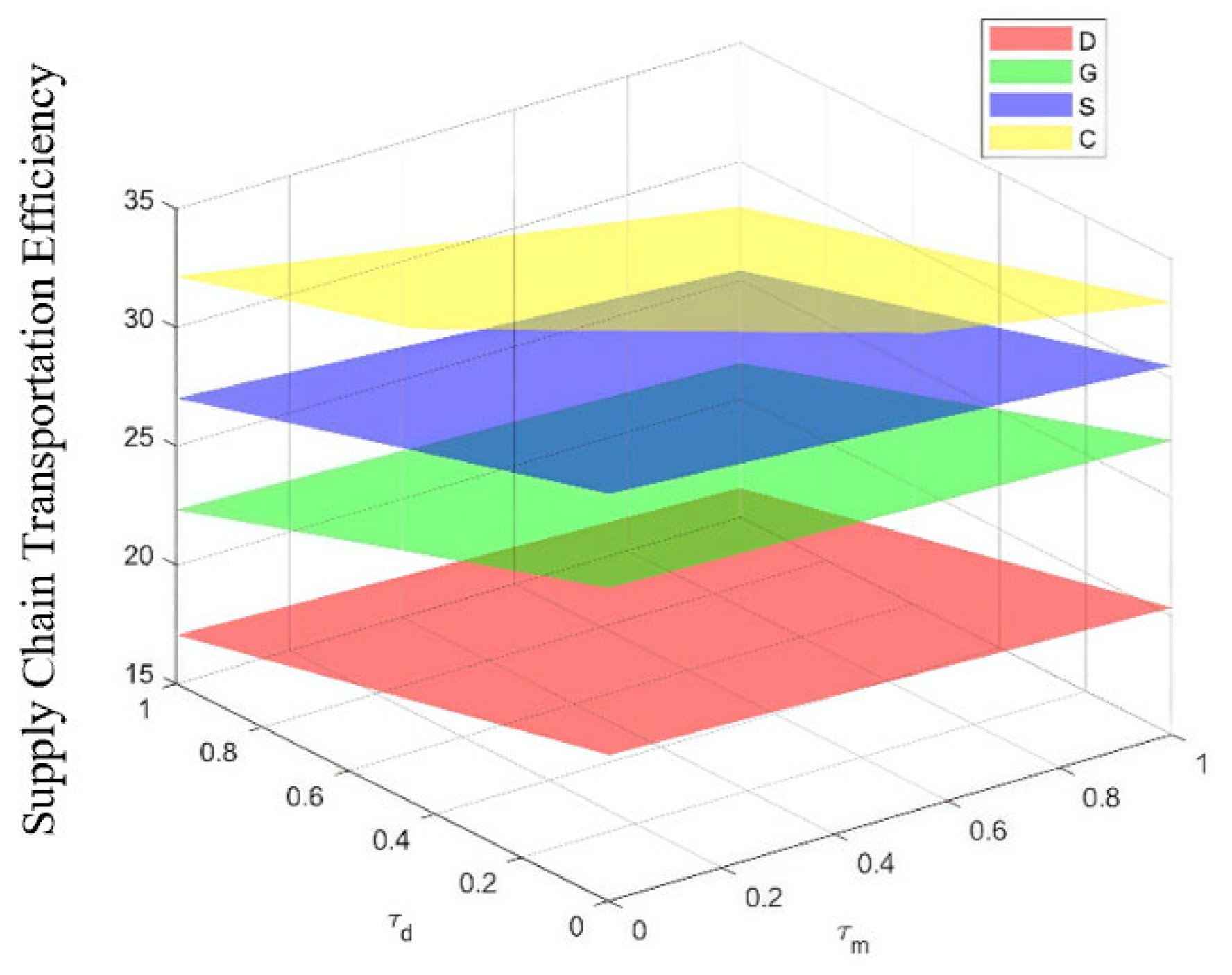
The analysis in
Figure 6 reveals a significant negative correlation between the supply chain transportation efficiency and the disappointment aversion of pharmaceutical enterprises and logistics companies: the stronger the enterprises’ disappointment aversion, the lower the transportation efficiency. The core reason is that decision-makers, concerned about unmet market demand after logistics investment and the rapid depreciation of pharmaceutical value, adopt conservative decision-making strategies and reduce resource input in logistics optimization, equipment upgrading and other links. In this regard, decision-makers can be guided to break away from short-sighted thinking by rationally planning decision cycles and clarifying long-term revenue goals, which reduces efficiency losses caused by conservative decisions and thus improves the overall collaborative efficiency and operational stability of the supply chain.
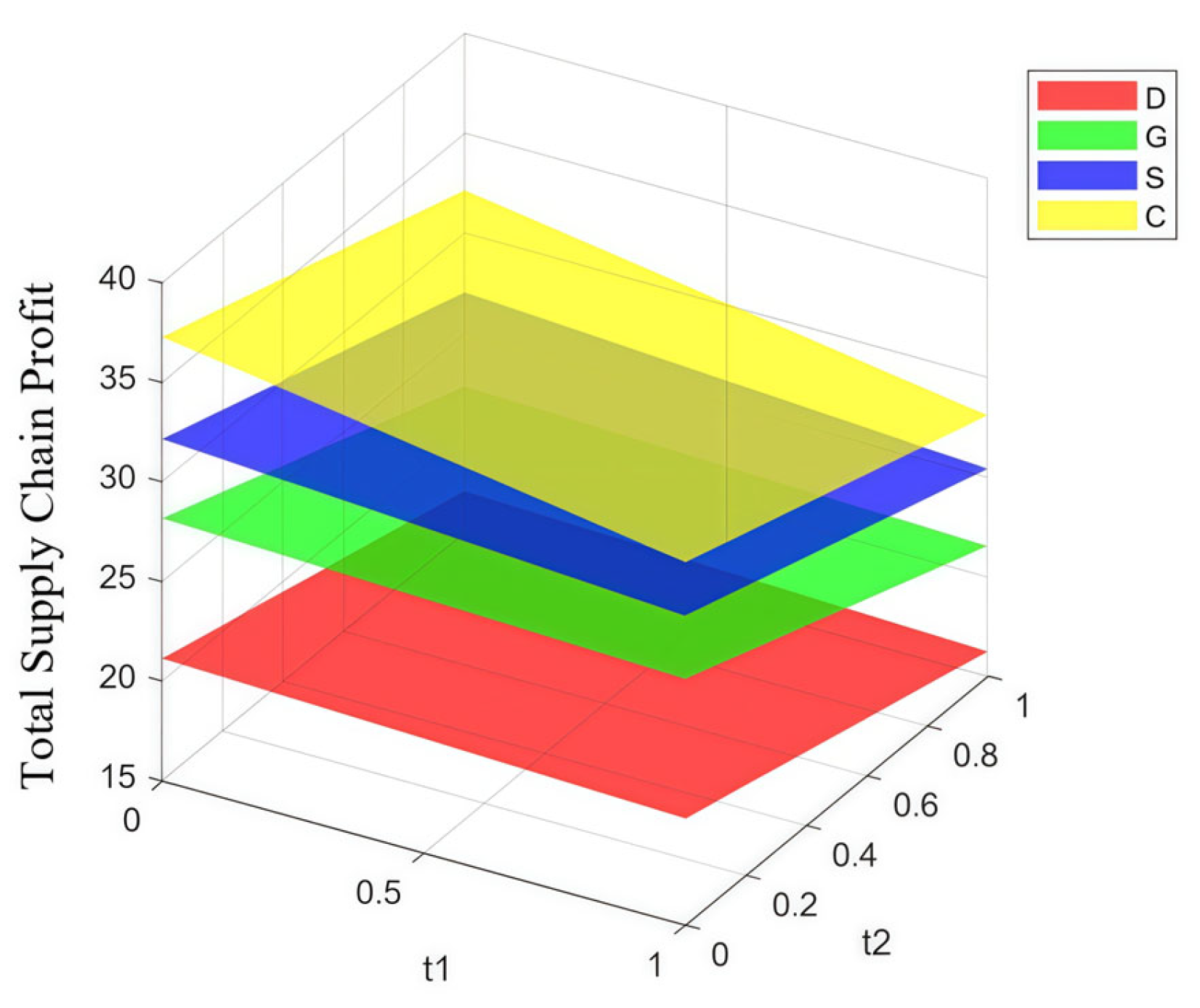
As shown in
Figure 7, in the pharmaceutical supply chain composed of pharmaceutical enterprises and logistics companies, the overall supply chain profit shows a gradual decline with the extension of transportation delay times (
t1,
t2), with t1 exerting a more significant negative impact. This finding highlights the high time sensitivity of pharmaceutical transportation and contains important managerial implications: first, supply chain participants need to establish a real-time dynamic scheduling mechanism for pharmaceutical transportation, reducing unnecessary delays by optimizing route planning and resource allocation; second, the signing of time-bound service agreements between pharmaceutical enterprises and logistics companies needs to be promoted, constraining the operational behaviors of both parties through the clear definition of liability for delays; third, the supply chain should be driven to increase investment in digital and intelligent logistics technologies (e.g., IoT-based cargo tracking, predictive scheduling systems) to improve the transparency and controllability of the entire transportation process. Time delays in pharmaceutical transportation not only increase the risk of expiration losses due to the limited shelf life of drugs but also reduce the timeliness of delivery for emergency and special drugs, which may disrupt clinical diagnosis and treatment processes, trigger drug returns and customer losses, and ultimately erode the overall profit of the supply chain.
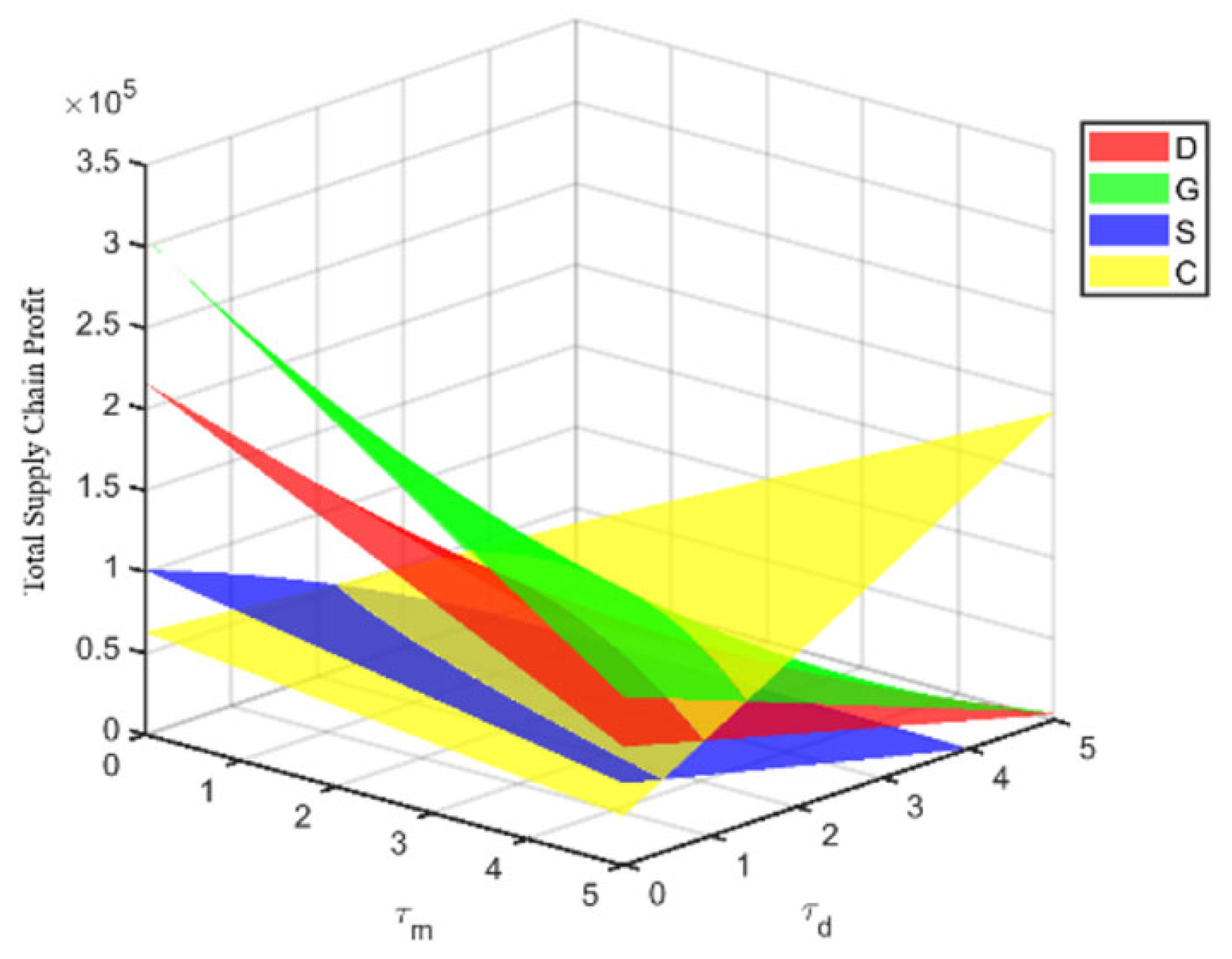
The analysis in
Figure 8 confirms that in the supply chain of pharmaceutical and logistics enterprises, the overall profit decreases significantly as both parties’ disappointment aversion levels rise. This psychology prompts decision-makers to adopt conservative operational decisions: pharmaceutical enterprises may cut investments in capacity and quality control, weakening product competitiveness; logistics companies may reduce inputs in cold-chain and distribution optimization, lowering service efficiency. Ultimately, this hinders supply chain collaboration and reduces overall profitability.
This conclusion is of great guiding significance for practical operations: enterprises must attach importance to regulating disappointment aversion psychology. A scientific profit expectation evaluation mechanism needs to be established to help decision-makers objectively understand profit fluctuations and avoid conservative decisions. Moreover, enterprises should strengthen their inter-enterprise collaboration in the supply chain, build information- and profit-sharing mechanisms, jointly formulate development strategies, overcome passive decision-making tendencies, and promote the supply chain’s efficient profitability and sustainable value growth.
9.4. Impacts of Government Subsidy Intensity on Supply Chain Transportation Efficiency and Overall Profit
In the face of public health emergencies, such as the COVID-19 pandemic, the government usually increases the subsidy intensity to incentivize logistics enterprises to add transportation vehicles, upgrade operation equipment and expand human resource reserves. This is to ensure the timely distribution of medical drugs and avoid delaying the treatment processes of patients. The law governing the impacts of the dynamic adjustment of the government subsidy intensity on the supply chain transportation efficiency and overall profit is shown in
Figure 9.
A comparative analysis of
Figure 3,
Figure 4 and
Figure 9 reveals that with the increase in the subsidy coefficient, the peaks of the logistics transportation efficiency across all four models rise significantly and stabilize at approximately t = 0.6. This is highly consistent with the core connotation of incentive theory: as an external incentive tool, subsidies can effectively reduce enterprises’ operational costs, drive enterprises to increase resource inputs, and thereby break through the existing efficiency bottleneck. In terms of model differences, the centralized-decision-making model and the government logistics subsidy model register the most prominent efficiency growth. The core reason is that the centralized-decision-making model achieves global supply chain optimization based on the collaborative management theory, and its cross-entity collaboration advantages form a positive linkage with government subsidies, thereby amplifying the incentive efficiency and achieving a “1 + 1 > 2” subsidy effect.
When the subsidy level is high, the efficiency of all the models declines more rapidly for t > 0.6, a phenomenon that confirms the core viewpoint of resource dependence theory—short-term efficiency improvement relies excessively on external resource input, and such growth is unsustainable in the absence of an endogenous coordination mechanism. In addition, the efficiency gap between the models widens as the subsidy coefficient increases, which further confirms that subsidies are more likely to unleash their incentive potential in supply chain models with strong collaboration. For enterprise management, this implies that the implementation of subsidy policies must be combined with the construction of supply chain collaboration capabilities; relying solely on subsidy input cannot achieve long-term efficiency improvement, and it is necessary to build an endogenous coordination mechanism to lay a solid foundation for the stable growth of efficiency.
9.5. Impacts of Pharmaceutical Stability on Supply Chain Transportation Efficiency and Overall Profit
Different pharmaceuticals exhibit distinct sensitivities to factors such as storage space and temperature, leading to significant differences in their stabilities. This poses the challenge of dynamic regulation for supply chain transportation efficiency and exerts a substantial impact on the overall supply chain profit by influencing timeliness and quality loss, with the specific impacts shown in
Figure 10.
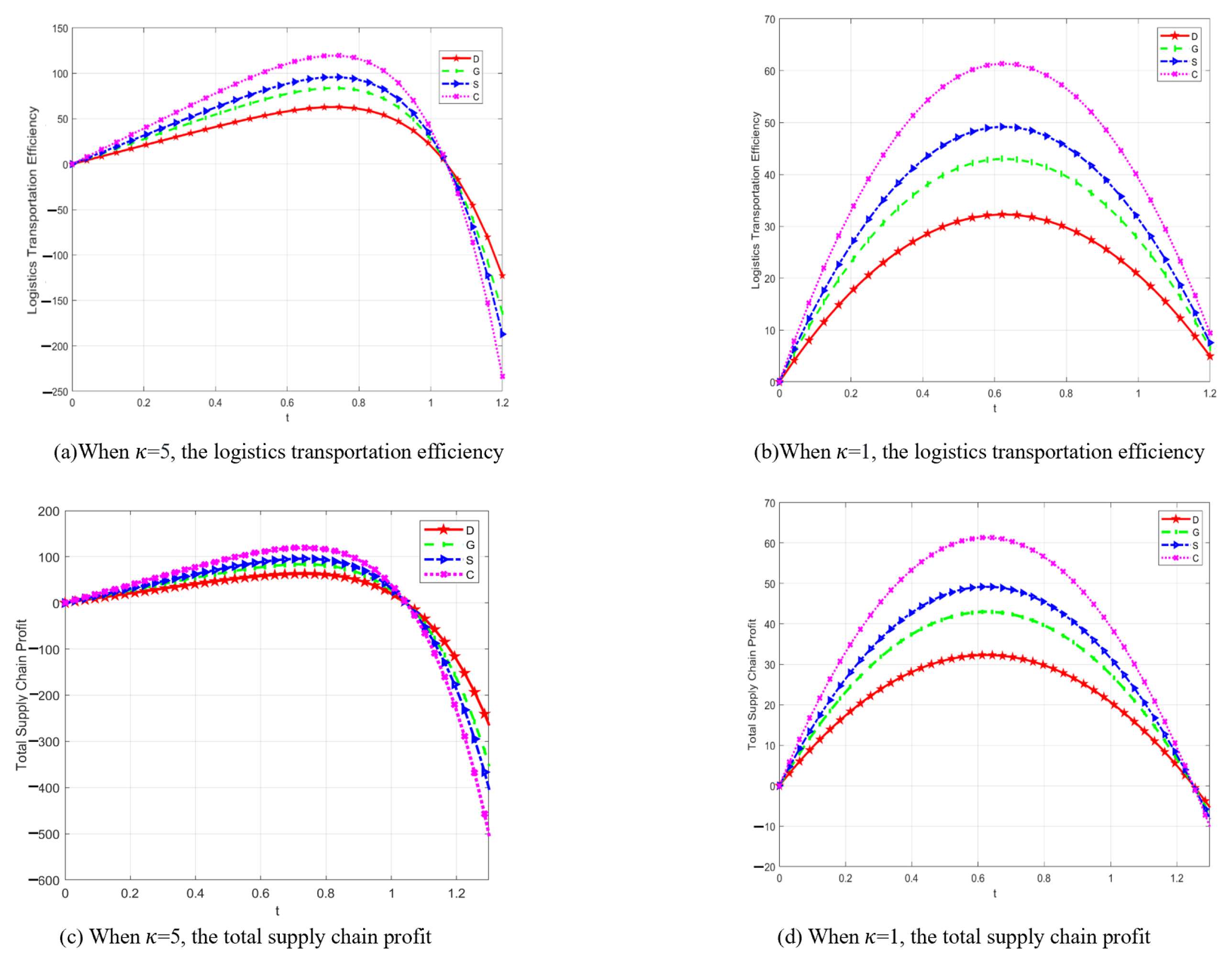
The analysis in
Figure 10 reveals that with the improvement in the pharmaceutical stability, the peaks of the logistics transportation efficiency and overall supply chain profit across all four models increase synchronously: when the stability is 1, the efficiency peak is approximately 80 and the profit peak is about 60; when the stability reaches 5, both indicators exceed 100. The core logic behind this pattern is that pharmaceuticals with high stability provide a larger fault tolerance range for logistics operations, enabling enterprises to flexibly allocate transportation resources, optimize scheduling schemes to improve their operational efficiency, and reduce the risks of pharmaceutical loss and deterioration, thereby achieving dual improvements in efficiency and profit. In contrast, pharmaceuticals with low stability are highly sensitive to links such as transportation times and temperature–humidity control, which not only increases the difficulty of operational management and control but also leads to a significantly faster decline in efficiency and profit after t > 0.6, entering the negative range earlier. Notably, the centralized-decision-making model demonstrates the most prominent advantages in efficiency and profit under high-stability scenarios. This conclusion can provide a quantitative basis for enterprises to formulate differentiated logistics strategies for pharmaceuticals with different stability levels, helping to enhance the precision and adaptability of supply chain operations.
9.6. Impacts of Discount Rate on Supply Chain Transportation Efficiency and Overall Profit
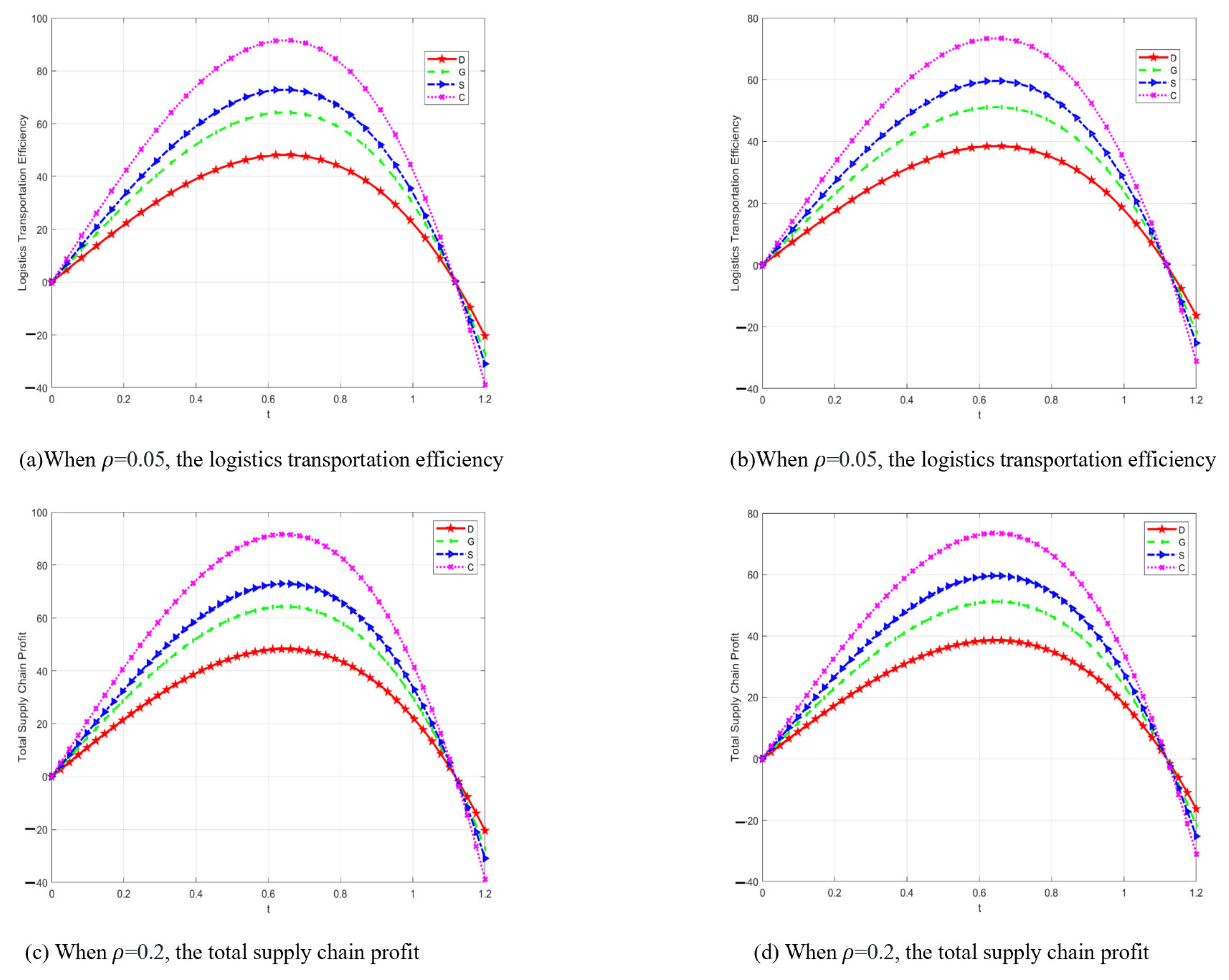
The discount rate is a core parameter influencing the transportation strategies of emergency medical logistics and supply chain benefits: a high discount rate emphasizes immediate response and low losses, while a low discount rate focuses on long-term reserves and cost optimization. The specific impacts of both factors are illustrated in
Figure 11.
The analysis in
Figure 11 reveals that the core function of the discount rate is to match the supply chain’s differentiated demands for long-term reserve and emergency response: a low discount rate is more suitable for scenarios of long-term emergency reserve and network optimization, where the transportation efficiency and profit peaks of all four models reach higher levels and decline more gently after t > 0.6. This is essentially because a low discount rate incentivizes enterprises to make long-term resource inputs and conduct collaborative layout. In contrast, a high discount rate aligns with the demand for immediate response during public health emergencies but squeezes the space for long-term investment, leading to lower efficiency and profit peaks, a faster decline rate and an earlier slide into negative territory, which reflects the limitations of resource allocation under a short-term emergency-oriented approach.
Among the models, the centralized-decision-making model demonstrates the most prominent advantages in efficiency and profit under the low-discount-rate scenario, which confirms that a highly collaborative supply chain model is more adaptable to the long-term emergency reserve strategy. Through overall resource coordination and cross-entity risk sharing, such a model can maximize the returns of long-term investment and mitigate the pressure of value attenuation caused by the passage of time. Enterprises need to dynamically adjust their discount rate strategies based on specific scenarios: a low discount rate should be adopted for long-term reserve scenarios, and centralized decision-making should be leveraged to strengthen collaborative layout; a high discount rate should be flexibly implemented for emergency response scenarios, and immediate response and benefit losses should be balanced by simplifying processes and prioritizing the scheduling of core resources, thereby enhancing the supply chain’s adaptability across different scenarios.
10. Extended Model
During seasonal transitions and peak infectious disease periods, pharmaceutical demand surges and inventory depletes rapidly. Extreme weather not only increases delivery risks in transportation but also causes pharmaceutical value loss, making the shortening of transportation cycles a core priority to ensure stable supply, preserve pharmaceutical value and improve supply chain operational efficiency.
Based on differential game theory, a dynamic decision-making model for the pharmaceutical logistics supply chain was constructed previously, which initially depicts the strategic evolution laws of all participants. However, the long-term feedback mechanism of multi-agent interaction and the model’s adaptability to practical scenarios remain to be further verified. It should be noted that this study does not conduct formal stability analysis on the delay differential equations in the model for the following core reasons: the research focuses on analyzing the actual operational laws of the supply chain; the coupling of multiple factors in the model leads to an exponential rise in the computational complexity of stability analysis; and subsequent system dynamics (SD) simulations have fully demonstrated the convergence trend and robustness of the system evolution, which strongly supports the reliability of the research conclusions.
To address the aforementioned outstanding issues and align with the inherent characteristics of the model, this paper introduces the system dynamics (SD) model, where the parameter values are set in accordance with those in
Section 9 and the actual situation, and the equilibrium solutions of the differential game are adopted as the core input variables. The coupling of the two models achieves the complementary advantages of “theoretical derivation–scenario simulation”, thereby revealing the dynamic evolution laws of the pharmaceutical logistics supply chain system in a more comprehensive and accurate manner.
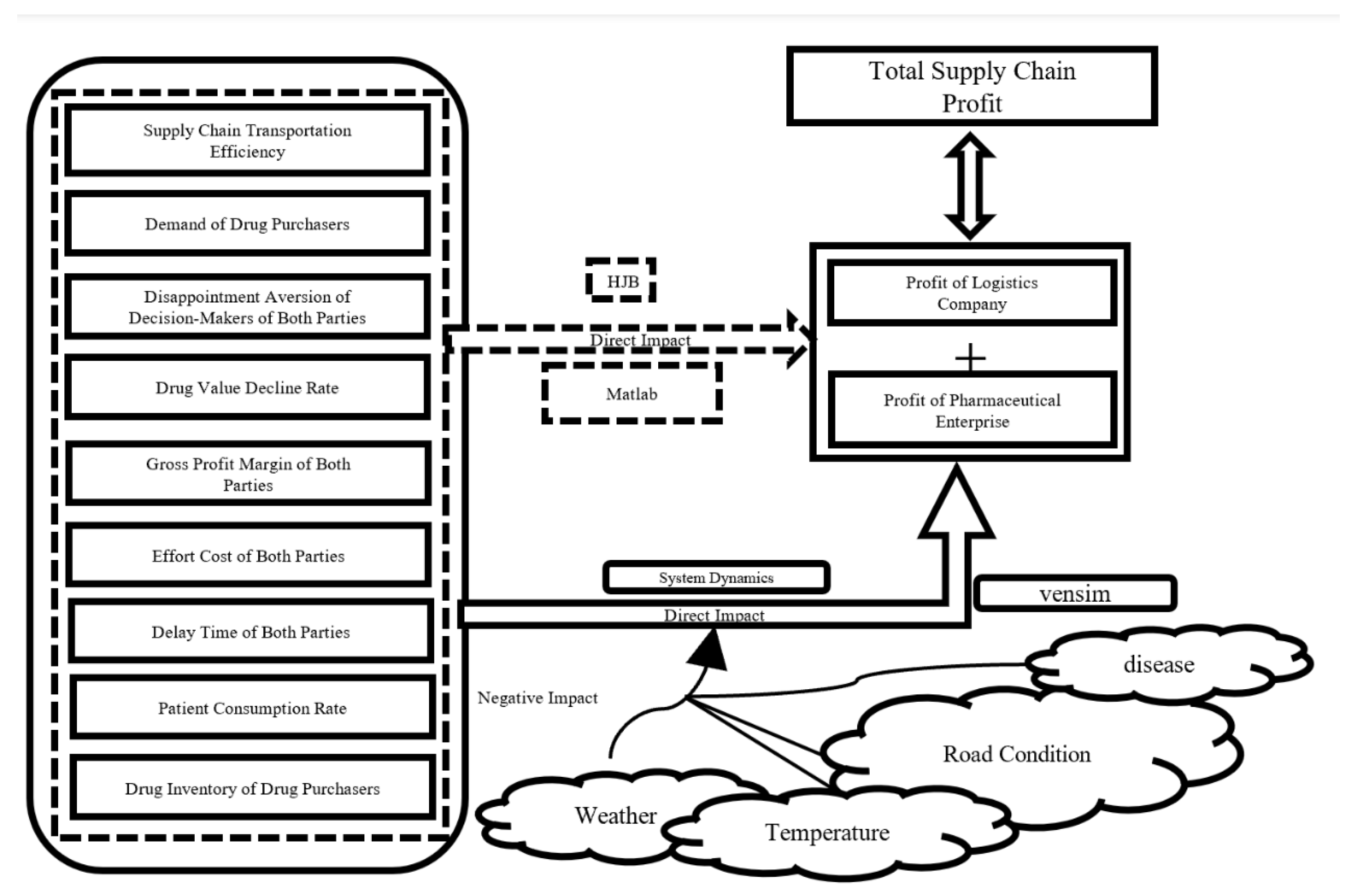
Specifically, this study establishes a two-layer analytical framework of “theoretical modeling–dynamic simulation” (see
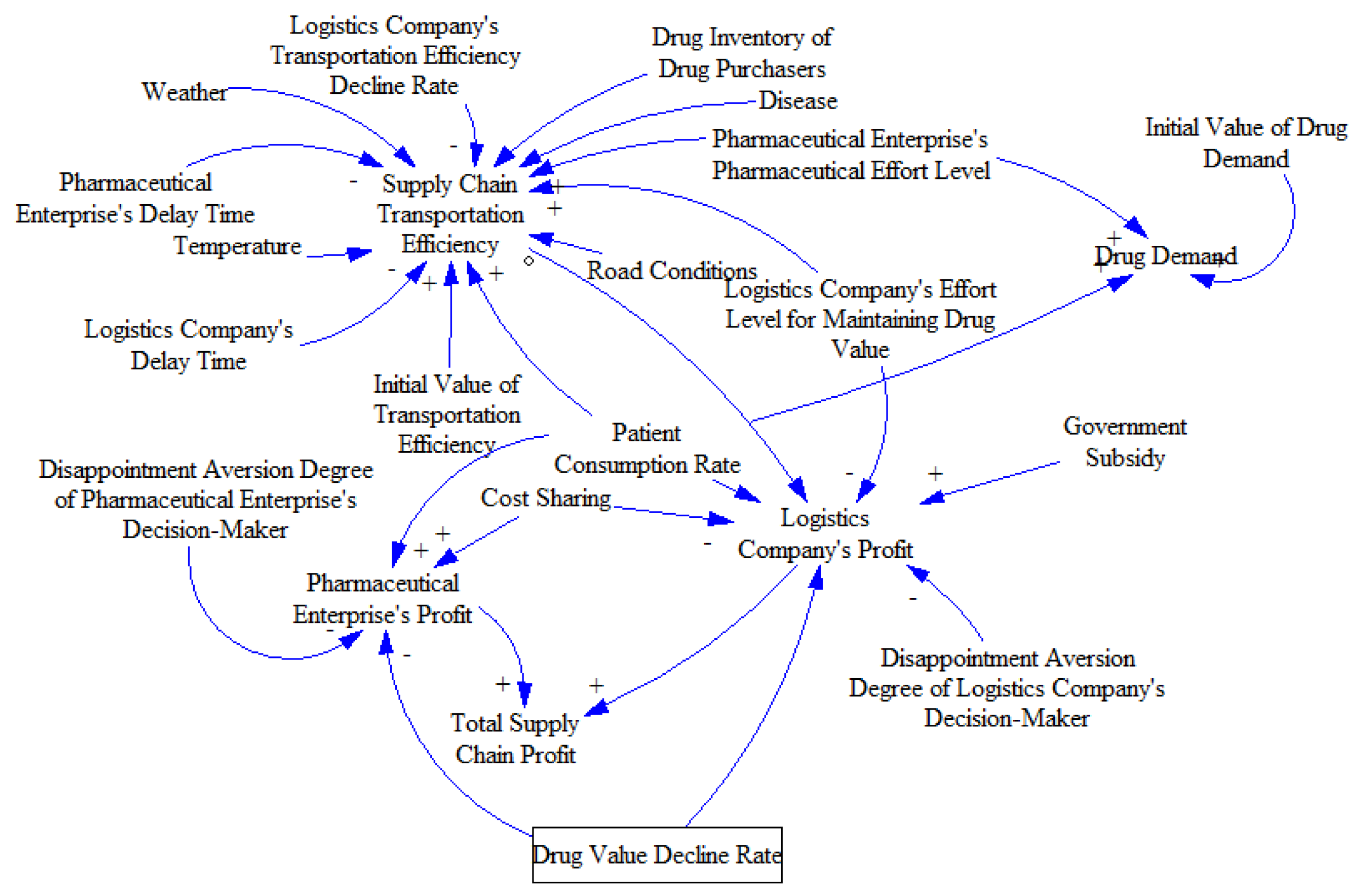
Figure 12 for the link relationships): first, the differential game method is used to depict the dynamic strategic interaction among the supply chain participants, derive the equilibrium decision solution and conduct a graphical interpretation of the evolutionary characteristics; on this basis, an SD model is built with Vensim, integrating key factors such as the transportation delay effect and extreme weather fluctuations, and the dynamic evolution mechanism of the cold-chain transportation efficiency and overall supply chain profit is revealed through simulation analysis.
10.1. Causal Relationship Analysis
By analyzing the causal relationships among the aforementioned elements, the causal relationship diagram of the three-level supply chain composed of pharmaceutical enterprises, logistics companies, and drug purchasers, such as pharmacies and hospitals, was obtained, as shown in
Figure 13.
10.2. System Flow Diagram
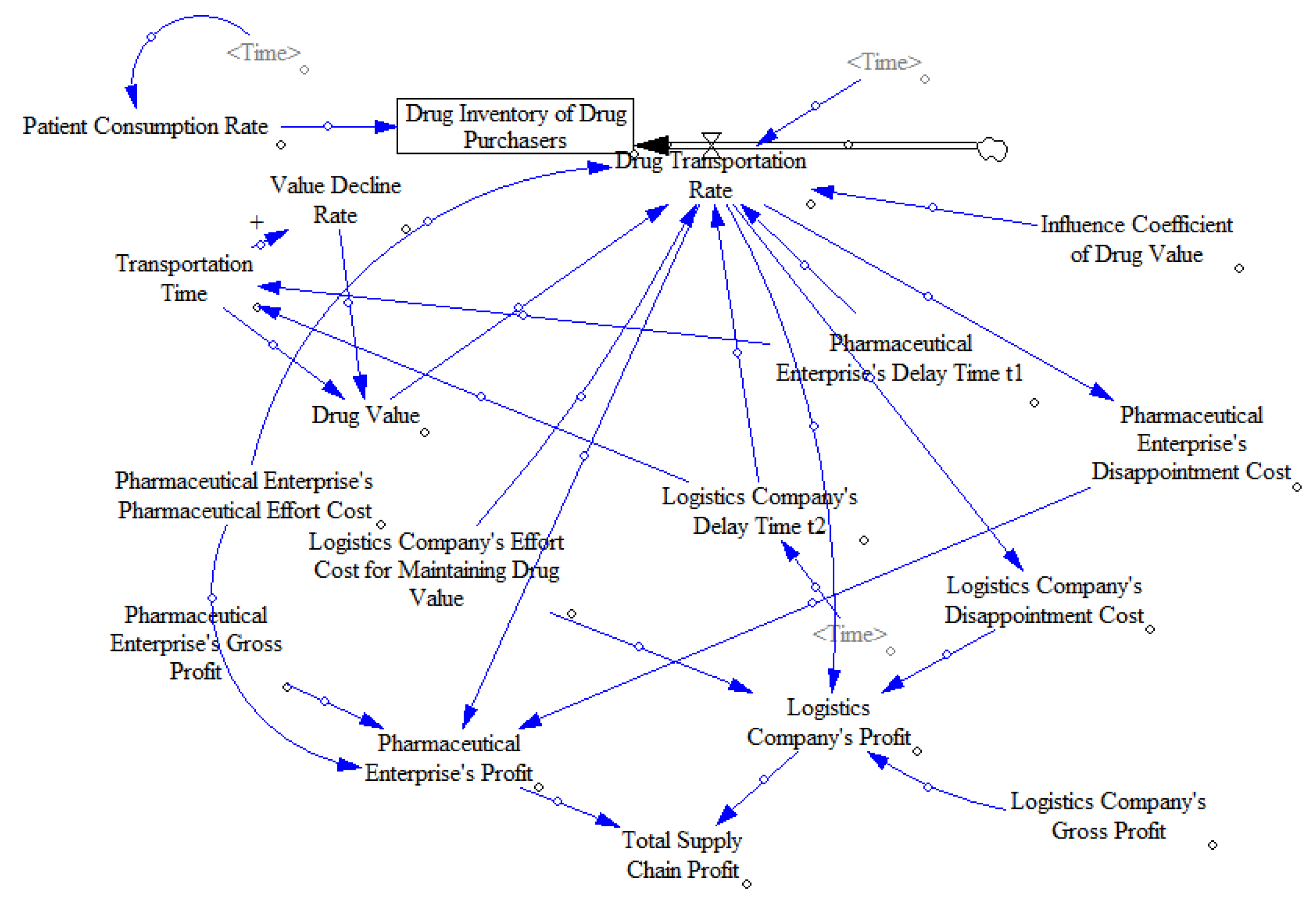
As can be seen from the causal relationship analysis, the demand of drug purchasers interacts with pharmaceutical enterprises and logistics companies. Based on this, the system flow diagram of the three-level supply chain was constructed, as shown in
Figure 14.
10.3. Sensitivity Analysis
The basic conditions of the model are set as follows: INITIAL TIME = 0, FINAL TIME = 72, and TIME STEP = 0.01, with the unit of time defined as Hour. In addition, the initial values of the external variables in the system dynamics (SD) model are consistent with the parameter settings in the aforementioned differential game model.
10.3.1. Simulation of Impact of Pharmaceutical Enterprises’ Delay Time on Transportation Efficiency and Total Profit of Three-Level Supply Chain
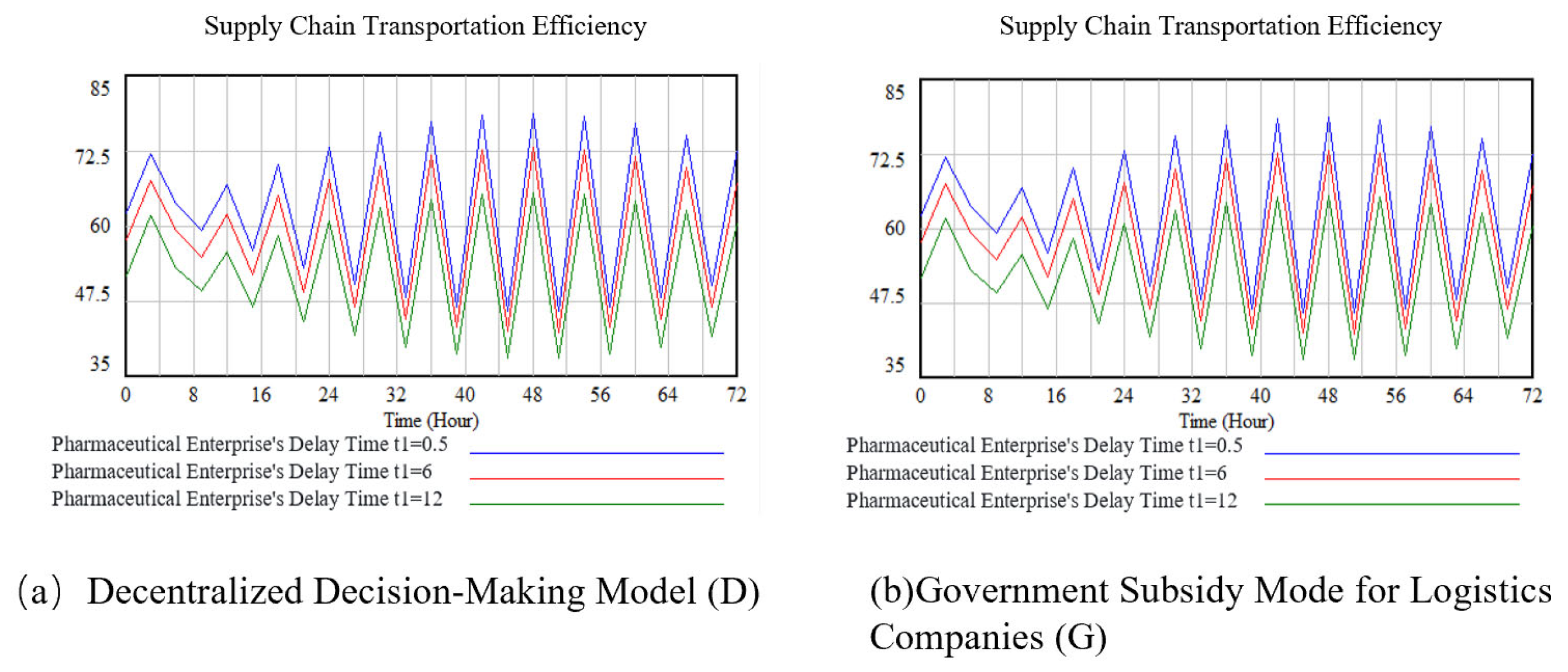
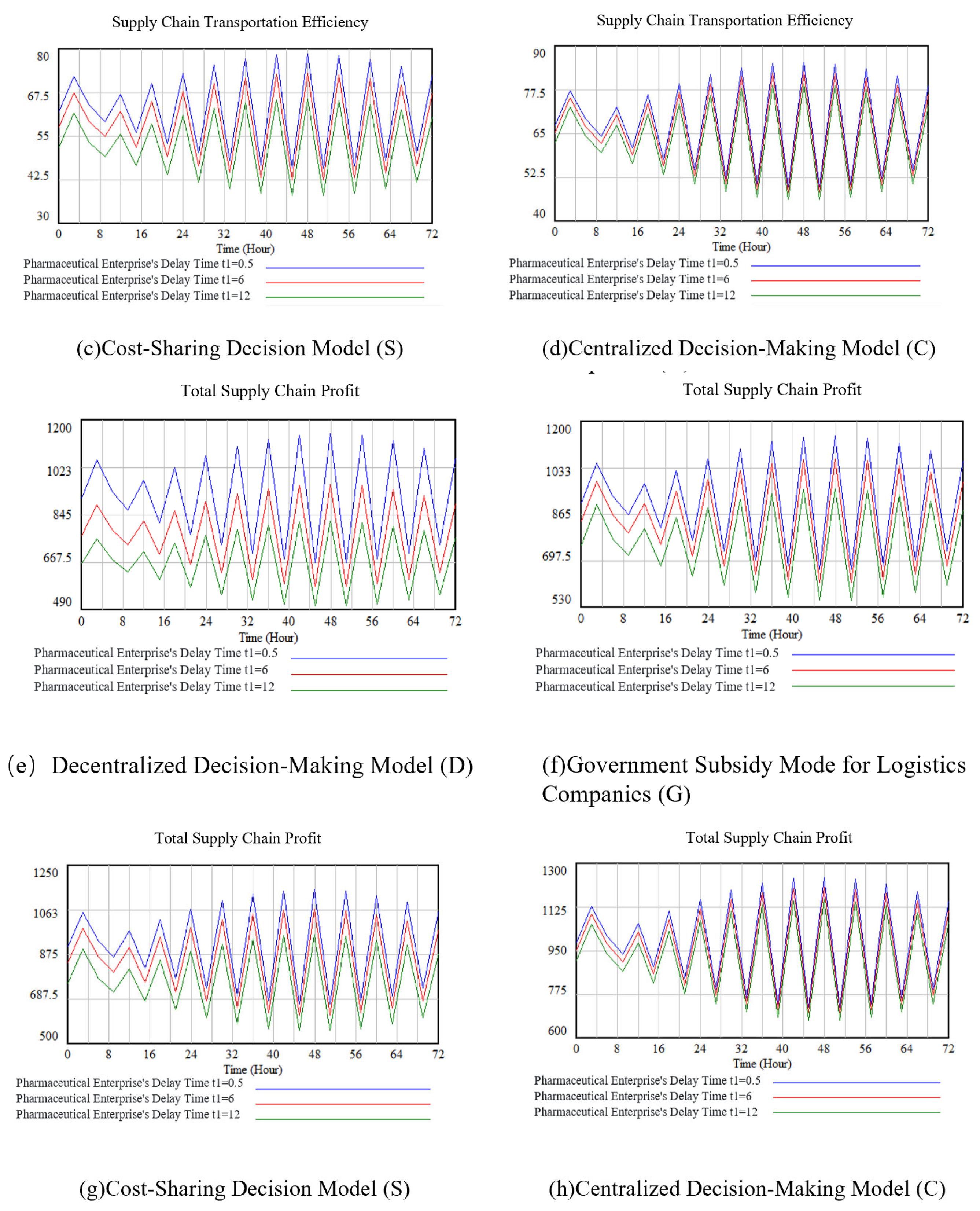
To verify the impact of pharmaceutical enterprises’ delay time on the transportation efficiency and total profit of the three-level supply chain, the parameter value of delay time t1 was adjusted. The effects of the increase in delay time t1 on the transportation efficiency and overall profit of the three-level supply chain under four different modes were compared, and the simulation results obtained are shown in
Figure 15.
As shown in
Figure 15, the extension of pharmaceutical enterprises’ delay time (t
1) essentially reflects the imbalance between “production and logistics” collaboration, leading to a decline in the supply chain transportation efficiency across all four models. The centralized-decision-making model mitigates the impact through overall resource coordination, maintaining the highest efficiency with minimal fluctuations. In contrast, the other models suffer from low efficiency due to the lack of collaboration, which results in idle logistics resources and reduced turnover rates.
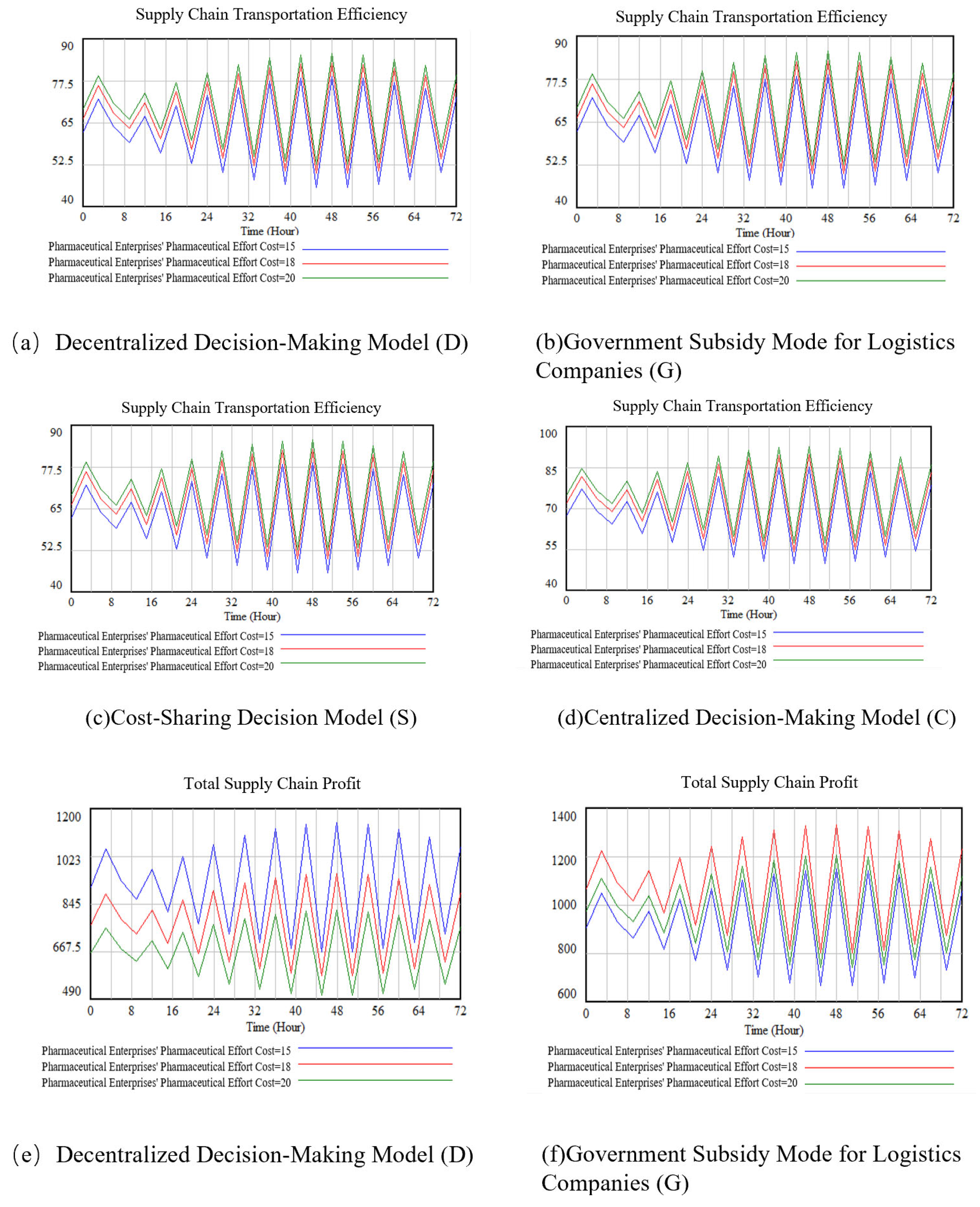
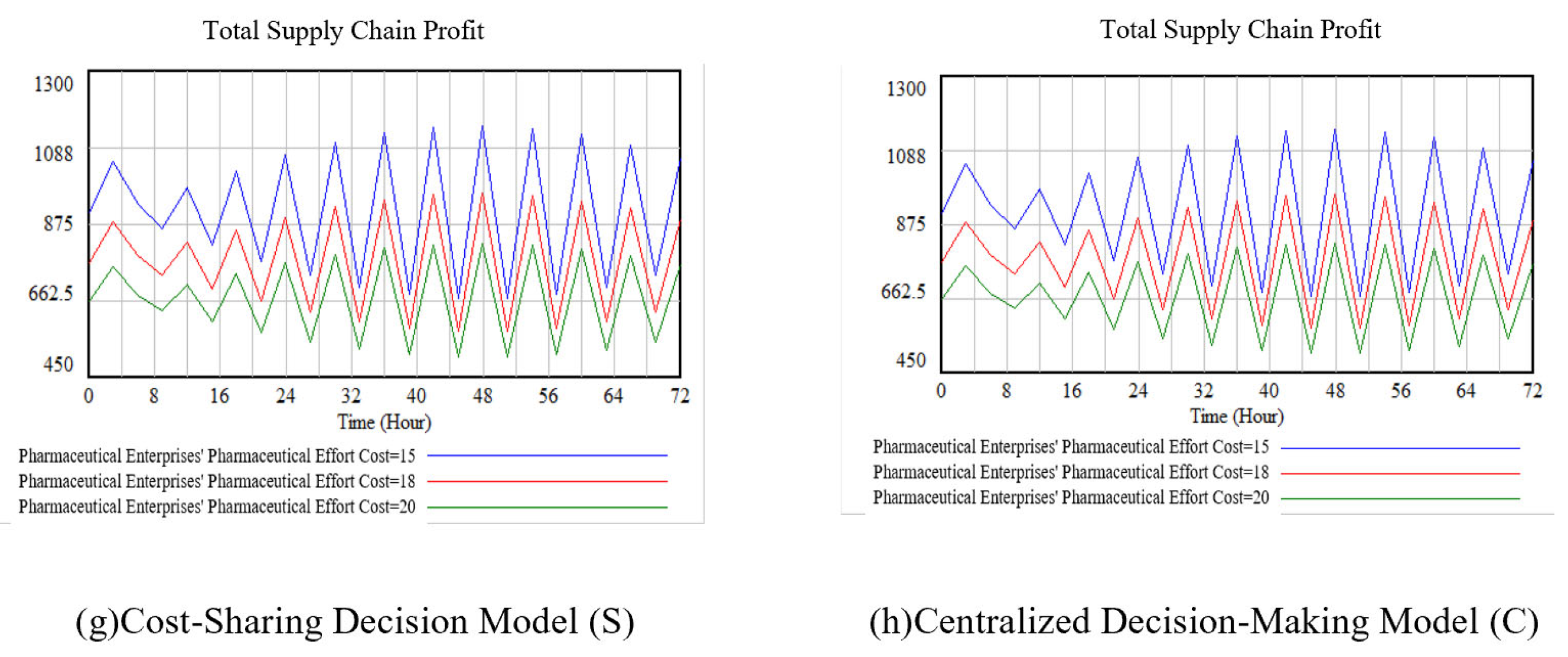
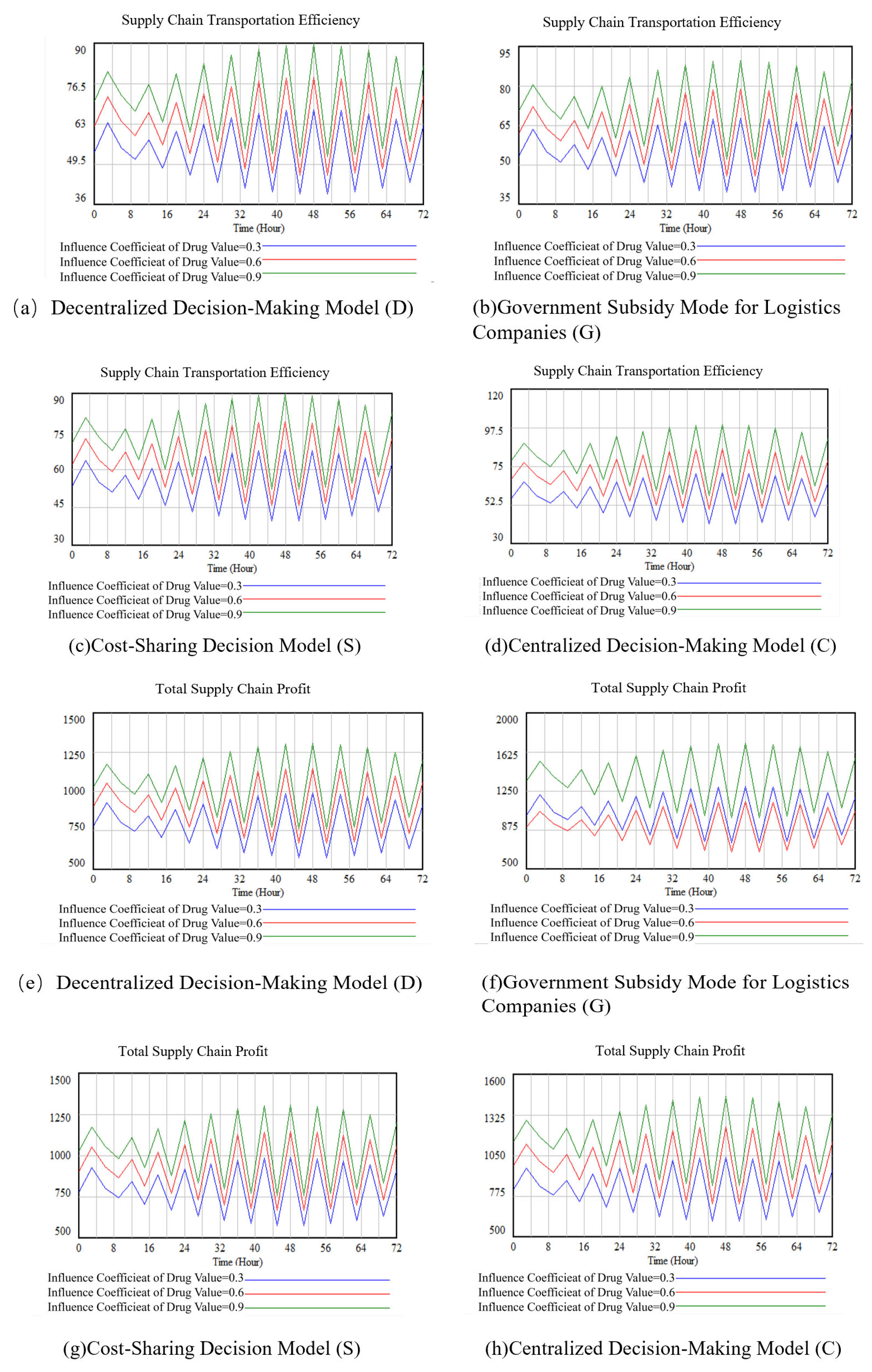
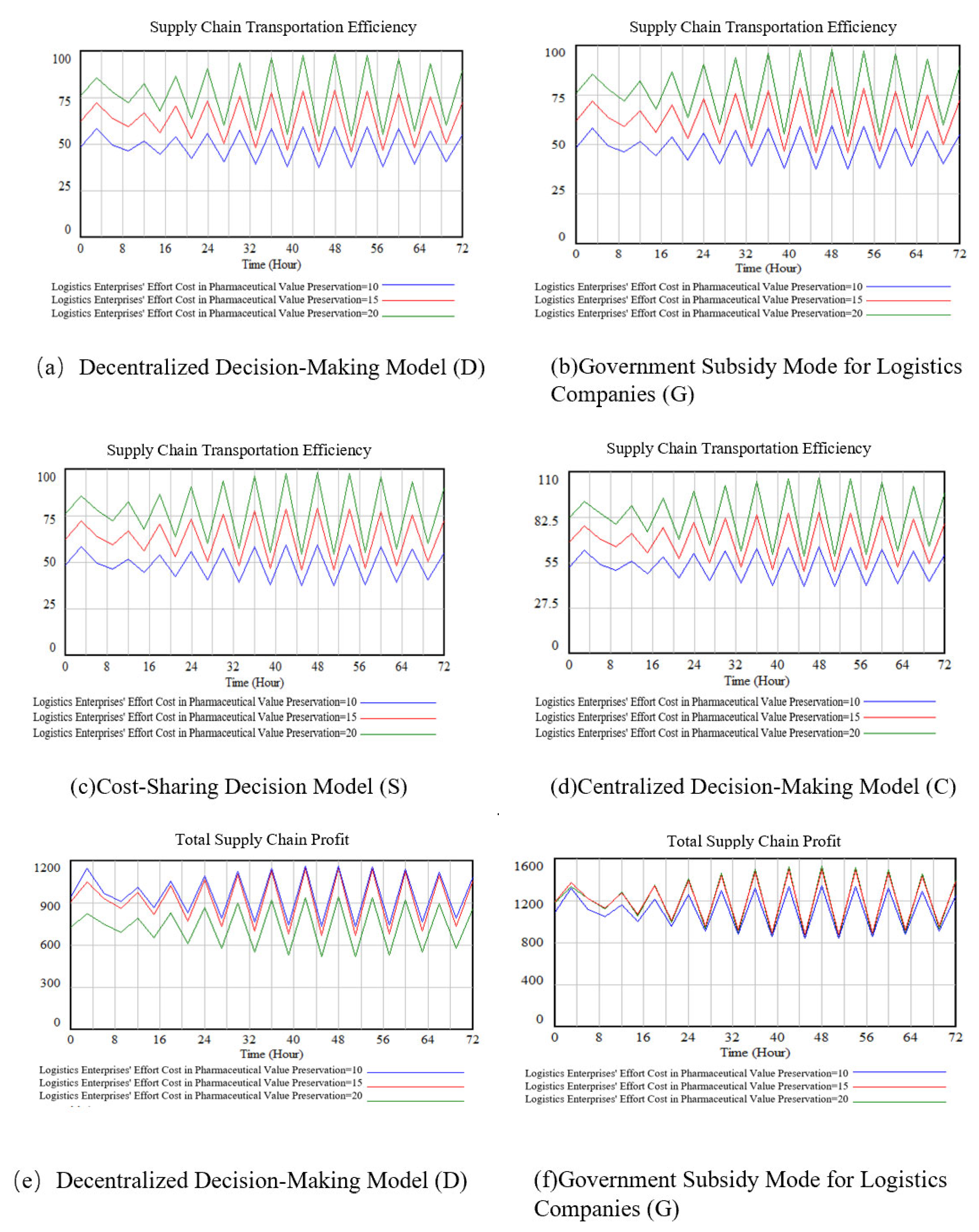
In terms of profit, the decentralized-, cost-sharing, and centralized-decision-making models experience declines as delays drive up warehousing costs and exacerbate pharmaceutical depreciation. The government subsidy model shows a differentiated performance based on the matching degree between subsidies and delays: when t1 = 6, the alignment of funds and preparation time achieves peak profit; when t1 = 0.5, profit hits the bottom due to difficulties in resource allocation; when t1 = 12, pharmaceutical backlogs erode the advantages brought by subsidies. Enterprises need to adapt delay cycles to the characteristics of each model: centralized decision-making should strengthen collaboration to stabilize efficiency; the government subsidy model should lock in the optimal delay threshold. Meanwhile, a dynamic early warning mechanism should be established to balance costs and efficiency, enhancing the supply chain’s resilience against fluctuations.
10.3.2. Simulation of the Impact of Pharmaceutical Manufacturers’ Effort Level on Transportation Efficiency and Total Profit of a Three-Echelon Supply Chain
To verify the impact of pharmaceutical enterprises’ pharmaceutical effort level on the transportation efficiency and total profit of the three-level supply chain, the parameter value of pharmaceutical enterprises’ pharmaceutical effort level was adjusted. The effects of the increase in different effort levels on the transportation efficiency and overall profit of the three-level supply chain under four modes were compared, and the simulation results obtained are shown in
Figure 13.
As shown in
Figure 16, the increase in pharmaceutical enterprises’ effort costs essentially represents an investment upgrade for capacity expansion and quality assurance, directly driving the synchronous growth of the supply chain transportation efficiency. The centralized-decision-making model, relying on its overall resource coordination capability, can optimally match the logistics and transportation demands brought by pharmaceutical enterprises’ capacity expansion, thereby maintaining the highest transportation efficiency at all times. In contrast, the other models struggle to fully meet the incremental transportation needs due to fragmented resource allocation.
The difference in profits lies in the varying degrees of alignment among “cost input–capacity–revenue”: In the decentralized-, cost-sharing, and centralized-decision-making models, the capacity expansion and product quality improvement brought by increased effort costs of pharmaceutical enterprises are directly converted into enhanced market supply capacity, driving steady profit growth. The government subsidy model, however, shows differentiated characteristics: profits peak when the effort cost is 18 (the optimal alignment between additional staff recruitment and production line upgrades, with subsidy funds amplifying efficiency advantages); marginal returns decline when the cost is 20 due to excessive production line upgrades or redundant personnel; profits are the lowest when the cost is 15, as limited capacity improvement and incomplete production line upgrades fail to form economies of scale.
For enterprises, the key is to establish a dynamic alignment mechanism of “cost–capacity–efficiency”: The centralized-decision-making model should strengthen resource coordination and flexible scheduling to accurately accommodate the capacity increment brought by increased costs; the government subsidy model needs to accurately calculate the threshold of pharmaceutical enterprises’ effort costs to avoid insufficient or excessive investment that wastes subsidy funds; all models must control the boundary of cost input through data monitoring, avoiding efficiency losses and profit compression caused by excessively high or low costs, and enhancing the precision and stability of supply chain operations.
10.3.3. Simulation of Impact of Drug Value Influence Coefficient on Transportation Efficiency and Total Profit of Three-Level Supply Chain
To verify the impact of the drug value influence coefficient on the transportation efficiency and total profit of the three-level supply chain, the parameter value of the drug value influence coefficient was adjusted. The effects of the increase in different effort levels on the transportation efficiency and overall profit of the three-level supply chain under four modes were compared, and the simulation results obtained are shown in
Figure 14.
As shown in
Figure 17, the pharmaceutical value impact coefficient has a significant positive correlation with the supply chain transportation efficiency and total profit, which is essentially the combined result of the “resource inclination effect” and “value-added effect” of high-value pharmaceuticals. From the perspective of efficiency, high-value pharmaceuticals possess both economic and social values, prompting logistics enterprises to prioritize the allocation of high-quality resources such as dedicated cold-chain facilities and air transportation routes. By optimizing routes to reduce transit links, the transportation efficiency is directly improved at the resource allocation level. In terms of profit, high-value pharmaceuticals not only endow all links of the supply chain with stronger pricing power (e.g., logistics enterprises can charge premium fees for high-end services) but also reduce unit product losses and management costs through improved transportation efficiency. Additionally, the growth in the market demand for high-value pharmaceuticals drives the expansion of the supply chain service scale, with simultaneous increases in order volumes and types of value-added services, ultimately forming multiple drivers for profit growth.
Therefore, the core strategy for enterprises is to establish a “pharmaceutical value-stratified operation system”: high-quality logistics resources should be concentrated and full-process services optimized for high-value pharmaceuticals, and a positive cycle of “efficiency improvement–cost reduction–profit growth” should be built centered on value. Meanwhile, the supply chain’s service adaptability to high-value products should be strengthened—economic benefits should be amplified through precise operations, and the efficient distribution of high-value pharmaceuticals (such as special therapeutic drugs and innovative drugs) should be ensured to achieve the dual improvement in operational efficiency and social value.
10.3.4. Simulation of the Impact of the Drug Value Influence Coefficient on Transportation Efficiency and Total Profit of a Three-Echelon Supply Chain
To verify the impact of logistics companies’ effort level in pharmaceutical value preservation on the transportation efficiency and total profit of the three-echelon supply chain, we adjusted the parameter values of the aforementioned effort level and compared the effects of the increase in this effort level under four models on the transportation efficiency and overall profit of the three-echelon supply chain, and the obtained simulation results are presented in
Figure 18.
As shown in
Figure 18, the effort level of logistics companies in preserving pharmaceutical value is significantly positively correlated with both the transportation efficiency and total profit of the supply chain under all four models. A cross-model comparison reveals that the centralized-decision-making model yields the optimal transportation efficiency, while the government subsidy model achieves the highest total supply chain profit, with both performing significantly better than the decentralized-decision-making model. The underlying reasons are as follows: centralized decision-making effectively reduces information asymmetry and interest conflicts across all links through unified supply chain planning; government subsidies alleviate the cost pressures on logistics enterprises by virtue of external policy incentives; in contrast, the decentralized-decision-making model results in the weakest overall performance due to the lack of collaboration among participants and their exclusive pursuit of individual profit maximization. For the supply chain management practice of the pharmaceutical industry, pharmaceutical enterprises can break the efficiency bottleneck of decentralized decision-making by promoting centralized decision-making or introducing government subsidies; supply chain managers should attach importance to the effort input of logistics companies in pharmaceutical value preservation and establish a reasonable cost-sharing and profit distribution mechanism to fully stimulate the collaborative motivation of all participants; the government can formulate targeted subsidy policies to guide logistics companies to increase investment in pharmaceutical value preservation so as to improve the overall performance of the supply chain while ensuring the quality and safety of pharmaceutical circulation.
11. Discussion
11.1. Conclusions
In the global public health domain, the frequent outbreaks of emerging infectious diseases, such as influenza and COVID-19, not only pose a severe threat to public health but also exert a tremendous impact on the stability of the pharmaceutical supply chain. Furthermore, the physical transportation link of pharmaceuticals is highly susceptible to interference from uncertain factors, such as weather conditions and road conditions, thereby affecting the timeliness, quality, and safety of pharmaceutical distribution. To address these industry pain points, this study adopts a dynamic modeling approach to construct a three-echelon supply chain model encompassing pharmaceutical manufacturers, logistics companies, and pharmaceutical purchasers. It conducts an in-depth analysis of the influence mechanisms of pharmaceutical manufacturers’ production delays, logistics companies’ transportation delays, and the disappointment aversion behaviors of decision-makers from both parties on the optimal decisions regarding the total supply chain profit and supply chain transportation efficiency. Furthermore, this study focuses on special periods such as influenza outbreaks, incorporates key variables such as the patient medication consumption rate, pharmaceutical purchasers’ inventory levels, as well as weather, temperature, road conditions, and epidemic development trends, and constructs a dynamic system dynamics model to systematically explore the dynamic impacts of parameter changes on the supply chain performance and supply chain transportation efficiency. The following conclusions are drawn:
Decision-making models feature a clear hierarchy and scenario adaptability: The centralized model outperforms the others in terms of transportation efficiency, profit stability, and complex environment adaptability, reducing conflicts and mitigating external shocks via global collaboration. The decentralized model performs the worst due to its lack of cross-entity coordination and information sharing. The cost-sharing model acts as an intermediate transition, balancing collaboration and independent decision-making. The government subsidy model’s effectiveness depends on the alignment between parameter n and specific scenarios, requiring integration with collaborative mechanisms to avoid over-reliance on policies.
Key variables exert consistent yet context-dependent impacts: The pharmaceutical stability, value impact coefficient, and enterprise effort levels (logistics firms’ pharmaceutical value preservation, pharmaceutical enterprises’ production efforts) are significantly positively correlated with the supply chain performance, with the centralized model offering the strongest incentives. Disappointment aversion and excessive delays hinder performance, while reasonable delays and a low discount rate (for long-term reserves) optimize resource use. Government subsidies need to pair with collaborative mechanisms (e.g., centralized decision-making, cost sharing), and a clear exit strategy is needed to balance short-term incentives and long-term sustainability, converting policy dividends into technological and risk management capabilities.
The supply chain follows distinct evolutionary rules: The transportation efficiency and total profit first rise and then decline, with the centralized model slowing decay and reducing volatility through global resource allocation and risk sharing. System dynamics simulations confirm that practical factors (e.g., patient consumption rates, weather changes) amplify performance differences across models. Reasonably increasing logistics firms’ effort costs in pharmaceutical value preservation and offsetting delay impacts via centralized decision-making are core paths to achieving the supply chain’s “efficiency–profit–stability” triple optimization.
Building on previous research, this paper achieves systematic improvements and innovations as follows: First, while the existing studies have focused on disappointment aversion or delay effects separately, few have integrated these two factors. Breaking this limitation, this paper combines the disappointment aversion of decision-makers in pharmaceutical and logistics enterprises with system-wide delay effects in the pharmaceutical logistics supply chain context, constructs a dynamic differential game model of their joint profits to analyze the action paths and mechanisms of these factors on the overall supply chain profit, and incorporates pharmaceutical value attenuation as a key industry-specific factor, addressing the deficiency of the existing studies in fully considering the core attributes of pharmaceutical logistics [
6,
7,
8,
9,
10,
11,
12,
22,
23,
24,
27,
28,
29]. Second, unlike previous single decision-making model designs [
6,
7,
8,
9,
10,
11,
12], this study develops four models (decentralized decision-making, government subsidies, cost sharing, centralized decision-making) to promote supply chain cooperation and improve logistics efficiency and profit. Through numerical simulation and sensitivity analysis, it explores the influence laws of core parameters such as delay times, the disappointment aversion degree, the government subsidy intensity, pharmaceutical attenuation, and the discount rate, providing quantitative support for optimal decisions. Finally, considering practical factors like the patient consumption rate and pharmaceutical purchaser inventory, it introduces system dynamics to build an extended model [
8,
9], integrates complex environmental variables such as delay effects and weather changes, explores the impacts of the pharmaceutical delay time, effort cost, and pharmaceutical value coefficient on logistics efficiency and supply chain profit through variable control, and reveals the dynamic evolution mechanism of the cold-chain transportation efficiency and total supply chain profit, making up for the insufficient adaptability of the existing studies to multi-factor coupling and complex scenarios [
6,
7,
8,
9,
10,
11,
12,
17,
18,
19,
27,
28,
29].
11.2. Management Implications
Therefore, against the realistic backdrop of pharmaceutical value attenuating over time, to effectively integrate decision-makers’ disappointment aversion psychology and the delay effects across all supply chain links, construct a multi-agent collaborative decision-making mechanism between pharmaceutical enterprises and logistics companies, and ultimately achieve the dual optimization of the cold-chain transportation efficiency and the overall profit of the supply chain, specific implementation can be accomplished through the following approaches:
A governance framework with “centralized decision-making as the core + dynamic model adaptation” should be established: Centralized decision-making should focus on full-chain data integration and risk sharing, especially strengthening synergy in scenarios involving high-value pharmaceuticals and complex environments. The cost-sharing model should target core links (e.g., cold-chain upgrades), while government subsidies should be bound to collaborative mechanisms with predefined exit thresholds. The decentralized-decision-making model is only applicable to short-term, low-complexity scenarios.
The key variables should be precisely regulated and an incentive closed loop formed: Logistics companies’ efforts in pharmaceutical value preservation and pharmaceutical enterprises’ production efforts should be linked to profit sharing and long-term agreements to mitigate the impact of disappointment aversion. Hierarchical operations for high-stability and high-value pharmaceuticals should be implemented, and “optimal delay windows” and discount rates should be set based on pharmaceutical characteristics to balance short-term efficiency and long-term returns.
The “2B > A” cooperation bottom line should be adhered to and dynamic optimization conducted: Taking the premise that collaborative premium (2B) covers unilateral operational costs and collaboration losses (A), the benefit–cost ratio can be regularly calculated. When collaborative benefits are insufficient to cover costs (2B ≤ A), transitioning to centralized decision-making or temporarily introducing subsidies should be prioritized to avoid falling into a negative-sum game where “collaboration leads to losses”.
Adaptation to system evolution and external environments is needed: centralized decision-making should be leveraged to slow down performance attenuation, dynamic early warning mechanisms should be established for factors such as patient consumption rates and weather, and resource allocation should be flexibly adjusted to enhance the supply chain’s ability to resist fluctuations.
11.3. Future Research
Although this study explores the impacts of the delay time and decision-makers’ disappointment aversion on the supply chain transportation efficiency and overall profit, incorporates variables (e.g., patient consumption rate, pharmaceutical purchaser inventory level) via system dynamics modeling, and accounts for environmental factors such as weather and temperature fluctuations, an in-depth review of the research design, parameter setting, and adaptability to practical scenarios reveals several limitations. First, the model’s adaptability to real scenarios needs expansion: the two-agent framework (“pharmaceutical manufacturer + logistics service provider + government subsidy”) excludes core demand nodes (hospitals, retail pharmacies), failing to fully depict the multi-level interaction mechanism of the supply chain and disconnecting the “production–logistics–terminal consumption” collaborative system. The demand function does not cover non-linear market drivers (e.g., medical insurance policy adjustments), and the cost-sharing ratio is set as a fixed constant, overlooking dynamic scenarios and post-risk re-negotiation processes. The core parameters are based on theoretical assumptions and literature reviews rather than empirical calibration with industry-specific data, potentially affecting the simulation results and conclusion universality. Second, the model lacks precision in depicting complex scenarios and completeness in value dimension measurement: it does not distinguish differentiated impacts of extreme weather or consider regional risk heterogeneity, only qualitatively describes demand fluctuations, and excludes random disturbances. The demand side does not refine product availability indicators, and the performance evaluation system only focuses on economic profit and transportation efficiency, excluding non-economic dimensions, such as pharmaceutical quality compliance. Future research will address these limitations for further improvement.