Correct Degree Selection for Koopman Mode Decomposition


Abstract
1. Introduction
2. Theoretical Frameworks Underlying Koopman Mode Decomposition
2.1. Temporal Transition of States and Semigroup Property
2.2. Koopman Operator
2.3. Koopman Generator
2.4. Koopman Mode Decomposition and Spectral Theorem
- Orthogonality: .
- Countable additivity: For any countable mutually disjoint family ,
3. Discrete Koopman Mode Decomposition
3.1. DFT and Vandelmonde Matrix
- .
- .
- Viewing as a linear map , F is injective if and only if , surjective if and only if , and bijective if and only if .
3.2. Formulation of DKMD
3.3. Definitions and Notations
3.4. Known Methods to Compute DKMD for Known Degrees
3.4.1. Computing the Koopman Eigenvalues
3.4.2. Computing the Koopman Modes
3.5. The Contributions of This Article
- Minimality: The optimal degree should be the smallest among all feasible degrees. This principle is analogous to Occam’s razor, favoring the simplest representation that adequately explains the observations.
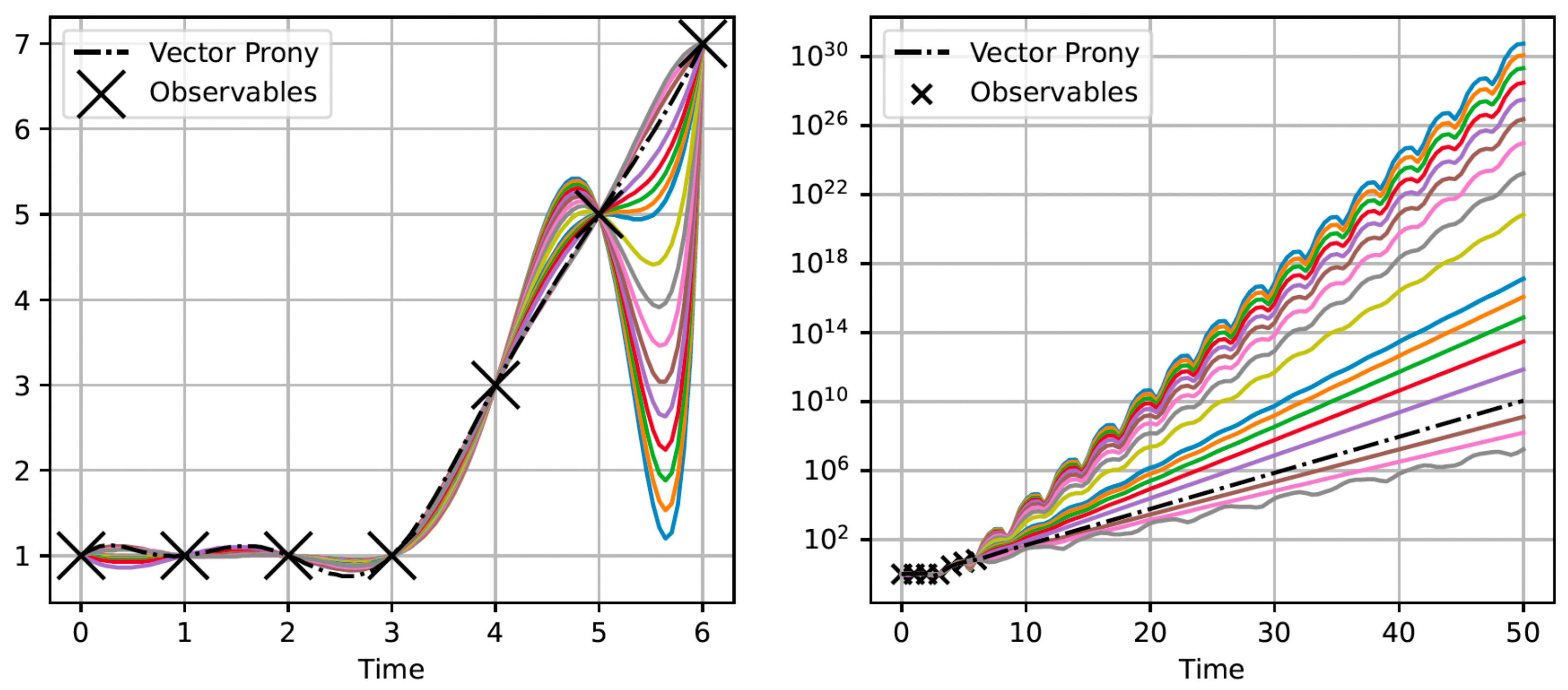
- Uniqueness: The optimal degree should correspond to a unique DKMD. If multiple DKMDs exist for a given ℓ, as described in a later section, the set of such decompositions forms a continuum, where different DKMDs yield distinct eigenvalues and modes. Consequently, any particular DKMD extracted from this continuum—such as one obtained by the vector Prony method—may fail to reproduce the true dynamics precisely.
- A uniquely feasible degree for a given observable matrix, if it exists, is the smallest among all feasible degrees.
- Several structural properties of uniquely feasible degrees lead to computationally efficient algorithms for determining them.
- These algorithms are further extended to handle noisy observables via least-squares formulations.
4. Finding Uniquely Feasible Degrees
4.1. Key Indices: Hankel Dimension and Codimension
- 1.
- admits a DKMD with Koopman degree ℓ; equivalently, ℓ is feasible for .
- 2.
- There exists a square-free coefficient vector satisfying
- Even if we can find withit may happen that , meaning that the polynomial corresponding to is of degree lower than ℓ, which cannot induce a DKMD of degree ℓ;
- Even ifthe resulting polynomialmay have repeated roots, rendering it unsuitable as a characteristic polynomial.
- 1.
- The DKMD is unique if and only if .
- 2.
- The set of ℓ-degree DKMDs forms a continuum if and only if .
4.2. The Koopman Dimension and Codimension for
4.3. Examples
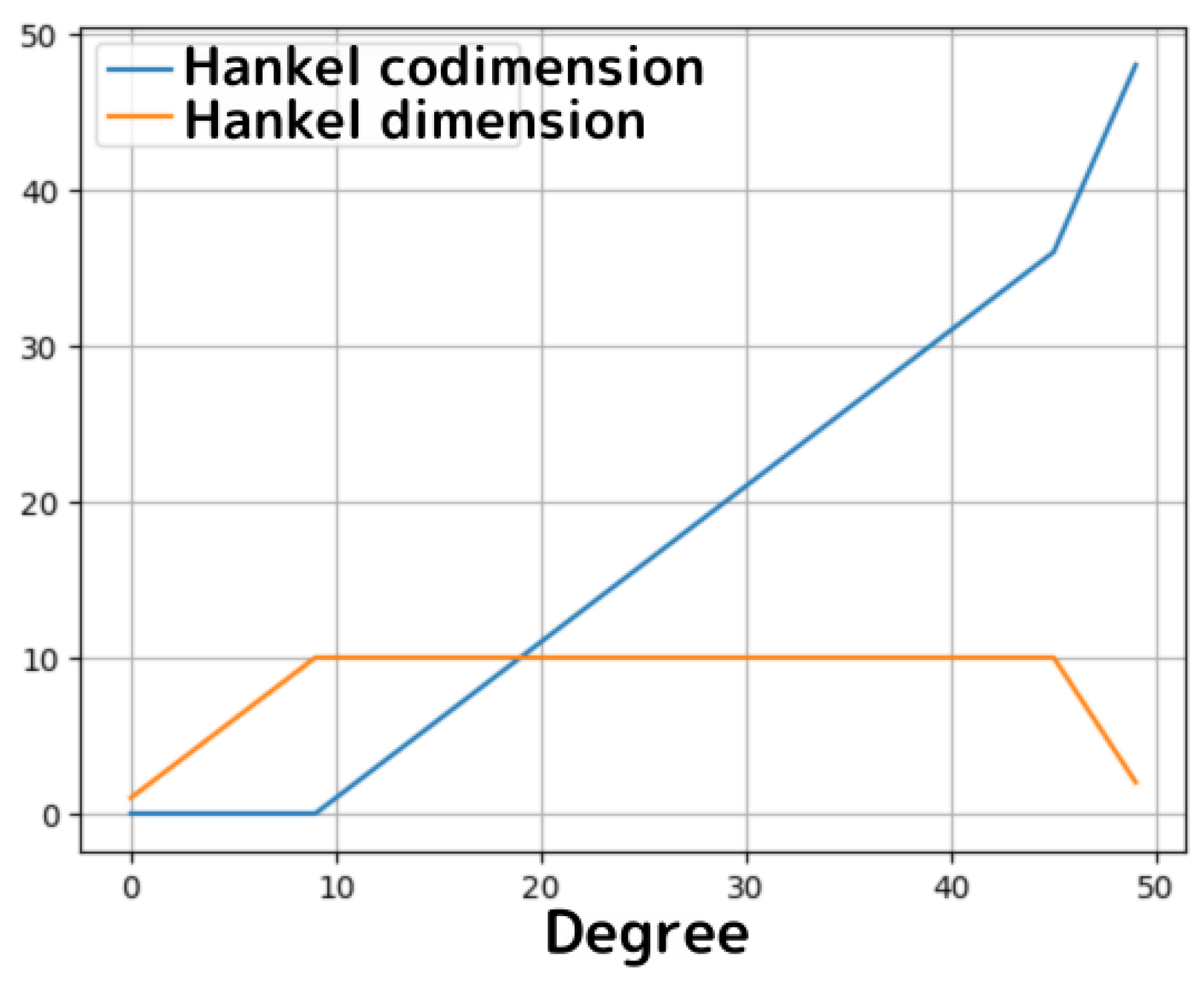
- No Koopman degree ℓ satisfies , meaning that no uniquely feasible degree exists (Example 7).
- A Koopman degree ℓ with exists, but the corresponding characteristic polynomial is not square-free. As a result, a uniquely feasible degree does not exist (Example 8).
- A uniquely feasible degree exists, ensuring that a DKMD is uniquely determined for the degree (Example 9).
- 1.
- For , no characteristic polynomial exists.
- 2.
- For , if a DKMD existed, the corresponding characteristic polynomial would bewhich is not square-free.
- 3.
- For , if a DKMD existed, the corresponding characteristic polynomial would be of the formwhich is also not square-free.
4.4. Important Properties of the Hankel Dimension and Codimension
- Best Possible Upper Bound of a Uniquely Feasible Degree: Let . If , then . Hence, no uniquely feasible degree can exceed , which is also the sharpest possible upper bound.
- Monotonic Increase of the Hankel Codimension: The Hankel codimension is strictly increasing with respect to ℓ over the interval .
- Equivalence Between Unique and Minimal Feasibility: The monotonicity of the codimension implies that, if ℓ is uniquely feasible, then . In particular, if , no uniquely feasible degree exists.
- Saturation of the Hankel Dimension: If and , thenIn particular, holds, which implies L is the only candidate for a uniquely feasible degree.
4.4.1. Invariance Under Basis Transformations
- 1.
- for each .
- 2.
- for each .
- 3.
- The set of characteristic polynomials for is identical with that for .
- 4.
- A DKMD of can be converted to a DKMD of , while a DKMD of can be converted to a DKMD of . These conversions yield a bijective correspondence between the set of DKMDs for and that for .
- Case where A is nonsingular: When is a nonsingular matrix, we have automatically, and thus Theorem 3 provides the invariance of the Hankel dimension, Hankel codimension, characteristic polynomials, and DKMDs under basis transformations in .
- Case where A is fat: When with is selected to satisfy , the matrix has fewer rows than , and thus requires less computation to obtain DKMDs than .
4.4.2. The Best Possible Upper Bound for a Uniquely Feasible Degree
4.4.3. Monotonic Increase of the Hankel Codimension
4.4.4. Equivalence Between Unique and Minimal Feasibility
4.4.5. Saturation of
- with . To achieve this, take such that the rows are linearly independent. Then, define so that the j-th row of has 1 as the -th component and 0 for the other components.
- The first row of has no zero component: for . Since each column of is nonzero and , we can find a nonsingular matrix such that the first row of has no zero component.
4.5. Algorithms
- One that applies to the case where and determines L by ;
- Another that performs a binary search to determine L in the case when .
4.5.1. A Theoretical Scenario
| Algorithm 1: Dimension reduction of the observable matrix. |
| Require: |
| Ensure: Matrices and for with and rank |
| 1: Find such that the row vectors are linearly independent; |
| 2: Determine a matrix such that the component is 1 and all other components are 0 for ; |
| 3: return and . |
| Algorithm 2: Search for an L-degree characteristic polynomial when . |
| Require: |
| Ensure: The signal if ; the characteristic polynomial if is uniquely feasible; |
| if is not uniquely feasible. |
| 1: if then |
| 2: Let ; |
| 3: Execute Algorithm 3; |
| 4: return the return value of Algorithm 3; |
| 5: else |
| 6: return |
| 7: end if |
| Algorithm 3: Determine the characteristic polynomial. |
| Require: and L |
| Ensure: An L-degree characteristic polynomial or |
| 1: if then |
| 2: Let ; |
| 3: if has no repeated roots then |
| 4: return |
| 5: end if |
| 6: end if |
| 7: return |
| Algorithm 4: Search for an L-degree characteristic polynomial when . |
| Require: with |
| Ensure: Either the characteristic polynomial of the DKMD of for the uniquely feasible degree , if present, or , otherwise. |
| 1: if then |
| 2: return |
| 3: end if |
| 4: Let ; |
| 5: Let ; |
| 6: while do |
| 7: Let ; |
| 8: if then |
| 9: Let ; |
| 10: else if then |
| 11: Let ; |
| 12: Execute Algorithm 3; |
| 13: return the return value of Algorithm 3; |
| 14: else |
| 15: Let ; |
| 16: end if |
| 17: end while |
| 18: if then |
| 19: Let ; |
| 20: Execute Algorithm 3; |
| 21: return the return value of Algorithm 3; |
| 22: else |
| 23: return ; |
| 24: end if |
Dimension Reduction
Case
- A vector exists in . This can be efficiently verified by performing a QR decomposition of .
- If such a vector exists, verify that the polynomialhas no repeated roots.
Case
4.5.2. A Practical Scenario
4.5.3. Time Complexities
5. Simulations
5.1. Synthetic Datasets Used in the Simulations
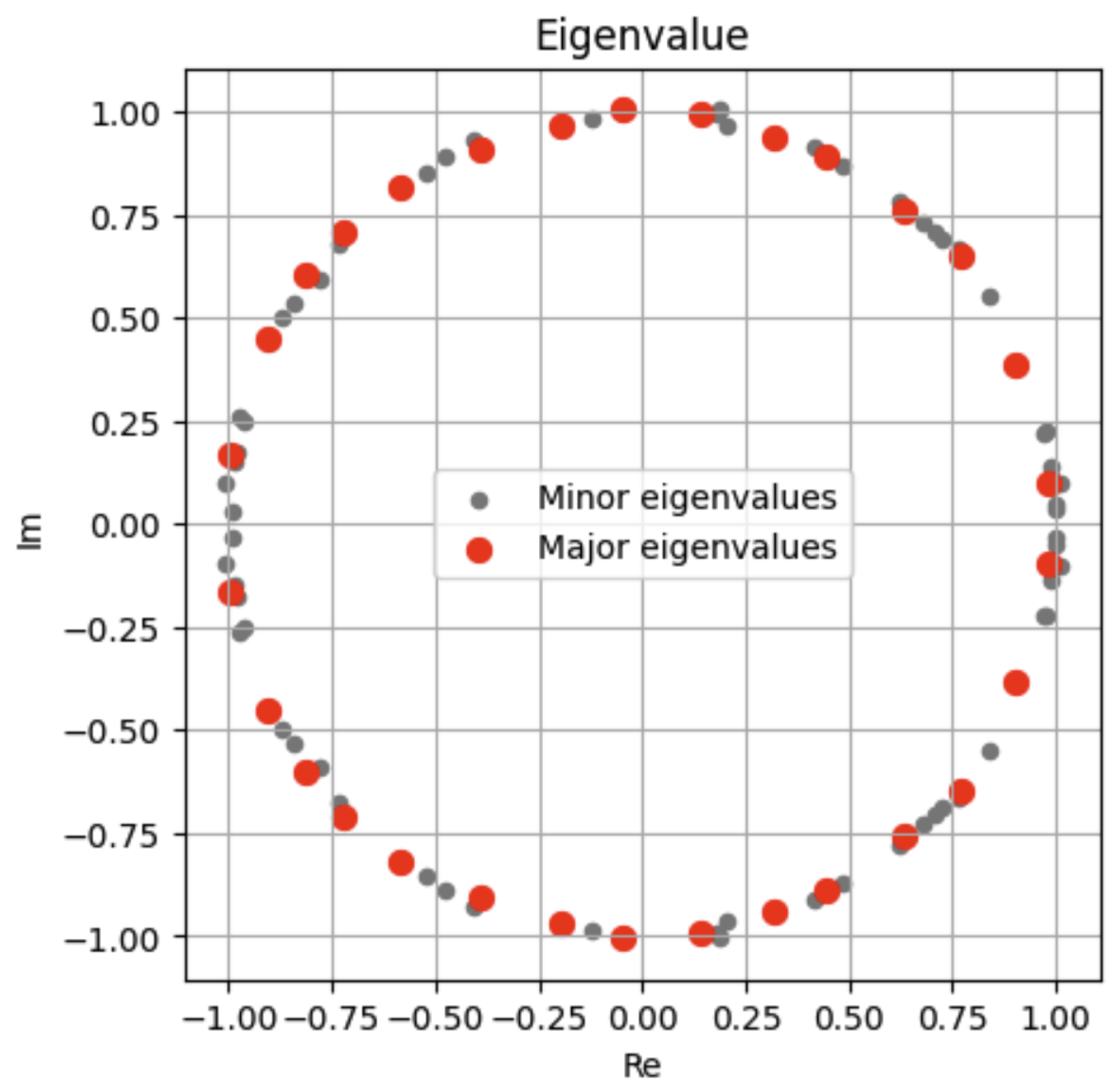
- Sample as many distinct Koopman eigenvalues, each classified as either major or minor, as specified in Table 3. Let denote these eigenvalues. For each , its complex conjugate must also be in the set. Furthermore, every conjugate pair is sampled independently as follows:
- is sampled according to a log-normal distribution with parameters and , whose probability density function is . The median, mean, and variance of this distribution are , , and , respectively.
- is sampled uniformly from the interval .
The distribution of is designed to restrict the occurrence of samples too far from 1, because much larger than 1 causes the observables to diverge, while a component with much smaller than 1 decays rapidly. - Determine the Koopman mode corresponding to with the following constraints:
- and hold whenever ;
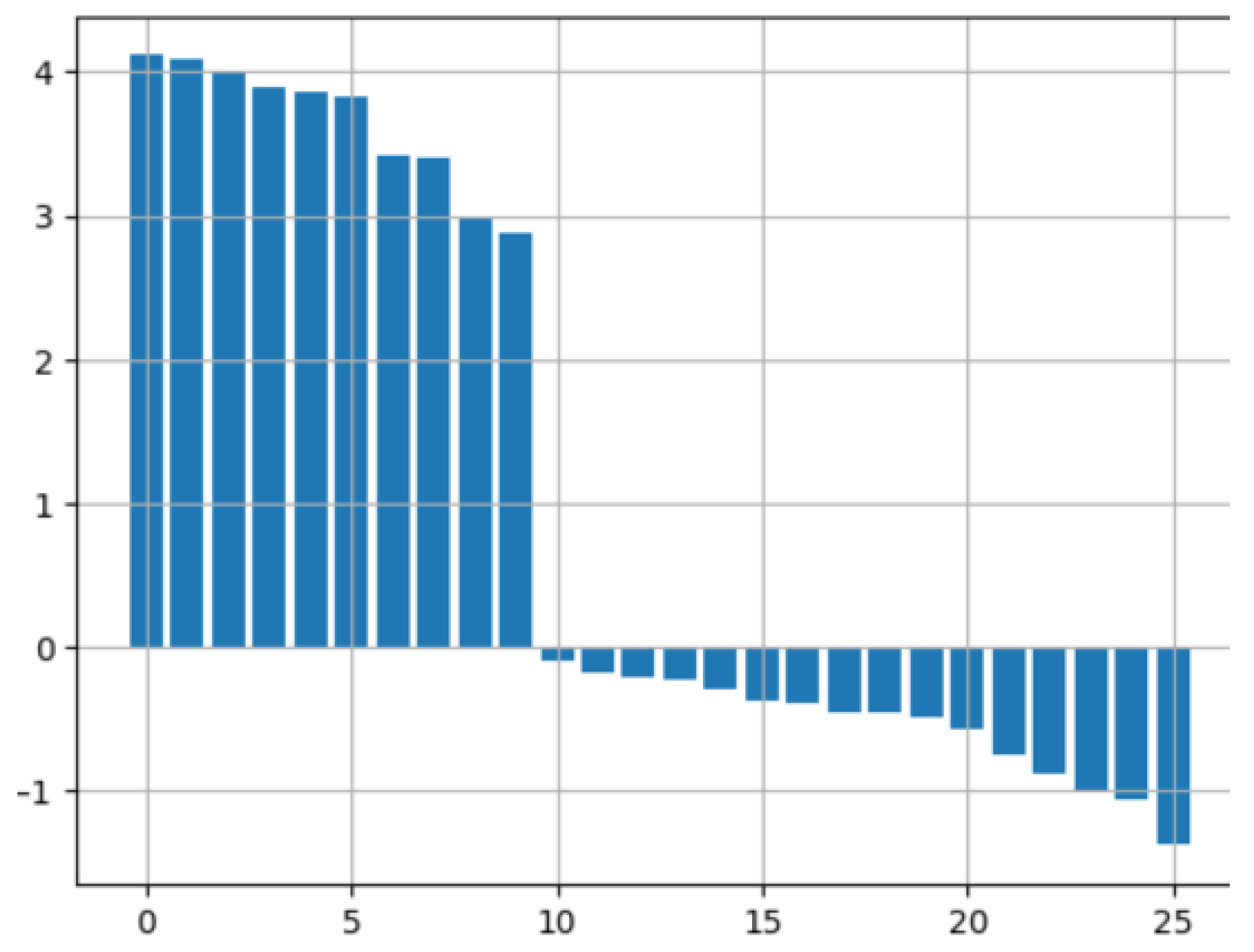
- The modes associated with the major eigenvalues must have significant magnitudes, while those associated with the minor eigenvalues must have smaller magnitudes.
To satisfy the second requirement, we use a function defined below, which has sharp peaks only at the sampled major eigenvalues :For each Koopman eigenvalue , the mode is determined by sampling the argument of each component uniformly at random, while setting the magnitude to , i.e., . - Construct as . If the inclusion of noise is required, add to a noise matrix with and , where each is independently sampled from a normal distribution .
5.2. Simulation Scenarios
- Scenarios 1 and 2 investigate the case where an exact DKMD is obtained via QR decomposition (Section 4.5.1).
- Scenarios 3 and 4 investigate the case where an approximated DKMD is obtained via singular value decomposition (Section 4.5.2).
- Scenarios 1 and 3 are used to investigate Algorithm 2.
- Scenarios 2 and 4 are used to investigate Algorithm 4.
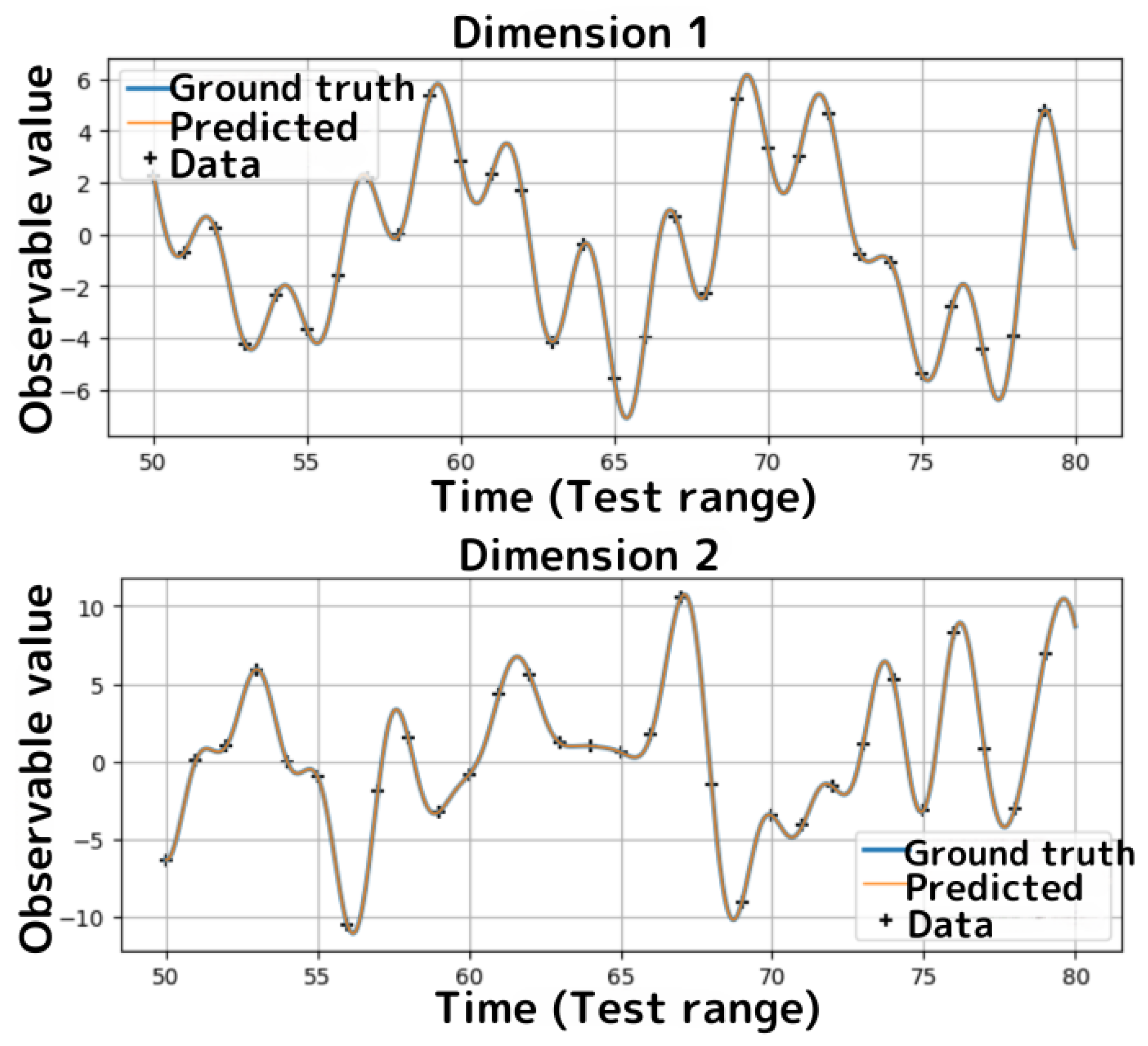
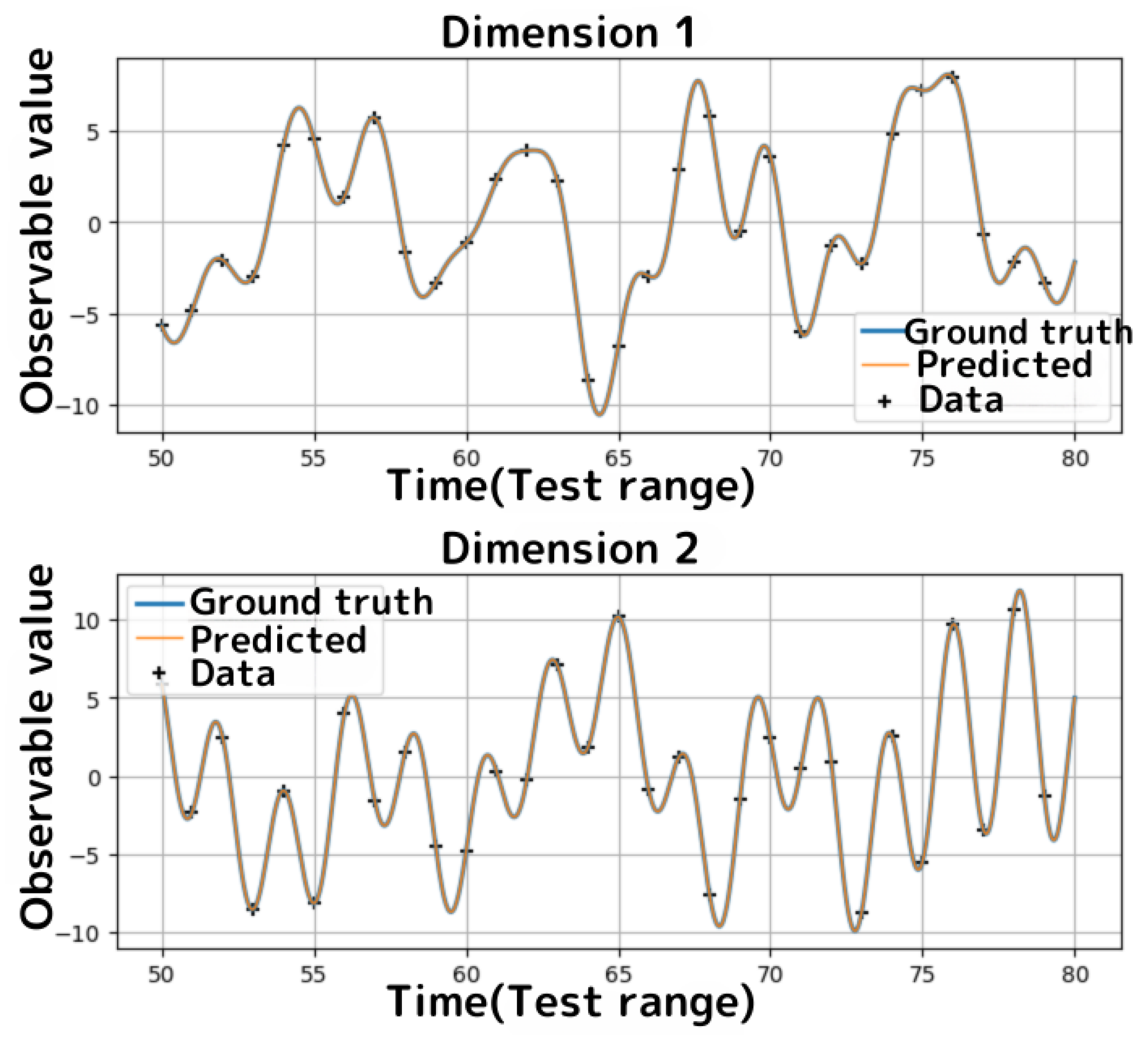
5.3. Results of the Simulations
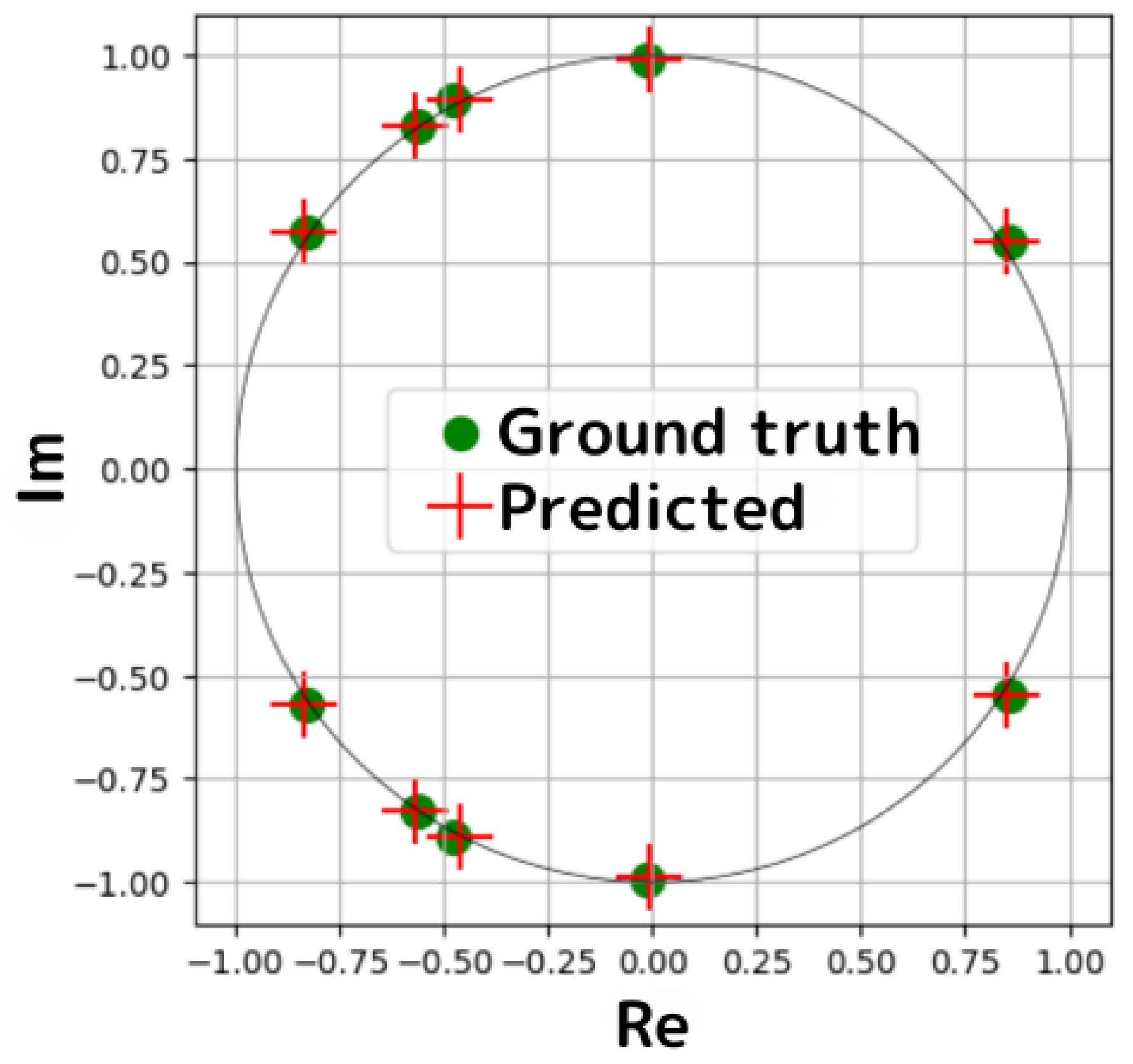
5.3.1. Scenario 1
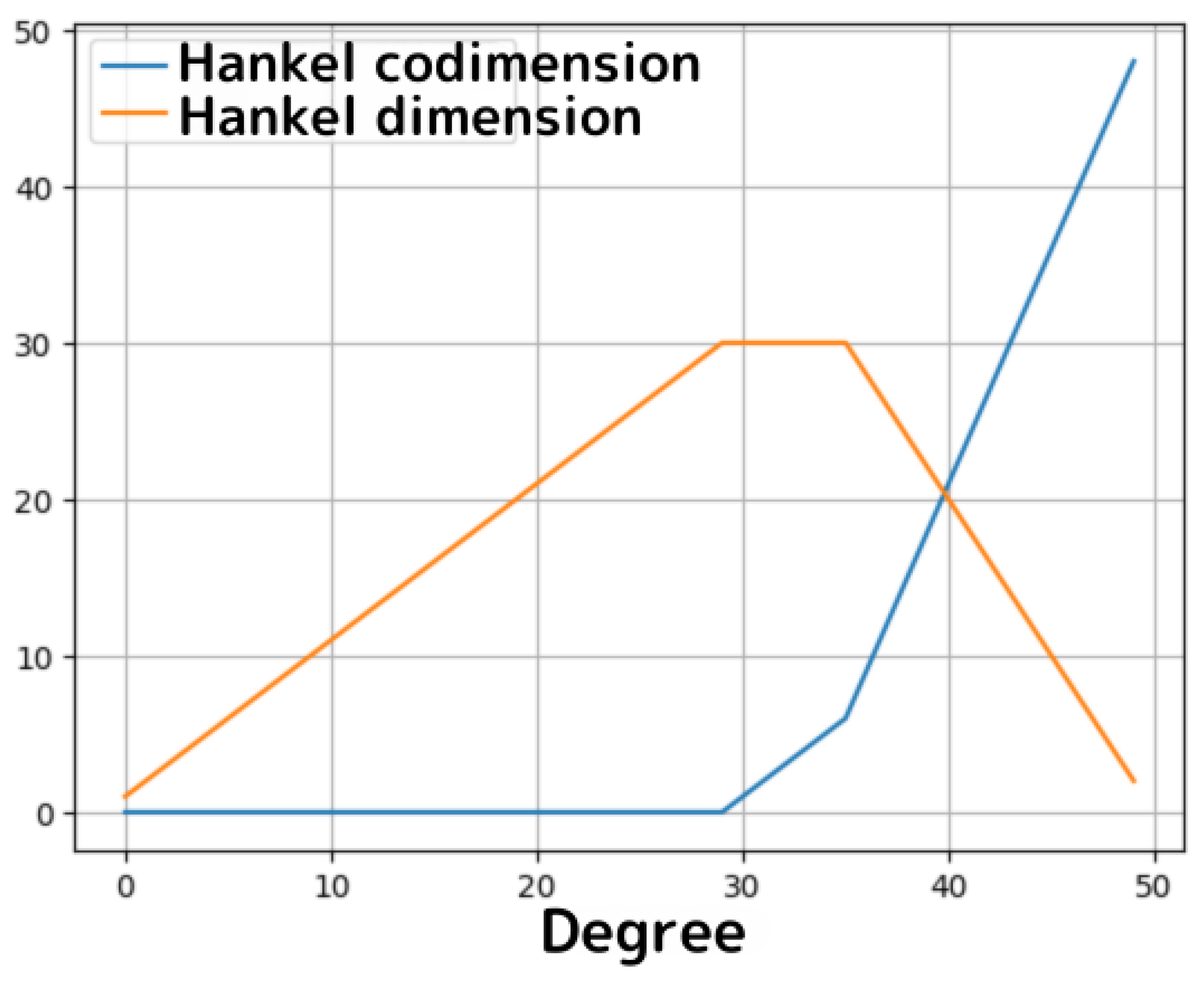
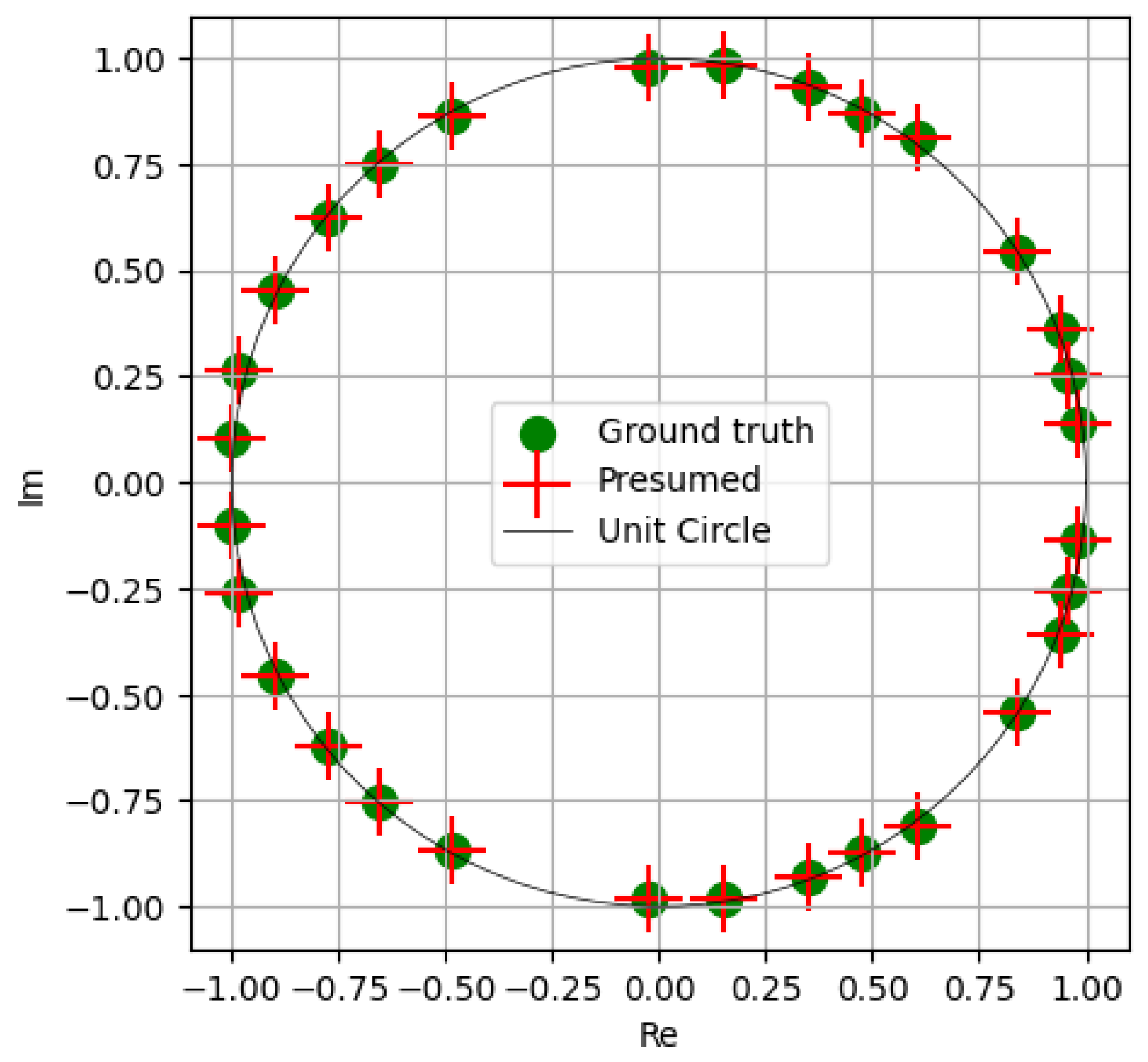
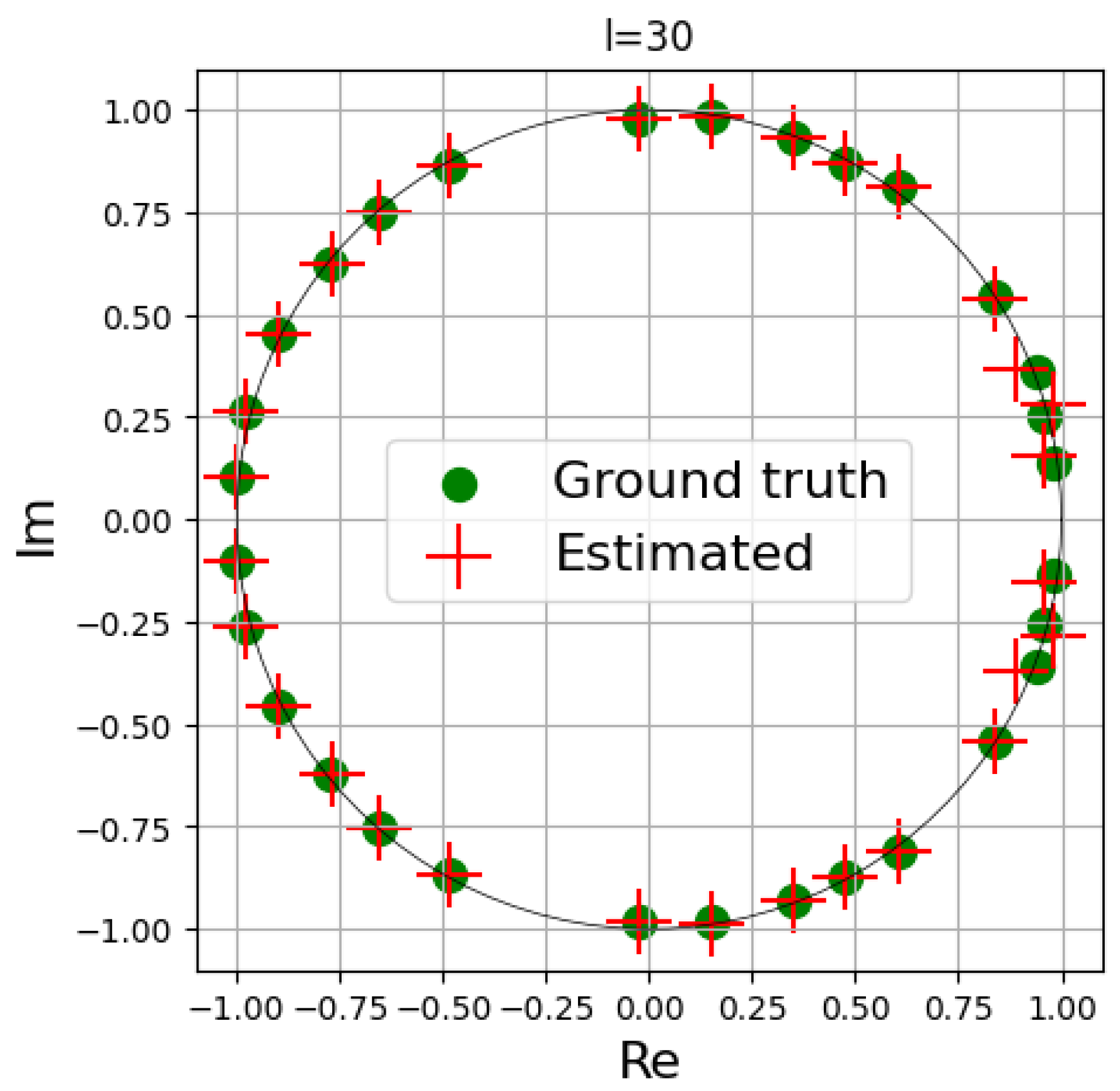
5.3.2. Scenario 2
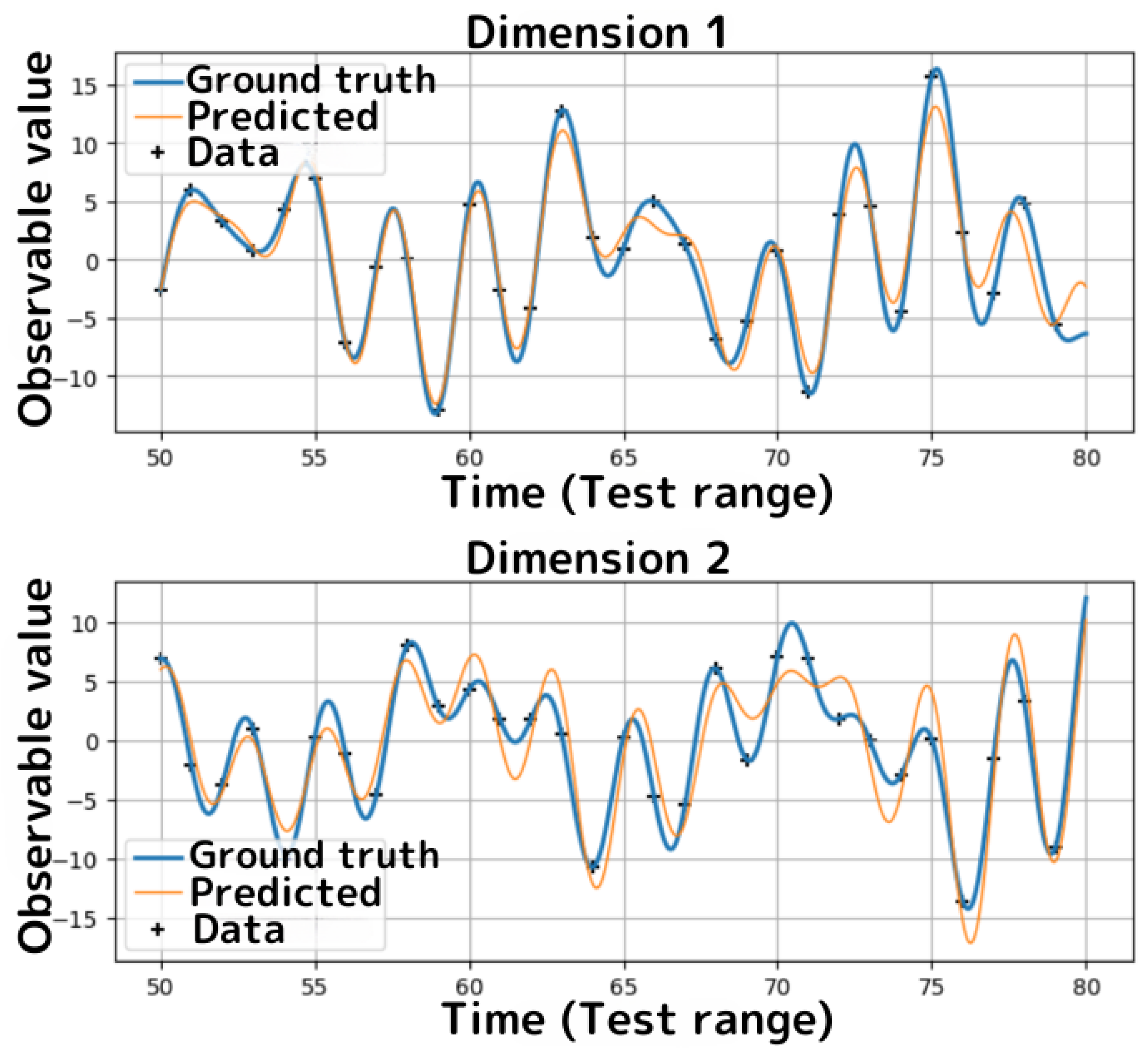
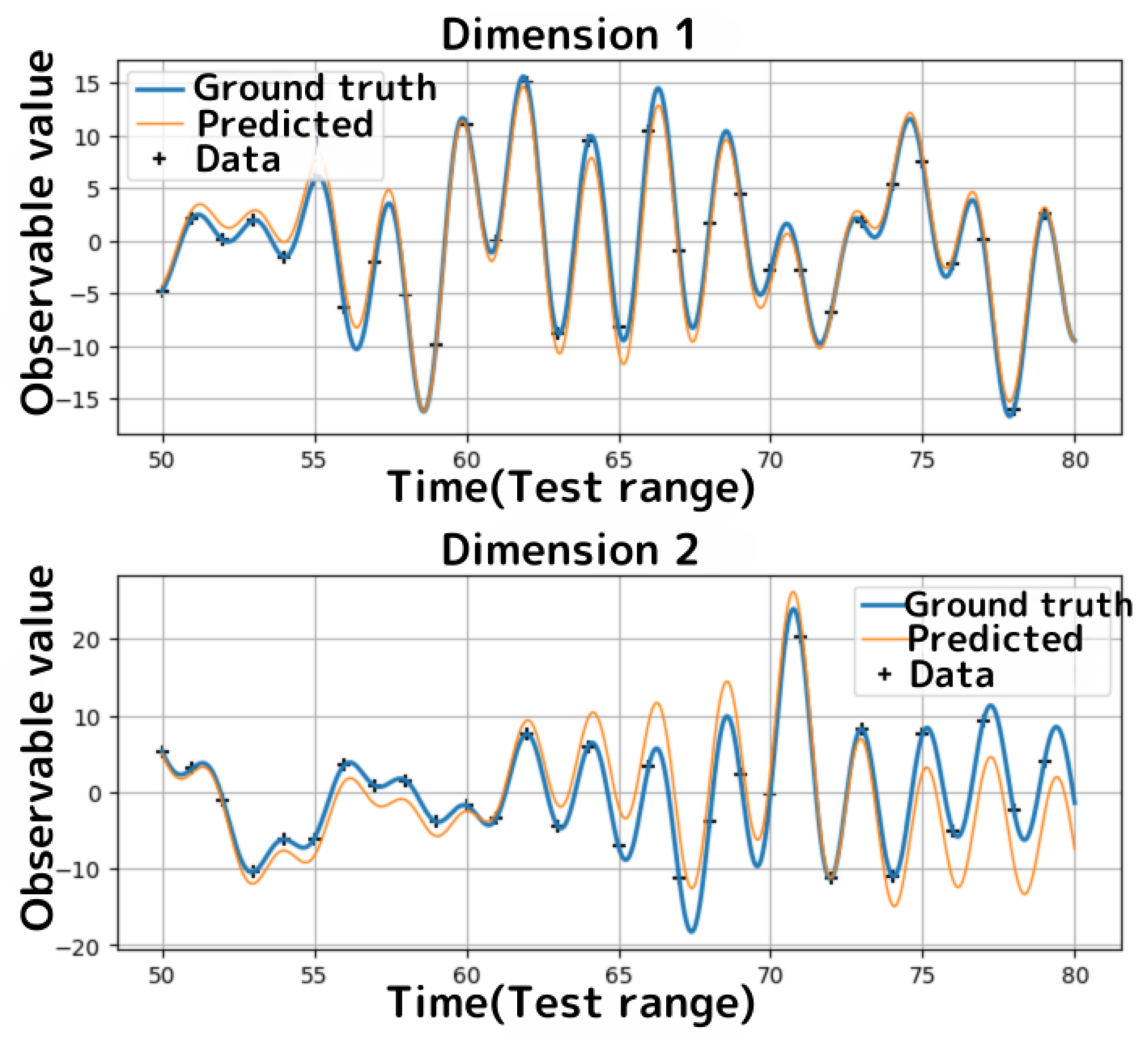
5.3.3. Scenario 3
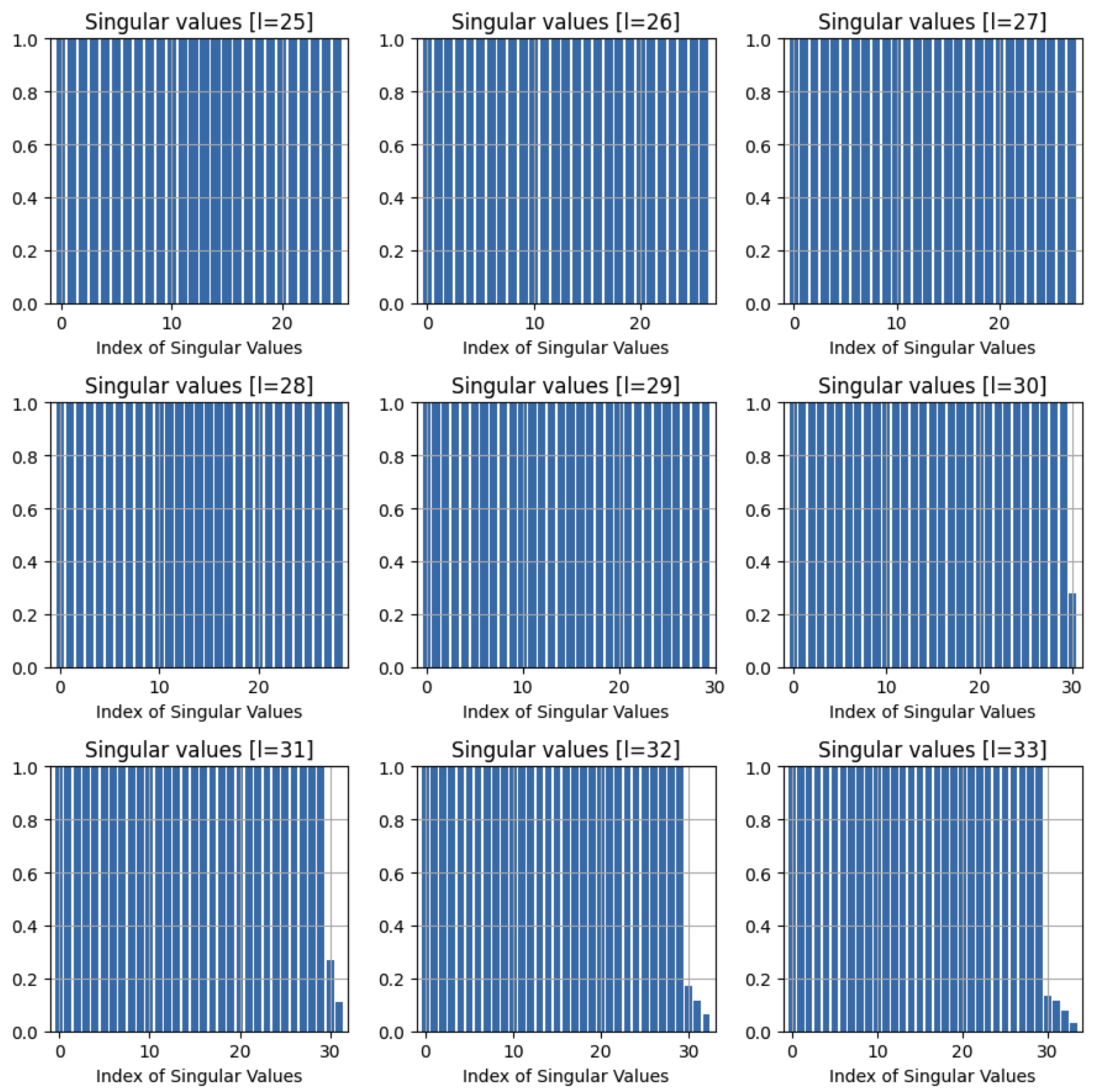
5.3.4. Scenario 4
6. Conclusions
Author Contributions
Funding
Data Availability Statement
Conflicts of Interest
References
- Rudin, W. Real and Complex Analysis, 3rd ed.; McGraw-Hill: New York, NY, USA, 1987. [Google Scholar]
- Koopman, B.O. Hamiltonian systems and transformation in Hilbert space. Proc. Natl. Acad. Sci. USA 1931, 17, 315–318. [Google Scholar] [CrossRef] [PubMed]
- Schmid, P.J. Dynamic mode decomposition of numerical and experimental data. J. Fluid Mech. 2010, 656, 5–28. [Google Scholar] [CrossRef]
- Rowley, C.W.; Mezić, I.; Bagheri, S.; Schlatter, P.; Henningson, D.S. Spectral analysis of nonlinear flows. J. Fluid Mech. 2009, 641, 115–127. [Google Scholar] [CrossRef]
- Tu, J.H.; Rowley, C.W.; Luchtenburg, D.M.; Brunton, S.L.; Kutz, J.N. On dynamic mode decomposition: Theory and applications. J. Comput. Dyn. 2014, 1, 391. [Google Scholar] [CrossRef]
- Taira, K.; Brunton, S.L.; Dawson, S.T.; Rowley, C.W.; Colonius, T.; McKeon, B.J.; Schmidt, O.T.; Gordeyev, S.; Theofilis, V.; Ukeiley, L.S. Modal analysis of fluid flows: An overview. AIAA J. 2017, 55, 4013–4041. [Google Scholar] [CrossRef]
- Brunton, S.L.; Brunton, B.W.; Proctor, J.L.; Kaiser, E.; Kutz, J.N. Chaos as an intermittently forced linear system. Nat. Commun. 2017, 8, 19. [Google Scholar] [CrossRef] [PubMed]
- Brunton, B.W.; Johnson, L.A.; Ojemann, J.G.; Kutz, J.N. Extracting spatial–temporal coherent patterns in large-scale neural recordings using dynamic mode decomposition. J. Neurosci. Methods 2016, 258, 1–15. [Google Scholar] [CrossRef] [PubMed]
- Taylor, R.; Kutz, J.N.; Morgan, K.; Nelson, B.A. Dynamic mode decomposition for plasma diagnostics and validation. Rev. Sci. Instruments 2018, 89, 053501. [Google Scholar] [CrossRef] [PubMed]
- Kaptanoglu, A.A.; Morgan, K.D.; Hansen, C.J.; Brunton, S.L. Characterizing magnetized plasmas with dynamic mode decomposition. Phys. Plasmas 2020, 27, 032108. [Google Scholar] [CrossRef]
- Kusaba, A.; Shin, K.; Shepard, D.; Kuboyama, T. Predictive Nonlinear Modeling by Koopman Mode Decomposition. In Proceedings of the 2020 International Conference on Data Mining Workshops (ICDMW), Sorrento, Italy, 17–20 November 2020; pp. 811–819. [Google Scholar] [CrossRef]
- Fujii, K.; Takeishi, N.; Kibushi, B.; Kouzaki, M.; Kawahara, Y. Data-driven spectral analysis for coordinative structures in periodic human locomotion. Sci. Rep. 2019, 9, 16755. [Google Scholar] [CrossRef] [PubMed]
- Berger, E.; Sastuba, M.; Vogt, D.; Jung, B.; Ben Amor, H. Estimation of perturbations in robotic behavior using dynamic mode decomposition. Adv. Robot. 2015, 29, 331–343. [Google Scholar] [CrossRef]
- Takeishi, N.; Kawahara, Y.; Yairi, T. Sparse nonnegative dynamic mode decomposition. In Proceedings of the 2017 IEEE International Conference on Image Processing (ICIP), Beijing, China, 17–20 September 2017; pp. 2682–2686. [Google Scholar] [CrossRef]
- Rudin, W. Functional Analysis, 2nd ed.; McGraw-Hill Series in Higher Mathematics; McGraw-Hill, Inc.: New York, NY, USA, 1991. [Google Scholar]
- Horn, R.A.; Johnson, C.R. Matrix Analysis, 2nd ed.; Cambridge University Press: Cambridge, UK, 2012. [Google Scholar]
- Mezić, I. Spectral properties of dynamical systems, model reduction and decompositions. Nonlinear Dyn. 2005, 41, 309–325. [Google Scholar] [CrossRef]
- Susuki, Y.; Mezic, I. A Prony approximation of Koopman mode decomposition. In Proceedings of the 2015 54th IEEE Conference on Decision and Control (CDC), Osaka, Japan, 15–18 December 2015; pp. 7022–7027. [Google Scholar] [CrossRef]





| Notation | Description |
|---|---|
| ℓ | Koopman degree. |
| Column vectors of observables. | |
| Koopman eigenvalues of an ℓ-degree DKMD. | |
| Koopman modes of an ℓ-degree DKMD. | |
| Observable matrix . | |
| Mode matrix . | |
| Submatrix for . | |
| The ith row vector of . | |
| Vandermonde matrix (Definition 2). | |
| Hankel matrix (Definition 6). | |
| kth Hankel dimension of , defined as (Definition 10). | |
| kth Hankel codimension of , defined as (Definition 10). | |
| L | The smallest ℓ such that . |
| Entry of a matrix at row i and column j. | |
| Frobenius norm of : . | |
| Moore–Penrose pseudoinverse of ; minimizes . | |
| Transpose of . | |
| Conjugate transpose of . | |
| Subspace spanned by the column vectors of . | |
| Matrix obtained by appending the n columns of to . | |
| Orthogonal complement of a subspace . | |
| The ith component of a vector . | |
| n-dimensional zero row vector . | |
| Column vector defined as for . | |
| Block diagonal matrix with diagonal blocks . |
| Algorithms | Theoretical | Practical | ||
|---|---|---|---|---|
| QRD | EqS | SVD | EqS | |
| Algorithm 1 | 1 | 0 | 1 | 0 |
| Algorithm 2 | 1 | 0 | 1 | 0 |
| Algorithm 3 | 1 | 1 | 1 | 1 |
| Algorithm 4 | < | 0 | < | 0 |
| Scenario Number | Type | No. of Major Eigenvalues | No. of Minor Eigenvalues | Noise Inclusion |
|---|---|---|---|---|
| 1 | 10 | 0 | No | |
| 2 | 30 | 0 | No | |
| 3 | 10 | 90 | Yes | |
| 4 | 30 | 70 | Yes |
Disclaimer/Publisher’s Note: The statements, opinions and data contained in all publications are solely those of the individual author(s) and contributor(s) and not of MDPI and/or the editor(s). MDPI and/or the editor(s) disclaim responsibility for any injury to people or property resulting from any ideas, methods, instructions or products referred to in the content. |
© 2026 by the authors. Licensee MDPI, Basel, Switzerland. This article is an open access article distributed under the terms and conditions of the Creative Commons Attribution (CC BY) license.
Share and Cite
Shin, K.; Asaoka, S. Correct Degree Selection for Koopman Mode Decomposition. Mathematics 2026, 14, 603. https://doi.org/10.3390/math14040603
Shin K, Asaoka S. Correct Degree Selection for Koopman Mode Decomposition. Mathematics. 2026; 14(4):603. https://doi.org/10.3390/math14040603
Chicago/Turabian StyleShin, Kilho, and Shodai Asaoka. 2026. "Correct Degree Selection for Koopman Mode Decomposition" Mathematics 14, no. 4: 603. https://doi.org/10.3390/math14040603
APA StyleShin, K., & Asaoka, S. (2026). Correct Degree Selection for Koopman Mode Decomposition. Mathematics, 14(4), 603. https://doi.org/10.3390/math14040603