Algorithms for Solving Systems of Boolean Equations Based on the Transformation of Logical Expressions

 , , , and
Abstract
1. Introduction
2. Criteria for Analytical Transformations of Boolean Expressions
3. Methods of Boolean Formula Transformations for Simplifying Logical Statements
4. Text Example
5. Solution of Second-Degree Nonlinear Boolean Equation Systems of a Special Class
- –
- Groups of elements of the statements in system R are identified;
- –
- All possible groupings within these groups are performed, and new variables are introduced.
- –
- From each group, such groupings of elements are selected to ensure that for the resulting system , the functional is maximized among all functionals of systems formed from the groupings of the system’s groups.
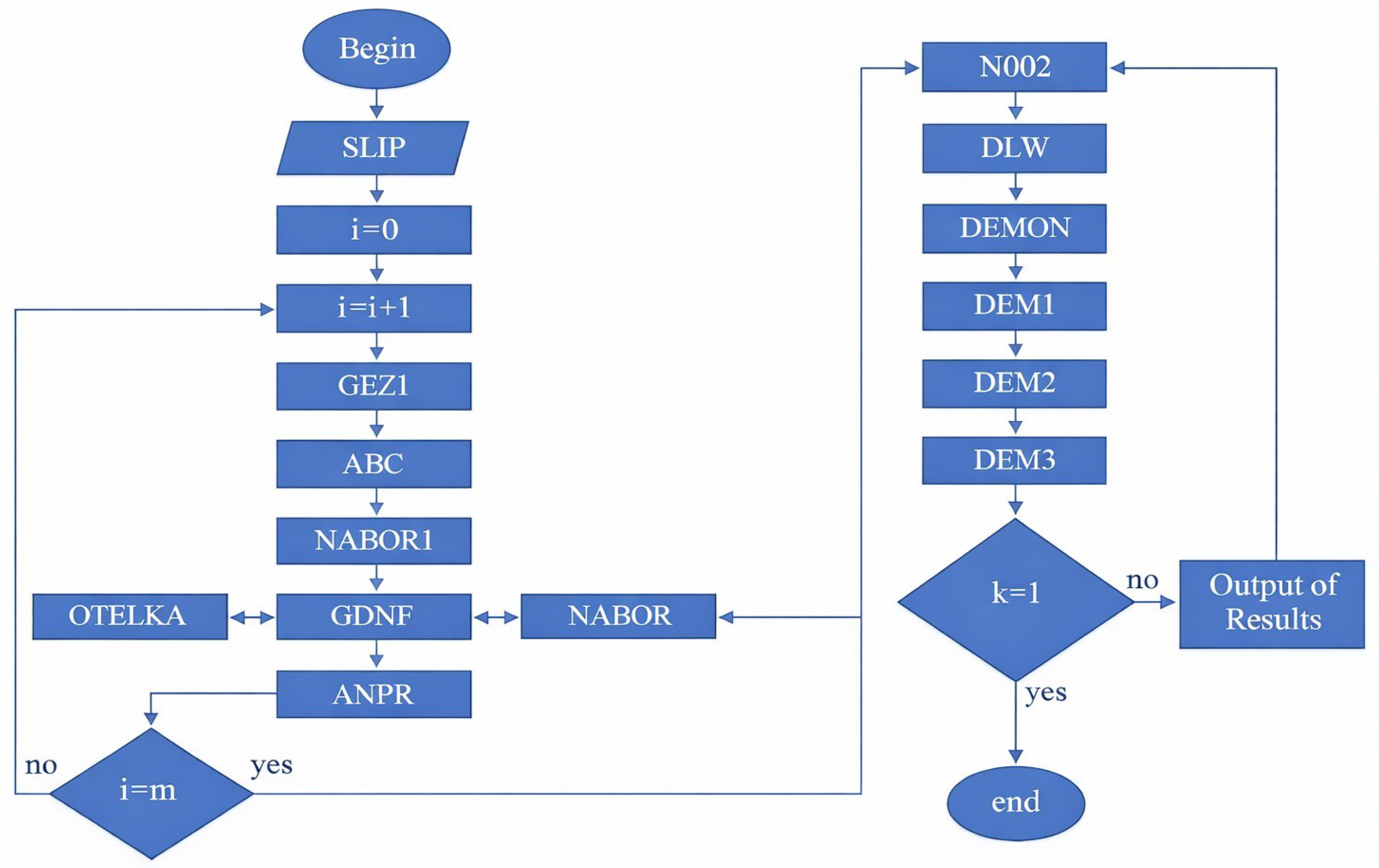
6. Description and Structure of the Program for Solving a Special Class System and a Test Example
- –
- F represents a Zhegalkin polynomial of a special type (a statement of system R);
- –
- is an array of encoded logical expressions;
- –
- is the number of structural components (s.k.).
- –
- L is the number of structural components in the A array;
- –
- A is an array of bit strings corresponding to structural components.
- –
- is the array of sets from the set ;
- –
- N is the number of bits in vectors from ;
- –
- K is the number of ones in the coordinates.
- –
- is the number of c.c.;
- –
- is a binary set;
- –
- is the number of one-bit positions;
- –
- is an auxiliary conditional parameter.
- –
- —a bit string of c.c. statements of the Zhegalkin polynomial;
- –
- —an array of elements;
- –
- —the number of c.c. of the Zhegalkin polynomial at input and the number of c.c. in DNF at output;
- –
- —arrays of bit strings of c.c. in DNF;
- –
- N—the number of variables;
- –
- —an auxiliary conditional parameter;
- –
- K—the number of unit coordinates.
- –
- —the number of elementary conjunctions in the DNF of system ;
- –
- —arrays of binary sets representing the form;
- –
- —an elementary conjunction in analytical form;
- –
- N—the number of variables;
- –
- Z—an array of encoded functions.
- –
- —the number of equations in the system;
- –
- N—the number of variables;
- –
- T—an array containing the number of elementary conjunctions in the equations of system R;
- –
- B—an array of complex conjunctions in system R.
- –
- —an array defining the number of equations;
- –
- L—the size of array ;
- –
- B—an array of elementary conjunctions in the equations;
- –
- —a conditional parameter;
- –
- —the size of array B;
- –
- N—the number of variables.
- –
- —a vector corresponding to the Zhegalkin polynomial in the product;
- –
- A—a vector corresponding to the remaining part of the product ;
- –
- —the number of Zhegalkin polynomials in BB and the dimension of arrays A;
- –
- N—the number of variables.
- –
- —the number of Zhegalkin polynomials in the product;
- –
- B—a vector corresponding to the Zhegalkin polynomial in the product;
- –
- A—a vector corresponding to the remaining part of the product;
- –
- —the dimension of vector A.
7. Instruction for the RLSY Program (Solution of Logical Systems of Equations)
- –
- N—number of variables;
- –
- M—number of equations;
- –
- —formulas of the system of logical equations of a special second-degree class.
- A
- The solution to this system is . Taking into account the previous variable roots, we obtain the general solution of the system without the fourth equation: .
- B
- Thus, we obtain the general solution of the system without the third equation: .
8. Conclusions
Author Contributions
Funding
Data Availability Statement
Acknowledgments
Conflicts of Interest
References
- Chong, J.; Jiang, N.; Zhuo, Z.; Zhang, W. Boolean Functions with Two Distinct Nega-Hadamard Coefficients. IEICE Trans. Fundam. Electron. Commun. Comput. Sci. 2024, 107, 1603–1608. [Google Scholar] [CrossRef]
- Carlet, C. Boolean Functions for Cryptography and Coding Theory; Cambridge University Press: Cambridge, UK, 2020. [Google Scholar]
- Picek, S.; Carlet, C.; Guilley, S.; Miller, J.F.; Jakobovic, D. Evolutionary Algorithms for Boolean Functions in Diverse Domains of Cryptography. Evol. Comput. 2016, 24, 667–694. [Google Scholar] [CrossRef]
- Garcia, F.; Simmons, H.; Kumar, S. Classification of Boolean Functions. Discret. Appl. Math. 2022, 290, 9–23. [Google Scholar]
- Bushnell, M.L.; Agrawal, V.D. Essentials of Electronic Testing for Digital, Memory and Mixed-Signal VLSI Circuits; Kluwer Academic Publishers: Boston, MA, USA, 2000. [Google Scholar]
- O’Donnell, R. Analysis of Boolean Functions; Cambridge University Press: New York, NY, USA, 2014. [Google Scholar] [CrossRef]
- Lee, S.-Y.; Riener, H.; Mishchenko, A.; Brayton, R.K.; De Micheli, G. A Simulation-Guided Paradigm for Logic Synthesis and Verification. IEEE Trans. Comput.-Aided Des. Integr. Circuits Syst. 2022, 41, 2573–2586. [Google Scholar] [CrossRef]
- Wang, C.; Agarwal, R.P.; Regan, D.O.; Sakthivel, R. Theory of Translation Closedness for Time Scales; Springer Nature: New York, NY, USA, 2020. [Google Scholar] [CrossRef]
- Ahmed, M.; Baker, T.; Patel, S. On the Cryptographic Properties of Boolean Functions. J. Cryptogr. Eng. 2022, 12, 231–245. [Google Scholar]
- Muhiddinov, M.; Ochilov, N.; Umurkulov, B.; Kholnazarov, U.; Sapaev, I.; Bazarova, N.; Kholova, M.; Aripova, G. Privacy-Aware Information Security for E-Learning Platforms in History Using Attribute-Based Encryption Algorithm. J. Internet Serv. Inf. Secur. 2025, 15, 305–-315. [Google Scholar] [CrossRef]
- Xia, B.; Mantegh, I.; Xie, W.-F. Hybrid Framework for UAV Motion Planning and Obstacle Avoidance: Integrating Deep Reinforcement Learning with Fuzzy Logic. In Proceedings of the 2024 10th International Conference on Control, Decision and Information Technologies (CoDIT), Valletta, Malta, 1–4 July 2024; Volume 9, pp. 2662–2669. [Google Scholar] [CrossRef]
- Bakhronova, D.; Narziyeva, M.; Yuldosheva, N.; Zayniyeva, U.; Yusupov, J.; Uralov, B.; Sapaev, I.; Khikmatov, N. Intelligent Information Security System for Language and History Education Using Machine Learning-based Intrusion Detection Algorithm. J. Internet Serv. Inf. Secur. 2025, 15, 520–529. [Google Scholar] [CrossRef]
- Kabulov, A.; Saymanov, I.; Yarashov, I.; Muxammadiev, F. Algorithmic method of security of the Internet of Things based on steganographic coding. In Proceedings of the 2021 IEEE International IOT, Electronics and Mechatronics Conference (IEMTRONICS), Toronto, ON, Canada, 21–24 April 2021; pp. 1–5. [Google Scholar] [CrossRef]
- Cusick, T.W.; Stănică, P. Cryptographic Boolean Functions and Applications; Academic Press: San Diego, CA, USA, 2017. [Google Scholar]
- Srinivasan, C.; Lakshmy, K.V.; Sethumadhavan, M. Complexity measures of cryptographically secure boolean functions. In Cyber Security Cyber Crime and Cyber Forensics Applications and Perspectives; IGI Global: Hershey, PA, USA, 2011; pp. 220–230. [Google Scholar] [CrossRef]
- Rosen, K.H. Discrete Mathematics and Its Applications, 8th ed; McGraw-Hill: New York, NY, USA, 2019; p. 1120. [Google Scholar]
- Zheng, J. Security analysis of Boolean algebra based on Zhang-Wang digital signature scheme. AIP Conf. Proc. 2014, 1618, 507–509. [Google Scholar] [CrossRef]
- Kim, J.; Nguyen, F.; Lee, S. Boolean Functions in Cryptography. IEEE Trans. Inf. Theory 2024, 70, 310–325. [Google Scholar]
- Green, R.; Ahmed, L.; Qureshi, N. Circuit Realizations of Boolean Functions. J. Log. Comput. 2021, 31, 222–236. [Google Scholar]
- Jackson, T.; Velasquez, M.; Dutta, R. Spectral Properties of Boolean Functions. Comput. Complex. 2022, 29, 1065–1079. [Google Scholar]
- Kim, D.; Nair, V.; Zhang, X. Boolean Functions in Quantum Computing. Quantum Comput. Quantum Inf. 2022, 33, 12–29. [Google Scholar]
- Jukna, S. Boolean Function Complexity: Advances and Frontiers; Springer: Berlin, Germany, 2012. [Google Scholar] [CrossRef]
- Ballani, F. The surface pair correlation function for stationary Boolean models. Adv. Appl. Probab. 2007, 39, 1–15. [Google Scholar] [CrossRef][Green Version]
- Wegener, I. The Complexity of Boolean Functions; John Wiley & Sons: Chichester, UK, 1987. [Google Scholar]
- López-López, I.; Sosa-Gómez, G.; Segura, C.; Oliva, D.; Rojas, O. Metaheuristics in the Optimization of Cryptographic Boolean Functions. Entropy 2020, 22, 1052. [Google Scholar] [CrossRef]
- Bonich, T.A.; Panferov, M.A.; Tokareva, N.N. On the number of ℓ-suitable Boolean functions in constructions of filter and combining models of stream ciphers. Prikl. Diskretn. Mat. 2023, 62, 1211–1216. [Google Scholar] [CrossRef]
- Sun, Q.; Wei, S.; Saymanov, I.; Lu, Y.; Deng, W.; Lou, J. A Mechanical–Electrical Damage Model for Performance Analysis of Crack-based Strain Sensor. Int. J. Appl. Mech. Source Preview 2025, 18, 2550124. [Google Scholar] [CrossRef]
- Sun, Z.; Ambrosi, E.; Bricalli, A.; Ielmini, D. Logic Computing with Stateful Neural Networks of Resistive Switches. Adv. Mater. 2018, 30, 1802554. [Google Scholar] [CrossRef]
- Stallings, W. Cryptography and Network Security: Principles and Practice, 7th ed.; Pearson Prentice Hall: Boston, MA, USA, 2017. [Google Scholar]
- Mesnager, S. Bent Functions: Fundamentals and Results; Springer: Cham, Switzerland, 2016. [Google Scholar] [CrossRef]
- Brayton, R.K.; Hachtel, G.D.; McMullen, C.T.; Sangiovanni-Vincentelli, A.L. Logic Minimization Algorithms for VLSI Synthesis; Kluwer Academic Publishers: Boston, MA, USA, 1984. [Google Scholar] [CrossRef]
- Yang, Y.; Zhang, L.; An, L. Fixed-Time Adaptive Fault-Tolerant Control for Uncertain Nonlinear Systems with Actuator Faults. Appl. Math. Comput. 2025, 516, 129867. [Google Scholar] [CrossRef]
- Kuzmin, A.S.; Markov, V.T.; Nechaev, A.A.; Neljubin, A.S. A Generalization of the Binary Preparata Code. Discret. Appl. Math. 2005, 154, 337–345. [Google Scholar] [CrossRef][Green Version]
- Hiep, X.H.; Bao, H.L.; Hung, V.C.L.; Tam, T.L.; Nghia, D.-T. Design of an IoT ultrasonic-vision based system for automatic fruit sorting utilizing size and color. Internet Things 2024, 25, 101017. [Google Scholar] [CrossRef]
- Tran, T.C.T.; Phan, L.P.; Huynh, H.X. Approach of Item-Based Collaborative Filtering Recommendation Using Energy Distance. J. Adv. Inf. Technol. 2024, 15, 10–16. [Google Scholar] [CrossRef]
- Shukla, S.; Hussain, S.; Irshad, R.R.; Alattab, A.A.; Thakur, S.; Breslin, J.G.; Hassan, M.F.; Abimannan, S.; Husain, S.; Jameel, S.M. Network analysis in a peer-to-peer energy trading model using blockchain and machine learning. Comput. Stand. Interfaces 2024, 88, 103799. [Google Scholar] [CrossRef]
- Chang, Y.-S.; Huang, S.-T.; Haobijam, B.; Abimannan, S.; Kushida, T. Marine ecological information prediction by using adjacent location spatiotemporal deep learning model with ensemble learning techniques. Ecol. Inform. 2025, 85, 102964. [Google Scholar] [CrossRef]
- Gotarane, V.; Abimannan, S.; Hussain, S.; Irshad, R.R. A Hybrid Framework Leveraging Whale Optimization and Deep Learning With Trust-Index for Attack Identification in IoT Networks. IEEE Access 2024, 12, 36296–36310. [Google Scholar] [CrossRef]
- She, Y.; Hong, Y.; Shen, S.; Yang, B.; Zhang, L.; Wang, J. Consistency regularization for few shot multivariate time series forecasting. Sci. Rep. 2025, 15, 14195. [Google Scholar] [CrossRef]
- Makhmudov, F.; Privalov, A.; Egorenkov, S.; Pryadkin, A.; Kutlimuratov, A.; Bekbaev, G.; Cho, Y.I. Analytical Approach to UAV Cargo Delivery Processes Under Malicious Interference Conditions. Mathematics 2025, 13, 2008. [Google Scholar] [CrossRef]
- Kabulov, A.; Baizhumanov, A.; Saymanov, I. Synthesis of Optimal Correction Functions in the Class of Disjunctive Normal Forms. Mathematics 2024, 12, 2120. [Google Scholar] [CrossRef]
- Saymanov, I. Logical automatic implementation of steganographic coding algorithms. J. Math. Mech. Comput. Sci. 2024, 121, 122–131. [Google Scholar] [CrossRef]
- Kabulov, A.; Normatov, I.; Saymanov, I.; Baizhumanov, A. On the Completeness of Classes of Correcting Functions of Heuristic Algorithms. Azerbaijan J. Math. 2025, 15, 51–64. [Google Scholar] [CrossRef]
- GOST R 34.12-2015; Information Technology. Cryptographic Data Security. Block Ciphers. Technical Committee for Standardization “Cryptography and Security Mechanisms” (TC 26): Moscow, Russia, 2015.


| X | ||||||
|---|---|---|---|---|---|---|
| R | ||||||
| 1 | 1 | *1 | 0 | * | 1 | |
| 2 | * | 0 | 1 | 0 | 1 | |
| 3 | * | * | 0 | * | 0 | |
| 4 | 0 | * | 0 | * | 0 | |
| X | ||||||
|---|---|---|---|---|---|---|
| 1 | * 1 | 1 | 1 | * | * | |
| 2 | * | * | 1 | 1 | * | |
| 3 | * | * | 1 | * | 0 | |
| 4 | 0 | 1 | * | * | 1 | |
| 5 | 0 | * | * | 1 | 1 | |
| 6 | 0 | * | 0 | * | * | |
| Number of Solutions | ||
|---|---|---|
| ; | ; | ; |
| ; | ; | ; |
| -optional | -optional | |
| 8 | 4 | 1 |
| Number of Solutions | |
|---|---|
| ; | |
| -optional | |
| 8 | 3 |
| No. | ||||||
|---|---|---|---|---|---|---|
| 11 | 7 | 18 | 3 | 2 | 5 | |
| 10 | 7 | 17 | 3 | 2 | 5 | |
| 10 | 7 | 17 | 3 | 2 | 5 | |
| 9 | 6 | 15 | 3 | 2 | 5 | |
| 9 | 6 | 15 | 3 | 2 | 5 | |
| 9 | 6 | 15 | 3 | 2 | 5 | |
| 10 | 7 | 17 | 3 | 2 | 5 | |
| 9 | 6 | 15 | 3 | 2 | 5 | |
| Total | 77 | 52 | 129 | 24 | 16 | 40 |
Disclaimer/Publisher’s Note: The statements, opinions and data contained in all publications are solely those of the individual author(s) and contributor(s) and not of MDPI and/or the editor(s). MDPI and/or the editor(s) disclaim responsibility for any injury to people or property resulting from any ideas, methods, instructions or products referred to in the content. |
© 2026 by the authors. Licensee MDPI, Basel, Switzerland. This article is an open access article distributed under the terms and conditions of the Creative Commons Attribution (CC BY) license.
Share and Cite
Kabulov, A.; Babadzhanov, A.; Baizhumanov, A.; Saymanov, I.; Babadjanov, A. Algorithms for Solving Systems of Boolean Equations Based on the Transformation of Logical Expressions. Mathematics 2026, 14, 594. https://doi.org/10.3390/math14040594
Kabulov A, Babadzhanov A, Baizhumanov A, Saymanov I, Babadjanov A. Algorithms for Solving Systems of Boolean Equations Based on the Transformation of Logical Expressions. Mathematics. 2026; 14(4):594. https://doi.org/10.3390/math14040594
Chicago/Turabian StyleKabulov, Anvar, Alimdzhan Babadzhanov, Abdussattar Baizhumanov, Islambek Saymanov, and Akbarjon Babadjanov. 2026. "Algorithms for Solving Systems of Boolean Equations Based on the Transformation of Logical Expressions" Mathematics 14, no. 4: 594. https://doi.org/10.3390/math14040594
APA StyleKabulov, A., Babadzhanov, A., Baizhumanov, A., Saymanov, I., & Babadjanov, A. (2026). Algorithms for Solving Systems of Boolean Equations Based on the Transformation of Logical Expressions. Mathematics, 14(4), 594. https://doi.org/10.3390/math14040594