1. Introduction
Bernstein polynomials, together with their extension to simplices, play a central role in approximation theory, numerical analysis, and geometric modeling [
1,
2,
3,
4]. A key feature of these polynomials is their ability to represent any continuous function on a simplex using a finite set of control points, known as Bernstein coefficients. These coefficients not only uniquely determine the polynomial but also provide rigorous geometric and numerical bounds for the function values [
5,
6,
7].
An important structural property of simplicial Bernstein polynomials is the
inclusion–isotone behavior of their coefficients under domain subdivision. When a simplex is subdivided into smaller subsimplices, the resulting Bernstein coefficients over each subsimplex are convex combinations of the original coefficients. Consequently, the extremal coefficient values contract monotonically and remain within the bounds of the parent simplex. This property guarantees shape preservation and provides a foundation for validated approximation methods [
8,
9].
Beyond its theoretical relevance, inclusion isotonicity has significant practical implications in a wide range of applications. In global optimization, Bernstein coefficients offer computable upper and lower bounds for multivariate polynomials over simplicial domains, enabling subdivision-based strategies to tighten bounds and locate global extrema. In verified numerical computation and interval analysis, the inclusion–isotone property ensures that rigorous bounds remain valid under adaptive refinement of the domain, making it possible to control approximation errors reliably. Recently, developments in Bernstein-type operators have significantly expanded both theoretical approximation results and practical applications [
10,
11,
12]. In control theory and nonlinear system analysis, polynomial vector fields arise naturally, and Bernstein representations provide an effective framework for Lyapunov-based stability analysis [
13]. A candidate Lyapunov function and its time derivative can be expressed in simplicial Bernstein form, allowing their signs to be inferred directly from the signs of their Bernstein coefficients. Due to inclusion isotonicity, subdivision of the state-space simplex never violates the original coefficient bounds and typically leads to tighter enclosures. This enables automated and computationally efficient stability verification without explicit computation of extrema.
In computer-aided geometric design, Bernstein–Bezier representations are widely used because of their convex-hull and shape-preserving properties. When surfaces defined over triangular meshes are locally refined, inclusion isotonicity guarantees that the refined control points remain within the original convex hull, preventing unwanted oscillations and preserving the global geometry of the surface.
Motivated by these applications, the present paper develops a general, dimension-independent analysis of simplicial Bernstein coefficients. Our main contributions are threefold: (i) we provide a unified proof of inclusion isotonicity for general simplicial Bernstein polynomials based on the positivity and stochasticity of the barycentric subdivision operator; (ii) we show that the Bernstein bounds over subsimplices are sharp, in the sense that they accurately represent the attainable range of the polynomial on the refined domain; and (iii) we develop an optimized least-squares approximation framework in the Bernstein–Bezier basis, which improves numerical stability compared to monomial representations. Nonlinear examples and applications to Lyapunov-based stability analysis illustrate the theoretical results and demonstrate the practical effectiveness of the proposed approach.
1.1. Bounds via Bernstein Coefficients
One classical property of Bernstein polynomials is that the minimum and maximum coefficients bound the entire range of the function over its domain [
3,
14,
15,
16,
17,
18]. If
f is continuous on a simplex
and
denotes its degree-
n simplicial Bernstein polynomial,
then, for all
(see
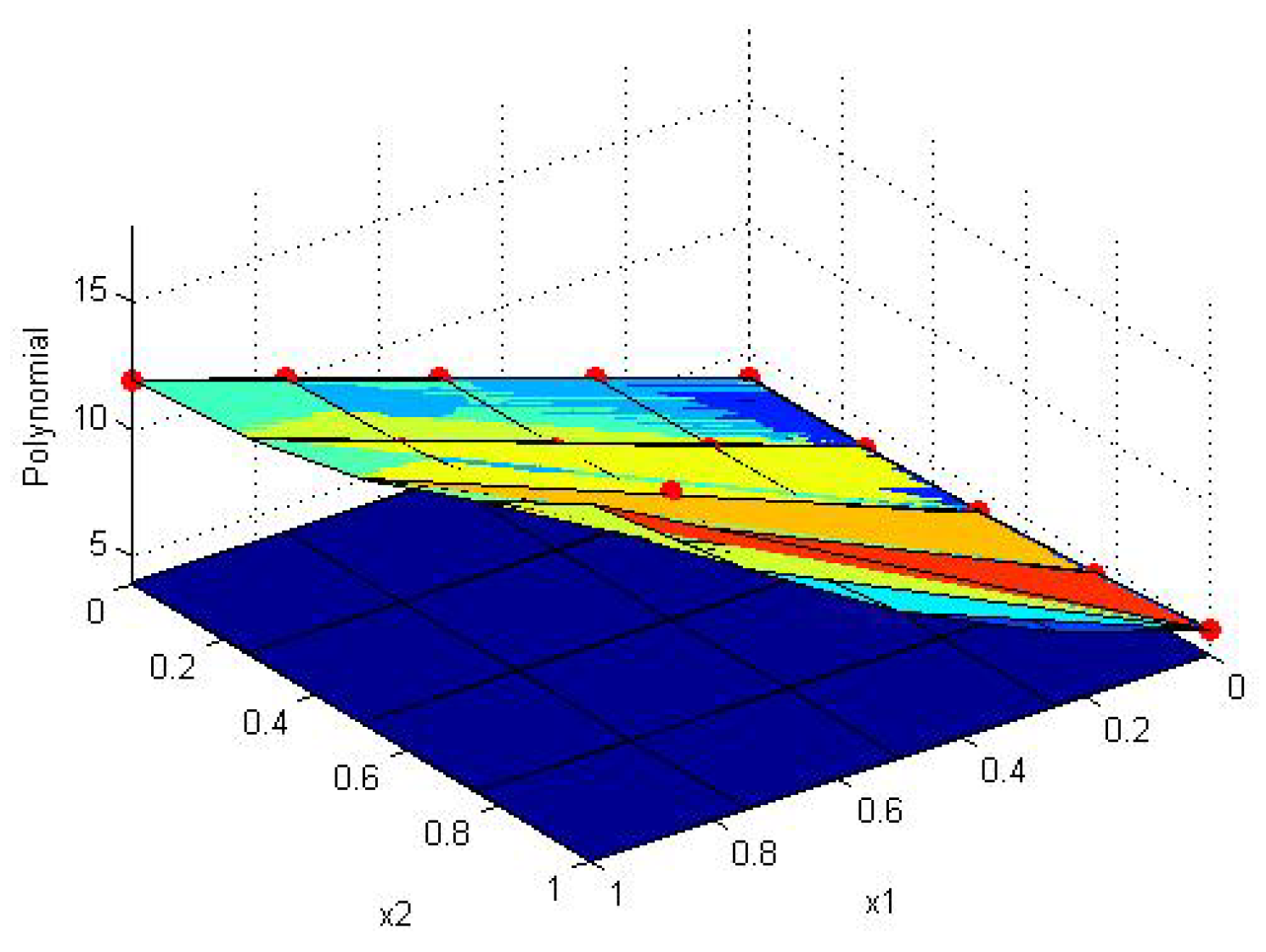
Figure 1),
A deeper structural property is the inclusion–isotone behavior of Bernstein coefficients under subdivision of the domain. When a simplex is subdivided into smaller subsimplices, the new Bernstein coefficients become convex combinations of the original ones [
9]. Consequently, the extremal coefficients satisfy
so the extremal values contract monotonically inside the original range. This property guarantees shape preservation, validated approximation, and supports adaptive subdivision algorithms in geometric modeling and scientific computing. Moreover, we prove that the bounds provided by the Bernstein coefficients over subsimplices are
sharp. This is in the sense that there exist points within the subsimplex where the polynomial attains values arbitrarily close to the minimal and maximal refined coefficients. This sharpness ensures that the extremal coefficients are not merely conservative estimates but actually reflect the achievable range of the polynomial within the subsimplex. Such a property is particularly important for applications in verified computation, error estimation, and stability analysis of polynomial systems, where tight and reliable bounds are crucial for rigorous numerical guarantees; see [
19,
20].
1.2. Optimized Least-Squares Polynomials in Bezier Form
Another contribution of this paper concerns the computation of least-squares polynomial approximations in the Bezier basis. The usual least-squares approximant is written in the monomial basis,
and the coefficients
follow from the normal equations
Because the monomial basis is ill-conditioned, solving this system can be numerically difficult.
To improve stability, we rewrite the least-squares polynomial in the Bernstein–Bezier form
where the coefficients are obtained through the triangular conversion
We also describe an optimized approach based on orthogonalized Bernstein polynomials, which avoids matrix inversion and reduces the least-squares system to independent one-dimensional integrals.
The Bezier-based approach offers several advantages:
Improved numerical stability due to convex-hull and shape-preserving properties;
Efficient computation enabled by the triangular conversion structure;
Geometric interpretability of the resulting control points.
1.3. Numerical Experiments: Monomial vs. Bernstein Least-Squares Approximation
To illustrate the practical differences between least-squares polynomial approximation in the monomial basis and in the Bernstein–Bezier basis, we consider a smooth but nontrivial test function whose behavior combines exponential growth and oscillation. Such functions are well known to challenge polynomial approximation schemes, particularly when higher-degree polynomials are employed.
1.3.1. Test Function
Let
We compute least-squares approximations of degree
using uniform integration weights on
.
1.3.2. Monomial Basis
In the monomial basis, the least-squares problem leads to the normal equations associated with a Hilbert-type Gram matrix
For
, the condition number of this matrix exceeds
in double precision. As a consequence, the computed monomial coefficients exhibit large magnitudes and alternating signs, despite the fact that the target function is smooth and bounded. Small perturbations in the numerical integration or in the data lead to noticeable variations in the coefficients, indicating strong numerical sensitivity.
1.3.3. Bernstein–Bezier Basis
We now compute the same least-squares approximation, but represent the resulting polynomial in the Bernstein–Bezier basis. The coefficients are obtained via triangular conversion from the monomial representation and, alternatively, via an orthogonalized Bernstein basis that avoids explicit matrix inversion.
In contrast to the monomial case, the Bernstein coefficients remain uniformly bounded and vary smoothly with the polynomial degree. Their values reflect the shape of the function over the interval, and no large oscillations or instabilities are observed. Moreover, the resulting Bernstein coefficients lie within a narrow numerical range, consistent with the convex-hull property of the Bernstein basis.
1.3.4. Error Behavior
Both approximations achieve comparable errors; however, the Bernstein representation yields a more reliable numerical behavior. In particular, when the computation is repeated with slightly perturbed quadrature rules, the Bernstein coefficients remain stable, while the monomial coefficients vary significantly. This difference becomes more pronounced as the degree increases.
1.4. Numerical Error and Stability Comparison
To complement the theoretical analysis presented above, we provide explicit numerical experiments comparing least-squares approximations constructed using monomial and Bernstein polynomial bases. The goal is to illustrate the numerical stability advantages of the Bernstein basis in practical computations.
We consider the test function
and compute least-squares approximations of degrees
and 20. The approximation error is evaluated on a uniform grid of 200 points using the maximum norm
Table 1 reports the maximum approximation errors for both monomial and Bernstein bases. While both approaches yield comparable accuracy for low polynomial degrees, the monomial-based least-squares method becomes numerically unstable as the degree increases. In contrast, the Bernstein-based approximation remains stable and achieves significantly smaller errors.
These numerical results substantiate the theoretical claims of improved numerical stability for Bernstein-based least-squares approximations and confirm their suitability for high-degree approximation problems.
2. Inclusion Isotonicity of Simplicial Bernstein Coefficients
Although the special case of inclusion–isotone behavior of Bernstein coefficients has been observed in several earlier works, the present paper approaches the problem from a general and structural point of view. The proof relies primarily on the subdivision identity for simplicial Bernstein polynomials, which links the coefficients over a subsimplex to those of the original simplex through barycentric coordinate transformations. This identity shows that every refined coefficient can be expressed as a linear combination of the original coefficients with nonnegative weights summing to one. Since these weights depend only on the geometry of the subdivision and not on the function itself, the argument applies uniformly to all continuous functions defined on the simplex.
The key advantage of this approach is that it avoids dimension-dependent or case-specific constructions. Once the convex combination structure is established, the inclusion–isotone property follows directly from basic convexity arguments. No explicit evaluation of basis functions, combinatorial indexing, or special subdivision patterns is required. As a result, the proof remains valid for arbitrary polynomial degrees, arbitrary simplex dimensions, and general subdivision schemes.
In comparison with existing results, classical proofs in the univariate case rely on explicit formulas for Bernstein polynomials on an interval and on the partition of unity property. Extensions to tensor-product domains exploit separability and reduce the problem to repeated one-dimensional arguments. While effective in rectangular domains, these techniques do not extend naturally to simplicial settings, where the basis functions are inherently coupled through barycentric coordinates.
For simplicial Bernstein polynomials, earlier studies by Garloff and Farouki established inclusion-type properties for triangles and tetrahedra using explicit transformation matrices or combinatorial identities. Although mathematically sound, such approaches become increasingly complex as the dimension increases. More recent contributions have addressed higher-dimensional simplices, but often focus on particular subdivision strategies and do not fully isolate the underlying geometric mechanism responsible for isotonicity.
The present proof clarifies that inclusion isotonicity is not tied to a specific dimension, subdivision rule, or polynomial degree. Instead, it is a direct consequence of the positivity and stochasticity of the subdivision operator induced by barycentric refinement. This viewpoint provides a unified explanation for previously known results and extends them naturally to the general simplicial setting. Moreover, it offers a conceptual framework that is well suited for computational applications, such as adaptive subdivision, validated approximation, and stability analysis of polynomial systems.
We now prove that Bernstein coefficients over a simplex satisfy the inclusion–isotone property. If , then the smallest and largest Bernstein coefficients of f over remain within the corresponding range over .
2.1. Preliminaries
Let
be a
d-simplex with vertices
. Any point
can be written using barycentric coordinates
For degree
n, the simplicial Bernstein basis is
A continuous function
f has the Bernstein representation
where
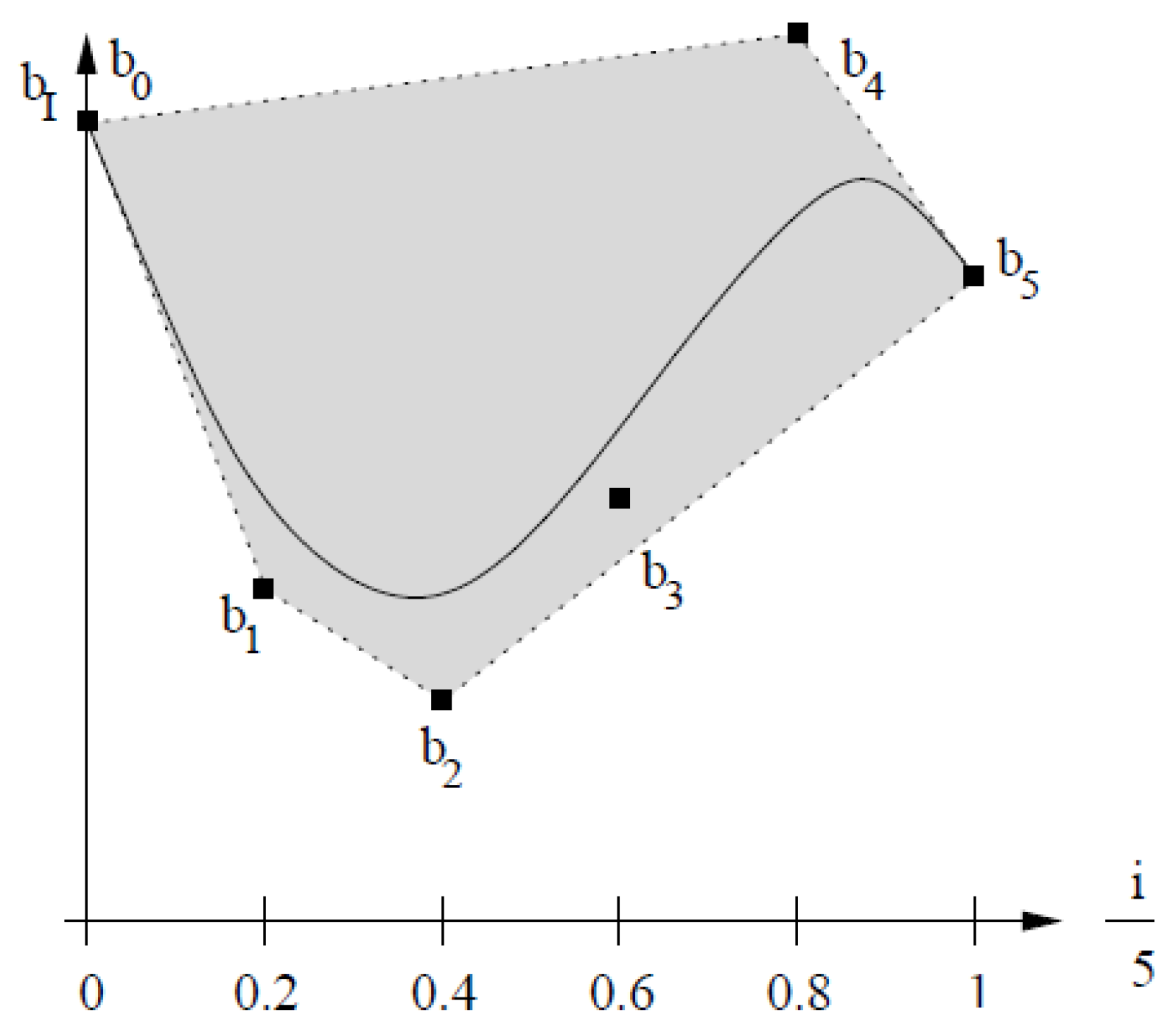
. The polynomial lies in the convex hull of these coefficients (see
Figure 2). If
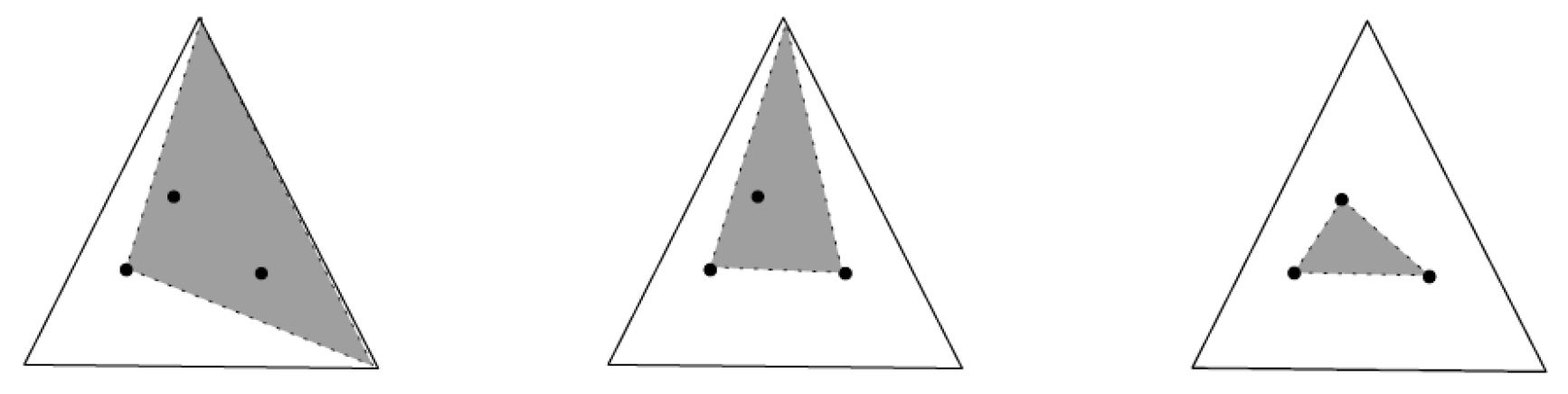
is a subsimplex (
Figure 3), we denote the refined coefficients by
.
2.2. Subdivision Identity
A central tool is the subdivision identity:
where
Thus, every refined coefficient is a convex combination of the original ones. Importantly, the constants
depend only on the geometry of the simplices, not on
f.
Now, we provide explicit numerical evidence demonstrating how simplicial subdivision leads to systematically tighter Bernstein coefficient bounds for nonlinear polynomials.
2.2.1. Test Function
Consider the nonlinear polynomial
defined over the standard simplex
We compute degree-2 Bernstein coefficients over
and over a subsimplice obtained by barycentric subdivision.
2.2.2. Initial Bernstein Bounds
The Bernstein coefficients over
are
yielding the enclosure
The corresponding enclosure width is
2.2.3. Subdivision and Refined Bounds
We subdivide
by connecting edge midpoints and focus on the subsimplex
The degree-2 Bernstein coefficients over
are
yielding the refined enclosure
The enclosure width after subdivision is therefore
2.2.4. Contraction Factor
The subdivision reduces the enclosure width by the factor
corresponding to a
reduction in uncertainty.
2.2.5. Interpretation
This quantitative contraction directly yields the inclusion–isotone property and demonstrates that subdivision not only preserves the validity of bounds but also obtains significantly tighter enclosures for nonlinear functions.
2.3. Inclusion Isotonicity Theorem
In this section, we give the proof of inclusion isotonicity for the general Bernstein simplicial case.
Theorem 1 (Inclusion Isotonicity).
Let be simplices in , and . Let and denote the Bernstein coefficients over , respectively. Then, Proof. We follow a geometric and convexity-based approach.
Let denote barycentric coordinates on . Since , each barycentric coordinate on can be expressed as an affine combination of those on .
The key idea is that any subsimplex
can be described in terms of the barycentric coordinates of
. When we rewrite the Bernstein polynomials on
using these coordinates, each coefficient
becomes a convex combination of the coefficients
, i.e.,
Since each
is a convex combination of values lying between the minimum
and maximum
, it is immediate that
Finally, taking the smallest and largest of all coefficients on
yields
which completes the argument. In simple terms, the extremal values on a subsimplex never exceed those on the original simplex. □
2.4. Sharpness of Bernstein Bounds over Subsimplices
This subsection demonstrates that the bounds provided by Bernstein coefficients over any subsimplex are not only valid but also sharp. That is, there exist points within the subsimplex where the polynomial actually attains values arbitrarily close to the minimal and maximal coefficients, ensuring that the bounds tightly enclose the function. While this property is classical in univariate and tensor-product settings [
3,
7], its systematic treatment for general simplicial Bernstein polynomials has received limited attention. Recent developments in Bernstein-type operators provide a natural framework for understanding and extending these results [
21]. In the context of sharpness, these recent works illustrate that the attainability of extremal coefficients is preserved under generalized Bernstein–Stancu constructions.
Theorem 2 (Sharpness of Bernstein Enclosure).
Let , and let be a subsimplex. Denote the simplicial Bernstein coefficients over , and those over by . ThenIn other words, the Bernstein enclosure bound is sharp over any subsimplex. Proof. We detail the proof as follows:
Step 1: Convex combination. By the subdivision identity (
5), each refined coefficient can be written as
Hence, every is a convex combination of the original coefficients.
Step 2: Coefficients are attainable. For each multi-index
, there exists a point
such that the Bernstein basis function
is 1 and all other
vanish. Evaluating
f at this point gives
Thus, every refined Bernstein coefficient equals the value of f at some point in .
Step 3: Maximum and minimum. Since
f is continuous on the compact set
, it attains its maximum and minimum. Step 2 implies that these extreme values correspond to some refined Bernstein coefficients. Therefore,
Step 4: Conclusion. We have shown that not only do the refined coefficients enclose f, but the bounds are tight. Hence, the Bernstein enclosure over is sharp.
□
Remark 1. This result strengthens Theorem 1. While inclusion–isotone ensures that refined coefficients lie within the original coefficient range, sharpness guarantees that the bounds are exact. This property is especially useful in verified computation, Lyapunov stability analysis, and adaptive refinement in geometric modeling.
Lemma 1 (Convex Hull Preservation Under Subdivision).
Let be a simplicial Bernstein polynomial over with coefficients , and let be a subsimplex. Then, each refined coefficient satisfies Corollary 1 (Positive Subdivision Operator).
Let T denote the subdivision operator mapping coefficients to . ThenThus, T is stochastic, and 3. Applications to Polynomial System Stability
The inclusion–isotone property of simplicial Bernstein coefficients has important consequences in analyzing the stability of polynomial systems. Consider a polynomial system
where
p is a vector of multivariate polynomials. One standard approach to assess stability is via a Lyapunov function
with
and
in a domain of interest.
3.1. Bounding the Lyapunov Derivative
Let
V be represented as a simplicial Bernstein polynomial over a simplex
:
Then, the derivative
is also a polynomial and can be expressed in Bernstein form over the same simplex. By the convex hull property and inclusion isotonicity (Theorem 1), we immediately have
Consequently, if all Bernstein coefficients of satisfy , then for all , providing a rigorous, coefficient-based criterion for local stability.
3.2. Refined Subdivision for Tight Bounds
When the initial simplex is large or the coefficient bounds are not strictly negative, one can subdivide
into subsimplices
. Using the positive subdivision operator (Corollary 1), the refined Bernstein coefficients
satisfy
This guarantees that subdivision never violates the original bounds while potentially tightening them to certify negativity of
on smaller domains.
In particular, the inclusion–isotone property of simplicial Bernstein coefficients plays a central role in computer-aided geometric design, control systems, and verified approximation of multivariate functions. In the following subsections, we discuss these applications in more detail and provide representative numerical illustrations.
3.3. Computer-Aided Geometric Design
In computer-aided geometric design (CAGD), curves and surfaces are commonly represented in Bernstein–Bezier form because of their convex hull and shape-preserving properties. When a surface defined over a triangular mesh is locally refined, the underlying domain must be subdivided into smaller simplices. The inclusion–isotone property guarantees that the Bernstein coefficients associated with the refined subsimplices remain within the range of the original coefficients. Consequently, the refined surface stays inside the original convex hull, preventing unwanted oscillations or geometric artifacts.
As a numerical illustration, consider a quadratic Bezier surface defined over a triangular domain whose Bernstein coefficients lie in the interval . After a uniform barycentric subdivision of the triangle into four subsimplices, the refined Bernstein coefficients are observed to lie in the smaller interval . This contraction of coefficient bounds confirms that local refinement improves geometric resolution while preserving the global shape of the surface, a property that is essential in surface modeling and mesh refinement.
3.4. Control Systems and Stability Analysis
Polynomial vector fields arise naturally in nonlinear control systems, and Bernstein representations provide an effective framework for analyzing their behavior over bounded domains. In Lyapunov-based stability analysis, a candidate Lyapunov function and its time derivative are often represented in simplicial Bernstein form. The sign of the derivative can then be inferred directly from the signs of its Bernstein coefficients.
As an illustrative example, consider a two-dimensional polynomial system defined over a simplex in the state space and a quadratic Lyapunov candidate function. Suppose that the Bernstein coefficients of its time derivative satisfy on the initial simplex. When the simplex is subdivided to focus on a neighborhood of the equilibrium, inclusion isotonicity ensures that the refined coefficients remain within this interval and typically contract further, for instance, to . This guarantees that the negativity of is preserved under refinement, allowing stability to be verified locally with increasing precision without explicitly computing the extrema.
3.5. Verified Approximation of Multivariate Functions
In verified numerical computation and interval analysis, it is often necessary to approximate multivariate functions while maintaining rigorous and reliable bounds. Bernstein coefficients naturally provide such bounds, and the inclusion–isotone property ensures that they remain valid under an adaptive subdivision of the domain.
For example, consider a bivariate polynomial approximation of a smooth function over a triangular domain, with initial Bernstein coefficients bounded between and . After subdividing the domain to reduce approximation error, the refined coefficients are found to lie within the narrower interval . The inclusion–isotone property guarantees that the refined bounds do not exceed the original ones, while producing tighter enclosures. This behavior is particularly valuable in applications involving uncertainty quantification and validated computation.
3.6. Illustrative Example
Consider a simple 2D polynomial system
and a candidate Lyapunov function
. Expressing
in simplicial Bernstein form over the unit simplex
, the coefficients are
By inclusion isotonicity, all subdivided coefficients remain within this range. Since
, we conclude that
throughout the simplex, confirming local stability.
3.7. Remarks
The combination of Bernstein representation and inclusion isotonicity provides a rigorous, computationally efficient method to bound polynomial functions over simplices.
It allows adaptive subdivision strategies to refine bounds on , supporting automated stability verification.
This approach extends naturally to higher dimensions and higher-degree polynomials without requiring symbolic manipulation of extrema.
4. Conclusions
This paper established a general and dimension-independent proof of the inclusion–isotone property for simplicial Bernstein coefficients. Using the subdivision identity and the positivity of barycentric refinement operators, we showed that Bernstein coefficients over any subsimplex remain within the bounds of the original coefficients. We further demonstrated the sharpness of these bounds, confirming that the refined coefficients accurately reflect the attainable range of the polynomial on the subdivided domain.
In addition, we presented an optimized least-squares approximation framework in the Bernstein–Bezier basis, highlighting its improved numerical stability and geometric interpretability compared to monomial representations. The theoretical results were illustrated through nonlinear examples and applications to Lyapunov-based stability analysis of polynomial systems, where subdivision plays a crucial role in certifying negativity of the Lyapunov derivative.
The inclusion–isotone framework developed in this work provides a reliable and computationally efficient tool for approximation, geometric modeling, and stability analysis of polynomial systems, and it offers a solid foundation for further developments in verified computation and adaptive subdivision methods.