Article

A New Trigonometric-Inspired Probability Distribution: The Weighted Sine Generalized Kumaraswamy Model with Simulation and Applications in Epidemiology and Reliability Engineering

1
Department of Computer Science, Faculty of Science and Letters, Çukurova University, Adana 01330, Türkiye
2
Department of Primary Mathematics Teaching, Faculty of Education, Mersin University, Mersin 33110, Türkiye
*
Author to whom correspondence should be addressed.
Mathematics 2026, 14(3), 510; https://doi.org/10.3390/math14030510
Submission received: 9 January 2026 / Revised: 27 January 2026 / Accepted: 28 January 2026 / Published: 31 January 2026
(This article belongs to the Section D1: Probability and Statistics)

Abstract

The importance of statistical distributions in representing real-world scenarios and aiding in decision-making is widely acknowledged. However, traditional models often face limitations in achieving optimal fits for certain datasets. Motivated by this challenge, this paper introduces a new probability distribution termed the weighted sine generalized Kumaraswamy (WSG-Kumaraswamy) distribution. This model is constructed by integrating the Kumaraswamy baseline distribution with the weighted sine-G family, which incorporates a trigonometric transformation to enhance flexibility without adding extra parameters. Various statistical properties of the WSG-Kumaraswamy distribution, including the quantile function, moments, moment-generating function, and probability-weighted moments, are derived. Maximum likelihood estimation is employed to obtain parameter estimates, and a comprehensive simulation study is performed to assess the finite-sample performance of the estimators, confirming their consistency and reliability. To illustrate the practical advantages of the proposed model, two real-world datasets from epidemiology and reliability engineering are analyzed. Comparative evaluations using goodness-of-fit criteria demonstrate that the WSG-Kumaraswamy distribution provides superior fits compared to established competitors. The results highlight the enhanced adaptability of the model for unit-interval data, positioning it as a valuable tool for statistical modeling in diverse applied fields.

1. Introduction

Probability distributions serve as fundamental tools for modeling and analyzing real-world phenomena across diverse scientific and engineering disciplines. By characterizing the uncertainty inherent in observational data, these mathematical frameworks enable researchers to make informed decisions, predict future outcomes, and understand underlying processes [1]. From reliability engineering to financial risk assessment and hydrological forecasting, probabilistic models provide the backbone for data-driven inference in applied contexts [2,3]. These models have also proven valuable in emerging areas such as sports data analysis, where the models help evaluate athlete performance and game outcomes, and music engineering, for modeling instrument lifetimes and sound patterns [4,5]. Among the extensive repertoire of continuous distributions, the Weibull model and its variants occupy a prominent position due to their flexibility and interpretability [6,7]. The two-parameter Weibull distribution, in particular, has been extensively studied and applied for modeling time-to-event data, failure rates, survival times, and extreme events in fields like physical education and reliability [8,9,10]. Flexible modifications of the Weibull baseline have recently been proposed, incorporating trigonometric elements to enhance quartile-based properties and overall fitting performance [11]. Its special cases, such as the exponential and Rayleigh distributions, further extend its utility in specific scenarios where hazard rates exhibit monotonic behavior. The Rayleigh distribution, defined on positive real line with a scale parameter, emerges as a useful model in reliability studies involving increasing failure rates [12]. Recent works have successfully applied trigonometric transformations to Rayleigh and generalized Rayleigh baselines, yielding models with enhanced flexibility for sports and engineering datasets [4,11]. Tangent-based generalizations of the Rayleigh model have shown particular promise in analyzing reliability and musical instrument data, offering superior fits without additional parameters [5]. Similar approaches have been used to modify inverse Weibull structures for hydrology and reliability applications, demonstrating superior fits in failure time modeling [3]. Despite their widespread adoption, classical distributions often lack the flexibility to capture complex data patterns, such as bathtub-shaped or unimodal-bimodal hazard rates, skewed densities, heavy-tailed behavior, or proportions bounded on the unit interval. This limitation has motivated statisticians to develop more flexible families through various generalization techniques, including the addition of shape parameters, composition methods, compounding, and transformation approaches [13]. Extra parameters, however, can introduce estimation challenges, overfitting risks, and reduced interpretability, as noted in several recent modifications of Weibull and Rayleigh models [5,11]. Recently, trigonometric-based transformations have gained attention as a parsimonious way to inject flexibility without adding parameters [14]. Notably, ref. [14] introduced the weighted sine-G (WS-G) family, which generates a new distribution by applying a specific trigonometric transformation to the cumulative distribution function of any baseline distribution. This strategy resonates with the philosophy behind recent weighted approximation methods [15], where a deterministic weight function is used to enrich model capability without increasing complexity. This method preserves the parameter count while significantly enriching density and hazard shapes, as demonstrated in several recent studies applying the WS-G family or similar trigonometric approaches to Weibull, Rayleigh, exponentiated Weibull, and inverse Weibull baselines for diverse applications including musical instruments, physical education, sports, and hydrology [3,4,5,8,11]. Alongside Weibull-type models, the Kumaraswamy distribution [16] has emerged as a versatile two-parameter model supported on the unit interval ( 0 , 1 ) . With its tractable closed-form CDF, and probability density function, it offers advantages in data fitting over the beta distribution in certain proportional data applications such as hydrological, reliability, record and actuarial datasets [17,18,19,20,21,22]. Its density assumes various shapes, including unimodal, increasing, decreasing, or U-shaped, making it particularly suitable for modeling rates, proportions, efficiencies, and other bounded phenomena. Recent extensions of the Kumaraswamy model have further expanded its use in survival analysis and double-bounded hydro-environmental data [23]. Nevertheless, the standard Kumaraswamy distribution may still be inadequate for fitting datasets exhibiting more complex behaviors, such as those with pronounced skewness or non-standard hazard forms commonly encountered in real-world unit-interval data. While some generalized Kumaraswamy families exist in the literature, a trigonometric-weighted modification based on the WS-G approach has not yet been explored for this distribution. This gap presents an opportunity to develop a more adaptable model that retains the simplicity of Kumaraswamy and bounded support while enhancing its flexibility for practical modeling in reliability and related fields. Motivated by the above considerations, this study introduces the weighted sine generalized Kumaraswamy (WSG-Kumaraswamy) distribution, derived by applying the WS-G transformation to the Kumaraswamy baseline. The extensions of the Kumaraswamy distribution usually introduce one or more additional shape parameters, which may complicate estimation and increase the risk of overfitting. The WSG-Kumaraswamy distribution proposed in this work follows a different strategy: it applies the weighted sine-G transformation, a deterministic trigonometric weighting that enhances the density and hazard-rate shapes without adding extra parameters. Consequently, the model preserves the parsimony of the two-parameter Kumaraswamy baseline while gaining the flexibility to represent hazard rates with various shapes. This makes it especially attractive for unit-interval data where conventional Kumaraswamy variants may lack the necessary adaptability.
The proposed model inherits the bounded support of Kumaraswamy and tractability but gains considerable extra flexibility in density and hazard shapes without introducing additional parameters. The specific aims of this paper are
1.
To define the WSG-Kumaraswamy distribution and derive its essential statistical properties.
2.
To estimate the model parameters using the maximum likelihood method and evaluate the performance of the estimator via a comprehensive simulation study.
3.
To demonstrate the practical utility of the distribution by applying it to two real-world datasets and comparing its fit against several competing distributions.
The remainder of the paper is organized as follows. Section 2 presents the WSG-Kumaraswamy distribution and its density, survival and hazard functions. Section 3 derives key statistical properties including quantile function, moments and moment-generating function. Section 4 discusses parameter estimation via maximum likelihood estimation method. Section 5 provides the simulation details and reports the simulation results. Section 6 provides two empirical applications. Finally, Section 7 offers concluding remarks and suggests directions for future research.

2. WSG-Kumaraswamy Distribution

The Kumaraswamy distribution, a flexible two-parameter model supported on the unit interval ( 0 , 1 ) , has found widespread use in many areas due to its closed-form CDF and tractability compared to the beta distribution [17,22]. The cumulative distribution function (CDF) and probability density function (PDF) of the Kumaraswamy distribution are given by
F K ( y δ , α ) = 1 ( 1 y δ ) α , 0 < y < 1 ,
and
f K ( y δ , α ) = δ α y δ 1 ( 1 y δ ) α 1 , 0 < y < 1 ,
where δ > 0 and α > 0 are shape parameters.
The approach introduced by [14], referred to as the WS-G family, offers a systematic way to construct new probability distributions based on a trigonometric transformation without introducing additional parameters. The CDF of the WS-G family is defined as follows:
F ( y ; ξ ) = sin π 2 G ( y ; ξ ) e 1 sin π 2 G ( y ; ξ ) ,
with the corresponding PDF
f ( y ; ξ ) = π 2 g ( y ; ξ ) cos π 2 G ( y ; ξ ) e 1 sin π 2 G ( y ; ξ ) 1 sin π 2 G ( y ; ξ ) ,
where G ( y ; ξ ) and g ( y ; ξ ) are the baseline CDF and PDF, respectively.
In this section, we propose the WSG-Kumaraswamy distribution as a novel extension obtained by applying the WS-G family transformation to the Kumaraswamy baseline. Substituting the Kumaraswamy CDF (1) to Equation (2) yields the CDF of the WSG-Kumaraswamy distribution as
F ( y δ , α ) = cos π 2 ( 1 y δ ) α e 1 cos π 2 ( 1 y δ ) α , 0 < y < 1 , δ , α > 0 .
The PDF corresponding to the CDF given in Equation (3) for the WSG-Kumaraswamy distribution is
f ( y δ , α ) = π 2 δ α y δ 1 ( 1 y δ ) α 1 cos π 2 ( 1 y δ ) α e 1 cos π 2 ( 1 y δ ) α 1 cos π 2 ( 1 y δ ) α .
The survival function (SF) and hazard rate function (HRF) of the WSG-Kumaraswamy distribution are
S ( y δ , α ) = 1 cos π 2 ( 1 y δ ) α e 1 cos π 2 ( 1 y δ ) α ,
and
h ( y δ , α ) = π 2 δ α y δ 1 ( 1 y δ ) α 1 cos π 2 ( 1 y δ ) α e 1 cos π 2 ( 1 y δ ) α 1 cos π 2 ( 1 y δ ) α 1 cos π 2 ( 1 y δ ) α e 1 cos π 2 ( 1 y δ ) α .
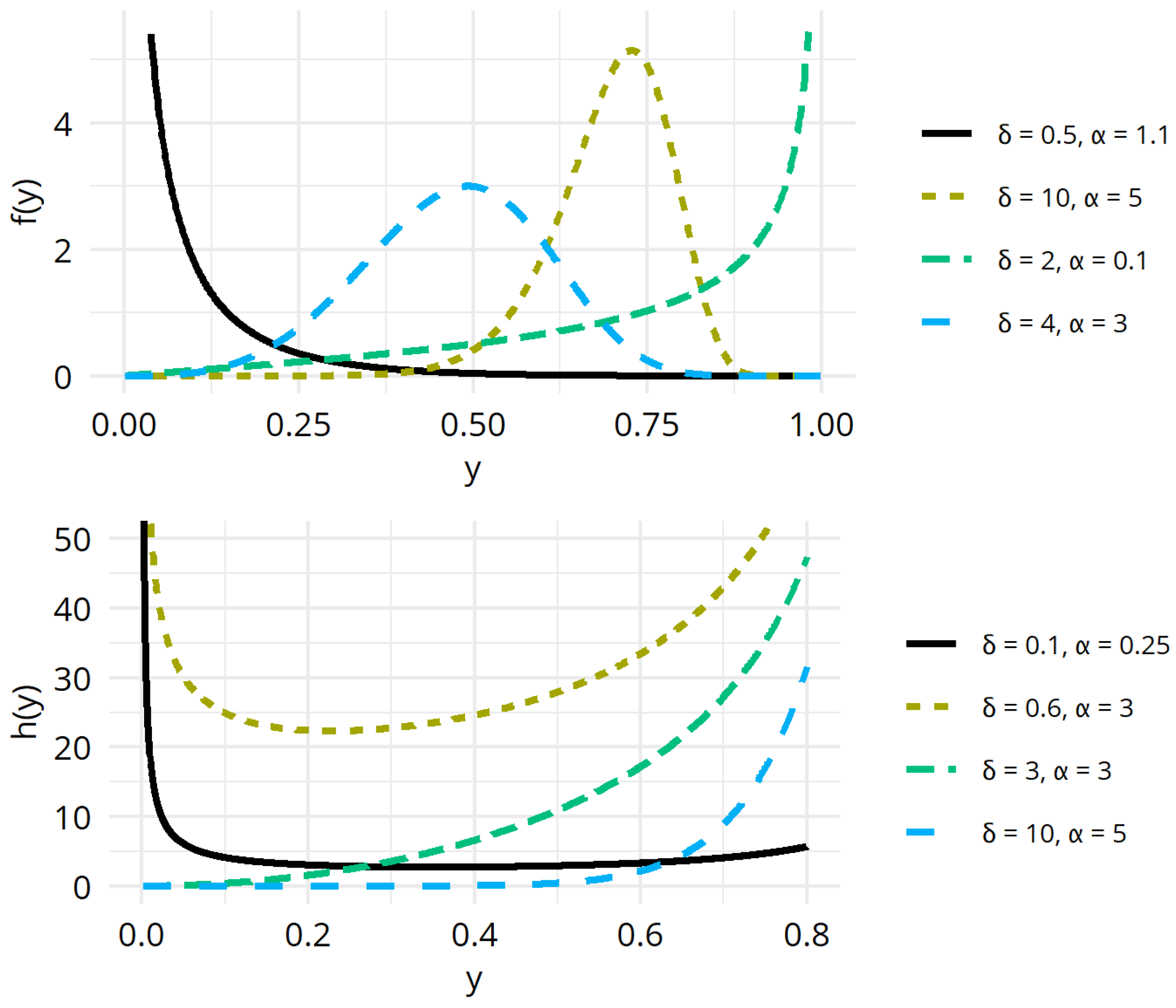
The WSG-Kumaraswamy distribution offers considerable flexibility for modeling data on ( 0 , 1 ) . The top panel of Figure 1 illustrates various shapes of its PDF, including decreasing, increasing, and near-symmetric and skewed unimodal patterns. The bottom panel of Figure 1 displays the HRF plots, which exhibit decreasing, bathtub, or increasing behaviors depending on the parameter values.

3. Statistical Properties

In this section, we derive different statistical properties of the WSG-Kumaraswamy distribution, involving the quantile function, moments and moment generating function.

3.1. The Quantile Function

The quantile function is a fundamental tool for computing quantiles and generating random numbers from a given distribution. For the WSG-Kumaraswamy distribution with CDF given in Equation (3), the p-th quantile Q ( p ) satisfies the equation
cos π 2 1 Q ( p ) δ α exp 1 cos π 2 1 Q ( p ) δ α = p , 0 < p < 1 .
Due to the transcendental nature of Equation (5), an explicit closed-form solution for Q ( p ) in terms of elementary functions is not available. Nevertheless, the quantile function can be computed efficiently using numerical algorithms. To improve numerical stability, we rewrite the defining Equation (5) in logarithmic form
log cos π 2 1 Q ( p ) δ α p + 1 cos π 2 1 Q ( p ) δ α = 0 .
Equation (6) is well-behaved for all p ( 0 , 1 ) and solved numerically using Brent’s algorithm, which is robust and efficient even for extreme probabilities. The logarithmic formulation avoids underflow or overflow issues, and convergence is typically achieved within a small number of iterations. This makes the quantile function suitable for large-scale simulation and bootstrap procedures.
To comprehensively characterize the behavior of the WSG-Kumaraswamy distribution, we computed quantiles for a systematic parameter grid. The quantile function is computed numerically by solving Equation (6) using the uniroot function in R version 4.4.3. Table 1 presents the quantile values for δ { 0.5 , 1 , 2 , 5 , 10 } and α { 0.5 , 1 , 2 , 5 , 10 } at probability levels p { 0.01 , 0.1 , 0.25 , 0.5 , 0.75 , 0.9 , 0.99 , 0.999 } .
The quantile values in Table 1 reveal that the WSG-Kumaraswamy distribution offers substantial flexibility in shape behavior. The  parameter δ primarily controls location, with larger values shifting the distribution toward higher quantiles. Conversely, α influences both scale and shape, as increasing values concentrate probability mass near zero and reduce overall dispersion. The model accommodates diverse distributional forms, ranging from highly right-skewed to nearly symmetric configurations.

3.2. Moments

Moments of a probability distribution play a fundamental role in describing its location, variability, asymmetry, and tail behavior, all of which are central to statistical inference. For the WSG-Kumaraswamy distribution, the r-th raw moment is given by
E Y r = 0 1 π 2 δ α y r + δ 1 ( 1 y δ ) α 1 cos π 2 ( 1 y δ ) α e 1 cos π 2 ( 1 y δ ) α 1 cos π 2 ( 1 y δ ) α d y .
To evaluate the integral in Equation (7), we apply the change of variable θ = π 2 ( 1 y δ ) α , which leads to
E Y r = 0 π / 2 1 2 θ π 1 / α r / δ cos θ e 1 cos θ ( 1 cos θ ) d θ .
Since the integral in Equation (8) lacks a closed-form solution, we derive a series representation. The  kernel cos θ e 1 cos θ ( 1 cos θ ) is expanded as a power series, while the term [ 1 ( 2 θ / π ) 1 / α ] r / δ is expanded via the binomial theorem. The resulting expression involves partial Bell polynomials, which provide a compact notation for the coefficients arising from the composition of series. Introducing u = 1 cos θ , the kernel in Equation (8) becomes u ( 1 u ) e u . Expanding the kernel as a power series gives
u ( 1 u ) e u = n = 1 b n u n , b 1 = 1 , b n = 2 n ( n 1 ) ! ( n 2 ) .
The variable u possesses the trigonometric expansion
u = 1 cos θ = k = 1 a k θ 2 k ,
with a k = ( 1 ) k + 1 ( 2 k ) ! . Consequently, for  n 1 ,
u n = m = n c ˜ n , m θ 2 m ,
where the coefficients c ˜ n , m are expressible via the partial Bell polynomials B m , n [24,25]
c ˜ n , m = B m , n ( a 1 , a 2 , a 3 , ) = k 1 + + k n = m , k i 1 j = 1 n a k j .
Additionally, the power term in Equation (8) is expanded via the binomial series as
1 2 θ π 1 / α r / δ = j = 0 r / δ j ( 1 ) j 2 π j / α θ j / α .
Hence, substituting the series expansions given by Equations (9)–(11) into Equation (8) yields
E Y r = j = 0 n = 1 m = n r / δ j ( 1 ) j 2 π j / α b n c ˜ n , m 0 π / 2 θ j / α + 2 m d θ = α n = 1 m = n j = 0 b n c ˜ n , m π 2 2 m + 1 r / δ j ( 1 ) j j + α ( 2 m + 1 ) .
Since
j = 0 r / δ j ( 1 ) j j + α ( 2 m + 1 ) = B α ( 2 m + 1 ) , r δ + 1
in Equation (12), the r-th raw moment of the WSG-Kumaraswamy distribution has the form
E Y r = α n = 1 m = n b n c ˜ n , m π 2 2 m + 1 B α ( 2 m + 1 ) , r δ + 1
where B · , · denotes the beta function.

3.3. Moment Generating Function

The moment generating function (MGF) of the WSG-Kumaraswamy distribution can be expressed directly in terms of its raw moments. Using the general definition
M Y ( t ) = r = 0 t r r ! E Y r ,
and substituting the raw moment formula from Equation (13) into Equation (14), we obtain
M Y ( t ) = α r = 0 t r r ! n = 1 m = n b n c ˜ n , m π 2 2 m + 1 B α ( 2 m + 1 ) , r δ + 1 .
After the rearrangement in Equation (15), the MGF of the WSG-Kumaraswamy distribution can be written as
M Y ( t ) = α r = 0 n = 1 m = n t r r ! b n c ˜ n , m π 2 2 m + 1 B α ( 2 m + 1 ) , r δ + 1 .

4. Maximum Likelihood Estimation

Maximum likelihood Estimation (MLE) is the most widely used method for parameter estimation due to its desirable asymptotic properties, including consistency and efficiency. Let y 1 , y 2 , , y n be a random sample of size n drawn from the WSG-Kumaraswamy distribution with PDF given in Equation (4). The log-likelihood function ( ξ ) corresponding to the parameter vector ξ = ( δ , α ) , after omitting additive constants that do not involve the parameters, is given by
( ξ ) = n log δ + n log α + ( δ 1 ) i = 1 n log y i + ( α 1 ) i = 1 n log 1 y i δ + i = 1 n log cos π 2 1 y i δ α + i = 1 n 1 cos π 2 1 y i δ α + i = 1 n log 1 cos π 2 1 y i δ α .
The MLEs δ ^ MLE and α ^ MLE are obtained by maximizing ( ξ ) with respect to δ and α . This is achieved by solving the score equations
( ξ ) δ = 0 , ( ξ ) α = 0
where the partial derivatives of ( ξ ) given by Equation (16) are
( ξ ) δ = n δ + i = 1 n log y i ( α 1 ) i = 1 n y i δ log y i 1 y i δ π 2 α i = 1 n y i δ log y i 1 y i δ α 1 sin π 2 1 y i δ α cos π 2 1 y i δ α + π 2 α i = 1 n y i δ log y i 1 y i δ α 1 sin π 2 1 y i δ α + π 2 α i = 1 n y i δ log y i 1 y i δ α 1 sin π 2 1 y i δ α 1 cos π 2 1 y i δ α ,
and
( ξ ) α = n α + i = 1 n log 1 y i δ π 2 i = 1 n 1 y i δ α log 1 y i δ sin π 2 1 y i δ α cos π 2 1 y i δ α + π 2 i = 1 n 1 y i δ α log 1 y i δ sin π 2 1 y i δ α + π 2 i = 1 n 1 y i δ α log 1 y i δ sin π 2 1 y i δ α 1 cos π 2 1 y i δ α .
Since the score Equations (17) and (18) do not admit closed-form solutions, the MLEs must be computed numerically using iterative optimization algorithms. In the implementation for this study, the optim function in R was employed with the BFGS algorithm to maximize the log-likelihood function and obtain the parameter estimates.
The log-likelihood function in Equation (16) is continuously differentiable with respect to δ and α over the parameter space. In the numerical experiments, the likelihood surface exhibited a unique maximum for the datasets. As with many bounded-support distributions, special attention is required when the sample contains observations very close to the boundaries 0 or 1. In such cases, the contributions log y i or log ( 1 y i δ ) can become numerically unstable. A practical remedy is to add a small tolerance (e.g., 10 10 ) to confine the data inside ( 0 , 1 ) before fitting. The simulation study in Section 5 confirms the consistency of the MLEs and the robustness of the numerical optimization.

5. Simulation Study

To assess the finite-sample performance of the MLEs δ ^ and α ^ of the WSG-Kumaraswamy distribution parameters, a comprehensive simulation study is conducted. Samples of sizes n = 25 , 50 , 100 , 200 , 400 , 600 are generated from the distribution using the quantile function detailed in Section 3.1. For each sample size n, the simulation is replicated N = 1000 times under four distinct parameter scenarios, which cover various shapes and scales of the distribution:
  • Scenario 1: δ = 0.75 , α = 2 ,
  • Scenario 2: δ = 2 , α = 0.5 ,
  • Scenario 3: δ = 1 , α = 1 ,
  • Scenario 4: δ = 3 , α = 2 .
The performance of the estimators is evaluated using
  • Bias: Bias ( η ^ ) = 1 N j = 1 N ( η ^ ( j ) η ) ,
  • Mean squared error: MSE ( η ^ ) = 1 N j = 1 N ( η ^ ( j ) η ) 2 ,
  • Mean absolute error: MAE ( η ^ ) = 1 N j = 1 N | η ^ ( j ) η | ,
where η represents the true value of δ or α .
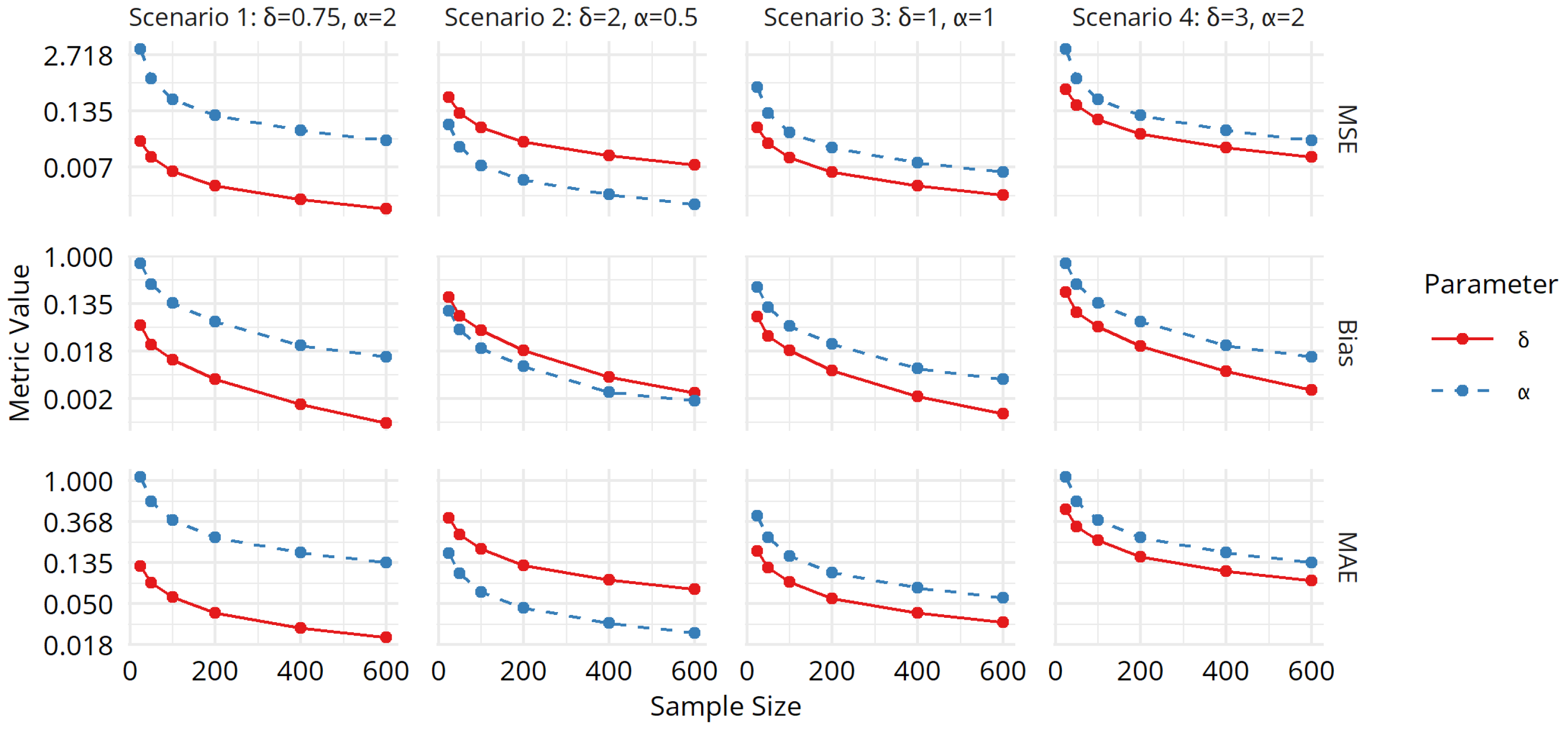
The simulation results are presented in Table 2, Table 3, Table 4 and Table 5 and illustrated in Figure 2.
The results presented in Table 2, Table 3, Table 4 and Table 5 and Figure 2 demonstrate that the maximum likelihood estimators δ ^ and α ^ of the WSG-Kumaraswamy distribution exhibit strong finite-sample performance across all scenarios. As the sample size increases, bias, MSE, and MAE decrease monotonically toward zero, confirming the consistency of the estimators. In small samples, some bias is observed, particularly when one parameter deviates substantially from unity; however, this rapidly diminishes, becoming negligible for larger samples. The MSE shows a substantial reduction with increasing sample size.
An examination of the simulation results in Table 2, Table 3, Table 4 and Table 5 suggests that the estimator α ^ often achieves a slightly faster reduction in bias and mean squared error compared to δ ^ . This pattern is most evident when the true value of δ is relatively small, a situation in which information about the lower tail of the distribution is limited.
Overall, these findings validate the desirable asymptotic properties of the MLEs and show reliable performance even for moderate sample sizes. The results support the practical application of the maximum likelihood method for fitting the WSG-Kumaraswamy distribution to unit-interval data.

6. Real Data Applications

This section aims to illustrate the practical utility of the WSG-Kumaraswamy distribution by applying the distribution to two real-world datasets originating from epidemiology and reliability engineering. The WSG-Kumaraswamy distribution is evaluated against two well-established competing models: the beta distribution and the Kumaraswamy distribution. The probability density functions of the competing models are given below:
  • Beta distribution:
    f ( y ) = 1 B ( δ , α ) y δ 1 ( 1 y ) α 1 , 0 < y < 1 , δ > 0 , α > 0 ,
  • Kumaraswamy distribution:
    f ( y ) = δ α y δ 1 ( 1 y δ ) α 1 , 0 < y < 1 , δ > 0 , α > 0 .
All model parameters are estimated using the maximum likelihood method. To compare the goodness-of-fit of the models, a set of evaluation criteria (EC) is employed. The EC include:
  • EC 1 : Kolmogorov-Smirnov (KS) statistic,
  • EC 2 : p-value corresponding to the KS statistic,
  • EC 3 : Anderson-Darling (AD) statistic,
  • EC 4 : p-value corresponding to the AD statistic,
  • EC 5 : Maximized log-likelihood (log-L),
  • EC 6 : Akaike Information Criterion (AIC),
  • EC 7 : Bayesian Information Criterion (BIC).
For the KS and AD statistics, smaller values of EC 1 and EC 3 indicate a better agreement between the empirical distribution and the fitted model, whereas larger p-values ( EC 2 and EC 4 ) suggest stronger support for the null hypothesis that the data originate from the fitted distribution. A higher log-likelihood value ( EC 5 ) signifies a better overall fit to the observed data. Regarding the information criteria, lower AIC ( EC 6 ) and BIC ( EC 7 ) values reflect a more favorable balance between goodness-of-fit and model complexity.

6.1. Application to COVID-19 Mortality Data

The first dataset, studied by [26,27], consists of daily mortality rates due to COVID-19 in France over 24 days, from 1 October to 24 October 2021. The data values are: 0.0740, 0.1190, 0.1344, 0.1926, 0.2232, 0.3140, 0.3243, 0.3393, 0.3563, 0.3706, 0.3843, 0.4164, 0.4482, 0.4578, 0.4616, 0.4755, 0.4917, 0.5045, 0.5069, 0.5325, 0.5625, 0.5972, 0.8057, and 0.8078.
Table 6 presents the descriptive statistics of the dataset. The positive skewness together with the negative kurtosis indicates an asymmetric distribution with lighter tails.
The maximum likelihood estimates of the parameters and the corresponding evaluation criteria are reported in Table 7 and Table 8. Table 7 lists the point estimates δ ^ MLE and α ^ MLE for each model. Table 8 provides the computed values of the seven EC.
Inspection of Table 8 reveals that the WSG-Kumaraswamy distribution delivers the best overall performance. It achieves the smallest EC 1 and EC 3 statistics, the highest EC 2 and EC 4 , the largest EC 5 , and the lowest EC 6 and EC 7 . Consequently, among the three candidates, the WSG-Kumaraswamy distribution provides the most adequate representation of the COVID-19 mortality data. The estimated parameters produce a unimodal density that peaks away from the boundaries, indicating that daily mortality rates tend to cluster around a central value with a slight asymmetry toward higher rates.
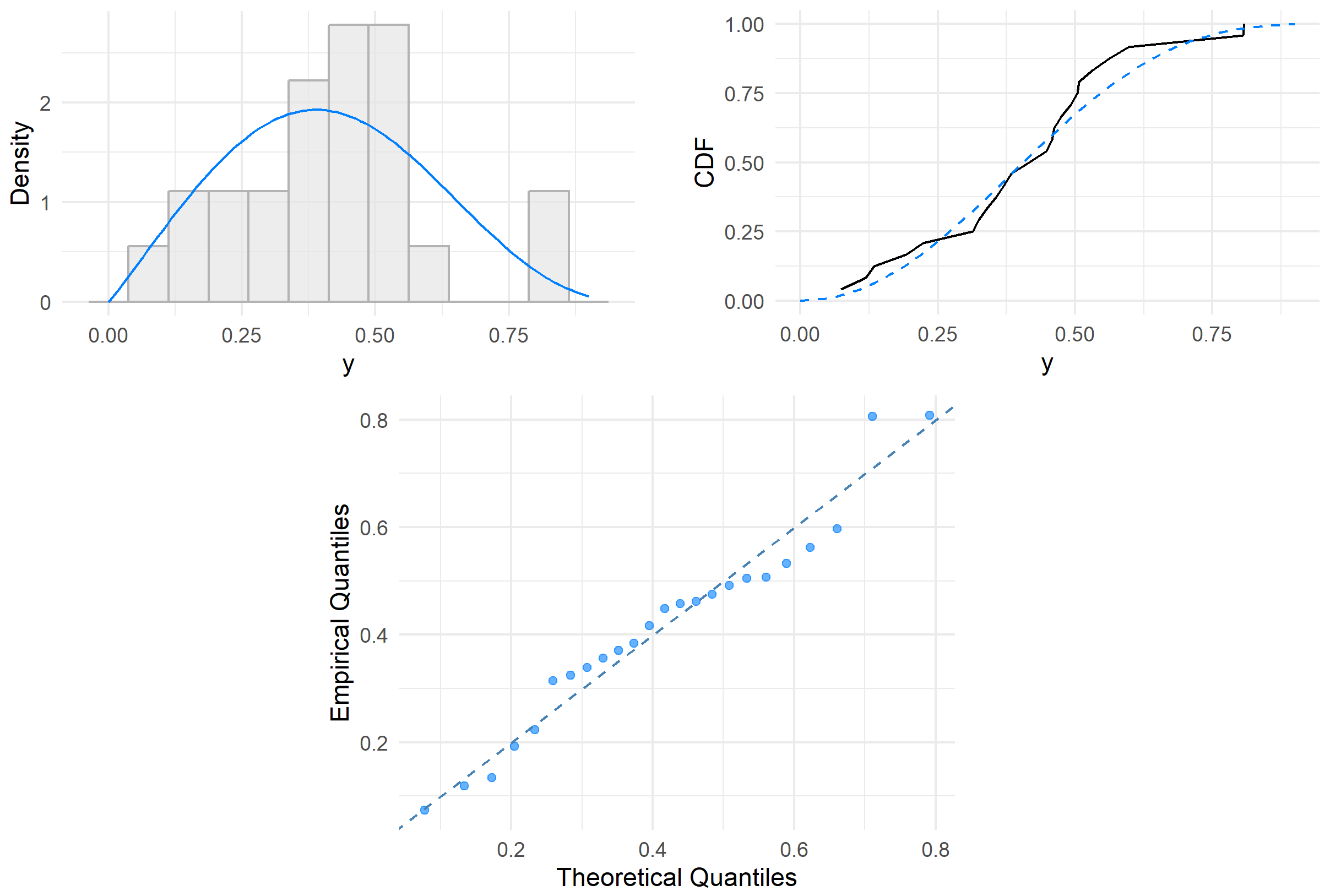
Figure 3 displays the histogram with the fitted density, the empirical and fitted cumulative distribution functions, and the quantile-quantile (QQ) plot. The visual inspection corroborates the numerical findings, showing an agreement between the WSG-Kumaraswamy distribution and the empirical data. The QQ plot reveals a broadly linear trend between theoretical and empirical quantiles, confirming a reasonable overall fit. A mild upward curvature in the upper tail suggests that the empirical distribution has a slightly heavier tail than the fitted model, which aligns with the positive skewness reported in Table 6.

6.2. Application to Times Between Failures Data

The second dataset, studied by [28,29], represents times between failures of secondary reactor pumps and consists of 23 observations. The data values are: 0.216, 0.015, 0.4082, 0.0746, 0.0358, 0.0199, 0.0402, 0.0101, 0.0605, 0.0954, 0.1359, 0.0273, 0.0491, 0.3465, 0.007, 0.656, 0.106, 0.0062, 0.4992, 0.0614, 0.532, 0.0347, and 0.1921.
The descriptive statistics are given in Table 9. The positive skewness and positive kurtosis indicate a right-skewed distribution with relatively heavy tails.
Parameter estimates and evaluation criteria are summarized in Table 10 and Table 11.
The results in Table 11 favor the WSG-Kumaraswamy distribution. It attains the smallest EC 1 and EC 3 values, the highest EC 2 and EC 4 , the largest EC 5 , and the lowest EC 6 and EC 7 . The Kumaraswamy distribution follows as the second-best model, while the beta distribution exhibits the poorest fit. The parameter estimates reflect a reliability scenario where short failure intervals are common and the likelihood of longer intervals diminishes rapidly.
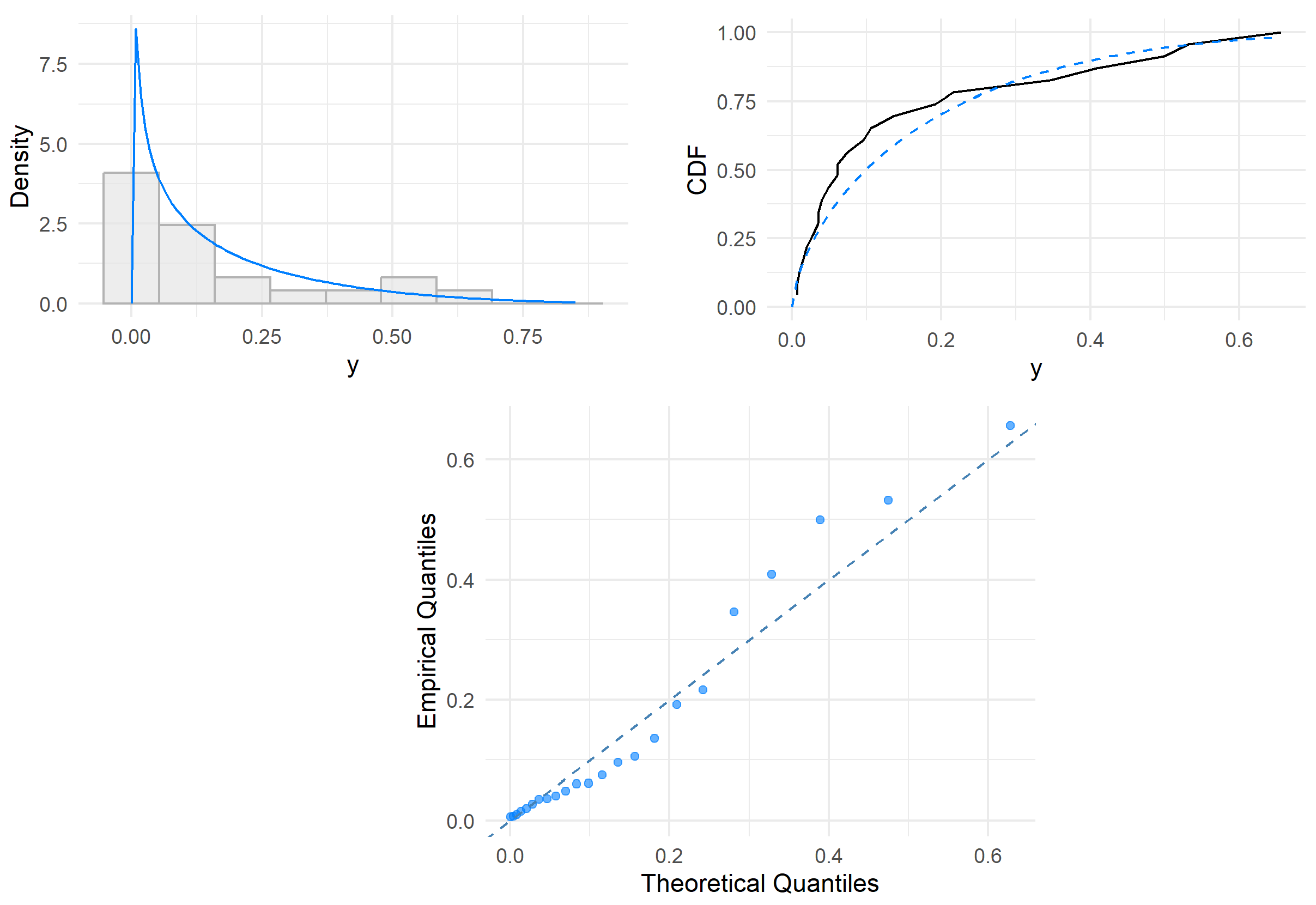
Figure 4 provides a graphical comparison, confirming that the WSG-Kumaraswamy distribution captures the overall shape of the empirical data very closely. The QQ plot shows good alignment along the reference line, indicating that the WSG-Kumaraswamy distribution captures the empirical quantiles well across the entire range.
The two empirical applications clearly demonstrate the enhanced flexibility and superior fitting ability of the WSG-Kumaraswamy distribution for modeling unit-interval data. In both datasets, the proposed model outperforms the competing models according to all considered evaluation criteria.

6.3. Simulation-Based Model Comparison

To further investigate the robustness and generalizability of the superior fit observed in the real-data applications in Section 6.1 and Section 6.2, we conducted an additional simulation study. Data were generated from three competing distributions: Beta ( 2 , 3 ) , Kumaraswamy ( 2 , 3 ) and WSG Kumaraswamy ( 2 , 3 ) , with sample size n = 100 over M = 100 independent replications. Each generated dataset was then fitted using all three candidate models. The average values of the seven evaluation criteria across the M replications are summarized in Table 12 (criteria for which smaller values indicate a better fit) and Table 13 (criteria for which larger values are preferred).
The results exhibit a clear and consistent pattern: each model achieves the best average goodness-of-fit when it is fitted to data generated from its own distribution. In every row of Table 12 and Table 13, the diagonal element (where the fitted model matches the true data-generating mechanism) corresponds to the smallest value of EC 1 , EC 3 , EC 6 , EC 7 and the largest value of EC 2 , EC 4 , EC 5 . This confirms that the true underlying distribution is correctly identified by the evaluation criteria.
Two further observations are noteworthy. First, the proposed WSG-Kumaraswamy distribution not only performs best on data generated from itself but also remains highly competitive when fitting data that originate from the Beta or Kumaraswamy distributions; its criterion values are often very close to those of the true model. Second, the absolute values of the log-likelihood (and consequently of AIC and BIC) for the WSG-Kumaraswamy rows are substantially larger than those for the Beta and Kumaraswamy rows. This is a direct consequence of the exponential term exp 1 sin ( π G / 2 ) in the WSG-Kumaraswamy density, which naturally elevates the likelihood scale. Within each row, however, the relative comparison of the three fitted models on the same dataset is valid, and the superiority of the diagonal elements is clear.
Overall, this simulation-based comparison reinforces the findings of the empirical applications: the WSG-Kumaraswamy distribution possesses the flexibility to adapt to various data patterns while consistently providing excellent fit when the data genuinely follow the proposed trigonometric-weighted structure.

7. Conclusions

This study has introduced the WSG-Kumaraswamy distribution as a novel and flexible model for unit-interval data. Derived by integrating the Kumaraswamy baseline with the weighted sine-G family, the WSG-Kumaraswamy distribution offers enhanced adaptability in density and hazard shapes without additional parameters, addressing limitations of traditional bounded models. Key statistical properties, including the quantile function, moments and moment-generating function have been derived. Parameter estimation via the MLE method has been explored, with a simulation study confirming the consistency and efficiency of the WSG-Kumaraswamy distribution across various scenarios.
To demonstrate its practical value, the WSG-Kumaraswamy distribution was applied to two real-world datasets from epidemiology and reliability engineering. In both cases, the WSG-Kumaraswamy distribution outperformed competing models as evidenced by superior goodness-of-fit measures.
While the WSG-Kumaraswamy distribution exhibits strong performance for the analyzed unimodal and skewed datasets, it may have limitations in capturing bimodal patterns or extreme tail behaviors in certain applications. Moving forward, we plan to explore further modifications, such as incorporating additional shape parameters or compounding techniques, to enhance its applicability across a broader range of data structures.

Author Contributions

Conceptualization, M.G. and Ö.Ö.; Methodology, M.G. and Ö.Ö.; Software, M.G.; Validation, Ö.Ö.; Formal analysis, M.G.; Investigation, M.G. and Ö.Ö.; Resources, M.G. and Ö.Ö.; Data curation, M.G. and Ö.Ö.; Writing—original draft, M.G. and Ö.Ö.; Writing—review and editing, Ö.Ö.; Visualization, M.G.; Supervision, Ö.Ö. All authors have read and agreed to the published version of the manuscript.

Funding

This research received no external funding.

Data Availability Statement

The original contributions presented in this study are included in the article. Further inquiries can be directed to the corresponding author.

Conflicts of Interest

The authors declare no conflicts of interest.

References

  1. Dodson, B.; Schwab, H. Accelerated Testing: A Practitioner’s Guide to Accelerated and Reliability Testing; SAE International: Warrendale, PA, USA, 2021. [Google Scholar]
  2. Stødle, K.; Flage, R.; Guikema, S.D.; Aven, T. Data-driven predictive modeling in risk assessment: Challenges and directions for proper uncertainty representation. Risk Anal. 2023, 43, 2644–2658. [Google Scholar] [CrossRef]
  3. Tu, X.; Kong, J.; Fu, Q.; Chang, S.; Zhang, K.; Alballa, T.; Alqahtani, H.; Khalifa, H.A.E.-W. A new trigonometric-inspired probability distribution: A simulation study and applications in reliability and hydrology. Alex. Eng. J. 2025, 113, 181–194. [Google Scholar] [CrossRef]
  4. Wang, Y.; Xu, J.; Huang, Q.; Albalawi, O.; Alshanbari, M. A new optimal probability model: Its background and applications to sports and reliability. Alex. Eng. J. 2024, 107, 521–532. [Google Scholar] [CrossRef]
  5. Wang, M.; Albalawi, O.; Alshanbari, M. A new probabilistic model with properties: Its implementations to the reliability and musical instruments. Alex. Eng. J. 2024, 109, 1–11. [Google Scholar] [CrossRef]
  6. Lai, C.-D.; Xie, M. Stochastic Ageing and Dependence for Reliability; Springer: New York, NY, USA, 2006. [Google Scholar]
  7. McCool, J.I. Using the Weibull Distribution: Reliability, Modeling, and Inference; John Wiley & Sons: Hoboken, NJ, USA, 2012. [Google Scholar]
  8. Zhou, J.; Qian, H.; Yao, Y.; Tashkandy, Y.A.; Bakr, M.E.; Kumar, A.; Bahloul, M.M. On the empirical exploration of a new probability distribution in physical education and reliability. Alex. Eng. J. 2024, 106, 422–437. [Google Scholar] [CrossRef]
  9. Ulrich, W.; Nakadai, R.; Matthews, J.; Kubota, Y. The two-parameter weibull distribution as a universal tool to model the variation in species relative abundances. Ecol. Complex. 2018, 36, 110–116. [Google Scholar] [CrossRef]
  10. Almalki, S.J.; Nadarajah, S. Modifications of the weibull distribution: A review. Reliab. Eng. Syst. Saf. 2014, 124, 32–55. [Google Scholar] [CrossRef]
  11. Wang, Y.; Albalawi, O.; Alshanbari, H.M.; Alsubaie, H.H. A modified cosine-based probability distribution: Its mathematical features with statistical modeling in sports and reliability prospects. Alex. Eng. J. 2024, 109, 322–333. [Google Scholar] [CrossRef]
  12. Merovci, F. Transmuted generalized rayleigh distribution. J. Stat. Appl. Probab. 2014, 3, 9. [Google Scholar] [CrossRef]
  13. Cordeiro, G.M.; Ortega, E.M.M.; da Cunha, D.C.C. The exponentiated generalized class of distributions. J. Data Sci. 2013, 11, 1–27. [Google Scholar] [CrossRef]
  14. Heydari, T.; Zare, K.; Shokri, S.; Khodadadi, Z.; Almaspoor, Z. A new sine-based probabilistic approach: Theory and monte carlo simulation with reliability application. J. Math. 2024, 2024, 9593193. [Google Scholar] [CrossRef]
  15. Dell, F.; Guessab, A.; Milovanović, G.V.; Nudo, F. Truncated gegenbauer-hermite weighted approach for the enrichment of the crouzeix-raviart finite element. BIT Numer. Math. 2025, 65, 24. [Google Scholar]
  16. Kumaraswamy, P. A generalized probability density function for double-bounded random processes. J. Hydrol. 1980, 46, 79–88. [Google Scholar] [CrossRef]
  17. Jones, M.C. Kumaraswamy’s distribution: A beta-type distribution with some tractability advantages. Stat. Methodol. 2009, 6, 70–81. [Google Scholar] [CrossRef]
  18. Lemonte, A.J.; Barreto-Souza, W.; Cordeiro, G.M. The exponentiated kumaraswamy distribution and its log-transform. Braz. J. Probab. Stat. 2013, 27, 31–53. [Google Scholar] [CrossRef]
  19. Kızılaslan, F.; Nadar, M. Estimation of reliability in a multicomponent stress–strength model based on a bivariate kumaraswamy distribution. Stat. Pap. 2018, 59, 307–340. [Google Scholar] [CrossRef]
  20. Kohansal, A. On estimation of reliability in a multicomponent stress-strength model for a kumaraswamy distribution based on progressively censored sample. Stat. Pap. 2019, 60, 2185–2224. [Google Scholar] [CrossRef]
  21. Arshad, M.; Azhad, Q.J. Parametric and reliability estimation of the kumaraswamy generalized distribution based on record values. J. Mod. Appl. Stat. Methods 2022, 19, 28. [Google Scholar]
  22. Alanzi, A.R.A.; Rafique, M.Q.; Tahir, M.H.; Sami, W.; Jamal, F. A new modified kumaraswamy distribution: Actuarial measures and applications. J. Math. 2022, 2022, 4288286. [Google Scholar] [CrossRef]
  23. Elghaly, H.E.; Elgawad, M.A.A.; Tian, B. A novel alternative to the beta and kumaraswamy distributions for double bounded hydroclimatology data. IEEE Access 2025, 13, 111217–111236. [Google Scholar] [CrossRef]
  24. Comtet, L. Advanced Combinatorics: The Art of Finite and Infinite Expansions; Springer Science & Business Media: Berlin/Heidelberg, Germany, 2012. [Google Scholar]
  25. Charalambides, C.A. Enumerative Combinatorics; Chapman and Hall/CRC: Boca Raton, FL, USA, 2018. [Google Scholar]
  26. Alrumayh, A.; Weera, W.; Khogeer, H.A.; Almetwally, E.M. Optimal analysis of adaptive type-II progressive censored for new unit-lindley model. J. King Saud Univ.-Sci. 2023, 35, 102462. [Google Scholar] [CrossRef]
  27. Dutta, S.; Dey, S.; Kayal, S. Bayesian survival analysis of logistic exponential distribution for adaptive progressive type-II censored data. Comput. Stat. 2024, 39, 2109–2155. [Google Scholar] [CrossRef]
  28. Suprawhardana, M.S.; Prayoto, S. Total time on test plot analysis for mechanical components of the RSG-GAS reactor. At. Indones 1999, 25, 81–90. [Google Scholar]
  29. Maya, R.; Jodra, P.; Irshad, M.R.; Krishna, A. The unit muth distribution: Statistical properties and applications. Ric. Mat. 2024, 73, 1843–1866. [Google Scholar] [CrossRef]
Figure 1. The PDF and HRF of the WSG-Kumaraswamy distribution for selected parameter values.
Mathematics 14 00510 g001
Figure 2. Behavior of MSE, MAE and bias for the MLEs of δ and α across the four parameter scenarios as sample size increases.
Mathematics 14 00510 g002
Figure 3. Fitted plots for the COVID-19 mortality data: histogram with fitted density (top left), empirical and fitted CDFs (top right), and QQ plot (bottom).
Mathematics 14 00510 g003
Figure 4. Fitted plots for the times between failures data: histogram with fitted density (top left), empirical and fitted CDFs (top right), and QQ plot (bottom).
Mathematics 14 00510 g004
Table 1. Quantile values of the WSG-Kumaraswamy distribution.
δ α Q ( 0.01 ) Q ( 0.1 ) Q ( 0.25 ) Q ( 0.5 ) Q ( 0.75 ) Q ( 0.9 ) Q ( 0.99 ) Q ( 0.999 )
0.50.50.0000220.0023120.0157900.0760920.2261990.4347150.7883390.929324
1.00.50.0046960.0480840.1256600.2758470.4756030.6593290.8878850.964014
2.00.50.0685260.2192810.3544860.5252120.6896400.8119910.9422760.981842
5.00.50.3422490.5450050.6604490.7729190.8618840.9200690.9764980.992697
10.00.50.5850200.7382450.8126800.8791580.9283770.9592020.9881790.996342
0.51.00.0000060.0005920.0042170.0222090.0760920.1733300.4424430.656588
1.01.00.0023510.0243380.0649390.1490280.2758480.4163300.6651640.810301
2.01.00.0484840.1560070.2548300.3860420.5252120.6452360.8155760.900167
5.01.00.2980150.4756180.5787630.6833670.7729190.8392420.9216920.958803
10.01.00.5459070.6896510.7607650.8266600.8791580.9161020.9600480.979185
0.52.00.0000010.0001500.0010900.0060090.0222100.0557040.1775360.318610
1.02.00.0011760.0122440.0330140.0775190.1490290.2360170.4213500.564456
2.02.00.0342930.1106530.1816980.2784220.3860420.4858160.6491150.751303
5.02.00.2594680.4145580.5055220.5996270.6833670.7491840.8412570.891920
10.02.00.5093800.6438620.7110010.7743560.8266600.8655540.9172000.944415
0.55.00.0000000.0000240.0001780.0010090.0039080.0104220.0386260.080001
1.05.00.0004710.0049160.0133390.0317600.0625110.1020880.1965360.282845
2.05.00.0216930.0701120.1154940.1782130.2500230.3195130.4433240.531832
5.05.00.2160360.3453970.4217190.5016210.5743700.6335710.7222510.776801
10.05.00.4647970.5877050.6493990.7082520.7578720.7959720.8498540.881363
0.510.00.0000000.0000060.0000450.0002560.0010090.0027480.0107410.023455
1.010.00.0002350.0024610.0066920.0160080.0317600.0524180.1036380.153150
2.010.00.0153400.0496080.0818030.1265230.1782140.2289500.3219290.391344
5.010.00.1880750.3007590.3673740.4373890.5016220.5544930.6354830.687105
10.010.00.4336760.5484150.6061140.6613540.7082530.7446430.7971720.828918
Table 2. Simulation results for Scenario 1: δ = 0.75 , α = 2 .
nParameterBiasMSEMAE
25 δ 0.053800.027150.12488
α 0.738243.721221.09238
50 δ 0.023740.011600.08236
α 0.301440.779080.60620
100 δ 0.012820.005420.05861
α 0.137420.256800.38189
200 δ 0.005670.002500.03933
α 0.062940.108360.25067
400 δ 0.001960.001210.02761
α 0.023600.049380.17372
600 δ 0.000900.000730.02198
α 0.014380.028780.13482
Table 3. Simulation results for Scenario 2: δ = 2 , α = 0.5 .
nParameterBiasMSEMAE
25 δ 0.176430.288820.40472
α 0.100740.067080.17150
50 δ 0.079480.129060.28275
α 0.046280.023070.11285
100 δ 0.040230.058700.19107
α 0.022650.009590.07460
200 δ 0.020080.027490.13174
α 0.010960.004200.05036
400 δ 0.009520.012790.09049
α 0.005250.001940.03457
600 δ 0.006010.008260.07197
α 0.003410.001240.02738
Table 4. Simulation results for Scenario 3: δ = 1 , α = 1 .
nParameterBiasMSEMAE
25 δ 0.071590.041700.16188
α 0.295810.743630.45305
50 δ 0.031650.017570.10562
α 0.120790.185470.29436
100 δ 0.015800.008000.07120
α 0.055090.060630.19335
200 δ 0.007540.003710.04842
α 0.026280.025260.13150
400 δ 0.002750.002510.03986
α 0.008800.008760.07343
600 δ 0.001320.001530.03172
α 0.005670.005160.05709
Table 5. Simulation results for Scenario 4: δ = 3 , α = 2 .
nParameterBiasMSEMAE
25 δ 0.215190.434320.49953
α 0.738233.721161.09237
50 δ 0.094960.185670.32943
α 0.301430.779070.60620
100 δ 0.051260.086650.23442
α 0.137410.256800.38190
200 δ 0.022690.040060.15731
α 0.062930.108360.25068
400 δ 0.007820.019300.11042
α 0.023590.049380.17372
600 δ 0.003590.011740.08791
α 0.014380.028790.13483
Table 6. Descriptive statistics for the COVID-19 mortality data.
StatisticnMeanMedianStd. Dev.SkewnessKurtosisSk/Ku
Value240.41250.43230.18720.1985−0.2601−0.7633
Table 7. Parameter estimates for the COVID-19 mortality data.
Distribution δ ^ MLE α ^ MLE
Beta2.44953.4956
Kumaraswamy2.04874.0201
WSG-Kumaraswamy2.06320.9531
Table 8. Evaluation criteria for the COVID-19 mortality data.
Distribution EC 1 EC 2 EC 3 EC 4 EC 5 EC 6 EC 7
Beta0.12440.80830.46960.77636.93913−9.87826−7.52215
Kumaraswamy0.11680.86160.45670.78966.95118−9.90236−7.54625
WSG-Kumaraswamy0.11650.86340.44830.79826.98818−9.97636−7.62025
Table 9. Descriptive statistics for the times between failures data (normalized).
StatisticnMeanMedianStd. Dev.SkewnessKurtosisSk/Ku
Value230.15780.06140.19311.27630.24305.2521
Table 10. Parameter estimates for the times between failures data.
Distribution δ ^ MLE α ^ MLE
Beta0.63073.2318
Kumaraswamy0.67662.9360
WSG-Kumaraswamy0.67870.6926
Table 11. Evaluation criteria for the times between failures data.
Distribution EC 1 EC 2 EC 3 EC 4 EC 5 EC 6 EC 7
Beta0.15410.59180.68860.566720.02854−36.05708−33.78609
Kumaraswamy0.13930.71230.57550.669620.32962−36.65924−34.38825
WSG-Kumaraswamy0.13760.72630.56340.681420.33736−36.67473−34.40374
Table 12. Average evaluation criteria ( EC 1 , EC 3 , EC 6 , EC 7 ) for the three fitted distributions across M = 100 replications.
True Distribution Criterion Beta Kumaraswamy WSG-Kumaraswamy
Beta EC 1 0.06238 0.06319 0.06260
Kumaraswamy EC 1 0.06390 0.06288 0.06265
WSG-Kumaraswamy EC 1 0.06652 0.06199 0.06149
Beta EC 3 0.37143 0.38286 0.37621
Kumaraswamy EC 3 0.39111 0.37599 0.37266
WSG-Kumaraswamy EC 3 0.44401 0.38695 0.38136
Beta EC 6 −44.29420 −44.07363 −44.08824
Kumaraswamy EC 6 −38.71087 −38.82817 −38.80964
WSG-Kumaraswamy EC 6 −145.61167 −146.34561 −146.36645
Beta EC 7 −39.08386 −38.86329 −38.87790
Kumaraswamy EC 7 −33.50053 −33.61783 −33.59930
WSG-Kumaraswamy EC 7 −140.40133 −141.13527 −141.15610
Table 13. Average evaluation criteria ( EC 2 , EC 4 , EC 5 ) for the three fitted distributions across M = 100 replications.
True Distribution Criterion Beta Kumaraswamy WSG-Kumaraswamy
Beta EC 2 0.79957 0.78447 0.79229
Kumaraswamy EC 2 0.77418 0.79037 0.79379
WSG-Kumaraswamy EC 2 0.74697 0.80350 0.80941
Beta EC 4 0.86370 0.85141 0.85726
Kumaraswamy EC 4 0.83766 0.85322 0.85579
WSG-Kumaraswamy EC 4 0.80277 0.84676 0.85153
Beta EC 5 24.14710 24.03682 24.04412
Kumaraswamy EC 5 21.35543 21.41408 21.40482
WSG-Kumaraswamy EC 5 74.80584 75.17281 75.18322
Disclaimer/Publisher’s Note: The statements, opinions and data contained in all publications are solely those of the individual author(s) and contributor(s) and not of MDPI and/or the editor(s). MDPI and/or the editor(s) disclaim responsibility for any injury to people or property resulting from any ideas, methods, instructions or products referred to in the content.