


A Bayesian Decision-Theoretic Optimization Model for Personalized Timing of Non-Invasive Prenatal Testing Based on Maternal BMI
Abstract
1. Introduction
2. Optimization Model Based on Bayesian Decision Theory
2.1. Notation
2.2. Determining the Expected Risk Function for Treatment Using a Bayesian Decision Model
2.3. Establishing a Dual-Objective Optimization Model for Determining the Optimal Detection Timing
3. Correlation Analysis
3.1. Identifying Key Indicators via Principal Component Analysis
3.2. Further Analysis of the Relationship Between Indicators and Y Chromosome Concentration Using Logistic Regression Models
- (1)
- Establishing the Logistic Regression Model
- (2)
- Solving Logistic Regression Parameters via Maximum Likelihood Estimation
4. Model Results
4.1. Correlation Analysis Results
4.2. Logistic Regression Results
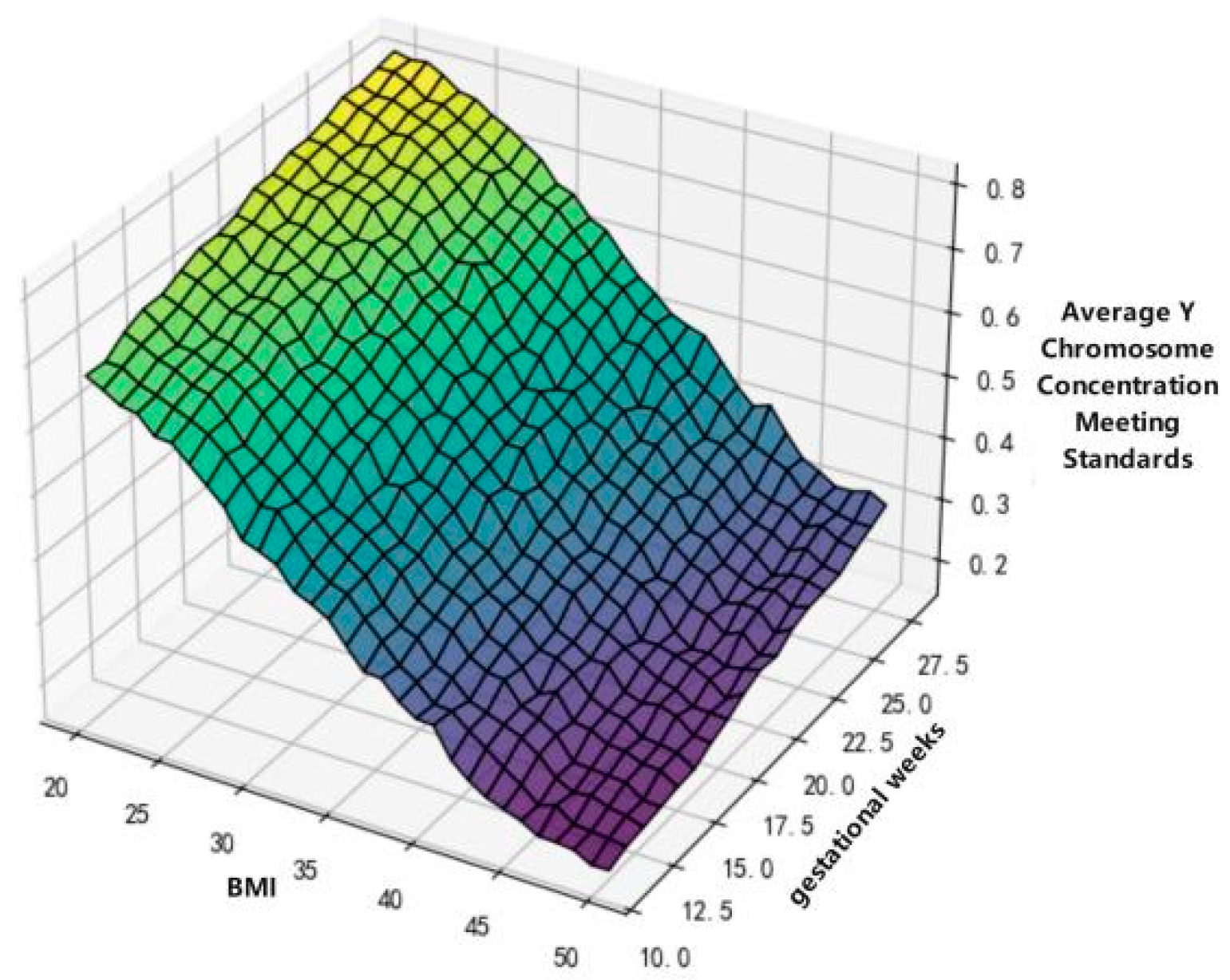
4.3. Monte Carlo Data Simulation
4.4. BMI Grouping Results
4.5. In-Depth Analysis and Discussion
5. Discussion
Author Contributions
Funding
Data Availability Statement
Conflicts of Interest
References
- Garcia, E.; Henneman, L.; Gitsels-van der Wal, J.T.; Martin, L.; Koopmanschap, I.; Bekker, M.N.; Timmermans, D.R.M. Non-invasive prenatal testing (nipt) and pregnant women’s views on good motherhood: A qualitative study. Eur. J. Hum. Genet. 2022, 30, 669–675. [Google Scholar] [CrossRef] [PubMed]
- Bedei, I.; Wolter, A.; Weber, A.; Signore, F.; Axt-Fliedner, R. Chances and challenges of new genetic screening technologies (nipt) in prenatal medicine from a clinical perspective: A narrative review. Genes 2021, 12, 501. [Google Scholar] [CrossRef] [PubMed]
- Gug, C.; Mozos, I.; Ratiu, A.; Tudor, A.; Gorduza, E.V.; Caba, L.; Gug, M.; Cojocariu, C.; Furau, C.; Furau, G.; et al. Genetic counseling and management: The first study to report NIPT findings in a Romanian population. Medicina 2022, 58, 79. [Google Scholar] [CrossRef]
- Long, S.; O’Leary, P.; Dickinson, J.E. Western Australian women’s expectations for expanded NIPT—An online survey regarding NIPT for single gene, recessive, and chromosomal conditions. J. Genet. Couns. 2023, 32, 1047–1056. [Google Scholar] [CrossRef] [PubMed]
- Chen, M.; Chen, P.; Yu, S.; Ai, L.; Yu, X.; Wang, R.; Yan, J.; Lin, S. Retrospective study on NIPT or NIPT plus combined with ultrasound in screening fetal chromosomal abnormalities. Sci. Rep. 2025, 15, 12859. [Google Scholar] [CrossRef]
- van Prooyen Schuurman, L.; de Koning, H.J.; Meier, E.; Galjaard, R.H.; van Ravesteyn, N.T. Clinical and economic impact of genome-wide non-invasive prenatal testing (NIPT) as a first-tier screening method compared to targeted NIPT and first-trimester combined testing: A modeling study. PLoS Med. 2025, 22, e1004790. [Google Scholar] [CrossRef]
- Meng, M.; Chen, J.; Yang, Y.; Zhang, Y.; Zou, G.; Zhou, F.; Wei, X.; Ge, Y.; Zhou, J.; Sun, L. The efficacy of expanded non-invasive prenatal testing (NIPT) in a high-risk twin pregnancies cohort. Acta Obstet. Gynecol. Scand. 2024, 103, 2426–2432. [Google Scholar] [CrossRef]
- Wilkins-Haug, L.; Reimers, R. Unique challenges of NIPT for sex chromosome aneuploidy. Clin. Obstet. Gynecol. 2023, 66, 568–578. [Google Scholar] [CrossRef]
- Liehr, T. False-positives and false-negatives in non-invasive prenatal testing (nipt): What can we learn from a meta-analyses on >750,000 tests? Mol. Cytogenet. 2022, 15, 36. [Google Scholar] [CrossRef]
- Hu, Y.; Liu, W.; He, G.; Xu, J.; Peng, Y.; Wang, J. Clinical utility of expanded NIPT for chromosomal abnormalities and etiology analysis of cytogenetic discrepancy cases. J. Assist. Reprod. Genet. 2022, 39, 267–279. [Google Scholar] [CrossRef]
- Zhao, Q.; Chen, J.; Ren, L.; Zhang, H.; Liu, D.; Xi, X.; Wu, X.; Fang, C.; Ye, P.; Zeng, S.; et al. Two cases of placental trisomy 21 mosaicism causing false-negative NIPT results. Mol. Cytogenet. 2023, 16, 16. [Google Scholar] [CrossRef]
- Xiang, J.; Sun, X.; Peng, J.; Zhang, H.; Shen, J.; Li, J.; Li, H.; Hu, L.; Zhang, J.; Zhou, S.; et al. Determining the origin of genome aberrations improves the positive predictive value of NIPT for 22q11.2 deletion syndrome. Sci. Rep. 2025, 15, 24755. [Google Scholar] [CrossRef]
- Yang, J.; Wu, J.; Peng, H.; Hou, Y.; Guo, F.; Wang, D.; Ouyang, H.; Wang, Y.; Yin, A. Performance of NIPT for copy number variations at different sequencing depths using the semiconductor sequencing platform. Hum. Genom. 2021, 15, 41. [Google Scholar] [CrossRef]
- Paluoja, P.; Teder, H.; Ardeshirdavani, A.; Bayindir, B.; Vermeesch, J.; Salumets, A.; Krjutskov, K.; Palta, P. Systematic evaluation of NIPT aneuploidy detection software tools with clinically validated NIPT samples. PLoS Comput. Biol. 2021, 17, e1009684. [Google Scholar]
- Guo, Y.; Charoenkwan, P.; Traisrisilp, K.; Piyamongkol, W.; Tongprasert, F. Application of digital polymerase chain reaction (dPCR) in non-invasive prenatal testing (NIPT). Biomolecules 2025, 15, 360. [Google Scholar] [CrossRef]
- Dai, P.; Yang, Y.; Zhao, G.; Gu, Z.; Ren, H.; Hu, S.; Liu, N.; Jiao, W.; Li, J.; Kong, X. A dPCR-NIPT assay for detections of trisomies 21, 18 and 13 in a single-tube reaction—Could it replace serum biochemical tests as a primary maternal plasma screening tool? J. Transl. Med. 2022, 20, 269. [Google Scholar] [CrossRef] [PubMed]
- Hatt, L.; Ravn, K.; Dahl Jeppesen, L.; Hestbek Nicolaisen, B.; Baasch Christensen, I.; Singh, R.; Schelde, P.; Horsholt Thomsen, S.; Christensen, R.; Sinding, M.; et al. How does cell-based non-invasive prenatal testing (NIPT) perform against chorionic villus sampling and cell-free NIPT in detecting trisomies and copy number variations? Prenat. Diagn. 2023, 43, 854–864. [Google Scholar] [CrossRef]
- Schöne-Seifert, B.; Junker, C. Making use of non-invasive prenatal testing (nipt): Rethinking issues of routinization and pressure. J. Perinat. Med. 2021, 49, 959–964. [Google Scholar] [PubMed]
- Horn, R. NIPT and the concerns regarding ‘routinization’. Eur. J. Hum. Genet. 2022, 30, 637–638. [Google Scholar] [PubMed]
- Bilardo, C.M. The implementation of non-invasive prenatal testing (NIPT) in the Netherlands. J. Perinat. Med. 2021, 49, 941–944. [Google Scholar]
- Jayashankar, S.S.; Nasaruddin, M.L.; Hassan, M.F.; Dasrilsyah, R.A.; Shafiee, M.N.; Ismail, N.A.S.; Alias, E. Non-invasive prenatal testing (NIPT): Reliability, challenges, and future directions. Diagnostics 2023, 13, 2570. [Google Scholar] [CrossRef]
- Rehmann-Sutter, C.; Timmermans, D.R.M.; Raz, A. Non-invasive prenatal testing (NIPT): Is routinization problematic? BMC Med. Ethics 2023, 24, 87. [Google Scholar] [CrossRef]
- Taylor-Sands, M.; Johnston, M.; Mills, C. Should the scope of NIPT be limited by a ‘threshold of seriousness’? Eur. J. Hum. Genet. 2025, 33, 189–193. [Google Scholar] [CrossRef]
- Young, P.D.; Sahan, K.M. Views and attitudes about the offer of NIPT: A qualitative study of UK healthcare professionals. BMC Med. Ethics 2025, 26, 101. [Google Scholar] [CrossRef] [PubMed]
- Kristalijn, S.A.; White, K.; Eerbeek, D.; Kostenko, E.; Grati, F.R.; Bilardo, C.M. Patient experience with non-invasive prenatal testing (nipt) as a primary screen for aneuploidy in the netherlands. BMC Pregnancy Childbirth 2022, 22, 782. [Google Scholar] [CrossRef]
- Bakkeren, I.M.; Henneman, L.; van Vliet-Lachotzki, E.H.; Martin, L.; Gitsels-van der Wal, J.T.; Polak, M.G.; Bekker, M.N.; Galjaard, R.H. Psychological impact of additional findings detected by genome-wide non-invasive prenatal testing (NIPT): Trident-2 study. Eur. J. Hum. Genet. 2024, 32, 302–308. [Google Scholar] [CrossRef] [PubMed]
- Xue, Z.; Zhou, A.; Zhu, X.; Li, L.; Zhu, H.; Jin, X.; Wang, J. NIPT-PG: Empowering non-invasive prenatal testing to learn from population genomics through an incremental pan-genomic approach. Brief. Bioinform. 2024, 25, bbae266. [Google Scholar] [CrossRef] [PubMed]
- Soster, E.; Mossfield, T.; Menezes, M.; Agenbag, G.; Dubois, M.L.; Gekas, J.; Hardy, T.; Loggenberg, K.; Global Expanded NIPT Consortium. Clinical outcomes of screen-positive genome-wide cfDNA cases for trisomy 20: Results from the Global Expanded NIPT Consortium. Mol. Cytogenet. 2024, 17, 9. [Google Scholar] [CrossRef]
- van Eekhout, J.C.A.; Bekker, M.N.; Bax, C.J.; Galjaard, R.H. Non-invasive prenatal testing (NIPT) in twin pregnancies affected by early single fetal demise: A systematic review of NIPT and vanishing twins. Prenat. Diagn. 2023, 43, 829–837. [Google Scholar] [CrossRef]
- Labuschagne, R.; Aldous, C.; Vorster, E.; Walters, S. Scoping review: The current landscape of NIPT in South Africa. J. Community Genet. 2025, 16, 227–241. [Google Scholar] [CrossRef]
- Stevens, C.; Llorin, H.; Gabriel, C.; Mandigo, C.; Gochyyev, P.; Studwell, C. Genetic counseling for fetal sex prediction by NIPT: Challenges and opportunities. J. Genet. Couns. 2023, 32, 945–956. [Google Scholar] [CrossRef] [PubMed]
- Ghiasi, M.; Armour, C.; Walker, M.; Shaver, N.; Bennett, A.; Little, J. Issues associated with possible implementation of non-invasive prenatal testing (nipt) in first-tier screening: A rapid scoping review. Prenat. Diagn. 2023, 43, 62–71. [Google Scholar] [CrossRef]
- Liu, P.; Zhang, Y.; Ye, L.; Huang, M.; Zeng, T.; Yang, J.; Tian, F.; Wu, Z.; Zhang, X.; Hu, C.; et al. Laser-induced graphene decorated with Ni-Pt alloy nanoparticles for non-enzymatic electrochemical quantification of glucose. Diam. Relat. Mater. 2024, 146, 111205. [Google Scholar] [CrossRef]
- Krawczak, M.; Eiben, B.; Sendel, S.; Caliebe, A.; Henneman, L.; Glaubitz, R.; Borth, H.; Schmidtke, J. Age-specific uptake of non-invasive prenatal tests (NIPT) in Germany: A decision theory-based analysis. J. Community Genet. 2025, 16, 769–774. [Google Scholar] [CrossRef]
- Kantor, V.; Mo, L.; DiNonno, W.; Howard, K.; Palsuledesai, C.C.; Parmar, S.; Chithiwala, Z.; Jelsema, R.; Xu, W.; Hedriana, H.L. Positive predictive value of a single nucleotide polymorphism (SNP)-based NIPT for aneuploidy in twins: Experience from clinical practice. Prenat. Diagn. 2022, 42, 1587–1593. [Google Scholar] [CrossRef] [PubMed]
- Blangero, Y.; Rabilloud, M.; Ecochard, R.; Subtil, F. A Bayesian method to estimate the optimal threshold of a marker used to select patients’ treatment. Stat. Methods Med. Res. 2020, 29, 29–43. [Google Scholar] [CrossRef] [PubMed]
- Kornak, J.; Lu, Y. Bayesian decision analysis for choosing between diagnostic/prognostic prediction procedures. Stat. Interface 2011, 4, 27. [Google Scholar] [CrossRef]
- Graham, G.; Gupta, S.; Aarons, L. Determination of an optimal dosage regimen using a Bayesian decision analysis of efficacy and adverse effect data. J. Pharmacokinet. Pharmacodyn. 2002, 29, 67–88. [Google Scholar] [CrossRef]

| Symbols | Explanations |
|---|---|
| Gestational week. | |
| Fetal disease status, a 0–1 variable. | |
| Treatment cost function when fetal condition is d at w weeks of pregnancy. | |
| The detection results are categorized into four types: TN/TP/FN/FP. | |
| A 0–1 variable indicating whether the NIPT test result is credible. | |
| Loss under detection state k at week w. | |
| Treatment risk function when fetal condition is k at w weeks gestation and test result reliability is j. | |
| Expected risk for the pregnant woman at week w of pregnancy. | |
| Sample space for chromosomal abnormalities | |
| Sample space for Y chromosome concentration meeting standards | |
| Probability function for fetal chromosomal abnormalities | |
| Probability function for fetal Y chromosome concentration meeting standards at w weeks of pregnancy | |
| Total number of BMI groups for pregnant women | |
| Group to which the pregnant woman with BMI value i belongs |
| Detection State | True Positive | False Positive | True Negative | False Negative |
|---|---|---|---|---|
| Percentage | 0.32% | 10.35% | 86.55% | 2.77% |
| Age | Height | Weight | Gestational Age at Testing | BMI | |
|---|---|---|---|---|---|
| Characteristic Value | 2.11705 | 1.05837 | 0.97152 | 0.85157 | 0.00149 |
| Eigenvalue Contribution Rate | 42.341% | 21.1674% | 19.4304% | 17.0314% | 0.0298% |
| Cumulative Contribution Rate | 42.341% | 63.5084% | 82.9388% | 99.9702% | 100.0000% |
| Parameter | Constant | Gestational Age Estimation | Age | Height | Weight |
|---|---|---|---|---|---|
| Parameter Estimate | 3.9609 | 0.0069 | −0.0321 | −0.0033 | −0.0386 |
| Std. Error | 1.1863 | 0.0013 | 0.0141 | 0.0015 | 0.0098 |
| z-value | 3.3389 | 5.3077 | −2.2766 | −2.2001 | −3.9388 |
| p-value | 0.0001 | 0.0000 | 0.0228 | 0.0278 | 0.0001 |
| Odds Ratio | 19.9576 | 1.0065 | 0.9637 | 0.9899 | 0.9573 |
| Variable | Unit | n | Mean | Range |
|---|---|---|---|---|
| Gestational age at testing | weeks | 1082 | 15.2 | 11.0 to 29.0 |
| Maternal age | years | 1082 | 29.8 | 18.0 to 44.0 |
| Maternal height | cm | 1082 | 161.5 | 145.0 to 178.0 |
| Maternal weight | kg | 1082 | 66.2 | 42.0 to 110.0 |
| Maternal BMI | kg per m2 | 1082 | 30.6 | 20.0 to 47.0 |
| Fetal Y chromosome concentration | percent | 1082 | 4.9 | 0.3 to 15.2 |
| Test reportability indicator j | 0 or 1 | 1082 | 0.87 | 0 to 1 |
| BMI Range | (20, 25] | (25, 29] | (29, 31] | (31, 39] | (39, 45] | (45, 47) |
|---|---|---|---|---|---|---|
| Optimal Timing | 16 weeks | 11 weeks | 12 weeks | 15 weeks | 12 weeks | 16 weeks |
Disclaimer/Publisher’s Note: The statements, opinions and data contained in all publications are solely those of the individual author(s) and contributor(s) and not of MDPI and/or the editor(s). MDPI and/or the editor(s) disclaim responsibility for any injury to people or property resulting from any ideas, methods, instructions or products referred to in the content. |
© 2026 by the authors. Licensee MDPI, Basel, Switzerland. This article is an open access article distributed under the terms and conditions of the Creative Commons Attribution (CC BY) license.
Share and Cite
Ding, Y.; Ni, K.; Fan, X.; Yan, Q. A Bayesian Decision-Theoretic Optimization Model for Personalized Timing of Non-Invasive Prenatal Testing Based on Maternal BMI. Mathematics 2026, 14, 437. https://doi.org/10.3390/math14030437
Ding Y, Ni K, Fan X, Yan Q. A Bayesian Decision-Theoretic Optimization Model for Personalized Timing of Non-Invasive Prenatal Testing Based on Maternal BMI. Mathematics. 2026; 14(3):437. https://doi.org/10.3390/math14030437
Chicago/Turabian StyleDing, Yubu, Kaixuan Ni, Xiaona Fan, and Qinglun Yan. 2026. "A Bayesian Decision-Theoretic Optimization Model for Personalized Timing of Non-Invasive Prenatal Testing Based on Maternal BMI" Mathematics 14, no. 3: 437. https://doi.org/10.3390/math14030437
APA StyleDing, Y., Ni, K., Fan, X., & Yan, Q. (2026). A Bayesian Decision-Theoretic Optimization Model for Personalized Timing of Non-Invasive Prenatal Testing Based on Maternal BMI. Mathematics, 14(3), 437. https://doi.org/10.3390/math14030437

