1. Introduction
According to the definition of the Council of Supply Chain Management Professionals [
1], supply chain (SC) management encompasses the planning and management of the activities involved in procurement, conversion, and supply through coordination and collaboration between its links.
One aspect that is still debated worldwide is related to the emission of the carbon footprint that may be generated by biodiesel supply chains and whether the energy balance of biodiesel is positive, understood as the difference between the energy produced by one kilogram of fuel (biodiesel in this case) and the energy needed to produce it. Another aspect that causes controversy is the impact on the price and availability of food products, fats, and oils derived from agricultural commodities used for biofuel production [
2]. Finally, another controversial aspect is environmental care, particularly related to monoculture. Despite these concerns, biofuels such as ethanol and biodiesel produced from biomass have been considered worldwide as a real alternative to oil [
3], given the reduction of world oil reserves, the commitments of countries to reduce their carbon footprint, and the factual evidence of their industrial-scale use in oil palm- and sugarcane-producing countries [
4,
5] that have favorable conditions for production, such as high percentage of climatically suitable areas and the ability to reach production scales that allow for competitive costs compared to oil-derived alternatives [
6].
By way of example, in Colombia, the state has led the process of promoting biofuels through the proposal and deployment of the national biodiesel policy, established in document CONPES 3510 [
7], which has encouraged the production of biodiesel by expanding the percentage of biodiesel in the fuel mix, especially for heavy and cargo transportation. The development and use of biofuels is now a reality, showing a growing trend in production and use, especially because international policies on commodity sustainability have mitigated negative agricultural effects. In Colombia, production has increased during the last decade due to higher demand, which, according to Fedebiocombustibles [
8], is expected to continue. The sector generates direct and indirect jobs and contributes to the agricultural GDP, which, according to Fedebiocombustibles [
9], reached 7.3% in 2022, and will continue supporting national carbon-footprint mitigation efforts.
These regulatory and public policy frameworks, though relevant, must be translated into decision support tools that integrate profitability and sustainability criteria into operational planning. This need motivates the present work, which addresses a gap in the literature: the absence of integrated mathematical models for the midstream and downstream phases of the biodiesel supply chain in Latin American contexts.
The development of the biodiesel industry calls for advances in organizational management and technological tools that facilitate decision-making processes oriented toward cost reduction and environmental improvement along the entire chain, thereby increasing competitiveness and sustainability [
10].
Previous works have typically separated these elements, focusing either on production–distribution or on blending operations. In contrast, the present MIP provides a unified representation that enables realistic coordination between processing capacities, blending ratios, and taxation structures. This work focuses on addressing these deficiencies by proposing a tactical-level planning model for the palm oil biodiesel supply chain, covering its refining, blending, and distribution stages. The model maximizes after-tax profit under supply–demand, capacity, inventory, and scale-economy constraints. It also captures the interactions among production, blending, and logistics flows under real economic conditions. Such integration extends beyond conventional techno-economic models by introducing computational enhancements—namely valid inequalities and a warm-start heuristic procedure, VI, and a WS—that improve solvability without sacrificing interpretability.
The central research question addressed in this study is as follows: How can tactical-level decisions on refining, blending, and distribution be optimized within a palm oil biodiesel supply chain using a mathematical programming approach that accounts for scale economies and operational constraints?
The work draws upon the established supply chain management literature and is adapted to the context of palm oil biodiesel. Although this case study centers on a palm oil biodiesel supply chain, it exemplifies a broader class of multi-echelon process industry networks where discrete operating scales, capacity–cost nonlinearities, and multi-stage material transformations drive tactical decisions. The formulation is therefore not limited to biodiesel; it can be ported to other bio-based fuels (e.g., bioethanol), edible oils, oleochemicals, and commodity processing networks facing analogous planning trade-offs across refining/blending/distribution. Importantly, the monotonicity-based VI templates and the scale-mapping WS pipeline remain applicable whenever throughput-based scale activation and network flow conservation hold, making the proposed approach transferable beyond the present case study.
In summary, the main contributions of this work are fourfold: (i) the joint integration of economies of scale, tailored VI, and a WS strategy within a unified MILP framework for tactical supply chain planning, a combination that distinguishes our approach from existing models that treat these aspects in isolation; (ii) the design of problem-specific VI that tighten the formulation and strengthen the linear relaxation; (iii) the development of a WS heuristic that exploits the model’s structure to significantly reduce the time-to-first-feasible and overall solution time; and (iv) a comprehensive computational evaluation on a realistic biodiesel case, demonstrating substantial improvements in computational performance (faster solution times and robust solutions) and highlighting the practical utility of the proposed framework for decision makers.
This article is organized as follows:
Section 2 reviews the related optimization literature and positions the research gap.
Section 3 describes the methodological design and the tactical planning setting.
Section 4 presents the MILP formulation, emphasizing scale activation and tax-consistent profitability.
Section 5 details the solution enhancements (VI and the WS pipeline).
Section 6 reports computational results and sensitivity analyses, highlighting both performance gains (TTFF/CPU) and managerial insights.
Section 7 discusses generalization and extension pathways,
Section 8 concludes with key takeaways, and
Section 9 proposes directions for future research.
2. State of the Art
An et al. [
11] review mathematical programming models applied to biofuel SCs, taking into account the SCM planning levels—operational, tactical, and strategic—and the SC stages: primary (biomass suppliers to conveyor plants), secondary (biomass conversion), and tertiary (storage and customer distribution). The work evidences the dynamics that the biofuels industry has been experiencing on types of biomasses and the processes of conversion to biofuels, concluding that there is a lack of research in the development of support systems for decision making that support a tactical planning that comprehensively manages all the stages that our work addresses.
Below is a review of articles on mathematical programming models addressing the tactical planning of biodiesel supply chains (SCs).
Table 1 systematically synthesizes the most representative contributions in this research stream, organizing the selected studies according to their planning scope, modeling approach, decision level, and solution techniques. In particular, the table highlights differences in the temporal resolution, treatment of scale economies, incorporation of uncertainty, and consideration of policy or sustainability-related aspects. This structured comparison provides a consolidated view of the methodological evolution of tactical biodiesel SC models and serves as a reference framework to position the proposed model with respect to the existing literature.
The review shows few works on optimization at the tactical level of direct supply chain (SC) planning for biodiesel and, in particular, for biodiesel produced from palm oil. Regarding decision variables, most of the models reviewed include variables related to product flow—raw materials, intermediate, and finished products through the SC—as well as capacity and mass balance. In recent years, the environmental impact and sustainability of supply chains that integrate both economic and social aspects in strategic contexts have been considered in modeling.
As for the type of modeling, the papers include mixed-integer programming (MIP) and linear programming (LP). There is also evidence of a mathematical programming model for the palm oil agroindustry SC at the tactical level; however, this focuses only on the upstream phase, leaving aside the midstream and downstream phases associated with biodiesel [
10]. In addition, there is recent evidence of work on the planning of the oil palm SC operation [
12], so the present work is proposed as a complement to these. There is also evidence of SC research on biodiesel from oil palm in reverse flows [
17].
In summary, there is no evidence of direct SC optimization models for biodiesel at the tactical decision level, except for the work of [
16], which, however, differs significantly from this study since its purpose is to explore chain expansion under environmental and technological considerations.
Table 2 presents a structured comparison of representative optimization studies cited in the manuscript, encompassing both biodiesel-specific and general supply chain formulations. The comparison distinguishes each work according to its decision level, modeling approach, and methodological focus. Earlier studies addressed strategic design and policy-oriented analysis, whereas more recent contributions have advanced toward tactical formulations that improve computational efficiency and practical applicability. The proposed model builds upon these developments by integrating economies of scale, blending, and taxation within a unified tactical MILP framework enhanced by VI and a WS solution strategy.
Recent research emphasizes that the effectiveness of mixed-integer programming (MIP) solvers relies heavily on the availability of high-quality incumbent solutions early in the search. In large-scale or complex supply chain problems—such as those IBM has addressed in planning semiconductor supply chains—theoretical models alone are insufficient; heuristic methods that quickly find good feasible solutions are critical to keep computation times acceptable and practical [
28].
3. Methodology Framework
The methodological structure focuses exclusively on the formulation, parameterization, and computational implementation of the model, following the tactical framework introduced earlier. All procedural steps are described in a neutral and reproducible manner, without interpretative or comparative remarks.
The proposed formulation represents the midstream and downstream planning of the biodiesel supply chain. It defines variables for production flows, blending ratios, inventory levels, and capacity utilization across processing facilities. The model incorporates constraints associated with supply, demand, economies of scale, and tax structures, ensuring that profitability and feasibility are jointly addressed.
While parameterized for palm biodiesel, the modeling workflow is intentionally modular: network flow decisions (production, transfers, inventories, and deficits/surpluses) are separated from scale activation logic and from the tax/price consistency mechanism. Consequently, extending the framework to other supply chains requires only replacing (a) the process yield relationships and product sets, (b) the facility–scale grids (e ∈ E) and their associated capacity–cost parameters, and (c) sector-specific price/tax coefficients while preserving the decision variable structure and the feasibility logic. This modularity is key to reproducing the model in other process industries and to benchmarking the same VI + WS enhancements under comparable tactical planning settings.
Two complementary computational strategies are applied: (i) the inclusion of VI to strengthen the linear relaxation and (ii) a WS designed to accelerate the identification of feasible solutions and enhance the quality of initial incumbents. The model is implemented in LINGO 9, and its performance is assessed using simulated scenarios of increasing complexity. The evaluation criteria include objective value, CPU time, time-to-first-feasible (TTFF), and memory usage.
This methodological structure ensures reproducibility and neutrality, aligning the presentation of the model with MDPI’s standards for clarity and transparency in optimization research.
Below is a description of the SC discussed and the development of mathematical programming modeling.
4. The Model
The model is based on the characterization of tactical decisions in refining and blending facilities. It considers the existence of operational scales with increasing economies of scale, mass balances, logistical constraints, and costs associated with product deficits/surpluses. This formulation responds to the need for a realistic representation of the problem by integrating market and infrastructure conditions.
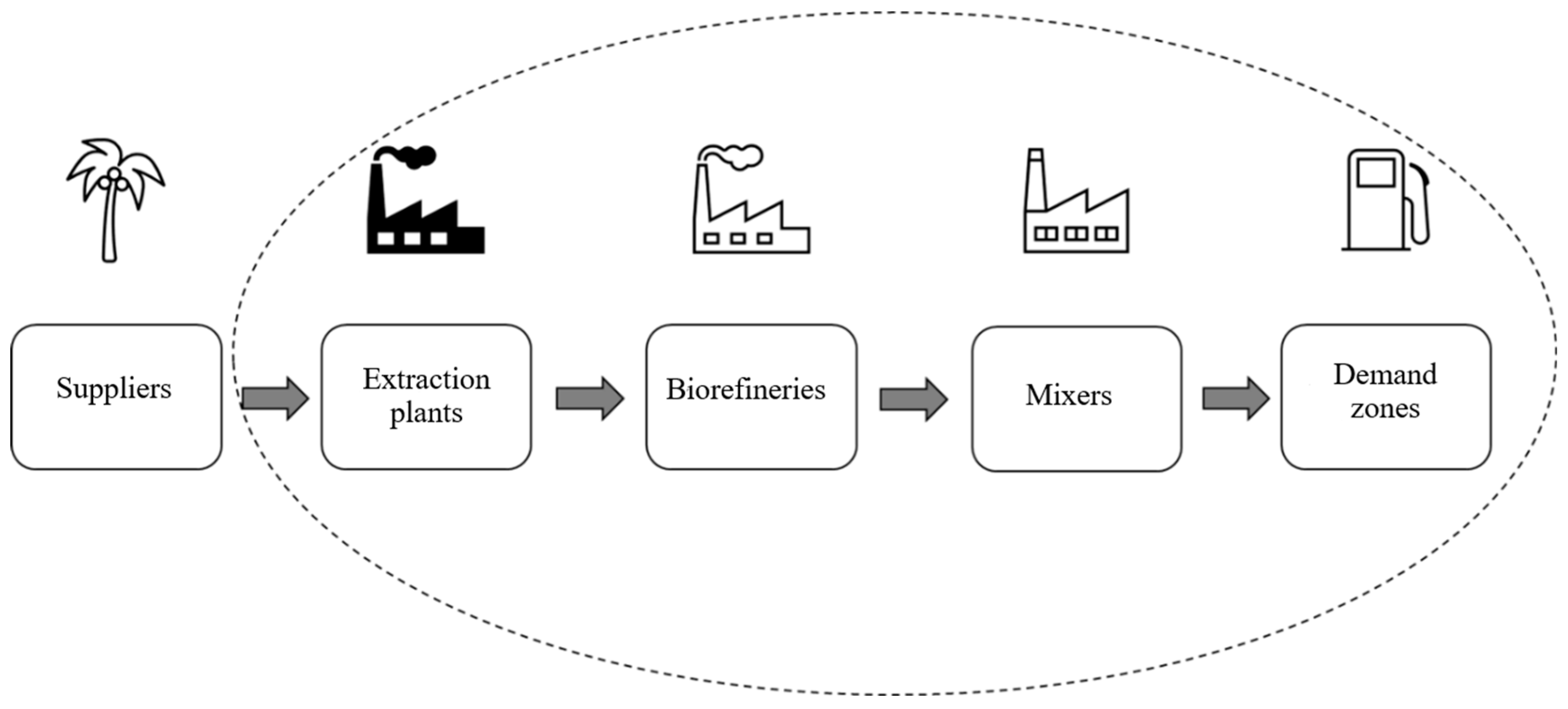
This paper presents a mathematical programming model for the tactical optimization of the SC of biodiesel from palm oil, seeking to maximize the after-tax profits of the agents involved. The five echelons comprising the chain under study are as follows: 0. oil palm fruit suppliers, 1. CPO extractors, 2. bio-refineries, 3. blenders (mixers), and 4. demand zones (distributors).
Figure 1 illustrates the biodiesel supply chain under study.
Key parameters (symbols and roles): The table shows the symbols of the model, including the factors that control relaxation strength and incumbent construction: scale bounds (GMIN/GMAX), capacity settings (CAPP), and penalty parameters (CFLB/CSOLB). Careful tuning of these values helps achieve a lower TTFF and smaller early gaps.
To facilitate the reading of the article, parameters are denoted with capital letters and variables with lower case letters. The mathematical programming model developed is presented below, and the symbols are detailed in
Appendix A.
4.1. Objective Function
Maximizing after-tax profit:
where
a*: pre-tax net income of facility type
* in the time period, where * ∈ (
J ∪
Q ∪
K ∪
L).
Net profit of the CPO extractors:
Net profit from diesel bio-refineries:
Net benefit of diesel blenders:
Net profit from DZs (distributors):
In the profit function, the parameter U* represents the after-tax net income per unit of product for each stage, while corresponds to the final selling price at DZs. The objective function therefore considers only once in the downstream revenue term, avoiding duplication with the net margins included in U*.
Consistent with Silver & Peterson’s inventory theory, the holding-cost component is parameterized as
, where the outer term is the per-unit, per-period monetary rate, and the bracket is an inventory-equivalent quantity in units. All symbols are constants calibrated ex ante; hence, the resulting term is linear and dimensionally consistent (see
Table 3).
4.2. Constraints
Scales of operation: Constraints (6)–(8) ensure that the throughput of a facility is associated with that of one of the operating scales at which it can operate.
Constraints (9), (11), and (13) ensure that the facility operates with at most one operating scale. Constraints (10), (12), and (14), on the other hand, limit the level of throughput of items in each of the operating scales.
Binary variables , , and activate the facility–scale combinations for extractors, bio-refineries, and blenders, respectively. These variables are directly linked to flow constraints (29)–(31), ensuring that each material movement occurs only when the corresponding scale is active.
Demand: The quantity distributed to a DZ minus its demand generates a demand deficit or surplus.
Production capacity: Constraints (16)–(18) limit the throughput of an item in each facility to the production and handling capacity at the largest scale of operation.
Bill of materials: The raw material used to manufacture the items of a facility cannot exceed the quantity supplied by the suppliers; constraints (19)–(21) model this condition:
Offer: The flow limits per item at each facility or source are modeled by means of constraints (22)–(25). The minimum dimension corresponds to the minimum dimension of the smallest scale of operation and the upper dimension to the maximum of the largest scale of operation of the facility for the specific product:
Finally, the decision variables are non-negative.
5. Solution Enhancements
The solution procedure adopted in this study combines two complementary strategies to strengthen the computational performance of the proposed MIP model.
5.1. Valid Inequalities
The solution of the model includes a VI proposal stage [
29], which has the purpose of bringing the feasible space of the problem closer to its convex hull and thus facilitating its solution. VI (26)–(28) are designed to tighten the feasible region by exploiting the monotonicity property of scale-based production. They are formulated based on the principle that higher-scale operations should not produce lower aggregate flow than smaller ones. Their inclusion improves solution efficiency without affecting optimality.
Scales of operation and Big-M gating constraints: The VI (26)–(28), in number associated with the number of combinations bounded by the number of scales n: n(n + 1)/2 for each of these, were proposed, taking advantage of the monotonicity condition of the economies of scale in the production flows of the facilities:
Constraints (29)–(31) ensure that a facility generates flow only if one of its production scales is activated.
The Big-M gating constraints (29)–(31) tighten the feasible region by deactivating non-selected facility–scale combinations. They establish the logical basis for the monotonicity-based VI introduced in this section, which strengthen the linear relaxation without relaxing the capacity–scale logic defined in the model.
The added valid inequalities indeed tighten the linear relaxation, yet they often fail to yield an immediate feasible solution. Equations (26)–(31) formalize this condition. These constraints reduce the gap between the relaxation and the convex hull of the problem without affecting optimality.
5.2. Proposed Warm-Start Solution Procedure
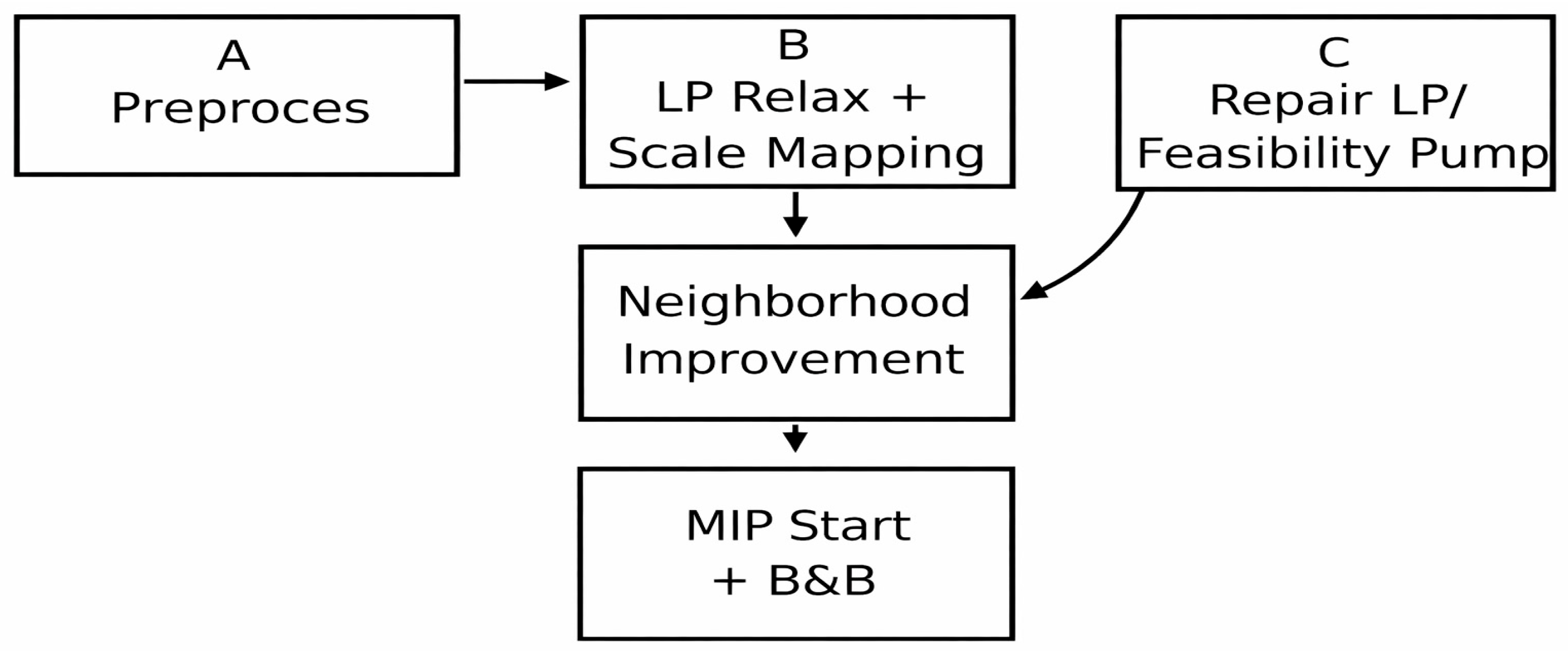
Warm-starting is introduced to cut the time-to-first-feasible (TTFF) and improve early optimality gaps, thereby accelerating convergence on large instances. The procedure complements VI by supplying a high-quality incumbent that focuses the branch-and-bound search and reduces node counts. We implement a four-phase pipeline—preprocessing and strong bounds, continuous relaxation with scale mapping, repair LP with feasibility pump if needed, and neighborhood improvement (fix and optimize, local branching, and RINS)—before launching the global MIP solve with a seeded MIP start.
This procedure aims to generate high-quality incumbent solutions early in the solution process, thereby reducing the computational burden of solving large-scale instances. The procedure is aligned with state-of-the-art approaches in supply chain optimization and consists of four integrated phases:
Phase A—preprocessing and strong bounds. Tight Big-M constants are calculated for each scale–product pair based on maximum feasible throughput. Dominated arcs are filtered out, and flow variable bounds are reduced using supply–demand balances and safety stock constraints. This strengthens the LP relaxation before branching.
Phase B—continuous relaxation and scale mapping. The strengthened LP relaxation is solved without binary variables. The resulting continuous flows are used to map each facility to the smallest operational scale that accommodates its throughput, leveraging the monotonicity property of economies of scale. This generates an initial binary assignment of scales.
Phase C—repair LP and feasibility pump. With binary scale decisions fixed, a repair LP is solved to re-optimize flows. If infeasibility arises due to minimum scale thresholds, a feasibility pump heuristic restricted to scale binaries is applied, followed by another repair LP to restore feasibility. The output is a feasible MIP solution.
Phase D—neighborhood improvement. The feasible solution is improved through fix-and-optimize heuristics applied to subsets of facilities, local branching constraints exploring Hamming-distance neighborhoods, and relaxation-induced neighborhood search (RINS). These methods improve the incumbent solution before the global branch-and-bound procedure is launched.
Expected impact: The WS procedure reduces the time to the first feasible solution, decreases the optimality gap in early iterations, and accelerates convergence. It also facilitates the reuse of MIP starts in related instances with perturbed demand or capacity data. Computational experiments should compare baseline results against the WS approach to quantify improvements in solution time, optimality gap, and scalability.
Pseudocode of the warm-start procedure: To complement the description of the solution procedure, a pseudocode is provided to outline the WS method in an algorithmic manner. This pseudocode aims to facilitate replication of the approach and provides a concise summary of its key steps. The inclusion of this algorithmic representation ensures clarity for both academic readers and practitioners interested in implementing the proposed procedure.
The following pseudocode summarizes the steps of the proposed WS procedure, structured into preprocessing, continuous relaxation, repair, and neighborhood improvement. It can be embedded within the solution procedure section to provide a clear, algorithmic description of the approach for reproducibility and implementation.
WS-PalmBiodiesel():
(A) PreprocessAndTighten()
Compute tight big-M values or replace them with SOS1/indicator constraints.
Remove dominated arcs and tighten flow bounds using supply–demand balances.
(B) (x−, y−, z−, h−) ← SolveContinuousRelaxation(with valid inequalities)
w* ← MapScalesGreedyMonotone(throughputs derived from x−, y−, z−, h−)
(C) (x*, y*, z*, h*) ← RepairLPGivenScales(w*)
If the solution is infeasible, then
(w*, x*, y*, z*, h*) ← FeasibilityPumpRestrictedTo(w*)
(x*, y*, z*, h*) ← RepairLP(w*)
(D) Incumbent ← (w*, x*, y*, z*, h*)
LoadAsMIPStart(Incumbent)
ImproveByFixAndOptimize(Blocks)
LocalBranching(k)
RINS()
return Incumbent. |
The pseudocode highlights the structured sequence of the WS procedure, from preprocessing and continuous relaxation to repair and neighborhood improvement. By following this structure, researchers and decision makers can reproduce the method, adapt it to related biofuel supply chain models, and extend it with metaheuristics or decomposition techniques. This structured description bridges the conceptual explanation of the solution approach with the empirical results presented in the next section.
Warm-start solution procedure—LINGO. The WS solution procedure implemented in LINGO is schematically summarized in
Figure 2.
The proposed WS strategy reduces the time-to-first-feasible solution by steering the B&B process toward structurally valid regions of the solution space, thereby avoiding fruitless explorations and solver restarts. Unlike generic heuristics that may quickly produce a feasible incumbent by blind rounding or randomization—often disregarding critical problem structure (e.g., minimum operational scale requirements or network flow balance constraints)—the WS leverages domain-specific structure to generate an initial solution that is both feasible and aligned with the model’s logical requirements. In particular, each of the four phases (A–D) of the WS contributes directly to cutting the TTFF. Phase A (preprocessing) tightens variable bounds and eliminates dominated decisions (using, for example, supply–demand balances and calibrated Big-M constants), which shrinks the search space and preempts exploration of infeasible. Phase B (relaxation and scale mapping) solves a continuous relaxation and maps its solution to discrete facility scales by exploiting the monotonic economies-of-scale. This yields a structurally coherent starting point—each facility is assigned to the smallest viable scale that can accommodate its throughput—ensuring that any proposed configuration respects scale activation logic. Phase C (repair) then enforces full feasibility: with the scale decisions fixed, flows are re-optimized, and any residual violations (such as unmet minimum scale thresholds) are resolved via targeted adjustments (including a feasibility pump restricted to scale binaries), producing a consistent feasible. Finally, Phase D (neighborhood improvement) refines this incumbent through localized search heuristics (fix and optimize, local branching, and RINS), raising the incumbent’s quality before the global solver is launched. By beginning the B&B with a high-quality, structure-compliant incumbent, the solver can immediately focus on the most promising regions of the search tree and prune suboptimal branches. Collectively, these integrated steps explain why the WS achieves a markedly lower time-to-first-feasible, outpacing traditional approaches that lack problem-specific guidance.
Beyond the observed computational gains, the effectiveness of the proposed WS and VI framework can be explained by its alignment with the structural properties of the biodiesel supply chain model. First, the VI tighten flow bounds and reinforce supply–demand consistency, which significantly reduces the feasible region explored by the solver and prevents early branching on structurally infeasible configurations. Second, the problem exhibits a monotonic relationship between throughput and scale activation: once a facility operates at a given scale, higher scales become relevant only when flows increase. The scale-mapping step explicitly exploits this monotonicity by assigning each facility to the smallest admissible scale capable of accommodating the relaxed throughput, thereby avoiding non-viable scale combinations that would otherwise dominate early B&B nodes. This mapping transforms fractional LP solutions into structurally coherent discrete decisions, effectively embedding problem-specific logic into the initial incumbent. As a result, the B&B search is guided toward regions that respect both scale activation logic and network feasibility from the outset. In contrast to generic heuristics, which often generate feasible solutions without enforcing such structural consistency, the proposed approach yields a high-quality, structure-compliant MIP start. Consequently, the solver can prune large portions of the search tree early and converge to a first feasible solution significantly faster, providing a clear mechanistic explanation for the substantial reductions observed in the time-to-first-feasible and overall CPU time.
6. Solution and Results
An analysis was performed on commercial LINGO 9 software, running on an Intel Core I5, 2.67 GHz CPU with 8 GB of RAM and a 64-bit operating system (Windows 10). For integrality checks, we used LINGO’s absolute and relative integrality tolerances ABSINT = 1 × 10⁻⁶ and RELINT = 8 × 10⁻⁶, respectively, so that an integer variable x is deemed feasible when ∣x−I∣ ≤ 1 × 10⁻⁶ or ∣x−I∣/∣x∣ ≤ 8 × 10⁻⁶. Linear feasibility tolerances followed the standard ILFTOL/FLFTOL settings (≈3 × 10⁻⁶ and 1 × 10⁻⁷), and the linear optimality tolerance LOPTOL was kept at 1 × 10⁻⁷. Early termination of the MIP search was governed by the relative optimality tolerance IPTOLR (relative gap).
LINGO 9 was selected due to its built-in support for solving MIP problems with VI and for its ease of integration with algebraic modeling languages. Although LINGO offers acceptable computational performance, the model remains NP-hard due to binary decision variables and flow constraints, which can affect scalability beyond certain instance sizes. Additionally, the model formulation is compatible with other commercial solvers such as CPLEX, Gurobi, or GAMS, offering flexibility for implementation depending on user preferences or computational resources.
The tested instances reflect realistic network sizes for tactical planning in palm oil biodiesel, spanning 814–6273 variables and up to ~1.8 × 10
4 constraints, which aligns with mid-scale industrial studies. The model parameters were analyzed using four different instances (including a variant with the VI enhancements).
Table 4 presents the SC configuration.
Although the computational experiments rely on simulated instances, the selected parameter ranges and instance sizes were calibrated to reflect stylized characteristics commonly reported in real biodiesel supply chains. Facility capacities, transportation costs, and demand levels were defined within ranges consistent with medium-scale biodiesel networks described in the literature, where multiple feedstock collection points supply a limited number of processing and blending facilities serving regional demand zones. In particular, capacity scales were constructed to capture typical stepwise expansion patterns observed in biofuel production systems, while demand levels and transportation distances were chosen to reflect regional rather than national deployment scenarios, which are representative of tactical planning horizons. The resulting instance sizes balance computational tractability with structural realism, preserving key features such as economies of scale, network flow coupling, and scale activation constraints. This stylized calibration ensures that the numerical experiments are not purely abstract but rather are anchored in plausible operational conditions encountered in real-world biodiesel supply chains.
We compare the performance of the baseline solver with that of the WS pipeline, and for the WS approach, we also report standard deviations across 10 runs.
Table 5 complements the network configuration in
Table 4 and the solver/tolerance settings described above, enabling an integrated view of scalability and solver efficiency [
30,
31,
32].
The computational performance of the baseline solver and the proposed WS pipeline, including TTFF, CPU time, and scalability indicators across increasing instance sizes, is summarized in
Table 6.
The ablation results confirm the complementary contribution of VI and WS, demonstrating that their combined use significantly improves computational efficiency without affecting optimality or solution quality.
Overall, the results highlight three clear patterns. First, the problem scale increases significantly across instances (e.g., 814→6273 variables; ~1.4 k→17.7 k constraints), reflected in the non-linear growth of iterations (≈1.6 × 10
4→4.7 × 10
7). Second, the WS procedure reduces the TTFF by 60–75% and CPU time by ≈17–21%, with relative gains that persist or improve as the instance size grows (e.g., in Instance 4, CPU decreases from ~10,153 s to ~8000 s, ≈21.2%). Third, profit values are not monotonic with problem size (Instance 2 exceeds Instances 1 and 4), which is consistent with structural differences in parameterization and network topology rather than algorithmic performance. Importantly, TTFF values are consistently lower than CPU times, as theoretically expected, and the reported standard deviations show moderate variability across 10 runs. These findings align with prior studies reporting the stabilizing role of WS in mixed-integer programming [
33,
34].
The observed computational gains are consistent with prior findings on primal heuristics and WS procedures in mixed-integer programming. In particular, early incumbents generated by approaches such as the feasibility pump and relaxation-induced neighborhood search tend to shrink initial gaps and reduce node counts, which, in turn, accelerates convergence [
30,
31,
32]. The magnitude and pattern of TTFF reductions in our experiments (60–75%) fall within the upper range reported for problems where the number of binaries and the breadth of the search tree amplify the value of high-quality incumbents. Moreover, the larger absolute savings in medium-to-large instances agree with solver behavior documented on representative test sets such as MIPLIB 2010, where the impact of incumbents generally increases with problem scale and complexity [
33,
34].
Across 10 independent runs per instance, the dispersion of WS performance is modest in absolute terms and shrinks, in relative terms, as the problem size grows. For TTFF, standard deviations of 0.3/1/45/90 s yield coefficients of variation (CVs) of ~30.0%, 16.7%, 14.3%, and 12.5% for Instances 1–4, respectively. For CPU, standard deviations of 5/7/45/80 s correspond to CVs of 100%, 14%, 2.0%, and 1.0%. The inflated CV for Instance 1 is purely a denominator effect (mean CPU = 5 s); in practical terms, a ±5 s spread is negligible. For the largest instance, the 95% confidence interval of the WS CPU mean is approximately 8000 ± 60 s (n = 10), reinforcing stability. This pattern—lower relative variability as scale and search tree breadth increase—is consistent with the behavior of primal heuristic-aided solvers reported in the MIP benchmarking literature, where high-quality incumbents reduce sensitivity to random seeds and cut activation order [
32,
33,
34].
It can be deduced from the previous table that the TTFF and CPU times for the solution of the different instances of the problem show good performance values for the instances under study. The summary of the runs of Instance 1 is presented in order to better illustrate the results (see
Table S1). The results of the four instances also are presented in the
Supplementary Materials.
Table S1 disaggregates the optimal solution for Instance 1 across the four stages—suppliers → extractors → bio-refineries → blenders → DZs—thus illustrating how the model operationalizes economies of scale and mass balance consistency. Four patterns stand out:
6.1. Network Sparsity with Cost-Driven Routing
Flows concentrate on a limited set of i→j, j→q, and q→k arcs, indicating that the solver selects a small number of cost-effective routes while suppressing dominated arcs identified in preprocessing. This sparsity is consistent with the fixed/initial transport cost structure and leads to lower effective unit costs at activated routes (cf. constraints (22)–(25)).
6.2. Scale Activation Consistent with Throughput
Although scale binaries are not shown in
Table S1, the throughputs implied by
x,
y,
z, and
h align with the monotonicity logic enforced by the VI: facilities operate at the smallest scale that feasibly accommodates their load, avoiding minimum-scale infeasibilities and capturing scale economies where volumes justify it (constraints (6)–(14) and VI (26)–(31)).
6.3. Mass Balance Coherence and Capacity Discipline
The observed stage-to-stage throughputs are coherent with bill-of-materials relations and do not overshoot facility production/handling limits, reflecting compliance with capacity constraints (16)–(18) and input–output balances (19)–(21). This ensures that the material flow plan is physically implementable without artificial slack.
6.4. Service Levels Priced by Penalty Terms
Deliveries from blenders to DZs (h) prioritize meeting market requirements; any residual imbalance is priced via shortage/surplus penalties rather than hidden in the flow structure (constraint (15) and parameters CFLB/CSOLB). In the reported solution, these penalties are non-dominant in the profit decomposition (constraints (2)–(5)), confirming that profitability is primarily driven by scale-efficient processing and cost-effective routing.
6.5. Managerial Takeaway
Even in a small network, the model (i) channels volume through a few high-leverage routes and scales, (ii) respects plant bottlenecks, and (iii) keeps imbalance penalties marginal. Practically, this means that managers can increase profitability by (a) consolidating flows on the most economical corridors, (b) activating facility scales only when throughput clears minimum thresholds, and (c) monitoring bottlenecks at extractors and refineries where marginal capacity expansions yield the largest gains.
6.6. Sensitivity Analysis
A sensitivity analysis was performed to evaluate the impact on the objective function, derived from eventual changes in certain parameters of the model. The results can significantly help in the decision-making process in the entire SC. Thresholds of change in the study parameters were selected at a value sufficient to clearly identify the effects on the utilities. In this regard, the analyses studied the impact of changes between 10% and 90% with 10% increments. The simulated parameters were revenues and capacities for each of the facilities in order to study the effect of the change on profits (objective function).
The sensitivity analysis varies two main parameters: (i) revenues and (ii) facility capacities. Each parameter was increased from 10% to 90% in 10% increments, while other inputs remained constant at baseline values. All results are expressed in USD for profit and % for the tested parameter.
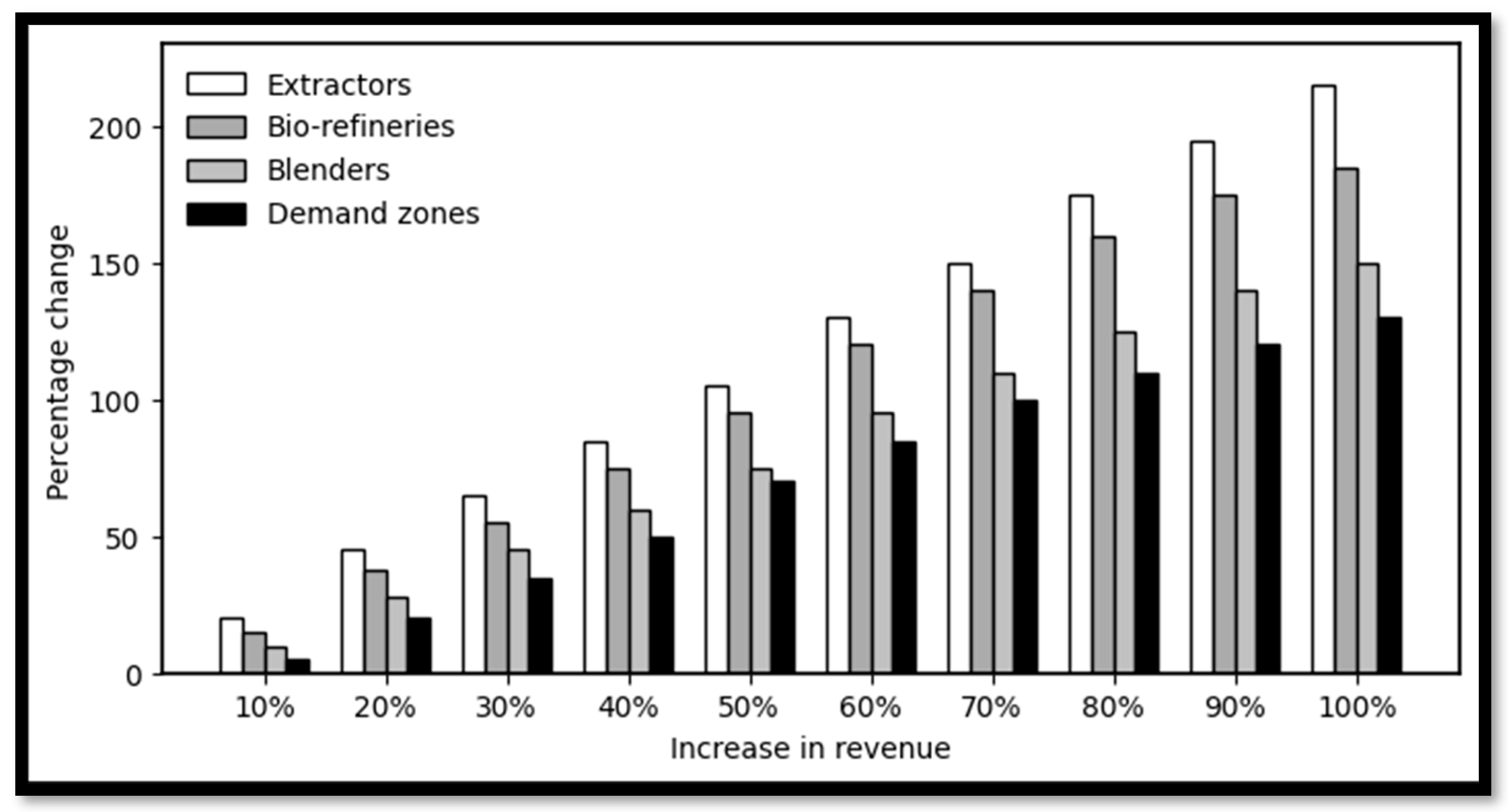
Figure 3 shows the variation of profit as revenue increases, and
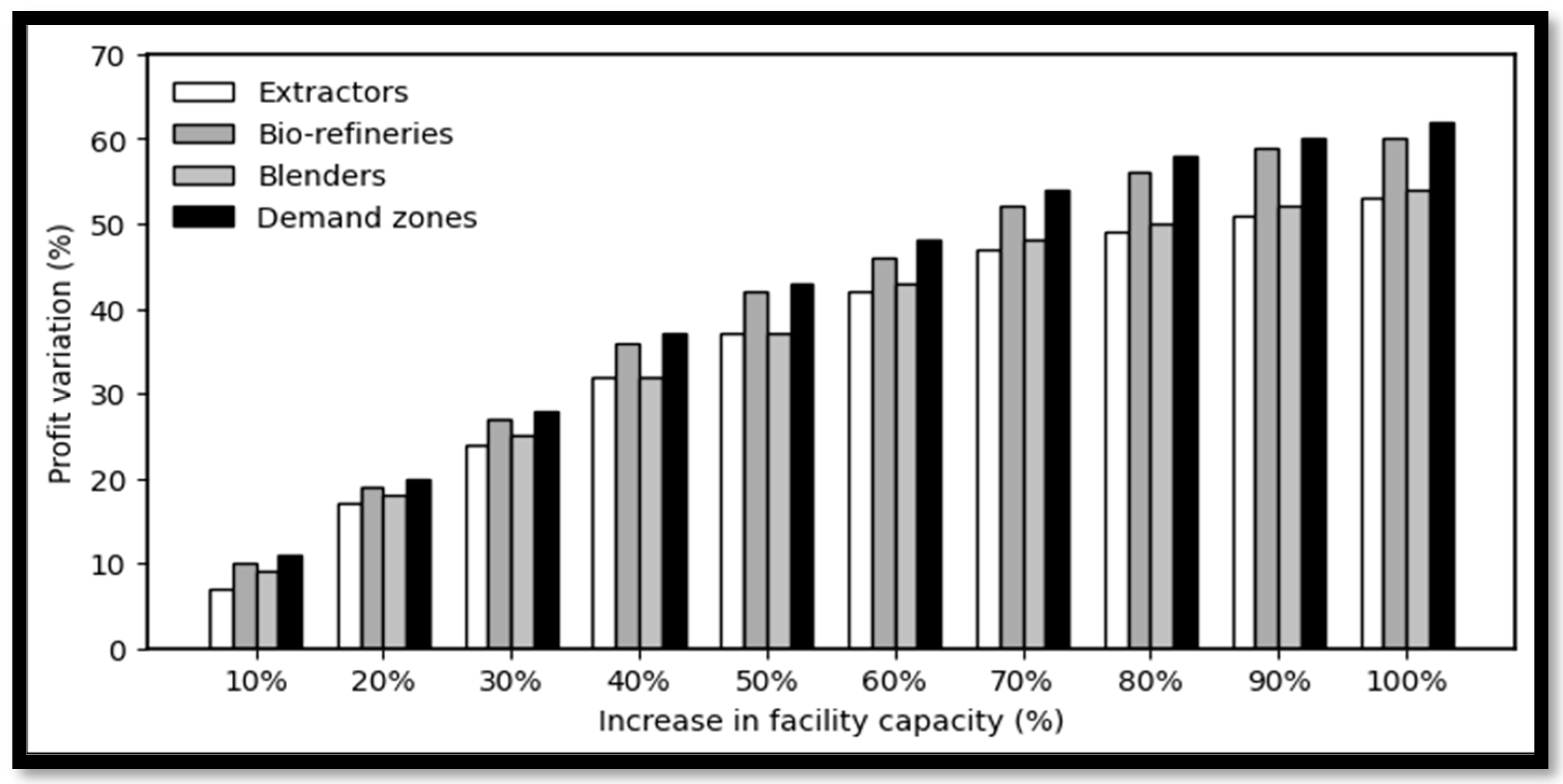
Figure 4 depicts profit variation as capacity expands. Both figures are standardized with explicit units for all axes.
Table 7 summarizes the sensitivity parameters.
6.7. Impact of Revenues on Profits
Figure 3 details the impact of revenues on profits for each of the links, constraints (2)–(5), which shows a linear behavior in all cases.
Increases in revenues lead to non-negative and significantly higher percentage variations in profits in each of the links and facilities analyzed, which shows the goodness of profit derived from focusing on higher revenues as long as the other parameters do not vary significantly, a matter of interest for SC managers.
The revenue and capacity sensitivities translate into actionable rules for tactical planning. On the revenue side, the near-linear response of profits (cf. constraints (2)–(5)) implies that managers should prioritize commercial actions that raise effective selling prices or net unit revenues at refineries and blenders, where the slope of the profit curve is steepest in our tests. On the capacity side (constraints (16)–(18)), the increasing but diminishing marginal gains indicate a practical expansion threshold: invest in additional capacity (or activate a higher operating scale) only when expected throughputs approach the current scale’s lower bound (GMIN*) and the marginal profit still exceeds the shadow cost of capacity. In operational terms, (i) consolidate flows on corridors already operating at favorable scale, (ii) upgrade scale at extractors/refineries before persistent bottlenecks force costly rerouting or shortages (CFLB), and (iii) keep surplus penalties (CSOLB) non-dominant by aligning production plans with DZs that exhibit the highest revenue elasticity. Because the marginal returns flatten beyond the first capacity increments, further expansions should be justified by scenario runs (e.g., demand or price shocks), which the WS pipeline can evaluate rapidly through MIP-start reuse across perturbed instances.
6.8. Impact of Capacities on Profits
Figure 4 details the impact of capacities on profits for each of the links, which shows an increasing non-linear behavior in all the SC links.
The study of the impact on profits is caused by the increase in capacity of the related parameter in constraints (16)–(18). With the increase in capacity of each facility, positive and marginally decreasing percentage variations in profit are observed in each of the analyzed links. The results show that the effects on utility are slightly higher in percentage terms in the refining and final distribution stages and slightly lower in the other two stages of the SC; this is explained by the fact that the stages do not experience the same level of marginal exploitation of economies of scale.
The analyses can be extended to other parameters such as cost components, which, however, are usually kept confidential by the companies and are beyond the scope of this work, which does not imply that they can be taken into account by decision makers.
In addition to revenue and capacity variations, future analyses may incorporate sensitivity to unit transportation costs, energy prices, and carbon penalties, factors with significant real-world variability and strategic implications.
Taken together, the experiments show consistent TTFF and CPU improvements from coupling VI with a WS pipeline, with stable dispersion across 10 runs per instance and increasing relative benefits as instance size grows. The disaggregated flows confirm feasibility, scale activation logic, and cost-driven routing, while the sensitivity tests supply actionable levers—pricing, scale upgrades, and corridor consolidation—and support rapid scenario evaluation via MIP-start reuse.
We now synthesize managerial implications and outline methodological extensions in the Discussion and Conclusions.
7. Discussion: Generalizability and Extensions
The proposed MILP framework is readily adaptable to other supply chains by adjusting industry-specific parameters while preserving its core structure. Key components such as demand patterns, cost coefficients, and capacity constraints can be modified to reflect different sectors without altering the fundamental decision variables or constraints of the model. Crucially, the VI introduced for the biodiesel case are formulated in a general manner and could be applied to analogous multi-echelon logistics problems. Likewise, the WS solution strategy leverages structural properties (e.g., production–distribution flow balance and capacity utilization) that are common to many network design and tactical planning problems, making it a generally applicable heuristic beyond this biodiesel scenario.
Transferable insights (what carries over): Beyond parameter changes, the main transferable insight is that explicit scale activation (with minimum/maximum throughput and fixed/variable cost coupling) materially changes tactical recommendations compared with constant-returns models, particularly under corridor consolidation and capacity expansion scenarios. Likewise, the combination of monotonicity-based VI and a scale-mapping WS is broadly useful in tactical MILPs where (i) scale binaries gate flow, (ii) scale ordering implies dominance/monotonicity, and (iii) decision makers require repeated “what-if” re-solves. Under these conditions, the proposed hybrid strategy is not case specific; it functions as a reusable acceleration pattern for multi-echelon planning problems.
In addition to its immediate adaptability, the model’s design invites several extensions to broaden its scope. Future adaptations might incorporate demand uncertainty (to handle volatile markets or prices), multi-product interactions (to model supply chains producing multiple fuel or co-products simultaneously), and explicit sustainability metrics (to account for environmental impacts or carbon footprints). Introducing stochastic elements or multi-objective criteria would further enhance the relevance of the framework for sustainable supply chain design, allowing it to capture a wider range of real-world conditions. These extensions would make the approach even more transferable, enabling decision makers in other sectors to tailor the model to their specific logistical and strategic contexts.
To deploy the framework beyond the present case, practitioners only need to (i) redefine the network sets (facilities, markets, and feasible corridors) and product conversion yields; (ii) specify the scale grid E and the associated throughput bounds (GMIN and GMAX) and scale-linked cost coefficients; and (iii) calibrate sector-specific price/tax and shortage/surplus penalty parameters. Under these inputs, the monotonicity-based VI templates remain valid whenever higher scales imply non-decreasing feasible throughput, and the WS pipeline can be reused to accelerate repeated “what-if” runs across perturbed scenarios, making the approach operationally transferable rather than case specific.
Within the tactical planning context addressed in this study, the adopted modeling and analytical choices are well suited to the decision objectives under consideration. The deterministic MILP formulation, complemented by sensitivity analysis, enables a transparent evaluation of how profit-oriented decisions respond to variations in key economic and capacity parameters, supporting iterative scenario analysis and managerial insight under stable planning assumptions. This approach aligns with the intended use of the model for repeated re-solving and fast “what-if” exploration, which is further reinforced by the valid inequalities and warm-start solution procedure. In broader planning settings, alternative decision paradigms that explicitly incorporate uncertainty and risk attitudes—such as robust optimization approaches—may serve as a complementary extension, particularly for strategic or risk-averse applications.
8. Conclusions
This paper contributes to the development of tactical-level optimization models by incorporating production and distribution planning in a unified MIP framework for biodiesel derived from palm oil. It addresses a specific research gap by explicitly modeling midstream and downstream flows with VI and scalable production decisions.
From a research standpoint, the gap addressed is not merely application driven: tactical models that ignore discrete scale economies and rely on weak formulations can be impractical for iterative planning, limiting their adoption in decision support settings. By jointly enforcing scale-consistent feasibility (via VI) and enabling fast incumbent generation (via WS), the proposed approach makes tactical MILPs operationally usable for scenario-based management, where decisions must be recomputed under frequent price, demand, and capacity updates.
The boost given to biofuels in recent years has positioned it as a real alternative to reduce CO2 emissions and mitigate climate change. The effort to optimize and make the industry sustainable implies the development of decision support systems, which follows a line of works that are consolidating a dossier of technical possibilities that facilitate the management of the SC.
This work proposes MIP and a solution procedure based on VI that was implemented in a commercial solver to tactically optimize the biodiesel SC (at midstream and downstream levels) and can be considered complementary to the efforts undertaken for the upstream phase of the oil palm supply chain. The proposed formulation captures discrete operating scales (economies of scale), mass balance and logistics constraints, and surplus/shortage costs, enabling realistic tactical integration of market and infrastructure conditions. From a managerial perspective, the model can support decisions on facility scaling, product allocation, and economic feasibility under supply–demand constraints. However, the current approach assumes deterministic demand and cost data, which limits its application in uncertain environments. Future work should consider stochastic formulations and real-time data integration. The model’s formulation preserves economic consistency by isolating after-tax margins from downstream selling prices, avoiding revenue duplication, and maintaining a coherent representation of tactical-level profitability. This contributes to both methodological transparency and the practical relevance of the results.
The computational analysis performed in this work was aimed at determining the efficiency of the problem under the objective of maximizing after-tax profits. The TTFF and CPU times obtained for the optimal solution showed good performance in practical instances of the problem. From a computational perspective, the integration of VI and WS mechanisms proved to be a robust strategy for tactical-level biodiesel supply chain problems under economies of scale. Across all instances, substantial reductions were observed in the TTFF (60–75%) and CPU time (≈17–21%), with bounded dispersion across runs. These results confirm that providing an early, high-quality incumbent guides a more focused branch-and-bound search, accelerates gap closure, and improves scalability without altering model optimality [
30,
31].
The model supports decisions on facility scaling, product allocation, and economic feasibility under realistic supply–demand constraints, with computation times compatible with tactical “what-if” analyses. Future extensions should include (i) stochastic formulations addressing demand, cost, and energy price uncertainty; (ii) decomposition-based approaches (benders and column generation) and lightweight metaheuristics for large-scale instances; and (iii) reuse of MIP starts under perturbed input data, leveraging the WS pipeline to accelerate sensitivity analyses and scenario planning [
32,
34].
Results are based on simulated data and a single commercial solver on mid-range hardware, which may limit generalizability to larger industrial networks. Deterministic parameters omit demand and price uncertainty; however, the WS pipeline facilitates rapid “what-if” re-solves under perturbed scenarios. Cross-solver tests (e.g., CPLEX/Gurobi) and stochastic extensions are left for future work.
The approximation of the problem that has been presented can be a basis for further work both in mathematical modeling with the inclusion of new constraints and objectives as well as the development of solution procedures based on heuristics and/or metaheuristics, to be compared considering optimality gaps, memory usage, computational time, among other performance parameters.
Theoretically, this work contributes by showing how multi-stage tactical planning with discrete scale economies can be strengthened and operationalized through monotonicity-based VI and a WS pipeline that improves early feasibility and scalability. While demonstrated on palm biodiesel, the modeling and acceleration principles apply to a wider family of process industry and renewable energy supply chains in which throughput-based scale activation and multi-echelon flow conservation govern tactical decisions.
9. Perspectives for Future Research
Research perspectives focus on two fronts: The first one is algorithmic, to make its solution more efficient, supported by relaxations such as benders or column generation or by the development of heuristics if the algorithmic solution is insufficient. The second front is related to the inclusion of new constraints or objectives.
Recent advances in biodiesel supply chain optimization have introduced new methodological trends, combining mathematical programming with hybrid, data-driven, and multi-objective approaches. For instance, Ref. [
35] proposed a robust optimization-based framework for resilient biodiesel supply chains, while [
36] formulated a multi-objective model for long-term biofuel planning using micro-algal resources. Ref. [
37] reviewed the integration of optimization and simulation techniques for biofuel logistics, and [
38] analyzed the impact of carbon pricing policies on renewable fuel supply chains. Additionally, Ref. [
39] discussed adaptive and viable supply chain designs inspired by immune system modeling. These studies confirm the relevance of hybrid optimization and sustainability-driven models, which align with the methodological direction of the present research. Future work may integrate stochastic or multi-objective extensions, life-cycle indicators, and policy-driven constraints within the same tactical framework proposed here. Future research may complement the present tactical framework by incorporating robustness analysis, allowing for explicit treatment of parameter uncertainty and alternative decision attitudes within extended planning contexts.