1. Introduction
Curling is an Olympic sport in which two teams take turns executing shots, requiring both precision and strategic decision-making. First included in the 1924 Winter Olympics in Chamonix, curling has since developed into a highly tactical sport with a rich history [
1].
Victory in curling depends on more than just strength and accuracy. Players must precisely control the stone’s speed and rotation while considering friction, collisions, and ice conditions. Strategic shot placement is key, whether to obstruct the opponent’s stones or secure an advantageous position. Since each shot affects the game’s progression, players must balance immediate gains with long-term strategy.
Curling involves strategic considerations such as hammer usage and cumulative scoring dynamics (e.g., blank ends). However, in this study we focus on strategic decision-making within a single end. We model one end as an episodic Markov Decision Process (MDP) with a fixed horizon of 16 deliveries (8 per team). Even under this single-end setting, the problem remains challenging because each shot can have delayed and collision outcomes, creating long-horizon credit assignment over the remaining deliveries. Addressing these challenges motivates the development of a dedicated reinforcement learning (RL) framework tailored to the structure and strategic demands of curling.
In recent years, AI has demonstrated remarkable success in analyzing and optimizing strategies across various games and sports [
2]. In intellectual sports, AI systems have already surpassed human expertise and provided new forms of strategic insight [
3]. Google’s AlphaGo and AlphaGo Zero, for example, defeated world-class Go professionals and transformed modern Go training [
4,
5]. Similarly, Microsoft’s Suphx—a mahjong AI combining supervised learning with RL—has outperformed 99.99% of players on the competitive Tenhou platform [
6]. Kuaishou’s DouZero has likewise achieved strong performance in Fighting the Landlord, surpassing hundreds of competing AI agents and demonstrating human-level competence despite the stochastic nature of the game [
7]. More recently, deep reinforcement learning (DRL) approaches have been applied to curling [
8,
9], indicating growing interest in strategic shot-planning for this domain.
Despite this progress, applying deep reinforcement learning (DRL) to curling presents several distinctive challenges. First, an RL-compatible curling simulator must (i) maintain physically plausible dynamics while remaining computationally stable; and (ii) expose learning-relevant internal state variables, such as stone positions, velocities, and collision events, in a consistent and analyzable form. Although perfect physical replication is not the goal of this study, a simulator that is consistent, fully observable, and reproducible is a critical prerequisite for methodological development in curling. Second, beyond simulation fidelity, curling requires long-horizon and hierarchical reasoning: each shot influences not only the immediate scoring outcome but also the future tactical landscape within an end, where each shot shapes the later tactical landscape (e.g., setting guards or preparing for the final hammer shot) under delayed rewards. Effective agents must therefore learn to integrate short-term shot execution with long-term strategic planning under delayed rewards.
These challenges make curling a demanding problem for DRL-based decision-making. Developing an effective agent requires accurate physical simulation and sequential decision-making under uncertainty. Unlike board games such as chess or Go, curling involves continuous action spaces (e.g., shot speed, angle, and rotation) and dynamic environmental interactions (e.g., ice friction and stone collisions). These factors make DRL- and model-based planning particularly effective for optimizing shot selection and adapting to evolving game conditions.
To overcome these limitations, search-based methods such as Monte Carlo Tree Search (MCTS) [
10] have been applied. MCTS has demonstrated high performance in strategic games like chess and Go by probabilistically exploring decision paths to identify optimal actions. However, applying traditional MCTS to curling is challenging due to its continuous action space and inherent uncertainty. Unlike board games with discrete moves, curling requires selecting precise shot parameters, including speed, angle, and rotation. Yee et al. [
11] extended upper confidence trees [
12] with the Kernel Regression UCT (KR-UCT) algorithm, allowing information sharing among similar actions to improve decision-making in continuous spaces. Their results showed that KR-UCT outperformed conventional MCTS by efficiently exploring promising action regions beyond predefined shot candidates. Despite these advancements, Monte Carlo-based search methods remain computationally expensive, requiring a large number of simulations. Furthermore, since MCTS re-executes the search from scratch at each turn, it cannot retain learning from past experiences unless identical situations arise.
Recent advancements in DRL have opened new possibilities for curling strategy optimization [
8,
9,
13,
14,
15]. Unlike rule-based or search-based methods, DRL enables agents to learn optimal strategies through self-play and experience, without relying on predefined heuristics. With sufficient training, DRL has the potential to surpass human decision-making. However, its application to curling presents challenges, including the complexity of building a stable, rule-consistent simulator, the continuous action space, and sparse rewards, as points are only awarded at the end of an end. D. Won et al. [
13] framed curling as a real-world AI challenge and proposed an adaptive DRL. Their key innovation was integrating temporal features into DRL algorithms, enabling the agent to adapt to changing ice conditions. Their agent, Curly, refined shot decisions using accumulated game data, significantly improving accuracy. In experimental matches, Curly won three out of four games against South Korea’s national teams, demonstrating DRL’s potential to bridge the gap between simulation and real-world performance. Despite its potential, DRL requires significant computational resources and training time. Additionally, learned policies often lack interpretability, making AI-driven decisions difficult to analyze. To mitigate these challenges, DRL is often integrated with traditional search and simulation techniques, improving stability and serving as a step toward fully autonomous DRL-driven curling strategies. Further advancements in self-play learning have been explored in curling AI. Y. Han et al. [
8] applied Neural Fictitious Self-Play (NFSP) [
15], where two neural networks were alternately trained through repeated self-play. To handle curling’s continuous action space, they integrated NFSP with KR-UCT, allowing the policy network to encode strategic knowledge while reducing reliance on computationally expensive MCTS searches. However, their study highlighted the challenges of achieving optimal strategies solely through end-to-end deep learning due to learning instability and the complexity of function approximation in continuous spaces. Junjie Lin et al. [
9] combined RL with decision trees using Distributed Proximal Policy Optimization (PPO). They first constructed a decision tree based on domain knowledge, then refined it through DRL to enhance generalization while maintaining interpretability and stability. This method won the 2022 RLChina curling competition with a record of 31 wins, 19 draws, and 0 losses. However, if the initial decision tree is inaccurate, PPO may struggle with inefficient exploration. Additionally, DRL does not automatically correct flaws in the tree, requiring manual adjustments. PPO’s clipping mechanism, while stabilizing training, can also limit the model’s ability to learn highly flexible strategies.
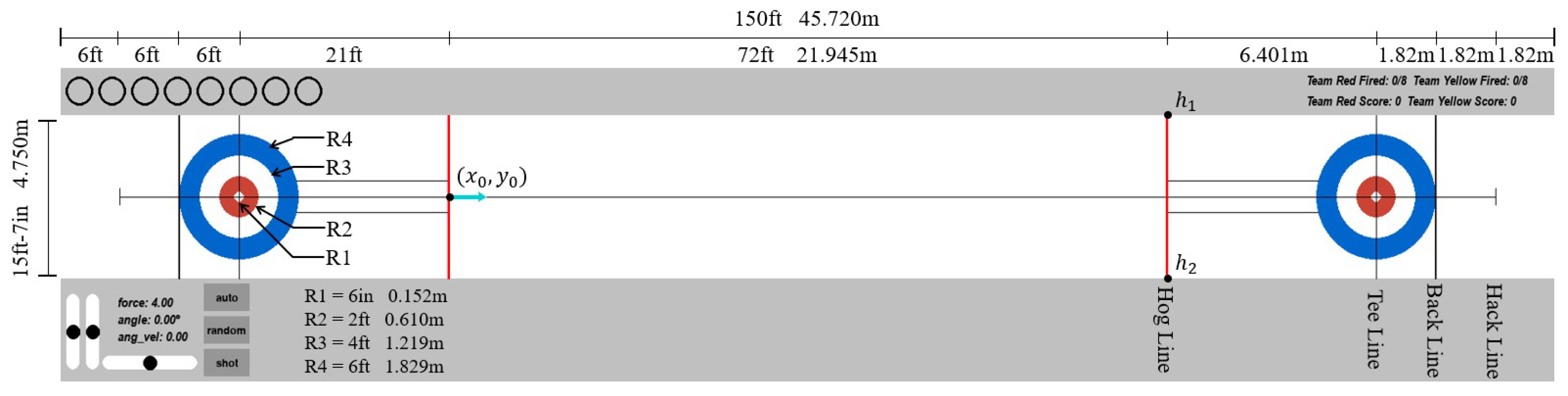
To address these limitations, we introduce a unified reinforcement learning framework for curling, designed to provide a complete pipeline spanning environment modeling, MDP formulation, and agent training. Unlike previous methods that depend on discretized action spaces or handcrafted decision structures, our framework directly supports continuous shot-level control, enabling direct continuous control of release force, angle, and rotation without discretizing the action space. The framework is built on a custom curling simulator specifically developed for RL research, providing stable stone dynamics, configurable rules, and full access to internal states necessary for systematic analysis and reproducible benchmarking.
Central to the framework is a new curling-specific MDP formulation that incorporates continuous actions, physically grounded state representations, and a reward structure aligned with tactical objectives within an end. This MDP allows agents to learn both offensive and defensive behaviors by anticipating opponent responses over the remaining shots in the current end. Furthermore, we introduce a two-phase training strategy: Phase 1 focuses on establishing low-level shot consistency by learning to deliver stones accurately toward the tee line, while Phase 2 optimizes end-level scoring through reward shaping based on strategic outcomes. This staged learning procedure stabilizes policy acquisition and mitigates the difficulty of sparse, delayed rewards typically found in curling.
For policy learning, we adopt Soft Actor–Critic (SAC), a DRL algorithm well-suited for continuous control, combining entropy regularization with off-policy learning to enhance exploration and sample efficiency. Within our framework, SAC operates over the proposed MDP and leverages twin Q-networks to improve stability under complex curling dynamics.
The main contributions of this work are as follows:
A unified RL framework for curling, integrating environment, MDP, and training pipeline to support systematic evaluation of curling strategies;
A curling-specific MDP formulation featuring continuous action spaces, structured state representations, and reward functions aligned with real strategic objectives;
A novel two-phase training strategy that progressively builds from low-level shot accuracy to high-level strategic optimization, improving stability under sparse rewards;
A custom curling simulator optimized for DRL research, providing reproducible and flexible experimentation for the development of curling AI agents.
The remainder of this paper is structured as follows.
Section 2 introduces the proposed framework, including the simulator, MDP design, and training strategy.
Section 3 presents experimental evaluations, including ablation studies and comparisons with elite curling players. Finally,
Section 4 discusses limitations and future research directions.
3. Experiments and Results
In this section, we present a comprehensive experimental evaluation of the proposed unified reinforcement learning framework for strategic curling. Our goal is to verify that the proposed simulator and MDP design and two-phase curriculum enable stable long-horizon learning under continuous shot control, and to quantify how effectively the resulting policies translate mechanical shot execution into end-level strategic advantage. To this end, we conduct controlled experiments under consistent training and evaluation protocols, emphasizing fairness across algorithms and reproducibility of all reported results.
We begin by summarizing reproducibility details, including the exact code reference and the principal training configurations used throughout the study (
Section 3.1). Next, we evaluate learning dynamics and competitive strength by benchmarking representative continuous-control RL methods under identical conditions, using both learning curves and head-to-head match outcomes as primary evidence (
Section 3.2). We then isolate the contribution of key MDP components via ablation studies, analyzing how game-context signals, score-based shaping, and rotational control affect performance and behavior (
Section 3.3). Finally, we assess whether the learned agent exhibits tactically plausible patterns by qualitatively comparing selected agent decisions with situations observed in elite curling match records, providing an interpretable link between simulated self-play strategies and real-world competitive play (
Section 3.4).
3.1. Reproducibility Details
All experiments were conducted with fixed random seeds under identical architectural settings across SAC, A2C, and PPO.
Table 1 summarizes the principal experimental configurations, including key hyperparameters and optimizer settings for each algorithm, together with the hardware and software specifications used for all runs. Using this fixed setup, we next evaluate both learning dynamics and competitive performance of the trained agents.
3.2. Evaluating RL Agents for Curling
To evaluate the effectiveness of the proposed curling RL framework, we conducted a series of experiments focusing on both quantitative and qualitative aspects of agent behavior. Our primary objective was to determine whether the proposed MDP design and the two-phase curriculum enable stable learning across different reinforcement learning algorithms.
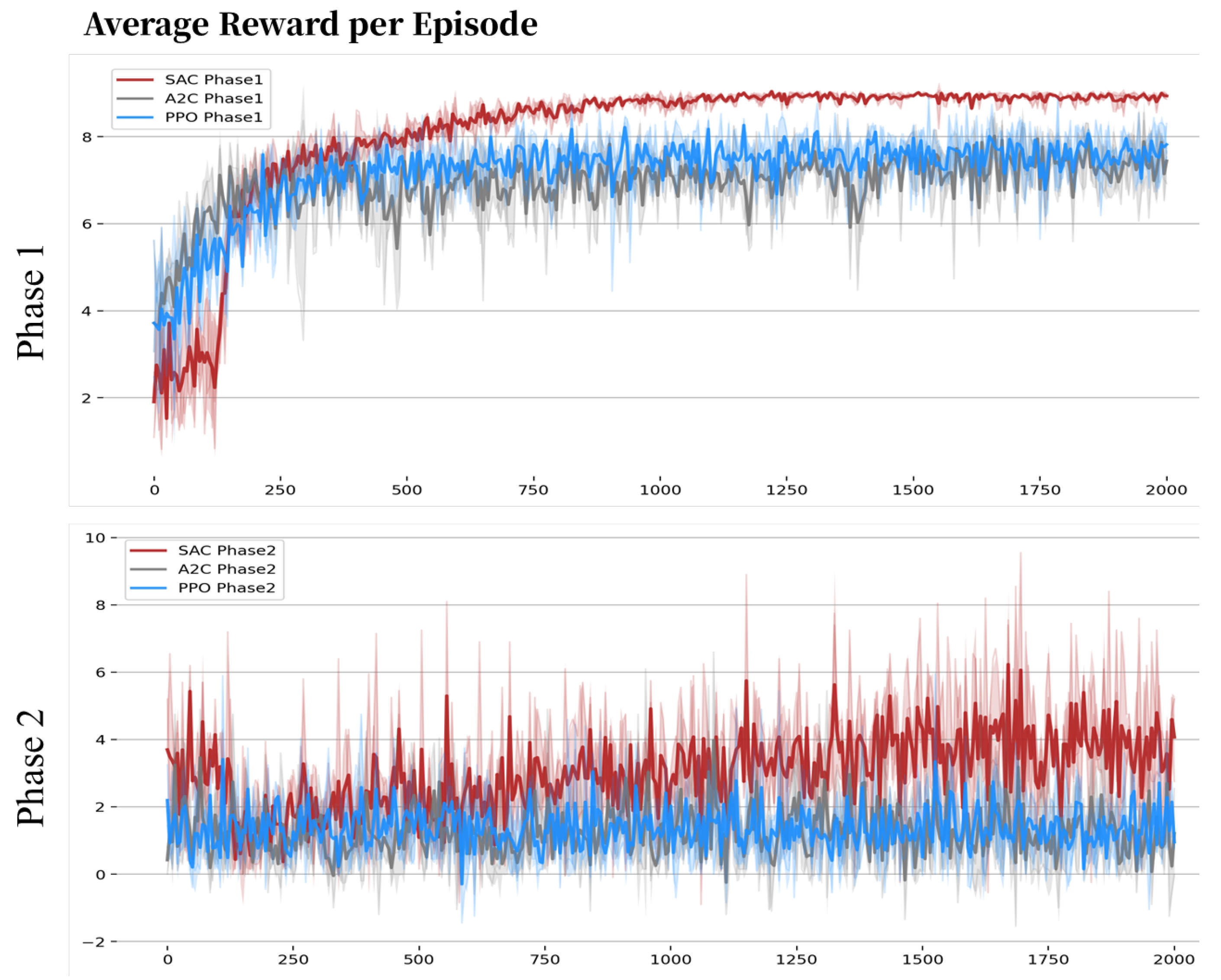
We benchmarked three representative continuous-control methods, Soft Actor–Critic (SAC), Proximal Policy Optimization (PPO), and Advantage Actor–Critic (A2C) under identical simulator conditions and architectural settings. As shown in
Figure 2, during Phase 1, where only the distance-based reward is active, all agents progressively learn basic delivery mechanics. However, SAC demonstrates markedly faster convergence and reaches a substantially higher asymptotic reward than both PPO and A2C, indicating superior stability and sample efficiency in the early stage of curling skill acquisition.
The difference between algorithms becomes more pronounced in Phase 2, where the reward function transitions to the area- and score-based terms and agents enter competitive self-play. This setting introduces sparse and delayed returns, substantially increasing the difficulty of policy optimization. Under this regime, SAC continues to steadily improve and maintains stable reward progression, whereas PPO and A2C exhibit oscillatory or stagnant behavior despite extended training. These results suggest that entropy-regularized off-policy learning is particularly advantageous in curling, where continuous shot parameters and strategic game outcomes must be jointly optimized. Overall, SAC proves to be the most robust approach across both phases, successfully transferring low-level mechanical skill into high-level strategic decision-making.
Beyond the learning curves, we assess the competitive strength of the trained agents via direct head-to-head evaluation. In our experiments, each match begins with the Red team throwing first, and the teams alternate the first throw from match to match. Hammer possession within an end follows the standard curling rule: the team that does not score in an end receives the hammer in the subsequent end. In a blank end (i.e., an end in which neither team scores), the hammer is retained by the same team for the next end. As summarized in
Table 2, each pairing is tested over 30 matches, where each match consists of 10 ends and the random seed is resampled per match; we report both the match-level outcome (Win–Draw–Loss from the Red team’s perspective) and the averaged score differential (Score Avg and End Score Avg).
In the Phase 2 vs. Phase 2 setting, the SAC agent exhibits the strongest overall performance. Against A2C, SAC achieves a 24–0–6 record and attains a high average score (Score Avg: ). In contrast, A2C shows a lower average score (Score Avg: ). Against PPO, SAC achieves a perfect 30–0–0 record and the largest margin (Score Avg: ). These results suggest that the combination of off-policy learning with strategic reward terms and entropy regularization enables SAC to discover advantageous shot patterns and reliably convert them into scoring outcomes. In addition, the A2C–PPO matchup indicates that A2C is comparatively weaker, recording 11–0–19, along with a lower average score.
The benefits of the proposed two-phase training strategy become more evident in Phase 2 vs. Phase 1 comparisons. SAC consistently outperforms all Phase 1 agents trained only for placement, showing particularly large gaps against A2C and PPO with records of 27–0–3 and 27–0–3, respectively. In some matches, Phase 1 agents occasionally secure wins; this can be attributed to their lack of contextual reasoning, which often leads them to take overly aggressive or poorly positioned shots that inadvertently create scoring opportunities. In contrast, the Phase 2 SAC adapts its behavior to the shot context and leverages freezes, guards, and come-around trajectories to establish multi-stone scoring positions. Overall, these findings highlight that the transition from mechanical skill acquisition (Phase 1) to strategic optimization (Phase 2) is crucial for curling performance, and that SAC can effectively exploit this transition to achieve strong competitive strength.
3.3. Ablation Studies
Among the components of the MDP , the game-context information and the score-based reward are crucial for strategic decision-making. Curling does not reward purely high-precision placements; agents must evaluate advantageous house configurations, deny scoring opportunities to the opponent, and adapt shot selection accordingly. Without game-context feedback, the agent tends to optimize local stone placement but fails to reason about global scoring outcomes, resulting in limited offensive or defensive intent.
Angular velocity
is another essential factor for tactical diversity. Removing curl forces the agent to rely solely on linear force
F and release angle
, which restricts its ability to execute core curling maneuvers such as guards, freezes, or come-arounds that require curved trajectories. Prior approaches often fix spin direction to a discrete set or eliminate rotation entirely [
8,
19,
20], thus reducing the expressive capacity of the action space. In contrast, our formulation treats
as a continuous control variable, allowing for wider behavioral variation in the house.
Table 3 reports head-to-head results for the proposed agent and its ablated variants. The full model consistently dominates the ablations, showing the strongest win–draw–loss records and the largest average score margins. When we remove the game-context signals
and the score-based reward term
, performance drops substantially, indicating that strategic awareness is critical for end-level decision-making. Disabling curl by fixing angular velocity
also causes a clear degradation: while the agent can still place stones near the house, it becomes less effective at executing tactically important curved trajectories (e.g., guards, freezes, and come-arounds), particularly against defensive responses. The most restricted variant that removes both game-context and curl performs worst overall, confirming that game-context shaping and rotational control provide complementary benefits for competitive curling play.
To verify that the auxiliary placement term
functions as intended, we conduct a limited sensitivity test by varying only the weight of
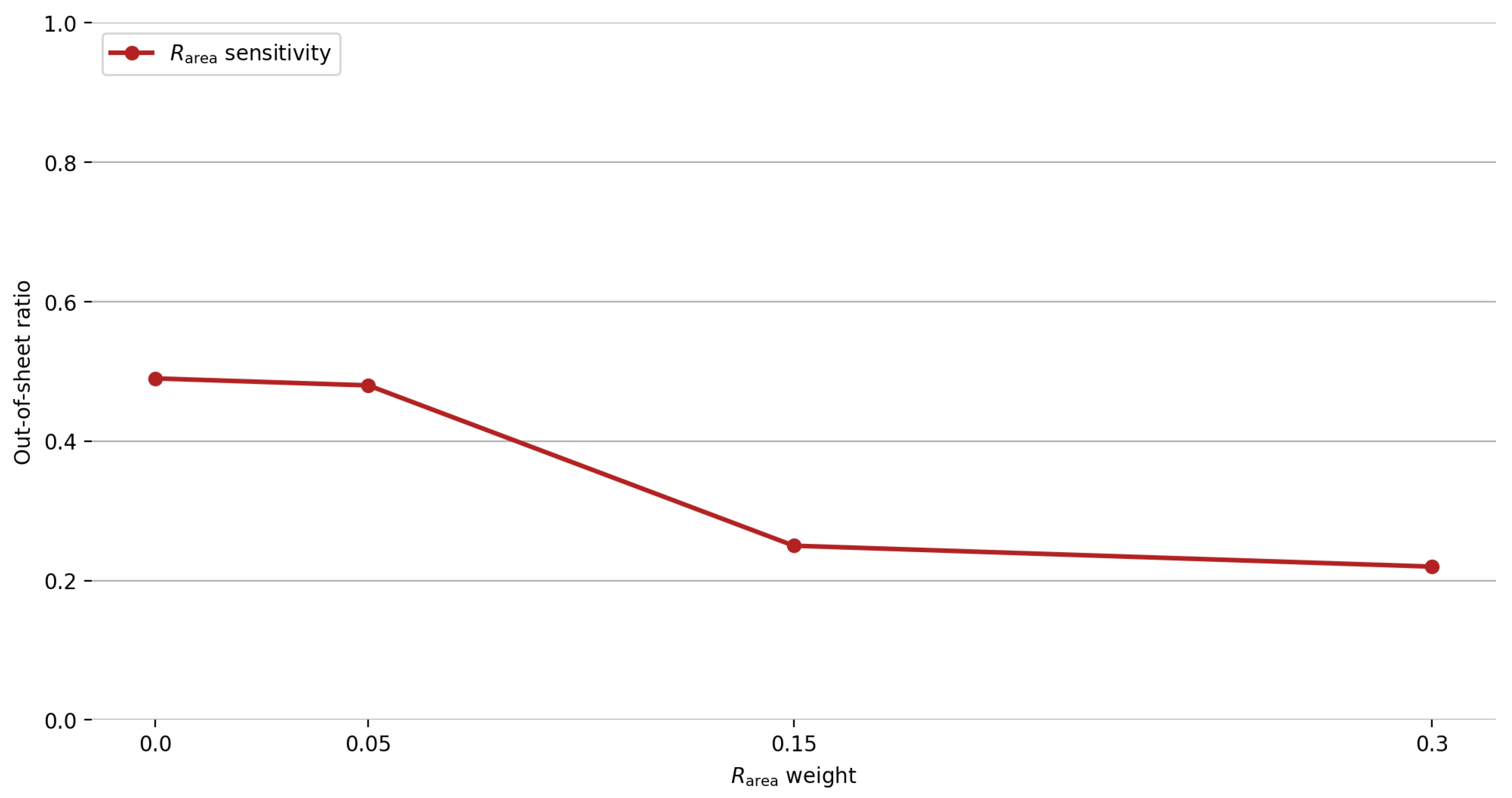
while keeping all other components of the reward and the training protocol unchanged. We report the out-of-sheet ratio, defined as the fraction of executed shots whose final stone state lies outside the playable sheet boundary. As shown in
Figure 3, increasing the weight of
lowers the out-of-sheet ratio, from about
at weights 0–
to about
at 0.3, confirming that this term provides an effective shaping signal to discourage degenerate actions that immediately exit the sheet.
Importantly, a non-zero out-of-sheet ratio is expected even under well-executed play, because this metric also counts strategically valid take-out outcomes in which the stone (or the contacted opponent stone) leaves the playing area after collision. The nonzero out-of-sheet rate at higher weights (≈0.2) is expected, since it includes both intentional take-outs and occasional exits after high-impact collisions, rather than indicating persistent execution failure.
3.4. Comparison Between the AI Agent and an Elite Curling Team
To qualitatively examine whether the AI agent’s decisions exhibit tactical patterns similar to those seen in elite curling matches, we utilized the game record data from the men’s division of the Le Gruyère AOP European Curling Championships 2023, organized by the World Curling Federation [
21]. The dataset consists of a PDF file spanning a total of 500 pages, which is accessible on the website. From these pages, a total of 6512 shot images were extracted, and stone position data were automatically retrieved using the Hough Circle Transform combined with image processing techniques. To map the detected stone-center coordinates to the simulator’s sheet coordinate system, we compute two independent scaling factors. (i) The longitudinal scale ratio,
, is defined as the ratio between the hog-to-back line distance measured in the image and the corresponding physical distance used in the simulator. (ii) The lateral scale ratio,
, is defined as the ratio between the sheet width in the image and the sheet width in the simulator. Each detected stone center is expressed in tee-centered relative coordinates. The longitudinal component is scaled by
, and the lateral component is scaled by
. The scaled coordinates are then transformed into the simulator’s coordinate frame. Because the broadcast charts are generated from a consistent template, the calibration of the hog and back lines, as well as that of the sheet boundaries, is performed once and reused for all frames, which ensures consistent alignment across the entire dataset.
However,
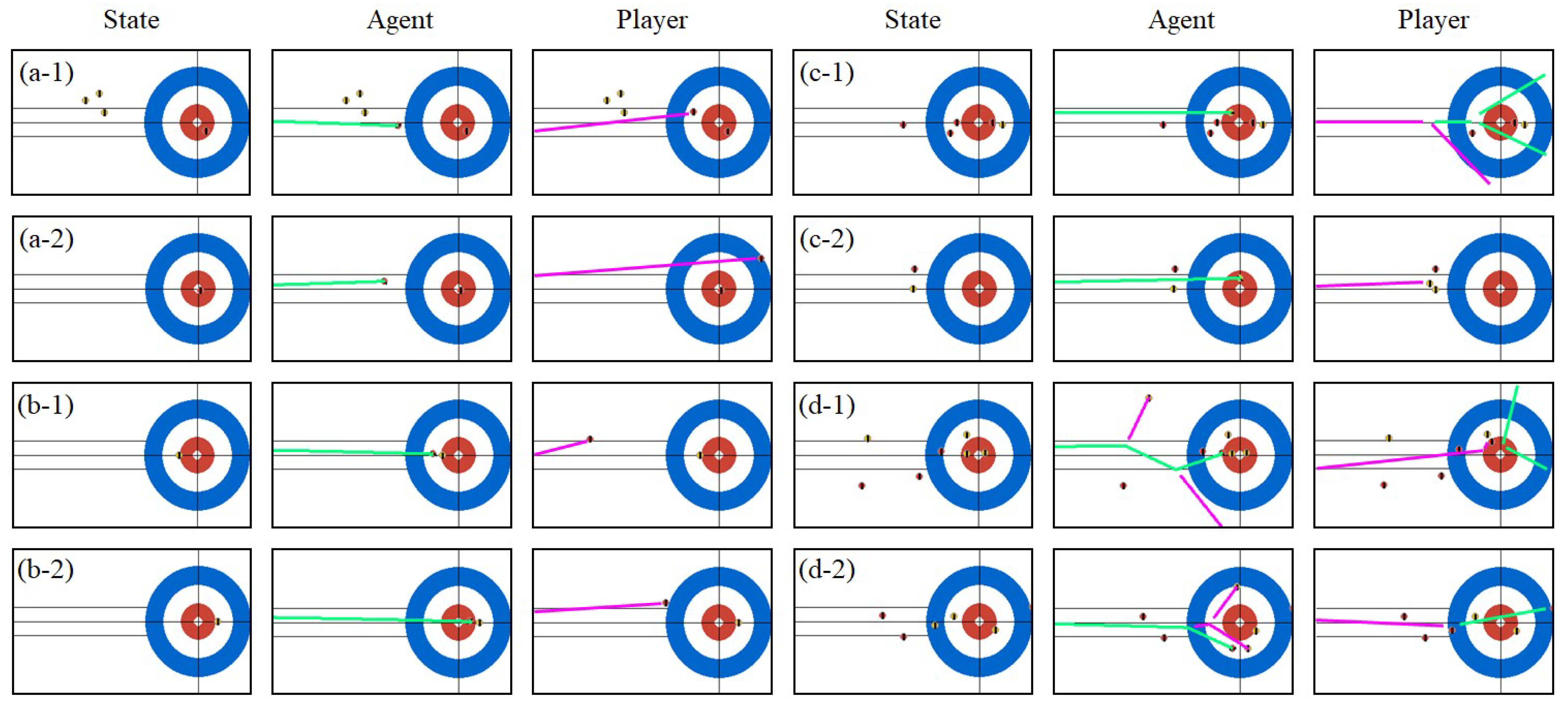
Figure 4 presents a qualitative case study based on a selected subset of representative situations, rather than all extracted shots. Specifically, we analyze outcomes from Guard, Freeze, Come-around, and Hit & Roll shots to probe the agent’s strategic inference across typical, defensive, and offensive contexts. By comparing the agent’s decisions with those observed in elite match play, we assess the extent to which the learned strategies align with professional behavior and highlight key differences.
In the first scenario
Figure 4(a-1,a-2), the agent executed a shot that left the stone short, positioned in front of the house. This placement forced the opponent to make a direct removal attempt while securing a defensive position with minimal risk. This shot type is classified as a Guard in curling. In the second scenario
Figure 4(b-1,b-2), the agent positioned the stone in a location where it could not be immediately taken out by the opponent, effectively limiting the opponent’s strategic options. This shot corresponds to a Freeze, a highly effective technique that can exert psychological pressure on the opposing team.
In scenario
Figure 4(c-1,c-2), the agent considered a Come-around shot. In
Figure 4(c-1), it navigated past the opponent’s guard and directly secured a scoring position in a complex house setup. In
Figure 4(c-2), it skillfully passed between two stones, naturally utilizing the opponent’s stones as guards. Additionally, in scenario
Figure 4(d-1,d-2), the agent executed a Hit & Roll strategy, where it not only took out the opponent’s stone but also repositioned its own stone into a more advantageous location. This is a highly advanced technique, often leading to errors among even professional players. The fact that the agent was able to learn and apply such a high-level technique without explicit guidance suggests that it can exhibit tactically plausible behaviors that resemble patterns observed in expert match play in selected examples.
The agent demonstrated proficiency in executing a variety of shot types, including Guard, Freeze, Come-around, and Hit & Roll. These examples indicate that the AI agent can execute a variety of recognizable shot patterns and adapt its decisions to different in-end situations in our simulator.
4. Discussion and Conclusions
In this work, we introduced a unified reinforcement learning framework for curling that integrates a physically grounded simulator, a curling-specific MDP formulation, and a two-phase training strategy. Unlike previous approaches that rely on discrete shot candidates or handcrafted decision rules, our framework enables agents to directly control continuous delivery parameters (release force, angle, and spin) while reasoning over evolving strategic contexts within an end. Experimental results demonstrate that this design yields stable training dynamics, human-like tactical behavior, and competitive superiority over ablated variants and alternative RL baselines.
A central finding of this study is the importance of curriculum structure in long-horizon physical sports. During Phase 1, agents learned delivery consistency under distance-only objectives, forming a foundation of reliable shot mechanics. Transitioning to Phase 2 introduced adversarial self-play and score-based rewards, enabling agents to develop both offensive and defensive strategic reasoning. As shown in the learning curves (
Figure 2) and head-to-head evaluations (
Table 2), SAC transferred placement proficiency into multi-stone scoring strategies, while PPO and A2C stagnated or oscillated under sparse and delayed rewards. These observations highlight that entropy-regularized off-policy learning is particularly advantageous in curling, where exploration in continuous action space must coexist with context-dependent decision-making.
The ablation results further clarify which MDP components contribute to high-level curling competence. Removing relative score context and its associated reward diminished strategic awareness, hence agents could place stones well but failed to deny opponent scoring or maintain favorable house configurations. Eliminating angular velocity constrained maneuverability and suppressed core curling patterns such as come-around and freeze. The worst-performing variant removed both, reducing the game to mechanical placement without tactical foresight (
Table 3). These outcomes indicate that curling strategy emerges not merely from accuracy, but from the interaction of game-context signals and rotational control, which collectively support nuanced shot selection.
Beyond quantitative metrics, qualitative evaluations revealed that the agent autonomously discovered hallmark curling strategies, including guard, freeze, come-around, and hit-and-roll plays. These behaviors were not explicitly encoded; rather, they emerged during self-play under the proposed MDP and simulator dynamics. This suggests that reinforcement learning can model higher-order dynamic reasoning in precision sports, bridging mechanical execution and situational tactics without handcrafted heuristics.
Despite these strengths, our framework inherits several limitations. First, the simulator excludes sweeping mechanics and advanced ice variability, both of which affect real-world shot outcomes. Second, Phase 2 relies solely on self-play; while this fosters robust competitive policies, it may bias learning toward equilibrium strategies that differ from human conventions. Third, the reward shaping components use empirical scaling, which may require adaptation under different rule sets or competition formats. Addressing these limitations constitutes meaningful avenues for future work. Integrating supervised imitation from elite match data, modeling stochastic ice conditions, and incorporating sweeping as a controllable variable may further improve realism, generalization, and strategic depth.
Overall, this study demonstrates that a carefully designed reinforcement learning framework can acquire professional-level curling tactics from first principles. By combining structured state representation, continuous shot control, and staged training, our approach moves beyond simulation accuracy or isolated strategy heuristics and toward holistic curling intelligence. We anticipate that this methodology will support future research in sports analytics, strategic AI, and agent-based coaching tools for real-world curling applications.