1. Introduction
The 5G New Radio (NR) standard defines three major use cases—enhanced mobile broadband (eMBB), massive machine-type communications (mMTC), and ultra-reliable low-latency communications (URLLC)—and has become a core technology for next-generation wireless communication systems [
1]. To support these use cases, numerous studies have been conducted [
2,
3,
4,
5,
6,
7,
8,
9]. These studies employ clustering techniques to classify data effectively and apply the K-means algorithm to improve beamforming efficiency, resource allocation, multiple-input multiple-output (MIMO) system performance, energy efficiency, and power control. As a representative unsupervised learning method, the K-means algorithm is computationally simple and exhibits strong clustering capability. Owing to these advantages, it has been widely applied to various physical-layer technologies [
10,
11].
In particular, clustering based on signal similarity enhances resource utilization and improves channel estimation accuracy even in multipath environments [
12,
13]. Channel estimation plays a crucial role in compensating for signal distortion by accurately identifying time-varying channel conditions and multipath fading. In 5G NR, demodulation reference signal (DM-RS)-based channel estimation has been adopted as a standard technique [
14,
15,
16,
17]. While DM-RS enables effective channel estimation, it occupies time–frequency resources together with data symbols, thereby consuming resources that could otherwise be used for data transmission. Hence, minimizing such resource consumption is essential. To address this limitation, a K-means-based channel estimation method has been proposed [
18]. This approach performs pilotless channel estimation using only received signals without DM-RS transmission, thereby eliminating pilot overhead and improving spectral efficiency. However, this method assumes that all symbols within the resource block to which K-means is applied experience identical channel responses—namely, that the block lies entirely within the coherence time and coherence bandwidth of the channel.
In practice, when the coherence time and coherence bandwidth are exceeded, channel characteristics vary rapidly. In particular, high-mobility environments exhibit strong time selectivity, where the channel changes quickly over time, whereas environments with large delay spreads experience significant frequency selectivity, where the channel response differs across subcarriers [
14,
19]. Under such highly dynamic channel conditions, the assumption of channel uniformity within a single resource block no longer holds. Consequently, K-means-based estimation fails to fully capture actual channel variations, leading to increased estimation errors and potential degradation of overall system performance.
To overcome these limitations, time–frequency grouping is applied. By partitioning the resource grid into smaller subgroups and performing K-means-based channel estimation independently within each group, more accurate estimation can be achieved within local coherence regions. However, excessively fine grouping reduces the number of data samples available in each group, weakening the noise-averaging effect of K-means and consequently degrading clustering accuracy. Conversely, identifying the optimal group size through an exhaustive search over all possible time–frequency partition combinations results in prohibitively high computational complexity, making such approaches impractical for real-time communication systems.
To address this issue, this paper introduces a signal-to-noise ratio (SNR)-based effective data count constraint. The effective data count specifies the minimum number of data symbols required in each group to ensure reliable K-means estimation, thereby excluding grouping patterns that are computationally expensive yet performance-irrelevant. As a result, the proposed constraint significantly reduces the search space and improves computational efficiency while maintaining the required channel estimation accuracy.
Previous studies have investigated adaptive channel estimation strategies based on channel statistics or SNR-related criteria, such as switching estimation methods according to Doppler characteristics or sparsity levels [
14,
20]. However, these approaches primarily focus on estimator selection and do not explicitly consider adaptive time–frequency grouping. In contrast, the proposed method determines the time–frequency grouping structure within a unified K-means-based framework by incorporating an SNR-dependent effective data count constraint, without requiring prior channel statistics or pilot signals.
Furthermore, the proposed algorithm employs two search strategies: the Time-main strategy, which is effective in rapidly time-varying channels with high time selectivity, and the Freq-main strategy, which performs better in channels with large delay spreads and high frequency selectivity. Both strategies conduct efficient searches under the effective data count constraint, significantly reducing computational load compared to exhaustive search while maintaining high estimation performance across diverse channel environments. Finally, the performance of the proposed method is evaluated through simulations and compared with the conventional K-means-based approach [
18] and a fixed-pattern method.
2. System Model
This study is based on the 5G NR data transmission structure, in which the transmitted signal is allocated to a resource grid (RG). The RG consists of one or more slots in the time domain and one or more resource blocks (RBs) in the frequency domain. A single slot contains 14 orthogonal frequency division multiplexing (OFDM) symbols, while a single RB contains 12 subcarriers. The resource element (RE), defined by one OFDM symbol in the time domain and one subcarrier in the frequency domain, represents the smallest unit of time–frequency resources [
21].
In this study, the RG is configured with one slot and ten RBs, resulting in a total of 1680 REs. The transmitted data undergo cyclic redundancy check (CRC) attachment, channel coding, and digital modulation before being mapped onto the RG. Quadrature phase shift keying (QPSK) is employed for digital modulation. The modulated signal is OFDM-modulated, transmitted through a wireless fading channel, and received at the user equipment (UE) with additive noise [
21,
22]. The received signal model is given by
where
denotes the subcarrier index in the frequency domain and
denotes the OFDM symbol index in the time domain.
is the received signal at the
-th subcarrier and
-th OFDM symbol,
is the transmitted signal, and
is the wireless fading channel,
is the noise. The UE performs K-means-based blind channel estimation based on the QPSK constellation defined as
where
denotes the constellation index. Since QPSK consists of four constellation points, the number of clusters is fixed to K = 4 when applying the K-means algorithm. To improve clustering stability, K-means++ initialization is employed, where the initial centroids are selected according to a distance-based probability distribution [
23]. Accordingly, the received signals
are partitioned into four clusters using the K-means algorithm, and the centroid of each cluster, denoted by
is obtained, where
represents the cluster index. The channel estimate is derived from the cluster centroids as
By combining the four cluster centroids
and the four QPSK symbols
, a total of 16 candidate channel estimates
are obtained. For each candidate channel estimate, the transmitted symbol is reconstructed as
QPSK demodulation is then applied, and the bit error rate (BER) is computed. The estimated channel
that minimizes the BER is selected as the final estimated channel, denoted by
. Since all resource elements classified within the same cluster are assumed to share an identical channel response, the final estimated channel
is uniformly assigned to all corresponding
, yielding
. The mean squared error (MSE) between the estimated channel and the actual channel is calculated as
where
and
denote the total numbers of subcarriers and OFDM symbols in the considered resource grid, respectively. The MSE is used as a performance metric to evaluate the accuracy of channel estimation.
3. Proposed Method
The conventional K-means-based channel estimation method [
18] assumes that all symbols within a resource block experience identical channel characteristics. However, in practical wireless environments, this assumption is often violated due to time- and frequency-selective fading caused by user mobility and multipath propagation. In the time domain, channel variations are primarily governed by the Doppler frequency shift. The maximum Doppler frequency
is given by
where
denotes the user velocity,
is the carrier frequency, and
is the speed of light. The corresponding coherence time
, which represents the duration over which the channel can be regarded as approximately time-invariant, is commonly approximated in the literature as
This relationship indicates that as user mobility increases, the coherence time decreases. Consequently, assuming a constant channel response over a long time interval becomes increasingly inaccurate in high-mobility scenarios, and time-domain grouping should be constrained within the channel coherence time to preserve channel homogeneity.
Similarly, in the frequency domain, channel selectivity is characterized by the delay spread
. The coherence bandwidth
, which quantifies the frequency range over which the channel response remains highly correlated, can be approximated as
As the delay spread increases, the coherence bandwidth decreases, implying that grouping across a wide frequency span becomes increasingly unfavorable due to significant channel variations within a group. These fundamental relationships indicate that the feasible resolution of time–frequency grouping is inherently constrained by the physical characteristics of the wireless channel. In particular, stronger time selectivity requires finer grouping in the time domain, while stronger frequency selectivity requires finer grouping in the frequency domain to maintain channel consistency within each group.
Although applying various time–frequency grouping patterns can improve channel estimation accuracy, an exhaustive search over all possible grouping combinations leads to an exponentially growing search space, resulting in prohibitive computational complexity that limits real-time applicability. Moreover, excessively fine partitioning reduces the number of data symbols available per group, which degrades the clustering reliability of the K-means algorithm and ultimately deteriorates channel estimation performance. This behavior is consistent with well-established observations that insufficient data samples impair clustering stability in K-means-based methods [
24,
25,
26].
To address these limitations, this paper introduces an SNR-based effective data count criterion that excludes grouping patterns insufficient to ensure reliable channel estimation. This criterion significantly reduces the search space and computational burden while preserving estimation accuracy. Furthermore, two pattern search strategies—Time-main and Freq-main—are proposed to prioritize time-domain and frequency-domain grouping, respectively, within the proposed pattern selection framework.
3.1. Resource Grouping Pattern Definition
The resource grouping patterns, which form the basis of the proposed search algorithm, are defined separately in the time and frequency domains. Channel estimation is then performed for each group using K-means clustering based on these patterns.
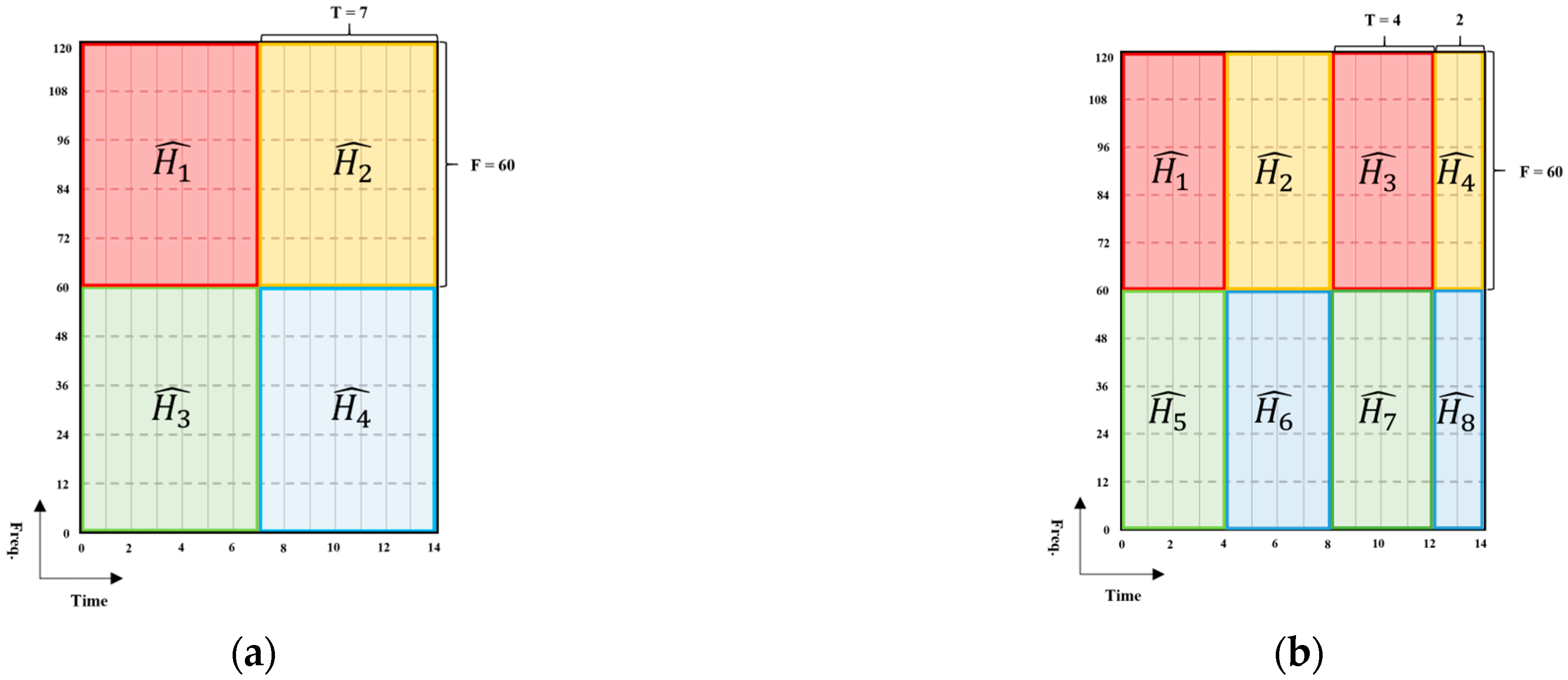
The frequency-domain pattern is defined according to the group size , which is set as a divisor of the total number of subcarriers (120). Each pattern groups subcarriers to form equally sized groups. For example, when , the pattern is represented as [40, 40, 40], resulting in three equal groups.
The time-domain pattern is defined based on 14 OFDM symbols within one slot, where the group size is set as an integer between 1 and 14. Each pattern groups consecutive OFDM symbols starting from the first symbol, and the remaining symbols are included in the final group. For example, when , the pattern [4, 4, 4, 2] has the smallest group size of 2. The square brackets [] denote the number of elements in each group, representing the number of subcarriers in the frequency domain and the number of OFDM symbols in the time domain.
To reduce computational complexity, a limited set of candidate grouping patterns is defined based on the effective data count constraint introduced in
Section 3.2. In the frequency domain,
is restricted to divisors of 120 so that all frequency groups have equal size. This design avoids data-count imbalance across groups and ensures stable K-means clustering. As a result, asymmetric grouping is not adopted in the frequency domain.
In contrast, in the time domain, 15 representative grouping patterns are predefined to limit the search space while allowing diverse symbol grouping lengths. For
, the conventional pattern
includes a small minimum group. To address this issue, an asymmetric pattern
is additionally included to expand feasible grouping options. The final set of 15 time-domain pattern candidates is summarized in
Table 1, and
Figure 1 illustrates examples of these resource grouping patterns for different values of
and
.
3.2. SNR-Based Determination of Effective Data Count
This section presents the procedure for determining an appropriate data count under different SNR conditions. Since the number of data symbols within a group directly affects the performance of K-means-based channel estimation, it must be adjusted according to the channel environment. The manner in which the data count increases differs depending on whether the main axis is set to the time domain or the frequency domain.
In the Freq-main strategy, the time domain is fixed to 14 OFDM symbols, and the data count is expanded along the subcarrier axis. Consequently, the number of resource elements increases from 14 up to 1680 in increments of 14, resulting in a total of 120 configurations.
In the Time-main strategy, the frequency domain is fixed to 10 resource blocks, corresponding to 120 subcarriers, and the data count is expanded along the OFDM symbol axis. In this case, the number of resource elements increases from 120 up to 1680 in increments of 120, resulting in a total of 14 configurations.
For each configuration, K-means-based channel estimation is performed, and the MSE between the estimated and actual channels is computed. As the data count increases, the MSE decreases rapidly at first and then gradually approaches a saturated region with diminishing improvement. Accordingly, the effective data count is defined as the point at which this performance saturation begins. To identify this point in a consistent manner, the standard deviation of the MSE is computed over consecutive configurations, and the first data count at which it falls below a predefined threshold is selected. The resulting effective data count is then used as a reference criterion for the subsequent grouping pattern selection algorithm.
Figure 2 illustrates examples of how the data count expands in both the frequency and time domains. In the frequency domain, additional subcarriers are grouped incrementally, whereas in the time domain, the number of OFDM symbols is progressively increased. This visualization highlights the difference in how effective data counts are determined under the Freq-main and Time-main strategies.
3.3. Time–Freq Pattern Selection Algorithm
Based on the candidate resource grouping patterns and the effective data count constraint, this section presents the proposed time–frequency pattern selection algorithm. The algorithm is implemented using two strategies: Time-main and Freq-main. In the Time-main strategy, the time-domain pattern
is designated as the main axis pattern
, and the frequency-domain pattern
is assigned as the sub axis pattern
. Conversely, in the Freq-main strategy,
is selected as the main axis and
as the sub axis. The overall selection procedure consists of two steps, as summarized in Algorithm 1.
| Algorithm 1 Time-Frequency Grouping Selection |
| Input: |
| | : Candidate set for the main-axis pattern. |
| | : Candidate set for the sub-axis pattern. |
| | : Effective data count required for the current SNR. |
| | : Received signals on the resource grid. |
| | : True channel responses. |
| 1: | Step 1: Generation of Candidate Combinations |
| 2: | Initialize candidate set |
| 3: | for each do |
| 4: | | |
| 5: | | |
| 6: | | | |
| 7: | | | if then |
| 8: | | | | } ▷ select the smallest feasible sub-axis |
| 9: | | | | |
| 10: | | | end if |
| 11: | | end for |
| 12: | Step 2: Performance Evaluation and Final Selection |
| 13: | Initialize ,, |
| 14: | for each , do |
| 15: | | |
| 16: | | for each group do |
| 17: | | | |
| 18: | | | for all |
| 19: | | | | |
| 20: | | | end for |
| 21: | | end for |
| 21: | | evaluate using Equation (5) with and |
| 22: | | then |
| 23: | | | |
| 25: | | | , |
| 26: | | end if |
| 27: | end for |
| Output: Final selected pair , ) |
Algorithm 1 illustrates the detailed procedure of the proposed time–frequency pattern selection algorithm. The algorithm consists of two main steps. In the first step, for each main-axis pattern , the minimum group size is computed, and sub-axis pattern candidates that satisfy the condition are identified. If multiple sub-axis candidates exist, only the finest-grained feasible sub-axis pattern is selected to reduce unnecessary exploration. Therefore, each main-axis pattern generates at most one candidate combination.
In the second step, performance evaluation is conducted on the candidate set . For each combination , , the resource grid is divided into groups, and K-means-based channel estimation is performed for each group to obtain the representative channel . The estimated channel is uniformly assigned to all resource elements within the group, and performance is evaluated using the MSE criterion defined in the system model. Among all candidates, the combination that achieves the lowest MSE is selected as the final grouping pattern.
Unlike exhaustive search methods that evaluate all possible main–sub axis pattern combinations, the proposed approach excludes unnecessary candidates in advance through the constraint. As a result, each main-axis pattern yields at most one candidate, and the total number of evaluated combinations is limited to no more than the number of main-axis patterns. This significantly reduces the computational burden while maintaining stable channel estimation performance.
3.4. Computational Complexity Analysis
This section analyzes the computational complexity of the proposed time–frequency pattern selection algorithm and compares it with an exhaustive search-based approach.
In K-means-based channel estimation, the computational complexity of a single K-means run applied to a group
can be expressed as
where
denotes the number of data samples in the group,
is the number of clusters,
is the number of iterations required for convergence, and
is the data dimension.
When evaluating a single time–frequency pattern combination, the K-means operation is applied repeatedly to all groups formed by that pattern. Consequently, the total computational cost for one pattern combination is determined by the cumulative cost of K-means executions over all groups.
In an exhaustive search-based scheme, all combinations of the time-domain pattern set and the frequency-domain pattern set must be evaluated. As a result, the total computational complexity scales proportionally to Since K-means-based channel estimation is repeatedly performed for multiple groups under each pattern combination, the overall computational burden becomes very large, making real-time implementation challenging.
In contrast, the proposed method employs the effective data count constraint , which allows only one sub-axis pattern to be evaluated for each main-axis pattern . Accordingly, the number of pattern combinations considered is limited to , which is significantly smaller than required by exhaustive search-based approaches.
Although the number of data samples in each K-means execution may vary depending on the grouping configuration, the total number of samples processed over the entire resource grid remains unchanged. Therefore, the proposed grouping strategy does not alter the asymptotic order of the computational complexity per K-means execution. Instead, it substantially reduces the total number of K-means executions required during the pattern selection stage, leading to a significant reduction in overall computational complexity compared to exhaustive search-based methods.
4. Simulation Results
In this study, after determining the effective data count as a function of SNR, the performance of the proposed method was evaluated under various channel conditions. Four schemes were compared in terms of MSE and BER: the conventional K-means-based method, the fixed-pattern method, and the proposed methods with Time-main and Freq-main strategies. In addition, the average runtime was measured to assess the computational overhead of the proposed method.
All simulations were conducted based on the 5G NR tapped-delay line (TDL-A) channel model, and the key simulation parameters are summarized in
Table 2. For reproducibility and fair comparison, the random seed was reinitialized at each Monte Carlo iteration and set to the iteration index, ensuring that all schemes were evaluated under identical data, channel, and noise realizations. All reported results were obtained by averaging over 100,000 Monte Carlo iterations.
The analysis results of the effective data count are presented in
Table 3. The simulation results indicate that, at lower SNR values, noise effects become more pronounced, requiring a larger number of data samples to ensure stable clustering. Conversely, as the SNR increases, reliable channel estimation can be achieved with fewer data samples, leading to a gradual reduction in the effective data count.
In the frequency-domain case (Freq-main), the data count increases in increments of 14 resource elements, and the MSE variation across consecutive data configurations remains relatively smooth. Accordingly, to conservatively identify the stabilization point, the consecutive data segment size was set to 3, and the standard deviation threshold was set to 0.0013.
In the time-domain case (Time-main), the data count increases in increments of 120 resource elements, which results in larger MSE fluctuations in the initial region. Therefore, the consecutive data segment size was set to 2, and a more relaxed standard deviation threshold of 0.005 was applied. With these domain-specific criteria, the stabilization point of the MSE was consistently identified across various SNR conditions, and the effective data count was determined in a reproducible manner.
The proposed algorithm determines the grouping pattern based on the SNR-based effective data count and evaluates its performance through MSE and BER analyses.
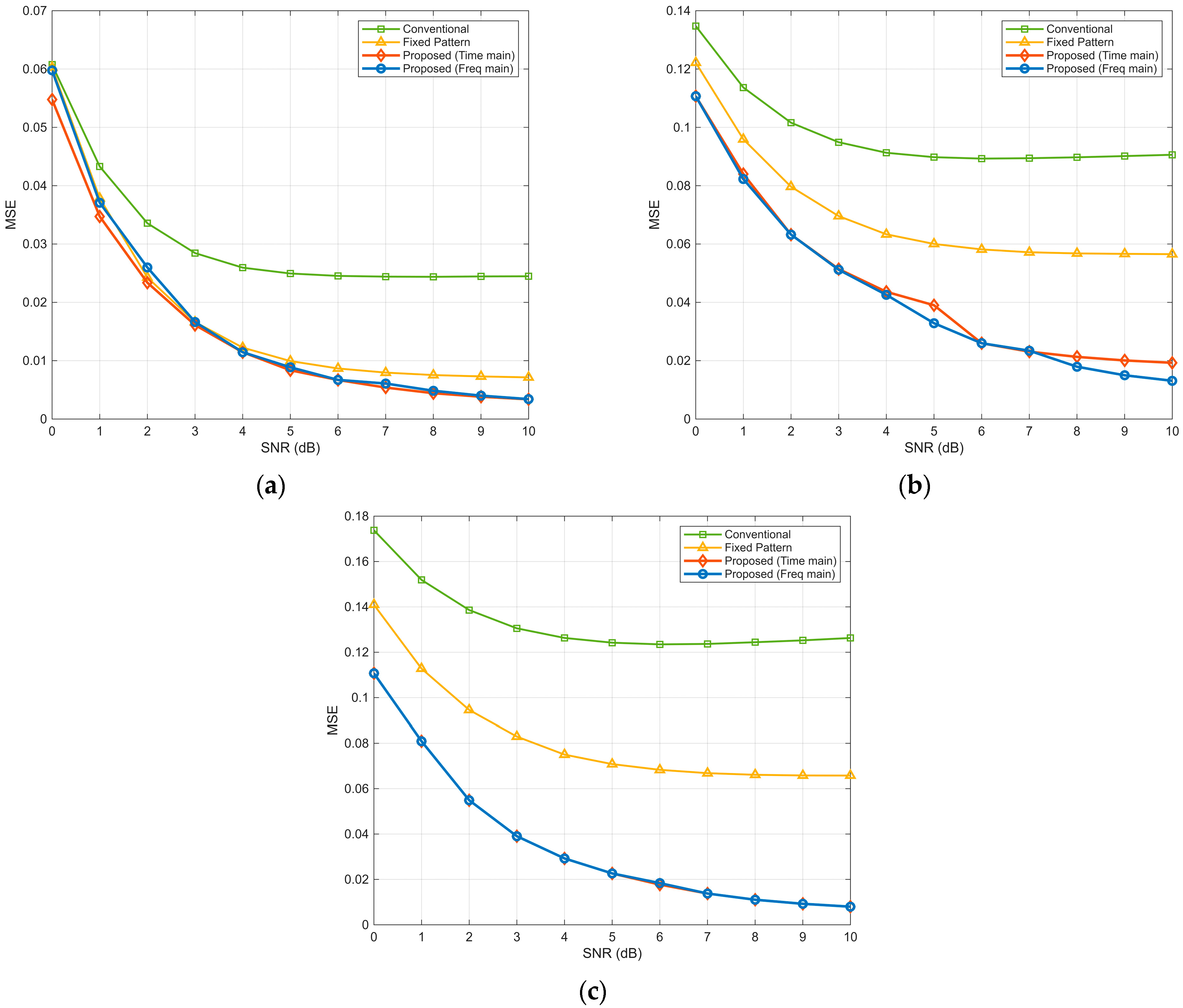
Figure 3 shows the MSE performance versus SNR under various channel conditions with different delay spreads and UE velocities.
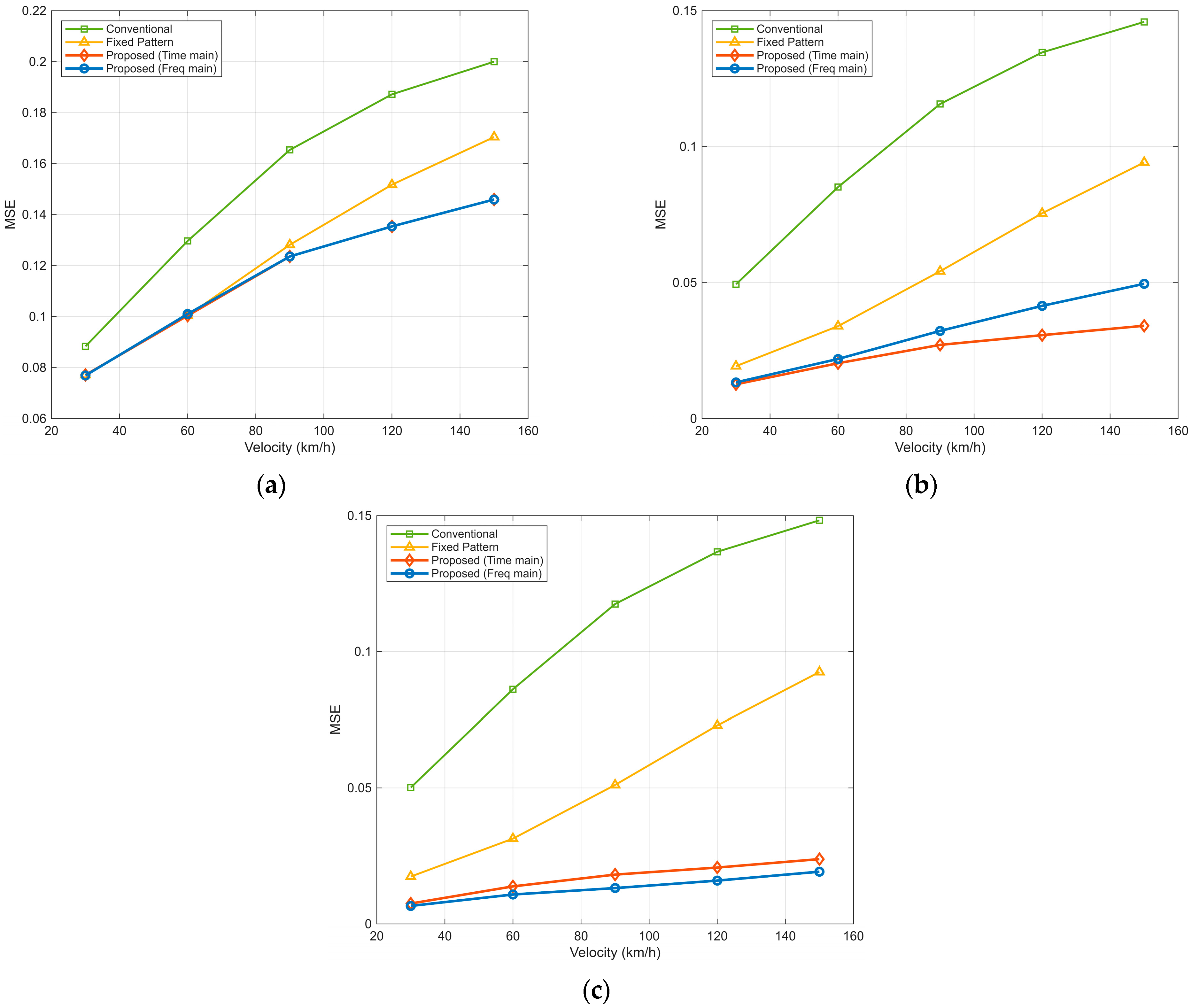
Figure 4 analyzes the impact of increasing UE velocity on MSE performance under a fixed delay spread, whereas
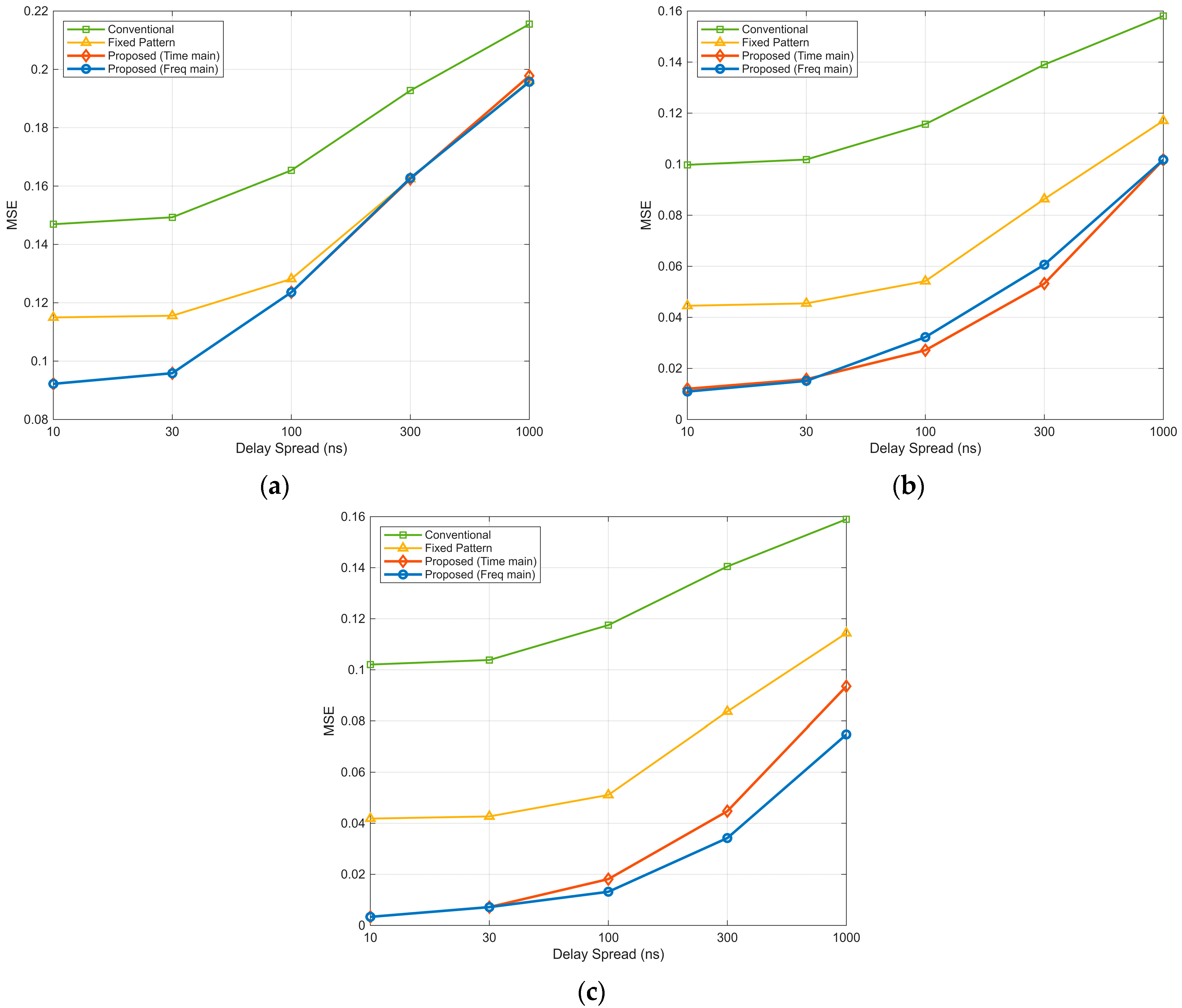
Figure 5 focuses on the effect of increasing delay spread under a fixed UE velocity.
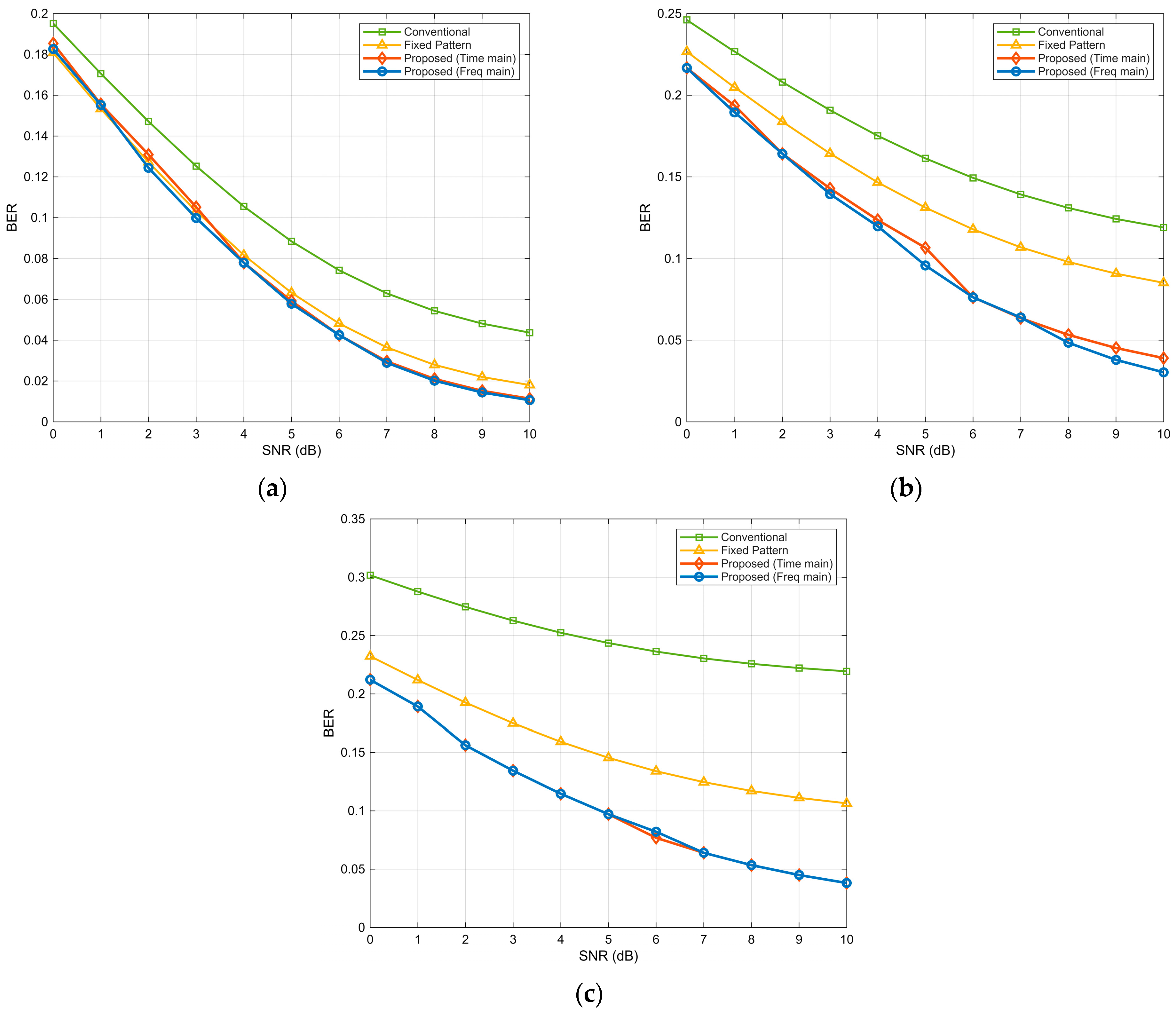
Figure 6 presents the BER performance versus SNR under the same channel conditions used for the MSE evaluation, enabling consistent comparisons across different metrics. In addition,
Table 4 compares the average elapsed time of the proposed K-means-based channel estimation with that of conventional methods.
The Conventional Pattern, introduced in [
8], represents the baseline K-means-based channel estimation method, which assumes identical channel conditions for all resources without grouping. The Fixed Pattern applies a predefined grouping scheme with
set to 60 in the frequency domain and
set to 7 in the time domain. The Proposed Pattern represents the time–frequency pattern selection algorithm presented in this paper, which applies two strategies: Time-main, where the time domain is the primary axis, and Freq-main, where the frequency domain is the primary axis.
4.1. MSE Performance Versus SNR
Figure 3 presents the MSE performance versus SNR under three channel conditions, where the delay spread and UE velocity are varied across the scenarios.
Figure 3a shows the MSE performance in an environment with a delay spread of 30 ns and a UE velocity of 30 km/h. In this relatively stable environment, with limited variation in both the time and frequency domains, the performance curves of Time-main and Freq-main are nearly identical. Both strategies exhibit a consistent reduction in MSE as SNR increases, achieving approximately 86% improvement over the Conventional Pattern and 52% improvement over the Fixed Pattern at an SNR of 10 dB.
Figure 3b illustrates the MSE performance in an environment with a delay spread of 300 ns and a UE velocity of 30 km/h. In this environment, where frequency selectivity dominates, the Freq-main strategy demonstrates clear superiority. For example, at an SNR of 10 dB, Freq-main achieves an MSE that is approximately 32% lower than that of Time-main, along with an 86% improvement over the Conventional Pattern and 77% improvement over the Fixed Pattern. In addition, the Time-main curve shows a sharp improvement between 5 and 6 dB, which can be attributed to the relaxation of the effective data count constraint from 240 to 120, enabling additional candidate patterns to be included in the search.
Figure 3c presents the MSE performance in an environment with a delay spread of 30 ns and a UE velocity of 120 km/h. In this case, where time variation dominates, Freq-main still shows an overall advantage; however, the performance gap between the two strategies narrows significantly, with Time-main converging to a similar level of accuracy. Overall, these results confirm that the proposed pattern selection strategy effectively exploits the dominant channel variation characteristics, achieving robust performance over a wide range of SNR conditions.
4.2. MSE Performance Versus UE Velocities
Figure 4 presents the MSE performance with respect to different UE velocities when the delay spread is fixed at 100 ns, evaluated at SNR levels of 0 dB, 6 dB, and 10 dB.
Figure 4a illustrates the performance variation in a low-SNR environment at an SNR of 0 dB. As the UE velocity increases from 30 km/h to 150 km/h, the MSE performance of all methods deteriorates. In this case, the performance curves of the proposed methods, Time-main and Freq-main, are nearly identical. This indicates that, in low-SNR environments, noise effects outweigh the impact of channel variations, resulting in negligible differences between the two pattern selection strategies.
Figure 4b shows the performance variation with respect to UE velocity at an SNR of 6 dB. Across the entire range, the Time-main method consistently outperforms the Freq-main method, with the performance gap becoming more pronounced in high-mobility environments. At 30 km/h, both methods show similar MSE values; however, at 150 km/h, Time-main achieves approximately 31% lower MSE than Freq-main. This indicates that the advantage of Time-main becomes more evident as the UE velocity increases. This behavior can be attributed to the relaxation of the effective data count constraint from 240 to 120 at an SNR of 6 dB, which enables finer exploration of time-domain patterns and allows the algorithm to better capture time variations under high-mobility conditions.
Figure 4c presents the MSE performance at an SNR of 10 dB. At the lower velocity of 30 km/h, Freq-main achieves superior performance with approximately 12% lower MSE than Time-main. However, as velocity increases, the MSE of both methods degrades. Despite this degradation, the performance gap between Time-main and Freq-main does not widen significantly, and even at the highest velocity of 150 km/h, the difference remains below 20%.
4.3. MSE Performance Versus Delay Spread
Figure 5 illustrates the impact of increasing delay spread on MSE performance when the UE velocity is fixed at 90 km/h, evaluated at SNR levels of 0 dB, 6 dB, and 10 dB.
Figure 5a shows the MSE performance variation with respect to delay spread in an environment with an SNR of 0 dB and a UE velocity of 90 km/h. For all methods, the MSE increases as the delay spread becomes larger. At low delay spread values, the proposed pattern selection methods outperform both the Conventional and Fixed Patterns. However, as the delay spread increases, the frequency selectivity of the channel becomes more significant, and the performance of the proposed methods gradually approaches that of the Fixed Pattern. This indicates that, in environments with high noise and strong channel variations, the effectiveness of pattern selection becomes limited.
Figure 5b presents the MSE performance for varying delay spreads at an SNR of 6 dB and a UE velocity of 90 km/h. As the delay spread increases, the performance degradation of the Conventional and Fixed Patterns becomes more pronounced. In contrast, the proposed Time-main and Freq-main methods consistently achieve lower MSE values across all delay spread conditions. In particular, for delay spreads between 10 ns and 30 ns, both methods perform similarly. However, at delay spreads of 100 ns and 300 ns, the Time-main method outperforms Freq-main. This behavior can be attributed to the relaxation of the effective data count constraint from 240 to 120 in this range, which increases the number of candidate patterns available for Time-main. As the delay spread further increases to 1000 ns, the performance of both methods becomes similar.
Figure 5c illustrates the MSE performance variation with respect to delay spread in an environment with an SNR of 10 dB and a UE velocity of 90 km/h. While all methods exhibit performance degradation as the delay spread increases, the differences between the patterns become more pronounced under high-SNR conditions. At a delay spread of 10 ns, the Time-main and Freq-main methods achieve nearly identical performance. However, as the delay spread increases, the performance gap between the two methods widens. This result suggests that, under larger delay spreads, frequency selectivity has a stronger impact on channel distortion, thereby amplifying the relative performance advantage of the Freq-main method.
4.4. BER Performance Versus SNR
Figure 6 illustrates the BER performance as a function of SNR under different channel conditions.
Figure 6a and
Figure 6b, and 6c correspond to the scenarios of (a) DS = 30 ns and V = 30 km/h, (b) DS = 300 ns and V = 30 km/h, and (c) DS = 30 ns and V = 120 km/h, respectively. When evaluated under the same channel conditions as in
Section 4.1, the BER results exhibit performance trends consistent with the corresponding MSE results, indicating that improvements in channel estimation accuracy lead to consistent gains in detection performance.
In the relatively stable channel environment shown in
Figure 6a, where both time- and frequency-domain variations are limited, the performance difference between the two proposed strategies remains marginal. At SNR = 10 dB, the proposed strategies achieve approximately a 74–76% relative BER reduction compared with the Conventional Pattern and about a 37–41% relative reduction compared with the Fixed Pattern, indicating that the proposed grouping approach provides tangible gains even under mild channel variations.
As the delay spread increases, as shown in
Figure 6b, frequency selectivity becomes the dominant impairment, and the advantage of the Freq-main strategy becomes more noticeable. At SNR = 10 dB, Freq-main achieves approximately a 74.5% relative BER reduction compared with the Conventional Pattern and about a 64.4% relative reduction compared with the Fixed Pattern. Furthermore, compared with Time-main, Freq-main achieves approximately a 22% relative BER reduction, suggesting that frequency-domain-oriented grouping may be more effective under highly frequency-selective channels.
In contrast, in the high-mobility scenario depicted in
Figure 6c, the BER performances of Time-main and Freq-main are very similar over most of the SNR range. A slight performance difference is observed around SNR = 6 dB, where Time-main achieves approximately 6% lower BER than Freq-main; however, the overall performance gap between the two strategies remains marginal in this scenario.
4.5. Runtime Analysis
To assess the practical feasibility of the proposed method, the average execution time of the K-means-based channel estimation stage was compared for each scheme using the selected resource patterns. The experiments were conducted under three representative channel conditions, including a low-mobility environment with short delay spread, an environment with large delay spread, and a high-mobility environment. The average execution time was analyzed over the entire SNR range from 0 to 10 dB. The comparative results of the average execution time for each method are presented in
Table 4.
As shown in
Table 4, the Conventional method exhibits the lowest execution time across all channel conditions, since it does not involve resource grouping. The Fixed Pattern method applies a predefined grouping structure, which increases the execution time compared with the Conventional method; however, the runtime variation across the considered channel conditions remains limited. In contrast, the proposed Time-main and Freq-main methods incur additional computational cost due to group-wise processing and repeated K-means operations under the selected grouping patterns, resulting in higher execution times than the Fixed Pattern method. Although the measured execution time can vary depending on the selected grouping configuration, the overall runtime remains stable across the evaluated channel conditions without abrupt increases.
By jointly considering the runtime results with the MSE and BER performance, it is observed that the proposed method provides consistent performance gains across diverse channel environments with a bounded computational overhead. In particular, the Freq-main strategy tends to be more effective in frequency-selective conditions (large delay spread), whereas the Time-main strategy becomes more competitive and achieves comparable performance in high-mobility conditions dominated by time selectivity. These trends suggest that, in practical operational scenarios, an appropriate strategy can be selected according to channel characteristics (e.g., SNR, delay spread, and UE velocity). Moreover, under the considered experimental settings, the average execution time remains within 30 ms for all conditions, supporting the practical applicability of the proposed method in terms of computational cost relative to the achieved performance gains.