Article

Stability of Discrete-Time Neutral Systems with Discrete and Distributed Delays: A Delay Decomposition Approach


1
Laboratory of Applied Sciences and Emerging Technologies, National School of Applied Sciences, BP 72, My Abdallah Avenue Km. 5 Imouzzer Road, Fez 30000, Morocco
2
Instituto de Procesos Sostenibles, Universidad de Valladolid, 47005 Valladolid, Spain
*
Author to whom correspondence should be addressed.
Mathematics 2026, 14(3), 390; https://doi.org/10.3390/math14030390
Submission received: 19 December 2025 / Revised: 20 January 2026 / Accepted: 21 January 2026 / Published: 23 January 2026
(This article belongs to the Special Issue Recent Advances in Positive Networked Systems)

Abstract

A stability analysis of linear discrete-time neutral systems with both discrete and distributed delays is examined. To address this problem with accuracy, Lyapunov–Krasovskii candidates (LKCs) are formulated by heterogeneously splitting the whole delay interval into various parts; then, each part is assigned functionals with different weighting matrices. Then, new stability criteria are established and expressed in the form of linear matrix inequalities (LMIs) by combining a delay decomposition approach with an auxiliary function-based summation inequality method. These criteria provide a computationally efficient framework. Finally, several numerical examples are presented to confirm the validity and expanded feasibility region of our results when compared to existing approaches.

1. Introduction

Systems with time delays generally fall into two categories: retarded or neutral. Retarded systems [1,2] involve delays (called discrete delays) only in their states, whereas neutral systems (studied here) incorporate also delays in the derivatives of the states [3]. These neutral systems [4] arise naturally in practical applications, including ecological systems [5], distributed networks, heat exchangers, and robotics. Moreover, some recent control technologies, such as repetitive control, make use of an engineered neutral delay to refine the control performance for periodic signals [6]. This distinction between retarded and neutral systems is crucial because neutral systems exhibit more complex dynamics [7]. In particular, the number of unstable poles is infinite in a neutral system (See, for instance, [8,9]). That makes a neutral system much harder to analyze, and a considerable number of studies are being carried out on the stability of the neutral systems (See, for instance, [10,11] and the references therein). Among them, the delay partitioning approach, first proposed in [12], is of special interest, as conservatism is reduced. Based on this, ref. [13] suggested the delay partitioning method for uncertain dynamic systems, dividing the delay interval into two, with different free weighting matrices in each interval. This methodology has been successfully applied, for instance, in [14] to analyze the dynamic behavior of neutral systems under nonlinear disturbances and distributed delays. Finally, the global stability problems of linear neutral systems with multiple neutral and discrete delays has been recently studied [15].
It is pointed out that in practice some delay phenomena cannot be expressed as discrete or neutral delays. This is the case of the so-called distributed delays [16]. Stability for systems with these delays have been addressed for instance in [16,17], where stability criteria were developed that are mixed delay dependent, but are independent of the neutral delays. Robust stability conditions for neutral systems with discrete and distributed delays were investigated using the slack variable approach in [18]. Moreover, in [19], some results for stability of a class of neutral systems with distributed time-varying delays has been developed. Finally, we point out [20] that has recently investigated the robust stability for switched linear neutral systems. Nevertheless, there appears to be no prior literature regarding the stability analysis of discrete-time neutral systems incorporating both discrete and distributed delays.
All of this motivates the present study, which focuses on discrete-time systems, as estimation and control algorithms are generally implemented in microprocessors, digital controllers or digital computers. Thus, the stability analysis of linear discrete neutral systems incorporating both discrete and distributed delays is studied, constructing Lyapunov–Krasovskii candidates (LKCs) via the segmentation of the delays into unequal intervals and assigning distinct functionals to each interval. By utilizing an auxiliary function-based summation inequality method, tight delay-dependent stability conditions are established using the delay decomposition technique. The stability conditions are given in terms of LMIs which are numerically tractable using the MATLAB-based convex optimization solvers. The paper concludes with numerical examples that validate the approach.
Notations:  R n and R n × m represent, respectively the n-dimensional Euclidean space, and the set of n × m real matrices. Y 0 (respectively, Y > 0 ), where Y is a symmetric matrix, means that Y is positive semi-definite (respectively, positive definite). The superscript T of a matrix refers to its transpose. The asterisk ( ) denotes the symmetric counterpart of the opposite off-diagonal entry.

2. Problem Statement and Mathematical Prerequisites

The discrete-time neutral systems under study are described by:
x k + 1 = A x k + B x k d + C x k + 1 τ + D l = k r k 1 x l x k = φ k , k m a x ( d , τ , r ) , 0 , k 0
where x k R n represent the state vector, d, τ , r are unknown positive integers corresponding to the discrete, neutral and distributed delays respectively, φ k is the initial function, and A, B, C, D are real system matrices of appropriate dimensions.
Let η > 0 be an integer and τ j , d j ( j = 1 , 2 , , η ) be some scalars satisfying
0 = d 0 < d 1 < d 2 < < d η 1 < d η = d 0 = τ 0 < τ 1 < τ 2 < < τ η 1 < τ η = τ
The delay ranges d , 0 , τ , 0 are irregularly divided into η fragments. Namely,
d , 0 = j = 1 η d j , d j 1 , τ , 0 = j = 1 η τ j , τ j 1
For ease of notation, we define α j , β j to be the width of the sub-intervals d j , d j 1 and τ j , τ j 1 , respectively. That is,
α j = d j d j 1 , β j = τ j τ j 1 , ( j = 1 , 2 , , η )
Definition 1
([21]). Let the difference operator D : C [ τ , 0 ] , R n R n be defined as follows:
D x k = x k C x k τ
Then, the stability of D x k is guaranteed if the equilibrium state of the autonomous difference equation
D x k = 0 , k 0 , x k = ν ψ k C ( [ τ , 0 ] : D ψ k = 0 )
exhibits uniform asymptotic stability. The stability of the difference operator D x k is a prerequisite for the stability of the neutral system dynamics (1), which holds for all τ when C < 1 (or, alternatively, the Schur-stability index of the matrix C, ρ ( C ) , satisfies ρ ( C ) < 1 ).
Several technical lemmas required for our stability analysis are now presented:
Lemma 1
([22]). Given an arbitrary constant matrix B R n × n with B = B T > 0 , integers q 1 < q 2 , and a vector function w k R n × n , then the following Jensen inequality holds:
( q 2 q 1 + 1 ) k = q 1 q 2 w k T B w k k = q 1 q 2 w k T B k = q 1 q 2 w k
Lemma 2
([2]). For any symmetric positive definite matrix D > 0 , vector functions y i ( y i = x i + 1 x i , i [ a , a + n 1 ] ) and a polynomial auxiliary function p k i = ( i a + 1 ) k , the following inequality holds for 0 m 3 :
i = a a + n 1 y i T D y i k = 0 m 2 k + 1 n Ω k T D Ω k
where
Ω 0 = x a + n x a , Ω 1 = x a + n + x a 2 n + 1 i = a a + n x i , Ω 2 = x a + n x a + 6 n + 1 i = a a + n x i 12 ( n + 1 ) ( n + 2 ) l = a a + n i = l a + n x i , Ω 3 = x a + n + x a 12 n + 1 i = a a + n x i + 60 ( n + 1 ) ( n + 2 ) l = a a + n i = l a + n x i 120 ( n + 1 ) ( n + 2 ) ( n + 3 ) l = a a + n s = l a + n i = s a + n x i

3. Main Results

This section presents some results for the asymptotic stability of one-dimensional discrete neutral systems with discrete and distributed delays: Based on Lyapunov–Krasovskii functionals and using a delay decomposition technique, a tight stability criterion is obtained.
For this, the following vectors are used for convenience:
Λ 1 T = x k T x k d 1 T x k d 2 T x k d η 1 T x k d η T , Λ 2 T = x k τ 1 T x k τ 2 T x k τ η 1 T x k τ η T
Λ 3 T = l = k d 1 k 1 x l T l = k d 2 k d 1 1 x l T l = k d η k d η 1 1 x l T , Λ 4 T = l = k τ 1 k 1 x l T l = k τ 2 k τ 1 1 x l T l = k τ η k τ η 1 1 x l T
Theorem 1.
For given non-negative scalars τ, d, r > 0 , the system ( 1 ) is asymptotically stable, if the difference operator D is stable and there exist real symmetric matrices P > 0 , R > 0 , U > 0 , T j > 0 , Q j > 0 , M j > 0 , N j > 0 , X j > 0 , Y j > 0   ( j = 1 , 2 , , η ) such that the following LMI holds:
Ξ = Ψ 11 Ψ 12 Ψ 13 Ψ 14 Ψ 22 Ψ 23 Ψ 24 Ψ 33 Ψ 34 Ψ 44 < 0
where
Ψ 11 = Θ 1 Θ 2 0 0 Θ 3 Θ 13 Θ 14 0 0 Θ 17 0 0 Θ 19 Θ 20 Θ 22 , Ψ 12 = Θ 4 0 0 0 0 0 0 0 0 0 0 0 0 0 0 0 0 0 0 0 , Ψ 13 = Θ 5 Θ 6 Θ 7 Θ 15 Θ 16 0 0 Θ 18 0 0 0 Θ 21 0 0 Θ 23
Ψ 14 = Θ 8 Θ 9 Θ 10 Θ 11 Θ 12 0 0 0 0 0 0 0 0 0 0 0 0 0 0 0 0 0 0 Θ 24 Θ 25 , Ψ 22 = Θ 26 Θ 27 0 0 Θ 30 0 0 Θ 32 Θ 33 Θ 35 , Ψ 23 = 0 0 0 0 0 0 0 0 0 0 0 0
Ψ 24 = Θ 28 Θ 29 0 0 0 0 Θ 31 0 0 0 0 0 Θ 34 0 0 0 0 Θ 36 Θ 37 0 , Ψ 33 = Θ 38 0 0 Θ 39 0 Θ 40 , Ψ 34 = 0 0 0 0 0 0 0 0 0 0 0 0 0 0 0
Ψ 44 = Θ 41 0 0 0 0 Θ 42 0 0 0 Θ 43 0 0 Θ 44 Θ 45 Θ 46
and
Θ 1 = A T P A P + A ¯ T Z A ¯ + r 2 R + Q 1 + T 1 2 M 1 2 N 1 j = 1 η ρ j ( α j + 1 ) α j X j j = 1 η σ j ( β j + 1 ) β j Y j
Θ 2 = 2 M 1 , Θ 3 = A T P B + A ¯ T Z B , Θ 4 = 2 N 1 , Θ 5 = 6 α 1 + 1 M 1 + ρ 1 α 1 X 1 , Θ 6 = ρ 2 α 2 X 2 , Θ 7 = ρ η α n X η
Θ 8 = 6 β 1 + 1 N 1 + σ 1 β 1 Y 1 , Θ 9 = σ 2 β 2 Y 2 , Θ 10 = σ η β η Y η , Θ 11 = A T P C + A ¯ T Z C , Θ 12 = A T P D + A ¯ T Z D
Θ 13 = T 2 T 1 4 M 2 4 M 1 , Θ 14 = 2 M 2 , Θ 15 = 6 α 1 + 1 M 1 , Θ 16 = 6 α 2 + 1 M 2
Θ 17 = T 3 T 2 4 M 3 4 M 2 , Θ 18 = 6 α 2 + 1 M 2 , Θ 19 = T η T η 1 4 M η 4 M η 1 , Θ 20 = 2 M η
Θ 21 = 6 α η + 1 M η , Θ 22 = B T P B + B T Z B T η 2 M η , Θ 23 = 6 α η + 1 M η , Θ 24 = B T P C + B T Z C
Θ 25 = B T P D + B T Z D , Θ 26 = Q 2 Q 1 4 N 2 4 N 1 , Θ 27 = 2 N 2 , Θ 28 = 6 β 1 + 1 N 1 , Θ 29 = 6 β 2 + 1 N 2
Θ 30 = Q 3 Q 2 4 N 3 4 N 2 , Θ 31 = 6 β 2 + 1 N 2 , Θ 32 = Q η Q η 1 4 N η 4 N η 1 , Θ 33 = 2 N η
Θ 34 = 6 β η + 1 N η , Θ 35 = Q η U 4 N η , Θ 36 = 6 β η + 1 N η , Θ 37 = U
Θ 38 = 12 ( α 1 + 1 ) 2 M 1 ρ 1 α 1 ( α 1 + 1 ) X 1 , Θ 39 = 12 ( α 2 + 1 ) 2 M 2 ρ 2 α 2 ( α 2 + 1 ) X 2
Θ 40 = 12 ( α η + 1 ) 2 M η ρ η α η ( α η + 1 ) X η , Θ 41 = 12 ( β 1 + 1 ) 2 N 1 σ 1 β 1 ( β 1 + 1 ) Y 1
Θ 42 = 12 ( β 2 + 1 ) 2 N 2 σ 2 β 2 ( β 2 + 1 ) Y 2 , Θ 43 = 12 ( β η + 1 ) 2 N η σ η β η ( β η + 1 ) Y η
Θ 44 = C T P C + C T Z C U , Θ 45 = C T P D + C T Z D , Θ 46 = D T P D + D T Z D R
Z = j = 1 η α j 2 M j + j = 1 n β j 2 N j + j = 1 η ρ j α j 4 ( d j + d j 1 + 1 ) X j + j = 1 η σ j β j 4 ( τ j + τ j 1 + 1 ) Y j + U , A ¯ = A I n
ρ j = d j 2 d j 1 2 , σ j = τ j 2 τ j 1 2 , j = 1 , 2 , , η
Proof. 
Denote
y s = x s + 1 x s
The Lyapunov–Krasovskii functional is selected to be
V ( x k ) = z = 1 7 V z ( x k )
where
V 1 ( x k ) = x k T P x k V 2 ( x k ) = j = 1 η l = k τ j k τ j 1 1 x l T Q j x l + j = 1 η l = k d j k d j 1 1 x l T T j x l V 3 ( x k ) = l = k τ k 1 y l T U y l + r q = r 1 l = k + q k 1 x l T R x l V 4 ( x k ) = j = 1 η α j q = d j d j 1 1 l = k + q k 1 y l T M j y l V 5 ( x k ) = j = 1 η β j q = τ j τ j 1 1 l = k + q k 1 y l T N j y l V 6 ( x k ) = j = 1 η ρ j 2 s = d j d j 1 1 q = s 1 l = k + q k 1 y l T X j y l V 7 ( x k ) = j = 1 η σ j 2 s = τ j τ j 1 1 q = s 1 l = k + q k 1 y l T Y j y l
The forward difference of V ( x k ) along the trajectory of the system (1) is given by
Δ V ( x k ) = z = 1 7 Δ V z ( x k )
where
Δ V 1 ( x k ) = x k + 1 T P x k + 1 x k T P x k
Δ V 2 ( x k ) = j = 1 η x k τ j 1 T Q j x k τ j 1 x k τ j T Q j x k τ j + j = 1 η x k d j 1 T T j x k d j 1 x k d j T T j x k d j
Δ V 3 ( x k ) = y k T U y k y k τ T U y k τ + r 2 x k T R x k r l = k r k 1 x l T R x l
Δ V 4 ( x k ) = j = 1 η α j 2 y k T M j y k α j l = k d j k d j 1 1 y l M j y l
Δ V 5 ( x k ) = j = 1 η β j 2 y k T N j y k β j l = k τ j k τ j 1 1 y l M j y l
Δ V 6 ( x k ) = j = 1 η ρ j α j 4 ( d j + d j 1 + 1 ) y k T X j y k ρ j 2 l = d j d j 1 1 l = k + s k 1 y l T X j y l
Δ V 7 ( x k ) = j = 1 η σ j β j 4 ( τ j + τ j 1 + 1 ) y k T Y j y k σ j 2 l = τ j τ j 1 1 l = k + s k 1 y l T Y j y l
From Lemma 1, the following relations are obtained:
r l = k r k 1 x l T R x l l = k r k 1 x l T R l = k r k 1 x l
l = d j d j 1 1 l = k + s k 1 y l T X j y l 2 ( α j + 1 ) α j x k 1 α j + 1 l = k d j k d j 1 1 x l T X j x k 1 α j + 1 l = k d j k d j 1 1 x l
l = τ j τ j 1 1 l = k + s k 1 y l T Y j y l 2 ( β j + 1 ) β j x k 1 β j + 1 l = k τ j k τ j 1 1 x l T Y j x k 1 β j + 1 l = k τ j k τ j 1 1 x l
In light of Lemma 2, for 0 m 1 , we have
l = k d j k d j 1 1 y l T M j y l v = 0 m 2 v + 1 α j Ω v T M j Ω v
l = k τ j k τ j 1 1 y l T N j y l v = 0 m 2 v + 1 β j Φ v T N j Φ v
where
Ω 0 = x k d j 1 x k d j , Ω 1 = x k d j 1 + x k d j 2 α j + 1 l = k d j k d j 1 x l
Φ 0 = x k τ j 1 x k τ j , Φ 1 = x k τ j 1 + x k τ j 2 β j + 1 l = k τ j k τ j 1 x l
Now, combining (4)–(15), we obtain
Δ V ( x k ) x k + 1 T P x k + 1 x k T P x k + j = 1 η x k τ j 1 T Q j x k τ j 1 x k τ j T Q j x k τ j + j = 1 η x k d j 1 T T j x k d j 1 x k d j T T j x k d j + y k T U y k y k τ T U y k τ + r 2 x k T R x k l = k r k 1 x l T R l = k r k 1 x l + j = 1 η α j 2 y k T M j y k j = 1 η v = 0 m ( 2 v + 1 ) Ω v T M j Ω v + j = 1 η β j 2 y k T N j y k j = 1 η v = 0 m ( 2 v + 1 ) Φ v T N j Φ v + j = 1 η ρ j α j 4 ( d j + d j 1 + 1 ) y k T X j y k j = 1 η ρ j ( α j + 1 ) α j x k 1 α j + 1 l = k d j k d j 1 1 x l T X j x k 1 α j + 1 l = k d j k d j 1 1 x l + j = 1 η σ j β j 4 ( τ j + τ j 1 + 1 ) y k T Y j y k j = 1 η σ j ( β j + 1 ) β j x k 1 β j + 1 l = k τ j k τ j 1 1 x l T Y j x k 1 β j + 1 l = k τ j k τ j 1 1 x l = ξ k T Ξ ξ k
where ξ k is a state-augmented vector defined as follows:
ξ k = c o l Λ 1 , Λ 2 , Λ 3 , Λ 4 , x k + 1 τ , l = k r k 1 x l
From (16), we have the following inequality:
Δ V ( x k ) ξ k T Ξ ξ k
Hence, if LMI ( 2 ) is satisfied, then Δ V ( x k ) < 0 for all nonzero ξ k , which implies that the system ( 1 ) is asymptotically stable through Lyapunov analysis. The proof is thus complete. □
Remark 1.
By Theorem 1, one can readily establish the following corollary for the discrete-time delay system without neutral and distributed delays, which is the system
x k + 1 = A x k + B x k d x k = φ k , k d , 0 , k 0
Corollary 1.
For a prescribed scalar d > 0 , the trajectories of system ( 17 ) converge asymptotically to the origin if there exist real symmetric matrices P > 0 T j > 0 M j > 0 and X j > 0 , ( j = 1 , , η ) such that the following LMI holds:
Ψ ˜ 11 Ψ ˜ 12 Ψ ˜ 22 < 0
with
Ψ ˜ 11 = Θ ˜ 1 Θ 2 0 0 Θ 3 Θ 13 Θ 14 0 0 Θ 17 0 0 Θ 19 Θ 20 Θ 22 , Ψ ˜ 12 = Θ 5 Θ 6 Θ 7 Θ 15 Θ 16 0 0 Θ 18 0 0 0 Θ 21 0 0 Θ 23
Ψ ˜ 22 = Θ 38 0 0 Θ 39 0 Θ 40
where
Θ ˜ 1 = A T P A P + A ¯ T Z ˜ A ¯ + T 1 2 M 1 j = 1 η ρ j ( α j + 1 ) α j X j , Z ˜ = j = 1 η α j 2 M j + j = 1 η ρ j α j 4 ( d j + d j 1 + 1 ) X j
The remaining terms are similarly obtained, as established in Theorem 1.
Proof. 
Eliminating the term j = 1 η l = k τ j k τ j 1 1 x l T Q j x l in V 2 ( x k ) , followed by removing V 3 ( x k ) , V 5 ( x k ) and V 7 ( x k ) , and operating similarly with the other terms in ( 3 ) using the same approach of the proof of Theorem 1, the LMI condition in ( 18 ) is easily derived.
Remark 2.
The number of decision variables in Corollary 1 is N = n 2 + n 1 2 + 3 2 η .
Remark 3.
When employing the delay partitioning method in this paper and bearing in mind Remark 2, it is clear that as the number of partitions η increases, the dimensions of the LMIs increase, together with the computational time. Nonetheless, conservatism will be reduced, as the decomposition becomes thinner. Therefore, in practice there is a trade-off between computational time and reduced conservatism.

4. Numerical Examples

Example 1.
Consider system ( 10 ) with the following system matrices, taken from [2]:
A = 0.8 0 0 0.89 , B = 0.1 0 0.1 0.12
Applying Corollary 1 with the following parameters:
α 1 = α 2 = d 2 , ρ 1 = α 1 2 , ρ 2 = 3 α 1 2
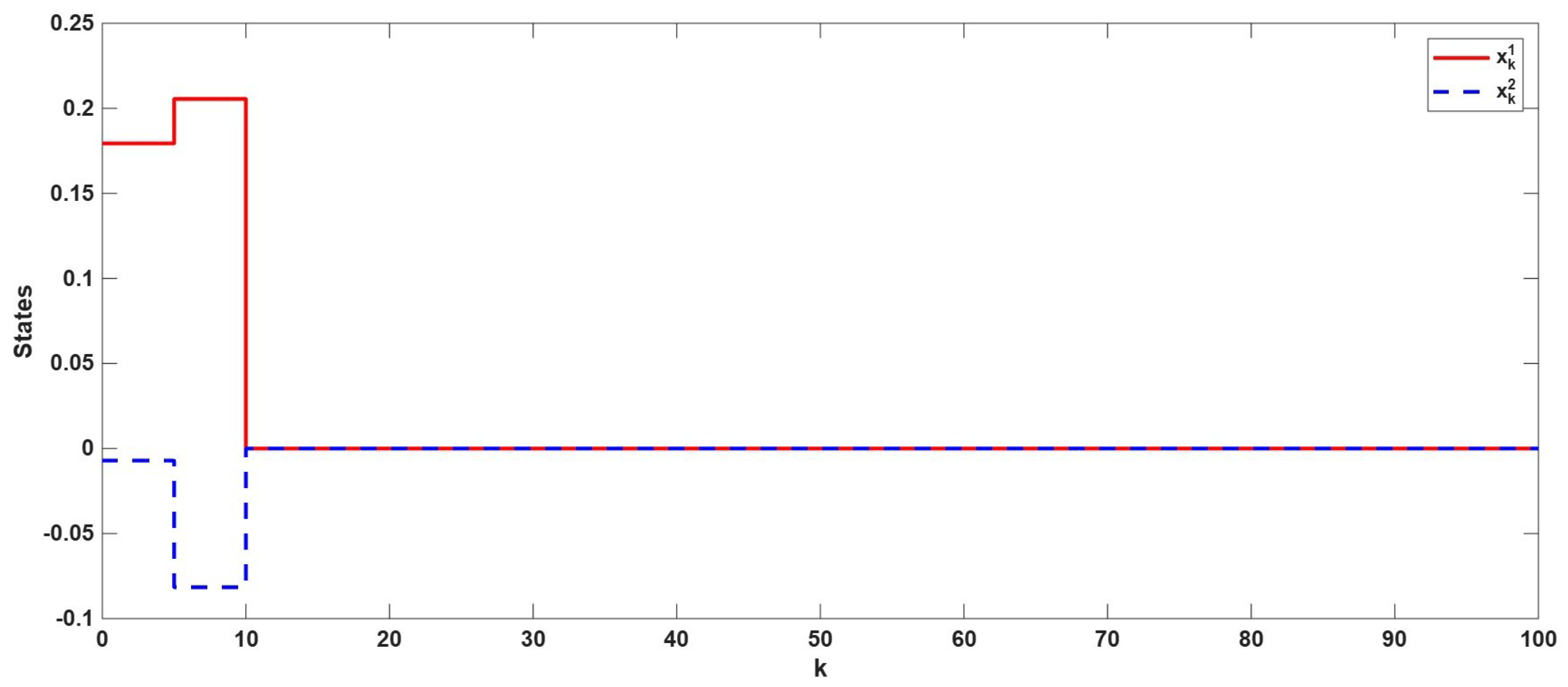
then the first two rows of Table 1 present the asymptotic stability margins guaranteed for system (17). These are compared in the last row with the result obtained in [2] (for m = 1 that is a parameter related to the auxiliary function-based summation inequality lemma). From Table 1, it is clear that when the delay interval is partitioned ( η = 2 ), the stability criteria proposed in this paper improve significantly the results obtained in [2], in terms of reduced conservatism and computational effort. When there is no partitioning ( η = 1 ) the results in this paper reduce significantly the computational effort, but with some conservativeness. Some simulations results are presented in Figure 1, for the maximum value guaranteed by the proposed results when η = 2 , starting from the boundary conditions φ 0 = 0.17 0.007 and with the delay d fixed to be d = 92 . Figure 1 confirms that the states converge to the equilibrium for this value of the delay.
Example 2.
Let the system ( 1 ) be described by:
A = 0.8 0 0 0.89 , B = 0.1 0 0.1 0.12 C = 0.5 0 0.4 0.4 , D = 0.2 0.03 0.03 0.2
By solving Theorem 1 via LMI Toolbox of MATLAB (R2025b) with
α 1 = α 2 = d 2 , ρ 1 = α 1 2 , ρ 2 = 3 α 1 2 , β 1 = β 2 = τ 2 , σ 1 = β 1 2 , σ 2 = 3 β 1 2
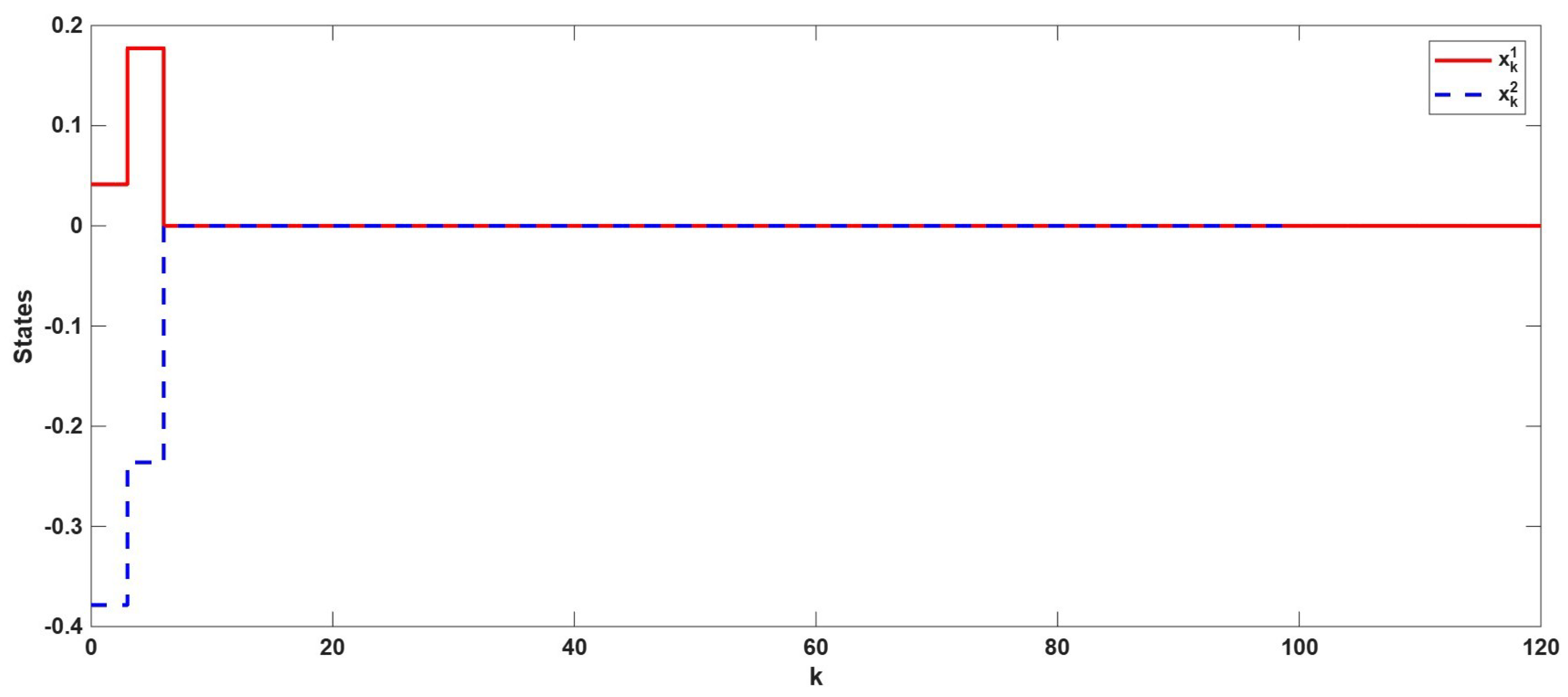
Table 2 shows the allowable upper bound d obtained in this article for several τ and r, that guarantees the stability of the system ( 1 ) . By choosing the random boundary conditions φ 0 = 0.04 0.37 with delays d = 80 , τ = 1 and r = 3 , Figure 2 exhibits the state trajectories, which demonstrates the stability of system (1). It is worth mentioning that in the case that the delay is not partitioned ( η = 1 ), the LMI (2) proves to be intractable, which is an additional demonstration of the usefulness of the approach proposed here.

5. Conclusions

The current investigation has addressed the analysis of asymptotic stability of discrete-time neutral systems subject to both discrete and distributed delays. By constructing Lyapunov–Krasovskii candidates tailored to each partitioned segment of the delay, novel delay-dependent stability conditions have been formulated, expressed as LMIs. To validate the theoretical findings, numerical simulations have been presented, which demonstrate the effectiveness of the suggested approach when compared with previous results. For further work, the use of these conditions for controller and observer design is worthy of study. Moreover, the effect of uncertainties could be considered.

Author Contributions

Conceptualization, A.H. and M.O.; Methodology, M.O.; Software, A.H.; Validation, A.H.; Formal analysis, M.O.; Investigation, A.H. and M.O.; Resources, M.O.; Data curation, F.T.; Writing—original draft, A.H.; Writing—review and editing, A.H., M.O. and F.T.; Visualization, A.H.; Supervision, M.O. and F.T.; Project administration, M.O. and F.T.; Funding acquisition, F.T. All authors have read and agreed to the published version of the manuscript.

Funding

This research is part of project DSInVar (PID2024-157718OB-C31), funded by MICIU/AEI/10.13039/501100011033 and the European Regional Development fund FEDER/ERDF, of the EU.

Data Availability Statement

The original contributions presented in this study are included in the article. Further inquiries can be directed to the corresponding author.

Conflicts of Interest

The authors declare no conflicts of interest.

References

  1. Kolmanovskii, V.; Myshkis, A. Introduction to the Theory and Applications of Functional Differential Equations; Springer: Dordrecht, The Netherlands, 1999. [Google Scholar]
  2. Park, P.; Lee, W.I.; Lee, S.Y. Auxiliary Function-based Integral/Summation Inequalities: Application to Continuous/Discrete Time-Delay Systems. Int. J. Control Autom. Syst. 2016, 14, 3–11. [Google Scholar] [CrossRef]
  3. Kolmanovskii, V.; Myshkis, A. Applied Theory of Functional Differential Equations; Kluwer Academic Publishers: Dordrecht, The Netherlands, 1992; ISBN 978-0-7923-2013-5. [Google Scholar]
  4. Niculescu, S.I. Delay Effects on Stability: A Robust Control Approach; Springer: London, UK, 2001; ISBN 978-1-85233-291-4. [Google Scholar]
  5. Kuang, Y. Delay Differential Equations with Application in Population Dynamics; Academic Press: Boston, MA, USA, 1993. [Google Scholar]
  6. Hara, S.; Yamamoto, Y.; Omata, T.; Nakano, M. Repetitive Control System: A New Type Servo System for Periodic Exogenous Signals. IEEE Trans. Autom. Control 1988, 33, 659–668. [Google Scholar] [CrossRef]
  7. Kolmanovskii, V.B.; Nosov, V.R. Stability of Functional Differential Equations; Academic Press: London, UK, 1986; ISBN 978-0-12-417941-7. [Google Scholar]
  8. Azbelev, N.V.; Simonov, P.M. Stability of Differential Equations with Aftereffect; Taylor and Francis: London, UK, 2002; ISBN 9780429178016. [Google Scholar]
  9. Bainov, D.; Domoshnitsky, A. Nonnegativity of the Cauchy matrix and exponential stability of a neutral type system of functional-differential equations. Extr. Math. 1993, 8, 75–82. [Google Scholar]
  10. Portilla, G.; Bajodek, M.; Mondié, S. Necessary and sufficient stability conditions for neutral-type delay systems: Polynomial approximations. Math. Control Signals Syst. 2025, 37, 1–32. [Google Scholar] [CrossRef]
  11. Zhu, Q.; Senthilraj, S.; Raja, R.; Samidurai, R. Stability analysis of uncertain neutral systems with discrete and distributed delays via the delay partition approach. Int. J. Control Autom. Syst. 2017, 15, 2149–2160. [Google Scholar] [CrossRef]
  12. Gu, K. Discretized Lyapunov functional for uncertain systems with multiple time-delay. Int. J. Control 2010, 72, 1436–1445. [Google Scholar] [CrossRef]
  13. Kwon, O.M.; Park, J.H.; Lee, S.M. An improved delay-dependent criterion for asymptotic stability of uncertain dynamic systems with time-varying delays. J. Opt. Theory Appl. 2010, 145, 343–353. [Google Scholar] [CrossRef]
  14. Qiu, F.; Cui, B.; Ji, Y. A delay-dividing approach to stability of neutral system with mixed delays and nonlinear perturbations. Appl. Math. Model. 2010, 34, 3701–3707. [Google Scholar] [CrossRef]
  15. Faydasicok, O.; Ozcan, N. A Further Stability Analysis of Neutral Systems With Multiple Time-Varying Delays. IEEE Access 2025, 13, 109161. [Google Scholar] [CrossRef]
  16. Zhang, Q.; Li, Z.Y.; Zhou, B. Stability and convergence rate analysis of continuous-time delay-difference systems with both point and distributed delays. Int. J. Syst. Sci. 2025, 56, 434–449. [Google Scholar] [CrossRef]
  17. Han, Q.L. A descriptor system approach to robust stability of uncertain neutral systems with discrete and distributed delays. Automatica 2004, 40, 1791–1796. [Google Scholar] [CrossRef]
  18. Chen, H.; Zhang, Y.; Zhao, Y. Stability analysis for uncertain neutral systems with discrete and distributed delays. Appl. Math. Comput. 2012, 218, 11351–11361. [Google Scholar] [CrossRef]
  19. Altun, Y. Stability estimates for a class of neutral type systems with distributed time-varying delay components. Adv. Contin. Discret. Model. 2025, 2025, 1. [Google Scholar] [CrossRef]
  20. Khorchani, N.; El Harabi, R.; Jemai, W.J.; Dahman, H. New robust stability analysis for switched neutral systems with state time-delays. In Proceedings of the 20th International Multi-Conference on Systems, Signals and Devices (SSD), Mahdia, Tunisia, 20–23 February 2023; IEEE: New York, NY, USA, 2023; Volume 60, pp. 497–502. [Google Scholar]
  21. Hale, J.K.; Verduyn Lunel, S.M. Introduction to Functional Differential Equations; Springer: New York, NY, USA, 1993; Volume 99. [Google Scholar]
  22. Seuret, A.; Gouaisbaut, F.; Fridman, E. Stability of Discrete-Time Systems with Time-Varying Delays via a Novel Summation Inequality. IEEE Trans. Autom. Control 2015, 60, 2740–2745. [Google Scholar] [CrossRef]
Figure 1. Example 1: Asymptotically stable trajectories x k 1 (in red) and x k 2 (in blue) generated from x 0 1 = 0.17 and x 0 2 = 0.007 .
Mathematics 14 00390 g001
Figure 2. Example 2: Asymptotically stable trajectories x k 1 (in red) and x k 2 (in blue) generated from x 0 1 = 0.04 and x 0 2 = 0.37 .
Mathematics 14 00390 g002
Table 1. Comparison between the approaches of the current paper and Theorem 4 in [2], based on allowable upper bound delay d m a x that guarantees the stability of system (1) and the number of decision variables.
d m a x Number of Decision Variables
Corollary 1 ( η = 1 )4712
Corollary 1 ( η = 2 )9221
Theorem 4 [2]5151
Table 2. Maximum allowable delay bound d for various values of r and τ when the partition parameter is fixed to be η = 2 .
r τ dNumber of Decision Variables
118045
212045
31645
Disclaimer/Publisher’s Note: The statements, opinions and data contained in all publications are solely those of the individual author(s) and contributor(s) and not of MDPI and/or the editor(s). MDPI and/or the editor(s) disclaim responsibility for any injury to people or property resulting from any ideas, methods, instructions or products referred to in the content.