Article

Two-Stage Multi-Frequency Deep Learning for Electromagnetic Imaging of Uniaxial Objects

1
Department of Electrical and Computer and Engineering, Tamkang University, New Taipei City 251301, Taiwan
2
School of Engineering, San Francisco State University, San Francisco, CA 94117-1080, USA
*
Author to whom correspondence should be addressed.
Mathematics 2026, 14(2), 362; https://doi.org/10.3390/math14020362
Submission received: 14 December 2025 / Revised: 13 January 2026 / Accepted: 16 January 2026 / Published: 21 January 2026

Abstract

In this paper, an anisotropic object electromagnetic image reconstruction system based on a two-stage multi-frequency extended network is developed by deep learning techniques. We obtain the scattered field information by irradiating the TM different polarization waves to uniaxial objects located in free space. We input the measured single-frequency scattered field into the Deep Residual Convolutional Neural Network (DRCNN) for training and to be further extended to multi-frequency data by the trained model. In the second stage, we feed the multi-frequency data into the Deep Convolutional Encoder–Decoder (DCED) architecture to reconstruct an accurate distribution of the dielectric constants. We focus on EMIS applications using Transverse Magnetic (TM) and Transverse Electric (TE) waves in 2D scenes. Numerical findings confirm that our method can effectively reconstruct high-contrast uniaxial objects under limited information. In addition, the TM/TE scattering from uniaxial anisotropic objects is governed by polarization-dependent Lippmann–Schwinger integral equations, yielding a nonlinear and severely ill-posed inverse operator that couples the dielectric tensor components with multi-frequency field responses. Within this mathematical framework, the proposed two-stage DRCNN–DCED architecture serves as a data-driven approximation to the anisotropic inverse scattering operator, providing improved stability and representational fidelity under limited-aperture measurement constraints.

1. Introduction

Despite the extensive progress in classical inversion techniques, the reconstruction of uniaxial anisotropic media under TM and TE excitations remains mathematically challenging due to the tensorial nature of dielectric contrasts and the polarization-dependent Green’s functions embedded in the Lippmann–Schwinger integral formulation. The resulting nonlinear operator that maps multi-frequency scattered fields to dielectric distributions is compact and ill-posed, causing severe instability and sensitivity to measurement noise. These difficulties become more pronounced in limited-aperture or sparsely sampled configurations, where traditional iterative schemes struggle to achieve stable convergence. Consequently, there is a growing interest in developing data-driven surrogates capable of approximating the underlying anisotropic inverse operator while retaining robustness against multi-scattering effects and measurement incompleteness. Inverse problems involve multiple scattering. In the past, scattered fields have been extensively employed to solve Electromagnetic Inverse Scattering (EMIS) problems for real-time image reconstruction. However, the deficiency of information is still a barrier. Electromagnetic imaging technology combined with IoT applications has shown great promise in many areas, such as transmissive radar in the geophysical field [1]. IoT sensors can be deployed to assist transmission radar systems in transmitting polarized waves to the ground surface, and reflected waves generated by different dielectric constants of different surface materials are received to explore underground resources (e.g., mineral deposits, oil and gas, groundwater, and geothermal information, etc.). In environmental and engineering applications, IoT provides real-time monitoring data at multiple points, which can further enhance the use of electromagnetic imaging for pipeline localization [2], burst detection [3], background noise measurement and correction evaluation [4], etc. From a medical imaging perspective, with the rapid development of image technology, electromagnetic imaging systems combined with IoT can capture the electromagnetic scattering data of human tissues in real time and accurately identify the structure of biological tissues through cloud or edge computing processing [5], which aid medical diagnosis and real-time monitoring.
Scholars have made significant progress in recent years to solve the EMIS problem. Generally, solutions can be categorized into two main groups: (1) conventional algorithms [6,7,8,9,10] and (2) deep learning methods [11,12,13,14,15].
In terms of conventional algorithms, in 2019, Zhou proposed a dual-mesh method to reconstruct non-sparse microwave objects. Experimental results demonstrated that integrating a dual-mesh method with a non-decimated wavelet-iterative method could quickly reconstruct non-sparse objects, even when the received data were relatively limited or under noisy environments [6]. Wei presented a method in 2020 in which numerical results showed that by converging to an exact solution, good accuracy and efficiency could be achieved even for high-order components [7]. In 2021, Menshov proposed an alteration to the contrast source inversion method for imaging two-dimensional objects amidst a focusing medium for TM polarization. This method could overcome the inverse scattering problem and significantly enhance the accuracy of contrast source inversion algorithm reconstruction, especially for inhomogeneous objects [8]. In 2022, Morimoto introduced a hybrid algorithm by estimating thickness and dielectric constants through compressed sensing and contrast source inversion. In his study, reconstruction for complex dielectric constant distribution of multilayer objects in the terahertz frequency band was proposed. Numerical tests showed that this method could accurately reckon the thickness and relative dielectric constants of two-layer objects. In addition, it could also avoid the problem of falling into local extrema [9]. In 2023, Chen introduced a novel algorithm based on the wideband Sherman–Morrison–Woodbury formula. This algorithm aims to tackle electromagnetic scattering problems efficiently, particularly in scenarios involving broadband signals and wide-angle applications. Unlike conventional methods relying on the Sherman–Morrison–Woodbury formula, Chen’s approach eliminated the need for repetitive execution of the standard adaptive cross-approximation process, resulting in significant computational time savings. Numerical experiments confirmed the effectiveness and precision of this algorithm in solving electromagnetic equations across various broadband and wide-angle scenarios [10].
In terms of deep learning, in 2019, Wei introduced and compared three different methods. Numerical results demonstrated that DCS outperformed the other two schemes and was able to solve a typical inverse scattering problem quickly within 1 s. Moreover, both the back propagation scheme and DCS were capable of reconstructing clear and satisfactory boundaries using the measured scattered field, even though the tests were carried out far beyond the training database range [11]. Xiao utilized the convolutional neural network known as 3-D U-Net in 2020 [12]. In 2021, Ma justified that the proposed method based on the pix2pix model had superior performance when compared to other neural networks like U-Net [13]. In 2022, Li proposed a novel hybrid electromagnetic inversion method. Results indicated that the proposed hybrid method could effectively reconstruct isotropic, anisotropic, homogeneous, or non-homogeneous scatterers effectively. This mechanism was not only noise resistant but also had the advantages of higher reconstruction accuracy as well as lower computational cost compared with traditional variational born iterative methods [14]. In 2023, Zhang presented an artificial intelligence method to predict the multi-frequency electromagnetic scattered field. This method could recover the dielectric object effectively [15].
In 2020, Zhuo proposed the Variational Born Iteration Method (VBIM) to solve the EMIS [16]. In 2022, Ye utilized the Super resolution algorithm to improve image quality significantly with a shorter computing time [17]. In 2023, Huang discussed the EMIS problem solved by VBIM [18]. In 2023, Chiu utilized Artificial Intelligence to reconstruct uniaxial images. Numerical results showed that Modified Contrast Scheme (MCS) outperformed DCS in reconstructing uniaxial objects [19].
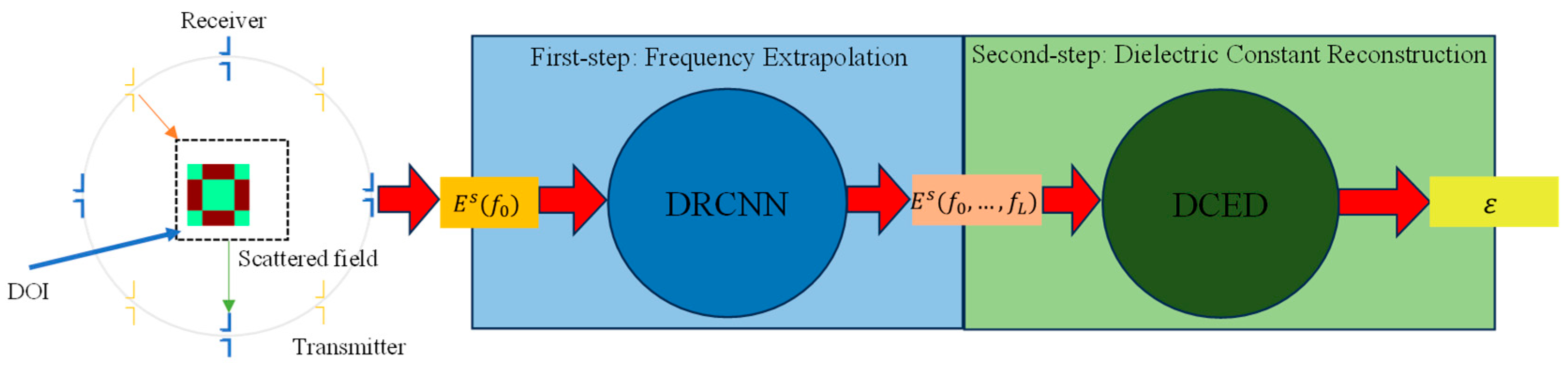
In this study, we propose an enhanced neural network to reconstruct the dielectric constant by measuring electric field with evenly distributed transmitters and receivers around the unknown object. The measured single-frequency scattered field is then input to the first stage of DRCNN to estimate the multi-frequency information. Next, the estimated multi-frequency information is input to the second stage of DCED with the attention mechanism to reconstruct an accurate distribution of dielectric constants (ϵ), which is known as the electromagnetic image, as shown in Figure 1. This paper makes the following contributions:
(1)
The reconstruction for TE polarized waves will be more difficult than TM polarized waves because of the different orientations of the incident waves, different dielectric coefficient components, and high nonlinearity susceptibility. The two-stage deep learning method proposed by Zhang [15] only dealt with TM polarized waves, while we consider both TM and TE polarized waves simultaneously.
(2)
Compared to similar studies in the past [11,20], our method does not require the use of imaging methods such as back propagation schemes and DCS to provide initial guess images. Providing initial guess images can help the neural network learning process by reducing the training difficulty and improving image reconstruction resolution.
(3)
Since the frequency is extrapolated from a single frequency to multiple frequencies, the measurement time can be reduced. Compared with the two-step machine learning approach proposed by Yao [21], we extend the frequencies to obtain more object information. In addition, in the context of sparse data or difficulty obtaining multi-frequency data (e.g., deep targets, extreme environments), the single-frequency extrapolation can generate complete multi-frequency data with limited measurement data, which improves the efficiency of data utilization.
(4)
Simulation results demonstrate that our algorithm can regenerate the shape and material, even under high Gaussian noise.
(5)
In the TE wave simulation, by optimizing the field strength ( E x i or E y i ) for a specific incidence angle, the influence of the system in a specific direction is strengthened, and the ability to enhance the recognition of anisotropic targets by targeting to capture the characteristics of the scattered field in different directions is enhanced.
Currently, traditional methods are most prevalently used to resolve EMIS problems. Unfortunately, traditional methods may incur substantial computational cost, nonlinearity, and inappropriateness. For this topic, we combined deep learning and multi-frequency techniques to improve the shortcomings of the algorithms. In Section 2, we introduce the EMIS problem. Section 3 presents the enhanced two-stage deep learning method proposed. Section 4 shows the simulation results. Section 5 presents the conclusions.

2. Theory

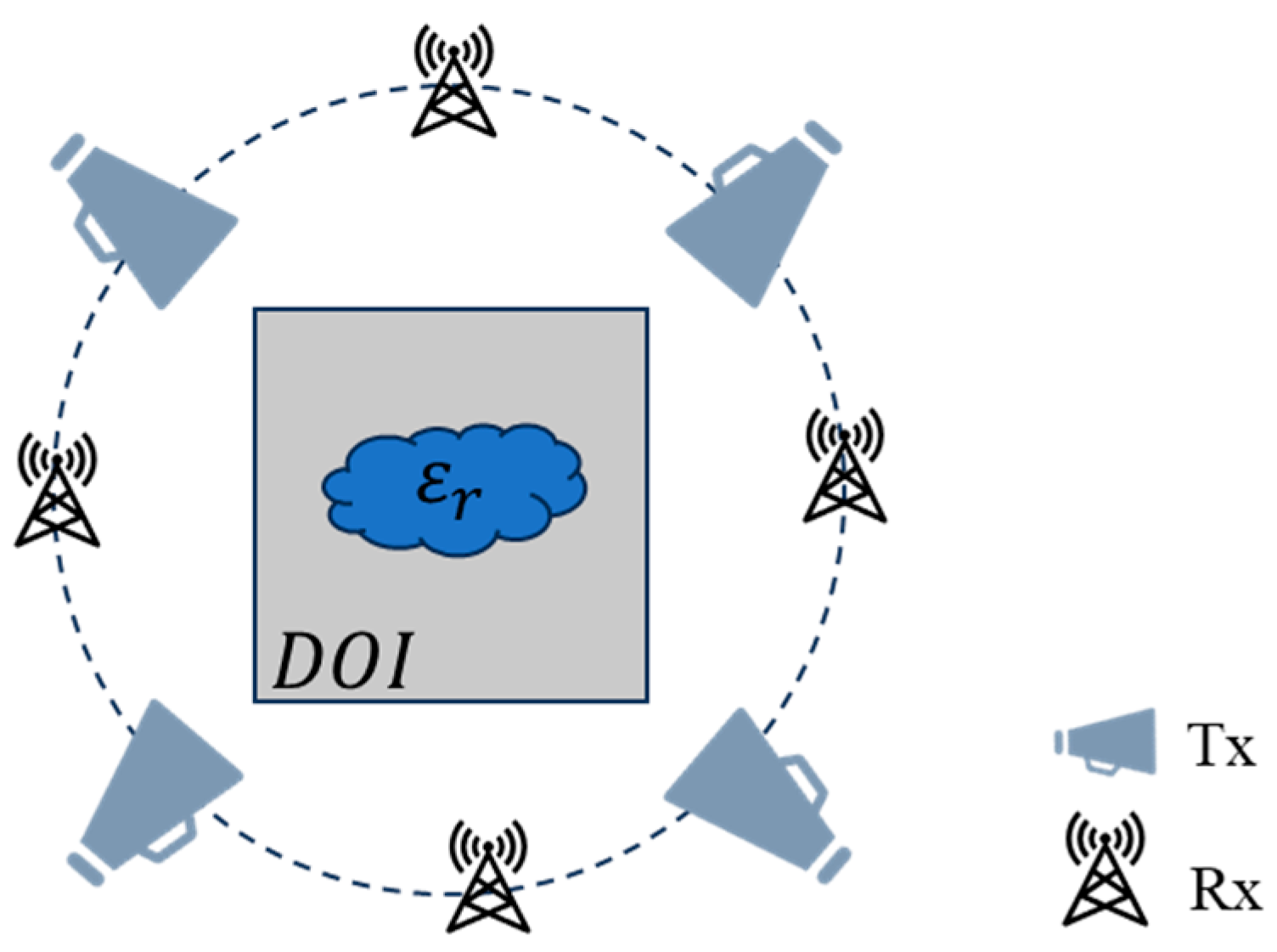
EMIS plays a key role in imaging and sensing, allowing the reconstruction of unknown scatterers in a specific region Domain of Interest (DOI). This research investigates the EMIS applications using TM and TE waves in 2D, as shown in Figure 2. The DOI is divided into N × N square subunits, and the scattered field is computed using the Method of Moments (MoM). In this study, we set N to be 32.
The object dielectric constants ε ̿ r r   can be described by the diagonal matrix of Cartesian coordinates (x, y, z), which can be expressed as
ε ̿ r = ε x r ¯ 0 0 0 ε y r ¯ 0 0 0 ε z r ¯ x y z
ε x r ¯ ,   ε y r ¯ ,   a n d   ε z r ¯ are usually complex numbers and r ¯ denotes (x, y). Assume e j ω t (ω is the angular frequency) is a time-dependent function for electrical data. The challenge is to solve the highly nonlinear problem.
The TM and TE cases are considered in the following sections.

2.1. TM (Transverse Magnetic) Waves

Let E z ( r ¯ ) denote the total electric field with only a z component [11].
E z r ¯ = E z i r ¯ + S G ( r ¯ , r ¯ ) ( ε z r ¯ 1 ) E z r ¯ d s ,     r ¯ , r ¯ S
The incident and scattered fields are expressed as follows:
E ¯ i r ¯ = E z i x , y z ^ = e j k 0 ( x c o s φ + y s i n φ ) z ^
φ is incident angle.
E z s r ¯ = S G ( r ¯ , r ¯ ) ( ε z r ¯ 1 ) × E z r ¯ d s ,     r ¯ S , r ¯ S
where G r ,   r   = j 4 H 0 2 k 0 r r , and H 0 2 is the zeroth-order Hankel function of the second kind. ε z r ¯ is the z component dielectric coefficient. k 0 2 = ω 2 μ 0 ε 0 denotes the wavenumber in free space.

2.2. TE (Transverse Electric) Waves

TE waves have no electric field component in the propagation direction, and their total field, incident field, and scattered information are all combined by the x-direction and y-direction, which can be expressed respectively as [20] follows:
E r ¯ = E x r ¯ + E y r ¯
E x r ¯ = 2 x 2 + k 0 2 S G ( r ¯ , r ¯ ) ε x r ¯ 1 E x r ¯ d s + 2 x   y S G ( r ¯ , r ¯ ) ε y r ¯ 1 E y r ¯ d s + E x i r ¯
E y r ¯ = 2 x   y S G ( r ¯ , r ¯ ε x r ¯ 1 E x r ¯ d s + 2 y 2 + k 0 2 S G ( r ¯ , r ¯ ε y r ¯ 1 E y r ¯ d s + E y i r ¯
E i r ¯ = E x i r ¯ + E y i r ¯
E x i r ¯ = s i n φ e j k 0 ( x c o s φ + y s i n φ )
E y i r ¯ = c o s φ e j k 0 ( x c o s φ + y s i n φ )
E s r ¯ = E x s r ¯ + E y s r ¯
E x s r ¯ = 2 x 2 + k 0 2 S G ( r ¯ , r ¯ ) ε x r ¯ 1 E x r ¯ d s + 2 x   y S G ( r ¯ , r ¯ ) ε y r ¯ 1 E y r ¯ d s
E y s r ¯ = 2 x   y S G ( r ¯ , r ¯ ε x r ¯ 1 E x r ¯ d s + 2 y 2 + k 0 2 S G ( r ¯ , r ¯ ε y r ¯ 1 E y r ¯ d s
To avoid solving the coupled equations directly, we discretize a DOI into sufficiently small and homogeneous segments N × N. The incident and scattered fields of the TM and TE waves can be expressed as follows, using the pulse function as the base function in the extended equation.
( E z i ) = ( G 1 τ z I ) ( E z )
( E z s ) = G 2 τ z ( E z )
E x i E y i = G 3 [ G 4 ] G 4 G 5 τ x 0 0 τ y I 0 0 I × E x E y
E x s E y s = G 6 [ G 7 ] G 7 G 8 τ x 0 0 τ y E x E y
( G 1 ) m n = j π k 0 a n 2 J 1 k 0 a n H 0 2 k 0 ρ m n ,       m n j 2 [ π k 0 a n H 1 2 k 0 a n 2 j ,                     m = n
( G 2 ) m n = j π k 0 a n 2 J 1 k 0 a n H 0 2 k 0 ρ m n
G 3 = j π a n J 1 k 0 a n 2 ρ 3 m n × k 0 ρ m n y m y n 2 H 0 2 k 0 ρ m n + ( x m x n 2 ( y m y n ) 2 ) H 1 2 ( k 0 ρ m n ) , m n j 4 π k 0 a n H 1 2 k 0 a n 4 j           ,   m = n
G 4 = j π a n J 1 k 0 a n 2 ρ 3 m n x m x n y m y n × 2 H 1 2 k 0 ρ m n k 0 ρ m n H 0 2 k 0 ρ m n , m n 0         ,   m = n
G 5 = j π a n J 1 k 0 a n 2 ρ 3 m n × k 0 ρ m n x m x n 2 H 0 2 k 0 ρ m n + ( y m y n ) 2 ( x m x n ) 2 , m n j 4 π k 0 a n H 1 2 k 0 a n 4 j ,   m = n
( G 6 ) = j π a n J 1 k 0 a n 2 ρ m n 3 × [ k 0 ρ m n y m y n 2 H 0 2 k 0 ρ m n + ( x m x n 2 ( y m y n ) 2 ) H 1 2 ( k 0 ρ m n ) ]
( G 7 ) m n = j π a n J 1 k 0 a n 2 ρ m n 3 x m x n y m y n × 2 H 1 2 k 0 ρ m n k 0 ρ m n H 0 2 k 0 ρ m n
( G 8 ) m n = j π a n J 1 k 0 a n 2 ρ m n 3 × [ k 0 ρ m n x m x n 2 H 0 2 k 0 ρ m n + ( ( y m y n ) 2 x m x n 2 ) H 1 2 ( k 0 ρ m n ) ]
ρ m n   =   ( x m x n 2 + ( y m y n ) 2 ) 1 2 denotes the distance, H 0 2 is the zeroth-order Hankel function of the second kind, H 1 2 is the first-order Hankel function of the second kind, J 1 is the first-order Bessel function of the first kind, x m ,   y m and x n ,   y n represent the m t h observation point and the n t h source point, respectively.
E x ( r ¯ )   , E y ( r ¯ )   , and E z ( r ¯ )   denote the total electric field column vectors of length N , and E x i , E y i , and E z i are the incident field column vectors of length N . E x s   , E y s , and E z s are the scattered field vectors with M elements, where M denotes the number of measurement points. G 1 , G 3 , [ G 4 ], and   G 5 denote N × N arrays. G 2 , G 6 , G 7 , and G 8 denote M × N arrays. τ x   , τ y , and τ z are diagonal matrices formed by the dielectric coefficients, with diagonal entries τ x   n n   =   ε x r 1 , τ y   n n = ε y r 1 ,   a n d   τ z n n = ε z r 1 . [ I ] is an N × N unitary matrix.
In this paper, we assume that the relative permittivity remains constant across different frequencies. The nonlinear function F relating the measured scattered field at f 0 to the expected scattered fields at f 1 , , f L is given by [15]
E s f 1 , , f L = F E s f 0
L is number of frequencies. The loss function is the following:
Q f 1 , , f L = i = 1 N E i s f 1 , , f L F E i s f 0
Here, α represents the constant regularization factor, and R stands for the regularization term. F is implemented by the trained DRCNN and ‖⋅‖ denotes Frobenius.
m i n : f χ = i = 1 N i E i s E i s ( χ ) + α R ( χ )

3. Neural Network

We propose an enhanced deep learning approach to overcome the limitations of traditional methods for solving EMIS. Different neural networks are used in the two stages to realize the dielectric constant. First, DRCNN is used to generate a multiple frequency electric field, which is crucial for solving the EMIS problem because it can effectively extrapolate the electromagnetic scattered field between different frequencies, thus reducing the complexity and cost of multi-frequency measurements. The advantages of our augmented method include the effectiveness of high contrast for inhomogeneous scatterers, the flexibility to integrate more prior information to improve performance, and the reduction of computational complexity.
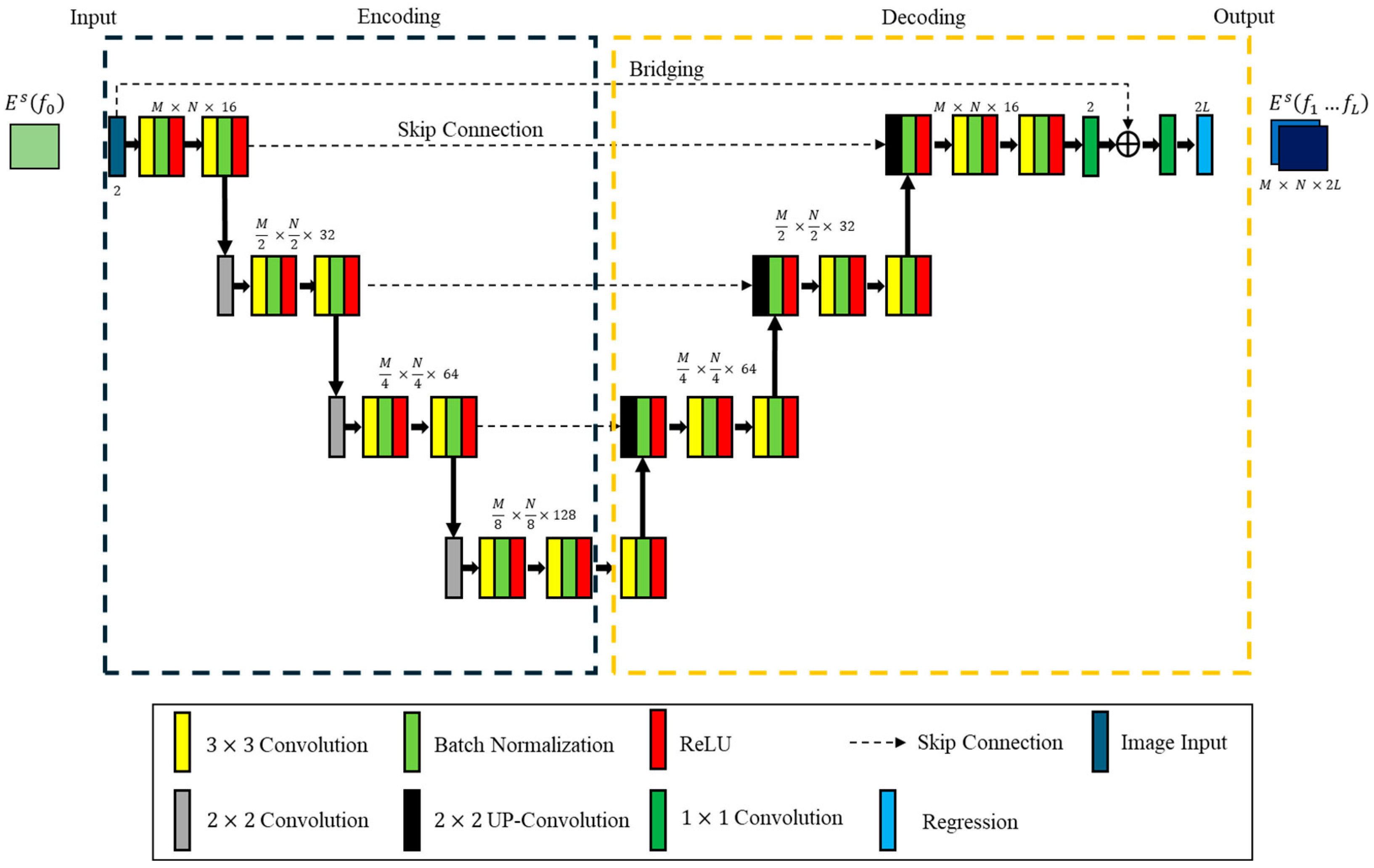
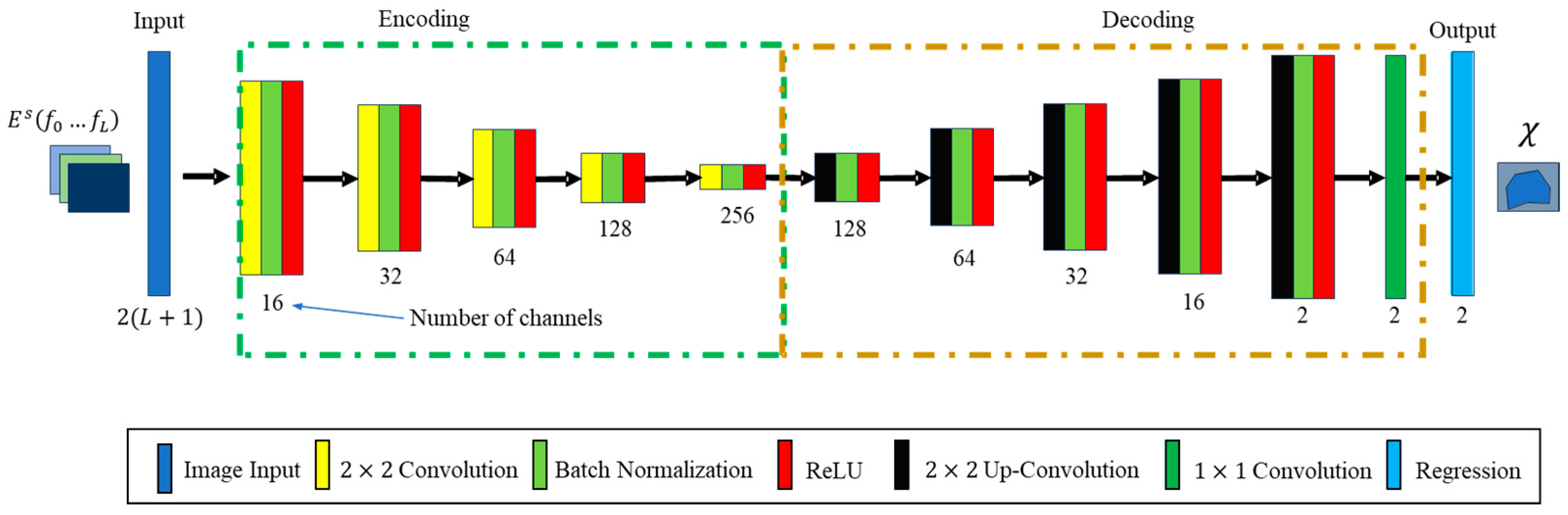
The architecture of the first stage for DRCNN is shown in Figure 3. This is achieved through multiple layers of convolutional, normalization, and activation layers, enabling it to evolve from single-frequency to multi-frequency electromagnetic scattered fields. This gives us a richer set of information, including both high-frequency and low-frequency scattered fields, which is helpful for the subsequent reconstruction of the dielectric constant. The advantages of this stage are also realized in the effectiveness in handling inhomogeneous scatterers, improving local stability, and sharing the same training data for subsequent deep learning models. Moreover, multi-frequency electromagnetic scattered fields are good at solving EMIS problems in terms of tackling nonlinearity, improving local stability, as well as improving interference immunity. In real practice, however, most of the existing frequency extrapolation methods use narrow frequency bands and are unable to use only one electromagnetic frequency point for extrapolation. In addition, these methods usually require a large number of computations and complex derivations. Specifically, existing extrapolation methods suffer from the following problems. Many fundamental calculations are essential, such as nonlinear spreading and a bundle of matrix transfer calculations. Furthermore, they cannot arbitrarily select a target electromagnetic frequency to extrapolate due to the constraints of the specific mathematical theory derived for the extrapolation method. Therefore, new extrapolation methods need to be developed to address the shortcomings of existing methods.
The proposed DRCNN consists of three paths, encoding, decoding, and bridging. We input a single-frequency scattered field of size M × N × 2 , where M corresponds to the number of receivers and N corresponds to the total number of incident fields shown in Figure 1. Two channels are defined, corresponding to the real and imaginary components. The encoding part captures features of the single-frequency scattered field by progressively compressing the spatial resolution through stacked 2 × 2 convolution, normalization, and ReLU activation layers. The decoding part symmetrically recovers the resolution and extrapolates the scattered fields at other frequencies using stacked 2 × 2 transposed convolution, normalization, and ReLU activation layers. The bridging path implements U-Net-style skip connections that concatenate encoder features with decoder features at the same resolution, allowing the decoder to leverage multi-scale information from different layers. The convolutional layer with the 1 × 1 filter followed by a regression layer produces the multi-frequency output with 2 L channels across the L target frequencies for the real and imagary parts. The loss function of DRCNN is as follows:
L o s s D R C N N = 1 k k = 1 k F θ E k s f 0 E k s F 2
where F θ denotes the DRCNN model, k is the number of test sets, L denotes the number of frequencies and ‖ ‖F denotes Frobenius norm.
The multiple frequency electric field output from the first stage is fed into the DCED to reconstruct the image of the target scatterer, as illustrated in Figure 4. The DCED adopts an encoder–decoder pipeline in which the encoder extracts hierarchical representations through stacked 2 × 2 convolution, normalization, and ReLU activation layers, while progressively reducing the feature-map resolution. The decoder then restores the resolution through stacked 2 × 2 transposed convolution (up-convolution), normalization, and ReLU activation layers. Finally, a regression head outputs the reconstructed dielectric constant map. The DCED loss function is as follows:
L o s s D R C N N = 1 k k = 1 k Y Y F 2
where Y is the reconstructed image by DCED and Y is ground truth.

4. Numerical Results

We set up a free-space environment for unknown scatterers by incident TM and TE polarization waves into the target region. An enhanced two-stage deep learning approach is used to reconstruct the image by means of the received scattered field information.
The simulation is performed with an incident wave frequency of 0.3 GHz. A total of 32 transmitters and 32 receivers are placed in the environment, and Gaussian noise levels of 5% and 20% are added to the measurements. The Domain of Interest (DOI) is a square region of size 2   m × 2   m and is discretized into an N × N grid with N = 32 , resulting in a spatial sampling interval of 0.0625   m per cell. The uniaxial object occupies a square support of approximately 1   m × 1   m within the DOI. The transmitter/receiver array is placed at a radius of 1 m from the DOI. The operating frequency is f 0 = 0.3   G H z , and a total of 32 transmitting antennas and 32 receiving antennas are employed, with additive 5% and 20% Gaussian noise applied to the measurements [11,20].
For the TM simulation, the transmitting antennas and receiving antennas are placed at intervals of 11.25 degrees. In the TE simulation, the incident electric field components E x i and E y i change as a function of the incident angles. Therefore, we set the incident angles at specific degrees: 0, 2.5, 5, 7.5, 10 (for larger E y i ); 82.5, 85, 87.5, 90, 92.5, 95, 97.5, 100 (for larger E x i ); 172.5, 175, 177.5, 180, 182.5, 185, 187.5, 190 (for larger E y i ); 262.5, 265, 267.5, 270, 272.5, 275, 277.5, 280 (for larger E x i ); 352.5, 355, and 357.5 (for larger E y i ).
When E x i is larger, E x s is used to reconstruct ε x . Likewise, when E y i is larger, E y s is used to reconstruct ε y . In total, there are 32 incident waves.
We use different ways for verifying our algorithm. In the first stage, we apply the Mean Square Error (MSE) to evaluate the extrapolated scattered field, which is expressed as follows [15]:
M S E = 1 K i = 1 K y i y ^ i 2
y i and y ^ i represent the exact and predicted scattered fields, respectively, and K denotes the size of the training samples.
In the second stage, we use Normalized Mean Square Error (NMSE) and Structural Similarity Index Measure (SSIM) to evaluate the performance of the reconstructed images as follows [21]:
N M S E = i = 1 K ε i ε ^ i 2 i = 1 K ε i 2
where ε i and ε ^ i are the average true dielectric coefficient and predicted dielectric coefficient, respectively.
S S I M = ( 2 μ y ^ μ y + C 1 ) ( 2 σ y ^ y + C 2 ) ( μ y ^ 2 + μ y 2 + C 1 ) ( σ y ^ 2 + σ y 2 + C 2 )
μ y is the mean of y and y and σ y ^ y is the covariance between y and y ^ .

4.1. Dielectric Constants Between 1 and 7.5

We set the dielectric constant between 1 and 7.5. The electrical data at f 0 = 0.3   G H z are extrapolated to obtain a multi-frequency scattered field with the frequencies f 1 = 0.2   G H z and f 2 = 0.4   G H z . TM and TE waves are incident from 0 degrees to 360 degrees to irradiate the target domains from different directions. The dielectric constant is reconstructed in the second stage by combining the frequencies obtained in the first stage. There are a total of 6000 datasets for the simulation. We randomly selected 5000 datasets for training and 1000 datasets testing.
Throughout the training process, as each U-Net operates independently, the first- and second-stage training parameters can be selected optimally. This can effectively enhance computational performance. An initial learning rate of 10 2 is applied and decayed by a factor of 0.1 every 30 epochs (i.e., to 10 3 after 30 epochs) and is used for the Adaptive Moment Estimation (Adam) optimizer. The regularization factor is set to 10 4 , a batch size of 32, and a maximum of 60 training epochs are employed. The Adam hyperparameters are β 1 = 0.9 and β 2 = 0.999 . In the first stage of the neural network, out of the 5000 training samples, we allocate 50% for training and 50% for validation. The results from the DRCNN are used as inputs to the DCED to reconstruct the real dielectric constant, of which 80% are used for training and 20% are used for validation. After the two-stage deep learning method is trained, we input new test data to evaluate the reconstruction performance. Here, the new test data refer to a fully independent external test set that is disjoint from all training/validation data and is never used during training or model selection. In terms of model size, the DRCNN contains 7.713 × 10 5 learnable parameters, while the DCED contains 3.508 × 10 5 learnable parameters.
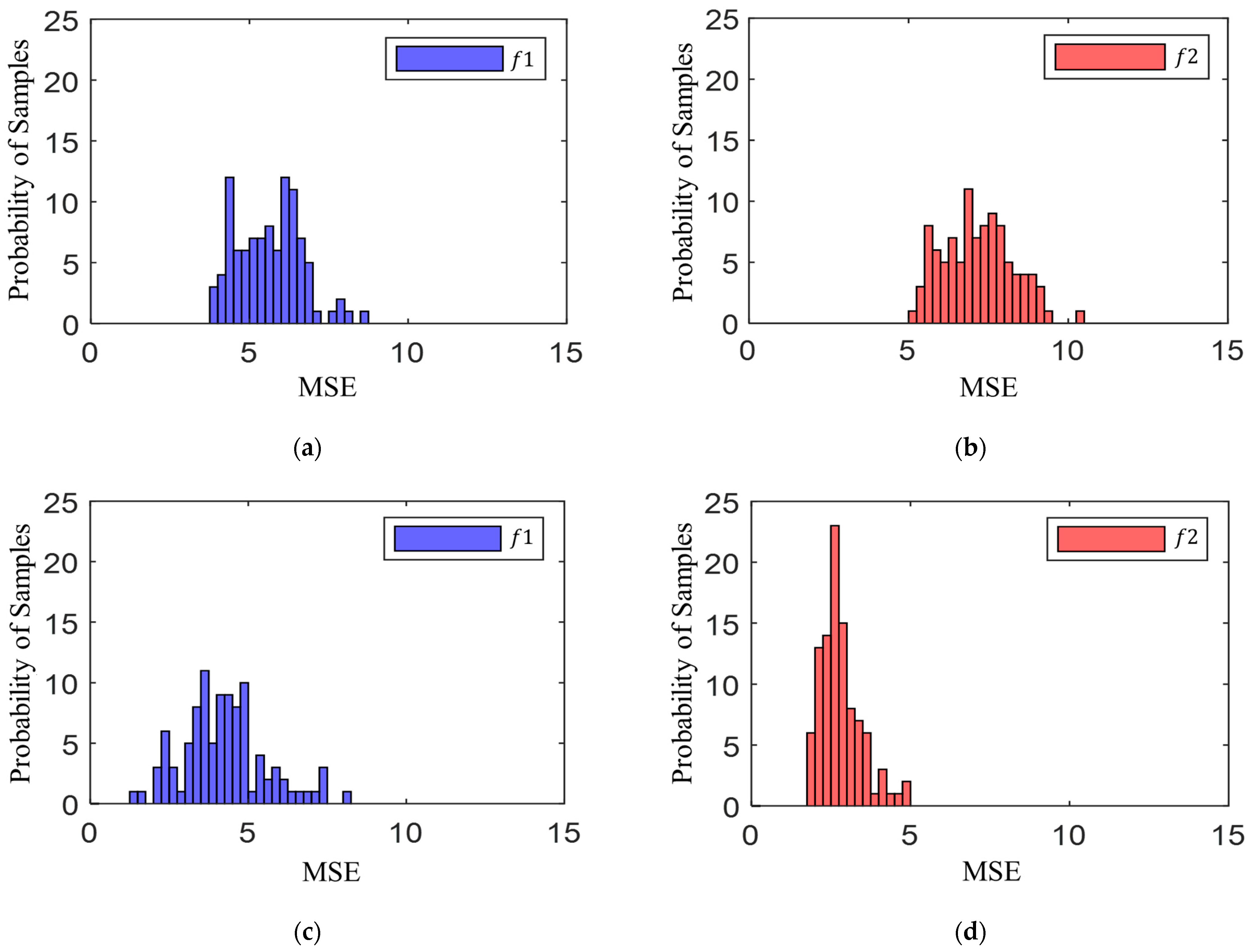
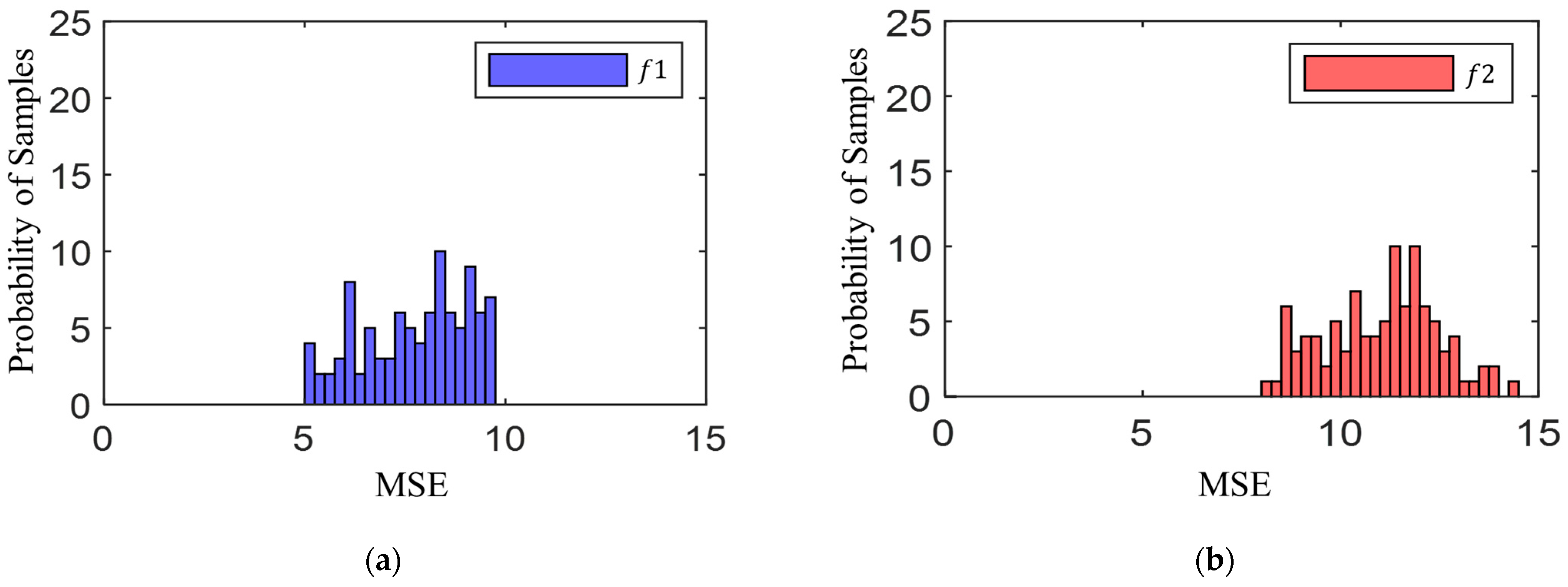
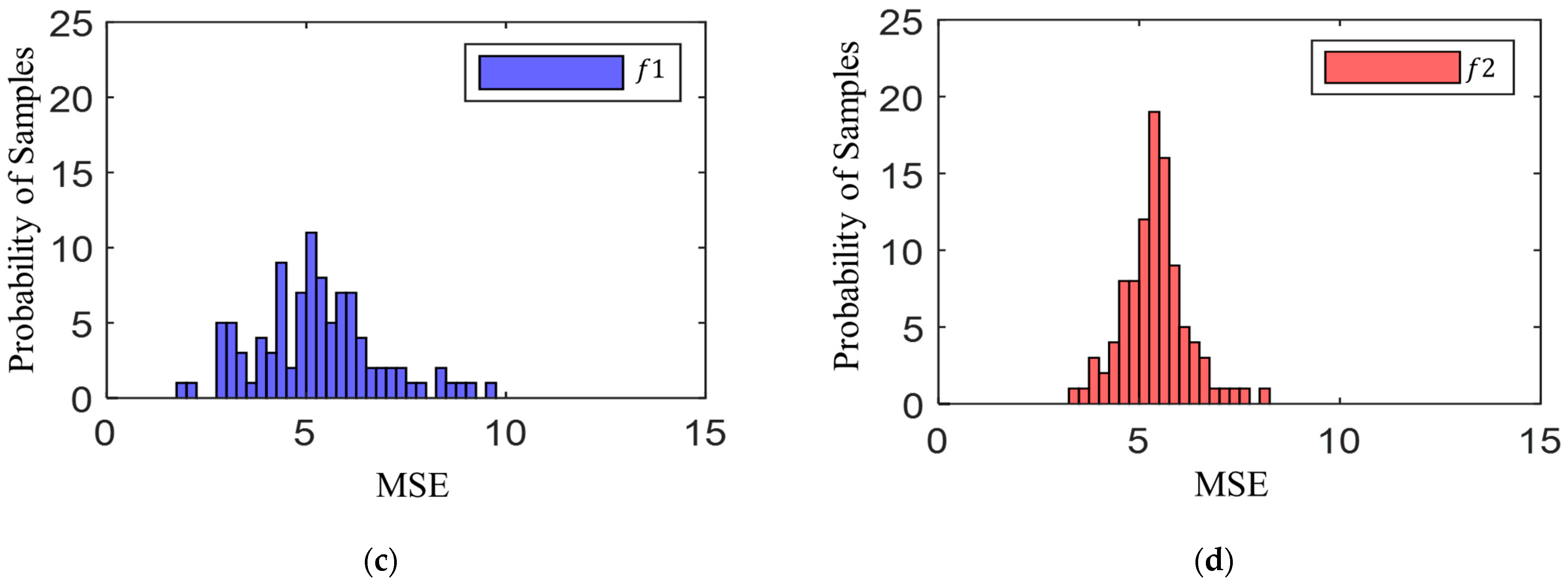
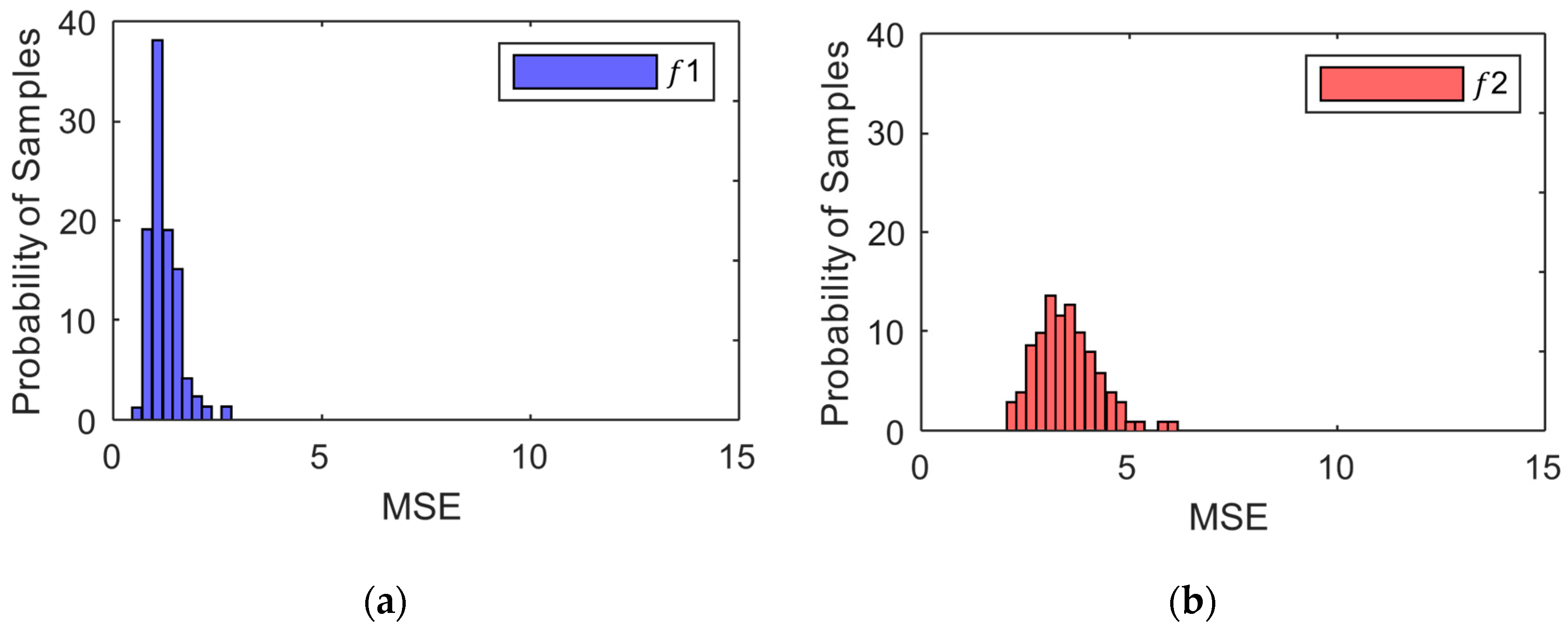
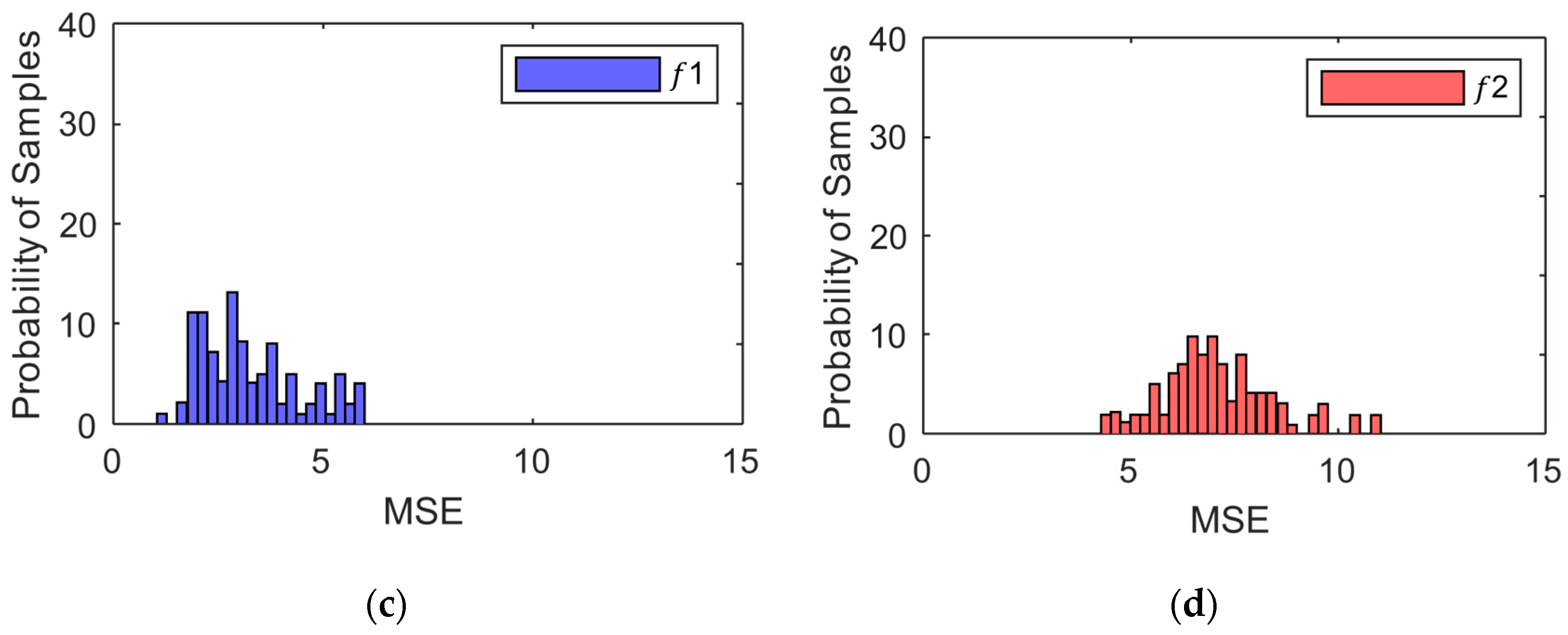
Figure 5a,b show the histograms for MSE of relative permittivity ε z at 5% noise for frequencies f 1 and f 2 , respectively. Figure 5c,d show the histograms for MSE of relative permittivity ε x at 5% noise for frequencies f 1 and f 2 , respectively. Figure 6a,b show the histograms for MSE of relative permittivity ε z at 20% noise for frequencies f 1 and f 2 , respectively. Figure 6c,d show the histograms for MSE of relative permittivity ε x at 20% noise for frequencies f 1 and f 2 , respectively. From Figure 5 and Figure 6, in the first stage of frequency extrapolation, when the object is square, the MSE of f 1 and f 2 for TE is better than that for TM, regardless of whether it is a 5% or 20% noise scenario. The values are very small, which is enough to show that the frequency extrapolation method is feasible.
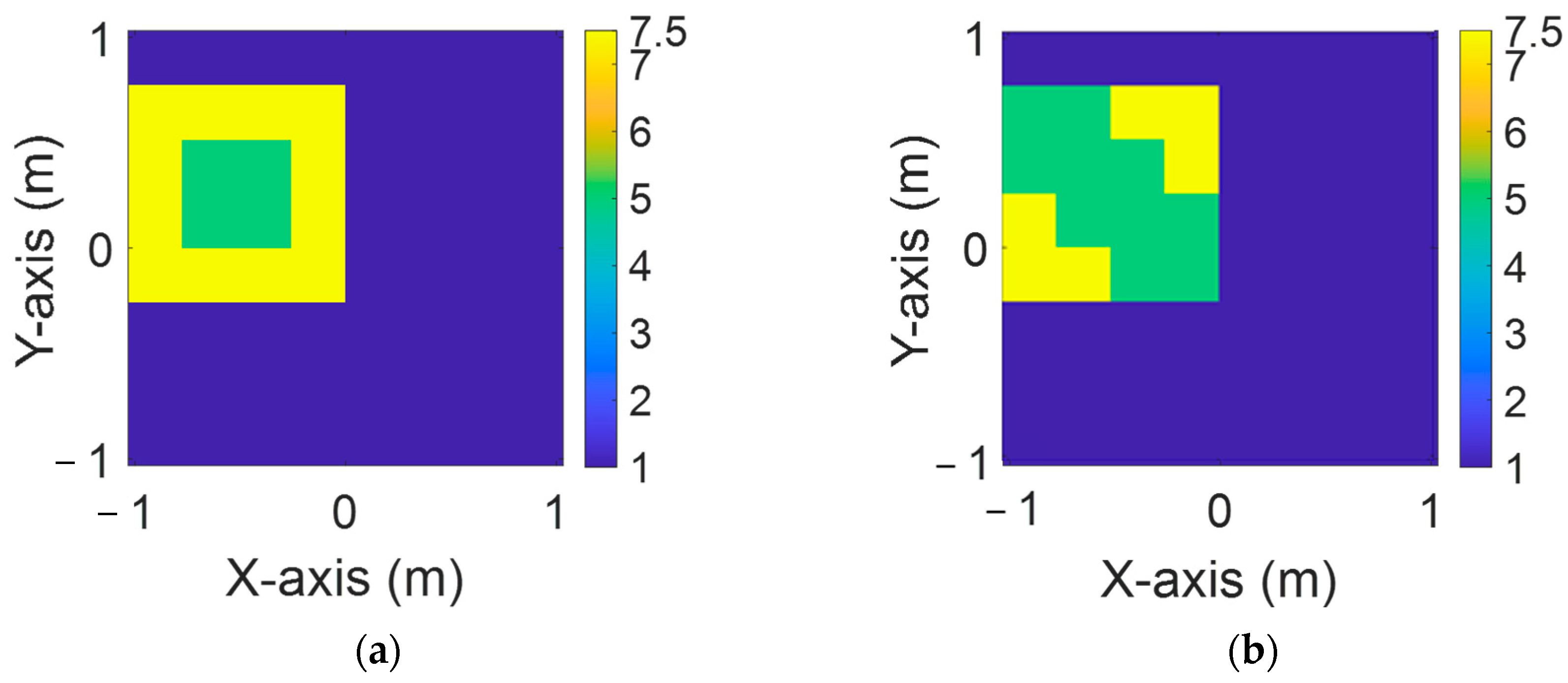
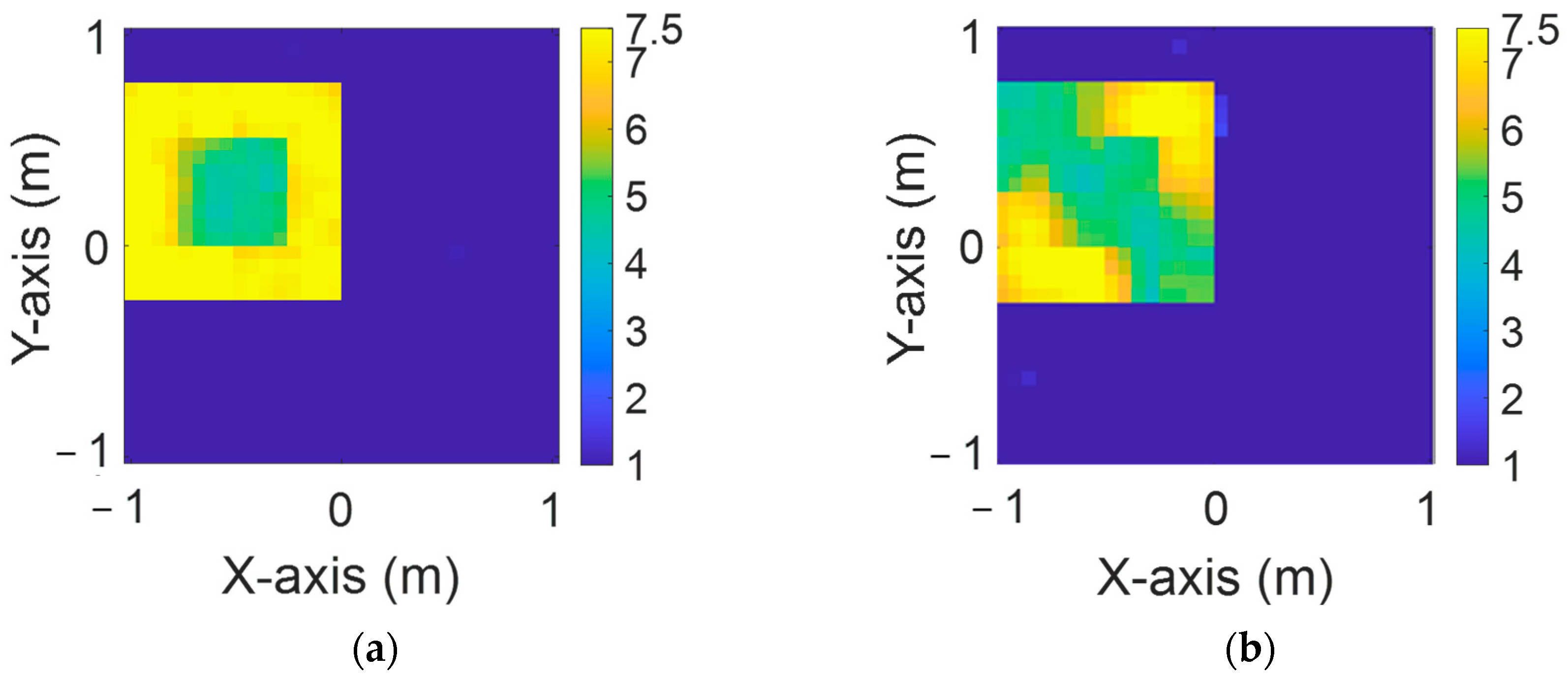
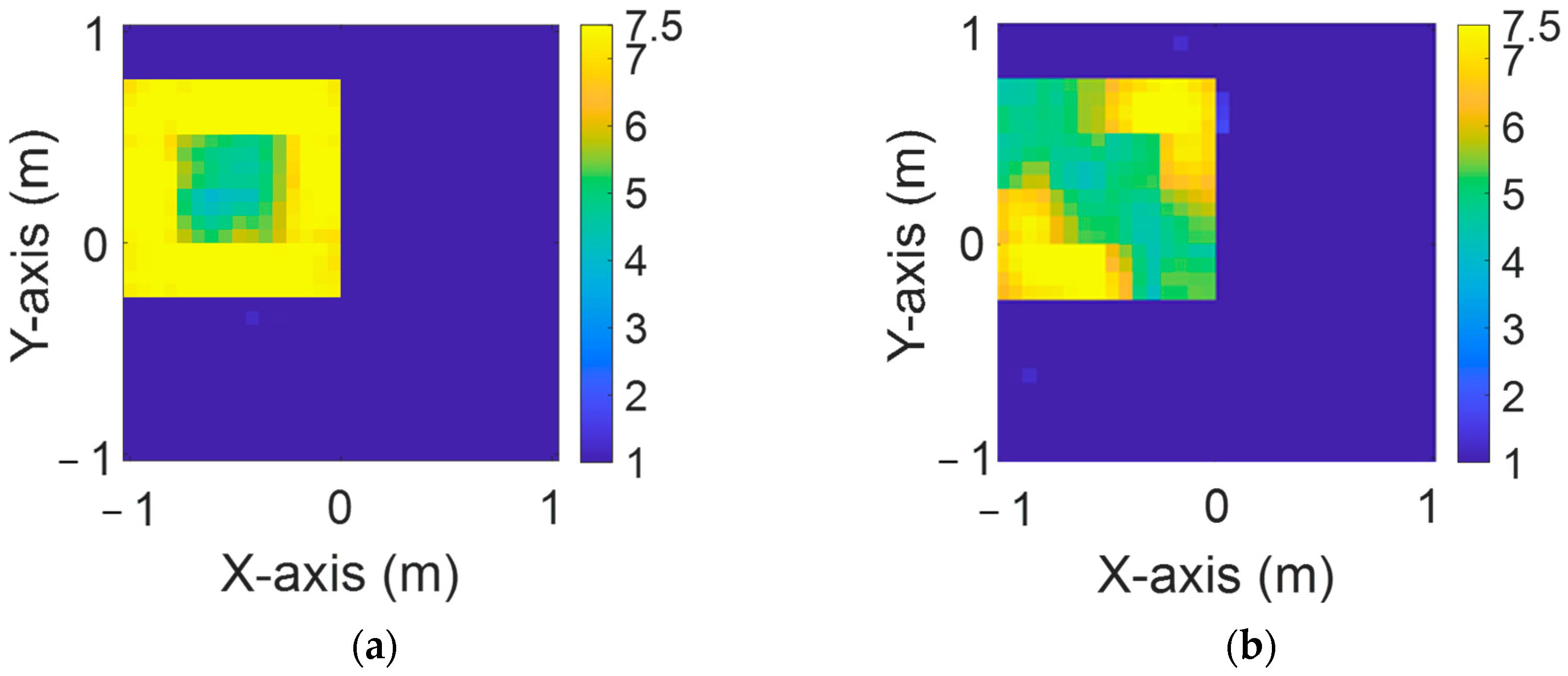
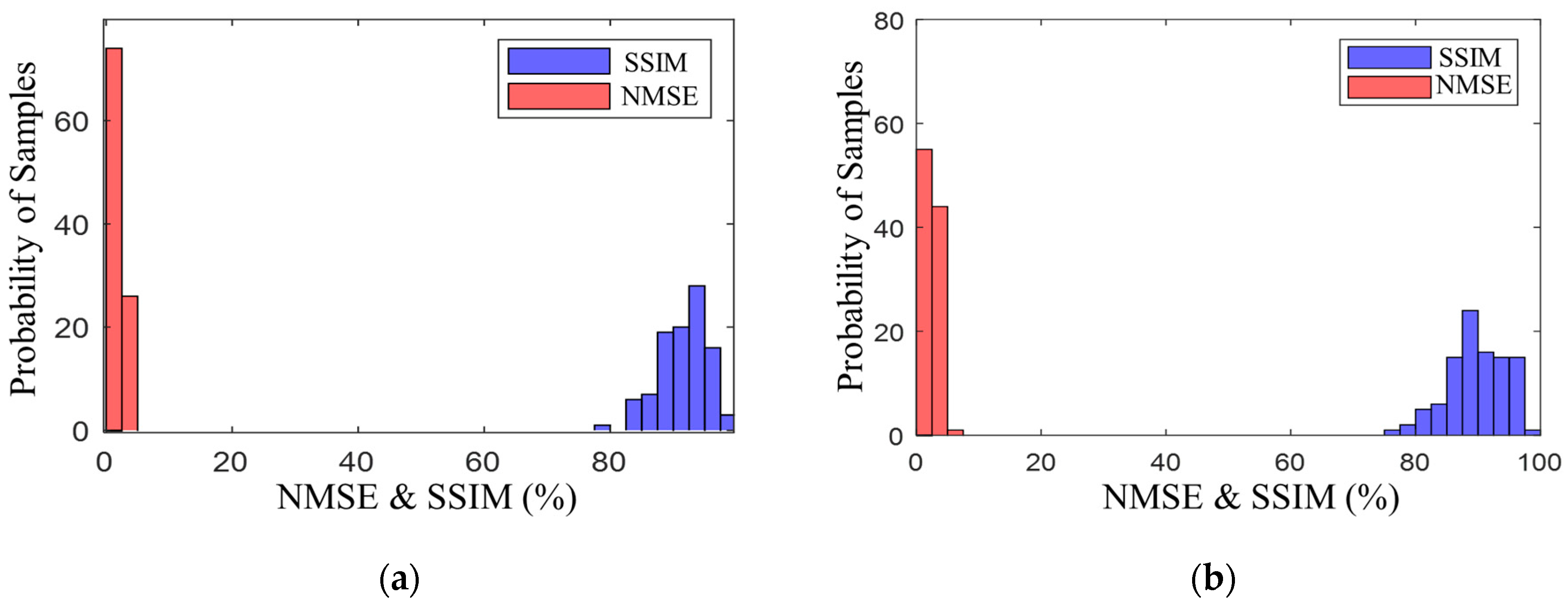
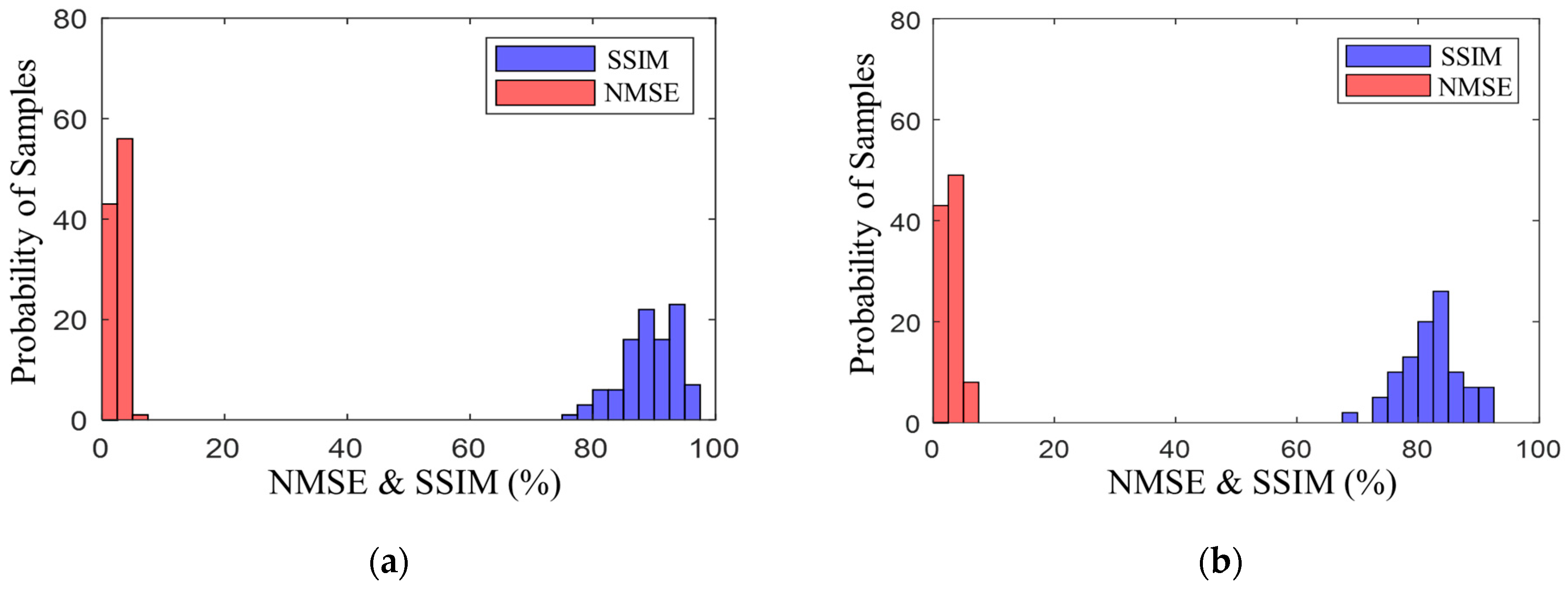
Figure 7a,b show the ground truth with relative permittivities ε z and ε x , respectively. The relative objects ε z and ε x obtained through the two-stage deep learning method with 5% noise are plotted in Figure 8a,b, respectively. The relative objects ε z and ε x obtained through the two-stage deep learning method with 20% noise are plotted in Figure 9a,b, respectively. Figure 8a,b and 9a,b are the images of the dielectric constants. The NMSE and SSIM reconstructed results for ε z and ε x with 5% noise, obtained via the proposed two-stage are shown in Figure 10a,b, respectively. Figure 11a,b show the NMSE and SSIM reconstructed results by the proposed two-stage approach of relative permittivities ε z and ε x with 20% noise, respectively. Figure 10 and Figure 11 demonstrate the noise immunity observed in the second stage of image reconstruction.
The final results for dielectric constant values between 1 and 7.5 under 5% and 20% noise, including the MSE in the first stage and the NMSE and SSIM in the second stage, are presented in Table 1 and Table 2, respectively.

4.2. Dielectric Constants Between 1 and 8

We plan to reconstruct the Modified National Institute of Standards and Technology database (MNIST) within the DOI. There are 1000 different ways to write the numbers 0 to 9. In the dataset, we randomly selected 6000 data items. We used 5000 data for training and 1000 data for testing in the paper.
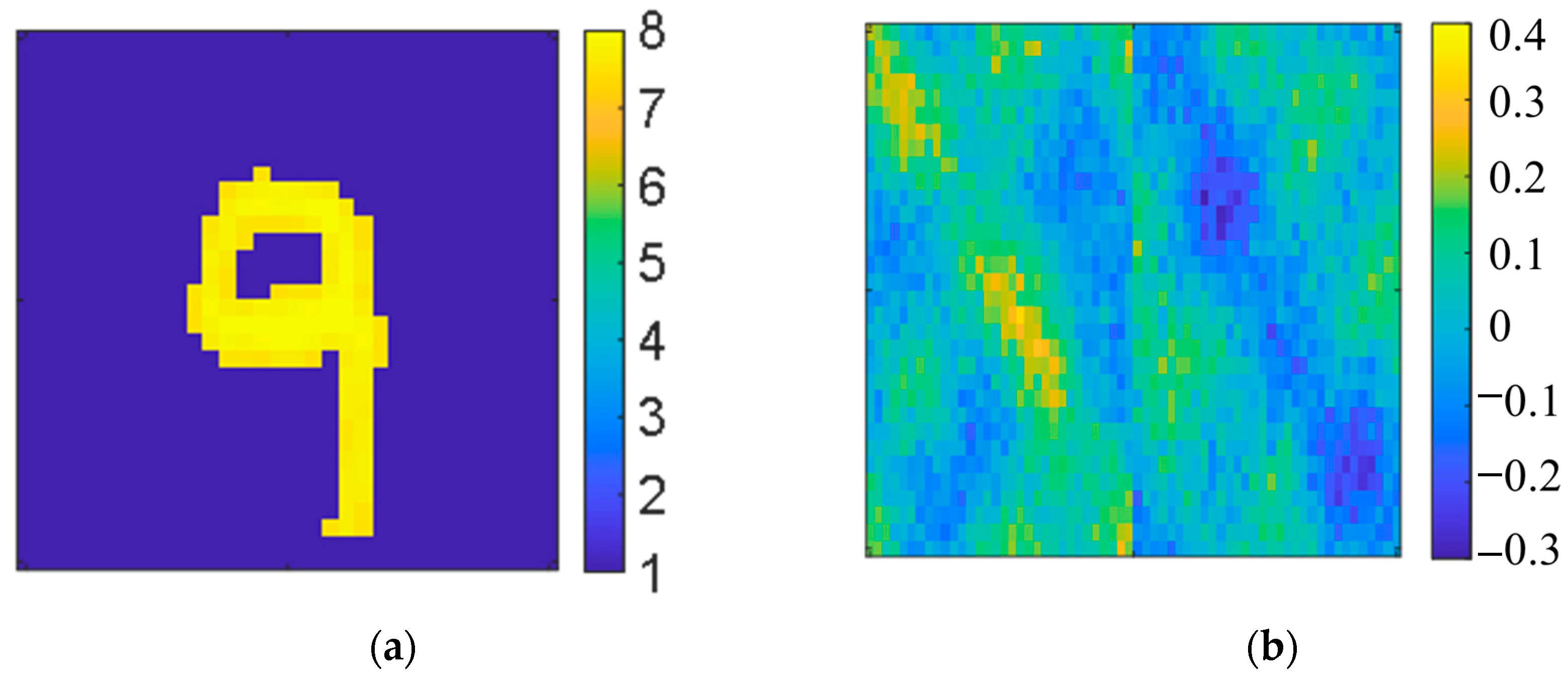
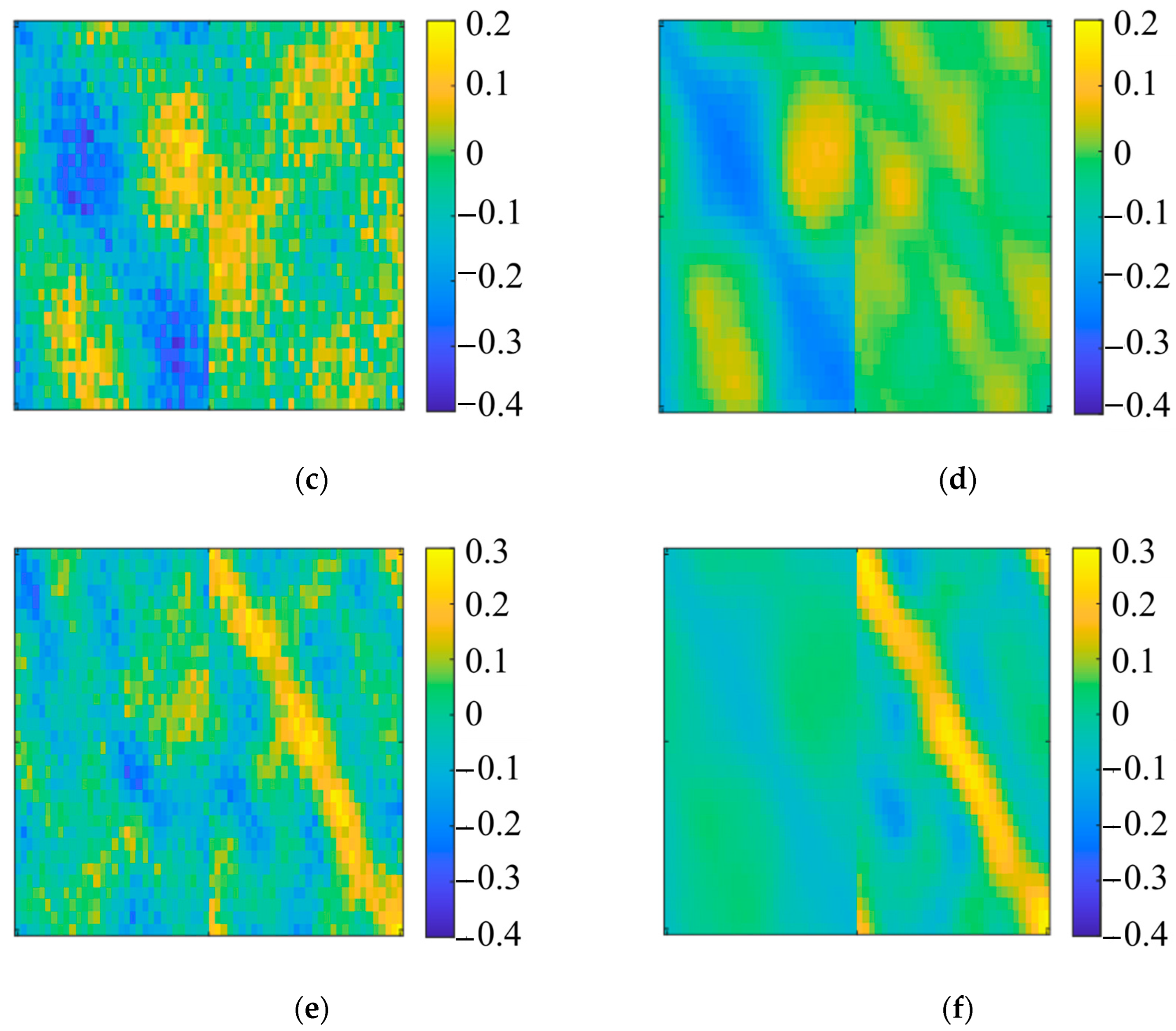
Figure 12 shows the scattered field based on MNIST with 5% noise and relative permittivity ε z : (a) A sample from the MNIST dataset; (b) the scattered field “image” at frequency f 0 generated from the sample in (a), with the real part shown on the left and the imaginary part on the right; (c) ground truth electrical data “image” in f 1 , in which the left and right show the real and imaginary parts, respectively; (d) the scattered field “image” at frequency f 1 generated from the sample in (a), with the real part shown on the left and the imaginary part on the right; (e) ground truth electrical data “image” in f 2 , in which the left and right show the real and imaginary parts, respectively; (f) the scattered field “image” at frequency f 2 generated from the sample in (a), with the real part shown on the left and the imaginary part on the right. Note that Figure 12 is not shown in a physical spatial coordinate system. The horizontal axis corresponds to the transmitter (Tx) index, and the vertical axis corresponds to the receiver (Rx) index.
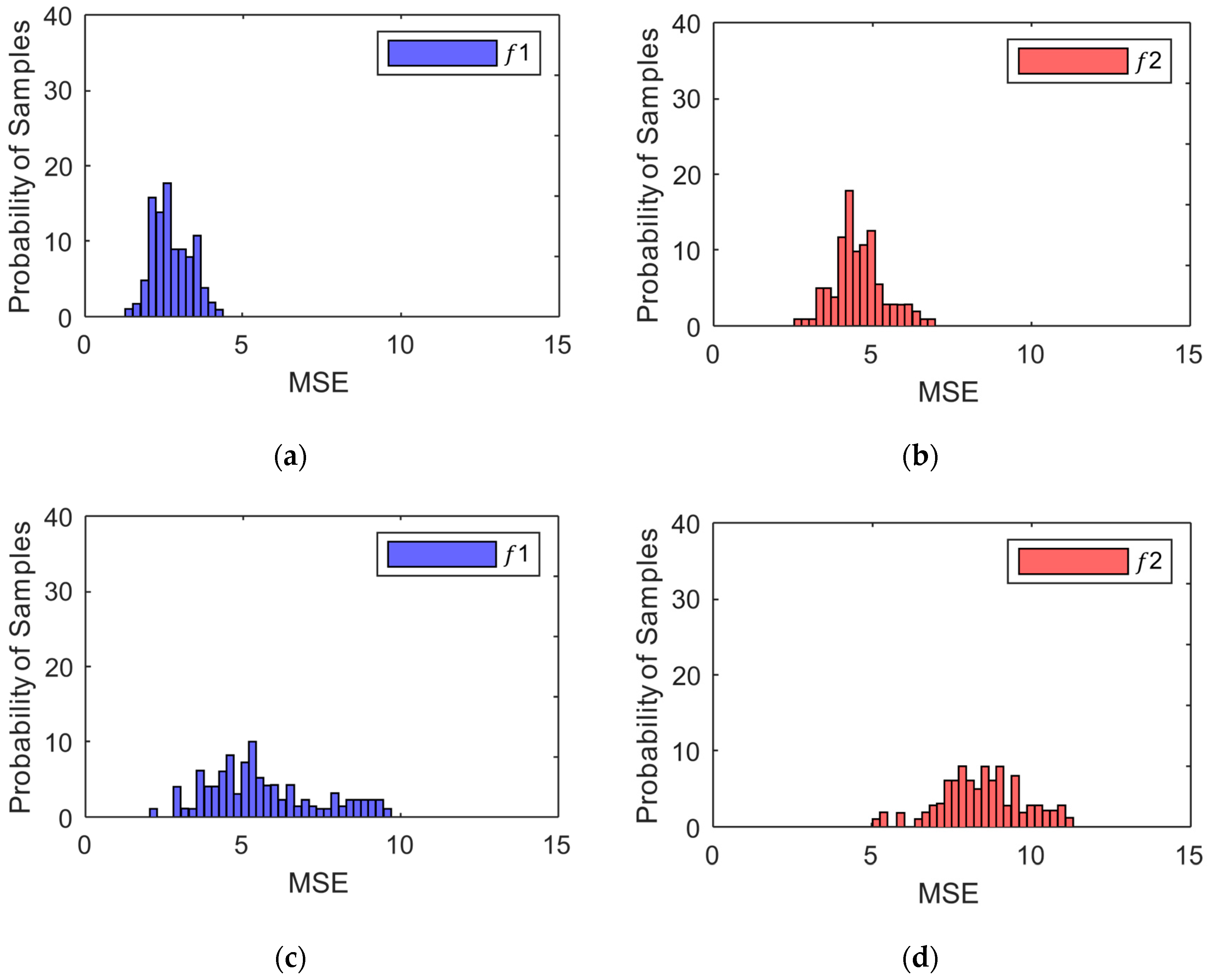
Figure 13a,b show the histograms for MSE of relative permittivity ε z at 5% noise for frequencies f 1 and f 2 , respectively. Figure 13c,d show the histograms for MSE of relative permittivity ε x at 5% noise for frequencies f 1 and f 2 , respectively. Figure 14a,b show the histograms for MSE of relative permittivity ε z at 20% noise for frequencies f 1 and f 2 , respectively. Figure 14c,d show the histograms for MSE of relative permittivity ε x at 20% noise for frequencies f 1 and f 2 , respectively. Figure 15a,b show the ground truth with relative permittivities ε z and ε x . In order to compare the proposed two-stage approach with other EMIS problem solvers, we use a frequency of 0.3 GHz.
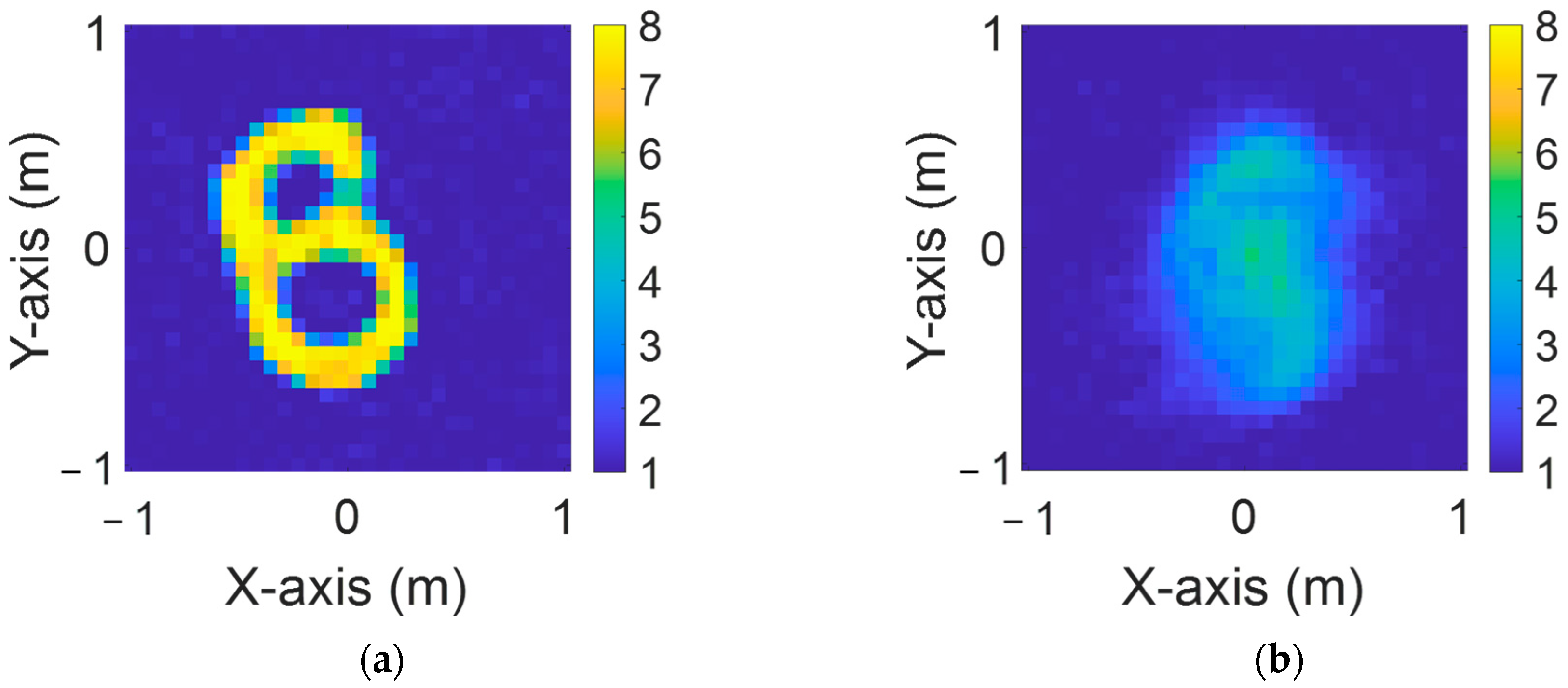
A single-frequency scattered field is used as an input into the second-stage network, as shown in Figure 16. Figure 16a,b show the dielectric constants ε z and ε x with 5% noise. As shown in Figure 17, DIS can roughly recover the target silhouette in the TM case; however, in the TE case, its reconstruction deteriorates substantially, with the target structure largely blurred and difficult to distinguish from the background.
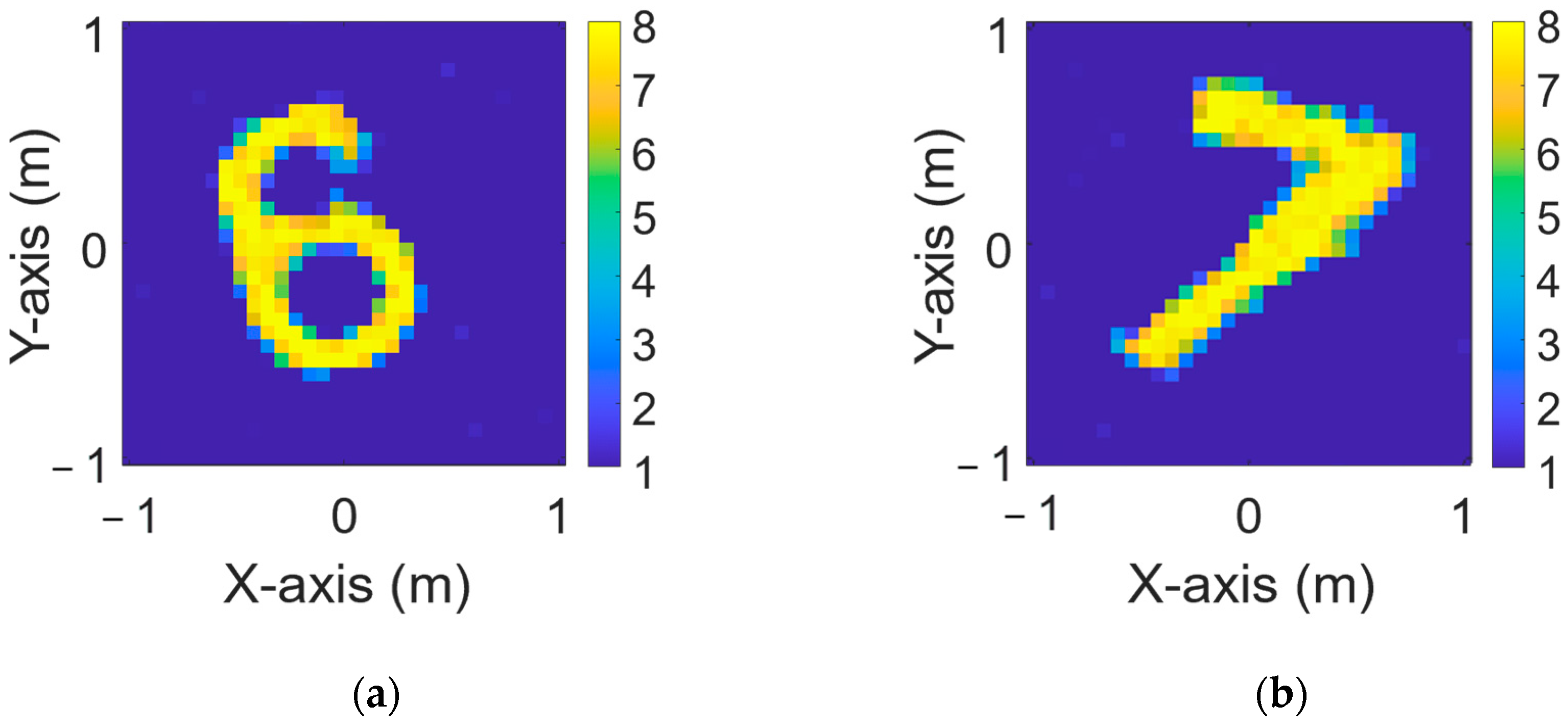
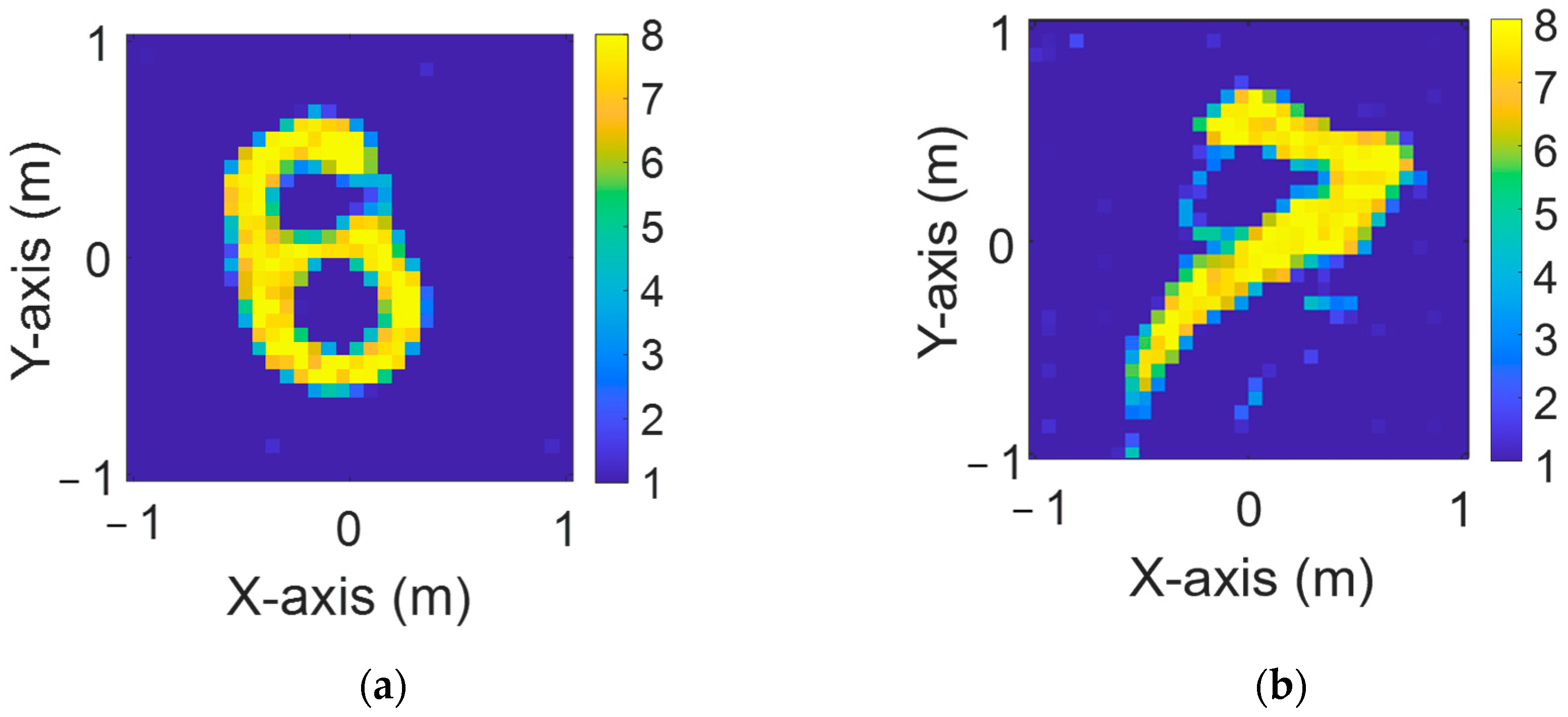
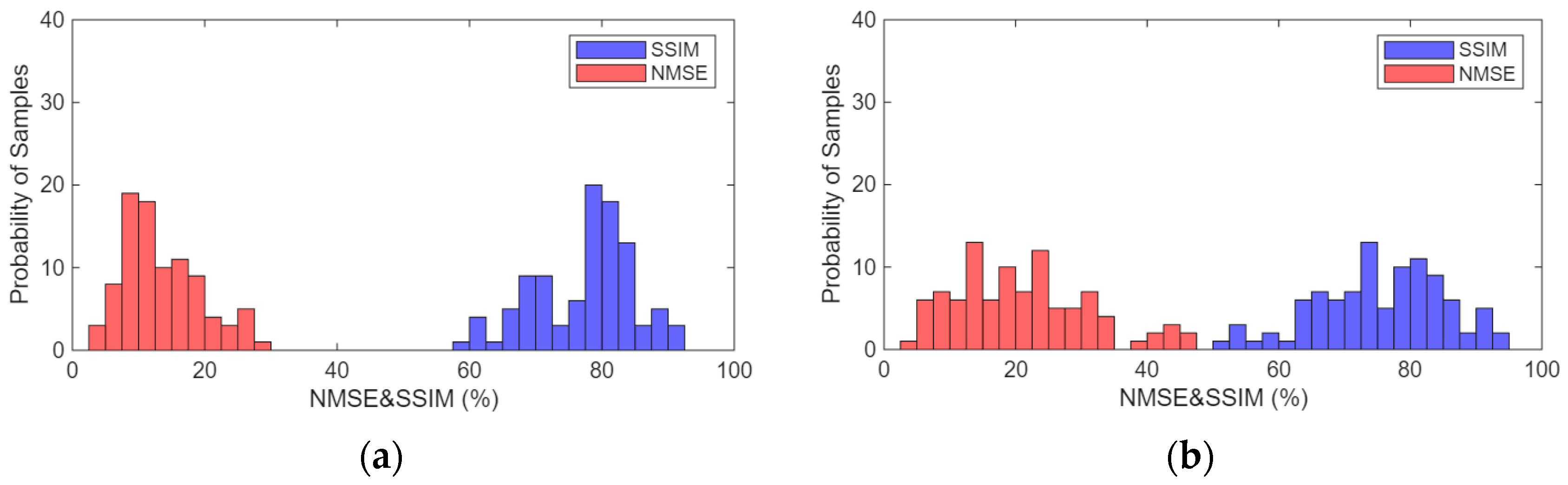
By comparing Figure 16a,b with Figure 18a,b, we observe that the performance of Figure 16a,b is not as good as that of the proposed two-stage method, although they are still recognizable. By comparing Figure 16a,b with Figure 18a,b, we observe that the performance of Figure 16a,b is not as good as that of the proposed two-stage method, although they are still recognizable. In addition, we conducted a quantitative baseline comparison against the Direct Inversion Scheme (DIS) using consistent evaluation metrics (e.g., NMSE and SSIM). Figure 18a,b and Figure 19a,b show that the images of the dielectric constants are well reconstructed. Figure 18a,b show the reconstructed relative objects ε z and ε x by the enhanced two-stage deep learning method with 5% noise. Figure 19a,b shows the reconstructed relative objects ε z and ε x by the enhanced two-stage deep learning method with 20% noise. The NMSE and SSIM reconstructed results for ε z and ε x with 5% noise, obtained via the proposed two-stage method, are shown in Figure 20a,b. The NMSE and SSIM reconstructed results for ε z and ε x   w i t h   5 %   n o i s e , obtained via the proposed two-stage method, are shown in Figure 21a,b. The reconstruction results of the MSE in the first stage and the NMSE and SSIM in the second stage are shown in Table 3 and Table 4, respectively. Table 3 shows the reconstruction results with 5% and 20% noise for first-stage relative permittivity from 1 to 8, and Table 4 shows the reconstruction results with 5% and 20% noise for second-stage relative permittivities from 1 to 8. It is seen that the enhanced two-stage deep learning approach proposed in this paper is still applicable, even in high relative permittivity distributions.
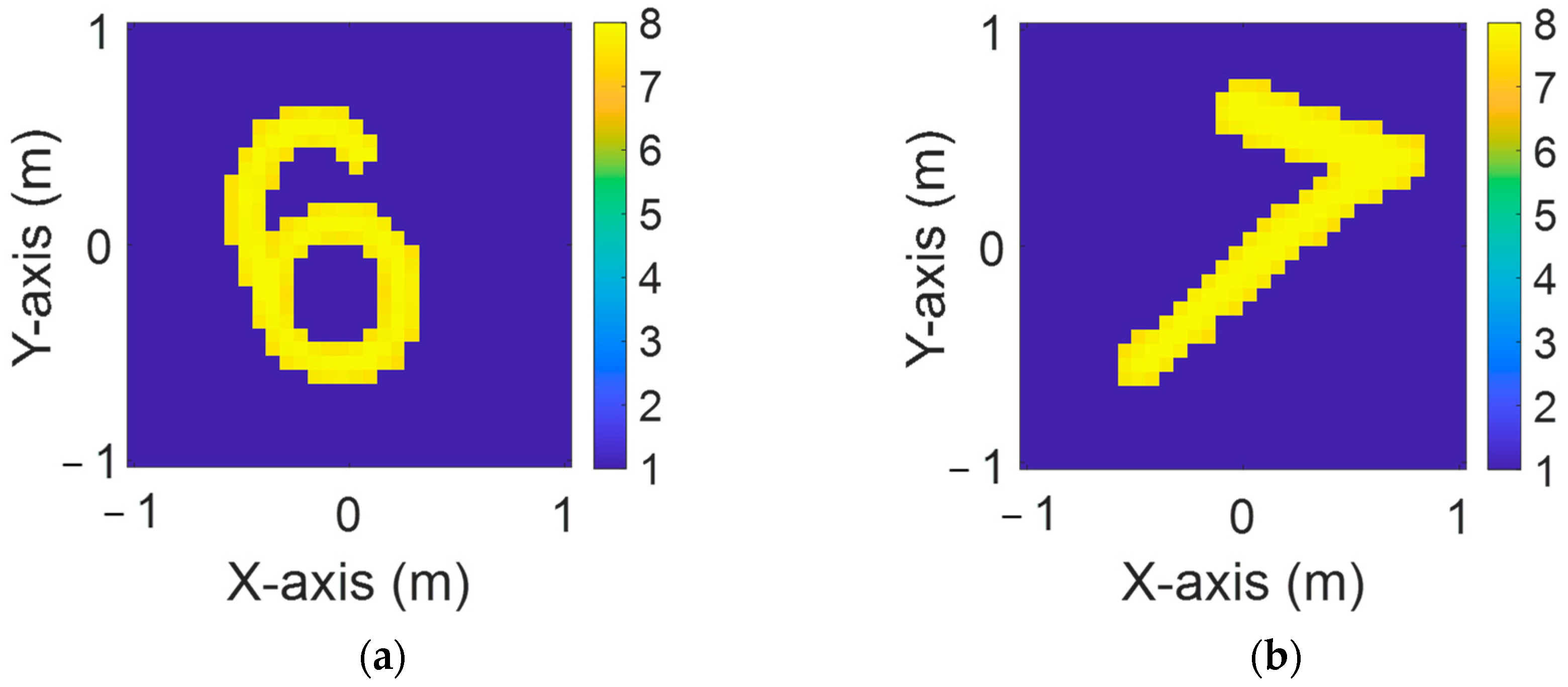
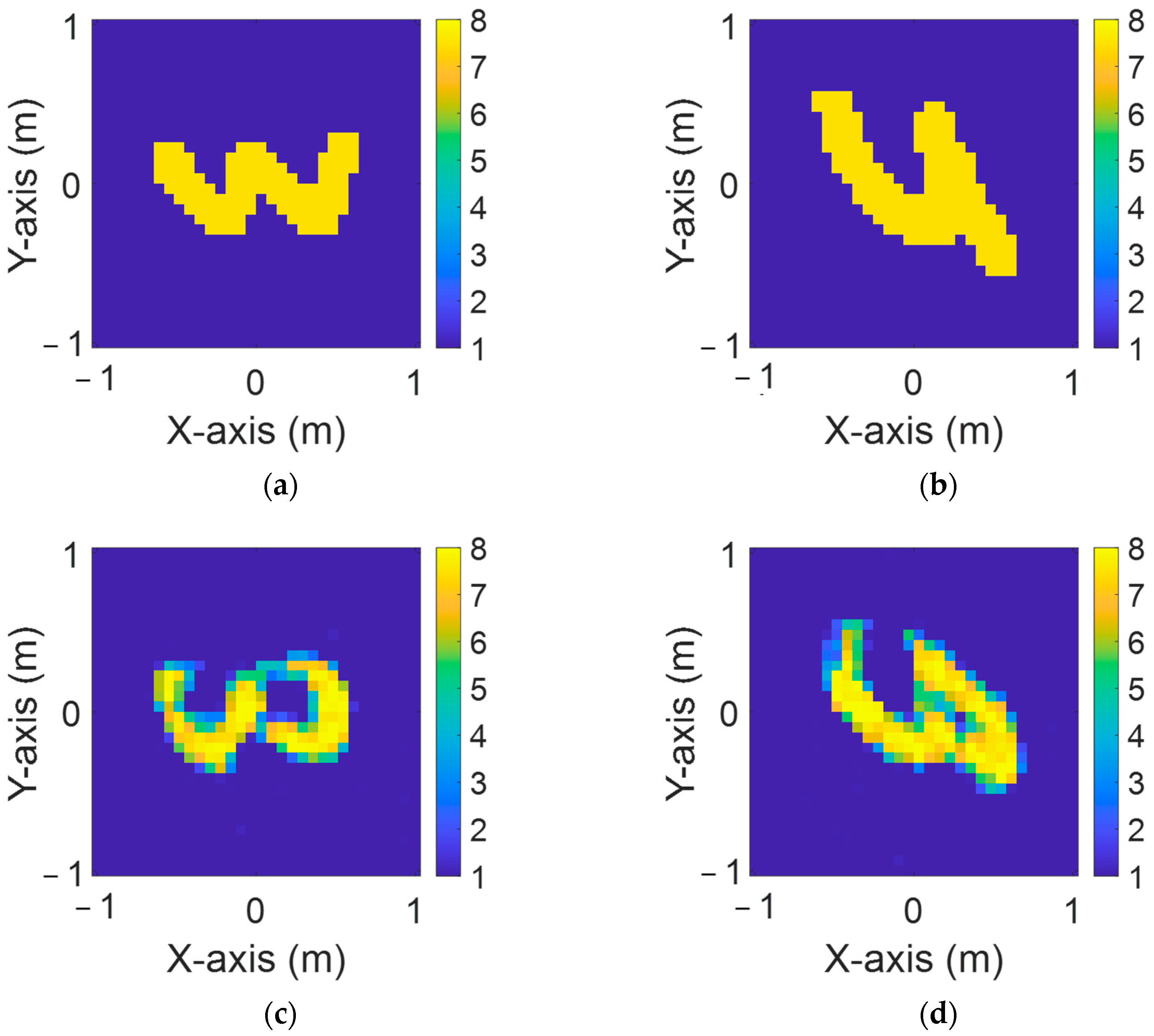
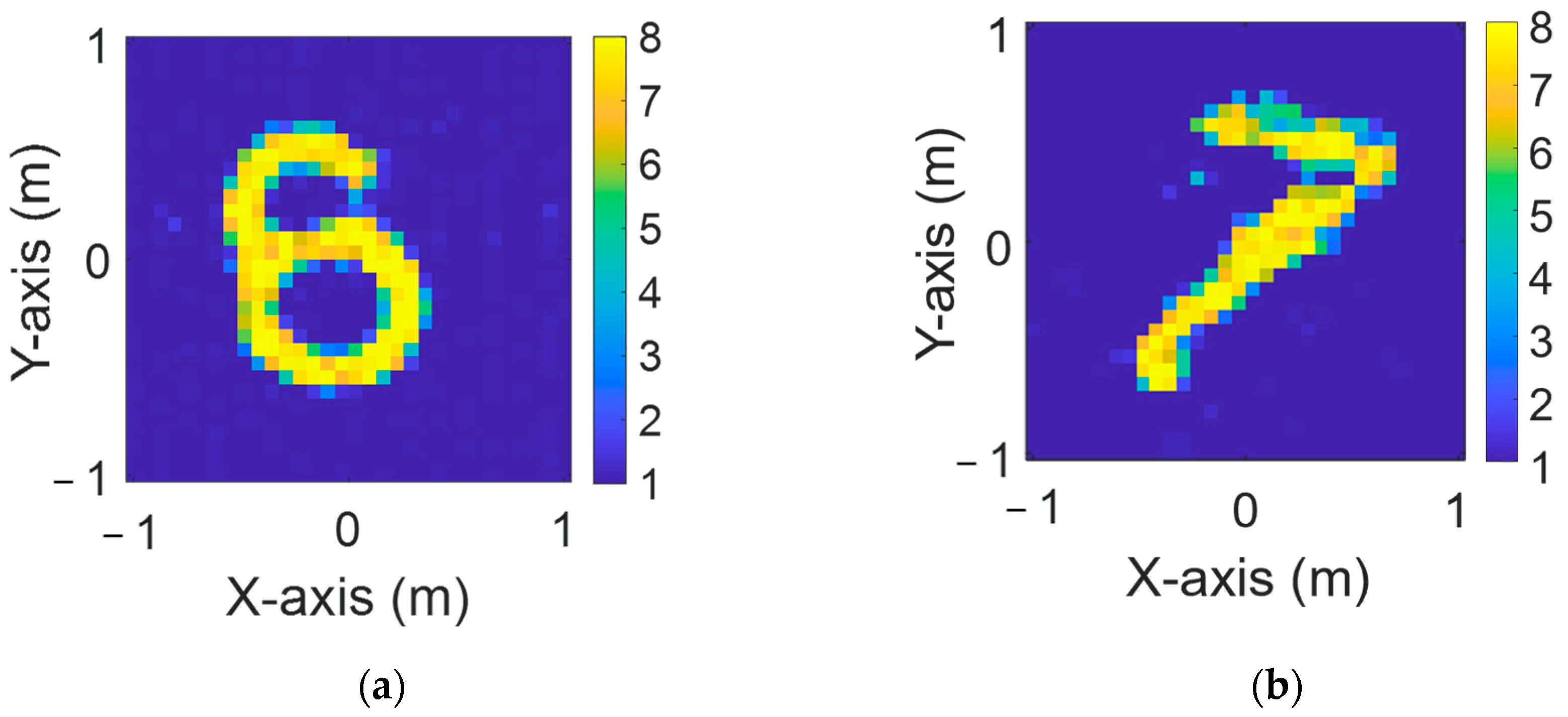
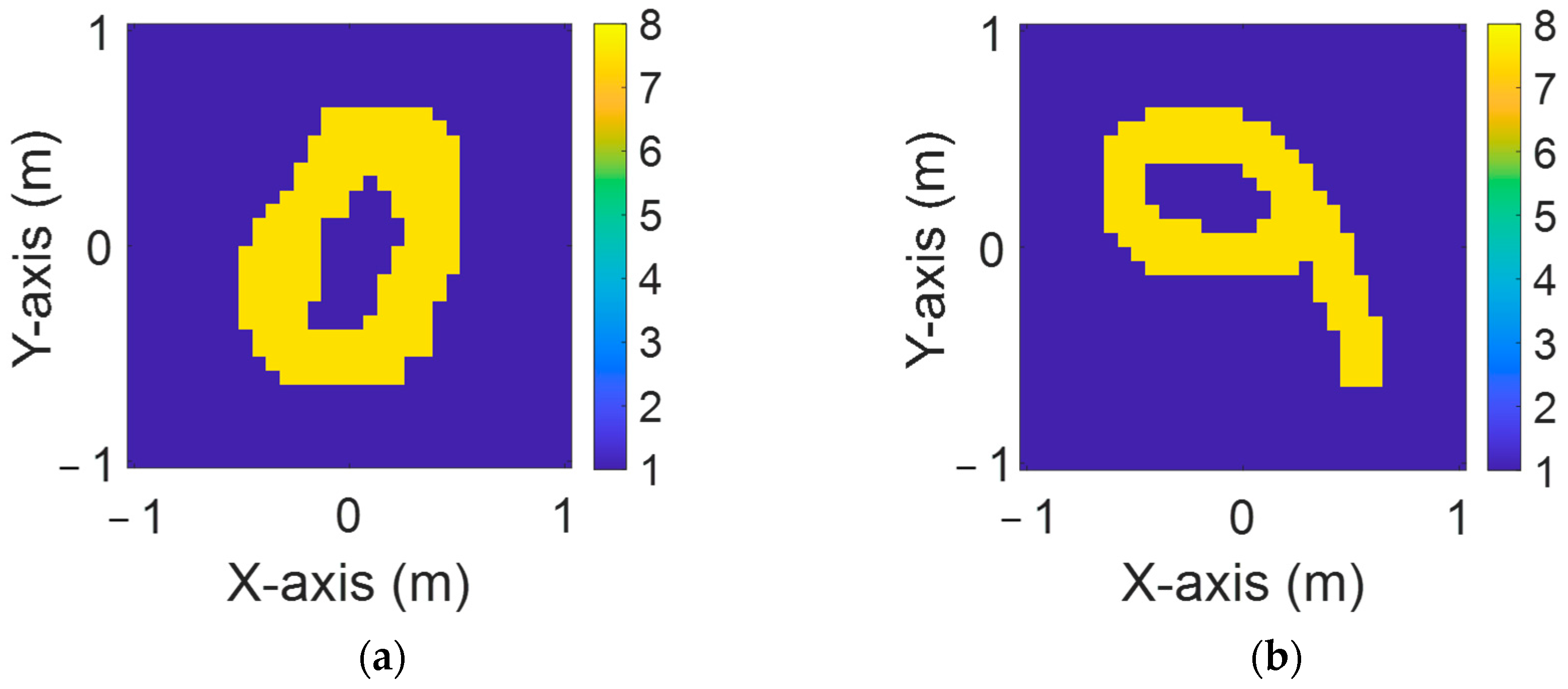
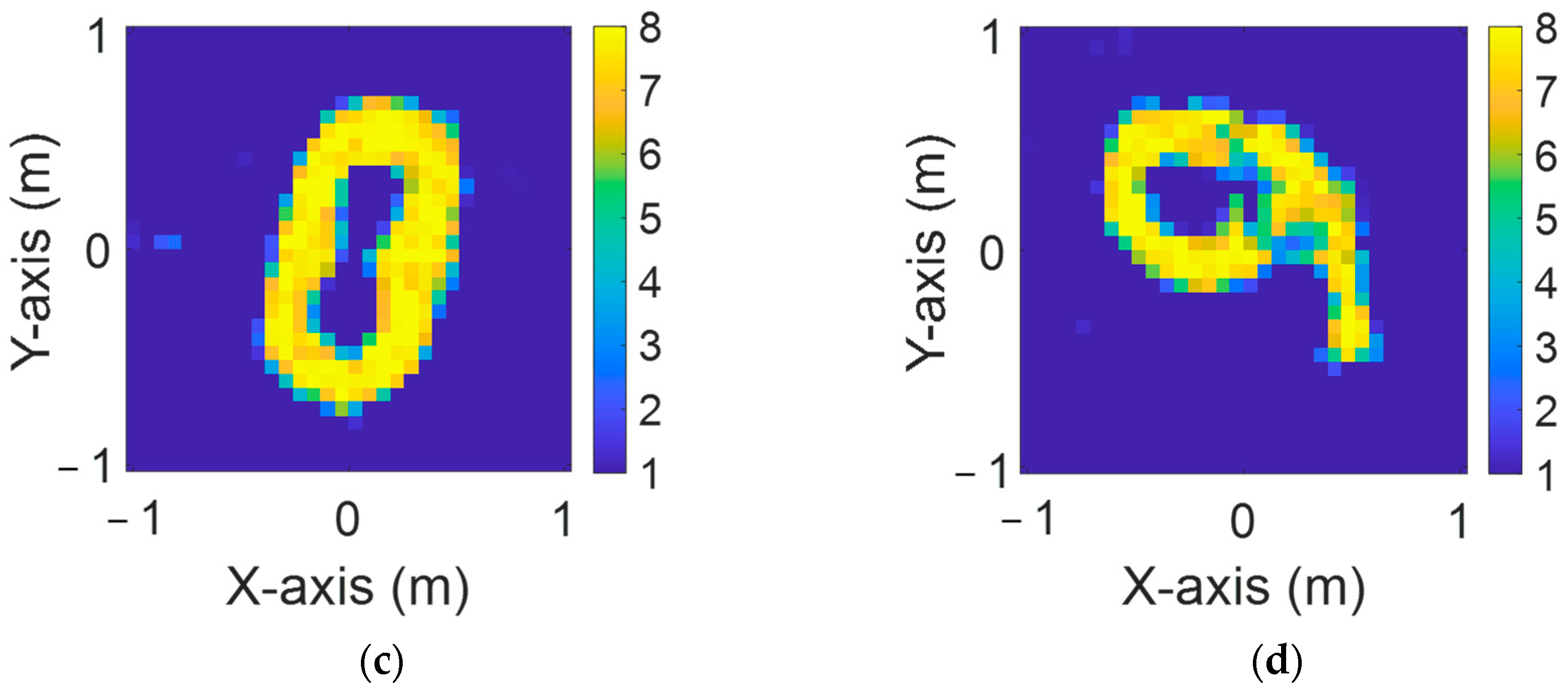
Figure 22 and Figure 23 show the ground truth and the comparison of the reconstruction results of the proposed method for TM with the exemplar of TE. We use the training results of scheme B to predict the different shapes, and despite the fact that the tested shapes are new and have high dielectric constants, our method can accurately reconstruct the shapes of the different letters, and the reconstruction results are in high agreement with the ground truth.
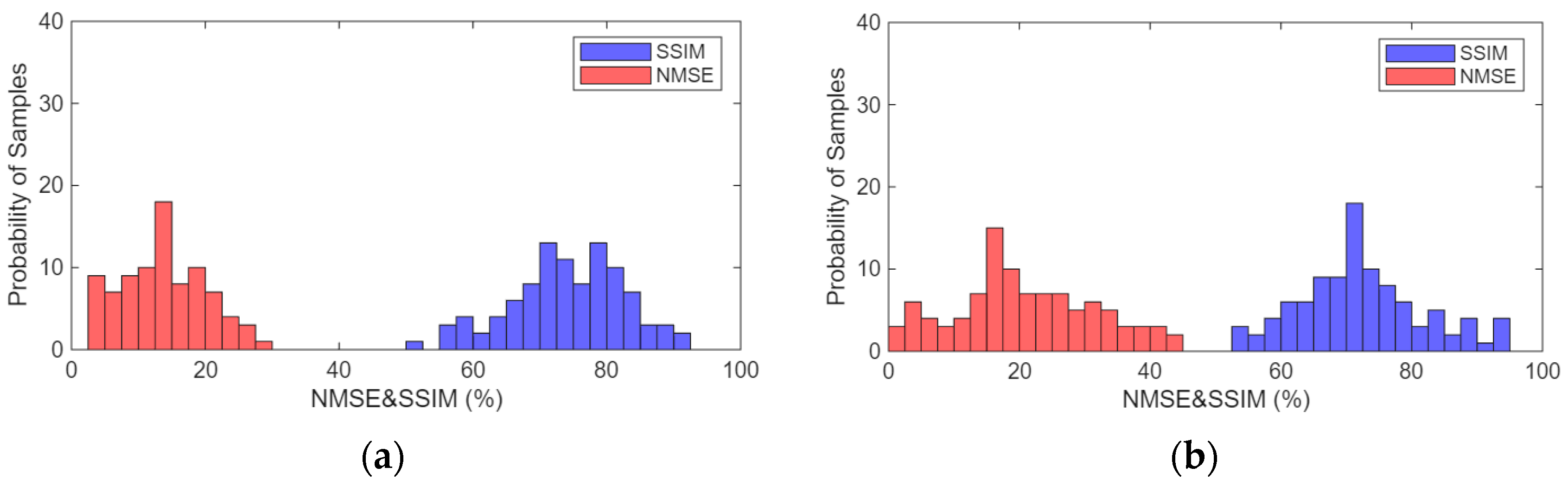
We randomly selected 500 objects in the “Letter” dataset as exact dielectric constants and reconstructed them with the proposed deep learning model. Then, we calculated the NMSE and SSIM between the reconstructed objects and the exact dielectric constants, and the results show that the average NMSE of the TM reconstructed images is about 18.23%, and the average SSIM reaches 69.5%, and the average NMSE of the TE reconstructed images is about 23.58%, and the average SSIM reaches 67.73%.

4.3. Relative Permittivities from 1 to 10

This case was conducted to further evaluate the model’s generalization capability. We utilized the model from Section 4.2 to assess the retrieved results for permittivity values beyond the range of 1 to 10. The reconstruction performance was viewed by randomly taking 1000 data strokes in MNIST.
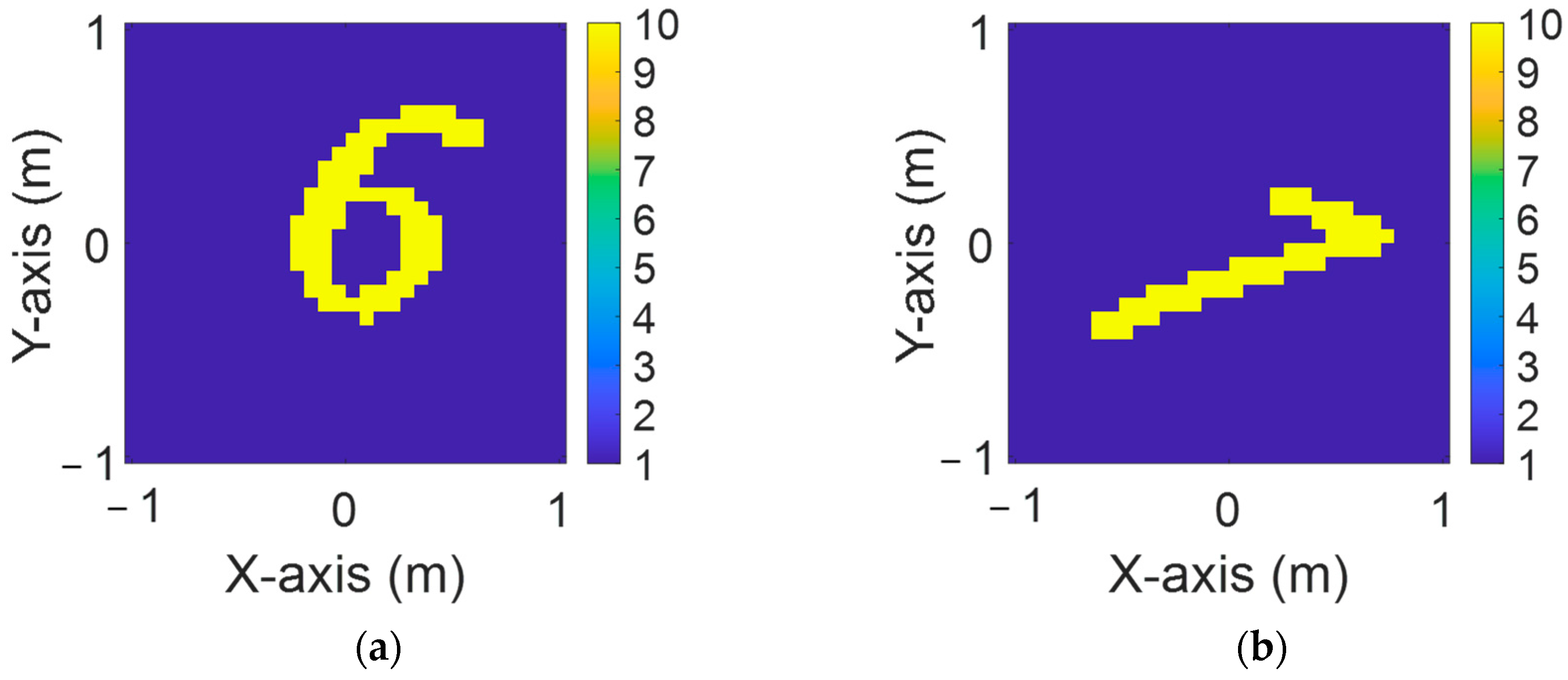
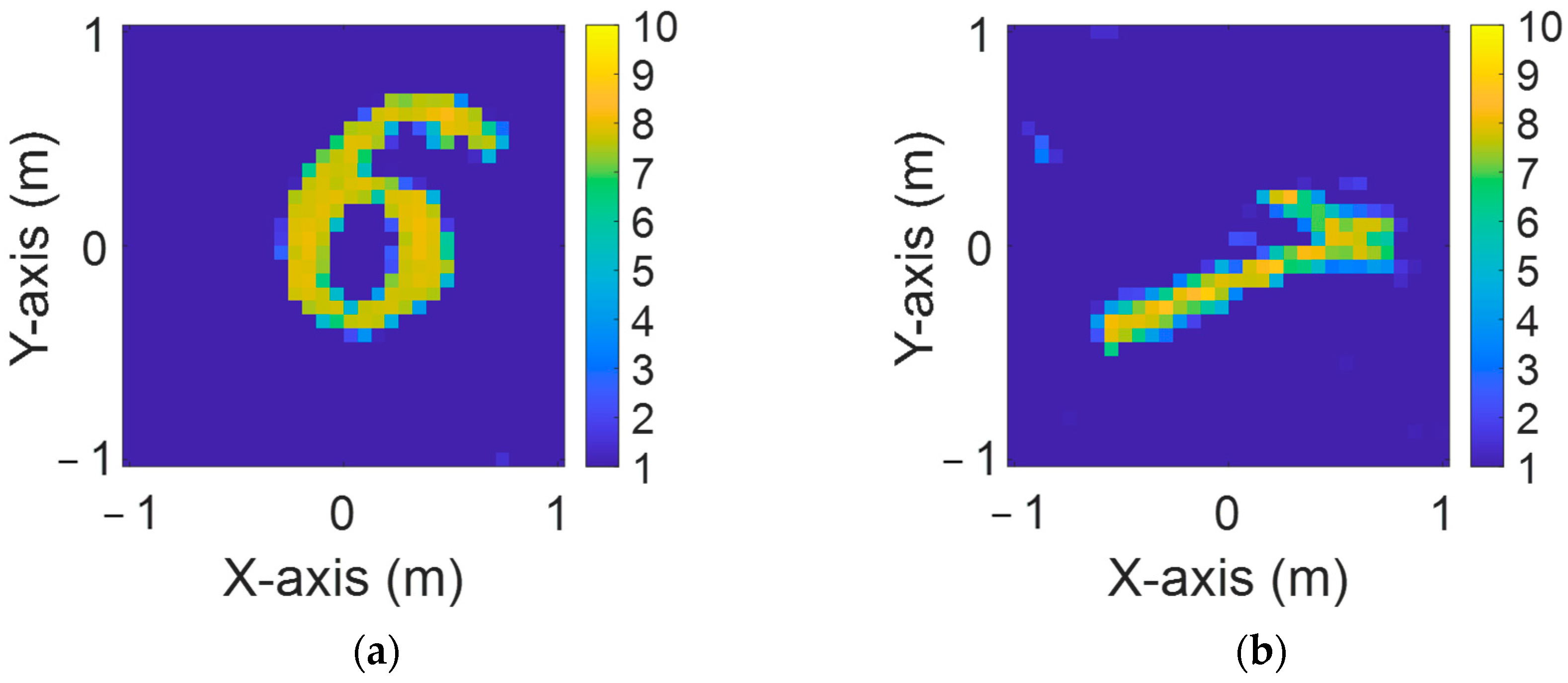
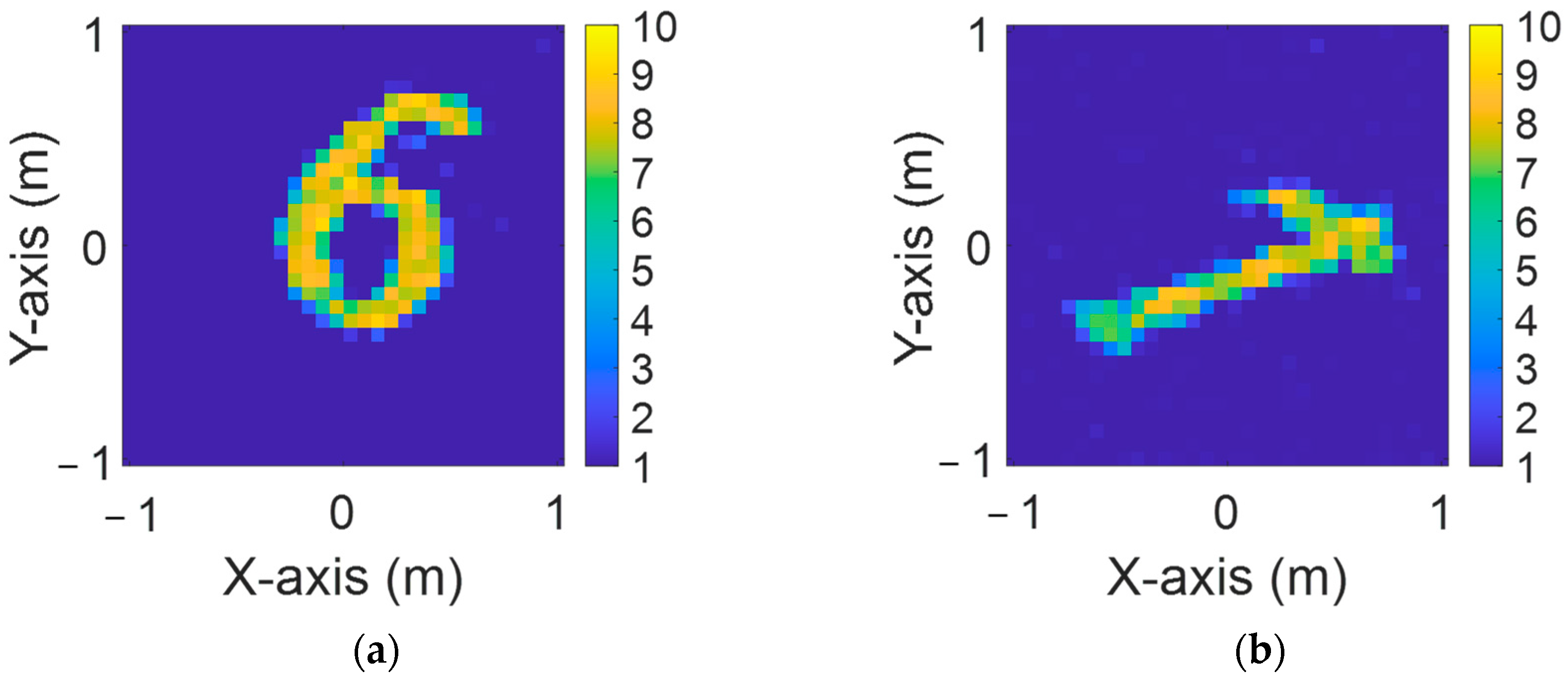
Figure 24a,b show the ground truth with relative permittivities ε z and ε x . Figure 25a,b show the objects ε z and ε x retrieved by the enhanced two-stage deep learning method with 5% noise. Figure 26a,b show the reconstructed relative objects ε z and ε x by the enhanced two-stage deep learning method with 20% noise. From the results, the enhanced two-stage deep learning method is capable of reconstructing the shape as well as the location of the object, regardless of the permittivity’s magnitude.
Experiments were conducted on a workstation with an Intel i7 CPU, 64 GB RAM, and an NVIDIA RTX 40 series GPU. Stage-I DRCNN completed in approximately 600 s with a peak memory usage of 5.43 GB, while Stage-II DCED took about 150 s with a peak memory of 4.57 GB.

5. Conclusions

Applying artificial intelligence with an enhanced two-stage technique was presented to deal with the electromagnetic inverse scattering problem. We transmitted TM and TE polarized waves in the target domain to obtain the single-frequency electrical data to input into the DRCNN so that multi-frequency data can be extrapolated subsequently to provide more information for reconstruction. The multi-frequency scattered field output from the DRCNN is then used as input to the DCED to reconstruct the real dielectric constants. Via this frequency extrapolation process, computing time can be saved. Numerical results indicate that the enhanced two-stage deep learning method is capable of locating as well as generating the shapes and materials, either despite the existence of very high Gaussian noise or high dielectric coefficients. Moreover, the proposed model also exhibits strong generalization ability. This research has the following limitations: the proposed method may degrade substantially when the test distribution is significantly more complex than the training distribution. In addition, when the number of measurements is too limited (e.g., too few transmitter/receiver views), the available information becomes insufficient, and the reconstruction quality can deteriorate markedly. In addition to these empirical findings, the developed two-stage deep learning framework demonstrates its effectiveness within the broader mathematical context of inverse scattering. The TM and TE anisotropic formulation inherently defines a nonlinear and ill-posed inverse operator, and the proposed frequency extrapolation strategy effectively enriches the data space without increasing measurement requirements. As a data-driven surrogate, the model approximates the underlying multi-frequency inverse mapping with notable stability, even in scenarios involving severe noise contamination and high-contrast dielectric distributions. These observations suggest that learning-based operator approximators may provide a viable pathway for addressing anisotropic inverse problems that remain challenging for traditional iterative, regularized solvers. Future investigations may further explore theoretical aspects such as stability bounds, generalization guarantees, and multi-physics extensions of the proposed operator learning framework.

Author Contributions

Conceptualization, H.J.; methodology, C.-C.C.; software, P.-H.C. and G.-J.L.; validation, W.-T.L.; formal analysis, P.-H.C.; investigation, G.-J.L.; resources, W.-T.L.; data curation, P.-H.C. and H.J.; writing—original draft preparation, G.-J.L.; writing—review and editing, C.-C.C.; visualization, H.J.; supervision, W.-T.L.; project administration, C.-C.C.; funding acquisition, W.-T.L. All authors have read and agreed to the published version of the manuscript.

Funding

This research was funded by National Science and Technology Council grant number 114-2221-E-032-034 and 114-2221-E-032-018.

Data Availability Statement

The original contributions presented in this study are included in the article. Further inquiries can be directed to the corresponding author.

Conflicts of Interest

The authors declare no conflict of interest.

References

  1. Gennarelli, G.; Ludeno, G.; Catapano, I.; Soldovieri, F. Full 3-D imaging of vertical structures via ground-penetrating radar. IEEE Trans. Geosci. Remote Sens. 2020, 58, 8857–8873. [Google Scholar] [CrossRef]
  2. Zhou, X.; Chen, Q.; Lyu, S.; Chen, H. Mapping the buried cable by ground penetrating radar and Gaussian-process regression. IEEE Trans. Geosci. Remote Sens. 2022, 60, 4509912. [Google Scholar] [CrossRef]
  3. Liu, H.; Zhao, C.; Zhu, J.; Ge, J.; Dong, H.; Liu, Z.; Mrad, N. Active detection of small UXO-like targets through measuring electromagnetic responses with a magneto-inductive sensor array. IEEE Sens. J. 2021, 21, 23558–23567. [Google Scholar] [CrossRef]
  4. Su, J.; Pellicer-Guridi, R.; Edwards, T.; Fuentes, M.; Rosen, M.S.; Vegh, V.; Reutens, D. A CNN-based software gradiometer for electromagnetic background noise reduction in low-field MRI applications. IEEE Trans. Med. Imaging 2022, 41, 1007–1016. [Google Scholar] [CrossRef]
  5. Umezu, G.; Yamauchi, Y.; Kidera, S. Contrast source inversion enhanced confocal imaging for highly heterogeneous breast media in microwave mammography. IEEE J. Electromagn. RF Microw. Med. Biol. 2022, 6, 494–500. [Google Scholar] [CrossRef]
  6. Zhou, H.; Narayanan, R.M. Microwave imaging of nonsparse object using dual-mesh method and iterative method with adaptive thresholding. IEEE Trans. Antennas Propag. 2019, 67, 504–512. [Google Scholar] [CrossRef]
  7. Wei, T.-F.; Wang, X.-H.; Wang, L.; Feng, Z.; Wang, B.-Z. Efficient Born iterative method for inverse scattering based on modified forward-solver. IEEE Access 2020, 8, 229101–229107. [Google Scholar] [CrossRef]
  8. Menshov, A.; Okhmatovski, V.I. Superlens enhanced 2-D microwave tomography with contrast source inversion method. IEEE Open J. Antennas Propag. 2021, 2, 453–463. [Google Scholar] [CrossRef]
  9. Morimoto, H.; Yamauchi, Y.; Kidera, S. Contrast source inversion-based multilayered object analysis for terahertz wave imaging. IEEE Geosci. Remote Sens. Lett. 2022, 19, 8018005. [Google Scholar] [CrossRef]
  10. Chen, X.; Zhang, L.; Gu, C.; Li, Z. Wideband Sherman–Morrison–Woodbury formula-based algorithm for electromagnetic scattering problems. IEEE Trans. Antennas Propag. 2023, 71, 5487–5492. [Google Scholar] [CrossRef]
  11. Wei, Z.; Chen, X. Deep-learning schemes for full-wave nonlinear inverse scattering problems. IEEE Trans. Geosci. Remote Sens. 2019, 57, 1849–1860. [Google Scholar] [CrossRef]
  12. Xiao, J.; Li, J.; Chen, Y.; Han, F.; Liu, Q.H. Fast electromagnetic inversion of inhomogeneous scatterers embedded in layered media by Born approximation and 3-D U-Net. IEEE Geosci. Remote Sens. Lett. 2020, 17, 1677–1681. [Google Scholar] [CrossRef]
  13. Ma, Z.; Xu, K.; Song, R.; Wang, C.-F.; Chen, X. Learning-based fast electromagnetic scattering solver through generative adversarial network. IEEE Trans. Antennas Propag. 2021, 69, 2194–2208. [Google Scholar] [CrossRef]
  14. Li, J.; Chen, Y.; Zhuo, J.; Han, F. 3-D voxel-based reconstruction of multiple objects buried in layered media by VBIM hybridized with unsupervised machine learning. IEEE Trans. Geosci. Remote Sens. 2022, 60, 2002212. [Google Scholar] [CrossRef]
  15. Zhang, H.H.; Yao, H.M.; Jiang, L.; Ng, M. Enhanced two-step deep-learning approach for electromagnetic inverse scattering problems: Frequency extrapolation and scatterer reconstruction. IEEE Trans. Antennas Propag. 2023, 71, 1662–1672. [Google Scholar] [CrossRef]
  16. Zhuo, J.; Ye, L.; Han, F.; Xiong, L.; Liu, Q.H. Multiparametric electromagnetic inversion of 3-D biaxial anisotropic objects embedded in layered uniaxial media using VBIM enhanced by structural consistency constraint. IEEE Trans. Antennas Propag. 2020, 68, 4774–4785. [Google Scholar] [CrossRef]
  17. Ye, X.; Du, N.; Yang, D.; Yuan, X.; Song, R.; Sun, S.; Fang, D. Application of generative adversarial network-based inversion algorithm in imaging 2-D lossy biaxial anisotropic scatterer. IEEE Trans. Antennas Propag. 2022, 70, 8262–8275. [Google Scholar] [CrossRef]
  18. Huang, R.; Wu, Q.; Han, F. 3-D EM scattering and inverse scattering by anisotropic objects straddling multiple planar uniaxial layers with a 2-D locally rough surface. IEEE Trans. Antennas Propag. 2023, 71, 8936–8948. [Google Scholar] [CrossRef]
  19. Chiu, C.-C.; Chen, P.-H.; Shih, Y.-C.; Lim, E.-H. An enhanced deep learning scheme for electromagnetic imaging of uniaxial objects. IEEE Trans. Microw. Theory Tech. 2023. Early Access. [Google Scholar] [CrossRef]
  20. Chiu, C.-C.; Chen, P.-H.; Jiang, H. Electromagnetic imaging of uniaxial objects by artificial intelligence technology. IEEE Trans. Geosci. Remote Sens. 2022, 60, 2008414. [Google Scholar] [CrossRef]
  21. Yao, H.M.; Sha, W.E.I.; Jiang, L. Two-step enhanced deep learning approach for electromagnetic inverse scattering problems. IEEE Antennas Wirel. Propag. Lett. 2019, 18, 2254–2258. [Google Scholar] [CrossRef]
Figure 1. Sensing and reconstruction framework.
Mathematics 14 00362 g001
Figure 2. Typical schematic of EMIS in free space.
Mathematics 14 00362 g002
Figure 3. Deep residual convolutional neural network.
Mathematics 14 00362 g003
Figure 4. Deep convolutional encoder–decoder.
Mathematics 14 00362 g004
Figure 5. Histograms for MSE of relative permittivities ε z and ε x at 5% noise for frequencies f 1 and f 2 , respectively. (a) ε z for f 1 . (b) ε z for f 2 . (c) ε x and ε y for f 1 . (d) ε x and ε y for f 2 .
Mathematics 14 00362 g005
Figure 6. Histograms for MSE of relative permittivities ε z and ε x at 20% noise for frequencies f 1 and f 2 , respectively. (a) ε z for f 1 . (b) ε z for f 2 . (c) ε x and ε y for f 1 . (d) ε x and ε y for f 2 .
Mathematics 14 00362 g006aMathematics 14 00362 g006b
Figure 7. Ground truth of relative permittivity (a) ε z ( r ¯ ) . (b) ε x ( r ¯ ) and ε y ( r ¯ ) .
Mathematics 14 00362 g007
Figure 8. Reconstruction by the enhanced two-stage deep learning method under 5% noise. (a) ε z ( r ¯ ) . (b) ε x ( r ¯ ) and ε y ( r ¯ ) .
Mathematics 14 00362 g008
Figure 9. Reconstruction by the enhanced two-stage deep learning method under 20% noise. (a) ε z ( r ¯ ) . (b) ε x ( r ¯ ) and ε y ( r ¯ ) .
Mathematics 14 00362 g009
Figure 10. NMSE and SSIM reconstructed results by the proposed two-stage approach with 5% noise. (a) ε z ( r ¯ ) . (b) ε x ( r ¯ ) and ε y ( r ¯ ) .
Mathematics 14 00362 g010
Figure 11. NMSE and SSIM reconstructed results by the proposed two-stage approach under 20% noise. (a) ε z ( r ¯ ) . (b) ε x ( r ¯ ) and ε y ( r ¯ ) .
Mathematics 14 00362 g011
Figure 12. Scattered field based on MNIST with 5% noise and relative permittivity ε z : (a) one sample of MNIST; (b) electrical data “image” in f 0 , with the real part shown on the left and the imaginary part on the right; (c) ground truth electrical data “image” in f 1 , with the real part shown on the left and the imaginary part on the right; (d) extrapolated electrical data “image” in f 1 , with the real part shown on the left and the imaginary part on the right; (e) ground truth electrical data “image” in f 2 , with the real part shown on the left and the imaginary part on the right; (f) extrapolated electrical data “image” in f 2 , with the real part shown on the left and the imaginary part on the right.
Mathematics 14 00362 g012aMathematics 14 00362 g012b
Figure 13. Histograms for MSE of relative permittivities ε z and ε x at 5% noise for frequencies f 1 and f 2 , respectively. (a) ε z ( r ¯ ) for f 1 . (b) ε z ( r ¯ ) for f 2 . (c) ε x ( r ¯ ) and ε y for f 1 . (d) ε x ( r ¯ ) and ε y ( r ¯ ) for f 2 .
Mathematics 14 00362 g013aMathematics 14 00362 g013b
Figure 14. Histograms for MSE of relative permittivities ε z and ε x at 20% noise for frequencies f 1 and f 2 , respectively. (a) ε z ( r ¯ ) for f 1 . (b) ε z ( r ¯ ) for f 2 . (c) ε x ( r ¯ ) and ε y ( r ¯ ) for f 1 . (d) ε x ( r ¯ ) and ε y ( r ¯ ) for f 2 .
Mathematics 14 00362 g014
Figure 15. Ground truth with relative permittivity. (a) ε z ( r ¯ ) . (b) ε x ( r ¯ ) and ε y ( r ¯ ) .
Mathematics 14 00362 g015
Figure 16. Reconstruction results by the single-frequency scattered field with 5% noise. (a) ε z ( r ¯ ) . (b) ε x ( r ¯ ) and ε y ( r ¯ ) .
Mathematics 14 00362 g016
Figure 17. Reconstruction results by DIS with 5% noise. (a) ε z ( r ¯ ) . (b) ε x ( r ¯ ) and ε y ( r ¯ ) .
Mathematics 14 00362 g017
Figure 18. Reconstruction results by the enhanced two-stage deep learning method under 5% noise. (a) ε z ( r ¯ ) . (b) ε x ( r ¯ ) and ε y ( r ¯ ) .
Mathematics 14 00362 g018
Figure 19. Reconstruction results by the enhanced two-stage deep learning method under 20% noise. (a) ε z ( r ¯ ) . (b) ε x ( r ¯ ) and ε y ( r ¯ ) .
Mathematics 14 00362 g019
Figure 20. NMSE and SSIM reconstructed results from the proposed two-stage approach under 5% noise. (a) ε z ( r ¯ ) . (b) ε x ( r ¯ ) and ε y ( r ¯ ) .
Mathematics 14 00362 g020
Figure 21. NMSE and SSIM reconstructed results from the proposed two-stage approach under 20% noise. (a) ε z ( r ¯ ) . (b) ε x ( r ¯ ) and ε y ( r ¯ ) .
Mathematics 14 00362 g021
Figure 22. Analysis of the results of 5% noise reconstruction relative permittivity of ε z ( r ¯ ) by the proposed method. (a) Ground truth of letter-shaped ‘o’. (b) Ground truth of letter-shaped ‘q’. (c) Reconstructed relative permittivity of ‘o’. (d) Reconstructed relative permittivity of ‘q’.
Mathematics 14 00362 g022aMathematics 14 00362 g022b
Figure 23. Analysis of the results of 5% noise reconstruction relative permittivities of ε x ( r ¯ ) and ε y ( r ¯ ) by the proposed method. (a) Ground truth of letter-shaped ‘w’. (b) Ground truth of letter-shaped ‘u’. (c) Reconstructed relative permittivity of ‘w’. (d) Reconstructed relative permittivity of ‘u’.
Mathematics 14 00362 g023
Figure 24. Ground truth. (a) ε z ( r ¯ ) . (b) ε x ( r ¯ ) and ε y ( r ¯ ) .
Mathematics 14 00362 g024
Figure 25. Reconstruction results from 1 to 10 by the enhanced two-stage deep learning method under 5% noise. (a) ε z ( r ¯ ) . (b) ε x ( r ¯ ) and ε y   r ¯ .
Mathematics 14 00362 g025
Figure 26. Reconstruction results from 1 to 10 by the enhanced two-stage deep learning method under 20% noise. (a) ε z ( r ¯ ) . (b) ε x ( r ¯ ) and ε y ( r ¯ ) .
Mathematics 14 00362 g026
Table 1. Reconstruction results with 5% and 20% noise for first-stage relative permittivities from 1 to 7.5.
Reconstruction5% Noise20% Noise
Performance MSE   of   f 1 MSE   of   f 2 MSE   of   f 1 MSE   of   f 2
TM0.57%0.71%0.78%1.09%
TE0.45%0.29%0.56%0.54%
Table 2. Reconstruction results with 5% and 20% noise for second-stage relative permittivities from 1 to 7.5.
Reconstruction5% Noise20% Noise
Performance NMSESSIMNMSESSIM
ε z 1.75%91.76%1.96%91.72%
ε x ,   ε y 1.93%91.48%1.96%85.08%
Table 3. Reconstruction results with 5% and 20% noise for first-stage relative permittivities from 1 to 8.
Reconstruction5% Noise20% Noise
Performance MSE   of   f 1 MSE   of   f 2 MSE   of   f 1 MSE   of   f 2
TM0.13%0.35%0.27%0.46%
TE0.41%0.70%0.62%0.88%
Table 4. Reconstruction results with 5% and 20% noise for second-stage relative permittivities from 1 to 8.
Reconstruction5% Noise20% Noise
Performance NMSESSIMNMSESSIM
ε z 16.75%75.73%17.56%72.69%
ε x ,   ε y 21.60%72.27%23.81%69.66%
Disclaimer/Publisher’s Note: The statements, opinions and data contained in all publications are solely those of the individual author(s) and contributor(s) and not of MDPI and/or the editor(s). MDPI and/or the editor(s) disclaim responsibility for any injury to people or property resulting from any ideas, methods, instructions or products referred to in the content.