


Abstract
The adaptive event-triggered fault-tolerant control problem for bidirectional consensus of multi-agent systems (MASs) subject to sensor faults and external disturbances is investigated. A hierarchical algorithm is first introduced to eliminate the dependence on Laplacian matrix information, thereby reducing computational complexity. Subsequently, a disturbance observer (DO) and a compensation signal were constructed to accommodate external disturbances, filtering errors, and approximation errors introduced by the radial basis function neural network (RBFNN). Compared with the absence of a disturbance observer, the tracking performance was improved by . In addition, a switching event-triggered mechanism is considered, in which the advantages of fixed-time triggering and relative triggering are integrated to balance communication frequency and tracking performance. Finally, the boundedness of all signals under the proposed fault-tolerant control (FTC) scheme is established. It has been clearly demonstrated by the simulation results that the proposed mechanism achieves a reduction in triggering frequency relative to the FT scheme, while simultaneously yielding a enhancement in tracking performance compared with the RT scheme, thereby highlighting its superior efficiency and effectiveness.
Keywords:
bidirectional consensus; disturbance observer; event-triggered; fault-tolerant control; sensor faults MSC:
93D05
1. Introduction
With the advancement of modern industrial machinery, the consensus problem in MASs has become one of the central research topics in cooperative control, with broad applications in robotic networks, unmanned aerial vehicle formations [1], sensor networks [2], and related areas [3,4]. In practical engineering scenarios, communication topology often involves asymmetric weights and adversarial interaction patterns, thereby giving rise to bidirectional consensus challenges [5,6]. For instance, ref. [7] proposed resilient consensus algorithms capable of mitigating the influence of mobile malicious agents on directed graphs, effectively ensuring convergence despite non-symmetric and adversarial interactions. Ref. [8] developed dynamic event-triggered bidirectional consensus protocols for nonlinear MASs over signed networks, demonstrating that efficient convergence can be achieved while reducing communication overhead. Furthermore, ref. [9] developed a differentially private bidirectional consensus algorithm over signed networks by injecting time-varying noise and carefully tuning step-sizes, showing that MASs can achieve mean-square and almost-sure convergence while preserving a predefined differential-privacy level. Unbalanced and switching topologies may further introduce more complex cooperative dynamics and stability challenges. Therefore, the development of a bidirectional consensus control framework under asymmetric topology with switching behavior possesses significant theoretical importance as well as broad practical value.
Meanwhile, from an engineering implementation perspective, the system is often subjected to external disturbances and unknown faults during the dynamic modeling process. In recent years, DOs have been widely employed in adaptive and robust control to enable real-time estimation of unknown disturbances [10,11]. A finite-time DO is designed to estimate unknown external disturbances in real time, and this estimation is integrated with a control law to achieve rapid and robust attitude tracking of a constrained second-order UAV system [12]. A fixed-time disturbance-observer-based sliding mode control strategy was proposed for robotic manipulators, in which convergence and tracking performance are guaranteed even in the presence of unknown external disturbances and model uncertainties [13]. However, the observer itself introduces additional tracking errors due to filtering, estimation inaccuracies, and numerical implementation. Therefore, an auxiliary compensation signal was introduced, through which the observation errors were integrated with the system dynamics, ensuring the effective attenuation of both the tracking and consensus errors.
On the other hand, system faults represent an inevitable adverse influence in practical operations and can generally be categorized as sensor faults and actuator faults [14,15,16]. These faults degrade system performance and hinder the achievement of the desired control objectives. A distributed robust FTC protocol has been designed for uncertain MASs in the presence of actuator faults, thereby overcoming the practical adverse effects of such faults on system performance [17]. For the tracking control problem of nonlinear systems subject to sensor faults, an event-triggered FTC method based on bounded estimation has been proposed, in which several auxiliary filters and auxiliary functions are incorporated to overcome the difficulties induced by network delays and unknown control directions [18]. However, the aforementioned results involve only a single type of fault. Consequently, the quality control problem in which sensor faults and actuator faults occur simultaneously remains a challenging issue and warrants further investigation.
To conserve communication resources and enhance overall system efficiency, event-triggered control has emerged as a highly popular strategy. In contrast to periodic control schemes, event-triggered mechanisms update the control input or initiate communication only when specified triggering conditions are satisfied, thereby significantly reducing the communication burden and computational overhead [19,20,21]. In recent years, various event-triggered control strategies have been proposed, including fixed-threshold (FT) [22] and relative-threshold (RT) [23,24]. FT triggering can effectively prevent Zeno behavior, while its adaptability to continuously varying system conditions remains limited [25]. To accommodate both communication efficiency and performance requirements, a switching-threshold mechanism that integrates FT and RT triggering strategies has been proposed by researchers [26,27,28]. In [29], a switching-threshold event-triggering mechanism was proposed and integrated with an adaptive controller, by which the triggering frequency was significantly reduced while the tracking error of nonlinear systems with dynamic uncertainties was ensured to converge a tunable small neighborhood. Nevertheless, the aforementioned studies have been primarily applied to single nonlinear systems; therefore, rational application of the switching-threshold event-triggered mechanism to MASs subject to external disturbances and sensor faults is regarded as a worthwhile objective.
Building upon the aforementioned results, a disturbance-observer-based adaptive switching event-triggered FTC scheme is proposed in this study to achieve bidirectional consensus tracking for MASs subject to external disturbances and sensor faults. The main contributions of the present research are summarized as follows.
- A hierarchical algorithm is proposed to address unbalanced topology induced by negative weighting effects, in contrast to prevalent bidirectional consensus control designs under balanced communication topology [6]. Tracking error for each agent is defined solely based on its immediate parent node, thereby simplifying analysis of local errors and eliminating dependence on Laplacian matrices.
- DO and compensation signals are constructed to address external disturbances and command filtering errors in MASs [13]. This design enables overall FTC strategy to simultaneously account for both external disturbances and sensor or actuator faults, thereby broadening its applicability. The DO reduces the steady-state tracking error by compared to no-observer designs.
- Integrating the advantage of fewer triggering instances inherent in FT with the enhanced flexibility offered by RT [25], a novel switching threshold-based time-triggered mechanism is developed. This approach effectively balances communication frequency and tracking performance in MASs, thereby further mitigating the zero phenomenon while ensuring boundedness of signals is rigorously demonstrated. It has been demonstrated by the simulation results that the triggering frequency is reduced by compared with the FT scheme, while the tracking performance is improved by relative to the RT scheme.
The remainder of this manuscript is organized as follows. In Section 2, the system model, preliminary results, and the disturbance-observer formulation are presented. Section 3 provides a detailed description of the switching event-triggered mechanism and the backstepping-based controller design, followed by a comprehensive stability analysis. In Section 4, simulation studies of the proposed switching event-triggered fault-tolerant control scheme are reported, and comparative simulations are conducted to verify its effectiveness. Finally, Section 5 summarizes the main conclusions of this work.
2. Problem Description and Preliminaries
A system model problem formulation is presented, and sensor fault and actuator fault models are analyzed. A hierarchical algorithm is employed to address the imbalance in communication topology caused by negative weight effects, thereby enabling bidirectional consensus under switching topology scenarios. A disturbance observer is constructed to estimate external disturbances and to compensate for external perturbations and approximation errors generated by RBFNNs. The relevant notation definitions are given in Table 1.
Table 1.
Notation list.
2.1. Problem Statement
Consider the dynamics of an ith follower agent with the following inputs saturation:
where . and denote the control input subject to actuator faults and the output of the follower.
denotes the unknown smooth nonlinear function, which is approximated by RBFNNs and formulated as
with being a constant, and denoting the ideal weight vector. The form of the Gaussian functions are shown as
where and represent the center and width respectively.
The system output and input of an ith follower agent are, respectively, affected by sensor faults and actuator faults of the following forms:
where and are known constants, and and denote the sensor bias and actuator bias, respectively. Two unknown scalar quantities, and , are assumed to exist such that and .
Control objective: The primary aim of this work is to propose an adaptive switching event-triggered fault-tolerant control framework based on disturbance-observer techniques so that a bidirectional consensus can be achieved under switching-topology scenarios in the presence of external disturbances and sensor faults. The proposed control scheme is designed to accomplish two key objectives.
- Bidirectional consensus tracking with guaranteed communication efficiency and tracking performance;
- Boundedness of all closed-loop signals regardless of the presence or absence of actuator and sensor faults.
Lemma 1
([28]). For , one has
where τ is a positive constant.
Lemma 2
([19]). Given that the Lyapunov function is a continuous and positive definite function, and its initial value lies within a finite range, it can be inferred that remains bounded and satisfies the following condition:
where a and b are positive constants, then .
Lemma 3.
The unknown continuous nonlinear function can be approximated by RBFNNs with the approximated error , where and is an unknown constant.
Assumption 1
([3]). There is at least one path between the leader and the followers. has a fixed spanning tree if the leader is the root node.
Assumption 2
([6]). The reference signal satisfies , with being a positive constant.
Assumption 3
([27]). There exist unknown constants and such that and .
2.2. Preliminary Work
The communication topology of MASs to represent the interactions between agents, which is described by a signed digraph , where is a node set, is an edge set, and is the adjacency matrix. There are three relationships between agent and for the directions of as follows: (1) the cooperative interaction relationship: ; (2) the antagonistic relationship: ; (3) otherwise: .
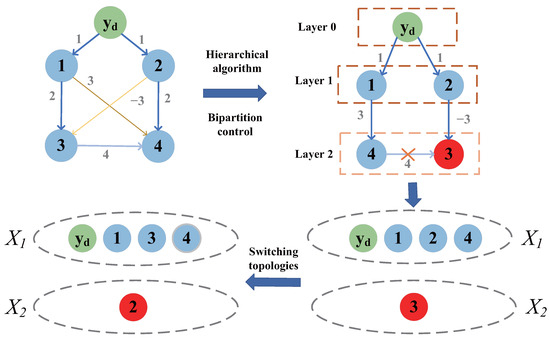
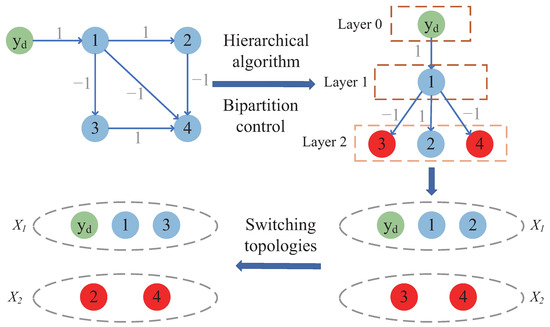
The treatment of imbalanced topology induced by negative-weight effects is generally not amenable to classical consensus analysis since the error dynamics involve cross-coupling terms originating from multiple neighbors, thereby complicating the computation. To address this issue, a hierarchical algorithm is designed in which the original imbalanced topology is analyzed through a spanning tree. Under this framework, each agent interacts only with its unique parent node, allowing the error analysis to be simplified to a local level. Design hierarchical matrix , where . To provide a more intuitive illustration of the hierarchical algorithm, an example is presented in Figure 1. Agents and can directly receive the information from , so is in the layer 0 and and are in the layer 1. For the agents and , they can receive the information from a unique agent in the layer 1, so they are in the layer 2. Then, interactions at each layer are restricted to nodes in the upper layer. For and , the corresponding , . Similarly, it can be concluded that and . There are two shortest routes in the layered directed graph as follows: : ; : . We determine that if ; otherwise, holds. In Figure 1, , and . The hierarchical matrix after the topology switching is designed as . As shown in Figure 1, prior to the switching, one has . After the topology switching occurs, the corresponding values are altered, leading to .
Figure 1.
Hierarchical algorithm-based graph decomposition and topology switching.
2.3. Design of DO
Due to complexity and diversity in practical operating conditions, influence of external disturbances on controlled systems is often unavoidable, which may lead to degradation of system performance. Hence, suppression or compensation of such disturbances is regarded as an indispensable component in controller design. In this work, a DO has been proposed, through which external disturbances and approximation errors generated by RBFNNs can be effectively compensated. For convenience in subsequent design, the following auxiliary variables are introduced.
where denotes unknown lumped disturbance, with denoting the design parameters.
3. Main Results
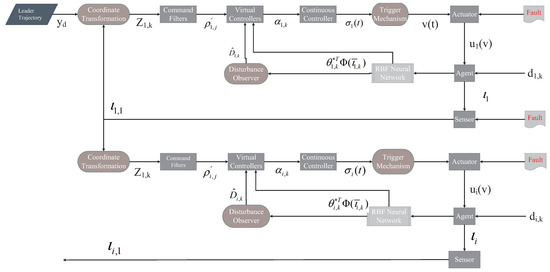
In this section, a detailed controller design procedure is presented, as illustrated in Figure 2. An adaptive event-triggered FTC scheme based on a switching-threshold mechanism is proposed, and stability of the system is verified.
Figure 2.
A block diagram of the designed control strategy.
3.1. Event-Triggered Mechanism
To balance the utilization of communication resources and the tracking performance of the controlled system [27], an event-triggered mechanism with switching thresholds is introduced.
where denotes the continuous control law, which will be provided later. The term represents the deviation between the continuous control law and the actual control input . The quantities , and H are known constants, and the initial value of the dynamic threshold parameter is assumed to satisfy .
A continuous control law and an actual control law are constructed:
where denotes the virtual control law, which will be provided in the controller design section, represents smoothing coefficient, and and , designed as time-varying auxiliary functions introduced to ensure the boundedness of the continuous control law, satisfy and . The parameters and are defined as follows:
Remark 1.
The event-triggered control scheme with switching thresholds is proposed such that the advantages of both the FT and RT mechanisms are incorporated. Through this integration, an effective balance between communication resource utilization and tracking performance is achieved. Since , , , and are all bounded, is also bounded, and . From the switching event-triggered mechanism, it can be observed that the minimum inter-event time satisfies , and . Inter-event time is strictly positive. Hence, Zeno behavior is excluded.
3.2. Controller Design
First, in order to prevent the occurrence of complexity explosion, the following command filter, together with its corresponding compensation signal, is introduced for the agent
where , , constants , , , and are filtering errors, and are virtual controllers, which will be given later.
The following coordinate transformation and auxiliary error signals are defined:
where , , and , , , is the state of the node in the upper layer, which transmits information to the node in the adjacent lower layer.
The virtual controller is constructed as
where if ; otherwise, . if ; otherwise, . if ; otherwise, . if ; otherwise .
In addition, the adaptive laws are designed as
where , , , , , and are design parameters. and to guarantee the negativity of the Lyapunov derivative.
Based on the proposed controller and adaptive laws, the adaptive bidirectional consensus switching event-triggered FTC scheme is formally established in Theorem 1. The detailed proof of Theorem 1 is provided in the subsequent stability analysis section.
3.3. Stability Analysis
Theorem 1.
Under Assumptions 1–3, for the multi-agent system described by Equation (1) and operating in the presence of sensor faults (4), the switching-threshold event-triggered mechanism (10)–(12), the command filter (14) together with its associated compensation signal (15), the virtual controller (17), and the adaptive laws (18)–(20) collectively ensure the realization of bidirectional consensus with a balanced trade off between communication efficiency and tracking performance. Furthermore, the boundedness of all closed-loop signals is guaranteed, irrespective of whether actuator or sensor faults occur.
Proof.
From Equations (1), (4), (9), and (14)–(16), the following can be deduced:
where is the unknown function, which can be approximated by RBFNNs, and one can obtain the following:
The Lyapunov function is chosen as
where , if ; otherwise, .
By computing Equation (23), the following result is obtained
where if ; otherwise, .
Based on Young’s inequality, we have
where . is RBFNNs node number.
By applying Young’s inequality, we have
From Equations (1), (4), (12), and (14)–(16), the following can be deduced:
where is the unknown function, which can be approximated by RBFNNs, and one can obtain
Choosing the Lyapunov function as
By computing Equation (32), the following result is obtained
Based on Young’s inequality, we have
where .
Similar to Equation (26), we have
We define . Considering Equations (15) and (17) and applying Lemma 1, the following inequality can be obtained
where and .
By Lemma 2, integrating Equation (37) over [0,t], one has
Based on the definition of and the coordinate transformation in Equation (16), it can be ensured that all closed-loop system signals remain bounded. □
Remark 2.
The proposed ETC scheme with a switching threshold integrates the advantages of both FT and RT mechanisms, thereby achieving an effective balance between communication resources and tracking performance. While ensuring flexibility in the triggering threshold, the occurrence of Zeno behavior is simultaneously avoided. From inequality (38), it can be inferred that achieving a faster convergence rate while reducing the convergence error requires either a larger value of or a smaller value of . In practical scenarios, multiple control objectives—such as convergence rate, tracking performance, and communication frequency—must be taken into account. Therefore, the selection of these parameters should be conducted with the aim of balancing the overall performance requirements.
4. Simulation Examples
In this section, the effectiveness of the proposed adaptive bidirectional consensus FTC scheme, employing a switching event-triggered mechanism, is demonstrated through simulation examples. In addition, comparative simulations are conducted to further verify the superiority of the designed controller.
4.1. Main Simulations
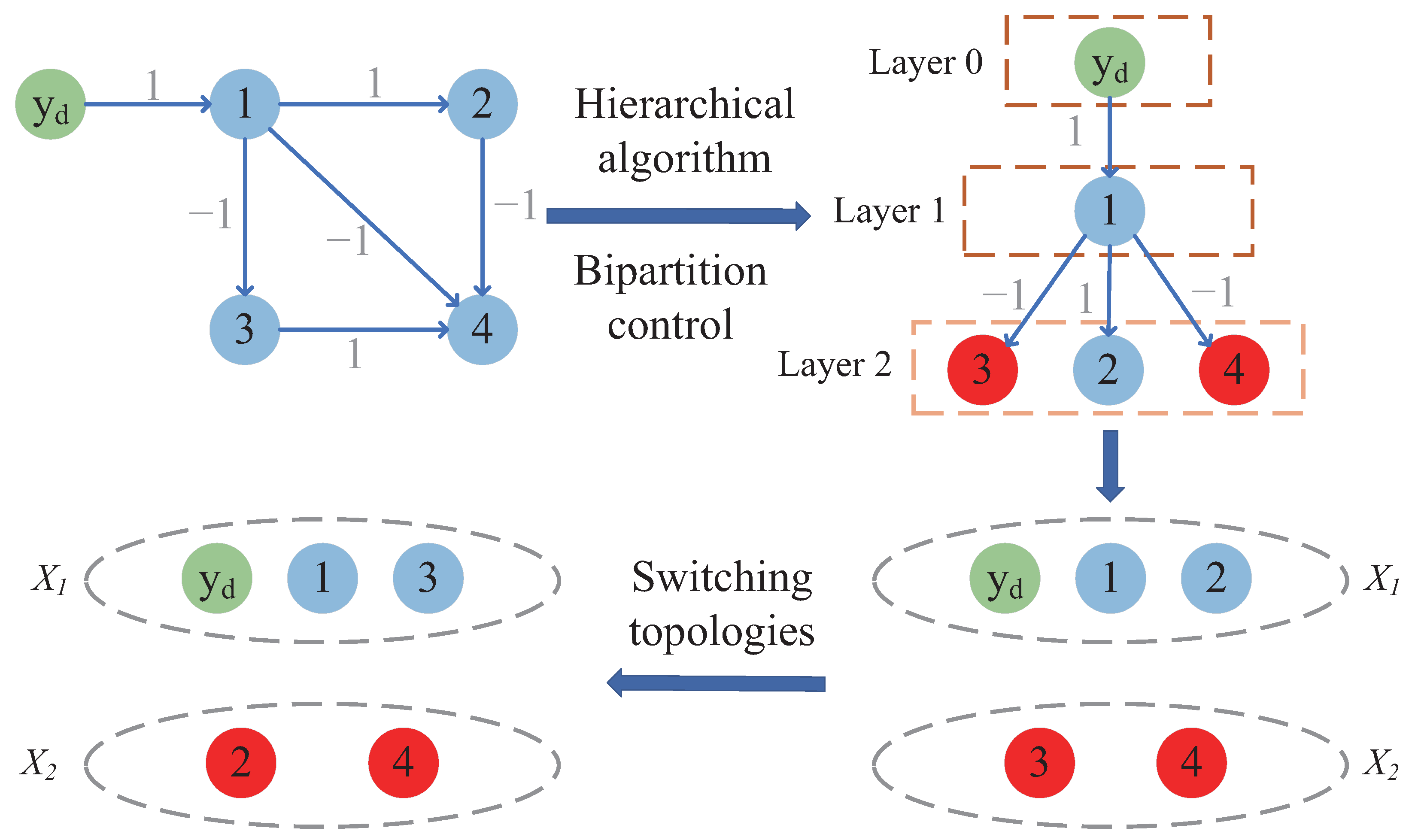
The communication graph is illustrated in Figure 3, where the multi-agent system consists of four agents, and denotes the leader agent. The communication topology is directed and connected, indicating that the proposed algorithm is applicable to a broad class of systems. The dynamics of each agent follow the reference model in [28] can be described as
where , , and random Gaussian noise is incorporated into the disturbance. Then, unknown function in the system is approximated by RBFNNs, for which the basis functions are selected as
where , , .
Figure 3.
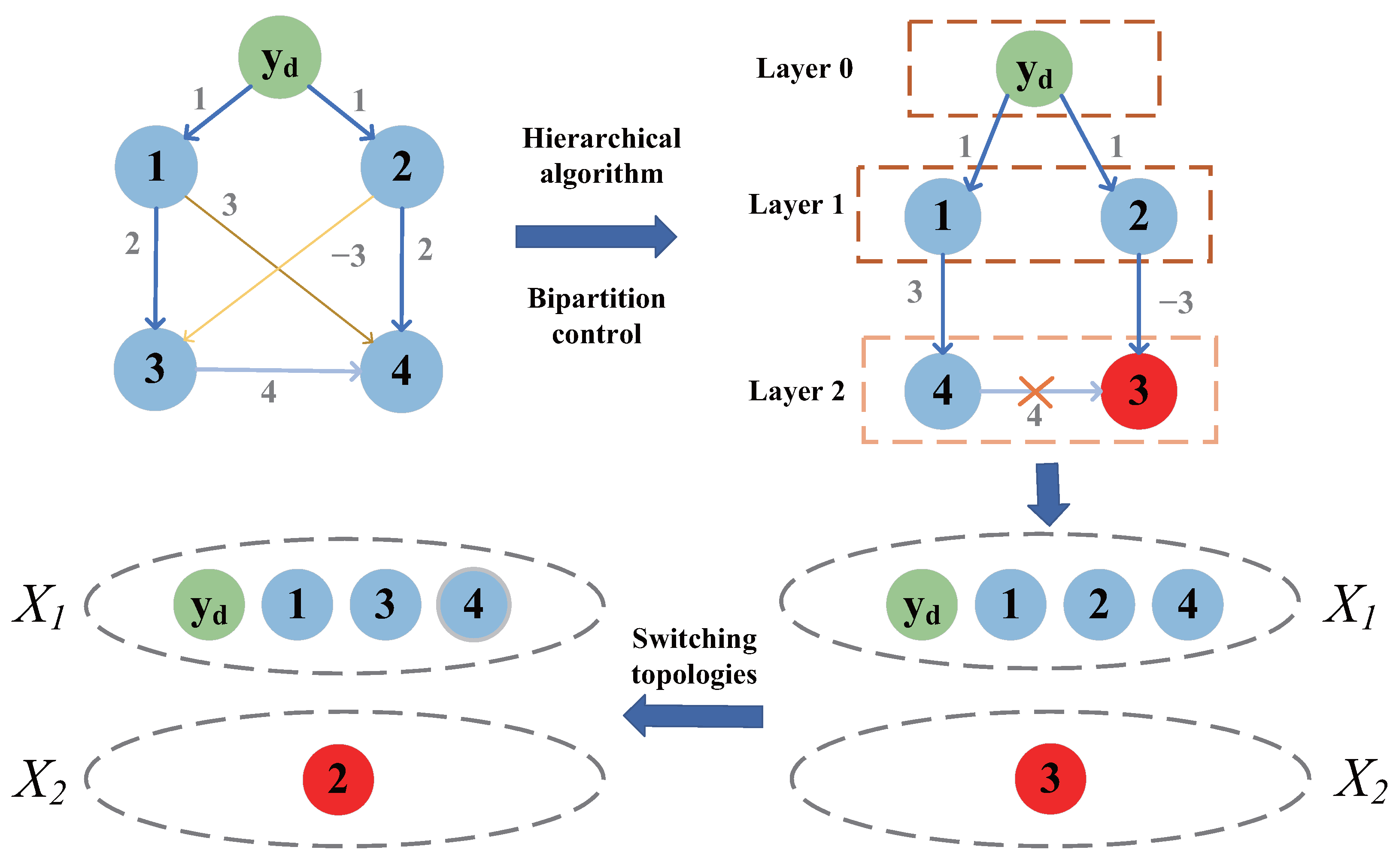
Decomposition of agents based on hierarchical algorithm and switching topology.
The leader’s dynamic is described as . The communication graph is shown in Figure 3. The agents are divided into two different groups based on the hierarchical algorithm. The shortest routes for agents are , , and . Thus, according to the shortest routes, and can be given. As shown in Figure 3, prior to the switching, one has . Topology switching occurs at s; the corresponding values are altered, leading to .
Considering that follower 1 is affected by a sensor fault, while followers are all subjected to actuator faults, the corresponding sensor-fault and actuator-fault models are formulated
In this simulation, the initial conditions are specified as follows: , , , ; and the initial values of the design parameter are assigned as follows: , , .
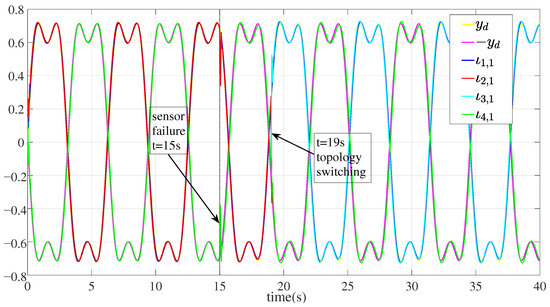
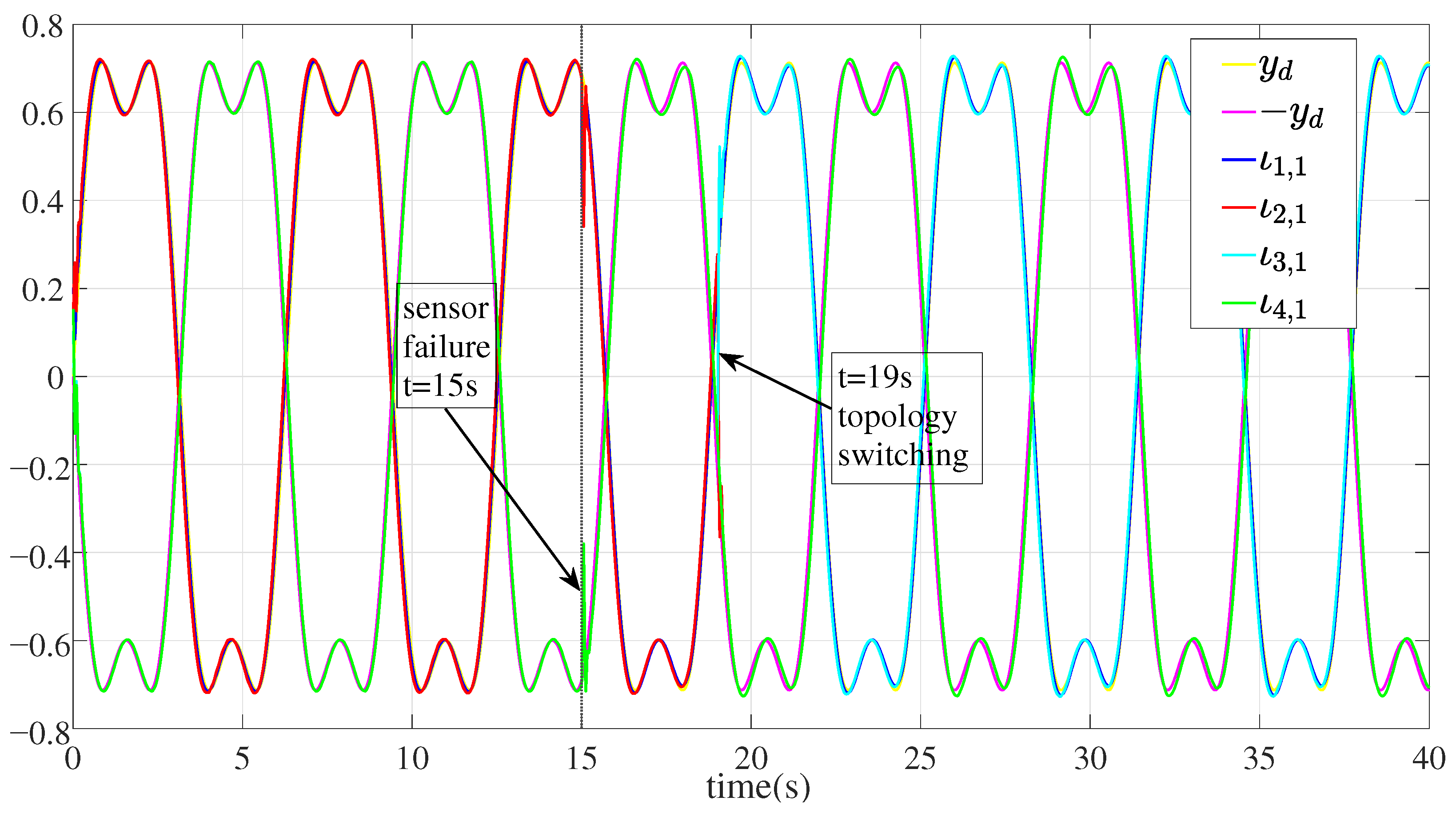
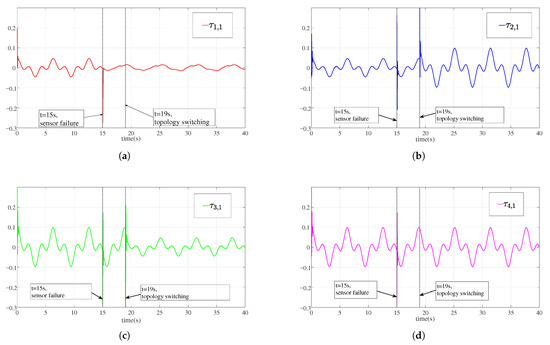
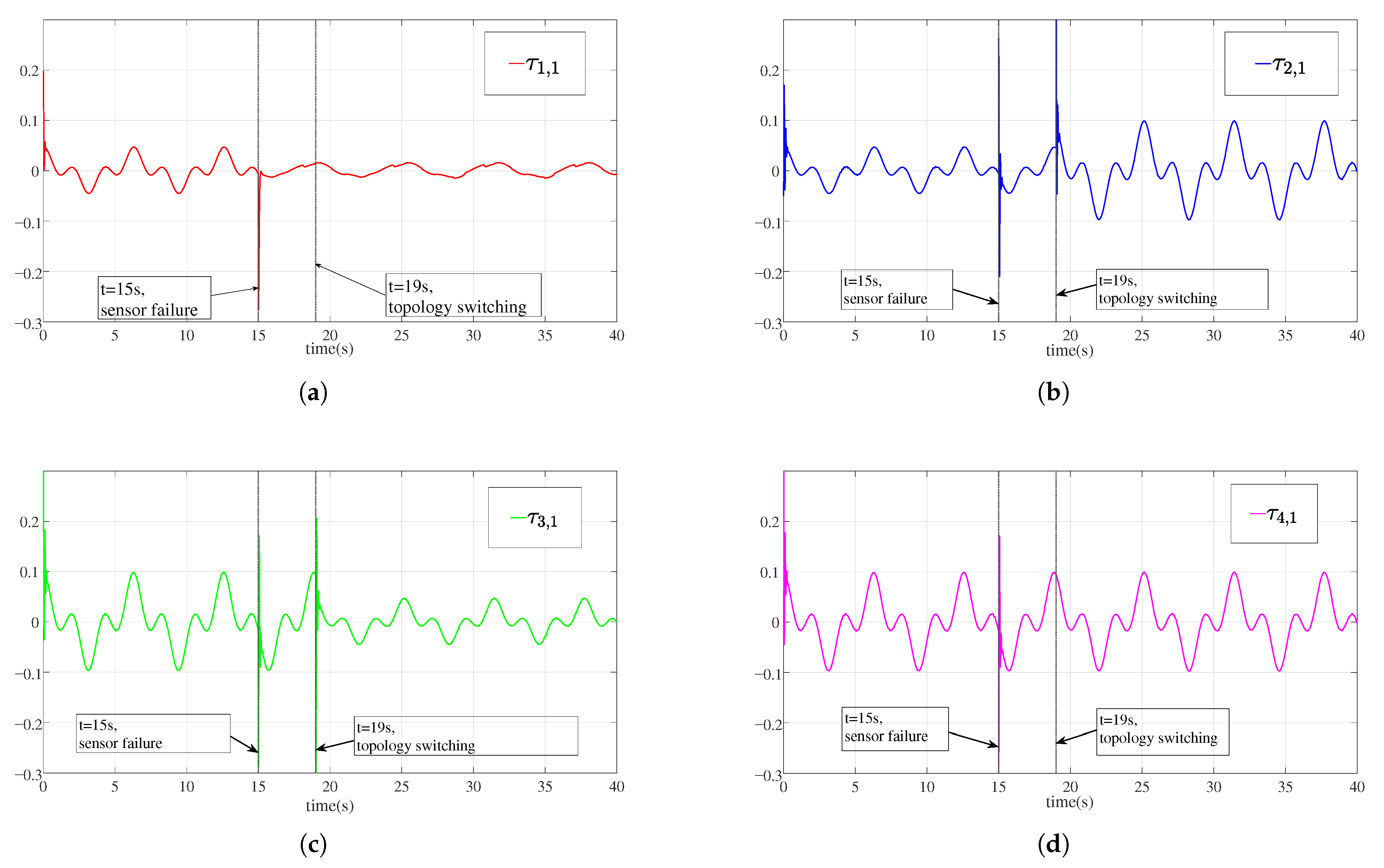
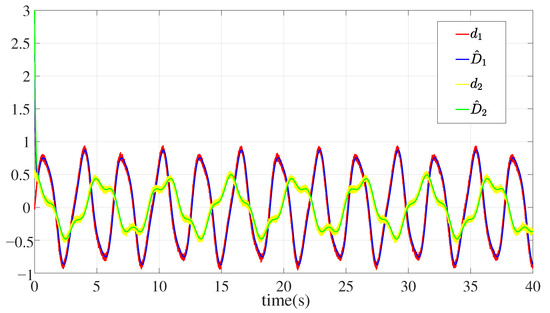
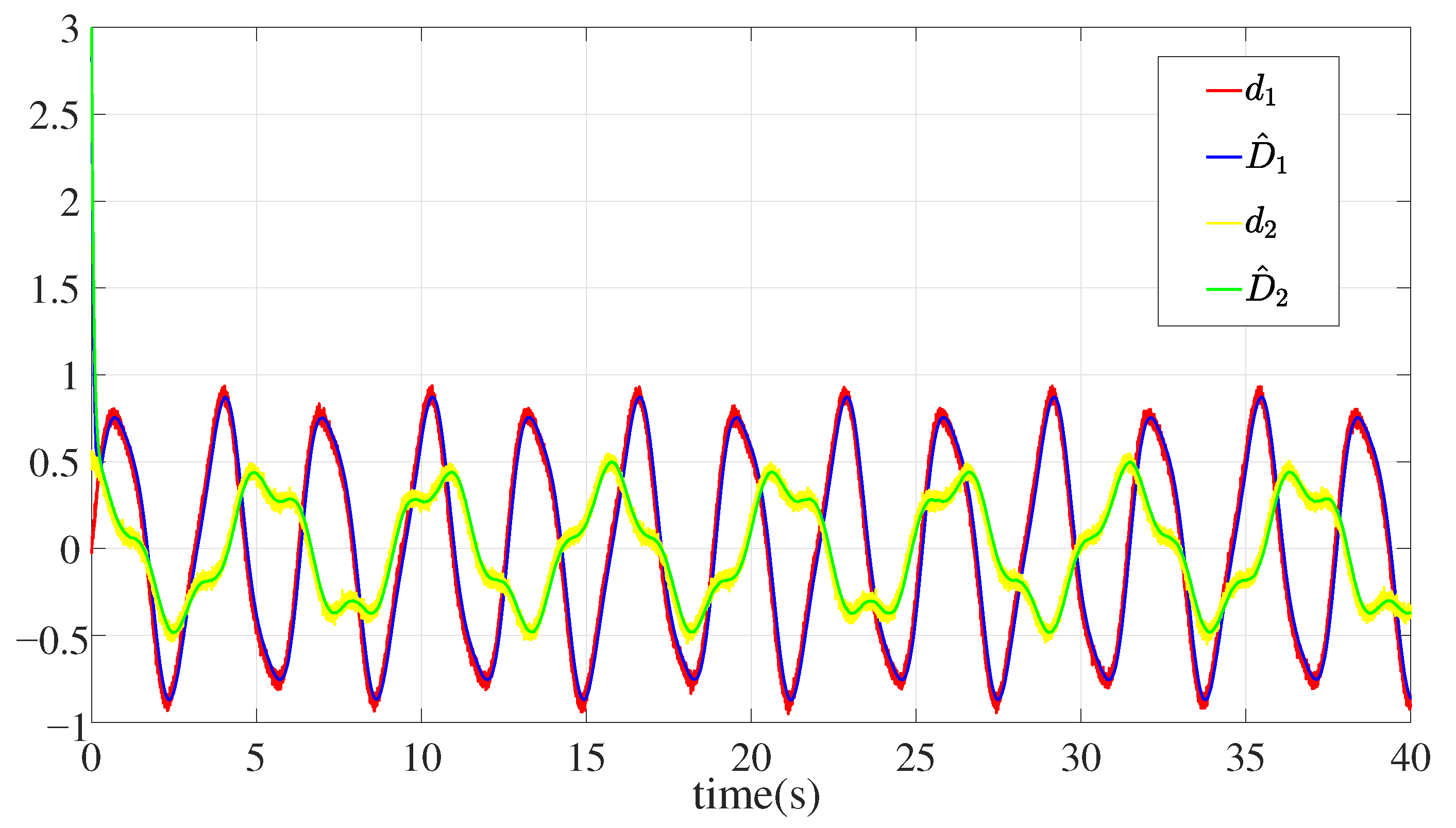
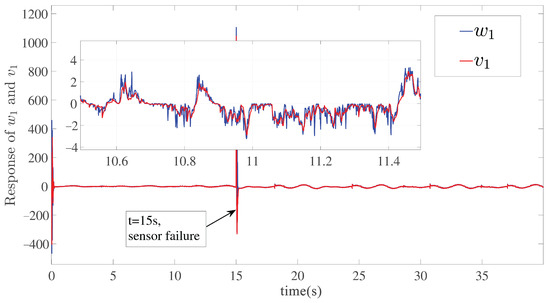
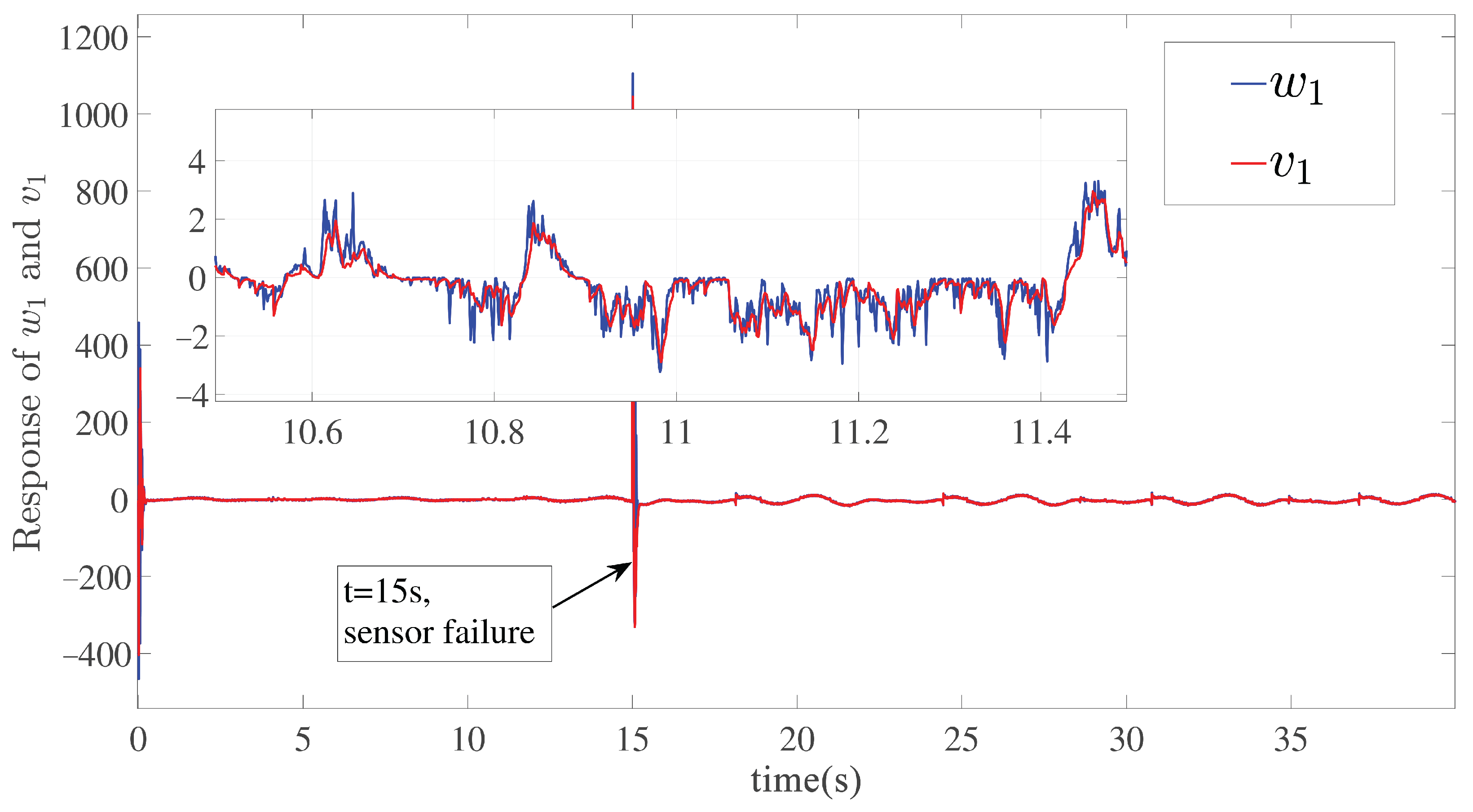
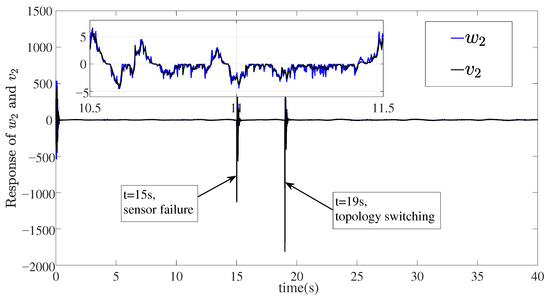
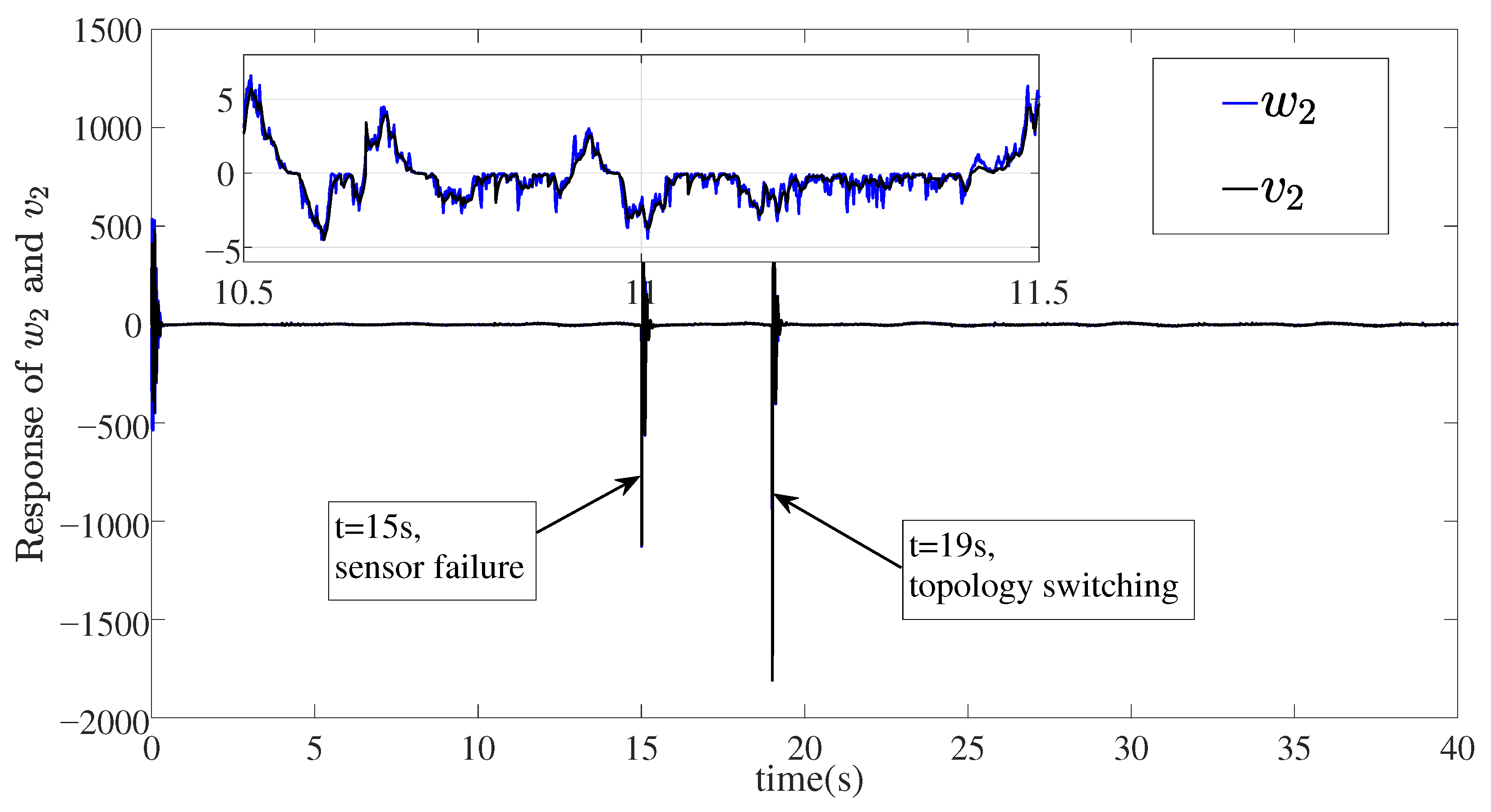
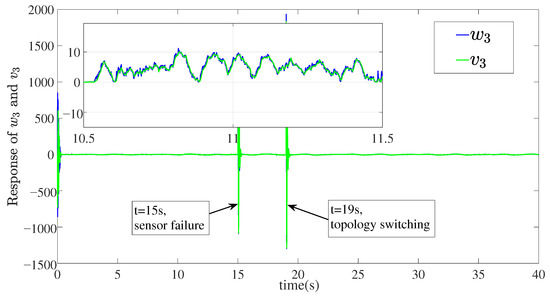
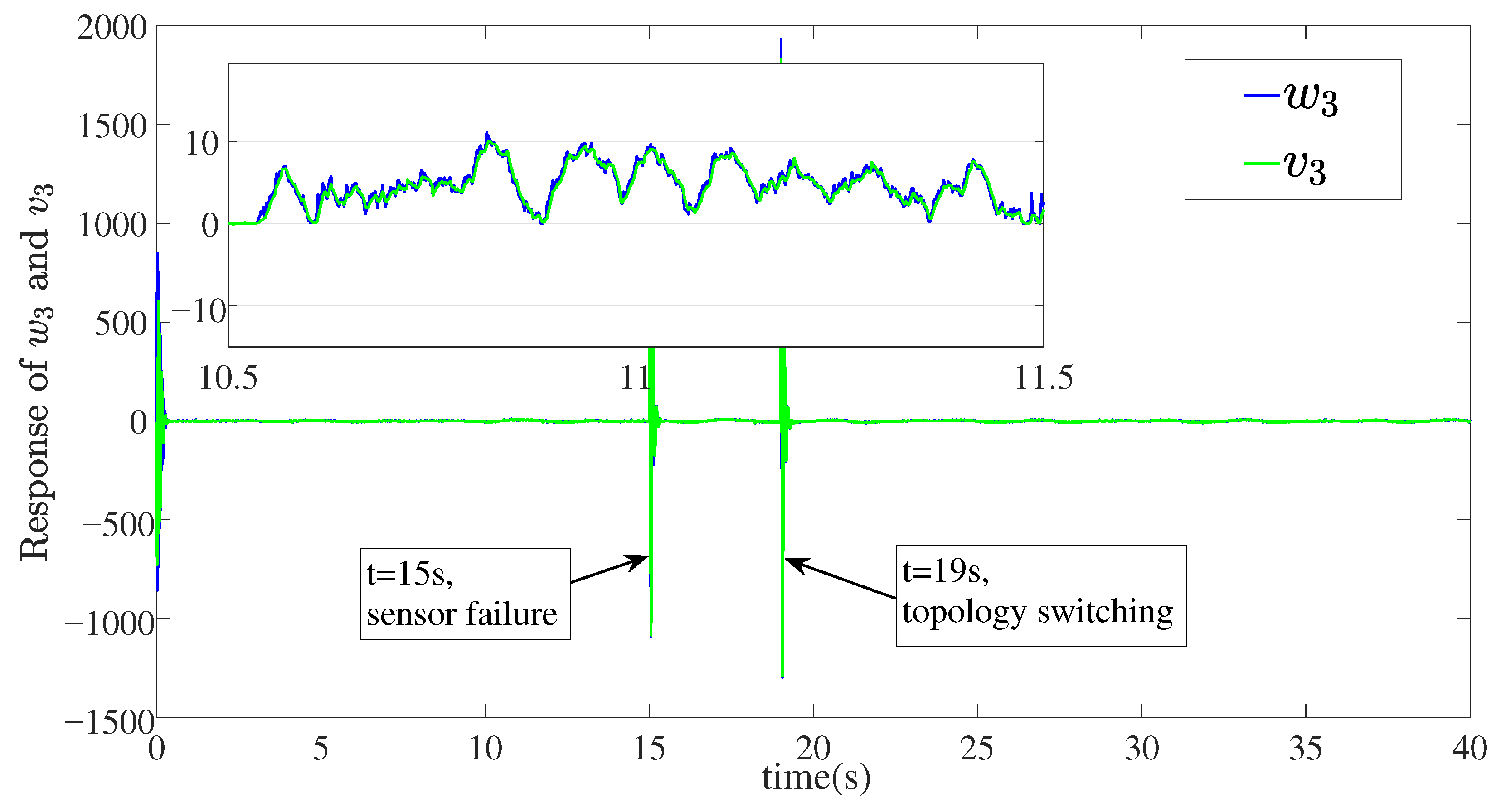
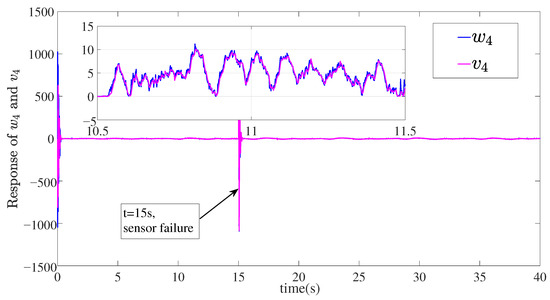
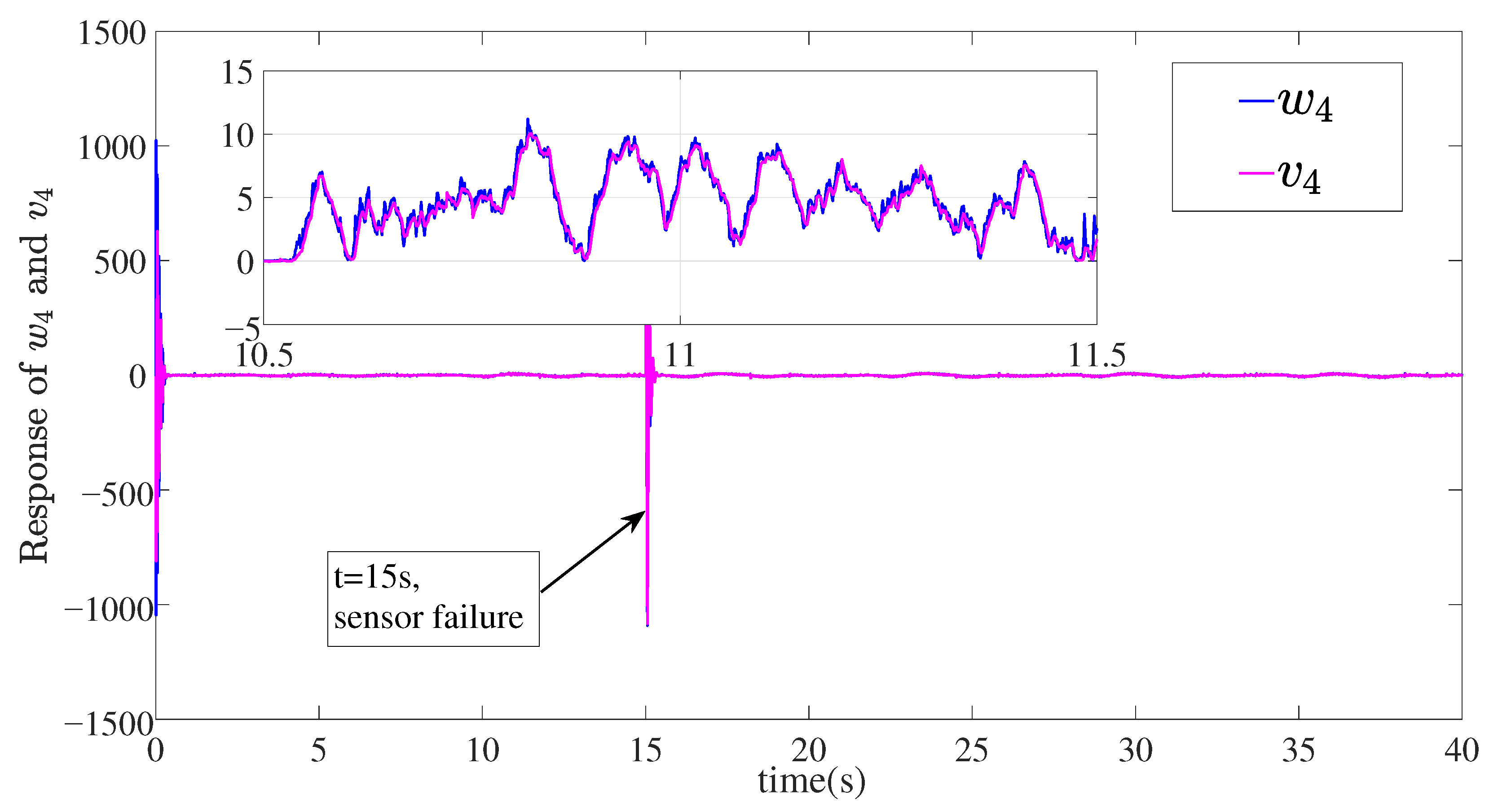
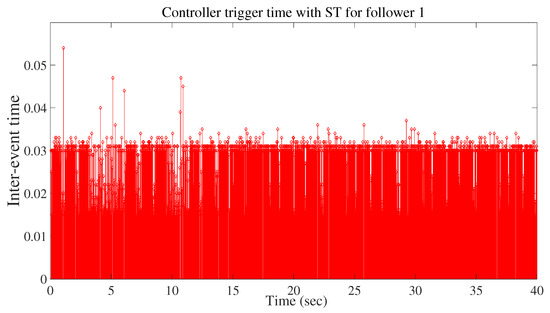
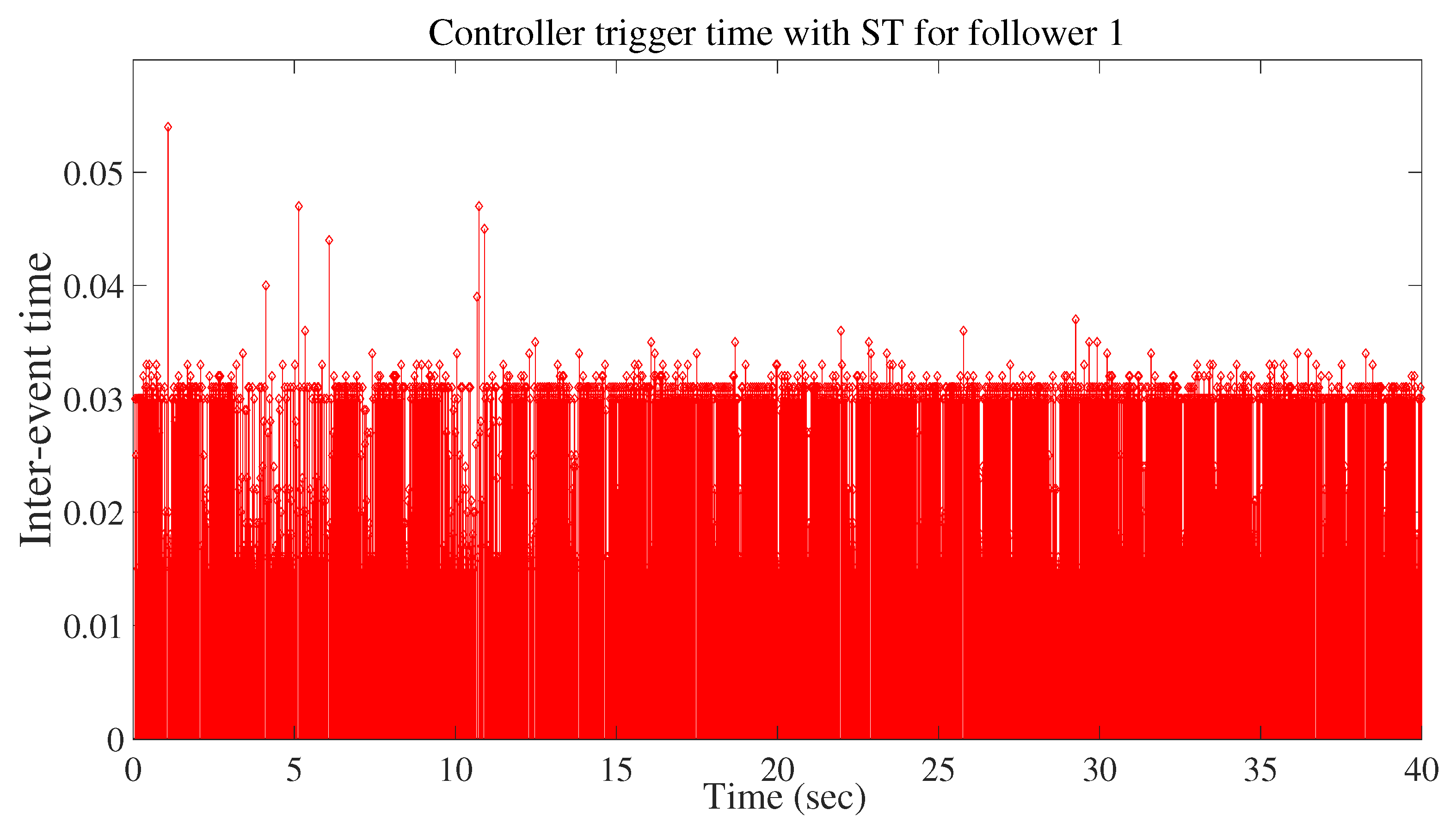
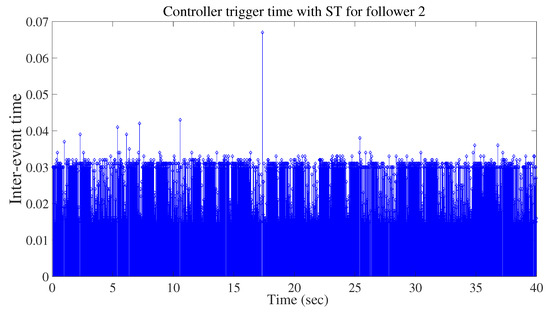
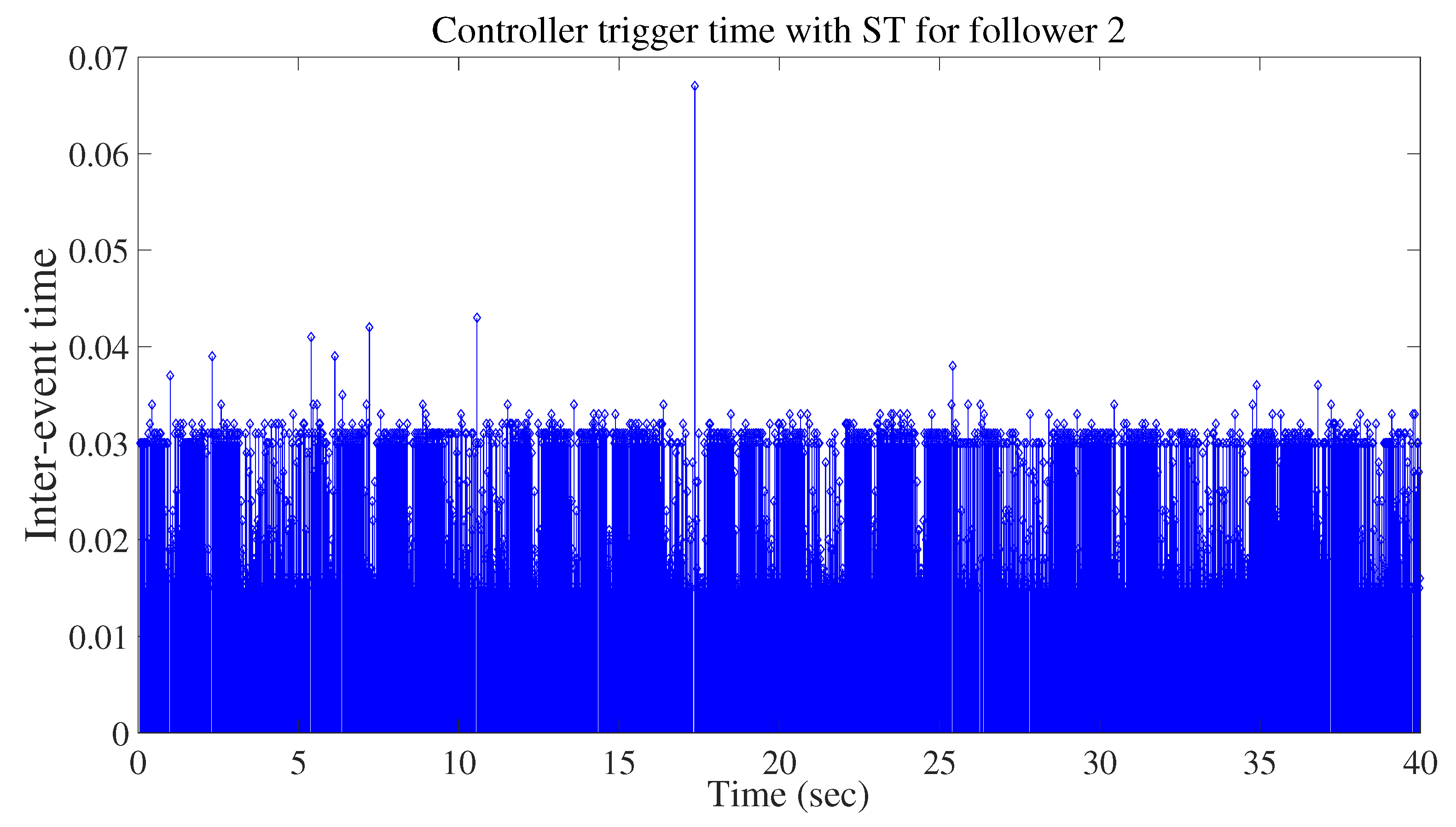
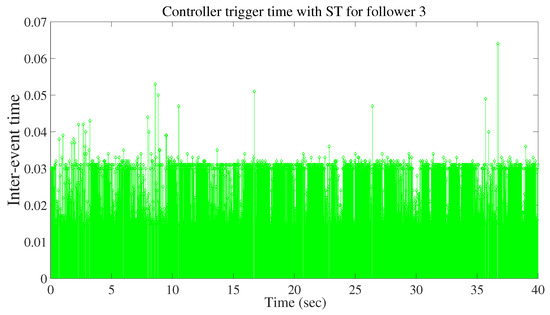
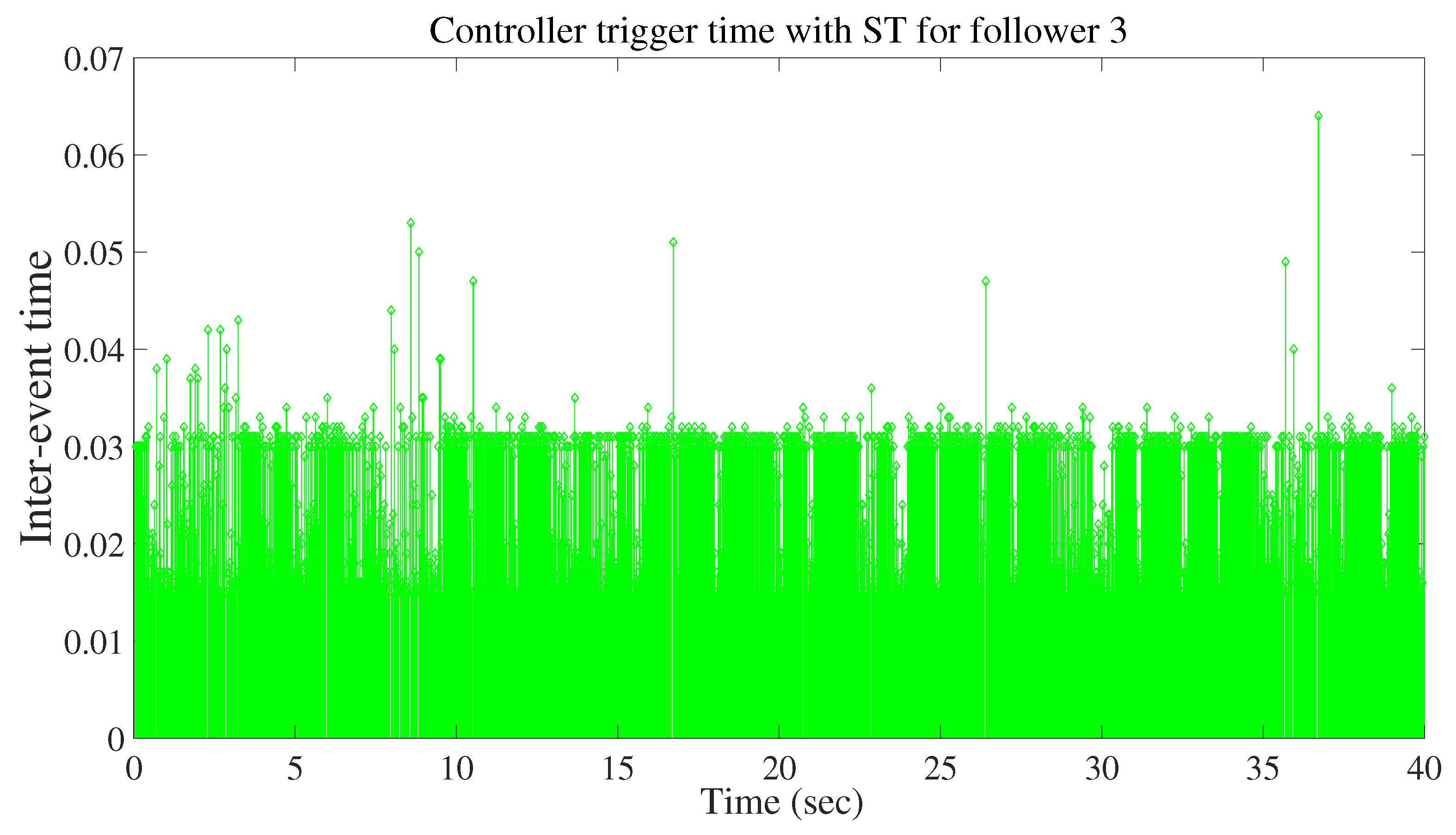
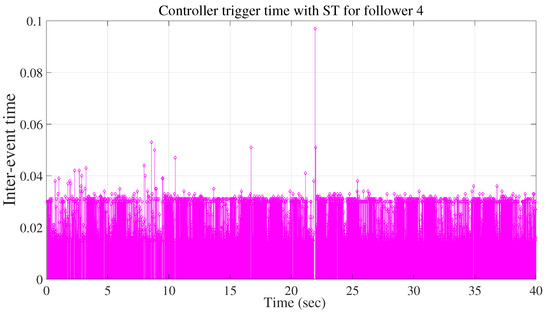
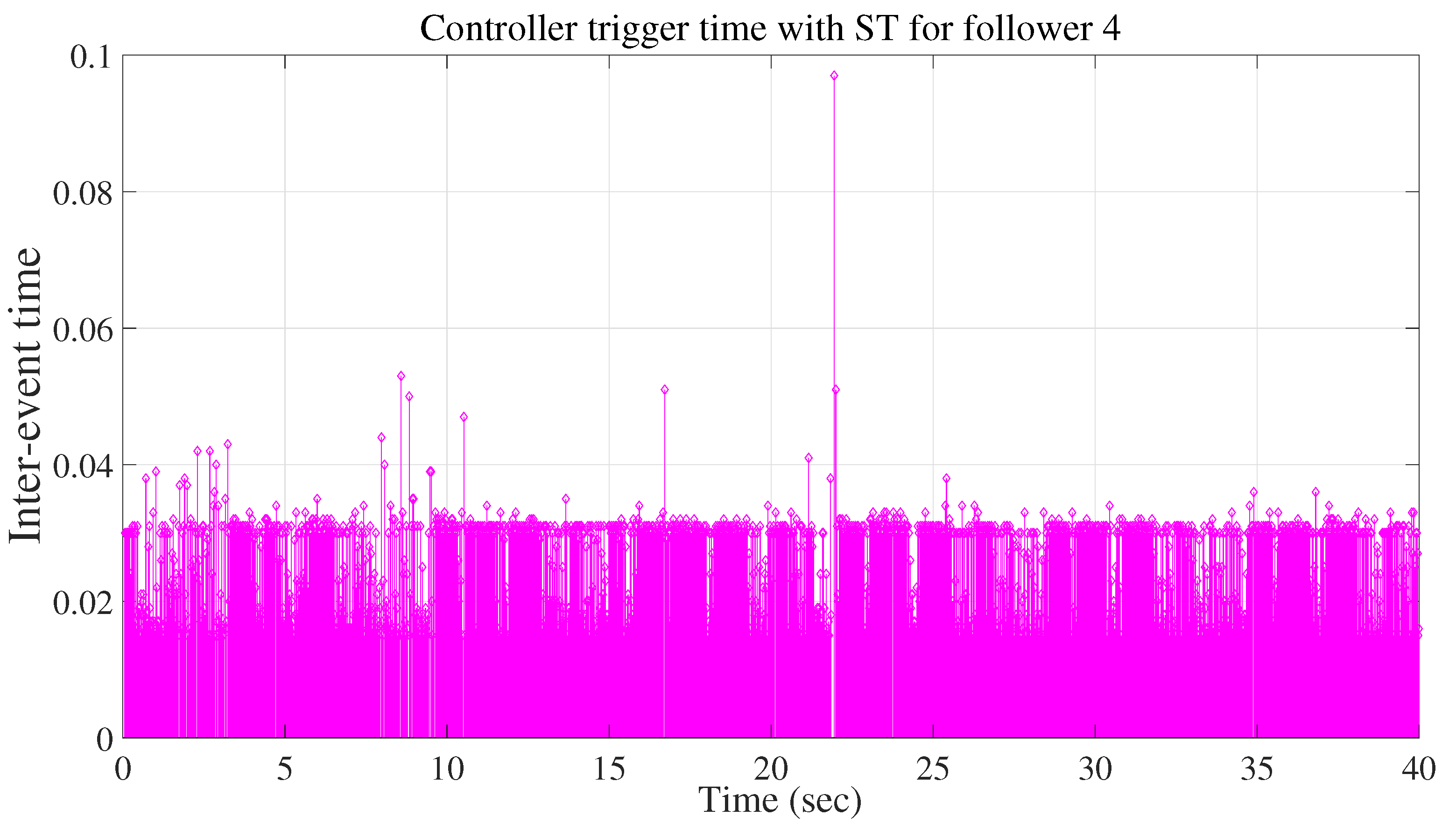
Based on the aforementioned selection of control parameters, the simulation results under random noise disturbances, sensor faults, and switching topology are presented in Figure 4, Figure 5, Figure 6, Figure 7, Figure 8, Figure 9, Figure 10, Figure 11, Figure 12, Figure 13 and Figure 14. As illustrated in Figure 4, after the sensor fault occurring at s and the topology switching at s, the tracking performance is rapidly recovered due to the designed controller, and all agents are still able to maintain stable trajectory tracking. These observations indicate that the proposed control strategy can accommodate topology switching scenarios and effectively compensate for sensor faults. Figure 5 shows the tracking errors of all agents under the switching event-triggered mechanism. In comparison with Figure 4, it further demonstrates that the designed controller ensures stable and effective tracking performance. Figure 6 depicts the trajectories of the disturbance observer subjected to random Gaussian noise, from which it can be observed that the designed observer accurately tracks the system disturbance. Figure 1, Figure 2, Figure 3, Figure 4, Figure 5, Figure 6, Figure 7, Figure 8, Figure 9 and Figure 10 display the trajectories of continuous controllers and actual controllers for each agent under the proposed switching event-triggered mechanism. Figure 11, Figure 12, Figure 13 and Figure 14 present the triggering intervals of all agents under the designed scheme. Each curve represents the updates of the controller, and its amplitude corresponds to the triggering interval. It can be observed that the proposed triggering mechanism is free of Zeno behavior.
Figure 4.
Tracking performance under sensor failure with topology switching.
Figure 5.
(a) Responses of tracking error under switching event triggering mechanism. (b) Responses of tracking error under switching event triggering mechanism. (c) Responses of tracking error under switching event triggering mechanism. (d) Responses of tracking error under switching event triggering mechanism.
Figure 6.
Disturbed observation trajectories with random noise.
Figure 7.
Responses of and under switching event triggering mechanism.
Figure 8.
Responses of and under switching event triggering mechanism.
Figure 9.
Responses of and under switching event triggering mechanism.
Figure 10.
Responses of and under switching event triggering mechanism.
Figure 11.
Follower 1 controller trigger time under switching event trigger mechanism.
Figure 12.
Follower 2 controller trigger time under switching event trigger mechanism.
Figure 13.
Follower 3 controller trigger time under switching event trigger mechanism.
Figure 14.
Follower 4 controller trigger time under switching event trigger mechanism.
4.2. Comparison Studies
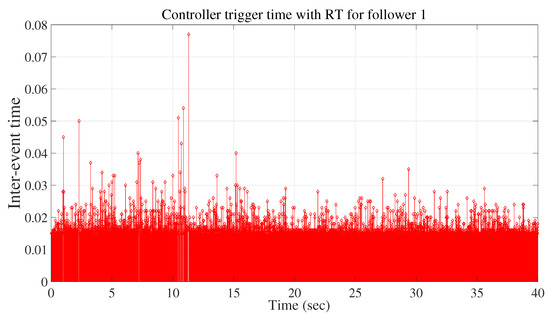
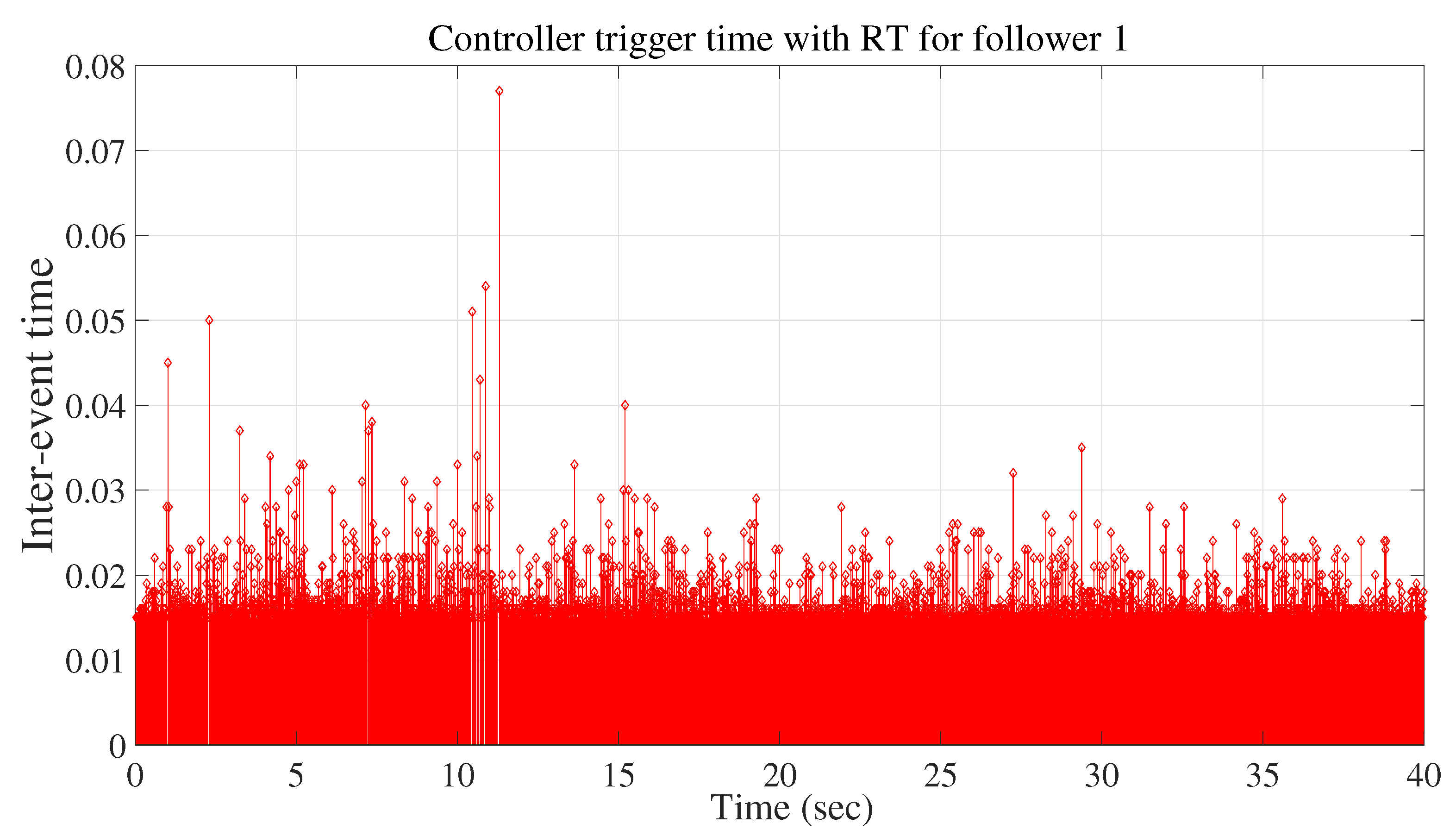
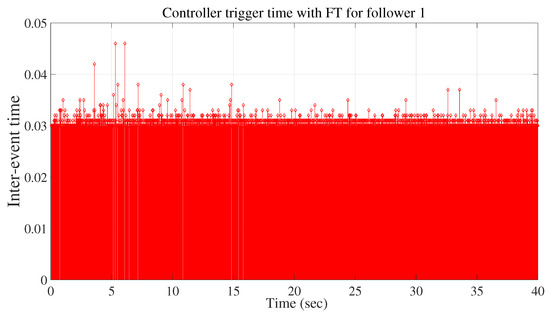
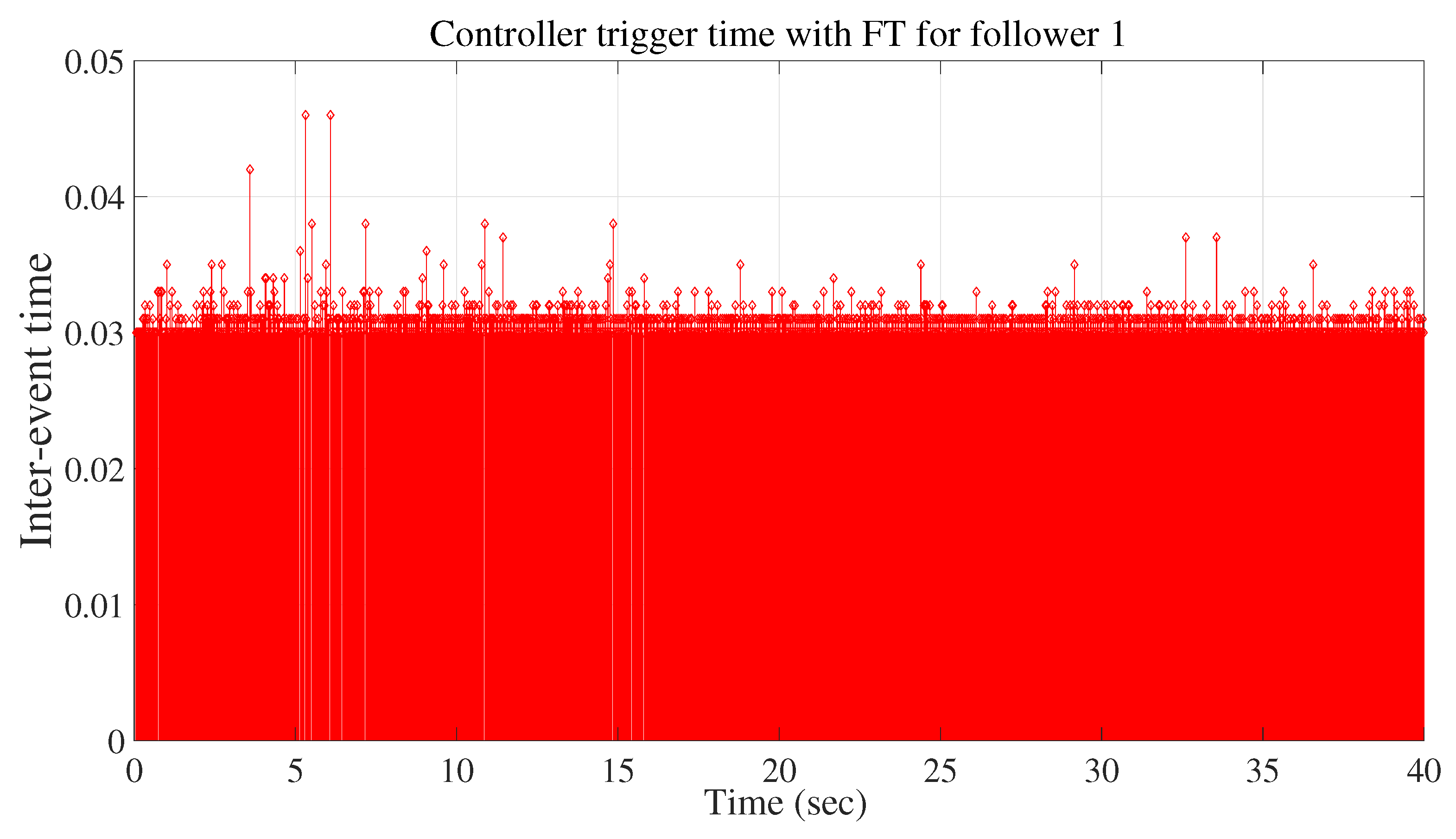
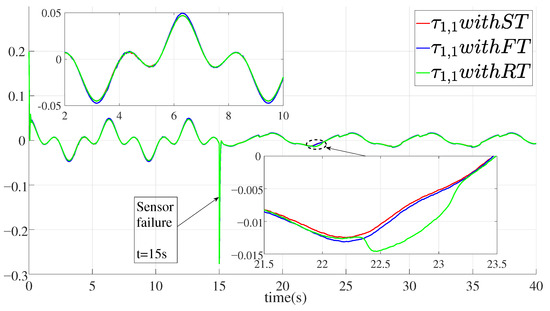
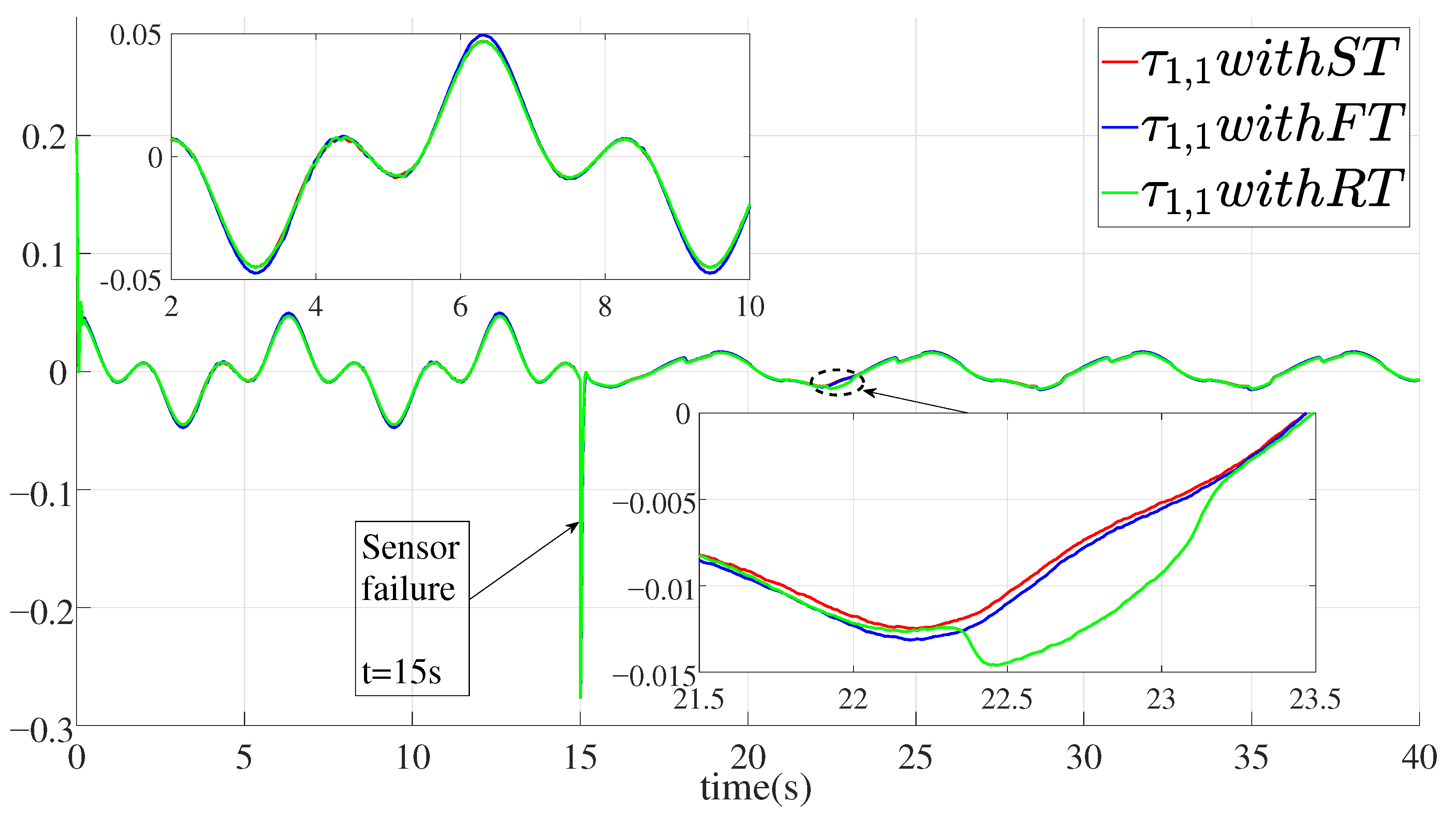
Under the condition that all other scenarios remain identical, comparative simulations are first conducted using the FT and RT mechanisms, and the results are contrasted with those obtained under the switching event-triggered mechanism by taking agent 1 as an illustrative example. Figure 15 presents the controller triggering intervals under the RT mechanism, while Figure 16 shows those under the FT mechanism. Figure 17 illustrates the differences in tracking performance of agent 1 under the three triggering mechanisms, simultaneously demonstrating that all mechanisms are capable of achieving the desired tracking performance. To more clearly highlight the superiority of the proposed switching event-triggered mechanism, Table 2 summarizes the triggering counts and average tracking errors of agent 1 under the three mechanisms. The data in Table 2 indicate that compared with the RT mechanism, the proposed switching mechanism reduces the triggering count by , and compared with the FT mechanism, it decreases the average tracking error by . These results verify that the proposed event-triggered mechanism achieves a favorable balance between tracking performance and communication frequency.
Figure 15.
Follower 1 controller trigger time with RT.
Figure 16.
Follower 1 controller trigger time with FT.
Figure 17.
Responses of tracking error under different event-triggering mechanisms.
Table 2.
Update times and average tracking errors of follower 1 under three different triggering controllers.
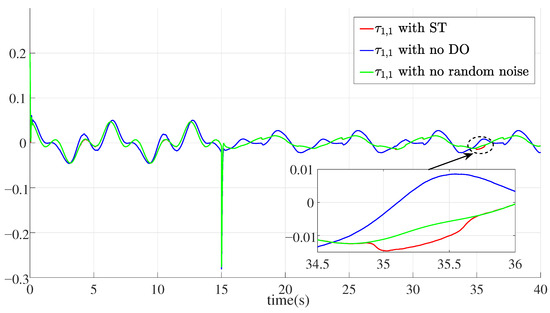
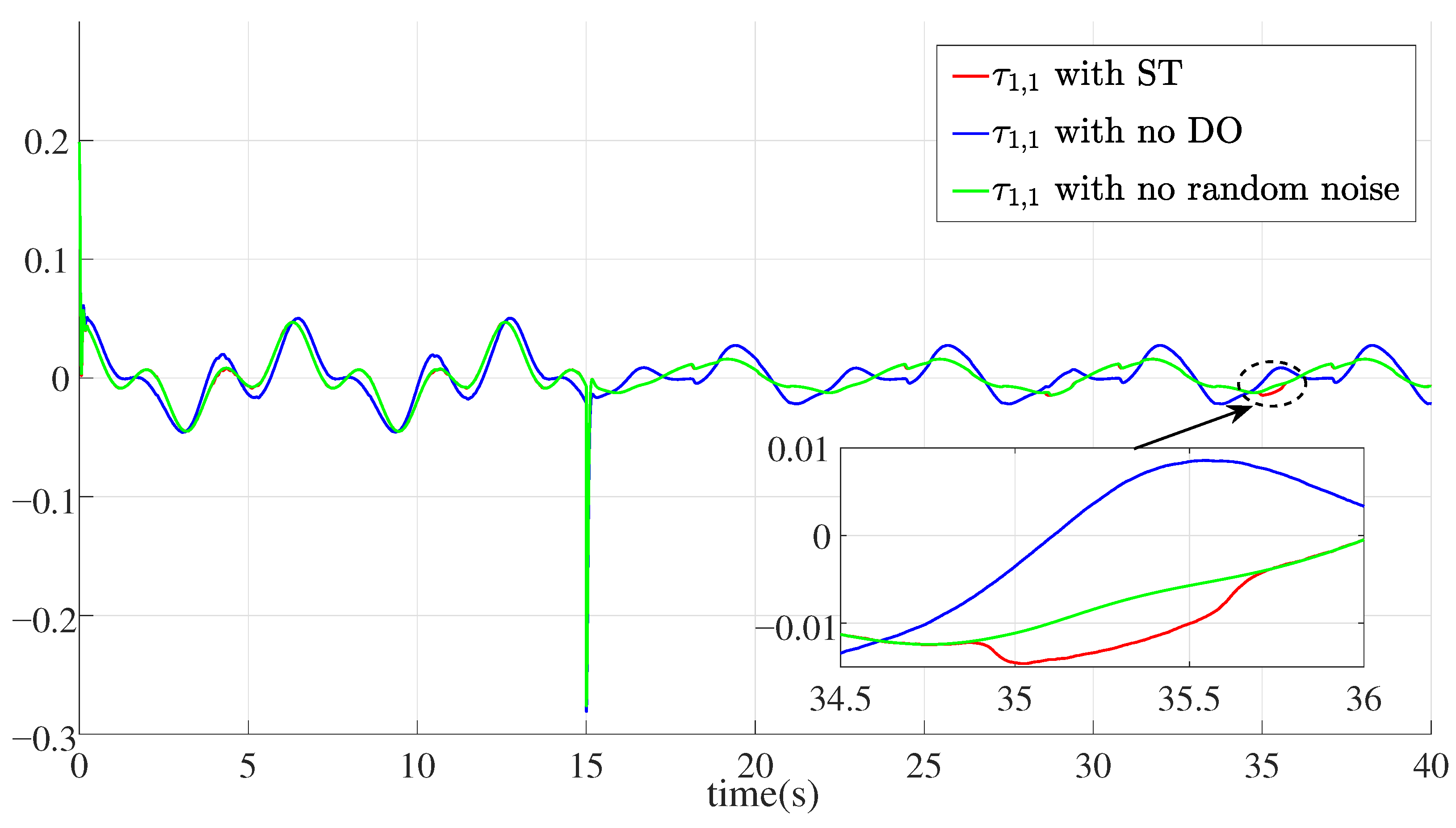
On the other hand, while keeping the control mechanism unchanged, additional simulations are performed by modifying the disturbance-handling component. Taking agent 1 as an example once again, Figure 18 illustrates the tracking performance differences under different disturbance-handling designs. Without the disturbance observer, the average tracking error is . Under the switching event-triggered mechanism, the incorporation of the disturbance observer reduces the average tracking error by , thereby significantly enhancing the tracking performance.
Figure 18.
Responses of tracking error under different disturbance designs.
5. Conclusions
A switching event-triggered FTC scheme based on a disturbance observer has been proposed for MASs subject to sensor faults, achieving bidirectional consensus under switching topology. A hierarchical algorithm is adopted to address communication topology imbalance induced by negative weights; each agent interacts with only one parent node in the upper layer, which simplifies local error analysis and avoids complexity associated with asymmetric global Laplacian operators. A disturbance observer and its associated compensation signal are constructed to accommodate external disturbances and filtering errors. A switching event-triggered mechanism is developed, combining advantages of FT and ST mechanisms and enabling a balanced trade-off between communication frequency and tracking performance. Numerical simulations confirm superiority and boundedness of the proposed scheme. Future research will focus on more complex settings, such as heterogeneous MASs.
Author Contributions
Conceptualization, S.Y. and H.W.; methodology, S.Y. and H.W.; software, H.W. and S.L.; validation, S.Y., H.W., and S.L.; formal analysis, S.Y. and S.L.; investigation, H.W. and S.L.; resources, S.Y.; data curation, H.W.; writing—original draft preparation, H.W.; writing—review and editing, S.Y. and H.W.; visualization, S.Y. and S.L.; supervision, S.Y.; project administration, S.L.; funding acquisition, S.Y. All authors have read and agreed to the published version of the manuscript.
Funding
This research was funded by National Natural Science Foundation of China, under grant number 61703224, and the National Natural Science Foundation of China, under grant number 61640302.
Data Availability Statement
The original contributions presented in this study are included in the article. For further inquiries, please contact the corresponding author.
Conflicts of Interest
The authors declare no conflicts of interest.
Abbreviations
The following abbreviations are used in this manuscript:
| DO | Disturbance observer |
| FTC | Fault-tolerant control |
| MASs | Multi-agent systems |
| RBFNNs | Radial basis function neural networks |
References
- Lizzio, F.F.; Capello, E.; Guglieri, G. A Review of Consensus-Based Multi-Agent UAV Implementations. J. Intell. Robot. Syst. 2022, 106, 43. [Google Scholar] [CrossRef] [Scilit]
- Zheng, B.; Ji, J.; Miao, Z.; Zhou, J. Achieving Distributed Consensus in Networked Flexible-Joint Manipulator Systems via Energy-Shaping Scheme. Int. J. Control Autom. Syst. 2023, 21, 2323–2337. [Google Scholar] [CrossRef] [Scilit]
- Li, H. Event-Triggered Bipartite Consensus of Multi-Agent Systems in Signed Networks. AIMS Math. 2022, 7, 5499–5526. [Google Scholar] [CrossRef] [Scilit]
- Wang, X.; Cao, Y.; Niu, B.; Song, Y. A Novel Bipartite Consensus Tracking Control for Multiagent Systems under Sensor Deception Attacks. IEEE Trans. Cybern. 2023, 53, 5984–5993. [Google Scholar] [CrossRef] [Scilit]
- Manickavalli, S.; Parivallal, A.; Kavikumar, R.; Kaviarasan, B. Distributed Bipartite Consensus of Multi-Agent Systems via Disturbance Rejection Control Strategy. Mathematics 2024, 12, 3225. [Google Scholar] [CrossRef] [Scilit]
- Zhang, H.; Duan, J.; Wang, Y.; Gao, Z. Bipartite Fixed-Time Output Consensus of Heterogeneous Linear Multiagent Systems. IEEE Trans. Cybern. 2021, 51, 548–557. [Google Scholar] [CrossRef] [Scilit]
- Wang, Y.; Ishii, H.; Bonnet, F.; Défago, X. Resilient Real-Valued Consensus in Spite of Mobile Malicious Agents on Directed Graphs. IEEE Trans. Parallel Distrib. Syst. 2022, 33, 586–603. [Google Scholar] [CrossRef] [Scilit]
- Ren, J.; Hua, L.; Zhao, M.; Lu, G. Bipartite consensus for multi-agent systems over signed networks: A novel dynamic event-triggered mechanism. Neurocomputing 2024, 609, 128502. [Google Scholar] [CrossRef] [Scilit]
- Wang, J.; Ke, J.; Zhang, J.-F. Differentially Private Bipartite Consensus over Signed Networks with Time-Varying Noises. IEEE Trans. Autom. Control 2024, 69, 5788–5803. [Google Scholar] [CrossRef] [Scilit]
- Chen, W.-H.; Yang, J.; Guo, L.; Li, S. A Nonlinear Disturbance Observer for Robotic Manipulators. IEEE Trans. Ind. Electron. 2000, 47, 932–938. [Google Scholar] [CrossRef] [Scilit]
- Zhang, D.; Hu, J.; Cheng, J.; Wu, Z.-G.; Yan, H. A Novel Disturbance Observer Based Fixed-Time Sliding Mode Control for Robotic Manipulators with Global Fast Convergence. IEEE/CAA J. Autom. Sin. 2024, 11, 661–672. [Google Scholar] [CrossRef] [Scilit]
- Nguyen, X.; Tiep, N.H.; Au, L.T.K.; Anh, N.N.; Nguyen, X.; Phi, N. A Finite-Time Disturbance Observer-Based Control for Constrained Second-Order Dynamical Systems and Its Application to the Attitude Tracking of a UAV. Mathematics 2025, 13, 1810. [Google Scholar]
- Hu, X.; Wang, B.; Shen, Y.; Fu, Y.; Li, N. Disturbance Observer-Enhanced Adaptive Fault-Tolerant Control of a Quadrotor UAV against Actuator Faults and Disturbances. Drones 2023, 7, 541. [Google Scholar] [CrossRef] [Scilit]
- Khan, Z.; Nasir, A.; Mekid, S. Fault-Tolerant Control Strategies for Industrial Robots: State of the Art and Future Perspective on AI-Based Fault Management. Artif. Intell. Rev. 2025, 58, 362. [Google Scholar] [CrossRef] [Scilit]
- Cartocci, N.; Napolitano, M.R.; Costante, G.; Valigi, P.; Fravolini, M.L. Aircraft robust data-driven multiple sensor fault diagnosis based on optimality criteria. Mech. Syst. Signal Process. 2022, 170, 108668. [Google Scholar] [CrossRef] [Scilit]
- Ren, H.; Ma, H.; Li, H.; Zhang, J.; Chen, M. Adaptive Fixed-Time Control of Nonlinear MASs with Actuator Faults. IEEE/CAA J. Autom. Sin. 2023, 10, 1252–1262. [Google Scholar] [CrossRef] [Scilit]
- Shi, J.; Chen, X.; Xing, S.; Liu, A.; Chen, C. Robust Cooperative Fault-Tolerant Control for Uncertain Multi-Agent Systems Subject to Actuator Faults. Sensors 2024, 24, 2651. [Google Scholar] [CrossRef] [Scilit]
- Wang, C.; Wen, C.; Hu, Q. Event-Triggered Adaptive Control for a Class of Nonlinear Systems with Unknown Control Direction and Sensor Faults. IEEE Trans. Autom. Control 2020, 65, 763–770. [Google Scholar] [CrossRef] [Scilit]
- Cao, L.; Mo, Y.; Xiao, W.; Feng, K.; Wu, Z.; Li, X. Dynamic Event-Triggered Adaptive Broad Learning for a Two-Degree-of-Freedom Helicopter System with Prescribed Performance. Mathematics 2025, 13, 3558. [Google Scholar] [CrossRef] [Scilit]
- Ji, R.; Ge, S.S.; Zhao, K. Coded Event-Triggered Control for Nonlinear Systems. Automatica 2024, 167, 111753. [Google Scholar] [CrossRef] [Scilit]
- Ge, X.; Han, Q.L.; Zhang, X.M.; Ding, D. Dynamic Event-Triggered Control and Estimation: A Survey. Int. J. Autom. Comput. 2021, 18, 857–886. [Google Scholar] [CrossRef] [Scilit]
- Li, Y.; Wang, H.; Zhao, X.; Xu, N. Event-Triggered Adaptive Tracking Control for Uncertain Fractional-Order Nonstrict-Feedback Nonlinear Systems via Command Filtering. Int. J. Robust Nonlinear Control 2022, 32, 7987–8011. [Google Scholar] [CrossRef] [Scilit]
- Xu, T.; Sun, Z.; Wen, G.; Duan, Z. Data-Driven Dynamic Event-Triggered Control. IEEE Trans. Autom. Control 2024, 69, 8804–8811. [Google Scholar] [CrossRef] [Scilit]
- Xu, C.; Xu, H.; Guan, Z.-H.; Ge, Y. Observer-Based Dynamic Event-Triggered Semiglobal Bipartite Consensus of Linear Multi-Agent Systems With Input Saturation. IEEE Trans. Cybern. 2023, 53, 3139–3152. [Google Scholar] [CrossRef] [Scilit]
- Dou, Y.; Xing, G.; Ma, A.; Zhao, G. A review of event-triggered consensus control in multi-agent systems. J. Control Decis. 2024, 12, 1–23. [Google Scholar] [CrossRef] [Scilit]
- Yu, R.; Chen, Y.-Y.; Zhang, Y. Switching Threshold Event-Triggered Critic Algorithm for Optimal Orbit-Tracking and Formation Motion. IET Control Theory Appl. 2024, 18, 454–464. [Google Scholar] [CrossRef] [Scilit]
- Wang, Z.; Liu, S.; Niu, B.; Zhang, L.; Zhao, N. Disturbance-Observer-Based Adaptive Neural Event-Triggered Fault-Tolerant Control for Uncertain Nonlinear Systems against Sensor Faults. Int. J. Gen. Syst. 2025, 54, 334–356. [Google Scholar] [CrossRef] [Scilit]
- Liu, S.; Niu, B.; Zong, G.; Zhao, X.; Xu, N. Adaptive Fixed-Time Hierarchical Sliding Mode Control for Switched Under-Actuated Systems with Dead-Zone Constraints Via Event-Triggered Strategy. Appl. Math. Comput. 2022, 435, 127441. [Google Scholar] [CrossRef] [Scilit]
- Pang, N.; Wang, X.; Wang, Z. Event-triggered adaptive control of nonlinear systems with dynamic uncertainties: The switching threshold case. IEEE Trans. Circuits Syst. II Express Briefs 2022, 69, 3540–3544. [Google Scholar] [CrossRef] [Scilit]

Disclaimer/Publisher’s Note: The statements, opinions and data contained in all publications are solely those of the individual author(s) and contributor(s) and not of MDPI and/or the editor(s). MDPI and/or the editor(s) disclaim responsibility for any injury to people or property resulting from any ideas, methods, instructions or products referred to in the content. |
© 2026 by the authors. Licensee MDPI, Basel, Switzerland. This article is an open access article distributed under the terms and conditions of the Creative Commons Attribution (CC BY) license.