1. Introduction
In recent years, the study of stochastic partial differential equations (SPDEs) has attracted a lot of interest due to their ability to formulate physical systems with natural randomness [
1]. These equations are very important in the description of various processes, such as diffusion processes [
2], fluid dynamics [
3], plasma turbulence, and many others [
4,
5]. External random effects, such as Brownian motion [
6] and ambient noise [
7], are unavoidable because no physical system is totally isolated from its surroundings. Therefore, it is significantly harder to obtain precise answers to SPDEs in contrast to their deterministic analogs. Nevertheless, a great number of solution methods for classical partial differential equations can be mapped to SPDEs. Some of the notable methods include the Jacobi elliptic function approach, the Darboux transformation theory, the generalized exponential rational function method, the variable coefficient method, and the extended tanh-coth approach [
8,
9,
10,
11,
12].
Recent research highlights the importance of stochastic computational techniques in modeling complex nonlinear systems in a wide range of scientific disciplines. Neural network-based methods have been found to be especially useful, e.g., in environmental science, LMQBP-NNs have been successfully used to model a fractional order system in plastic waste management. Hybrid models that combine graph neural networks (GNNs), genetic algorithms (GAs), and sequential quadratic programming (SQP) and use stochastic optimization in nuclear physics have been used to improve the accuracy and stability of the solutions found by the model [
13,
14,
15]. Equally, probabilistic-trained artificial neural networks (ANNs), e.g., Levenberg–Marquardt backpropagation (LMB), have proven superior in predicting nanofluid dynamics to a very low error forecast. More recent epidemiological modeling has also benefited from stochastic methods in that LMBP-NN improved generalization by mimicking the spread of computer viruses by employing randomized data selection processes [
16]. Collectively, these developments underscore the changing face of predictive capabilities of computational modeling to be determined by randomized training strategies, adaptive optimization, and quantifying uncertainty.
NPDEs find application in the modeling of wave propagation, fluid mechanics, plasma physics, and other complex engineering systems, especially when such modeling involves nonlinearity, dispersion, and stochastic processes. Of them, the Korteweg–De Vries (KdV) equation and its extensions have received a great deal of attention because they can be used to model solitary waves and the nonlinear dispersive behavior of water bodies [
17]. The generalized stochastic SIdV (stochastic integrable dispersive–vortical) equation extends the classical Korteweg–de Vries (KdV) framework by incorporating nonlinear dispersive effects and stochastic perturbations. It models the evolution of nonlinear waves in dispersive media under the influence of random fluctuations, making it suitable for describing complex physical systems such as fluid flows, plasma dynamics, and optical wave propagation. The inclusion of multiplicative white noise captures environmental uncertainty and enhances the ability of the model to simulate real-world phenomena, where randomness plays a crucial role.
In this work, we investigate a broader class of such models, the generalized stochastic SIdV equation, which incorporates both higher-order nonlinearities and stochastic perturbations:
where
is a field with a real value depending on space and time,
and
are tunable parameters, and
represents multiplicative white noise via the derivative of Brownian motion
. This stochastic term introduces random fluctuations, which can dramatically alter system dynamics, pushing them from regular periodic behavior to chaotic or even probabilistically governed regimes. The deterministic version of this equation (with
) reduces to the classical KdV for
, while the generalized SIdV structure emerges for more flexible parameter settings [
18,
19].
The solitary-wave and exact solutions to Equation (
1) have been examined in the previous literature, as well as some first steps taken to assess the stochastic dynamics of [
19]. However, the complete dynamical characterization of the system, particularly in terms of the stochastic influence, is not well explored. In this paper, we add to previous theoretical constructs in the field of nonlinear dynamics and chaos theory, including bifurcation diagrams, Lyapunov exponents, phase portraits, recurrence plots, and sensitivity analysis, among other qualitative and quantitative approaches to analysis [
20,
21].
What we have found is a development from simple periodic to quasi-periodic and then chaotic dynamics, which is extremely dependent upon the interaction of nonlinearity, dispersion, and stochastic forcing. More specifically, the application of irrational or incommensurate driving frequencies (e.g., the golden mean, the square root of 2
) brings out complicated geometric constructions in phase space, echoing earlier results on strange non-chaotic attractors and quasi-periodic ways to chaos [
22,
23]. We demonstrate the presence of multistability and dynamic transformations in nonlinear oscillations with many equilibria using bifurcation theory and Poincaré mapping. They are even more exaggerated in the presence of noise that has the capacity to cause switching between the attractors, deteriorate the recurrence structure, and reorganize the stability boundaries.
This work presents a detailed dynamical description of the stochastic SIdV equation, therefore adding to the more profound insight into the dynamics of modulating deterministic structures by stochasticity, with practical applications to the modeling of real-world systems, including micro-electromechanical systems (MEMSs), secure communications, biological oscillators, and energy harvesting devices. This is due to the fact that the combination of the classical tools and the new stochastic diagnostics offers a sound structure to predict and control complex behaviors in nonlinear dynamical systems.
The research design of this paper is based on the progressive development of analytical and numerical knowledge with respect to the nonlinear oscillatory system under study. In
Section 2, the governing equations and the mathematical modeling framework are presented, which are used as the basis for all further analyses.
Section 3 presents the major results and discussions, where the construction and interpretation of the seed solutions and fields of the Darboux-transformed seeds are introduced in
Section 3.1. The possibility of order-to-complexity transition between quasi-periodic regimes is discussed in
Section 3.2, and a qualitative discussion given qualitative analysis of the nonlinear forced oscillator with many equilibria is presented in
Section 3.3.
Section 3.4 further develops this analysis by providing Poincaré mappings in detail, and
Section 3.5 assesses the deterministic and stochastic sensitivity. The aspects of controls are considered in
Section 3.6, in which OGY-based chaotic dynamics control is demonstrated.
Section 3.7 gives recurrence-based diagnostics, and
Section 3.8 gives a further explanation of nonlinear stability using Lyapunov exponents and phase portraits. Multistability and dynamic transitions are then used in
Section 3.9 to put the richness of the system behavior into perspective. Lastly,
Section 4 summarizes the overall implications of the investigation and suggests additional research avenues that would provide a coherent conclusion to the investigation.
2. Mathematical Modeling
The stochastic nonlinear partial differential equation in Equation (
1) is analyzed by introducing a traveling-wave transformation that incorporates both deterministic and stochastic effects. Following standard approaches in stochastic calculus [
24,
25], we adopt the stochastic wave ansatz
where
denotes the deterministic wave profile. The traveling-wave variable
represents a moving coordinate frame that combines the spatial and temporal variables, with
corresponding to the wave number and
denoting the wave propagation speed. Here,
is a standard Brownian motion and
measures the noise intensity. The multiplicative exponential factor is introduced to exploit the properties of geometric Brownian motion, thereby facilitating the analytical handling of stochastic contributions.
It is important to emphasize that the stochastic wave ansatz in Equation (
2) is an exact transformation rather than an approximate one. The exponential factor
corresponds to the explicit solution of a geometric Brownian motion and is deliberately introduced so that, upon applying Itô’s lemma, all stochastic differential terms generated by the multiplicative noise cancel identically. As a result, the stochastic partial differential equation is rigorously reduced to a deterministic ordinary differential equation that governs the wave profile
. Therefore, the precision of the ansatz follows directly from stochastic calculus and does not depend on perturbative assumptions or approximations.
Substituting (
2) into Equation (
1) yields
To separate the stochastic and deterministic contributions, we take the expectation, using the factorization property of independent stochastic terms:
Employing the identity
, the exponential terms cancel exactly, yielding the deterministic ordinary differential equation
We further note that the Itô correction associated with the multiplicative noise is already embedded in the exponential term
appearing in the wave transformation. This term represents the exact stochastic flow of a geometric Brownian motion; therefore, no higher-order Itô contributions are neglected in the derivation. The subsequent expectation is applied only after the stochastic differential terms have been analytically canceled, ensuring that Equation (
5) follows rigorously from the original stochastic model rather than from a mean-field or closure approximation.
This derivation rigorously justifies the cancellation of the stochastic exponential and reduces the problem to a deterministic ODE for , with the stochastic effects fully captured by the expectation.
Multiplying Equation (
5) by
and integrating with respect to
produces the first integral
where
is an integration constant that represents an energy-conserved quantity. Assuming that
, Equation (
6) may be written in the more familiar nonlinear form
with parameter combinations
To facilitate dynamical analysis, Equation (
7) is expressed as the autonomous system
which reveals the nonlinear coupling between the wave amplitude
P and its gradient
R.
Applying the first-integral method yields the invariant relation
or, equivalently,
At this stage, the qualitative structure of the reduced dynamics depends crucially on the exponent , which controls the nonlinear scaling of the first-integral term . Different values of lead to distinct classes of effective potentials and phase-space geometries. In particular, special rational values of yield polynomial forms of the reduced equation, which are analytically tractable and dynamically representative of higher-order nonlinear wave interactions.
A particularly informative and representative case arises when
, since this choice converts the reduced equation into a quintic polynomial form without introducing singular coefficients, thereby yielding a smooth conservative system that is amenable to detailed phase-space and stability analysis.
with the corresponding conservative dynamical system
Depending on the parameters, the accompanying quintic nonlinearity forecasts the existence of multiple equilibrium states, an elaborate phase-space arrangement, and the potential for bifurcation scenarios. Based on this reduced form, the analysis of stability and the construction of the precise solution are presented in the following sections.
The nature of the intrinsic evolution of the traveling-wave amplitude without any external effects is described by the conservative dynamical system of the problem expressed in the form of Equation (
12), but physical environments are hardly an isolated environment. Small perturbations, external forces, or weak environmental stimuli can cause an imbalance to this idealized behavior, and the system leaves its conservative pathways. Even such slight changes have been reported to produce long-term irregular or chaotic behavior of nonlinear oscillators, with the result that these systems were found to be highly sensitive to external excitations [
26].
The Perturbed and Stochastic Systems
To incorporate these realistic influences, we introduce a deterministic forcing term of the form
, which models external periodic or quasi-periodic disturbances acting on the wave profile. The resulting periodically perturbed system becomes
with the parameter combinations
and
governing the strength of the perturbation. The function
prescribes the temporal or spatial structure of the excitation; the choice
corresponds to a harmonic forcing mechanism that is commonly used to model vibrational, electromagnetic, or hydrodynamic input. It is worth noting that the alternative forcing form
is mathematically equivalent to
up to a constant phase shift, i.e.,
. Therefore, the present formulation naturally encompasses sine-type harmonic forcing without loss of generality, and all qualitative and quantitative dynamical features remain unchanged under such a phase transformation.
The system is further extended to incorporate stochastic effects by introducing additive Gaussian white noise,
, resulting in the stochastic dynamical system
This expansion makes the initial conservative equation a forced nonlinear oscillator with restoring forces, which are nonlinear polynomials and external modulations. The initial ensuing system, which is described in the first line of Equation (
13), is the periodically perturbed dynamical system whose deterministic forcing, namely,
, appears to represent coherent external disturbances. When combined with the high-order nonlinearities in the dynamics of the amplitude, as well as this applied external forcing, a condition is formed in which a wide range of dynamical regimes can occur. This system can display bounded periodic oscillations, quasi-periodic tori, resonance phenomena, intermittency, or the development of deterministic chaos, depending on the ranges of parameters.
Since we will be dealing with both systems, the second equation—Equation (
14)—is a stochastic dynamical system, and the term
represents the weak, persistent noise and the chance variations. This system explains the disruptive effects of random input that can cause stochastic jumps, noise-induced transitions, and diffusion of trajectories in the phase space. Introducing deterministic forcing as well as stochastic noise into the model, we obtain a more detailed framework that allows for capturing the intrinsic nonlinear behavior of the traveling wave and the complicated dynamics that are caused by both coherent and random external perturbations, thus bringing the mathematical description into closer agreement with real-life physical processes.
3. Results and Discussion
3.1. Analysis of Seed Solutions and Their Darboux-Transformed Fields
Unlike the rich literature that aims to obtain analytical soliton solutions of the governing Equation (
1) [
27], the current article takes another position. Instead of retracting or generalizing these derivations, we adopt three quite established solutions—a Gaussian soliton, a singular soliton, and an implicit complex soliton—as reference seeds and consider solely the behavior of each of them in the framework of the Darboux transformation. This change in focus makes it possible to explore a new mathematical dimension of the model: the ways in which structurally distinct seed profiles leave their qualitative characteristics on the Darboux-constructed fields. The analysis thus does not emphasize the fact of the solutions themselves, which is already well known, but rather how their own properties (smoothness, singularity, or implicit branching) diffuse through the transformation. Thus, we will add a complementary view of the classical soliton literature, showing how the Darboux operation gives us a single mechanism by which the dynamical action, the stability behavior, and the structural modulation of each type of seed can be compared. This method provides a deeper analysis of the occurrence of various analytic soliton families as generators for new solution structures in nonlinear integrable models, which is not available in the derivation of solutions via the traditional approach.
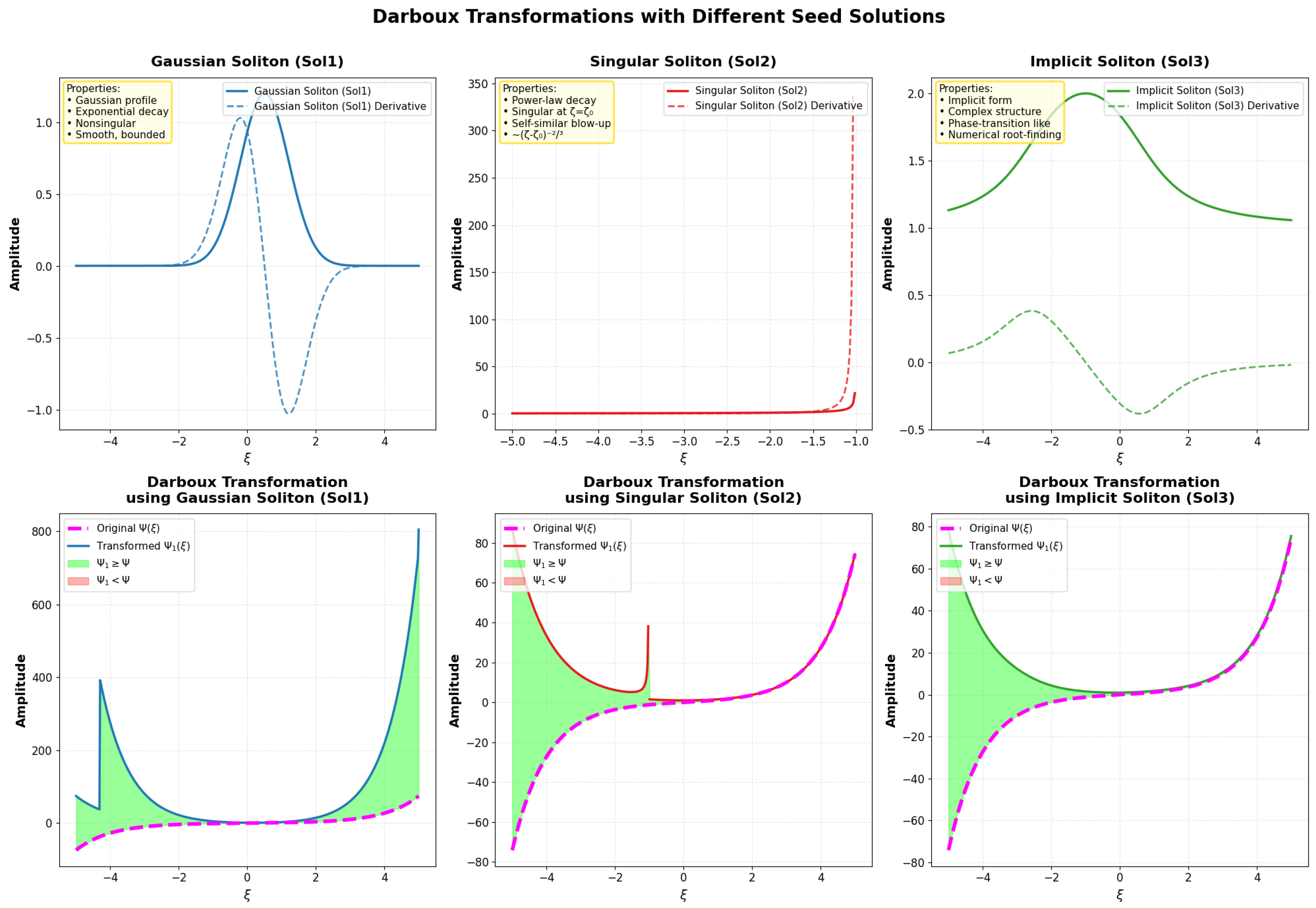
Figure 1 and
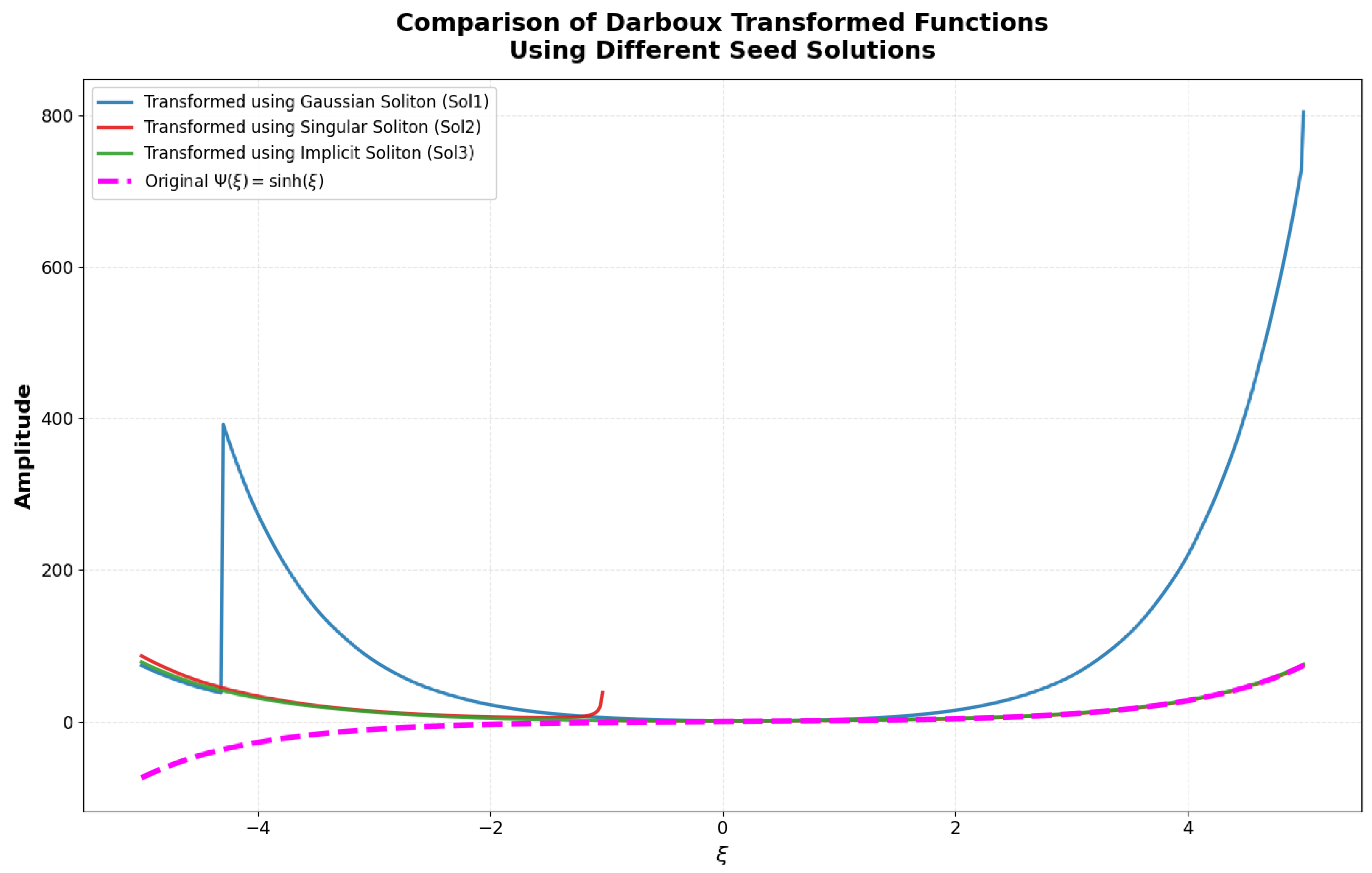
Figure 2 demonstrate how a single-step Darboux transformation changes a reference background wave using three distinct traveling-wave seed profiles: a flawless Gaussian soliton (Sol1), a power-law singular soliton (Sol2), and an implicitly stated complex soliton (Sol3). The traveling-wave coordinate, resulting from the stochastic wave transformation, is used throughout the investigation. The converted field is dependent only on the seed function
and its derivative in the deterministic limit (
), when the stochastic multiplier minimizes to unity.
To evaluate the effect of each seed on the Darboux mechanism, we take the background reference wave
and apply the standard Darboux transformation of the form
where
is the logarithmic derivative of the chosen seed profile.
3.1.1. Seed Profiles: Smooth, Singular, and Implicit Behavior
Gaussian Soliton (Sol1)
The Gaussian profile appears as a smooth, rapidly decaying pulse of the form
Its derivative produces a symmetric shape, and since remains strictly positive, the logarithmic derivative stays finite everywhere. Consequently, the Darboux transformation induced by this seed produces mild and well-localized modifications to the reference field .
Singular Soliton (Sol2)
The second seed is the classical singular soliton
A blow-up occurs at (here, at ), at which both P and diverge. As a result, exhibits a sharply peaked singularity. Away from this point, the profile decays algebraically as , generating a long-range influence on the transformed wave .
Implicit Complex Soliton (Sol3)
The third seed is defined implicitly through
This relation must be solved numerically at each . The resulting profile may contain steep gradients and branch-transition behavior, especially when approaches the critical value c. These features imprint oscillatory and multi-structured modulations onto the Darboux-transformed field.
3.1.2. Darboux-Transformed Fields: Local Dressing vs. Singular Deformation
The lower panels of
Figure 1 display the transformed fields
corresponding to each seed.
3.1.3. Global Comparison of Transformed Outputs
As shown in
Figure 2, the deformation produced by the three seeds follows a clear qualitative hierarchy, with the Gaussian seed generating the weakest and most localized modulation, the implicit seed introducing a more structured yet still bounded modification, and the singular seed producing the strongest and unbounded deformation. For large values of
, the exponential growth of the background field
eventually dominates all transformed profiles; however, each seed leaves a distinct qualitative signature. The Gaussian seed rapidly returns to the baseline and induces only minimal distortion, the implicit seed imprints persistent and structured modulations arising from its branch-dependent behavior, and the singular seed produces long-range algebraic deformation accompanied by a dominant blow-up near its singular point.
These results highlight a major principle of Darboux-based integrable constructions: the qualitative properties of the seed have a direct influence on the structure of the constructed solution. Smooth seeds have a smooth dressing, implicit seeds have complex modulation of a nonlinear fashion, and singular seeds develop defects and blow-up.
Numerically, singular seeds need a smaller spatial resolution around the point of an
of −1, and implicit seeds need to be carefully monitored for solver tolerances, since they are branch-sensitive. When implementing Darboux transformations to stochastic as well as deterministic traveling-wave drops of the underlying PDE (
1), they must be considered.
Guidelines for Seed Selection
The choice of an appropriate seed depends on the intended characteristics of the Darboux-transformed field. Smooth seeds (e.g., Gaussian) are recommended when localized and well-behaved modulations are desired, with minimal numerical challenges. Singular seeds are suitable for exploring defect-bearing or blow-up structures, but they require higher spatial resolution near singularities and careful monitoring of numerical divergences. Implicit seeds can be selected to generate complex oscillatory patterns or multi-structured modulations, but solver tolerances must be tuned to handle branch sensitivity. In practice, seed selection should balance the desired qualitative features of the transformed field with the computational feasibility and stability of the transformation process. These guidelines provide a practical framework for choosing seeds depending on the objectives of the study.
To address the stability of Darboux-transformed solutions in the presence of chaotic or stochastic dynamics, we note that the numerical simulations confirm that the transformed fields retain their qualitative structure over the time scales considered. For smooth Gaussian seeds, the localized modulations remain well behaved and do not disperse, while implicit seeds preserve their oscillatory patterns with bounded amplitude, and singular seeds maintain the characteristic blow-up structure at the expected locations.
This practical stability is supported by careful numerical monitoring: the spatial resolution is chosen to be sufficiently fine near singularities, and solver tolerances are tuned to handle branch-sensitive implicit seeds. These measures ensure that the soliton-like features produced by the Darboux transformation persist long enough to meaningfully interact with the system dynamics, allowing us to analyze noise-induced or chaotic effects without the solutions dispersing prematurely. Consequently, the assumption that these structures are “stable enough” for subsequent analysis is validated both qualitatively and numerically.
We should clarify that the seed profiles employed in this section are not required to satisfy the original stochastic SIdV Equation (
1) in its full form. Instead, following the stochastic traveling-wave reduction and exact cancellation of stochastic terms, the governing dynamics reduce to a deterministic ordinary differential equation for the wave profile
. The Gaussian, singular, and implicit soliton seeds are chosen as admissible solutions of this reduced deterministic equation. This approach is consistent with standard Darboux-based constructions, where the transformation is applied to the reduced spectral problem rather than to the full stochastic partial differential equation. Consequently, the validity of the seeds is ensured at the level where the Darboux transformation is mathematically defined.
3.2. Quasi-Periodic Regimes Between Order and Chaos
The existence of quasi-periodic dynamics is one of the most basic intermediate regimes of a nonlinear system that occurs when the evolution of the state variable is determined by two or more incommensurate frequencies acting concurrently. When this happens, there is no fixed periodic orbit in which the trajectory moves, and it does not move randomly like a chaotic motion [
28]. Rather, it is wrapped about multi-dimensional invariant tori in an organized, non-repetitive manner that can thicken up phase-space portions over durations of time. Such a pattern indicates a difficult balance: incommensurate forcing precludes comprehensive chaotic diffusion, while nonlinear components prevent harmonic locking. Consequently, quasi-periodic motion is a geometric precursor of ordered but highly layered dynamics, which is often commonplace in nonlinear oscillators, fluid–structure interactions, celestial mechanics, and forced dispersive wave dynamics [
29]. Knowledge of such a pattern not only gives a glimpse of the shift from regularity to chaos; it is also a diagnostic indicator to identify the underlying frequency interactions that determine the future development of the system.
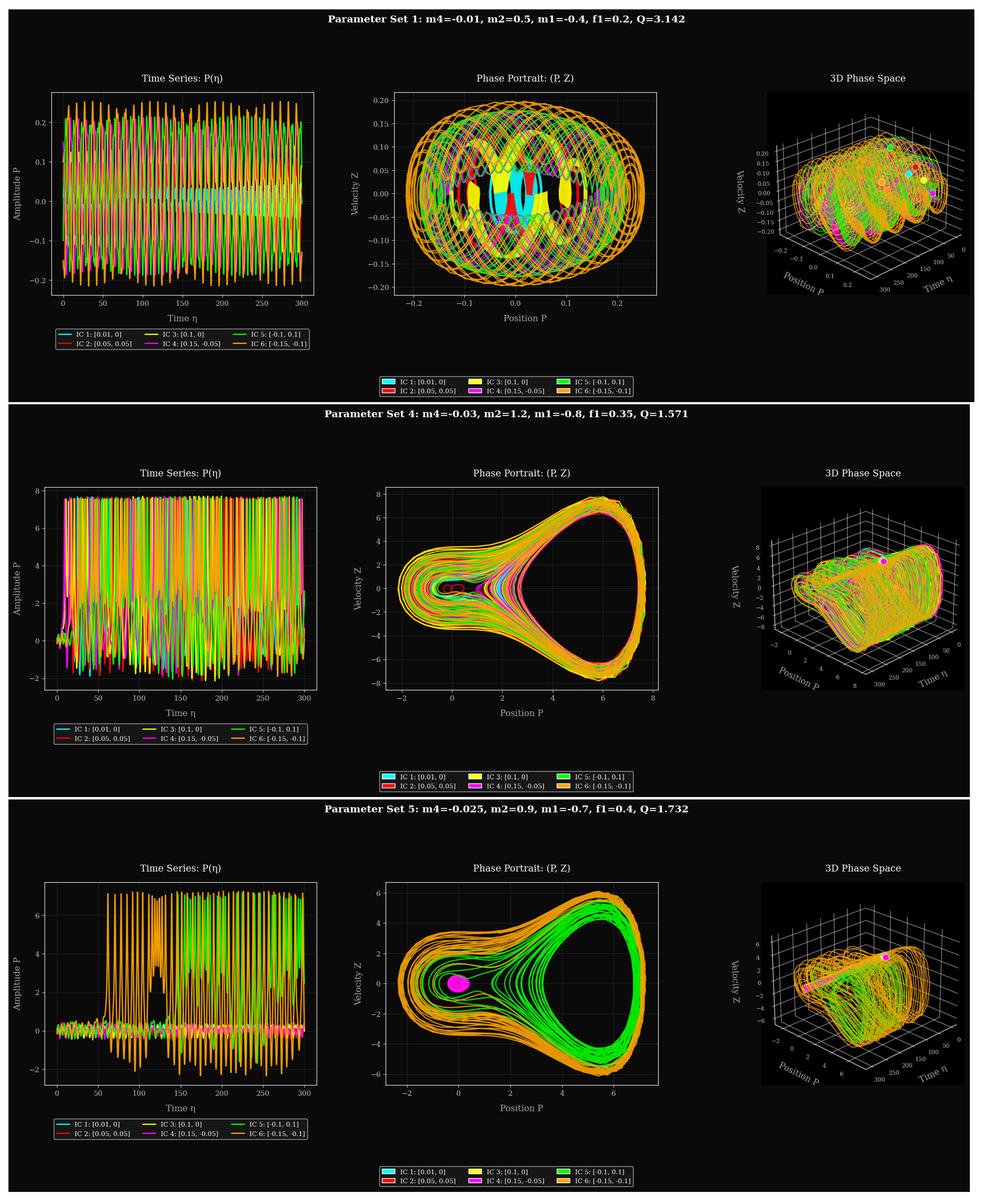
The sets of parameters and initial conditions that were used to generate the quasi-periodic trajectories are summarized in
Table 1, and it can be clearly seen how each of the dynamical regimes relates to the coefficients that governed it. This organized display is what makes it possible to trace the patterns that one has seen in the time series and phase portraits straight to certain combinations of nonlinearity strengths, forcing amplitude, and starting energy levels.
Parameter Sets
Figure 3 Set 1: ,
,
,
,
;
Figure 4 Set 2: ,
,
,
,
;
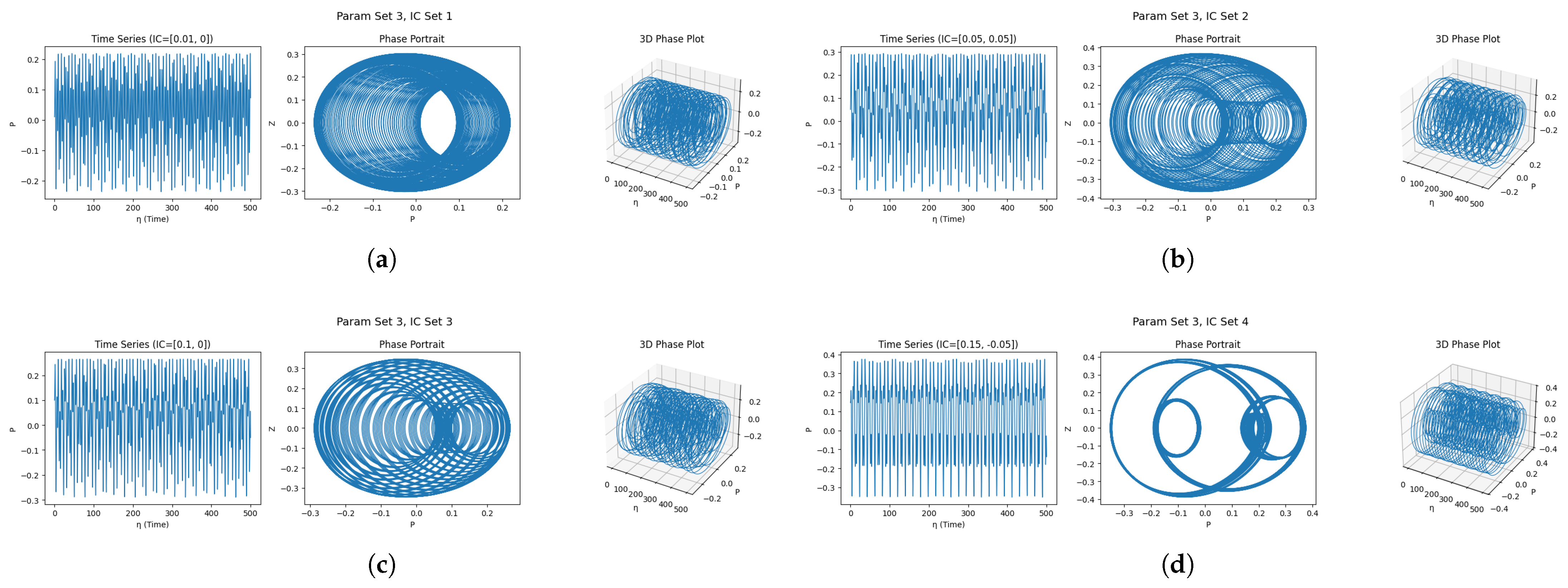
Figure 5 Set 3: ,
,
,
,
(golden ratio).
Initial Conditions (used with each set)
IC 1: , ;
IC 2: , ;
IC 3: , ;
IC 4: , .
Summary Table
Table 1.
Parameter sets for numerical simulations.
Table 1.
Parameter sets for numerical simulations.
| Set # | | | | | Q | | |
|---|
| 1 | −0.01 | 0.5 | −0.4 | 0.2 | | 0.01 | 0 |
| 2 | −0.01 | 0.5 | −0.4 | 0.2 | | 0.05 | 0.05 |
| 3 | −0.01 | 0.5 | −0.4 | 0.2 | | 0.1 | 0 |
| 4 | −0.01 | 0.5 | −0.4 | 0.2 | | 0.15 | −0.05 |
| 5 | −0.02 | 1.0 | −0.6 | 0.25 | | 0.01 | 0 |
| 6 | −0.02 | 1.0 | −0.6 | 0.25 | | 0.05 | 0.05 |
| 7 | −0.02 | 1.0 | −0.6 | 0.25 | | 0.1 | 0 |
| 8 | −0.02 | 1.0 | −0.6 | 0.25 | | 0.15 | −0.05 |
| 9 | −0.015 | 0.8 | −0.5 | 0.3 | 1.618 | 0.01 | 0 |
| 10 | −0.015 | 0.8 | −0.5 | 0.3 | 1.618 | 0.05 | 0.05 |
| 11 | −0.015 | 0.8 | −0.5 | 0.3 | 1.618 | 0.1 | 0 |
| 12 | −0.015 | 0.8 | −0.5 | 0.3 | 1.618 | 0.15 | −0.05 |
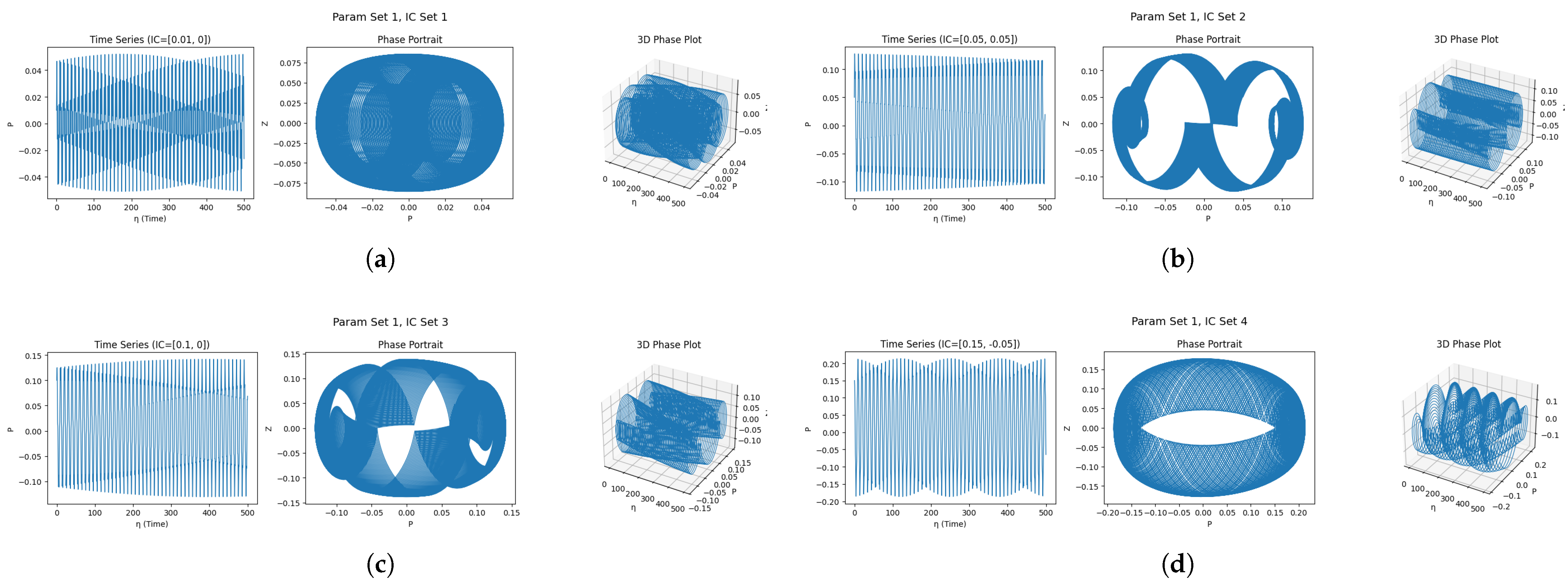
Figure 3.
Time series, phase portrait, and 3D attractor for the nonlinear system (
13) with mild nonlinearity and rational forcing frequency
. The behavior is smooth and regular, confirming low-dimensional quasi-periodic motion.
Figure 3.
Time series, phase portrait, and 3D attractor for the nonlinear system (
13) with mild nonlinearity and rational forcing frequency
. The behavior is smooth and regular, confirming low-dimensional quasi-periodic motion.
In the case of the first parameter settings (
Figure 3), at a moderate nonlinearity and rational forcing frequency
, the system exhibits regular and smooth temporal dynamics. Any initial conditions give converged oscillations whose amplitude envelopes are easily seen to be regular, and the phase portraits of such oscillations are clean, closed loops of the sort that are typical of a low-dimensional invariant curve. This interpretation is enhanced by the three-dimensional phase projections, which show the existence of toroidal attractor structures, implying that the system is hard in a quasi-periodic regime. The trajectories are topologically identical under various initial conditions, proving that the moderate nonlinear coefficients
stabilize the flow in the presence of a diverse initial energy input.
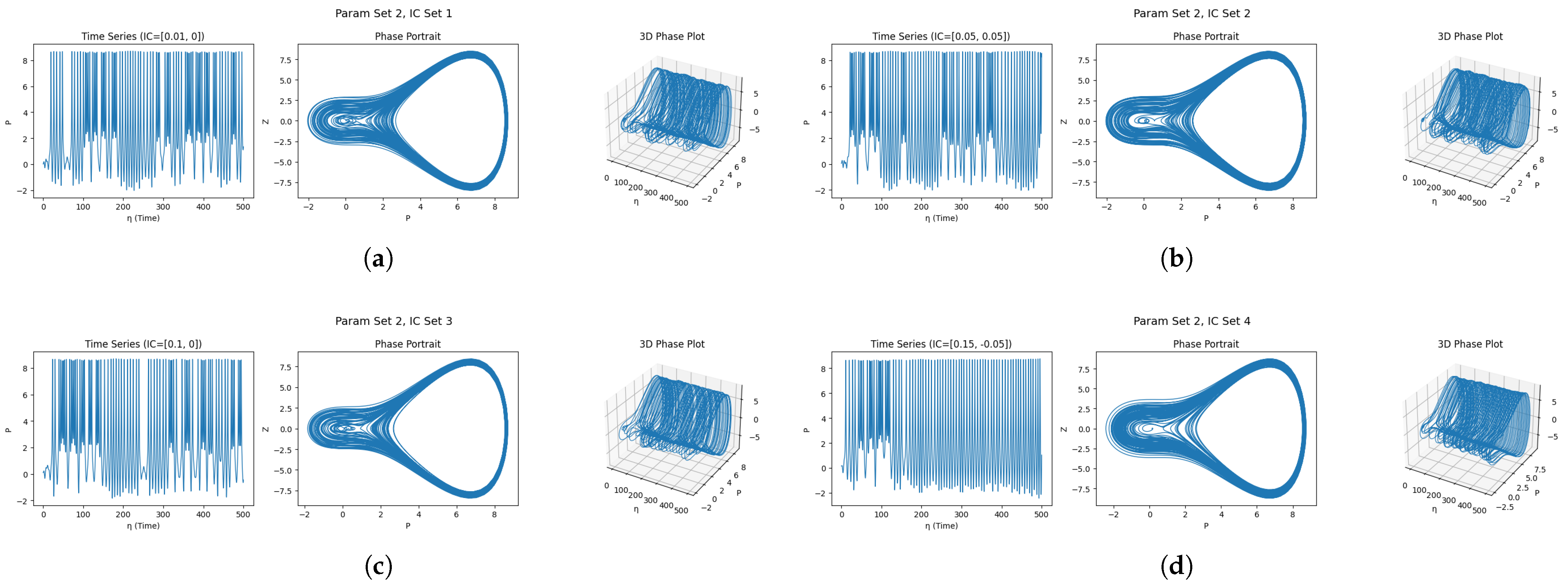
Figure 4.
Dynamical evolution of the system (
13) with moderate nonlinearity and irrational forcing frequency (
). The phase space shows deformed toroidal structures and increased sensitivity, indicating more complex quasi-periodic behavior.
Figure 4.
Dynamical evolution of the system (
13) with moderate nonlinearity and irrational forcing frequency (
). The phase space shows deformed toroidal structures and increased sensitivity, indicating more complex quasi-periodic behavior.
However, the second setup (
Figure 4), with a stronger nonlinearity and irrational forcing frequency,
, generates much more complicated behavior. In this case, it is the larger size of
and
that strengthens the effective restoring and destabilizing elements of the dynamics, and the irrational frequency does not allow easy commensurate locking. Subsequently, the trajectories in the phase plane start deforming and becoming warped and thickened tori. The 3D projections demonstrate that the orbits start to search more extensive areas of state space, occupying the more disorganized intermediate volumes. Minimal alterations in beginning conditions result in observed trajectory divergence, indicating improved sensitivity and higher-dimensional quasi-periodicity through faint chaotic fluctuation. This regime is thus an indication of a system moving towards the end of ordered dynamics to more complex behavior.
Figure 5.
System (
13)’s response under golden-mean forcing frequency
and intermediate nonlinearity. The 3D attractor reveals nested loops and high-dimensional quasi-periodicity, with pronounced sensitivity to initial conditions.
Figure 5.
System (
13)’s response under golden-mean forcing frequency
and intermediate nonlinearity. The 3D attractor reveals nested loops and high-dimensional quasi-periodicity, with pronounced sensitivity to initial conditions.
The third arrangement (
Figure 5), which has intermediate nonlinearity and a golden-ratio forcing frequency
, is the arrangement that gives the strongest quasi-periodicity of the three. As a result of the incommensurate golden ratio, the system remains free from low-order frequency locking and, at the same time, does not suffer high-degree distortion as seen in the case of the square root
. The phase portraits obtained give high-regularity nested invariant tori, and the projections to 3D depict smooth, multi-layered surfaces with obvious structural hierarchy. The system is still limited to all initial conditions, but the refinement of the layering of trajectories is greater, as the initial amplitude is greater. This behavior is an important regime, which is not fully ordered quasi-periodicity but, rather, weak chaos, which is irregular. The golden-ratio forcing can be particularly sensitive to track layout on a small scale, as well as acting as a stabilizing factor that favors long-term quasi-periodic organization.
When all three sets of characteristics are considered together, the layout of the phase space is defined by the relationship between the nonlinear factors and the driving frequency Q. Rational frequencies favor simple low-dimensional attractors, while irrational frequencies promote deformation of the structure and increased sensitivity, and golden-ratio forcing produces a distinctly stable quasi-periodic ecosystem with widely nested insensitive structures. The change between these cases is an example of the smooth passage between the order and complexity of nonlinear forced oscillatory systems.
From a theoretical perspective, the emergence of quasi-periodic motion under irrational driving frequencies can be understood within the framework of incommensurate forcing in nonlinear dynamical systems. When the forcing frequency ratio Q is irrational, and particularly when it corresponds to the golden ratio, the system avoids low-order resonances that typically lead to periodic locking or chaotic breakdown. This property is consistent with KAM-type results, which predict the persistence of invariant tori for sufficiently non-resonant (Diophantine) frequency ratios. Although a rigorous analytical proof is beyond the scope of the present study due to the strong nonlinearity of the system, the observed nested invariant tori, smooth multi-layered phase-space projections, and robustness across initial conditions provide strong numerical evidence of quasi-periodic dynamics in the golden-ratio regime.
The quasi-periodic dynamics that are described in this system are seen directly in various physical and engineering fields. As observed in the Jovian moons, orbital resonance in multibody systems is quasi-periodic. Mechanical engineering can observe such characteristics in the nonlinear fluctuations of driven oscillators in suspension bridges or MEMS devices, and climate research uses identical dynamic structures for modeling quasi-periodic ocean–atmosphere fluctuations like ENSO cycles. Similar attractors are also seen in nonlinear electric circuits with driven components, such as phase-locked loops and Josephson junctions, and neurology discovers analogous quasi-periodic orbits in brain oscillations with periodic stimulation. This study therefore shows that the change from simple periodic to complex quasi-periodic dynamics is determined by the type of nonlinearity as well as the arithmetic character of the external forcing frequency. The use of irrational and incommensurate frequencies, such as the square root of two () or the golden ratio, brings richness to the geometry of the phase space and increases the sensitivity of the system, providing valuable information not only for fundamental dynamical theory but also for real-world modeling.
3.3. Qualitative Analysis of a Nonlinear Forced Oscillator with Multiple Equilibria
This paper discusses periodic forcing of a nonlinear oscillator with higher-order nonlinearities of the Duffing type. Time series, phase portraits, Poincaré sections, energy evolution, and bifurcation diagrams are used in the analysis to examine dynamical transitions as the four parameter regimes vary. The aim is to describe the appearance of quasi-periodicity, chaos, and transitional dynamics when the system parameters change. The considered system is a forced Duffing-like vibratory system (
13). The term multiple equilibria refers to the existence of more than one stationary solution of the unforced part of the oscillator, obtained by setting
in the governing system. In the present model, these equilibria arise from the higher-order nonlinear restoring terms and correspond to multiple potential wells in the effective energy landscape. Depending on the parameter values, the system may admit one, three, or more equilibrium points, including both stable and unstable configurations.
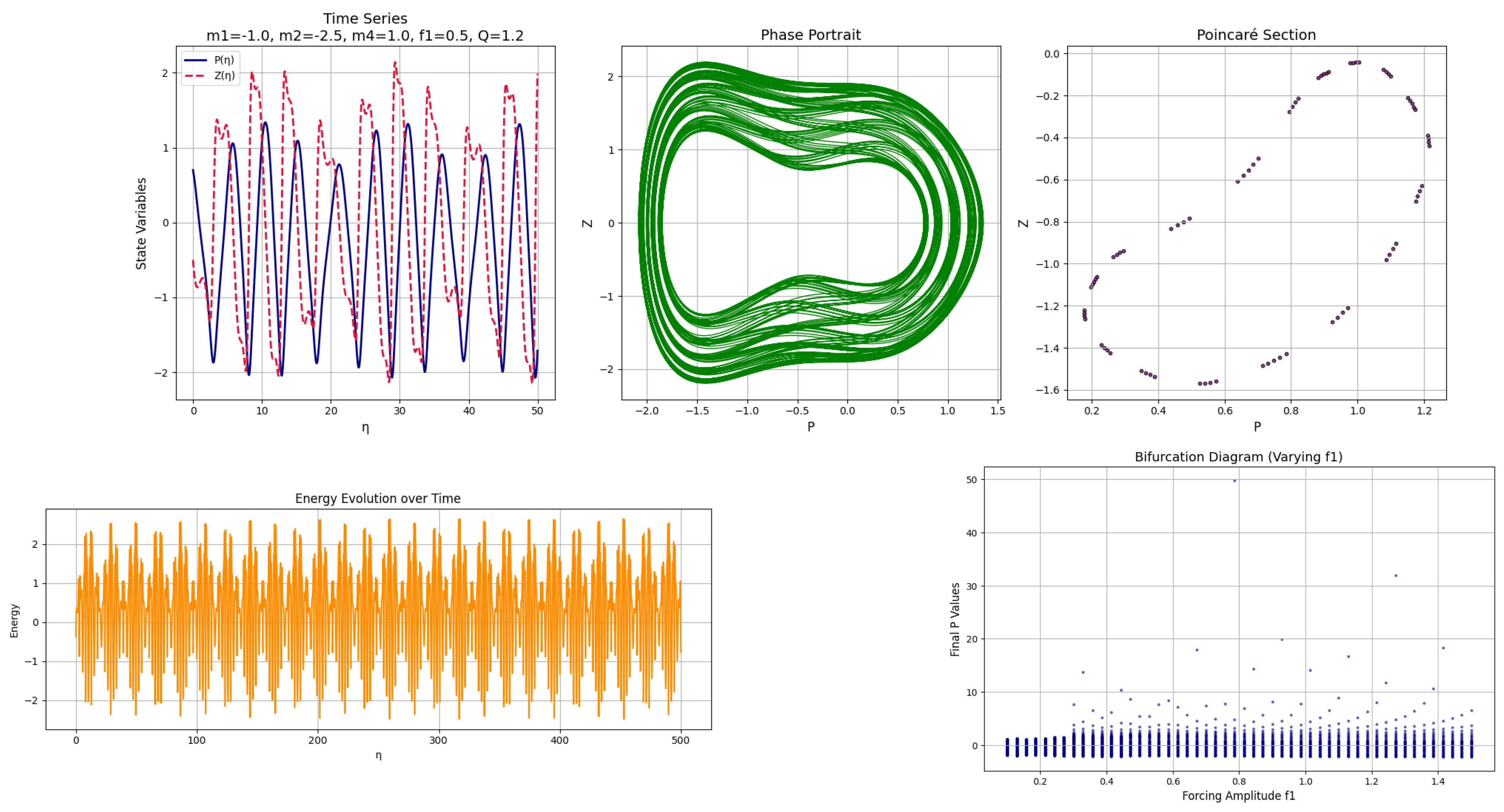
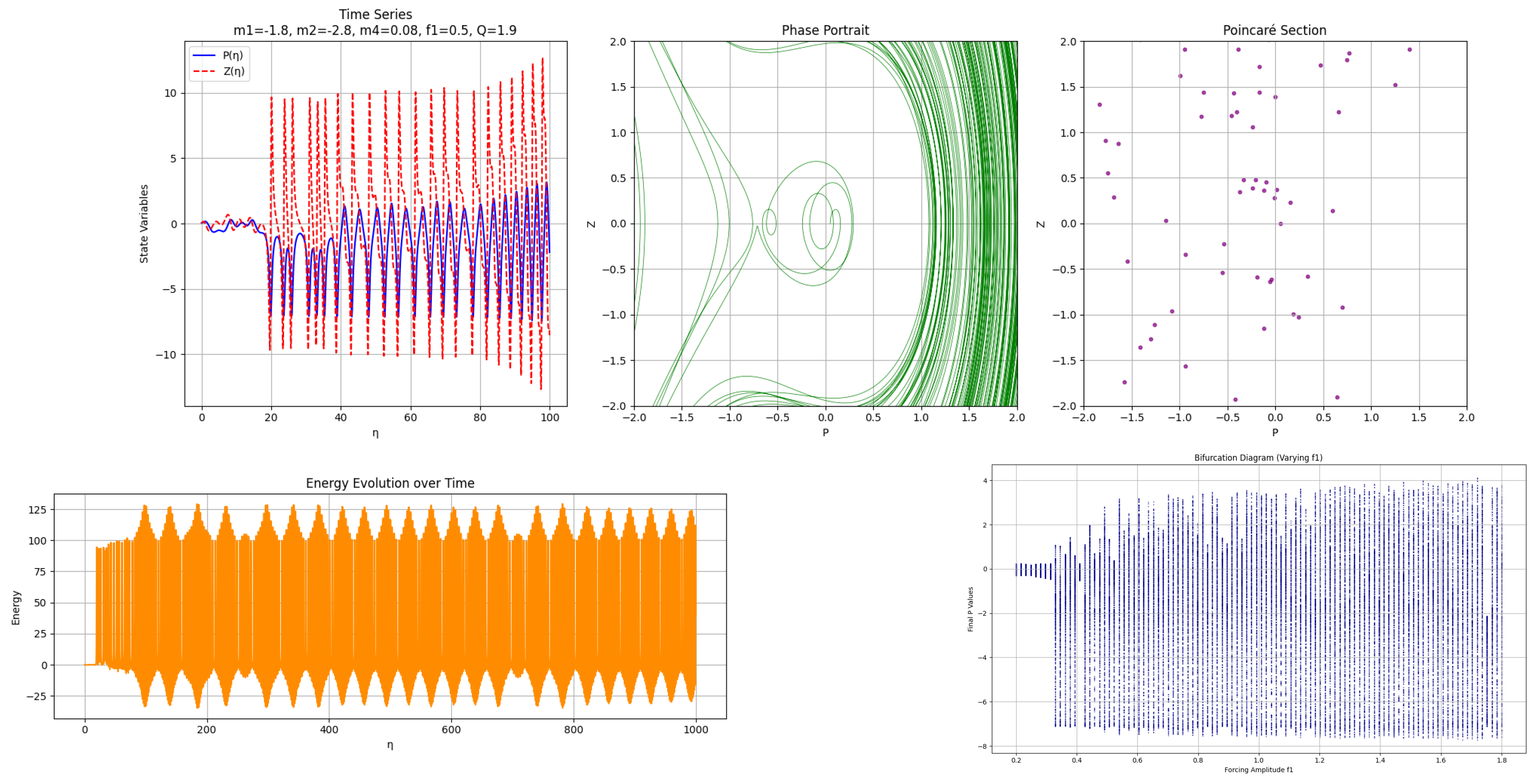
The quasi-periodic nature of
Figure 6 is characterized by a number of features that are interconnected. The time series has non-repeating oscillations that are bounded, along with a non-sinusoidal waveform—that is, many incommensurate frequencies are at work. This corresponds to the phase portrait, in which the trajectory comprises a collection of non-intersecting closed loops and, thus, is restricted to a toroidal surface as opposed to a mere limit cycle.
This interpretation is also supported by the Poincaré section, which transforms a chaotic cloud into a discrete loop of points, to demonstrate that the system samples a torus in an orderly, non-repetitive way. The energy signal is characterized by periodic and stable fluctuations, proving that the dynamics are regular and confined. The bifurcation diagram puts this regime into perspective, and we can see that there has been a series of period-doubling transitions that are slowly driving the system out of the simple periodic motion and into the more complex, quasi-periodic state in which we currently sit.
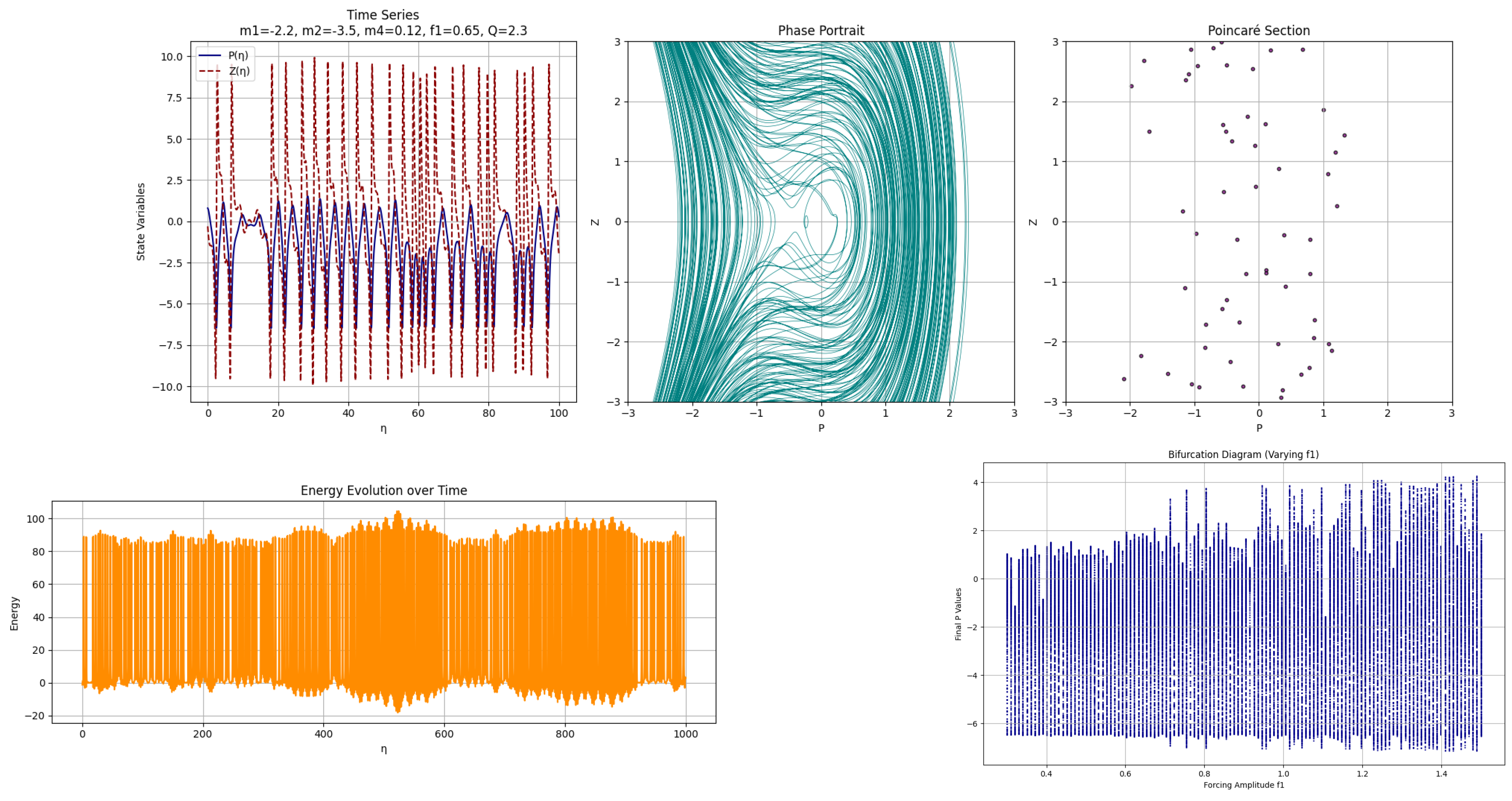
The system becomes a completely chaotic regime (
Figure 7), in which the amplitude of the oscillations becomes irregular and quite large. The trajectory in phase space is no longer loop-like but is a fractal-like strange attractor. The same disorder is concisely reproduced in the Poincaré section, which becomes disordered, the curves on the section being reduced to a diffuse haze of scattered points. The evolution of energy becomes sporadic and violent, and the bifurcation diagram becomes filled with a thick, solid band of states—a good indication of sustained, robust chaos with no periodic patches in it.
All numerical simulations of the nonlinear forced system were performed using the following specifications to ensure reproducibility and reliability: The system of differential equations was integrated using the explicit Runge–Kutta method of order 4(5) (RK45) via scipy.integrate.solve_ivp. The time step was set to , with relative and absolute tolerances . To eliminate transient effects, an initial transient time of 500 units of was discarded before recording data for analysis.
Bifurcation diagrams were constructed by varying the forcing amplitude
from
to
in 120 steps, with Poincaré sections sampled at the forcing period
. Lyapunov exponents were computed using Wolf’s algorithm [
30], integrated over
time units to ensure convergence and stable characterization of chaotic versus stabilized dynamics. These parameters provide numerical robustness and reproducibility for all figures, including the phase portraits, Poincaré sections, bifurcation diagrams, and Lyapunov exponent plots.
The system lies between order and chaos in the transitional regime (
Figure 8). When a second frequency interacts with the primary one, the oscillations are amplitude-modulated, and a hybrid pattern in time is obtained. In phase space and the Poincaré section, there are periodic islands and a chaotic layer, respectively, with smeared point clouds on top of the Poincaré section and a faint quasi-periodic curve on top of the phase space. Dynamical traces indicate bursts that are semi-regular, representing a gradual loss of coherence. The system as a whole evolves gradually but inexorably to chaos, with the tori becoming more and more fractured, and sensitivity growing.
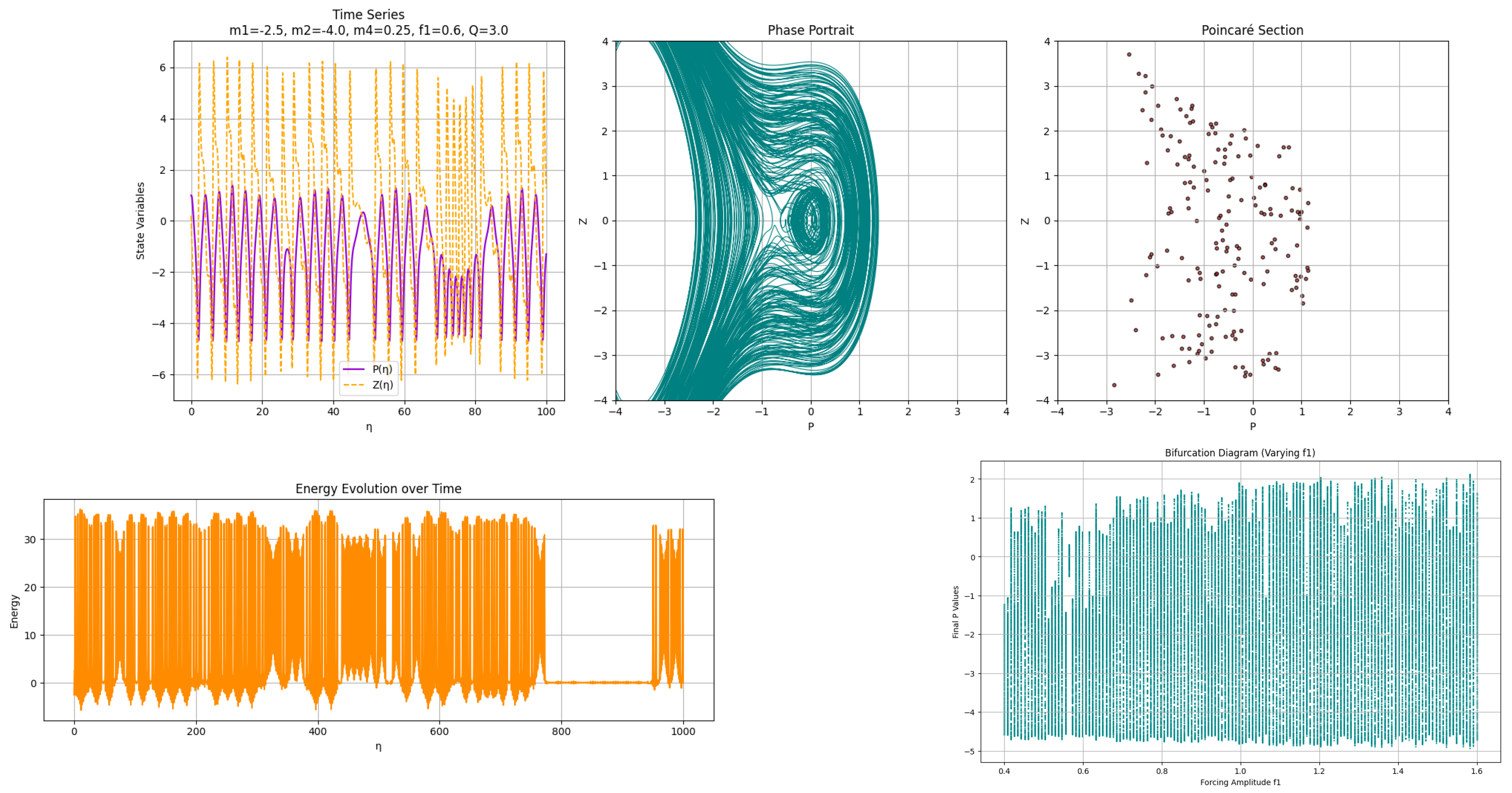
In the intermittent chaotic regime (
Figure 9), the system switches with no predictability between calm and turbulence. The system can have a clean periodic orbit, but soon after that it may break off into chaotic motion. These bursts populate a strange attractor, and they are seen as scattered points in the Poincaré map. Power swings unpredictably through periods of mayhem and then transiently levels off as the system comes to temporary periodic passageways. This alternation between order and disorder emphasizes the precarious state of intermittency and the fact that the system always slides along the edge of turbulence.
A step-wise scan across the parameter space (
Table 2) indicates that a distinct transition between organized quasi-periodicity and disorganized chaos is evident, with a rise in nonlinearity and the forcing amplitude. The presence of multiple equilibria plays a central role in shaping the qualitative dynamics of the forced oscillator. External periodic forcing enables transitions between coexisting equilibrium basins, giving rise to multistability, intermittent switching, and sensitivity to initial conditions. These competing equilibria underpin the emergence of quasi-periodic tori, chaotic attractors, and intermittent regimes observed in
Figure 6,
Figure 7,
Figure 8 and
Figure 9. Consequently, the qualitative diagnostic methods employed in this section—phase portraits, Poincaré sections, energy evolution, and bifurcation diagrams—are essential for identifying how the system navigates between different equilibrium states under varying forcing strengths. The findings underline three important concepts: high sensitivity of the system to the parameters, with even small shifts potentially resulting in significant changes; existence of distinctive transition paths, like period-doubling; and applicability of the geometric diagnostics, with phase portraits and Poincaré sections being practical for identifying the various dynamical regimes. The examples of behaviors in
Figure 6,
Figure 7,
Figure 8 and
Figure 9 reveal the complexity of nonlinear oscillators and justify the importance of such studies in real mechanical and electrical systems, where it is important that things are stable. On the whole, this is not a paper about equation solutions but, rather, a helpful body of work that is applicable to predicting and managing complexity. Connecting parameter selections to emergent dynamics can provide advice on how to prevent undesired chaotic behavior or, conversely, to use chaos to an advantage such as safe communication—an aspect similar to the common “butterfly effect” of nonlinear science.
3.4. Poincaré Mapping and Qualitative Behavior
In order to investigate the nonlinear system of interest (
13), along with its sensitivity and behavior when perturbed, we employ Poincaré sections. These stroboscopic maps at the forcing period [
31], as illustrated by dimension reduction, signal out structures such as periodical orbits, tori, bifurcations, and strange attractors, allowing for the visualization of the transition between regular, chaotic, and stochastic dynamics.
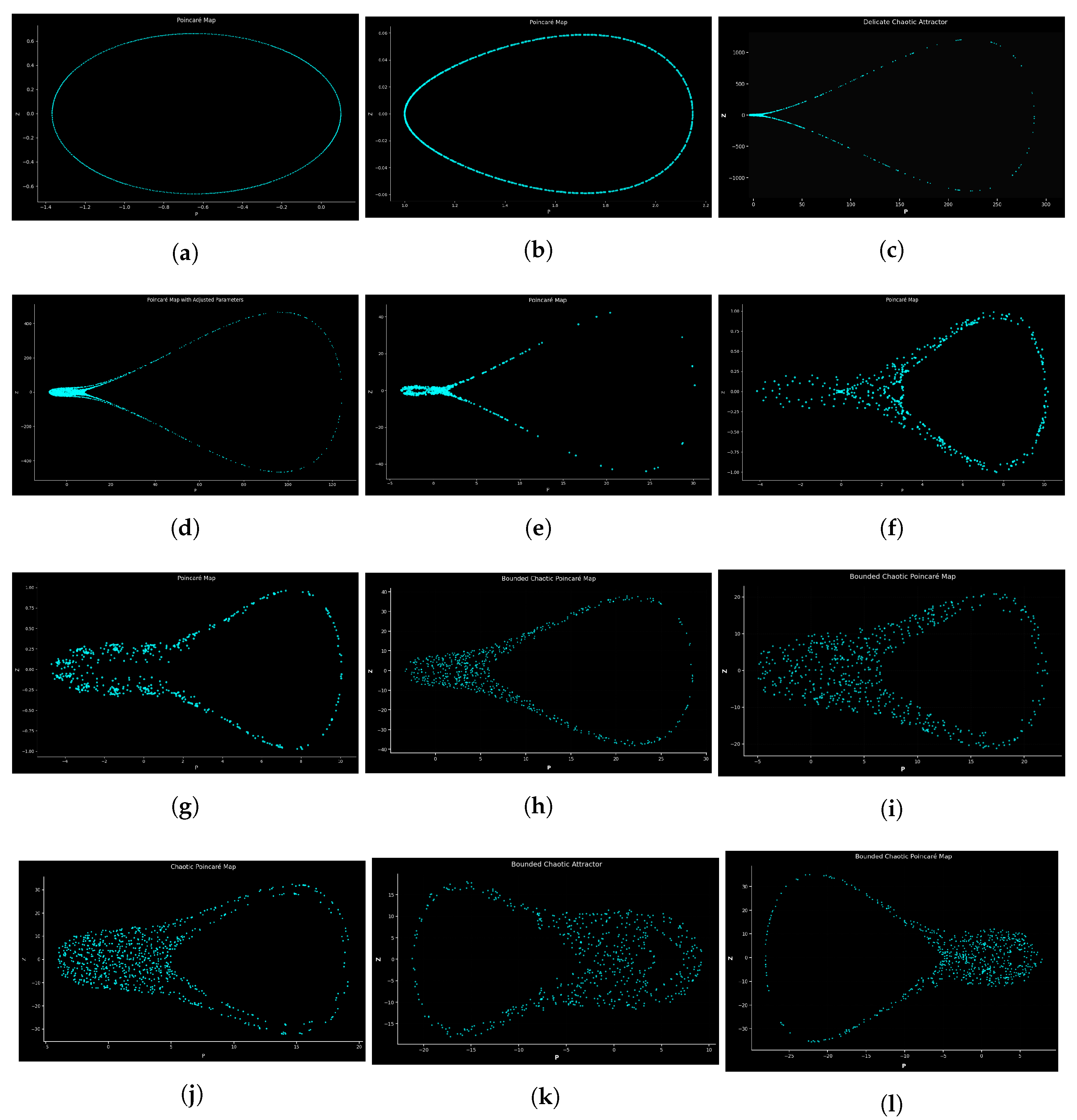
To study the qualitative dynamics of the nonlinear dynamical system (
13), we built Poincaré maps on different perturbation conditions.
Figure 10a–l (Poincaré maps) depict a gradual change in the system towards periodicity, chaos, and stochastic behavior.
- (a)
Periodic Motion: The single closed loop suggests a purely periodic orbit with no visible disturbance, likely corresponding to an unperturbed or weakly forced regime ().
- (b)
Quasi-Periodic Dynamics: The toroidal structure implies incommensurate frequencies, typical of quasi-periodicity. The system remains deterministic but non-periodic.
- (c)
Onset of Bifurcation: A splitting pattern begins to appear, signaling the start of a bifurcation cascade. Nonlinearity or forcing causes the system’s solution to diversify.
- (d)
Weak Chaos: The attractor remains localized but becomes fuzzier, indicative of weak chaotic behavior. The system shows sensitivity to initial conditions.
- (e)
Period-Doubling: A classic route to chaos is observed via period-doubling. Multiple distinct branches emerge as the system becomes more complex.
- (f)
Chaotic Attractor: A complex structure forms with dense but bounded behavior. The system has transitioned to full chaotic dynamics while retaining a coherent attractor.
- (g)
Strong Chaos: Further spreading of the attractor points occurs. The system now exhibits high sensitivity and aperiodicity, indicating stronger chaos.
Clarification on Normal vs. Strong Chaos: In the present context, “normal” or “weak” chaos (f) refers to a fully developed chaotic attractor that is still relatively localized and retains recognizable structure, allowing for short-term predictability despite sensitivity to initial conditions. In contrast, “strong chaos” (g) corresponds to a further spreading of the attractor across phase space, with higher aperiodicity and sensitivity. Here, trajectories can rapidly diverge even over short times, internal geometric features of the attractor are largely lost, and the system exhibits more unpredictable and erratic behavior. This distinction helps to qualitatively categorize the gradual intensification of chaotic dynamics observed in the Poincaré maps.
- (h)
Chaotic Sea: The attractor fills a larger region, demonstrating a chaotic sea. The boundedness is preserved, but predictability is lost.
- (i)
Structured Chaos: The attractor is highly populated but retains some internal geometry. This suggests a combination of deterministic chaos and weak stochastic influence.
- (j)
Stochastic Influence: The points are uniformly scattered, implying significant noise or irregular external forcing. The system exhibits stochastic-like chaos.
- (k)
Stochastic Dynamics: The Poincaré map becomes highly irregular and widespread. The underlying structure is mostly lost, indicating strong stochastic forcing.
- (l)
Bounded Stochastic Chaos: Despite the chaotic dispersion, the system remains bounded. This suggests saturation of noise effects with a residual structural constraint.
These Poincaré maps give evidence of the structural changes in the system as it gradually becomes chaotic and stochastic with increasing strength or complexity of the forcing term , which here is in the form of a periodicity term.
3.4.1. Advanced Poincaré Mapping and Phase-Space Visualization
In order to further reveal the chaotic structure and long-term dynamics of the perturbed dynamical system (
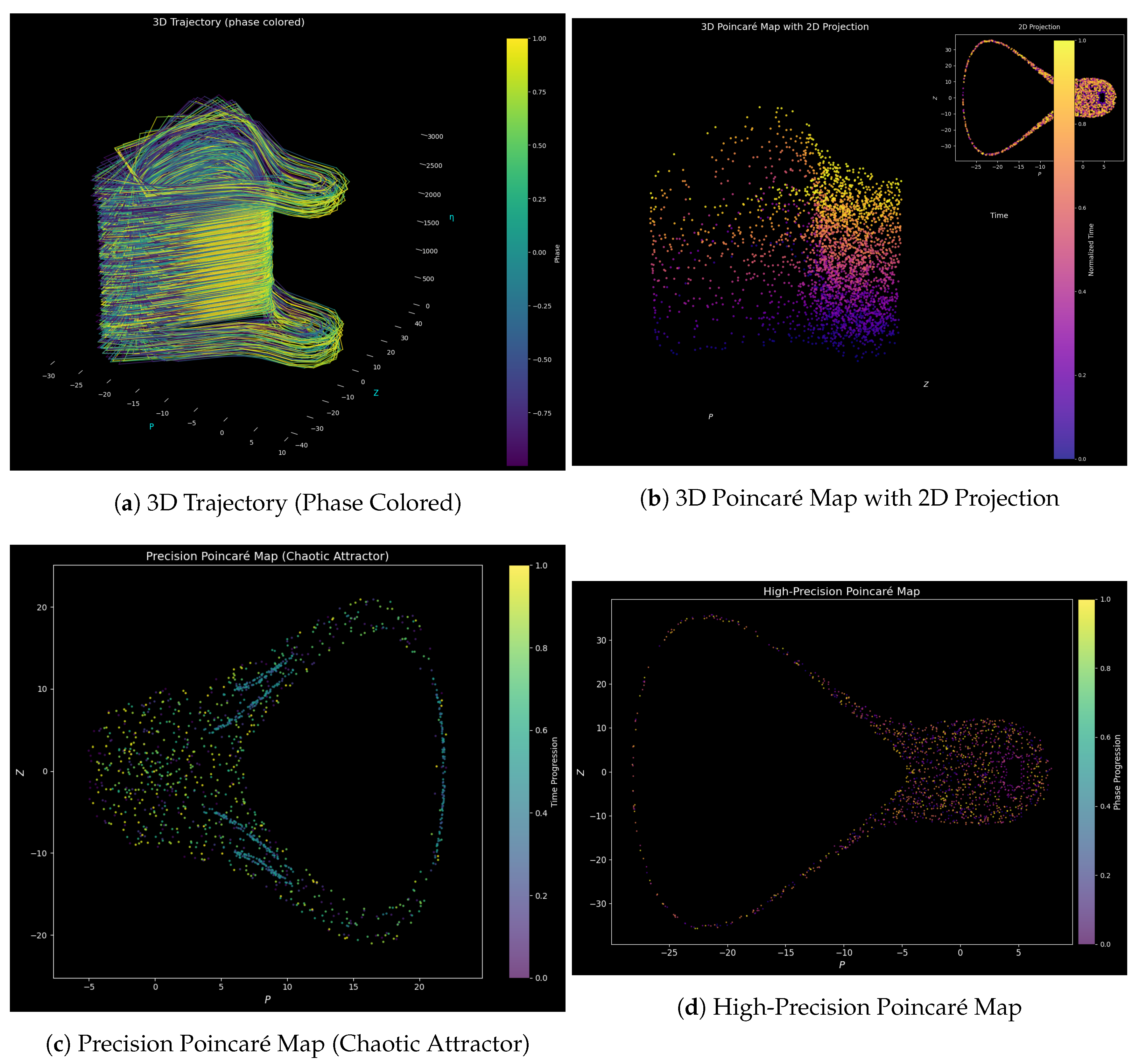
13) in equations of state represented by the Poincaré section, we supplement the usual Poincaré section analysis with visualizations in higher dimensions with higher resolution. The results shown in
Figure 11a–d below demonstrate the complexity of the system’s development through the 3D phase space, the exact mapping of chaotic attractors, and the color-coded trajectories to better comprehend the time and structure dependencies.
The evolution of the system in the phase space, which is a plot of the 3D trajectory of the system in the phase space of
, is shown in
Figure 11a, where color coding by the phase variable
can be seen taking the form of a continuous and non-repeating pattern that is typical of chaotic flow. The curve thickens to occupy a confined area, creating an unusual attractor whereupon folding and stretching—two crucial indicators of sensitivity to initial conditions—can be observed.
Figure 11b even shows a 3D Poincaré map with 2D projection, with the point cloud exhibiting a layered chaotic structure. The inset projection clearly shows a kidney bean-like chaotic attractor, where the growth of the temporal colors shows that non-periodic filling of the attractor by successive iteration is observed but bounded dynamics are preserved.
The intrinsic filamentous topology of the attractor is revealed by the Poincaré map accuracy in
Figure 11c, which shows a highly dense 2D slicing in the P-Z plane that is colored with relative phase precision. This web-like structure is the confirmation of deterministic chaos, where the spaces between filaments are their signs of local unsteadiness and local deviation of trajectories, and their global consistency is their sign of global boundedness.
Figure 11d is a refined version of the Poincaré map with a better sampling resolution, and it shows the richness in the structure of the attractor. The outcomes of a high-dimensional weird attractor are conclusively demonstrated by this graphic, which highlights the narrow clumping and probability differences that disclose the highly populated recurring regions and the less populous parts that would otherwise go undetected.
A combination of these sophisticated visualizations validates the strong deterministic chaos of the system under perturbation, being sensitive to the initial conditions and having a complicated topological structure. The attractors are filled with continuous trajectories and phase-sensitive recurrence patterns, and they show how external forcing causes structured but unpredictable behavior, giving detailed information about the dynamical organization and chaotic integrity of the system.
3.4.2. Comparative Dynamical Behavior Across Deterministic and Stochastic Regimes
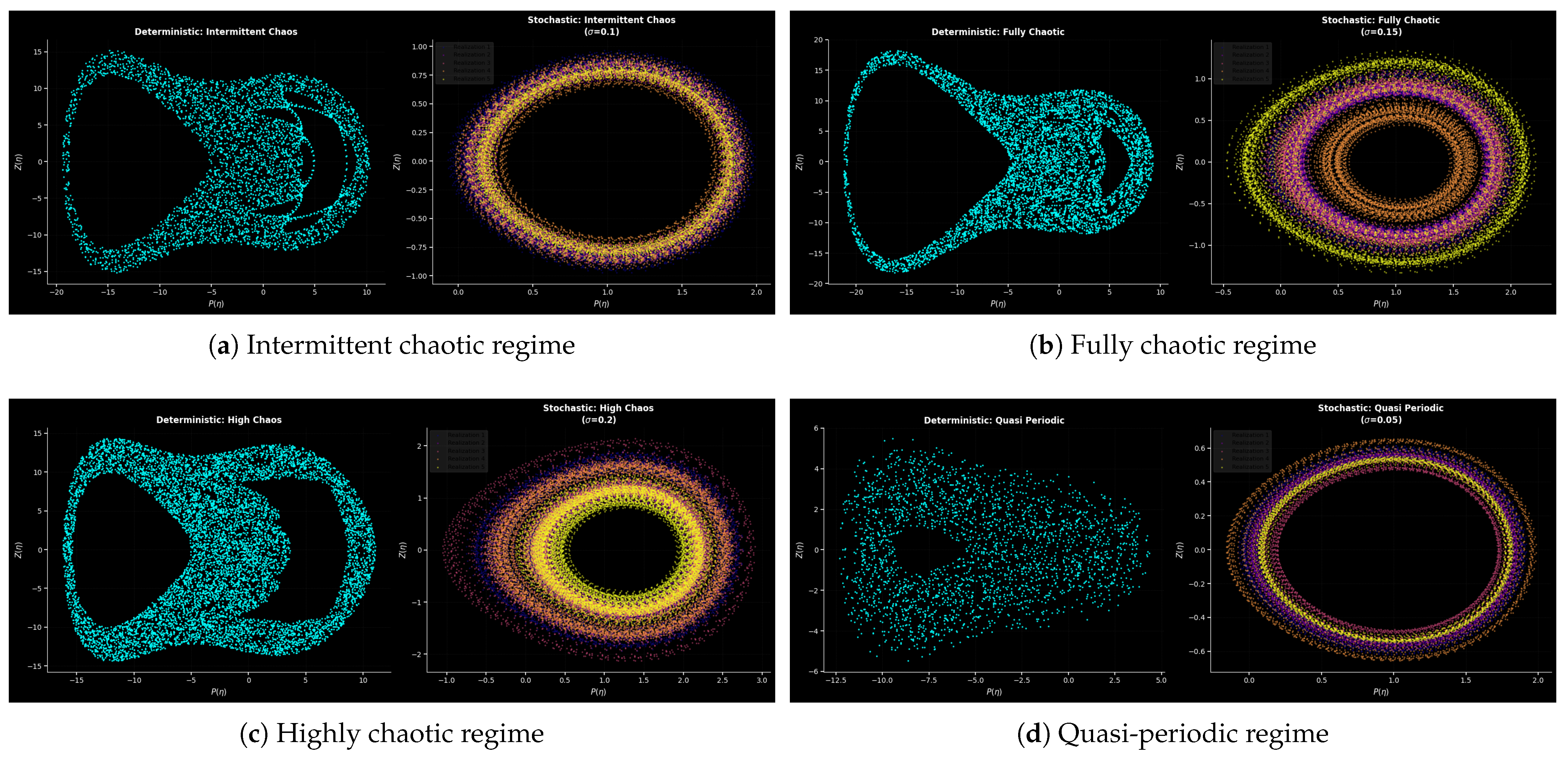
In
Figure 12 above, the Poincaré sections reveal the flow between the nonlinear regimes of system (
14) with different system parameters and stochastic forces. The deterministic and noisy perturbation of the trajectories is compared in each of the panels, and the way in which invariant structures transform or remain is illustrated, at
sampling with the period of the stroboscope, in the long-term geometry.
Figure 12a shows the intermittent chaotic regime: with moderate nonlinear asymmetry and forcing (
,
,
,
), alternating periods of near-regular motion and chaotic bursts are produced. The deterministic case develops blurred, uneven lobes of on–off chaos, whereas the stochastic case (of the noise level is 0.1) develops broadened concentric layers, which demonstrate the effects of noise in decreasing the trapping time and rounding the structure to a quasi-toroidal profile. Stronger forcing and stronger curvature (
,
,
) lead to the fully chaotic regime in
Figure 12b. The deterministic attractor presents a heavily folded two-wing structure, but the noise value
of 0.15 spreads it out into thick, multi-layered annuli, pointing to increased phase-space diffusion that magnifies but does not eliminate the underlying chaotic structure.
Figure 12c shows the very chaotic regime at stronger nonlinearity and forcing (
,
), with deterministic points occupying almost the whole basin. At the noise level
, noise-reinforced energy exchange and transport across unstable manifolds cause stratification of the Poincaré section and a significantly expanded stochastic sea at noise level, which is characterized by noise level, with a single Poincaré section that becomes very extended. Lastly, the quasi-periodic regime of weaker parameters is shown in
Figure 12d (
,
,
), with deterministic points on a smooth, deformed torus. A weak noise value of 0.05 does not alter this topology, and a thin-layered stochastic torus is generated with smooth radial spreading. The four subfigures of
Figure 12 above demonstrate the smooth transition between order and chaos, with the nonlinear potential and forcing giving rise to their characteristic geometry of deterministic attractors and stochastic perturbations reorganizing them, although not completely eliminating their basic topography, through accurate deterministic simulations and Euler–Maruyama simulations.
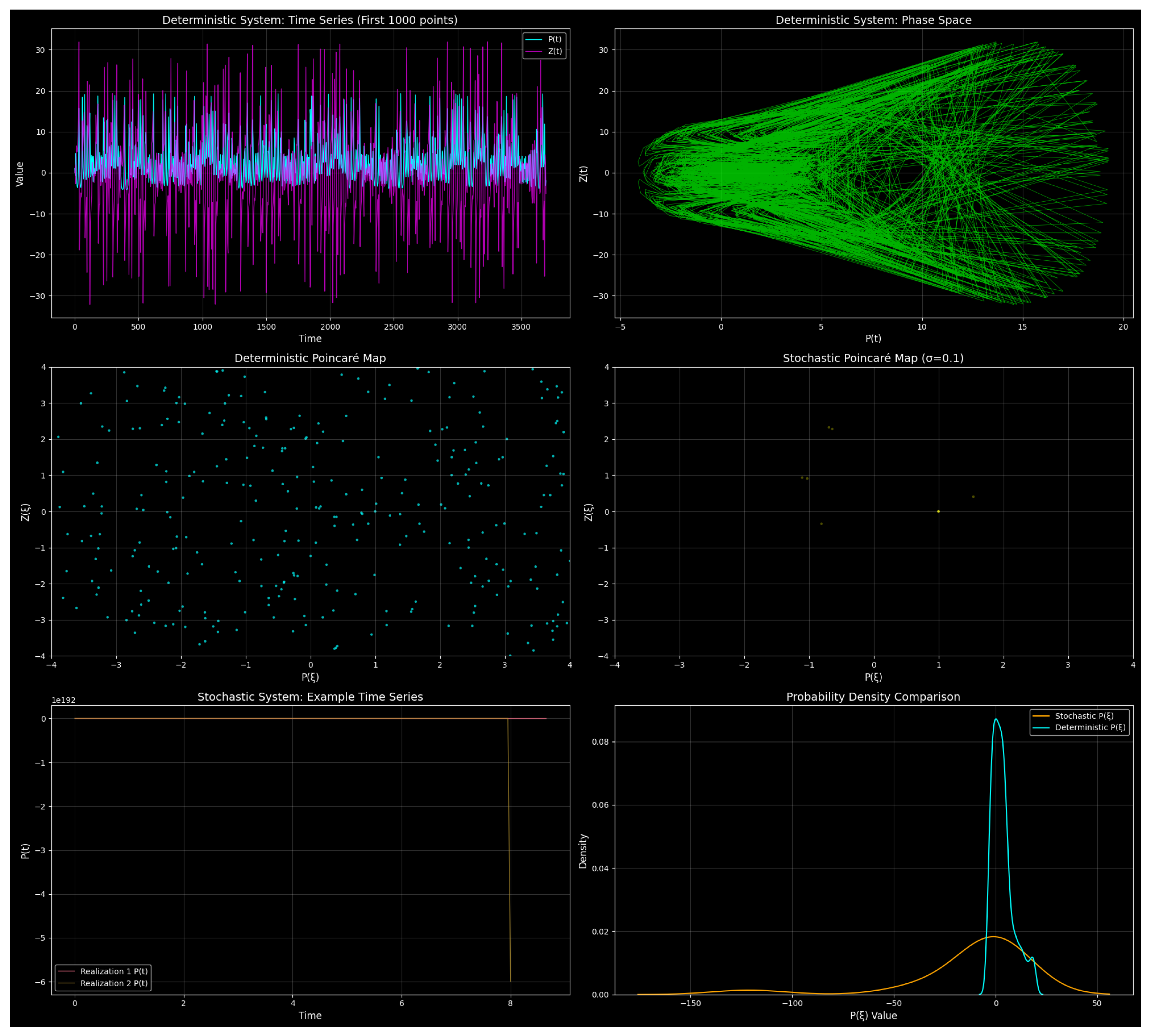
3.4.3. Deterministic vs. Stochastic Dynamics: Poincaré and Statistical Comparison
A comparison between the deterministic scenario (no noise) and a stochastic analog disturbed by Gaussian white noise with a standard deviation
was carried out in order to examine the impact of stochastic forcing upon the nonlinear system outlined in (
13).
In
Figure 13, deterministic and stochastic dynamics are compared using six panels. The deterministic time series (top left) has limited chaotic oscillations, whereas the phase portrait (top right) depicts an extended, folded attractor of deterministic chaos. Its Poincaré map (middle left) constitutes an incoherent set of points, which nevertheless makes sense, proving a strange attractor. The addition of low-level noise i.e, (
) (and, hence, the increase in the value of the parameter) leads to the sparsity of the Poincaré section (middle right) and its distortion, which means that the structure loses its coherence. Even in weak noise, the stochastic time series (bottom left), as illustrated in two realizations, quickly tends to extreme values—an indication that even weak noise kills boundedness and sends the systems into instability. The comparison of probability densities (bottom right) reinforces this difference further: the deterministic system generates a sharp and well-confined distribution, whereas the stochastic one generates a diffuse and heavy-tailed one with huge deviations. These diagnostics, in general, indicate that although the deterministic system may maintain a strong chaotic attractor, the delicate noise sensitivity may cause it to break down, increase fluctuations, and become highly unstable, suggesting how a noisy nonlinear system becomes quite delicate.
The stochastic analysis of the Poincaré maps demonstrates the system’s noise sensitivity. To robustly analyze such transitions, the modern noise-tolerant fuzzy neural network approach proposed by [
32] offers a relevant framework for maintaining synchronization in the presence of similar disturbances.
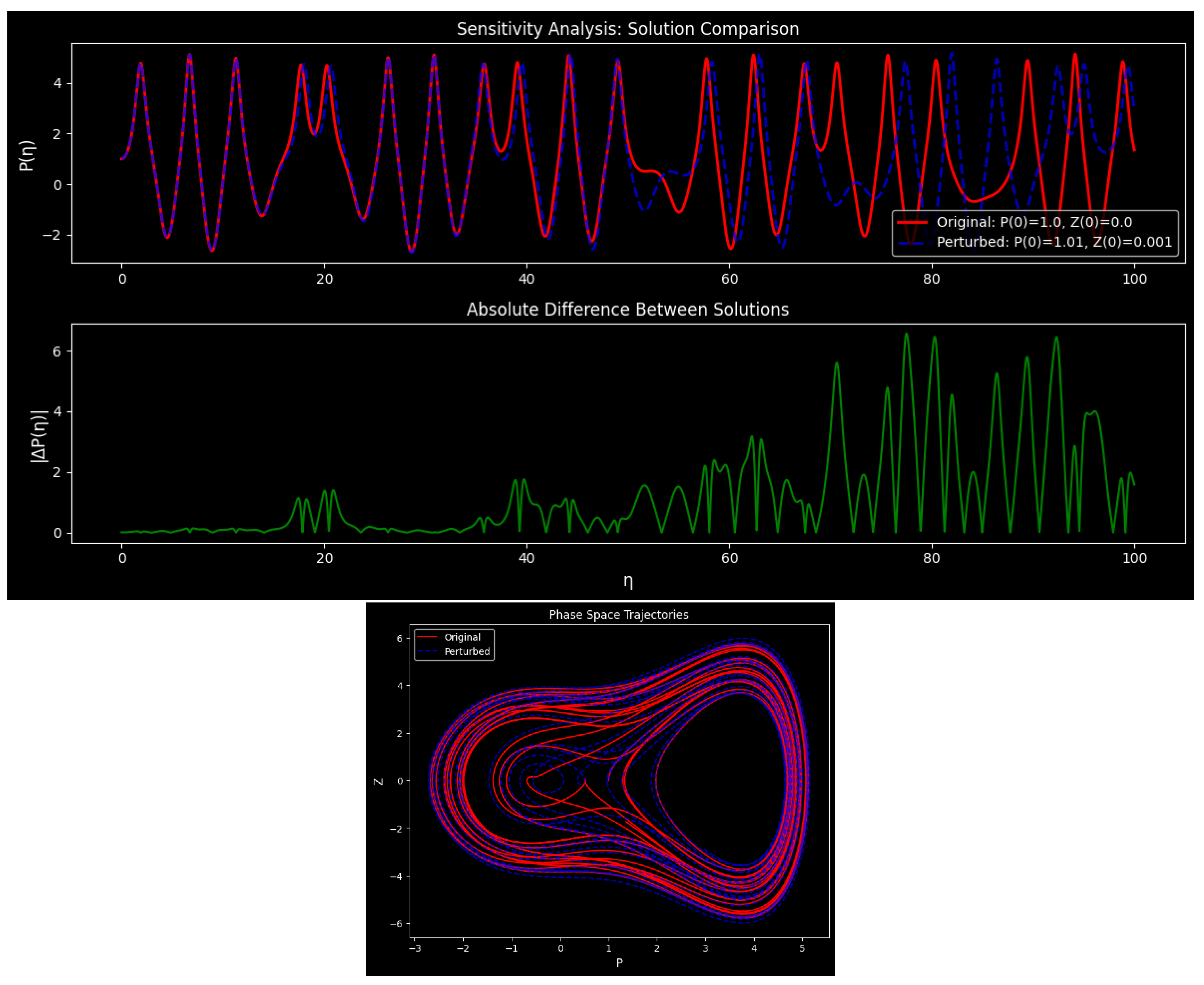
3.5. Sensitivity Analysis
The analysis of sensitivity is the key to comprehending complex systems, as it will show the impact of changes in initial conditions or parameters on the behavior of the system in the long run. This method is critical in the case of nonlinear systems to determine limits between ordered and chaotic states and provide the stable and predictable functioning of real-life systems. The sensitivity of the nonlinear oscillators (
13) and (
14) in deterministic (with no noise, i.e., having the coefficient of noise variation
) and stochastic (i.e., having the coefficient of noise variation
) cases is considered in this work. Contrasting research reveals intrinsic sensitivity to initial conditions and noise-enhanced effects. The deterministic and stochastic cases of the equations are solved by
solve_ivp with RK45 and Euler–Maruyama, respectively, on 5000 points on a grid of
with parameters
,
,
,
, and
. This paper compares the impact of initial perturbations on the development of trajectories and the system stability of both regimes.
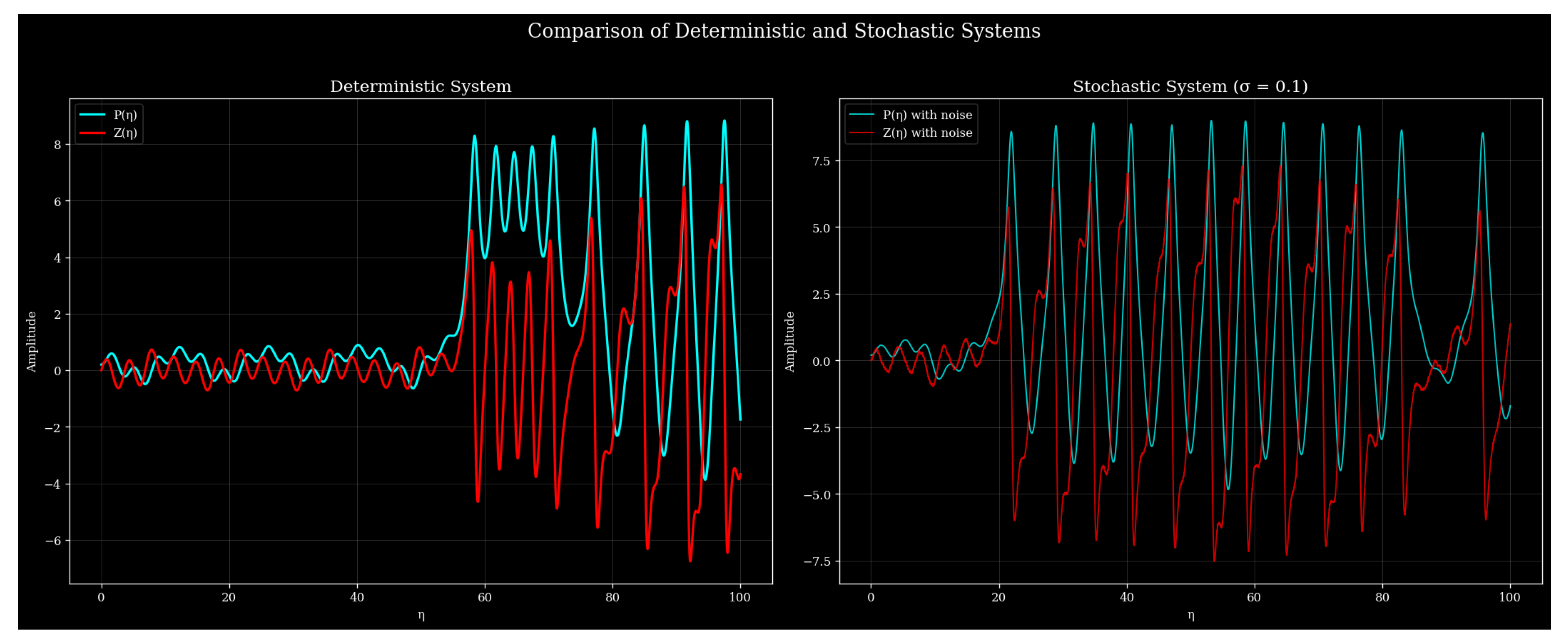
Figure 14 indicates that the initial perturbed and reference solutions coincide, which demonstrates the existence of short-term stability. Gradual divergence takes place over time (primarily through phase drift), but the amplitudes and shapes remain constant while the temporal misalignments increase. The error propagation is also limited as the absolute error, of the form of
, grows gradually and is limited. Although it permits gradual desynchronization, these two routes in phase space share a limit cycle; thus, the affected orbit stays close to the original, indicating that the system is robust to minor perturbations.
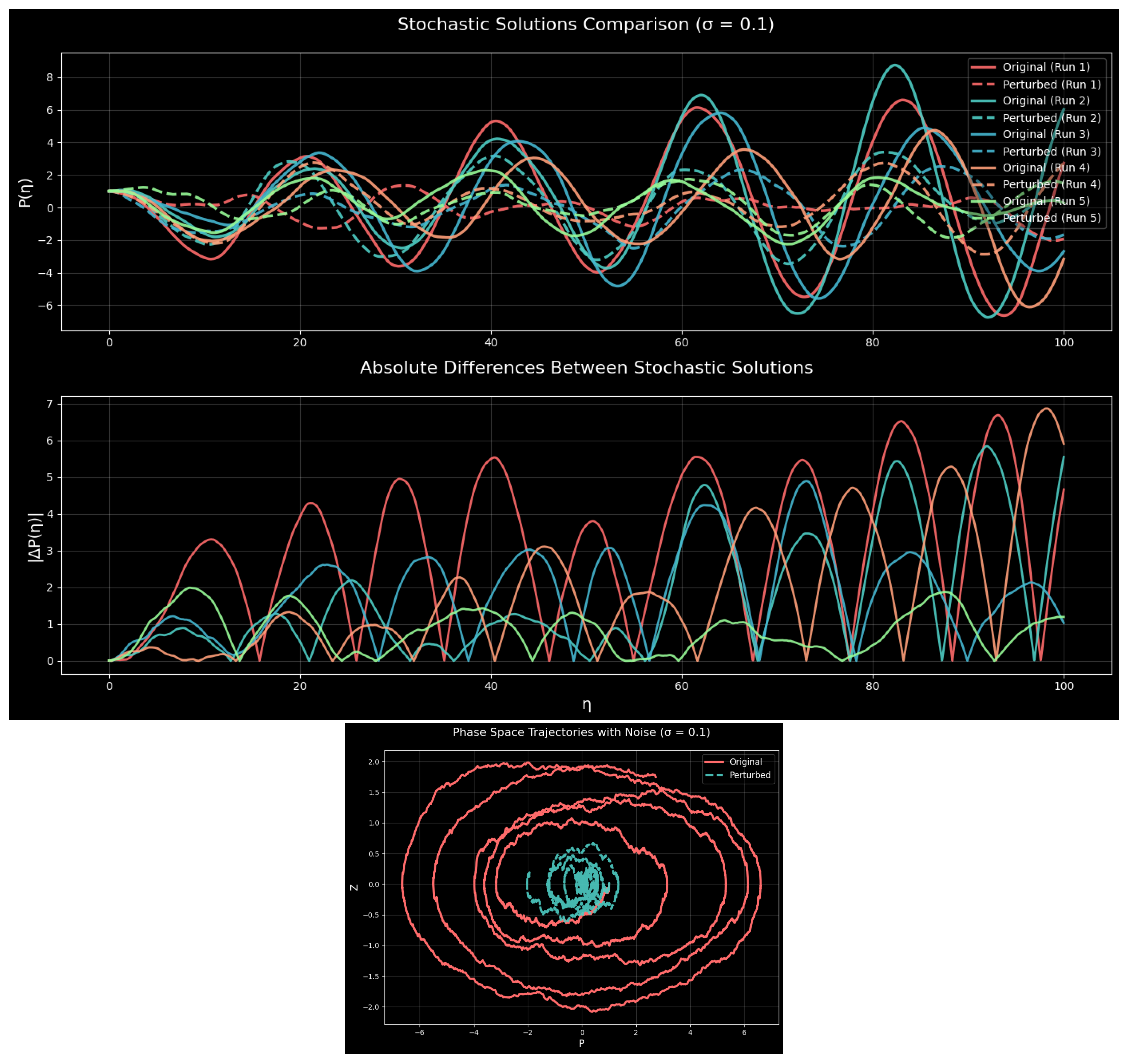
Stochastic perturbations have a major impact on the evolution of the system, so there is a large degree of variability between realizations even though the initial conditions are the same (
Figure 15). The deviations are also random in nature but bounded, as opposed to deterministic. Although the ensemble preserves the general arrangement of the trajectory, noise in phase space produces a diffusive halo surrounding the deterministic limiting cycles, suggesting that noise contributes local unpredictability without destroying the attractor’s global structure.
Table 3 illustrates the difference between deterministic sensitivity and the unpredictability caused by noise. While stochastic perturbation provides irregular deviations, leading to a fuzzy yet confined exploration of phase space, deterministic dynamics show a bounded, phase-drifting structure. This is a representation of the coexistence of global stability and local sensitivity, indicating that both intrinsic instability and stochastic effects need to be considered in order to achieve robust system performance. Stability is not enough in the case of engineering and forecasting, because noise-dependent predictability is very important in the real world.
3.6. Analysis of OGY Control Demonstrations for the Double-Well Oscillator
The control of chaotic systems is a milestone in nonlinear dynamics, and the OGY method remains an elegant demonstration of how unpredictable motion can be regulated with minimal intervention. In this study, OGY control is applied to a double-well potential oscillator—an archetypal chaotic system shaped by strong nonlinear restoring forces and periodic excitation described by system (
13), with the potential
. The method stabilizes an unstable periodic orbit (UPO) by introducing small adjustments
to the forcing amplitude whenever the trajectory enters the vicinity of the target UPO. Control is activated at time
, and the perturbation strength follows the linear feedback law
where
denotes the stable manifold direction and
K is the control gain.
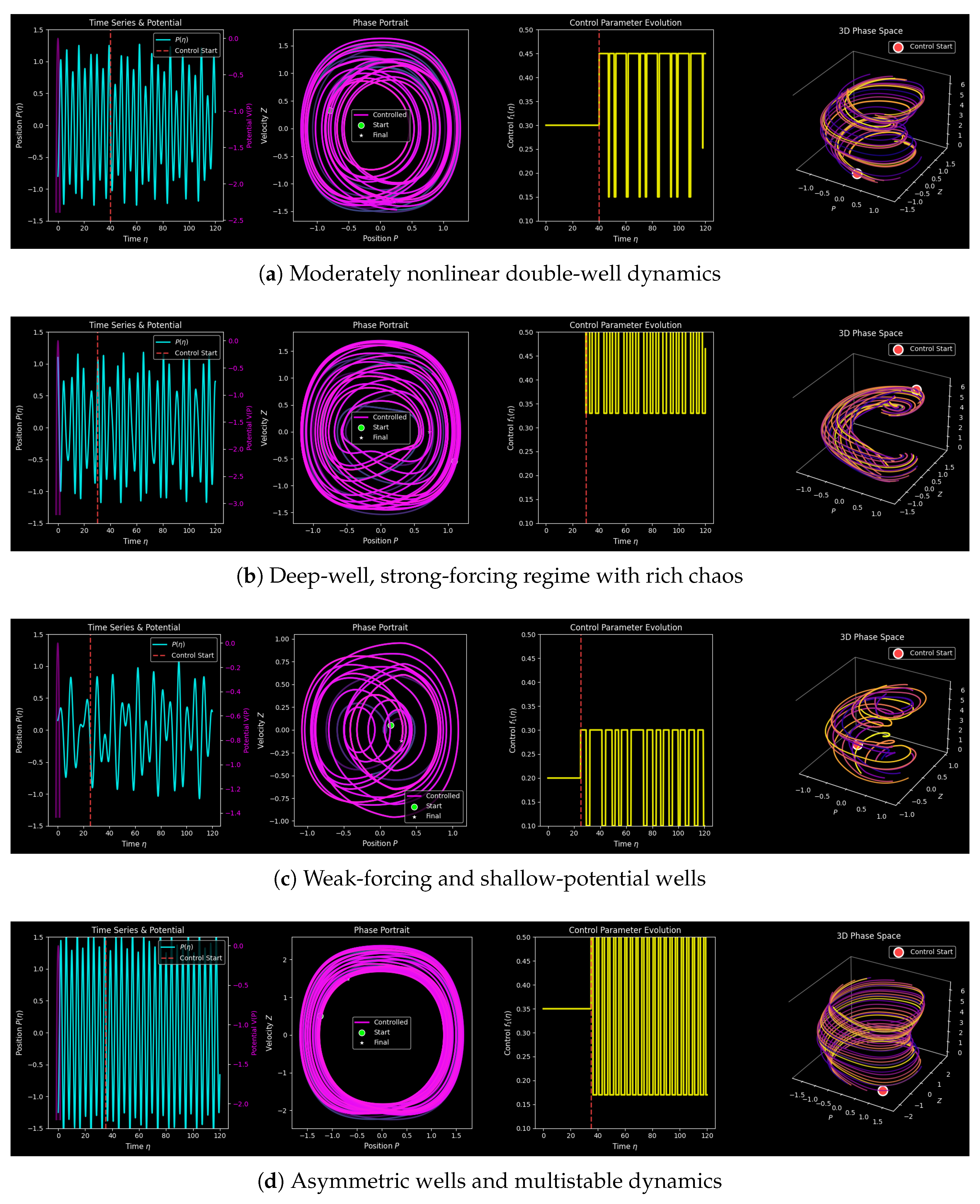
Case 1: Moderately Nonlinear Double-Well Dynamics
In
Figure 16a, the simulation is performed using the parameter set
for the double-well potential, with a forcing amplitude
and driving frequency
, while control is activated at
from an initial condition located in the left well (
). Before control engages, the oscillator displays low-to-moderate chaotic motion, producing irregular trajectories largely confined to the left well; the corresponding
phase portrait forms a thick annular band characteristic of a mild strange attractor with limited stretching–folding dynamics, and the system only infrequently approaches the potential barrier. Once the OGY mechanism is triggered, the trajectory rapidly converges toward the designated UPO, with control perturbations initially active during the alignment phase and then diminishing as stabilization is achieved. The once-chaotic three-dimensional attractor collapses from a broad tubular structure into a single helical filament with period
. Overall, this case illustrates the classical OGY regime, where the chaotic saddle contains easily reachable UPOs and the system’s moderate nonlinearity enables efficient stabilization using minimal corrective effort.
Case 2: Deep-Well, Strong-Forcing Regime with Rich Chaos
For this configuration, the system parameters are set to
,
, with forcing values
and
, and with control activated at
and the initial state starting in the right well at
, as shown in
Figure 16b. Prior to control, the strong nonlinearity and forcing generate vigorous chaotic motion marked by frequent inter-well jumps, high-amplitude irregular oscillations in the time series, and a broad, intricately looped phase portrait. The corresponding three-dimensional attractor reveals dense folding and stretching, indicative of high-dimensional chaotic behavior. After applying OGY control, the system requires relatively larger perturbations due to heightened sensitivity to initial conditions, leading to a long transient phase before settling onto a stable periodic orbit; the controlled forcing parameter
continues to fluctuate as the method compensates for the strong chaotic tendencies. Geometrically, the deepened double-well landscape intensifies homoclinic tangles, increasing both the abundance and fragility of unstable periodic orbits, thereby illustrating the robustness of OGY control while underscoring the inherent trade-off between stabilization effort and the severity of chaotic dynamics.
Case 3: Weak-Forcing and Shallow-Potential Wells
Figure 16c shows that the oscillator is weakly nonlinear with
,
,
,
, control at
, and
at equilibrium. Prior to losing it to control, the dynamics are almost periodic, and the phase loop is thin and elliptical, with little chaos generated by weak forcing and shallow potential. Perturbations vanish after OGY control, and the trajectory and the 3D attractor remain largely the same. This base shows that the OGY approach is strict and non-invasive; it is not active when the chaos is weak or not present at all.
Case 4: Asymmetric Wells and Multistable Dynamics
In
Figure 16d, the system is examined under the parameter set
, with control activated at
and the trajectory initialized in the left potential well at
. Prior to control, the asymmetric double-well potential prefers to move in the deeper left well, with the occasional crossings of the barriers forming lopsided lobes in phase space. Once the system has activated to OGY, it settles down to an intra-well periodic orbit at a slow pace, and the trajectories experience sporadic bursts of perturbation, oscillating between competing basins. A series of unsustainable periodic loops are produced by the potential’s broken symmetry, highlighting the significance of manifold geometry and basin structure in the stabilization process.
Table 4 gives the performance of OGY under various system conditions.
The geometry of the chaotic attractor is the determinant of the effectiveness of OGY control, because the geometry of the attractor determines the accessibility and stabilizability of the embedded UPOs. Stronger chaos (higher Lyapunov exponents) necessitates more active management but offers more candidate orbits, and it becomes simpler to stabilize an intended UPO while its orbits can approach the target UPO. Nonlinear stiffness and symmetry affect the UPOs that are feasible to achieve, and control effort depends on the amplitude of forcing.
Figure 16 depicts the four parameter setups of a chaotic double-well vibrationary system by displaying how small, timely perturbations stabilize UPOs in various chaotic regimes. The outcomes show the potential and constraints of OGY control, indicating that the success depends on the attractor geometry, system nonlinearity, and UPO choice.
The use of the mean-field control framework introduced in [
33] establishes a rigorous mathematical foundation for the control methods presented in this study. This foundation is particularly relevant for extending the analysis to stochastic regimes, where mean-field jump-diffusion models offer a more complete description.
3.7. Recurrence Plots
Recurrence plots (RPs) serve as a powerful nonlinear analysis tool for visualizing the recurrence characteristics of dynamical systems [
34]. For a given trajectory
in phase space, the recurrence matrix is mathematically defined as
, where
represents the Heaviside function and
denotes a predefined threshold distance. The visualization approach demonstrates clear signature patterns of various dynamical regimes: the deterministic systems have organized patterns like continuous diagonal lines and textured patterns, whereas the stochastic systems have broken and irregular patterns. The hybrid systems, which are a composite of deterministic and stochastic features, are the superposition of these features.
In addition to qualitative visualization, recurrent plots can be used to perform strict quantification of important dynamical properties. The diagonal line structures and the presence give us first-hand observations about the predictability of the system, where longer structures indicate higher predictability. Entropy measures based on line length distributions are useful measures of the complexity of a system, whereas the transitions in patterns of the recurrence matrix are useful detection methods for shifts in dynamical regime. This visualization and quantification ability allow recurrence plots to be of great use in the analysis of complicated systems when the use of traditional linear methods might not be enough.
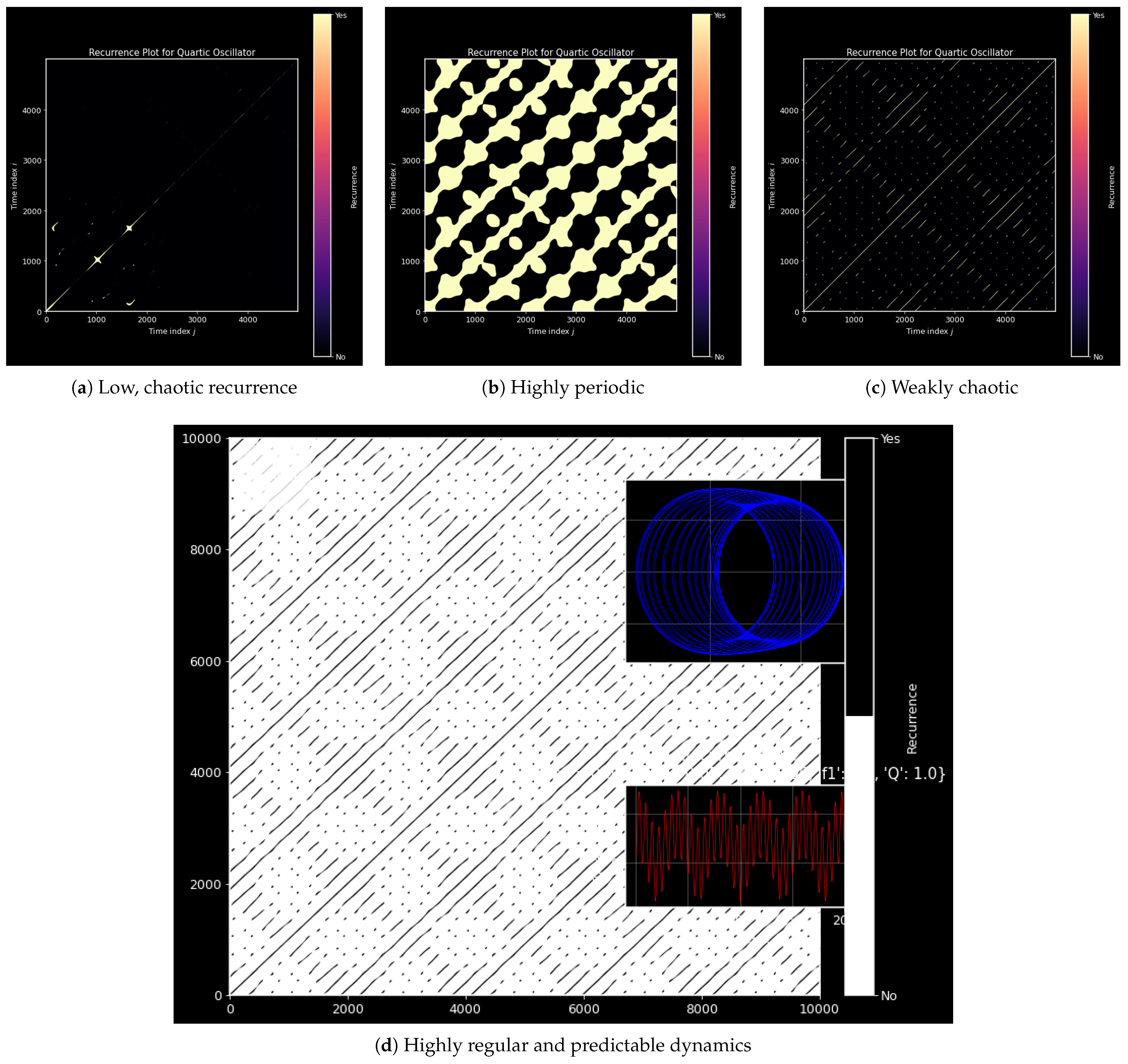
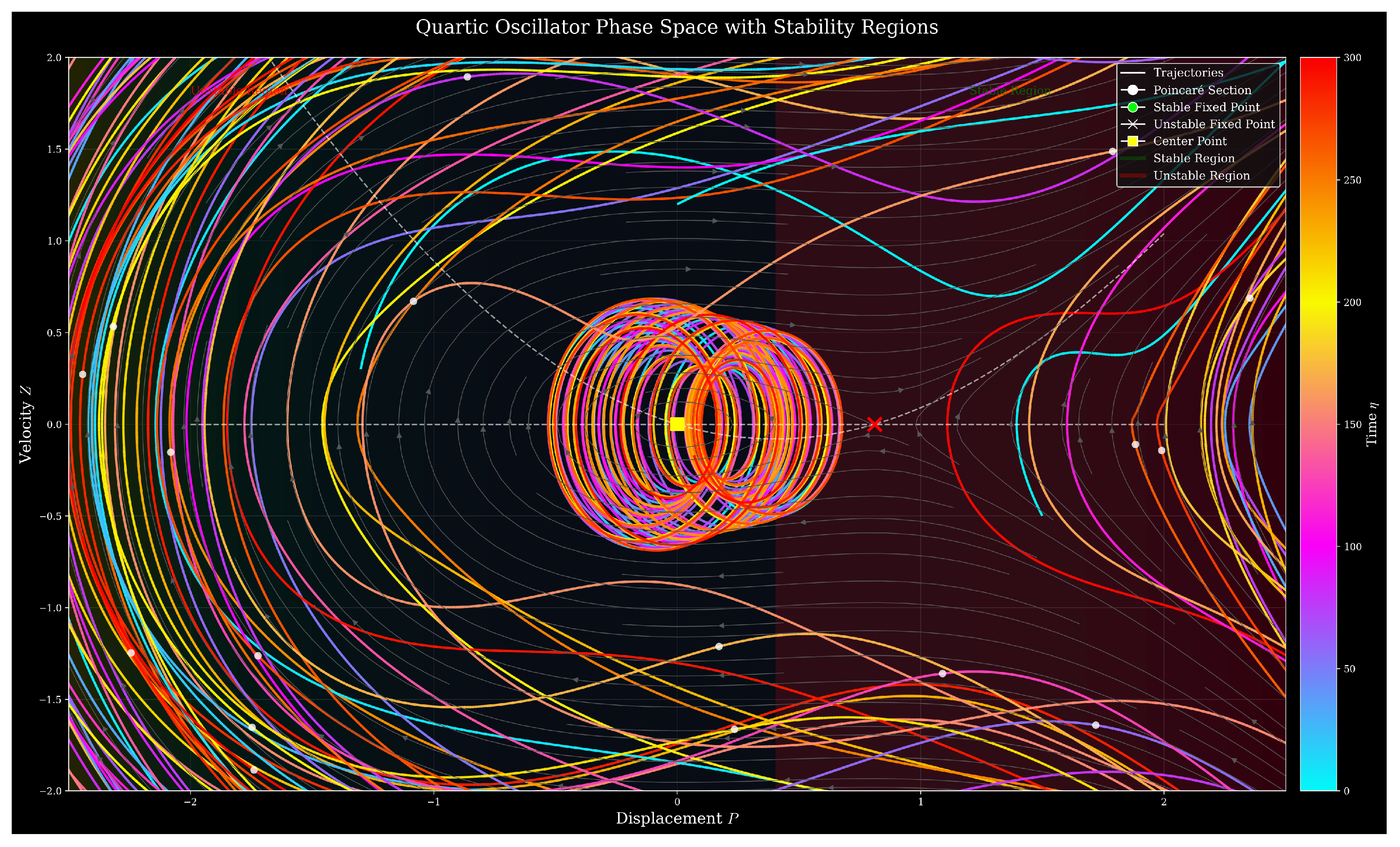
The recurrence plot in
Figure 17a reveals sparse recurrence points concentrated along the main diagonal, indicating a low recurrence rate and minimal regularity. The trajectory likely exhibits chaotic or weakly structured dynamics, with infrequent returns to previous states.
A dense and highly structured recurrence pattern is evident in
Figure 17b, showing strong periodic bands and repeating structures. This indicates a highly periodic or quasi-periodic system with consistent and frequent recurrences. The behavior is likely stable and regular.
The plot in
Figure 17c displays a moderate level of recurrence, with linear structures hinting at deterministic behavior. Although less dense than (b), it still shows signs of underlying periodicity or weakly chaotic dynamics.
The plot in
Figure 17d is characterized by strong diagonal and off-diagonal recurrence structures, indicative of a highly regular and predictable system. The included insets (phase space and time series) confirm this, with clean oscillatory cycles and phase-locked behavior.
These recurrence plots collectively demonstrate the progression from weakly structured, potentially chaotic dynamics (
Figure 17a) to strongly periodic and regular behavior (
Figure 17d). The increased density and patterning in the recurrence plots reflect increasing regularity, determinism, and phase coherence in the underlying dynamics of the quartic oscillator.
3.7.1. Stochastic Analysis of Recurrence Plots
We wish to clarify that the recurrence plots are not used here to compute Lyapunov exponents explicitly. Instead, they serve as qualitative tools to visualize trajectory divergence, loss of determinism, and predictability degradation under stochastic perturbations. In the context of stochastic dynamical systems, classical Lyapunov exponents require specialized definitions and numerical schemes and are therefore beyond the scope of the present work.
Recurring patterns are distorted with stochastic perturbations, which cannot be analyzed deterministically. Here, the frequency of noise intensity, denoted as , is shown to modify the topology of the recurrence plots, causing a coherent shift in the topology and deterministic line structures to diffuse stochastic distributions. Through these changes, we can measure the loss of predictability, detect the endurance of underlying deterministic skeletons, and decide where levels of noise start to take over the dynamics of the system.
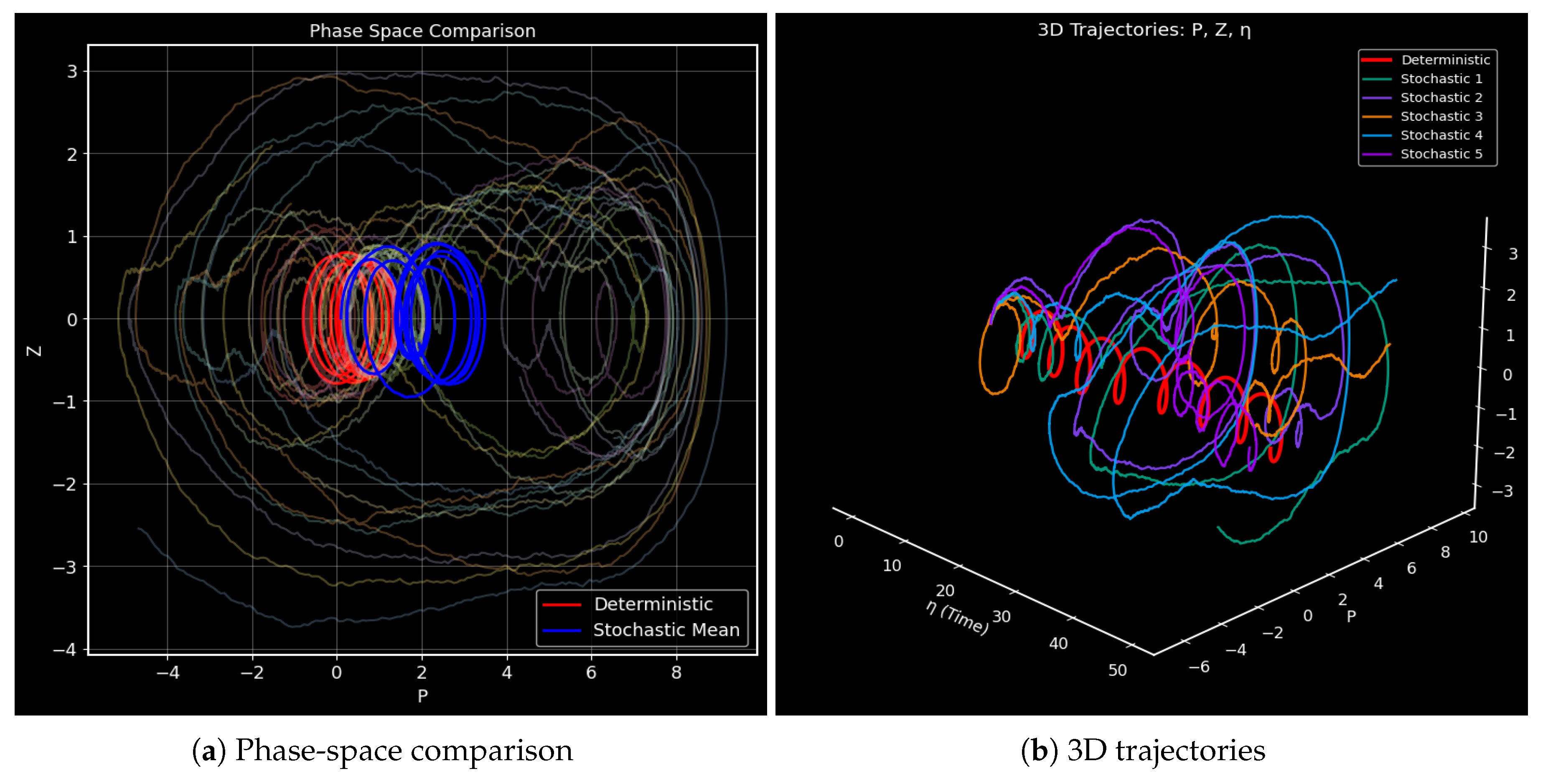
Figure 18a depicts the evolution of the phase space of a deterministic and a stochastic system in the
plane, with phase-space trajectories. The deterministic orbit (red) follows a regular, quasi-periodic orbit; whereas the fine, many-colored, stochastic trajectories follow a stochastic diffusion as a result of nonlinear amplification of noise. The stochastic mean (blue) is similar but can be seen to have diffusion, and when recurrence plots are constructed based on this data, they become blurred and fragmented, implying less predictability as compared to a clean deterministic scenario.
Figure 18b shows the time evolution of
in 3D. The deterministic behavior is tightly limited, while the stochastic clustering (cyan, magenta, yellow, etc.) rapidly expands regardless of the almost identical initial conditions, suggesting that it is highly sensitive to random noise. Both evidence of stochastic bifurcations and weaker, increasingly dispersed diagonal layouts in recurrence plots may directly contribute to such a growing gap.
Recurrence plots (RPs), which show how stochastic perturbation widens trajectories and dispersion and modifies end-state distributions with respect to P and Z, therefore offer a clear contrast between noise-induced and deterministic dynamics.
3.7.2. Trajectory Comparison
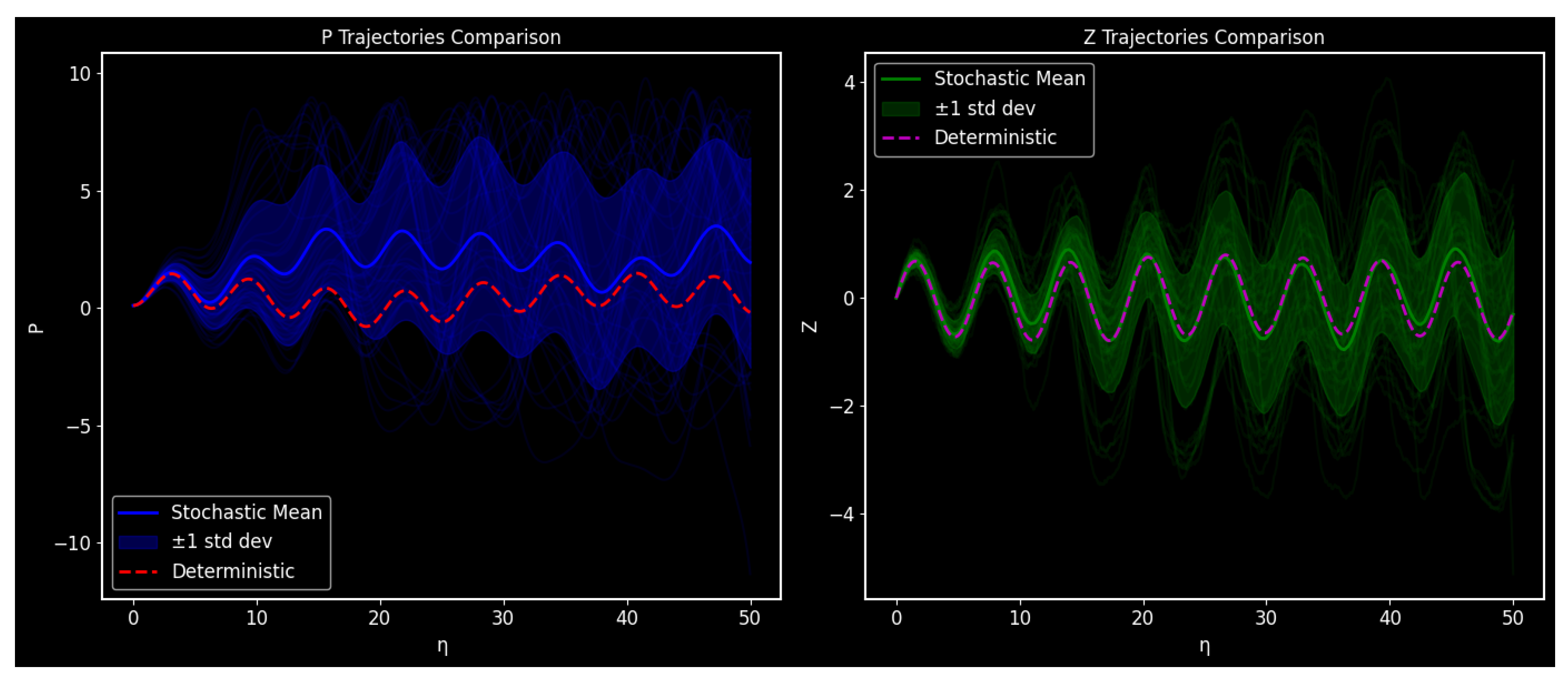
Comparison shows that although the individual stochastic trajectories are scattered away by noise, the ensemble mean is nearly equal to the deterministic path; therefore, the ensemble is statistically stable, even though the system is chaotic. It shows that noisy systems in the real world can still behave in a predictable, average way, and the statistical—rather than purely deterministic—approach to the analysis and engineering of such dynamics is justified.
Figure 19 demonstrates the deterministic dynamics of the state of a system, i.e.,
P and
Z. Several stochastic realizations are depicted as thin transparent lines, and the mean trajectory and one-sigma band in bold and markers are the summaries of these statistics. The growing scale of noisy diffusion is the cumulative growth of noisiness, but the average of ensembles is near the more deterministic baseline, especially for the time series
Z, which is a strong indicator of robustness in the collective behavior in the presence of stochastic separation.
3.7.3. Statistical Distribution at Final Time
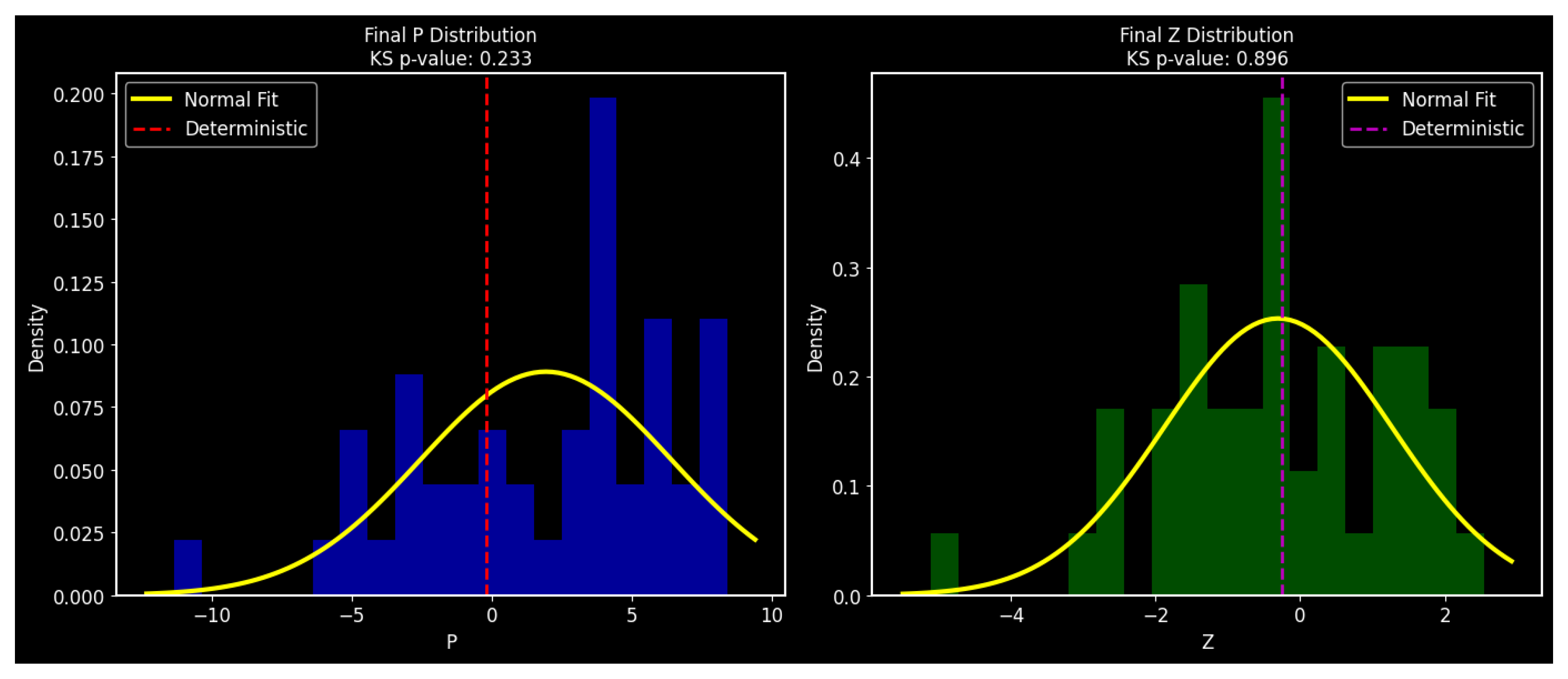
It is possible to analyze the final probabilistic structure of the system under stochastic influences by analyzing the statistical distribution. The roughly Gaussian distributions imply that there is a diffusive cloud around the mean that is stable, and the drift of the deterministic equilibrium is an indicator of the presence of noise-induced drift. The following observations explain the properties of recurrence plots, such as sparse recurrence density and disordered diagonals, which demonstrate that the long-term dynamics of the system can no longer be characterized as a deterministic trajectory but, rather, a predictable probability cloud—an important fact in practice, since it suggests that we can no longer call the system robust.
The histogram analysis in
Figure 20 reveals that the variables
P and
Z both exhibit approximately Gaussian distributions, as indicated by their bell-shaped profiles. Normal distribution fits, represented by yellow curves, align closely with the empirical data—an observation further supported by the Kolmogorov–Smirnov test
p-values of 0.233 for
P and 0.896 for
Z, indicating no significant deviation from normality. However, a notable bias is observed, as the deterministic equilibrium values, marked by dashed lines, are offset from the centers of the stochastic distributions—particularly evident for the variable
P—demonstrating how stochastic effects systematically displace the system’s average state from its deterministic counterpart.
Such properties of distribution have a direct effect on quantifying recurrence. Heavy variability and systematic displacement can reduce the repetition density by decreasing state revisitations, and the stochastic perturbations will discontinue the diagonal forms that depict predictable evolution. Consequently, recurrence entropy, determinism, and laminarity increase, which are indicators of a less predictable and more dynamically uncertain environment.
The progressive blurring and fragmentation of diagonal line structures in the recurrence plots indicate an increasing separation of nearby trajectories and reduced predictability. While such features are commonly associated with positive Lyapunov exponents in deterministic systems, here they are interpreted qualitatively as manifestations of noise-induced divergence, rather than as quantitative Lyapunov measurements.
In general, stochasticity converts the system of deterministic predictability to complex and probability-driven behavior. Although the overall trends of the averages might be determined, phase-space and 3D analyses indicate that there is a high degree of variability that diminishes recurrence structure. This suggests the necessity of using statistical and probabilistic techniques to supplement classical phase-space techniques in order to completely describe the stability and predictability frontiers of stochastic dynamical systems.
A quantitative computation of Lyapunov exponents for the stochastic system, although informative, would require a separate methodological framework and is therefore left for future investigation.
3.8. Analysis of Lyapunov Exponents and Phase Portraits
Lyapunov exponents are important in the evaluation of stability and chaos [
35], i.e., the average rate of exponential separation or convergence of close paths. The positive exponents are a sign of chaos, whereas negative numbers are an indication of stability. These behaviors can be modified complexly by introducing stochasticity. In this case, we compare deterministic and stochastic dynamics in two configurations in terms of time-evolving Lyapunov exponents and phase-space trajectories [
30].
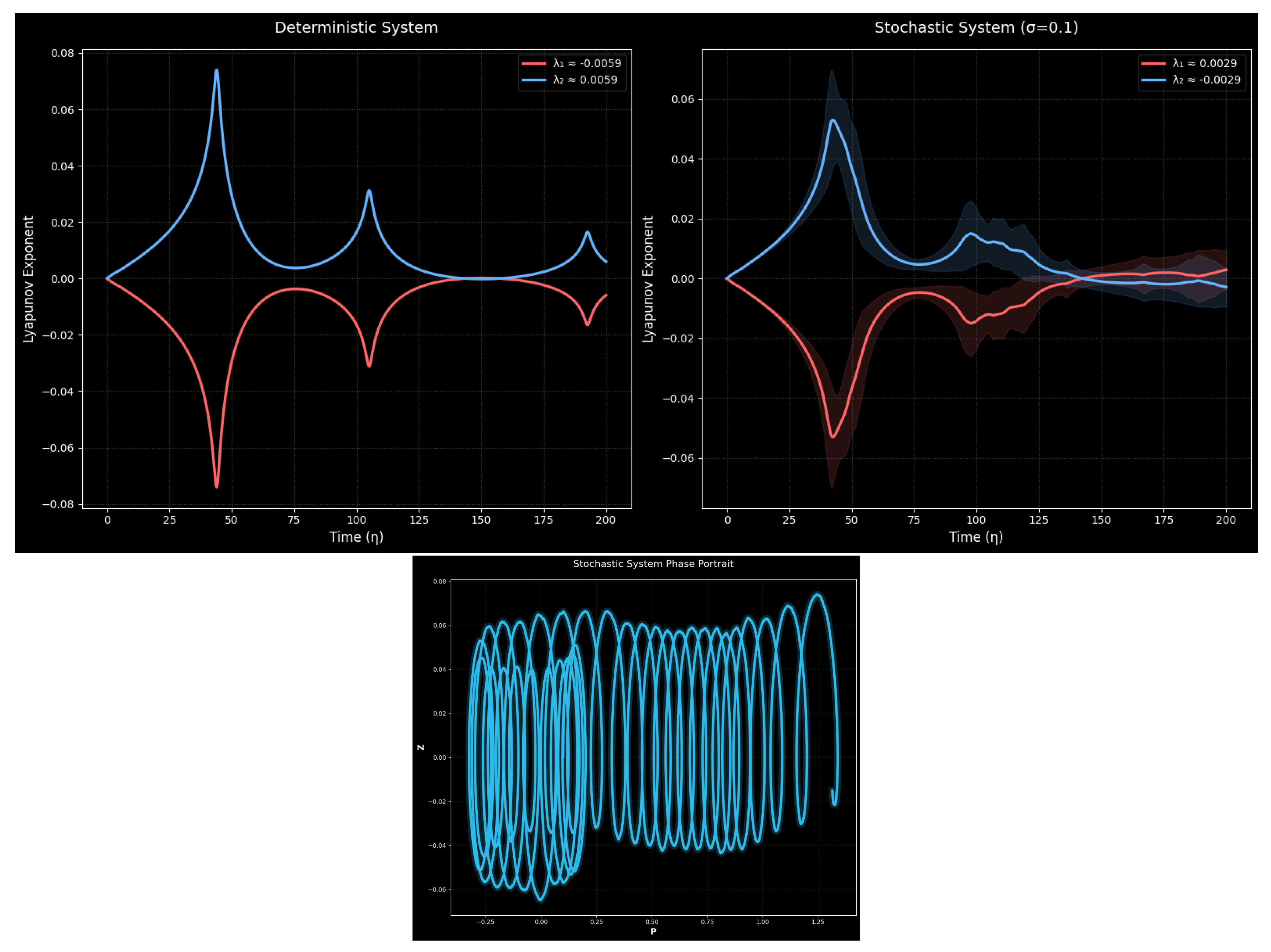
Analysis of
Figure 21 reveals fundamental differences between deterministic and stochastic dynamics. The deterministic system exhibits chaotic behavior with a positive Lyapunov exponent (
), confirming exponential divergence, while the negative exponent (
) indicates dissipative contraction. Under stochastic forcing (
), both exponents converge to negative values (
), demonstrating noise-induced stabilization that suppresses chaotic divergence. This transition is visually confirmed in the phase portrait, where the stochastic system forms a bounded, noise-perturbed manifold in the
P-
Z plane, retaining structural coherence while losing fine-scale chaotic features. The convergence of exponents and the confined yet complex trajectory collectively illustrate how stochastic perturbations can regularize dynamics by dampening inherent instabilities.
In computing the Lyapunov exponents for the stochastic systems, we ensure convergence by integrating over sufficiently long time intervals. Specifically, each exponent is computed over a time horizon of time units, which is verified to yield stable, convergent values independent of the initial transient. This choice ensures that the reported exponents reliably characterize the long-term average exponential divergence or convergence, providing a repeatable and rigorous diagnostic of chaotic versus stabilized dynamics.
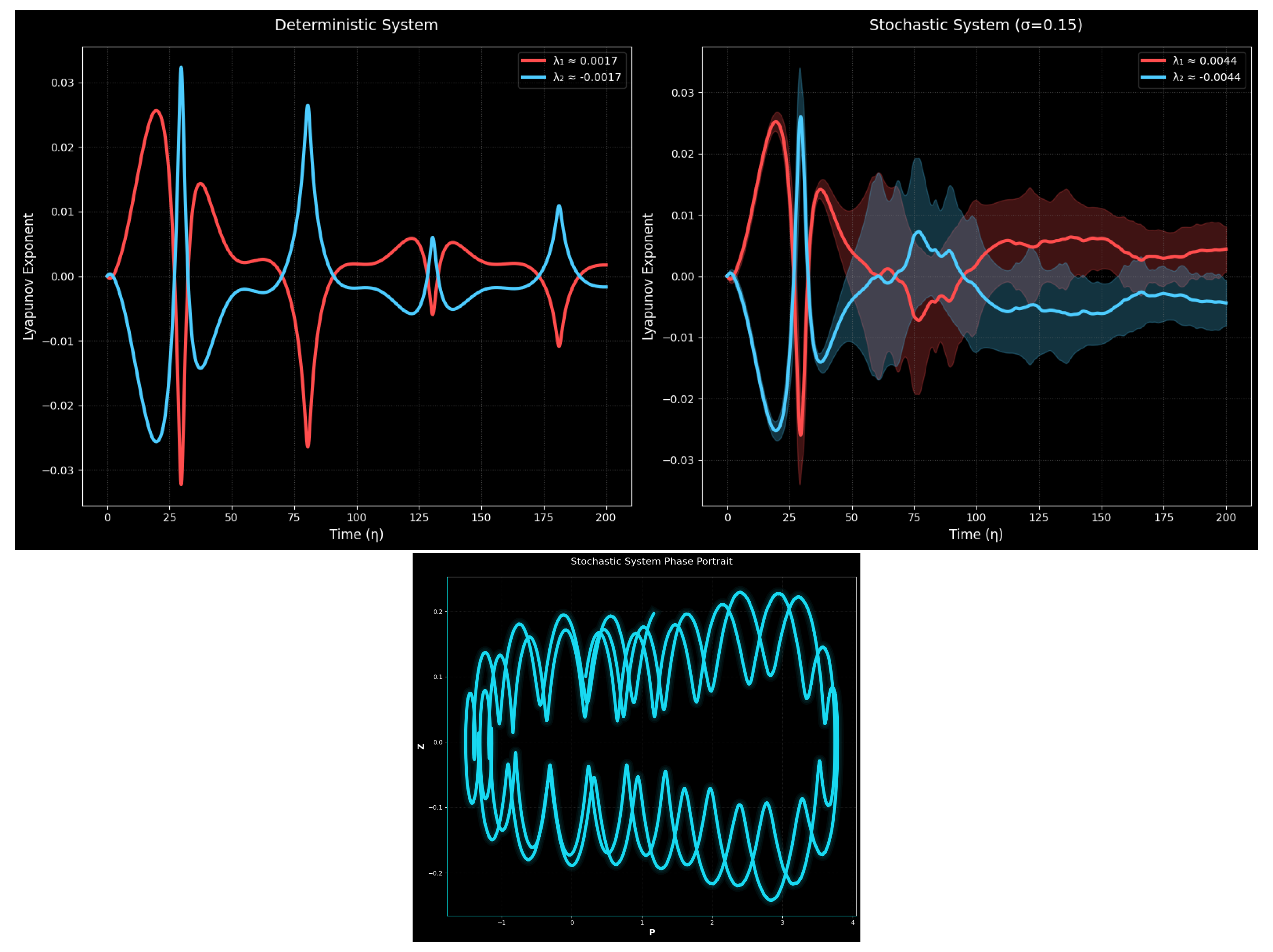
Analysis of
Figure 22 reveals a contrasting dynamical regime where noise induces rather than suppresses chaos. The deterministic system exhibits near-critical behavior with Lyapunov exponents
and
, indicating weak instability balanced by dissipative contraction. However, under moderate stochastic forcing (
), both exponents shift to positive values (
), demonstrating noise-induced chaos where random perturbations destabilize the otherwise marginally stable system. This contrasts sharply with the noise-suppressed chaos observed in
Figure 21, highlighting the dual role of stochasticity in nonlinear systems. The corresponding phase portrait visually confirms this transition, showing increased dispersion and structural complexity in the
P-
Z plane that reflect enhanced sensitivity to initial conditions and potential stochastic resonance phenomena.
Numerical Specifications: Lyapunov exponents were computed using the standard QR decomposition algorithm applied to the variational equations. Deterministic systems were integrated using
scipy.integrate.odeint with absolute and relative tolerances of
and
, respectively, while stochastic systems employed an Euler–Maruyama scheme with time step
for
Figure 21 and
for
Figure 22. Each exponent calculation was integrated over
time units after discarding an initial transient of 50 units. Ensemble statistics were obtained from
(
Figure 21) and
(
Figure 22) independent realizations to ensure statistical convergence. The reported values represent the mean over the final 50% of the integration interval. The software versions used include Python 3.11, NumPy 1.27, and SciPy 1.11. The numerical parameters used for Lyapunov exponent calculations, including time step, integration duration, transient removal, ensemble size, and integration schemes, are summarized in
Table 5.
The Lyapunov exponent analysis shows the subtle nature of stochasticity in nonlinear systems.
Figure 21 and
Figure 22 show that both stronger noise (
) and weaker noise (
) suppress chaos, causing both exponents to become negative and positive, respectively. This demonstrates that noise may inhibit or amplify chaos, depending on the intensity and stability in the system. This is supported by the phase portraits, which draw pictures of the way in which noise transforms the attractor geometry of confined, damped structures into dispersed, complex manifolds. These findings highlight the fact that stochastic effects are context-dependent and can regularize or destabilize dynamics through the interaction between noise and nonlinearity.
3.9. Multistability and Dynamic Transitions
Multistability frequently occurs in the study of nonlinear dynamical systems, in which multistability occurs with two or more stable attractors of the same governing equations but under different initial conditions [
36]. A model used to study such complicated dynamics is the quartic oscillator with its fourth-degree potential, which is a prototypical model of oscillators with a quartic potential energy of oscillation of the mass point of a spring [
37]. This paper compares the response of the oscillator under changes in parameters—including mono-, bi-, and multistable dynamics—along with the influence of stochastic perturbations on attractor stability, and correspondingly reveals the complexity and controllability of the structure of nonlinear systems.
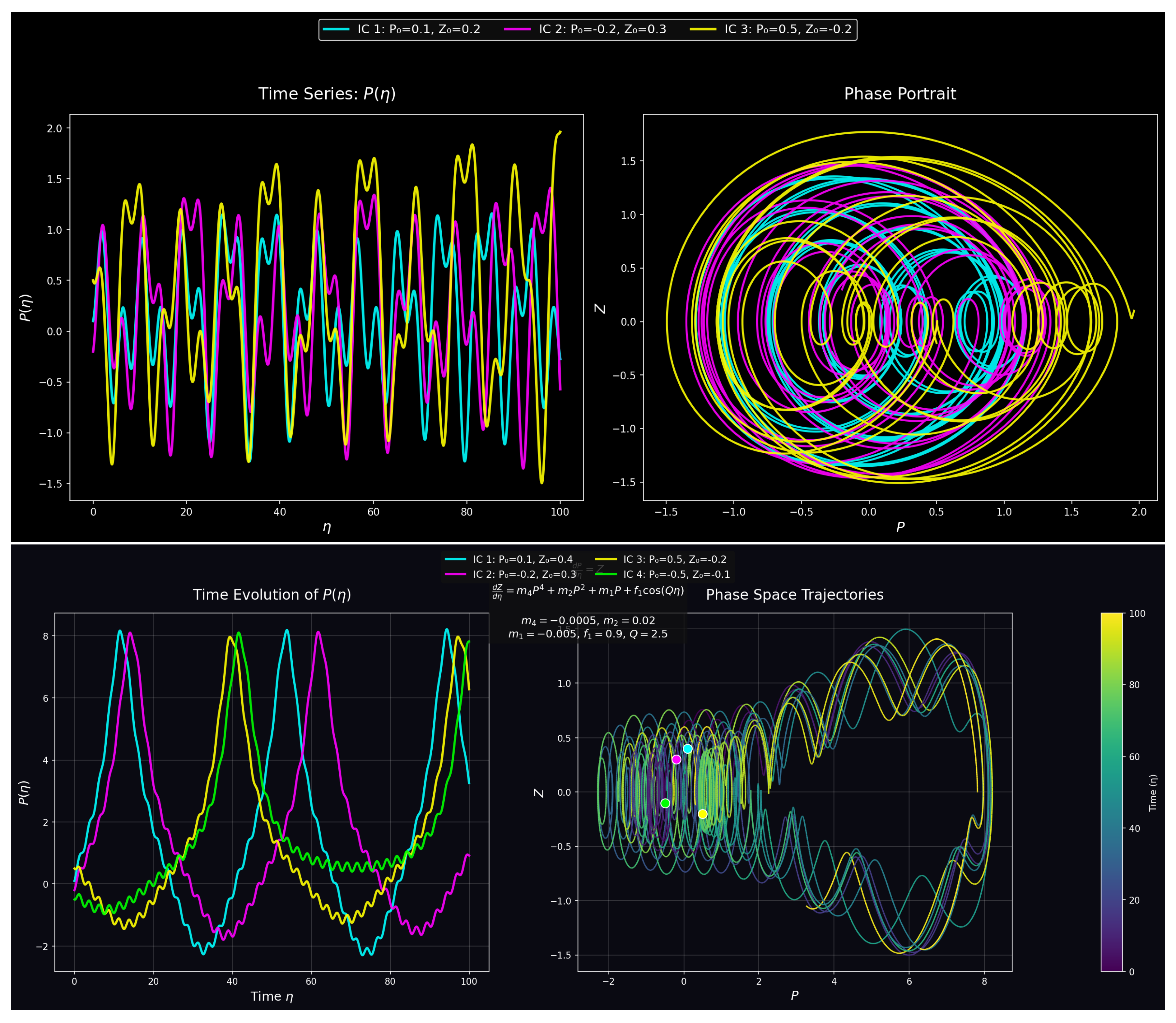
The time dependence of the system variable
P (top left of
Figure 23) exhibits distinct amplitude and phase variation waveforms for identical parameter values, indicating a pronounced sensitivity to initial conditions. The corresponding phase portraits (top right) display qualitatively different loops and spiral-like structures associated with different initial conditions, suggesting the possible presence of multiple long-term dynamical states. Other trajectories (bottom left of
Figure 23) exhibit steep transitions and intermittent bursts, while the three-dimensional phase-space trajectories (lower right) show surface-like structures typical of strange attractors, with the color gradient indicating temporal evolution.
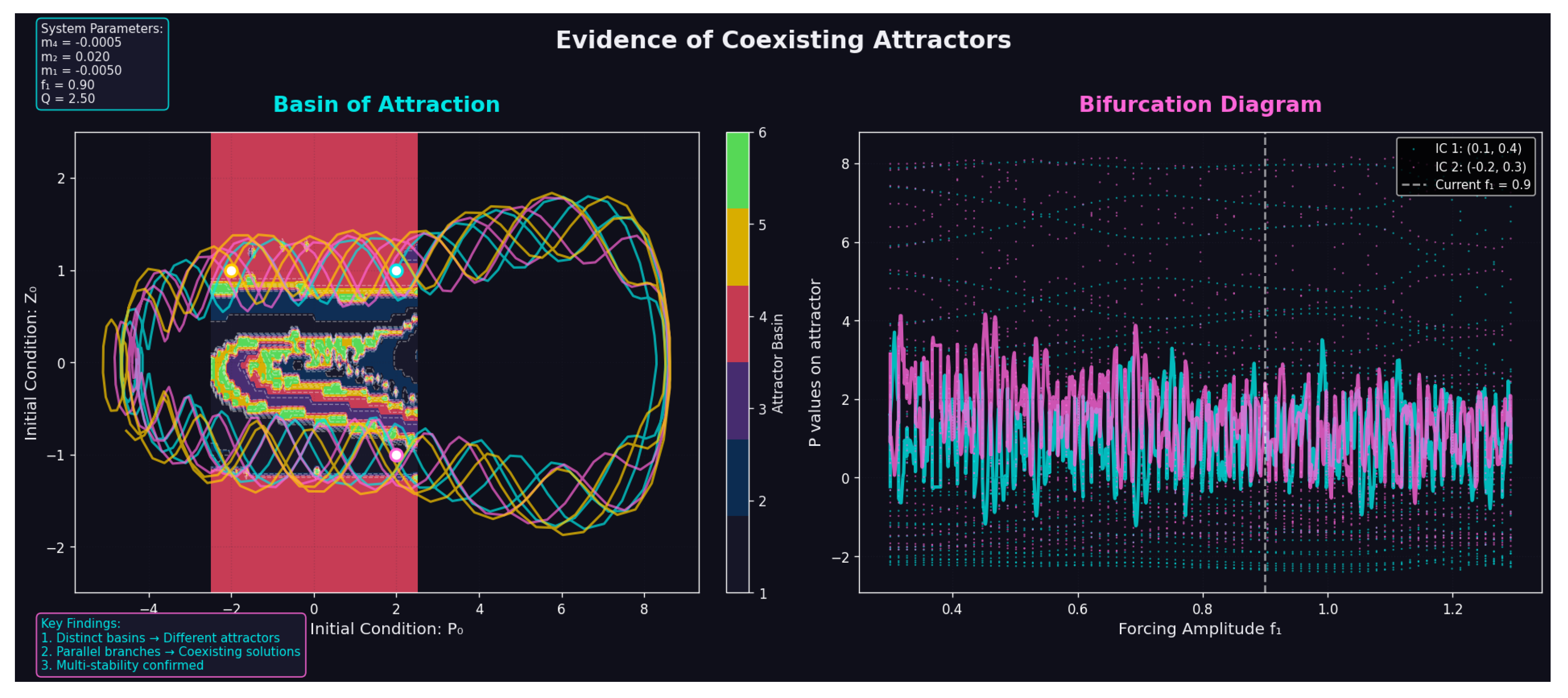
To rigorously substantiate the coexistence of attractors beyond qualitative phase-space visualization, complementary analyses were performed using basin-of-attraction computations and bifurcation diagrams for the same parameter set. The basin-of-attraction (left panel of
Figure 24) analysis was conducted by scanning a dense grid of initial conditions in the
plane and classifying the resulting long-term dynamics after discarding transients. The resulting partition of the phase space into distinct regions demonstrates that different initial conditions converge to different stable attractors under identical system parameters, thereby providing direct evidence of multistability.
In addition, bifurcation diagrams (right panel of
Figure 24) constructed by varying the forcing amplitude
reveal the presence of parallel branches corresponding to distinct attractors coexisting at the same parameter values. Such parallel solution branches are a hallmark of coexisting attractors and confirm that the observed multistability is an intrinsic property of the system rather than a transient or visualization artifact. These results provide quantitative and reproducible confirmation of the multistable dynamics inferred from the phase portraits.
In general, these findings indicate that the system possesses multiple stable regimes, leading to non-unique long-term dynamics and inherent unpredictability. The coexistence of multistability and chaos, together with aperiodicity, extreme sensitivity to initial conditions, and strange attractors, is of practical relevance in biological rhythms, mechanical systems, neural circuits, and climate models. Understanding these dynamics enables the development of control strategies capable of steering the system toward desired attractors while avoiding undesirable regimes, thereby enhancing robustness and predictability under perturbations.
3.9.1. Multistability Under Varying Parameters
An oscillator with nonlinearly forced periodic equations is represented by Equation (
13) below: The displacement of the system is called
P, the velocity is called
Z, and there is a phase
, which is a time-dependent quantity. Its dynamics rely on the parameters
and the forcing frequency
.
Figure 25 compares three parameter regimes to illustrate how the system reacts to changes in parameters through time series, the 2D phase portraits of the system
, and 3D trajectories
.
Each row shows how multistability emerges or changes as the system parameters evolve.
Parameter Set A:
For , the system shows sustained symmetric oscillations with mild amplitude variation across initial conditions. The 2D phase portrait forms a closed, symmetric curve characteristic of periodic or quasi-periodic motion, while the 3D phase space displays a toroidal structure. This regime reflects robust multistability with coexisting, non-switching attractors.
Parameter Set B:
For , the system enters a transitional regime where time series show stronger divergence across initial conditions, indicating heightened sensitivity near basin boundaries. The phase portrait exhibits stretched, asymmetric loops, suggesting coexistence of large- and small-amplitude attractors. The 3D trajectories display elongated, increasingly irregular structures, signaling growing dynamical complexity and emerging chaotic features within the multistable landscape.
Parameter Set C:
At , the system appears most complex, with a time series illustrating unstable growth and significant deviation of the trajectories. The phase diagram displays various different attractors, including closed loops to long structures, which point to the coexistence of limit cycles or chaos. The 3D phase space has well-separated, complex trajectories with large divergence, as is characteristic of chaotic saddles or strange attractors, and basin switching may occur.
The findings illustrate obvious multistability in all of the parameter sets, whose dynamical complexity rises progressively between Set A and Set C. Bifurcation and a more sensitive basin of attraction are manifested by variations in attractors between smooth quasi-periodic and deformed—and then chaotic—structures of attractor through variations in the values of , , and . All things considered, the repeatedly forced quartic synthesizer shows tunable changes beyond periodic towards chaotic multistability, which are pertinent to systems like climate oscillators, biological rhythms, and MEMS resonators.
3.9.2. Global Stability and Phase-Space Topology
The phase-space analysis plays a crucial role in the analysis of the global dynamics and stability of the system, showing the areas of attraction and instability that are used to calculate the long-term behavior. This allows for the visualization of fixed points, stability limits, and transient paths that assist in the control of nonlinear systems, as it allows the identification of stable working regimes and possible instabilities that can be useful in engineering and physics.
Figure 26 demonstrates a phase-space study of the system in a plane of
, showing the complex geometry of the stability state of the system using trajectories of several different initial conditions. The fixed points are systematically categorized into the stable (blue), unstable (red), and saddle/neutral (green) types and provide a major landmark in learning about the equilibrium structures. The potential landscape is mapped out with the help of the nullclines and contour lines, and the areas of local stability (dark partially shaded) and instability (bright partially shaded) are obtained, which point to the bounded and divergent, dynamics respectively. The use of Poincaré sections, illustrated by the white stroboscopic, assists in distinguishing between periodic, quasi-periodic, and chaotic regimes, while color-coded time-dependent development of the orbits captures the time-varying development of trajectories. A combination of these elements will give a complete perspective of the global dynamics of the system, along with its equilibrium structure and transient behaviors, and will provide vital information about the stability of the system and its nonlinear complexity.
3.9.3. Noise-Induced Transitions in Multistable Systems
This section compares the deterministic and stochastic processes of the nonlinear oscillator. In the deterministic case (
Figure 27, left), the curve stabilizes after a period of transient into large periodic excursions, which shows a bifurcation-type transition and the existence of several interacting attractors. The oscillatory structure is maintained in the stochastic case (
Figure 27, right), with noise intensity
, but is disrupted by the fluctuations, and noise promotes metastable states to explore alternative basins of attraction.
These experiments demonstrate that multistability is inherently created by the quartic nonlinearity of the system, with attractors being separated by clear energy barriers. Deterministic transitions involve only initial conditions and parameter values, but stochastic perturbations allow for noise-assisted switching between basins and make trajectories less predictable, but they are more likely to explore large parts of the state space. The resultant dynamical repertoire—periodic, quasi-periodic, or chaotic—is a result of the interaction between nonlinear restoring forces, external forcing, and random perturbations.
A summary of the main changes due to noise (i.e., the difference between deterministic and stochastic dynamics)—in terms of coherence of trajectories, transition mechanisms, attractor stability, predictability, and pattern regularity—is provided in
Table 6. It summarizes the visual findings of
Figure 27, in that it highlights the transition between a predictable regime, characterized by bifurcation, and a probabilistic regime, characterized by switching and diminished coherence.
The quartic oscillator has multistable dynamics influenced by nonlinearities, periodic forcing, and noise. Deterministic cases exhibit very clear attractors and transitions based on bifurcation, whilst stochastic conditions bring about the switching due to noise. Alterations in cause a transition between quasi-periodic and chaotic regimes. This is applicable to MEMS devices, biological oscillators, and energy harvesters, where controlled multistability is essential, and nonlinearity and stochasticity determine the changes in state in physical systems.
3.10. Stochastic Bifurcation Analysis with Respect to Noise Strength
From a stochastic dynamical systems perspective, the noise intensity
is regarded as a control parameter, and its impact on the global attractor structure is analyzed through a stochastic bifurcation diagram.
Figure 28 presents the stochastic bifurcation diagram of the nonlinear oscillator as a function of the noise strength
. The system incorporates quartic and quadratic nonlinearities, linear stiffness, harmonic forcing, and additive Gaussian white noise. For each value of
, multiple stochastic realizations are simulated using the Euler–Maruyama scheme, and the long-term amplitudes of the state variable
P are sampled after discarding transients to construct the bifurcation structure.
In the low-noise regime (), the diagram exhibits a highly localized distribution of amplitudes concentrated around a single dominant value of P. This behavior indicates that the deterministic attractor of the system is strongly stable and resilient to weak stochastic perturbations. The oscillator remains confined to a noise-robust equilibrium or periodic orbit, reflecting a mono-stable dynamical configuration.
As the noise strength is increased, the amplitude distribution remains narrow with only negligible broadening. No branch splitting, amplitude scattering, or qualitative restructuring of the attractor is observed across the entire investigated range of . This indicates that the nonlinear restoring forces dominate the system response, preventing noise-induced transitions between coexisting attractors or the emergence of new dynamical states. In this regime, stochastic forcing acts as a perturbative modulation rather than a mechanism for inducing qualitative changes in system behavior.
Notably, the absence of classical stochastic bifurcation signatures—such as noise-induced pitchfork splitting, intermittency, or attractor switching—demonstrates the structural stability of the oscillator with respect to variations in noise intensity. From a dynamical systems viewpoint, the topology of the phase space remains invariant under stochastic excitation, with noise only inducing bounded fluctuations around a persistent mean state. Such robustness is characteristic of strongly dissipative nonlinear systems operating away from critical thresholds.
Importantly, this figure constitutes a systematic bifurcation analysis with respect to the noise strength , directly addressing the role of stochastic forcing as a control parameter. By explicitly varying and constructing a stochastic bifurcation diagram based on ensemble-averaged long-term dynamics, the analysis demonstrates that noise neither suppresses nor enhances chaos within the explored parameter regime. Instead, it establishes that the underlying deterministic attractor remains intact, thereby distinguishing noise-modulated dynamics from genuine noise-induced bifurcation phenomena. This result clarifies the influence of stochastic excitation and confirms that, for the present system, noise primarily affects quantitative fluctuations without altering the qualitative dynamical structure.
This analysis is important because it systematically quantifies the influence of stochastic forcing by treating the noise strength as a bifurcation parameter, thereby moving beyond qualitative claims of noise-induced suppression or enhancement of chaos. The resulting stochastic bifurcation diagram clearly distinguishes genuine noise-induced bifurcations from bounded fluctuations around a persistent deterministic attractor.
Moreover, this analysis supports the present study by confirming the robustness of the underlying dynamical structure against stochastic perturbations within the considered parameter range. The absence of noise-induced attractor splitting or transitions demonstrates that the observed dynamical behaviors are intrinsic to the nonlinear system, thereby reinforcing the validity and consistency of the deterministic and stochastic analyses presented in this work.
4. Conclusions
This paper presents a complete analysis of nonlinear oscillatory dynamics using an integrated approach to Darboux-transform analysis, quasi-periodic analysis, bifurcation structures, Poincaré mappings, stochastic perturbations, recurrence quantification, Lyapunov exponent diagnostics, multistability characterization, and chaos control based on the OGY mechanism. In these varied approaches, a common thread can be worked out: the qualitative and quantitative dynamics of nonlinear oscillators are determined at a very fine balance among nonlinear structure, external forcing, and stochastic action. The Darboux-transformed fields have shown that seed choice is a fundamental determinant of emergent waveforms, and that smooth, implicit, and singular seeds produce classes of modulated, complex, or defect-bearing solutions; smooth, implicit, and singular seeds do not need further explanation. The study of quasi-periodic zones showed that forced computation is crucial, and that irrational and golden-ratio frequencies promote higher-order invariant tori and improve phase-space geometry.
The qualitative and quantitative dynamic regime characterizations of periodic and quasi-periodic dynamical responses to chaos, intermittency, and coexistence between multiple attractors illustrated the sensitivity of nonlinear forced oscillators to changes in parameters. This study was able to capture the subtle transition mechanisms of these behaviors through intense visual and statistical diagnostics like Poincaré sections, recurrence plots, and Lyapunov spectra. Furthermore, the deterministic–stochastic comparisons showed that noise can reconfigure attractor geometry along with predictability horizons and can be either a stabilizing or destabilizing influence with regard to amplitude and system structure. As factors such as attractor structure and accessibility to UPOs are properly utilized, the OGY control demonstrations have shown that unstable periodic orbiting in extremely unpredictable double-well potentials can be selectively stabilized with few interventions. Finally, the stochastic bifurcation analysis with respect to the noise strength demonstrates that the underlying attractor structure of the nonlinear system remains robust under stochastic excitation, confirming that noise primarily induces bounded fluctuations rather than qualitative dynamical transitions within the investigated parameter regime.
When taken as a whole, these findings offer a cohesive understanding of nonlinear oscillatory activity, or of oscillatory behavior that occurs in a complicated parameter space that is orderly, multistable, chaotic, and driven by noise. The combined numerical and analytical findings point to the fact that nonlinear oscillators are not just sensitive to initial conditions—they are also sensitive to modeling decisions, seed functions, driving arithmetic, and stochastic perturbations. This study thus provides the basis for further insight into the ways in which nonlinear structure and external modulation and noise interact to define the behavior of physical and engineered oscillatory systems.