


Abstract
Accurate global mapping of lunar iron oxide (FeO) abundance is essential for understanding the Moon’s geological evolution and for supporting future in situ resource utilization (ISRU). While hyperspectral data from the Moon Mineralogy Mapper (M3) provide a unique combination of high spectral dimensionality, hectometre-scale spatial resolution, and near-global coverage, existing FeO retrieval approaches struggle to fully exploit the high dimensionality, nonlinear spectral variability, and planetary-scale volume of the Global Mode dataset. To address these limitations, we present an integrated machine learning pipeline for estimating lunar FeO abundance from M3 hyperspectral observations. Unlike traditional methods based on raw reflectance or empirical spectral indices, the proposed framework combines Discrete Wavelet Transform (DWT), deep autoencoder-based feature compression, and ensemble regression to achieve robust and scalable FeO prediction. M3 spectra (83 bands, 475–3000 nm) are transformed using a Daubechies-4 (db4) DWT to extract 42 representative coefficients per pixel, capturing the dominant spectral information while filtering high-frequency noise. These features are further compressed into a six-dimensional latent space via a deep autoencoder and used as input to a Random Forest regressor, which outperforms kernel-based and linear Support Vector Regression (SVR) as well as Lasso regression in predictive accuracy and stability. The proposed model achieves an average prediction error of 1.204 wt.% FeO and demonstrates consistent performance across diverse lunar geological units. Applied to 806 orbital tracks (approximately pixels), covering more than 95% of the lunar surface, the pipeline produces a global FeO abundance map at 150 m per pixel resolution. These results demonstrate the potential of integrating multiscale wavelet representations with nonlinear feature learning to enable large-scale, geochemically constrained planetary mineral mapping.
Keywords:
Lunar FeO estimation; Moon Mineralogy Mapper (M3); hyperspectral data; wavelet transform; autoencoder; Random Forest; in-situ resource utilization (ISRU); planetary mineral mapping MSC:
68T07
1. Introduction
Iron oxide (FeO) is one of the most abundant and geochemically informative components of the lunar surface, providing essential constraints on the Moon’s geological evolution, mantle heterogeneity, and magmatic processes [1,2,3]. Accurate mapping of FeO concentration also plays a critical role in mission planning for future in situ resource utilization (ISRU), as Fe-rich regions may enable the extraction of metals, oxygen, and other consumables required for sustained lunar presence [4,5,6].
Traditional global FeO estimation approaches, originally developed using Clementine UVVIS [2] and Lunar Prospector gamma-ray spectrometry [7], have provided essential first-order constraints on lunar surface chemistry. However, their limited spectral dimensionality and kilometre-scale spatial resolution restrict their ability to resolve fine-scale mineralogical heterogeneity [2,8]. The Moon Mineralogy Mapper (M3) onboard Chandrayaan-1 substantially advanced lunar compositional studies by providing near-global hyperspectral observations in the visible to shortwave infrared range, with a spatial resolution of approximately 150 m per pixel in Global Mode [9,10]. Despite this progress, accurately exploiting the full M3 Global Mode dataset at planetary scale remains a significant challenge, owing to its high dimensionality, nonlinear spectral variability, and sheer data volume exceeding spectra.
To address these challenges, a variety of machine learning approaches have been applied to M3 data, including Random Forest regression, Support Vector Regression, and convolutional neural networks [5,11,12]. In parallel, dimensionality-reduction techniques such as Principal Components Analysis (PCA) and Independent Component Analysis (ICA) have been used to mitigate spectral redundancy [5], while wavelet transforms and autoencoders have been explored for multiscale spectral compression and nonlinear feature learning [4]. However, these methods have typically been employed in isolation or demonstrated on regional subsets, limiting their ability to jointly address noise suppression, nonlinear spectral–chemical relationships, and scalability to the full global M3 dataset. As a result, a unified and scalable framework that integrates multiscale signal processing with nonlinear representation learning for quantitative global FeO retrieval remains lacking.
In this study, we address this gap by proposing a three-stage processing pipeline designed specifically for the scale and complexity of the M3 Global Mode dataset. The approach combines wavelet-based multiscale spectral analysis with deep autoencoder-based feature learning in a self-supervised setting, followed by supervised regression calibrated using laboratory FeO measurements from returned lunar samples. By decoupling representation learning from geochemical calibration, the framework enables robust exploitation of the full hyperspectral information content while maintaining computational scalability. The outcome is a globally consistent FeO abundance map at 150 m per pixel resolution, providing new insights into lunar surface composition and supporting future exploration and ISRU activities.
2. Materials and Methods
This section describes the data sources and the processing pipeline developed to estimate and map FeO concentrations on the lunar surface using hyperspectral observations. The methodological workflow comprises three sequential stages: first, multiscale spectral compression via a two-level wavelet transform; second, nonlinear feature learning using a deep autoencoder; and finally, supervised regression based on compact latent representations and laboratory ground truth. This modular design decouples unsupervised feature learning from supervised calibration, improving scalability, interpretability, and robustness to limited ground-truth data. The subsections below follow this sequence, detailing each component of the pipeline and the evaluation framework used throughout the study.
2.1. Dataset and Preprocessing Overview
This study employs hyperspectral reflectance data acquired by the Moon Mineralogy Mapper (M3) instrument onboard the Chandrayaan-1 mission. M3 provides calibrated, photometrically corrected reflectance (I/F) measurements across 430–3000 nm with high radiometric stability and well-characterized noise performance [13]. We use the Level 2 (L2) reflectance products together with their corresponding Level 1B (L1B) geolocation files, both obtained from the Planetary Data System (PDS) Imaging Node.
The L2 data cubes contain unitless reflectance values corrected to standard illumination geometry, whereas the L1B files provide pixel-level latitude, longitude, and spacecraft geometry in the Mean Earth/Polar Axis coordinate system. These paired datasets enable the construction of spatially reliable hyperspectral observations suitable for large-scale compositional analysis and model training.
2.1.1. Data Source and Processing Level
The L2 products used here represent top-of-exosphere reflectance derived from L1B radiance through radiometric calibration, stray-light removal, and photometric normalization based on the Apollo 16 standard and a MODTRAN-based solar irradiance model [14]. Reflectances are stored in 32-bit floating-point format, where a value of 1.0 corresponds to 100% reflectance. Although M3 nominally operated from a 100 km orbit, a substantial fraction of the global-mode dataset was acquired from ∼200 km altitude, slightly reducing spatial resolution but not affecting spectral fidelity [15].
The associated L1B location (LOC.fits) files supply per-pixel geodetic coordinates and observing geometry, allowing accurate geolocation and consistent spatial registration across orbital tracks.
2.1.2. Data Structure, Selection, and Preprocessing
The full dataset comprises 806 global-mode orbits, with each orbit containing approximately spatial pixels. Following instrument-team recommendations due to persistently low signal levels [15], the two shortest wavelength channels were excluded. Consequently, each pixel is represented by 83 valid reflectance samples spanning the spectral range of 475–3000 nm, resulting in a global repository of over hyperspectral spectra.
Since the L2 reflectance spectra are already photometrically normalised by the standard M3 calibration pipeline, no additional spectral normalisation was applied in this study. The preprocessing was thus restricted to a quality-control filtering step to ensure data integrity. Pixels flagged by the M3 pipeline as having a low signal-to-noise ratio (SNR < 30), belonging to non-illuminated surface regions, or exhibiting detector saturation at long wavelengths were systematically excluded from subsequent analysis.
No spectral resampling, band interpolation, or orbital mosaicking was performed, thereby preserving the native spectral and spatial characteristics of the M3 Global Mode observations. The resulting curated set of valid spectra served as the direct input for the multiscale compression and representation-learning stages described in Section 2.2.
2.2. Wavelet-Based Spectral Compression
We use the Level-2 (L2) M3 reflectance products described in Section 2.1 as the input spectra for wavelet analysis. Each L2 spectrum comprises 83 calibrated reflectance values (475–3000 nm) sampled at native M3 band centres. To obtain a compact multiscale representation that separates continuum-scale variation from fine-scale fluctuations, we apply a two-level discrete wavelet transform (DWT) based on the Daubechies-4 (db4) orthonormal filter bank.
The choice of a wavelet-based representation is motivated by the multiscale nature of lunar hyperspectral data, where broad continuum variations coexist with narrower absorption features (e.g., the ∼1 m Fe2+ band). Wavelets provide a localized time–frequency decomposition that preserves such features while isolating noise, which often dominates the finest scales. The Daubechies-4 wavelet was selected for its compact support and adequate smoothness, which balance spectral leakage and feature localization properties widely adopted in remote-sensing spectral analysis [16]. A two-level decomposition was empirically found to retain % of the signal energy while discarding high-frequency coefficients known to be noise-dominated in M3 data [15].
For completeness, the continuous wavelet transform (CWT) of a signal is
where denotes the reflectance spectrum as a function of the band index t, is the mother wavelet, a is the scale parameter, and b is the translation parameter. For sampled data, we employ the discrete multiresolution pipeline of Mallat [17] and its standard dyadic filter-bank implementation.
The DWT is implemented through the db4 scaling and wavelet filters h and g. Starting from the sampled spectrum , the level-wise approximation and detail coefficients are produced by the standard filter–downsample scheme:
where k and n are discrete indices, h and g are the db4 scaling and wavelet filters, and corresponds to the original sampled spectrum.
For two decomposition levels () the transform yields the set , which preserves the input dimensionality (here 83 coefficients in total). In our implementation the partition typically yields
Interpretatively, encodes the low-frequency continuum and broad albedo variations; captures intermediate-scale absorption-related morphology (e.g., the Fe2+ band near ); and represents the finest-scale structures. As noted earlier, fine-scale coefficients () are known to be dominated by noise in hyperspectral remote-sensing data [16,18].
The theoretical role of fine-scale coefficients in multiresolution signal analysis is reviewed in [19].
Given these properties, we retain the full and coefficient sets (42 coefficients) as the compact representation for downstream learning and discard the high-frequency coefficients (41 coefficients). This choice is physically justified: while the low-frequency approximation coefficients () represent the spectral background (continuum and albedo), the intermediate-frequency detail coefficients () capture the morphology of absorption features diagnostic of mafic minerals, including the Fe2+ band near m that is essential for FeO estimation. Thus, discarding only the noise-dominated coefficients preserves both the continuum shape and the diagnostically relevant mafic-absorption structure. This approach is consistent with classical wavelet-denoising principles, where fine-scale coefficients are expected to be the noisiest and least stable across acquisition conditions.
A quantitative comparison of alternative coefficient–selection strategies was performed using a stratified sample of 5,000,000 M3 spectra. The comparison was based on unsupervised metrics: the percentage of retained signal energy and the spectral reconstruction RMSE after inverse DWT (see Section 3.1). These results confirmed that the subset offers the most favourable balance between information retention and reconstruction fidelity. The impact of this selection on FeO prediction accuracy is evaluated separately in the supervised regression stage (Section 2.4).
Having established the 42-coefficient multiscale representation based on the physically motivated selection of the and families, we next learn a nonlinear embedding capable of capturing spectral variability beyond the scope of linear subspace models.
2.3. Nonlinear Spectral Embedding via Autoencoder
Following discrete-wavelet compression (Section 2.2), each pixel is represented by a 42-dimensional coefficient vector corresponding to the full set. To capture nonlinear spectral variation that cannot be represented adequately by linear subspaces, we learn a parametric nonlinear embedding using a deep autoencoder. The autoencoder implements an encoder and a decoder parametrised by weights ; in this work (see justification below).
Let be the set of DWT coefficient vectors extracted from the L2 spectra. The encoder and decoder are feed-forward neural networks with parameters and , respectively. The reconstruction map is
We optimise the regularised mean-squared reconstruction loss
Equation (4) defines the regularized reconstruction loss used to train the autoencoder. The first term is the mean squared error (MSE) between the input wavelet coefficients and their reconstructions , ensuring fidelity in the latent representation. The second term is an weight decay regularizer with strength , applied to all trainable parameters (encoder weights) and (decoder weights). This regularizer penalizes large weights, improving generalization and stabilizing the learned embedding. The value was selected via a coarse search over using a held-out validation subset, aiming to balance reconstruction accuracy and model simplicity without overfitting.
Optimisation uses Adam (learning rate ), mini-batches of size 256, and early stopping on a validation split (patience 12). The encoder was considered converged when the validation reconstruction loss did not improve for 12 consecutive epochs (early-stopping patience =12), at which point its weights were frozen and used for all subsequent supervised regression. Hidden layers employ LeakyReLU activations with negative slope .
The encoder–decoder architecture is symmetric with the following layer widths:
Batch normalisation is applied after each hidden affine transform and before LeakyReLU. The latent layer is linear (no activation) to preserve signed coefficient information. The model contains parameters.
The symmetric architecture with intermediate dimensions 32 and 16 was chosen to enable a gradual reduction from the 42 wavelet coefficients to the 6-dimensional latent space, allowing the network to learn hierarchical representations without compressing information too abruptly. This design balances representational capacity and parameter efficiency, reducing the risk of overfitting to noise present in the unsupervised training data. Hyperparameters including dropout rate (), weight decay (), early stopping patience (12), learning rate (), and LeakyReLU slope () were selected via a coarse validation-driven search over plausible ranges, while other settings (Adam , , Xavier initialization) follow widely adopted defaults for stable autoencoder training. The parameters and are thus determined by minimizing via backpropagation with these optimization settings.
Under mild regularity conditions, the encoder–decoder pair approximates the data manifold in a least-squares sense. This formulation is consistent with established signal processing theory, where wavelet-based denoising and representation learning provide a principled foundation for spectral feature extraction. Key references for these concepts include the seminal works of Mallat [17], Donoho & Johnstone [18], and the broader literature on representation learning [20].
To assess the effectiveness of the proposed nonlinear embedding, we compare the autoencoder-based representation with alternative dimensionality-reduction strategies commonly used in hyperspectral analysis. Specifically, we perform an unsupervised comparative evaluation of three low-dimensional representations: linear principal component analysis (PCA, projected to d components), independent component analysis (ICA, implemented using fastICA with d components), and the autoencoder-based embedding (d dimensions). All experiments are conducted using the same stratified benchmark dataset described below and are evaluated in terms of spectral reconstruction fidelity.
A benchmark dataset of spectra was drawn from the M3 Global Mode archive by stratified sampling across latitude, longitude, photometric incidence angle, albedo quintiles and geological unit (maria, highlands, pyroclastics, mixed terrains). This sample ensures stable estimation of reconstruction metrics and embedding behaviour while remaining computationally tractable.
For each representation and each latent dimension we evaluated:
- Reconstruction RMSE: inverse-transform reconstruction RMSE (unitless I/F) computed on a held-out validation subset.
- Manifold stability: relative pairwise distance distortion,where denotes the Euclidean norm, is the embedded representation, and quantifies the relative distortion of pairwise distances between the original () and embedded () spaces.
The results (Section 3.2) showed a clear minimum in reconstruction error for the autoencoder at , justifying this choice for the latent dimension. The predictive utility of this representation for FeO estimation is validated in the supervised regression stage described next.
2.4. Supervised Regression with Laboratory Ground Truth
The 6-dimensional latent vectors produced by the autoencoder serve as inputs to the final supervised regression models. Unlike the previous unsupervised stages, this step relies on a limited set of laboratory-measured ground-truth data.
2.4.1. Ground-Truth Dataset
The regression models were trained and evaluated using a curated set of 50 lunar soil samples with accurately known FeO concentrations (wt.%). This set comprises the 49 samples compiled by [21] plus one sample from the Chang’E-6 mission [22]. In their analysis, Li et al. 2024 reported FeO abundances for three distinct samples from the Chang’E-6 landing site: two soil samples (CE6C0000YJFM00102, CE6C0000YJFM00103) and one subophitic basalt fragment (CE6C0000YJYX41301) [22]. The two soil samples yielded nearly identical FeO values. To calibrate our spectral model, we selected the soil sample CE6C0000YJFM00103. The primary rationale is that the spectral signal captured by M3 at ∼150 m/pixel resolution is an areal average dominated by the most extensive surface component: the fine-grained regolith (soil). A single rock fragment, while petrologically valuable, does not represent the bulk pixel-scale composition that the sensor measures [8]. This selection ensures that our ground-truth data align with the physical nature of the remote sensing observation.
For each sample, the corresponding M3 reflectance spectrum was extracted from the global dataset described in Section 2.1 using the sample’s known lunar coordinates. This process yielded 50 paired observations , where is the autoencoder latent vector and is the laboratory FeO abundance.
2.4.2. Regression Models and Evaluation Protocol
Due to the small sample size (), we adopted a rigorous hold-out validation protocol combined with cross-validation on the training set to ensure robust model selection and an unbiased final performance estimate.
We considered four regressors with complementary inductive biases:
- Lasso Regression: Estimates a sparse linear predictor with an penalty.
- Support Vector Regression (SVR): Evaluated with two kernels, linear and Radial Basis Function (RBF).
- Random Forest Regression: An ensemble of decision trees, robust to nonlinear interactions.
The mathematical foundations and standard formulations for these models are well-established and can be found in their seminal references: Lasso [23], SVR [24], and Random Forest [25,26].
The evaluation protocol operates as follows:
- Hold-out Test Split: The dataset was initially split into a training/validation set (45 samples, 90%) and a final independent test set (5 samples, 10%). This test set was held out from all model development steps and used solely for the final unbiased evaluation.
- Model Selection and Tuning on Training/Validation Set: On the 45-sample training/validation set, we performed a 10-fold cross-validation (CV). Within each CV fold, a grid search was conducted to optimize the hyperparameters for each regression algorithm. The model performance was assessed by averaging the metrics (MAE, RMSE, R2) across all 10 folds.
- Final Model Training and Evaluation: Based on the CV results, the best-performing algorithm (Random Forest) was selected. This model was then retrained using the entire 45-sample training/validation set with its optimal hyperparameters. The final, frozen model was applied to the held-out 5-sample test set to obtain the reported final performance metrics.
This protocol strictly separates model selection/tuning from final evaluation, providing a realistic estimate of the pipeline’s generalization error on unseen lunar material. The cross-validated metrics on the training/validation set reflect model stability during development, while the test-set metrics represent its ultimate predictive accuracy.
As an illustrative example, we consider the Apollo 17 LRV12 soil sample, located at 30°46’ E, 20°11’ N. Its M3 reflectance spectrum was transformed into the 6-dimensional latent vector . The trained Random Forest regressor produced a predicted FeO abundance of 18.0wt.%, compared to the laboratory value of 17.4wt.% (relative error ).
2.5. Robustness Analysis
To assess the sensitivity of the full
pipeline to spectral noise, we performed a controlled perturbation analysis. Gaussian noise with zero mean and standard deviation was injected into the wavelet coefficients () before the autoencoder encoding step. We tested a range of values corresponding to fractions of the autoencoder’s intrinsic reconstruction error. For each noise level, we computed the resulting perturbations in the reconstructed spectra and the final FeO estimates. This analysis, detailed in Section 3.4, evaluates the pipeline’s stability without requiring additional ground-truth labels.
2.6. Computational Implementation and Global Mapping
All algorithms were implemented in Python 3.13.5 using standard scientific libraries (NumPy, SciPy, scikit-learn, PyTorch v. 2.2.1). The unsupervised training of the wavelet–autoencoder feature extractor was performed on a workstation equipped with an AMD Ryzen Threadripper PRO 5955WX CPU, 1 TB RAM, and NVIDIA RTX 4090 GPUs, requiring several hours of GPU computation. The subsequent Random Forest regression, trained on only 50 samples, incurred negligible computational cost.
The computational complexity of the pipeline is dominated by the wavelet transform and autoencoder encoding during inference. For a single spectrum of length bands, the two-level DWT requires operations, and the encoder forward pass scales linearly with B and the hidden layer dimensions. Thus, processing N pixels scales as . The final trained pipeline (DWT + frozen autoencoder encoder + selected regressor) was applied to the full M3 archive ( pixels). Global inference, whose runtime was dominated by I/O operations rather than arithmetic complexity, completed in approximately 1.5 h, demonstrating practical efficiency and linear scalability for planetary-scale hyperspectral datasets.
2.7. Summary of the Data Flow and Training Strategy
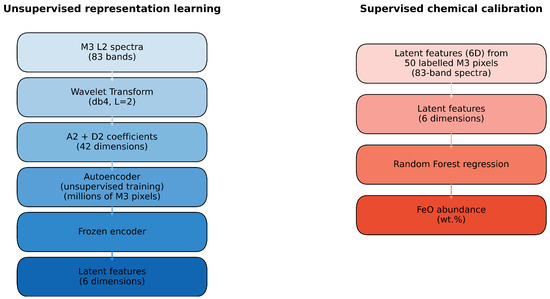
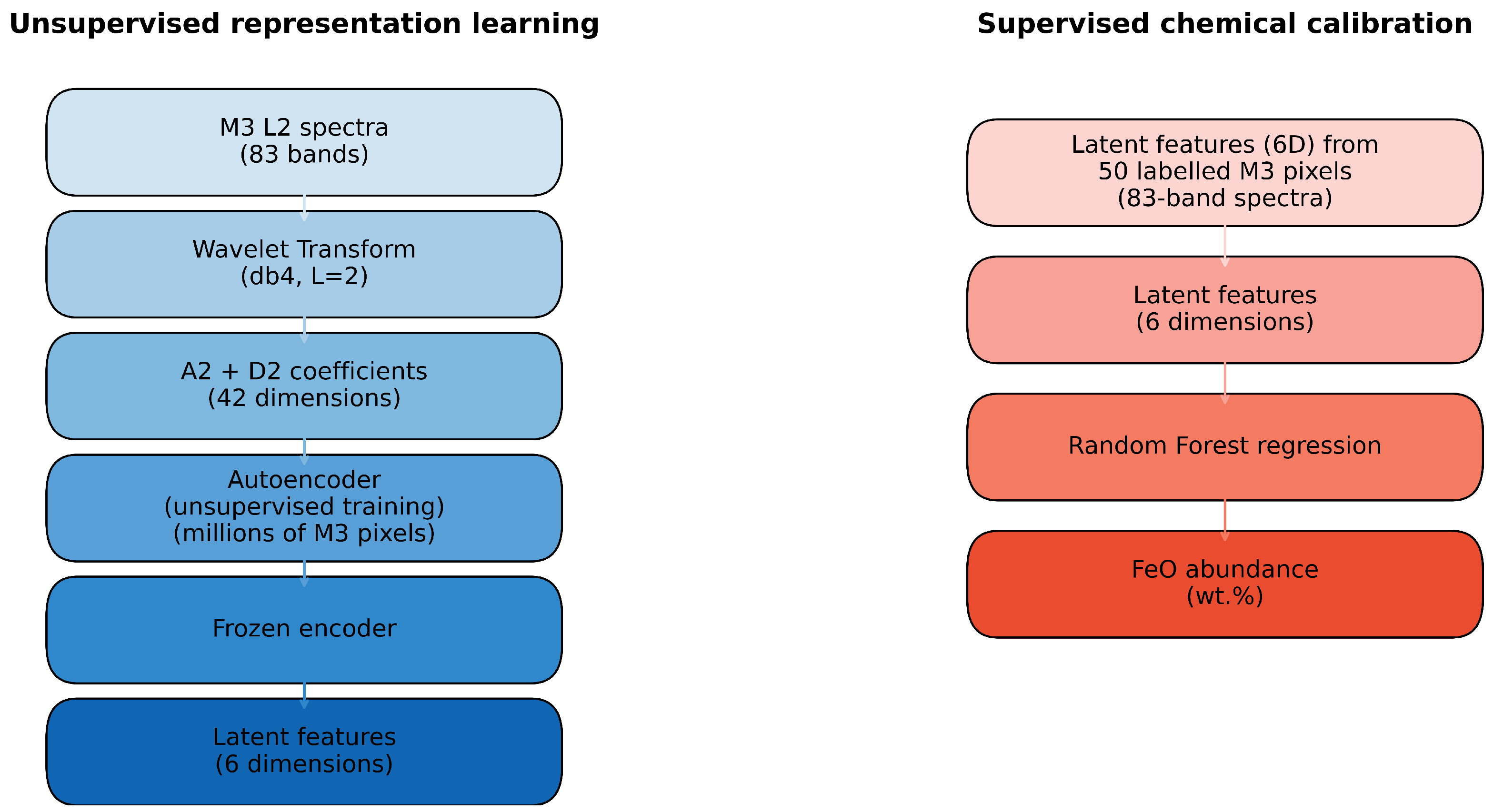
For completeness, we summarise here the data flow across the different components of the proposed pipeline and clarify the distinction between unsupervised representation learning and supervised chemical calibration (Figure 1). Each M3 L2 pixel is initially represented by an 83-dimensional reflectance spectrum, which is used directly as input to the wavelet stage without additional spectral normalization, as the data are already photometrically corrected by the standard M3 calibration pipeline. A two-level db4 discrete wavelet transform is applied to each spectrum, and only the and coefficient families are retained and concatenated into a 42-dimensional multiscale feature vector. These wavelet coefficients constitute the explicit input to the autoencoder, which is trained in a fully unsupervised manner using millions of M3 spectra to learn a compact nonlinear embedding. After training, the encoder is frozen and used to map any wavelet-compressed spectrum to a 6-dimensional latent representation. In the final stage, these latent features are used as inputs to supervised regression models that are calibrated exclusively using laboratory-measured FeO abundances from returned lunar samples, which provide the ground truth for quantitative FeO estimation.
Figure 1.
Schematic overview of the proposed processing pipeline, highlighting the separation between unsupervised representation learning and supervised chemical calibration.
3. Results
Before discussing the global FeO distribution derived in this study, it is essential to validate the methodological choices that underpin the proposed pipeline. The wavelet transform and autoencoder are trained in an unsupervised manner, and their configuration must be justified by their ability to compactly and faithfully represent spectral information. For this reason, the first part of this section examines the quantitative evidence supporting each unsupervised decision in the workflow, including the selection of the wavelet coefficients and the choice of a six-dimensional nonlinear latent space. Subsequently, we evaluate the supervised regression performance and the robustness of the full pipeline. These analyses ensure that the adopted configuration is both statistically justified and robust, providing a transparent foundation for the final compositional map.
Crucially, the unsupervised stages, wavelet decomposition and autoencoder training, were conducted using only a representative subset of M3 spectra that explicitly excluded all 50 pixels corresponding to the laboratory samples. This strict separation ensures that no information from the ground-truth dataset was used during feature extraction or representation learning, thereby preventing data leakage and preserving the independence of the subsequent supervised regression.
3.1. Unsupervised Evaluation of Wavelet Coefficient Selection
As described in Section 2.2, the two-level db4 decomposition produces three families of coefficients: , , and . To validate the physically motivated decision to retain only the and coefficients, we evaluated alternative coefficient subsets using a spatially stratified benchmark of 5,000,000 M3 spectra. Each variant was assessed using two unsupervised metrics relevant for a compression stage: the percentage of cumulative signal energy retained, and the fidelity of spectral reconstruction after inverse DWT. The results are shown in Table 1.
Table 1.
Unsupervised evaluation of wavelet coefficient subsets. Results are based on a benchmark of 5 million spectra. Reconstruction RMSE is reported in unitless reflectance (I/F). The subset provides the optimal trade-off, retaining > 96% of the signal energy while achieving the lowest reconstruction error.
The subset achieves the lowest reconstruction error (RMSE = 0.0074 I/F) despite discarding 41 high-frequency coefficients and retaining 96.8% of the signal energy. The monotonic increase in reconstruction error when including progressively more coefficients quantitatively confirms that this family is dominated by variance that is non-informative for spectral shape recovery, consistent with noise. Thus, the 42-dimensional representation constitutes an optimal trade-off between information retention and noise suppression for the subsequent feature-learning stage.
3.2. Unsupervised Comparison of Embedding Strategies
To assess the suitability of nonlinear embeddings for representing the 42-dimensional wavelet coefficients, we compared Principal Component Analysis (PCA), Independent Component Analysis (ICA), and the autoencoder (AE) described in Section 2.3, which employs a symmetric architecture with LeakyReLU activations (), batch normalization, dropout (), and regularization (). All methods were evaluated under identical conditions using the benchmark set of 1,000,000 spectra, based on their spectral reconstruction fidelity.
Table 2 summarises the reconstruction errors for a latent dimension of , the target dimensionality used in the final pipeline.
Table 2.
Comparison of low-dimensional embeddings at using unsupervised reconstruction error. The autoencoder achieves significantly lower RMSE, indicating its superior capacity to capture nonlinear spectral manifolds.
The autoencoder clearly outperforms both linear methods, achieving a 31% reduction in reconstruction RMSE compared to PCA. This indicates that a significant portion of M3 spectral variability, particularly the nonlinear curvature associated with absorption bands, is not efficiently captured by linear projections.
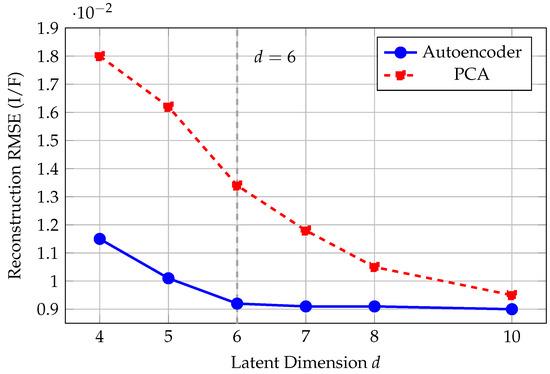
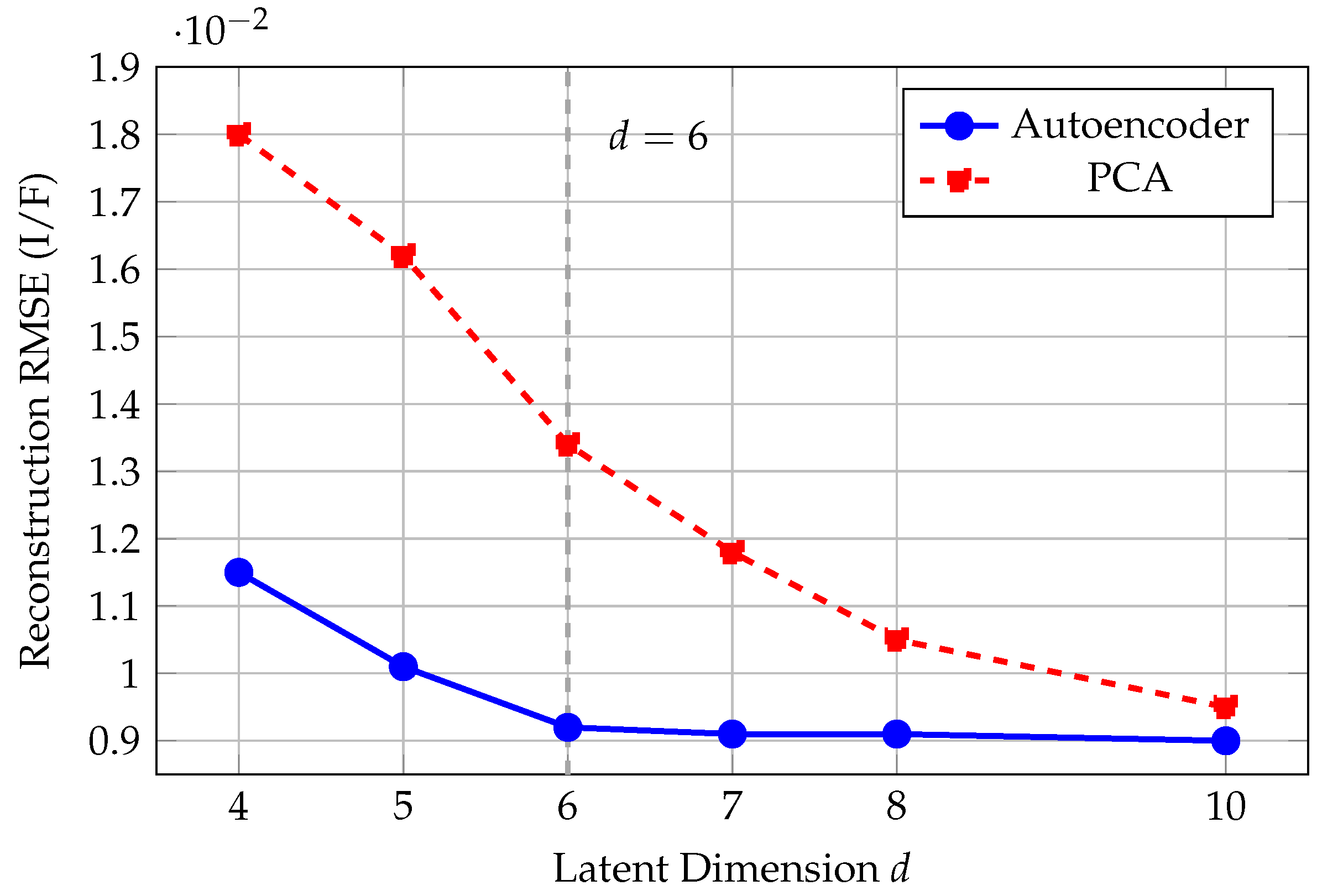
We further evaluated how reconstruction error varies with latent dimensionality d for both the autoencoder and PCA (Figure 2, Table 3). For each , we trained a separate autoencoder (with the same symmetric architecture resized accordingly) and computed the PCA projection onto the top d components, always evaluating reconstruction RMSE on the same held-out validation set. A good embedding should minimize the reconstruction error (distortion) for a given code rate (dimension d).
Figure 2.
Rate–distortion curves for autoencoder (blue) and PCA (red, dashed). The autoencoder consistently achieves lower reconstruction error than PCA for any given latent dimension d. The autoencoder curve shows a distinct elbow at (marked by vertical dashed line), beyond which additional dimensions yield negligible improvement (≤ 0.0002 I/F total). At , the autoencoder reduces reconstruction error by 31.3% compared to PCA (0.0092 vs. 0.0134 I/F). PCA requires approximately to approach the reconstruction fidelity that the autoencoder achieves at .
Table 3.
Reconstruction RMSE (I/F) as a function of latent dimension d for autoencoder and PCA. The autoencoder consistently achieves lower error than PCA at every dimension. A distinct elbow in the autoencoder curve occurs at , beyond which improvements are negligible (≤0.0002 I/F total).
Table 3 and Figure 2 reveal several important patterns. First, the autoencoder consistently outperforms PCA across all dimensions d, with the performance advantage ranging from 36.1% at to 5.3% at . Second, the autoencoder curve exhibits a distinct elbow at , where the marginal gain in reconstruction fidelity per added dimension drops sharply, from approximately 0.0014 I/F (between and ) to less than 0.0001 I/F per dimension thereafter. In contrast, the PCA curve decreases more steadily without such a pronounced elbow, indicating that linear representations require more dimensions to capture equivalent spectral information.
The choice of is therefore justified by three concurrent factors: it represents the elbow of the autoencoder’s rate–distortion curve, where compression efficiency is optimal; at this dimension, the autoencoder maintains a substantial 31.3% advantage over PCA; and it provides a compact representation that mitigates overfitting risks in the subsequent regression stage, which has only 50 training samples. This dimensionality captures the essential nonlinear structure of the lunar spectral manifold while discarding noise and redundant variance.
3.3. Supervised Regression Performance with Laboratory Data
The unsupervised pipeline (DWT + AE with ) produces a 6-dimensional latent vector for any M3 spectrum. The final mapping to FeO abundance was trained and evaluated on the ground-truth dataset of 50 laboratory samples using the hold-out validation protocol described in Section 2.4.
The cross-validated performance during the model selection phase is summarized in Table 4. The Random Forest regressor showed highly competitive performance, with the lowest mean MAE ( wt.%) and RMSE ( wt.%), and robust stability as indicated by its standard deviations.
Table 4.
Cross-validation performance metrics (mean ± std) for the evaluated regression models during model selection (trained/evaluated on the 45-sample training/validation set via 10-fold CV).
The optimal hyperparameters for each model, determined via grid search within the cross-validation, are listed in Table 5.
Table 5.
Optimal hyperparameters obtained via grid search during model selection.
Based on its optimal balance of accuracy and robustness, the Random Forest model was selected as the final regressor. After retraining on the full 45-sample training set, its performance was assessed on the independent 5-sample hold-out test set. The final integrated pipeline (DWT + AE + Random Forest) achieved excellent predictive accuracy, with an MAE of 1.204 wt.%, RMSE of 1.873 wt.%, and R2 of 0.900 (Table 6).
Table 6.
Final performance of the selected regression models on the independent hold-out test set (5 samples). The Random Forest-based pipeline achieves the best accuracy.
The superior performance of the Random Forest model, particularly on the unseen test data, confirms its ability to capture the complex, nonlinear relationship between the autoencoder-derived spectral features and FeO abundance. This model was therefore used to generate the global FeO map.
3.4. Pipeline Robustness to Spectral Perturbations
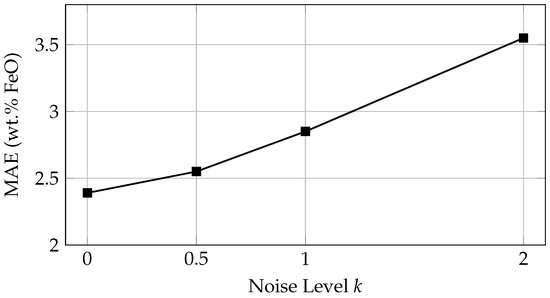
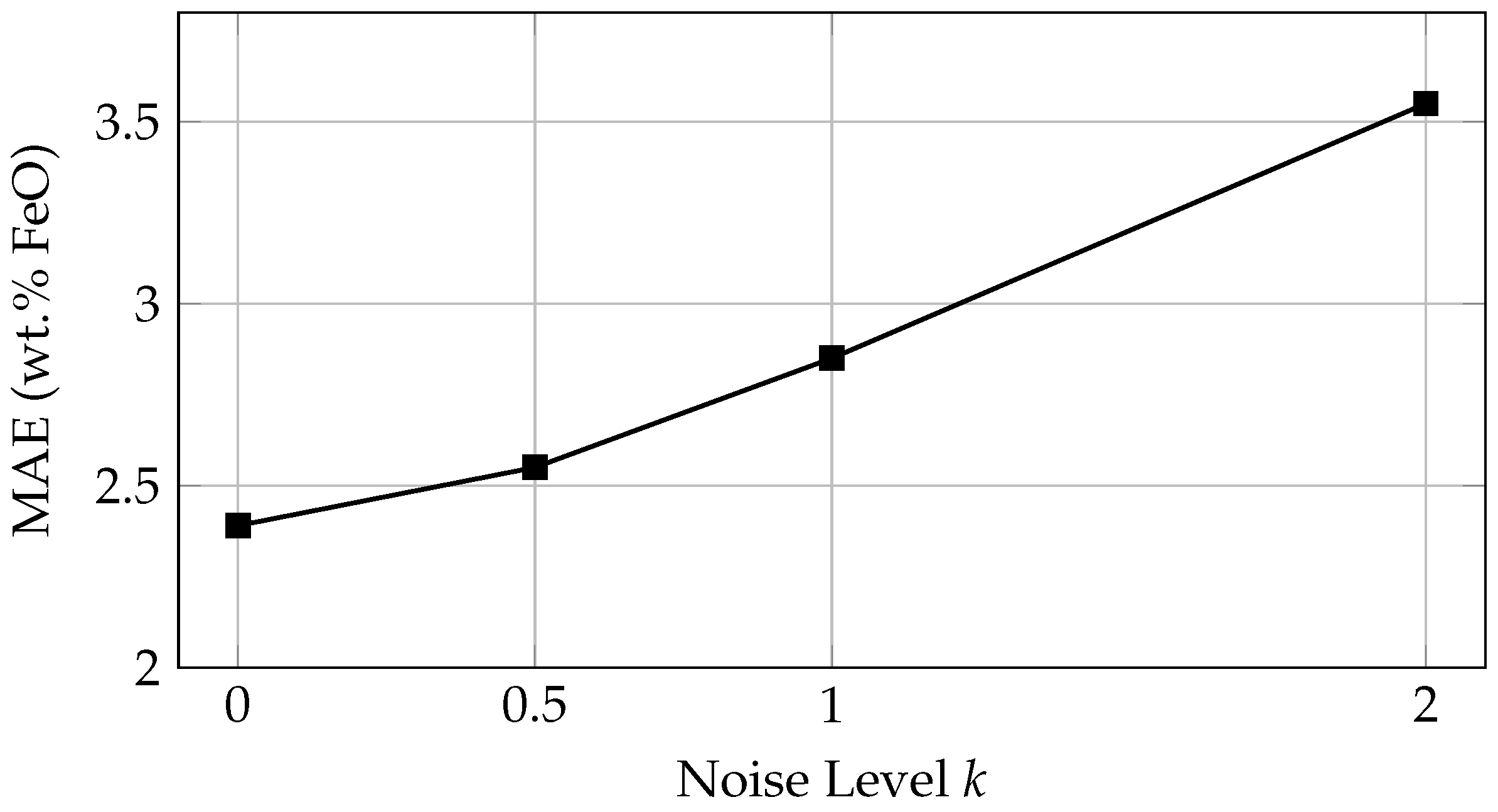
To evaluate the stability of the full pipeline to instrumental or environmental noise, Gaussian perturbations were injected into the wavelet coefficients prior to encoding. Noise amplitudes were expressed as fractions of the autoencoder’s intrinsic reconstruction RMSE (, with ). The resulting impact on FeO prediction accuracy on the ground-truth dataset is shown in Table 7.
Table 7.
Robustness of the full pipeline to injected Gaussian noise in the wavelet domain. Performance degrades gracefully, demonstrating stability. (Metrics are from the nested CV using the Random Forest regressor.)
Pipeline performance degrades gracefully with increasing noise (Figure 3). For a perturbation equal to the AE’s own reconstruction error (), the MAE increases by approximately 0.4 wt.%. This demonstrates the inherent denoising properties of the wavelet truncation and the autoencoder, coupled with the robustness of the Random Forest regressor.
Figure 3.
Robustness of the pipeline’s FeO estimation error under controlled spectral perturbations. Error bars represent one standard deviation from the cross-validation folds. Performance degrades gracefully, with an MAE increase of 0.4 wt.% for noise levels comparable to the autoencoder’s own reconstruction error ().
3.5. Global FeO Distribution
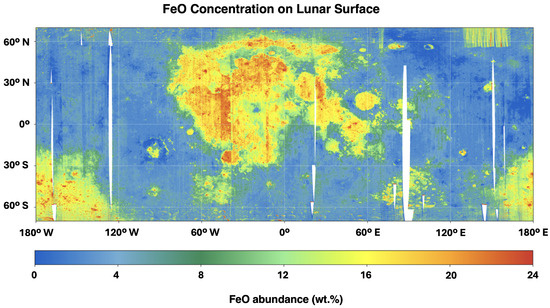
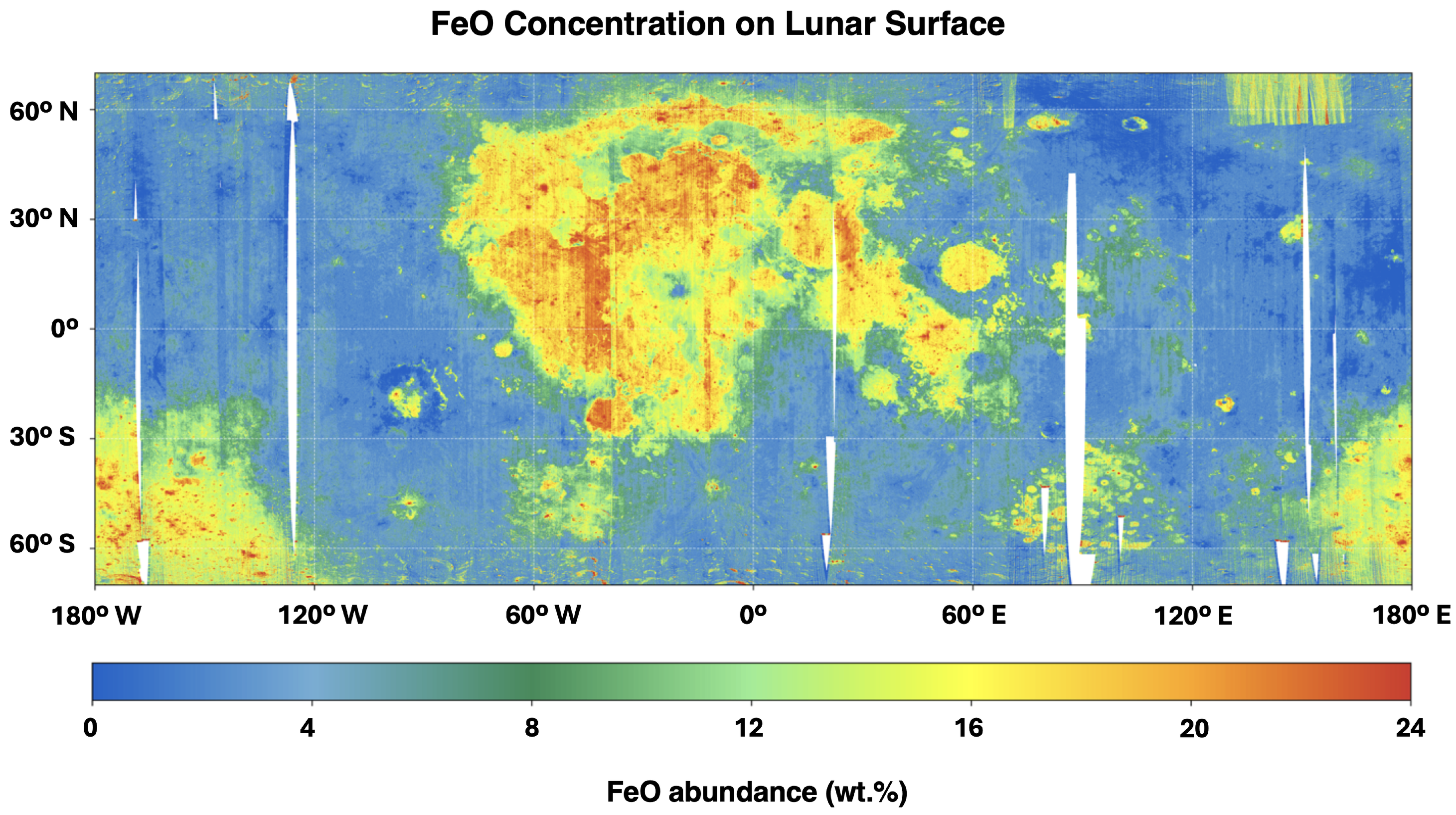
The integrated wavelet–autoencoder–Random Forest pipeline, configured and validated as described in the previous subsections, was applied to the full M3 global archive (>3.5 pixels) to generate a global FeO abundance map at the native M3 spatial resolution of approximately 150 m/pixel (Figure 4). The resulting product represents a continuous, spatially resolved estimate of surface FeO concentration derived solely from hyperspectral reflectance information.
Figure 4.
Global FeO abundance map of the lunar surface derived from M3 hyperspectral data using the wavelet–autoencoder–Random Forest pipeline. The color scale represents FeO concentration in weight percent (wt.%), ranging from low values (blue) to high values (red).
At the global scale, the map clearly reproduces the first-order lunar geochemical dichotomy. Elevated FeO concentrations, typically in the range of approximately 16–24 wt.%, dominate the nearside basaltic maria, including Oceanus Procellarum, Mare Imbrium, and Mare Tranquillitatis. These regions are spatially coincident with extensive mare basalt provinces and exhibit FeO abundances broadly consistent with previously mapped basaltic units of Imbrian to Eratosthenian age.
These intermediate FeO values occur in transitional terrains and impact basins, where mixed regolith compositions—attributed to the interplay of mafic and feldspathic sources—are commonly inferred from earlier compositional studies.
In contrast, the farside and polar highlands are characterized by systematically lower FeO values, generally between 3 and 6 wt.%, consistent with anorthositic crustal compositions dominated by plagioclase feldspar. Large expanses of the farside highlands display relatively homogeneous low-FeO signatures, reflecting the compositional uniformity of the primordial lunar crust inferred from previous remote sensing and sample-based studies.
Intermediate FeO abundances, typically ranging from 8 to 12 wt.%, are observed in transitional terrains and in and around major impact structures, most notably the South Pole–Aitken basin. These intermediate FeO values occur in transitional terrains and impact basins, where mixed regolith compositions—attributed to the interplay of mafic and feldspathic sources—are commonly inferred from earlier compositional studies.
The Procellarum KREEP Terrane (PKT) exhibits moderate FeO enrichment relative to the surrounding highlands, with typical values of approximately 12–15 wt.%. This pattern is consistent with the geochemically evolved character of the PKT and its association with incompatible-element-rich materials, although FeO alone does not uniquely trace KREEP components.
At local scales, the map resolves spatial variability within individual mare units and delineates sharp compositional gradients at mare–highland boundaries. While these fine-scale variations should be interpreted cautiously given the indirect nature of optical compositional estimates, their spatial coherence and geological consistency suggest that the model preserves meaningful subregional FeO contrasts at the native resolution of the M3 dataset.
4. Discussion
The wavelet–autoencoder–regression pipeline developed in this study represents a novel approach to quantitative compositional mapping from planetary hyperspectral data. While the validation metrics (MAE = 1.20 wt.%, ) demonstrate strong predictive performance, the broader value of the method lies in how it advances the state of the art in lunar FeO mapping. In this section, we contextualize our results by comparison with contemporary global FeO products, discuss the specific advantages and limitations of the proposed pipeline, and outline promising directions for future research.
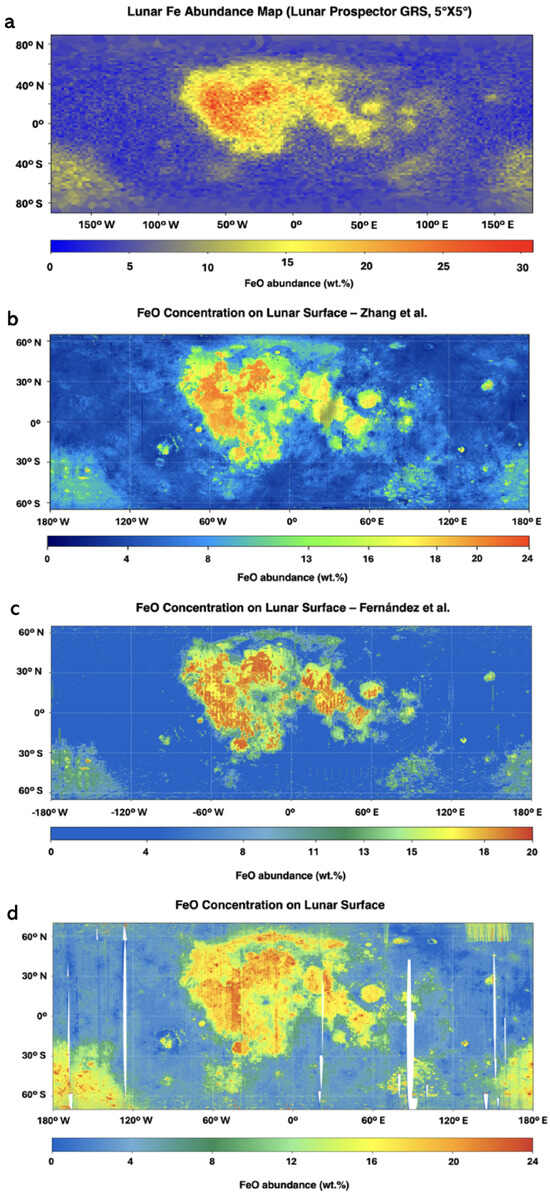
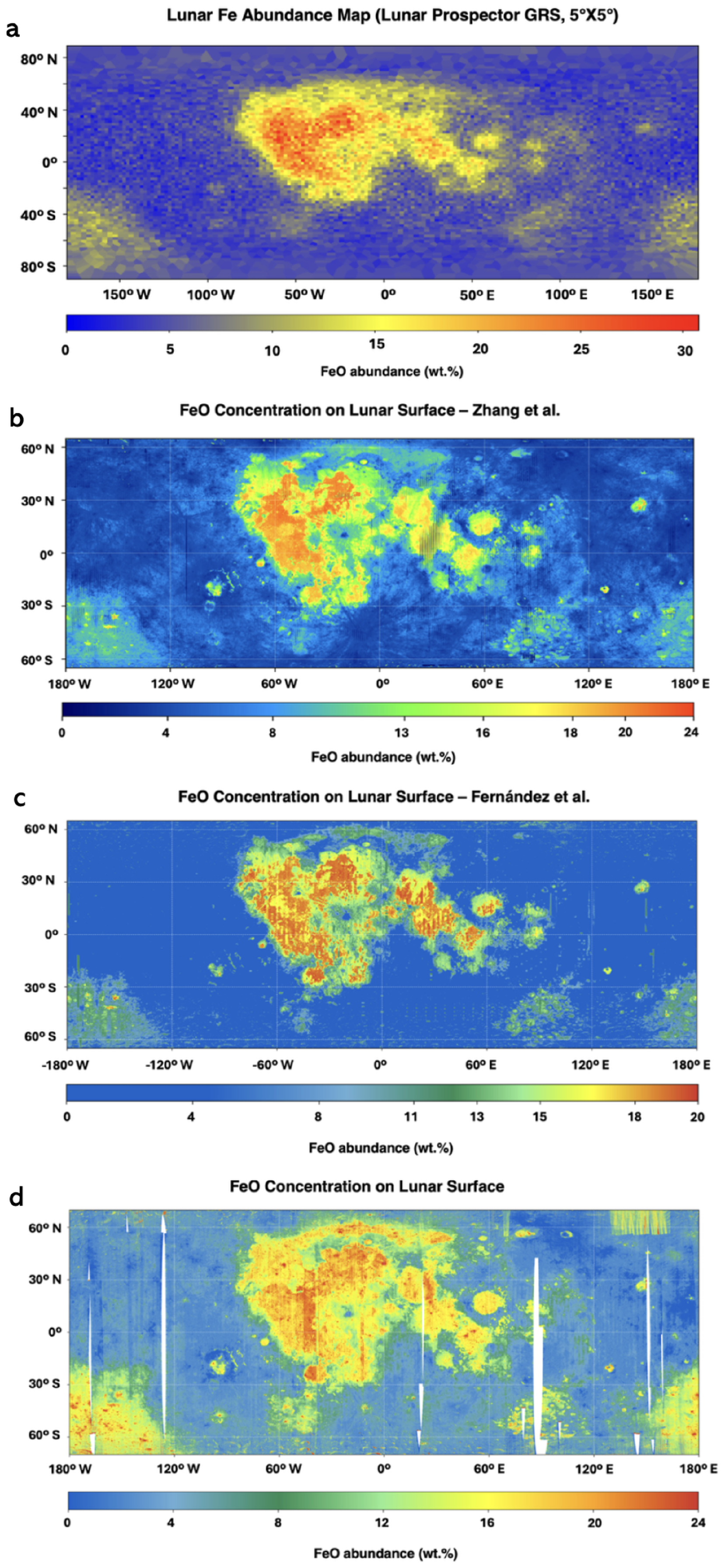
Our global FeO map occupies a distinctive position within the current landscape of lunar compositional datasets (Table 8). Unlike the Lunar Prospector gamma-ray spectrometer (GRS) map, which provides direct elemental measurements but at very coarse spatial resolution (5°, ∼150 km), our product preserves high spatial detail (∼150 m) while deriving composition from hyperspectral reflectance. Compared to the M3-based empirical map of Zhang et al. (2023) [5], which relies on reflectance band ratios at similar spatial resolution, our approach exploits the full hyperspectral range through learned feature representations rather than pre-defined spectral indices. This addresses well-known limitations of index-based methods, including sensitivity to specific noise sources and implicit assumptions of linearity between band depths and composition [2,6]. The Random Forest regression applied to Clementine multispectral data by Fernández et al. (2025) [12] similarly adopts a machine learning pipeline, but its reliance on only 11 spectral bands limits sensitivity to subtle absorption features that are critical for precise FeO estimation.
Table 8.
Characteristics of contemporary global lunar FeO abundance maps.
Visually, the similarities between the maps are more prominent than their differences (Figure 5). All products capture the fundamental lunar geochemical dichotomy between iron-rich nearside maria and iron-poor farside highlands. In our map, typical mare FeO values range from approximately 16 to 20 wt.%, with localized maxima reaching up to ∼24 wt.% in the most iron-rich basaltic provinces, while highland regions predominantly exhibit values of ∼3–6 wt.%. The Lunar Prospector GRS map reproduces this global pattern at continental scales, smoothed by its coarse spatial resolution. Optical maps derived from imaging spectroscopy resolve substantially finer structure, including heterogeneous compositions within individual mare basins, sharper mare–highland boundaries, and spatial gradients consistent with regolith mixing processes.
Figure 5.
Comparative FeO abundance maps: (a) Lunar Prospector GRS (2012) [27], (b) Zhang et al. (2023) M3 empirical regression [5], (c) Fernández et al. (2025) Clementine Random Forest [12], (d) This study (wavelet–autoencoder–RF from M3). All products reproduce the lunar FeO dichotomy but differ in spatial detail, noise characteristics, and expression of intra-mare variability.
Relative to the Zhang et al. (2023) [5] M3 empirical product, our map exhibits different noise characteristics rather than a simple reduction in noise amplitude. The wavelet-based preprocessing suppresses high-frequency spectral noise, particularly in low-FeO highland regions where diagnostic absorption features are weak, while preserving mesoscale spatial variability within mare units. As a result, intra-mare compositional heterogeneity appears more clearly expressed, with coherent spatial patterns consistent with distinct basalt flows and volcanic units. Residual instrument-related artefacts, including faint longitudinal striping, remain visible in both products, reflecting differences in noise mitigation and regularization strategies rather than fundamental discrepancies in FeO distribution.
In transitional zones such as the margins of Mare Imbrium and Oceanus Procellarum, our map displays spatially coherent gradients rather than pixel-scale fluctuations. This behaviour is consistent with improved handling of mixed spectral signatures through the nonlinear feature learning of the autoencoder. However, because the current implementation processes pixels independently and does not explicitly incorporate spatial context, these observations should be interpreted as qualitative improvements rather than definitive evidence of superior mixed-pixel unmixing.
Quantitative intercomparison reveals both strong agreement and informative discrepancies among global FeO products (Table 9). The high spatial correlation with the Zhang et al. (2023) [5] map () confirms that both M3-derived products capture the same fundamental FeO distribution, validating the underlying spectral data. The slightly lower correlation with the Clementine-based product of Fernández et al. (2025) [12] () is consistent with the reduced spectral dimensionality of that dataset. Notably, the correlation with Lunar Prospector GRS data () is substantial given the fundamentally different measurement principles involved, with optical reflectance sampling the uppermost microns of the regolith and gamma-ray spectroscopy probing material to depths of several tens of centimetres.
Table 9.
Quantitative comparison of global FeO products. Metrics computed on a 0.5° grid across the lunar nearside.
The modest positive bias of our estimates relative to other optical methods (+0.5 to +0.7 wt.% FeO) is most pronounced in iron-rich mare regions. Rather than indicating a systematic overestimation, this behaviour is interpreted as enhanced sensitivity to high-FeO endmembers, enabled by multiscale wavelet analysis of Fe2+ related absorption features and nonlinear regression. The small negative bias relative to Lunar Prospector GRS measurements (−0.3 wt.%) likely reflects differences in sampling depth, spatial support, and calibration, as well as genuine surface–subsurface compositional contrasts.
Several limitations of the present approach warrant consideration. Computationally, the unsupervised training of the wavelet–autoencoder feature extractor requires significant resources (GPU memory and multi-hour preprocessing), though once trained, global inference is efficient (≈1.5 h for pixels). Methodologically, model calibration depends on laboratory analyses of returned samples. Our training set comprises the full ensemble of approximately 50 geolocated lunar samples with published FeO abundances from the Apollo, Luna, and Chang’e missions that are commonly employed in the literature. While this represents the most comprehensive ground truth currently available, these samples are geographically clustered in nearside mare regions, leading to underrepresentation of farside highlands and some basin interiors. In addition, space weathering processes modify spectral slopes and absorption strengths independently of bulk FeO content. Although the wavelet transform emphasizes absorption-band morphology and is therefore relatively robust to continuum changes, maturation-related effects may still introduce subtle regional biases. Finally, the current pixel-independent framework does not exploit spatial context, which could further improve predictions in mixed or geologically complex terrains. Moreover, the wavelet-based compression, while effective for noise suppression, may attenuate subtle spectral features unrelated to FeO, and the pipeline’s transfer to other planetary datasets would require sensor-specific recalibration and validation.
Looking forward, the modular architecture of the pipeline offers several promising avenues for extension. Incorporating spatial information through convolutional or graph-based models could explicitly address mixed pixels and geological boundaries. The wavelet–autoencoder feature extraction stage is designed to be largely sensor-agnostic and could potentially be adapted to other planetary hyperspectral datasets, such as CRISM for Mars or MERTIS for Mercury, though this would require sensor-specific recalibration and validation beyond the scope of this study. Moreover, the learned latent representations likely encode information relevant to additional compositional parameters, suggesting potential for multi-element mapping within a unified pipeline.
In summary, the wavelet–autoencoder–regression pipeline advances lunar FeO mapping by combining physically motivated multiscale signal analysis with the flexibility of modern machine learning. It produces global maps with high spatial fidelity, enhanced contrast in iron-rich terrains, and quantitative agreement with established datasets, while maintaining a transparent and extensible methodological structure. Despite limitations related to ground truth availability and space weathering effects, the approach provides a robust foundation for next-generation planetary hyperspectral compositional analysis.
At regional scales, several local features in the retrieved FeO map (Figure 5d) merit specific discussion. Mare Tranquillitatis exhibits FeO abundances characteristic of basaltic terrains, though its contrast relative to other large mare provinces appears less pronounced than in some previous products. This reflects both the heterogeneous nature of Tranquillitatis basalts and the use of a global colour scale optimized for preserving the full dynamic range of FeO values. Within Mare Imbrium, the map reveals spatially continuous compositional variability rather than a sharply defined east–west division, consistent with a quantitative representation of FeO abundance rather than a discretized geological unit classification. Localized FeO enrichments are also observed in and around young impact craters such as Tycho. These features are interpreted as the combined effect of excavation of compositionally distinct subsurface materials, impact-driven regolith mixing, and the known sensitivity of optical FeO retrievals to surface maturity and photometric conditions. Such local anomalies highlight inherent limitations of pixel-based optical compositional mapping and are therefore explicitly acknowledged here to guide a cautious geological interpretation of the results.
5. Conclusions
This work presents a unified and scalable machine-learning pipeline for the quantitative estimation of lunar iron oxide (FeO) abundance from M3 hyperspectral data. By integrating multiscale spectral compression via the Discrete Wavelet Transform, nonlinear feature learning through a deep autoencoder, and ensemble regression using Random Forests, the proposed approach enables robust FeO prediction while remaining computationally tractable at global scales.
The final model achieves a mean absolute error of 1.204 wt.% FeO (RMSE = 1.873 wt.%, ) on independent test data, and its application to the full M3 Global Mode dataset yields a global FeO abundance map at ∼150 m/pixel resolution. The retrieved large-scale compositional patterns are consistent with established lunar geochemical trends, demonstrating the ability of the method to capture meaningful spectral–chemical relationships across diverse terrains.
From a methodological perspective, the results highlight the effectiveness of combining wavelet-based spectral representations with autoencoder-derived latent features for large-scale hyperspectral compositional mapping. The substantial reduction in data dimensionality enables efficient processing of billions of spectra without sacrificing diagnostically relevant information.
Although the pipeline is subject to limitations inherent to optical remote sensing, including sparse ground-truth sampling and sensitivity to space-weathering effects, its modular design provides a flexible basis for future extensions. These include uncertainty-aware regression, multi-oxide estimation, and potential adaptation to other planetary hyperspectral datasets, subject to sensor-specific validation. Overall, the proposed pipeline offers a robust foundation for scalable, data-driven mineralogical analysis in planetary science.
Author Contributions
Conceptualization, J.F.–D.; methodology, J.F.–D.; software, F.J.d.C.J.; validation, F.J.d.C.J. and J.F.–D.; formal analysis, J.F.–D., F.S.L. and S.I.Á.; investigation, J.F.–D. and F.J.d.C.J.; resources, J.F.–D. and A.L.M.S.; data curation, F.S.L. and J.G.R.; writing—original draft preparation, J.F.–D.; writing—review and editing, F.J.d.C.J., F.S.L. and J.G.R.; visualization, J.F.–D.; supervision, F.J.d.C.J., F.S.L. and J.G.R.; project administration, J.F.–D. and F.J.d.C.J.; funding acquisition, F.J.d.C.J. All authors have read and agreed to the published version of the manuscript.
Funding
This research was funded by Plan Nacional by Ministerio de Ciencia, Innovación y Universidades, Spain, grant number MCIU-22-PID2021-127331NB-I00 and the research agreement between the Institute of Space Sciences and Technologies of Asturias (ICTEA) and Hulleras del Norte S.A (HUNOSA), reference SV-21-HUNOSA-2.
Data Availability Statement
The data presented in this study are openly available in NASA Planetary Data System (PDS) at https://pds-imaging.jpl.nasa.gov/volumes/m3.html (accessed on 30 December 2025).
Acknowledgments
This research was supported by HUNOSA through the Specific Collaboration Agreement for the Promotion of Research on Space Mining and Energy Resources, reference SV-21-HUNOSA-2.
Conflicts of Interest
The authors declare no conflicts of interest.
References
- Heiken, G.H.; Vaniman, D.; French, B.M. Lunar Sourcebook: A User’s Guide to the Moon; Cambridge University Press: Cambridge, UK, 1991; Available online: https://www.lpi.usra.edu/publications/books/lunar_sourcebook/pdf/LunarSourceBook.pdf (accessed on 14 October 2025).
- Lucey, P.G.; Blewett, D.T.; Jolliff, B.L. Lunar iron and titanium abundance algorithms based on final processing of Clementine ultraviolet-visible images. J. Geophys. Res. Planets 2000, 105, 20297–20305. [Google Scholar] [CrossRef] [Scilit]
- Lucey, P.G.; Taylor, G.J.; Malaret, E. Abundance and Distribution of Iron on the Moon. Science 1995, 268, 1150–1153. [Google Scholar] [CrossRef] [Scilit] [PubMed]
- Zhong, Y.; Low, J.; Zhu, Q.; Jiang, Y.; Wang, X.; Zhang, F.; Shang, W.; Long, R.; Yao, Y.; Yao, W.; et al. In situ resource utilization of lunar soil for highly efficient extraterrestrial fuel and oxygen supply. Nat. Sci. Rev. 2022, 10, nwac200. [Google Scholar] [CrossRef] [Scilit] [PubMed]
- Zhang, L.; Zhang, X.; Yang, M.; Xiao, X.; Qiu, D.; Yan, J.; Xiao, L.; Huang, J. New maps of major oxides and Mg # of the lunar surface from additional geochemical data of Chang’E-5 samples and KAGUYA multiband imager data. Icarus 2023, 397, 115505. [Google Scholar] [CrossRef] [Scilit]
- Wilcox, B.B.; Lucey, P.G.; Gillis, J.J. Mapping iron in the lunar mare: An improved approach. J. Geophys. Res. Planets 2005, 110, E11001. [Google Scholar] [CrossRef] [Scilit]
- Gillis, J.; Jolliff, B.L.; Elphic, R.C. A revised algorithm for estimating TiO2 from Clementine UVVIS data: A synthesis of rock, soil, and remotely sensed TiO2 concentrations. J. Geophys. Res. Planets 2003, 108, E2. [Google Scholar] [CrossRef] [Scilit]
- Pieters, C.M.; Head, J.W.; Sunshine, J.M.; Fischer, E.M.; Murchie, S.L.; Belton, M.; McEwen, A.; Gaddis, L.; Greeley, R.; Neukumet, G.; et al. Crustal diversity of the moon: Compositional analyses of Galileo solid state imaging data. J. Geophys. Res. Planets 1993, 98, 17127–17148. [Google Scholar] [CrossRef] [Scilit]
- Pieters, C.M.; Boardman, J.; Buratti, B.; Chatterjee, A.; Clark, R.; Glavich, T.; Green, R.; Head, J.W.; Isaacson, P.; Malaret, E.; et al. The Moon Mineralogy Mapper (M3) on Chandrayaan-1. Curr. Sci. 2009, 96, 500–505. [Google Scholar]
- NASA Planetary Data System Imaging Node. Moon Mineralogy Mapper (M3) Online Data Volumes, Chandrayaan-1 Mission; NASA/JPL: Pasadena, CA, USA, 2009. Available online: https://pds-imaging.jpl.nasa.gov/volumes/m3.html (accessed on 25 November 2025).
- Qiu, D.; Wu, J.; Li, F.; Yan, J. Machine learning for inversing FeO and TiO2 content on the Moon: Method and comparison. Icarus 2021, 373, 114778. [Google Scholar] [CrossRef] [Scilit]
- Fernández, J.; De Cos, F.J.; Sánchez, F.; Gracia, J. Spectral Parameter-Based Prediction of Lunar FeO Content Using Random Forest Regression. Mathematics 2025, 13, 2802. [Google Scholar] [CrossRef] [Scilit]
- Green, R.O.; Pieters, C.; Mouroulis, P.; Eastwood, M.; Boardman, J.; Glavich, T.; Isaacson, P.; Annadurai, M.; Besse, S.; Barr, D.; et al. The Moon Mineralogy Mapper (M3) imaging spectrometer for lunar science: Instrument description, calibration, and on-orbit performance. J. Geophys. Res. Planets 2011, 116. [Google Scholar] [CrossRef] [Scilit]
- Lundeen, S.; McLaughlin, S.; Alanis, R. Moon Mineralogy Mapper Data Product Software Interface Specification. Jet Propuls. Lab. 2012, D-38529 (Version 3.17). Available online: https://planetarydata.jpl.nasa.gov/img/data/m3/CH1M3_0004/DOCUMENT/ARCHSIS.PDF (accessed on 30 December 2025).
- Isaacson, P.J.; Pieters, C.M.; Besse, S.; Clark, R.N.; Head, J.W.; Klima, R.L.; Mustard, J.F.; Petro, N.E.; Staid, M.I.; Sunshine, J.M.; et al. Remote compositional analysis of lunar olivine-rich lithologies with Moon Mineralogy Mapper (M3) spectra. J. Geophys. Res. Planets 2011, 116. [Google Scholar] [CrossRef] [Scilit]
- Starck, J.-L.; Murtagh, F. Astronomical Image and Data Analysis, 2nd ed.; Springer: Berlin/Heidelberg, Germany, 2007. [Google Scholar]
- Mallat, S. A Wavelet Tour of Signal Processing: The Sparse Way, 3rd ed.; Academic Press: Burlington, MA, USA, 2009; ISBN 978-0-12-374370-1. [Google Scholar]
- Donoho, D.L.; Johnstone, I.M. Adapting to unknown smoothness via wavelet shrinkage. J. Am. Stat. Assoc. 1995, 90, 1200–1224. [Google Scholar] [CrossRef]
- Starck, J.-L.; Murtagh, F.; Bijaoui, A. Image Processing and Data Analysis: The Multiscale Approach; Cambridge University Press: Cambridge, UK, 1998. [Google Scholar]
- Zhu, L.; Wu, J.; Biao, W.; Liao, Y.; Wu, D. Spectral Masked Autoencoder for Hyperspectral Remote Sensing Information Reconstruction. Sensors 2023, 23, 3728. [Google Scholar] [CrossRef] [Scilit]
- Qiu, D.; Chen, W.; Yan, J.; Yi, S. FeO and TiO2 Maps of the Lunar Polar Regions Derived From the Clementine Data. J. Geophys. Res. 2025, 130. [Google Scholar] [CrossRef] [Scilit]
- Li, C.; Hu, H.; Yang, M.-F.; Liu, J. Nature of the lunar far-side samples returned by the Chang’E-6 mission. Natl. Libr. Med. 2024, 11, nwae328. [Google Scholar] [CrossRef] [Scilit] [PubMed]
- Tibshirani, R. Regression Shrinkage and Selection via the Lasso. J. R. Stat. Soc. Ser. B Methodol. 1996, 58, 267–288. [Google Scholar] [CrossRef] [Scilit]
- Smola, A.J.; Schölkopf, B. A Tutorial on Support Vector Regression. Stat. Comput. 2004, 14, 199–222. [Google Scholar] [CrossRef] [Scilit]
- Breiman, L. Random Forests. Mach. Learn. 2001, 45, 5–32. [Google Scholar] [CrossRef] [Scilit]
- Aumon, A.; Ni, S.; Lizotte, M.; Wolf, G.; Moon, K.R.; Rhodes, J.S. Random Forest Autoencoders for Guided Representation Learning. arXiv 2025, arXiv:2502.13257v1. Available online: https://arxiv.org/html/2502.13257v1 (accessed on 6 January 2026).
- Lunar Prospector Gamma-Ray Spectrometer Elemental Abundance Data, Version 1. NASA Planetary Data System (PDS) Geosciences Node. Available online: https://pds-geosciences.wustl.edu/lunar/lp-l-grs-5-elem-abundance-v1/lp_9001/data/ (accessed on 14 November 2025).

Disclaimer/Publisher’s Note: The statements, opinions and data contained in all publications are solely those of the individual author(s) and contributor(s) and not of MDPI and/or the editor(s). MDPI and/or the editor(s) disclaim responsibility for any injury to people or property resulting from any ideas, methods, instructions or products referred to in the content. |
© 2026 by the authors. Licensee MDPI, Basel, Switzerland. This article is an open access article distributed under the terms and conditions of the Creative Commons Attribution (CC BY) license.