Article

End-to-End Graph-Embedded Reinforcement Learning for Solving the Shortest Path Problem with Constraints


1
College of Information Science and Engineering, Northeastern University, Shenyang 110819, China
2
School of Computer Science and Informatics, De Montfort University, Leicester LE1 9BH, UK
3
College of Computer Science and Engineering, Northeastern University, Shenyang 110169, China
4
College of Software, Northeastern University, Shenyang 110819, China
*
Author to whom correspondence should be addressed.
Mathematics 2026, 14(17), 3085; https://doi.org/10.3390/math14173085
Submission received: 19 July 2026 / Revised: 22 August 2026 / Accepted: 25 August 2026 / Published: 27 August 2026
(This article belongs to the Special Issue AI, Machine Learning and Optimization)

Abstract

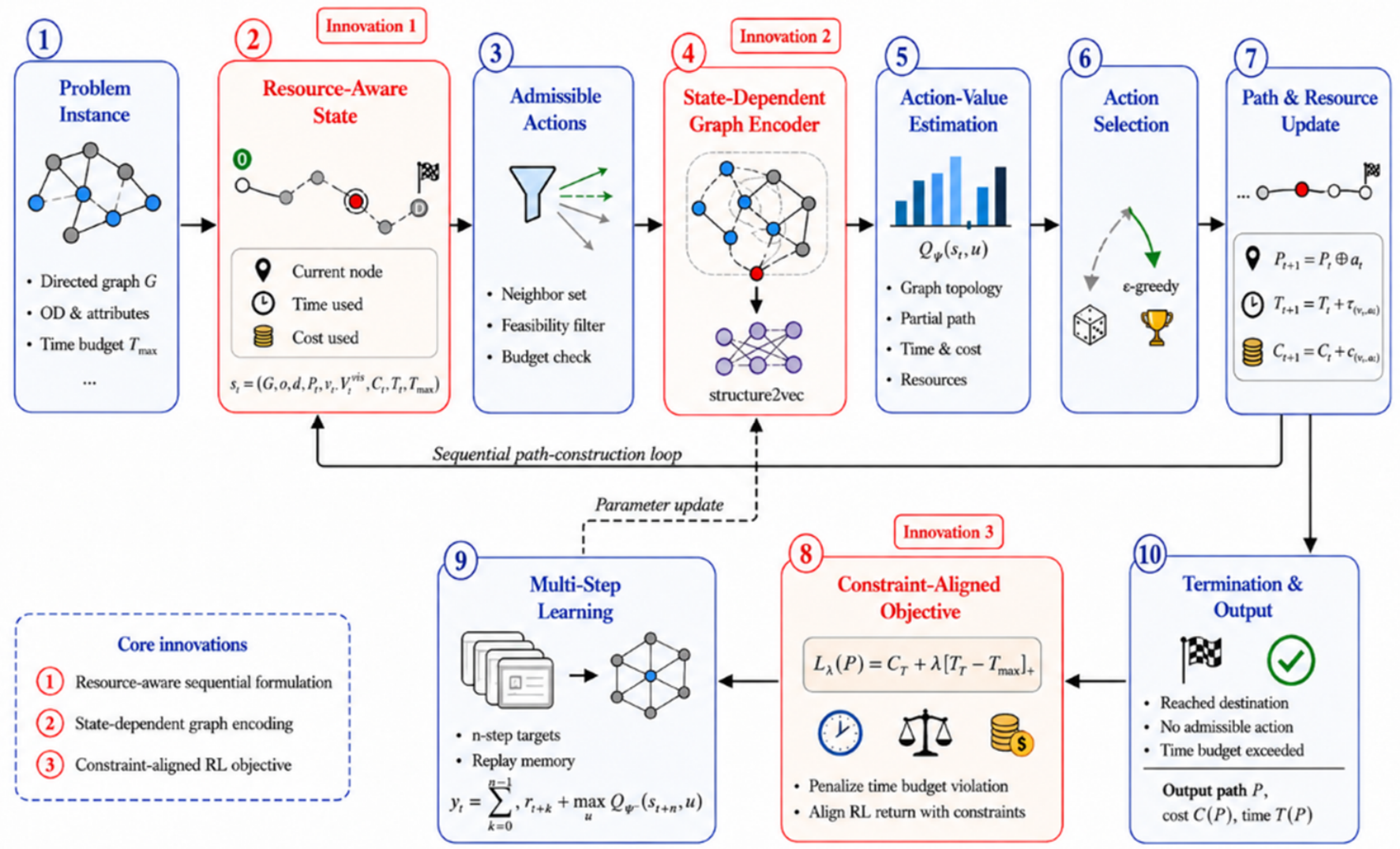
The shortest path problem (SPP) with constraints constitutes a fundamental yet computationally prohibitive NP-hard challenge in operations research and logistics. Traditional optimization algorithms, including both exact and approximate methods, often suffer from prohibitive computational times and severe scalability bottlenecks on large-scale instances. In contrast, emerging Neural Combinatorial Optimization (NCO) approaches offer the potential for rapid inference but frequently fail to guarantee structural feasibility under strict constraints. To bridge this gap, this study introduces E2E_GERL, a novel end-to-end graph-embedded reinforcement learning algorithm for the time-constrained SPP. The problem is reformulated as a structure-aware and resource-aware sequential decision-making process, where a neural graph embedding network, structure2vec, is integrated to capture the long-term structural equivalence of critical graph nodes. In our framework, a ReLU-based Lagrangian penalty is introduced to embed time constraint violation into the learning objective, and n-step Q-learning is employed to effectively overcome delayed path-level consequences. Extensive experiments on synthetic graphs, modified benchmark instances, and a real-world logistics network demonstrate the superiority of the proposed algorithm, E2E_GERL. It achieves better results with substantially lower inference time than classical and NCO baselines, which also validate the potential of integrating NCO into constrained optimization problem algorithms.
Keywords: constrained shortest path problem; end-to-end; reinforcement learning; graph embedding; neural combinatorial optimization constrained shortest path problem; end-to-end; reinforcement learning; graph embedding; neural combinatorial optimization