1. Introduction
Software testing is one of the most resource-intensive phases of the software development lifecycle, often consuming 40–70% of total development resources in safety-critical domains [
1,
2]. Regression testing—re-executing existing tests after code changes to detect regressions—poses a particularly acute bottleneck: as software evolves, test suites grow in size, making exhaustive re-execution infeasible. This has motivated the development of complementary families of mathematically grounded optimization techniques:
Test Case Prioritization (TCP) [
3,
4,
5], which orders test cases to maximize early fault detection;
Test Case Selection (TCS) [
6], which selects a subset relevant to code changes;
Test Suite Minimization (TSM), which removes redundant test cases; and
Test Case Generation (TCG) [
7], which automatically synthesizes new test cases [
1,
8].
Scope and Suitability for Mathematics. This survey is fundamentally a study of multi-objective optimization methodology and its algorithmic evolution, using software testing as the primary application domain. This paper falls squarely within several core topics of this journal: (i) Optimization and Control: we survey the mathematical foundations of Pareto optimality, hypervolume indicators, convergence-diversity trade-offs, and scalarization methods (weighted sum, -constraint, and Tchebycheff decomposition) as applied to multi- and many-objective optimization problems; (ii) Algorithms: we provide a structured analysis of NSGA-II, MOEA/D, SPEA2, AGE-MOEA, and their variants, comparing algorithmic complexity, convergence properties, and scalability to high-dimensional objective spaces; (iii) Artificial Intelligence and Mathematics: we trace how reinforcement learning formulates optimization as a Markov decision process with mathematically defined reward functions and how large language models embed test cases and code into high-dimensional vector spaces where optimization operates over semantic manifolds; (iv) Computational Mathematics: we examine surrogate-assisted evolutionary computation, Bayesian optimization, and the computational complexity of fitness landscape analysis; and (v) Decision Theory and Decision Analysis: we analyze multi-criteria decision making under uncertainty, including reference-point-based methods, knee-point identification, and interactive preference articulation. The 120+ papers surveyed collectively form a case study in how a classical mathematical discipline—multi-objective optimization—evolves when confronted with the challenges of AI-driven, semantics-aware, large-scale decision problems. We emphasize throughout that the mathematical frameworks, algorithmic principles, and formal problem structures surveyed herein are transferable to other engineering optimization domains beyond software testing.
A fundamental characteristic of these problems is their
inherently multi-objective nature. Practitioners rarely care about a single criterion—code coverage, execution time, fault detection history, test case diversity, and domain-specific safety requirements must all be balanced simultaneously. This situation corresponds exactly to the mathematical framework of Pareto multi-objective optimization [
9], where the goal is to identify (or approximate) the set of non-dominated solutions, known as the Pareto front. Early approaches aggregated multiple criteria into a single weighted-sum objective with user-specified weights [
1], but this requires careful weight tuning and produces only a single solution, obscuring the rich trade-off landscape.
The introduction of Pareto-based multi-objective evolutionary algorithms (MOEAs) to software testing [
10,
11] marked the first major paradigm shift: algorithms such as NSGA-II [
9] and its many-objective derivatives MOSA [
10], DynaMOSA [
11], and MIO [
12] enabled Pareto-front approximation for problems with up to hundreds of coverage objectives, dominating from approximately 2010 to 2020. The field is now undergoing a
second paradigm shift: the rise of deep reinforcement learning (RL), large language models (LLMs), and hybrid neuro-evolutionary systems introduces semantic understanding of code intent, learned optimization policies from historical data, and the capacity to reason about test adequacy without explicit fitness function specification. We characterize this transition as moving
“From Pareto to Hybrid Pareto-Neural”—not a replacement of classical methods, but an expansion of the optimization toolkit toward learned, semantically-aware strategies that complement, rather than supplant, numerical Pareto-front approximation. We emphasize that the title “From Pareto to Neural” describes a historical
expansion of methodology—not a claim that neural methods are uniformly superior.
Motivation and Research Gap. Several surveys have examined aspects of test optimization [
1,
13,
14,
15,
16,
17]. Yoo and Harman’s seminal 2012 survey [
1] covered TCP, TCS, and TSM comprehensively but predates the AI revolution. More recent surveys on ML-based testing [
14,
16] and LLM-based software testing [
18] exist, but none specifically focuses on the
multi-objective optimization aspect across the full intelligence spectrum. Existing surveys either focus on one paradigm (e.g., classical MOEA [
1], LLM testing [
18]), or one activity (e.g., TCP only [
15]).
No existing survey provides (i) a unified mathematical formulation spanning all five paradigms, (ii) a principled classification of approaches by their optimization structure, or (iii) a cross-cutting analysis of when each paradigm is theoretically and empirically preferable. This taxonomy supports the following concrete decisions:
For practitioners: Given a testing context—available historical data? well-defined coverage criteria? semantic understanding needed?—the taxonomy guides method selection by mapping context characteristics to appropriate intelligence levels.
For researchers: The taxonomy reveals underexplored intersections—e.g., many-objective LLM methods (L4 with ); RL for test suite minimization (L3 for TSM)—that represent high-impact research opportunities.
For tool builders: The complementarity analysis (
Section 10.3) identifies which components are best handled by MOEAs vs. LLMs, guiding architectural decisions in hybrid system design.
For educators and new researchers: The taxonomy provides a structured entry point to a complex, multi-paradigm field spanning evolutionary computation, reinforcement learning, and natural language processing.
Contributions. This paper makes the following contributions:
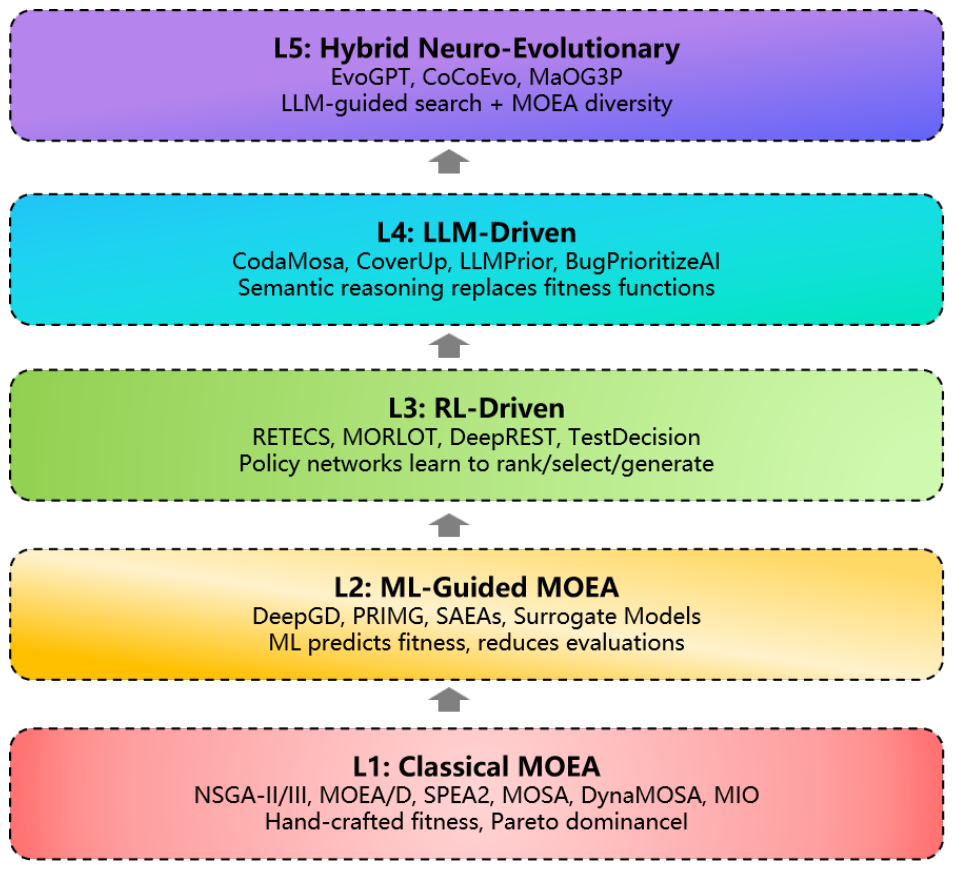
We propose a novel five-level taxonomy (L1–L5) for classifying multi-objective test optimization approaches based on the type and degree of mathematical intelligence: Classical MOEA, ML-Guided MOEA, RL-Driven, LLM-Driven, and Hybrid Neuro-Evolutionary [
19,
20].
We systematically survey 120+ approaches published between 2000 and 2025, mapping each to our taxonomy with structured analysis of mathematical problem formulations, objective function designs, and empirical performance.
We provide formal mathematical definitions for the core optimization problems—including Pareto dominance for TCP and Markov Decision Processes for RL-based testing—and present a submodularity result for test suite generation (adapted from post-cutoff work by TestDecision [
21]; see
Section 3).
We conduct a cross-cutting analysis comparing the complementary strengths of AI and classical MOEA methods across four test optimization activities.
We identify ten critical open challenges and outline a research roadmap for intelligent multi-objective test optimization, with emphasis on mathematical foundations that can bridge theory and practice.
Paper Structure. Section 2 provides the mathematical background on multi-objective optimization and formal definitions of test optimization activities.
Section 3 describes our systematic mapping study methodology.
Section 4 presents the five-level taxonomy with formal characterizations.
Section 5,
Section 6,
Section 7,
Section 8 and
Section 9 detail each intelligence level with mathematical problem formulations.
Section 10 provides cross-cutting analysis across levels.
Section 11 discusses open challenges and future directions.
Section 12 concludes this paper.
3. Systematic Mapping Study Methodology
Following the distinction between systematic literature reviews and systematic mapping studies [
27], this work is best characterized as a
systematic mapping study: we provide a broad, structured classification of the research landscape rather than in-depth evidence synthesis of individual study outcomes. Systematic literature reviews aggregate and synthesize evidence on focused research questions, while systematic mapping studies classify and structure a broader research area [
27,
28]. Given our goal of providing a panoramic taxonomy across five paradigms (L1–L5), a mapping study design is appropriate.
We followed the guidelines of Kitchenham et al. [
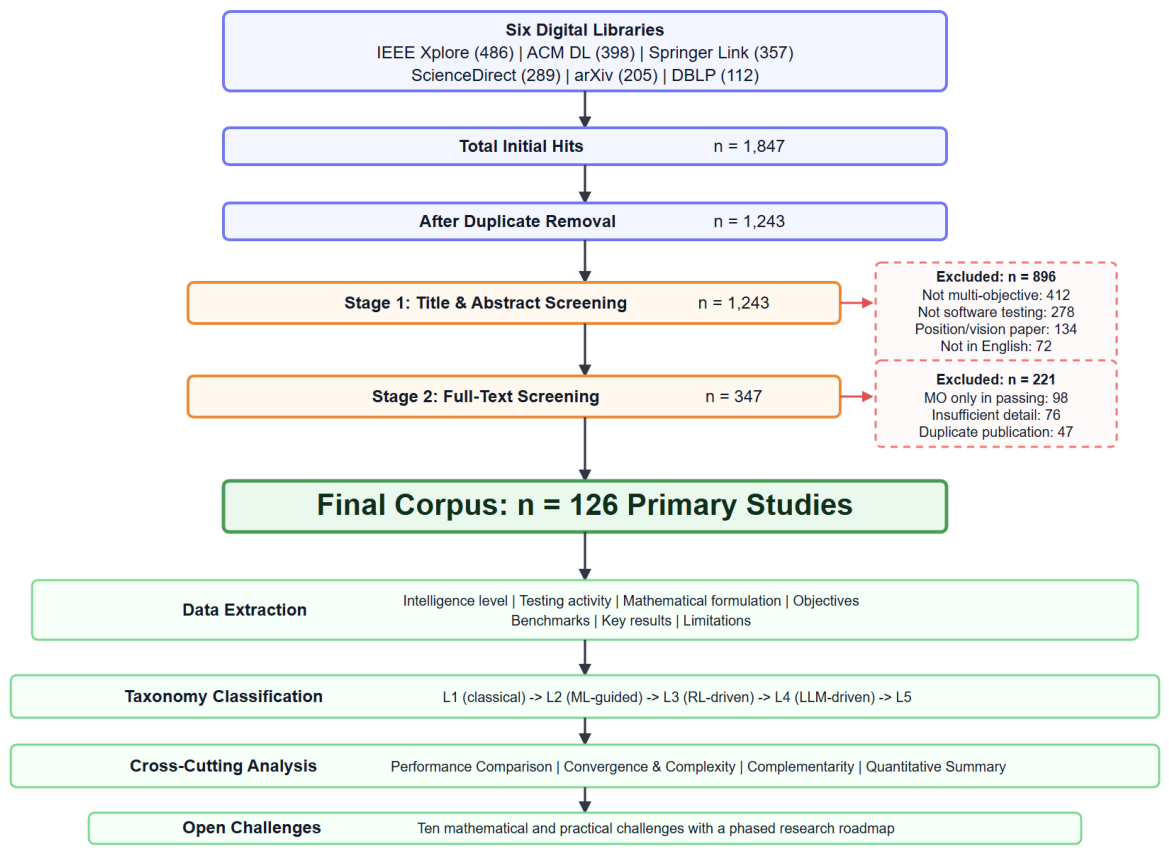
29] for conducting systematic studies in software engineering. The survey covers papers published between January 2000 and May 2025, retrieved from six digital libraries: IEEE Xplore, ACM Digital Library, Springer Link, ScienceDirect, arXiv, and DBLP.
Late Additions (Post-Cutoff). During the revision process, three papers published after the May 2025 search cutoff were incorporated as
late additions to ensure the survey reflects the most current developments in this rapidly evolving field: (i) CoverUp [
30] (published June 2025 in
Proc. ACM Softw. Eng., FSE 2025), a major LLM-driven test generation system that achieved 80% coverage versus CodaMosa’s 47%; (ii) TestDecision [
21] (arXiv:2604.01799, April 2026), which provides one of this paper’s key mathematical results (Theorem 1 on submodularity of test suite coverage); and (iii) E-Test [
31] (published 2026 in
Proc. ACM Program. Lang., OOPSLA 2026), an LLM-based test augmentation system. These three papers are clearly identified as late additions in the classification tables (
Table S1) and are excluded from the temporal trend calculations in Table 9 and the PRISMA counts (
Figure 1), which reflect only the 123 primary studies identified during the original search window.
Selection Criterion. Post-cutoff papers were considered for late addition if they met at least one of two criteria, evaluated over June 2025–July 2026 (the revision window): (i)
Formal mathematical result—this paper provides a theorem, proof, or complexity bound directly addressing a gap identified in the original systematic mapping. TestDecision [
21] is the only post-cutoff paper meeting this criterion, providing the first submodularity proof for sequential test suite coverage (Theorem 1). (ii)
Step-change in empirical performance—this paper reports results that redefine the quantitative frontier at a surveyed level. CoverUp [
30] (80% coverage vs. CodaMosa’s 47%) and E-Test [
31] (RAG-based test augmentation for production behaviors) satisfy this criterion. To verify completeness, we re-ran the original search strings on arXiv (cs.SE; cs.LG; cs.AI) and DBLP for the post-cutoff window; no other eligible papers meeting either criterion were identified.
Protocol boundary. Results that depend on post-cutoff material—notably Theorem 1 (submodularity of test suite coverage, due to TestDecision [
21])—are explicitly identified at each point of use with a provenance note and fall outside the formal systematic mapping protocol. They are retained as supplementary theoretical enrichments that do not alter the taxonomy, the PRISMA counts (
Figure 1), the temporal trend calculations (Table 9), or any core finding of the mapping study. The inclusion of these late additions does not alter any of this survey’s core findings or the taxonomy structure.
3.1. Research Questions
We formulated four research questions that structure this entire study:
RQ1: How can multi-objective test optimization approaches be systematically classified along the intelligence spectrum?
RQ2: What are the dominant mathematical formulations, objective functions, and algorithms at each intelligence level?
RQ3: How do AI-driven methods compare to classical MOEAs in terms of effectiveness, efficiency, and generalizability?
RQ4: What are the key open challenges and promising future directions for this domain?
3.2. Search Strategy
The search string combined three concept groups connected by the Boolean AND operator:
Concept Group 1 (Multi-Objective Optimization): “multi-objective” OR “many-objective” OR “Pareto” OR “NSGA” OR “MOEA” OR “multiobjective” OR “many objective”;
Concept Group 2 (Test Optimization Activities): “test case prioritization” OR “test case selection” OR “test suite minimization” OR “test case generation” OR “test optimization” OR “regression testing” OR “TCP” OR “TCS” OR “TSM” OR “TCG”;
Concept Group 3 (Algorithm Families): “evolutionary” OR “genetic” OR “reinforcement learning” OR “deep learning” OR “large language model” OR “neural network” OR “surrogate-assisted” OR “Bayesian optimization”.
Table 1 summarizes the database-specific search configurations. For each digital library, we adapted the query syntax and search scope to match the platform’s capabilities.
3.3. Study Selection Process and PRISMA Flow
Figure 1 presents the PRISMA-style flow diagram [
28] of our study selection process across four phases: identification, screening, eligibility, and inclusion.
3.4. Screening and Inclusion Criteria
Table 2 summarizes the counts and exclusion reasons at each screening stage.
Inclusion Criteria: (a) proposes or evaluates a multi-objective approach for at least one of TCP, TCS, TSM, or TCG; (b) published in a peer-reviewed venue or available as a high-quality preprint with sufficient methodological detail; (c) published between January 2000 and May 2025 (with three late additions incorporated during revision as documented in
Section 3); (d) written in English.
Exclusion Criteria: (a) single-objective optimization only; (b) not in the software testing domain; (c) position papers, vision statements, or editorials without empirical or formal evaluation; (d) duplicate publications from the same authors with substantially overlapping content.
3.5. Inter-Rater Reliability
Both authors independently screened and classified a random sample of 30 papers (25% of the final corpus). Inter-rater agreement on inclusion decisions was assessed using Cohen’s
, with disagreements resolved through discussion.
Results: inter-rater reliability was “almost perfect” across all three coding dimensions per Landis & Koch (1977) benchmarks: inclusion decisions
(93.3% observed agreement), taxonomy level
(88.5% observed agreement), and testing activity
(92.3% observed agreement). Full per-paper agreement data are provided in
Supplementary Table S2. For taxonomy classification (
Section 4.1), we applied the same dual-screening procedure. The remaining papers were screened and classified by the first author following the agreed protocol.
3.6. Data Extraction
For each included primary study, we extracted the following: intelligence level (L1–L5) and sub-category, testing activity (TCP/TCS/TSM/TCG), mathematical formulation, objective functions, evaluation benchmarks, key quantitative results, and identified limitations.
10. Cross-Cutting Analysis
10.1. Performance Comparison Across Levels
Important Methodological Caveat. The comparisons in this section are descriptive and cross-sectional, not a controlled meta-analysis. Methods were evaluated on different benchmarks, under different protocols, and with different metrics. Numbers are reported as stated in the original papers and cannot be directly compared across rows. The purpose of this synthesis is to illustrate the diversity of evidence available at each intelligence level, not to establish the superiority of any level over another.
Table 8 synthesizes the reported performance of representative methods across testing activities.
Key Observation: No single level dominates across all activities. L1 methods remain highly competitive for traditional unit test generation with well-defined coverage objectives. L3/L4 methods excel when semantic understanding or adaptability is required (CI prioritization, REST API testing, and DNN testing). L5 methods, when evaluated within their respective studies, consistently outperform their study-specific pure-LLM and pure-SBST baselines. However, these comparisons are not normalized across studies, and the improvement margin (10–15%) is modest relative to the added system complexity.
Limitations of Cross-Study Synthesis. The heterogeneity of evaluation protocols across the surveyed literature imposes fundamental limits on comparative analysis. Specifically, (i) benchmarks range from small academic programs (EvoSuite benchmark, ∼100 classes) to industrial CI pipelines with thousands of tests; (ii) metrics vary—APFD for TCP, branch coverage for TCG, and mutation score for test quality—and are not inter-convertible; (iii) computational budgets differ by orders of magnitude (minutes for L1, hours for L5 with API calls); and (iv) most studies report best-configuration results, introducing an optimistic bias relative to default-configuration performance. A rigorous multi-method multi-benchmark study under controlled conditions is needed to draw reliable comparative conclusions.
10.2. Mathematical Trade-Offs Across Intelligence Levels
Beyond empirical performance comparisons, the five intelligence levels embody distinct mathematical trade-offs that determine when each paradigm is theoretically preferable:
Convergence guarantees. L1 (classical MOEAs) benefit from well-established convergence theory. NSGA-II guarantees
complexity per generation for non-dominated sorting. Under the assumptions of elitism, strictly positive mutation probability, and infinite population size, NSGA-II converges to the global Pareto front in the limit [
9,
44]. In finite-population practice, convergence is not guaranteed, though empirical evidence shows effective Pareto-front approximation on problems with up to
objectives. L3 (RL-driven) methods inherit the convergence guarantees of policy gradient algorithms—typically
regret bounds for natural policy gradient methods—but these bounds apply to scalarized reward functions, not to Pareto-front quality. L4–L5 methods currently lack formal convergence characterization in the optimization-theoretic sense; their behavior is governed by the implicit inductive biases of the pre-training distribution and the prompt-conditioned sampling process, for which convergence theory is an active area of research (see Challenge 8).
Computational complexity. The per-generation cost of L1 methods grows quadratically with population size N (due to pairwise dominance comparisons), making them practical for but challenging for very large populations. L3 methods shift computation to the offline training phase; online inference is per decision. L4–L5 methods have unpredictable latency due to autoregressive decoding, typically requiring forward passes for a response of L tokens, with single-query costs of 1–3 s at current API latencies.
Dimensionality scaling. In many-objective problems (
), dominance-based selection degrades because most solution pairs become mutually non-dominated (incomparable), an effect known as
dominance resistance [
22]. For
m independent and uniformly distributed objectives, the probability that one randomly chosen solution dominates another is
(each objective independently has probability
of being better). Consequently, the probability that two solutions are
incomparable (neither dominates the other) is
. For
, this means 87.5% of random solution pairs are incomparable, rendering pairwise dominance comparisons largely uninformative; for
, over 99.8% of pairs are incomparable.
Two asymptotic regimes must be carefully distinguished, as they exhibit opposite limiting behavior [
22,
57]:
Fixed , (growing population). The expected number of non-dominated points among independently sampled solutions grows as , while the proportion of non-dominated points tends to 0. For typical population sizes () and moderate , a fraction of the population may remain mutually non-dominated, but this fraction decays (logarithmically in ; exponentially in ) as grows.
Fixed , (growing objective count). Since , the probability that any two solutions are comparable tends to 0; consequently, virtually all solutions become mutually non-dominated, and dominance-based ranking provides no selection pressure. This regime is the primary concern in many-objective test generation, where can reach –.
In practice, with typical population sizes (
), dominance resistance becomes severe at
and prohibitive at
. L1 methods address this via decomposition (MOEA/D [
58]) or reference-point methods (NSGA-III [
57]), which scale to
in practice. L4–L5 methods are not yet evaluated beyond
, and whether LLM-based optimization can exploit the lower effective dimensionality of real-world objective sets remains an open question.
Landscape structure sensitivity. L1 methods perform best on problems with well-defined fitness gradients, where genetic operators can incrementally improve solutions. They struggle on deceptive landscapes and on needle-in-haystack problems. L3 methods can learn to navigate deceptive landscapes from experience. L4–L5 methods bypass fitness landscapes entirely by operating in a learned semantic space, but their effectiveness is bounded by the quality of that representation rather than the intrinsic structure of the optimization problem.
10.3. The Complementarity Principle
Our central finding is that AI and evolutionary methods are complementary across four orthogonal dimensions:
Semantic vs. Numerical: LLMs handle semantic reasoning; MOEAs handle numerical optimization of well-defined coverage distances.
Cold-start vs. Refinement: LLM pre-trained knowledge provides strong initialization; MOEAs refine through principled diversity-preserving search.
Exploration vs. Exploitation: Multi-temperature/multi-prompt LLM generation provides broad exploration; MOEA crossover/mutation provides controlled exploitation.
Adaptation vs. Optimization: RL agents continuously adapt to changing environments (CI pipelines); MOEAs solve fixed problems to convergence.
10.4. Quantitative Trends Across Intelligence Levels
Table 9 summarizes the distribution of primary studies across intelligence levels, testing activities, and temporal periods. The temporal trend is pronounced: L1 papers dominate the 2000–2018 corpus (approximately 60%), L3 grows from 2017 onward (approximately 15%), and L4–L5 papers account for roughly 40% of the post-2023 literature, reflecting the rapid emergence of LLM-driven and hybrid approaches.
The most notable gap revealed by this distribution is the near-absence of L3–L5 studies for TCS and TSM: despite the practical importance of change-aware test selection and suite minimization in CI/CD pipelines, AI-driven approaches for these activities remain largely unexplored. Similarly, many-objective formulations () are studied almost exclusively at L1, with few L3–L5 papers addressing more than three objectives.
Note on non-assigned entries. The 15 non-assigned entries are not assigned to any L1–L5 level and are retained in the corpus solely as comparative baselines and methodological references. They are distributed across the three temporal periods by their original publication date as follows: four papers in 2000–2018, four papers in 2019–2022, and seven papers in 2023–2025. The per-period rows in
Table 9 report shares among level-assigned entries only; the residual to 100% in each row is accounted for by these non-assigned entries together with multi-period overlaps. Exact per-paper assignments are provided in
Supplementary Table S1.
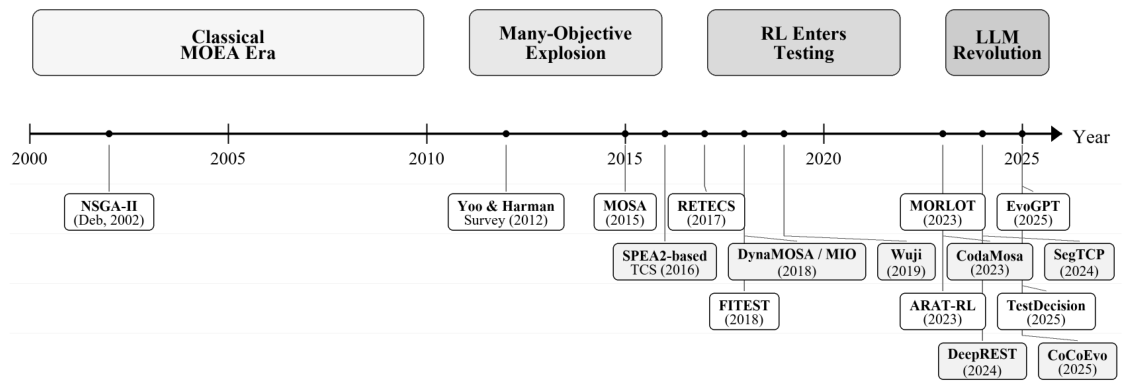
10.5. Evolution Timeline
The evolution of multi-objective test optimization can be traced through four distinct phases (
Figure 3):
2000–2010: Foundational period. The Yoo and Harman survey [
1] systematized the field. Early MOEA applications used basic NSGA-II for small-scale test problems. This phase corresponds to the first row of
Table 9 (2000–2018), during which L1 methods constituted approximately 60% of all primary studies.
2011–2018: Many-objective explosion. MOSA (2015), DynaMOSA (2018), MIO (2018), and FITEST (2018) established many-objective optimization as the dominant paradigm for test generation. While RETECS (2017) pioneered RL for CI-based TCP during this phase, RL methods did not achieve significant volume until the subsequent period.
2019–2022: RL enters testing. RL-based approaches grew to approximately 25% of annual publications (
Table 9), led by RETECS, MORLOT, DeepREST, and ARAT-RL. L2 (ML-guided) methods also reached their peak share during this period.
2023–2025: LLM revolution. CodaMosa (2023) opened the LLM+SBST era, followed by an explosion of LLM-based and hybrid methods—CoverUp, TELPA, EvoGPT, TestDecision, and CoCoEvo—that have redefined the frontier. L4–L5 papers grew from 0% (pre-2023) to approximately 45% of annual publications in 2024–2025.
11. Open Challenges and Future Directions
Despite significant progress, ten critical challenges remain at the intersection of mathematical optimization and domain-specific testing knowledge:
11.1. Challenge 1: Standardized Benchmarks
L3–L5 methods are evaluated on ad hoc benchmarks with varying protocols, making direct comparison difficult. Unlike computer vision (ImageNet) or NLP (GLUE), test optimization lacks a community-standard benchmark. We propose a multi-language, multi-activity benchmark suite with standardized evaluation protocols, pre-computed coverage baselines, and LLM API cost budgets.
11.2. Challenge 2: Computational Cost of LLM Inference
Querying GPT-4-level models for every CI/CD decision is economically infeasible. Three mitigation strategies emerge: (i) cached LLM embeddings with lightweight online models; (ii) distillation to small (7B) models trained on large-model traces; (iii) selective LLM invocation triggered by MOEA stagnation detection.
11.3. Challenge 3: Many-Objective Scalability of AI Methods
While L1 methods specialize in many-objective optimization (), L4/L5 methods have been evaluated almost exclusively on single or dual objectives. How LLMs and RL scale to hundreds of objectives remains unexplored. Mathematical approaches—objective grouping via PCA, RL-based objective selection, and LLM-based dimensionality reduction—represent promising directions.
11.4. Challenge 4: Reproducibility and Prompt Sensitivity
LLM-based methods are notoriously sensitive to prompt design. Minor variations can produce substantially different results. Solutions include prompt versioning mandates, open-weight model baselines (CodeLlama; DeepSeek-Coder), and prompt-agnostic methods relying on structural code analysis.
11.5. Challenge 5: Cross-Project and Cross-Domain Transfer
Current AI methods are largely project-specific. Meta-RL for cross-project policy transfer, RAG-based retrieval from cross-project corpora, and federated learning across CI pipelines are promising directions requiring formalization of transfer learning in the context of multi-objective test optimization.
11.6. Challenge 6: Safety-Critical and Regulated Domains
L4/L5 methods are inherently non-deterministic, and their outputs cannot be formally verified—which is problematic for avionics (DO-178C), medical devices, and autonomous vehicles where testing must satisfy regulatory standards. A promising direction is using LLMs to generate test descriptions that are formalized by human engineers, combined with formal coverage verification and MOEA-based test suite optimization.
11.7. Challenge 7: Multi-Agent LLM Coordination
All current L4/L5 methods use a single LLM in isolation. Multi-agent frameworks where specialized LLM agents each address different testing concerns (security, performance, and edge cases) and coordinate through a Pareto-based coordinator remain unexplored. This requires mathematical formalization of multi-agent Pareto optimization in the testing context.
11.8. Challenge 8: Formal Convergence Guarantees for LLM-Driven Optimization
Classical MOEAs (L1) enjoy well-established convergence theory: NSGA-II provably converges to the global Pareto front under infinite populations and appropriate selection pressure. In contrast, L4–L5 methods lack any formal convergence characterization. The optimization dynamics of autoregressive language models are poorly understood—there is no known bound on the number of samples required to reach a given hypervolume, no characterization of the stationary distribution induced by prompt-conditioned token sampling, and no framework for proving that a hybrid LLM+MOEA system converges to a better front than either component alone. We propose three research directions: (i) formalizing LLM-based test generation as sampling from an energy-based model, enabling application of Markov chain Monte Carlo convergence theory; (ii) developing PAC bounds for LLM-driven optimization: given , how many LLM queries guarantee -hypervolume proximity to the true Pareto front with probability ?; and (iii) analyzing hybrid convergence through cooperative co-evolution theory, where LLM and MOEA components evolve separate subpopulations with periodic migration.
11.9. Challenge 9: Sample Complexity of RL for Combinatorial Test Optimization
L3 methods formulate test optimization as an MDP, but the state space is combinatorial: for prioritization and for selection of a size-n test suite. Standard RL sample complexity bounds (e.g., for tabular Q-learning) are vacuous for such spaces. Current empirical results show RL methods matching or slightly exceeding MOEAs on specific benchmarks, but we lack theoretical understanding of when RL achieves lower sample complexity than evolutionary search. Promising directions include deriving bounds that exploit problem structure (submodularity of coverage functions; Lipschitz continuity of APFD), analyzing whether function approximation breaks the curse of dimensionality through generalization across test cases, and establishing formal conditions under which RL is provably more sample-efficient than evolutionary search.
11.10. Challenge 10: Metric Theory for Semantic Optimization Spaces
L4–L5 methods embed test cases into high-dimensional vector spaces via code LLMs and perform optimization in this semantic manifold. However, the metric properties of these embedding spaces are poorly understood: does cosine distance between test case embeddings correlate with functional diversity? Is the embedding space approximately Euclidean, or does it exhibit hyperbolic or spherical geometry requiring different optimization operators? Without answers, we cannot design principled diversity preservation mechanisms for LLM-driven optimization. We propose the following: (i) empirically characterizing the intrinsic dimensionality and curvature of code LLM embedding spaces; (ii) developing geometry-aware diversity operators (e.g., hyperbolic entailment cones for semantic diversity); and (iii) establishing whether Pareto optimality in semantic space implies, or at least correlates with, Pareto optimality in functional objective space.
11.11. Emerging Directions Not Yet Surveyed
Several rapidly evolving areas were beyond the scope of this survey at the time of writing but merit attention in future updates. First, agentic testing frameworks where multiple LLM agents collaborate with specialized roles (test designer, test executor, oracle judge, and coverage analyst) are beginning to emerge, though their optimization dynamics remain uncharacterized. Second, the use of code-specific foundation models (DeepSeek-Coder-V2, StarCoder2, and CodeLlama) as drop-in replacements for general-purpose LLMs in L4–L5 methods may substantially alter the cost–quality trade-off. Third, LLM-guided neural architecture search for evolving test generation models represents a frontier where automated machine learning intersects with multi-objective optimization. These directions are expected to feature prominently in the next update of this mapping study.
We note that, with the exception of three late additions incorporated during revision and explicitly identified as such (CoverUp [
30], TestDecision [
21], E-Test [
31]; see
Section 3 for details), papers published after May 2025 are not included in the main corpus. A living version of this mapping study will incorporate new developments on an ongoing basis.
11.12. Research Roadmap
We propose the following timeline:
Immediate (2025–2026): standardized benchmarks; cost-aware LLM invocation; reproducibility mandates.
Medium-term (2026–2028): many-objective LLM/RL methods; cross-project transfer; industrial CI/CD integration.
Long-term (2028+): multi-agent LLM optimization; safety-certified AI-driven testing; fully autonomous self-improving test suites.
12. Conclusions
This survey has traced the mathematical and computational evolution of multi-objective test optimization—from classical Pareto-based evolutionary algorithms to the emerging frontier of LLM-driven and hybrid neuro-evolutionary methods. We proposed a novel five-level taxonomy that captures the increasing role of mathematical intelligence, formalized the core optimization problems using rigorous notation, and systematically analyzed 120+ approaches.
Our analysis reveals a clear trajectory “From Pareto to Neural”—and, more precisely, toward hybrid Pareto-neural optimization—but also a more nuanced finding: the levels are complementary rather than strictly progressive. Classical MOEAs (L1) remain the method of choice for well-defined coverage optimization with hundreds of objectives. ML-guided methods (L2) reduce evaluation costs. RL-driven approaches (L3) excel in adaptive, online settings. LLM-driven methods (L4) bring unprecedented semantic understanding. Hybrid neuro-evolutionary systems (L5) consistently achieve the best results by combining complementary strengths.
The field stands at an inflection point where the mathematical foundations of multi-objective optimization intersect with the semantic capabilities of modern AI. Realizing the vision of optimization systems that are simultaneously semantically aware, computationally efficient, and continuously adaptive requires addressing the ten critical challenges we have identified—challenges that demand both mathematical rigor and domain-specific engineering knowledge, spanning formal convergence theory, sample complexity analysis, and the metric geometry of semantic optimization spaces.