1. Introduction
The geometry of rigid-body motions plays a fundamental role in differential geometry, kinematics, robotics, and mathematical physics. In the Euclidean setting, rigid motions are represented by the special Euclidean group , while their infinitesimal generators are described by twists in the Lie algebra . One of the central problems in modern geometric kinematics concerns the characterization of motions whose instantaneous geometric structure remains invariant during evolution. Such motions are closely related to screw theory, moving frames, and the geometry of one-parameter submanifolds in Lie groups.
In recent years, Carricato and collaborators introduced the notion of persistent screw systems and persistent manifolds in
[
1,
2]. Roughly speaking, persistence describes the property that tangent spaces along a motion remain mutually congruent up to rigid displacement. This concept has attracted considerable attention in robotics and mechanism theory due to its applications in mobility analysis, motion interpolation, manipulator kinematics, and screw-system synthesis [
3,
4,
5,
6,
7,
8,
9,
10]. In particular, Selig and Carricato [
11] showed that the persistence property of one-parameter Frenet–Serret motions in
is equivalent to the constancy of the pitch of the associated instantaneous twist. Related geometric and kinematic interpretations of rigid-body motions traced by moving frames have been discussed in [
12,
13,
14,
15].
In Minkowski space, a curve in the Poincaré group
may be interpreted as the trajectory of a rigid motion [
14,
16]. This observation provides a natural framework for studying persistent frame motions in Lorentzian geometry. Motivated by previous studies [
17,
18,
19,
20,
21,
22], the present paper focuses on persistent rigid motions generated by timelike and spacelike slant helices in the three-dimensional Minkowski space
. The lightlike case is excluded because null frames require a fundamentally different geometric framework and lead to degenerate instantaneous twist structures. The Lorentzian counterpart of this theory remains comparatively less developed. In Minkowski space, the geometry of rigid motions is governed by the Poincaré group
, whose causal structure introduces substantial geometric differences compared with the Euclidean case. Timelike and spacelike directions lead to distinct types of rotational behavior, and consequently, the associated twist structures depend strongly on the causal character of the generating curve. Although various studies have investigated Lorentzian kinematics, Minkowski motions, and pseudo-Riemannian frame geometry [
23,
24,
25,
26,
27,
28,
29,
30], the theory of persistent rigid motions in Lorentzian geometry is still relatively unexplored.
A first systematic Lorentzian formulation of persistent rigid motions was established in [
31], where persistent Frenet–Serret frame motions in Minkowski space were classified according to the causal character of the generating curve. More recently, persistent rigid motions generated by adapted frames along null Cartan curves were investigated in [
32], extending the theory to the lightlike setting. In the Euclidean setting, persistent motions induced by slant helices and adapted frames were studied in [
21].
Slant helices constitute an important class of curves in differential geometry because their principal normal lines maintain a constant causal angular relation with a fixed direction. Their intrinsic geometry naturally connects curvature, torsion, and spherical indicatrices, making them particularly suitable for the study of frame-induced motions. In the Lorentzian setting, the causal character of the curve further enriches the geometry of slant helices and leads to several distinct kinematic regimes.
A fundamental difference between the Euclidean and Lorentzian settings is the presence of causal structure. While Euclidean persistent motions are governed by a single positive-definite metric, Minkowski space naturally distinguishes timelike, spacelike, and lightlike geometries. As a consequence, the persistence property depends on the causal character of the generating curve and the associated moving frame. This leads to distinct pitch formulas, different curvature–torsion representations, and different persistence conditions that do not arise in the Euclidean theory. These differences suggest that persistence in Minkowski space possesses geometric features that have no direct Euclidean counterpart.
Although the proposed framework builds upon previous studies on persistent rigid motions in both Euclidean and Lorentzian geometry, its contribution is not merely a Lorentzian reformulation of existing results. In the Euclidean setting, persistence has mainly been investigated through screw systems and Frenet–Serret frame motions in , whereas our previous Lorentzian work focused on persistent Frenet–Serret motions classified according to the causal character of the generating curve. Specifically, the present paper goes beyond these results by establishing an intrinsic relationship between Frenet–Serret and adapted frame motions through the geodesic curvature of the principal normal indicatrix and by providing a ruled-surface interpretation of persistence in Minkowski space. Consequently, the proposed framework unifies these geometric aspects into a single intrinsic formulation.
The main contributions of this paper are threefold. First, we establish a unified Lorentzian framework for persistent rigid motions generated by slant helices in Minkowski space. Within this framework, necessary and sufficient conditions are obtained for both Frenet–Serret and adapted frame motions to generate persistent Lorentzian motions.
Second, we derive an explicit intrinsic relationship between the pitches of Frenet–Serret and adapted frame motions in terms of the geodesic curvature of the spherical image of the principal normal indicatrix. As a consequence, persistence is shown to be governed entirely by intrinsic curve invariants and to be independent of the chosen moving frame representation.
Third, we provide a geometric interpretation of persistence through associated ruled surfaces. In particular, the pitch of a persistent Lorentzian motion is proved to coincide with the distribution parameter of the ruled surface generated by the corresponding frame motion. This establishes a direct connection between Lorentzian kinematics, slant helix geometry, and ruled surface theory. Taken together, these results show that the novelty of the paper is not simply the extension of Euclidean persistence to Minkowski space, but the establishment of an intrinsic framework linking Lorentzian slant helices, frame-induced persistent motions, and ruled-surface geometry through common geometric invariants.
The paper is organized as follows.
Section 2 reviews the fundamental notions and preliminary results from Lorentz geometry that are required throughout the paper. In
Section 3, we investigate special frame motions in Minkowski space and characterize the persistence property in terms of instantaneous twists with constant pitch.
Section 4 establishes necessary and sufficient conditions for Frenet–Serret and adapted frame motions determined by slant helices to generate persistent rigid motions, together with an intrinsic relationship between their pitches. In
Section 5, we derive geometric descriptions of the associated ruled surfaces generated by persistent frame motions and show that their distribution parameters coincide with the corresponding motion pitches.
Section 6 presents illustrative examples and geometric visualizations of persistent motions together with their associated ruled surfaces and kinematic interpretations. The geometric and kinematic implications of the obtained results are further discussed in
Section 7. Finally,
Section 8 summarizes the main contributions of the paper and outlines several directions for future research.
2. Basic Notions and Properties
Here, the fundamental elements of Lorentz geometry are briefly introduced to satisfy the requirements in the subsequent sections (more complete elementary treatments can be found in [
33,
34]).
A real vector space
that has an indeterminate metric tensor described generally by
for each pair of vectors
and
is known as an
n-dimensional Minkowski space
. Taking into account that
is an indeterminate metric, any vector
u in
could hold one of the three causal character traits:
- i.
If , timelike;
- ii.
If or , spacelike;
- iii.
If and , lightlike.
A regular curve , is referred to as timelike (spacelike, lightlike, respectively) if the curve has a timelike (spacelike, lightlike, respectively) velocity vector for all s in the interval I. Therefore, using the norm of a vector u in described by , a regular curve is said to be a unit speed curve under the assumption that the velocity vector of the curve satisfies the condition .
The formula
where
and
are any two vector pairs in Minkowski space
of dimension three, yields the Lorentz vector product
, which reflects the Euclidean vector product ∧ according to the plane
. On the other hand, with these definitions, inner and vector products of Minkowski space have the following conditions:
- i.
- ii.
,
where
and
w are arbitrary vectors in
[
33].
The Lorentz group, an indeterminate orthogonal group
, is composed exclusively of matrices
in
with the property
such that
. In this case, the indeterminate special orthogonal group
, which contains all the elements (whose determinant is equal to 1) of
, is specified as
A
semi-skew-symmetric matrix corresponds to a three-dimensional vector,
where
[
34]. The Lie algebra
of the group
identified by
is constructed by the set of all semi-skew-symmetric matrices. With these definitions, the product of the matrix
with any three-dimensional vector precisely models the vector product with
, that is,
for any vector
x in
.
3. An Investigation of Special Frame Motions
This section reviews some kinematic properties of one-parameter persistent rigid motions in
, which are a class of one-dimensional persistent submanifolds defined by the requirement that the instantaneous velocity twist must have a constant pitch. The results are discussed in light of the theory presented by [
31].
In the following discussions, the lightlike case is disregarded.
3.1. Persistent Rigid Motions
The Poincaré group, generally referred to as the inhomogeneous Minkowski group and denoted with
is constructed by the isometry group of
, which stands for the set of entire rigid motions in Minkowski space
of dimension three [
35,
36].
Given a rigid motion
of the Poincaré group
expressed as
its instantaneous twist in the fixed reference frame can be represented by
where
mainly denotes a rotational matrix in indeterminate special orthogonal group
at time
s, and
implies a translational vector. In the moving reference frame,
and therefore, provides the instantaneous twist for motion
. (For a thorough treatment, we refer to [
11,
31,
37].)
The tangent space at identity constructs the Lie algebra
of the Poincaré group
, whose components are twists specified as
in which the semi-skew-symmetric matrix
in
corresponds to the angular velocity
, and
is related to linear velocity. Furthermore,
formulates the pitch of the instantaneous twist.
Definition 1. Considering a Lorentz submanifold that gains its manifold characteristic from the Poincaré group , the mutual correspondence of tangent spaces at any two pairs of point and explicitly indicates that is a persistent manifold, i.e., that for every in ,Therefore, the persistence property of a one-parameter rigid displacement in is determined by the relationwhere defines a constant twist given pitch and once again designates an arbitrary motion in the group [31]. 3.2. Persistent Frenet–Serret Frame Motions
Assume that a unit speed curve is given by
,
so that
. The Frenet–Serret frame
can therefore be defined by the following formulas:
with the Darboux vector characterized as
wherein
and
are the curvature and torsion functions of the curve
, respectively. Notice here that Frenet vectors provide the statements that
such that
describes the causal character, i.e., for any vector
x in
,
The Frenet–Serret frame motion along
in
is represented by the matrix
in which
in
contains columns for the Frenet–Serret frame vectors
,
, and
:
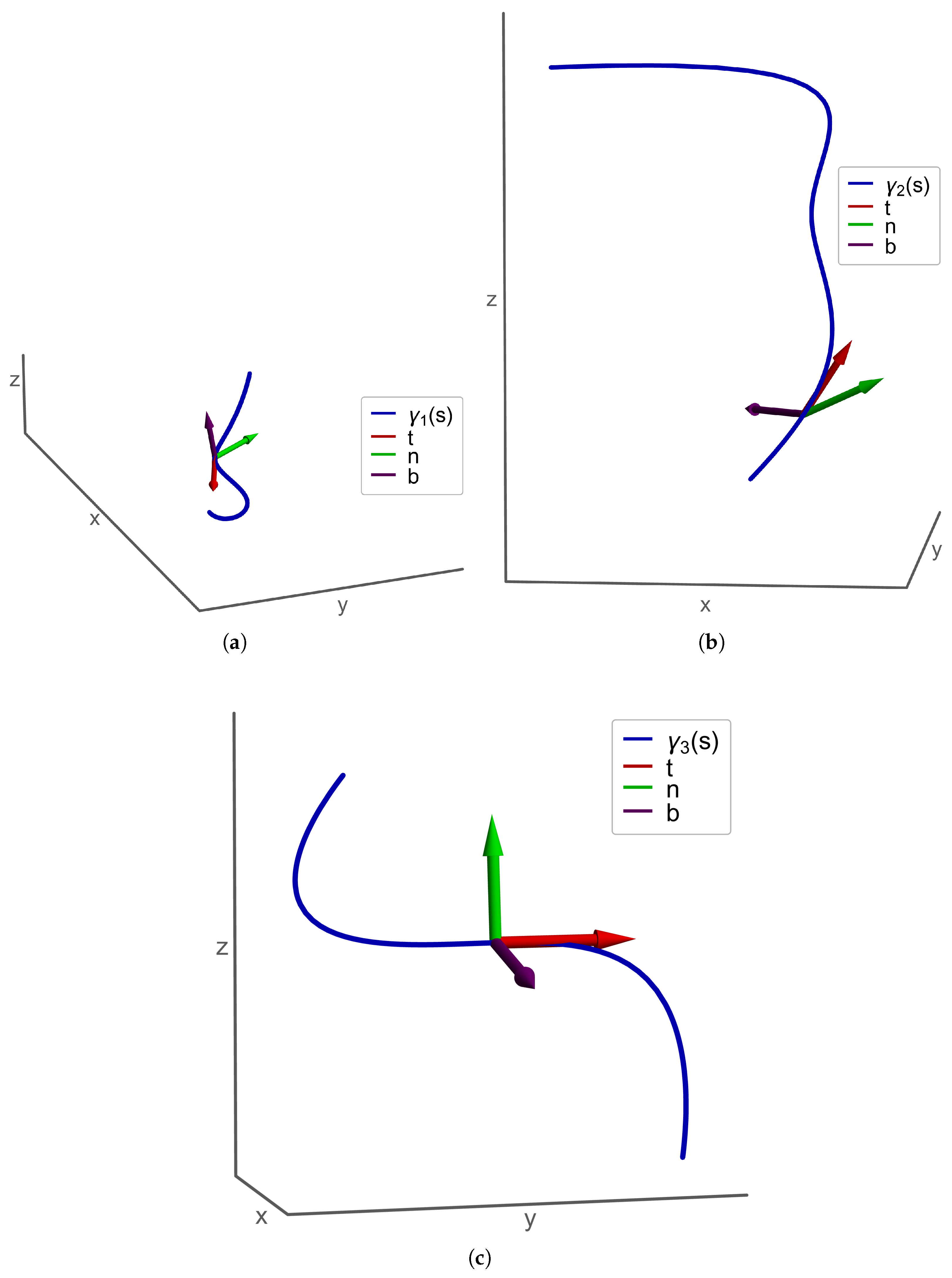
Corollary 1. Given a Frenet–Serret frame motion determined by a regular curve , , parametrized by arclength with the intrinsic equations and denoting respectively curvature and torsion, the persistence property is indicated in [31] by the condition that the motion must have an instantaneous twist with constant pitch, where the pitch is defined as(See for example, Figure 1). Remark 1. The zero-pitch twists, i.e., twists that have the pitch , are referred to as the Ribaucour motion, which is adopted to represent a particular case of the Frenet–Serret frame motion [11,38]. 3.3. Persistent Adapted Frame Motions
Assume an orthonormal adapted frame
[
39,
40] of the classic Frenet–Serret frame
along a unit speed curve
,
, in which
denotes the normal vector of
, and the relations
and
are satisfied. Therefore, the following equations can be used to define the adapted frame
:
with the Darboux vector specified as
where
and
are the curvatures of the curve
. Remark here that adapted frame vectors allow the relations that
where
expresses the causal character, just like already mentioned.
The adapted frame motion along
in
is represented by the matrix
in which
in
includes columns for the adapted frame vectors
,
, and
:
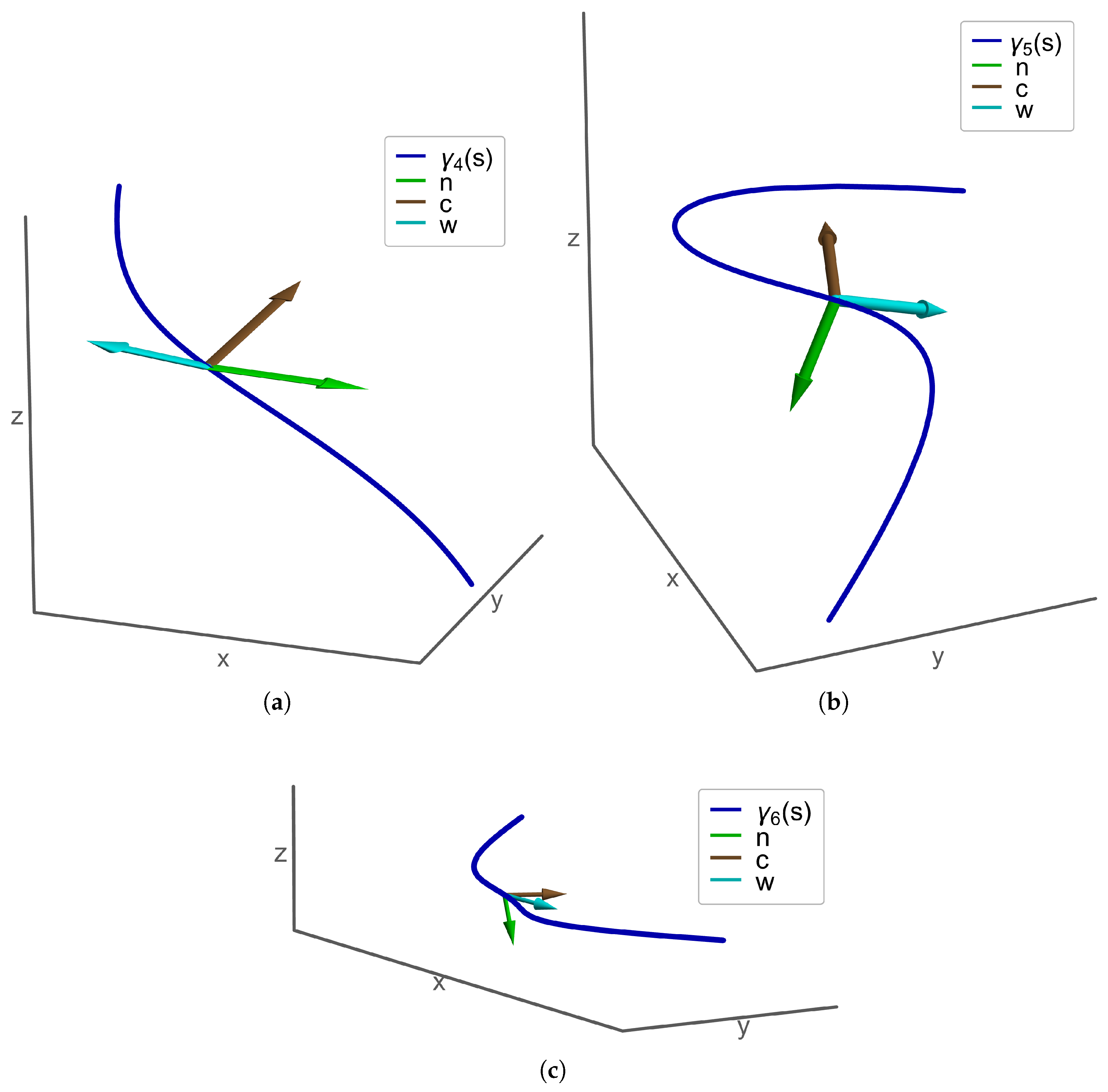
Corollary 2. For an adapted frame motion identified by a regular curve , , parametrized by arclength with the intrinsic equations and denoting curvatures, the persistence property is stated in [31] by the condition that the motion must have an instantaneous twist with constant pitch, where the pitch is represented asHere, it should be noted that τ designates the torsion function of γ in the Frenet–Serret frame. (See for example, Figure 2.) 4. Persistent Motions Determined by Slant Helices
The purpose of this section is twofold. First, we derive necessary and sufficient conditions for frame motions determined by Lorentzian slant helices to be persistent. Second, we establish an intrinsic relationship between the pitches of the Frenet–Serret and adapted frame motions and show how the persistence of one frame motion is related to the persistence of the other.
Theorem 1 is the central structural result of this section. It establishes the intrinsic relationship between the pitches of the Frenet–Serret and adapted frame motions. The subsequent corollaries should be understood as geometric consequences of this pitch relation together with the classical characterization of Lorentzian slant helices by the geodesic curvature of the principal normal indicatrix.
Theorem 1. Assume that , represents any unit speed curve in Minkowski space of dimension three. There is a relationship between the pitch of Frenet–Serret and the pitch of adapted frame motions, determined by the ratiowhere σ is a function that defines the geodesic curvature of the spherical image of the principal normal indicatrix of the curve γ:such that does not vanish. Proof. Here, we will prove our assumption through the idea that the curvatures
and
of the adapted frame can be derived using the curvature
and torsion
of the Frenet–Serret frame, that is,
in which
and
determine the causal characters of tangent vector
and binormal vector
, respectively. Therefore, we have five independent cases based on the causal characters of both Frenet–Serret and adapted frame vectors
,
,
,
, and
:
Consider the case when
is a timelike unit speed curve that contains a timelike tangent vector
, a spacelike normal vector
, and a spacelike binormal vector
. Thus, we infer from Equation (
30) that
with timelike and spacelike adapted frame vectors
and
, respectively. The substitution of pitch variables from instantaneous motion twists represented in Equations (
21) and (
27) and use of Equation (
31) reveal that
and then from Equation (
30), we have
which is
hence,
Consider the case when
is a timelike unit speed curve that contains a timelike tangent vector
, a spacelike normal vector
, and a spacelike binormal vector
. Thus, we infer from Equation (
30) that
with spacelike and timelike adapted frame vectors
and
, respectively. The substitution of pitch variables from instantaneous motion twists represented in Equations (
21) and (
27) shows that
Consider the case when
is a spacelike unit speed curve that contains a spacelike tangent vector
, a timelike normal vector
, and a spacelike binormal vector
. Thus, we infer from Equation (
30) that
with spacelike adapted frame vectors
and
, respectively. The substitution of pitch variables from instantaneous motion twists represented in Equations (
21) and (
27) shows that
Consider the case when
is a spacelike unit speed curve that contains a spacelike tangent vector
, a spacelike normal vector
, and a timelike binormal vector
. Thus, we infer from Equation (
30) that
with timelike and spacelike adapted frame vectors
and
, respectively. The substitution of pitch variables from instantaneous motion twists represented in Equations (
21) and (
27) shows that
Consider the case when
is a spacelike unit speed curve that contains a spacelike tangent vector
, a spacelike normal vector
, and a timelike binormal vector
. Thus, we infer from Equation (
30) that
with spacelike and timelike adapted frame vectors
and
, respectively. The substitution of pitch variables from instantaneous motion twists represented in Equations (
21) and (
27) shows that
The proof is now complete. □
Definition 2. A unit speed curve , is referred to as a slant helix if a non-zero constant vector field in exists, in which the product is a constant. That is, the curve γ is a slant helix if and only if
- (a)
For a timelike curve γ, either one of the two following functions is constant:where does not vanish; - (b)
For a spacelike curve γ that has a timelike normal vector , the following function is constant: - (c)
For a spacelike curve γ that has a timelike binormal vector , either one of the two following functions is constant:where does not vanish.
Notice here that the functions σ define the geodesic curvature of the spherical image of the principal normal indicatrix of the curve, as previously stated [18]. Although the characterization of Lorentzian slant helices by the geodesic curvature of the principal normal indicatrix is well known, its role in the present work is fundamentally different. Here, this intrinsic invariant is shown to govern the relationship between the pitches of two different frame-induced rigid motions. Consequently, the following corollary should not be viewed merely as another characterization of slant helices, but rather as an intrinsic connection between slant-helix geometry and the persistence properties of Frenet–Serret and adapted frame motions.
Corollary 3. Suppose that γ represents any unit speed curve in Minkowski space of dimension three. Then, γ is a slant helix if and only if the ratio denoted by is a constant.
Proof. Suppose
is a slant helix, namely the geodesic curvature
of the spherical image of the principal normal indicatrix of the curve
is a constant. Therefore, using the Theorem 1, it is straightforward to demonstrate that
is satisfied. Conversely, assuming the ratio
is a constant, we conclude that the curvature
must also be a constant, which means that the curve
is a slant helix. □
The following corollary gives the corresponding equivalence of persistence for the two frame motions:
Corollary 4. Consider a slant helix , in Minkowski space of dimension three. The Frenet–Serret frame motion along γ is persistent if and only if the adapted frame motion along γ is persistent.
Proof. Assume
is a slant helix in Minkowski space
of dimension three. Then, Corollary 3 states unequivocally that
If the Frenet–Serret frame motion along
is persistent, then its instantaneous twist has constant pitch
. Accordingly, it is easy to conclude from Equation (
45) that the rigid motion traced by an adapted frame of the curve
, to which the motion is bonded, has a constant pitch
, indicating that the adapted frame motion has the persistence property. Conversely, if the adapted frame motion along
is persistent, then its instantaneous twist has constant pitch
. Therefore, the pitch
is a constant, which means that the Frenet–Serret frame motion has the persistence property. The proof is now complete. □
The primary objective of this study is to examine the situation in which a Frenet–Serret frame or an adapted frame generates persistent motion determined by a slant helix. This situation can be addressed by stating the following theorems:
Theorem 2. Suppose , is a timelike slant helix that is parametrized by arclength with the intrinsic equations and , in which . The Frenet–Serret frame generates persistent motion determined by γ if and only ifsuch that , . Proof. Given a timelike slant helix
expressed with the intrinsic equations
and
, the instantaneous twist of Frenet–Serret frame motion determined by
has a constant pitch
under the assumption that the Frenet–Serret frame has the persistence property. The pitch
allows us to restate
with the previously described curvature
and torsion
. It can be simplified as
and therefore, the solution of the differential Equation (
48) gives
where
,
. Conversely, assume that the function
,
is represented by
, given a timelike slant helix
expressed with the intrinsic equations
and
. Then, the pitch
formulated in Equation (
21) yields
which means that the Frenet–Serret frame motion has persistence property. The proof is now complete. □
The following theorems are obtained by applying the same analytical procedure used in Theorem 2 to the remaining causal configurations of Lorentzian slant helices. They are stated separately because each case corresponds to a distinct causal geometry and yields a different intrinsic representation of the curvature and torsion functions, although the proof strategy remains unchanged.
Nevertheless, all of these cases are governed by the same underlying geometric principle. In every causal configuration, the persistence condition reduces to a first-order differential equation for the generating function , while the differences among the resulting expressions arise solely from the Lorentzian causal character of the moving frame. Thus, the separate treatment reflects different manifestations of a common persistence mechanism rather than independent geometric phenomena.
Theorem 3. Suppose , is a timelike slant helix that is parametrized by arclength with the intrinsic equations and , in which . The Frenet–Serret frame generates persistent motion determined by γ if and only ifsuch that , . Theorem 4. Suppose , is a spacelike slant helix that has a timelike normal vector that is parametrized by arclength with the intrinsic equations and , in which . The Frenet–Serret frame generates persistent motion determined by γ if and only ifsuch that , . Theorem 5. Suppose , is a spacelike slant helix that has a timelike binormal vector that is parametrized by arclength with the intrinsic equations and , in which . The Frenet–Serret frame generates persistent motion determined by γ if and only ifsuch that , . Theorem 6. Suppose , is a spacelike slant helix that has a timelike binormal vector that is parametrized by arclength with the intrinsic equations and , in which . The Frenet–Serret frame generates persistent motion determined by γ if and only ifsuch that , . 5. Associated Ruled Surfaces of Persistent Frame Motions
The aim of this section is to specify explicit parameter equations for associated ruled surfaces of persistent frame motions determined by slant helices in Minkowski space of dimension three.
Definition 3. An associated ruled surface of persistent Frenet–Serret frame motion determined by a slant helix γ in Minkowski space of dimension three is expressed with the equationin which u is a parameter in and denotes the Frenet–Serret frame. Theorem 7. The distribution parameter corresponding to the associated ruled surface specified by Equation (55) coincides with the pitch of the Frenet–Serret motion. Proof. In the local differential geometry of curves and surfaces [
41], the distribution parameter of a ruled surface
specified by Equation (
55) is described as
Assuming the slant helix
is timelike, the distribution parameter
k can be calculated with the derivative
as
which turns out to be the pitch of the Frenet–Serret motion.
Assuming the slant helix
is spacelike that has a timelike normal vector
, the distribution parameter
k can be calculated with the derivative
as
which turns out to be the pitch of the Frenet–Serret motion.
Assuming the slant helix
is spacelike that has a timelike binormal vector
, the distribution parameter
k can be calculated with the derivative
as
which turns out to be the pitch of the Frenet–Serret motion.
□
Definition 4. An associated ruled surface of persistent adapted frame motion determined by a slant helix γ in Minkowski space of dimension three is expressed with the equationin which u is a parameter in and denotes the adapted frame. Theorem 8. The distribution parameter corresponding to the associated ruled surface specified by Equation (60) coincides with the pitch of the adapted frame motion. Proof. In the local differential geometry of curves and surfaces [
41], the distribution parameter of a ruled surface
specified by Equation (
60) is described as
Assuming
is a timelike adapted frame vector, the distribution parameter
k can be calculated with the derivative
and adapted frame vector
as
which turns out to be the pitch of the adapted frame motion.
Assuming
is a spacelike adapted frame vector that has a timelike adapted frame vector
, the distribution parameter
k can be calculated with the derivative
and adapted frame vector
as
which turns out to be the pitch of the adapted frame motion.
Assuming
is a spacelike adapted frame vector that has a timelike adapted frame vector
, the distribution parameter
k can be calculated with the derivative
and adapted frame vector
as
which turns out to be the pitch of the adapted frame motion.
□
6. Illustrative Examples
In the local differential geometry of curves and surfaces, slant helices provide a useful class of curves for illustrating the interaction between curvature, torsion, and moving frames. In order to examine specific frame motions derived from the intrinsic geometry of a given slant helix in Minkowski space, this section presents illustrative examples of persistent rigid motions determined by slant helices and their associated ruled surfaces. These examples are intended as geometric visualizations of the theoretical results rather than as physical or algorithmic models.
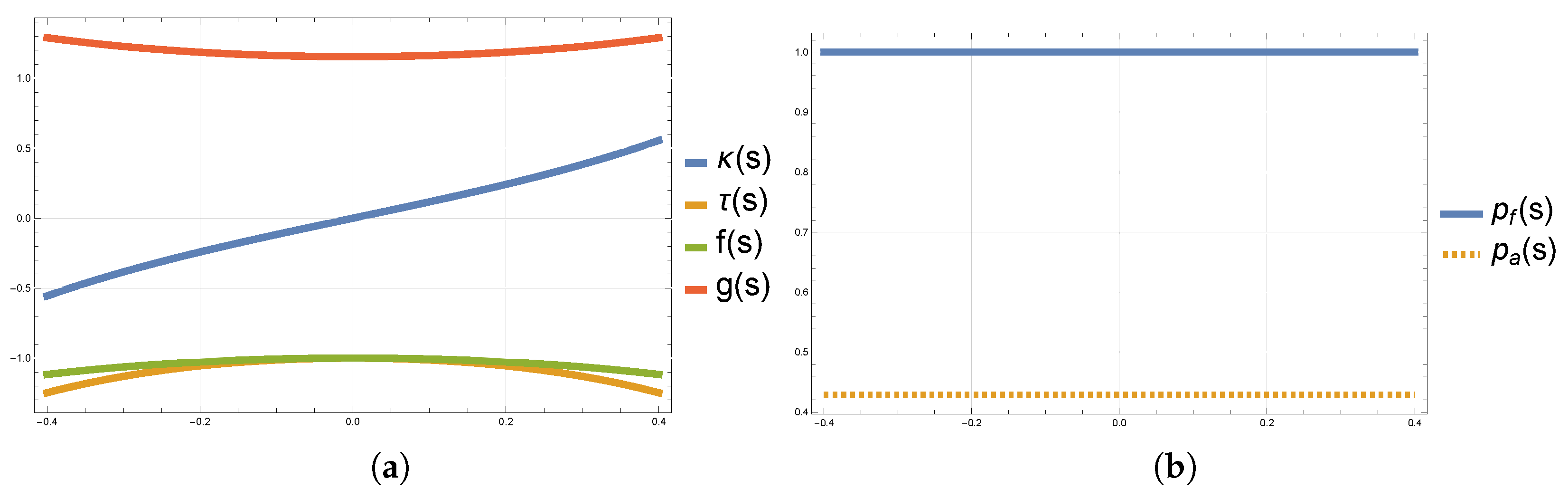
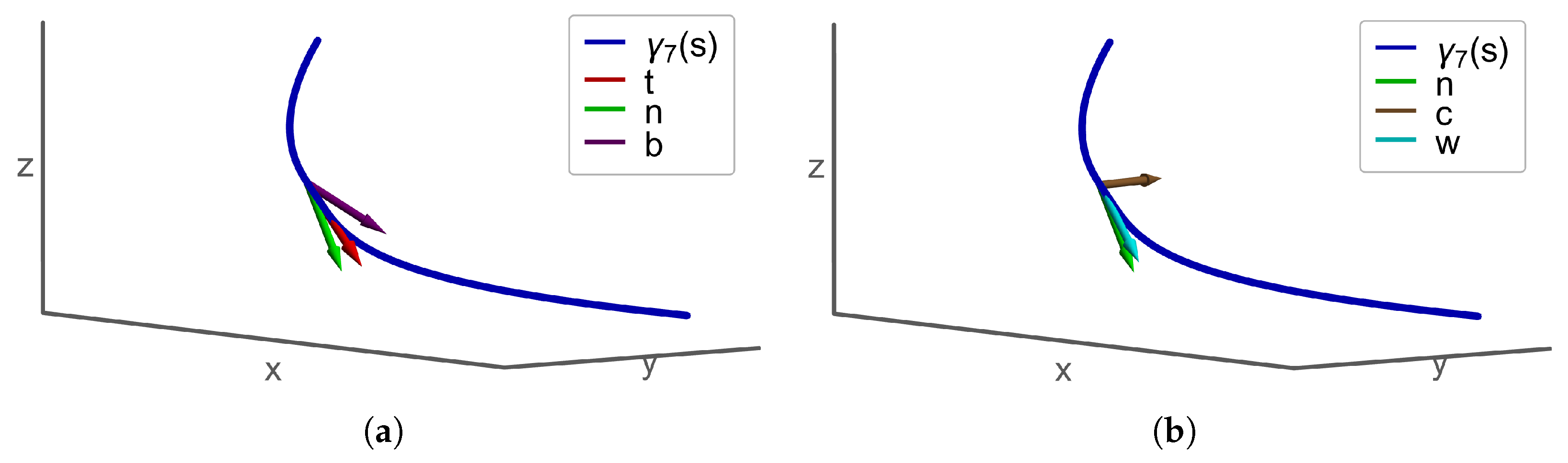
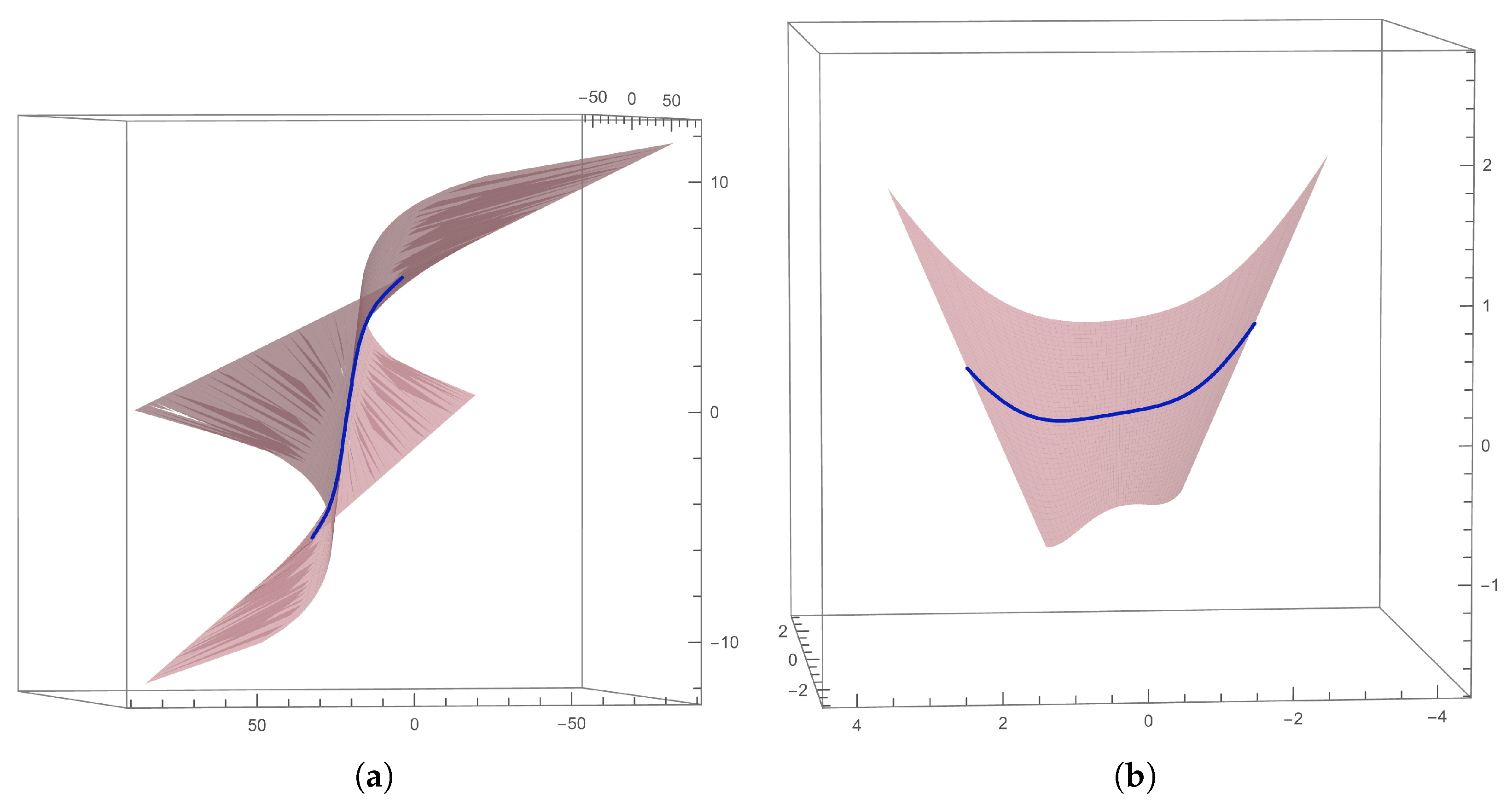
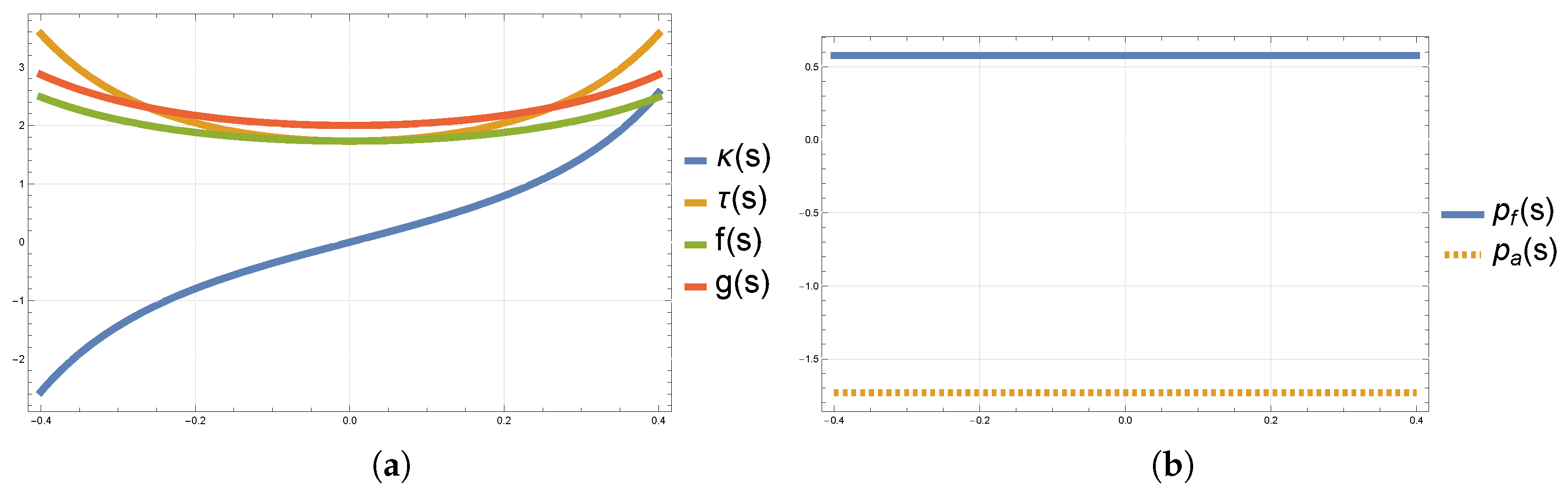
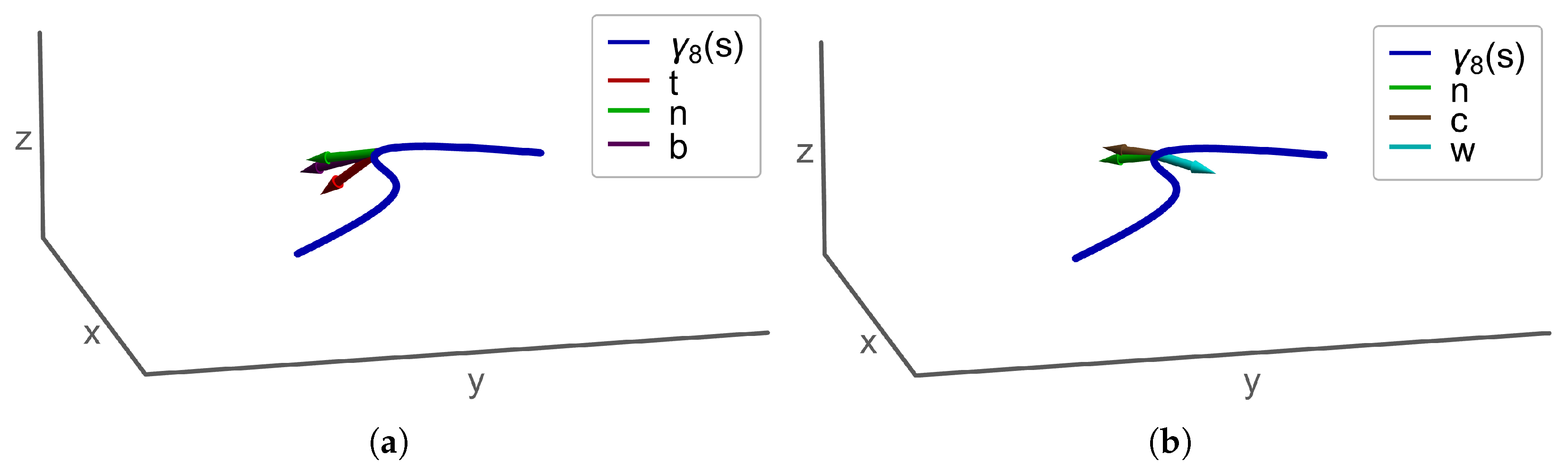
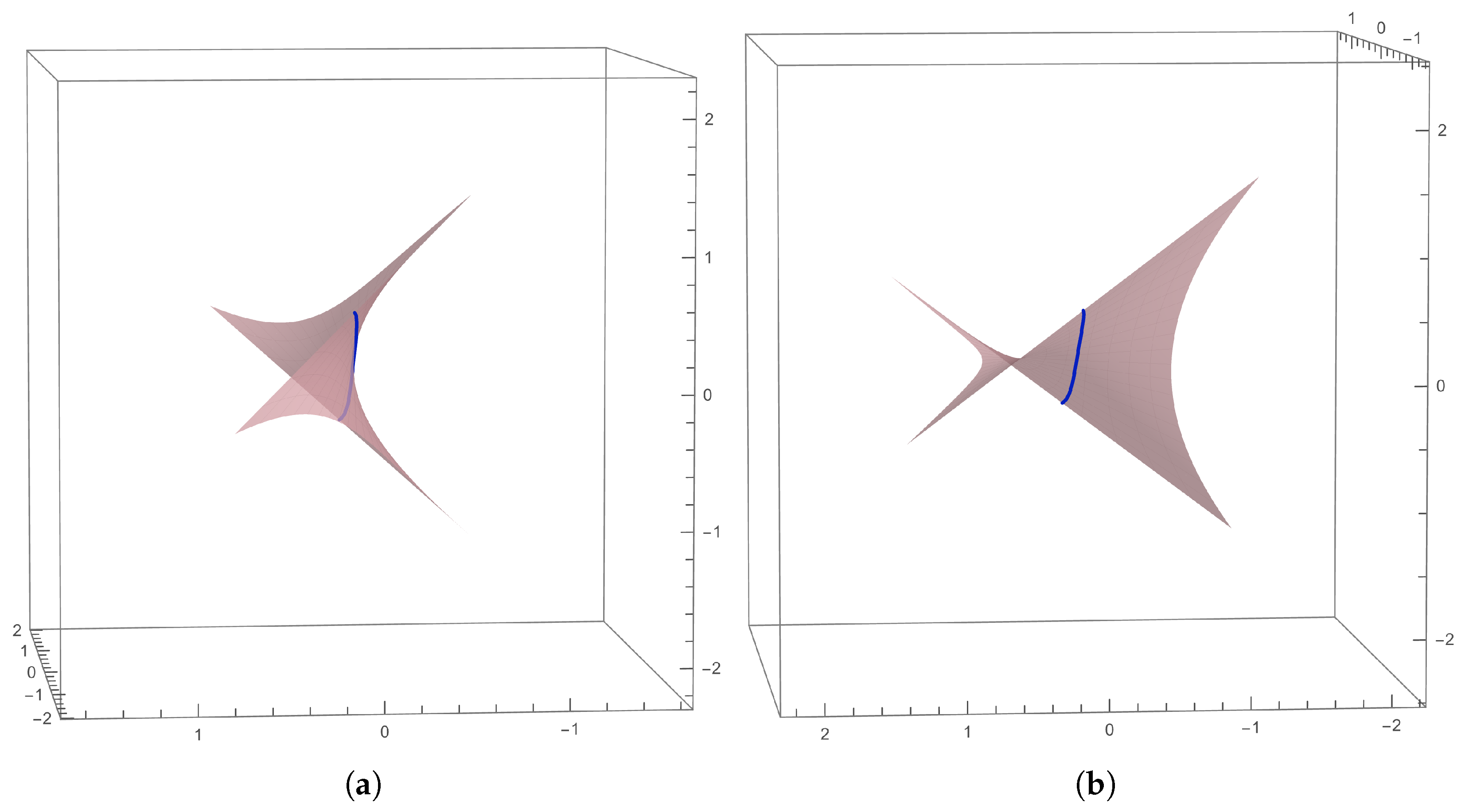
Example 1. Based on the Theorem 2, consider a timelike slant helix whose Frenet–Serret frame has the curvature and torsion functions described with the intrinsic equation asandFollowing that, the curvatures of the adapted frame are determined through the formulasHence, after some numerical integrations through the intrinsic equations specified above, it is simple to compute the pitches of Frenet–Serret and adapted frame motions, respectively, aswhich state that these motions have the persistence property. On the other hand, according to the local differential geometry of curves and surfaces, there is a unique curve with given curvature and torsion functions up to a rigid motion. Thus, the corresponding persistent Frenet–Serret and adapted frame motions and their associated ruled surfaces can be illustrated in Figure 3 and Figure 4, respectively. To further illustrate the persistence property, we also examine the variation of the curvature and torsion functions of the Frenet–Serret frame together with the adapted frame invariants. Figure 5a shows the behavior of , , and along the generating slant helix. Although these quantities vary significantly with the parameter s, Figure 5b demonstrates that the pitches of both Frenet–Serret and adapted frame motions remain constant. This confirms that persistence is preserved despite the nontrivial variation of the underlying geometric invariants. Example 2. Based on Theorem 6, consider a spacelike slant helix that has a timelike binormal vector whose Frenet–Serret frame has the curvature and torsion functions described with the intrinsic equation asandFollowing that, the curvatures of the adapted frame are determined through the formulasHence, after some numerical integrations through the intrinsic equations specified above, it is simple to compute the pitches of Frenet–Serret and adapted frame motions, respectively, aswhich state that these motions have the persistence property. On the other hand, according to the local differential geometry of curves and surfaces, there is a unique curve with given curvature and torsion functions up to a rigid motion. Thus, the corresponding persistent Frenet–Serret and adapted frame motions and their associated ruled surfaces can be illustrated in Figure 6 and Figure 7, respectively. To further illustrate the persistence property, Figure 8a displays the variation of the curvature and torsion functions together with the adapted frame invariants, while Figure 8b shows the corresponding Frenet–Serret and adapted motion pitches. Although the geometric invariants vary significantly along the curve, both pitches remain constant. This behavior provides a direct visualization of the persistence property and highlights the distinction between variable local geometric quantities and invariant motion pitches. Remark 2. The preceding examples illustrate two different causal configurations of Lorentzian slant helices. Although both examples generate persistent motions, the resulting pitch values, curvature–torsion representations, and associated frame structures differ according to the causal character of the generating curve.
This behavior contrasts with the Euclidean setting, where a single positive-definite metric governs all frame motions. In Minkowski space, the distinction between timelike and spacelike geometries leads to different persistence conditions and different intrinsic descriptions of the corresponding motions. Consequently, the separate treatment of the causal cases is not merely technical but reflects genuinely different geometric regimes arising from the Lorentzian metric structure. In this sense, the examples illustrate a phenomenon that is specific to the Lorentzian setting, namely the explicit dependence of persistence properties on causal character.
Moreover, the additional plots presented in Figure 5 and Figure 8 complement the geometric visualizations by illustrating the behavior of the curvature and torsion functions together with the corresponding adapted frame invariants. Although these local geometric quantities vary along the curves, the pitches remain constant, providing a direct visualization of the persistence property in different Lorentzian causal configurations. 7. Discussion
The theory developed throughout this paper establishes a geometric framework for persistent rigid motions generated by slant helices in the three-dimensional Minkowski space . Unlike the classical Euclidean formulation of persistent motions in , the Lorentzian setting introduces additional geometric complexity due to the causal structure of the ambient space. In particular, the timelike and spacelike characters of the tangent, normal, and binormal vectors fundamentally affect both the Frenet equations and the associated instantaneous twists.
One of the principal outcomes of this study is that the persistence property is governed entirely by intrinsic geometric invariants of the generating curve. More precisely, the persistence of both Frenet–Serret and adapted frame motions is characterized through the constancy of the pitch of the instantaneous twist, which is determined solely by the curvature and torsion of the generating slant helix. This demonstrates that persistence is not merely a property of a chosen moving frame representation, but rather a geometric characteristic of the curve itself.
Another significant outcome of the paper is the explicit relationship established between the pitches of Frenet–Serret and adapted frame motions. The obtained formula
reveals that the two motions are linked through the geodesic curvature of the spherical image of the principal normal indicatrix. Consequently, the persistence of one frame motion automatically implies the persistence of the other whenever the generating curve is a slant helix. This result provides a unified interpretation of different moving frame systems in Lorentzian kinematics.
A feature that is genuinely specific to the Lorentzian setting is the dependence of persistence properties on the causal character of the generating curve and its associated moving frame. In the Euclidean theory, a single positive-definite metric governs all frame motions. In contrast, Minkowski space naturally separates timelike, spacelike, and lightlike geometries, leading to different pitch formulas, different admissible curvature–torsion representations, and different persistence conditions. These causal effects are reflected in the intrinsic relationship between Frenet–Serret and adapted frame motions established in the present work. Consequently, persistence is not merely transferred from Euclidean geometry to Minkowski space; rather, it acquires new geometric features arising from the interaction between pitch invariants and causal character.
The geometric interpretation obtained through associated ruled surfaces constitutes another important contribution of the present work. It is shown that the pitch of a persistent motion coincides exactly with the distribution parameter of the ruled surface associated with the corresponding frame motion. Hence, persistence admits an equivalent surface-geometric characterization. Therefore, persistent Lorentzian motions can be interpreted simultaneously as kinematic invariants in the Poincaré group and as differential-geometric invariants of ruled surfaces in Minkowski space.
The illustrative examples further demonstrate that persistent motions may arise even under highly nontrivial curvature and torsion variations. In particular, the examples indicate that neither constant curvature nor constant torsion is necessary for persistence. Instead, the induced weight functions compensate for variations in the angular velocity vector and preserve the constant-pitch condition. This observation considerably enlarges the class of admissible persistent motions in Lorentzian geometry.
From a geometric mechanics perspective, persistent motions are of particular interest because they preserve a constant coupling between translational and rotational behavior despite variations in curvature and torsion. In Lorentzian geometry, this property becomes substantially richer due to the coexistence of timelike and spacelike rotational regimes. Consequently, persistent Lorentzian motions may be viewed as generalized screw-like motions whose intrinsic geometric structure remains invariant under changes of moving frame representation.
From a kinematic perspective, the visualizations presented in the examples provide a geometric interpretation of the generated persistent trajectories and the associated ruled surfaces. These visualizations should be understood as geometric models of frame-induced motions rather than as robotic simulations or physical implementations. No algorithmic trajectory-planning procedure, robotic control scheme, or physical model is developed in this study. Therefore, possible connections with robot kinematics or orientation-preserving motion design should be regarded only as potential directions for future research.
The present framework also provides a theoretical basis for future investigations of constrained frame motions, trajectory interpolation in pseudo-Riemannian spaces, and the geometry of Lorentzian isometries. Since the Poincaré group plays a central role in Lorentzian geometry and mathematical physics, possible connections with relativistic kinematics should be regarded as future directions rather than direct consequences of the present work.
8. Conclusions
This paper investigated persistent rigid motions generated by slant helices in the three-dimensional Minkowski space . Using the interpretation of curves in the Poincaré group as trajectories of rigid motions, the persistence problem was studied through Frenet–Serret and adapted frame motions associated with Lorentzian slant helices.
Necessary and sufficient conditions ensuring the persistence of these frame motions were derived explicitly in terms of curvature and torsion functions. It was further shown that the persistence properties of Frenet–Serret and adapted frame motions are intrinsically connected through the geodesic curvature of the spherical image of the principal normal indicatrix. Thus, persistence is shown to be independent of the chosen moving frame representation. Both Frenet–Serret and adapted frame motions encode the same intrinsic persistence behavior through the geometry of the generating slant helix.
One of the main findings of this study is the geometric interpretation established through associated ruled surfaces. The coincidence between the pitch of the instantaneous twist and the distribution parameter of the associated ruled surface provides a direct geometric characterization of persistent Lorentzian motions in terms of surface geometry and instantaneous screw behavior.
Overall, the proposed framework extends the classical Euclidean theory of persistent rigid-body motions into Lorentzian geometry and provides a unified approach connecting slant helices, moving frames, screw theory, and ruled surfaces in Minkowski space. Unlike the Euclidean case, the obtained persistence relations explicitly depend on the causal character of the generating curve and the associated moving frames. These results demonstrate that persistence in Minkowski space possesses geometric features that arise from the Lorentzian causal structure and have no direct Euclidean counterpart.
Possible future directions include the investigation of persistent motions in higher-dimensional Lorentzian spaces, dual Lorentzian geometries, null-frame motions, and trajectory generation problems involving pseudo-Riemannian constraints. Algorithmic trajectory-planning procedures and physically realizable models are beyond the scope of the present paper and may be considered in future applied studies.