Article

Bipartite Consensus of Discrete-Time Multi-Agent Systems via Intermittent Dynamic Event-Triggered Control

School of Science, Hunan University of Technology, Zhuzhou 412008, China
*
Author to whom correspondence should be addressed.
Mathematics 2026, 14(13), 2411; https://doi.org/10.3390/math14132411
Submission received: 22 December 2025 / Revised: 30 May 2026 / Accepted: 23 June 2026 / Published: 6 July 2026
(This article belongs to the Special Issue Complex Systems and Networks)

Abstract

In this paper, bipartite consensus is studied for multi-agent systems (MAS) with discrete-time dynamics via intermittent dynamic event-triggered control (IDETC). Firstly, by applying the event-triggered control (ETC) mechanism to the intermittent control strategy, an intermittent dynamic event-triggered state feedback bipartite consensus protocol is proposed, and the stability analysis is given by employing the switching system method. Then, through integration of IDETC and observer-based relative output information, an observer-based IDETC bipartite consensus protocol is proposed and the corresponding consensus conditions are obtained. In the final section, two numerical simulations are given for validating the efficiency of the theoretical findings.

1. Introduction

Recently, cooperative control of MAS has been a very hot topic for applications in many fields, such as platooning control of connected vehicles, sensor networks, and power systems [1,2,3,4]. Among the related issues, the consensus of MAS is particularly important, and lots of results about consensus have emerged in the past two decades [5,6,7,8].
It should be noted that competitive relation between the nodes in real networks may exist, such as social networks, biological networks, and so on. The approaches for solving consensus cannot be available because of negative links in the MAS with competitive topology. For dealing with the cooperative control of MAS under the competitive links, the bipartite consensus is proposed and the gauge transformation is used for analyzing the convergence [9]. And then, many works about bipartite consensus of MAS under different control methods are reported, such as adaptive bipartite consensus [10], finite-time bipartite consensus [11], intermittent bipartite consensus [12], resilient bipartite consensus [13], event-triggered bipartite consensus [14], bipartite output consensus [15], and the literature therein.
In addition, for a MAS, its communication bandwidth is limited, which may cause the burden of information transmission. In order to overcome the above obstacles, a novel control method, named event-triggered control (ETC), is proposed, which is widely used for stabilizing networked systems. The ETC is first proposed in [16], which mainly investigates the stabilization problem for a single system, and the event function is executed if the given function outnumbers the threshold. Ref. [17] proposes an ETC protocol for the consensus of MAS with integrator dynamics, and the self-triggered issues are also introduced. Then, the ETC method is employed for coping with the consensus problem for MAS with general linear dynamics [18,19], and observer-based ETC is investigated for consensus of linear MAS [20]. To solve the consensus problem for uncertain MAS, event-triggered robust fixed-time consensus of MAS with uncertainties is studied in [21], and a FAT-based event-triggered learning control method is proposed for investigating command-filter consensus of uncertain nondeterministic MAS [22]. For further cutting down the communication load, ref. [23] proposes a dynamic event-triggered control (DETC) method by introducing a dynamical variable instead of the fixed threshold designed in [16]. The distributed DETC is proposed for handling the consensus of MAS, which extended theory given by [23] to the networked multiple systems [24]. Then, many kinds of DETC approach are developed for solving the cooperative control of MAS [25,26,27,28,29].
However, although existing ETC and DETC methods can effectively cut down the communication load, they may still suffer from unnecessary triggering. For further dealing with this problem, it should be considered that intermittent control is another effective method for cutting down the communication load because there exists a communication-free interval for every period. Intermittent event-triggered control (IETC) is proposed for solving the quasi-synchronization of multiple coupled delayed memristive neural networks [30]. IETC means to use ETC in the control interval of each period, and it integrates the advantage of intermittent control and ETC, which can alleviate the communication load more effectively. Then, many related works have been reported in the past several years. IETC-based impulsive control is investigated for stabilizing nonlinear systems, by designing impulsive instants in the control intervals [31]. And IETC is addressed for studying consensus of nonlinear MAS [32]. By using hybrid dynamic ETC mechanism and intermittent control strategies, intermittent dynamic event-triggered control (IDETC) is proposed for synchronizing stochastic complex networks [33], and the stabilizing problem of delayed dynamic systems is solved by IDETC in [34].
All of the related works inspire us to study bipartite consensus of DMAS via IDETC. The main contributions are as follows: (i) The dynamics of each node are driven by the difference equation. (ii) The discrete-time IDETC method is proposed by applying the DETC mechanism to the intermittent strategy, and the corresponding framework is given. (iii) Under the proposed control mechanism, two kinds of protocols are designed and the corresponding consensus conditions are presented.
Notations: ⊗ represents the Kronecker product. represents the Euclidean norm. A matrix L 0 ( o r 0 , 0 , 0 ) means L is positive (or semi-positive, negative, semi-negative) definite.

2. Problem Description and Preliminaries

In this section, some basic preliminaries are introduced. G = ( W , E , A ) represents the topology of a MAS, where W = { ϖ 1 , ϖ 2 , , ϖ N } represents the node set, E W × W denotes the edge set, and A = [ g i j ] N × N indicates the adjacent matrix. For an undirected graph, g i j = g j i 0 ( i , j ) E . Or else, g i j = g j i = 0 . For distinct nodes, ϖ i 1 , ϖ i 2 , , ϖ i m , ( ϖ i 1 , ϖ i 2 ) , ( ϖ i 2 , ϖ i 3 ) , , ( ϖ i m 1 , ϖ i m ) represents a path from ϖ i 1 to ϖ i m . A connected graph means that there are one or more paths between any two nodes. Moreover, the Laplacian matrix L = [ l i j ] N × N is defined as
l i j = g i j , i j l i i = j = 1 , j i N | g i j | .
Considering a DMAS consisting of N + 1 nodes, N followers and a leader, the followers are driven by
x i ( t + 1 ) = A x i ( t ) + B u i ( t ) y i ( t ) = C x i ( t ) , i = 1 , 2 , , N ,
and the leader is driven by
x 0 ( t + 1 ) = A x 0 ( t ) y 0 ( t ) = C x 0 ( t )
where x i R n , u i R m and y i R l , respectively, denote the state, control input, and measured output of the i t h agent. A R n × n , B R n × m , C R l × n .
It is worth noting that the linear dynamics assumption in (1) is a simplification. Many real-world agents exhibit nonlinearities, such as robot manipulators or unmanned aerial vehicles. Nevertheless, linear models are often obtained via linearization, and the proposed IDETC framework can serve as a foundation for extending to nonlinear systems via feedback linearization or Lipschitz-based methods. MAS (1)–(2) with general linear dynamics can describe many practical networks, such as sensor networks [2] and connected vehicles [3].
Definition 1
([9]). G  is called structurally balanced if both of the following hold
(1) 
W 1 W 2 = , W 1 W 2 = W .
(2) 
g i j = 1 , if i , j are in the same cluster, and g i j = 1 , if i , j are in a different cluster.
Assumption 1.
  G  is connected and structurally balanced.
Assumption 2.
There exists at least one follower pinned by the leader.
Lemma 1
([29]). G  is structurally balanced if and only if there exists a diagonal matrix Λ = d i a g { h 1 , h 2 , , h N } , h i { 1 , 1 } , such that Λ A Λ is semi-positive definite.
Lemma 1 is important for dealing with bipartite consensus problems. It can transform a structurally balanced graph to into an equivalent cooperative graph.
Thus, in a structurally balanced graph, the nodes can be divided into two clusters. For one cluster, h i = 1 , and for the other cluster, h i = 1 .
Definition 2.
For MAS (1–2), bipartite consensus is realised, if
lim t x i ( t ) h i x 0 ( t ) = 0 .
for any x i ( 0 ) R n , i W { ϖ 0 } .
Assumption 3.  ( A , B ) is stabilizable.
Remark 1
([29]). For given constants c > 0 , γ > 0 , under Assumption 3, there exists a positive definite matrix Q > 0 , satisfying the following discrete-time algebraic Riccati inequality
A T Q A Q γ A T Q B ( B T Q B + I ) 1 B T Q A + c I < 0 .
Assumption 4.
Suppose that ( A , C ) is detectable.

3. Intermittent Event-Triggered Bipartite Consensus Based on Relative State Information

In this section, an IDETC state feedback protocol is designed. Denote the event-triggered time sequence with intermittent control as T 2 l = t i , 0 l t i , 1 l t i , s l T 2 l + 1 ( l = 0 , 1 , 2 , ) of the follower i, where [ T 2 l , T 2 l + 1 ) is the time period in which intermittent control occurs. Then, the DETC protocol for discrete-time MAS has the following form
u i ( t ) = K { j N i | a i j | ( x i ( t i , s l ) s g n ( g i j ) x j ( t j , s l ) ) + g i 0 ( x i ( t i , s l ) h i x 0 ( t ) ) } , t [ T 2 l , T 2 l + 1 ) , 0 , t [ T 2 l + 1 , T 2 l + 2 ) ,
where t j , s l = arg min l N , t t j , s l { t t j , s l } represents the last triggered instant of follower j.
For t [ t i , s l , t i , s + 1 l ) , denote the system error and the measurement error as φ i ( t ) = x i ( t ) h i x 0 ( t ) and e i ( t ) = x i ( t i , s l ) x i ( t ) , respectively. Then, the instants t i , s l , i W , are expressed for the following criteria:
t i , s + 1 l = inf { t > t i , s l | 1 ξ η i ( t ) + ι φ i T ( t ) φ i ( t ) κ e i T ( t ) e i ( t ) 0 } ,
with t i , 0 l = 0 , where ξ , ι and κ are positive constants to be designed. And the η i ( t ) is driven by
η i ( t + 1 ) = ϖ η i ( t ) + ι φ i T ( t ) φ i ( t ) κ e i T ( t ) e i ( t ) ,
where ϖ ( 0 , 1 ) and η i ( 0 ) 0 .
Lemma 2.
For arbitrary η i ( 0 ) 0 , if ϖ > 1 ξ holds, the dynamic auxiliary variable satisfies
η i ( t ) > 0 , i = 1 , 2 , , N .
Proof. 
For any t [ t i , s l , t i , s + 1 l ) , there exists s , such that t [ t i , s l , t i , s + 1 l ) . Since no event is released between t i , s l and t i , s + 1 l , one has
1 ξ η i ( t ) + ι φ i T ( t ) φ i ( t ) κ e i T ( t ) e i ( t ) > 0 .
Then, according to (6) and (8), we have
η i ( t + 1 ) > ( ϖ 1 ξ ) η i ( t ) ,
then, after iterations, one has η i ( t + 1 ) > ( ϖ 1 ξ ) t + 1 η i ( 0 ) . Due to η i ( 0 ) 0 and ϖ > 1 ξ , it is apparent that η i ( t ) > 0 holds. This completes the proof. □
Recalling that e i ( t ) = x i ( t i , s l ) x i ( t ) , then, for t [ t i , s l , t i , s + 1 l ) , (4) can be cast to
u i ( t ) = K { j N i | g i j | ( x i ( t ) + e i ( t ) s g n ( g i j ) ( x j ( t ) + e j ( t ) ) ) + g i 0 ( x i ( t ) + e i ( t ) h i x 0 ( t ) ) } , t [ T 2 l , T 2 l + 1 ) , 0 , t [ T 2 l + 1 , T 2 l + 2 ) ,
Theorem 1.
Suppose Assumptions 1–3 hold. Under the IDETC protocol (4) with K = 1 λ N ( B T Q B + I ) 1 B T Q A , for ϖ ( 0 , 1 ) and η i ( 0 ) > 0 , MAS (1)–(2) can reach bipartite consensus if the following conditions can be satified:
(i) 
1 < Φ < 0 with Φ = max { Φ 1 , Φ 2 } ;
(ii) 
τ 2 i , τ 2 i + 1 , i = 1 , 2 , , l , and τ 1 τ 2 > b a
  • where Φ 1 = c + ι λ N ϱ N ( 2 α + 1 ) κ + 2 λ N ϱ N α λ m a x ( Q ) , Φ 2 = ( 2 α + 1 ) λ N ϱ N κ 1 ξ + ( ϖ 1 ) , l = T l + 1 T l , and a = ln ( 1 + λ ˜ λ m i n ( Q ) ) , b = ln ( 1 + Φ ) .
Proof. 
According to Lemma 1, it is obvious that g i j s g n ( g i j ) = | g i j | = h i g i j h j 0 , one has h i = s g n ( g i j ) h j . Then, when t [ t i , s l , t i , s + 1 l ) [ T 2 l , T 2 l + 1 ) , combining with (1) and (10), one gets
φ i ( t + 1 ) = x i ( t + 1 ) h i x 0 ( t + 1 ) = A x i ( t ) B K { j N i | g i j | ( x i ( t ) + e i ( t ) s g n ( g i j ) ( x j ( t ) + e j ( t ) ) ) + g i 0 ( x i ( t ) + e i ( t ) h i x 0 ( t ) ) } h i A x 0 ( t ) = A x i ( t ) B K { j N i | g i j | ( x i ( t ) h i x 0 ( t ) + e i ( t ) s g n ( g i j ) ( x j ( t ) h j x 0 ( t ) + e j ( t ) ) ) + g i 0 ( x i ( t ) + e i ( t ) h i x 0 ( t ) ) } h i A x 0 ( t ) = A φ i ( t ) B K j N i l ¯ i j φ j ( t ) B K j N i l ¯ i j e j ( t ) .
Denote e ( t ) = ( e 1 T ( t ) , e 2 T ( t ) , , e N T ( t ) ) T , φ ( t ) = ( φ 1 T ( t ) , φ 2 T ( t ) , , φ N T ( t ) ) T , then,
φ ( t + 1 ) = ( I N A L ¯ B K ) φ ( t ) ( L ¯ B K ) e ( t ) ,
where L ¯ = L + G and G = d i a g { g 10 , g 20 , , g N 0 } . For t [ T 2 l + 1 , T 2 l + 2 ) , one has
φ i ( t + 1 ) = x i ( t + 1 ) h i x 0 ( t + 1 ) = A φ i ( t ) .
Let L ^ = Λ L ¯ Λ = [ l ^ i j ] R N × N , it can obtain that l ^ i i = j N i g ^ i j + g i 0 > 0 and l ^ i j = g ^ i j < 0 , i j . Therefore, it is clear that L ^ 0 . Denoting φ ^ ( t ) = ( Λ I n ) φ ( t ) and e ^ ( t ) = ( Λ I n ) e ( t ) , one has
φ ^ ( t + 1 ) = ( I N A L ^ B K ) φ ^ ( t ) ( L ^ B K ) e ^ ( t ) , t [ T 2 l , T 2 l + 1 ) , ( I N A ) φ ^ ( t ) , t [ T 2 l + 1 , T 2 l + 2 ) ,
According to Lemma 2, η i ( t ) > 0 . Denote
V ( t ) = V 1 ( t ) + V 2 ( t ) ,
where
V 1 ( t ) = φ T ( t ) ( I N Q ) φ ( t ) ,
V 2 ( t ) = i = 1 N 1 ξ η i ( t ) ,
and Q > 0 satisfying (3).
For t [ T 2 l , T 2 l + 1 ) , one has
V ( t ) = V 1 ( t + 1 ) V 1 ( t ) = φ T ( t + 1 ) ( I N Q ) φ ( t + 1 ) φ T ( t ) ( I N Q ) φ ( t ) = φ ^ T ( t + 1 ) ( I N Q ) φ ^ ( t + 1 ) φ ^ T ( t ) ( I N Q ) φ ^ ( t ) = φ ^ T ( t ) ( I N ( A T Q A Q ) 2 L ^ K T B T Q A + L ^ 2 K T B T Q B K ) φ ^ ( t ) 2 e ^ T ( t ) ( L ^ K T B T Q A L ^ 2 K T B T Q B K ) φ ^ ( t ) + e ^ T ( t ) ( L ^ 2 K T B T Q B K ) e ^ ( t ) .
Since L ^ 0 , there exists an orthogonal matrix U, s.t. U T L ^ U = d i a g { λ 1 , λ 2 , , λ N } with 0 < λ 1 λ 2 λ N . Define φ ˜ ( t ) = ( U I n ) φ ^ ( t ) . Nevertheless, let K = 1 λ N ( B T Q B + I ) 1 B T Q A , where λ N is the largest eigenvalue of L ˜ . Meanwhile, it is clear that B T Q B < B T Q B + I , one has ( B T Q B + I ) 1 B T Q B ( B T Q B + I ) 1 < ( B T Q B + I ) 1 . Thus, it follows
φ ^ T ( t ) ( I N ( A T Q A Q ) 2 L ^ K T B T Q A + L ^ 2 K T B T Q B K ) φ ^ ( t ) φ ˜ T ( t ) ( I N ( A T Q A Q ) 2 U T L ^ U K T B T Q A + U T L ^ 2 U K T B T Q B K ) φ ˜ ( t ) = i = 1 N φ ˜ i T ( t ) ( I N ( A T Q A Q 2 λ i K T B T Q A + λ i 2 K T B T Q B K ) ) φ ˜ i ( t ) i = 1 N φ ˜ i T ( t ) ( I N ( A T Q A Q ( 2 λ i λ N λ i 2 λ N 2 ) A T Q B × ( B T Q B + I ) 1 B T Q A ) ) φ ˜ i ( t ) .
Denoting γ = 2 λ 1 λ N λ 1 2 λ N 2 , due to 2 λ i λ N λ i 2 λ N 2 = λ i λ N ( 2 λ i λ N ) λ 1 λ N ( 2 λ 1 λ N ) > 0 , (16) can be converted to
φ ^ T ( t ) ( I N ( A T Q A Q ) 2 L ^ K T B T Q A + L ^ 2 K T B T Q B K ) φ ^ ( t ) φ ˜ T ( t ) ( I N ( A T Q A Q γ A T Q B ( B T Q B + I ) 1 × B T Q A ) φ ˜ ( t ) c i = 1 N φ ˜ i T ( t ) φ ˜ i ( t ) = c i = 1 N φ i T ( t ) φ i ( t ) .
Noting that Q > 0 , one can know B T Q B 0 , then B T Q B + I > 0 . Nevertheless, without loss of generality, one can suppose A T Q B 0 ; otherwise, A T Q A Q + c I < 0 , which means that A is Schur stable and the MAS (1) will realise consensus without any control. Therefore, one can conclude A T Q b ( B T Q B + I ) 1 B T Q A > 0 , and then, K T B T Q A > 0 . And then one has L ^ K T B T Q A > 0 . Consequently, there must exist a matrix M, such that L ^ K T B T Q A = M T M . Denote ϱ N is the maximum eigenvalue of K T B T Q A , then
2 e ^ T ( t ) ( L ^ K T B T Q A ) φ ^ ( t ) = 2 ( M e ^ ( t ) ) T ( M φ ^ ( t ) ) α e ^ T ( t ) M T M e ^ ( t ) + 1 α φ ^ T ( t ) M T M φ ^ ( t ) α λ N ϱ N i = 1 N e i T ( t ) e i ( t ) + λ N ϱ N α i = 1 N φ i T ( t ) φ i ( t ) .
Similar to (18), according to K T B T Q B K < 1 λ N K T B T Q A , one has L ^ 2 K T B T Q B K < L ^ K T B T Q A , hence, it follows
2 e ^ T ( t ) ( L ^ 2 K T B T Q B K ) φ ^ ( t ) 2 e ^ T ( t ) ( L ^ A T Q B K ) φ ^ ( t ) α λ N ϱ N i = 1 N e i T ( t ) e i ( t ) + λ N ϱ N α i = 1 N φ i T ( t ) φ i ( t ) ,
and
e ^ T ( t ) ( L ^ 2 K T B T Q B K ) e ^ ( t ) e ^ T ( t ) ( L ^ A T Q B K ) e ^ ( t ) λ N ϱ N i = 1 N e i T ( t ) e i ( t ) .
Hence, (17) can be further given by combining (19)–(21)
V 1 ( t ) ( c + 2 λ N ϱ N α ) i = 1 N φ i T ( t ) φ i ( t ) + ( 2 α + 1 ) λ N ϱ N i = 1 N e i T ( t ) e i ( t ) .
Moreover, combining (21) with (6), one gets
V ( t ) ( c + 2 λ N ϱ N α ) i = 1 N φ i T ( t ) φ i ( t ) + ( 2 α + 1 ) λ N ϱ N i = 1 N e i T ( t ) e i ( t ) + i = 1 N 1 ξ η i ( t + 1 ) i = 1 N 1 ξ η i ( t ) = i = 1 N 1 ξ ( ϖ 1 ) η i ( t ) + ( c + 2 λ N ϱ N α + ι κ ) i = 1 N φ i T ( t ) φ i ( t ) + ( ( 2 α + 1 ) λ N ϱ N κ ξ ) i = 1 N e i T ( t ) e i ( t ) .
From (5), e i T ( t ) e i ( t ) 1 ξ κ η i ( t ) + ι ξ φ i T ( t ) φ i ( t ) , consequently, (22) can be expressed as
V ( t ) ( c + ι λ N ϱ N ( 2 α + 1 ) κ + 2 λ N ϱ N α ) i = 1 N φ i T ( t ) φ i ( t ) + ( λ N ϱ N ( 2 α + 1 ) κ 1 ξ + ( ϖ 1 ) ) i = 1 N 1 ξ η i ( t ) ( c + ι λ N ϱ N ( 2 α + 1 ) κ + 2 λ N ϱ N α ) λ m a x ( Q ) i = 1 N φ i T ( t ) Q φ i ( t ) + ( λ N ϱ N ( 2 α + 1 ) κ 1 ξ + ( ϖ 1 ) ) i = 1 N 1 ξ η i ( t ) = Φ 1 i = 1 N φ i T ( t ) Q φ i ( t ) + Φ 2 i = 1 N 1 ξ η i ( t ) Φ ( i = 1 N φ i T ( t ) Q φ i ( t ) + i = 1 N 1 ξ η i ( t ) ) = Φ V ( t ) ,
where Φ 1 = c + ι λ N ϱ N ( 2 α + 1 ) κ + 2 λ N ϱ N α λ m a x ( Q ) < 0 , Φ 2 = λ N ϱ N ( 2 α + 1 ) κ 1 ξ + ( ϖ 1 ) < 0 , Φ = max { Φ 1 , Φ 2 } .
For t [ T 2 l + 1 , T 2 l + 2 ) ,
V ( t ) = φ T ( t + 1 ) ( I N Q ) φ ( t + 1 ) φ T ( t ) ( I N Q ) φ ( t ) = φ T ( t ) ( I N ( A T Q A Q ) ) φ ( t ) λ m a x ( A T Q A Q ) λ m i n ( Q ) i = 1 N φ i T ( t ) Q φ i ( t ) λ m a x ( A T Q A Q ) λ m i n ( Q ) ( i = 1 N φ i T ( t ) Q φ i ( t ) + i = 1 N 1 ξ η i ( t ) ) λ ˜ λ m i n ( Q ) V ( t ) ,
where λ ˜ is the maximum eigenvalue of γ A T Q A ( B T Q B + I ) 1 B T Q A , and λ ˜ > 0 based on Remark 1.
Combining (24) with (23), it can get that
V ( t + 1 ) = ( 1 + Φ ) V ( t ) , t [ T 2 l , T 2 l + 1 ) , ( 1 + λ ˜ λ m i n ( Q ) V ( t ) , t [ T 2 l + 1 , T 2 l + 2 ) .
Therefore,
V ( T 2 l + 2 ) ( 1 + λ ˜ λ m i n ( Q ) ) V ( T 2 l + 2 1 ) ( 1 + λ ˜ λ m i n ( Q ) ) 2 V ( T 2 l + 2 2 ) ( 1 + λ ˜ λ m i n ( Q ) ) T 2 l + 2 T 2 l + 1 V ( T 2 l + 1 ) .
Sequently,
V ( T 2 l + 1 ) ( 1 + Φ ) V ( T 2 l + 1 1 ) ( 1 + Φ ) 2 V ( T 2 l + 1 2 ) ( 1 + Φ ) T 2 l + 1 T 2 l V ( T 2 l ) .
Thus, by combining (26) and (27), one can obtain
V ( T 2 l + 2 ) ( 1 + λ ˜ λ m i n ( Q ) ) T 2 l + 2 T 2 l + 1 × ( 1 + Φ ) T 2 l + 1 T 2 l V ( T 2 l ) .
Then, (28) can be rewritten as
V ( T 2 l + 2 ) ( 1 + λ ˜ λ m i n ( Q ) ) 2 l + 1 + 2 l 1 + + 1 × ( 1 + Φ ) 2 l + 2 l 2 + + 0 ) V ( 0 ) ,
where i = T i + 1 T i , i = 0 , 1 , 2 , , 2 l + 1 . Let a = ln ( 1 + λ ˜ λ m i n ( Q ) ) , b = ln ( 1 + Φ ) with 1 < Φ < 0 , then
V ( T 2 l + 2 ) e a ( 2 l + 1 + 2 l 1 + + 1 ) + b ( 2 l + 2 l 2 + + 0 ) V ( 0 ) ,
according to the condition (ii), for t [ T 2 l , T 2 l + 2 ) , l = 0 , 1 , , one has V ( T 2 l + 2 ) 0 , as l . Thus, Theorem 1 is proved.
Remark 2.
The IDETC protocols include several parameters: ω , ξ , κ , ι , τ 1 , τ 2 and Q. The selection of each parameter can be found in Table 1.

4. Observer-Based Intermittent Event-Triggered Bipartite Consensus

In this section, an observer-based IDETC protocol is proposed. The observer of MAS (1)–(2) are designed as follows
ν i ( t + 1 ) = A ν i ( t ) + B u i ( t ) F ( y i ( t ) C ν i ( t ) ) ,
ν 0 ( t + 1 ) = A ν 0 ( t ) F ( y 0 ( t ) C ν 0 ( t ) ) , i N ¯ ,
where ν i ( t ) R n is the estimated value of x i ( t ) , F R n × q will be given later.
Let
y ^ i ( t ) = C ν i ( t ) , i N ¯ ,
y ^ 0 ( t ) = C ν 0 ( t ) .
Then, a new observer-based IDETC law is proposed by
u i ( t ) = K { j N i | g i j | ( ν i ( t i , s l ) s g n ( g i j ) ν j ( t j , s l ) ) + g i 0 ( ν i ( t i , s l ) h i ν 0 ( t ) ) } , t [ T 2 l , T 2 l + 1 ) , 0 , t [ T 2 l + 1 , T 2 l + 2 ) ,
Denote π i ( t ) = ν i ( t ) h i ν 0 ( t ) , and q i ( t ) = ν i ( t i , s l ) ν i ( t ) . Then,
u i ( t ) = K { j N i | g i j | ( ν i ( t ) + q i ( t ) s g n ( g i j ) ( ν j ( t ) + q j ( t ) ) ) + g i 0 ( ν i ( t ) + q i ( t ) h i ν 0 ( t ) ) } , t [ T 2 l , T 2 l + 1 ) , 0 , t [ T 2 l + 1 , T 2 l + 2 ) .
The triggering instant t i , s l is shown as the following:
t i , s + 1 l = inf { t > t i , s l | 1 ζ χ i ( t ) + ϑ i T ( t ) π i ( t ) ε q i T ( t ) q i ( t ) 0 } ,
with t i , 0 l = 0 , where ζ , ϑ and ε are all positive scalars.
Meanwhile, χ i ( t ) is the dynamic threshold driven by
χ i ( t + 1 ) = μ χ i ( t ) + ϑ π i T ( t ) π i ( t ) ε q i T ( t ) q i ( t ) ,
where χ i ( 0 ) 0 is the initial condition and μ ( 0 , 1 ) is a known constant.
Theorem 2.
Under Assumptions 1–3, for given χ i ( 0 ) > 0 and μ ( 0 , 1 ) under the law (35) with K = 1 λ N ( B T Q B + I ) 1 B T Q A , the MAS (1)–(2) can achieve bipartite consensus when the following conditions hold:
(i) 
1 < Ψ < 0 with Ψ = max { Ψ 1 , Ψ 2 } ;
(ii) 
τ 2 i , τ 2 i + 1 , i = 1 , 2 , , l , and τ 1 τ 2 > b a
  • where Ψ 1 = c + ϑ λ N ϱ N ( 2 β + 1 ) ε + 2 λ N ϱ N β λ m a x ( Q ) , Ψ 2 = ( 2 β + 1 ) λ N ϱ N ε 1 ζ + ( μ 1 ) , l = T l + 1 T l and a ˜ = ln ( 1 + λ ˜ λ m i n ( Q ) ) , b ˜ = ln ( 1 + Ψ ) .
Proof. 
Denote ϕ i ( t ) = x i ( t ) x ^ i ( t ) . Similar to the last section, combining with (31), (32) and (38), when t [ t i , s l , t i , s + 1 l ) [ T 2 l , T 2 l + 1 ) , one has
π i ( t + 1 ) = ν i ( t + 1 ) h i ν 0 ( t + 1 ) = A ν i ( t ) B K { j N i | g i j | ( ν i ( t ) + q i ( t ) s g n ( g i j ) ( ν j ( t ) + q j ( t ) ) ) + g i 0 ( ν i ( t ) + q i ( t ) h i ν 0 ( t ) ) } F ( y i ( t ) C ν i ( t ) ) h i A ν 0 ( t ) + F ( y 0 ( t ) C ν 0 ( t ) ) = A x i ( t ) B K { j N i | g i j | ( ν i ( t ) h i ν 0 ( t ) + q i ( t ) s g n ( g i j ) ( ν j ( t ) h j ν 0 ( t ) + q j ( t ) ) ) + g i 0 ( ν i ( t ) + q i ( t ) h i ν 0 ( t ) ) } F C ϕ i ( t ) h i A ν 0 ( t ) + F C ϕ 0 ( t ) = A π i ( t ) B K j N i l ¯ i j π j ( t ) B K j N i l ¯ i j q j ( t ) F C ϕ i ( t ) + F C ϕ 0 ( t ) .
ϕ i ( t + 1 ) = x i ( t + 1 ) ν i ( t + 1 ) = A x i ( t ) + B u i ( t ) A ν i ( t ) B u i ( t ) + F C ϕ i ( t ) = ( A + F C ) ϕ i ( t ) ,
ϕ 0 ( t + 1 ) = x 0 ( t + 1 ) x 0 ( t + 1 ) = A x i ( t ) A z i ( t ) + F C ϕ 0 ( t ) = ( A + F C ) ϕ 0 ( t ) .
Because ( A + F C ) is Schur stable, one has ϕ i ( t ) 0 , and ϕ 0 ( t ) 0 as t .
Therefore, one can obtain
π i ( t + 1 ) = A π i ( t ) B K j N i l ¯ i j π j ( t ) B K j N i l ¯ i j q j ( t ) .
Denote that π ( t ) = ( π 1 T ( t ) , π 2 T ( t ) , , π N T ( t ) ) T , and q ( t ) = ( q 1 T ( t ) , q 2 T ( t ) , , q N T ( t ) ) T ; then, (42) can be changed to the following
π ( t + 1 ) = ( I N A L ¯ B K ) π ( t ) ( L ¯ B K ) q ( t ) ,
For t [ T 2 l + 1 , T 2 l + 2 ) , one has
π i ( t + 1 ) = ν i ( t + 1 ) h i ν 0 ( t + 1 ) = A ν i ( t ) F C ϕ i ( t ) h i A ν 0 ( t ) + F C ϕ 0 ( t ) ,
based on (40) and (41); then (44) can change to
π ( t + 1 ) = ( I N A ) π ( t ) .
Similarly, denoting π ^ ( t ) = ( Λ I n ) π ( t ) and q ^ ( t ) = ( Λ I n ) q ( t ) , then, one has
π ^ ( t + 1 ) = ( I N A L ^ B K ) π ^ ( t ) ( L ^ B K ) q ^ ( t ) , t [ T 2 l , T 2 l + 1 ) , ( I N A ) π ^ ( t ) , t [ T 2 l + 1 , T 2 l + 2 ) ,
Similarly to Lemma 2, χ i ( t ) > 0 can be proved. Let
W ( t ) = W 1 ( t ) + W 2 ( t ) ,
where
W 1 ( t ) = π T ( t ) ( I N Q ) π ( t ) ,
W 2 ( t ) = i = 1 N 1 ζ χ i ( t ) .
For t [ T 2 l , T 2 l + 1 ) , one has
W 1 ( t ) = π T ( t + 1 ) ( I N Q ) π ( t + 1 ) π T ( t ) ( I N Q ) π ( t ) = π ^ T ( t + 1 ) ( I N Q ) π ^ ( t + 1 ) π ^ T ( t ) ( I N Q ) π ^ ( t ) = π ^ T ( t ) ( I N ( A T Q A Q ) 2 L ^ K T B T Q A + L ^ 2 K T B T Q B K ) π ^ ( t ) 2 q ^ T ( t ) ( L ^ K T B T Q A L ^ 2 K T B T Q B K ) π ^ ( t ) + q ^ T ( t ) ( L ^ 2 K T B T Q B K ) q ^ ( t ) .
Denote π ˜ ( t ) = ( U I n ) π ^ ( t ) . Similarly to (16), substitute K = 1 λ N ( B T Q B + I ) 1 B T Q A into (47), and noting that ( B T Q B + I ) 1 B T Q B ( B T Q B + I ) 1 < ( B T Q B + I ) 1 , one can obtain
π ^ T ( t ) ( I N ( A T Q A Q ) 2 L ^ K T B T Q A + L ^ 2 K T B T Q B K ) π ^ ( t ) = π ˜ T ( t ) ( I N ( A T Q A Q ) 2 U T L ^ U K T B T Q A + U T L ^ 2 U K T B T Q B K ) π ˜ ( t ) = i = 1 N π ˜ i T ( t ) ( I N ( A T Q A Q 2 λ i K T B T Q A + λ i 2 K T B T Q B K ) ) π ˜ i ( t ) π ˜ T ( t ) ( I N ( A T Q A Q ( 2 λ i λ N λ i 2 λ N 2 ) A T Q B × ( B T Q B + I ) 1 B T Q A ) ) π ˜ ( t ) .
Because 2 λ i λ N λ i 2 λ N 2 > 0 , and based on Remark 1, (48) can be rewritten as the following:
π ^ T ( t ) ( I N ( A T Q A Q ) 2 L ^ K T B T Q A + L ^ 2 K T B T Q B K ) π ^ ( t ) π ˜ T ( t ) ( I N ( A T Q A Q γ A T Q B ( B T Q B + I ) 1 × B T Q A ) π ˜ ( t ) c i = 1 N π ˜ i T ( t ) π ˜ i ( t ) = c i = 1 N π i T ( t ) π i ( t ) .
Besides, similarly to (18), it has
2 q ^ T ( t ) ( L ^ K T B T Q A ) π ^ ( t ) = 2 ( M q ^ ( t ) ) T ( M π ^ ( t ) ) β q ^ T ( t ) M T M q ^ ( t ) + 1 β π ^ T ( t ) M T M π ^ ( t ) β λ N ϱ N i = 1 N q i T ( t ) q i ( t ) + λ N ϱ N β i = 1 N π i T ( t ) π i ( t ) .
Recalling to L ^ 2 K T B T Q B K < L ^ K T B T Q A , thus, it follows
2 q ^ T ( t ) ( L ^ 2 K T B T Q B K ) π ^ ( t ) 2 q ^ T ( t ) ( L ^ A T Q B K ) π ^ ( t ) β λ N ϱ N i = 1 N q i T ( t ) q i ( t ) + λ N ϱ N β i = 1 N π i T ( t ) π i ( t ) ,
q ^ T ( t ) ( L ^ 2 K T B T Q B K ) q ^ ( t ) q ^ T ( t ) ( L ^ A T Q B K ) q ^ ( t ) λ N ϱ N i = 1 N q i T ( t ) q i ( t ) .
Therefore, considering the combination of (49)–(52), (47) can be further given
W 1 ( t ) ( c + 2 λ N ϱ N β ) i = 1 N π i T ( t ) π i ( t ) + ( 2 β + 1 ) λ N ϱ N i = 1 N q i T ( t ) q i ( t ) .
In addition, combining with (6), one has
W ( t ) ( c + 2 λ N ϱ N β ) i = 1 N π i T ( t ) π i ( t ) + i = 1 N 1 ζ χ i ( t + 1 ) + ( 2 β + 1 ) λ N ϱ N i = 1 N q i T ( t ) q i ( t ) i = 1 N 1 ζ χ i ( t ) = i = 1 N 1 ζ ( μ 1 ) χ i ( t ) + ( c + 2 λ N ϱ N β + ϑ ε ) i = 1 N π i T ( t ) π i ( t ) + ( ( 2 β + 1 ) λ N ϱ N ε ζ ) i = 1 N q i T ( t ) q i ( t ) ,
based on (36), q i T ( t ) q i ( t ) 1 ζ ε χ i ( t ) + ϑ ζ π i T ( t ) π i ( t ) is obtained. Accordingly, (54) can be shown as
W ( t ) ( c + ϑ λ N ϱ N ( 2 β + 1 ) ε + 2 λ N ϱ N β ) i = 1 N π i T ( t ) π i ( t ) + ( λ N ϱ N ( 2 β + 1 ) ε 1 ζ + ( μ 1 ) ) i = 1 N 1 ζ χ i ( t ) ( c + ϑ λ N ϱ N ( 2 β + 1 ) ε + 2 λ N ϱ N β ) λ m a x ( Q ) i = 1 N π i T ( t ) Q π i ( t ) + ( λ N ϱ N ( 2 β + 1 ) ε 1 ζ + ( μ 1 ) ) i = 1 N 1 ζ χ i ( t ) = Ψ 1 i = 1 N π i T ( t ) Q π i ( t ) + Ψ 2 i = 1 N 1 ζ χ i ( t ) Ψ ( i = 1 N π i T ( t ) Q π i ( t ) + i = 1 N 1 ζ χ i ( t ) ) = Ψ W ( t ) ,
where Ψ 1 = c + ϑ λ N ϱ N ( 2 β + 1 ) ε + 2 λ N ϱ N β λ m a x ( Q ) < 0 , Ψ 2 = λ N ϱ N ( 2 β + 1 ) ε 1 ζ + ( μ 1 ) < 0 , Ψ = max { Ψ 1 , Ψ 2 } .
For t [ T 2 l + 1 , T 2 l + 2 ) ,
W ( t ) = π T ( t + 1 ) ( I N Q ) π ( t + 1 ) π T ( t ) ( I N Q ) π ( t ) = π T ( t ) ( I N ( A T Q A Q ) ) π ( t ) λ m a x ( A T Q A Q ) λ m i n ( Q ) i = 1 N π i T ( t ) Q π i ( t ) λ m a x ( A T Q A Q ) λ m i n ( Q ) ( i = 1 N π i T ( t ) Q π i ( t ) + i = 1 N 1 ζ χ i ( t ) ) λ ˜ λ m i n ( Q ) W ( t ) ,
Combining with (55) and (56), then
W ( t + 1 ) = ( 1 + Ψ ) W ( t ) , t [ T 2 l , T 2 l + 1 ) , ( 1 + λ ˜ λ m i n ( Q ) W ( t ) , t [ T 2 l + 1 , T 2 l + 2 ) .
Consequently,
W ( T 2 l + 2 ) ( 1 + λ ˜ λ m i n ( Q ) ) W ( T 2 l + 2 1 ) ( 1 + λ ˜ λ m i n ( Q ) ) 2 W ( T 2 l + 2 2 ) ( 1 + λ ˜ λ m i n ( Q ) ) T 2 l + 2 T 2 l + 1 W ( T 2 l + 1 ) .
Sequently,
W ( T 2 l + 1 ) ( 1 + Ψ ) W ( T 2 l + 1 1 ) ( 1 + Ψ ) 2 W ( T 2 l + 1 2 ) ( 1 + Ψ ) T 2 l + 1 T 2 l W ( T 2 l ) .
Thus, by integrating (58) and (59), one has
W ( T 2 l + 2 ) ( 1 + λ ˜ λ m i n ( Q ) ) T 2 l + 2 T 2 l + 1 × ( 1 + Ψ ) T 2 l + 1 T 2 l W ( T 2 l ) .
After further iteration, then, (60) can be changed to as
W ( T 2 l + 2 ) ( 1 + λ ˜ λ m i n ( Q ) ) 2 l + 1 + 2 l 1 + + 1 × ( 1 + Ψ ) 2 l + 2 l 2 + + 0 ) W ( 0 ) ,
where i = T i + 1 T i , i = 0 , 1 , 2 , , 2 l + 1 . Let a ˜ = ln ( 1 + λ ˜ λ m i n ( Q ) ) , b ˜ = ln ( 1 + Ψ ) with 1 < Ψ < 0 , thus
W ( T 2 l + 2 ) e a ˜ ( 2 l + 1 + 2 l 1 + + 1 ) + b ˜ ( 2 l + 2 l 2 + + 0 ) W ( 0 ) ,
it is noted that condition (ii), for t [ T 2 l , T 2 l + 2 ) , l = 0 , 1 , , there is W ( T 2 l + 2 ) 0 , as l , which means that Theorem 2 holds.

5. Simulations

Consider a communication topology containing six followers and one leader in Figure 1, which shows that it is connected and structurally balanced. It can satisfy Assumptions 1 and 2. Noting that W 1 = { 1 , 2 , 3 } and W 2 = { 4 , 5 , 6 } in Figure 1, Λ = d i a g { 1 , 1 , 1 , 1 , 1 , 1 } can be taken.
Example 1.
Choose A and B as
A = 1 0.1 0.2 0 , B = 4 1.5 ,
where ( A , B ) satisfy Assumption 3. For the dynamic triggering condition (5) with (6), the parameters can be selected as ϖ = 0.64 , ι = 0.7 , ξ = 2 , and κ = 6.5 , τ 1 = 6 , τ 2 = 4 .
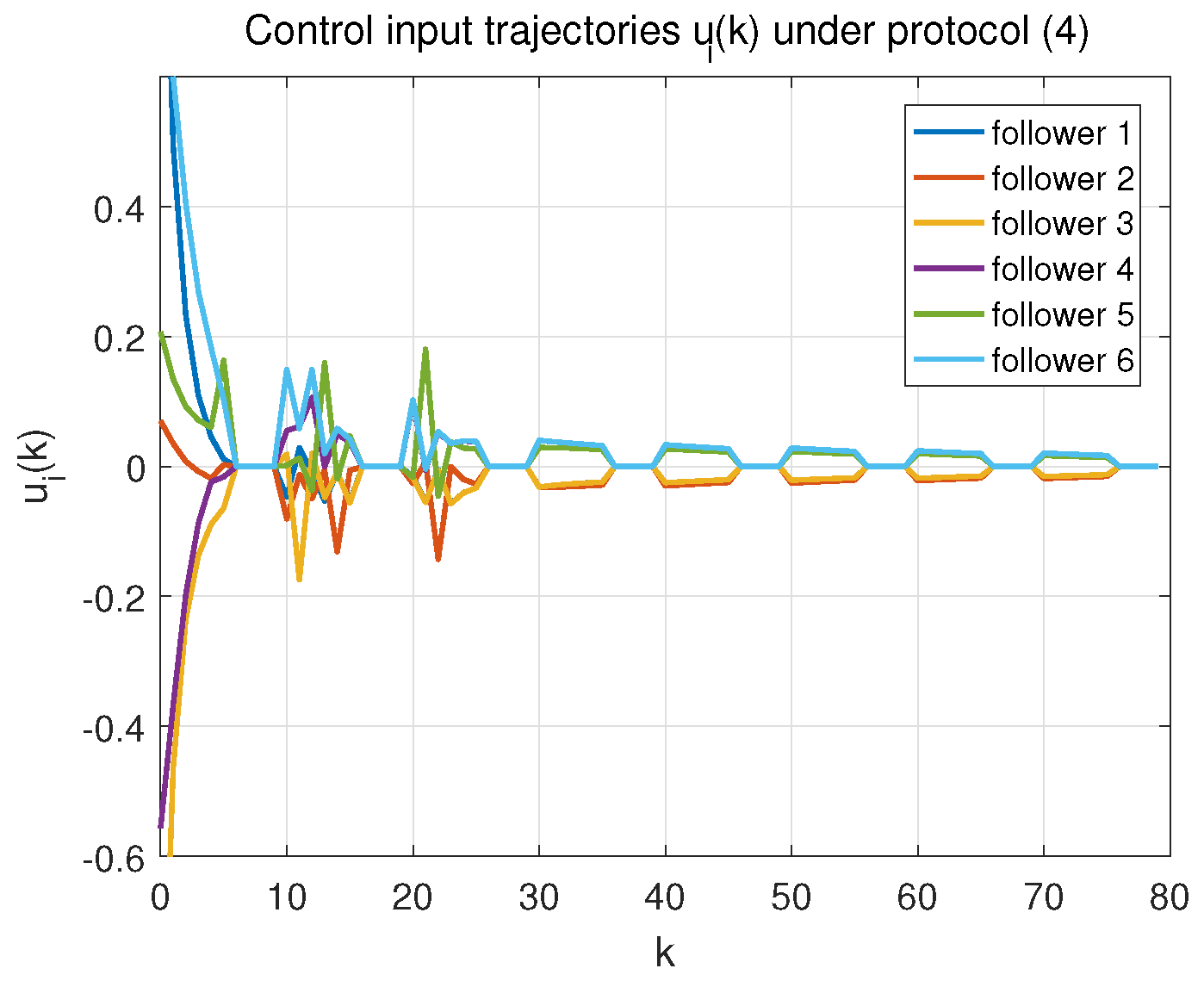
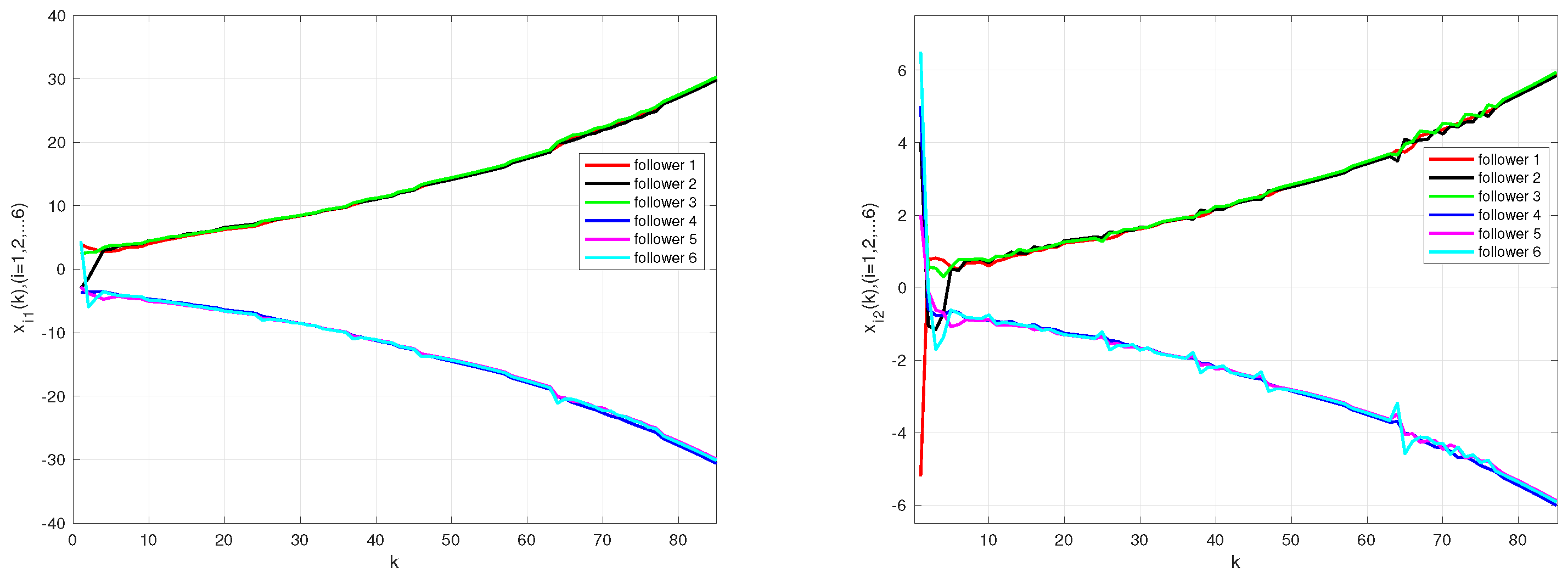
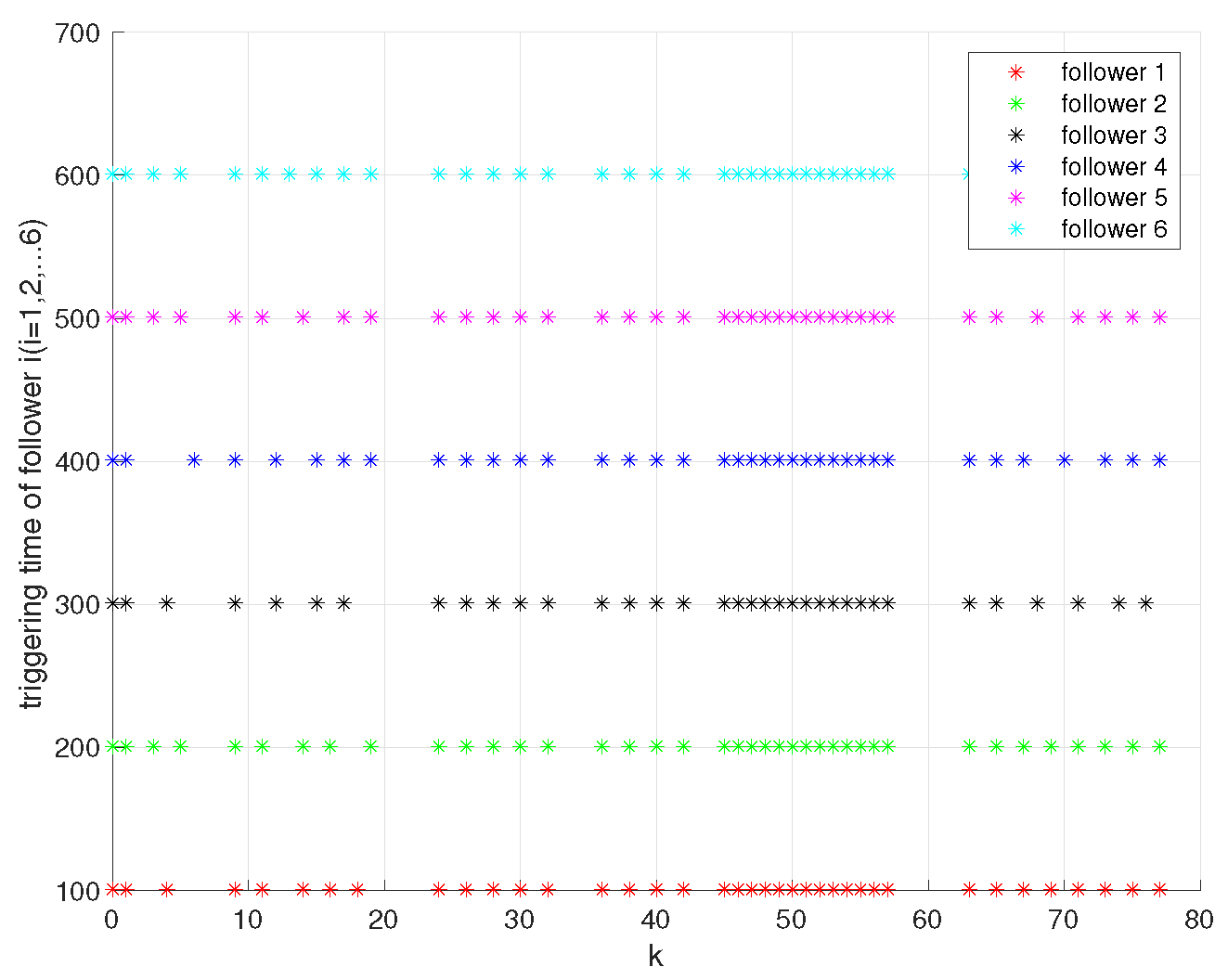
From Figure 2, one can find that bipartite consensus is realised before k = 80 . Figure 3 shows the trajectories of the control u i , i = 1 , , 6 . Figure 4 presents the triggering instants of each agent.
Nevertheless, from Table 2, one can know that the IDETC can cut down the number of triggering times effectively.
Example 2.
Considering the topology within Figure 1, and A, B, C and F can be given as
A = 1 0.1 0.18 0 , B = 1 1.5 ,
C = 1 0.1 0.2 0.5 , F = 1 0.4 0 0.3 ,
which satisfies Assumptions 3 and 4. Meanwhile, A + F C is Schur stable. Let x 1 ( 0 ) = [ 4 ; 5.3 ] , x 2 ( 0 ) = [ 3.1 ; 6.6 ] , x 3 ( 0 ) = [ 5.8 ; 4.2 ] , x 4 ( 0 ) = [ 3.15 ; 3.4 ] , x 5 ( 0 ) = [ 2.4 ; 6.25 ] , x 6 ( 0 ) = [ 5.5 ; 3.3 ] , and x 0 ( 0 ) = [ 4 ; 4.3 ] . Other parameters for (36) with (37) are displayed as ζ = 0.68 , ϑ = 4 , μ = 0.6 , and ε = 16.5 , respectively.
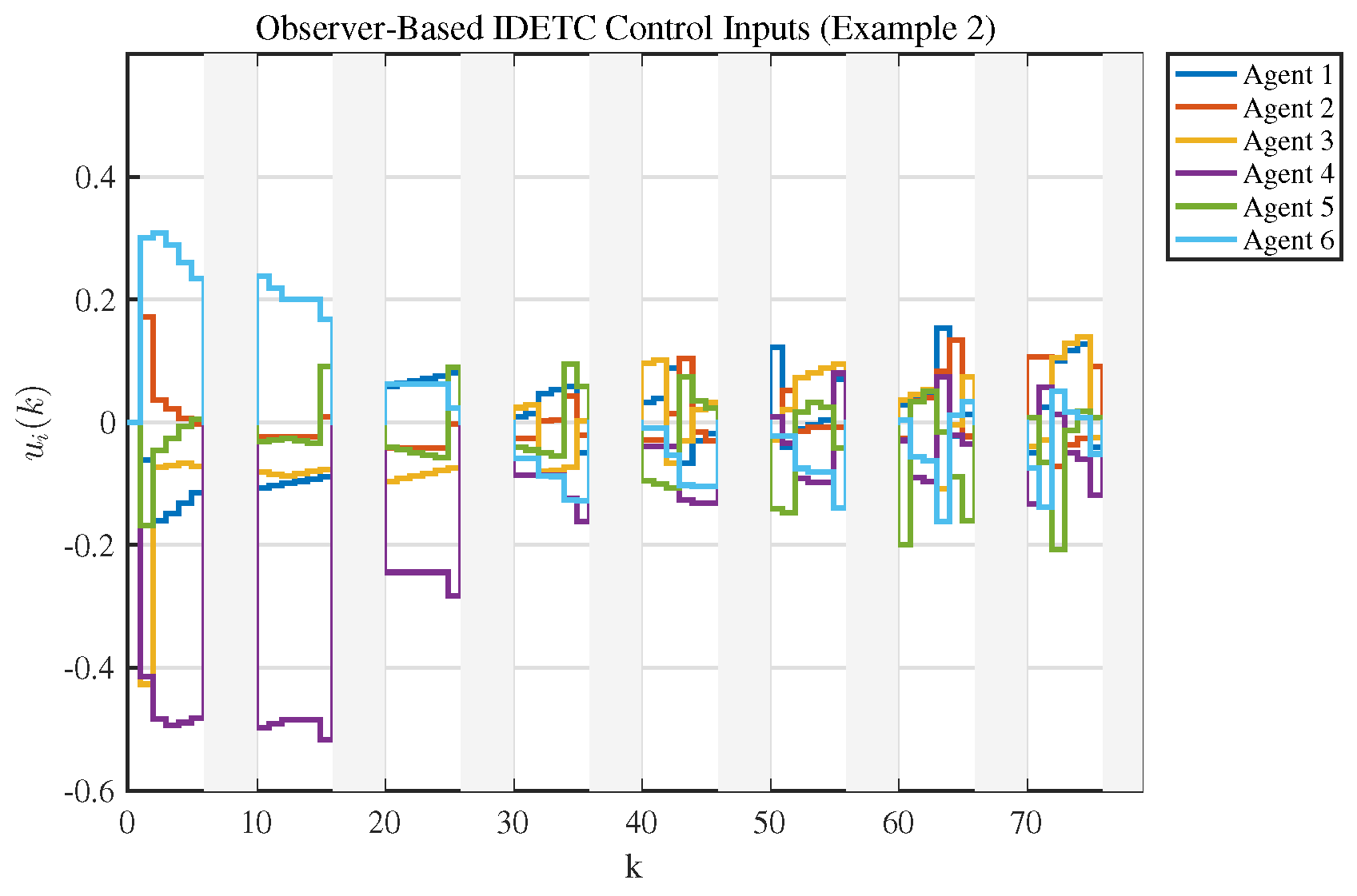
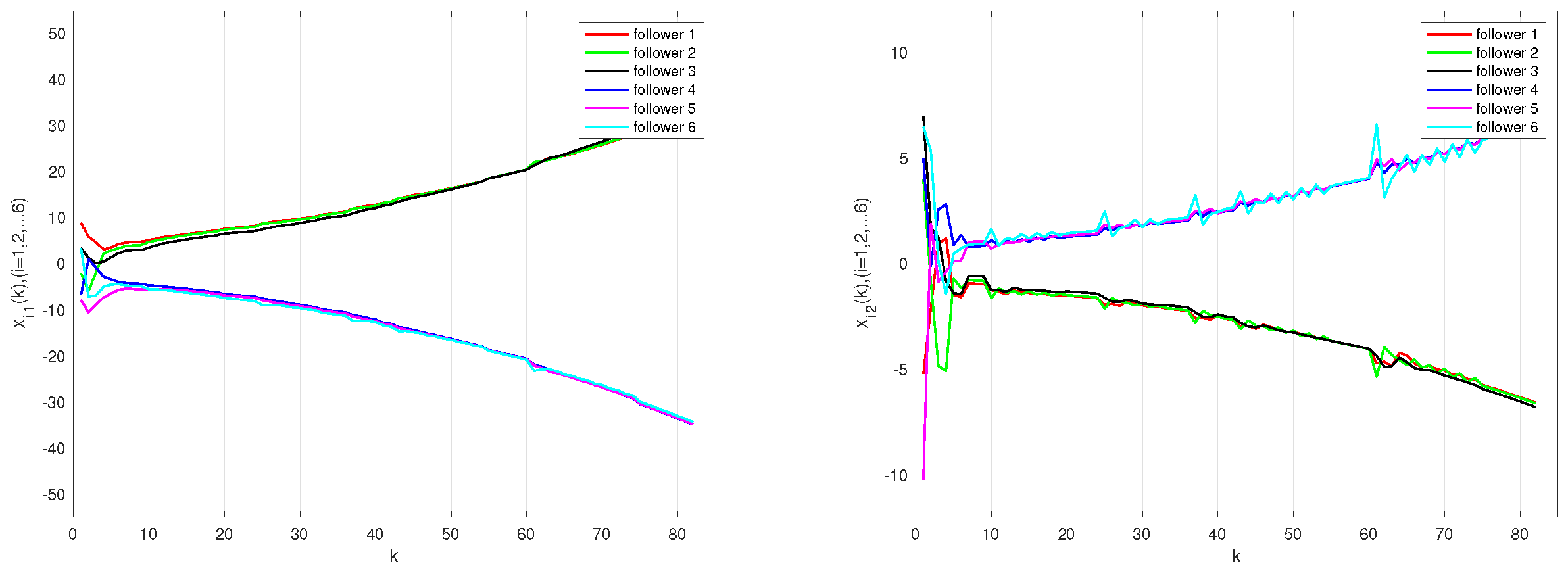
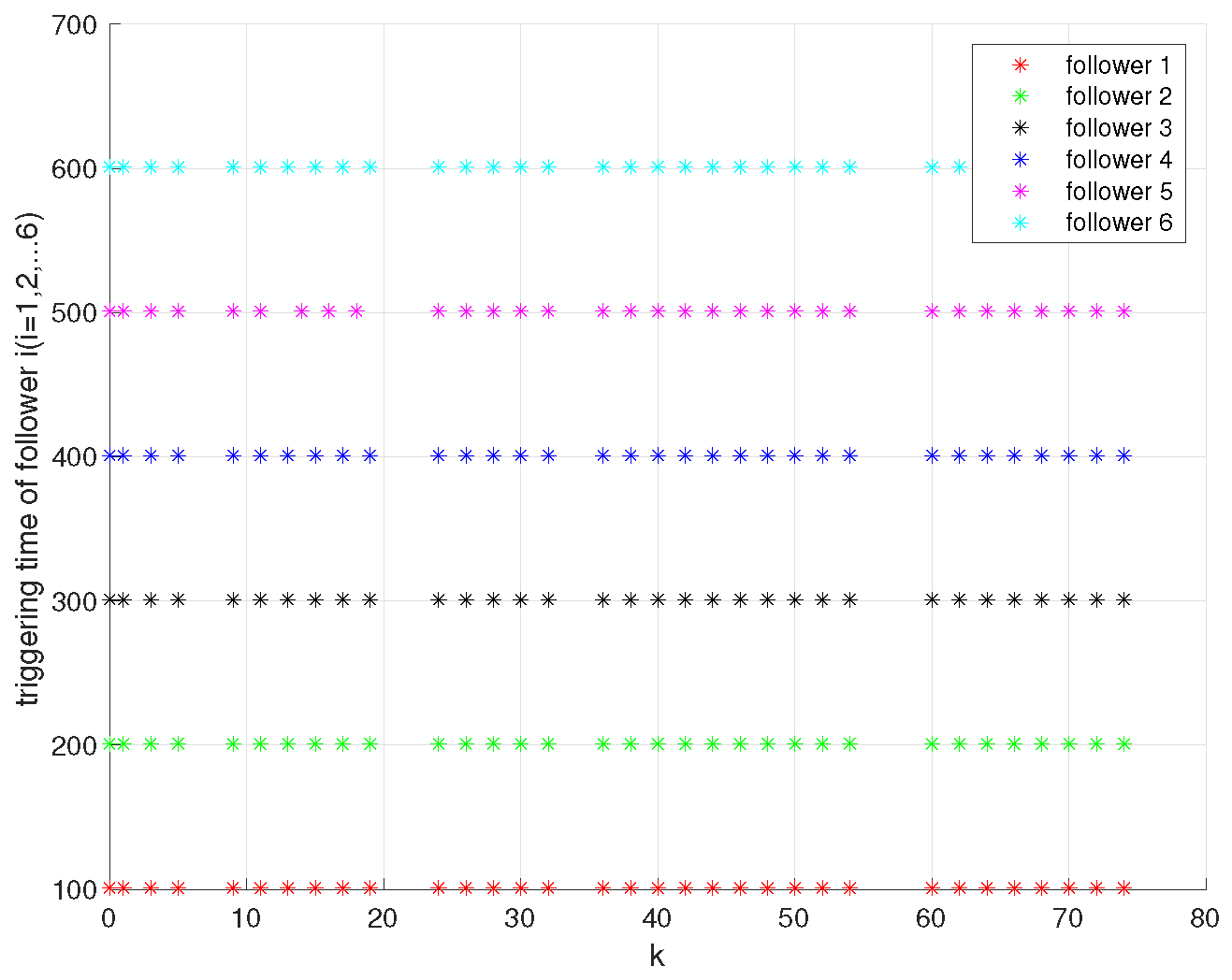
Then, Figure 5 shows the trajectories of control law (35). Figure 6 illustrates trajectories of states of the MAS (1)–(2), in which one can find that the bipartite consensus can be realised before k = 70 . Figure 7 shows the triggering time of each agent under the observer-based IDETC approach.

6. Conclusions

In this paper, the problem of bipartite consensus of DMAS via IDETC is discussed. Firstly, the IDETC mechanism is established and a state feedback protocol is proposed, under which the bipartite consensus is achieved. Additionally, an observer-based IDETC protocol is proposed by the established IDETC mechanism and the corresponding sufficient conditions are derived. The proposed IDETC mechanism can reduce bandwidth usage effectively. However, some limitations in this paper exist. For example, the model is ideal and the memory and computation complexity are not considered in this paper. Future works will investigate the consensus of MAS with time-delay and stochastic noise under IDETC, how to choose the control interval length and how to design the control protocol under directed topology. In addition, optimal bipartite consensus of MAS will be studied by using a tempered fractional gradient descent approach in our future works [35].

Author Contributions

Conceptualization, Methodology, Investigation, and Writing—review and editing, C.L.; Conceptualization, Methodology, and Investigation, C.X. All authors have read and agreed to the published version of the manuscript.

Funding

This research was funded by the National Natural Science Foundation of China under Grant No. 62373143, Key Project of the Department of Education in Hunan Province (21A0366, 22A0406), and the Project of Zhuzhou Double Innovation Excellent Talent (2024-7).

Data Availability Statement

The original contributions presented in this study are included in the article. Further inquiries can be directed to the corresponding author.

Acknowledgments

The authors of the paper acknowledge the support and help of Chengjie Xu and Yuyan Qin.

Conflicts of Interest

The authors declare no conflicts of interest.

References

  1. Ren, W.; Beard, R.W. Consensus seeking in multiagent systems under dynamically changing interaction topologies. IEEE Trans. Autom. Control 2005, 50, 655–661. [Google Scholar] [CrossRef] [Scilit]
  2. Zhang, H.; Zhou, X.; Wang, Z.; Yan, H.; Sun, J. Adaptive consensus-based distributed target tracking with dynamic cluster in sensor networks. IEEE Trans. Cybern. 2019, 49, 1580–1591. [Google Scholar] [PubMed]
  3. Zhao, N.; Zhao, X.; Chen, M.; Zong, G.; Zhang, H. Resilient distributed event-triggered platooning control of connected vehicles under denial-of-service attacks. IEEE Trans. Intell. Transp. Syst. 2023, 24, 6191–6202. [Google Scholar] [CrossRef] [Scilit]
  4. Yan, H.; Han, J.; Zhang, H.; Zhan, X.; Wang, Y. Adaptive event-triggered predictive control for finite time microgrid. IEEE Trans. Circuits Syst. I Regul. Pap. 2020, 67, 1035–1044. [Google Scholar] [CrossRef] [Scilit]
  5. Wang, X.; Wang, X.; Su, H.; James, L. Reduced-order interval observer based consensus for MASs with time-varying interval uncertainties. Automatica 2022, 135, 109989. [Google Scholar]
  6. Xu, C.; Zeng, W.; Liu, C.; Yan, H. Event-triggered semi-global output consensus of discrete-time multi-agent systems with input saturation and external disturbances. IEEE Trans. Circuits Syst. Ii Express Briefs 2023, 70, 4469–4473. [Google Scholar] [CrossRef] [Scilit]
  7. Gao, X.; Chen, C.; Xiang, Z. Consensus for nonlinear multiagent systems via hybrid event-triggered mechanism. IEEE Syst. J. 2024, 18, 2022–2029. [Google Scholar] [CrossRef] [Scilit]
  8. Huang, Y.; Xu, C.; Song, Z.-A.; Zhang, G. Dynamic event-triggered consensus of matrix-weighted linear multiagent systems. IEEE Syst. J. 2025, 19, 975–982. [Google Scholar] [CrossRef] [Scilit]
  9. Altafini, C. Consensus problems on networks with antagonistic interactions. IEEE Trans. Autom. Control 2013, 58, 935–946. [Google Scholar]
  10. Hu, J.; Wu, Y.; Liu, L.; Feng, G. Adaptive bipartite consensus control of high-order multiagent systems on coopetition networks. Int. J. Robust Nonlinear Control 2018, 28, 2868–2886. [Google Scholar]
  11. Wang, H.; Yu, W.; Wen, G.; Chen, G. Finite-time bipartite consensus for multi-agent systems on directed signed networks. IEEE Trans. Circuits Syst. I Regul. Pap. 2018, 65, 4336–4348. [Google Scholar] [CrossRef] [Scilit]
  12. Xu, C.; Xu, H.; Su, H.; Liu, C. Adaptive bipartite consensus of competitive linear multi-agent systems with asynchronous intermittent communication. Int. J. Robust Nonlinear Control 2022, 32, 5120–5140. [Google Scholar] [CrossRef] [Scilit]
  13. Wu, J.; Zhu, Y.; Zheng, Y.; Wang, H. Resilient bipartite consensus of second-order multiagent systems with event-triggered communication. IEEE Syst. J. 2023, 17, 146–153. [Google Scholar]
  14. Zhang, S.; Liu, J.; Wang, W.; Zhang, Z. Bipartite leader-following consensus of nonlinear switched multiagent systems under modeldepended dynamic event-triggered control. IEEE Syst. J. 2024, 18, 1044–1055. [Google Scholar] [CrossRef] [Scilit]
  15. Mu, R.; Wei, A.; Li, H.; Zhang, X.; Qi, Y. Bipartite output consensus for heterogeneous multi-agent systems with observer-based adaptive event-triggered strategy. IEEE Syst. J. 2023, 17, 6011–6021. [Google Scholar]
  16. Tabuada, P. Event-triggered real-time scheduling of stabilizing control tasks. IEEE Trans. Autom. Control 2007, 52, 1680–1685. [Google Scholar] [CrossRef] [Scilit]
  17. Dimarogonas, D.V.; Frazzoli, E.; Johansson, K.H. Distributed event-triggered control for multi-agent systems. IEEE Trans. Autom. Control 2012, 57, 1291–1297. [Google Scholar] [CrossRef] [Scilit]
  18. Fan, Y.; Feng, G.; Wang, Y.; Song, C. Distributed event-triggered control of multi-agent systems with combinational measurements. Automatica 2013, 49, 671–675. [Google Scholar] [CrossRef] [Scilit]
  19. Wu, Z.-G.; Xu, Y.; Pan, Y.-J.; Su, H.; Tang, Y. Event-triggered control for consensus problem in multi-agent systems with quantized relative state measurements and external disturbance. IEEE Trans. Circuits Syst. I Regul. Pap. 2018, 65, 2232–2242. [Google Scholar]
  20. Zhang, H.; Feng, G.; Yan, H.; Chen, Q. Observer-based output feedback event-triggered control for consensus of multi-agent systems. IEEE Trans. Ind. Electron. 2014, 61, 4885–4894. [Google Scholar] [CrossRef] [Scilit]
  21. He, T.; Goh, H.H.; Yew, W.K.; Kurniawan, T.A.; Goh, K.C.; Phan, Q.D.; Wong, S.Y. Enhancingmulti-agent systemcoordination: Fixed-time and event-triggered controlmechanismfor robust distributed consensus. Ain Shams Eng. J. 2024, 15, 103105. [Google Scholar] [CrossRef] [Scilit]
  22. Feizizadeh, A.; Alfi, A.; Keighobadi, J.; Cao, J. Event-based command-filtered consensus control for uncertain nondeterministic multi-agent systems: A FAT-based learning control scheme. Int. J. Dyn. Control 2025, 13, 276. [Google Scholar] [CrossRef] [Scilit]
  23. Girard, A. Dynamic triggering mechanisms for event-triggered control. IEEE Trans. Autom. Control 2015, 60, 1992–1997. [Google Scholar] [CrossRef] [Scilit]
  24. Yi, X.; Liu, K.; Dimarogonas, D.V.; Johansson, K.H. Dynamic event-triggered and self-triggered control for multi-agent systems. IEEE Trans. Autom. Control 2019, 64, 3300–3307. [Google Scholar] [CrossRef] [Scilit]
  25. Xu, W.H.B.; Han, Q.-L.; Qian, F. Adaptive consensus control of linear multiagent systems with dynamic event-triggered strategies. IEEE Trans. Cybern. 2020, 50, 2996–3008. [Google Scholar] [CrossRef] [Scilit]
  26. Du, S.-L.; Liu, T.; Ho, D.W.C. Dynamic event-triggered control for leader-following consensus of multiagent systems. IEEE Trans. Syst. Man Cybern. Syst. 2020, 50, 3243–3251. [Google Scholar]
  27. Liu, D.; Yang, G.-H. A dynamic event-triggered control approach to leader-following consensus for linear multiagent systems. IEEE Trans. Syst. Man Cybern. Syst. 2021, 51, 6271–6279. [Google Scholar] [CrossRef] [Scilit]
  28. Xu, C.; Xu, H.; Guan, Z.-H.; Ge, Y. Observer-based dynamic event-triggered semiglobal bipartite consensus of linear multi-agent systems with input saturation. IEEE Trans. Cybern. 2023, 53, 3139–3152. [Google Scholar] [CrossRef] [Scilit] [PubMed]
  29. Xu, C.; Deng, F.; Guan, Z.-H.; Ge, Y. Dynamic event-triggered fault-tolerant secure bipartite output consensus of multi-agent systems with quantized information and DoS attacks. IEEE Trans. Control Netw. Syst. 2026, 13, 1121–1133. [Google Scholar] [CrossRef] [Scilit]
  30. Chen, J.; Chen, B.; Zeng, Z. Exponential quasi-synchronization of coupled delayed memristive neural networks via intermittent event-triggered control. Neural Netw. 2021, 14, 98–106. [Google Scholar] [CrossRef] [Scilit]
  31. Zhuang, J.; Peng, S.; Wang, Y. Event-triggered intermittent-based impulsive control for stabilization of nonlinear systems. IEEE Trans. Circuits Syst. Ii Express Briefs 2022, 69, 5039–5043. [Google Scholar] [CrossRef] [Scilit]
  32. Liang, H.; Chang, Z.; Ahn, C.K. Hybrid event-triggered intermittent control for nonlinear multi-agent systems. IEEE Trans. Netw. Sci. Eng. 2023, 10, 1975–1983. [Google Scholar] [CrossRef] [Scilit]
  33. Wu, Y.; Sen, B.; Ahn, C.K.; Li, W. Intermittent dynamic event-triggered control for synchronization of stochastic complex networks. IEEE Trans. Circuits Syst. I Regul. Pap. 2021, 68, 2639–2650. [Google Scholar] [CrossRef] [Scilit]
  34. Liu, B.; Liu, T.; Xiao, P. Dynamic event-triggered intermittent control for stabilization of delayed dynamical systems. Automatica 2023, 149, 110847. [Google Scholar] [CrossRef] [Scilit]
  35. Naifar, O. Tempered fractional gradient descent: Theory, algorithms, and robust learning applications. Neural Netw. 2026, 193, 108005. [Google Scholar] [CrossRef] [Scilit] [PubMed]
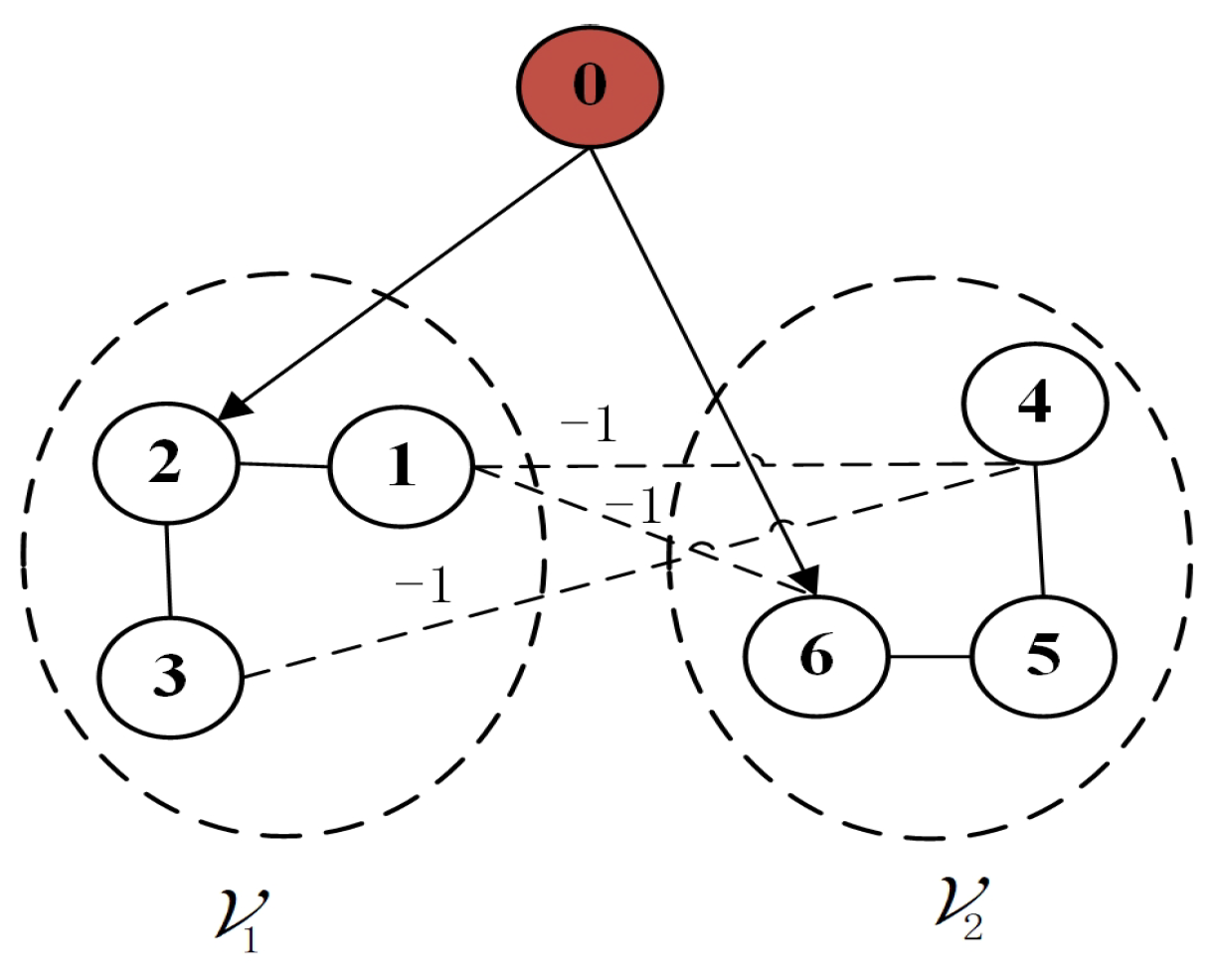
Figure 1. The graph of system communication topology.
Mathematics 14 02411 g001
Figure 2. Trajectories of u i ( t ) in control protocol (4).
Mathematics 14 02411 g002
Figure 3. Trajectories of x i ( t ) for MAS (1)–(2) in Example 1.
Mathematics 14 02411 g003
Figure 4. Triggering instants for the ith follower in Example 1.
Mathematics 14 02411 g004
Figure 5. Trajectories of u i ( t ) in observer-based control protocol (35).
Mathematics 14 02411 g005
Figure 6. Trajectories of x i ( t ) for MAS (1)–(2) in Example 2.
Mathematics 14 02411 g006
Figure 7. Triggering instants for the ith follower in Example 2.
Mathematics 14 02411 g007
Table 1. Design parameters and practical selection.
ParametersRole/FunctionPractical Choice
α The gain determining the convergency rate in (6).Choose ω close to one to reduce the triggering frequency.
κ , ι Weight parameter in (6) can determine the threshold in event function; used to dominate quantization and coupling terms.Select κ > ι to ensure event-triggering threshold to be smaller than 1.
τ 1 , τ 2 τ 1 , τ 2 denote the length of control interval and the length of control-off interval in each period.Choose τ 1 , τ 2 to satisfy the condition in Theorem 1.
QThe solution of algebraic Riccati inequality (3).Q can be obtained directly by solving inequality (3).
Table 2. Numbers of triggering times under control law (4) (IDETC versus DETC).
Agent i123456
0–60 sIDETC192123212323
DETC272732313233
Disclaimer/Publisher’s Note: The statements, opinions and data contained in all publications are solely those of the individual author(s) and contributor(s) and not of MDPI and/or the editor(s). MDPI and/or the editor(s) disclaim responsibility for any injury to people or property resulting from any ideas, methods, instructions or products referred to in the content.