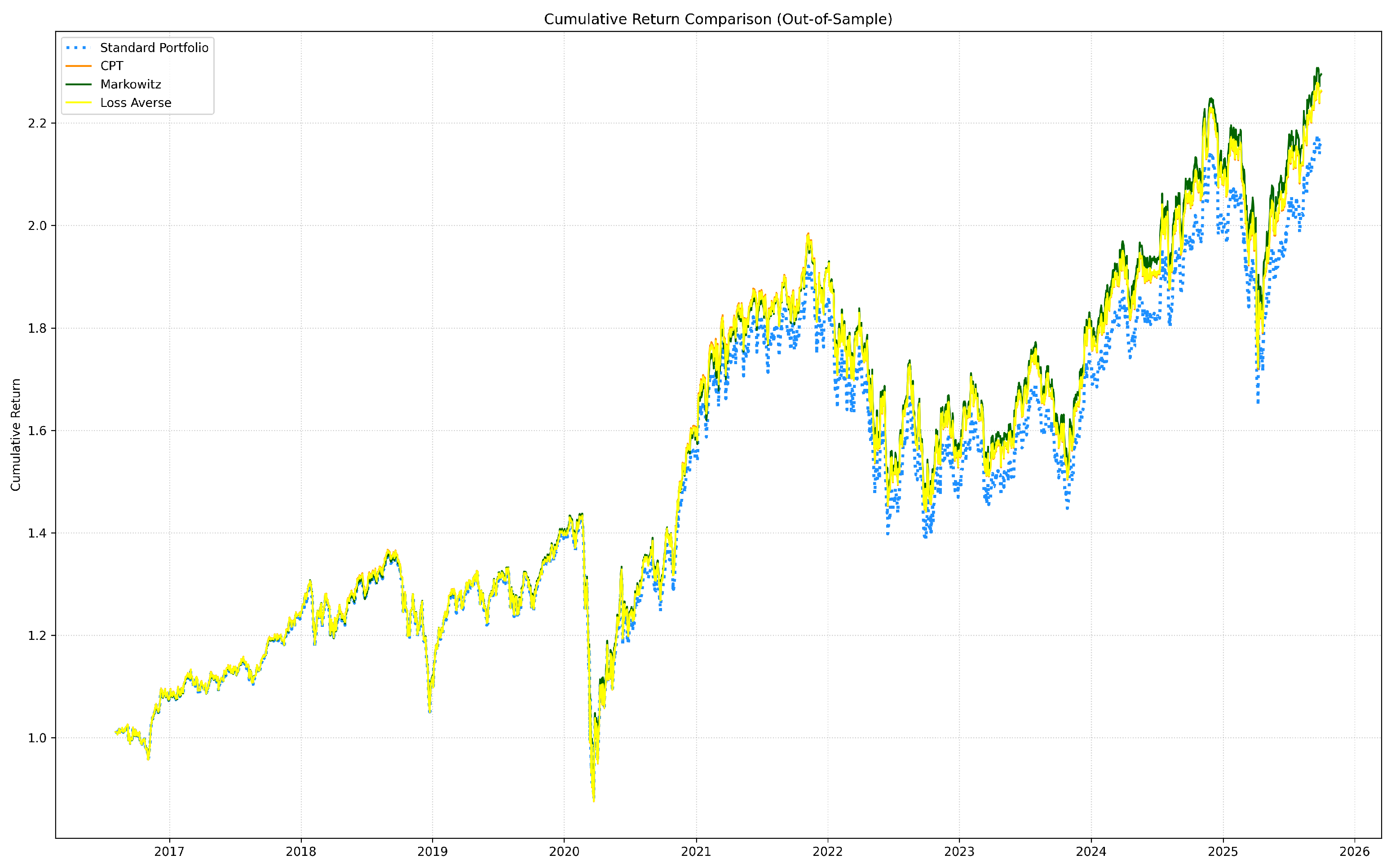
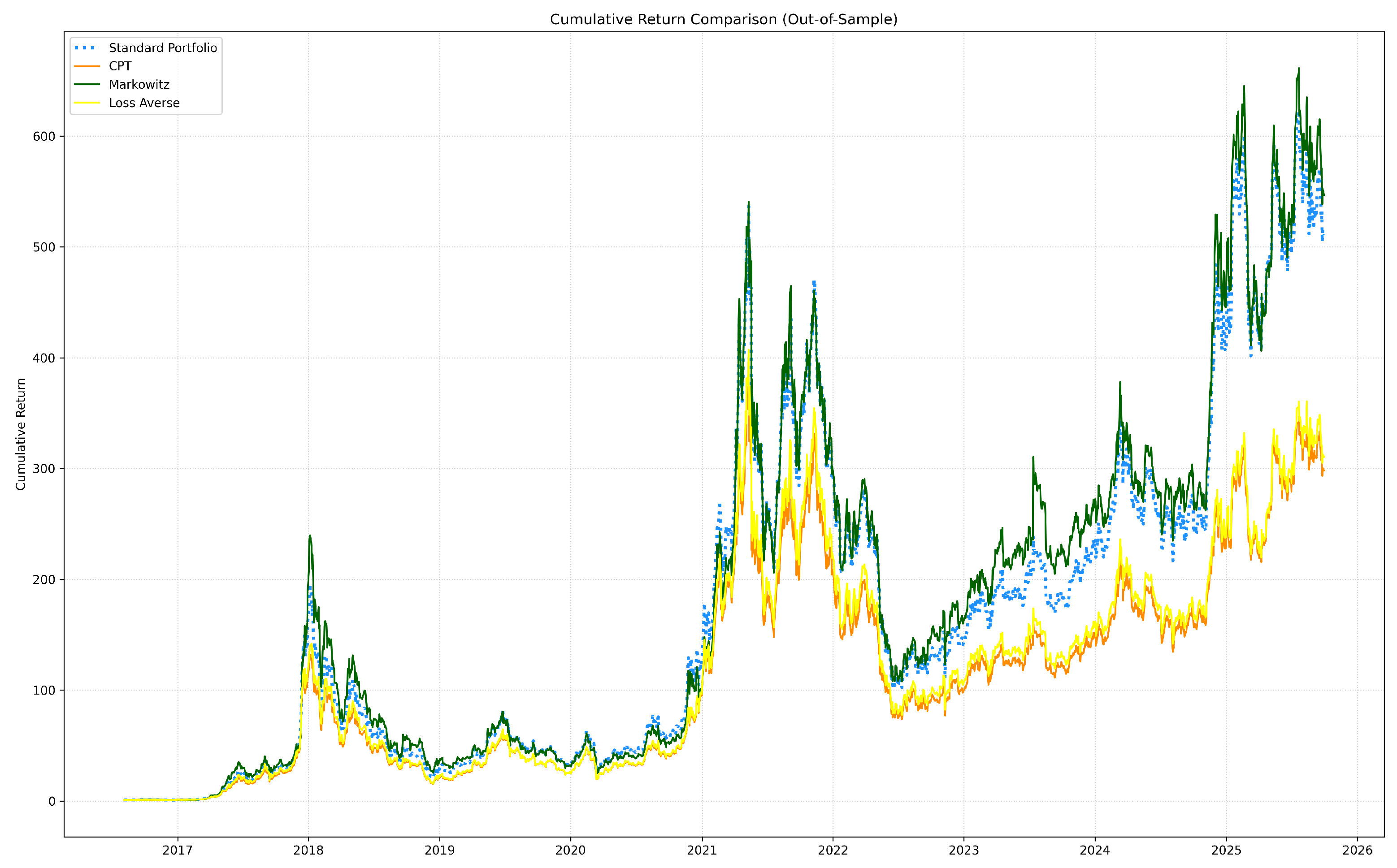
1. Introduction
Modern Portfolio Theory (henceforth MPT), as articulated by economist Harry Markowitz in his seminal papers [
1,
2], provides the foundational framework for rational portfolio construction under uncertainty. By characterizing investors as expected utility maximizers who evaluate assets based on their contributions to portfolio-level mean and variance, MPT establishes normative principles that have guided asset allocation for decades. However, a substantial body of empirical and experimental evidence demonstrates that actual investor behavior deviates systematically from these rational benchmarks. Investors exhibit loss aversion, whereby losses loom larger than equivalent gains [
3]. They display probability weighting, overreacting to tail events while underweighting moderate probabilities [
4], and they engage in mental accounting, evaluating assets in isolated mental accounts rather than as integrated portfolio components [
5,
6].
These behavioral phenomena have profound implications in portfolio choice [
7] because they demonstrate that when investors evaluate returns over short horizons and apply loss aversion to these frequent assessments, they hold substantially less equity than would be optimal under standard expected utility theory. Other scholars [
8] show that investors exhibiting prospect-theoretic preferences demand higher equity premia and display greater sensitivity to past returns [
9], establishing that investors who overweight small probabilities of large gains are attracted to positively skewed securities, potentially explaining observed patterns of stock returns and volatility. In a more recent paper [
10], the authors provide a comprehensive synthesis of how investor psychology affects portfolio decisions, documenting that narrow framing—the tendency to evaluate each investment separately rather than considering the portfolio holistically—leads to suboptimal diversification and excess conservatism in risk-taking.
Despite these theoretical advances, a critical methodological gap remains: existing behavioral portfolio models typically require either (i) parametric optimization under assumed return distributions, which may be sensitive to distributional misspecification [
11,
12], or (ii) complex dynamic programming solutions that are computationally prohibitive for realistic portfolio sizes [
13]. Traditional approaches either impose strong parametric assumptions about return distributions [
14], or require complex optimization procedures that may be sensitive to estimation error [
11]. Furthermore, the narrow framing dimension—evaluating assets individually before portfolio aggregation—has been theoretically analyzed but not operationalized in practical portfolio construction. Our DVT framework addresses this gap by providing a non-parametric, machine learning-based methodology that naturally incorporates narrow framing through the segregation structure and quantifies behavioral asset importance without distributional assumptions. Furthermore, most behavioral portfolio models focus on the value function or probability weighting in isolation, without fully integrating the narrow framing dimension that experimental evidence suggests is pervasive in actual decision-making [
15].
This paper addresses these gaps by developing a machine learning-based methodology that operationalizes behavioral distortions in portfolio construction through what we term Distorted Value Transformation (DVT). Our approach is grounded in the behavioral finance principle of segregation, wherein investors perceive and evaluate each asset’s returns through a behavioral lens before aggregating these evaluations. Formally, we model investors who apply persona-specific non-linear transformations
to individual asset returns
and then form perceptions of portfolio value by averaging these transformed values:
. This segregation approach contrasts with integration, where investors would first aggregate returns into a portfolio outcome and then apply behavioral evaluations:
. The distinction is economically significant: segregation and integration yield different perceived values, with segregation reflecting the mental accounting bias documented by [
5] and the narrow framing behavior analyzed by [
16].
We implement DVT using RF regression, a non-parametric machine learning algorithm that captures complex, non-linear relationships between asset returns and portfolio outcomes without imposing distributional assumptions [
17]. For each investor persona
p, we train a RF to learn from the behavioral target
from the vector of transformed individual asset returns. The algorithm’s variable importance (VI) measures, computed via Mean Decrease in Impurity (MDI), quantify each asset’s contribution to explaining variance in the behavioral target. These VI scores naturally reflect the behavioral distortions embedded in the transformation: assets that contribute to periods of high behavioral disutility (e.g., volatile assets under loss aversion) will exhibit different importance rankings than under undistorted returns. By normalizing VI scores into portfolio weights, we construct portfolios that align with how behaviorally biased investors perceive asset significance.
Our empirical analysis examines three distinct investor personae. The Cumulative Prospect Theory (CPT) investor exhibits both loss aversion and diminishing sensitivity, consistent with the original parameterization of Tversky and Kahneman [
4], with no probability weighting being applied as discussed below. The Loss-Averse (LA) investor displays pure loss aversion without curvature (
), reflecting asymmetric weighting of gains and losses as in Benartzi and Thaler [
7]. Last but not least, the [
1] investor persona, and also following [
18], possesses an inverse S-shaped value function where (
), capturing risk-seeking behavior in the domain of small gains and losses, perfectly suited for financial returns. These three personas span a range of behavioral profiles observed in experimental and field settings.
We apply our methodology to a portfolio of ten assets comprising traditional financial instruments—equity indices (S&P 500, Russell2000), fixed income (US Aggregate Bonds), cash equivalents, and equity factors—alongside the four largest cryptoassets by market capitalization (BTC, Ethereum, XRP, Litecoin). The sample period spans from August 2015 to September 2025, encompassing multiple market regimes including the 2017–2018 cryptoassets’ boom and crash, the COVID-19 pandemic, and the recent maturation of digital asset markets. This setting provides an ideal lab for studying behavioral portfolio choice, as cryptoassets exhibit extreme volatility, positive skewness, and lottery-like return characteristics that should differentially appeal to investors with varying behavioral biases [
19,
20].
The performance implications of these behavioral allocations are nuanced. Behaviorally constructed portfolios exhibit significantly lower volatility and shallower drawdowns than their undistorted counterparts, consistent with the risk-mitigating effects of reducing volatile asset exposure. However, this stability comes at the cost of lower cumulative returns during bull markets, as behaviorally biased investors systematically underweight high-growth assets. Sharpe ratio comparisons reveal that in certain market environments—particularly during periods of sustained cryptoasset appreciation—the behavioral bias towards stability proves costly, while in others—such as during the 2022 cryptoassets’ winter—the conservative positioning proves beneficial. Out-of-sample tests using rolling windows confirm that these patterns are robust and not artifacts of in-sample overfitting.
Our primary contribution is methodological: we provide a tractable, non-parametric framework that operationalizes behavioral distortions in portfolio construction. The empirical analysis across traditional and digital assets serves to validate this methodology by demonstrating that (i) the framework produces economically interpretable reallocations consistent with behavioral theory, and (ii) these reallocations exhibit meaningful out-of-sample persistence. We do not claim that behaviorally weighted portfolios are superior investment strategies; rather, we demonstrate that behavioral biases can be systematically modeled and their portfolio implications quantified.
Thus, this paper addresses the following research question: How do behavioral distortions—specifically loss aversion, diminishing sensitivity, and narrow framing—systematically alter investors’ perception of asset importance, and how can these distorted perceptions be operationalized through machine learning to construct behaviorally consistent portfolios? We answer this by developing the Distorted Value Transformation (DVT) framework, wherein behavioral transformations applied to individual asset returns before aggregation (segregation) generate persona-specific targets, and Random Forest variable importance measures translate these distorted perceptions into portfolio weights.
2. Theoretical Framework and Methodology
2.1. Distorted Value Transformation: Behavioral Perception and Narrow Framing
The DVT methodology builds on the fundamental insight from behavioral economics that investors’ perceptions of return distributions can deviate systematically from objective reality due to cognitive biases [
3,
4]. While classical finance assumes that agents evaluate portfolios using concave utility functions applied to actual return distributions, behavioral finance recognizes that psychological phenomena—including loss aversion, probability weighting, and reference dependence—systematically warp how investors perceive and process financial outcomes.
We formalize this distinction by positing that each investor persona
p transforms the objective return vector
for the
K available assets at time
t into a vector of perceived or distorted values
, where
, is a persona-specific value function capturing behavioral biases. Critically, the transformation is applied to each asset’s return individually before any aggregation occurs. The investor then forms a perception of overall portfolio value by computing the simple average (thus segregating) of these distorted individual values:
The choice of simple averaging in Equation (
1) reflects the theoretical assumption that narrowly framed investors treat each asset as a separate mental account of equal psychological salience prior to any portfolio-level evaluation. This specification follows Thaler [
5,
6], who documents that mental accounts are typically evaluated independently before aggregation, and Barberis et.al. [
10,
16], who model narrow framing as treating each gamble as a separate evaluation object. Alternative aggregation schemes—such as value-weighted or attention-weighted averaging—would introduce additional assumptions about differential salience that, while potentially realistic, would conflate narrow framing effects with attention allocation effects. We deliberately adopt equal weighting to isolate the pure narrow framing mechanism: the behavioral distortion arises entirely from applying
before aggregation, not from differential weighting across accounts. Future research could extend this framework by incorporating attention-weighted aggregation based on factors such as asset prominence, trading frequency, or recency of returns.
Experimental evidence demonstrates that individuals often fail to fully integrate risks across accounts, instead evaluating each account’s performance separately and then aggregating these separate evaluations [
15]. This behavior contrasts sharply with normative expected utility theory, which prescribes that agents should evaluate the distribution of total wealth or total portfolio returns.
To clarify the economic significance of Equation (
1), consider the alternative approach of integration (or broad framing), wherein the investor first computes the portfolio return
and then applies the behavioral transformation:
Because the value function
exhibits curvature (convexity or concavity in different regions of gains and losses), as well as asymmetry (different weighting of gains versus losses), the order of operations matters significantly. Specifically, for any non-affine
, we have
, in general. The segregation approach in Equation (
1) leads investors to overlook diversification benefits: even when individual asset losses are offset by other assets’ gains at the portfolio level (yielding
), the investor applying
before aggregation perceives negative value if loss aversion causes
to exceed
for offsetting returns. This diversification myopia is precisely the pattern documented in behavioral studies, showing that narrowly framed investors hold inefficiently conservative portfolios [
7,
21].
This specific DVT framework thus captures two interrelated behavioral biases. First, the shape and parameters of encode domain-specific bias such as loss aversion and diminishing sensitivity. Second, the application of at the individual asset level before averaging encodes the narrow framing bias, reflecting mental accounting and the failure to integrate portfolio-level hedging. Together, these features allow us to model investors who perceive asset importance, through a distorted lens shaped by their psychological biases.
This modeling choice is consistent with the interpretation that behavioral biases arise in the perception and framing stage, but that any subsequent optimization remains coherent ([
8,
22]; among others). By distorting the inputs rather than the decision rule, we preserve the mathematical structure necessary for meaningful portfolio comparison and ensure that our results do not conflate irrational preferences with irrational perceptions.
2.2. Investor Personae and Value Functions
We examine three distinct investor personae, each characterized by a specific form of the value function
:
where
is the characteristic function,
govern the curvature in the gain and loss domains, respectively, and
is the loss aversion coefficient. These personae span a range of behavioral profiles documented in experimental and empirical studies, allowing us to assess how different cognitive biases shape portfolio allocation. We adopt canonical parameter values to facilitate comparison with the behavioral finance literature. Sensitivity analysis to parameter variation and/or estimation lies beyond the scope of this work.
2.2.1. Cumulative Prospect Theory (CPT) Investor
The CPT investor adheres to the value function, proposed by [
4] in their seminal formalization of Cumulative Prospect Theory. This value function exhibits two key properties: loss aversion and diminishing sensitivity. Loss aversion captures the empirical regularity that individuals experience losses more intensely than gains of equal magnitude, while diminishing sensitivity implies that the marginal value of outcomes decreases as they move away from a reference point (typically taken as zero return). Thus, the standard CPT value function can be obtained via Equation (
3) if
and
.
The economic interpretation of these parameters is straightforward. The exponent
renders the value function concave for gains, implying risk aversion in the domain of positive returns. Symmetrically,
renders the function convex for losses, implying risk-seeking behavior in the loss domain. The loss aversion parameter
scales losses by reflecting the asymmetric psychological impact of negative outcomes. Together, these features produce the characteristic S-shaped value function central to Prospect Theory [
3].
It is important to note that, despite being extensively described in the related papers, we do not incorporate the probability weighting function, as each historical observation represents a realized outcome (objective probability = 1), not a prospective gamble with uncertain probabilities. Future research could explore decision-weight-based sample weighting to model availability bias. These extensions could incorporate CPT’s probability weighting function to model salience effects, where extreme outcomes (particularly losses) are over-weighted in the investor’s memory, analogous to the availability heuristic. This could be implemented through rank-dependent sample weights during RF training, left for future consideration.
2.2.2. Loss-Averse Investor
The LA investor represents a simplified variant of prospect-theoretic preferences, isolating loss aversion while eliminating diminishing sensitivity. This persona is motivated by models such as in Benartzi and Thaler [
7], who demonstrate that loss aversion alone—without probability weighting or curvature—suffices to explain a range of puzzling investor behaviors, including the equity premium puzzle and insufficient diversification. The LA value function can be obtained via Equation (
3) if
and
.
This function is piecewise linear, exhibiting a kink at the origin but no curvature. The interpretation is that the investor weighs losses times more heavily than gains but evaluates marginal changes in outcomes linearly within each domain. This persona is particularly useful for isolating the role of asymmetric weighting independent of risk attitudes and for comparing with the full CPT framework to assess whether curvature materially affects portfolio allocations.
2.2.3. Markowitz Investor
We follow the work of Markowitz [
1,
2], who argued that the utility function of Friedman and Savage [
18] must have convex and concave segments near the point of origin. In this regard, an inverse S-shaped value function emerges where the curvature changes at the point of origin, which separates gains from losses. This type of investor is averting losses in the losses domain and seeking risk in the gains domain. Investors employ a reverse S-shaped value function when it comes to betting whose outcomes are moderate and not too extreme. Under this context, no loss aversion coefficient is applied. The Markowitz value function can be obtained via Equation (
3) if
and
.
This quadratic form reflects risk-seeking preferences that might explain willingness to purchase positively skewed securities or lottery-like gambles. Similarly, for small losses, the concave form implies risk aversion. This persona serves as a contrasting benchmark to CPT and LA, illustrating how inverse curvature alters portfolio implications.
2.3. RF Regression
Having defined the behavioral transformations that generate persona-specific targets
, we now describe how these targets are used in conjunction with machine learning to quantify asset importance and derive portfolio weights. Our approach leverages RF (RF) regression [
17], a non-parametric ensemble learning method well suited to capturing complex, non-linear relationships between predictor variables (behaviorally distorted asset returns in our case) and a continuous target variable (behavioral value).
2.3.1. RF Algorithm
A RF is an ensemble of decision trees, each trained on a bootstrap sample of the data and using a random subset of features at each split. For a given persona
p, we construct the training dataset as follows. Let
denote the matrix of raw asset returns, where row
contains the vector
, and let
denote the vector of behavioral targets, where element
t is
as defined in Equation (
1). The objective is to learn the mapping
.
Each tree in the forest is constructed recursively by binary splitting. At each node
m containing a subset of observations
, the algorithm selects randomly a feature
and a threshold
to partition
into left and right child nodes
and
. The split is chosen to maximize the reduction in impurity, measured by the variance of the target within the node. Formally, the impurity at node
m is
where
is the number of observations in node
m and
is the mean target value in the node. The decrease in impurity from splitting node
m on feature
i at threshold
is
where
and
are the sizes of the left and right child nodes, and
and
are their respective impurities. The optimal split maximizes
over all candidate features and thresholds.
This recursive partitioning continues until a stopping criterion is met (e.g., minimum node size or maximum tree depth). The RF prediction for a new observation is the average of predictions across all trees in the ensemble, which smooths individual tree predictions and reduces overfitting. Another important element of the RF method is that the tree creating the “forest” does not need standardization, thus making the method scale-invariant. Variance is reduced through bootstrap aggregating (bagging).
2.3.2. Variable Importance via Mean Decrease in Impurity
The key output of the RF for our purposes is the variable importance (VI) measure for each asset. Variable importance quantifies the contribution of each feature (behariorally distorted asset return
) to the predictive accuracy of the model. We employ the Mean Decrease in Impurity (MDI) measure, also known as Gini importance, which aggregates the total reduction in variance achieved by splits on a given feature across all trees in the forest [
17,
23].
Formally, let
denote the set of trees in the forest, and for each tree
, let
denote the set of internal nodes (i.e., nodes that are split). For each node
, where a split on feature
i occurs, we compute the impurity decrease
as in Equation (
5). The importance of feature
i in tree
is the sum of impurity decreases from all splits on feature
i:
The overall variable importance for feature
i across the entire forest is the average of
over all trees:
The interpretation of is that it measures the average behavioral contribution of asset i to reducing prediction error (variance) in the behavioral target across the forest. Assets with high VI scores are those whose return patterns are most informative for explaining the investor’s perceived portfolio value under persona p. Crucially, because the target incorporates the behavioral distortion applied to individual returns, the VI scores reflect not just the asset’s volatility or correlation with portfolio returns but also its behavioral significance—how much it drives the variance in the investor’s distorted perception of value.
2.3.3. Variable Importance Selection and Methodological Justification
Our methodology employs Mean Decrease in Impurity (MDI) as the variable importance metric and Random Forest (RF) as the learning algorithm. These choices are grounded in both statistical considerations and alignment with the behavioral framework’s theoretical foundations.
Why Random Forest
We employ RF regression for several reasons grounded in the nature of our research question. First, our objective is not to maximize predictive accuracy or forecast future returns, but rather to extract variable importance measures that quantify each asset’s contribution to explaining variance in behaviorally transformed portfolio values. RF’s MDI criterion provides a transparent, well-established measure of feature importance based on variance reduction [
17,
23], which naturally aligns with this goal. Second, RFs exhibit robustness to overfitting through bootstrap aggregation of independent trees, yielding stable importance estimates that are less sensitive to sample perturbations than sequential boosting methods [
24]. Third, the interpretation of RF variable importance as cumulative variance reduction across trees is straightforward and has been extensively validated in academic applications [
12,
25,
26].
Alternative ensemble methods such as Gradient Boosting or XGBoost could potentially yield higher predictive accuracy, but such improvements are immaterial to our research design. Moreover, Gradient Boosting’s sequential tree construction—wherein each tree corrects previous errors—introduces dependencies that complicate importance interpretation and can reduce estimate stability [
27]. Since our objective is robust importance extraction rather than maximizing predictive accuracy, RF’s bagging framework is better aligned with this goal. Introducing multiple algorithms would risk conflating behavioral effects with algorithmic artifacts and would obscure our core contribution, which lies in the behavioral framework rather than machine learning methodology.
Why MDI as the Importance Metric
Financial time series, specifically asset returns, are continuous variables characterized by high-cardinality values. The RF algorithm inherently handles such features by optimally searching for variance-reducing split points across the feature range. While MDI is known to exhibit a preference bias toward high-cardinality continuous features relative to Permutation Importance (PI), we deliberately select MDI because its focus on local impurity reduction aligns precisely with the DVT framework’s segregation approach.
Specifically, just as investors evaluate each asset’s contribution to perceived value before aggregation, MDI quantifies each asset’s contribution to variance reduction at the moment of split, prior to averaging across trees. This localized measurement captures the extent to which an asset’s returns contribute to fluctuations in the investor’s perceived portfolio value—measured by the behaviorally transformed target —rather than its objective return. Because the DVT approach interprets portfolio weighting as a reflection of cognitive salience—how strongly each asset influences subjective utility through the lens of narrow framing—MDI’s split-point variance decomposition provides a conceptually consistent framework for translating behavioral distortions into portfolio weights.
Alternative measures offer complementary perspectives: PI emphasizes global predictive dependence through out-of-sample shuffling, while SHAP values [
28] decompose predictions into marginal contributions based on cooperative game theory. While these metrics provide valuable insights, MDI’s direct focus on local variance structure at the point where the tree partitions observations based on behavioral disutility offers a more immediate analog to the investor’s segregated evaluation process. Moreover, MDI- and SHAP-based measures typically exhibit high correlation in tree ensemble applications [
29], suggesting that our qualitative conclusions are unlikely to be sensitive to this methodological choice. Moreover, MDI- and SHAP-based measures typically exhibit high correlation in tree ensemble applications [
29], suggesting that our qualitative conclusions are unlikely to be sensitive to this methodological choice (see
Appendix A for robustness checks confirming high rank correlations between MDI, PI, and SHAP in our model). Consequently, MDI provides a theoretically defensible and computationally stable measure of behavioral significance, well suited to deriving economically interpretable portfolio weights that reflect distorted perception.
2.3.4. Portfolio Weight Construction
Given the variable importance scores
for persona
p, we construct portfolio weights by normalizing these scores to sum to unity:
These weights define the behavioral portfolio for persona p. The rationale for this weighting scheme is that it allocates capital in proportion to each asset’s importance in explaining the investor’s behavioral experience. Assets that are highly predictive of behavioral value—whether due to high volatility, strong correlation with other assets, or specific return patterns that interact with the non-linearity of —receive higher allocations. Conversely, assets whose returns are uninformative for predicting receive lower weights.
For comparison, we construct a baseline or standard portfolio using the same RF methodology but without behavioral distortion. Specifically, we define the standard target as the simple average of raw returns:
training a RF to learn from
and extract variable importances
. The standard portfolio weights are then
Comparing with reveals how behavioral distortions alter perceived asset importance. Additionally, we consider the naive or equally weighted benchmark portfolio with for all i, which serves as a mechanical baseline requiring no estimation or modeling.
2.3.5. RF Hyperparameter Selection
To ensure that the resulting portfolio weights are robust and derived from generalized patterns rather than transient noise, the RF Regressor was configured with conservative hyperparameters designed for the low signal-to-noise ratio inherent in financial time-series data.
Table 1 summarizes the configuration for in-sample and out-of-sample analyses.
The high number of trees maximizes variance reduction through aggregation. Model complexity is strictly controlled by capping tree depth and enforcing aggressive regularization in terminal nodes: requiring a minimum of 20 samples per leaf ensures every final prediction is an average of at least 0.78% of the 2580 daily observations, facilitating strong local averaging that smooths high-frequency noise. The selection of max_features = (approximately 3 features) enforces de-correlation between trees, and sub-sampling via max_samples ensures training diversity. The reduced complexity for out-of-sample analysis (fewer trees, shallower depth) reflects computational efficiency requirements for rolling window estimation across 1580 iterations.
While hyperparameter tuning via Grid Search or Randomized Search adds rigor, it is computationally prohibitive for our rolling window methodology. Given the critical need for stable importance estimates in a low signal-to-noise environment, this defensible configuration—focused on strong regularization of key parameters governing tree growth and data support—provides a conservative starting point that mitigates the primary risk of overfitting inherent in time-series modeling.
2.4. Interpretation and Economic Intuition
The DVT-based portfolio construction method (
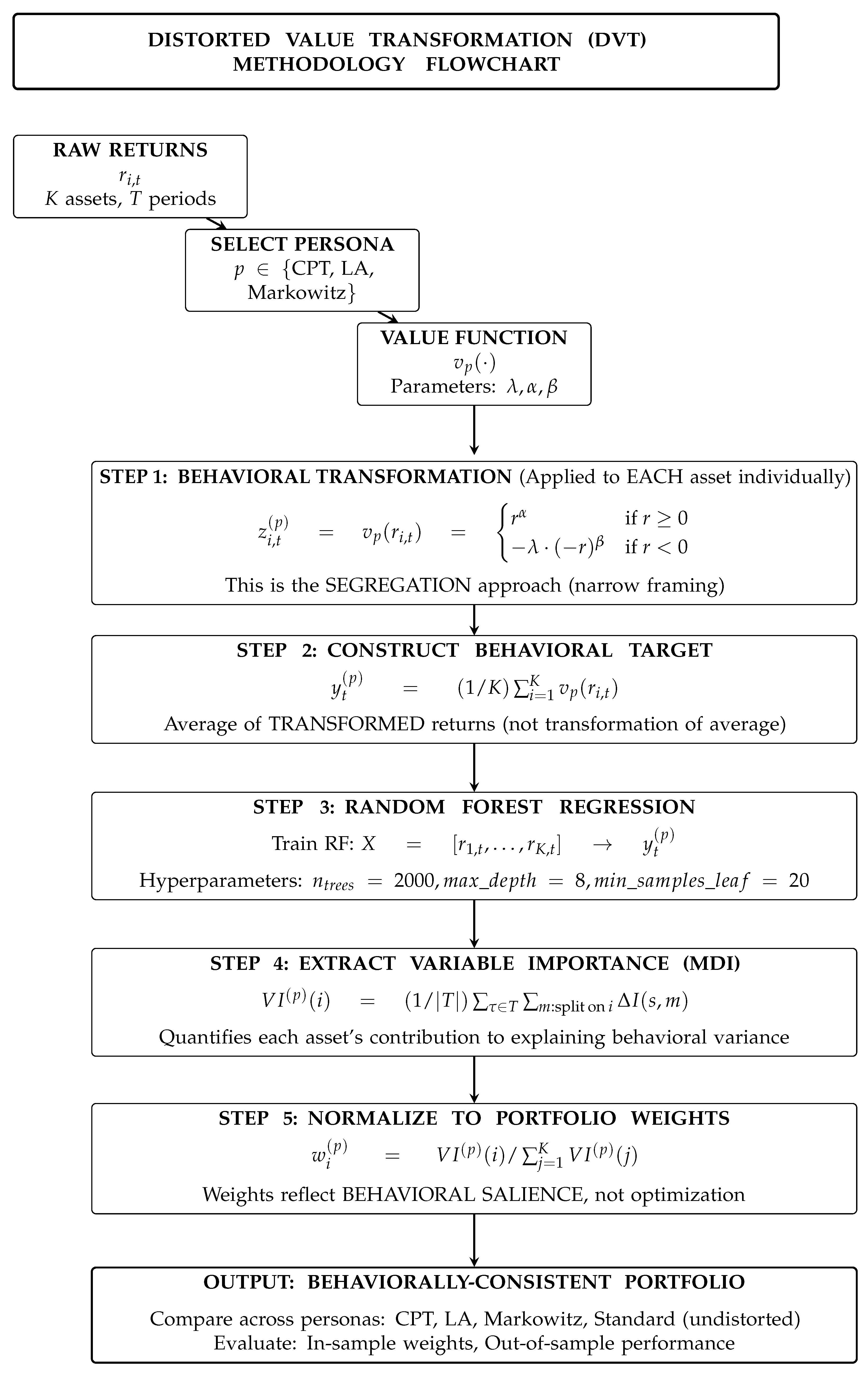
Figure 1) encapsulates the behavioral insight that investors’ allocation decisions are driven by their subjective perceptions of asset characteristics, which may deviate from objective measures due to cognitive biases. By training a RF on behaviorally transformed targets, we effectively model the mental process by which a narrow-framing investor assesses which assets are “important” or “risky” in their distorted frame of reference. The resulting VI-based weights do not purport to maximize any objective function such as Sharpe ratio or expected utility; rather, they describe how a behavioral investor, perceiving returns through the lens of
and aggregating via narrow framing, would allocate capital based on historical patterns of perceived value.
Several features of this approach merit emphasis. First, the methodology is agnostic to distributional assumptions. Unlike mean–variance optimization, which assumes returns are normally distributed (or at least that only the first two moments matter), the RF framework makes no parametric assumptions and can capture complex, non-linear relationships including tail behavior and higher-order interactions. This is particularly valuable in the context of cryptoassets, which exhibit non-normal distributions with heavy tails and extreme skewness.
Second, the segregation (narrow framing) inherent in our target construction has direct portfolio implications. Because we apply to individual returns before averaging, the perceived value can be substantially negative even when the actual portfolio return is near zero, provided that some individual assets experienced losses. This asymmetry arises from loss aversion: if asset A gains 10% and asset B loses 10%, the integrated portfolio return is 0%, but the segregated perceived value is negative because exceeds when . The RF trained on this target learns that volatile assets—which frequently appear in observations with large values—are important contributors to behavioral variance, but the direction and curvature of determines whether this importance translates into high or low portfolio weights. For LA investors, volatile assets may be penalized because their importance stems from generating negative perceived value during loss periods.
The target should be interpreted as the investor’s net psychological utility from portfolio returns on day t, evaluated through narrow framing. Positive values indicate days where the behavioral investor perceives net gains; negative values indicate days dominated by loss experiences. Critically, the variance of captures the volatility of the investor’s psychological experience—assets with high variable importance are those whose returns most strongly influence whether the investor has a ‘good’ or ‘bad’ day in utility terms, not necessarily in financial terms.
Third, by comparing portfolios across personae—CPT, LA, and Markowitz—we can isolate the role of specific behavioral features. The comparison between CPT and LA portfolios reveals the incremental effect of diminishing sensitivity (curvature), while the comparison between LA and Markowitz portfolios highlights the role of loss aversion versus risk-seeking near the origin. This decomposition provides insights into which behavioral mechanisms are most consequential for portfolio choice in our sample.
A potential concern regarding our methodology is circularity: the target variable
is constructed from transformed asset returns, and the RF then learns to predict this target from (untransformed) asset returns, with the resulting variable importance scores becoming portfolio weights. We emphasize that this is not statistical circularity but rather the intended design. The RF is not forecasting future returns; it is learning which assets’ returns’ patterns are most informative for explaining the investor’s contemporaneous behavioral experience—it quantifies behavioral salience by decomposing variance in perceived portfolio value. The ‘prediction’ is descriptive, not normative nor predictive—it quantifies which assets contribute most to explaining variance in how a behavioral investor would perceive portfolio outcomes. This is analogous to factor analysis, where factor loadings are derived from the same data used to construct factors, yet meaningfully describe the covariance structure. Thus, we do not claim that behavioral portfolios are superior investment strategies; we demonstrate that behavioral biases can be systematically modeled and their portfolio implications quantified. The comparison across personas (CPT, LA, Markowitz, Standard) reveals how different psychological profiles alter perceived asset importance, providing insights into the mechanisms by which cognitive biases shape allocation decisions. The out-of-sample validation (
Section 5) addresses overfitting concerns by demonstrating that importance-based weights estimated on trailing data produce coherent performance on subsequent periods, confirming that the variance decomposition captures persistent structural features rather than in-sample artifacts.
Finally, we note that our framework preserves a form of rationality conditional on perceptions. The investor is not making errors in optimization given their subjective beliefs, but rather the beliefs themselves are distorted by behavioral biases embedded in
and the narrow framing structure. This modeling choice follows the tradition in behavioral economics of separating perception errors from decision errors, and it aligns with empirical evidence that individuals often make coherent choices conditional on their (potentially biased) mental representations of problems [
8,
30].
3. Data and Experimental Setup
3.1. Asset Universe and Data Sources
Our empirical analysis examines a diversified portfolio comprising ten assets that span traditional financial markets and the cryptoassets domain. The traditional asset universe includes six instruments designed to capture broad equity market exposure, fixed income returns, and cash equivalents. The equity component consists of the S&P 500 Index (SPX Index), representing large-cap US equities; the Russell 2000 Index (RTY Index), capturing small-cap US equity exposure; and two actively managed equity mutual funds, Vanguard International Value Fund (VIVAX US Equity) and Vanguard Small-Cap Index Fund (NAESX US Equity), which provide diversification across investment styles and market segments. The fixed income component includes the Bloomberg US Aggregate Bond Index (LBUSTRUU Index), a broad measure of investment-grade bond market performance. The cash equivalent is represented by the US One-Month Treasury Bill (US0001M Index), serving as the risk-free rate proxy.
The cryptoassets component comprises the four largest digital coins by market capitalization over the sample period: BTC (BTC), Ethereum (ETH), Ripple (XRP), and Litecoin (LTC). These assets represent the most liquid and widely traded cryptoassets and collectively capture the evolution of the digital asset ecosystem from BTC’s dominance in the early sample to the emergence of alternative platforms such as Ethereum’s smart contract functionality. The inclusion of cryptoassets, alongside traditional assets, allows us to assess how behavioral distortions affect allocation decisions when the investment opportunity set includes assets with dramatically different risk-return profiles, including extreme volatility, positive skewness, and non-normal return distributions.
Daily (business) return data, based on closing prices, for all assets are obtained from Bloomberg Terminal for traditional asset, as well as from YahooFinance for cryptoassets. Returns are computed as percentage differences: , where denotes the closing price of asset i on day t. The only different returns formula is the one for the US0001M, which is . We use 250 instead of 365 calendar days because 250 is the standard, rounded approximation for the number of days the major financial markets (like the NYSE and/or NASDAQ) are open and actively trading in a year. It allows us to relate the sample size back to a clear financial timeframe. This provides a robust, finance-specific justification for the high regularization imposed by the hyperparameter choice. The use of 250 days (or 252) is standard practice for annualizing financial statistics, ensuring our model’s design and any subsequent performance metrics are comparable with industry benchmarks.
The sample period spans from 10 August 2015 to 30 September 2025, yielding a total of 2580 observations. This timeframe is selected to balance two considerations: it is sufficiently long to capture multiple market regimes and provide statistical power, while beginning at a point when cryptoassets’ markets had achieved sufficient liquidity and data quality for rigorous analysis. The sample encompasses several notable periods including the 2017–2018 cryptoassets boom and subsequent crash, the COVID-19 pandemic-induced market volatility of 2020, the 2021–2022 cryptoassets’ resurgence and correction, and the recent period of market normalization in 2024–2025.
3.2. Descriptive Statistics
Table 2 presents summary statistics for daily business returns across all ten assets. The statistics reveal stark differences in risk-return profiles between traditional assets and cryptoassets, providing motivation for examining how behavioral distortions differentially affect these asset classes.
Several patterns are immediately apparent from
Table 2. First, cryptoassets exhibit mean daily returns that are an order of magnitude larger than traditional assets: BTC’s mean return of 0.305% per day (approximately 76% annualized) and Ethereum’s 0.501% per day (approximately 125% annualized) dwarf the S&P 500’s return of 0.0512% per day (approximately 13% annualized). However, this return premium comes with dramatically elevated volatility: cryptoassets’ standard deviations range from 4.131% (BTC) to 7.193% (XRP) per day, compared to 0.301–1.465% for traditional assets. The volatility differential implies annualized standard deviations exceeding 100% for cryptoassets versus 5–23% for traditional assets.
Second, the minimum and maximum return observations reveal the extreme-tail behavior characteristic of cryptoassets’ markets. ETH exhibits the most severe downside realization at in a single day, while XRP displays the largest single-day gain at 87.14%. These extreme values are associated with market microstructure events, flash crashes, and periods of explosive price discovery common in nascent asset classes. Traditional assets, by contrast, exhibit maximum drawdowns on the order of 11–14% (during market crashes such as the COVID-19 panic of March 2020) and maximum single-day gains below 17%. This disparity in tail behavior has direct implications for behavioral portfolio choice: investors exhibiting loss aversion will perceive cryptoassets as particularly risky due to the frequency and magnitude of extreme losses.
Third, the interquartile ranges (25th to 75th percentiles) provide insight into typical return experiences. For traditional equity indices, the interquartile range spans approximately to , indicating that on a typical day, returns are modest and centered near zero. For cryptoassets, the interquartile ranges are substantially wider, spanning approximately from to , reflecting the high-frequency volatility that characterizes these markets. The median returns are near zero for most assets, with the exception of XRP, which exhibits a slightly negative median consistent with the observation that many cryptoassets’ investors experience long periods of flat or negative returns punctuated by infrequent but large positive spikes.
These distributional characteristics provide a rich empirical setting for studying behavioral portfolio choice. The presence of both low-volatility, mean-reverting assets (bonds, cash) and high-volatility, positively skewed assets (cryptoassets) in the same portfolio allows us to examine how loss aversion, diminishing sensitivity, and narrow framing differentially affect allocations across the risk spectrum. Moreover, the non-normality of cryptoassets’ returns—evidenced by extreme skewness and kurtosis—ensures that our non-parametric RF approach, which makes no distributional assumptions, is particularly appropriate for this application.
3.3. Experimental Design
Our empirical analysis consists of two complementary exercises designed to assess the robustness and generalizability of the behavioral portfolio construction methodology.
3.3.1. In-Sample Analysis Algorithm
The in-sample analysis uses the full observations to train RF models and extract variable importance, illustrating behavioral distortions’ effects on asset importance and portfolio performance across complete market cycles. For each investor persona and for the standard (namely, the undistorted) benchmark, we implement the following algorithm:
Construct the persona-specific target variable by applying the transformation to each individual asset return and computing the average: .
Train a RF regression model to learn from on the matrix of raw returns .
Extract variable importance scores via MDI.
Normalize the importance scores to obtain portfolio weights: .
Compute the realized portfolio return series: .
Calculate portfolio’s cumulative returns.
For reasons of completeness, we also construct the naive equally weighted portfolio with for all assets, which serves as a mechanical benchmark requiring no estimation.
3.3.2. Out-of-Sample Analysis Algorithm
The Out-of-Sample (OOS) analysis addresses potential concerns about overfitting and data mining by employing a rolling window methodology. We partition the sample into an initial training period of 1000 days (approximately four years) and a holdout test period comprising the remaining 1580 days. We implement daily weight re-estimation (rolling 1000-day window with 1-day step) to maximize the number of out-of-sample observations and provide the cleanest test of weight persistence. However, practical implementation would likely employ lower rebalancing frequencies to reduce transaction costs. The algorithm proceeds as follows:
At each date , we re-estimate portfolio weights using the most recent 1000 days of data (). Weights are thus updated daily, adapting to rolling market conditions.
Normalize the importance scores to obtain portfolio weights .
Compute the out-of-sample portfolio return for day t using weights estimated on data through : .
Roll the window forward one day and repeat for .
Aggregate the out-of-sample returns and compute performance metrics over the holdout period.
This rolling window methodology rebalances portfolios every 1000 days using trailing data, with performance evaluated out-of-sample. The window length balances estimation stability and regime adaptation, providing unbiased real-time performance estimates.
3.3.3. Sub-Portfolio Scenarios
To isolate the role of asset class composition in shaping behavioral allocations, we apply both the in-sample and out-of-sample analyses under three distinct portfolio scenarios:
Scenario 1: The full portfolio includes all ten assets—six traditional instruments and four cryptoassets—as described in
Section 3.1. This represents the unconstrained investment opportunity set and allows behavioral distortions to manifest across the full spectrum of risk-return profiles.
Scenario 2: The portfolio is restricted to the six traditional financial assets: SPX Index, LBUSTRUU Index, US0001M Index, RTY Index, VIVAX US Equity, and NAESX US Equity. This scenario isolates behavioral effects within the conventional asset universe and serves as a baseline for assessing whether cryptoassets’ extreme characteristics drive the primary findings.
Scenario 3: The portfolio comprises solely the four digital assets: BTC, ETH, XRP, and LTC. This scenario examines how behavioral distortions operate in an asset class characterized by high volatility, positive skewness, and frequent extreme outcomes—conditions under which loss aversion is hypothesized to exert particularly strong effects.
By comparing results across these three scenarios, we can assess whether behavioral reallocations are driven primarily by the presence of extreme assets (cryptoassets), or whether similar patterns emerge even within the relatively homogeneous traditional asset universe. Moreover, the cryptoassets’-only scenario allows us to examine whether behavioral investors differentiate among digital assets based on their specific volatility and tail characteristics, or whether all cryptoassets are perceived similarly through the behavioral lens.
3.4. Implementation Details
All computations are performed in Python 3.13.2, using the scikit-learn library for RF implementation ([
31]). RFs are configured with 500 trees regarding in-sample analysis and 100 trees regarding out-of-sample analysis, where preliminary analysis is confirmed to provide stable variable importance estimates (additional trees yield negligible changes in importance rankings). Bootstrap sampling is enabled, meaning each tree is trained on a random sample (with replacement) of the full dataset, and at each node split, a random subset of
features (i.e., asset returns) is considered. The minimum number of samples required to split an internal node is set to 2, and the minimum number of samples required to be at a leaf node is set to 1, allowing trees to grow until pure nodes are achieved or further splits provide no impurity reduction. These hyperparameter choices follow standard practice in the RF literature and ensure that the algorithm fully explores the data structure without imposing premature regularization.
RFs are configured with 500 trees regarding in-sample analysis and 100 trees regarding out-of-sample analysis, where preliminary analysis is confirmed to provide stable variable importance estimates (additional trees yield negligible changes in importance rankings, as detailed in the sensitivity analysis in
Appendix B).
Note that the more aggressive regularization (higher min_samples_leaf, deeper constraints) relative to scikit-learn defaults reflects the low signal-to-noise ratio characteristic of financial time series and our priority for weight stability over predictive accuracy.
Variable importance is extracted using the MDI metric as implemented in scikit-learn’s feature_importances_ attribute. This measure computes, for each feature, the total reduction in node impurity (weighted by the number of samples reaching each node) achieved by splits on that feature, averaged across all trees in the forest. Importance scores are normalized to sum to one within each model, though we apply an additional normalization when constructing portfolio weights to ensure .
For the behavioral transformations, the value functions resulting from Equation (
3), are applied element-wise to the asset return matrix. All returns are maintained in decimal form during transformation, and no truncation or winsorization is applied to preserve the integrity of extreme observations, which are economically relevant for behavioral evaluation. The segregation (narrow framing) operation—computing
—is implemented as a simple average of the transformed returns at each time point, yielding a target series of length
that is then regressed on the original return matrix.
Performance metrics are computed as follows. Cumulative return is the compounded gross return: . Annualized return is the geometric mean return scaled to 250 trading days: . Annualized volatility is the standard deviation of daily returns scaled by , that is . The Sharpe ratio is the ratio of annualized excess return (above the mean return of US0001M Index) to annualized volatility. Maximum drawdown is computed as the maximum percentage decline from a previous peak in cumulative wealth: , where wealth is initialized at 1 and updated as .
This experimental design provides a comprehensive assessment of how behavioral distortions—loss aversion, diminishing sensitivity, and narrow framing—alter portfolio allocation decisions across diverse asset classes and market conditions. The combination of in-sample and out-of-sample evaluation, alongside the sub-portfolio scenarios and parametric measures, ensures that our findings are robust and economically interpretable.
4. In-Sample Results
We present the in-sample analysis for the full sample period (August 2015–September 2025, 2580 observations), examining portfolio weight allocations and performance characteristics under the three behavioral personas relative to the standard (undistorted) and naive benchmarks. Results are organized by portfolio scenario, beginning with the full ten-asset universe.
4.1. Scenario 1 In-Sample: All Assets
Table 3 presents the portfolio weight allocations derived from variable importance scores for each investor persona when the full opportunity set of traditional assets and cryptoassets is available.
The most striking feature of
Table 3 is the overwhelming dominance of cryptoassets across all portfolios, accounting for 89.53%–96.35% of total allocations. This crypto-concentration reflects the extreme volatility of digital assets documented in
Table 2: with daily standard deviations of 4–7%, cryptoassets contribute disproportionately to explaining variance in both undistorted returns and behaviorally transformed targets. Traditional assets, despite comprising 60% of the universe by count, receive marginal allocations ranging from 3.64% (Markowitz) to 10.47% (CPT), as their low volatility renders them relatively uninformative for predicting portfolio-level variance.
Within this crypto-dominated structure, behavioral distortions produce notable reweighting patterns. The Markowitz portfolio, characterized by risk-seeking near the origin (convex value function with ), exhibits the most extreme crypto allocation at 96.35%, with a particularly heavy tilt toward XRP (36.75%). This preference for XRP—the most volatile cryptoasset in the sample with 7.19% daily standard deviation—is consistent with the Markowitz investor’s attraction to lottery-like payoffs and local risk-seeking behavior. The quadratic transformation amplifies both large gains and large losses, but the absence of loss aversion () means extreme volatility is not penalized, leading the RF to assign high importance to the most explosive asset.
The CPT and LA portfolios, despite incorporating loss aversion (
), maintain substantial cryptoasset exposure (89.53% and 91.60%, respectively), only marginally lower than the standard portfolio’s 91.82%. This limited reallocation may appear inconsistent with the theoretical prediction that loss-averse investors should avoid volatile assets. However, the result reflects the segregation structure of our behavioral framework: because the CPT and LA transformations are applied to individual asset returns before averaging, the high positive returns frequently observed in cryptoassets during the sample period generate large positive behavioral values that partially offset the negative values from loss periods. Moreover, the RF’s variance decomposition assigns importance based on predictive power for the target, and volatile cryptoassets remain highly informative for explaining variance in average behavioral value even under loss aversion. The modest increase in traditional asset allocation under CPT (10.47% vs. 8.18% Standard) suggests that stable assets become somewhat more important for predicting behavioral experience when losses are amplified, but the effect is muted in the presence of crypto’s dominant volatility signal.
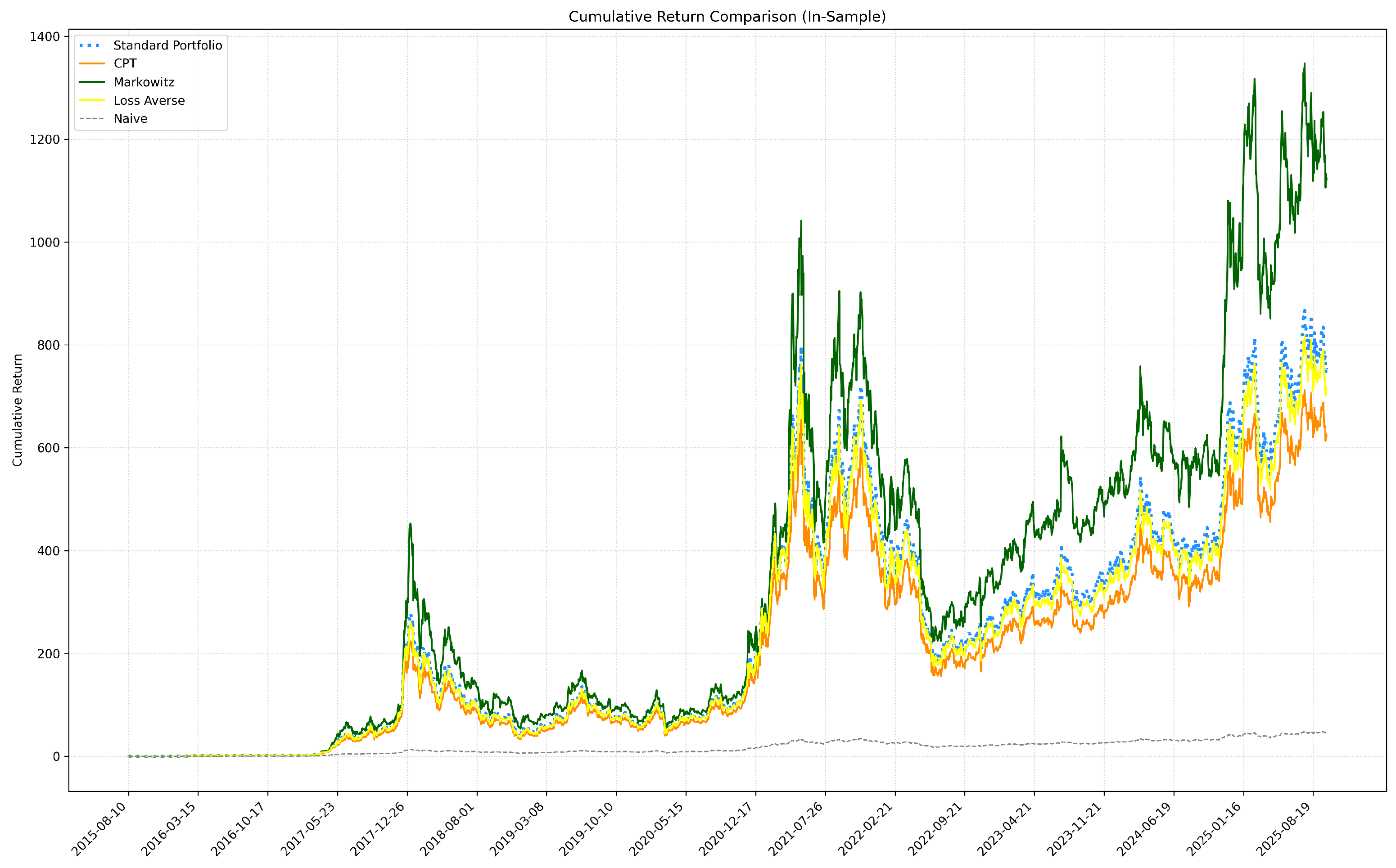
Figure 2 displays the cumulative return paths for each portfolio over the in-sample period, providing insight into the performance implications of these allocations.
The cumulative return trajectories reveal dramatic outperformance of all importance-weighted portfolios relative to the Naive benchmark, which remains essentially flat near zero throughout the sample. The Markowitz portfolio (green line) exhibits the most extreme behavior, reaching a peak cumulative return exceeding 1300% (13-fold wealth increase) in mid-2021, driven by its heavy overweight to XRP during cryptoasset bull markets. However, this exceptional performance comes with severe drawdowns, as evidenced by the decline from the 2021 peak to approximately 1150% by September 2025, as well as earlier collapses in 2018 and 2020. The Standard, CPT, and LA portfolios (blue, orange, and yellow lines, respectively) cluster together, displaying qualitatively similar paths with terminal cumulative returns in the 600–850% range. The CPT and LA portfolios track the Standard portfolio closely, exhibiting only slightly lower peak returns and marginally shallower drawdowns, consistent with their similar cryptoasset allocations documented in
Table 3.
The tight clustering of behavioral and standard portfolios in
Figure 2 underscores a central finding: in the presence of extremely volatile assets like cryptoassets, behavioral distortions produce limited portfolio differentiation when measured by cumulative returns. The variance contribution of cryptoassets overwhelms the reweighting effects of loss aversion and diminishing sensitivity, causing all importance-based portfolios to converge on crypto-heavy allocations. The Markowitz portfolio’s divergence reflects the qualitatively different nature of its convex (risk-seeking) value function, which actively seeks rather than penalizes volatility, leading to even more aggressive crypto concentration.
The RF model fit statistics corroborate these patterns. (Note:The values reported should be interpreted as measuring the reliability of the variance decomposition, not predictive accuracy in a forecasting sense. High indicates that the RF successfully partitions behavioral variance across assets, yielding stable variable importance scores.) The standard model achieves an of 0.8872, indicating that 88.7% of variance in the average return target is explained by individual asset returns. The CPT model achieves the highest at 0.9231, suggesting that the non-linear CPT transformation with loss aversion and diminishing sensitivity captures additional structure in return patterns beyond the linear average. The LA model, with , performs comparably to the standard model. The Markowitz model, by contrast, exhibits substantially lower fit (), reflecting that the convex transformation distorts the target in ways less predictable from asset returns, as extreme squaring amplifies noise and outliers.
The overwhelming crypto allocation across all personas—including the Standard (undistorted) portfolio—reflects that MDI-based variable importance is fundamentally a variance decomposition. Since cryptoassets exhibit daily volatilities 4–7× higher than traditional assets, they mechanically dominate variance contribution regardless of behavioral transformation. The behavioral effects operate within this volatility-determined structure: they alter relative allocations among cryptoassets (e.g., CPT increasing BTC from 17.79% to 20.36% while reducing XRP from 19.09% to 16.35%) rather than producing wholesale shifts from crypto to traditional assets. This finding has important implications: behavioral distortions modify the composition of risk exposure more than its overall magnitude when the opportunity set includes assets with dramatically different volatility scales.
These findings establish that when the investment opportunity set includes both traditional assets and cryptoassets, the extreme volatility differential causes all portfolios—regardless of behavioral bias—to concentrate heavily in digital assets. The behavioral transformations produce marginal shifts in crypto allocation (89–96%) but do not fundamentally alter the portfolio structure. To discern whether behavioral distortions have stronger effects in more homogeneous asset environments, we next examine sub-portfolios restricted to traditional assets only and cryptoassets only.
4.2. Scenario 2 In-Sample: Traditional Assets Only
Table 4 presents portfolio allocations when the investment universe is restricted to the six traditional financial instruments, excluding cryptoassets. This scenario isolates whether behavioral distortions produce meaningful reallocation effects in a more homogeneous asset environment characterized by moderate volatility and relatively normal return distributions.
The traditional-only portfolio exhibits substantially more balanced allocations compared to the crypto-dominated structure of Scenario 1, with the three equity indices (SPX, RTY, NAESX) accounting for the majority of weight across all portfolios. NAESX US Equity emerges as the dominant holding, receiving 32–37% allocation depending on persona, reflecting its highest volatility among traditional assets (1.38% daily standard deviation from
Table 2). The Russell 2000 (RTY) commands the second-largest allocation at 24–27%, followed by the S&P 500 at 21–24%. The actively managed international value fund (VIVAX) receives moderate weight of 14–18%, while fixed income securities (LBUSTRUU) and cash equivalents (US0001M) are essentially excluded with allocations below 1%, as their low volatility renders them uninformative for explaining portfolio return variance.
In contrast to Scenario 1, where behavioral distortions produced minimal differentiation due to crypto’s overwhelming volatility signal, the traditional-only setting reveals more nuanced patterns. The LA and CPT portfolios closely track the Standard allocation, with rank correlations exceeding 0.99 and maximum individual weight differences under 1 p.p. This near-identity reflects that within the traditional asset class, loss aversion () and diminishing sensitivity () do not fundamentally alter which assets are perceived as important: all equity indices exhibit similar loss frequencies and volatility profiles, leading the behavioral transformations to preserve the relative importance rankings established under undistorted returns.
The Markowitz portfolio again displays a distinct allocation pattern, exhibiting the most pronounced departures from the baseline. Compared to the Standard portfolio, Markowitz increases weight on SPX (24.34% vs. 20.86%) and VIVAX (18.28% vs. 14.63%) while reducing NAESX (32.43% vs. 36.72%) and RTY (24.25% vs. 27.09%). This rebalancing toward large-cap and international equity at the expense of small-cap domestic reflects the convex value function’s amplification of extreme returns: NAESX exhibits occasional extreme positive returns (maximum 16.56% from
Table 2) that, when squared, become extraordinarily large, but the Markowitz transformation treats these as outliers that add noise rather than systematic signals. The resulting lower-variable importance for NAESX under the Markowitz persona contrasts with CPT and LA, where the concave (
) transformation compresses extremes, rendering NAESX’s tail returns informative rather than distortionary.
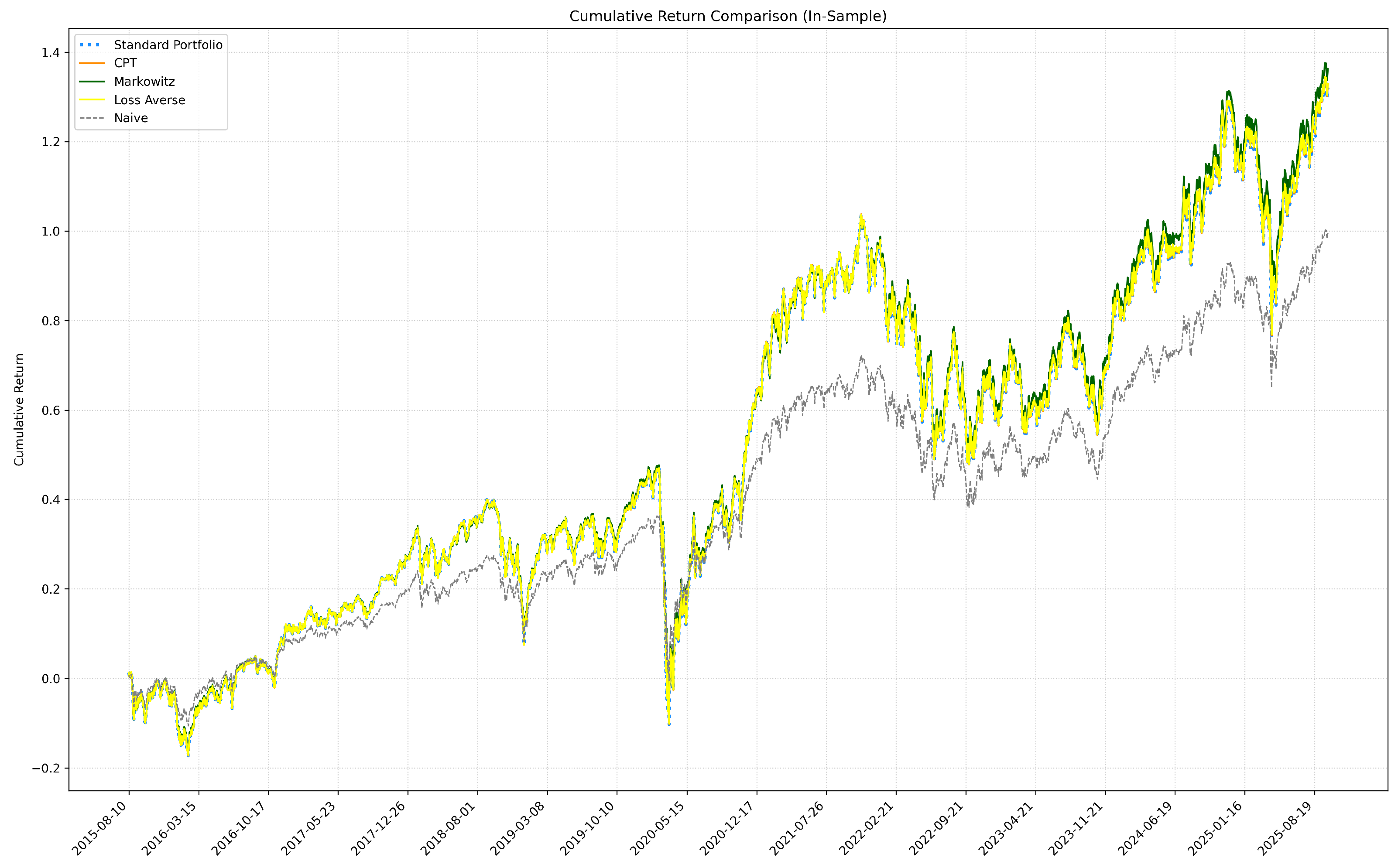
Figure 3 illustrates the cumulative performance of traditional-only portfolios over the sample period.
The cumulative return trajectories reveal that all importance-weighted portfolios—Standard, CPT, Markowitz, Naive and LA—exhibit nearly identical performance paths, achieving terminal cumulative returns in the 100–137% range (doubling to tripling initial wealth) over the ten-year period. The three behavioral portfolios cluster so tightly that their lines are visually indistinguishable in most periods, tracking the Standard portfolio with high fidelity. This convergence reflects the minimal weight differences documented in
Table 4: when allocations differ by only 1–4 p.p. across similar-volatility equity indices, the resulting return streams are near-perfectly correlated. The Markowitz portfolio exhibits marginally higher terminal wealth (approximately 137% vs. 130% for others), driven by its slight overweight to SPX and VIVAX during the late-sample equity rally of 2023–2025, though this outperformance is economically modest and well within sampling variation.
All importance-weighted portfolios dramatically outperform the Naive equal-weighted benchmark, which achieves a terminal cumulative return near 100% (doubling initial wealth). This performance gap underscores the value of volatility-based weighting even in the absence of behavioral distortions: by concentrating on high-variance equity indices (NAESX, RTY) and minimizing allocation to low-volatility fixed income, the importance-weighted portfolios capture the equity risk premium more efficiently than mechanical (i.e., manual) equal-weighting. The Naive portfolio’s 10% allocation to bonds and cash—which experienced negative or near-zero real returns over much of the sample due to rising rates—acts as a performance drag that importance-based methods avoid by assigning these assets negligible weight based on their low variance contribution.
The RF fit statistics for traditional-only portfolios indicate strong predictive power across most personas. The Standard model achieves , the CPT model , and the LA model , all exceeding 90% variance explained. The high values reflect that within the traditional asset universe, return patterns are relatively stable and linearly predictable, with equity indices exhibiting strong positive correlations that the RF captures efficiently. The Markowitz model again displays substantially lower fit (), as the quadratic transformation complicates any potential prediction, though the remains higher than in Scenario 1 (0.4595 vs. 0.5168), suggesting the convex transformation is less disruptive when applied to moderate-volatility traditional assets than to extreme-volatility cryptoassets.
The traditional-only analysis establishes that when investment opportunities are restricted to conventional financial instruments with comparable risk-return profiles, behavioral distortions produce minimal portfolio differentiation. The CPT and LA transformations preserve the dominance of high-volatility equity indices, yielding allocations and performance nearly identical to undistorted importance weighting. Only the Markowitz investor’s convex (risk-seeking) preferences generate meaningfully different allocations, though even these differences translate to modest performance divergence. The convergence of CPT, LA, and Standard allocations within the traditional asset universe represents a substantive finding: when assets exhibit similar volatility profiles and loss frequencies, behavioral transformations preserve relative importance rankings. This occurs because loss aversion () amplifies losses uniformly across assets with comparable tail characteristics—if all equity indices experience losses with similar frequency and magnitude, the transformation scales their contributions proportionally without altering rankings. The result validates our framework by showing that behavioral effects are context-dependent: they emerge strongly when assets differ in tail behavior (Scenario 3) but attenuate when assets are behaviorally similar. This pattern aligns with Barberis (2016), who argues that narrow framing effects require heterogeneous risk characteristics to generate meaningful portfolio differentiation.
4.3. Scenario 3 In-Sample: Cryptoassets Only
Table 5 presents portfolio allocations when the universe is restricted to the four major cryptoassets, providing a lab for examining how behavioral distortions operate within an asset class characterized uniformly by extreme volatility, positive skewness, and non-normal return distributions.
The crypto-only scenario reveals the most pronounced behavioral differentiation of the three sub-portfolios, as the uniformly extreme characteristics of digital assets allow behavioral biases to manifest through relative rankings rather than being dominated by a single volatility tier. In contrast to Scenario 2, where loss aversion produced negligible reallocation among similar-volatility traditional assets, and Scenario 1, where crypto’s aggregate volatility overwhelmed behavioral effects, the crypto-only setting permits meaningful comparison of how different personas perceive relative risk among highly volatile instruments.
The Standard portfolio allocates weight approximately equally to ETH (34.81%) and LTC (33.60%), with smaller positions in XRP (17.82%) and BTC (13.77%). This distribution reflects the extreme volatilities of ETH (6.75% daily) and LTC (6.00% daily) documented in
Table 2, which dominate variance decomposition in the undistorted RF model. BTC, despite being the largest cryptoasset by market capitalization, receives the lowest allocation due to its comparatively moderate volatility (4.13% daily), rendering it less informative for explaining portfolio return variance in a pure variance-weighting framework.
The CPT and LA portfolios exhibit a systematic reweighting away from the Standard allocation, increasing exposure to BTC (CPT: 20.57%, LA: 16.40% vs. Standard: 13.77%) and LTC (CPT: 36.78%, LA: 35.93% vs. Standard: 33.60%) while reducing ETH (CPT: 29.14%, LA: 33.07% vs. Standard: 34.81%) and XRP (CPT: 13.51%, LA: 14.61% vs. Standard: 17.82%). This pattern is consistent with loss aversion favoring assets with more stable tail behavior: BTC, as the most established cryptoasset, exhibits the smallest maximum drawdown ( vs. ETH’s ) and lower frequency of extreme loss events. The CPT transformation with amplifies the disutility of ETH’s and XRP’s catastrophic loss days, reducing their perceived importance for predicting behavioral value despite their high volatility. The diminishing sensitivity parameter () further compresses the value of extreme positive returns, ensuring that ETH’s occasional +60% gain days do not fully compensate for its severe downside risk in the behavioral calculus.
The Markowitz portfolio displays a dramatically divergent structure, concentrating 40.22% in XRP—more than double the Standard allocation of 17.82%—while severely underweighting BTC at 5.86%. This extreme tilt reflects the convex value function’s amplification of variance: XRP exhibits both the highest volatility (7.19% daily) and the most extreme single-day returns (87.14% maximum gain,
maximum loss). When returns are squared via
, XRP’s explosive days produce extraordinarily large transformed values that dominate the variance of the Markowitz target, leading the RF to assign XRP overwhelming importance. The Markowitz investor’s risk-seeking near the origin translates, in this cryptoassets’ context, into a preference for lottery-like assets with the highest potential for extreme outcomes, even at the cost of stability.
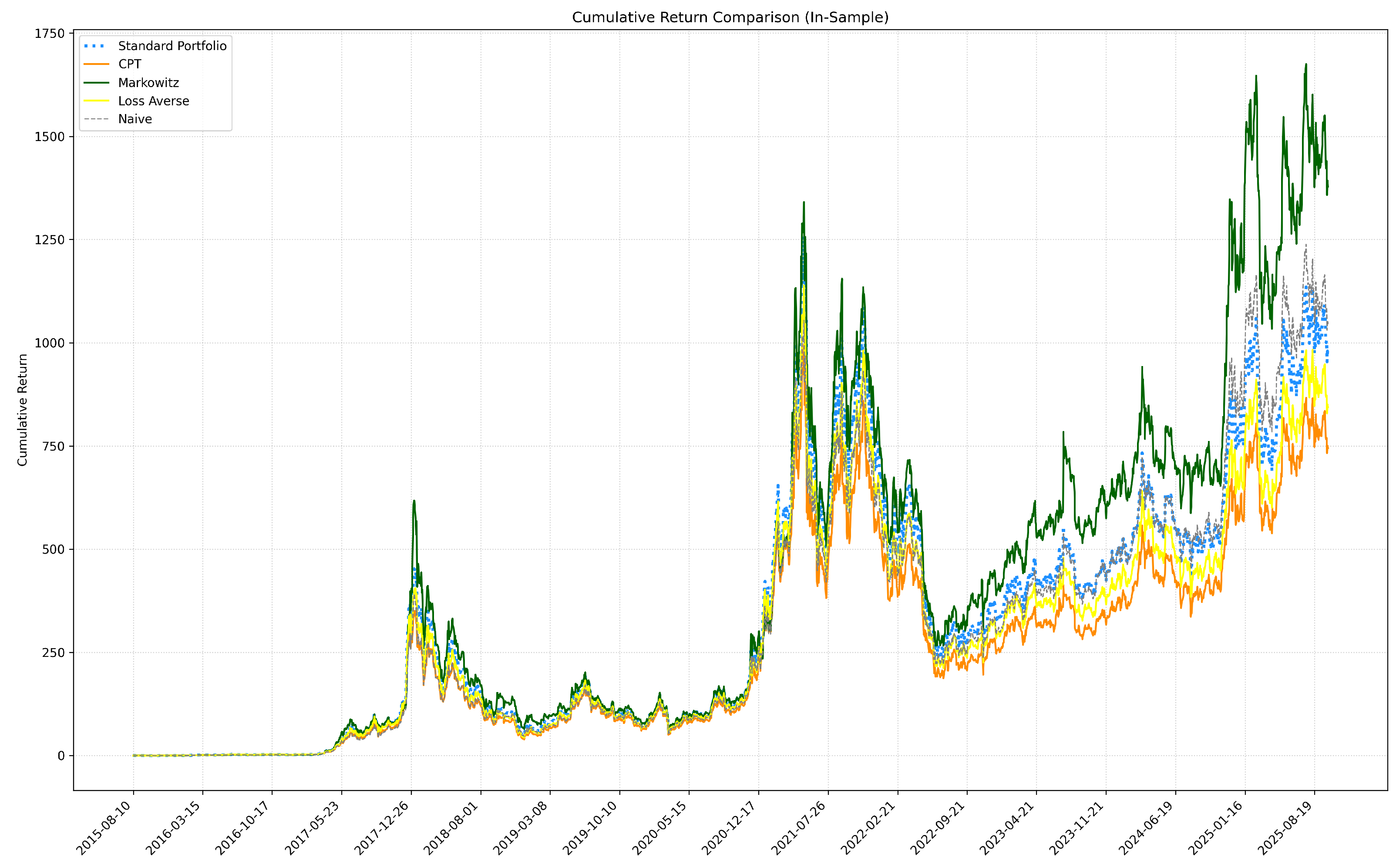
Figure 4 displays the cumulative performance trajectories, revealing the most substantial performance dispersion of any scenario.
The Markowitz portfolio (green line) achieves the most spectacular performance, reaching a peak cumulative return exceeding 1650% (17-fold wealth increase) in late 2024, substantially outperforming all other portfolios. This outperformance stems from its concentrated XRP position, which captured XRP’s explosive rallies during the 2017–2018 and 2020–2021 cryptoassets’ bull markets. However, this exceptional return comes at the cost of extreme volatility: the Markowitz portfolio experiences drawdowns exceeding 60% during crypto winter periods (2018–2019, 2022), and exhibits wild intra-year swings throughout the sample. The terminal value in September 2025 stands near 1450%, having declined from the peak but still vastly exceeding other portfolios.
The Standard, CPT, and LA portfolios exhibit more moderate but still substantial returns, clustering in the 750–1250% range by the sample’s end. Notably, these three portfolios display greater separation than in Scenario 2: the CPT and LA portfolios (orange and yellow lines) consistently underperform the Standard portfolio (blue dashed line) by 100–300 p.p. during bull market peaks, reflecting their reduced exposure to the highest-flying assets (ETH, XRP). This underperformance represents the cost of behavioral bias in the cryptoassets’ setting: by tilting toward the more stable, analogously BTC and away from more extreme assets, loss-averse investors sacrifice upside potential during periods when crypto volatility is rewarded. However, during the 2022 cryptoassets’ crash, the CPT and LA portfolios exhibit marginally shallower drawdowns, suggesting their conservative positioning provides modest downside protection during severe corrections.
The Naive equal-weighted benchmark again substantially underperforms across all importance-weighted portfolios, remaining nearly flat with cumulative returns near 50% at the sample’s end. This poor performance reflects the equal-weighting scheme’s failure to capture the correlation structure and volatility hierarchy among cryptoassets: by allocating 25% to each asset regardless of variance contribution, the Naive portfolio dilutes exposure to the high-performing assets during bull markets while maintaining full exposure during crashes.
The RF fit statistics reveal high explanatory power for most personas. The CPT model achieves the highest of 0.9435, indicating that the loss aversion and diminishing sensitivity transformations capture 94.35% of behavioral target variance, suggesting these biases align well with the structure of cryptoassets’ return patterns. The LA model () and Standard model () also exceed 90% variance explained. The Markowitz model once again exhibits substantially degraded fit (), reflecting that squaring already-extreme cryptoassets’ returns produces a target dominated by outliers that obscure systematic patterns, though the fit remains higher than in traditional-only settings ( in Scenario 2), as the uniform extremity of crypto returns provides more signals even after convex transformation.
The cryptoassets-only analysis establishes that within an asset class characterized by similar extreme volatility, behavioral distortions produce meaningful portfolio differentiation. Loss-averse investors (CPT, LA) systematically favor assets with less catastrophic tail behavior (BTC, LTC) over those with the most severe drawdowns (ETH, XRP), sacrificing upside potential for marginally improved downside protection. The Markowitz investor’s risk-seeking preferences translate into concentrated bets on the most volatile, lottery-like assets, generating extraordinary returns at the cost of extreme drawdowns. These findings demonstrate that narrow framing combined with behavioral value functions can generate heterogeneous portfolio choices even when all available assets occupy the same extreme-risk category, with the direction and magnitude of reallocation depending critically on the specific form of the behavioral distortion.
5. Out-of-Sample Analysis
To assess whether the behavioral portfolio allocations derived from in-sample variable importance scores generate robust out-of-sample performance, we implement a rolling window methodology that mimicks realistic investment conditions. Beginning with the 1001st observation (approximately four years into the sample), we train RF models using the preceding 1000 days of data, extract variable importance scores, normalize to portfolio weights, and compute the subsequent day’s portfolio return using these weights. This process is repeated daily (i.e., 1-day step) through the end of the sample, yielding 1580 out-of-sample observations spanning approximately 2018–2025. This way, we can isolate the performance attributable to the initial behavioral allocation decisions without introducing the confounding effects of dynamic reweighting strategies.
5.1. Scenario 1: All Assets
Table 6 presents comprehensive performance metrics for the out-of-sample period across all portfolios in the full ten-asset universe.
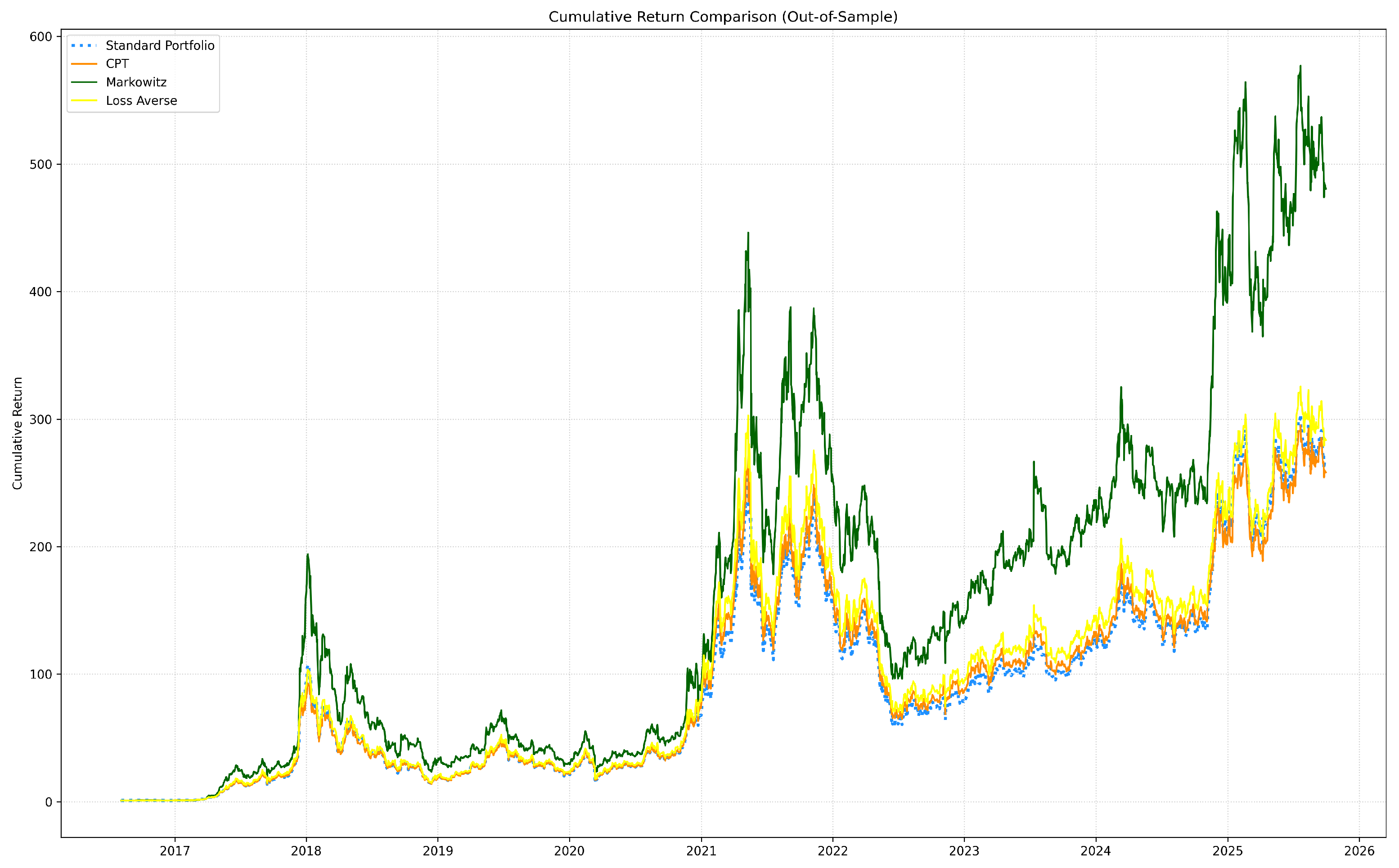
The out-of-sample results confirm patterns observed in-sample while revealing important performance differences. The Markowitz portfolio achieves exceptional out-of-sample returns, with a total return of 47,960% (480-fold wealth increase) and annualized return of 93.97%, substantially exceeding all other portfolios. This dramatic outperformance reflects the Markowitz investor’s concentrated exposure to XRP (36.75% from
Table 3), which experienced explosive appreciation during the 2020–2021 and 2024–2025 cryptoassets’ bull markets captured in the out-of-sample period. However, this return premium comes at the cost of elevated volatility (78.42% annualized) and the most severe maximum drawdown (
), indicating that the Markowitz portfolio experienced near-total wealth destruction during the 2022 cryptoassets crash before recovering in subsequent periods.
The Standard, CPT, and LA portfolios cluster tightly in cumulative returns (257–283%), annualized returns (81.5–83.3%), and volatilities (68–70%), demonstrating that behavioral distortions produce marginal performance differences when crypto-dominance persists. The LA portfolio marginally outperforms the Standard portfolio (28,262% vs. 26,371% total return), though this advantage is economically modest and accompanied by comparable volatility (69.68% vs. 70.09%). The CPT portfolio exhibits nearly identical performance to the Standard portfolio, with fractionally lower return (25,730%) but also marginally reduced volatility (68.03%), resulting in a slightly improved Sharpe ratio (1.183 vs. 1.172).
Risk-adjusted performance metrics reveal that behavioral portfolios achieve modestly superior Sharpe ratios despite similar or lower raw returns. The Markowitz portfolio’s Sharpe ratio of 1.203 is the highest, indicating that its return premium more than compensates for increased volatility on a mean–variance basis. The CPT and LA portfolios’ Sharpe ratios (1.183 and 1.186, respectively) exceed the Standard portfolio (1.172), suggesting that the conservative tilt toward BTC and away from ETH/XRP documented in
Table 3 provides marginal risk-adjusted benefit. However, these Sharpe ratio improvements are economically small (1–2 b.p.s) and likely within sampling error, tempering claims of meaningful behavioral advantage.
Downside risk metrics corroborate this pattern. The Sortino ratios [
32,
33], which emphasize downside deviation rather than total volatility, follow the same ranking: Markowitz (1.934) > LA (1.836) > CPT (1.831)> Standard (1.820), with the behavioral portfolios exhibiting marginally superior downside-adjusted performance. The upside potential to downside risk (UP/DR) ratios, which measure the asymmetry of return distributions, similarly favor behavioral portfolios (16.7–17.2) over the Standard portfolio (16.6), indicating that the behavioral tilts produce slightly more favorable return asymmetry by concentrating upside potential while modestly reducing downside exposure.
Maximum drawdowns are uniformly severe across all portfolios, ranging from 84.91% (CPT) to 88.01% (Markowitz), reflecting the systemic nature of the 2022 cryptoassets’ crash that affected all crypto-heavy portfolios regardless of specific allocations. The CPT portfolio’s marginally shallower drawdown (
vs. Standard’s
) suggests its reduced XRP exposure provided modest protection during the most severe correction, though the economic significance of avoiding an additional 2 p.p. of loss from a starting drawdown exceeding 80% is questionable.
Figure 5 displays the out-of-sample cumulative return trajectories, confirming the performance hierarchy observed in aggregate metrics.
The cumulative return paths reveal striking visual patterns. The Markowitz portfolio (green line) follows a dramatically different trajectory than other portfolios, experiencing explosive growth during early-2018, mid-2021, and late-2024 bull markets, interspersed with catastrophic collapses in 2018, 2019, and especially 2022, where the portfolio value declines from approximately 380 to 40 (a 90% drawdown from peak). The terminal value near 480 represents a recovery to levels exceeding pre-crash peaks, though investors experiencing the interim volatility might not have maintained positions through such extreme drawdowns. The Standard, CPT, and LA portfolios (blue, orange, yellow lines) track each other closely throughout most of the sample, exhibiting qualitatively similar bull and bear market patterns with terminal values clustering around 250–280. The behavioral portfolios display marginally smoother trajectories during the 2021–2022 period, consistent with their reduced exposure to the most volatile cryptoassets, though this difference is subtle and emerges primarily during extreme market stress.
The out-of-sample analysis validates several key findings from the in-sample results. First, the crypto-dominance documented in
Table 3 (89–96% allocation to digital assets) produces portfolios whose performance is overwhelmingly determined by cryptoassets’ market dynamics, with behavioral distortions generating only marginal differentiation. Second, the Markowitz investor’s risk-seeking preferences translate into concentrated bets on extreme assets that deliver superior long-run returns but at the cost of extraordinary interim volatility and drawdown severity that may be intolerable for most investors. Third, loss-averse investors (CPT, LA) achieve marginally improved risk-adjusted returns through modest reweighting toward less catastrophic assets (BTC over ETH/XRP), though the magnitude of improvement is economically small. Fourth, the static weight assumption—holding initial allocations constant throughout the out-of-sample period without rebalancing—proves to be remarkably effective, as evidenced by portfolio turnover of zero and Sharpe ratios exceeding 1.17 for all portfolios, suggesting that the variable importance-based allocations capture persistent structural features of cryptoasset return dynamics rather than transient sample-specific patterns.
5.2. Scenario 2: Traditional Assets Only
Table 7 presents out-of-sample performance metrics for the traditional assets sub-portfolio, examining whether behavioral distortions generate meaningful differentiation in the absence of cryptoassets’ volatility.
The traditional-only out-of-sample results reveal patterns sharply contrasting with the crypto-dominated Scenario 1. Total returns are dramatically lower, ranging from 116% (Standard) to 130% (Markowitz), representing wealth increases of 2.2–2.3-fold over the out-of-sample period compared to the 250–480-fold increases observed when cryptoassets are included. Annualized returns cluster tightly around 8.6–9.3%, consistent with historical equity market performance, while annualized volatilities of 19–20% are less than one-third of those observed in crypto-heavy portfolios. Maximum drawdowns are substantially shallower ( to ) compared to the 85–88% drawdowns in Scenario 1, reflecting that traditional equity indices experienced severe but not catastrophic declines during the 2020 COVID-19 panic and 2022 growth stock correction, whereas cryptoassets suffered near-total value destruction during the 2022 crypto winter.
In contrast to Scenario 1, where behavioral portfolios exhibited minimal performance differentiation from the Standard benchmark, the traditional-only setting reveals systematic behavioral outperformance. All three behavioral portfolios—CPT (126.14%), Markowitz (129.51%), and LA (126.31%)—exceed the Standard portfolio’s 116.09% total return by economically meaningful margins of 10–13 p.p. The Markowitz portfolio achieves the highest return (129.51%), translating to a 9.32% annualized return versus the Standard’s 8.62%, a 70 b.p. advantage that compounds to substantial wealth differences over multi-year horizons. This outperformance emerges despite the Markowitz portfolio’s only marginally different allocations documented in
Table 4 (24% SPX vs. 21% Standard, 18% VIVAX vs. 15% Standard), suggesting that even modest reweighting toward large-cap and international equity proves advantageous during the out-of-sample period’s market dynamics.
Risk-adjusted metrics corroborate this behavioral advantage. Sharpe ratios range from 0.393 (Standard) to 0.426 (Markowitz), with the behavioral portfolios achieving 2–3 b.p. improvements that, while modest in absolute terms, represent 5–8% relative improvements in risk-adjusted returns. The Markowitz portfolio’s Sharpe ratio of 0.426 is particularly notable, as it achieves higher returns (9.32% vs. 8.62%) with marginally lower volatility (19.68% vs. 19.76%) than the Standard portfolio—a mean–variance dominance relationship suggesting the Markowitz allocation occupied a more efficient position on the mean–variance frontier during this period. Sortino ratios follow an identical ranking (0.724 to 0.771), indicating that the behavioral portfolios’ outperformance is not merely driven by upside volatility but reflects genuinely improved downside-adjusted returns.
The uniformity of maximum drawdowns (
to
) across all portfolios reflects the systemic nature of traditional market corrections: the 2020 pandemic crash and 2022 growth stock decline affected all equity-heavy portfolios similarly, regardless of specific allocations to SPX versus NAESX versus VIVAX, as these indices exhibited high correlations during stress periods. The CPT and LA portfolios’ marginally deeper drawdowns (
and
, respectively) compared to Standard (
) are economically negligible, differing by less than one p.p., and do not suggest meaningful downside protection from behavioral tilts.
Figure 6 illustrates the cumulative return trajectories for traditional-only portfolios.
The cumulative return paths display remarkable convergence throughout most of the sample, with all four portfolios tracking closely until mid-2023. From 2018 through 2022, the portfolios move nearly in lockstep, reflecting the high correlation of equity index returns and the minimal allocation differences across personae. Beginning in 2023, the behavioral portfolios begin to separate from the Standard portfolio, with the Markowitz (green) and LA (yellow) lines pulling ahead, establishing a persistent performance gap that widens through the 2024–2025 equity rally. The terminal spread, with Markowitz reaching approximately 2.30 (130% cumulative return) versus Standard’s 2.16 (116% return), represents the cumulative effect of the modest behavioral tilts interacting with favorable market conditions for large-cap and international equity during the late-sample period.
The traditional-only out-of-sample analysis yields insights distinct from both the in-sample results and the crypto-inclusive out-of-sample findings. While in-sample traditional-only portfolios exhibited near-perfect convergence (
Section 4.2), the out-of-sample period reveals that the subtle behavioral reallocations—Markowitz’s overweight to SPX and VIVAX, CPT and LA’s marginal shifts among equity indices—translate to meaningful performance differences when tested on fresh data. This divergence between in-sample and out-of-sample patterns suggests that the behavioral transformations captured portfolio composition effects that proved advantageous during the specific market environment of 2018–2025, characterized by large-cap outperformance and international equity recovery, even though these effects were not apparent when evaluating full-sample returns. The static weight assumption again proves effective, with zero rebalancing costs enabling the behavioral portfolios to maintain their modest Sharpe ratio advantages without erosion from transaction costs. Importantly, the traditional-only Sharpe ratios (0.39–0.43) are dramatically lower than those achieved in crypto-inclusive portfolios (1.17–1.20), underscoring that the extraordinary risk-adjusted returns of Scenario 1 are attributable to cryptoassets exposure rather than portfolio construction methodology.
5.3. Scenario 3: Cryptoassets Only
Table 8 presents out-of-sample performance metrics for the cryptoassets-only sub-portfolio, isolating the performance implications of behavioral distortions within the most volatile asset class.
The crypto-only out-of-sample results reveal the most dramatic performance divergence across personas of any scenario, with behavioral distortions producing economically substantial return differences. The Standard and Markowitz portfolios achieve exceptional returns exceeding 500-fold wealth increases (51,005% and 54,574%, respectively), while the CPT and LA portfolios deliver materially lower though still extraordinary returns of approximately 300-fold (29,732% and 30,953%). This 20,000–25,000 p.p. performance gap represents the largest behavioral effect documented in our analysis, dwarfing the modest differentials observed in traditional-only (10–13 p.p.) and all-assets (negligible) scenarios.
The CPT and LA portfolios’ substantial underperformance directly reflects the conservative reallocations documented in
Table 5, where loss aversion (
) and diminishing sensitivity (
) induced systematic tilts toward BTC and LTC at the expense of ETH and XRP. During the out-of-sample period’s cryptoassets’ bull markets—particularly the 2020–2021 and 2024–2025 rallies visible in
Figure 7—ETH and XRP experienced the most explosive appreciation, with their high volatility and positive skewness generating the lottery-like payoffs that the CPT transformation actively penalized. By reducing exposure to these extreme-performing assets by 5–6 p.p. (ETH: 29.14% CPT vs. 34.81% Standard; XRP: 13.51% CPT vs. 17.82% Standard) and increasing BTC allocation (20.57% vs. 13.77%), the behavioral investors sacrificed substantial upside potential in exchange for marginal downside protection.
The Markowitz portfolio marginally outperforms even the Standard portfolio (54,574% vs. 51,005%), achieving the highest annualized return of 96.68%. This exceptional performance stems from its concentrated 40.22% XRP allocation (
Table 5), which captured XRP’s explosive rallies during periods when this asset outperformed the broader cryptoassets market. The Markowitz investor’s risk-seeking convex preferences (
) translated into a bet on the most volatile, lottery-like cryptoassets that proved prescient during the out-of-sample period. However, this outperformance comes at the cost of the highest volatility (82.25% annualized) and most severe maximum drawdown (
), indicating that investors experienced near-total wealth destruction during the 2022 cryptoassets’ winter before recovering in subsequent periods.
Risk-adjusted performance metrics reveal that the Standard portfolio achieves the highest Sharpe ratio (1.217), marginally exceeding Markowitz (1.201) and substantially exceeding the behavioral portfolios (1.158 and 1.157 for CPT and LA, respectively). This Sharpe ratio ranking inverts the raw return ranking, indicating that the Standard portfolio’s more balanced crypto allocation achieved superior risk efficiency. The CPT and LA portfolios’ 5–6 b.p. Sharpe ratio deficit represents approximately 5% relative underperformance in risk-adjusted terms, suggesting their conservative positioning sacrificed returns without proportionally reducing volatility: annualized volatilities (75–77%) are only marginally lower than the Standard portfolio’s 78.19%, while returns are substantially depressed.
Maximum drawdowns are catastrophic and uniform across all portfolios, ranging from 88.36% (CPT) to 89.64% (Markowitz), reflecting the systemic collapse of cryptoasset markets during the 2022 winter when BTC, ETH, XRP, and LTC all experienced drawdowns exceeding 70–80% from their 2021 peaks. The CPT portfolio’s marginally shallower drawdown (
vs. Standard’s
) provides minimal economic comfort, as investors experiencing an 88% loss are functionally indistinguishable from those experiencing an 89% loss in terms of wealth destruction and psychological distress. The behavioral portfolios’ incremental downside protection—achieved by favoring BTC’s relative stability—proves insufficient to justify their substantial return sacrifice during bull markets.
Figure 7 displays the cumulative return trajectories, revealing dramatic divergence across portfolios.
The return trajectories exhibit striking patterns. During the initial 2018–2020 period, all portfolios move together, as cryptoasset markets remained relatively flat following the 2017–2018 boom–bust cycle. Beginning in late 2020, the portfolios diverge sharply as the cryptoassets’ bull market accelerates: the Markowitz portfolio (green line) surges to approximately 550 by mid-2021, substantially exceeding the Standard portfolio’s 450, while the CPT and LA portfolios lag at 300–350. This gap reflects the Markowitz concentration in XRP and the behavioral portfolios’ underweight to the highest-performing assets. The 2022 crash affects all portfolios catastrophically, with values plummeting from peaks of 300–550 to troughs of 50–100, representing 80–90% declines. The 2023–2025 recovery phase sees the divergence reestablish the following: the Standard and Markowitz portfolios recover to terminal values of 510–650, while the CPT and LA portfolios stagnate near 300–350, never fully recovering to their pre-crash peaks relative to the volatility-weighted benchmarks.
The crypto-only out-of-sample analysis establishes that behavioral biases carry substantial opportunity costs in high-volatility, positively skewed asset classes. The CPT and LA investors’ systematic avoidance of extreme assets—driven by loss aversion amplifying the disutility of tail losses—causes them to miss the exceptional bull market returns that compensate cryptoassets investors for bearing extreme volatility. The 20,000+ p.p. return gap between Standard and behavioral portfolios represents forgone wealth accumulation equivalent to 150–200 times initial capital, demonstrating that behavioral conservatism, while potentially psychologically comforting during crashes, imposes severe long-run costs when applied to lottery-like assets. The Markowitz investor’s opposite bias—risk-seeking via convex preferences—proves advantageous in this setting, albeit at the cost of extreme interim volatility that few investors could tolerate. These findings underscore that the appropriateness of behavioral distortions depends critically on asset class characteristics: narrow framing and loss aversion may benefit investors in traditional markets (Scenario 2) but penalize them severely in cryptoasset markets where extreme outcomes dominate long-run performance.
6. Discussion
6.1. Economic Interpretation of Findings
Our empirical analysis demonstrates that behavioral distortions, operationalized through the DVT framework, produce systematic portfolio reallocations whose magnitude depends critically on investment opportunity set composition. Narrow framing—applying behavioral transformations to individual asset returns before aggregation—fundamentally alters perceived asset importance in ways that persist out-of-sample and translate into economically meaningful performance differentials. However, behavioral effects are amplified when the universe includes assets with extreme and heterogeneous characteristics, attenuated when assets exhibit similar moderate volatility, and maximized when all assets occupy the same extreme-risk category but differ in tail behavior.
The three-scenario structure reveals a hierarchy of behavioral influence. In Scenario 1, cryptoassets’ extreme volatility (4–7% daily versus 0.3–1.5% for traditional assets) produces crypto-dominance across all personas (89–96%), rendering behavioral adjustments marginal. CPT and LA portfolios’ modest 2–3 p.p. reallocation toward traditional assets generates negligible performance differentiation because capital remains predominantly exposed to high-variance cryptoassets. This illustrates that when one asset class contributes an order-of-magnitude greater variance than alternatives, behavioral distortions operating through variance perception cannot generate meaningful reweighting unless extraordinarily strong.
In Scenario 2, where assets exhibit comparable moderate volatility (1–1.5% daily), behavioral distortions produce near-zero weight in-sample performance differentiation (maximum 2.2 p.p.) but modest out-of-sample performance differentiation (10–13 p.p. cumulative return advantage). This suggests behavioral transformations capture subtle composition effects that prove advantageous during specific market environments even when not generating materially different full-sample allocations.
In Scenario 3, where all assets exhibit extreme volatility but differ in tail behavior, behavioral distortions produce maximum differentiation. CPT and LA investors’ 7–22 p.p. reallocations away from extreme-tail assets translate into a 20,000+ p.p. out-of-sample return gap—our largest documented behavioral effect. Within the cryptoassets’ universe, behavioral transformations systematically distinguish assets based on tail characteristics: loss aversion amplifies ETH’s catastrophic crash disutility while the Markowitz transformation amplifies XRP’s lottery-like gain utility, producing fundamentally different risk perceptions and allocations.
These patterns validate our core theoretical premise: narrow framing causes investors to overlook portfolio-level diversification benefits and perceive asset importance through distorted lenses. The segregation approach——ensures offsetting gains and losses do not cancel in perceived value, as under integration. When losses are amplified by before averaging, volatile assets contribute disproportionately to negative perceived variance even if hedged by negatively correlated holdings.
The empirical results in
Table 9 allow for a precise decomposition of the factors driving the DVT framework’s allocations. By isolating the crypto-only scenario, where asset volatilities are more homogeneous than in the multi-asset universe, we can separate the mechanical volatility dominance effect from true behavioral distortion.
As shown in
Table 9, the undistorted Standard persona serves as a baseline for volatility-driven weighting. The application of CPT transformations results in a net behavioral effect of +6.80 p.p. for Bitcoin (BTC) and a corresponding −4.31 p.p. reduction in XRP. This shift represents the psychological premium placed on lower tail risk; despite the mechanical dominance of higher-volatility assets, the CPT investor systematically reweights the portfolio toward assets that mitigate the perceived pain of extreme drawdowns.
Conversely, the Markowitz persona demonstrates the opposite distortion, allocating 40.22% to XRP—the highest among all personas—reflecting a risk-seeking preference for high-skewness outcomes. This decomposition confirms that while volatility provides the primary “salience” for the Random Forest, the behavioral value functions exert a secondary, economically significant influence that aligns with theoretical expectations of loss aversion and risk-seeking behavior.
6.2. Comparison with Behavioral Finance Literature
The findings significantly extend behavioral finance frameworks by providing modern empirical validation for several core theories. The systematic volatility reduction by CPT and LA investors, evident as they sacrifice substantial returns to avoid extreme crypto tail losses, aligns precisely with the myopic loss aversion and “flight to quality” predicted by [
7]. Furthermore, the extreme concentration of the Markowitz portfolio in a high-skewness asset (40.22% XRP) operationalizes and extends skewness preference [
9], demonstrating how inverse S-shaped utility translates into significant concentration based on asset tail behavior. The convergence of portfolio weights when restricted to traditional assets confirms that narrow framing effects attenuate when assets share similar risk characteristics [
10]. Crucially, the DVT methodology provides a tractable non-parametric alternative to complex dynamic behavioral optimization models [
13], using RF trained on behaviorally transformed targets to generate portfolio weights that reflect subjective preferences without requiring explicit parametric modeling or strong distributional assumptions.
6.3. Implications for Investors and Asset Allocation
The practical implications vary based on investor type and asset exposure. For retail investors accessing cryptoassets, behavioral biases, specifically loss aversion, incur substantial opportunity costs, sacrificing over 20,000 p.p. in return for negligible drawdown reduction; these investors may need commitment mechanisms to override biases or accept lower returns for psychological comfort. In contrast, Markowitz-type investors achieve exceptional returns but must endure extreme volatility and catastrophic drawdowns, demanding extraordinary loss tolerance to maintain highly concentrated positions. For institutions restricted to traditional assets, behavioral considerations are less critical, as different portfolio types (CPT, LA, Standard) show largely convergent performance. Ultimately, the DVT framework enables financial advisors to map client behavioral preferences to specific allocations, replacing objective mean–variance optimization with a methodology reflecting subjective risk perception, which is expected to improve client satisfaction and reduce portfolio abandonment during periods of stress.
6.4. Limitations and Future Research
Several limitations warrant attention. The analysis is constrained by several limitations: it assumes costless rebalancing, ignoring transaction costs that would diminish returns for high-turnover portfolios; the bull market sample period may overstate loss aversion effects; and while survivorship bias affects absolute returns, relative performance is less impacted. The behavioral framework is incomplete, implementing narrow framing but excluding biases like probability weighting and attention. Furthermore, using static out-of-sample weights ignores adaptive portfolio responses, and the model addresses only asset allocation, not asset selection, suggesting that future work should integrate behavioral screening.
Comparisons to classical benchmarks in
Table 10 confirms that behavioral portfolios generate economically grounded allocations. While Sharpe ratios for CPT and LA models trail the mean–variance optimal (MVO) benchmark—with spreads ranging from 0.17 in crypto-only scenarios to 1.38 in traditional-only contexts—they do not exhibit the irrational, order-of-magnitude collapses that would indicate methodological failure. This performance gap represents the implicit cost of behavioral distortion: the quantifiable welfare loss incurred when investors prioritize loss aversion and narrow framing over pure expected utility optimization.
6.5. Limitations
Several limitations bound the generalizability of our findings. First, the framework assumes static behavioral parameters; in reality, loss aversion may vary with wealth, market conditions, and investor experience. Second, we omit transaction costs, which would penalize the high-turnover Markowitz portfolio disproportionately. Third, the sample period (2015–2025) includes extended crypto bull markets that may overstate the opportunity cost of behavioral conservatism; different sample periods could alter relative performance rankings. Fourth, we implement narrow framing through equal-weighted segregation, abstracting from attention-based weighting that may characterize actual investor behavior. Fifth, the framework describes how behavioral investors perceive importance but does not model learning or belief updating—investors may adapt their behavioral parameters over time based on portfolio outcomes. Sixth, institutional constraints (position limits, mandate restrictions, liquidity requirements) are not incorporated, limiting applicability to institutional portfolio management. Finally, our analysis focuses on asset allocation given a fixed universe; behavioral effects on asset selection and market entry/exit decisions remain unexplored.
7. Conclusions
This paper developed a behavioral portfolio construction methodology that integrates cognitive biases with modern machine learning techniques. The proposed Distorted Value Transformation (DVT) formalizes how investors exhibiting loss aversion, diminishing sensitivity, and narrow framing perceive asset returns through non-linear transformations applied prior to aggregation. By training Random Forest regressions on these behaviorally transformed targets and deriving portfolio weights from variable importance (Mean Decrease in Impurity), we modeled how a perceived rather than an objective value drives allocation decisions. The empirical results across traditional and digital assets demonstrated that behavioral distortions induce systematic reweighting, particularly in high-volatility environments where perception and emotion dominate rational optimization.
Our findings indicate that cognitive perception, rather than optimization error, explains much of the observed deviation from rational portfolio theory. The DVT framework shows that behavioral importance—how strongly an asset influences subjective experience—can be quantified through its contribution to perceived variance reduction. This approach operationalizes psychological constructs such as mental accounting and loss aversion within an empirical, data-driven setting. However, the framework abstracts from certain real-world complexities: it assumes constant behavioral parameters, omits liquidity and transaction costs, and excludes probability weighting that may intensify salience effects. Furthermore, the machine learning component provides a descriptive rather than a normative mapping—it explains how investors perceive importance and not how they should allocate optimally.
Several avenues for future research emerge from this study. First, the DVT framework could incorporate probability weighting through rank-dependent sample weights during RF training, modeling availability bias, and salience effects beyond loss aversion. Second, individual-level data from brokerage accounts or experimental settings could validate whether actual portfolio holdings align with DVT predictions for investors with measured behavioral parameters. Third, extending the framework to incorporate learning and belief updating—allowing () to evolve based on realized portfolio performance—would capture dynamic adaptation of behavioral biases. Fourth, applying DVT to stress periods (2008 financial crisis, 2020 COVID crash) could test whether behavioral reallocations provide meaningful downside protection during tail events. Fifth, regulatory applications could use DVT to assess whether retail investor protection rules effectively mitigate behaviorally driven misallocation. Sixth, integrating DVT with attention-based models (using trading volume, news coverage, or search intensity as attention proxies) would enable joint modeling of narrow framing and selective attention. Finally, cross-country comparisons could assess whether cultural differences in loss aversion translate to systematically different portfolio compositions under the DVT framework. Finally, behavioral distortions produce meaningful portfolio differentiation only when assets exhibit heterogeneous tail characteristics: CPT and LA investors shift toward lower-volatility assets (BTC: 10.6% vs. 2.2% for Markowitz), while Markowitz investors concentrate in lottery-like assets (XRP: 37%, LTC: 31%). When assets share similar volatility profiles, as in the traditional-only scenario, all personas converge to nearly identical allocations.
Overall, this study contributes to behavioral finance by offering a replicable, tractable framework linking cognitive psychology and portfolio analytics. By grounding asset weighting in behavioral variance attribution, the DVT approach advances a novel interpretation of importance weighting as a behavioral, not purely statistical, construct. This synthesis between behavioral theory and data science opens new pathways for examining how perception, learning, and emotion jointly shape financial decision-making.