Article

A Refined 2D Lagrangian-Based Model for Joint Torque Estimation in Lower-Limb Exoskeleton Applications


by
Chanoknan Boonlupyanan
1,
Thitima Jintanawan
1,* and
Gridsada Phanomchoeng
1,2,*
1
Department of Mechanical Engineering, Faculty of Engineering, Chulalongkorn University, Bangkok 10330, Thailand
2
Center of Excellence in Applied Medical Virology, Chulalongkorn University, Bangkok 10330, Thailand
*
Authors to whom correspondence should be addressed.
Mathematics 2026, 14(13), 2400; https://doi.org/10.3390/math14132400 (registering DOI)
Submission received: 7 June 2026 / Revised: 26 June 2026 / Accepted: 2 July 2026 / Published: 4 July 2026
(This article belongs to the Special Issue Applications of Mathematical Methods in Robotic Systems)

Abstract

Exoskeletons are widely utilized across various domains, including biomedical and rehabilitative engineering. In clinical applications, precise joint torque evaluation is critical to ensuring exoskeleton efficiency, especially when assisting patients with impaired mobility. This work presents a straightforward inverse-dynamics framework to compute human joint torques using motion capture and force plate data. Estimating these torques is a key requirement for exoskeleton systems to deliver appropriate and individualized assistive support. A key innovation of the proposed model is the explicit integration of a three-link chain—comprising the thigh, shank, and foot—treated as a cohesive multi-segment limb. By formally incorporating the foot segment, the model enables a more rigorous representation of ground reaction forces (GRF) and the dynamic migration of the center of pressure (COP). The proposed framework was validated against OpenSim 4.0 using benchmark datasets involving walking, squatting, and drop-jump maneuvers. The results demonstrated strong agreement with OpenSim, yielding normalized root mean square errors of approximately 10% across major lower-limb joints during walking. In contrast, the squatting posture provided a significant magnitude offset, despite maintaining close temporal phase alignment. Beyond torque estimation, the results provide insight into the sensitive interplay among COP trajectories, foot geometry, and GRF orientation. The proposed framework offers a computationally efficient tool for biomechanical analysis and provides a practical foundation for future lower-limb exoskeleton and assistive robotic applications.

1. Introduction

Exoskeletons are widely utilized across various domains. In clinical applications, these devices are primarily employed for gait rehabilitation and physical improvement in individuals with motor impairments, paraplegia, or neuromuscular disorders [1,2,3,4]. Certain types of exoskeletons provide physical assistance by estimating the current gait phase using data from on-board sensors, such as IMUs and encoders, and subsequently predicting the desired assistive torque through a nominal torque profile [1,5]. These reference profiles are typically derived from experimental ground-truth datasets and scaled using tunable parameters to match the physiological characteristics of the user [5,6]. Specifically, prior research has implemented a Gaussian distribution to fit a nominal hip torque profile—referred to as an assistance profile [5]. Concurrently, other approaches have normalized the empirical torque data obtained from Winter [7], converting it into a two-dimensional (2D) look-up table that is dynamically extracted once the gait phase is identified.
As previously noted, assistive torque in certain studies is predicted solely based on reference torque profiles modulated by specified assistance levels. Most of these profiles remain static and require manual input from an experimenter to select the appropriate locomotion mode [5]; otherwise, they fail to adapt to the wearer’s dynamic posture. Ideally, if joint torque can be accurately estimated during locomotion, both gait-phase estimation and locomotion-mode selection could be reduced or bypassed, allowing assistive systems to utilize subject-specific torque information. However, acquiring the wearer’s actual joint torque presents a significant limitation, as direct measurement typically relies on invasive techniques—such as the surgical implantation of transducers—which largely restricts its application to animal models [7]. Although electromyography (EMG) offers a non-invasive alternative, it measures electrical muscle activity rather than mechanical output and necessitates specialized, complex signal processing [8]. Consequently, researchers employ musculoskeletal models to estimate joint reaction forces and muscle moments. While alternative AI-driven approaches can mitigate the computational burden of joint torque, they often rely heavily on pre-existing ground-truth datasets, thereby limiting their generalizability and interpretability [9,10].
Accurate estimation of human joint torque is fundamental for the development of adaptive assistive systems, as it provides direct information regarding the mechanical demand experienced by the wearer. Rather than relying solely on predefined assistance profiles, model-based torque estimation offers a pathway toward individualized assistance strategies that can better accommodate variations in gait patterns and user conditions.
The scope of this work is to establish a practical framework for estimating a user’s net joint torques during functional movements. These torque profiles provide quantitative information regarding lower-limb mechanical demand and may support the future development of assistive and rehabilitation technologies. Within this framework, motion capture and force plate measurements are integrated with a two-dimensional (2D) inverse-dynamics formulation to estimate joint torques in a computationally efficient manner. While many conventional studies emphasize three-dimensional (3D) modeling, several fundamental movements—such as walking and squatting—are predominantly planar and can be effectively analyzed within the sagittal plane without significant loss of fidelity [11,12]. Given that 3D models often introduce substantial computational complexity and parameter redundancy for such tasks, there is a strong motivation to develop reduced-order models that preserve essential biomechanical characteristics while maintaining computational efficiency. To this end, this work formulates a refined 2D single-limb model to predict net joint torques under planar motion constraints.
Many existing 2D inverse-dynamics models rely on simplified representations of foot–ground interaction, often reducing the foot to a single contact point. Such simplifications limit the explicit representation of center of pressure (COP) migration and its influence on ground reaction force (GRF)-induced joint moments. As a result, the interaction between COP progression, GRF orientation, and foot geometry is not fully captured, potentially affecting the accuracy of joint torque estimation.
Consequently, there remains a lack of a computationally efficient yet physically consistent framework that explicitly integrates COP–GRF interaction within a reduced-order dynamic model. This limitation motivates the development of a refined modeling approach that preserves essential biomechanical fidelity while maintaining computational efficiency.
To address this objective, the equations of motion (EOM) are derived using a 2D Lagrangian formulation. A key feature of the model is the explicit inclusion of a foot segment, enabling direct integration of ground reaction force (GRF) and center of pressure (COP) from force plate data. This improves upon conventional 2D models that simplify the foot as a single contact point [7,13], allowing more accurate joint torque estimation. In addition, the model supports analysis of mechanical work and energy based on measured kinematics.
The proposed 2D framework is validated against OpenSim, a widely adopted musculoskeletal simulation platform for biomechanical and rehabilitation research. While full musculoskeletal models provide detailed representations of internal muscle and joint dynamics, the present model focuses on net joint torque as the primary output. These torque profiles can support the evaluation of assistive devices by benchmarking performance against healthy normative data and may provide useful information for the development of robotic prostheses and lower-limb assistive systems [14]. Compared to static dynamometry commonly used for diagnosing strength deficits [15,16], the proposed model extends this capability by quantifying dynamic joint torque during functional movements. Furthermore, the framework supports parametric investigations of how joint configuration, foot geometry, and external loading conditions influence torque demand.
The primary contributions of this work are summarized as follows:
(1)
Development of a refined 2D Lagrangian-based lower-limb model with explicit foot representation.
(2)
Integration of COP and GRF effects through explicit foot representation and a physically consistent moment-arm formulation.
(3)
Validation against OpenSim across multiple locomotion tasks, including walking, squatting, and drop-jump maneuvers.
(4)
Analysis of the influence of COP migration and foot geometry on joint torque estimation.
This manuscript is organized into five sections. Following this Introduction, Section 2 describes the Materials and Methods, including the model formulation and mathematical modeling framework. Section 3 presents the Results, where the joint torques predicted by the proposed 2D Lagrangian model are compared with those obtained from OpenSim. Section 4 provides the Discussion, covering the physical interpretation of the results, model applications and limitations, and the geometric sensitivity of the ground reaction force (GRF) moment arm. Finally, Section 5 presents the Conclusions.

2. Materials and Methods

2.1. Formulation

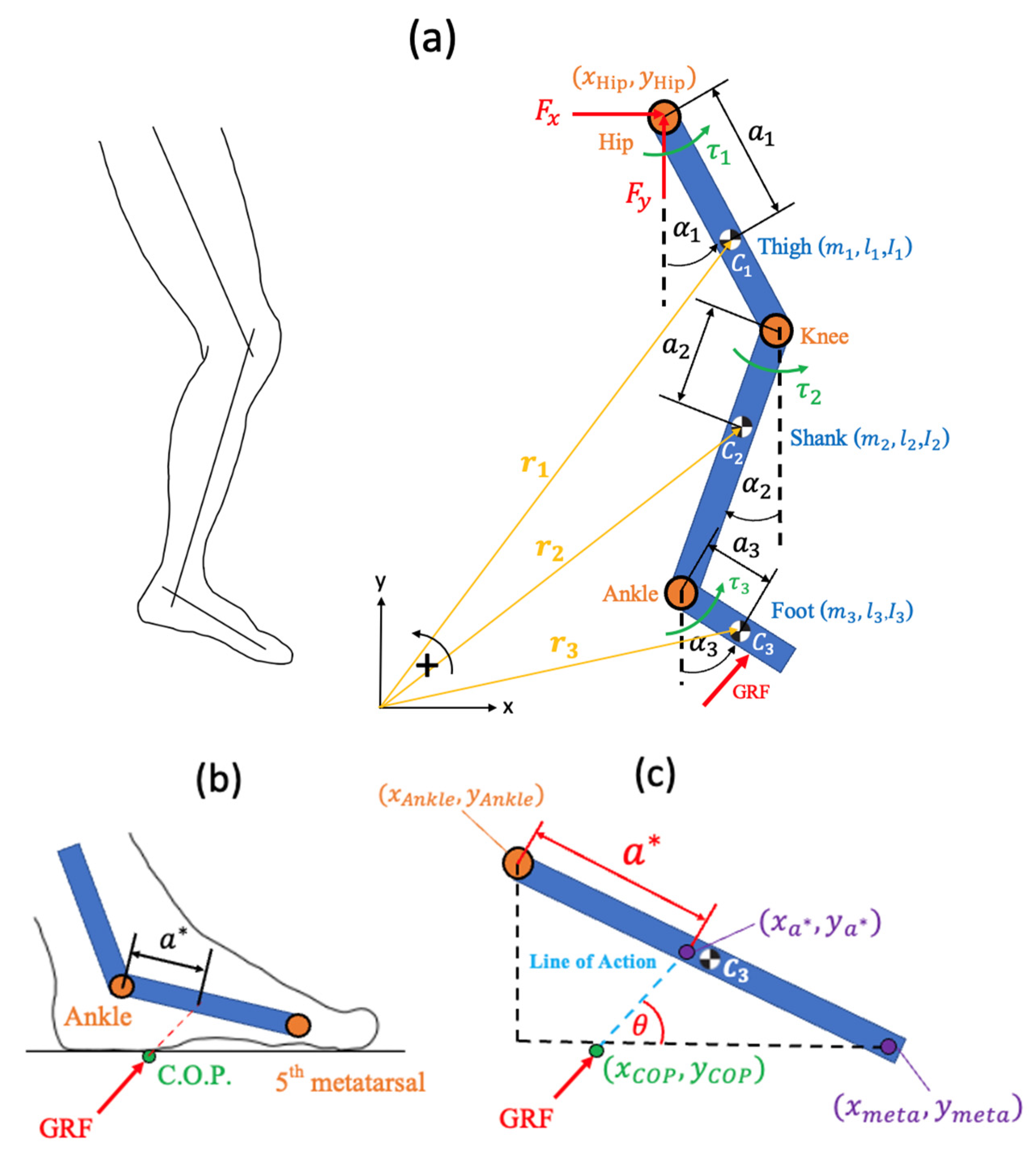
Figure 1a models the lower limb as a three-segment rigid linkage, comprising the thigh, shank, and foot. The model is driven by an input dataset comprising kinematic data from a motion capture system integrated with GRF and COP measurements recorded by a force plate. Using inverse dynamics, the model calculates net joint torques to provide quantitative insights into human gait locomotion. The validity of this 2D model is subsequently verified by comparing its output against joint torques generated by OpenSim (version 4.0; Stanford University, Stanford, CA, USA), a validated 3D biomechanical software package, using an identical experimental dataset. To determine segment kinematics, reflective markers were positioned at the hip, knee, ankle, and fifth metatarsal. Their Cartesian coordinates were aligned with the force plate’s coordinate system for spatial synchronization. These data were then used to calculate the absolute segment angles,  α 1 α 2 α 3 , in Figure 1a, for the thigh, shank, and foot via geometric relationships (Appendix B).
A critical challenge in our 2D formulation is the application of the GRF to the foot segment. Because the COP is located on the sole of the foot and does not coincide with the simplified geometry of the rigid foot link, as seen in Figure 1b,c, an equivalent force-moment system is required. The Principle of Transmissibility [17] (p. 24) is applied to translate the GRF from the COP to the modeled foot link. Under the assumption that the segment behaves as a rigid body, moment equivalence is strictly preserved for subsequent inverse dynamics calculations.
Since direct measurement of the subject’s mass distribution is not feasible, anthropometric data [7] was used to estimate the mass, COM, and moment of inertia for each segment. The moment of inertia  I  about the center of gravity was calculated as:
I = m ( k L ) 2
where m and L are the segment mass and length, respectively, and k is the dimensionless radius of gyration referenced to the center of gravity.

2.2. Mathematical Modeling

The lower extremity is modeled as a three-segment linkage system consisting of the thigh, shank, and foot (Figure 1a). These rigid links are characterized by their masses  m i , lengths  l i , and moments of inertia  I i , where  i = 1 ,   2 ,   3  corresponds to the thigh, shank, and foot, respectively. The COM for each link is located along the longitudinal axis at a distance  a i  from the proximal joint. The global positions of these COM points are defined by the position vectors  r 1 ,   r 2 ,  and  r 3 .
The hip, knee, and ankle joints are modeled as pin joints where the net muscle torques— τ 1 ,   τ 2 ,  and  τ 3 —are applied. Additionally, the hip joint forces act as external forces applied to the model. Segment orientations are defined by the absolute angles  α i , measured counterclockwise from vertical. Thus, there are angles corresponding to the three segments. While the knee and ankle are treated as hinge joints relative to the proximal segment, the hip is modeled as a “free joint” since the leg exhibits translational displacement rather than pure rotation alone, which requires two spatial positions to fully describe the aforementioned 2D translational motion of the entire leg. Consequently, the system possesses five degrees of freedom (DOF): the three angular orientations ( α 1 ,   α 2 ,   α 3 ) of each segment, and the global Cartesian coordinates of the hip ( x H i p ,   y H i p ) representing the translational motion of the human leg. These five kinematic quantities subsequently serve as the generalized coordinates for our model.
In Figure 1a, external loads include the active forces acting at the hip ( F x ,   F y ) and the GRF acting on the foot. The GRF is applied at a distance  a  from the ankle, as illustrated in Figure 1a. The model parameters are summarized in Table A1, while the derivation process for absolute joint angles and their angular rates is detailed in Appendix B.
As illustrated in Figure 1b,c, a challenge in 2D biomechanical modeling is that the GRF acts on COP at the sole, not directly on the rigid foot link (the segment connecting the ankle joint to the fifth metatarsal). To maintain mechanical equivalence, the GRF must be mapped onto the foot linkage.
By the Principle of Transmissibility, the GRF vector is shifted along its line of action to an equivalent intersection point ( x a , y a ) on the foot link, a process derived mathematically in Appendix C. This shift preserves the resultant moment about the ankle. The effective distance a*, which defines the GRF moment arm for calculating net joint torques, is therefore the Euclidean distance from the ankle ( x A n k l e , y A n k l e ) to this intersection point determined from:
a = x A n k l e x a 2 + y A n k l e y a 2
The EOM governing the 5-DOF linkage system in Figure 1a were derived using the Lagrange Equation:
d d t T q ˙ k T q k + V q k = Q k
where  T  and  V  represent the total kinetic energy and total gravitational potential energy of the system, respectively,  q k  is the k-th generalized coordinate describing the system configuration, and  Q k  is the generalized force corresponding to the k-th generalized coordinate.
There are five driving forces and torques,  F x ,   F y τ 1 ,   τ 2 ,  and  τ 3 , which serve as inputs in a forward dynamics framework to drive the human mechanism based on marker-measured kinematics. The first two components represent the joint forces acting on the hip, driving the translational motion of the entire link system, whereas the remaining quantities govern the angular motion of each individual linkage. Nevertheless, since our study focuses on the inverse dynamics process, these five quantities serve as the final outputs of the model.
Since the model possesses 5 DOF, five independent generalized coordinates are assigned to represent the global translation of the system and the absolute rotation of the segments. Hence, the vector of generalized coordinate  q  is:
q = α 1 α 2 α 3 x H i p y H i p T
In matrix form, the resulting EOM are expressed as
J ( q ) q ¨ + C ( q , q ˙ ) q ˙ + G ( q ) = Q
where
J ( q ) = J 11 J 12 J 13 J 14 J 15 J 21 J 22 J 23 J 24 J 25 J 31 J 32 J 33 J 34 J 35 J 41 J 42 J 43 J 44 J 45 J 51 J 52 J 53 J 54 J 55
C ( q ,   q ˙ ) = C 11 C 12 C 13 C 14 C 15 C 21 C 22 C 23 C 24 C 25 C 31 C 32 C 33 C 34 C 35 C 41 C 42 C 43 C 44 C 45 C 51 C 52 C 53 C 54 C 55
G ( q ) = G 1 G 2 G 3 G 4 G 5 T
Q = Q 1 Q 2 Q 3 Q 4 Q 5 T
Note that  J ( q )  is the inertia matrix,  C ( q ,   q ˙ )  is the matrix of Coriolis and Centripetal (velocity-dependent) terms,  G ( q )  is the vector of Gravitational terms, and  Q  is the vector of Generalized Forces, including muscle torques and external forces. The coefficients for these matrices, derived from the partial derivatives of the Lagrangian, are detailed in Table A2 (Appendix A).

3. Results

To validate the 2D Lagrange model, benchmarks were established using experimental datasets from Uhlrich et al. [18] and Arnold et al. [19]. These data were automatically reprocessed via AddBiomechanics framework [20] using raw coordinates to ensure kinematic consistency.
The verification suite comprises four cases testing various dynamic intensities:
  • Walking, drop-jump, and squatting maneuvers [18]
  • An additional walking profile [19] to extend the generalizability.
For more clarification, the anthropometry information of each dataset is provided in Table 1.
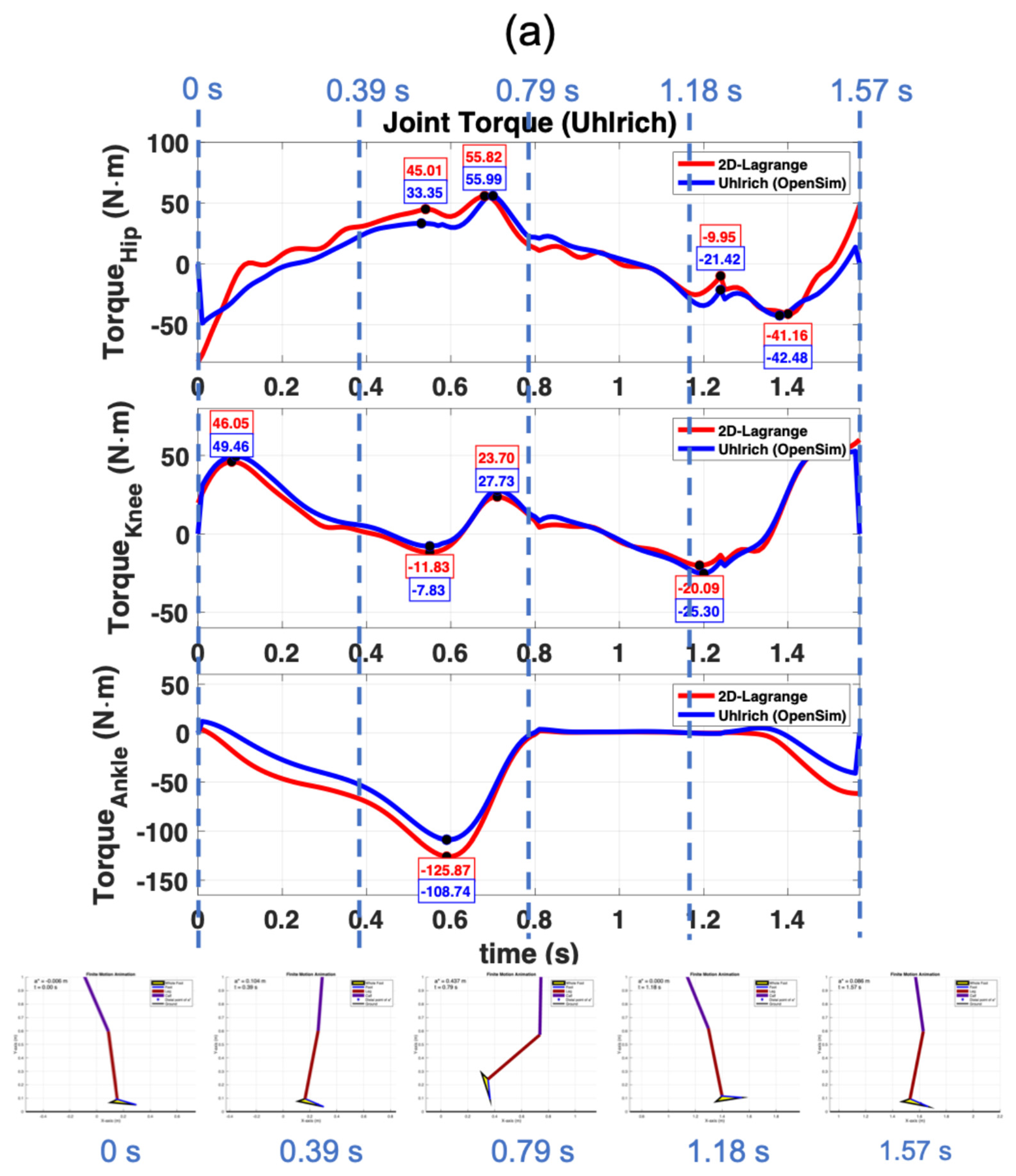
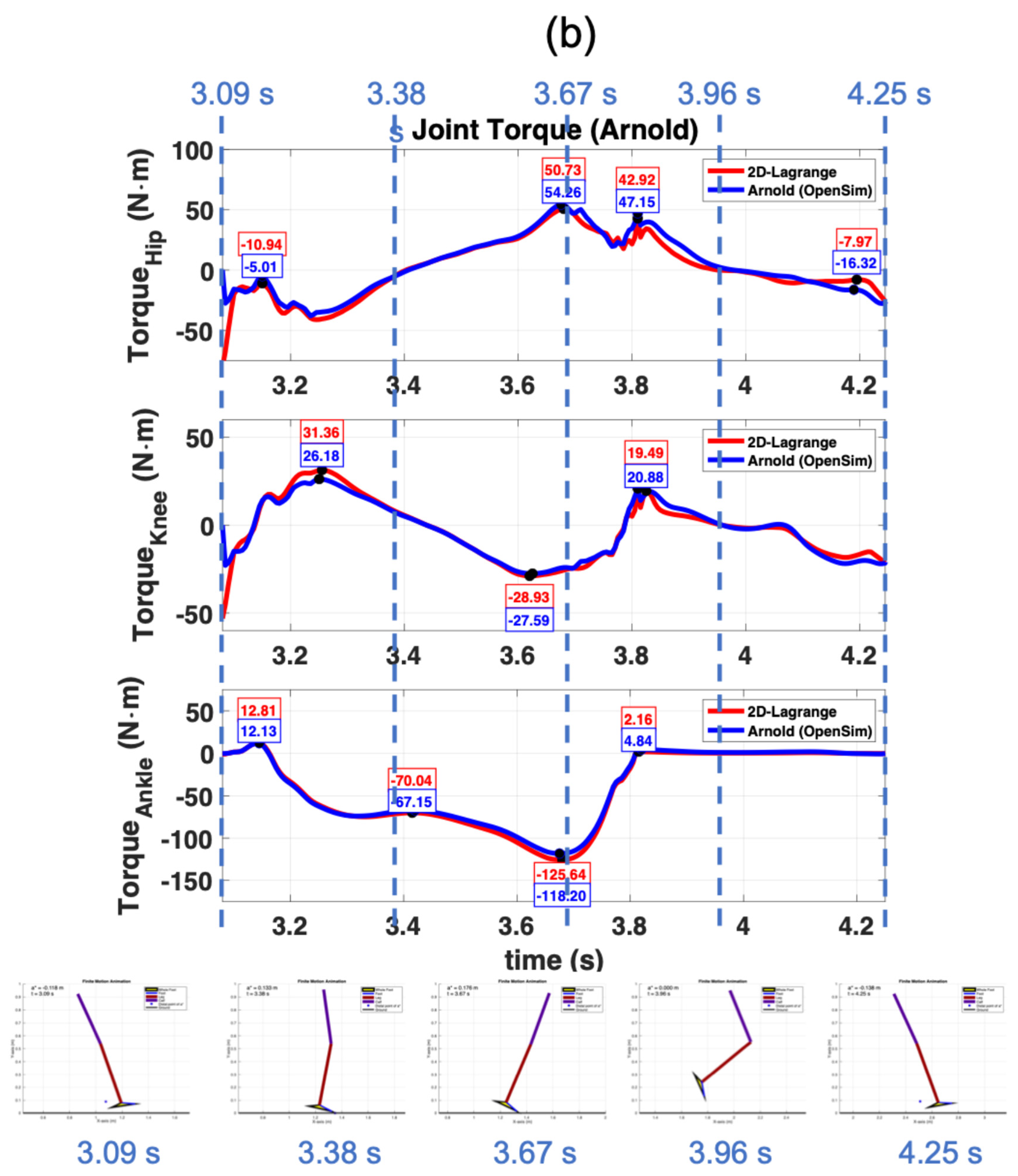
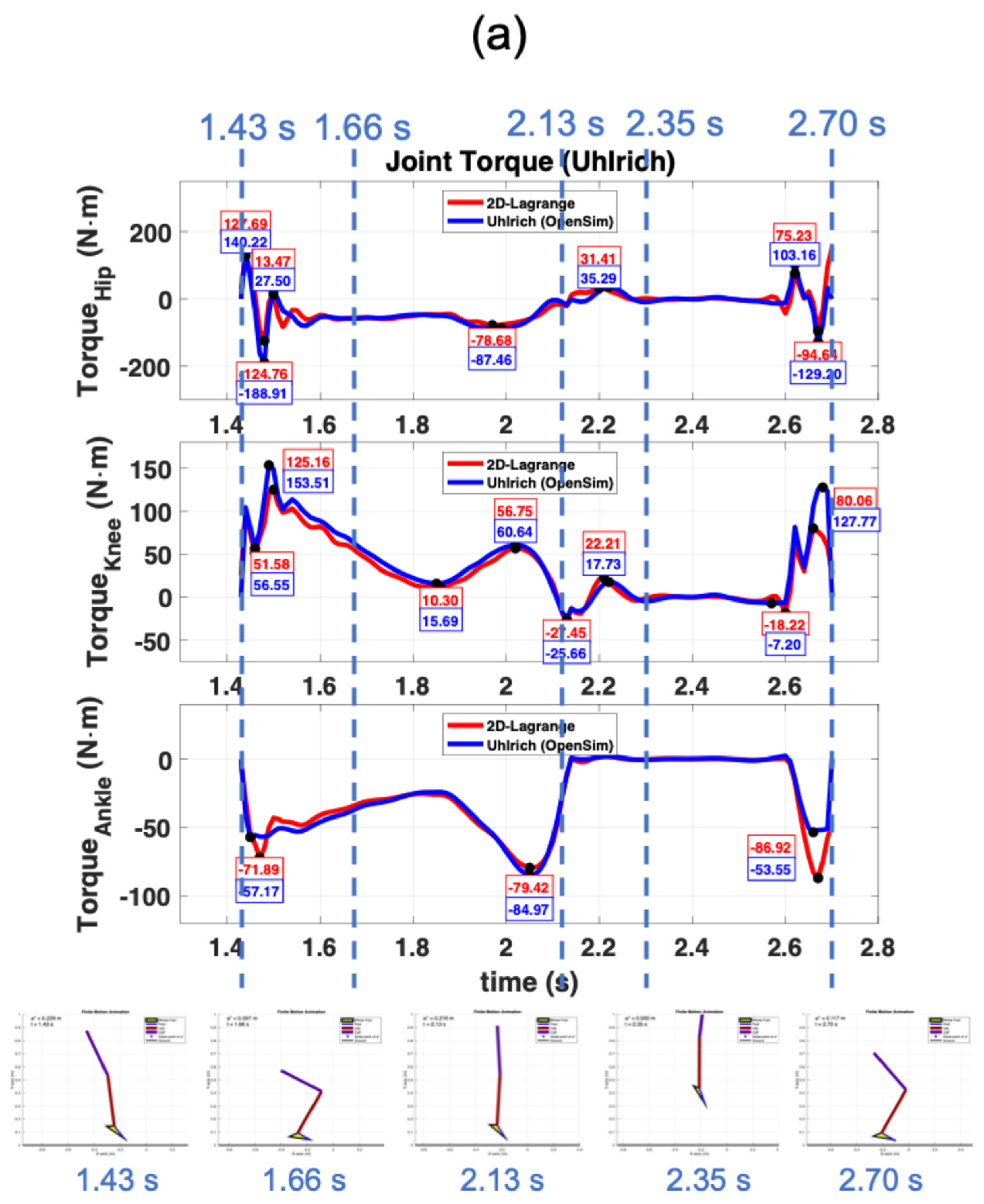
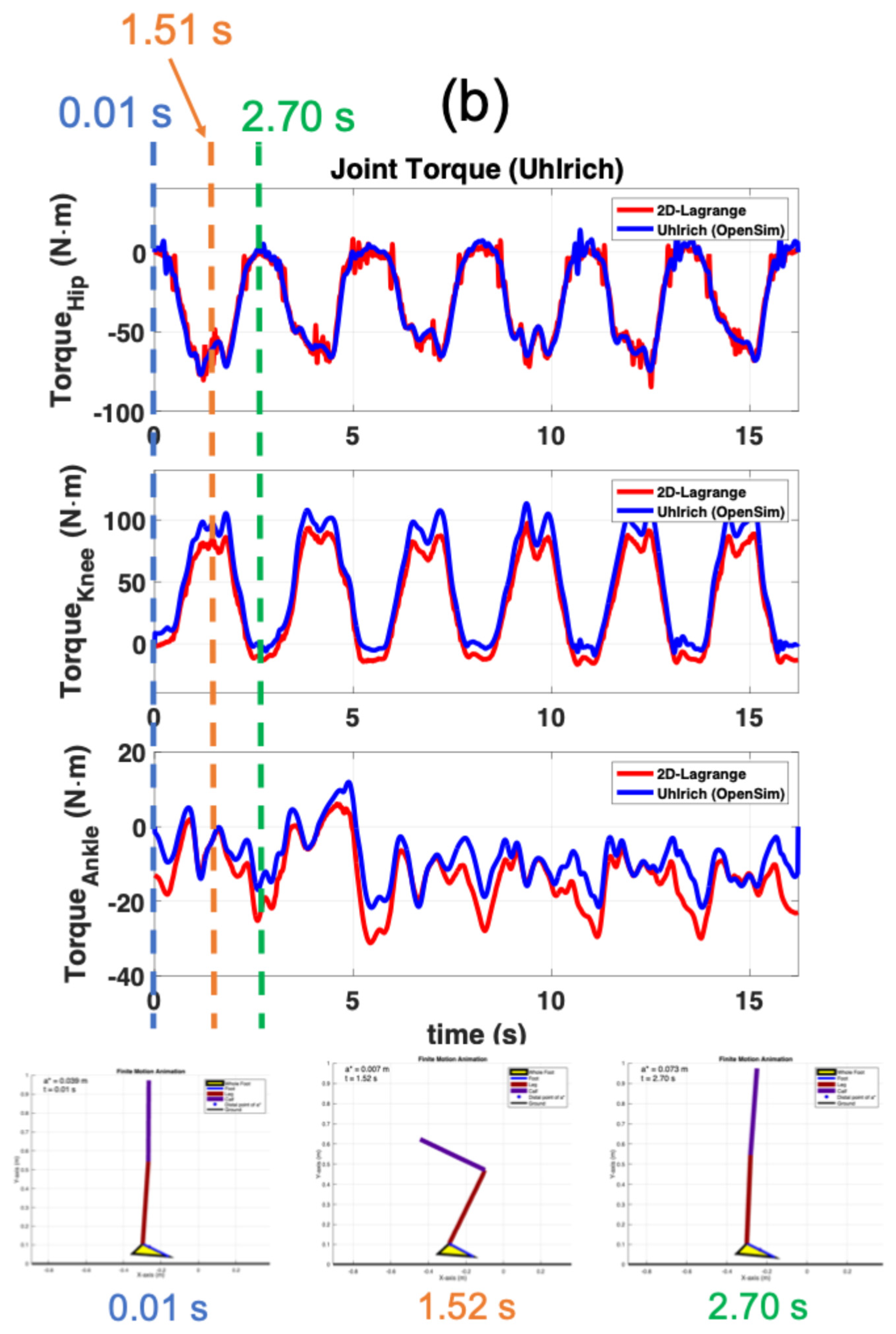
The predicted net joint torques from the 2D Lagrange model were compared against reference results obtained from OpenSim 4.0. The comparative results for the walking trials are presented in Figure 2a,b, while the drop-jump and squatting maneuvers are illustrated in Figure 3a and Figure 3b, respectively.
To quantify performance, the normalized root mean square error (NRMSE), normalized by the range of the reference signal, was calculated for the hip, knee, and ankle joint torques (Table 2).
Comparative results demonstrate that the 2D Lagrange model effectively captures dynamic joint torques across fundamental movement patterns. For walking trials (Figure 2a,b), most NRMSE values remained below 10%, except for Uhlrich’s ankle, which slightly exceeded this threshold, suggesting that a 2D sagittal-plane representation can provide reasonable accuracy for standard gait analysis. Furthermore, the torque profiles from the 2D model and OpenSim exhibited high phase synchronization, confirming the model’s temporal reliability. This consistency aligns with [21], who observed that while 2D and 3D joint moments may differ in magnitude, they exhibit nearly identical time-course patterns.
For the drop-jump maneuver (Figure 3a), NRMSE remained below 10%, though notable fluctuations occurred during initial and terminal ground contact. These peak torque discrepancies likely stem from the landing’s high-impact nature; as the feet outstretch upon impact, lower extremities may undergo minor transverse or frontal plane rotations. Such out-of-plane kinematics introduce mediolateral forces unresolved by a sagittal model, causing divergence at peak loading.
Regarding squatting (Figure 3b), hip torques correlated near-perfectly with OpenSim, showing only negligible peak deviations. Conversely, knee and ankle joints exhibited more pronounced magnitude offsets. While profiles remained strictly in-phase, the significant amount of offset is observed, especially at the ankle. This may be caused by several factors, such as the displacement of foot-attached markers, or the out-of-plane orientation of the foot during deep knee flexion, rendering the in-plane assumption an oversimplification.
In summary, the 2D Lagrange model provides a computationally efficient and accurate estimation of joint torques for movements primarily aligned within the sagittal plane. While magnitude discrepancies increase during maneuvers involving significant out-of-plane kinematics—such as the rapid impact of a drop-jump or the deep flexion of a squat—the model remains a robust tool for assessing the fundamental timing and trends of lower-limb dynamics.

4. Discussion

4.1. Physical Behavior

This section analyzes the subject’s kinematics and kinetics using the walking dataset provided by Arnold et al. [19], followed by a discussion of the physical principles governing these patterns.
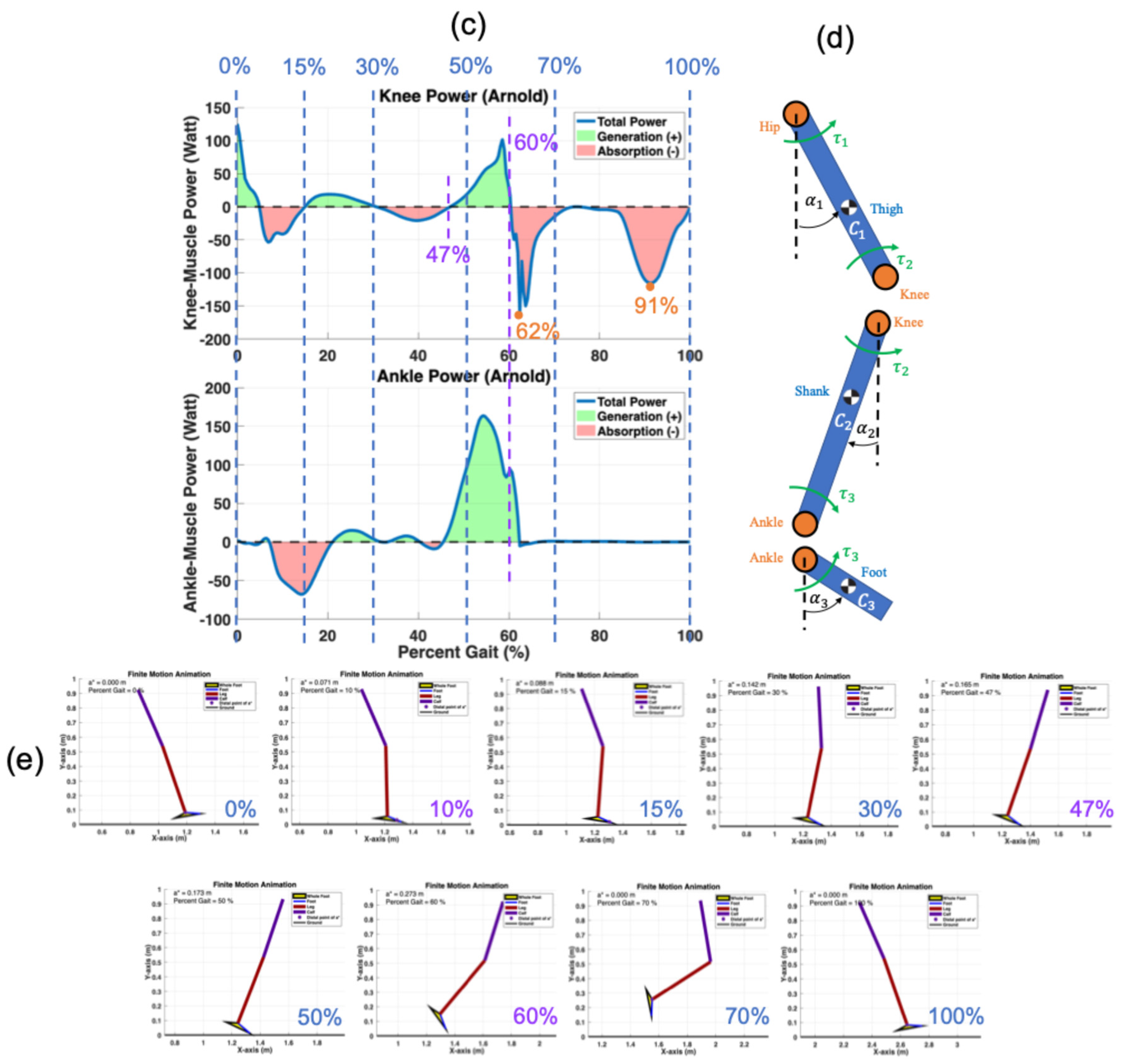
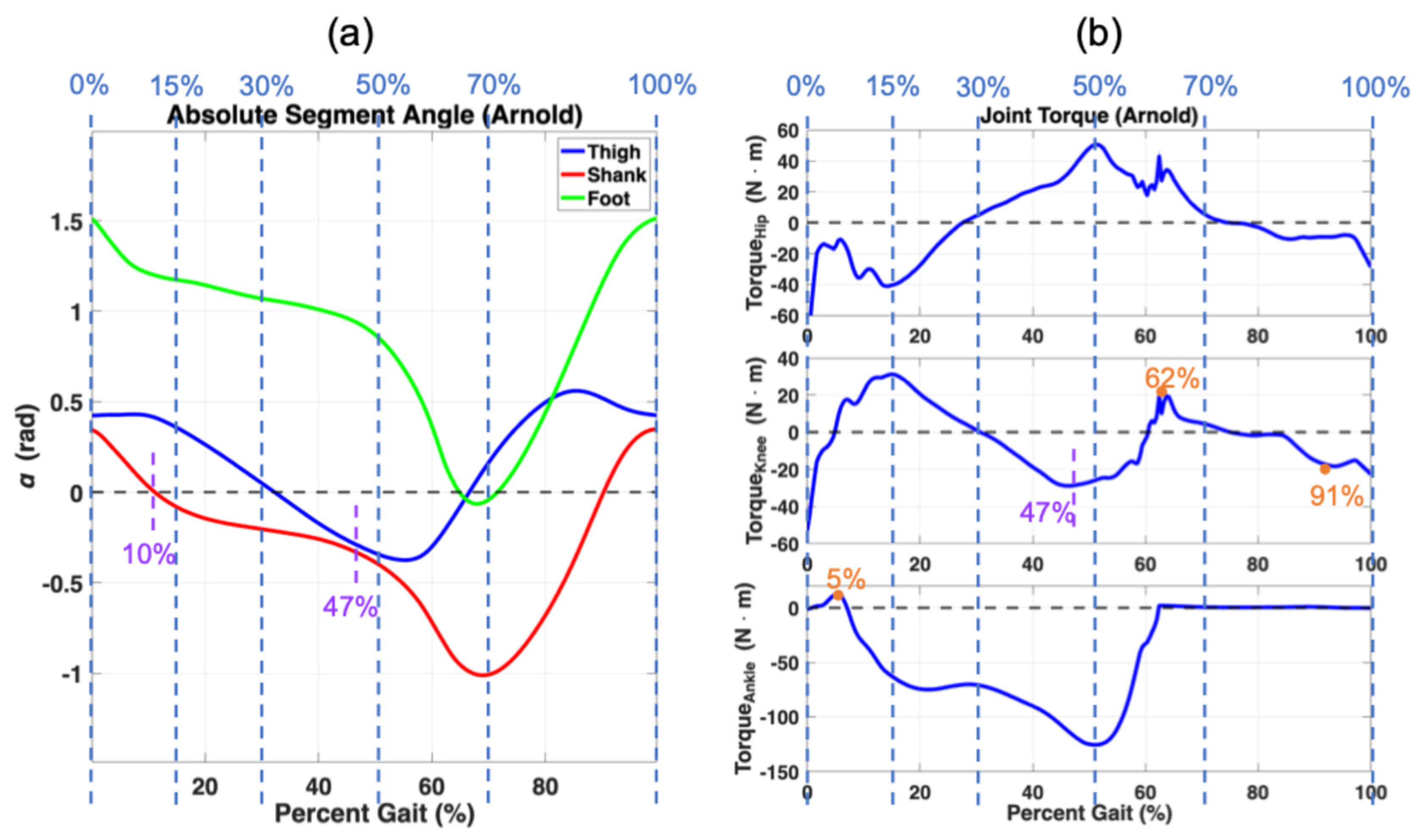
Figure 4 illustrates the joint angles, torques and powers computed via the 2D model. Positive sign conventions are defined in Figure 4d, where  τ 1 τ 2 , and  τ 3  represent the net internal joint torques of the hip, knee, and ankle, respectively. (Note that joint power profiles were determined from Equation (A5) in Appendix D.)
Correlation between the torque and power profiles and limb orientations in Figure 4 reveals the following distinct phases of the gait cycle (GC).
(1)
Initial Stabilization (0–15% GC):
At 0% GC, thigh and shank angles converge (Figure 4a,e), indicating near-full knee extension. During the 0–5% GC, the knee extensor moment approaches zero (Figure 4b) as the limb shifts from a posterior lean to a vertical orientation. By 5% GC, the knee torque crosses the zero-axis, transitioning from propulsion to active braking to stabilize the limb before the thigh reaches vertical at 10% GC (Figure 4a). Simultaneously, between 5% and 15% GC (Figure 4b), a sharp drop in ankle torque (increase in magnitude in a clockwise sense) reflects the plantarflexion required for the foot-flat transition.
During 0–15% GC, the knee exhibits fluctuating power resulting in nearly zero net work (Figure 4c), consistent with inverted pendulum behavior [10]. In contrast, the ankle performs significant negative work (Figure 4c) as the Achilles tendon pre-loads with potential energy, preparing the system for the subsequent push-off phase.
(2)
Thigh Propulsion (15–30% GC):
From 15 to 30% GC, mechanical focus shifts to the thigh. Coordinated negative hip torque and decreasing positive knee torque (Figure 4b) generate a net clockwise moment, accelerating the thigh toward verticality by 30% GC (Figure 4e).
Meanwhile, stabilized ankle torque following the foot-flat transition ends the active plantarflexion phase. Ankle power fluctuations remain minimal during 20–30% GC (Figure 4c), resulting in negligible mechanical work in this interval.
(3)
Transition and Preparation for Swing (30–50% GC):
In this phase, increasing positive hip torque and negative knee torque (Figure 4b) work together to decelerate the thigh’s clockwise rotation, “pre-loading” the limb for the counterclockwise swing ahead. Simultaneously, ankle torque drops sharply as the COP shifts toward the toes.
By approximately 47% GC, the thigh and shank angles converge (Figure 4a,e), marking a second near-full knee extension. Because these segments move at nearly identical speeds, the relative angular velocity at the knee reaches zero. Consequently, knee joint power vanishes at this interval despite significant torque, demonstrating that muscle power generation is driven by joint velocity rather than torque alone.
(4)
Late Stance to Pre-Swing (50–70% GC):
Positive hip torque acts as a brake during this phase, regulating thigh momentum as it transitions to counterclockwise rotation. Around 62% GC, a peak in negative knee power (Figure 4c) indicates the work required to decelerate the limb after it is lifted for ground clearance, preparing it for the forward swing. Simultaneously, ankle torque drops toward zero as GRF diminishes before toe-off.
Earlier, between 50 and 60% GC, positive work at the knee and ankle (Figure 4c)—partially powered by Achilles tendon elastic recoil—redirects the body’s COM velocity. This efficient energy transfer occurs just before the opposite heel strike, maximizing locomotive economy [10]. By 70% GC, the shank and foot reach their maximum posterior excursion and reverse direction (Figure 4a,e), initiating forward progression.
(5)
Swing Phase (70–100% GC):
During the final swing phase, ankle torque stabilizes near zero as the limb remains unloaded. Hip torque and knee torque transition to slightly negative values (Figure 4b), culminating in a final negative power surge at the knee around 90% GC (Figure 4c). This surge acts as a mechanical brake, regulating segment velocities to ensure a stable, synchronized configuration before the next heel strike.
Finally, the thigh and shank angles converge once more (Figure 4a,e), returning the limb to near-full extension. This convergence completes the gait cycle and mirrors the stabilization seen at initial contact, facilitating a seamless transition into the next stride.

4.2. Application and Limitation

4.2.1. Advantages and Clinical Utility

By utilizing kinematic data and force plate measurements, hip, knee, and ankle torques can be efficiently calculated via Lagrange-derived algebraic equations. This streamlined method minimizes technical complexity, making it potentially useful for clinical and rehabilitation applications.
For better interpretation, the model generates MATLAB (version R2024b; MathWorks, Natick, MA, USA) finite motion plots, visualizing subject posture alongside numerical torque results. Concurrently, it calculates joint reaction forces, essential for analyzing inter-segmental energy flow [12]. These features facilitate designing assistive devices, like actuated prostheses.

4.2.2. Model Limitations

The model has four primary limitations:
  • Net Torque Aggregation: Calculated values represent “net” joint torques—the algebraic sum of all muscle activity (flexors and extensors). Unlike muscle-actuated tools like OpenSim, this model cannot isolate individual muscle forces.
  • Planar Assumption: The model focuses on the sagittal plane, where most joint torque occurs during normal walking; therefore, out-of-plane torques are neglected.
  • The current model requires ground reaction forces (GRF) measured via a force plate, which may be inaccessible for users in practical, daily life scenarios. Consequently, alternative force estimation or measurement methods are necessary to fully capture all kinetic behaviors. Integrating these future methods with the wearer’s kinematic data may improve the accuracy of joint torque estimation in real-world environments.
  • Another constraint is the model’s reliance on a motion capture system for kinematic inputs, which has not yet been implemented in online exoskeleton control. Therefore, future studies need to address this challenge by developing practical methods to capture essential kinematic behaviors, thereby enabling accurate net torque estimation at each anatomical joint.

4.2.3. Parametric Versatility

The MATLAB implementation allows for rapid parametric tuning, including adjustments to mass, inertia, and segment lengths. This flexibility enables robust parametric studies, such as investigating the relationship between kinematic patterns and joint kinetics, or assessing the influence of subject weight and the additional load imposed by an equipped exoskeleton on ground reaction forces (GRF).

4.3. Geometric Sensitivity of the GRF Moment Arm

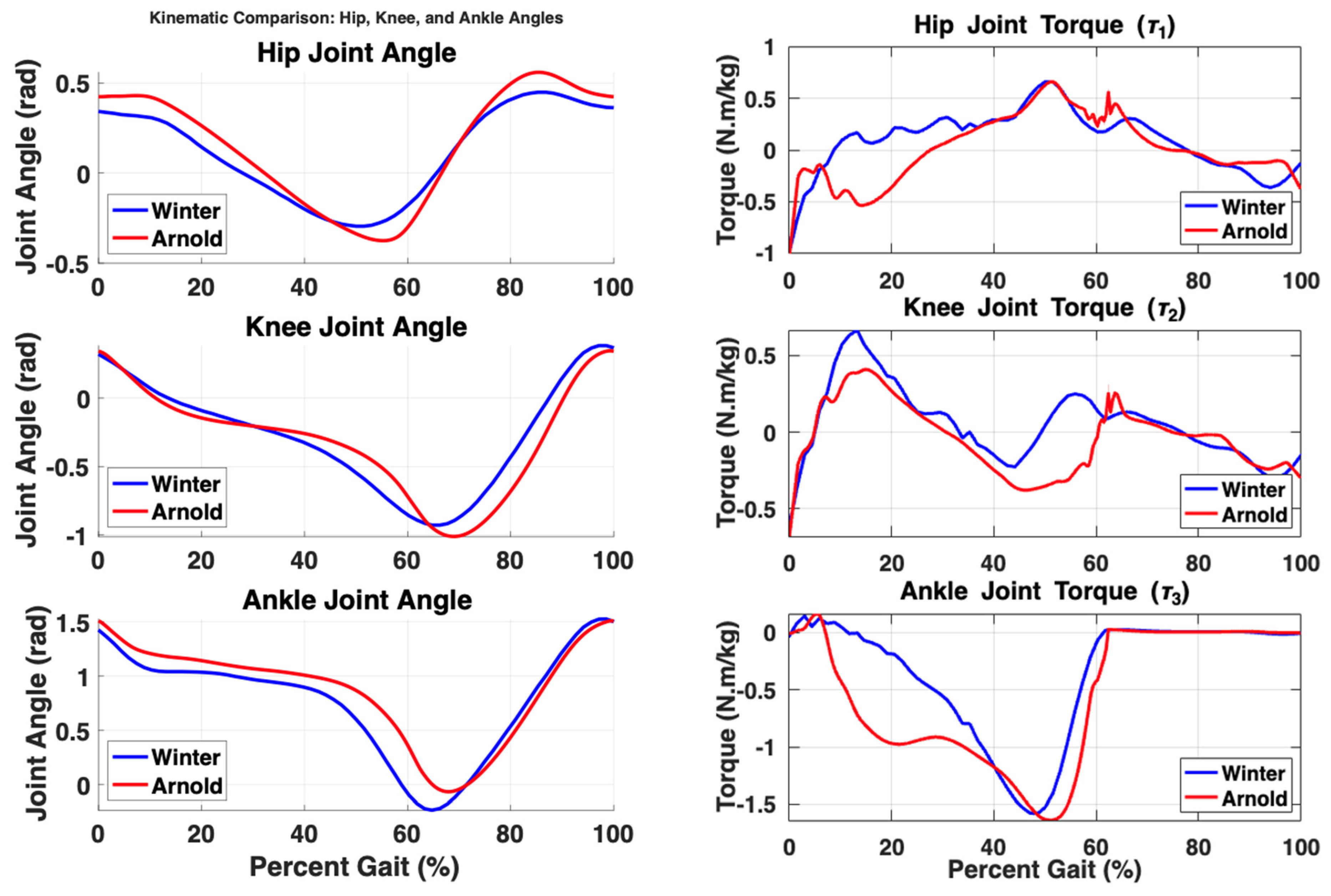
To demonstrate the model’s sensitivity, kinematic and resulting kinetic data of two different gait datasets from Winter [7] and Arnold et al. [19] were compared in Figure 5.
As illustrated in Figure 5, the segment angle profiles for both datasets are qualitatively similar; however, the Arnold dataset exhibits slightly higher fluctuations with more abrupt changes in slope.
Figure 5 also presents the joint torques normalized by body mass, revealing significant discrepancies in magnitude despite this normalization. These differences are prominent at the hip and ankle during the early stance phase (10–30%) and at the knee during the mid-to-late stance phase (40–60%).
The geometric sensitivity of the moment arm (a*) of GRF can explain the substantial divergence in hip and ankle torques observed during early stance (10–30% GC). Conversely, the profiles converge after 60% GC. As the foot enters the swing phase, the external moments vanish, leaving torque dictated solely by consistent internal dynamics.
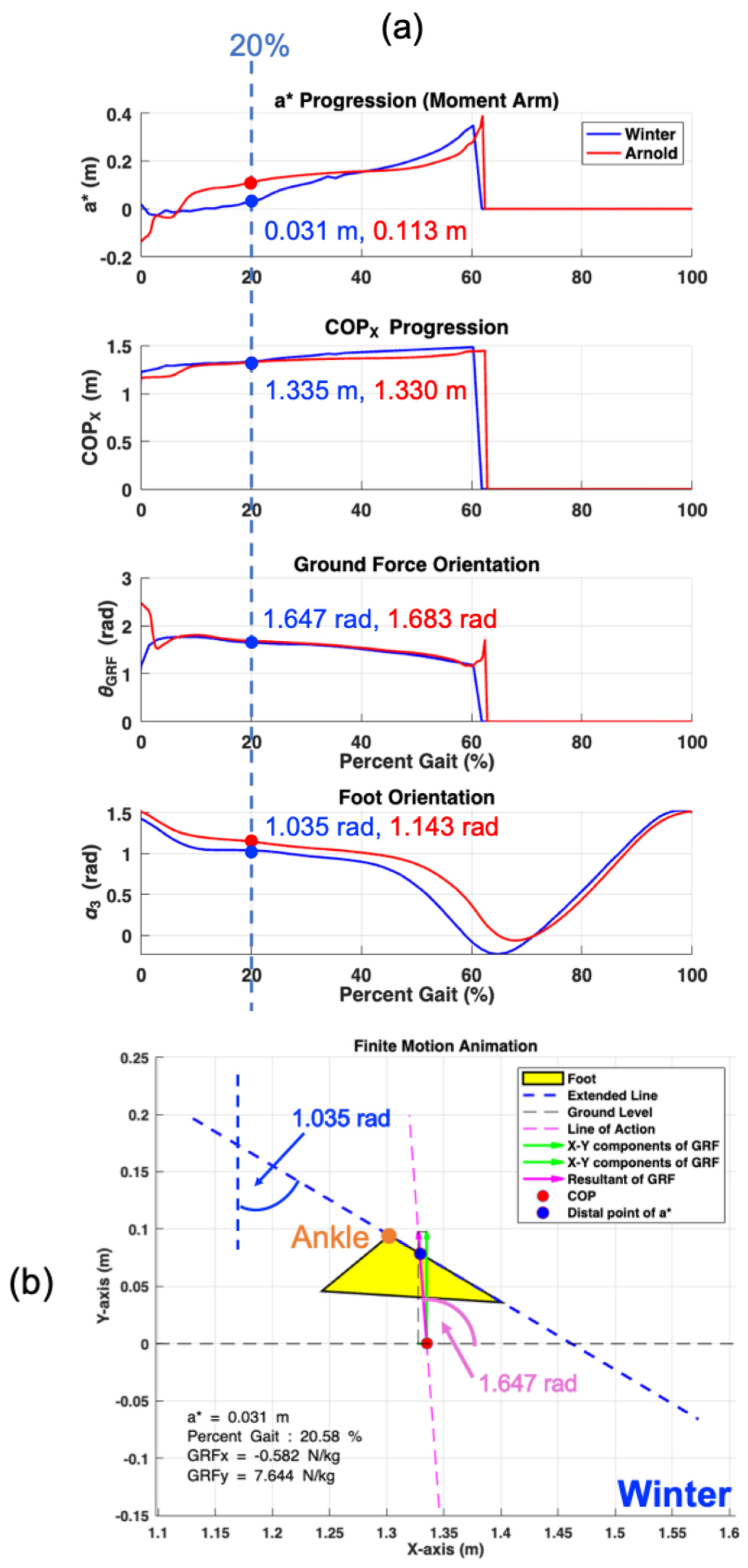
From Figure 1c, the GRF moment arm length a* is governed by three primary factors: (1) the orientation of the GRF vector ( θ ), (2) the orientation of the foot segment, and (3) the foot anatomical geometry. The first two factors determine the intersection of the line of action relative to the ankle, while the last specifies the anatomical location of the ankle joint relative to the foot. Furthermore, foot orientation affects the contact surface area between the foot and the ground, which ultimately influences the COP trajectory.
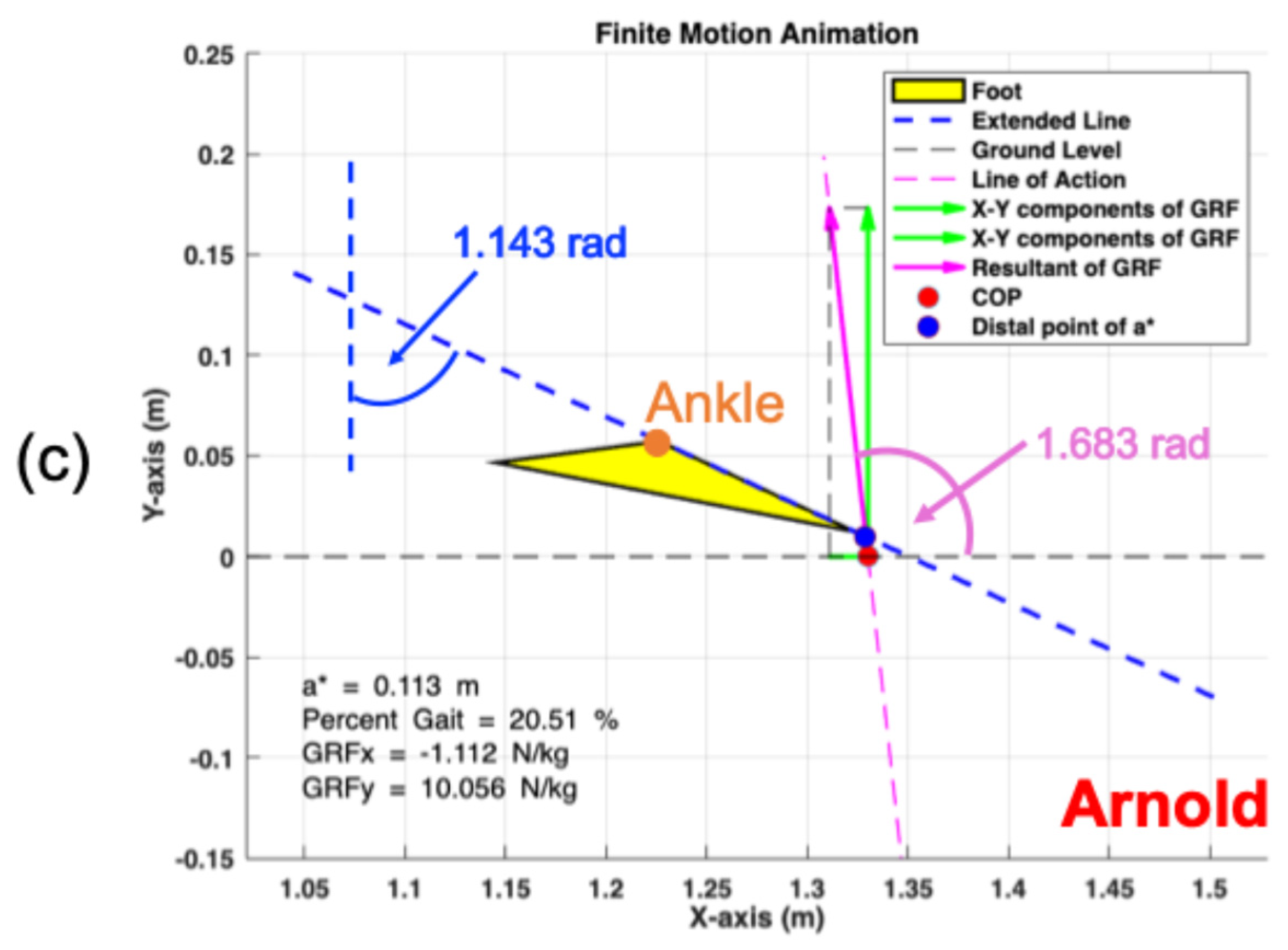
Figure 6 illustrates the temporal progression of the moment arm a*, COP, the ground reaction force (GRF) vector angle ( θ G R F ), and the absolute foot segment angle ( α 3 ), integrated with a foot kinematic visualization.
At 20% GC mark, a critical mechanical divergence occurs. While both subjects exhibit nearly identical GRF orientations ( θ G R F ) and COP positions, their underlying foot geometries—specifically the effective sole contact area and ankle joint placement—differ significantly. For Arnold, this geometry places the COP much closer to the toes relative to the ankle, resulting in the GRF moment arm a* (0.113 m) nearly four times larger than Winter’s (0.031 m). The mechanical disadvantage created by the longer moment arm dictates the higher hip torque and ankle torque at 20% GC in Figure 5.
This geometric sensitivity explains the disparate torque profiles observed during the 10–30% GC. The torque profiles eventually converge after 60% GC, as the dissipation of the GRF shifts the governing physics from external contact forces to internal segmental dynamics.

5. Conclusions

This work presents a 2D Lagrange model utilizing anthropometric data for a three-segment limb to predict sagittal-plane joint torques from motion capture and force plate measurements. The proposed framework was developed to provide accurate joint torque estimation during human locomotion while maintaining a computationally efficient model structure. The equations of motion, derived in matrix form, facilitate straightforward implementation in engineering software such as MATLAB R2024b. A primary advantage of the model is its ability to estimate dynamic joint torques without relying on predefined reference torque profiles. Validation against OpenSim for walking cases demonstrated that the proposed model achieves strong agreement with complex 3D musculoskeletal simulations, despite its reduced-order formulation. However, a significant discrepancy appears in squatting, which may be attributed to factors such as marker shift and out-of-plane misorientation. Nevertheless, the temporal synchrony remains acceptable. Beyond torque estimation, the framework provides insight into joint work, power, and the sensitivity of GRF moment arms to COP trajectories. The results further demonstrate that even under similar kinematic conditions, joint torque predictions remain highly sensitive to the interaction between ground reaction forces, COP progression, and foot geometry. Overall, the proposed approach provides a practical and computationally efficient tool for biomechanical analysis and establishes a foundation for future lower-limb exoskeleton, prosthetic, and assistive robotic applications. Future work will focus on validation using larger datasets and real-time implementation for wearable exoskeleton systems.

Author Contributions

Conceptualization, T.J.; Methodology, C.B.; Software, C.B.; Validation, C.B. and T.J.; Formal analysis, C.B. and T.J.; Investigation, C.B. and T.J.; Resources, T.J. and G.P.; Data curation, C.B. and T.J.; Writing—original draft, C.B., T.J. and G.P.; Writing—review and editing, C.B., T.J. and G.P.; Visualization, T.J. and G.P.; Supervision, T.J. and G.P.; Project administration, G.P.; Funding acquisition, G.P. All authors have read and agreed to the published version of the manuscript.

Funding

This research project is supported by the Second Century Fund (C2F), Chulalongkorn University, Bangkok, Thailand and the 111th Anniversary Engineering Research Catalyst Fund Towards U Top 100, Chulalongkorn University, Bangkok, Thailand.

Data Availability Statement

The original contributions presented in this study are included in the article. Further inquiries can be directed to the corresponding authors.

Conflicts of Interest

The authors declare no conflict of interest.

Appendix A

Table A1. Definition of symbols and parameters.
SymbolDescriptionUnit
a 1 The thigh C.O.M. position measured from proximal endm
a 2 The shank C.O.M. position measured from proximal endm
a 3 The foot C.O.M. position measured from proximal endm
a The position where ground reaction force is applied on the footm
F x The horizontal force acting on the hipN
F y The vertical force acting on the hipN
G x The X-component of a ground reaction forceN
G y The Y-component of a ground reaction forceN
I 1 The moment of inertia of the thigh kg · m 2
I 2 The moment of inertia of the shank kg · m 2
I 3 The moment of inertia of the foot kg · m 2
l 1 The distance between the hip and knee markersm
l 2 The distance between the knee and ankle markersm
l 3 The distance between the ankle and 5th metatarsal markersm
m 1 The mass of the thighkg
m 2 The mass of the shankkg
m 3 The mass of the footkg
r 1 The position vector of the thighm
r 2 The position vector of the shankm
r 3 The position vector of the footm
x A n k l e The X-coordinate of the marker at an anklem
x C O P The X-coordinate of the center of pressurem
x H i p The X-coordinate of the marker at a hipm
x K n e e The X-coordinate of the marker at a kneem
x M e t a The X-coordinate of the marker at an 5th metatarsalm
y A n k l e The Y-coordinate of the marker at an anklem
y C O P The Y-coordinate of the center of pressurem
y H i p The Y-coordinate of the marker at a hipm
y K n e e The Y-coordinate of the marker at a kneem
y M e t a The Y-coordinate of the marker at an 5th metatarsalm
α 1 The angle measured counterclockwise from the vertical reference to the thigh.rad
α 2 The angle measured counterclockwise from the vertical reference to the shank.rad
α 3 The angle measured counterclockwise from the vertical reference to the foot.rad
τ 1 The hip muscle torque N · m
τ 2 The knee muscle torque N · m
τ 3 The ankle muscle torque N · m
Table A2. Definition of Coefficients.
SymbolValueSymbolValue
J 11 m 1 a 1 2 + m 2 l 1 2 + m 3 l 1 2 + I 1 C 11 0
J 12 m 2 a 2 + m 3 l 2 l 1 cos α 1 α 2 C 12 m 2 a 2 + m 3 l 2 l 1 sin α 1 α 2 α 2 ˙
J 13 m 3 l 1 a 3 cos α 1 α 3 C 13 m 3 l 1 a 3 sin α 1 α 3 α 3 ˙
J 14 m 1 a 1 + m 2 l 1 + m 3 l 1 cos α 1 C 14 0
J 15 m 1 a 1 + m 2 l 1 + m 3 l 1 sin α 1 C 15 0
J 21 m 2 l 1 a 2 + m 3 l 1 l 2 cos α 1 α 2 C 21 m 2 l 1 a 2 + m 3 l 1 l 2 sin α 1 α 2 α 1 ˙
J 22 m 2 a 2 2 + m 3 l 2 2 + I 2 C 22 0
J 23 m 3 l 2 a 3 cos α 2 α 3 C 23 m 3 l 2 a 3 sin α 2 α 3 α 3 ˙
J 24 m 2 a 2 + m 3 l 2 cos α 2 C 24 0
J 25 m 2 a 2 + m 3 l 2 sin α 2 C 25 0
J 31 m 3 l 1 a 3 cos α 1 α 3 C 31 m 3 l 1 a 3 sin α 1 α 3 α 1 ˙
J 32 m 3 l 2 a 3 cos α 2 α 3 C 32 m 3 l 2 a 3 sin α 2 α 3 α 2 ˙
J 33 m 3 a 3 2 + I 3 C 33 0
J 34 m 3 a 3 cos α 3 C 34 0
J 35 m 3 a 3 sin α 3 C 35 0
J 41 m 1 a 1 + m 2 l 1 + m 3 l 1 cos α 1 C 41 m 1 a 1 + m 2 l 1 + m 3 l 1 sin α 1 α 1 ˙
J 42 m 2 a 2 + m 3 l 2 cos α 2 C 42 m 2 a 2 + m 3 l 2 sin α 2 α 2 ˙
J 43 m 3 a 3 cos α 3 C 43 m 3 a 3 sin α 3 α 3 ˙
J 44 m 1 + m 2 + m 3 C 44 0
J 45 0 C 45 0
J 51 m 1 a 1 + m 2 l 1 + m 3 l 1 sin α 1 C 51 m 1 a 1 + m 2 l 1 + m 3 l 1 cos α 1 α 1 ˙
J 52 m 2 a 2 + m 3 l 2 sin α 2 C 52 m 2 a 2 + m 3 l 2 cos α 2 α 2 ˙
J 53 m 3 a 3 sin α 3 C 53 m 3 a 3 cos α 3 α 3 ˙
J 54 0 C 54 0
J 55 m 1 + m 2 + m 3 C 55 0
G 1 m 1 a 1 + m 2 l 1 + m 3 l 1 g sin α 1
G 2 m 2 a 2 + m 3 l 2 g sin α 2
G 3 m 3 g a 3 sin α 3
G 4 0
G 5 m 1 + m 2 + m 3 g
Q 1 τ 1 τ 2 + G x l 1 cos α 1 + G y l 1 sin α 1
Q 2 τ 2 τ 3 + G x l 2 cos α 2 + G y l 2 sin α 2
Q 3 τ 3 + G x a cos α 3 + G y a sin α 3
Q 4 F x + G x
  Q 5 F y + G y

Appendix B

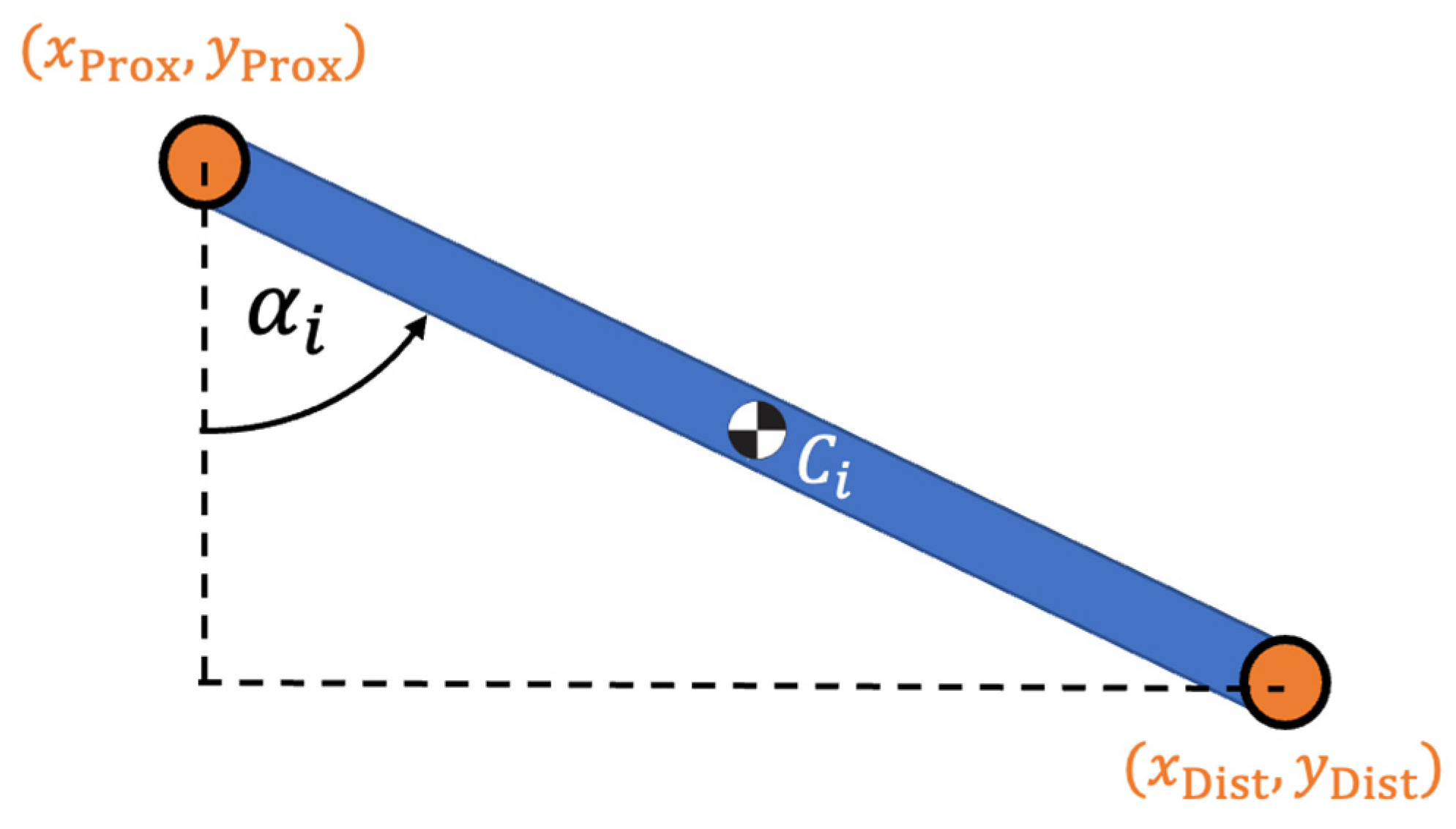
In Figure A1, to quantify the orientation of a lower limb segment, the absolute angles  α i  (where  i = 1 , 2 , 3  represents the thigh, shank, and foot, respectively) are calculated. Each angle is derived from the Cartesian coordinates of the joint markers using the following geometric relationship:
α i = tan 1 y P r o x y D i s t x D i s t x P r o x
where ( x P r o x y P r o x ) represent the coordinates of the proximal joint and ( x D i s t y D i s t ) represent the coordinates of the distal joint. For instance, in the thigh segment, the hip serves as the proximal joint while the knee serves as the distal joint. This convention ensures that all angles are measured consistently relative to the vertical axis. Furthermore, a Savitzky–Golay filter [22,23] was implemented to evaluate velocity and acceleration terms based on spatial coordinates in cases where these terms were not directly provided. This filtering technique ensures that the numerical differentiation of positional data does not introduce excessive noise.
Figure A1. Representation of a single segment with proximal/distal endpoints and local coordinate parameters.
Mathematics 14 02400 g0a1

Appendix C

To determine the equivalent point of application on the foot linkage ( x a , y a ), as shown in Figure 1c, we represent the GRF line of action and the rigid foot segment as two intersecting linear equations. The slope  s  of the GRF vector is defined by its vertical ( G y ) and horizontal ( G x ) components:
s = G y G x
Using the center of pressure ( x C O P y C O P ) as the reference point on the ground, the linear equation for the line of action is:
y = s x x C O P + y C O P
The foot segment is defined by the coordinates of the ankle ( x A n k l e , y A n k l e ) and the fifth metatarsal ( x M e t a , y M e t a ). Its linear equation is:
y = y A n k l e   y M e t a x A n k l e   x M e t a x x A n k l e + y A n k l e
By solving this system of two equations, we identify the coordinates ( x a , y a ) where the GRF line of action intersects the foot linkage. These coordinates serve as the distal point for calculating the effective distance a*.

Appendix D

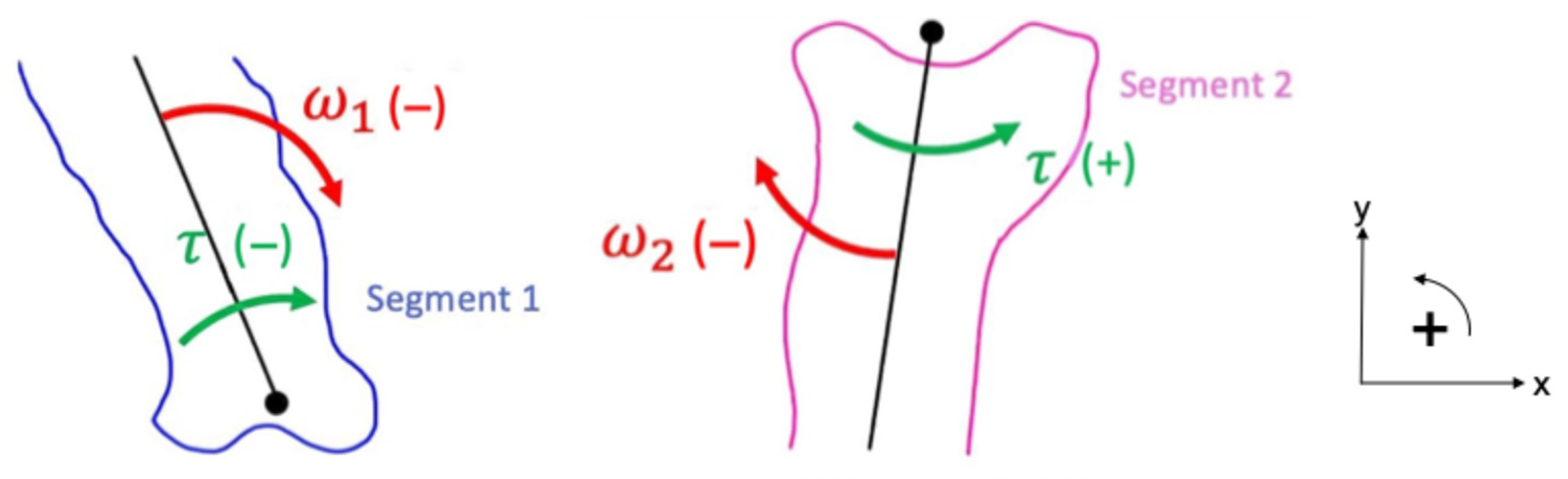
Figure A2 illustrates the interaction between two adjacent segments subjected to equal and opposite action–reaction muscle joint torques, denoted as  τ . The angular velocities of segments 1 and 2 are represented by  ω 1  and  ω 2 , respectively.
Figure A2. Internal joint torques (green arrows) acting on adjacent segments 1 and 2, with their respective angular velocities (red arrows).
Mathematics 14 02400 g0a2
Note that positive joint power indicates power generation by the muscles, while negative joint power reflects muscle-energy absorption [12].
Since our positive convention is defined as the counterclockwise direction, the joint power in segment 1 (+ P 1 ) yields a positive result from the product of negative joint torque (− τ ) and negative angular velocity (− ω 1 ), indicating that the muscles generate work and transfer it to this segment. In contrast, the joint power in segment 2 (+ P 2 ) yields a negative result from the product of positive joint torque (+ τ ) and negative angular velocity (− ω 2 ), where energy is absorbed from the segment by the musculature.
The net instantaneous muscle power  P  at the joint of interest is evaluated as follows.
P = τ ( ω 1 ω 2 )

References

  1. Lenzi, T.; Carrozza, M.C.; Agrawal, S.K. Powered hip exoskeletons can reduce the user’s hip and ankle muscle activations during walking. IEEE Trans. Neural Syst. Rehabil. Eng. 2013, 21, 938–948. [Google Scholar] [CrossRef] [PubMed]
  2. Kawamoto, H.; Hayashi, T.; Sakurai, T.; Eguchi, K.; Sankai, Y. Development of single leg version of HAL for hemiplegia. In Proceedings of the IEEE Engineering in Medicine and Biology Society (EMBC), Minneapolis, MN, USA, 3–6 September 2009; pp. 5038–5043. [Google Scholar] [CrossRef] [PubMed]
  3. Vallery, H.; van Asseldonk, E.H.F.; Buss, M.; van der Kooij, H. Reference trajectory generation for rehabilitation robots: Complementary limb motion estimation. IEEE Trans. Neural Syst. Rehabil. Eng. 2009, 17, 23–30. [Google Scholar] [CrossRef] [PubMed]
  4. Suzuki, K.; Mito, H.; Kawamoto, H.; Hasegawa, Y.; Sankai, Y. Intention-based walking support for paraplegia patients with robot suit HAL. Adv. Robot. 2007, 21, 1441–1469. [Google Scholar] [CrossRef]
  5. Kang, I.; Choi, H.; Farzad, M.M.S.; Aaron, P. Real-time gait phase estimation for robotic hip exoskeleton control during multimodal locomotion. IEEE Robot. Autom. Lett. 2021, 6, 3061380. [Google Scholar] [CrossRef] [PubMed]
  6. Camargo, J.; Ramanathan, A.; Flanagan, W.; Young, A. A comprehensive, open-source dataset of lower limb biomechanics in multiple conditions of stairs, ramps, and level-ground ambulation and transitions. J. Biomech. 2021, 119, 110320. [Google Scholar] [CrossRef] [PubMed]
  7. Winter, D.A. Biomechanics and Motor Control of Human Movement, 4th ed.; Wiley: Hoboken, NJ, USA, 2009. [Google Scholar]
  8. McBride, J.M.; Blaak, J.B.; Triplett-McBride, T. Effect of resistance exercise volume and complexity on EMG, strength, and regional body composition. Eur. J. Appl. Physiol. 2003, 90, 626–632. [Google Scholar] [CrossRef] [PubMed]
  9. Delp, S.L.; Anderson, F.C.; Arnold, S.L.; Loan, P.; Habib, A.; John, C.T.; Guendelman, E.; Thelen, D.G. OpenSim: Open-source software to create and analyze dynamic simulations of movement. IEEE Trans. Biomed. Eng. 2007, 54, 1940–1950. [Google Scholar] [CrossRef] [PubMed]
  10. Mansour, M.; Serbest, K.; Kutlu, M.; Cilli, M. Estimation of lower limb joint moments based on the inverse dynamics approach: A comparison of machine learning algorithms for rapid estimation. Med. Biol. Eng. Comput. 2023, 61, 3253–3276. [Google Scholar] [CrossRef] [PubMed]
  11. Schurr, S.A.; Marshall, A.N.; Resch, J.E.; Saliba, S.A. Two-dimensional video analysis is comparable to 3D motion capture in lower extremity movement assessment. Int. J. Sports Phys. Ther. 2017, 12, 163. [Google Scholar] [PubMed]
  12. Gordon, D.; Robertson, E.; Winter, D.A. Mechanical energy generation, absorption and transfer amongst segments during walking. J. Biomech. 2010, 13, 845–854. [Google Scholar] [CrossRef] [PubMed]
  13. McGrath, M.; Howard, D.; Baker, R. A Lagrange-based generalised formulation for the equations of motion of simple walking models. J. Biomech. 2017, 55, 139–143. [Google Scholar] [CrossRef] [PubMed]
  14. Lawson, B.E.; Mitchell, J.; Truex, D.; Shultz, A.; Ledoux, E.; Goldfarb, M. A robotic leg prosthesis: Design, control, and implementation. IEEE Robot. Autom. Mag. 2014, 21, 70–81. [Google Scholar] [CrossRef]
  15. Khalaj, N.; Vicenzino, B.; Smith, M.D. Hip and knee muscle torque and its relationship with dynamic balance in chronic ankle instability, copers and controls. J. Sci. Med. Sport 2021, 24, 647–652. [Google Scholar] [CrossRef] [PubMed]
  16. Gribble, P.A.; Robinson, R.H. An examination of ankle, knee, and hip torque production in individuals with chronic ankle instability. J. Strength Cond. Res. 2009, 23, 395–400. [Google Scholar] [CrossRef] [PubMed]
  17. Meriam, J.L.; Kraige, L.G. Engineering Mechanics: Statics, 7th ed.; John Wiley & Sons: Hoboken, NJ, USA, 2012. [Google Scholar]
  18. Uhlrich, S.D.; Falisse, A.; Kidziński, Ł.; Muccini, J.; Ko, M.; Chaudhari, A.S.; Hicks, J.L.; Delp, S.L. OpenCap: Human movement dynamics from smartphone videos. PLoS Comput. Biol. 2023, 19, e1011462. [Google Scholar] [CrossRef] [PubMed]
  19. Arnold, E.M.; Hamner, S.R.; Seth, A.; Millard, M.; Delp, S.L. How muscle fiber lengths and velocities affect muscle force generation as humans walk and run at different speeds. J. Exp. Biol. 2013, 216, 2150–2160. [Google Scholar] [CrossRef] [PubMed]
  20. Werling, K.; Bianco, N.A.; Raitor, M.; Stingel, J.; Hicks, J.L.; Collins, S.H.; Delp, S.L.; Liu, C.K. AddBiomechanics: Automating model scaling, inverse kinematics, and inverse dynamics from human motion data through sequential optimization. PLoS ONE 2023, 18, e0295152. [Google Scholar] [CrossRef] [PubMed]
  21. Alkjaer, T.; Simonsen, E.B.; Dyhre-Poulsen, P. Comparison of inverse dynamics calculated by two- and three-dimensional models during walking. Gait Posture 2001, 13, 73–77. [Google Scholar] [CrossRef] [PubMed]
  22. Savitzky, A.; Golay, M.J. Smoothing and differentiation of data by simplified least squares procedures. Anal. Chem. 1964, 36, 1627–1639. [Google Scholar] [CrossRef]
  23. MathWorks. Sgolayfilt—Savitzky-Golay Filtering—MATLAB. 2026. Available online: https://www.mathworks.com/help/signal/ref/sgolayfilt.html (accessed on 14 January 2026).
Figure 1. (a) Planar 2D three-segment link model of the human lower limb showing the free body diagram and generalized coordinates. (b) Foot with ground reaction force (GRF, red arrow) acting at COP (Shown as a green marker). (c) Free body diagram of the foot segment illustrating the ground reaction force (GRF, red arrow) and its line of action (dashed-blue line). See text for detailed parameter and variable definitions.
Mathematics 14 02400 g001
Figure 2. Joint torque comparison of (a) Uhlrich and (b) Arnold.
Mathematics 14 02400 g002aMathematics 14 02400 g002b
Figure 3. Joint torque comparison of (a) Uhlrich drop-jump and (b) Uhlrich squat.
Mathematics 14 02400 g003aMathematics 14 02400 g003b
Figure 4. Biomechanical profiles of lower-limb gait: (a) absolute segment angles ( α ); (b) joint muscle torques; (c) joint muscle power, where green and red shaded areas denote energy generation and absorption, respectively; (d) free body diagram of a 2D three-segment link with action-reaction joint muscle torque, all are based on positive convention; (e) limb postures at discrete intervals.
Mathematics 14 02400 g004aMathematics 14 02400 g004b
Figure 5. Kinematic patterns (Winter [7]; Arnold et al., [19]) and mass-normalized joint torque patterns.
Mathematics 14 02400 g005
Figure 6. (a) Comparison of gait parameters; (b) foot link kinematic of Winter (20% GC); (c) foot link kinematic of Arnold (20% GC).
Mathematics 14 02400 g006aMathematics 14 02400 g006b
Table 1. Dataset information.
CaseDataset NameGenderMass (kg)Height (m)
Uhlrich: walkingsubject2/walking1Male78.21.96
Arnold: walkingsubject02/walk2Male76.481.853
Uhlrich: drop-jumpsubject8/DJ2Female59.41.64
Uhlrich: squattingsubject5/squats1Male79.41.85
Table 2. NRMSE values of all cases.
CaseHip Joint TorqueKnee Joint TorqueAnkle Joint Torque
Uhlrich: walking9.175%4.521%10.537%
Arnold: walking6.251%5.932%2.564%
Uhlrich: drop-jump5.406%6.751%6.968%
Uhlrich: squatting4.739%10.416%18.008%
Disclaimer/Publisher’s Note: The statements, opinions and data contained in all publications are solely those of the individual author(s) and contributor(s) and not of MDPI and/or the editor(s). MDPI and/or the editor(s) disclaim responsibility for any injury to people or property resulting from any ideas, methods, instructions or products referred to in the content.