Review

Unsupervised Learning for Industrial Robot Health Monitoring: Trends, Techniques, and Challenges


by
Muhammad Umar Elahi
,
Rana Talal Ahmad Khan
,
Muhammad Haris Yazdani
and
Heung Soo Kim
*
Department of Mechanical, Robotics and Energy Engineering, Dongguk University-Seoul, 30 Pildong-ro 1-gil, Jung-gu, Seoul 04620, Republic of Korea
*
Author to whom correspondence should be addressed.
Mathematics 2026, 14(13), 2397; https://doi.org/10.3390/math14132397 (registering DOI)
Submission received: 30 April 2026 / Revised: 17 June 2026 / Accepted: 23 June 2026 / Published: 4 July 2026
(This article belongs to the Special Issue Artificial Intelligence for Fault Detection in Manufacturing)

Abstract

As industrial robots become increasingly essential to modern manufacturing and automation systems, ensuring their durability and operational integrity has emerged as a key concern. Traditional defect detection methods typically depend on labeled datasets and supervised learning techniques, which can be difficult and impractical to implement in real-world industries. In contrast, unsupervised learning presents a compelling alternative by facilitating anomaly detection and fault diagnosis without the need for labeled data. This article offers a thorough analysis of unsupervised learning techniques used in the health monitoring of industrial robots. We explore significant trends and key algorithms, such as clustering, autoencoders, and generative models, assessing their effectiveness in identifying faults and performance degradation. The research addresses the unique challenges associated with high-dimensional sensor data, variable operating conditions, and the lack of ground truth labels. Additionally, we highlight unresolved research questions and potential future directions, emphasizing the need for scalable, interpretable, and real-time solutions. This survey serves as a foundational reference for researchers and practitioners aiming to develop resilient and autonomous health monitoring systems for industrial robots.

1. Introduction

Industrial robots (IRs) are extensively employed in various manufacturing and production industries due to rising labor costs, complex job tasks, and hazardous working conditions. They are used in a wide range of applications, from high-precision assembly in automotive [1] and electronics [2] production to intricate tasks in aerospace [3,4], pharmaceuticals [5,6], logistics [7,8], and hazardous situations, including nuclear decommissioning and underwater infrastructure inspection [9,10,11]. The significant advancement in capabilities and implementation has been driven by the emergence of Industry 4.0, which promotes the seamless integration of cyber–physical systems, IoT connectivity, and data-driven intelligence in industrial environments [12,13]. Within this framework, robots are no longer confined to monotonous jobs; they are anticipated to function autonomously, adjust to fluctuating workloads, and interact safely with humans [14]. As IRs become increasingly vital to production, ensuring their durability and operational integrity is essential to prevent unexpected downtime and financial losses. Recent reports from the International Federation of Robotics (IFR) stated that by the end of 2024, an estimated 4.66 million IRs were operational in factories worldwide, reflecting a 9% increase from the previous year and record-high deployment levels. In that year alone, 542,076 new IRs were installed, marking the second-highest annual installation figure to date. This growth trend is expected to continue, with global robot installations projected to exceed 700,000 units by 2028, signaling sustained long-term expansion [15].
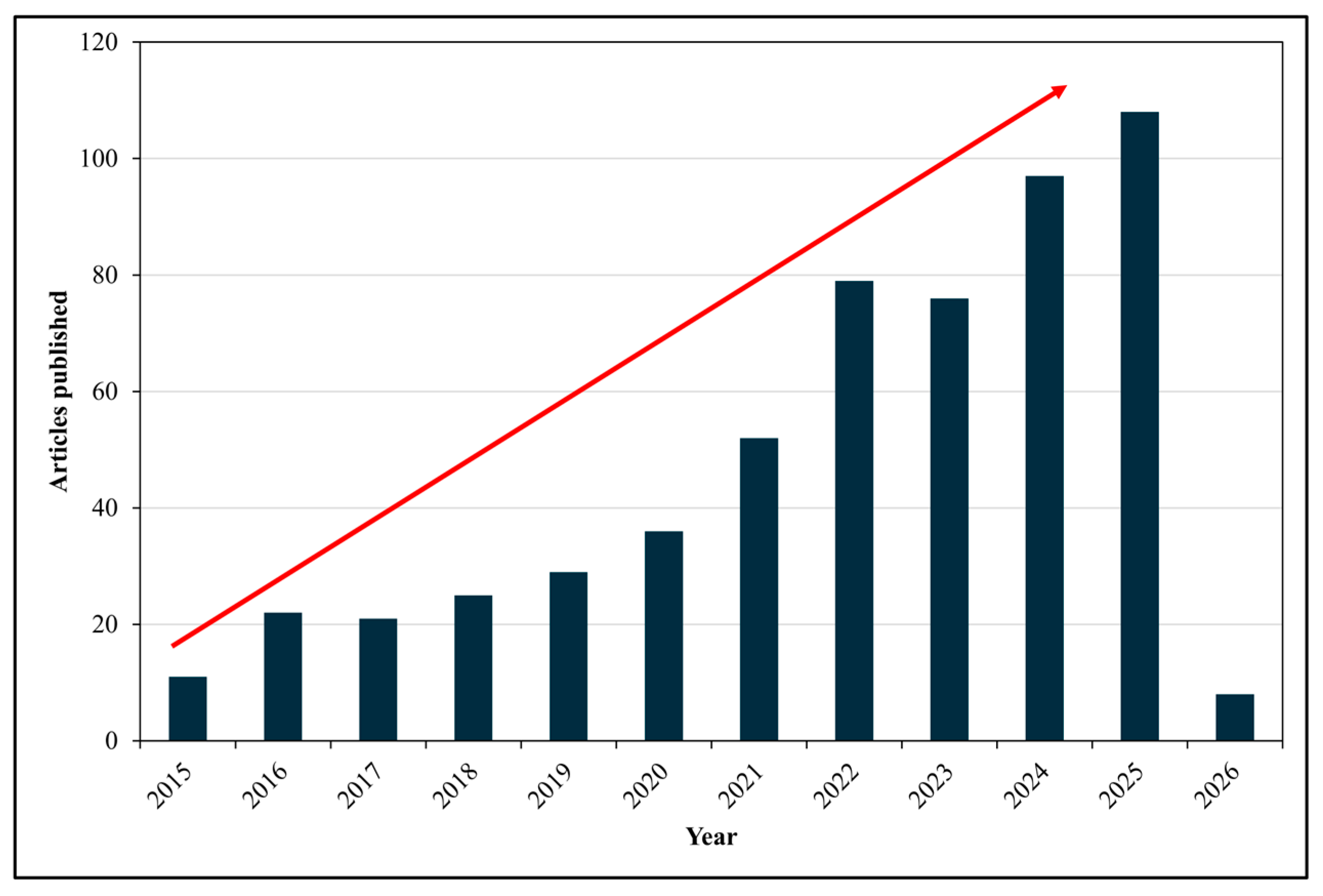
Figure 1 presents the annual publication trend for studies related to industrial robot fault monitoring and unsupervised learning (UL). The literature search covered studies published between January 2015 and April 2026 and was conducted using Web of Science, Scopus, IEEE Xplore, ScienceDirect, SpringerLink, MDPI, Google Scholar, and PubMed. The search strategy combined robot-related terms, including “industrial robot,” “robotic manipulator,” and “collaborative robot,” with PHM-related terms such as “fault detection,” “anomaly detection,” “health monitoring,” and “predictive maintenance,” and learning-related terms including “unsupervised learning,” “self-supervised learning,” “autoencoder,” “GAN,” “VAE,” “normalizing flow,” “clustering,” and “one-class classification.” Studies were included when they addressed industrial robots or robot-relevant subsystems and applied unsupervised, self-supervised, label-efficient, reconstruction-based, clustering-based, generative, or hybrid methods for health monitoring or anomaly detection. Studies were excluded when they were unrelated to industrial robot monitoring, relied exclusively on supervised learning without relevance to label-efficient methods, focused on non-industrial robotic applications or vision-only navigation, or lacked sufficient methodological or validation detail. The selected studies were classified according to learning principle, anomaly decision mechanism, diagnostic object, sensing modality, dataset type, evaluation metric, and deployment relevance. These qualitative trends are further organized by algorithm family, diagnostic object, sensing modality, anomaly criterion, and PHM task as discussed in Section 3.1 and Section 4.
The increase in publication volume has been accompanied by a clear evolution in technical routes and application targets. Earlier studies predominantly employed handcrafted statistical and frequency-domain features with clustering, dimensionality reduction, and one-class methods, typically using individual vibration or motor-current signals for bearings, gearboxes, motors, and transmission components. Subsequent research increasingly adopted autoencoders, variational autoencoders, generative adversarial networks, and time–frequency representations to model nonlinear and multivariate signals from reducers, actuators, joints, and controller systems. More recent studies, particularly those published between 2024 and 2026, have shifted toward self-supervised and attention-based learning, graph models, multimodal sensor fusion, digital-twin-assisted monitoring, and hybrid physics–data-driven frameworks. The sensing scope has similarly expanded from vibration and current measurements to torque, encoder, acoustic, thermal, force, and controller-log data. However, much of the available evidence still relies on proprietary laboratory datasets, while public robot-specific benchmarks and validation using real industrial data remain limited. Therefore, Figure 1 reflects not only increasing research activity but also a transition from isolated, component-level, single-signal monitoring toward condition-aware, multimodal, adaptive, and deployment-oriented industrial robot PHM.
As IRs become increasingly integrated into interconnected, data-driven production ecosystems, ensuring their operational health has emerged as a critical priority. In this context, prognostics and health management (PHM) has developed as an effective approach that combines sensing, diagnosis, and predictive analysis. This integration enables timely decision-making, minimizes downtime, and extends the lifespan of industrial robots [16,17]. Traditional PHM techniques, particularly those based on physics-driven or supervised learning approaches, often require significant expert input and large volumes of labeled fault data [18,19,20,21]. These data are costly and seldom available in real-world scenarios [22,23]. Supervised learning involves training models on labeled datasets, where input signals correspond to known fault labels. While this approach is effective, it is limited in its ability to generalize across different robotic platforms [24]. This has enabled unsupervised learning to identify anomalous patterns and emerging flaws directly from unlabeled data by modeling the intrinsic structure of normal data [25]. This limitation highlights the increasing significance of unsupervised learning, which provides a promising alternative by identifying abnormal patterns and emerging faults directly from unlabeled data. Consequently, unsupervised learning is particularly valuable for industrial robot fault detection and predictive maintenance, where obtaining labeled fault data is challenging or even impossible [26,27]. This review paper aims to help academics, engineers, and practitioners develop next-generation robot PHM systems that are efficient, autonomous, and responsive to the evolving dynamics of intelligent fault diagnosis by synthesizing current achievements and addressing practical challenges.
As shown in Table 1, the present review differs from previous studies by treating unsupervised and label-efficient learning as the central organizing theme and by connecting algorithmic principles with robot-specific sensing, trajectory-dependent operating conditions, benchmark limitations, and deployment requirements. The review covers relevant studies published between January 2015 and April 2026. Although several reviews have addressed industrial robot PHM, machine-learning-based fault diagnosis, and predictive maintenance, most focus on supervised learning, general deep learning, or rotating machinery monitoring. In contrast, this review differs by specifically focusing on unsupervised and label-efficient learning for industrial robot health monitoring, where fault labels are scarce, incomplete, or unavailable. This focus is important because industrial robots operate under task-dependent trajectories, variable payloads, controller-specific signals, and heterogeneous sensing conditions, making direct transfer from conventional supervised fault diagnosis insufficient. Accordingly, the main contribution of this review is to provide a robot-specific synthesis that integrates unsupervised learning methods with practical sensing modalities, fault sources, benchmark datasets, evaluation methodologies, and deployment challenges in industrial robot health monitoring.
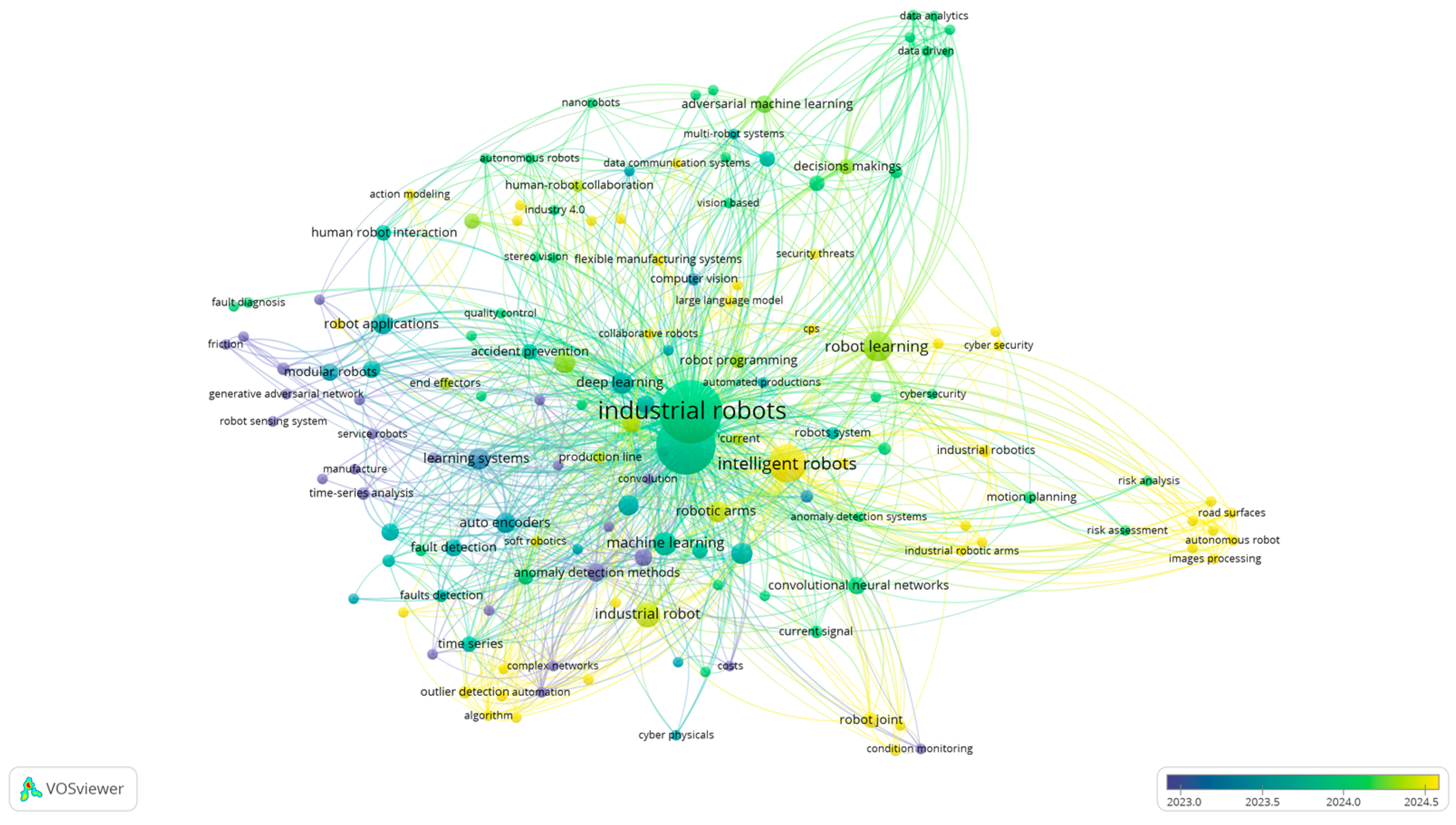
In this review, industrial robot health monitoring refers to the sensing, detection, interpretation, and maintenance-oriented assessment of faults or degradation affecting robot-specific subsystems and their operational performance. The scope includes robot joints, servo motors, actuators, bearings, gearboxes, RV reducers, encoders, cables, end-effectors, and controller systems, together with the effects of robot-specific operating conditions such as coupled joint dynamics, task-dependent trajectories, variable payloads, tool configurations, and human–robot interaction. Studies on general bearings, gearboxes, motors, and spindles are included only when their sensing principles, degradation mechanisms, signal-processing methods, or unsupervised anomaly detection strategies are transferable to corresponding robotic subsystems. These studies are not treated as direct evidence of robot-level performance unless they are validated on an industrial robot or under robot-relevant operating conditions. The prominence and interrelationships of these themes within the reviewed literature are further illustrated by the co-occurrence network of frequently appearing terms shown in Figure 2.
In this paper, we provide a comprehensive review of unsupervised learning techniques for industrial robot health monitoring, with a focus on their applications in anomaly detection, fault diagnosis, and predictive maintenance. Section 2 explains the rationale for using unsupervised techniques in robotic fault detection and discusses some of the main drawbacks of conventional methods. A detailed taxonomy of unsupervised algorithms is presented in Section 3, along with essential feature engineering and preprocessing methods. Section 4 highlights noteworthy applications and case studies that demonstrate how unsupervised learning models can be applied in industrial robot health monitoring. In Section 5, we review commonly used benchmark datasets, offering insights into model validation procedures. Section 6 addresses the current challenges and unresolved issues within the field. Promising research directions and recent advancements aimed at enhancing fault detection through unsupervised methods are explored in Section 7. Finally, Section 8 summarizes the conclusions of the review and offers suggestions for future research.

2. Motivation for Unsupervised Learning in Fault Detection

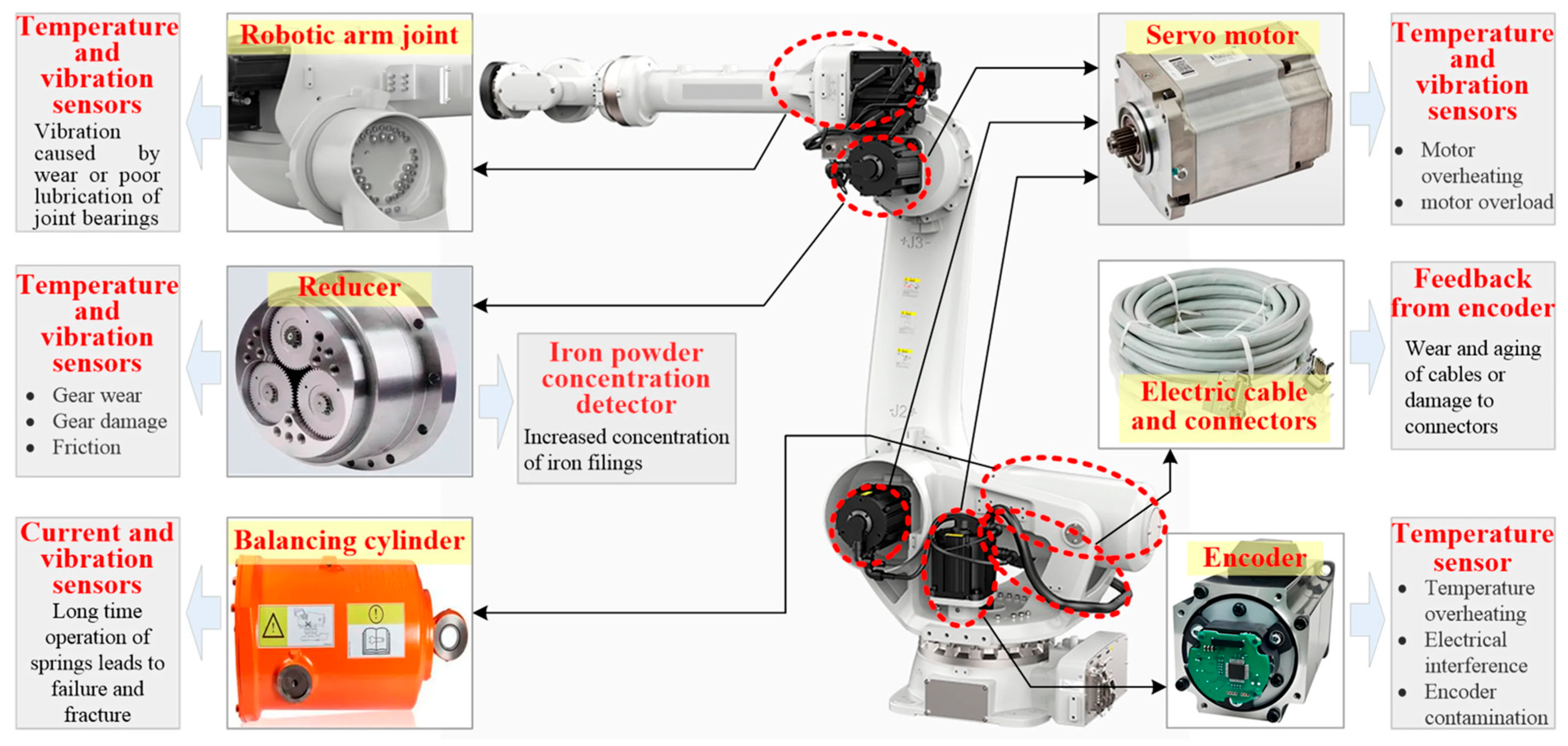
In industrial robots, ensuring operational continuity and preventing unexpected failures are critical challenges, particularly given the high variability and complexity of modern manufacturing conditions [16,40,41]. Traditional fault detection approaches, including physics-based modeling, data-driven modeling, and hybrid modeling, require extensive expert knowledge, well-defined system equations, and large volumes of labeled fault data—requirements that are rarely met in real-world industrial environments [16,21,42,43,44]. Moreover, mechanical and electrical components, such as bearings, gears, encoders, and RV reducers, often degrade, generating vibration signals, motor currents, acoustic signals, or thermal signals that may not exhibit clearly labeled failure patterns [45]. The various types of faults and major components of the industrial robot are shown in Figure 3.
To obtain a large volume of data, Zeynivand et al. introduced a hybrid digital twin methodology that integrates physics-based modeling with cloud-based data-driven diagnostics for bearing fault detection in industrial spindle systems. To simulate realistic bearing fault scenarios, they developed a custom MATLAB Simscape “Bearing Custom Block” that injects fault-induced disturbance torques into the spindle drive system. This model captures the quasi-periodic excitations resulting from localized bearing defects by modulating the electromagnetic torque based on shaft speed-dependent fault frequencies. By generating synthetic fault data across varying speeds and severities using Equation (1), this approach significantly reduces the need for risky real-world fault experiments while maintaining high diagnostic accuracy under previously unseen operating conditions [47].
τ fault t = α τ nom E t f F w f sin 2 π f f t t + ϕ f
where τ nom is nominal spindle load torque, factor α ranges from 0 to 1, which is dimensionality fault severity, E t is an optional envelope modeling gradual degradation; w f and ϕ f are the weighting factors and initial phases, f f t shows the defect characteristic frequency computed online from the instantaneous shaft rotational frequency, and F is a set of the modeled fault components.
Although various physics-based models have been developed to simulate working datasets for many industrial faults [48], e.g., Sabry et al. used Equations (2)–(4) to generate the power data for a single joint of an industrial robot actuator powered by a DC supply. They modeled the robot joint’s power consumption over time using Bode vector fitting, which enables the generation of additional data representing healthy patterns for fault detection. The total power consumption consists of two main components: (1) electrical losses from the actuator’s mechanical and electrical elements, and (2) power used to control the link’s speed and position [49].
d 2 ω d t 2 = k b L a J m V 1 J m d τ m d t R a L a J m τ m R a L a d ω d t k b 2 L a J m ω
d ω d t = τ τ m J m
d I d t = V L a R a L a I k b L a ω
where ω: angular speed of the actuator shaft [rad/s], I: motor current [A], V: applied voltage to the DC motor [V], Ra: armature resistance [Ω], La: armature inductance [H], J m : rotor moment of inertia [kg·m2], k b : back electromotive force (EMF) constant [V·s/rad], τ: input torque to the system [N·m], τm: mechanical load torque applied to the actuator [N·m], d τ m : rate of change of mechanical load torque [N·m/s]. To solve these differential equations, we first initialized the motor parameters and then performed numerical integration using MATLAB solvers, such as ode23 and ode45.
This enabled the simulation of the transient responses for three state variables: angular acceleration d ω / d t , rotational speed ω , and motor current I . Complex mathematical models and systems of equations have been extensively used to generate synthetic datasets for industrial robots, specifically to represent both optimal and defective working conditions when real-time data is scarce [50,51].
The inclusion of bearing, gearbox, motor, and spindle studies requires careful interpretation. These components are relevant because comparable elements are embedded within industrial robot joints, servo-drive systems, transmission units, and end-effector mechanisms, and they may exhibit similar physical degradation signatures in vibration, current, acoustic, thermal, or torque signals. Consequently, general machinery studies can provide transferable information on feature extraction, anomaly scoring, reconstruction modeling, and degradation-sensitive signal characteristics. However, their conclusions cannot be transferred directly to complete robotic systems because industrial robots exhibit configuration-dependent inertia, coupled joint dynamics, nonstationary trajectories, variable payloads, controller interactions, and task-specific disturbances. In this review, component-level studies are therefore used to support methodological and signal-level insights, whereas claims concerning robot-level robustness, fault localization, and industrial deployment are based primarily on studies conducted on robotic platforms or under robot-relevant operating conditions.
Nonetheless, due to intrinsic mathematical complexities and the limitations in accurately representing system dynamics, these models often fail to produce data that genuinely reflects real-world behavior. Consequently, simulation-driven data augmentation serves as a foundational element for unsupervised learning methodologies, which depend on understanding normal system behavior rather than relying on labeled fault data to detect anomalies.
Unsupervised learning presents a compelling alternative by utilizing healthy operational data to learn the underlying distribution of normal behavior and identify abnormal deviations, such as anomalies [52]. This framework is particularly beneficial for infrequent or developing fault situations where labeled samples are limited, costly to acquire, or absent. Additionally, unsupervised models offer intrinsic flexibility and scalability, allowing them to adapt to various signal types, such as scalograms, spectrograms, MCSA, and time series data for position or torque, as well as different robotic configurations. Unsupervised learning thus emerges as a viable approach for proactive and cost-effective industrial robot prognostics and health management by enabling label-free, online, and adaptive fault identification across complex multivariate sensor streams [53].

3. Taxonomy of Unsupervised Learning Techniques

3.1. Classification Framework for Unsupervised Learning Methods in Industrial Robot Health Monitoring

Fault detection in industrial robots often relies on learning from operational data that is minimally or entirely unlabeled. This technique is essential due to the scarcity, difficulty, and risks associated with collecting real fault records, which are often specific to particular tasks or working conditions. A well-defined taxonomy is therefore necessary to clarify how clustering, generative models (such as reconstruction or density models), and self-supervised representation learning interact with different robot subsystems (like bearings, gearboxes, RV reducers, motors, encoders, and joints) and various signals (motor current, vibration, torque, encoder position, and time–frequency images). The prevailing trend in the literature involves first learning the normal behavior of a system and then identifying deviations through anomaly scores, reconstruction errors, or cluster distances. This strategy reduces dependence on labeled failure examples and supports predictive maintenance.
This taxonomy focuses on unsupervised learning in a broad context. It includes techniques that (a) train exclusively on healthy data or (b) generate representations from unlabeled data, requiring only limited labeling for downstream. These techniques are primarily used in industrial robots for (i) detecting unusual joint currents and angles during repetitive operations, (ii) identifying vibrations in robotic joints and transmission components, (iii) assessing the condition of gearboxes or reducers via current signals, and (iv) employing time-frequency image processing methods, such as short-time Fourier transform spectrograms or continuous wavelet transform scalograms, to extract robust features under varying conditions [54]. According to previous research, unsupervised learning methods for industrial robot health monitoring can be broadly classified according to their learning principle and anomaly decision mechanism. Six major methodological categories are concisely summarized in Table 2.
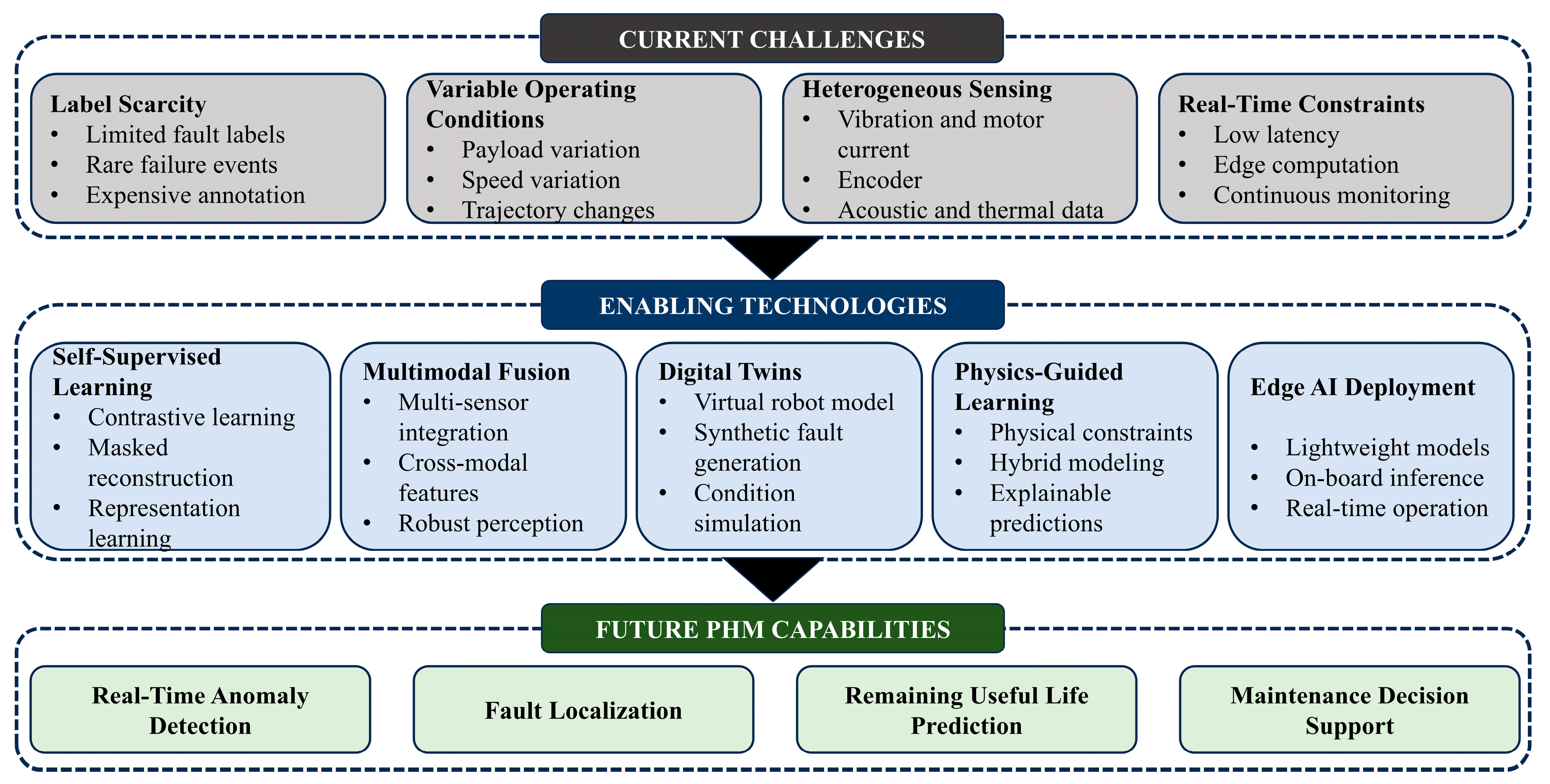
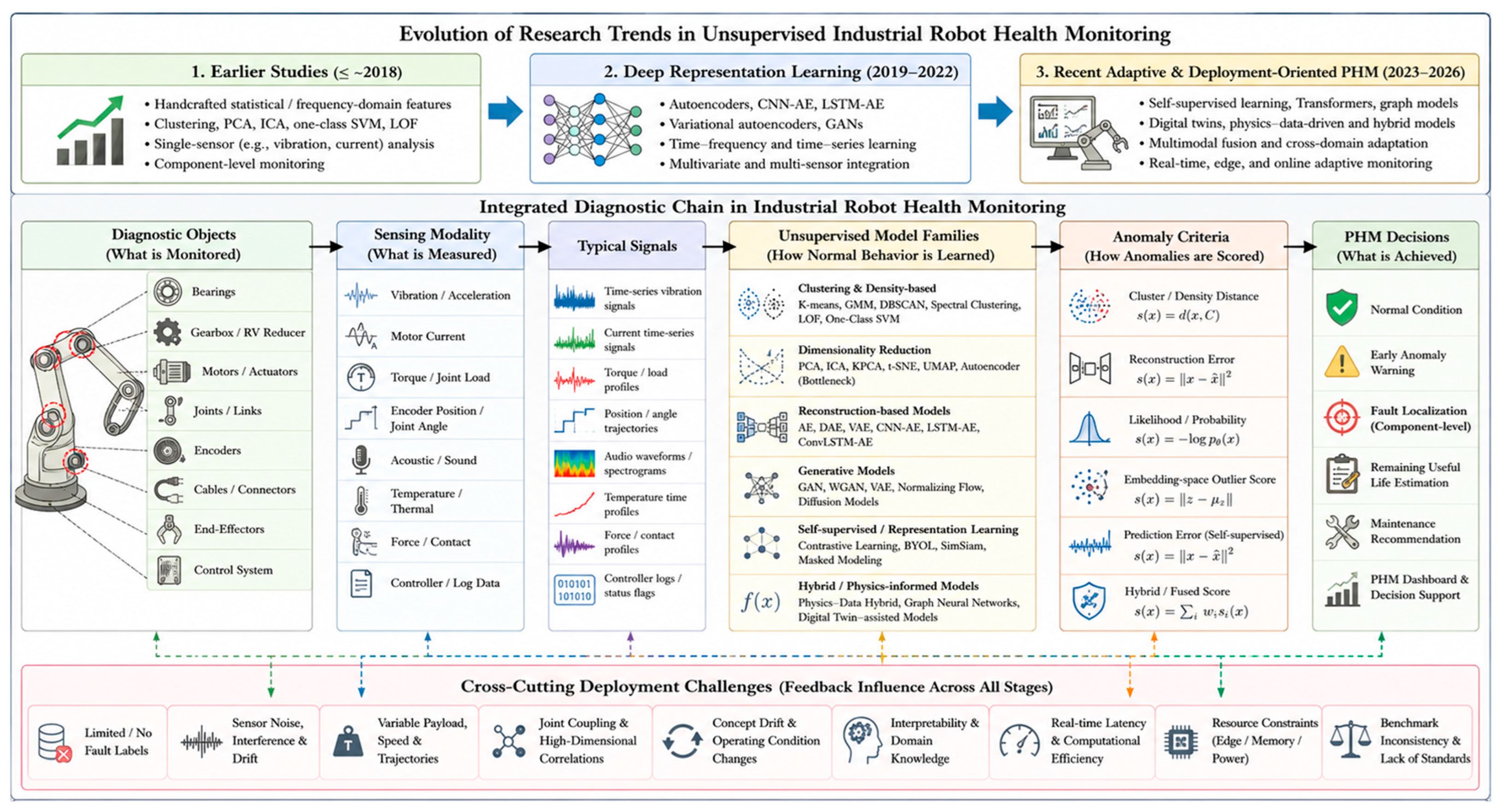
To provide an integrated synthesis of the reviewed literature, Figure 4 combines the methodological evolution of unsupervised industrial robot health monitoring with its physical, analytical, and deployment structure. The upper panel traces the transition from earlier studies based on handcrafted statistical and frequency-domain features, clustering, dimensionality reduction, and single-sensor analysis, to deep representation learning using autoencoders, generative models, time–frequency analysis, and multivariate sensing. It further highlights the recent shift toward self-supervised learning, Transformers, graph-based models, digital twins, physics–data-driven frameworks, multimodal fusion, domain adaptation, and real-time edge deployment.
The central panel presents the diagnostic chain from the monitored robot subsystem to the final PHM decision. Diagnostic objects, including bearings, gearboxes, RV reducers, motors, joints, encoders, cables, end-effectors, and control systems, are linked to sensing modalities such as vibration, motor current, torque, encoder position, acoustic response, temperature, force, and controller logs. These measurements are represented as time-series signals, trajectories, spectrograms, thermal profiles, force profiles, or status information and are then analyzed using clustering, dimensionality reduction, reconstruction-based models, generative models, self-supervised learning, or hybrid physics-informed methods. Each learning paradigm produces a corresponding anomaly criterion, including cluster or density distance, reconstruction error, likelihood or probability, embedding-space deviation, prediction error, or a fused anomaly score. These scores support normal-condition assessment, early anomaly warning, component-level fault localization, remaining useful life estimation, maintenance recommendation, and PHM decision support.
Three principal relationships emerge from this synthesis. First, the monitored component and the expected fault mechanism determine the most informative sensing modality and signal representation. Vibration and acoustic signals are particularly relevant to bearings, reducers, and structural faults, whereas current, torque, encoder, thermal, force, and controller data provide complementary information on actuators, trajectories, loading conditions, control behavior, and human–robot interaction. Second, the anomaly criterion is mathematically determined by the selected model family. Clustering methods rely on distance or density, reconstruction models on residual error, generative models on likelihood, self-supervised models on prediction or embedding-space deviation, and hybrid systems on weighted or fused scores. Third, the lower panel shows that deployment challenges act across the entire monitoring chain. Limited labels, sensor noise, variable payloads and trajectories, joint coupling, concept drift, interpretability requirements, latency, hardware constraints, and benchmark inconsistency influence sensing quality, representation learning, model selection, anomaly threshold calibration, and final maintenance decisions. Thus, the figure emphasizes that reliable industrial robot PHM requires joint consideration of physical fault mechanisms, sensing design, algorithmic formulation, and deployment conditions.
The first is clustering-based fault detection, where operational data are grouped into operating regimes using methods such as k-means, density-based clustering, Gaussian mixture models, and fuzzy clustering; samples that deviate from these groups are treated as potential anomalies. The second is dimensionality-reduction-based analysis, where PCA, kernel PCA, t-SNE, UMAP, and manifold learning compress high-dimensional robot signals into lower-dimensional spaces for visualization, feature compression, and abnormal-pattern detection. The third is reconstruction-based modeling, including autoencoders, sparse autoencoders, convolutional autoencoders, LSTM autoencoders, and variational autoencoders, where anomalies are identified through high reconstruction errors. The fourth includes generative and likelihood-based models, such as generative adversarial networks, variational autoencoders, normalizing flows, and diffusion-based models, which detect anomalies using low likelihood, discriminator scores, or generation–reconstruction inconsistency. The fifth is self-supervised representation learning, where useful features are learned from unlabeled robot signals through contrastive learning, masked reconstruction, predictive coding, or Transformer-based pretraining. The sixth consists of hybrid techniques, such as deep clustering autoencoders, autoencoder–one-class classifier combinations, digital-twin-assisted anomaly detection, and physics-guided unsupervised learning. Although these categories often overlap in practical implementations, this classification clarifies how different methods learn normal robot behavior, define abnormality, and support health monitoring under limited-label conditions. This review provides the basis for the subsequent discussion of representative studies, where clustering, reconstruction/generative modeling, self-supervised learning, and hybrid strategies are examined in relation to robot-specific sensing and fault-detection requirements.
Clustering-based techniques represent one of the fundamental forms of unsupervised learning. To sensor group data into clusters that show similar operational states, algorithms like k-means [70], hierarchical clustering, Gaussian Mixture Models (GMMs) [71], and density-based spatial clustering of applications with noise (DBSCAN) are used [72]. Anomalies are samples that either fall outside these clusters or exist in areas of low density within the feature space. While clustering methods are straightforward and effective for computer processing, they often struggle with high-dimensional data. Clustering-based approaches map each window of sensor data to features—either handcrafted or learned—cluster these features to represent normal operating regimes, and then identify outliers as potential faults [73].
For example, Li et al. propose an adaptive symmetrized dot pattern combined with density-based spatial clustering (ASDP-DBSCAN) for bearing vibration analysis. Their method reconstructs vibration signals into SDP patterns and generates clustering templates using DBSCAN to classify faults with minimal labeled data. This approach demonstrates strong performance, achieving accuracy values of 73.3%, 87.5%, 90.6%, 93.3%, and 95.0% with training thresholds ranging from 50% to 90%, resulting in a mean accuracy of 87.94%. This indicates effective fault detection capability [74]. Mo et al. recently presented “enhanced clustered autoencoder” approaches that integrate an autoencoder with dynamic clustering, making the latent space more conducive to clustering and enabling the identification of novel faults (unknown classes) [75].
Generative Adversarial Networks (GANs) have recently been adapted for unsupervised anomaly detection [76]. A typical GAN consists of a generator that creates synthetic data and a discriminator that distinguishes between real and generated samples. During training, both networks compete to enhance their performance. In the context of fault detection, anomalies are identified when the discriminator assigns a low probability to input data, indicating a deviation from the learned normal distribution. The most effective methods for detecting problems in industrial robots are GANs and reconstruction-based approaches [77]. This is because they adhere to the main principle: there is a substantial amount of good data and very little bad data. In industrial robots, variational autoencoder pipelines have been tested on controller signals (joint currents and joint angles) using sliding windows and anomaly scoring, with collisions resulting from realistic anomalies [54,78].
Zhong et al. proposed an unsupervised Sliding Window One-Dimensional Convolutional Autoencoder (SW1DCAE) for detecting vibration anomalies in industrial robots. The method utilizes sliding window data augmentation and dropout to enhance generalization, identifying anomalies through reconstruction error. Experimental validation demonstrates strong performance, achieving high accuracy and F1-score [61]. Normalizing flows for likelihood-based scoring and generative adversarial networks that generate reconstructions and use reconstruction errors as features are employed for unsupervised fault detection in bearings and gearboxes [79,80]. Self-supervised learning (SSL) trains models on unlabeled data by assigning them additional tasks, such as predicting future signals, solving sensor-segment puzzles, or reconstructing masked inputs [81].
This helps models learn strong representations for identifying anomalies. Additionally, contrastive and metric learning methods (like triplet loss, contrastive loss, and InfoNCE) learn feature spaces where similar samples are closer together and different ones are farther apart. This facilitates clustering, visualization, and the identification of outliers, especially in environments with multiple sensors. Ding et al. introduced SSPCL, a self-supervised pretraining framework based on contrastive learning, to learn distinctive features from unlabeled bearing vibration data. This approach enables effective early fault identification in run-to-failure cycles and outperforms many leading PHM methods with less labeled data [82]. For multivariate robotic sensor streams, self-supervised pretext-task design is crucial for learning representations that preserve temporal dynamics and cross-sensor dependencies. Predictive coding and contrastive predictive learning capture long-range temporal patterns in joint motion, actuator current, and torque signals, thereby improving anomaly detection over conventional feature-engineering methods [83,84]. Masked reconstruction methods, including masked autoencoders and transformer-based models, exploit redundancy among current, vibration, encoder, and torque signals to recover missing segments or sensor channels, leading to stronger latent representations and improved detection performance [85,86]. Contrastive learning further separates normal and abnormal operating states by comparing augmented views, operating cycles, or fault-related patterns, which is particularly beneficial when labeled fault data are limited [87]. Temporal order prediction and sensor-channel permutation tasks enhance sensitivity to physically inconsistent sequence structures and inter-sensor relationships, improving robustness to noise and missing measurements [88]. In this context, Tanveer et al. reviewed state-of-the-art AI-driven PHM techniques for robotic systems and presented detailed self-supervised learning frameworks, highlighting their ability to maintain high Remaining Useful Life prediction accuracy while mitigating labeled fault-data scarcity through proxy tasks such as sensor-signal masking and reconstruction [89]. Further, Luo and Liu propose an unsupervised framework for bearing fault diagnosis that integrates masked self-supervised learning with a Swin Transformer. In this framework, masked autoencoders derive representations from unlabeled vibration signals, while shifted-window attention identifies long-sequence fault patterns. Their methodology achieves 99.53% accuracy on the Paderborn dataset [90] and 100% on the Case Western Reserve University (CWRU) dataset, surpassing many existing unsupervised autoencoder-based techniques [91,92].
Recent studies published between 2024 and 2026 indicate that unsupervised industrial robot health monitoring is shifting toward digital twins, attention-based deep models, hybrid statistical–deep learning, and real-time predictive maintenance. Wang et al. integrated digital twins with a multiple-physics-informed hybrid convolutional autoencoder to compare virtual and real robot signals for anomaly detection [93]. Yang et al. developed a multidomain neural process model with source attention to fuse time–frequency features from heterogeneous robot signals [94]. Orabi et al. introduced an Adaptive Adversarial Transformer model for smart manufacturing anomaly detection, demonstrating the value of attention-based architectures for capturing local and global temporal dependencies [95]. Han et al. proposed a graph-attention-based unsupervised framework for motion anomaly detection in industrial robot labeling operations [25]. Long et al. introduced SA-PGAN, a statistical–deep learning hybrid method for dynamic anomaly detection in industrial robot clusters [96]. Li et al. developed a time–frequency convolutional autoencoder that incorporates IMU error calibration for industrial robot anomaly detection [97]. Zhang et al. proposed an unbiased estimation attentive neural process model for state assessment of multi-working-condition industrial robots [98]. Together, these studies highlight the recent movement from conventional clustering and autoencoder frameworks toward more adaptive, attention-based, sensor-aware, and deployment-oriented robot health monitoring frameworks.
Each technique offers distinct advantages and is typically chosen based on the specific attributes of the robotic system, the nature of the sensor data, and the desired balance between interpretability and accuracy. Autoencoders and VAEs are favored for systems with extensive multivariate time-series data [99], while clustering is effective in scenarios with simple operating patterns or limited computational resources [100]. Hybrid approaches are being developed that merge various unsupervised techniques or combine them with domain expertise. For instance, numerous studies utilize clustering to define operational states and then apply autoencoders within each cluster to identify intra-state anomalies. Some approaches also incorporate physics-based constraints in the learning process to enhance interpretability and generalization [101].
From a practical industrial perspective, no single unsupervised learning algorithm is universally optimal for robot health monitoring. As summarized in Table 3, clustering and dimensionality-reduction methods are computationally efficient and easier to interpret, making them suitable for early-stage screening and edge-level deployment, but they may be unreliable under complex task variations or high-dimensional multi-sensor data. Reconstruction-based models, particularly autoencoders and their temporal variants, provide stronger representation capability for nonlinear robot signals, although their performance is strongly affected by threshold selection and the quality of healthy training data. Generative and self-supervised models offer better potential for rare-event modeling, feature transfer, and label-efficient learning, but they usually require higher computational resources and more careful validation before industrial deployment. Hybrid approaches are therefore increasingly attractive because they can combine reconstruction error, cluster distance, likelihood estimation, and domain knowledge; however, their practical use depends on explainability, computational cost, and integration with real-time monitoring systems. The comparative advantages, limitations, computational requirements, and industrial applicability of these algorithm categories are presented in Table 3.
In addition, these methods differ substantially in scalability, noise robustness, and interpretability. Clustering is interpretable but becomes less reliable in high-dimensional or noisy spaces without careful feature extraction. Autoencoders scale better to multivariate time-series data and nonlinear signal patterns, but their decisions are often less interpretable unless reconstruction residuals are mapped back to specific sensors or robot components. GANs and likelihood-based models can capture complex distributions, but they are computationally expensive, sensitive to training instability, and harder to explain. Self-supervised methods are scalable for large unlabeled datasets and can learn transferable representations, but their interpretability depends on the design of the pretext task and the downstream anomaly scoring method.

3.2. Mathematical Basis and Robot-Specific Adaptation of Unsupervised Learning Methods

From a mathematical perspective, unsupervised robot health monitoring can be formulated as the problem of learning the distribution of normal robot behavior from unlabeled sensor observations. Let x t R m   denote a multichannel sensor vector at time t, where the channels may include joint current, torque, vibration, encoder position, acoustic signals, or temperature [102]. A windowed sample can be expressed in Equation (5) as:
X i = x i , x i + 1 , , x i + L 1
where L is the window length. Most unsupervised methods learn either a feature representation   z i = ϕ X i , a reconstruction function X ^ i = f θ X i , or a probability model p θ X i . An anomaly score is then defined as
s i = d X i , X ^ i
s i = log p θ X i
s i = D z i , Z N
where D measures the distance from the learned normal feature distribution Z N . A sample is classified as anomalous when s i > γ , where γ is a threshold determined from healthy validation data, statistical confidence bounds, or adaptive operating-condition-dependent calibration. This formulation is particularly important for robotic sensor data because the windowed signal X i is usually high-dimensional, temporally correlated, non-stationary, and often non-Gaussian. Its distribution may vary with trajectory phase, payload, joint velocity, acceleration, contact condition, and tool configuration. Consequently, a fixed single-Gaussian model is often too restrictive for representing normal robot behavior [103]. The serial-link structure of industrial robots creates fault signatures that differ from those of conventional rotating machinery. In a multi-axis manipulator, a disturbance observed at one joint may originate from another joint because inertial, Coriolis, gravitational, frictional, and payload effects are dynamically coupled through the robot configuration. Consequently, a vibration or torque anomaly is not necessarily component-local unless the signal is interpreted with respect to trajectory phase, joint configuration, velocity, acceleration, and end-effector load. The reviewed techniques attempt to decouple these effects in different ways. Clustering and regime-separation methods group data according to similar operating phases or load conditions before anomaly scoring. Windowing and cycle alignment reduce trajectory-phase variability by comparing signals within comparable task segments. Autoencoders and self-supervised models learn latent representations that suppress normal task-induced variation while preserving abnormal deviations. Digital-twin-assisted and physics-guided models further improve decoupling by comparing measured signals with expected responses generated from robot kinematics, dynamics, or simulated normal operation. These adaptations are essential for avoiding the direct transfer of rotating machinery assumptions to industrial robots.
The major algorithmic families differ in how they define the representation space and anomaly score. In clustering-based methods, feature vectors are partitioned into multiple local operating regimes rather than forced into one global distribution [104]. This is mathematically useful when normal behavior changes across motion phases or operating conditions. For example, k-means, a centroid-based clustering method, assigns each feature vector to the nearest cluster center by minimizing the within-cluster squared distance, expressed as Equation (9):
i min k z i c k 2
where z i denotes the learned or extracted feature vector, C k   is the k-th cluster, μ k is its centroid, and K   is the number of clusters. An anomaly score can then be defined from the distance between a new sample and its nearest normal cluster centroid. Autoencoders are suitable for high-dimensional multivariate robot signals because they learn a nonlinear low-dimensional manifold of normal behavior and treat large reconstruction errors as evidence of abnormality [105]. Variational autoencoders (VAEs) and normalizing flows extend this idea probabilistically by learning latent-variable or invertible density models, which are more appropriate when normal data occupy complex, non-Gaussian regions of the feature space [106]. Generative adversarial network (GAN)-based methods learn the boundary of realistic normal behavior through adversarial distribution matching, although their training instability and sensitivity to mode collapse remain practical limitations [103]. Self-supervised models are particularly useful for non-stationary robotic time series because masked reconstruction, temporal prediction, and contrastive learning exploit temporal structure without requiring explicit fault labels [107]. Therefore, the mathematical suitability of each method depends on whether the dominant challenge is high dimensionality, nonlinear structure, non-Gaussian distribution, temporal dependence, or operating-condition variation.
X i z i X ^ i
L A E = X i X ^ i 2 2
By minimizing a reconstruction loss, abnormal behavior is detected when the reconstruction error exceeds the normal range [108]. Generative models, including GANs, VAEs, and normalizing flows, attempt to learn the normal data distribution and detect anomalies using low likelihood, discriminator response, or generation–reconstruction inconsistency. Self-supervised methods define auxiliary learning objectives, such as masked reconstruction, temporal prediction, or contrastive learning, so that the learned representation separates normal and abnormal patterns even when explicit fault labels are unavailable.
The adaptation of these generic fault diagnosis techniques to industrial robots requires special consideration of robotic kinematics and dynamics. Unlike many rotating machines operating under relatively fixed conditions, industrial robots follow task-dependent trajectories and exhibit strongly coupled joint motion [97,98,99]. Their measured signals are influenced by joint position (q), velocity q ˙ , acceleration q ¨ , payload, tool configuration, and external interaction forces. Robot dynamics can be generally expressed as
M q q ¨ + C q , q ˙ q ˙ + g q + τ f = τ + J T q F e x t
where M q   is the inertia matrix, C q , q ˙   represents Coriolis and centrifugal effects, g q   is the gravity term, τ f is the friction torque, τ is actuator torque, and J T q F e x t   represents external force effects. Therefore, an increase in current, torque, or vibration may reflect a fault, but it may also result from a legitimate change in trajectory, speed, acceleration, payload, or contact condition. For this reason, unsupervised robot health monitoring models should incorporate trajectory segmentation, cycle alignment, operating-regime separation, payload-aware normalization, and condition-dependent thresholds. This robot-specific adaptation is essential for reducing false alarms and for distinguishing actual component degradation from normal task-induced signal variation [109,110,111].

3.3. Data Preprocessing and Feature Engineering

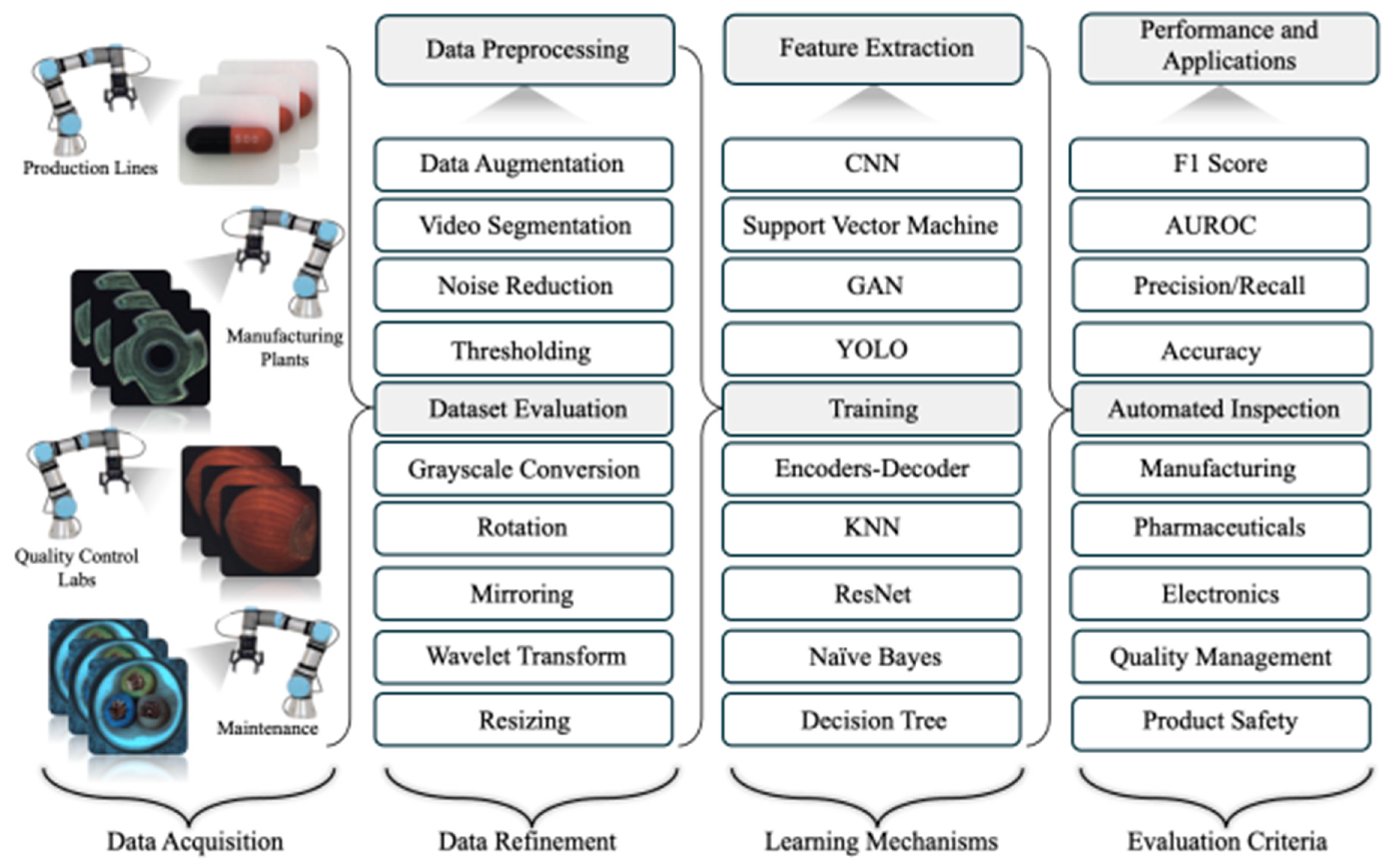
Data preprocessing and feature engineering are critical phases in using unsupervised learning to monitor the health of IRs, as they significantly impact the reliability and utility of subsequent analyses [112]. Raw sensor data from infrared sensors, including vibration signals, motor currents, temperature measurements, and positional feedback, often contains noise, outliers, missing values, and extraneous information. If not properly managed, these issues can diminish model accuracy, as shown in Figure 5. To address this, a variety of preprocessing techniques are employed to refine the raw signals and convert them into analyzable representations. Digital filtering and various noise reduction methods are commonly used to eliminate distortions caused by additive noise while preserving the essential characteristics of signals typically monitored in infrared systems, such as vibration, auditory, and current signals [113]. Kalman filtering is a method that effectively reduces noise while preserving the original vibration properties, achieving a balance between noise reduction and the integrity of the signal [114]. In addition to filtering, preparation procedures such as data cleaning, transformation, padding, normalization, and feature extraction are employed to improve data quality and consistency. These stages help identify significant patterns and anomalies, making it easier to detect issues and evaluate the performance of industrial robotic systems. The following sections discuss various common data pre-processing and feature engineering techniques used in unsupervised learning systems to monitor the health of infrared sensors.

3.3.1. Signal Conditioning and Normalization

Raw sensor inputs from IRs display significant scale disparities among modalities. Joint angle measurements (in radians) and motor current readings (in amperes) fall within distinct numerical ranges, which may imbalance machine learning algorithms towards characteristics with greater magnitude. Standardization addresses this issue by transforming each signal channel to have a mean of zero and a variance of one, as illustrated in Equation (13).
x norm t = x t μ σ
where x t signifies the raw sampled signal, μ represents the mean calculated from a reference dataset (healthy operation data), and σ denotes the associated standard deviation. Post normalization, signal values generally fall within the range for approximately normal distributions. This preprocessing step has been used in variational autoencoder-based anomaly detection systems for robot controller data, where normalizing to zero mean and unit variance improved model convergence and detection performance [80].

3.3.2. Temporal Segmentation

Continuous sensor streams must be divided into fixed-length chunks for analysis by machine learning algorithms. The sliding window approach generates either overlapping or non-overlapping frames, as illustrated in Equation (14).
x t = x t L + 1 , x t L + 2 , , x t T
where L   denotes the window length in samples. The choice of an appropriate window length involves balancing several factors: shorter windows offer better temporal resolution for detecting transient events, while longer windows capture more complete cycles of periodic phenomena and enhance frequency resolution in spectral analysis. In practice, the window length is usually selected to encompass multiple rotation cycles of the monitored component, with common implementations using values ranging from tens to thousands of samples, depending on the sampling frequency and the relevant characteristic frequencies [115,116].

3.3.3. Time-Domain Feature Extraction

Time-domain features provide computationally efficient representations of signal attributes, making them particularly advantageous for real-time monitoring systems and shallow learning models. The Root Mean Square (RMS) value quantifies the total energy content within each window, as shown in Equation (15) [117].
RMS x t = 1 L i = 1 L x t i 2
This feature serves as a compact measure of vibration or current magnitude, typically increasing under conditions such as mechanical imbalance, component looseness, or bearing damage. Time-domain features, including RMS, have been explicitly incorporated into explainable, unsupervised fault detection frameworks for rotating machinery, providing interpretable indicators for clustering and anomaly detection algorithms [118]. While RMS captures overall energy, kurtosis quantifies the impulsiveness of signals, as shown in Equation (16), making it particularly sensitive to localized defects [119].
Kurt x t = 1 L i = 1 L x t i x t ¯ 4 1 L i = 1 L x t i x t ¯ 2 2
where x t ¯   is the average of the window x t . Kurtosis techniques for signals exhibiting a Gaussian distribution. Bearing defects and gear tooth damage create impulsive events that lead to significantly elevated kurtosis values, making this characteristic very useful for identifying localized faults in rotating components.

3.3.4. Frequency-Domain Analysis

Frequency-domain representations reveal periodic patterns associated with rotating components, which help in identifying typical fault frequencies. The Short-Time Fourier Transform (STFT) generates time-frequency spectrograms using windowed Fourier analysis, as shown in Equation (17) [117].
X τ , f = n = x n w n τ e j 2 π f n
where w represents a window function (commonly Hann or Hamming), τ is the time shift index, and f denotes frequency. The window length and overlap percentage are key design parameters that determine the balance between time and frequency resolution. STFT-based spectrograms have become popular inputs for deep learning architectures, allowing two-dimensional convolutional networks to extract spatial patterns from time-frequency representations.

3.3.5. Time-Frequency Analysis

Time-frequency methods offer adaptive resolution, making them particularly valuable for analyzing non-stationary signals under varying speed conditions.
Continuous Wavelet Transform (CWT): The CWT generates scalogram images with multi-resolution time-frequency localization as shown in Equation (18).
W x a , b = 1 a x t ψ * t b a d t
where a represents the scale parameter (inversely related to frequency), b denotes the time shift, and ψ is the mother wavelet function [117]. Unlike the Short-Time Fourier Transform (STFT), the fixed-resolution CWT offers finer temporal resolution at high frequencies and improved frequency resolution at low frequencies. In RV reducer monitoring applications, one-dimensional current signals are transformed into scalogram images using CWT to facilitate transfer learning-based classification, with the resulting time-frequency images serving as inputs to convolutional neural networks [21,120].
Empirical Mode Decomposition (EMD): For highly non-stationary signals, EMD separates a signal into its characteristic oscillatory functions, as shown in Equation (19).
x t = k = 1 K c k t + r t
where c k ( t ) represents the k -th intrinsic mode function, r ( t ) is the residual trend, and K (typically 3–10 modes in machinery diagnostics) depends on signal complexity. Each mode represents an oscillatory component at a specific characteristic timescale, allowing for separate analysis of different physical processes. This decomposition facilitates precise feature extraction from distinct modes, as exemplified by the application of envelope spectrum analysis to certain intrinsic mode functions for bearing defect identification [117].

3.3.6. Dimensionality Reduction

High-dimensional feature spaces can lead to computational complexity and task-dependent redundancy, which degrade generalization performance.
Principal Component Analysis (PCA): PCA projects multivariate feature vectors into a lower-dimensional space that captures maximum variance, as shown in Equation (20).
z = W T x μ
where W is a matrix whose columns contain the leading eigenvectors of the feature covariance matrix, μ represents the mean feature vector, and z is the reduced-dimension representation. Studies on industrial robot gearbox failure detection have explicitly evaluated principal component preprocessing across multiple robots. This approach has demonstrated improved detection robustness by reducing task-dependent variability and concentrating on the primary modes of variation associated with component degradation [117,121].

3.3.7. Anomaly Scoring

Unsupervised learning methods require quantifiable criteria to assess the degree of anomaly in test samples [122].
Reconstruction Error: Autoencoder models are designed to replicate normal operational patterns, with the quality of reconstruction serving as an indicator of anomalies, as shown in Equation (21).
s x t = x t x t ^ 2 2
where x t is the input window, x t ^ is the model’s reconstruction, 2 denotes the Euclidean norm. This score quantifies the dissimilarity between a test window and the healthy operation patterns learned during training. Robot vibration anomaly detection systems compare the reconstruction error to empirically determined thresholds for online fault decisions, with higher errors indicating potential component degradation or abnormal operating conditions [117].
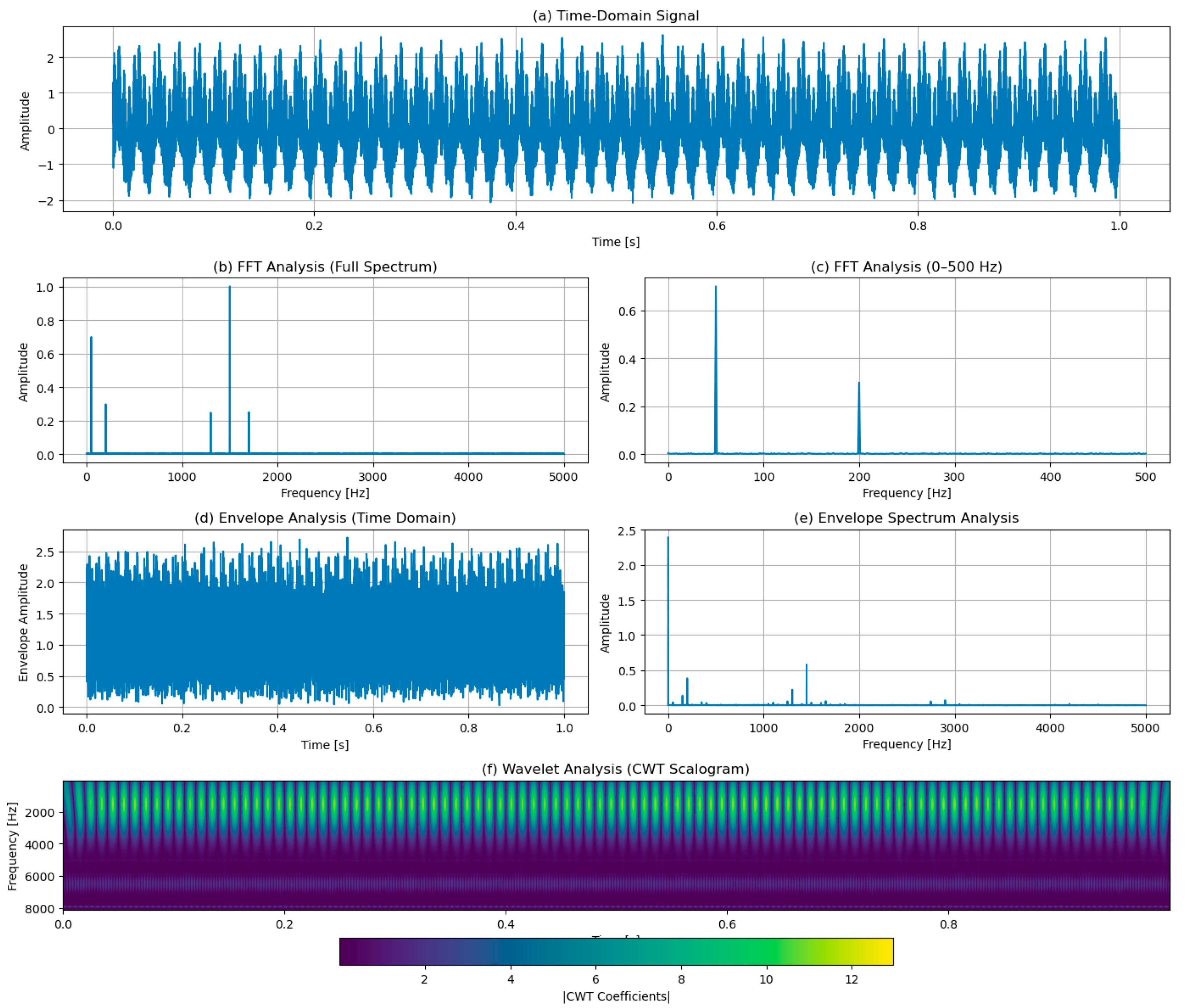
The selection and combination of preprocessing and feature extraction techniques significantly influence the effectiveness of fault detection [122]. Time-domain features are easy to compute and understand; frequency-domain methods excel at identifying periodic fault signatures, and time-frequency representations remain effective even when operating conditions change [123]. Modern deep learning methods increasingly learn features automatically from preprocessed signals; however, traditional engineered features remain valuable for explanation and in scenarios with limited data [124]. A comprehensive framework illustrating these stages within vision-based intelligent autonomous driving (IAD) is shown in Figure 5. Figure 6 illustrates the complementary information obtained from time-domain, frequency-domain, envelope, and CWT-based analyses of the same vibration signal [117].
Figure 5. A comprehensive framework for vision-based Intelligent Autonomous Driving (IAD). Outlines the various phases of flaw detection 400 and the associated processes [125].
Mathematics 14 02397 g005
Figure 6. Timedomain, frequency-domain, envelope-domain, and CWT-based analyses of the same vibration signal for identifying rotational, fault-related, transient, and non-stationary features [30].
Mathematics 14 02397 g006

4. Application and Case Studies

The implementation of unsupervised learning in industrial robot health monitoring has steadily increased in recent years, driven by the demand for scalable, label-independent methodologies that can operate in complex industrial environments. Case studies across various sectors demonstrate that these methods effectively support fault detection, condition monitoring, and predictive maintenance in real-world robotic systems, as summarized in Table 4.
Unsupervised learning has become a promising approach for monitoring the health of industrial robots, especially when substantial labeled fault data are unavailable. This technology analyzes sensor data in real time to identify normal operating patterns and detect variations indicative of potential defects. Unlike rule-based and supervised techniques, unsupervised learning is particularly effective for detecting problems, evaluating their severity, and enabling predictive maintenance in real manufacturing environments. A common application involves detecting anomalous patterns in the joint torque data of multi-axis robots, as robots provide significant torque information when load and motion conditions vary [131]. Individuals often train reconstruction-based models, such as variational autoencoders and LSTM autoencoders, using data from healthy operations. They then employ these models to identify changes associated with gear degradation, increased friction, or load imbalance [132]. Their utility stems from their ability to document the standard movement trajectories of robotic joints over time. A key application is monitoring motor current. Present signals can indicate both electrical and mechanical conditions, allowing for the early identification of problems. In automated production systems, current measurements are often transformed into time-frequency representations and then analyzed using convolutional autoencoders or similar unsupervised models [133]. This approach enables the prompt identification of issues such as misalignment, loose electrical connections, and worn components without interrupting production. Vibration-based monitoring has been extensively used in robotic systems to extract valuable time-frequency information. Subsequently, clustering methods, generative models, and other unsupervised techniques are employed to detect abnormal vibration patterns that indicate bearing deterioration, structural looseness, or other mechanical problems.
As shown in Table 5, previous studies differ substantially in terms of dataset type, sensing modality, algorithmic design, and evaluation strategy. Autoencoder-based models are widely used because they can learn normal behavior from multivariate robot signals without requiring labeled fault data; however, their reliability depends strongly on threshold selection and the quality of healthy training samples. Clustering and one-class methods are computationally efficient and easier to interpret, but they are sensitive to feature quality and operating-regime changes. In contrast, attention-based, neural-process, and predictive-embedding models provide stronger representation capability for complex robot signals, although they generally require higher computational resources and more careful validation before real-time industrial deployment.
To improve the interpretability of the reviewed studies, Table 6 shows that the suitability of an unsupervised monitoring strategy depends on the interaction among the monitored component, sensing modality, fault signature, anomaly criterion, and deployment environment. Vibration and acoustic signals are effective for monitoring bearings, reducers, and structural faults, but their reliability is strongly influenced by sensor placement, background noise, and operating-speed variation. Motor-current and torque signals provide valuable information on actuators, electrical faults, and transmission loads, although they are sensitive to payload changes, trajectory-dependent dynamics, electromagnetic interference, and joint coupling. Encoder and position signals support motion-anomaly detection but require accurate cycle alignment and calibration under changing tasks. Thermal and force-related measurements provide complementary evidence of overheating, contact anomalies, and human–robot interaction, but may be affected by slow sensor response, ambient conditions, and interaction variability. Therefore, model selection and anomaly threshold calibration should be performed jointly with sensor characteristics and deployment constraints rather than based solely on algorithmic accuracy.
A notable application is in collaborative robotic systems that use end-effectors and robotic grippers. Fluctuations in grip force, actuator response, or handling behavior may indicate that components are degrading, miscalibrated, or experiencing a gradual decline in performance. Unsupervised time-series models and representation learning techniques have been utilized to identify standard operational behavior and detect anomalies [134]. The combination of unsupervised learning with digital twin frameworks has enhanced their effectiveness. Digital twins offer a benchmark for anomaly detection and fault interpretation by comparing real-time sensor data with simulated normal behavior [135]. This method improves detection reliability and enhances the accuracy of identifying erratic behavior in unsupervised models, particularly in high-precision manufacturing environments. Case studies have shown that these unsupervised methods are effective for fleet-level monitoring. In intelligent manufacturing settings where multiple robots perform similar tasks, clustering and peer-comparison techniques can identify units exhibiting behavior that deviates from the group norm. This approach enables the detection of faulty robots even in the absence of known defect cases. Similar methodologies have been applied in warehouse and logistics automation, using indicators such as wheel torque, motor temperature, and inertial measurements to monitor mobile robots and automated guided vehicles [136]. Timely identification of changes in motion behavior, path consistency, or energy consumption can enhance system reliability and reduce unexpected downtime. Unsupervised and self-supervised techniques have shown promise in human–robot collaboration scenarios [137]. By analyzing standard interaction patterns, these models can detect atypical pauses, alterations in motion, or unforeseen trajectories that may indicate unsafe operations, control problems, or emerging system failures.
Present applications demonstrate that unsupervised learning is effective across various robot categories, sensory modalities, and operational contexts. It is particularly advantageous for industrial applications, as it operates without the requirement for labeled defect data. With the growing use of robotic systems in logistics, healthcare, agriculture, and advanced manufacturing, unsupervised learning is expected to play an increasingly important role in the development of prognostics and health management systems that can adapt and operate efficiently.

5. Benchmark Datasets and Evaluation Metrics

Benchmark datasets and suitable evaluation criteria are essential for advancing unsupervised learning in industrial robot health monitoring. Unlike supervised learning, which relies on labeled fault categories for training and evaluation, unsupervised methods are typically designed for scenarios where fault labels are scarce, incomplete, or absent. The quality of the dataset, the design of the benchmark, and the evaluation method are critical for ensuring fair comparisons and reliable model validation.
A major limitation in this field is the lack of publicly available and reliable datasets for robotic fault diagnosis. In industrial environments, operational data is often proprietary, and intentional fault injections can be costly, disruptive, or hazardous. As a result, much of the existing data is gathered in controlled laboratory settings, covering only a limited variety of robot types, workloads, and defect sources. This narrow focus restricts representativeness and undermines the generalizability of models trained on such data.
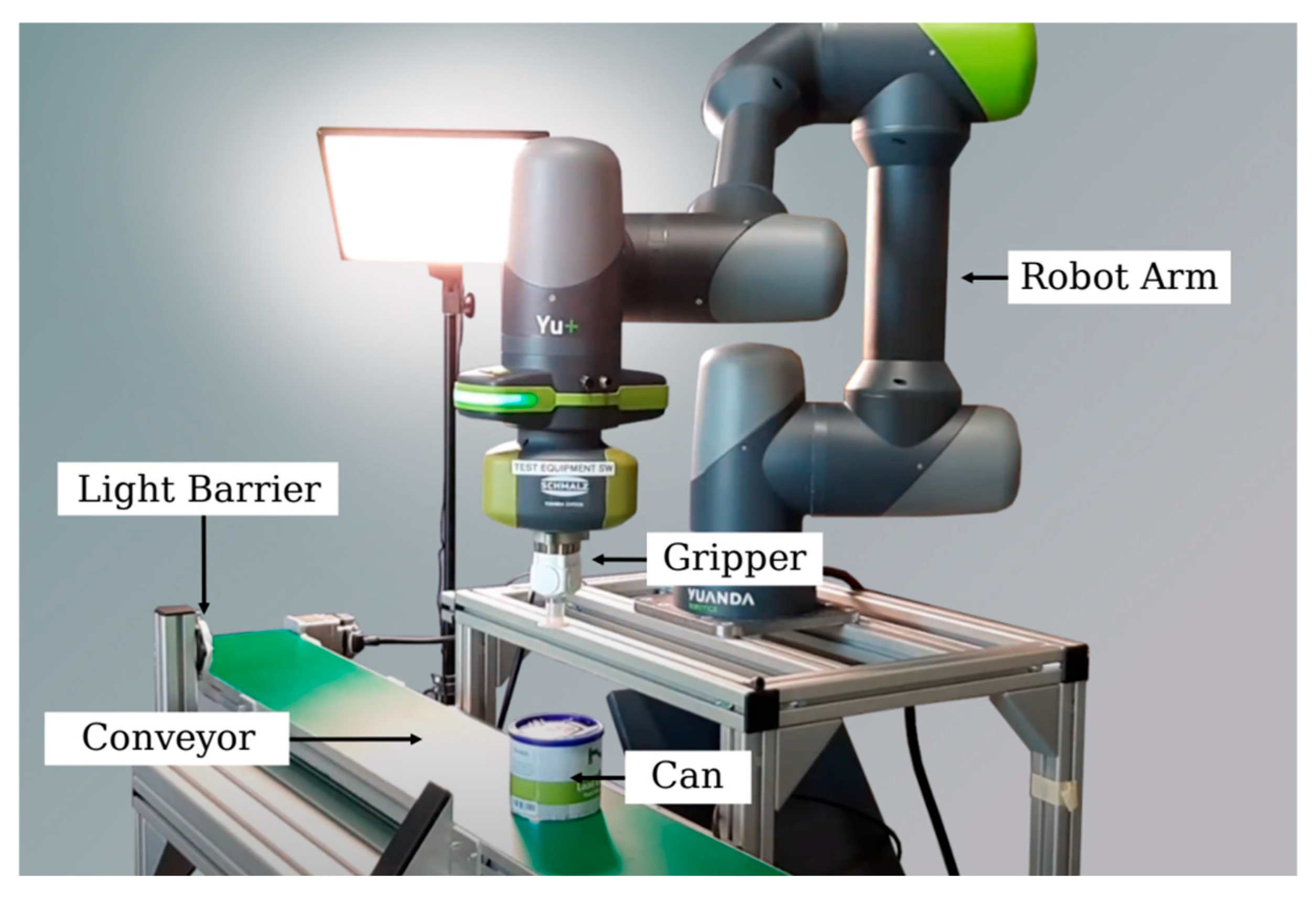
The VORAUS-AD dataset is one of the few documented datasets specifically designed for anomaly detection in robotic systems [138]. The dataset consists of multivariate time-series data, including robot joint measurements in both normal and abnormal operating conditions, making it a significant benchmark for unsupervised research. Figure 7 illustrates the setup for the pick-and-place operation using the Voraus-AD dataset. Additional datasets have been sourced from similar domains. The UCI Human Activity Recognition dataset has been repurposed in several studies because of its multivariate sensor architecture, though it is not specifically designed for robots [139]. Similarly, the MIMII dataset, originally developed for acoustic anomaly detection in industrial machinery, has impacted research on sound-based monitoring of robotic motors and end-effectors. Additionally, many studies rely on proprietary datasets from industrial robots such as KUKA, ABB, and Universal Robots; however, these datasets are rarely accessible to the broader scientific community [140].
Existing datasets for unsupervised industrial robot health monitoring can be grouped into four main categories. First, robot-specific public or documented datasets, such as VORAUS-AD, provide multivariate robot time-series data for evaluating normal and abnormal operating conditions [138]. However, they usually include limited robot types, trajectories, payloads, environmental conditions, and fault scenarios. Second, non-robot public datasets, including MIMII, UCI Human Activity Recognition, and PHM-related industrial datasets, are often used to test anomaly detection or representation-learning methods, but they do not fully represent coupled robot dynamics, controller-specific signals, joint interactions, end-effector load effects, or task-dependent trajectories [141,142,143]. Third, proprietary industrial robot datasets collected from KUKA, ABB, Universal Robots, collaborative robots, or production-line systems provide more realistic monitoring data, including motor current, torque, encoder feedback, vibration, acoustic response, temperature, controller logs, and force-related signals [144,145]. Nevertheless, these datasets are rarely public, and their labels are often incomplete, confidential, weakly annotated, or linked only to maintenance records. Fourth, synthetic, simulation-based, and digital-twin-generated datasets allow controlled fault injection and repeatable validation, but they may not fully capture real sensor noise, mechanical backlash, lubrication changes, payload variation, environmental disturbances, and unmodeled degradation processes [146,147].
These dataset differences directly affect evaluation practice. In fully unsupervised settings, model performance is commonly assessed using anomaly scores, reconstruction error, latent-space distance, likelihood score, or cluster-distance measures. When partial labels are available, accuracy, precision, recall, F1-score, AUROC, AUPRC, false-positive rate, false-negative rate, and detection delay can also be reported. However, comparison across studies remains difficult because preprocessing, window size, overlap ratio, normalization, threshold selection, train–test splitting, and anomaly definitions are not standardized. Therefore, future evaluations should report dataset accessibility, sensor configuration, label availability, thresholding strategy, false-alarm behavior, detection delay, cross-condition generalization, and computational cost under real or near-real industrial operating conditions.
A key limitation of the current evidence base is that many reported results are obtained under restricted experimental conditions. Publicly available robot-specific datasets remain scarce, while proprietary datasets from industrial robots are often inaccessible for independent verification. In addition, controlled laboratory experiments, simulation-based data generation, synthetic fault injections, and digital-twin environments are useful for method development, but they do not fully reproduce the variability of real manufacturing systems, including changing payloads, trajectories, speeds, tool conditions, controller settings, environmental noise, and sensor drift. Therefore, conclusions drawn from a single robot platform or a narrow operating condition should be interpreted cautiously. Cross-condition generalization remains insufficiently established unless models are evaluated across different robots, tasks, payloads, speeds, fault severities, and sensing configurations. Due to the limitations of publicly available datasets, many studies use synthetic fault injections, simulation-based data generation, or pseudo-labeling techniques to evaluate model performance. Digital twin environments are commonly employed to create controlled fault scenarios for benchmarking purposes [148]. While these methodologies help mitigate the shortcomings of identified abnormalities, they may inadequately address the noise, variability, and operational complexities of real industrial systems.
The evaluation of unsupervised learning models requires criteria tailored for anomaly detection, rather than relying solely on conventional classification metrics [149]. When partial ground truth is accessible, commonly used measures include the area under the receiver operating characteristic curve and the area under the precision-recall curve. These metrics evaluate how well a model distinguishes normal samples from abnormal ones across different decision thresholds. Precision at k is particularly beneficial in maintenance-oriented applications, where the objective is to identify the most critical anomalies for inspection.
Clustering-based methodologies often use internal validation criteria [150], Clustering-based methodologies often use internal validation criteria [25], such as the Silhouette Score and Davies–Bouldin Index, to assess cluster separation and compactness. When reference labels are available, cluster purity can also be measured. In reconstruction-based algorithms, particularly autoencoders, reconstruction error is typically employed as the anomaly score. Researchers can derive performance metrics—including accuracy, recall, F1-score, false positive rate, and false negative rate—by setting a threshold for this error [151]. The claimed performance heavily depends on the selection of the anomalous threshold, making consistent evaluation across investigations challenging.
Recent research integrates various anomaly indicators, such as reconstruction error, latent-space distance, and model uncertainty, to improve resilience [152]. Traditional outlier identification techniques, such as Local Outlier Factor, Isolation Forest, and Mahalanobis distance, are commonly used as baseline methods or as components of ensembles [153]. In prognostics-focused environments, temporal metrics such as time-to-detection and early warning lead time are becoming increasingly significant, as they more accurately reflect the practical utility of monitoring systems.
Reproducibility remains a critical issue in this field of research. Variations in preprocessing techniques, windowing approaches, normalization practices, train-test segmentation, and hyperparameter optimization complicate direct comparisons among studies. As a result, there is a growing emphasis on open-source benchmarking frameworks and well-defined evaluation protocols that facilitate transparent comparisons of methods. The creation of authentic and accessible benchmark datasets is also a key focus for the discipline. These datasets must encompass a variety of robot types, operational settings, task variations, sensor modalities, environmental disturbances, and patterns of component deterioration.
A major limitation of current benchmark practices is that many datasets do not fully capture cross-condition variability in industrial robot operation. Models are often trained and evaluated under controlled trajectories, fixed payloads, limited speeds, laboratory fault injections, or proprietary production data. As a result, high detection performance reported under one condition may not necessarily be transferred to different robot models, payloads, operating speeds, tool configurations, environmental noise levels, or production tasks. Future benchmarks should therefore include cross-condition evaluation protocols, such as train-on-one-task/test-on-another-task, train-on-one-payload/test-on-different-payload, and cross-robot or cross-factory validation. Such protocols would provide a more realistic assessment of model robustness and industrial applicability. A recommended reporting checklist for improving reproducibility in unsupervised robot health monitoring studies is provided in Table 7.
Current datasets and evaluation approaches provide a foundational starting point; however, they remain inadequate for rigorous and universally applicable benchmarking. Future advancements depend on the development of more representative public datasets and the adoption of standardized evaluation criteria. These developments are essential for creating robust, reproducible, and practically applicable unsupervised health monitoring systems for industrial robots.

6. Challenges and Open Problems

Despite significant advancements in unsupervised learning for fault detection in industrial robots, numerous technological and practical challenges persist, hindering widespread adoption. One major challenge is model interpretability. Many unsupervised models, particularly those using deep architectures like autoencoders, can identify anomalous patterns; however, they do not consistently reveal the underlying causes or locations of the issues. Maintenance engineers need relevant information, not just numerical data indicating the number of anomalies. Without a clear rationale for detections, trusting the results or acting becomes difficult. To enhance the clarity and acceptability of these systems within enterprises, it is essential to establish mechanisms for providing explicit feedback or identifying the sources of anomalies.
Another issue pertains to model generalization. Models trained in a specific robot, task, or environment often perform sub-optimally when applied to different contexts. When deployed outside the training setting, variations in mechanical architecture, control methodologies, sensor calibration, and user patterns can lead to decreased performance. The tasks performed by robots can vary significantly between facilities, complicating the establishment of a standard for typical behavior. This discrepancy creates a mismatch between the training data and the deployment conditions. Domain adaptation and transfer learning may help address this issue; however, they currently lack sufficient robustness for critical industrial operations where fault detection accuracy must remain consistently high.
Concept drift is a closely related challenge in industrial robot PHM because the statistical distribution of normal operating data may change over time. Such drift can occur due to payload variation, tool wear, lubrication changes, sensor recalibration, environmental conditions, controller updates, or changes in task scheduling. Mathematically, this problem can be viewed as a shift from an initial normal data distribution p t X to a later distribution p t + Δ t X , where a model trained under the earlier condition may no longer produce reliable anomaly scores. Several strategies can reduce this problem, including online learning, adaptive normalization, domain adaptation, and adaptive thresholding. Online learning updates model parameters or thresholds using recent healthy data, while adaptive normalization recalculates signal statistics within recent windows or operating regimes. Domain adaptation aims to learn representations that remain stable across different payloads, speeds, tasks, or robot platforms. Drift-aware monitoring can also track changes in reconstruction-error distributions, latent-space distances, or cluster structures to determine when recalibration or retraining is required. These strategies are important for distinguishing genuine degradation from normal changes in operating conditions.
Resource constraints and the integration of disparate systems also present challenges. Many industrial robots already operate with minimal processing resources, handling tasks such as movement planning, feedback control, and real-time safety monitoring. Adding a complex defect detection module may overburden the CPU, disrupt standard operations, or increase latency. Furthermore, unsupervised models can be affected by sensor noise, thermal drift, or mechanical degradation, potentially leading to false alarms. Caution is advised when modifying preprocessing techniques such as filtering, normalization, and signal segmentation.
A further challenge is the deployment of unsupervised learning models under real industrial conditions, where sensor data are noisy, imbalanced, non-stationary, and strongly affected by operating conditions. Industrial robot signals may vary because of electromagnetic interference, thermal drift, calibration errors, mechanical backlash, lubrication changes, payload variation, trajectory changes, and tool replacement. These effects can shift the distribution of normal behavior and reduce the reliability of anomaly thresholds established under laboratory conditions. Accordingly, deployment performance should not be evaluated only through accuracy, F1-score, or reconstruction error.
False-alarm stability is particularly important because repeated false alarms may lead to unnecessary inspections, production interruptions, operator desensitization, and increased maintenance costs. Studies should therefore report false-positive rates over extended operating periods and evaluate the stability of anomaly scores and thresholds across multiple robot cycles. Detection delay should also be quantified because an anomaly detector must identify degradation early enough to support maintenance action without disrupting robot control, safety functions, communication, or production-cycle timing. Suitable measures include inference latency per signal window, delay from fault onset to detection, and early-warning lead time.
Computational cost is another critical deployment factor. Future studies should report model size, memory consumption, inference time, processor utilization, and compatibility with robot controllers, programmable logic controllers, industrial PCs, embedded gateways, and edge devices. Online adaptability should also be evaluated because fixed models may become unreliable when payloads, tools, trajectories, environmental conditions, or degradation states change. Adaptive normalization, online parameter updating, drift-aware thresholding, and periodic model recalibration can help maintain performance under evolving conditions.
Cross-condition generalization should be assessed through train–test protocols involving different payloads, speeds, trajectories, tools, robot platforms, and production environments. Finally, practical deployment requires integration with industrial control and maintenance infrastructures, including programmable logic controllers, manufacturing execution systems, supervisory control and data acquisition systems, cloud or edge platforms, and maintenance-management software. Standardized middleware and interoperable interfaces remain necessary for connecting health-monitoring models with existing industrial control, communication, and maintenance systems.
At the same time, the growth of big data and predictive maintenance frameworks allows for the integration of unsupervised learning with large-scale data analytics and real-time monitoring [154]. By utilizing high-frequency sensor data, cloud infrastructure, and microservices-based architectures, we can enhance failure detection accuracy, conserve energy, and extend the lifespan of robotic components [155].
Research has demonstrated that the integration of predictive analytics with 3D visualization techniques can minimize downtime and enhance maintenance scheduling. However, these benefits depend significantly on effective data pipelines, scalable computing resources, and systems that work together seamlessly. Many businesses still cannot afford the initial investment in infrastructure and expertise, and more work needs to be done to ensure that different vendors and platforms can collaborate effectively. Despite these challenges, the increasing operational data from smart factories makes it easier to improve condition-based monitoring using data-driven methods.
In conclusion, while unsupervised learning offers an effective method for scalable, label-free defect identification in industrial robots, numerous unresolved challenges remain. These encompass augmenting interpretability, strengthening generalization, ensuring real-time performance, integrating with existing systems, mitigating sensor noise, and formulating adaptive learning frameworks. Addressing these difficulties necessitates interdisciplinary collaboration within the fields of machine learning, control systems, robotics, and industrial engineering.

7. Future Directions

As industrial robots become more complex, interconnected, and widely deployed, future research on unsupervised learning for robot health monitoring should move beyond algorithm development alone and focus on reliable, interpretable, and deployable maintenance systems. Key research directions include the integration of digital twins, federated learning, explainable artificial intelligence, edge computing, multimodal sensor fusion, smart sensing, human–robot interface-aware monitoring, and hybrid physics-guided learning frameworks. These directions are essential for improving model robustness, reducing dependence on labeled fault data, and enabling scalable implementation in real industrial environments. To provide a clearer synthesis of these future directions, Figure 8 presents a roadmap from the current challenges in unsupervised industrial robot health monitoring to enabling technologies and deployable PHM outcomes. The roadmap links label scarcity, variable operating conditions, heterogeneous sensing, and real-time constraints with self-supervised learning, multimodal fusion, digital twins, physics-guided learning, and edge AI deployment. These enabling technologies are expected to support real-time anomaly detection, fault localization, remaining useful life prediction, and maintenance decision-making, ultimately leading to autonomous, reliable, explainable, scalable, and real-time industrial robot PHM systems.
Digital twins are expected to play an important role in next-generation robotic maintenance systems. By creating a virtual representation of robot dynamics, operating conditions, and degradation behavior, digital twins can provide reference responses for anomaly detection, fault interpretation, and maintenance planning. They can also support synthetic fault-data generation and controlled scenario testing when real failure data are scarce or unsafe to collect. However, future studies must address the accuracy of twin models, synchronization between physical and virtual systems, and validation under changing payloads, trajectories, speeds, and environmental conditions.
Federated learning offers another promising direction for multi-robot and multi-factory health monitoring. In industrial environments, raw sensor data are often confidential, proprietary, or difficult to transfer due to privacy and data-ownership concerns. Federated learning allows multiple robots, production lines, or factories to collaboratively train shared models without directly sharing raw data. This approach can improve model generalization by exposing learning algorithms to diverse operating conditions. Nevertheless, further research is required to handle non-identically distributed data, communication limitations, model aggregation, and robustness against noisy or biased local updates.
Explainable artificial intelligence is also critical for the practical adoption of unsupervised robot health monitoring. In many existing systems, anomaly detection is reported only as a numerical score, which is insufficient for maintenance decision-making. Future models should provide component-level and signal-level explanations, indicating whether abnormal behavior is associated with a reducer, bearing, motor, encoder, cable, joint, end-effector, or task change. Reconstruction residuals, attention maps, latent-space visualization, feature attribution, and human-in-the-loop feedback can improve trust and help engineers convert model outputs into actionable maintenance decisions.
Human–robot interface-aware monitoring should also be considered in future PHM systems, especially for collaborative robots operating near human workers. In such environments, robot health cannot be evaluated only from internal signals such as current, vibration, torque, and encoder feedback; it should also consider interaction-related signals, including force, contact response, operator intention, and abnormal human–robot coupling. Scibilia et al. proposed a nonlinear modeling framework for estimating human force in human–robot interaction using a NARMAX model with an artificial neural network-based nonlinear approximator [156]. Such force-estimation models are relevant to robot PHM because deviations between expected and observed interaction forces may indicate abnormal contact, unsafe collaboration, actuator degradation, sensor drift, or unexpected task behavior. Future intelligent maintenance systems should therefore integrate unsupervised anomaly detection with force estimation, interaction-aware sensing, human-in-the-loop feedback, and safety-oriented decision rules to support both robot reliability and safe human–robot collaboration.
Edge computing will be essential for real-time deployment. Industrial robot monitoring systems must detect abnormal behavior without interrupting robot control, safety functions, communication networks, or production-cycle timing. Therefore, future research should develop lightweight unsupervised models that can operate on robot controllers, embedded processors, industrial gateways, or edge devices. Model compression, pruning, quantization, efficient windowing, and latency-aware evaluation should be considered alongside conventional accuracy-based metrics. This will allow anomaly detection systems to respond rapidly while reducing dependence on cloud-based computation.
Multimodal sensor fusion is another important research direction because robot faults rarely appear in a single signal modality. Combining motor current, vibration, torque, encoder position, acoustic emission, temperature, and controller-log data can provide a more complete representation of robot health. Future studies should develop robust fusion strategies that can handle asynchronous sampling rates, missing signals, noisy channels, and different physical meanings across sensor modalities. Attention-based fusion, graph neural networks, and self-supervised multimodal representation learning are promising approaches for improving fault sensitivity and reducing false alarms.
Smart sensing is another important direction for future industrial robot PHM because the reliability of unsupervised monitoring depends not only on the learning algorithm but also on the quality, stability, and dynamic behavior of the sensing layer. Smart sensors with embedded calibration, signal conditioning, self-diagnostic capability, and environmental compensation can improve the reliability of vibration, current, torque, acoustic, thermal, and force-related measurements before anomaly detection is performed. This is particularly important because sensor drift, temperature and humidity sensitivity, nonlinear response, and bandwidth limitations can shift anomaly scores and increase false alarms. Studies on ionic polymer–metal composite (IPMC)-based smart sensing and actuation have shown that environmental factors such as temperature and humidity can significantly influence sensor/actuator behavior, while IPMC-based resonant force sensors demonstrate the potential of smart-material sensing for force and interaction monitoring [157,158]. Therefore, future robot PHM systems should jointly consider sensor characterization, calibration stability, environmental compensation, and unsupervised learning to improve monitoring reliability under real industrial conditions.
Hybrid physics-guided and data-driven models should also be further explored. Purely data-driven models can identify complex patterns in high-dimensional robot signals, but they may generalize poorly when operating conditions change. Incorporating physical knowledge, such as robot kinematics, dynamics, actuator behavior, load effects, and degradation mechanisms, can improve reliability and interpretability. Physics-informed neural networks, digital-twin-assisted learning, and constraint-aware anomaly detection may help bridge the gap between laboratory validation and industrial deployment.
In the future, progress will require stronger standardization and system-level integration. Benchmark datasets should include diverse robot types, tasks, payloads, sensing modalities, and fault scenarios to enable fair comparison across methods. Evaluation should consider not only accuracy, F1-score, or reconstruction error, but also false-alarm stability, detection delay, computational cost, scalability, and ease of integration with industrial control systems. By combining robust unsupervised learning, domain knowledge, explainability, edge deployment, and standardized validation, future robotic maintenance systems can become more autonomous, reliable, and suitable for intelligent manufacturing environments.

8. Conclusions

Unsupervised learning has become a practical and effective approach for industrial robot health monitoring, particularly when labeled fault data are scarce or unavailable. This review paper provides a comprehensive examination of the current research landscape in this area, covering a wide range of methodologies such as clustering, autoencoders, generative models, and self-supervised learning. We explore essential data preparation techniques, benchmark datasets, and evaluation criteria that support the development and validation of these methods. The reviewed applications demonstrate their potential for enabling scalable, real-time monitoring without the need for extensive human annotation. Case studies illustrate how these models can identify joint anomalies, assess actuator health, and maintain the operational integrity of robotic arms across various sectors.
A critical finding of this review is that the suitability of an unsupervised learning method depends strongly on the monitoring objective, sensor availability, data dimensionality, and deployment constraints. Clustering and dimensionality-reduction methods are useful for preliminary screening, visualization, and operating-regime identification because they are simple and computationally efficient; however, they are sensitive to feature quality and changing operating conditions. Autoencoder-based models are more suitable for multivariate time-series signals such as motor current, vibration, torque, and controller data, but their reliability depends on representative healthy data and proper threshold selection. Generative, self-supervised, and hybrid models offer stronger representation capability and better potential for rare-fault or cross-condition scenarios, although they require higher computational resources and more careful validation before industrial deployment.
Despite its potential, unsupervised learning faces challenges, including limited interpretability, domain generalization, real-time processing, and integration with existing systems. The future of unsupervised learning in industrial robot PHM is likely to involve hybrid physics-informed models, federated and edge-based architectures, generative modeling and simulation, and explainable artificial intelligence. As research progresses, interdisciplinary collaboration will be vital for developing standardized tools, shared datasets, and practical deployment frameworks that ensure the reliability and adoption of new technologies in real-world applications.
In addition to maintenance-oriented monitoring, unsupervised signal analysis can also contribute to safer human–robot interaction, where signal-based fault tolerance is critical for safe communication between humans and robots. By monitoring force signals and other interaction-related data, robots can detect irregularities and take precautionary actions to protect human operators. However, important challenges remain, including the interpretation of complex signals, the need for diverse datasets, and the integration of these methodologies into operational robots. Further work should focus on explainable AI, unsupervised anomaly detection, and advanced signal processing techniques.
For researchers, future studies should prioritize benchmark datasets, robustness evaluation under variable operating conditions, explainable anomaly scoring, and validation across different robot platforms. For industrial practitioners, method selection should begin from the available sensing infrastructure and maintenance objective: lightweight clustering or PCA-based methods are suitable for low-cost monitoring; autoencoder-based methods are appropriate for multivariate controller and vibration data; and hybrid or digital-twin-assisted approaches are preferable for high-value systems requiring fault localization, interpretability, and reliable maintenance planning. This review synthesizes contemporary trends, approaches, and challenges, serving as a key reference for scholars, engineers, and practitioners seeking to develop intelligent, resilient, and scalable health monitoring solutions for next-generation industrial robotic systems.

Author Contributions

Conceptualization, H.S.K. and M.U.E.; methodology, M.U.E., M.H.Y. and R.T.A.K.; formal analysis, M.U.E., M.H.Y. and R.T.A.K., investigation and research, M.U.E., M.H.Y. and R.T.A.K.; resources, H.S.K.; writing—original draft preparation, M.U.E., M.H.Y. and R.T.A.K.; writing—review and editing, M.U.E. and H.S.K.; supervision, H.S.K. All authors have read and agreed to the published version of the manuscript.

Funding

This research was supported by the (1) “Regional Innovation System & Education (RISE)” through the Seoul RISE Center, funded by the Ministry of Education (MOE) and the Seoul Metropolitan Government (Grant No. 2026-RISE-01-007-04) and (2) National Research Foundation of Korea: RS-2025-00523019.

Data Availability Statement

No new data were created or analyzed in this study.

Acknowledgments

This work was supported by the National Research Foundation of Korea (NRF), grant funded by the Korea government (MSIT) (RS-2025-00523019), and also by the “Regional Innovation System & Education (RISE)” through the Seoul RISE Center, funded by the Ministry of Education (MOE) and the Seoul Metropolitan Government (2026-RISE-01-007-04).

Conflicts of Interest

The authors declare no conflicts of interest.

References

  1. Bartoš, M.; Bulej, V.; Bohušík, M.; Stanček, J.; Ivanov, V.; Macek, P. An Overview of Robot Applications in Automotive Industry. Transp. Res. Procedia 2021, 55, 837–844. [Google Scholar] [CrossRef]
  2. Bogue, R. The Role of Robots in the Electronics Industry. Ind. Robot 2023, 50, 717–721. [Google Scholar] [CrossRef]
  3. Sobolev, L.B. Robots in Aerospace Industry. Rev. Univ. Zulia 2021, 13, 241–256. [Google Scholar] [CrossRef]
  4. Wang, T.; Li, N.; Yu, N.; Mutilba, U.; Flores, J.; Wang, Y.; Bartolo, P.; Ong, S. Robot-Assisted Additive Manufacturing for Aerospace Applications: Recent Trends and Its Future Possibilities. Int. J. Comput. Integr. Manuf. 2025, 39, 204–244. [Google Scholar] [CrossRef]
  5. Tanzini, A.; Ruggeri, M.; Bianchi, E.; Valentino, C.; Vigani, B.; Ferrari, F.; Rossi, S.; Giberti, H.; Sandri, G. Robotics and Aseptic Processing in View of Regulatory Requirements. Pharmaceutics 2023, 15, 1581. [Google Scholar] [CrossRef] [PubMed]
  6. Bannigan, P.; Hickman, R.J.; Aspuru-Guzik, A.; Allen, C. The Dawn of a New Pharmaceutical Epoch: Can AI and Robotics Reshape Drug Formulation? Adv. Healthc. Mater. 2024, 13, 2401312. [Google Scholar] [CrossRef] [PubMed]
  7. Vasili, M. Optimization of Space Utilization for a Man-On-Board AS/RS Through Applying Modular Cells: A Case Study of a Spare Parts Warehouse. In Warehousing and Material Handling Systems for the Digital Industry; Manzini, R., Accorsi, R., Eds.; Springer International Publishing: Cham, Switzerland, 2024; pp. 201–217. [Google Scholar]
  8. Neaz, A.; Lee, S.; Nam, K. Design and Implementation of an Integrated Control System for Omnidirectional Mobile Robots in Industrial Logistics. Sensors 2023, 23, 3184. [Google Scholar] [CrossRef] [PubMed]
  9. Nauert, F.; Kampmann, P. Inspection and Maintenance of Industrial Infrastructure with Autonomous Underwater Robots. Front. Robot. AI 2023, 10, 1240276. [Google Scholar] [CrossRef] [PubMed]
  10. Bogue, R. Robots in the Nuclear Industry: A Review of Technologies and Applications. Ind. Robot Int. J. Robot. Res. Appl. 2011, 38, 113–118. [Google Scholar] [CrossRef]
  11. Rainer, R.K.; Richey, R.G.; Chowdhury, S. How Robotics Is Shaping Digital Logistics and Supply Chain Management: An Ongoing Call for Research. J. Bus. Logist. 2025, 46, e70005. [Google Scholar] [CrossRef]
  12. Çiğdem, Ş.; Meidute-Kavaliauskiene, I.; Yıldız, B. Industry 4.0 and Industrial Robots: A Study from the Perspective of Manufacturing Company Employees. Logistics 2023, 7, 17. [Google Scholar] [CrossRef]
  13. Sherwani, F.; Asad, M.M.; Ibrahim, B.S.K.K. Collaborative Robots and Industrial Revolution 4.0 (IR 4.0). In Proceedings of the 2020 International Conference on Emerging Trends in Smart Technologies (ICETST); IEEE: Karachi, Pakistan, 2020; pp. 1–5. [Google Scholar]
  14. Fu, Q.; Zhang, L.; Xu, Y.; You, F. The Review of Human–Machine Collaborative Intelligent Interaction with Driver Cognition in the Loop. Syst. Res. Behav. Sci. 2025, 42, 954–977. [Google Scholar] [CrossRef]
  15. Müller, C. World Robotics 2025—Industrial Robots; IFR Statistical Department, VDMA Services GmbH: Frankfurt am Main, Germany, 2025. [Google Scholar]
  16. Kumar, P.; Kumar, P.; Hati, A.S.; Kim, H.S. Deep Transfer Learning Framework for Bearing Fault Detection in Motors. Mathematics 2022, 10, 4683. [Google Scholar] [CrossRef]
  17. Grosso, L.A.; Martin, A.D.; Jacazio, G.; Sorli, M. Development of Data-Driven PHM Solutions for Robot Hemming in Automotive Production Lines. Int. J. Progn. Health Manag. 2023, 11, 1–12. [Google Scholar] [CrossRef]
  18. Leite, D.; Andrade, E.; Rativa, D.; Maciel, A.M.A. Fault Detection and Diagnosis in Industry 4.0: A Review on Challenges and Opportunities. Sensors 2024, 25, 60. [Google Scholar] [CrossRef] [PubMed]
  19. Azad, M.M.; Cheon, Y.; Raouf, I.; Khalid, S.; Kim, H.S. Intelligent Computational Methods for Damage Detection of Laminated Composite Structures for Mobility Applications: A Comprehensive Review. Arch. Comput. Methods Eng. 2024, 32, 441–469. [Google Scholar] [CrossRef]
  20. Khalid, S.; Azad, M.M.; Kim, H.S. A Generalized Autonomous Power Plant Fault Detection Model Using Deep Feature Extraction and Ensemble Machine Learning. Mathematics 2025, 13, 342. [Google Scholar] [CrossRef]
  21. Elahi, M.U.; Raouf, I.; Khalid, S.; Ahmad, F.; Kim, H.S. Transfer Learning-Based Health Monitoring of Robotic Rotate Vector Reducer Under Variable Working Conditions. Machines 2025, 13, 60. [Google Scholar] [CrossRef]
  22. Saeed, A.; Khan, M.A.; Akram, U.; Obidallah, W.J.; Jawed, S.; Ahmad, A. Deep Learning Based Approaches for Intelligent Industrial Machinery Health Management and Fault Diagnosis in Resource-Constrained Environments. Sci. Rep. 2025, 15, 1114. [Google Scholar] [CrossRef] [PubMed]
  23. Polverino, L.; Abbate, R.; Manco, P.; Perfetto, D.; Caputo, F.; Macchiaroli, R.; Caterino, M. Machine Learning for Prognostics and Health Management of Industrial Mechanical Systems and Equipment: A Systematic Literature Review. Int. J. Eng. Bus. Manag. 2023, 15, 1–20. [Google Scholar] [CrossRef]
  24. Hong, G.; Suh, D. Supervised-Learning-Based Intelligent Fault Diagnosis for Mechanical Equipment. IEEE Access 2021, 9, 116147–116162. [Google Scholar] [CrossRef]
  25. Han, J.; Chen, Z.; Zhou, D.; Hu, B.; Xia, T.; Pan, E. Unsupervised Motion-Based Anomaly Detection with Graph Attention Networks for Industrial Robots Labeling. Eng. Appl. Artif. Intell. 2025, 146, 110298. [Google Scholar] [CrossRef]
  26. Usama, M.; Qadir, J.; Raza, A.; Arif, H.; Yau, K.A.; Elkhatib, Y.; Hussain, A.; Al-Fuqaha, A. Unsupervised Machine Learning for Networking: Techniques, Applications and Research Challenges. IEEE Access 2019, 7, 65579–65615. [Google Scholar] [CrossRef]
  27. Koenig, S.; Simmons, R.G. Unsupervised Learning of Probabilistic Models for Robot Navigation. In Proceedings of the IEEE International Conference on Robotics and Automation; IEEE: Minneapolis, MN, USA, 1996; Volume 3, pp. 2301–2308. [Google Scholar]
  28. Carvalho, T.P.; Soares, F.A.; Vita, R.; Francisco, R.d.P.; Basto, J.P.; Alcalá, S.G. A Systematic Literature Review of Machine Learning Methods Applied to Predictive Maintenance. Comput. Ind. Eng. 2019, 137, 106024. [Google Scholar] [CrossRef]
  29. Chiang, L.H.; Russell, E.L.; Braatz, R.D. Fault Detection and Diagnosis in Industrial Systems; Springer Science & Business Media: London, UK, 2012. [Google Scholar]
  30. Zaidi, S.H.H.; Shenfield, A.; Zhang, H.; Ikpehai, A. A Systematic Review of Anomaly and Fault Detection Using Machine Learning for Industrial Machinery. Algorithms 2026, 19, 108. [Google Scholar] [CrossRef]
  31. Lei, Y.; Li, N.; Guo, L.; Li, N.; Yan, T.; Lin, J. Machinery Health Prognostics: A Systematic Review from Data Acquisition to RUL Prediction. Mech. Syst. Signal Process. 2018, 104, 799–834. [Google Scholar] [CrossRef]
  32. Jardine, A.K.; Lin, D.; Banjevic, D. A Review on Machinery Diagnostics and Prognostics Implementing Condition-Based Maintenance. Mech. Syst. Signal Process. 2006, 20, 1483–1510. [Google Scholar] [CrossRef]
  33. Kumar, P.; Khalid, S.; Kim, H.S. Prognostics and Health Management of Rotating Machinery of Industrial Robot with Deep Learning Applications—A Review. Mathematics 2023, 11, 3008. [Google Scholar] [CrossRef]
  34. Zhao, R.; Yan, R.; Chen, Z.; Mao, K.; Wang, P.; Gao, R.X. Deep Learning and Its Applications to Machine Health Monitoring. Mech. Syst. Signal Process. 2019, 115, 213–237. [Google Scholar] [CrossRef]
  35. Sahu, A.R.; Palei, S.K.; Mishra, A. Data-driven Fault Diagnosis Approaches for Industrial Equipment: A Review. Expert Syst. 2024, 41, e13360. [Google Scholar]
  36. Lei, L.; Li, W.; Zhang, S.; Wu, C.; Yu, H. Research Progress on Data-Driven Industrial Fault Diagnosis Methods. Sensors 2025, 25, 2952. [Google Scholar] [CrossRef] [PubMed]
  37. Zhang, K.; Shi, Y.; Karnouskos, S.; Sauter, T.; Fang, H.; Colombo, A.W. Advancements in Industrial Cyber-Physical Systems: An Overview and Perspectives. IEEE Trans. Ind. Inform. 2022, 19, 716–729. [Google Scholar] [CrossRef]
  38. Villalonga, A.; Beruvides, G.; Castano, F.; Haber, R. Industrial Cyber-Physical System for Condition-Based Monitoring in Manufacturing Processes. In Proceedings of the 2018 IEEE Industrial Cyber-Physical Systems (ICPS); IEEE: St. Petersburg, Russia, 2018; pp. 637–642. [Google Scholar]
  39. Fernandes, M.; Corchado, J.M.; Marreiros, G. Machine Learning Techniques Applied to Mechanical Fault Diagnosis and Fault Prognosis in the Context of Real Industrial Manufacturing Use-Cases: A Systematic Literature Review. Appl. Intell. 2022, 52, 14246–14280. [Google Scholar] [CrossRef]
  40. Garimella, G.; Funke, J.; Wang, C.; Kobilarov, M. Neural Network Modeling for Steering Control of an Autonomous Vehicle. In Proceedings of the 2017 IEEE/RSJ International Conference on Intelligent Robots and Systems (IROS); IEEE: Vancouver, BC, Canada, 2017; pp. 2609–2615. [Google Scholar]
  41. Pech, M.; Vrchota, J.; Bednář, J. Predictive Maintenance and Intelligent Sensors in Smart Factory: Review. Sensors 2021, 21, 1470. [Google Scholar] [CrossRef] [PubMed]
  42. Raouf, I.; Lee, H.; Noh, Y.R.; Youn, B.D.; Kim, H.S. Prognostic Health Management of the Robotic Strain Wave Gear Reducer Based on Variable Speed of Operation: A Data-Driven via Deep Learning Approach. J. Comput. Des. Eng. 2022, 9, 1775–1788. [Google Scholar] [CrossRef]
  43. Raouf, I.; Kumar, P.; Soo Kim, H. Deep Learning-Based Fault Diagnosis of Servo Motor Bearing Using the Attention-Guided Feature Aggregation Network. Expert Syst. Appl. 2024, 258, 125137. [Google Scholar] [CrossRef]
  44. Raouf, I.; Lee, H.; Kim, H.S. Mechanical Fault Detection Based on Machine Learning for Robotic RV Reducer Using Electrical Current Signature Analysis: A Data-Driven Approach. J. Comput. Des. Eng. 2022, 9, 417–433. [Google Scholar] [CrossRef]
  45. Raj, K.K.; Kumar, S.; Kumar, R.R. Systematic Review of Bearing Component Failure: Strategies for Diagnosis and Prognosis in Rotating Machinery. Arab. J. Sci. Eng. 2025, 50, 5353–5375. [Google Scholar] [CrossRef]
  46. Zhang, Y.; Wu, J.; Gao, B.; Xia, L.; Lu, C.; Wang, H.; Cao, G. Fault Types and Diagnostic Methods of Manipulator Robots: A Review. Sensors 2025, 25, 1716. [Google Scholar] [CrossRef] [PubMed]
  47. Zeynivand, M.; Kermansaravi, A.; Vahedi, H.; Gruosso, G. Digital Twin Synthetic Dataset for Bearing Fault Diagnosis in Industrial Spindles. IEEE Access 2026, 14, 29369–29386. [Google Scholar] [CrossRef]
  48. Aivaliotis, P.; Arkouli, Z.; Georgoulias, K.; Makris, S. Degradation Curves Integration in Physics-Based Models: Towards the Predictive Maintenance of Industrial Robots. Robot. Comput.-Integr. Manuf. 2021, 71, 102177. [Google Scholar] [CrossRef]
  49. Sabry, A.H.; Nordin, F.H.; Sabry, A.H.; Abidin Ab Kadir, M.Z. Fault Detection and Diagnosis of Industrial Robot Based on Power Consumption Modeling. IEEE Trans. Ind. Electron. 2020, 67, 7929–7940. [Google Scholar] [CrossRef]
  50. Zhang, X.; Ma, Z.; Fang, M.; Tang, Y.; Xiang, J.; Jiang, Y. Fault Diagnosis of Motorized Spindle Based on Lumped Parameter Model and Wasserstein Generative Adversarial Network. Mech. Syst. Signal Process. 2025, 230, 112668. [Google Scholar] [CrossRef]
  51. Jeong, D.; Son, S.; Sun, K.H.; Jeon, B.C.; Lee, S.H.; Oh, K.-Y. Comprehensive Multiphysics Model of an Induction Motor for Generating Synthetic Data under Diverse Bearing Faulty Conditions. J. Sound. Vib. 2026, 625, 119603. [Google Scholar] [CrossRef]
  52. Usmani, U.A.; Happonen, A.; Watada, J. A Review of Unsupervised Machine Learning Frameworks for Anomaly Detection in Industrial Applications. In Intelligent Computing; Arai, K., Ed.; Lecture Notes in Networks and Systems; Springer International Publishing: Cham, Switzerland, 2022; Volume 507, pp. 158–189. [Google Scholar]
  53. Michalski, M.A.D.C.; Murad, C.A.; Kashiwagi, F.N.; De Souza, G.F.M.; Da Silva, H.J.B.; Côrtes, H.M. A Multi-Criteria Framework for Selecting Machine Learning Techniques for Industrial Fault Prognosis. IEEE Access 2025, 13, 154508–154544. [Google Scholar] [CrossRef]
  54. Chen, T.; Liu, X.; Xia, B.; Wang, W.; Lai, Y. Unsupervised Anomaly Detection of Industrial Robots Using Sliding-Window Convolutional Variational Autoencoder. IEEE Access 2020, 8, 47072–47081. [Google Scholar] [CrossRef]
  55. Blachowicz, T.; Wylezek, J.; Sokol, Z.; Bondel, M. Real-Time Analysis of Industrial Data Using the Unsupervised Hierarchical Density-Based Spatial Clustering of Applications with Noise Method in Monitoring the Welding Process in a Robotic Cell. Information 2025, 16, 79. [Google Scholar] [CrossRef]
  56. Jiang, W.; Deng, Q.; Wu, J.; Zhou, Y.; Zhu, H. Human-Machine Collaborative Health Estimation of Industrial Robot Based on Fuzzy Self-Attention Network and Manifold Cluster. Knowl.-Based Syst. 2025, 316, 113430. [Google Scholar] [CrossRef]
  57. Yang, J.; Jin, L.; Han, Z.; Zhao, D.; Hu, M. Sensitivity Analysis of Factors Affecting Motion Reliability of Manipulator and Fault Diagnosis Based on Kernel Principal Component Analysis. Robotica 2022, 40, 2547–2566. [Google Scholar]
  58. Rodrigues, J.A.; Martins, A.; Mendes, M.; Farinha, J.T.; Mateus, R.J.; Cardoso, A.J.M. Automatic Risk Assessment for an Industrial Asset Using Unsupervised and Supervised Learning. Energies 2022, 15, 9387. [Google Scholar] [CrossRef]
  59. Wu, Y.; Fu, Z.; Fei, J. Fault Diagnosis for Industrial Robots Based on a Combined Approach of Manifold Learning, Treelet Transform and Naive Bayes. Rev. Sci. Instrum. 2020, 91, 015116. [Google Scholar] [CrossRef] [PubMed]
  60. Park, D.; Hoshi, Y.; Kemp, C.C. A Multimodal Anomaly Detector for Robot-Assisted Feeding Using an Lstm-Based Variational Autoencoder. IEEE Robot. Autom. Lett. 2018, 3, 1544–1551. [Google Scholar]
  61. Zhong, Z.; Zhao, Y.; Yang, A.; Zhang, H.; Qiao, D.; Zhang, Z. Industrial Robot Vibration Anomaly Detection Based on Sliding Window One-Dimensional Convolution Autoencoder. Shock Vib. 2022, 2022, 1179192. [Google Scholar] [CrossRef]
  62. Lu, H.; Du, M.; Qian, K.; He, X.; Wang, K. GAN-Based Data Augmentation Strategy for Sensor Anomaly Detection in Industrial Robots. IEEE Sens. J. 2021, 22, 17464–17474. [Google Scholar] [CrossRef]
  63. Shirshahi, A.; Moshiri, B.; Aliyari-Shoorehdeli, M. Intelligent Fault Diagnosis Based on Similarity Analysis Using Generative Model and Multi-Sensor Fusion in Industrial Processes. Process Saf. Environ. Prot. 2025, 197, 107097. [Google Scholar] [CrossRef]
  64. Tang, B.; Lu, Y.; Li, Q.; Bai, Y.; Yu, J.; Yu, X. A Diffusion Model Based on Network Intrusion Detection Method for Industrial Cyber-Physical Systems. Sensors 2023, 23, 1141. [Google Scholar] [CrossRef] [PubMed]
  65. Fu, D.; Liu, J.; Zhong, H.; Zhang, X.; Zhang, F. A Novel Self-Supervised Representation Learning Framework Based on Time-Frequency Alignment and Interaction for Mechanical Fault Diagnosis. Knowl.-Based Syst. 2024, 295, 111846. [Google Scholar]
  66. Kim, Y.; Lee, T.; Hyun, Y.; Coatanea, E.; Mika, S.; Mo, J.; Yoo, Y. Self-Supervised Representation Learning Anomaly Detection Methodology Based on Boosting Algorithms Enhanced by Data Augmentation Using StyleGAN for Manufacturing Imbalanced Data. Comput. Ind. 2023, 153, 104024. [Google Scholar]
  67. Tang, B. Self-Supervised Learning for Industrial Visual Anomaly Detection: A Review of Recent Advances, Applications, and Open Challenges. Ind. Robot. Mech. Syst. Q. 2026, 1. Available online: https://callpress.org/index.php/irmsq/article/view/46 (accessed on 22 June 2026).
  68. Yasenjiang, J.; Xu, C.; Zhang, S.; Zhang, X. Fault Diagnosis and Prediction of Continuous Industrial Processes Based on Hidden Markov Model-Bayesian Network Hybrid Model. Int. J. Chem. Eng. 2022, 2022, 3511073. [Google Scholar] [CrossRef]
  69. Bilal, H.; Obaidat, M.S.; Aslam, M.S.; Zhang, J.; Yin, B.; Mahmood, K. Online Fault Diagnosis of Industrial Robot Using IoRT and Hybrid Deep Learning Techniques: An Experimental Approach. IEEE Internet Things J. 2024, 11, 31422–31437. [Google Scholar] [CrossRef]
  70. Elshenawy, L.M.; Chakour, C.; Mahmoud, T.A. Fault Detection and Diagnosis Strategy Based on K-Nearest Neighbors and Fuzzy C-Means Clustering Algorithm for Industrial Processes. J. Frankl. Inst. 2022, 359, 7115–7139. [Google Scholar] [CrossRef]
  71. Yan, H.-C.; Zhou, J.-H.; Pang, C.K. Gaussian Mixture Model Using Semisupervised Learning for Probabilistic Fault Diagnosis under New Data Categories. IEEE Trans. Instrum. Meas. 2017, 66, 723–733. [Google Scholar] [CrossRef]
  72. Yun, J.; Cho, K.-C.; Kang, W.; Kim, C.; Kim, H.S.; Lee, C. A Density-Based Feature Space Optimization Approach for Intelligent Fault Diagnosis in Smart Manufacturing Systems. Mathematics 2025, 13, 3984. [Google Scholar] [CrossRef]
  73. Apostolakos, G. Operational Anomaly Detection Using Clustering Methods and Machine Learning Models. Bachelor’s Thesis, National Technical University of Athens, Zografou, Greece, 2024. [Google Scholar]
  74. Li, H.; Wang, W.; Huang, P.; Li, Q. Fault Diagnosis of Rolling Bearing Using Symmetrized Dot Pattern and Density-Based Clustering. Measurement 2020, 152, 107293. [Google Scholar] [CrossRef]
  75. Mo, H.; Huang, A.; Chen, S.; Wang, Z.; Kong, X.; Jiang, Z.; Mao, Z. Unsupervised Fault Diagnosis and Novel Fault Recognition for Rotating Machinery Based on Enhanced Clustered Autoencoder. Eng. Appl. Artif. Intell. 2025, 159, 111822. [Google Scholar] [CrossRef]
  76. Li, D.; Chen, D.; Goh, J.; Ng, S. Anomaly Detection with Generative Adversarial Networks for Multivariate Time Series. arXiv 2018, arXiv:1809.04758. [Google Scholar]
  77. Li, G.; Zhu, W.D.; Dong, H.; Ke, Y. Error Compensation Based on Surface Reconstruction for Industrial Robot on Two-Dimensional Manifold. Ind. Robot 2022, 49, 735–744. [Google Scholar] [CrossRef]
  78. Fathi, K.; Van De Venn, H.W.; Honegger, M. Predictive Maintenance: An Autoencoder Anomaly-Based Approach for a 3 DoF Delta Robot. Sensors 2021, 21, 6979. [Google Scholar] [CrossRef] [PubMed]
  79. Zhang, L.; Lin, J.; Shao, H.; Zhang, Z.; Yan, X.; Long, J. End-to-End Unsupervised Fault Detection Using a Flow-Based Model. Reliab. Eng. Syst. Saf. 2021, 215, 107805. [Google Scholar] [CrossRef]
  80. Zhao, D.; Liu, F.; Meng, H. Bearing Fault Diagnosis Based on the Switchable Normalization SSGAN with 1-D Representation of Vibration Signals as Input. Sensors 2019, 19, 2000. [Google Scholar] [CrossRef] [PubMed]
  81. Jha, M. Self-Supervised Learning: The Dawn of a New Era in Machine Learning; Students of PGDBA Post Graduate Diploma in Business Analytics; IIM Calcutta: Kolkata, India, 2025. [Google Scholar]
  82. Ding, Y.; Zhuang, J.; Ding, P.; Jia, M. Self-Supervised Pretraining via Contrast Learning for Intelligent Incipient Fault Detection of Bearings. Reliab. Eng. Syst. Saf. 2022, 218, 108126. [Google Scholar] [CrossRef]
  83. Paolanti, M.; Romeo, L.; Felicetti, A.; Mancini, A.; Frontoni, E.; Loncarski, J. Machine Learning Approach for Predictive Maintenance in Industry 4.0.; IEEE: Piscataway, NJ, USA, 2018; pp. 1–6. [Google Scholar]
  84. Oord, A.v.d.; Li, Y.; Vinyals, O. Representation Learning with Contrastive Predictive Coding. arXiv 2018, arXiv:1807.03748. [Google Scholar]
  85. Zerveas, G.; Jayaraman, S.; Patel, D.; Bhamidipaty, A.; Eickhoff, C. A Transformer-Based Framework for Multivariate Time Series Representation Learning. In Proceedings of the 27th ACM SIGKDD Conference on Knowledge Discovery & Data Mining, Virtual, Singapore, 14 August 2021; ACM: New York, NY, USA, 2021; pp. 2114–2124. [Google Scholar]
  86. He, K.; Chen, X.; Xie, S.; Li, Y.; Dollár, P.; Girshick, R. Masked Autoencoders Are Scalable Vision Learners. In Proceedings of the IEEE/CVF Conference on Computer Vision and Pattern Recognition (CVPR), New Orleans, LA, USA, 18–24 June 2022; pp. 15979–15988. [Google Scholar]
  87. Jing, L.; Tian, Y. Self-Supervised Visual Feature Learning with Deep Neural Networks: A Survey. IEEE Trans. Pattern Anal. Mach. Intell. 2021, 43, 4037–4058. [Google Scholar] [CrossRef] [PubMed]
  88. Misra, I.; Zitnick, C.L.; Hebert, M. Shuffle and Learn: Unsupervised Learning Using Temporal Order Verification. In Proceedings of the Computer Vision—ECCV, Amsterdam, The Netherlands, 11–14 October 2016. [Google Scholar]
  89. Tanveer, M.; Yazdani, M.H.; Khan, R.T.A.; Kim, H.S. Real-Time AI-Driven Prognostics and Health Management in Robotics. Appl. Sci. 2026, 16, 3441. [Google Scholar] [CrossRef]
  90. Deng, Y. Paderborn Bearing Dataset and PHM2009 Gearbox Dataset 2023; Mendeley Data, V1, 2023. Available online: https://data.mendeley.com/datasets/65d3pzth7v/1 (accessed on 6 November 2025).
  91. Luo, P.; Liu, Z. Unsupervised Bearing Fault Diagnosis Using Masked Self-Supervised Learning and Swin Transformer. Machines 2025, 13, 792. [Google Scholar] [CrossRef]
  92. Ayankoso, S.; Gu, F.; Louadah, H.; Fahham, H.; Ball, A. Artificial-Intelligence-Based Condition Monitoring of Industrial Collaborative Robots: Detecting Anomalies and Adapting to Trajectory Changes. Machines 2024, 12, 630. [Google Scholar] [CrossRef]
  93. Wang, S.; Tao, J.; Jiang, Q.; Chen, W.; Qin, C.; Liu, C. A Digital Twin Framework for Anomaly Detection in Industrial Robot System Based on Multiple Physics-Informed Hybrid Convolutional Autoencoder. J. Manuf. Syst. 2024, 77, 798–809. [Google Scholar] [CrossRef]
  94. Yang, B.; Huang, Y.; Jiao, J.; Xu, W.; Liu, L.; Xie, K.; Dong, N. Multidomain Neural Process Model Based on Source Attention for Industrial Robot Anomaly Detection. Adv. Eng. Inform. 2024, 62, 102910. [Google Scholar] [CrossRef]
  95. Orabi, M.; Tran, K.P.; Egger, P.; Thomassey, S. Anomaly Detection in Smart Manufacturing: An Adaptive Adversarial Transformer-Based Model. J. Manuf. Syst. 2024, 77, 591–611. [Google Scholar] [CrossRef]
  96. Long, W.; Yang, B.; Zhang, Y.; Wang, S.; He, Y.; Li, Y. Dynamic Anomaly Detection in Industrial Robot Clusters: A Statistical-Deep Learning Hybrid Approach. Mech. Syst. Signal Process. 2025, 234, 112863. [Google Scholar] [CrossRef]
  97. Li, J.; Liu, X.; Wu, X.; Wang, D.; Xu, K.; Li, Y. A Time and Frequency Convolutional Autoencoder for Anomaly Detection in Industrial Robots Based on Inertial Measurement Unit Error Calibration. Eng. Appl. Artif. Intell. 2025, 162, 112269. [Google Scholar] [CrossRef]
  98. Zhang, Y.; Huang, Y.; Yang, B.; Wang, S.; Wang, S.; Liang, M.; Liu, L. Unbiased Estimation Attentive Neural Processes for State Assessment of Multi-Working Condition Industrial Robots. Adv. Eng. Inform. 2026, 71, 104322. [Google Scholar] [CrossRef]
  99. Desai, A.; Freeman, C.; Wang, Z.; Beaver, I. TimeVAE: A Variational Auto-Encoder for Multivariate Time Series Generation. arXiv 2021, arXiv:2111.08095. [Google Scholar]
  100. Rose, K.; Gurewitz, E.; Fox, G.C. Constrained Clustering as an Optimization Method. IEEE Trans. Pattern Anal. Mach. Intell. 1993, 15, 785–794. [Google Scholar] [CrossRef]
  101. Sivtsov, V.; Papanikolaou, A.; Markovic, I.; Petrovic, I.; Bonsignorio, F. Physics-Informed Neural Networks in Robotics: A Review. 2025. Available online: https://ssrn.com/abstract=5125543 (accessed on 12 November 2025).
  102. Ali, W.; El-Thalji, I.; Giljarhus, K.E.T.; Delimitis, A. Spectrogram-Driven Unsupervised Autoencoder with Isolation Forest and One-Class SVM for Lab-Scale Wind Turbine Blade Fault Detection. Energy AI 2026, 23, 100681. [Google Scholar]
  103. Zamanzadeh Darban, Z.; Webb, G.I.; Pan, S.; Aggarwal, C.; Salehi, M. Deep Learning for Time Series Anomaly Detection: A Survey. ACM Comput. Surv. 2024, 57, 1–42. [Google Scholar] [CrossRef]
  104. Xu, Q.; Xie, T.; Jiang, C.; Cheng, Q.; Wang, X. Adaptive Working Condition Recognition with Clustering-Based Contrastive Learning for Unsupervised Anomaly Detection. IEEE Trans. Ind. Inform. 2024, 20, 12103–12113. [Google Scholar] [CrossRef]
  105. Yao, Y.; Ma, J.; Feng, S.; Ye, Y. SVD-AE: An Asymmetric Autoencoder with SVD Regularization for Multivariate Time Series Anomaly Detection. Neural Netw. 2024, 170, 535–547. [Google Scholar] [CrossRef] [PubMed]
  106. Campos-Romero, M.; Carranza-García, M.; Riquelme, J.C. Advancing Unsupervised Anomaly Detection with Normalizing Flow and Multi-Scale Ensemble Learning. Eng. Appl. Artif. Intell. 2024, 137, 109088. [Google Scholar] [CrossRef]
  107. Chen, Y.; Xu, H.; Pang, G.; Qiao, H.; Zhou, Y.; Shang, M. Self-Supervised Spatial-Temporal Normality Learning for Time Series Anomaly Detection. In Machine Learning and Knowledge Discovery in Databases; Springer: Berlin/Heidelberg, Germany, 2024; pp. 145–162. [Google Scholar]
  108. Neloy, A.A.; Turgeon, M. A Comprehensive Study of Auto-Encoders for Anomaly Detection: Efficiency and Trade-Offs. Mach. Learn. Appl. 2024, 17, 100572. [Google Scholar] [CrossRef]
  109. Siciliano, B.; Sciavicco, L.; Villani, L.; Oriolo, G. Robotics: Modelling, Planning and Control; Springer: Berlin/Heidelberg, Germany, 2009. [Google Scholar]
  110. Corke, P. Mobile Robot Vehicles. In Robotics, Vision and Control: Fundamental Algorithms In MATLAB® Second, Completely Revised, Extended and Updated Edition; Springer: Berlin/Heidelberg, Germany, 2017; pp. 99–124. [Google Scholar]
  111. Murray, R.M.; Li, Z.; Sastry, S.S. A Mathematical Introduction to Robotic Manipulation; CRC Press: Boca Raton, FL, USA, 2017. [Google Scholar]
  112. Koukaras, P.; Tjortjis, C. Data Preprocessing and Feature Engineering for Data Mining: Techniques, Tools, and Best Practices. AI 2025, 6, 257. [Google Scholar] [CrossRef]
  113. Iftikhar, N.; Nordbjerg, F. Real-Time Equipment Health Monitoring Using Unsupervised Learning Techniques. In Proceedings of the 13th International Conference on Data Science, Technology and Applications; SCITEPRESS—Science and Technology Publications: Dijon, France, 2024; pp. 401–408. [Google Scholar]
  114. Cheng, F.; Raghavan, A.; Jung, D.; Sasaki, Y.; Tajika, Y. High-Accuracy Unsupervised Fault Detection of Industrial Robots Using Current Signal Analysis. In Proceedings of the 2019 IEEE International Conference on Prognostics and Health Management (ICPHM); IEEE: San Francisco, CA, USA, 2019; pp. 1–8. [Google Scholar]
  115. Vybornova, Y.; Aleshin, M.; Illarionova, S.; Novikov, I.; Shadrin, D.; Nikonorov, A.; Burnaev, E. Self-Supervised Learning for Temporal Action Segmentation in Industrial and Manufacturing Videos. IEEE Access 2025, 13, 39650–39665. [Google Scholar] [CrossRef]
  116. Soete, C.; Van Der Donckt, J.; Vandemoortele, N.; Rademaker, M.; Van Hoecke, S. Impact of Window Sizes and Sensor Quality on MCSA for Misalignment Fault Detection. Int. J. Adv. Manuf. Technol. 2025, 141, 6179–6194. [Google Scholar] [CrossRef]
  117. Niu, Q.; Sui, Z.; Han, J.; Zhao, Y. An Industrial Robot Gearbox Fault Diagnosis Approach Using Multi-Scale Empirical Mode Decomposition and a One-Dimensional Convolutional Neural Network-Bidirectional Gated Recurrent Unit Method. Processes 2025, 13, 1722. [Google Scholar] [CrossRef]
  118. Kim, Y.; Park, J.; Na, K.; Yuan, H.; Youn, B.D.; Kang, C. Phase-Based Time Domain Averaging (PTDA) for Fault Detection of a Gearbox in an Industrial Robot Using Vibration Signals. Mech. Syst. Signal Process. 2020, 138, 106544. [Google Scholar] [CrossRef]
  119. Hyun, S.-Y.; Hong, J.-S.; Yun, S.-Y.; Kim, C.-H.; Lee, Y. Arc Modeling and Kurtosis Detection of Fault with Arc in Power Distribution Networks. Appl. Sci. 2022, 12, 2777. [Google Scholar] [CrossRef]
  120. Alobaidy, M.A.A.; Abdul-Jabbar, J.M.; Aly, M.; Hassanpour, R. Real Time Fault Diagnosis in Industrial Robotics Using Discrete and Slantlet Wavelet Transformations. Sci. Rep. 2025, 15, 34145. [Google Scholar] [CrossRef] [PubMed]
  121. Cardoso, R.; De Mattos, W.D.; Marchesini, G.; Inacio, E.C.; De Figueiredo, R.M.; Rigo, S.J. Elevating Rotating Machinery Fault Analysis: A Multifaceted Strategy with FFT, PCA, ANN, and K-Means. Comput. Electr. Eng. 2025, 127, 110604. [Google Scholar] [CrossRef]
  122. Goix, N. How to Evaluate the Quality of Unsupervised Anomaly Detection Algorithms? arXiv 2016, arXiv:1607.01152. [Google Scholar]
  123. Nayana, B.R.; Geethanjali, P. Analysis of Statistical Time-Domain Features Effectiveness in Identification of Bearing Faults From Vibration Signal. IEEE Sens. J. 2017, 17, 5618–5625. [Google Scholar] [CrossRef]
  124. Sejnowski, T.J. The Deep Learning Revolution; MIT Press: Cambridge, MA, USA, 2018. [Google Scholar]
  125. Alzarooni, A.; Iqbal, E.; Khan, S.U.; Javed, S.; Moyo, B.; Abdulrahman, Y. Anomaly Detection for Industrial Applications, Its Challenges, Solutions, and Future Directions: A Review. arXiv 2025, arXiv:2501.11310. [Google Scholar]
  126. Kim, H.; Lee, H.; Kim, S.W. Current Only-Based Fault Diagnosis Method for Industrial Robot Control Cables. Sensors 2022, 22, 1917. [Google Scholar] [CrossRef] [PubMed]
  127. Principi, E.; Rossetti, D.; Squartini, S.; Piazza, F. Unsupervised Electric Motor Fault Detection by Using Deep Autoencoders. IEEE/CAA J. Autom. Sin. 2019, 6, 441–451. [Google Scholar] [CrossRef]
  128. Hinojosa-Palafox, E.A.; Rodríguez-Elías, O.M.; Pacheco-Ramírez, J.H.; Hoyo-Montaño, J.A.; Pérez-Patricio, M.; Espejel-Blanco, D.F. A Novel Unsupervised Anomaly Detection Framework for Early Fault Detection in Complex Industrial Settings. IEEE Access 2024, 12, 181823–181845. [Google Scholar] [CrossRef]
  129. Yun, H.; Kim, H.; Jeong, Y.H.; Jun, M.B.G. Autoencoder-Based Anomaly Detection of Industrial Robot Arm Using Stethoscope Based Internal Sound Sensor. J. Intell. Manuf. 2023, 34, 1427–1444. [Google Scholar] [CrossRef]
  130. Kermenov, R.; Nabissi, G.; Longhi, S.; Bonci, A. Anomaly Detection and Concept Drift Adaptation for Dynamic Systems: A General Method with Practical Implementation Using an Industrial Collaborative Robot. Sensors 2023, 23, 3260. [Google Scholar] [CrossRef] [PubMed]
  131. Li, Y.F.; Chen, X.B. On the Dynamic Behavior of a Force/Torque Sensor for Robots. IEEE Trans. Instrum. Meas. 1998, 47, 304–308. [Google Scholar] [CrossRef]
  132. Lee, J.-H.; Okwuosa, C.N.; Hur, J.-W. Extruder Machine Gear Fault Detection Using Autoencoder LSTM via Sensor Fusion Approach. Inventions 2023, 8, 140. [Google Scholar] [CrossRef]
  133. Ventricci, L.; Ribeiro Junior, R.F.; Gomes, G.F. Motor Fault Classification Using Hybrid Short-Time Fourier Transform and Wavelet Transform with Vibration Signal and Convolutional Neural Network. J. Braz. Soc. Mech. Sci. Eng. 2024, 46, 337. [Google Scholar] [CrossRef]
  134. Franceschi, J.-Y.; Dieuleveut, A.; Jaggi, M. Unsupervised Scalable Representation Learning for Multivariate Time Series. Adv. Neural Inf. Process. Syst. 2019, 32, 4650–4661. [Google Scholar]
  135. Hnaien, I.B.; Gascard, E.; Simeu-Abazi, Z.; Dhouibi, H.; Duong, Q.B. Unsupervised Anomaly Detection in Robotic Systems via High-Fidelity Digital Twins and Deep Autoencoders. Int. J. Intell. Robot. Appl. 2025. [Google Scholar] [CrossRef]
  136. Castellani, A.; Schmitt, S.; Squartini, S. Real-World Anomaly Detection by Using Digital Twin Systems and Weakly Supervised Learning. IEEE Trans. Ind. Inf. 2021, 17, 4733–4742. [Google Scholar] [CrossRef]
  137. Bello, S. Self-Supervised Pretraining for Few-Shot Learning in Computer Vision; University of Ilorin: Ilorin, Nigeria, 2025; Available online: https://www.researchgate.net/publication/395337300_Self-Supervised_Pretraining_for_Few-Shot_Learning_in_Computer_Vision (accessed on 6 December 2025).
  138. Brockmann, J.T.; Rudolph, M.; Rosenhahn, B.; Wandt, B. The Voraus-AD Dataset for Anomaly Detection in Robot Applications. IEEE Trans. Robot. 2023, 40, 438–451. [Google Scholar] [CrossRef]
  139. Arshad, M.; Hassan Jaskani, F.; Ayub Sabri, M.; Ashraf, F.; Farhan, M.; Sadiq, M.; Raza, H. Hybrid Machine Learning Techniques to Detect Real Time Human Activity Using UCI Dataset. EAI Endorsed Trans. IoT 2021, 7, e1. [Google Scholar] [CrossRef]
  140. Kakade, S.; Patle, B.; Umbarkar, A. Applications of Collaborative Robots in Agile Manufacturing: A Review. Robot. Syst. Appl. 2023, 3, 59–83. [Google Scholar] [CrossRef]
  141. Purohit, H.; Tanabe, R.; Ichige, K.; Endo, T.; Nikaido, Y.; Suefusa, K.; Kawaguchi, Y. MIMII Dataset: Sound Dataset for Malfunctioning Industrial Machine Investigation and Inspection. arXiv 2019, arXiv:1909.09347. [Google Scholar]
  142. Su, H.; Lee, J. Machine Learning Approaches for Diagnostics and Prognostics of Industrial Systems Using Open Source Data from PHM Data Challenges: A Review. arXiv 2023, arXiv:2312.16810. [Google Scholar]
  143. Chalapathy, R.; Chawla, S. Deep Learning for Anomaly Detection: A Survey. arXiv 2019, arXiv:1901.03407. [Google Scholar]
  144. Lee, J.; Davari, H.; Singh, J.; Pandhare, V. Industrial Artificial Intelligence for Industry 4.0-Based Manufacturing Systems. Manuf. Lett. 2018, 18, 20–23. [Google Scholar] [CrossRef]
  145. Yin, S.; Kaynak, O. Big Data for Modern Industry: Challenges and Trends [Point of View]. Proc. IEEE 2015, 103, 143–146. [Google Scholar] [CrossRef]
  146. Tao, F.; Zhang, H.; Liu, A.; Nee, A.Y. Digital Twin in Industry: State-of-the-Art. IEEE Trans. Ind. Inform. 2018, 15, 2405–2415. [Google Scholar] [CrossRef]
  147. Baratta, A.; Cimino, A.; Longo, F.; Nicoletti, L. Digital Twin for Human-Robot Collaboration Enhancement in Manufacturing Systems: Literature Review and Direction for Future Developments. Comput. Ind. Eng. 2024, 187, 109764. [Google Scholar]
  148. Quamar, M.M.; Nasir, A. Review on Fault Diagnosis and Fault-Tolerant Control Scheme for Robotic Manipulators: Recent Advances in AI, Machine Learning, and Digital Twin. arXiv 2024, arXiv:2402.02980. [Google Scholar]
  149. Goldstein, M.; Uchida, S. A Comparative Evaluation of Unsupervised Anomaly Detection Algorithms for Multivariate Data. PLoS ONE 2016, 11, e0152173. [Google Scholar] [CrossRef] [PubMed]
  150. Xiong, H.; Li, Z. Clustering Validation Measures. In Data Clustering; Chapman and Hall/CRC: Boca Raton, FL, USA, 2018; pp. 571–606. [Google Scholar]
  151. Obi, J.C. A Comparative Study of Several Classification Metrics and Their Performances on Data. World J. Adv. Eng. Technol. Sci. 2023, 8, 308–314. [Google Scholar] [CrossRef]
  152. Del Col, G.; Karjalainen, V.; Hakala, T.; Zhang, Y.; Honkavaara, E. Deep Learning-Based Robust Autonomous Navigation of Aerial Robots in Dense Forests. arXiv 2025, arXiv:2512.17553. [Google Scholar]
  153. Fadul, A.M.A. Anomaly Detection Based on Isolation Forest and Local Outlier Factor. Master’s Thesis, University of Cape Town, Cape Town, South Africa, 2023. [Google Scholar]
  154. Ayala-Chauvin, M.; Avilés-Castillo, F.; Yánez-Arcos, D.; Buele, J. Predictive Maintenance in Industrial Robotics Using Big Data: Techniques, Challenges, and Opportunities. In Proceedings of the 2024 IEEE Eighth Ecuador Technical Chapters Meeting (ETCM); IEEE: Cuenca, Ecuador, 15 October 2024; pp. 1–5. [Google Scholar]
  155. Wan, J.; Tang, S.; Yan, H.; Li, D.; Wang, S.; Vasilakos, A.V. Cloud Robotics: Current Status and Open Issues. IEEE Access 2016, 4, 2797–2807. [Google Scholar] [CrossRef]
  156. Scibilia, A.; Pedrocchi, N.; Fortuna, L. A Nonlinear Modeling Framework for Force Estimation in Human-Robot Interaction. IEEE Access 2024, 12, 97257–97268. [Google Scholar] [CrossRef]
  157. Brunetto, P.; Fortuna, L.; Giannone, P.; Graziani, S.; Strazzeri, S. Static and Dynamic Characterization of the Temperature and Humidity Influence on IPMC Actuators. IEEE Trans. Instrum. Meas. 2010, 59, 893–908. [Google Scholar] [CrossRef]
  158. Bonomo, C.; Fortuna, L.; Giannone, P.; Graziani, S.; Strazzeri, S. A Resonant Force Sensor Based on Ionic Polymer Metal Composites. Smart Mater. Struct. 2008, 17, 015014. [Google Scholar] [CrossRef]
Figure 1. The publication trend derived from a keyword search of “industrial robot fault or industrial fault or industrial fault detection” in conjunction with “unsupervised learning” underscores the increasing scholarly focus on these topics. (Source: Web of Science. Last updated: 15 April 2026).
Mathematics 14 02397 g001
Figure 2. Co-occurrence network of frequently appearing terms in the titles and abstracts of the reviewed literature.
Mathematics 14 02397 g002
Figure 3. Various components and fault types in industrial robots [46].
Mathematics 14 02397 g003
Figure 4. Integrated synthesis of trends, techniques, and challenges in unsupervised industrial robot health monitoring.
Mathematics 14 02397 g004
Figure 7. Voraus-AD pick-and-place setup, a robotic arm grasps a can placed at a random location and transfers it to a designated fixed position [138].
Mathematics 14 02397 g007
Figure 8. Roadmap toward next-generation unsupervised PHM systems for industrial robots, showing the transition from current challenges to enabling technologies and future PHM capabilities.
Mathematics 14 02397 g008
Table 1. Comparison of the present review with representative existing reviews on industrial fault diagnosis, machinery PHM, and robot health monitoring.
Representative StudiesResearch ScopeLearning
Paradigm
Sensing
Modalities
Considered
DatasetEvaluation PracticesDeployment ChallengesDistinction from the Present
Review
Ref.
General Industry 4.0 fault detection and diagnosis reviewsBroad industrial fault detection and diagnosis across Industry 4.0 systemsMostly supervised, semi-supervised, and general machine learningGeneral industrial sensor dataDiscussed broadly, not robot-specificGeneral classification and diagnosis metricsGeneral industrial deployment issuesDoes not specifically focus on unsupervised learning for industrial robot PHM[28,29,30]
Industrial mechanical-system PHM reviewsPrognostics and health management of mechanical systems and equipmentSupervised machine learning, deep learning, and hybrid PHM methodsVibration, acoustic, thermal, current, and process signalsCovers multiple mechanical systems rather than robot-specific datasetsAccuracy, diagnosis metrics, prognostic indicatorsMaintenance planning and industrial implementationBroader mechanical PHM scope, with limited emphasis on robot kinematics and robot-specific operating regimes[31,32,33]
Deep-learning-based machinery health-management reviewsIntelligent health management of industrial machineryDeep learning and resource-aware diagnosisMachinery sensor streams, mainly vibration and currentFocused on machinery datasets and resource-constrained settingsDeep-learning performance metricsEdge/resource constraintsDoes not provide a focused taxonomy of unsupervised and label-efficient robot-monitoring methods[34,35,36]
Robot PHM and robot fault-detection studiesRobot component monitoring, robot production-line PHM, and reducer/motor fault diagnosisMostly supervised, transfer learning, data-driven, or task-specific PHMMotor current, torque, vibration, encoder signals, and controller dataUsually limited to specific robot components, tasks, or case studiesTask-specific diagnosis and prediction metricsApplication-specific constraintsValuable robot-focused studies, but not a review centered on unsupervised learning across robot subsystems and sensing modalities[37,38,39]
Present reviewIndustrial robot health monitoring and predictive maintenanceUnsupervised and label-efficient learning, including clustering, dimensionality reduction, autoencoders, generative models, self-supervised learning, and hybrid methodsMotor current, vibration, torque, encoder position, acoustic, thermal, force-related, controller-log, and time–frequency representationsReviews robot-relevant datasets, benchmark limitations, and validation practicesAnomaly score, reconstruction error, likelihood score, F1-score, AUROC, false-alarm behavior, detection delay, and computational costReal-time deployment, interpretability, concept drift, scalability, smart sensing, edge computing, and system integrationProvides a robot-specific synthesis linking unsupervised learning methods with sensing modalities, mathematical formulation, datasets, evaluation practices, and deployment challenges-
Table 2. Classification framework of unsupervised learning methods for industrial robot health monitoring.
MethodRepresentative MethodsAnomaly CriterionTypical Use in Robot Health MonitoringRef.
Clustering-based methodsk-means, GMM, DBSCAN, fuzzy clusteringDistance from clusters or low-density regionsOperating-regime identification, vibration, and current anomaly screening[55,56]
Dimensionality-reduction-based methodsPCA, kernel PCA, t-SNE, UMAPDeviation in reduced feature space or residual varianceFeature compression, visualization, early abnormal-pattern detection[57,58,59]
Reconstruction-based modelsAE, sparse AE, CNN-AE, LSTM-AE, VAEReconstruction errorMultivariate sensor monitoring, motor-current, and vibration anomaly detection[33,60,61]
Generative and likelihood-based modelsGAN, VAE, normalizing flow, diffusion modelLow likelihood, discriminator score, or generation inconsistencyRare-event modeling, synthetic fault-data generation, anomaly detection[62,63,64]
Self-supervised representation learningContrastive learning, masked reconstruction, predictive coding, Transformer pretrainingOutlier score in learned representation spaceLabel-efficient feature learning from unlabeled robot signals [65,66,67]
Hybrid techniquesDeep clustering AE, AE + one-class SVM, digital-twin-assisted models, physics-guided modelsCombined reconstruction, clustering, likelihood, or domain-consistency scoreRobust PHM under variable payloads, speeds, and operating regimes[68,69]
Table 3. Comparative analysis of unsupervised learning algorithms for industrial robot health monitoring.
MethodMain AdvantagesMain LimitationsComputational
Complexity
Industrial Applicability
Clustering-based methodsSimple, interpretable, and suitable for operating-regime identificationSensitive to feature quality, cluster number, noise, and changing operating conditionsLow to moderate; suitable for edge or online use when feature size is limitedUseful for preliminary fault screening, regime separation, and fleet-level comparison
Dimensionality-reduction-based methodsReduces feature redundancy and supports visualization of high-dimensional sensor dataMay lose nonlinear fault information and usually requires an additional anomaly scoreLow for PCA; moderate to high for nonlinear methods such as t-SNE and UMAPSuitable for feature compression, monitoring dashboards, and exploratory diagnosis
Reconstruction-based modelsEffective for high-dimensional and nonlinear time-series data; does not require fault labels for trainingThreshold selection is difficult; performance depends on the representativeness of healthy dataModerate to high, depending on network depth and sequence lengthHighly applicable for motor current, vibration, torque, and controller-signal monitoring
Generative and likelihood-based modelsCapable of modeling complex data distributions and supporting synthetic data generationTraining instability, limited interpretability, and high data/computational requirementsHigh, especially for GANs, normalizing flows, and diffusion-based modelsUseful for rare-event modeling and fault-data augmentation, but deployment requires careful validation
Self-supervised representation learningLearns transferable features from unlabeled data and reduces dependence on manual labelsRequires careful pretext-task design and sufficient unlabeled dataModerate to high, particularly for Transformer-based modelsPromising for multi-sensor robot monitoring and cross-task transfer learning
Hybrid techniquesCombines complementary strengths of different models and improves robustness under variable conditionsMore complex to design, tune, validate, and explainModerate to high, depending on model integrationSuitable for practical PHM systems involving variable payloads, task changes, and digital-twin or physics-guided monitoring
Table 4. Summary of representative studies on unsupervised learning-based fault detection in industrial robots.
UL ModelFeature Technique
(Preprocessing)
Fault Type
(Electrical, Mechanical, or Actuator)
Application (Purpose)Ref.
Memory-Augmented Encoder + Graph Attention Network (GAT)Motion-based signal segmentation, latent feature encoding, multi-scale skip connections, feature fusionEnd-effector anomaly during labeling tasks
Mechanical
Task-specific anomaly detection in industrial robot labeling operations[25]
Autoencoder (Adversarial Autoencoder with RaPP scoring)Three-phase current analysis, sum and ratio calculations, and moving average filteringSoft fault in control and instrumentation (C&I) cables
electrical
Soft fault diagnosis under varying environmental and operating conditions[126]
Multidomain Fusion Neural Process (MNP)Time–Frequency Domain Feature Extraction, Source Attention-based Calibration, Multidomain Fusion StrategyAnomaly in industrial robots (welding and bolt fastening)
electrical
Unsupervised anomaly detection for early fault detection in robot systems[94]
Autoencoder (MLP, CNN, LSTM variants)Vibration signal acquisition, LogMel feature extractionMechanical (accelerometer) faults in electric motorsUnsupervised fault diagnosis of electric motors in production lines[127]
Histogram, Cluster, and one-class support vector machinesSensor and control signals from the PHM 2015 dataset (electrical energy, control references)Early anomaly/fault detection (Electrical)Early fault detection and proactive maintenance decision-making in industrial plants[128]
SWCVAE (Sliding-Window Convolutional Variational Autoencoder)Multivariate time series; sliding window segmentation; convolutionalSpatial and temporal anomalies in robot behavior (Controller data, Electrical signals)Online unsupervised anomaly detection for condition-based maintenance in industrial robots (KUKA KR6R 900SIXX)[54]
SW1DCAE (Sliding Window 1D Convolutional Autoencoder)Raw vibration time-series data; sliding window segmentation; dropout regularizationVibration sensor
(Mechanical)
Online, unsupervised detection of abnormal vibration patterns for robot health monitoring[61]
Multi-Layer Perceptron Autoencoder (MLP-AE), Convolutional Neural Network Autoencoder (CNN-AE), Sparse Autoencoder (SAE), combined with Dynamic Time Warping (DTW)Multivariate operational data: DTW used for trajectory change detection; anomaly scoring via reconstruction errorElectrical (internal sensor logs)Online condition monitoring and anomaly detection for collaborative robots in smart factories[92]
Local Outlier Factor (LOF), Long Short-Term Memory (LSTM), Cox-Stuart Trend TestTime-series data from synthetic and accelerated wear tests; noise filtering; trend and anomaly segmentationMechanical (Gear wear and faults in robot joints)Condition monitoring of industrial robot gears using a combined trend and anomaly detection framework[92]
AutoencoderSTFT spectrogram features from internal sound signalsJoint anomalies, Internal sound sensor via USB microphone and stethoscopeAnomaly detection in industrial robot arms using internal acoustic sensing[129]
Predictive Embedding–based anomaly detectionReal-time data stream monitoring via Robot Operating System; adaptive handling of changing working conditions (concept drift)Internal robot controller signals.Fault detection and distinguishing between operational changes and mechanical anomalies in collaborative robots[130]
Table 5. Comparative summary of representative unsupervised learning studies for industrial robot health monitoring.
Dataset/
Experimental
Platform
Sensors/Signals UsedAlgorithm AppliedPerformance MetricsStrengthsLimitationsRef.
Industrial robot labeling-operation datasetMotion signals, end-effector trajectory-related featuresMemory-augmented encoder with graph attention networkAccuracy, F1-score, anomaly detection performanceCaptures spatial–temporal motion patterns and is suitable for task-specific robot anomaly detectionEvaluated on a single task[25]
KUKA KR6 R900 six industrial robot datasetJoint currents, joint angles, and controller signalsSliding-window convolutional variational autoencoderAccuracy, precision, recall, F1-score, reconstruction errorSupports online multivariate anomaly detectionSensitive to window and threshold settings[54]
Control and instrumentation cable fault dataset/experimental setupThree-phase current signalsAdversarial autoencoder with RaPP scoringAnomaly score, reconstruction-based score, fault-detection performanceEffective for soft-fault detectionDependent on signal quality and preprocessing[126]
Industrial robot welding and bolt-fastening dataRobot operational signals transformed into time–frequency featuresMultidomain neural process with source-attention calibrationAUROC, F1-score, anomaly detection accuracyIntegrates multidomain feature informationHigh computational complexity[94]
Electric motor production-line datasetVibration/accelerometer signals, Log-Mel featuresMLP autoencoder, CNN autoencoder, and LSTM autoencoderAccuracy, F1-score, reconstruction errorEnables comparison of autoencoder architecturesLimited to motor-related faults[127]
PHM 2015 datasetElectrical energy, sensor, and control-reference signalsHistogram-based method, clustering, and one-class SVMAnomaly score, detection accuracy, false-alarm behaviorComputationally efficientRelies on handcrafted features[128]
Industrial robot vibration monitoring datasetRaw vibration time-series signalsSliding-window 1D convolutional autoencoderAccuracy, F1-score, reconstruction errorSuitable for online vibration monitoringSensitive to operating-condition changes[61]
Collaborative robot operational datasetInternal sensor logs and trajectory-related signalsMLP-AE, CNN-AE, sparse AE, and dynamic time warpingReconstruction error, anomaly score, detection accuracyCombines trajectory and anomaly analysisRequires trajectory alignment[92]
Industrial robot arm acoustic datasetInternal sound signals from the microphone and stethoscopeAutoencoder using STFT spectrogram featuresReconstruction error, anomaly detection accuracyNon-invasive fault monitoringSensitive to acoustic noise[129]
Collaborative robot real-time data streamInternal robot controller signals through ROSPredictive embedding-based anomaly detectionAnomaly score, detection delay, false-alarm behaviorHandles concept driftRequires continuous model adaptation[130]
Table 6. Cross-layer synthesis of diagnostic objects, sensing signals, fault signatures, preprocessing methods, unsupervised model families, anomaly criteria, and dominant deployment challenges in industrial robot health monitoring.
Sensor
Signal
Robot
Component/
Subsystem
Fault TypeFeature/
Preprocessing
Algorithm
Category
Anomaly CriterionDominant
Deployment
Challenges
VibrationBearing, gearbox, RV reducer, jointWear, looseness, imbalance, bearing defectFFT, STFT, CWT, RMS, kurtosisClustering, AE, CNN-AE, GAN, hybridCluster distance, reconstruction error, discriminator/likelihood scoreSensitivity to sensor placement, environmental noise, and speed variation
Motor currentServo motor, actuator, reducer, cableElectrical fault, motor fault, load anomaly, transmission degradationNormalization, MCSA, time-frequency imageAE, VAE, one-class SVM, hybridReconstruction error, boundary distance, anomaly scorePayload dependence, electromagnetic interference, and controller-specific scaling
Torque/joint loadJoint, actuator, transmissionFriction, backlash, load imbalance, abnormal motionSliding window, statistical features, and temporal featuresLSTM-AE, clustering, SSL, hybridPrediction error, latent outlier scoreCoupling with trajectory, acceleration, and end-effector payload
Encoder position/joint angleEncoder, controller, jointPosition drift, collision, trajectory anomalySegmentation, normalization, temporal encodingVAE, SSL, Transformer, predictive modelLatent-space deviation, prediction errorCycle alignment, calibration drift, and task variation
Acoustic/soundMotor, joint, end-effectorAbnormal friction, looseness, internal sound anomalySTFT, LogMel, spectrogramCNN-AE, AE, clusteringReconstruction error or feature outlier scoreBackground noise and microphone-placement sensitivity
Temperature/
thermal
Motor, cable, reducer, controllerOverheating, insulation degradation, overloadFiltering, trend extraction, normalizationClustering, one-class model, hybridTrend deviation, distance scoreSlow response, ambient-temperature effects, and sensor drift
Table 7. Recommended reporting checklist for reproducible unsupervised robot health monitoring studies.
Reporting ItemWhat Should Be ReportedWhy It Matters
Sensor configurationSensor type, sampling rate, placement, synchronizationAffects signal quality and comparability
PreprocessingFiltering, denoising, normalization, resamplingChanges in the anomaly score distribution
WindowingWindow length, overlapping, stride, cycle alignmentStrongly affects temporal sensitivity
Feature extractionTime, frequency, time-frequency, or learned featuresDetermines model input representation
Data splitTrain/validation/test split, healthy/fault ratio, cross-condition splitPrevents data leakage and overoptimistic results
ThresholdingThreshold rule, validation strategy, adaptive/static thresholdDetermines false alarms and missed detections
MetricsAccuracy, F1-score, AUROC, AUPRC, false alarm rate, detection delayEnables fair comparison
Deployment settingHardware, inference time, memory, edge/cloud setupDetermines real-time feasibility
Disclaimer/Publisher’s Note: The statements, opinions and data contained in all publications are solely those of the individual author(s) and contributor(s) and not of MDPI and/or the editor(s). MDPI and/or the editor(s) disclaim responsibility for any injury to people or property resulting from any ideas, methods, instructions or products referred to in the content.