1. Introduction
Writing a comprehensive review on a certain topic is not easy nowadays. There are many impediments that force the researchers to limit their investigations to a relatively small number of papers related to a given topic. Equally relevant are the limitations that arise because of the high complexity of an exhaustive search of an enormous number of papers; increasing interdisciplinarity of topics combined with the fact the papers generally use keywords and terminology specific to only one discipline; and also the subjectivity of the researchers when identifying the most important papers published in a field. Being aware of these constraints, we aim to present our point of view on the current developments in the field of fractional programming, and to analyze some directions of further research, thus, making the survey more comprehensible but non-exhaustive. Having in mind that introducing new concepts is a dynamic process in the majority of the research fields, through this study, we try to make difference between fundamental papers and those that are extensions, applications or minor variations of the first ones. The survey was designed to be prospective, to enable retrieving conclusions regarding current trends, challenges, and promising directions for future research. Only such an approach can show how the literature from the field responded to the previously identified issues and opportunities.
Within mathematical programming, linear programming has played an important role from the beginning. Fractional programming became important when the decision maker faced problems related to the optimization of a ratio, for instance optimization of the benefits related to costs, quantity of products related to the number of employees, or benefits related to salaries.
As a research field, fractional programming was introduced in 1960s. A great contribution to the field had Charnes and Cooper [
1], who showed how to transform linear fractional programming problems to linear programming problems, thus, reducing the complexity of the solving algorithms. In the same period, B. Martos, starting with [
2], studied the field, and opened it to a wide range of applications. Since then, without interruptions, fractional programming evolved and was intensively addressed in the literature.
To stress the abundance of papers published on fractional programming, let us mention the tenth bibliography on the field [
3]. As its title says, this bibliography was a continuation of nine previous surveys by Stancu-Minasian (where the first one was published in 1981), and covers a relatively short period from 2018 to 2020. However, it listed 527 papers related to fractional programming problems and applications. Toloo et al. [
4] presented a comprehensive bibliographic metric analysis of the papers on fractional programming published between 1965 and 2020, including details on the most prominent authors, the most commonly cited papers, journals, institutions, and countries. Their aim was to track the research in the field, and identify some trends based on 1811 documents published in a half of a century. Verma and Singh [
5] wrote a survey of fractional programming under fuzzy environment covering the period up to 2023. They reported results related to generalized fuzzy sets as picture fuzzy sets, orthopair, intuitionistic, Pythagorean, Fermatean, neutrosophic, spherical fuzzy sets. The authors followed the evolution of fuzzy concepts describing their definitions/operations/properties, and also their implications within mathematical models and solution approaches. Additional details about fuzzy numbers involved in optimization models with fractional objective functions, and their impact on decision making can also be found in [
6].
The main contribution of this study is in providing a survey of fractional programming approaches based on the recent literature, useful to researchers interested in advancing the applicability of fractional programming in various adjacent fields, thus, widening interdisciplinarity. The survey ends by proposing directions for future research, which are clearly synthesized from the current trends and authors’ expertise.
The paper is organized as follows:
Section 2 provides minimally needed notation and terminology;
Section 3 reviews key papers on fractional programming from the recent literature helping us to highlight the main advances, and open the discussion on further valuable research directions within the field. The references are thematically organized in three groups: single, multiple objective fractional programming, and data envelopment analysis. For each category, papers addressing both crisp and fuzzy models are surveyed.
Section 4 identifies uncovered gaps in the recent literature, and suggests worthy research paths in the field of fractional programming. Summarizing our attempts and findings,
Section 5 concludes the paper.
2. Formal Setup and Analytic Perspective
This section is intended to provide a comprehensible framework for the remainder of the paper. It introduces the terminology used throughout the paper, and outlines the scope and our conceptual perspective. The content is divided in: crisp single- and multi-objective fractional programming, data enveloping analysis, and fuzzy fractional programming.
Mathematical programming is a sub-field of applied mathematics and optimization dealing with both modeling and solving optimization problems. It covers areas like problem modeling, and duality, convexity, optimality conditions theory. It relays on specific algorithms like simplex, interior-point methods, cutting planes, and has applications in operations research, economics, engineering, and so on. Within mathematical programming specific paradigms exist, each of them being related to specific solving techniques as linear programming, integer/mixed-integer programming, nonlinear programming, convex programming, stochastic programming, fuzzy programming, etc.
2.1. Crisp Fractional Programming
Fractional programming (FP) problem consists in optimizing a ratio of two functions over a feasible set, and for maximization, is formalized as “”, where , , and the feasible set X is defined with the help of equality and/or inequality constraints. Various types of FP arise with respect to the characteristics of the involved functions and constraints. As long as the numerator , the denominator , and the left hand side of the constraints are linear functions of x, a linear model (LFP) is obtained. On the next level, when at least one of the functions describing the numerator, denominator or constraints is nonlinear, the entire model becomes nonlinear, and implicitly more complex solution approaches are needed to solve it. In more detail, the general mathematical model for a LFP problem is given by “”, where: (i) the feasible set is convex and bounded, (ii) A is an constraint matrix; (iii) is the right hand side vector of the constraints; (iv) x is an n-dimensional vector of decision variable; (v) are the coefficients in the objective function; and (vi) is imposed to assure that the denominator of the objective function does not change its sign over the feasible set, that for the continuous functions is equivalent to not reaching 0 over its definition domain.
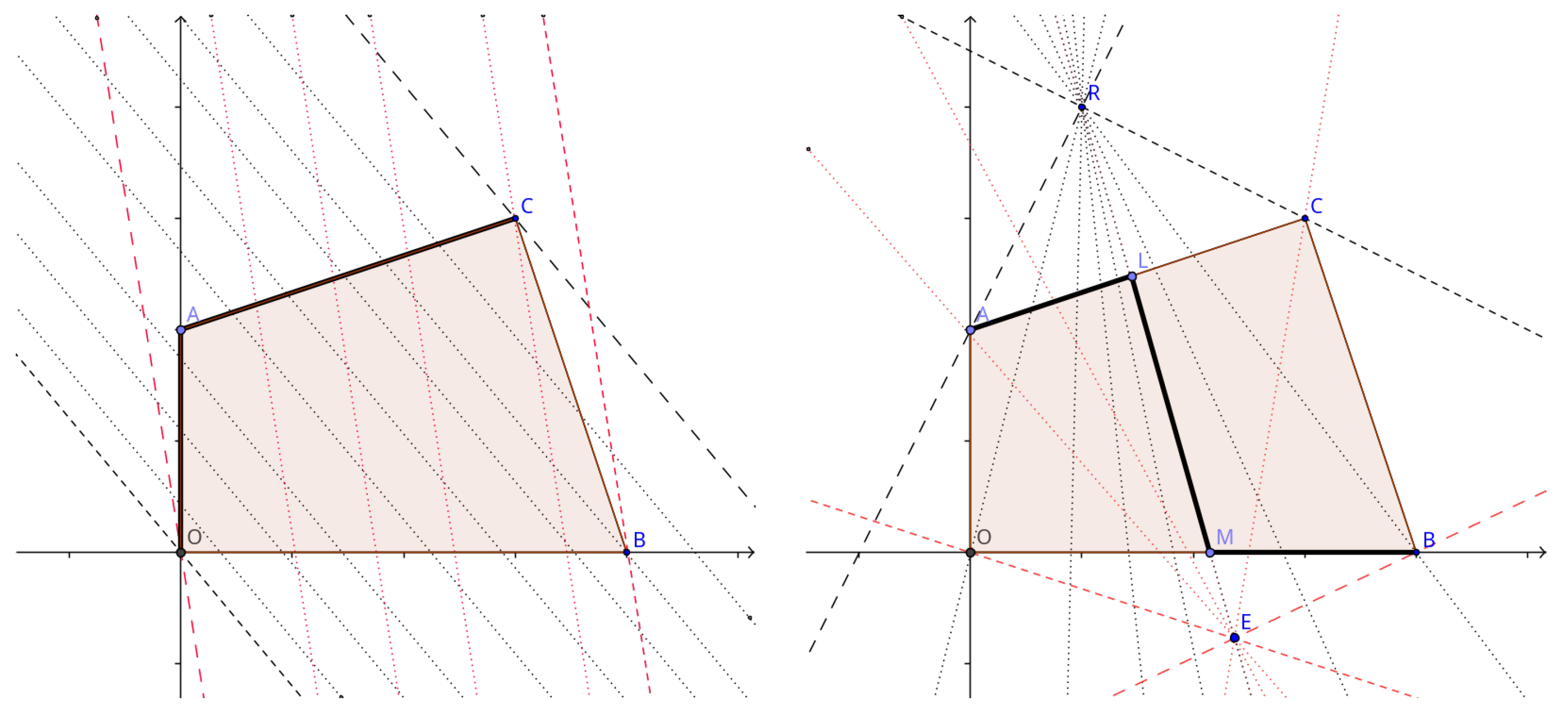
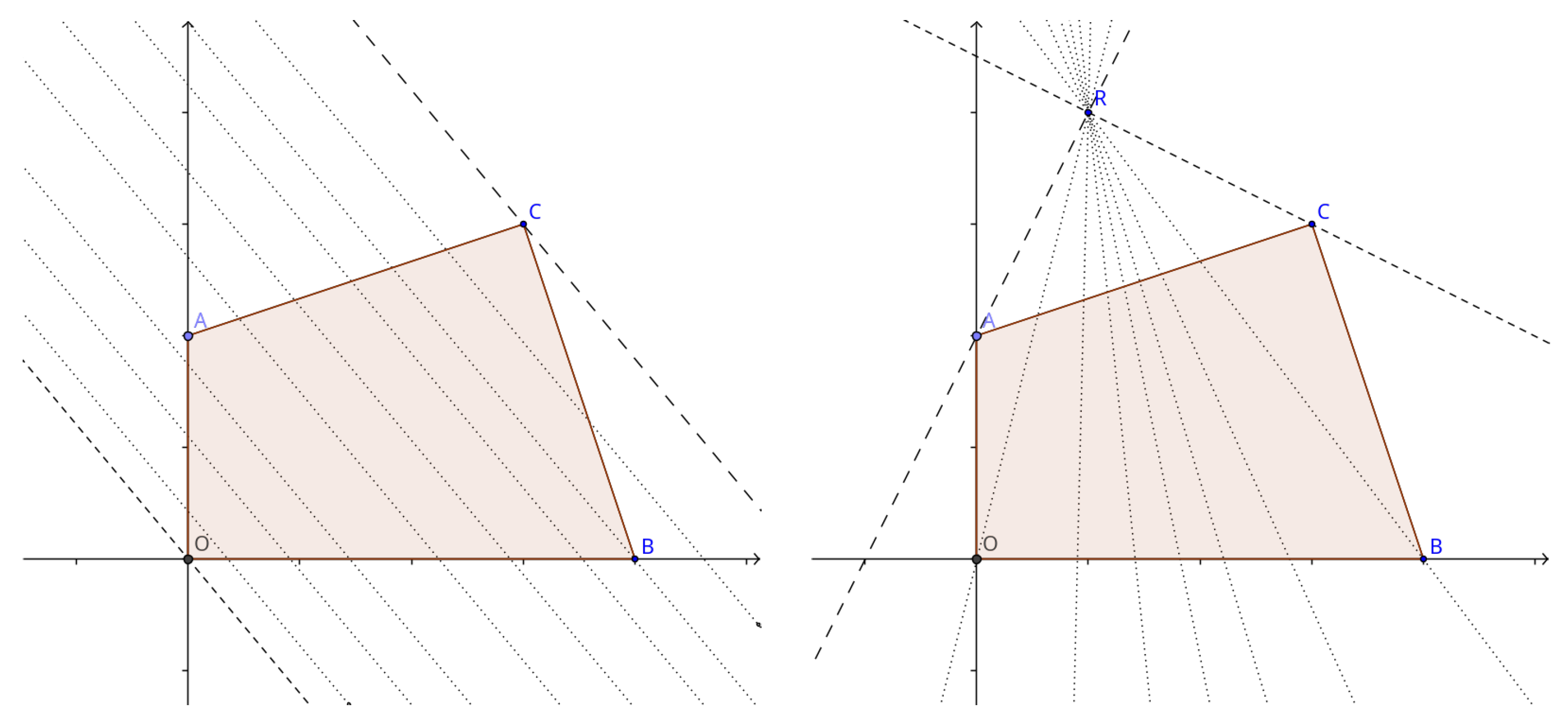
LFP has particularities that assure certain simplicity to its solution approaches. The most important fact is that the objective function is quasi-convex implying that it has unique optimal value over a bounded feasible set. Essential differences between LFP and LP can be seen in the graphic representation shown in
Figure 1.
Figure 1 (left) shows how a linear objective function keeps the constant value along each drawn parallel line, hence its optimal and pessimal values over the shaded feasible set are reached in
O and
C.
Figure 1 (right) shows a fascicle of lines of center
R such that along them the linear fractional objective function has the same value; hence it reaches its optimal and pessimal values over the shaded feasible set in
A and
C.
The linearization technique using Charnes–Cooper transformation [
1], Dinckelbach’s method [
7], the generalized simplex method [
8], as well as other parametric methods are the main approaches to solving FP problems. The best general reference here is Stancu-Minasian [
9].
2.2. Multiple Objective Fractional Programming
Aiming to optimize more fractional objective functions over the same feasible set gives rise to multiple objective fractional programming (MO-FP) models formalized by
where
X is a convex and bounded feasible set. Particularly, as long as all numerators, denominators and constraint functions are linear, the MO-LFP models are described using the following general notation: (i)
; (ii)
A is an
constraint matrix, (iii)
is the vector of decision variables; (iv)
is the right hand side vector of the constraints; (v)
is the number of objectives; (vi)
are the numerators and denominators of the objective functions respectively; (vii)
are the coefficients of the objective functions; (viii)
. Without losing the generality, condition (viii) assures that the denominators of the objective functions are never equal to zero.
The term “max” being used in (
1) for vector optimization shows that all functions have to be maximized. A compromise solution to the vector-optimization problem essentially relays on the definition of Pareto optimality. A feasible solution
is said to be efficient if and only if there is no
such that
, for all
and
for at least an index
. A feasible solution
is said to be weakly efficient if and only if there is no
such that
As far as solving methods are concerned, the MO-LFP is easy enough to be handled by means of LP, but complicated enough to elude a simple analogy. The main differences are shown in
Figure 2: some interior points may be efficient while others may not, and a given edge of the feasible set may start out efficient but become inefficient. Another difference is the fact that the efficient set of a MO-LFP problem is not necessarily closed.
The classic methods for solving multiple objective optimization problems are the weighted sum method and the -constraints method. The weighted sum method (WSM) aggregates the objective functions and optimizes a single objective function to derive a solution to the original problem. This method cannot be easily applied to multiple objective LFP problems since the sum of linear fractional expressions is not necessarily a linear fractional expression. On the other side, the -constraints method (CM) applied to multiple objective LFP results in a single objective LFP problem since it means to optimize one of the original objective functions under a reduced feasible set obtained by imposing -constraints to the rest of the objective functions. For fixed values of the new constraints are linear, thus, the whole system of constraints stays linear. There are also many specific solving approaches that are neither extensions of methods applied to LP problems nor particular methods derived from nonlinear programming.
2.3. Data Envelopment Analysis
Data Envelopment Analysis (DEA) successively uses LFP models to rank decision units based on the information that connects their observed inputs and outputs. Charnes et al. [
10] proposed the classic DEA model, as it follows. Given
n decision-making (DM) units involved in the evaluation process, denoting by
the
i-th input of the
j-th DM unit,
,
, and letting
be the
r-th output for the DM unit
j,
,
, in DEA models (
2), the efficiency of any DM unit is equal to the maximum of the ratio of weighted outputs to weighted inputs subject to the constraint that for every DM unit its corresponding ratio is less than or equal to unity. Model (
2) describes the efficiency
of the DM unit
p,
:
where each efficiency
is computed as a ratio
,
. The weights
u and
v of the inputs and outputs, respectively are decision variables, and
is an infinitesimal quantity which assures that all inputs and outputs are considered in the evaluation even with a minor weight. The standard model (
2) can be easily linearized, thus, yielding
but more sophisticated variants of DEA models must be analyzed as FP models, since the linearization technique might not be the most computational convenient solution approach.
2.4. Fuzzy Fractional Programming
The complexity of a real system is hard to fully model mathematically. One of the challenges nowadays is to model uncertainty and perform optimization in an uncertain environment. Using statistics and randomization, the deterministic models were generalized towards stochastic models, thus, “stochastic” might be used as opposite to “deterministic”. On the other hand, when describing the coefficients of a model, the term “uncertain” might be used as the opposite to ”crisp”.
Involving uncertain quantities of any kind within the model’s coefficients redefines the model, and reshapes the solution algorithms. The recent literature related to FP under uncertainty is mainly related to fuzzy uncertainty, and that is why we provide some more details related to fuzzy sets. In the recent literature, the classic fuzzy sets are already generalized to picture, orthopair, intuitionistic, Pythagorean, Fermatean, neutrosophic, spherical fuzzy sets, and so on. Each of them has its particularities but also a specific idea of generalization. Many times, the fuzzy quantities that describe the coefficients of a problem are reduced to simpler forms of fuzzy sets within solution approaches. In such cases, the focus was rather put on modeling input data, than on improving the existing solution approaches; at the same time, the majority of the solution approaches proposed to fuzzy optimization problems involving fuzzy numbers were blindly extended, by a simple analogy, to solve problems that use more general fuzzy sets.
Letting
R be the set of real numbers, we denote by
the set of all fuzzy subsets of
R. Every
is uniquely characterized by a membership function
that associates each
with a real number
that represents the grade of the membership of
x in
Y. For
, the set
is called the
-cut of the fuzzy subset
Y. The set
is called the support of the fuzzy subset
Y. A fuzzy number
is called triangular if the graph of the non-zero values of its membership function is a triangle. Any triangular fuzzy number is defined as a triple
[
11]. For
, the
-cut of
is the interval
, where
For a deeper discussion on the arithmetic of
-cut intervals we refer the reader to [
12].
Generalizing a LFP problem such that its coefficients are fuzzy, e.g., expressed by fuzzy numbers (FN), the following Model (
5) is obtained.
where: (i)
is the feasible set; (ii)
is the fuzzy matrix of the constraints; (iii)
is the right hand side vector of the constraints; (iv)
x is the
n-dimensional vector of decision variables; and (v)
represent the fuzzy coefficients of the objective function. Notation “
” used in (
5) can have various interpretations depending on the solution approach. It can either derive a fuzzy quantity as fuzzy optimal solution with respect to a given ranking function, or yield a crisp value obtained by the defuzzification of a fuzzy quantity. Model (
5) may have all coefficients expressed by fuzzy quantities or only some of them. In the literature, special solution approaches were proposed for fuzzy LFP problems having fuzzy coefficients only in the objective function.
Formulating parametric optimization models based on the -cuts of the involved coefficients yields interval optimization models solved by specific methodologies.
A fully fuzzified optimization model assumes that its both coefficients and decision variables are fuzzy quantities. The general form of a such problem is modeled by “
”, where
and
are vectors of fuzzy coefficients, and
is a vector of fuzzy decision variables. Solutions to fully fuzzified problems should be provided in compliance with Zadeh’s extension principle (EP) [
13]. Based on the EP, the definition of the membership function of the fuzzy solution is provided using the optimal solutions to the crisp following family of optimization problems “
”, where
a and
c are possible crisp values of the fuzzy coefficients
and
, respectively. Let
p denote the vector obtained by concatenating the vectors
a and
c, i.e.,
. Then, through EP, the membership degree of the crisp optimal value
z in the fuzzy set
is defined as
where
m is the number of scalar parameters used in modeling the original optimization problem.
3. Survey of the Literature
3.1. Methodology and Selection Criteria
Our survey is intended to provide an extensive understanding of the field of fractional programming, rather than a quantitative analysis of the existing literature. We craft our review to serve as base for future research, rather than identify references based on an artificial-search strategy. We inspected bibliographic database as Scopus, and Web of Science; publisher databases as ScienceDirect, SpringerLink, Wiley Online Library, and MDPI; and search engines as Google Scholar. Our search covered publications from 1960 to 2026, since we aimed to extract works related to both foundational and recent developments in fractional programming. We used “fractional programming”, “linear fractional programming”, “nonlinear fractional programming”, “multiple objective fractional programming”, “fuzzy fractional programming”, “fully fuzzy fractional programming”, “fractional optimization” as searching keywords, but also some of the above combined with “DEA”, “efficiency analysis”, and “ decision making”.
Our review intends to spread from theoretical evolution, to methodological extensions, and approaches handling fuzzy uncertainty. In the reference list, we include basic contributions to the field; studies directly addressing fractional programming; and also certain papers that are closely related to fractional programming, and whose results can be improved by incorporating fuzzy programming approaches. Within our survey, we also aim to present different methodological directions, to ensure a broad coverage of the entire topic. We accorded a special attention to recent works to maintain the relevance of the review, and selected studies representing diverse application domains.
We proceed to survey certain papers on FP from the recent literature aiming to highlight the main advances in the field, and open the discussion on further valuable research directions. The references are thematically organized in three groups: single, multiple objective FP, and data envelopment analysis. For each category, papers addressing both crisp and fuzzy models are surveyed. The summary included in
Section 3.7 separately groups linear and nonlinear optimization models, and list the applicability fields of the recent advances.
3.2. Single Objective FP
Upadhyay et al. [
14] studied duality for a certain class of non-differentiable, non-convex minimax fractional optimization problems. Using the
-invexity condition, the authors derived sufficient conditions for the optimality of a solution. They also proposed two dual models for the original problem, and prove several duality theorems. Their findings generalized the classic duality results from the literature to a wider class of non-differentiable minimax fractional problems.
Huang and Shen [
15] proposed an efficient branch and bound reduction algorithm aiming to solve LFP problems. They introduced a linear relaxation problem which has a closed-form solution to underestimate the solution to the original problem. To speed up the convergence of the solution algorithm, rules for eliminating irrelevant regions of the feasible set were formulated. The paper also reported results concerning the complexity of the new proposed algorithm.
Dey et al. [
16] developed a branch and bound algorithm to solve stochastic convex-concave FP problems. The addressed optimization problem is non-convex, but the optimization was performed on a reformulated problem derived by a piece-wise linear approximation. The proposed algorithm yielded accurate solutions when it was applied to solve moderate size stochastic equitable resource allocation and Cobb–Douglas problem instances.
Nadi et al. [
17] solved the inverse optimal value problem for LFPg, i.e., they aimed to identify the values of the coefficients of the fractional objective function that yield an optimal value as close as possible to a given target value. They concluded that the problem is NP-hard; proved theoretical results that supported new reformulations to the problem; and founded two solution algorithms.
Jiao et al. [
18] solved a min–max affine FP by proposing an outcome-space-based branch-and-bound algorithm. Such specific problems arise in various fields as system engineering, management engineering, and electronic science. The authors introduced new additional variables and constraints, and computed the lower bound of the optimal value of the original problem, employing a new linear relaxation technique. The computational complexity of the algorithm was discussed in the paper, and the maximal number of iterations in the worst case was estimated. The advantages of the algorithm were emphasized through numerical experiments on large-scale problems.
Bencheikh and Moulai [
19] focused on solving a LF problems over the efficient set of a multiple objective integer quadratic problem. Such problems are difficult, since the Pareto set is generally not known analytically and it can be exponentially large, especially in combinatorial problems. The authors proposed a branch-and-cut algorithm, by combining branching process that searched relevant values for the integer variables with cutting regions with non-increasing gradient directions of the objectives.
3.3. Single Objective Fuzzy FP
Akram et al. [
20] approached the fractional transportation problem modeling the problem’s uncertainty using interval-valued Fermatean fuzzy sets. They proposed a new method for solving this problem without constructing any equivalent crisp problem. Illustrative examples were provided to discuss and evaluate the advantages of the novel methodology. The precision and accuracy of the numerical results well illustrated their theoretical findings.
Theoretical foundations for deriving empirical solutions to full fuzzy LFP problems with trapezoidal fuzzy numbers were introduced in [
21]. The shape of the membership of the goal function optimal values of the problem were obtained based on the extension principle, and solving crisp quadratic optimization problems. The proposed model handled in different ways (namely, using two independent parameters) the objective function coefficients and the coefficients in the constraints. Comparison results were reported in the study.
Chauhan et al. [
22] addressed fuzzy LFP problems with fuzzy parameters and unrestricted variables. They transformed the original problem into an equivalent bi-objective model whose objectives referred to the upper and lower bounds of the original objective. Further on, the membership functions corresponding to various levels were obtained using the optimal values of the proposed bio-bjective model. The applicability of the method was illustrated on a real-life problem from the transportation sector.
Pokharna and Tripathi [
23] proposed a generalized division approach to solve interval FP problems. Interval programming problems are strictly related to fuzzy programming problems approached via
-cuts, since the interval coefficients are the same with fuzzy coefficients and arbitrary fixed values for the level
. The authors formulated a Wolfe-type dual model, and proved related duality theorems. The theoretical results were illustrated via a steel blending application problem.
Verma and Singh [
24] solved a LFP problem with neutrosophic coefficients essentially relaying on a fuzzy goal programming approach. They proposed two defuzzification methods (one component wise for the objectives, and one based on ranking strategy for the constraints), applied them on the original coefficients, thus, converting the neutrosophic LFP problem into a MO-LFP problem. Further on, the MO-LFP problem was solved using fuzzy goal programming.
Recent papers often used single objective FP models to solve real-life problems. See for instance ref. [
25] that applied a fractional quadratic programming model in tourism sector; ref. [
26] that applied a multi-stochastic FP model to find sustainable solutions in forestry ecological restoration, relating their case study and managing uncertainties in Kashgar Region, Xinjiang; ref. [
27] that optimized the water use efficiency in industrial parks, by using an inexact two-stage stochastic partial FP method combined with uncertain parameters; and ref. [
28] which modeled under uncertainty a process of industrial production using a LFP model that aggregates in a fractional objective the total carbon emissions and emission intensity. Within the field of autonomous systems control, Kim et al. [
29] used optimization to establish a convenient area partition; Mohammadzadeh et al. [
30] implemented non-linear fractional-order type-3 fuzzy control rules aiming to enhance the path-tracking performance of autonomous cars. Their methodology showed high efficiency under various road conditions and parametric uncertainties. Further on, Yang et al. [
31] proposed a fractional calculus with arbitrary non-integer orders operator, and based on it, designed the necessary control laws for uncertain multi-agent systems. The reported experiments, related to an inverted pendulum model, well illustrated the reliability of the new theoretical findings.
3.4. Multiple Objective FP
Kaur and Sharma [
32] addressed a pair of higher order non-differentiable symmetric FP problem over cones; introduced a higher order cone convex function; and set up the duality results. Using the properties of the new introduced function the authors proved that the involved non-linear models are symmetric in sense of duality.
Perić et al. [
33] emphasized the application efficiency, advantages, and sensitivity of their new iterative solution algorithm to multiple objective LFP problem. Within their iterative method, the main focus was put on a fine adjustment of the final solution based on aspirations and cooperation among decision makers.
Singh et al. [
34] addressed a nonlinear MO-FP whose objective functions are not necessarily differentiable, but only
E-differentiable. They formulated and proved
E-Karush–Kuhn–Tucker sufficient optimality conditions under assumption of
E-
B-invexity. Their theoretical results extended and generalized previous results from the literature. The theoretical findings were illustrated and validated by reporting numerical results of the experiments.
Xu et al. [
35] formulated a MO-FP model as optimization support for the operational management of a combined heat and power system. WSM was used to handle the conflicting objectives. Experiments showed that equal weights are the best option to be used within aggregation due to small differences among obtained results under other various weight combination conditions. Based on a case study, the advantages of the novel model were identified in enhancing the greenness of the operational schedule.
Zhang et al. [
36] addressed a multiple objective scheduling problem, and involved mixed-integer programming as an analytical tool within a decomposition-based constructive and improvement heuristics. The considered pairs of objectives with a trade-off relationship, unified to single objective fractional programs, can reduce the involvement of decision makers on certain levels, thus, achieving the desired minimal manual intervention within the designed automated algorithm.
3.5. Multiple Objective Fuzzy FP
Stanojević et al. [
37] introduced two new crisp linear models to solve fuzzy MO-LFP. Piece-wise linear membership functions were used to describe the fuzzy goals related to the optimization of the fractional objectives, and two distinct fuzzy-and aggregation operators to combine these functions yielding a crisp model. One model aggregated all fuzzy goals and constraints into a single crisp linear formulation, while the other incorporated both positive and negative information about the system in a bipolar manner. The obtained models were linear, and by adjusting the thresholds and tolerance levels within the fuzzy goals, they can produce distinct compromise solutions to the MO problem.
Maiti et al. in [
38,
39] developed two approaches that solved fuzzy MO-LFP. Both papers employed Stanojevic’s Normalization Technique [
40] to linearize the fractional objectives, while [
38] was also combining it with fuzzy goal programming to handle the multi-level nature of the problem. Later on, Valipour and Yaghoobi [
41] discussed the fuzzy linearization approaches for solving MO-LFP problems, focusing on proving that no feasible weights can exist that guarantee the equivalence between MO-LFP problems and any MO-LP problem under the assumption that the interior of the feasible set is nonempty, and the map is continuous.
Cao [
42] formulated a MCDM model incorporating picture-fuzzy parameters (as extensions of intuitionistic and neutrosophic quantities) to be applied to a green supplier selection problem. His solution approach is based on FP, incorporating elements of the TOPSIS technique. The available information was used to describe the parameters to pairs of FP models, and a bi-parametric picture fuzzy distance measure was proposed to determine the relative closeness coefficient intervals of the green suppliers.
Yang et al. [
43] applied a fuzzy MO-LFP model and solution approach to solve an agricultural planting structure optimization problem. The extraction of the highest membership value from the aggregated fuzzy quantities from the constraints was based on the superiority and inferiority measures method. Stating the fractional objectives as fuzzy goals, a linear goal programming methodology was introduced for deriving the fuzzy optimal solution to the original problem.
Bas and Ozkok [
44] and Arana-Jimenez [
45] addressed fully fuzzified MO-FP problems. In the former paper, an iterative approach was used to generate fuzzy solutions, while in the latter the generation of the Pareto front was performed via a compromise method.
The intuitionistic fuzzy MO-LFP problem was considered in [
46]. Enhanced solutions to such problems were obtained by employing a classic lexicographic method to solve certain crisp corresponding problems.
Moges et al. [
47] introduced an algorithm that efficiently solved the multilevel multi-objective linear fractional optimization problem with neutrosophic parameters. The authors proposed a novel intuitionistic fuzzy Chebyshev goal programming method; modified a neutrosophic accuracy ranking technique; and used a linearization method without derivatives and extra variables. Finally, they applied a specific distance metric in order to compare the performances of the derived solutions.
Zheng et al. [
48] developed a non-deterministic FP method that maximizes the carbon emission mitigation over the system’s net costs. Their model was applied to Shanxi Province, China. The authors analyzed the trade-offs among multiple socio-economic and environmental objectives/criteria and carried out a case study limited to a specific region.
Maiti et al. [
49] introduced a Stackelberg game model to design a fractional type-2 fuzzy programming model. The authors developed a probabilistic fuzzy MO-LFP with parameters expressed by type-2 fuzzy numbers, and right-hand side of the constraints following the Weibull distribution. The membership functions of the objectives were determined using the first-order Taylor series approximation, and then aggregated into a single objective function using equal weights. The efficiency of the proposed approach was illustrated through a numerical example, and a real-life application in the field of sugar cane processing.
Summarizing, above mentioned studies show the evolution of fuzzy linear fractional programming from normalization and linearization techniques toward more sophisticated fuzzy concepts used to handle the uncertainty.
3.6. Data Envelopment Analysis
DEA constantly increases its applicability, nowadays. There are many studies in the recent literature that applies DEA within MCDM fields by integrating it in classic MCDM. In this way, DEA-TOPSIS [
50] appeared, and found its widely applicability, for instance in forestry industry [
51]; selection of solar power plants [
52]; or process industry [
53]. Similarly, DEA incorporated in AHP methods yielded DEA-AHP technique (see [
54], one of the first references) which found its applications in various fields as evaluating the calorific efficiency of hardwoods [
55]; prioritization of renewable energy sources [
56]; or for efficiency benchmarking in a food retail chain [
57].
In [
58], Radovanović et al. proposed a fair data envelopment analysis method by incorporating an additional constraint in the original model which is able to balance the average efficiency scores for the privileged and unprivileged groups. In this way, the efficiency scores of the DM units, which fromed the privileged group, were reduced. Radovanović et al. [
59] aimed to compute fair cross-efficiency scores using DEA. Noting that the traditional cross-efficiency approaches can produce biased efficiency rankings of DM units, the authors proposed a novel max–min fairness model that optimized the worst cross-efficiency score while also considering the best scores. In this way, a balanced (i.e., avoiding to consider unfair advantages or disadvantages) evaluation of DM units was obtained. The experiments showed that the method is able to derive results that improve equity in efficiency assessments compared with conventional DEA cross-efficiency approaches.
Addressing a standard DEA approach in fuzzy environment, ref. [
60] introduced a procedure that provides analytic description to the fuzzy efficiencies of the DM units. The authors proposed two parametric optimization models whose optimal solutions separately described the left and right sides of the membership functions of the fuzzy efficiencies in accordance to the EP. The membership functions were derived through a parametric linear optimization. Later on, in [
61] a general framework for validating various approaches to full fuzzy data envelopment analysis was proposed. The main idea in founding the framework was to compare its compliance with results derived through a Monte Carlo simulation of the extension principle applied to the same fuzzy data.
Jin et al. [
62] proposed a general two-stage network DEA model by incorporating the fixed cost as a complementary input, and further optimizing the allocation plan. In the beginning, the authors constructed a functional relationship between the efficiency scores of DM units and their allocated fixed costs by employing a modified DEA model, aiming to classify the DM units, and then resolved infeasible solutions within a variable returns to scale framework. Secondly, they introduced a fair and singular allocation model based on principles of maximizing fairness and efficiency. Their empirical study on subsidy allocation among 30 provinces showed that the new proposed approach derived acceptable rational results.
A critical view on DEA studies with applicability in tourism and hospitality was provided in [
63]. The authors aimed to offer recommendations for researchers interested in using similar methodologies. The study showed that the majority of the analyzed papers contain significant shortcomings regarding several aspects of DEA application, related to both the nature and number of inputs/outputs, and model specification and orientation, thus, ensuring transparency and rigor in DEA applications.
Chen et al. [
64] proposed extended DEA models to evaluate green innovation efficiency of High-Tech Industries by integrating environment constraints and prospect theory. Using the new proposed models, they were able to identify gaps between actual and ideal production modes across provinces, and some regional disparities. Tailored strategies (as strengthening cross-regional collaboration, optimizing resource allocation, refining policy) were proposed to align multi-subject interests.
Fanati Rashidi et al. [
65] introduced a hybrid DEA–fuzzy clustering approach to identify accurate reference set. The DM units that were found to be efficient were further used as fixed cluster centers in classic algorithms. An incremental update mechanism was proposed to avoid re-solving DEA for new DM units. Through statistical validations, the high accuracy of the results and robustness of the model were confirmed. The approach was successfully applied to banking and banknote datasets.
In their study, Zhao et al. [
66] integrated the micro-scale mobile monitoring with an Inverse Network DEA framework to systematically characterize the collaborative emission reduction mechanism between traffic emissions and pocket park purification, and to propose an efficiency-constrained optimal resource allocation pathway. Within experiments, 30 representative pocket parks in Yuhang District, Hangzhou were considered as case studies. Further on, the authors formulated a two-stage network DEA model which was linking the traffic emissions and park purification, and transformed into an inverse network DEA model to estimate the input–output adjustments under different emission reduction targets.
Liu and Shih [
67] developed a virtual gap analysis procedure for MCDM and efficiency analysis problems. Identifying the challenges of evaluating a large number of alternatives, and limitations of the conventional efficiency analysis methods, they proposed novel models to evaluate the performance of each DM unit in relation to others based on best practices. The new models were based on linear programming, did not relay on any assumptions, and were capable to deliver robust and reliable solutions. Within their approach, each DM unit identified achievable benchmarks for its inputs and outputs. Non-performant DM units were removed, thus, classic MCDM methods were applied on a reduced amount of data.
Moragues et al. [
68] adapted and used the Li-test [
69] to select certain inputs and outputs as variables in the production processes of DM units. The relevance of each variable was established with respect to the statistically significant differences in the derived scores when the variable was excluded or not from the efficiency analysis.
In conclusion, from the addressed literature, we can clearly identify the tendency of DEA to incorporating two main MCDM techniques—AHP and TOPSIS—to improve efficiency evaluation and ranking. On the other side, DEA continues its expansion through fuzzy, probabilistic, and fairness frameworks, enhancing its ability to incorporate uncertainty, and decision-maker preferences in complex environments.
3.7. Summary
Table 1 lists the most recent bibliographic items grouped by problem type: linear/nonlinear, crisp/fuzzy, addressing single/multiple objectives.
Visually, from
Table 1, one can notice that CRISP column is inverse correlated with the FUZZY column, with respect to the cited references, having the “nonlinear FP” line most balanced. On the other hand, fuzzy elements are most present in “linear FP” models; and crisp DEA models are still under developing, and more conservative to incorporating fuzzy parameters.
Having in mind the computational complexity of various approaches, we can mention that, as expected, linear FP methodologies are less demanding than the non-linear ones due to their equivalent transformation to LP; while fuzzy approaches are generally more demanding than their crisp variants, since they are mainly based on a sequence of optimization sub-steps. Finding one non-dominated point to a multiple objective problem generally involve equally effort as a single objective optimization, but disclosing the entire Pareto front or deriving several non-domiated points implies significantly more effort.
Many papers addressing special types of FP problems illustrated their findings by solving real-life problems. The main areas of applicability of FP optimization models include: energy efficiency (where the relevant outputs per consumed energy is maximized); wireless communications (where data rate per unit power is maximized); finance and portfolio optimization (where the return per unit risk is maximized); manufacturing process selection or supply chain design (where the profit per unit cost is maximized); healthcare resources allocation (where the benefits per unit resources is maximized); transportation and logistics (where the delivered goods per fuel or time is maximized); environmental engineering (where pollution reduction per costs is maximized); and so on. Among the newest topics involving FP is machine learning and AI systems, that try to maximize the accuracy of the results per computation demand.
Table 2 includes recent references that have reported results obtained by applying FP models to practice. Their field of applicability and the model type are also listed in the table.
4. Future Research Directions
In this section we provide several research directions in the field of fractional programming. These directions are not necessarily completely new, but many of them are forgotten. For instance, it is not new to claim that for multiple objective problems Pareto optimal solutions are desired. However, many solution approaches derive solutions that are not efficient in Pareto sense. In the same way, fuzzy theory was introduce to handle uncertainty, and fuzzy concepts were formulated in a consistent way due to the extension principle that is able to naturally aggregate fuzzy quantities. However the non-compliance of many methodologies from fuzzy environment with the extension principle is often ignored, sometimes neglected and/or superficially addressed.
4.1. Nonlinear Programming Methods Particularized to Solve LFP Problems
The majority of the specific algorithms that solve LFP problems are extensions of the algorithms proposed for solving LP problems. This is a natural approach, since LFP is perceived as a first level generalization of the linear case. For instance, Simplex Method which is the most used method to solve LP problems has its variant developed to solve LFP problems.
Inspired by the study of Kuk et al. [
73] that derived generalized Karush–Kuhn–Tucker necessary and sufficient optimality conditions and proposed duality theorems for nonsmooth multiobjective fractional programming problems, we advance the idea that solution approaches to LFP problems can be obtained as particularization of solution approaches to nonlinear programming problems. Even though, linear fractional functions—as ratio of linear functions—are not necessarily convex, the solution approaches to LFP can be enriched by proper adaptations of convex optimization methods.
For instance, Rosen’s algorithm formulated in [
74,
75] for non-linear problems with linear/nonlinear constraints can be efficiently applied to solving convex programming problems. Its effectiveness in solving convex programming problems is due to the globality of any extreme point of convex objective functions. On the other side, when applied to a non-convex case, Rosen’s algorithm risks to derive a local optimal solution instead of a global one. This specificity can be extended to other classes of non-linear problems that are non-convex but do not admit local optima. Linear fractional functions are not convex, they still retain the property of convex functions of having only global extreme points. From this point of view, a generalization of the Rosen algorithm to a wider class than convex problems is based in fact on a particularization of both the optimality and improvement criterion of a current solution from topologically to algebraically evaluation.
More generally, it is expected that majority of the solution approaches to convex programming problems can be easily extended to ones for solving LFP problems. This applies to both single and multiple objective LFP problems.
4.2. New Methods for Finding the Pareto Front of MO-LFP Problems
With the increase number of studies on solution approaches to multiple objective optimization problems, the idea of applying them to MO-FP problems arises naturally. The methods based on -constraints has a better impact when linear fractional objective functions are involved, since such constraints can be transformed without any loss of generality to linear ones. However, the cumbersome of -constraints methods rapidly expands with respect to the number of objective functions that paired to their thresholds have to be included within the constraints. The other key method in MO programming, the one that involves the aggregation of the objective function, leads to a single objective optimization problem over the original feasible set, but with a nonlinear fractional objective function, bringing another kind of difficulties when coming to solve it.
The new developed heuristics or evolutionary algorithms, which can be recalled from the literature, are able to provide approximate Pareto fronts to MO problems in general and to MO-NLFP problems in particular. As long as exact Pareto fronts are desired, the approximations can be of different levels. For instance, the 0-level approximation refers to finding a subset of the true Pareto front; while 1-level approximation refers to finding approximate points that are close to certain non-dominated points but they are not non-dominated themselves.
4.3. Reinstatement of the Pareto Optimality
The Pareto efficiency is the central concept used in multiple objective optimization. Whenever approximate solutions (via heuristics and/or other tools for handling uncertainty) are derived to MO-FP problems, their Pareto efficiency should be tested before declaring them solutions to the original problem.
DM imposes his/her goals and demand compromise solutions accordingly. A compromise solution that fulfills DM’s goals is valuable, but if it is not Pareto optimal, it is worth putting additional effort to transform it into an efficient one. The best reference here, that emphasizes the importance of detection and restoration of Pareto inefficiency, is [
76]. Within that chapter the authors described the goal programming as a field arisen from optimization, and following the philosophy of optimizing several conflicting criteria.
Employing the general Benson’s method [
77] as the final step in such approaches is one way to achieve this kind of improvement, but finding problem specific methods related to the fractionality of the objective functions can bring additional improvements at least in terms of runtime.
4.4. Bi-Objective Problems Transformed to FP Problems
The idea of transforming a bi-objective programming problem into a single objective FP problem is rather forgotten, and rarely used in the recent literature, even though it is very effective when the decision maker seeks for a simple compromise solution.
Stanojevic et al. [
78] provided a solution approach to a Web Service Selection problem having four linear objectives and multiple constraints, by modeling it as a discrete bi-objective LFP problem.
Hanid et al. [
79] used deep recurrent neural networks and Hadoop/Spark cluster aiming to handle Big Data scalability, and detect falls in posture recognition. Within their study, the authors simultaneously focused on two objectives: efficiency and scalability in posture recognition. Maximizing their ratio would produce a relevant compromise solution.
Zhang et al. [
36] addressed a multi-objective reconfigurable distributed flow-shop group scheduling problem proposing an automatic design of two-layer decomposition-based solution approach that integrates constructive and improvement heuristics. They provided a wide comparative analyses among alternative methodologies emphasizing the advantages of their approach. The nature of the objectives included in the optimization model enables their aggregation into a fractional objective whose optimization might reduce the complexity of the approach, thus, illustrating the practical utility of multi-objective fractional models in manufacturing.
Nagy et al. in their paper [
80] combined decision making and robust optimization for information systems to handle emergency events. They chose the Net Present Value robust function as objective function to be maximize within their model. Robustness was obtained by maximizing the probability and minimizing the expected value for the variability of solutions, the expected non-satisfied demand, and the expected capacity slackness. These two optimizations are of different natures and might be aggregated in a single fractional objective function, thus, deriving a different kind of compromise solution.
4.5. Fuzzy Optimization in Accordance with the Extension Principle
The last, but not the least, two research directions listed in
Table 3 are related to the use of the Extension Principle (EP) within optimization in fuzzy environment.
EP was introduced from the beginning, as an essential component of the fuzzy set theory, to handle generalized operations on fuzzy quantities. From EP were further derived the arithmetic/algebraic operations on (specialized) fuzzy numbers. Fuzzy addition and subtraction follow EP rules, and are easily applicable in practice.
Unfortunately, fuzzy multiplication and division are already delicate when it comes to practical applications. They either work simple in special cases that reduce generality, or are applied in their approximate form, thus, losing effectiveness or being misleading.
A deeper discussion about the level of applicability of the extension principle within fuzzy optimization can be found in [
81]. Several papers on solving fuzzy mathematical programming via EP discussed specific aspects of methodologies not complying with EP. See for instance [
82] which provided a critical review of papers published between 2010 and 2020, highlighting theoretical drawbacks and mathematical incorrect assumptions in fuzzy operations research methodologies.
Aiming to provide a solid theoretical base for working with approximate versions of EP, Kupka [
83] has drawn important conclusions concerning the approximation of Zadeh’s extension of a given function. He developed a general procedure that performs approximations of EP for any continuous mapping function, and analyzed the effect of several metrics on the quality of the approximation.
On the other side, Diniz et al. [
84] established the topological context for applying EP for optimizing fuzzy-valued functions, thus, spreading the idea that EP is essential, and have to be properly valued when handling optimization in fuzzy environment. Following Diniz et al. [
84], and applying their results to fuzzy FP problems can open a wide specter of future developments in the field.
4.6. Usefulness of the General T-Norms Within EP
In the same context, another way to improve the quality of fuzzy solutions to fuzzy optimization problems is to consider different t-norms as generalizations of “min” operators within EP. Stanojević and Nadaban [
85] addressed full fuzzy LP problems, and provided empiric solutions that in the same time had narrower membership functions shapes than those derived by a classic EP-based approach, and were obtained in accordance with EP.
Table 3 lists the above suggested research directions, specifying the methodology to follow and the targeted effect.
5. Conclusions
To conclude the study, we reaffirm that fractional programming is widely studied in the recent literature, and it has not stopped being studied since it was first introduced. Optimizing ratio-based objectives, fractional programming enables a specific and realistic modeling of the trade-offs, thus, highly supporting decision-making process.
The primary objective of the current study was to provide a comprehensive survey of the field to researchers interested in advancing the applicability of fractional programming in various adjacent fields, thus, widening interdisciplinarity.
The cited references were selected based on their relevance to fractional programming in its both aspects theory and applications; historical significance; methodological diversity, and relevance nowadays. The introspection in the recent literature, and suggestions for further research directions, were related to optimization in a fuzzy environment, data envelopment analysis, and multiple objective optimization with fractional objective functions.
Throughout the survey, our main goal was to promote the idea that, when it is efficiently used, fractional programming can be an effective tool to managers to make a sound and confident decision.