1. Introduction
Integral inequalities play a fundamental role in mathematical analysis, numerical approximation theory, optimization, and fractional calculus. Classical inequalities such as Hermite–Hadamard, Simpson, Newton, Ostrowski, and Milne inequalities have been extensively investigated because of their applications in estimating integral means, error bounds, and quadrature formulas. In recent decades, the development of fractional calculus has led to numerous extensions of these inequalities within various fractional integral frameworks.
Parallel to the rapid growth of fractional analysis, multiplicative calculus has emerged as an alternative mathematical framework for describing proportional growth, exponential evolution, and multiplicative dynamic systems. The foundations of multiplicative calculus were established by Bashirov et al. [
1], while Abdeljawad and Grossman [
2] introduced the geometric fractional calculus and multiplicative fractional operators, opening a new direction in multiplicative fractional analysis.
Following these pioneering studies, several multiplicative fractional integral operators have been developed. Zhou and Du [
3] established analytical properties and related inequalities associated with multiplicative Hadamard fractional integrals, while Ali and Du [
4] investigated multiplicative Katugampola fractional integrals and obtained Newton-type inequalities for twice multiplicatively differentiable functions. More recently, Ali et al. [
5] proposed generalized multiplicative fractional integral operators and derived Hermite–Hadamard-type inequalities, further enriching the theory of multiplicative fractional calculus.
The theory of multiplicative convexity has also received considerable attention. Ali et al. [
6] established integral inequalities involving products and quotients of multiplicatively convex functions, whereas Ali et al. [
7] obtained multiplicative Hermite–Hadamard inequalities within the framework of multiplicative calculus. Subsequently, Peng and Du [
8] introduced multiplicative
-convexity and derived several related fractional inequalities. These developments demonstrate the important role of multiplicative convexity in the construction of multiplicative integral inequalities.
In recent years, increasing attention has been devoted to multiplicative fractional inequalities associated with various generalized fractional operators. Budak and Özçelik [
9] established Hermite–Hadamard-type inequalities for multiplicative Riemann–Liouville fractional integrals. Du et al. [
10] further introduced multiplicative Atangana–Baleanu fractional integral operators and derived multiplicative Hermite–Hadamard-type inequalities involving nonsingular memory kernels. Almatrafi et al. [
11], Frioui et al. [
12], Butt et al. [
13], Khan et al. [
14], Saleh et al. [
15], Lakhdari et al. [
16,
17,
18], and Umar and Butt [
19,
20] subsequently developed various multiplicative fractional inequalities associated with multiparameterized, Katugampola, G-calculus, Caputo-hybrid, and hybrid fractional integral operators.
In particular, Lakhdari et al. [
17] established Milne-type inequalities via Katugampola fractional multiplicative integrals, indicating that Milne-type approximation theory has become an active research topic within multiplicative fractional calculus.
Despite these significant developments, most existing results have been established either for multiplicative Riemann–Liouville, Hadamard, Katugampola, or Atangana–Baleanu fractional operators separately. The simultaneous incorporation of multiplicative structures, nonsingular Atangana–Baleanu memory effects, and conformable scaling properties has not yet been fully investigated in the context of multiplicative Milne–Mercer-type inequalities. Moreover, quantitative studies concerning the influence of fractional parameters on approximation behavior remain relatively limited.
Motivated by the above observations and inspired by the recent Atangana–Baleanu–conformable framework proposed by Lo in [
21], we introduce a new multiplicative Atangana–Baleanu–conformable fractional integral operator. By employing this operator together with multiplicatively convex functions, we establish several new multiplicative Milne–Mercer-type inequalities. The obtained results unify and extend a number of previously known inequalities associated with multiplicative Riemann–Liouville, Atangana–Baleanu, and conformable fractional integrals. In addition, numerical examples and parameter sensitivity analyses are presented to illustrate the validity and approximation behavior of the derived inequalities.
Table 1 shows that the proposed multiplicative Atangana–Baleanu–conformable fractional integral operator is the first framework that simultaneously incorporates multiplicative calculus, nonsingular Atangana–Baleanu memory effects, and conformable scaling properties. Therefore, it unifies several existing fractional integral structures within a single analytical setting.
2. Preliminaries
First, we recall some concepts of multiplicative calculus and convexity.
Definition 1 ([
22])
. A function is considered to be multiplicatively convex, ifsatisfies for any with From the definition, it readily yields that
This demonstrates that the multiplicatively convex functions have convexity, but convex functions may not necessarily have multiplicative convexity. The following property of the multiplicative convexity in aspects of two multiplicative functions is straightforward.
Definition 2 ([
1])
. Assume that the function is ∗
-differentiable on The notation symbolizes ∗
-differentiable of the function which is expressed as The relevance between
and
is as follows:
Furthermore, Bashirov et al. [
1] demonstrated that the multiplicative integral possesses the following properties:
Proposition 1. It is postulated that the function is ∗-differentiable on If the funciton f is increasing, then the multiplicative derivative satisfies
Proposition 2. We presume that the functions are *-differentiable, and the function is differentiable on If the constant then and are all *differentiable on as well, where is the interior of and the following properties hold:
(1)
(2)
(3)
(4)
(5)
(6)
Proposition 3. Let Presuming that the function is ∗-integrable on , then the multiplicative integral satisfies the following properties:
(1)
(2)
(3)
(4)
(5) and
Finally, we introduce the integration-by-parts formulas within the setting of multiplicative integrals.
Theorem 1 ([
1])
. It is presumed that the function is *differentiable, and that the function g is Then, the function is *integrable, and the succeeding formula holds: Theorem 2 ([
1])
. It is presumed that the function is *differentiable and that the functions g and are both Then, the succeeding formula holds: The rapid development of multiplicative calculus has provided an alternative analytical framework for describing proportional growth, exponential evolution, and multiplicative dynamic systems. Unlike classical additive calculus, multiplicative calculus is naturally formulated in terms of relative changes and geometric variations, making it particularly suitable for problems involving exponential-type behaviors and multiplicative processes.
Nevertheless, classical multiplicative operators are essentially local in nature and therefore may not adequately capture memory-dependent phenomena that frequently arise in practical applications. In contrast, fractional integral operators possess nonlocal characteristics and have been shown to be effective tools for modeling hereditary effects, long-range interactions, and memory mechanisms. Consequently, it is natural to investigate whether the advantages of fractional calculus can be incorporated into the framework of multiplicative calculus.
This idea has motivated the development of multiplicative fractional integral operators, which extend classical multiplicative integration by introducing fractional-order memory effects. Such operators preserve the multiplicative structure while simultaneously inheriting the nonlocal properties of fractional calculus. As a result, multiplicative fractional operators provide a broader analytical setting for studying multiplicative dynamical systems, generalized convexity, and multiplicative integral inequalities.
Over the past few years, several multiplicative fractional integral operators have been proposed in the literature. Starting from multiplicative Riemann–Liouville fractional integrals, researchers subsequently introduced multiplicative Hadamard and multiplicative Katugampola fractional integrals, leading to a variety of Hermite–Hadamard-, Simpson-, Newton-, and Milne-type inequalities in multiplicative settings. More recently, multiplicative Atangana–Baleanu fractional operators have attracted considerable attention due to their nonsingular kernel structure and improved memory representation. These developments indicate that multiplicative fractional calculus has become an active research area and provides a natural foundation for the investigation of generalized multiplicative integral inequalities.
For completeness, we recall several multiplicative fractional integral operators that will be used throughout this paper.
Abdeljawad and Grossman were the first to introduce the notion of fractional multiplication integrals and derivative.
Definition 3 ([
2])
. The multiplicative left Riemann–Liouville fractional integral of order beginning with a is specified byand the multiplicative right one is defined bywhere and are the classical left and right Riemann–Liouville fractional integrals. Zhou and Du introduced Hadamard fractional multiplicative integrals in the following manner:
Definition 4 ([
3])
. The left-sided Hadamard fractional multiplicative integral of order with is defined byand the multiplicative right one is defined bywhere and are the classical left-sided and right-sided Hadamard k-fractional integrals. Ali and Du introduced the multiplicative Katugampola fractional integrals in the following manner:
Definition 5 ([
4])
. Let with The left-sided and right-sided multiplicative integral Katugampola fractional integrals of order with and are defined byThe multiplicative right-sided operator is defined bywhere and are the classical left-sided and right-sided Katugampola fractional integrals. Multiplicative convexity can be regarded as a natural extension of classical convexity and plays an important role in mathematical analysis.
In [
5], Ali et al. gave the integer-order Hermite–Hadamard inequalities originating from multiplicatively convex functions
Theorem 3. Let is multiplicative convex on and The following inequalities hold: The multiplicative RL-fractional integrals, as a crucial extension of RL-fractional integrals, was proposed in [
9].
Definition 6. For an order with Re the multiplicative Riemann–Liouville-fractional integrals and are defined byand the multiplicative right one is defined by In [
9], Budak and Özçelik established the following midpoint-type and endpoint-type inequalities
Theorem 4. For , where f is the multiplicative RL-fractional integral, the following inequalities hold:and Du et al. [
10] gave the multiplicative Atangana–Baleanu fractional integral operator as follows:
Definition 7. Let f be a function such that For the order and the multiplicative left-sided AB-fractional integral operator is defined asand the corresponding multiplicative right-sided is defined aswhere denotes the Gamma functionand is a positive normalized function along with In [
21], Lo denoted the new operator with AB-conformable fractional integrals.
Definition 8. Let be a function, where , and the following integrals exist. For , where denotes the AB normalization function satisfying
We denote by the Gamma function and by the one-parameter Mittag–Leffler function.
Remark 1. Let , and set Then, for all ,
Remark 2. Let , and set Using and we obtainand Therefore, reduces to the conformable integral corresponding to the parameter
Remark 3. If and then , and then, the ABConf integral reduces to the classical Riemann integral.
We now introduce a multiplicative Atangana–Baleanu–conformable fractional integral operator within the framework of multiplicative calculus.
Definition 9. Assume that Assume further that , and For and , the multiplicative left-sided ABConf-fractional integral operator is defined asfor The corresponding multiplicative right-sided is defined asfor where the gamma function is given byand is a positive normalized function along with . Proposition 4 (Well-definedness and Positivity). Let and . Assume that is a positive function such that ln f belongs to
Then, the multiplicative Atangana–Baleanu–conformable fractional integral operators introduced in Definition 9 are well defined and positive.
Proof. We analyze the kernel near its possible singular endpoints.
Case 1:
Since
we obtain
for some
Since
Hence, the kernel is integrable near
Case 2:
Since
we have
Hence, the kernel is integrable near
Combining both endpoint analyses,
Therefore, exists whenever
Therefore, the operator is well defined and positive. □
Proposition 5 (Multiplicative Product and Power Properties)
. Let be positive functions such that Then, the multiplicative Atangana–Baleanu–conformable fractional integral operator satisfies the following properties:and Proof. Since
and the classical AB-conformable integral operator is linear,
Similarly,
gives
The proof is complete. □
Remark 4. The proposed multiplicative Atangana–Baleanu–conformable fractional integral operator combines three distinct mathematical structures.
First, multiplicative calculus is formulated through the logarithmic representation of positive functions and is particularly suitable for describing multiplicative growth phenomena.
Second, the Atangana–Baleanu component introduces a nonlocal memory effect through a normalized nonsingular kernel, allowing the operator to retain information from previous states.
Third, the conformable parameter β provides an additional scaling mechanism and controls the local distribution of the kernel.
Consequently, the proposed operator simultaneously incorporates multiplicative behavior, fractional memory effects, and conformable scaling properties. This unified structure provides the foundation for the multiplicative Milne–Mercer-type inequalities established in the next section.
The main contributions of this paper are summarized as follows:
(1) We introduce a new multiplicative Atangana–Baleanu–conformable fractional integral operator and investigate its analytical properties.
(2) We establish a new identity associated with the proposed operator and employ it to derive several multiplicative Milne–Mercer-type inequalities.
(3) We show that the proposed framework recovers previously known multiplicative Riemann–Liouville, multiplicative Atangana–Baleanu, and conformable integral inequalities as special cases.
(4) Numerical experiments, parameter sensitivity analyses, heatmaps, contour plots, and relative-error comparisons are presented to quantify the influence of the fractional parameters and to compare the obtained estimates with existing special cases.
Remark 5. Proposition 5 shows that the proposed operator preserves the fundamental algebraic structures of multiplicative calculus. In particular, multiplicative products and multiplicative powers remain compatible with the operator, demonstrating that the proposed framework is not merely a logarithmic reformulation of the classical Atangana–Baleanu–conformable fractional integral but also retains essential multiplicative characteristics.
The symbols appearing in the subsequent analysis are summarized in
Table 2.
3. Main Results
The main objective of this section is to establish generalized multiplicative Milne–Mercer-type inequalities under the newly proposed multiplicative Atangana–Baleanu–conformable fractional framework.
The obtained inequalities simultaneously incorporate multiplicative convexity, conformable scaling effects, and nonlocal fractional memory behavior. Consequently, the proposed framework extends several existing multiplicative fractional inequalities and provides a more flexible analytical structure for multiplicative fractional approximation theory.
Throughout this section, let , and let be a positive function. Assume that the multiplicative derivative exists on and that all multiplicative Atangana–Baleanu–conformable fractional integrals appearing in this section are well defined. Furthermore, whenever required, we assume that is multiplicatively convex on the corresponding interval.
For convenience, the notations introduced in
Section 2 will be used throughout the subsequent analysis.
Lemma 1. Let with and ; f is a multiplicative differentiable on , and is a multiplicative integrable function. Then, the following equality is valid for Atangana–Baleanu–conformable fractional integral operators: Proof. For convenience, the proof is divided into several steps.
Step 1. Definition of the first multiplicative integral.
Step 2. Application of multiplicative integration by parts.
Applying multiplicative integration by parts to
yields
Step 3. Variable transformation.
By changing of variables
we have
By Definition 9, the resulting expression can be identified as the left-sided multiplicative ABConf operator, and we get
By changing the variables
we have
By Definition 9, the resulting expression can be identified as the right-sided multiplicative ABConf operator, and we get
Step 4. Combination of the two integral identities.
□
The following theorem establishes a generalized multiplicative Milne–Mercer-type inequality involving the proposed multiplicative Atangana–Baleanu–conformable fractional operator.
Compared with the previously known multiplicative fractional inequalities, the obtained estimate simultaneously incorporates multiplicative convexity, nonlocal memory effects, and conformable scaling structures. Consequently, the resulting approximation framework exhibits improved analytical flexibility and broader applicability.
Theorem 5. Let , and let be a positive multiplicatively differentiable function, with and . Assume that is multiplicatively convex on and that all multiplicative Atangana–Baleanu–conformable fractional integrals involved in the statement exist. Then, the following multiplicative Milne–Mercer-type inequality holds: Proof. Using Lemma 1 and the multiplicative of
we have
□
Special Parameter Reductions
Theorem 5 contains two independent parameters, namely and . The parameter controls the contribution of the fractional memory component, whereas governs the conformable scaling effect. To better understand their respective roles, we consider the following limiting cases.
Remark 6 (Equality Condition). The equality in Theorem 5 is attained when the multiplicatively convex function f is constant on the interval .
Indeed, if for some positive constant c, then the multiplicative derivative satisfies , for all , and all multiplicative fractional integral terms reduce to the same constant contribution. Consequently, both sides of the inequality coincide, and the obtained estimate becomes exact.
Therefore, the inequality is sharp in the sense that equality is achieved by constant functions.
Corollary 1. Setting in Theorem 5, the memory contribution disappears and the resulting inequality depends solely on multiplicative and conformable structures. Corollary 2. Setting in Theorem 5, the conformable scaling mechanism is removed and only the multiplicative Atangana–Baleanu-type memory effect remains. Corollary 3. Setting in Theorem 5, both mechanisms vanish simultaneously, leading to a purely multiplicative integral inequality. These observations indicate that the proposed operator may be viewed as a two-parameter extension of several simpler multiplicative integral structures.
Theorem 6. Let , and let be a positive multiplicatively differentiable function, with and . Assume that is multiplicatively convex on for and that all multiplicative Atangana–Baleanu–conformable fractional integrals involved in the statement exist. Then, the following multiplicative Milne–Mercer-type inequality holds: Proof. By employing Lemma 1 and using Hölder’s inequality with Jensen–Mercer’s inequality, it follows that
□
Novelty and Relation to the Existing Literature
The present work differs from existing multiplicative fractional inequality studies in several important aspects.
First, most previously established multiplicative fractional inequalities were derived separately for multiplicative Riemann–Liouville, Hadamard, Katugampola, or Atangana–Baleanu fractional operators. In contrast, the multiplicative Atangana–Baleanu–conformable fractional operator introduced in this paper simultaneously incorporates multiplicative structures, nonsingular Atangana–Baleanu memory effects, and conformable scaling properties within a unified analytical framework.
Second, the obtained Milne–Mercer-type inequalities are established under this generalized operator setting. Consequently, various previously known multiplicative fractional inequalities are recovered as special cases through suitable parameter selections.
Third, unlike existing studies that mainly focus on theoretical inequalities, the present paper includes quantitative analyses of approximation behavior through logarithmic gap values, relative-error comparisons, heatmaps, contour plots, and parameter-sensitivity investigations.
Therefore, the contribution of this paper is not merely a formal extension of previously known inequalities. Rather, it provides a unified multiplicative fractional framework together with theoretical and numerical analyses that clarify the influence of fractional memory and conformable scaling on multiplicative approximation estimates.
4. Numerical Section for Theorem 5
This section provides two numerical examples for Theorem 5. We take
,
,
,
, and
. Hence,
,
, and
. For each example, we compute
where LHS and RHS denote the two sides of the inequality in Theorem 5. A nonnegative value of
indicates that the numerical data are consistent with the asserted upper bound. The first comparison fixes
and varies
. The second comparison fixes
and varies
.
Example 1. Let on . Then, , and . Since is affine, is multiplicatively convex on .
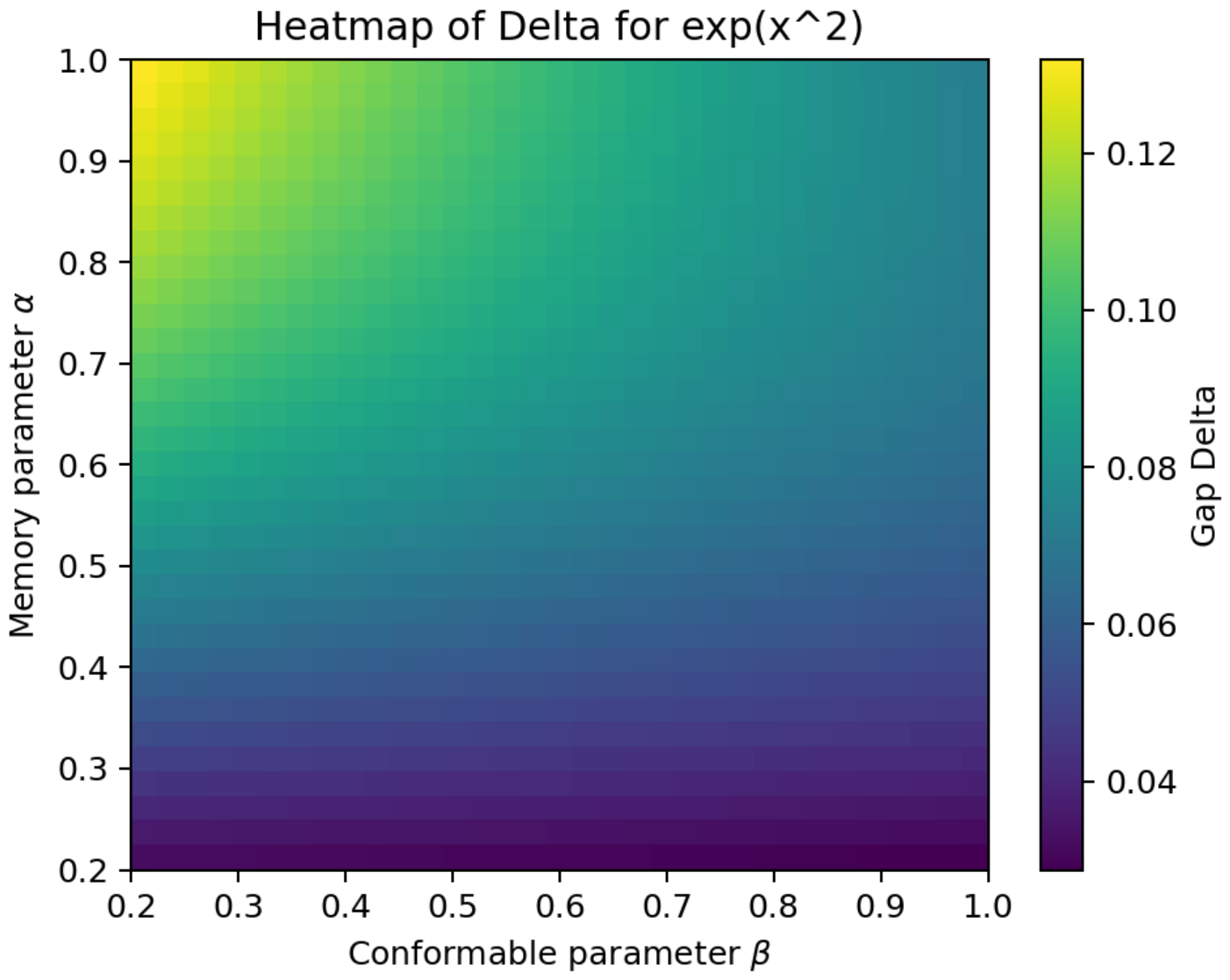
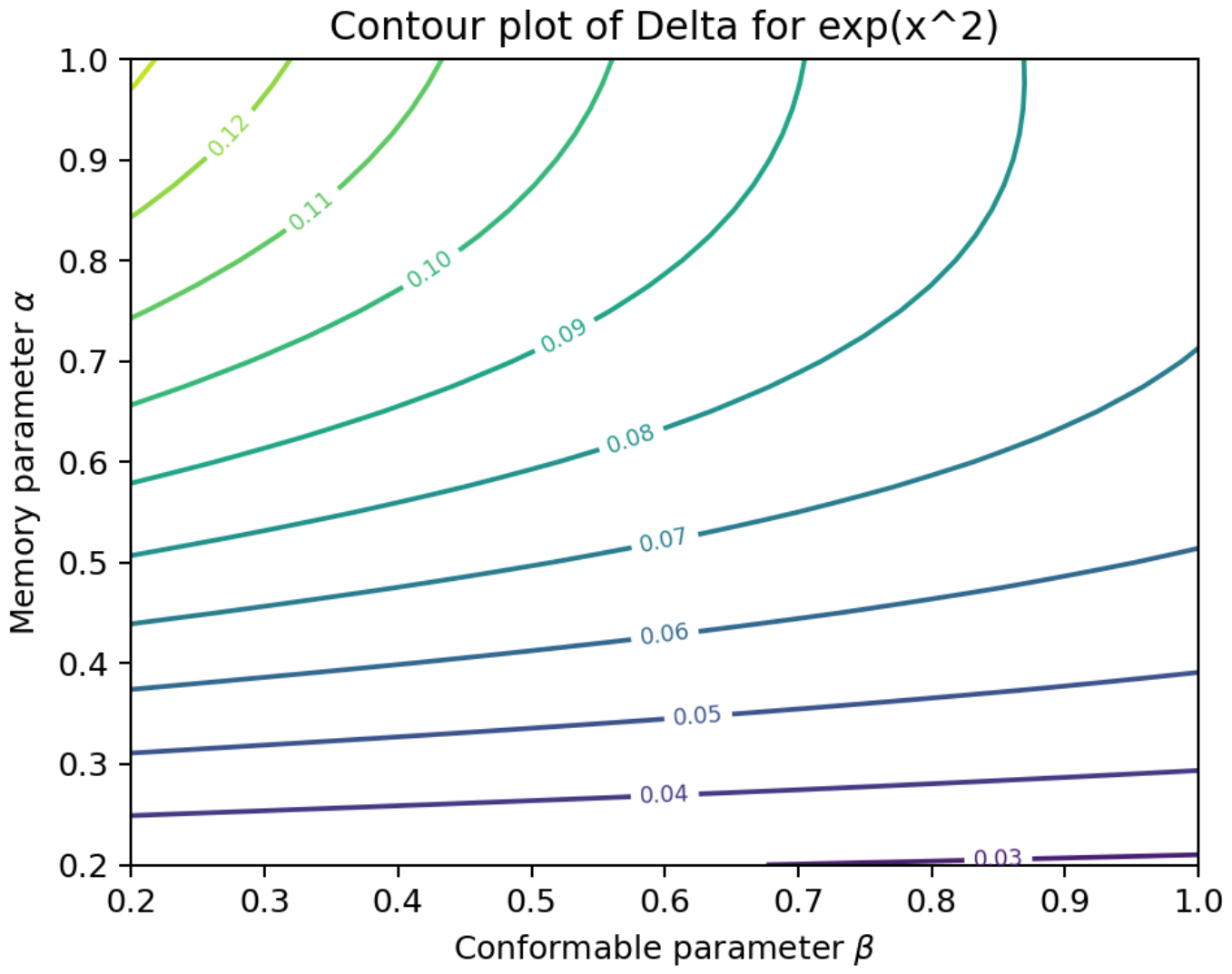
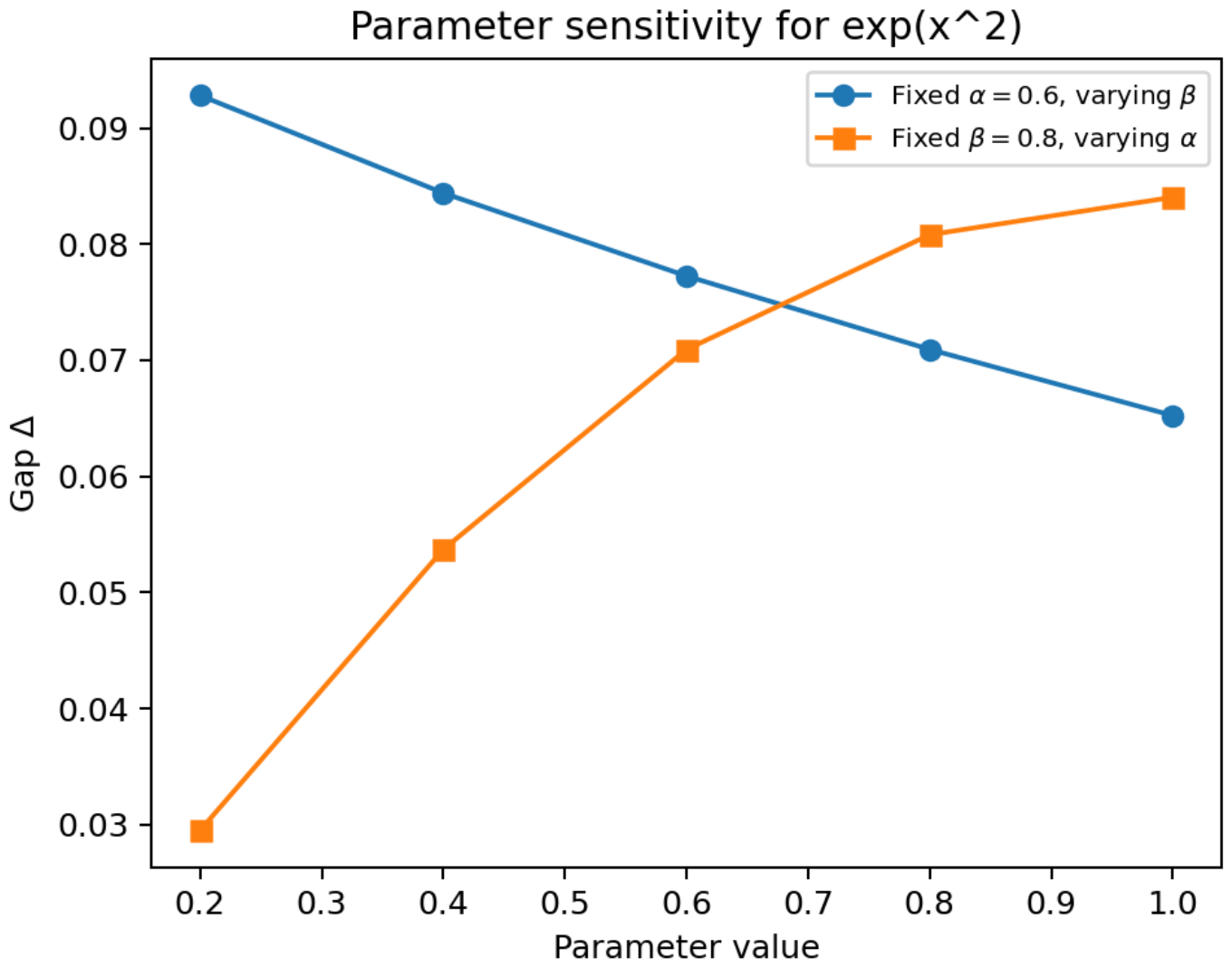
Discussion for Example 1. The numerical values in
Table 3 and
Table 4 are nonnegative in terms of the logarithmic gap. When
is fixed, the gap decreases, as
increases from
to
. When
is fixed, the gap increases, as
increases.
Figure 1,
Figure 2 and
Figure 3 show the same behavior from the heatmap, contour, and parameter-sensitivity viewpoints. The last column reports the relative error, defined by
. Thus, the tables now give a quantitative comparison between the two sides of the proposed estimate rather than only the logarithmic gap
.
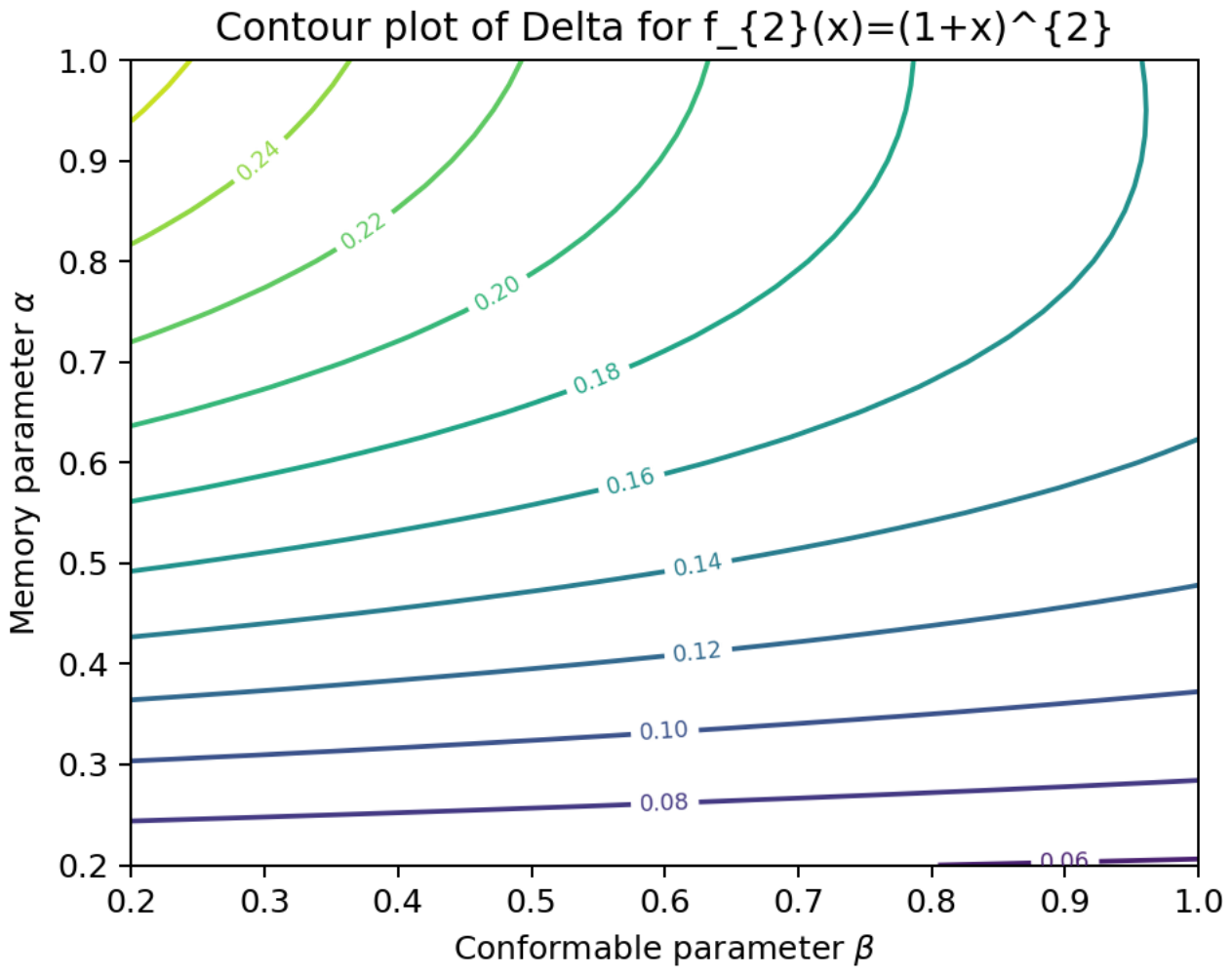
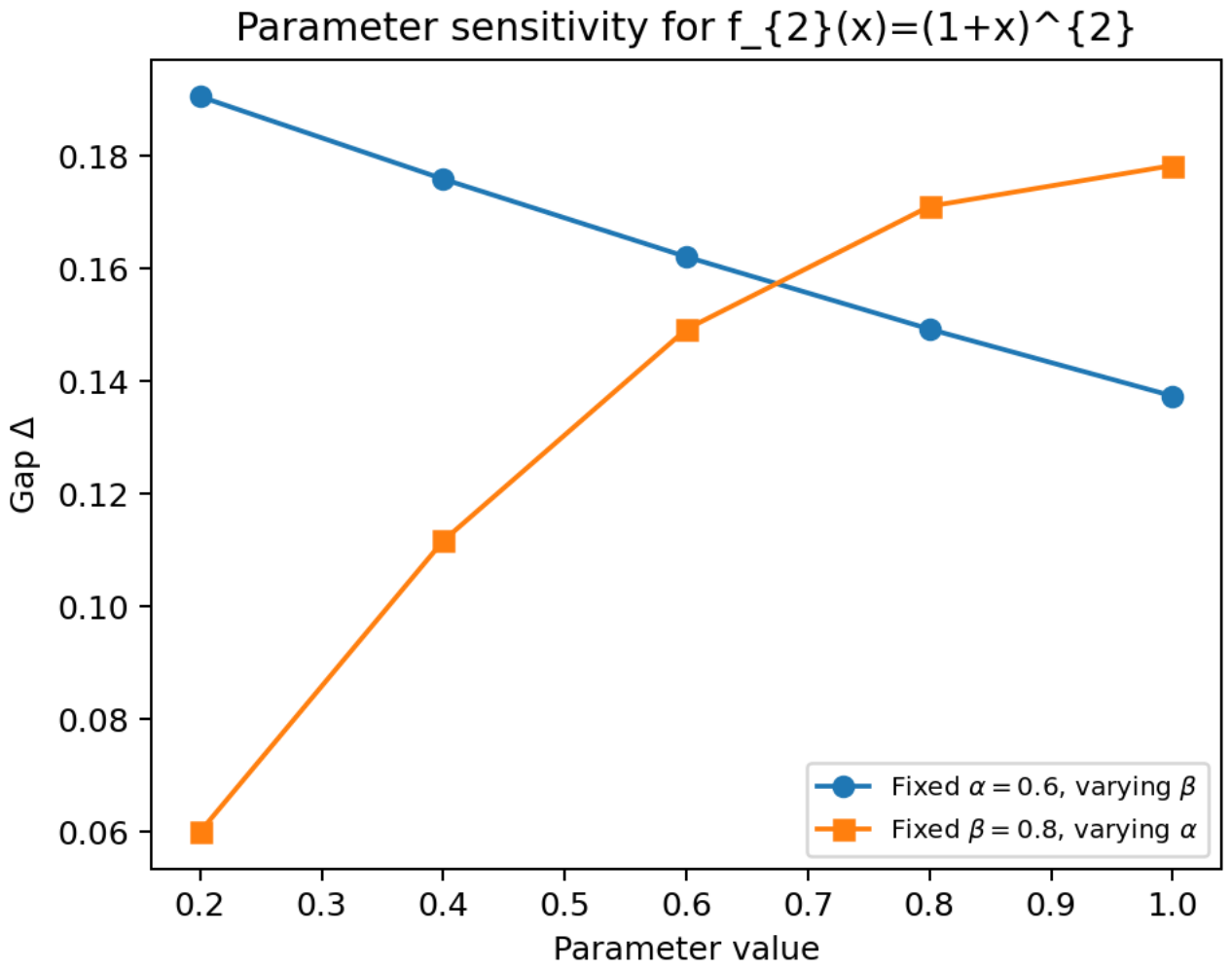
Example 2. Let on . Then, , and . Since is convex on , is multiplicatively convex on .
Discussion for Example 2. Table 5 and
Table 6 show that the logarithmic gap remains nonnegative for the second test function as well. This example differs from the first one because it is a power-type positive function rather than an exponential-type function.
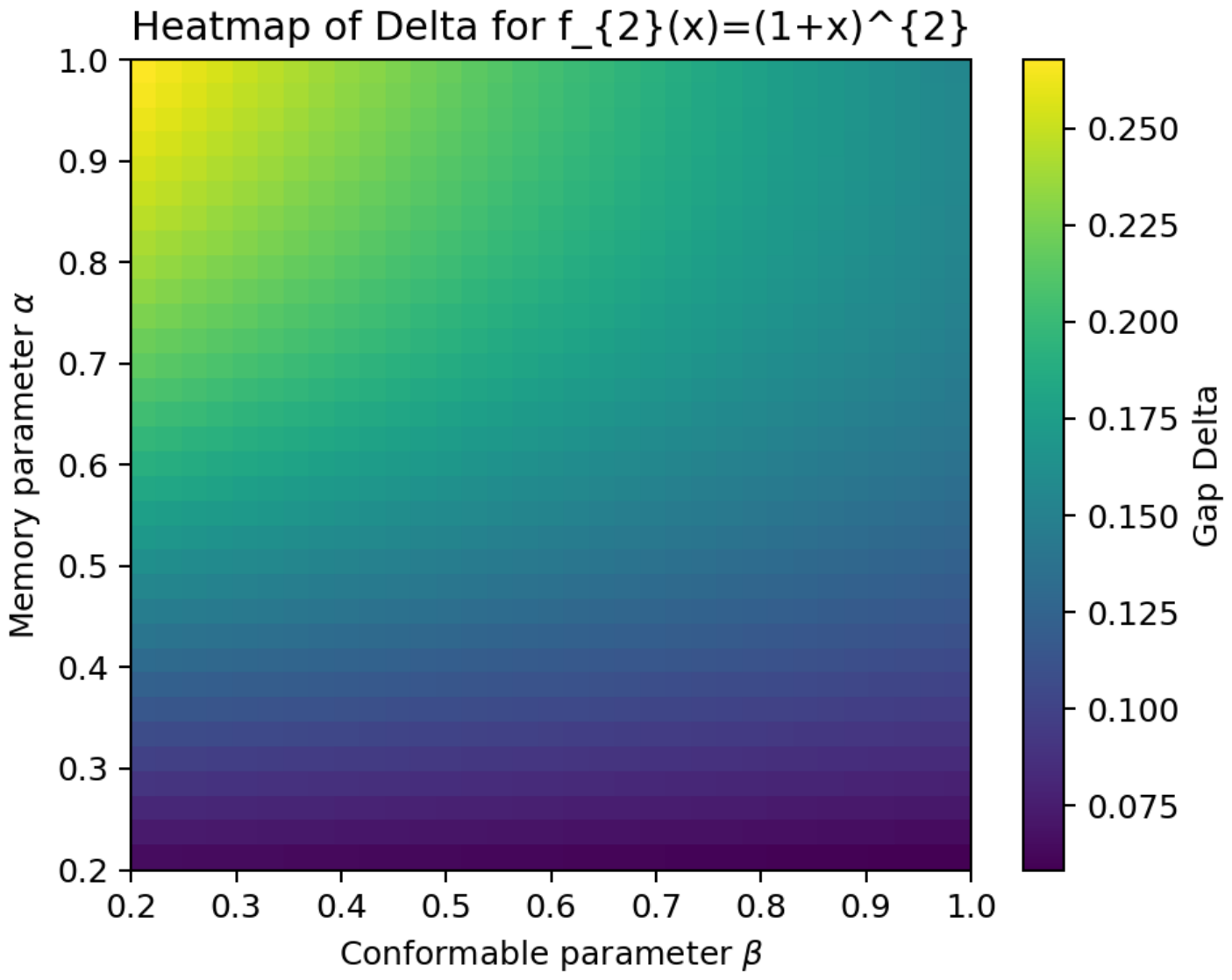
As illustrated in
Figure 4, the logarithmic gap decreases with respect to
when
= 0.6 is fixed, whereas it increases with respect to
when
= 0.8 is fixed.
Figure 5 provides the corresponding contour representation and reveals a similar sensitivity pattern over the entire parameter domain. In addition,
Figure 6 displays the relative errors associated with the obtained estimates, confirming the stability and reliability of the proposed multiplicative fractional inequality.
The two examples therefore provide numerical support for Theorem 5 under two different classes of positive functions. The computations are intended to illustrate the behavior of the derived estimate and the influence of the parameters and ; they are not used as a substitute for the analytical proof of the theorem. The logarithmic gap remains positive for all tested parameter values.
Furthermore, increases monotonically with respect to when is fixed, indicating that stronger fractional memory effects enlarge the approximation gap.
Conversely, decreasing tends to increase the influence of conformable scaling, producing larger deviations from the corresponding reduced special cases.
These observations illustrate the flexibility of the proposed multiplicative Atangana–Baleanu–conformable framework.
5. Conclusions
In this paper, we introduced a multiplicative Atangana–Baleanu–conformable fractional integral operator and established a new auxiliary identity associated with this operator. By combining this identity with the multiplicative convexity of the multiplicative derivative, we derived several multiplicative Milne–Mercer-type inequalities. The obtained results provide a unified two-parameter framework that extends both multiplicative Atangana–Baleanu and conformable fractional settings.
To illustrate the effectiveness of the proposed results, two numerical examples involving substantially different classes of functions were investigated, namely the exponential-type function
and the polynomial-type function
For all tested parameter combinations, the logarithmic gap
remained strictly positive, confirming the validity of Theorem 5 throughout the considered parameter domain.
The numerical investigations reveal a clear dependence of the obtained estimates on the fractional parameters. For fixed , the logarithmic gap decreases, as increases, indicating that the conformable scaling parameter directly affects the tightness of the inequality. In contrast, for fixed , the logarithmic gap increases with respect to , showing that a stronger Atangana–Baleanu memory contribution generally enlarges the distance between the two sides of the estimate. These observations suggest that the final behavior of the bound is governed by the interaction between the memory parameter and the conformable parameter .
Additional numerical evidence obtained from relative-error computations, heatmaps, contour plots, and parameter-sensitivity analyses demonstrates that the dependence of the inequality on is smooth throughout the admissible parameter region. Moreover, the polynomial example generally produces larger logarithmic gaps than the exponential example, indicating that the growth characteristics of the underlying multiplicatively convex function also influence the quality of the resulting estimates.
Overall, the theoretical analysis together with the numerical investigations confirm the validity of the proposed multiplicative Milne–Mercer-type inequalities and clarify the respective roles of and within the multiplicative Atangana–Baleanu–conformable framework.
Future research may focus on extending the present framework to broader classes of generalized convex functions, including logarithmically convex, GA-convex, harmonic convex, and preinvex functions. It would also be interesting to establish corresponding Hermite–Hadamard-, Simpson-, Ostrowski-, and Newton-type inequalities under the proposed multiplicative fractional setting. Furthermore, applications to multiplicative fractional differential equations, multiplicative optimization problems, and generalized multiplicative dynamical systems remain promising directions for future investigation.