
Article

A Multi-Objective Intelligent Method for Generating Mine Ventilation Feature Graphs Based on the Adaptive NSGA-II Algorithm


College of Safety Science and Engineering, Xi’an University of Science and Technology, Xi’an 710054, China
*
Author to whom correspondence should be addressed.
Mathematics 2026, 14(12), 2191; https://doi.org/10.3390/math14122191
Submission received: 28 May 2026 / Revised: 11 June 2026 / Accepted: 16 June 2026 / Published: 18 June 2026
(This article belongs to the Special Issue Advances of Optimization Theory and Applications)

Abstract

Ventilation network feature graphs (Q-H graphs) are a key visualisation tool for mine ventilation systems, and their automated generation reduces to a combinatorial optimisation problem over independent-path permutations. Existing methods, however, exhibit three limitations: a single-dimensional evaluation criterion, inadequate nodal pressure-energy assignment, and unstable convergence in factorial-scale search spaces. This paper proposes an adaptive NSGA-II (A-NSGA-II) framework with coordinated enhancements at the evaluation, modelling, and algorithmic levels. A three-objective system that minimises split-block count, topological-spatial discrepancy, and layout fragmentation is established, together with an aggregate evaluation score (AES) for engineering decision-making; nodal pressure energies are reconstructed via the longest path on a directed acyclic graph; and topology-aware initialisation, Lagrange three-point interpolated adaptive operators, and periodic memetic local search are integrated within NSGA-II. Experiments on two mine ventilation networks (75 and 112 branches) over 30 independent trials show that A-NSGA-II consistently outperforms four benchmarks (NSGA-II, MOEA/D, SPEA2, and MOSA) in terms of split-block count, AES, and hypervolume; statistical tests confirm significant, large-effect HV advantages on the 112-branch network, while the 75-branch network shows a 56.6–71.5% reduction in HV standard deviation.
MSC:
90C29; 90C27; 90C59; 90C35; 05C85

1. Introduction

Mine ventilation is a cornerstone of safe and efficient underground production: the rigour of its operational analysis and visual representation directly underpins the scientific rigour of airflow regulation, resistance diagnosis, and disaster-response decision-making [1,2]. Recent years have witnessed a rapid evolution of mine ventilation research toward intelligence and visualisation [3], with intelligent algorithms increasingly applied to the graphical modelling of ventilation networks [4]. As mining depths increase and ventilation networks grow in topological complexity, conventional network diagrams—although adequate for qualitatively depicting roadway connectivity—fail to convey concurrent quantitative information such as branch airflow, resistance, and power consumption [5]. Ventilation network feature graphs, commonly abbreviated as Q-H graphs, were introduced to bridge this gap. Each ventilation branch is mapped onto a rectangular block whose width, height, and area represent airflow, pressure-energy loss, and ventilation power, respectively; and the blocks are arranged according to the network topology so that ventilation zoning and airflow-state parameters can be inspected simultaneously on a single layout. The intelligent and automated generation of Q-H graphs therefore carries substantial theoretical and engineering value for advancing the refined management and decision-support capabilities of modern mine ventilation systems.
Research on Q-H graph generation has progressed through three successive stages: exhaustive search, the independent path method (IPM), and intelligent optimisation. The first stage was inaugurated by Huang [6], who articulated the physical essence and engineering significance of the Q-H graph, and was formalised by Xu et al. [7], who systematised the “four-line” features of the graph and proposed a drawing method based on depth-first exhaustive search. The efficiency of this approach deteriorates sharply with network size, however, owing to extensive redundant backtracking. The IPM was subsequently introduced to mitigate this bottleneck: independent paths from the source to the sink node are extracted in advance, and the coordinates of the rectangular blocks are then determined sequentially [8]. Yet in three-dimensional ventilation networks, the rectangular blocks corresponding to certain branches are inevitably partitioned into sub-blocks, and the extent of this fragmentation depends critically on the ordering of the independent paths—an ordering problem that, in its essence, constitutes a discrete combinatorial optimisation of cardinality N!. This factorial-scale search demand has motivated the third stage, in which intelligent optimisation algorithms have become the prevailing methodological choice.
In this stage, research efforts have proceeded along two main directions. One direction focuses on the independent-path ordering at the core of Q-H drawing. Jia et al. [9] proposed the IAGA–IPM hybrid algorithm, which combines a topology transformation-based hybrid encoding with an improved adaptive genetic algorithm and adopts the split-block count as the sole fitness function; the authors further introduced a unidirectional-loop discrimination model and network equivalent simplification techniques, enabling hierarchical presentation of Q-H graphs. Xie et al. [10] likewise optimised path ordering with an improved genetic algorithm, achieving drawing quality superior to that of the standard IPM. The other direction concentrates on the automatic layout and topological simplification of ventilation networks, which together provide the graph-representation and complexity-reduction techniques that underlie large-scale Q-H generation. Deng et al. [11,12] integrated hierarchical methods and a Sugiyama–GA–SA hybrid algorithm into network diagram generation, while Wei et al. [13] established the theory and procedure for topological simplification of complex networks. Building on these foundations, a hybrid sparrow search-based topological layout [14], a Hasse diagram-based automated generation framework [15], and an ant colony multi-constraint method [16] have further broadened the methodological landscape on which Q-H generation in complex networks can build. Complementary efforts in network simplification include a systematic classification of structural complexity [17], an automatic equivalent-simplification method for arbitrarily complex networks [18], and a rapid simplification algorithm that substantially reduces the simplification time of real-world mine networks [19].
From the broader perspective of multi-objective optimisation, decomposition-based and collaborative search paradigms provide useful methodological references for complex path-ordering problems. Wang et al. [20] studied the use of ideal and nadir reference points in decomposition-based multi-objective evolutionary algorithms to balance convergence and diversity. Guo et al. [21] investigated multimodal logistics path optimisation for coordinating trucks and UAVs within the cyber-physical internet framework, demonstrating the relevance of decomposition-based strategies to coupled path-planning tasks. Leung and Wang [22] further proposed a collaborative neurodynamic approach that combines scalarisation, projection neural networks, particle swarm-based reinitialisation, and hypervolume-oriented diversification. These studies enrich the broader algorithmic background of multi-objective optimisation.
Despite these advances, current Q-H graph drawing algorithms remain limited in three respects. First, the evaluation criterion is one-dimensional: prevailing methods rely solely on the split-block count, overlooking both the topological-spatial fidelity of physically adjacent branches and the layout fragmentation introduced by small blocks—features that are essential for a comprehensive assessment of engineering applicability. Second, the nodal pressure energy assignment mechanism is inadequate: in three-dimensional networks containing diagonal branches, breadth-first-search-based assignment determines nodal levels by the shortest path, causing certain ordinates to be under-assigned and producing vertical overlap. Third, the search performance is limited: standard genetic algorithms are prone to premature convergence in factorial-scale search spaces and lack an adaptive coordination mechanism between global exploration and local refinement.
To address these limitations in a unified manner, this paper proposes an adaptive NSGA-II (A-NSGA-II) framework for the multi-objective intelligent generation of mine ventilation Q-H graphs. The principal contributions are threefold. At the evaluation level, a three-objective system that minimises split-block count (f1), topological-spatial discrepancy (f2), and layout fragmentation (f3) is established, together with an aggregate evaluation score (AES) that supports the selection of a single recommended solution from the Pareto front for engineering practice. At the modelling level, a longest-path-based nodal pressure-energy reconstruction algorithm on a directed acyclic graph is developed, which guarantees a strictly positive vertical extent of every rectangular block and thereby eliminates layout overlap and inversion. At the algorithmic level, three Q-H-oriented modules—topology-aware adjacency-guided initialisation, Lagrange-interpolated adaptive discrete operators, and periodic memetic local search—are integrated into the NSGA-II framework to improve structured population seeding, Pareto-based operator adaptation, and local refinement of sparse front solutions. The proposed method is systematically evaluated on two mine ventilation networks of 75 and 112 branches against four benchmark algorithms (standard NSGA-II, MOEA/D, SPEA2, and MOSA) over 30 independent trials, with assessment based on Pareto-front analysis, convergence-trajectory tracking, and Wilcoxon rank-sum testing with Vargha–Delaney effect-size estimation.
The remainder of this paper is organised as follows. Section 2 develops the graph-theoretic modelling, nodal pressure-energy reconstruction, multi-objective evaluation system, and multi-objective optimisation model for Q-H graph generation. Section 3 details the A-NSGA-II algorithm. Section 4 reports the experimental setup. Section 5 presents the results and analysis. Section 6 discusses Sensitivity Analysis, limitations, and future research directions. Section 7 concludes the paper.

2. Graph-Theoretic Modelling and Multi-Objective Formulation for Q-H Graph Generation

The algorithmic generation of a Q-H graph involves four interrelated tasks: graph-theoretic representation of the ventilation network, reconstruction of nodal pressure-energy coordinates, multi-objective evaluation of layout quality, and mathematical formulation of the path-permutation optimisation problem. This section addresses these tasks in turn. Section 2.1 formulates the graph-theoretic representation of the ventilation network and establishes the independent-path structure used for Q-H graph generation. Section 2.2 develops a longest-path-based reconstruction method for nodal pressure-energy coordinates, ensuring the geometric consistency of rectangular blocks in the Q-H layout. Section 2.3 establishes the multi-objective evaluation system, comprising the split-block count, the topological-spatial discrepancy, and the layout fragmentation, together with an AES that is used as a post-processing criterion for engineering recommendation. Section 2.4 further formulates the multi-objective path-permutation optimisation model, clarifying the decision variable, feasible permutation space, drawing-mapping relationship, and physical consistency constraint of the Q-H graph generation problem.

2.1. Graph-Theoretic Representation of the Ventilation Network

A mine ventilation network is modelled as a connected directed graph G = ( V , E ) , in which V = { v 1 , v 2 , , v m } is the set of m nodes and E = { e 1 , e 2 , , e n } is the set of n directed branches representing roadways, each oriented along the positive airflow direction. Each branch is associated with two physical attributes: the airflow and the pressure-energy loss. In the subsequent Q-H representation, the airflow determines the horizontal scale of the corresponding rectangular block, whereas the pressure-energy loss provides the physical basis for its vertical pressure-energy extent. Therefore, the graph-theoretic representation preserves not only the topological connectivity of roadways, but also the physical direction and quantitative attributes required for Q-H graph generation.
The topological decomposition of the Q-H graph begins from a spanning tree: a spanning tree T = ( V , E T ) of G is a connected subgraph containing all m nodes and forming no cycle. A source-rooted spanning tree is constructed from the intake node to provide a consistent topological backbone for subsequent independent-path extraction. Let the intake boundary and the equivalent return-air be denoted as the source v s and sink v t , respectively. The branches not included in the spanning tree constitute the co-tree chord set. These co-tree chords provide the structural basis for generating independent source-to-sink paths, because inserting any co-tree chord into the spanning tree produces one unique fundamental cycle.
By the fundamental-cycle theorem of graph theory, inserting any co-tree chord c k into T produces a unique closed cycle L k , referred to as the k -th fundamental cycle. In Q-H drawing practice, a virtual fan branch is introduced to close the source-to-sink path and represent the pressure-energy input of the main fan. This branch is treated as a co-tree chord and contributes to cycle generation. With the virtual branch included, the source-to-sink path extraction can be equivalently transformed into a fundamental-cycle construction problem. After the virtual branch is removed from each generated cycle, the remaining directed branch sequence forms an effective independent path for Q-H graph drawing. Each independent path P k is the directed path from v s to v t obtained by removing e 0 from L k . For a real co-tree chord, the corresponding source-to-sink independent path can be further interpreted as the concatenation of three parts: the tree path from the source to the start node of the chord, the co-tree chord itself, and the tree path from the end node of the chord to the sink.
The path-branch incidence matrix B f = [ b i j ] N × n , derived from the fundamental-cycle representation, is defined with rows indexing the independent paths and columns indexing the network branches. Here, b i j denotes the element of B f in the i-th row and j-th column, representing the incidence relationship between independent path P i and ventilation branch e j . Its entries are given by Equation (1):
b i j = + 1 , e j P i ,   e j L i , 1 , e j P i ,   e j L i , + 0 , e j P i , i = 1,2 , , N ;   j = 1,2 , , n
where b i j is the incidence coefficient between the i-th independent path and the j-th ventilation branch; P i denotes the i-th independent source-to-sink path; e j denotes the j-th branch of the ventilation network; N is the number of independent paths; and n is the number of network branches. The symbols e j L i and e j L i indicate that the direction of branch e j is, respectively, consistent with and opposite to the traversal direction of path P i . Thus, b i j = +1, −1, and 0 indicate positive incidence, negative incidence, and non-incidence between the branch and the independent path, respectively.
Each row of B f encodes the branches traversed by an independent path together with their directional relations; reordering these rows therefore alters the sequence in which independent paths are placed side by side in the Q-H layout, and the resulting drawing quality is therefore strongly affected by this ordering. The Q-H permutation optimisation problem is accordingly formulated as the search for an optimal permutation π = ( π 1 , π 2 , , π N ) over the rows of B f , within a search space of cardinality N ! , that optimises the drawing-quality criteria.

2.2. Nodal Pressure-Energy Reconstruction for Q-H Graph Geometry

In a Q-H graph, each branch e j is rendered as a rectangular block. Let H ( v ) denote the ordinate of node v in the layout, and let v s t a r t and v e n d denote, respectively, the start and end nodes of branch e j along the airflow direction. The vertical height of the corresponding rectangular block is defined by Equation (2) and is numerically equal to the branch pressure-energy loss h j —that is, the geometric height of the block.
Δ H j = H ( v e n d ) H ( v s t a r t )  
Geometric consistency of the Q-H layout requires every rectangular block to extend along the airflow direction with a strictly positive vertical height, as stated in Equation (3):
Δ H j > 0 , e j E  
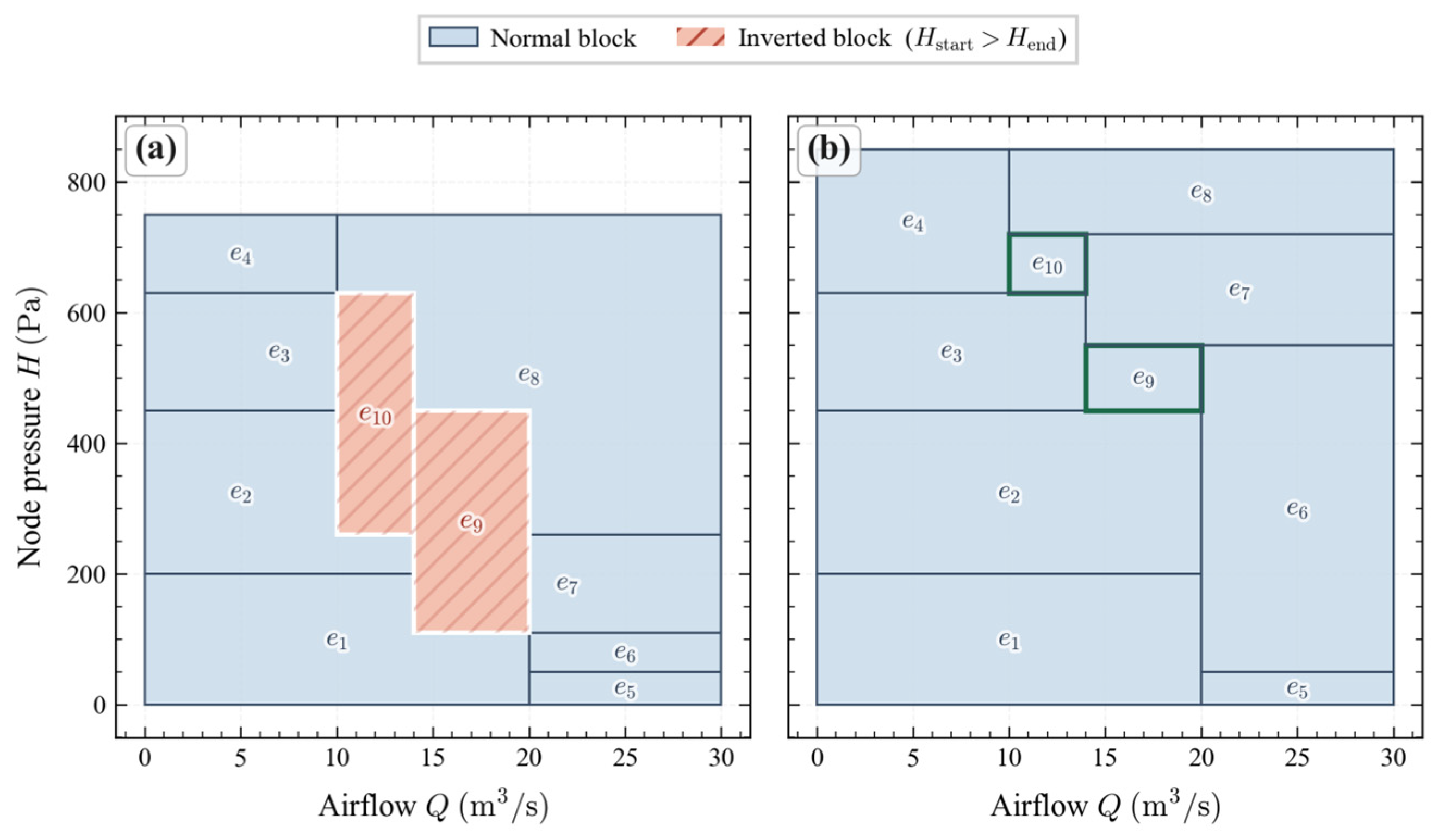
A natural approach is to assign nodal ordinates H ( v j ) via the level-order traversal of breadth-first search (BFS) [23]: at the first visit of a node, its ordinate is set to that of its predecessor plus the corresponding branch resistance, and is never updated thereafter. In networks containing diagonal branches or angle-coupled structures, however, multiple paths from v s to a downstream node v j generally coexist, each yielding a different cumulative resistance. Because BFS treats all incoming edges of a node uniformly, certain nodes are assigned H values smaller than the maximum cumulative resistance along their incoming-edge paths; this violates the constraint in Equation (3) and produces overlapping or even inverted rectangular blocks in the layout, as illustrated by the left panel of Figure 1.
To enforce Equation (3) strictly at the algorithmic level, a longest-path-based nodal pressure-energy reconstruction is proposed on the directed acyclic graph (DAG) induced by the airflow direction. In this study, acyclicity refers only to the effective directed graph obtained after the ventilation-network solution has assigned an airflow direction to each active branch. A directed cycle in this airflow graph corresponds to cyclic airflow or recirculation, which is not considered a normal safety-compliant ventilation state. Therefore, prior to the longest-path reconstruction, the effective airflow-directed graph is screened by topological sorting. If the number of sorted nodes is smaller than the number of nodes, strongly connected components are extracted, and the corresponding cyclic branches are reported. In this case, the pressure-energy reconstruction is not applied, and the ventilation design or airflow solution must be corrected before Q-H graph generation. For acyclic airflow-directed graphs, the nodal pressure-energy coordinates are then computed in topological order according to Equation (4).
H ( v j )   =   m a x v i p r e d ( v j ) H ( v i ) + h i j  
Here, p r e d ( v j ) denotes the predecessor set of v j , and h i j is the pressure-energy loss of branch v i , v j . The m a x operator in Equation (4) ensures that v j takes the largest cumulative resistance over all incoming-edge paths, thereby enforcing the constraint in Equation (3). As shown in the right panel of Figure 1, all rectangular blocks under the longest-path scheme form a non-overlapping vertical tessellation, in contrast to the BFS-based assignment in the left panel.

2.3. Multi-Objective Evaluation System

Existing studies commonly adopt the split-block count as a single objective; this scalar measure, however, captures only the visual integrity of the layout and overlooks both the spatial fidelity of topological adjacency and the readability degradation produced by small fragmented blocks. A three-dimensional multi-objective evaluation system—visual integrity, topological-adjacency fidelity, and layout heterogeneity—is therefore developed to provide a complete quantitative description of Q-H drawing quality. The three objectives are formulated in Section 2.3.1, Section 2.3.2 and Section 2.3.3, and an aggregate evaluation score for engineering decision-making is defined in Section 2.3.4.

2.3.1. Objective f1: Minimisation of the Split-Block Count

When two adjacent independent paths P π i and P π i + 1 share a common physical branch, the corresponding rectangular block need not be redrawn. Conversely, if a branch appears in two independent paths that are non-adjacent in π , its rectangular block is split into several sub-blocks; an excessive number of such splits directly degrades the visual coherence of the layout and the discriminability of the encoded information. Given a permutation π , the split-block count f 1 is given by Equation (5):
f 1 ( π )   =   K ( π )   =   P π 1   +   i = 2 N P π i     P π i P π i 1  
Here P π i is the number of branches in the π i -th path, and P π i P π i 1 is the number of branches shared between consecutive paths. Equation (5) shows that f 1 is minimised when shared branches are concentrated between consecutive paths in the permutation.

2.3.2. Objective f2: Minimisation of the Topological-Spatial Discrepancy

The engineering readability of the Q-H graph relies on whether its horizontal-adjacency structure faithfully reflects the network’s topological adjacency. An ill-chosen permutation π may place rectangular blocks that are horizontally adjacent in the layout but correspond to branches that are distant in the ventilation network, hindering the recovery of topological adjacency from the drawing. A topological-spatial discrepancy objective is introduced to quantify this distortion.
First, the set of undirected branch pairs sharing a common node is identified as in Equation (6):
E a d j = ( e u , e v ) E × E |   u < v ,   V ( e u ) V ( e v )
Let X u and X v be the centroidal abscissas of the rectangular blocks corresponding to branches e u and e v in the Q-H layout. The weighted topological-spatial discrepancy is defined by Equation (7):
f 2 ( π )   =   e u , e v E a d j ω u v X u ( π ) X v ( π ) / Q t o t a l e u , e v E a d j ω u v
The weight ω u v = ( Q u + Q v ) / 2 encodes the connectivity importance of each branch pair, defined as the arithmetic mean of the absolute airflow magnitudes.
A lower value of f 2 therefore indicates that branches sharing a node in the physical ventilation network are placed closer to each other in the Q-H graph. This improves the ability of engineers to trace airflow routes, identify local branch connections, and recover the original network topology from the layout. The airflow-weighted formulation further reflects engineering practice: spatial coherence is prioritised for high-airflow branches because these branches usually constitute the main intake and return-air routes and are more frequently inspected during ventilation diagnosis.

2.3.3. Objective f3: Minimisation of Layout Fragmentation

In Q-H annotation practice, each rectangular block must accommodate textual information such as branch identifier, airflow, and resistance. When the width or height of a block becomes insufficient, its information-carrying capacity is substantially diminished. To quantify the overall severity of small fragments in the layout while avoiding the objective-function discontinuity introduced by discrete threshold models, a continuous weighted formulation is adopted.
An adaptive reference scale is defined: given the total horizontal airflow span Q t o t a l and the total vertical pressure-energy range H r a n g e , the reference width and reference height are given by Equation (8):
w r e f = Q t o t a l N w , h r e f = H r a n g e N h
The denominators N w = 20 and N h = 12 denote the reference partition counts in the horizontal and vertical directions, respectively, chosen to reflect the typical branch density of the test networks (Section 4.1); a block occupying 1 N w of the total airflow span and 1 N h of the total pressure-energy range is considered to carry sufficient annotation space, and blocks falling below this threshold are penalised proportionally.
For the i -th rectangular block, the normalised readability index and inverse-area weight are given by Equation (9):
r i   =   m i n w i w r e f , 1 m i n h i h r e f , 1 , ω i   =   1 w i h i + ε
Here w i and h i are the block dimensions; and r i [ 0,1 ] : r i = 1 when the block attains the reference scale, and r i 0 when either dimension vanishes. The weight ω i amplifies the contribution of smaller fragments in the aggregation. The layout fragmentation is then defined by Equation (10):
f 3 ( π )   =   1     i = 1 K ω i r i i = 1 K ω i
Here f 3 [ 0,1 ] , with larger values denoting more severe fragmentation. The continuous weighted fragmentation model exhibits three properties. First, the objective function provides a continuous severity measure with respect to block dimensions, avoiding abrupt threshold-induced jumps in the objective value. Second, the reference scale is adaptively derived from the network’s intrinsic properties, eliminating the need for user-defined absolute thresholds and ensuring parameter invariance across network scales. Third, the dimensionally consistent inverse-area weighting prevents extreme fragments from dominating the aggregated objective, rendering the distribution of f 3 comparable across instances.
From an engineering-readability perspective, f 3 measures the severity of layout fragmentation. A larger f 3 indicates more small or narrow blocks, stronger local visual clutter, and weaker continuity of branch regions. Conversely, a lower f 3 improves visual organisation, branch-region recognition, Q-H area comparison, and the stable presentation of engineering annotations.

2.3.4. Aggregate Evaluation Score for Engineering Recommendation

After the Pareto front is obtained, an aggregate evaluation score (AES) is used as a post-processing decision criterion to identify a single recommended solution for engineering application. Since the three objectives differ markedly in dimension and order of magnitude, each is first mapped onto [ 0,1 ] via proportional normalisation, as in Equation (11):
f 1 ( π ) = m i n f 1 ( π ) 2 n , 1 ,   f 2 ( π ) = m i n f 2 ( π ) , 1 ,   f 3 ( π ) = m i n f 3 ( π ) , 1  
Here n is the total number of branches, f 1 is normalised by 2 n ,   and   2 n is used as a practical saturation reference for the split-block count rather than as a strict mathematical upper bound; f 2 , f 3 , already in [ 0,1 ] , is simply clipped.
In the Q-H drawing algorithm, rectangular blocks are generated through a branch-continuity-based block segmentation procedure along the ordered independent paths. If a physical branch appears continuously in adjacent independent paths, its rectangular region remains connected; if its occurrence is interrupted by other paths, the current block segment is terminated, and a new segment is created when the branch appears again, producing additional sub-blocks. Therefore, a layout with approximately one sub-block per active branch represents a near no-split state, whereas K ≈ 2n indicates that each branch is represented by approximately two sub-blocks on average. This level already reflects substantial layout fragmentation and loss of visual continuity. Accordingly, f 1 /2n provides an interpretable engineering scale for AES-based recommendation.
A weighted aggregate indicator is then defined by Equation (12):
A E S ( π )   =   1     α 1 f 1 ( π )   +   α 2 f 2 ( π )   +   α 3 f 3 ( π )
with α 1 , α 2 , α 3 0 and k = 1 3 α k = 1 as user-defined preference weights. T h e   A E S   l i e s   i n   A E S   [ 0,1 ] : a larger value indicates higher overall drawing quality, with A E S 1 when all objectives approach zero (the optimal state) and A E S 0 when they saturate at their normalised upper bounds.
In standard mine-ventilation drawing practice, the split-block count and the topological-spatial discrepancy jointly govern the engineering usability of the Q-H graph and are weighted equally, whereas the layout fragmentation—being mitigable through interactive operations such as scaling and zooming—is assigned a slightly lower priority. The default weights ( α 1 , α 2 , α 3 ) = ( 0.4 , 0.4 , 0.2 ) are therefore recommended. A weight-sensitivity analysis is provided in Section 6.1.
After a non-dominated solution set has been obtained, the AES can be computed for each candidate solution, and the solution with the maximum AES is selected as the engineering recommendation for Q-H graph generation. This strategy preserves the diversity of the multi-objective Pareto solutions while delivering a single, unambiguous, and interpretable recommended layout for engineering practice.

2.4. Multi-Objective Optimisation Model

In the preceding sections, the topological model of the ventilation network, the independent-path set, the nodal pressure-energy reconstruction method, and the three Q-H graph evaluation criteria have been established. For a given ventilation network G = ( V , E ) , let P = P 1 , P 2 , , P N denote the set of effective independent paths extracted by the independent-path method, where N is the number of effective independent paths. Since the splitting state and horizontal deployment pattern of the rectangular blocks in a Q-H graph are governed by the ordering of independent paths, the independent-path permutation is defined as π = ( π 1 , π 2 , , π N ) , where π k denotes the index of the independent path placed at the k-th horizontal position. Because each independent path can appear only once during the generation of a Q-H graph, and all effective independent paths must be included in the layout, π belongs to the symmetric group S N . Accordingly, the feasible search space has a cardinality of N!, indicating that the problem is essentially a discrete permutation-based combinatorial optimisation problem.
Based on the above definitions, the path-permutation optimisation model for Q-H graph generation can be formulated as
min π F ( π ) = f 1 ( π ) , f 2 ( π ) , f 3 ( π ) T s . t .       π S N B ( π ) = Φ ( G , H , P , π ) b B e π Δ x b π = q e ,   e E
where F ( π ) is the multi-objective evaluation vector corresponding to the path permutation π . The three objective functions f 1 ( π ) , f 2 ( π ) , and f 3 ( π ) represent the split-block count, the topological-spatial discrepancy, and the layout fragmentation degree, respectively, all of which are minimised. S N denotes the permutation space formed by the N independent paths, ensuring that each feasible solution is a valid independent-path ordering. H is the nodal pressure-energy set obtained by the longest-path-based reconstruction method described above; in the present optimisation model, it is treated as a known input rather than a decision variable. Φ ( G , H , P , π ) denotes the Q-H graph drawing operator. Given the ventilation network G, the nodal pressure-energy set H, the independent-path set P , and the path permutation π , this operator generates the corresponding set of rectangular blocks B ( π ) . B e ( π ) denotes the set of all rectangular sub-blocks associated with ventilation branch e under permutation π . Δ x b ( π ) represents the horizontal width of rectangular block b, and q e is the airflow of branch e .
In the above model, f 1 , f 2 , and f 3 evaluate the quality of the Q-H graph from the perspectives of graphical integrity, topological preservation, and layout readability, respectively. This study adopts the Pareto optimisation framework to solve the multi-objective permutation problem. For any two feasible permutations, if one permutation is no worse than the other in all three objectives and is strictly better in at least one objective, it is considered to dominate the other. Accordingly, the purpose of solving Equation (13) is to obtain a set of non-dominated path-permutation solutions that achieve a balanced trade-off among graphical integrity, topological preservation, and layout readability.

3. A-NSGA-II: An Adaptive Multi-Objective Algorithm Design

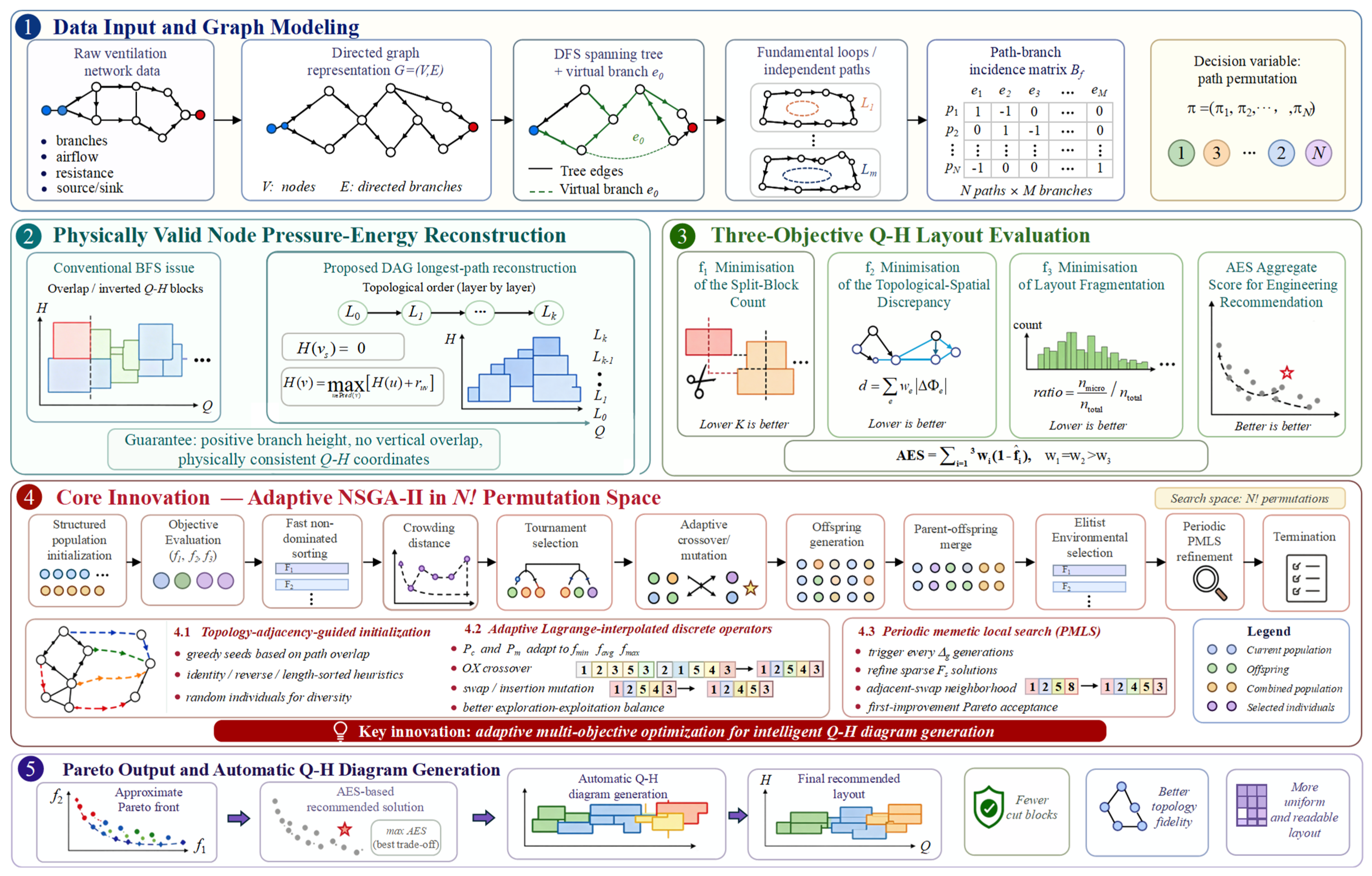
Section 2 formulates the automatic generation of Q-H graphs as a multi-objective discrete combinatorial optimisation over independent-path permutations. NSGA-II has emerged as a mainstream solver for such problems, owing to the low complexity of its fast non-dominated sorting, the crowding-distance-based diversity-preservation mechanism, and the robustness extensively validated in engineering practice [24]. In large-scale discrete search spaces, standard NSGA-II is hampered by low initial-population quality, a fixed exploration–exploitation balance, and limited local-refinement capability. Accordingly, an A-NSGA-II-based multi-objective intelligent generation framework is proposed, as depicted in Figure 2.
The framework first models the ventilation network as a directed graph and extracts the independent paths; nodal pressure-energy coordinates are then reconstructed by the DAG longest-path method to enforce the physical consistency of the rectangular blocks. On this basis, a three-objective evaluation system—the split-block count, the topological-spatial discrepancy, and the layout fragmentation—is defined, and the Pareto-optimal set is sought within the independent-path permutation space. For a population individual π i , the Q-H graph drawing operator is first invoked to generate the corresponding rectangular-block layout, and the objective vector is then evaluated as F ( π ) = f 1 ( π ) , f 2 ( π ) , f 3 ( π ) T . The three objectives are not aggregated into a scalar fitness during the evolutionary search. Instead, they are directly used for Pareto dominance comparison, fast non-dominated sorting, crowding-distance calculation, and elitist environmental selection. In this way, A-NSGA-II preserves the trade-off relationship among visual integrity, topological-spatial fidelity, and layout readability throughout the path-permutation optimisation process.
Algorithmically, three components are integrated: topology-aware adjacency-guided initialisation (Section 3.2), adaptive Lagrange-interpolated discrete operators (Section 3.3), and periodic memetic local search (Section 3.4). These components collectively enhance initial population quality, dynamically balance global exploration with local exploitation, and refine the search along the Pareto front.

3.1. Discrete Permutation Encoding and the NSGA-II Baseline

This section first describes the encoding scheme for path permutations and then formalises the standard NSGA-II procedure within this encoded space, serving as the common baseline for the three subsequent enhancements.
The ordering of N independent paths is encoded as an integer permutation vector defined by Equation (14):
π   =   ( π 1 , π 2 , , π N ) , π i { 1,2 , , N } , π i π j   f o r   i j
Here, π i denotes the index of the independent path placed at the i -th position. Every admissible individual π is a permutation of { 1,2 , , N } , and the search space has cardinality | Π | = N ! .
Within Π , standard NSGA-II proceeds through five sequential steps.
(i)
Initialisation. Let N p o p denote the population size and T the maximum number of generations. Standard NSGA-II generates the initial population P 0 by random initialisation, as in Equation (15):
P 0   =   π ( 1 ) , π ( 2 ) , , π ( N p o p ) , π ( i ) Π
At generation t , offspring Q t are produced from parents P t by genetic operators and merged into a transitional population of size 2 N p o p , as in Equation (16):
R t   =   P t Q t , | R t |   =   2 N p o p
(ii)
Pareto dominance and fast non-dominated sorting. For any two solutions π ( a ) , π ( b ) R t , the Pareto-dominance relation is defined by Equation (17):
π ( a ) π ( b )     k { 1,2 , 3 } :   f k ( π ( a ) ) f k ( π ( b ) )     k 0 :   f k 0 ( π ( a ) ) < f k 0 ( π ( b ) )
Fast non-dominated sorting partitions R t into a sequence of pairwise disjoint fronts, as in Equation (18):
R t = R r = 1 F r , F r = { π R t r a n k ( π ) = r }
Here, F 1 is the current Pareto-optimal set, and r a n k ( π ) is the non-dominated rank of π . The time complexity is O ( M N p o p 2 ) , with M = 3 being the number of objectives.
(iii)
Crowding distance. To preserve diversity within a front, F r is sorted along each objective; boundary individuals receive d c d = + , and the crowding distance of an interior individual is given by Equation (19):
d c d ( π i )   =   k = 1 M f k ( π i + 1 ) f k ( π i 1 ) f k m a x f k m i n
Here, f k m a x and f k m i n denote the maximum and minimum values of the k -th objective on the current front. A larger d c d indicates greater sparsity in the objective space and a stronger contribution to front diversity.
(iv)
Crowded-comparison operator and elitism. A partial order combining the non-dominated rank with the crowding distance is defined by Equation (20):
π ( a ) n π ( b )     r a n k ( π ( a ) ) < r a n k ( π ( b ) )   r a n k ( π ( a ) ) = r a n k ( π ( b ) )     d c d ( π ( a ) ) > d c d ( π ( b ) )
The top N p o p individuals from R t under n form the next generation P t + 1 ; this elitism prevents the loss of previously discovered non-dominated solutions.
(v)
Termination. Standard NSGA-II terminates upon reaching the generation budget T and outputs the first front F 1 ( T ) as an approximation of the Pareto-optimal set, as in Equation (21):
P F *     F 1 ( T )   =   { π P T     r a n k ( π ) = 1
While standard NSGA-II performs well on continuous problems, its direct application to the discrete Q-H permutation problem reveals three deficiencies: (i) random initialisation positions the population far from high-quality regions of the feasible domain, slowing early convergence; (ii) fixed crossover and mutation probabilities cannot accommodate the search demands of different evolutionary stages; and (iii) the global nature of the genetic operators yields low efficiency in fine-grained neighbourhood refinement of the permutation space.
To address these issues, A-NSGA-II integrates three Q-H-oriented modules into the NSGA-II framework. Topology-aware initialisation provides structured seed permutations based on the split-block formation mechanism, rather than directly fixing the final path order. The adaptive operator applies the classical adaptive-probability idea to Pareto-based permutation optimisation by linking OX crossover and swap mutation to non-dominated rank and crowding distance. PMLS specialises memetic local search to adjacent-swap refinement of independent-path permutations and accepts only Pareto-dominating local moves. These modules therefore adapt existing search ideas to the specific structure of Q-H graph generation.

3.2. Topology-Aware Adjacency-Guided Initialisation

Random initialisation in standard NSGA-II cannot ensure starting-point quality in an N ! -scale permutation space, so substantial fitness evaluations are spent in the early generations on preliminary objective improvements. To align the initial population with the problem’s topological structure, a heuristic greedy construction is introduced; guided by the cardinality of the branch-set intersection between paths, it produces high-quality seed solutions with low f 1 values. The validity of this construction follows from the algebraic expansion of Equation (5), given by Equation (22):
f 1 ( π )   =   i = 1 N P π i     i = 2 N P π i P π i 1
The first term, being independent of π , is a constant determined by the network structure. Hence, minimising f 1 is equivalent to maximising the sum of intersections over all adjacent path pairs. Since solving this problem optimally is prohibitively expensive, a step-wise greedy strategy is employed: each step maximises the adjacent-pair intersection, yielding a low-cost approximation of the global optimum. Specifically, the greedy rule at position k is given by Equation (23):
π k   =   a r g m a x j R k   P j P π k 1
Here, R k denotes the set of path indices available at iteration k, namely those not assigned in the previous k − 1 steps. Intersecting only with the immediate predecessor—rather than with the cumulative union of placed paths—matches the adjacent-pair structure of Equation (5) exactly. Ties are broken by choosing the candidate with the smallest index, thereby ensuring consistent and reproducible behaviour. A multiple greedy solution depends sensitively on the starting path in parallel: several greedy sequences are generated from distinct starting points in parallel, supplemented by the identity permutation, the reverse permutation, and ascending and descending orderings by path length, collectively forming a structured seed set. The remaining individuals are drawn uniformly at random to maintain broad coverage of the search space. The greedy component provides structured low- f 1 seeds, whereas the random component preserves diversity in the permutation space. This combination improves the starting population without replacing the subsequent Pareto-based evolutionary search.

3.3. Adaptive Lagrange-Interpolated Discrete Operators

Standard NSGA-II employs globally fixed operator probabilities, applying identical perturbations to every individual regardless of quality or of the evolving population distribution. To remedy this, the Srinivas–Patnaik adaptive principle [25] is incorporated, enabling crossover and mutation probabilities to co-adapt with individual fitness and the population distribution.
For each individual, a composite fitness score f s is computed by combining the non-dominated rank and the crowding distance, such that lower-ranked and more-isolated individuals receive higher f s values. Let f m i n , f a v g ,   a n d   f m a x denote the minimum, mean, and maximum fitness in the current population. Crossover probabilities P c 1 , P c 2 ,   a n d   P c 3 and mutation probabilities P m 1 , P m 2 ,   a n d   P m 3 are prescribed at the three anchor points; for an individual with fitness f , the operator probabilities are obtained by Lagrange three-point interpolation, as in Equation (24):
p c ( f )   =   k = 1 3 P c k j k f f ( j ) f ( k ) f ( j ) , p m ( f )   =   k = 1 3 P m k j k f f ( j ) f ( k ) f ( j )
Here, f ( 1 ) , f ( 2 ) ,   a n d   f ( 3 ) correspond, respectively, to f m i n , f a v g ,   and   f m a x . In this study, order crossover (OX) is adopted as the crossover operator and swap mutation as the mutation operator, both well-suited to the permutation representation of Equation (14); the adaptive probabilities p c ( f ) and p m ( f ) computed by Equation (24) govern the application of these operators at each generation. Thus, the adaptive-probability idea is transferred from a scalar-fitness GA setting to a Pareto-based discrete permutation setting, where operator probabilities are linked to front rank, diversity contribution, and permutation-preserving variation.
The mechanism is adaptive at two levels. At the individual level, the perturbation probability is inversely regulated by fitness: superior individuals receive smaller perturbations to preserve elite genes, whereas inferior individuals receive larger perturbations to accelerate escape from low-quality regions. Across generations, the three anchor points are updated dynamically: in early generations, a wide fitness range yields strong probability differentiation among individuals; in later generations, as the population converges, the interpolation curve flattens and applies only mild perturbations across the population. The combination of the two regulatory layers produces a natural exploration–exploitation transition over the course of evolution.

3.4. Periodic Memetic Local Search for Pareto-Front Refinement

To compensate for the limited fine-grained search capability of global evolutionary operators in discrete permutation spaces, the periodic memetic local search (PMLS) mechanism is introduced, complementing the global operators within a two-tier search architecture. In contrast to generic memetic local search [26], the present PMLS is specialised for independent-path permutations: it targets sparse first-front solutions, explores the smallest adjacent-swap neighbourhood, and uses Pareto dominance rather than scalar fitness improvement as the acceptance criterion. Let s w a p ( π , i , j ) denote the operator that exchanges positions i and j of π . For an individual π = ( π 1 , π 2 , , π N ) , the adjacent-swap neighbourhood is given by Equation (25):
N ( π )   =   { s w a p ( π , i , i + 1 )     i = 1,2 , , N 1  
The neighbourhood has cardinality N 1 , and its perturbation magnitude—the smallest continuous operation definable on a permutation—is precisely matched in scale to the objective of Pareto-front refinement.
PMLS is triggered at fixed generational intervals; at each trigger, a subset of individuals from the current first front is selected, in descending order of crowding distance, as targets for local search. High-crowding individuals are selected because they reside in sparse regions of the front, where refinement simultaneously improves objective values and extends front coverage. For each selected permutation, a first-improvement strategy traverses the adjacent-swap neighbourhood: as soon as a candidate strictly dominating the current solution is identified, it is accepted and used as the new starting point. Therefore, PMLS accepts only strict Pareto-dominating candidates. A candidate that improves one objective but worsens another is not accepted, because it does not satisfy Pareto dominance. All acceptance decisions therefore strictly respect Equation (17), ensuring that PMLS does not introduce scalarised trade-off moves during local refinement.
As PMLS is triggered only periodically, acts on a small subset of the first front, and employs first-improvement rather than full enumeration, its computational overhead is negligible compared with the main evolutionary loop.

4. Experimental Setup

To provide a reproducible basis for evaluating the proposed A-NSGA-II framework, this section specifies the experimental setup used in the comparative study. The test networks are first introduced to characterise the structural complexity of the Q-H graph generation task (Section 4.1), followed by the benchmark algorithms used for comparison (Section 4.2). The common and algorithm-specific parameter settings are then reported to ensure fairness across methods (Section 4.3), and the evaluation metrics together with the statistical testing procedures are defined to support quantitative and statistically grounded performance assessment (Section 4.4).

4.1. Test Networks

To evaluate the effectiveness and scalability of the proposed A-NSGA-II framework, two mine ventilation networks of different structural scales are adopted as test cases.
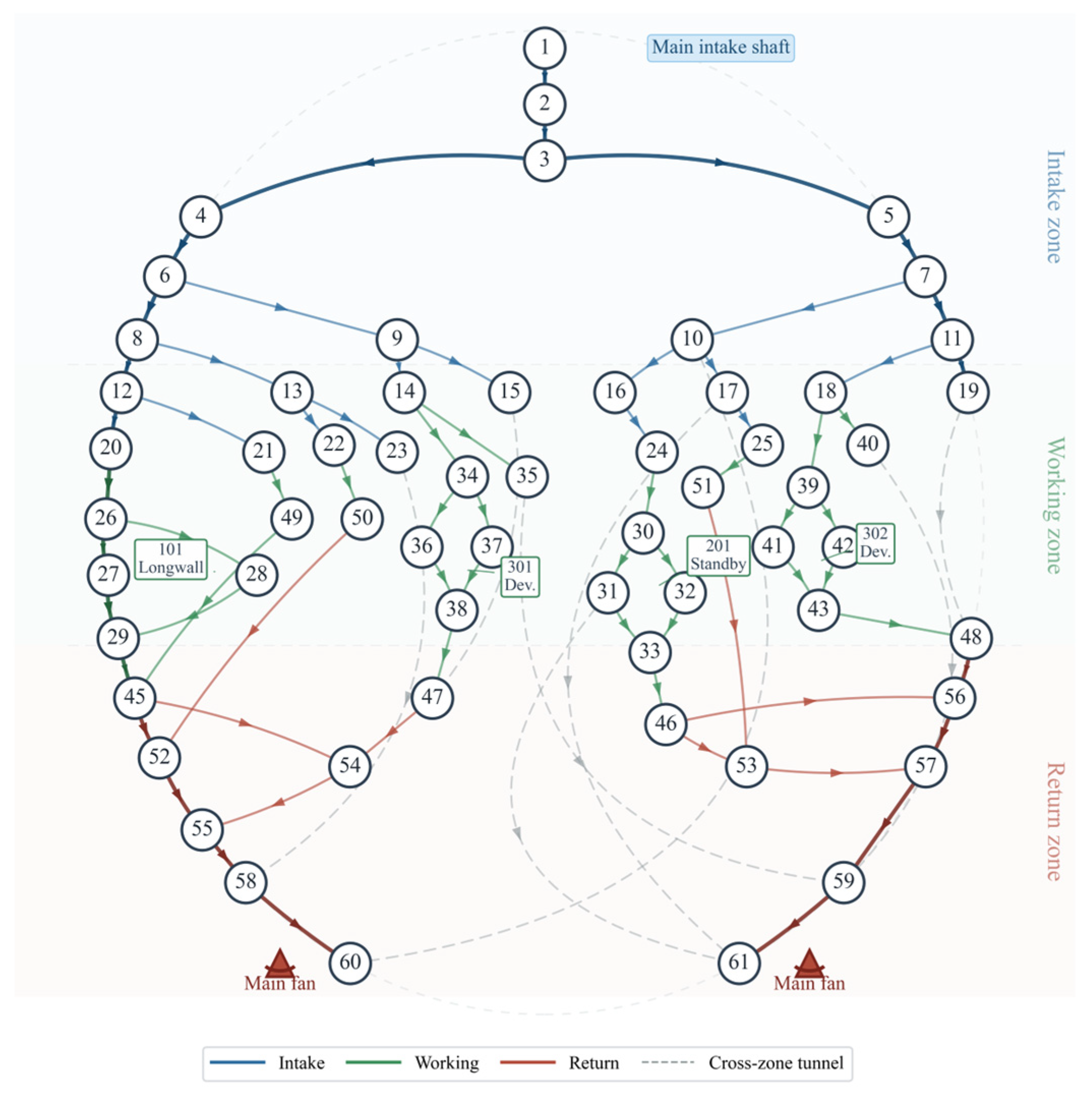
The first is a 75-branch primary ventilation network comprising typical intake, working-face, and return-airflow subsystems. It contains angle-coupled structures characteristic of real mine ventilation systems and serves as the primary case for detailed comparative analysis and Q-H layout evaluation.
The second test case is a 112-branch ventilation network of larger scale. It contains more nodes, branches, independent paths, and heading working faces, posing a more challenging combinatorial optimisation instance for examining the scalability and robustness of the proposed algorithm.
The topological and engineering parameters of the two test networks are summarised in Table 1. In particular, the number of independent paths directly determines the dimension of the path-permutation optimisation problem. As the number of independent paths increases from 18 to 36, the corresponding search space expands sharply from 6.40 × 10 15 to 3.72 × 10 41 , confirming that Q-H graph generation constitutes a factorial-scale combinatorial optimisation problem whose difficulty increases rapidly with network complexity.
The topological structure and engineering-semantic annotations of the 75-branch primary network are shown in Figure 3.

4.2. Comparison Algorithms

Five methods serve as benchmarks for the quantitative evaluation of A-NSGA-II:
(i)
IPM default ordering [9]—the Q-H graph is drawn directly with the default co-tree-chord extraction order of the standard IPM, with no permutation optimisation applied; it provides a non-optimised reference that represents the drawing quality achievable under the default path ordering.
(ii)
Standard NSGA-II [24]—random initialisation with fixed probabilities P c = 0.9 and P m = 0.1 , OX crossover, and swap mutation; this configuration serves as the direct ablation baseline for quantifying the cumulative effect of the three proposed improvements over standard NSGA-II.
(iii)
Strength Pareto Evolutionary Algorithm 2 (SPEA2) [27]—an archive-based elitist multi-objective evolutionary algorithm that assigns fitness according to Pareto strength and density information; it is implemented with permutation-preserving OX crossover and swap mutation to provide a strong Pareto-based permutation benchmark.
(iv)
Multi-Objective Simulated Annealing (MOSA) [28]—the initial temperature is auto-calibrated to an initial acceptance rate of 0.8, the cooling rate is 0.95, and the neighbourhood operator is a random two-position swap.
(v)
Multi-Objective Evolutionary Algorithm Based on Decomposition (MOEA/D) [29]—a decomposition-based multi-objective evolutionary algorithm implemented directly in the independent-path permutation space. The original multi-objective problem is decomposed into scalar sub-problems by Tchebycheff aggregation; neighbourhood sharing is used for replacement; and offspring are generated by permutation-preserving order crossover and swap/insert mutation.

4.3. Parameter Configuration

For fairness and reproducibility of the benchmark comparison, the common search scale and stopping criteria were made explicit. NSGA-II, MOEA/D, SPEA2, and A-NSGA-II were assigned the same population or swarm size and the same maximum generation/iteration number. Thus, the population-based algorithms were compared at the same main evolutionary search scale. Since MOSA is not population-based, its termination was controlled by a comparable maximum objective-evaluation budget. Algorithm-specific operators and parameters were retained according to the standard mechanism of each method, and the A-NSGA-II-specific parameters are listed in Table 2. To mitigate stochastic effects, each algorithm was run 30 independent times on each test network. In the r -th independent trial, the same random seed was used for all algorithms, so that the comparison followed a paired-seed protocol and reduced random-sequence bias. All experiments were conducted on a workstation equipped with an Intel Core i7-12800HX processor and 32 GB of RAM, using Python 3.13.2.

4.4. Evaluation Metrics and Statistical Tests

The evaluation metrics and statistical tests employed in the subsequent experiments are consolidated in this section. The three objectives f 1 , f 2 , and f 3 , defined in Section 2.3 (Equations (5), (7) and (10)), assess the multi-dimensional quality of the Pareto front; the AES indicator, defined in Section 2.3.4 (Equation (12)), selects a single recommended solution from each run’s Pareto front, thereby supporting between-run comparison. The hypervolume (HV) indicator is further introduced to measure the overall quality of the entire Pareto front, together with the Wilcoxon rank-sum test and the Vargha–Delaney effect size, which respectively quantify the statistical significance and practical magnitude of inter-algorithm differences.
The hypervolume indicator [30]—one of the most widely adopted comprehensive metrics in multi-objective optimisation—is defined as the Lebesgue measure of the region in objective space dominated by the non-dominated set with respect to a reference point, as in Equation (26):
H V ( S )   =   V o l s S [ s , z r e f ]
Here, S is the non-dominated solution set, z r e f the reference point, [ s , z r e f ] the hyper-rectangle bounded by s and z r e f in the objective space for minimisation, and V o l ( ) the Lebesgue measure. A larger HV value indicates a higher-quality approximation of the Pareto front. In the reported HV calculation, the reference point was fixed before statistical comparison rather than determined from the per-objective maxima across algorithms or runs. For each test network, the network-scale reference point r e f = ( 2 n + 1,1.1,1.1 ) was used, where n is the number of ventilation branches. This setting is independent of algorithm-generated worst objective values and therefore avoids the scale bias that may arise from data-dependent reference-point selection.
To determine whether the HV distributions of two algorithms differ significantly, the two-sided Wilcoxon rank-sum test [31] is adopted. As a non-parametric test, it requires no specific distributional assumption on the samples, making it appropriate for comparing the 30-trial samples produced by multi-objective evolutionary algorithms.
While the Wilcoxon rank-sum test establishes statistical significance, it does not characterise the practical magnitude of the difference. To complement this, the Vargha–Delaney effect size A ^ 12 [32] is additionally adopted, as defined in Equation (27).
A ^ 12   =   # { ( x , y ) X × Y x > y }   +   0.5 # { ( x , y ) X × Y x = y } | X | | Y |
Here, X and Y are the HV sample sets from 30 independent trials of the two algorithms, and # { } denotes set cardinality. A ^ 12 is the probability of x > y plus half the probability of x = y for a randomly sampled pair from X and Y ; A ^ 12 > 0.5 thus indicates that algorithm X is favoured over Y in pairwise comparisons.
Reporting both the Wilcoxon p-value and the A ^ 12 effect size follows mainstream practice in multi-objective evolutionary algorithm benchmarking, providing a complete picture of both the statistical reliability and the practical relevance of inter-algorithm differences.

5. Results and Analysis

Based on the experimental setup described in Section 4, this section evaluates the optimisation performance of the proposed A-NSGA-II framework from three complementary perspectives. Section 5.1 reports the comparative performance and statistical significance on the 75-branch primary network. Section 5.2 analyses the Pareto-front distribution and the trade-off relationships among the three drawing-quality objectives. Section 5.3 further examines the cross-scale convergence behaviour, run-to-run stability, representative Q-H layouts, and statistical robustness on both the 75-branch and 112-branch networks.

5.1. Comparative Performance and Statistical Significance on the Primary Network

Table 3 reports the core performance metrics obtained by the five stochastic multi-objective optimisation algorithms on the 75-branch primary network, denoted as Network-S, over 30 independent trials. The reported indicators include the mean and standard deviation of the split-block count (K), the mean aggregate evaluation score, and the mean and standard deviation of the hypervolume. Here, K is a minimisation-oriented indicator, whereas AES and HV are maximisation-oriented indicators.
The results in Table 3 show that A-NSGA-II achieves the best overall performance among the five stochastic algorithms in Network-S. In terms of the split-block count, A-NSGA-II obtains the lowest mean split-block count, whereas NSGA-II, MOEA/D, SPEA2, and MOSA yield mean values of 86.43, 85.07, 87.20, and 85.53, respectively. Compared with these four benchmarks, A-NSGA-II reduces the mean split-block count by 4.17%, 2.63%, 5.01%, and 3.16%, respectively. This indicates that the proposed method more effectively preserves the visual integrity of the Q-H graph by reducing unnecessary block fragmentation.
The AES results further confirm this advantage. A-NSGA-II achieves the highest mean AES of 0.4588, exceeding NSGA-II, MOEA/D, SPEA2, and MOSA by 1.31%, 3.12%, 2.00%, and 6.04%, respectively. Since AES integrates the three drawing-quality objectives into a comprehensive engineering recommendation score, this result suggests that A-NSGA-II provides a more balanced layout quality rather than merely improving a single objective.
In terms of Pareto-front quality, A-NSGA-II also obtains the highest mean HV value, reaching 36.9521. The corresponding HV improvements over NSGA-II, MOEA/D, SPEA2, and MOSA are 1.31%, 3.24%, 2.81%, and 14.41%, respectively. The HV standard deviation of A-NSGA-II is 56.58% lower than NSGA-II, 71.52% lower than MOEA/D, 61.05% lower than SPEA2, and 69.82% lower than MOSA. Therefore, A-NSGA-II improves not only the expected optimisation quality, but also the run-to-run stability of the Pareto-front approximation.
To further determine whether the observed HV differences are statistically significant, a two-sided Wilcoxon rank-sum test is performed between A-NSGA-II and each benchmark algorithm. The Vargha–Delaney ( A ^ 12 ) effect size is also calculated to quantify the practical magnitude of the pairwise advantage. The results are summarised in Table 4.
The statistical results show that A-NSGA-II achieves significant HV advantages over MOEA/D, SPEA2, and MOSA at α = 0.01. It also shows a weaker but still statistically detectable advantage over NSGA-II at p < 0.05. The corresponding A ^ 12 values against NSGA-II, MOEA/D, SPEA2, and MOSA are 0.6500, 0.7144, 0.7856, and 1.0000, respectively.
For comparison with NSGA-II, the (p)-value is (4.59 × 10⁻²), which does not satisfy the stricter significance threshold of (α = 0.01). Nevertheless, the effect size A ^ 12 = 0.6500 still indicates a medium practical advantage. This result is reasonable for Network-S: in a relatively small-scale network, the standard NSGA-II can still explore the permutation space to a certain extent, so the mean HV improvement of A-NSGA-II over NSGA-II is not large enough to reach the 0.01 significance level. However, A-NSGA-II still achieves the best mean K, the highest AES, the highest mean HV, and the smallest HV standard deviation. These results indicate that the proposed topology-aware initialisation, adaptive discrete operators, and periodic memetic local search jointly improve both the quality and the robustness of Q-H graph generation on the primary network.
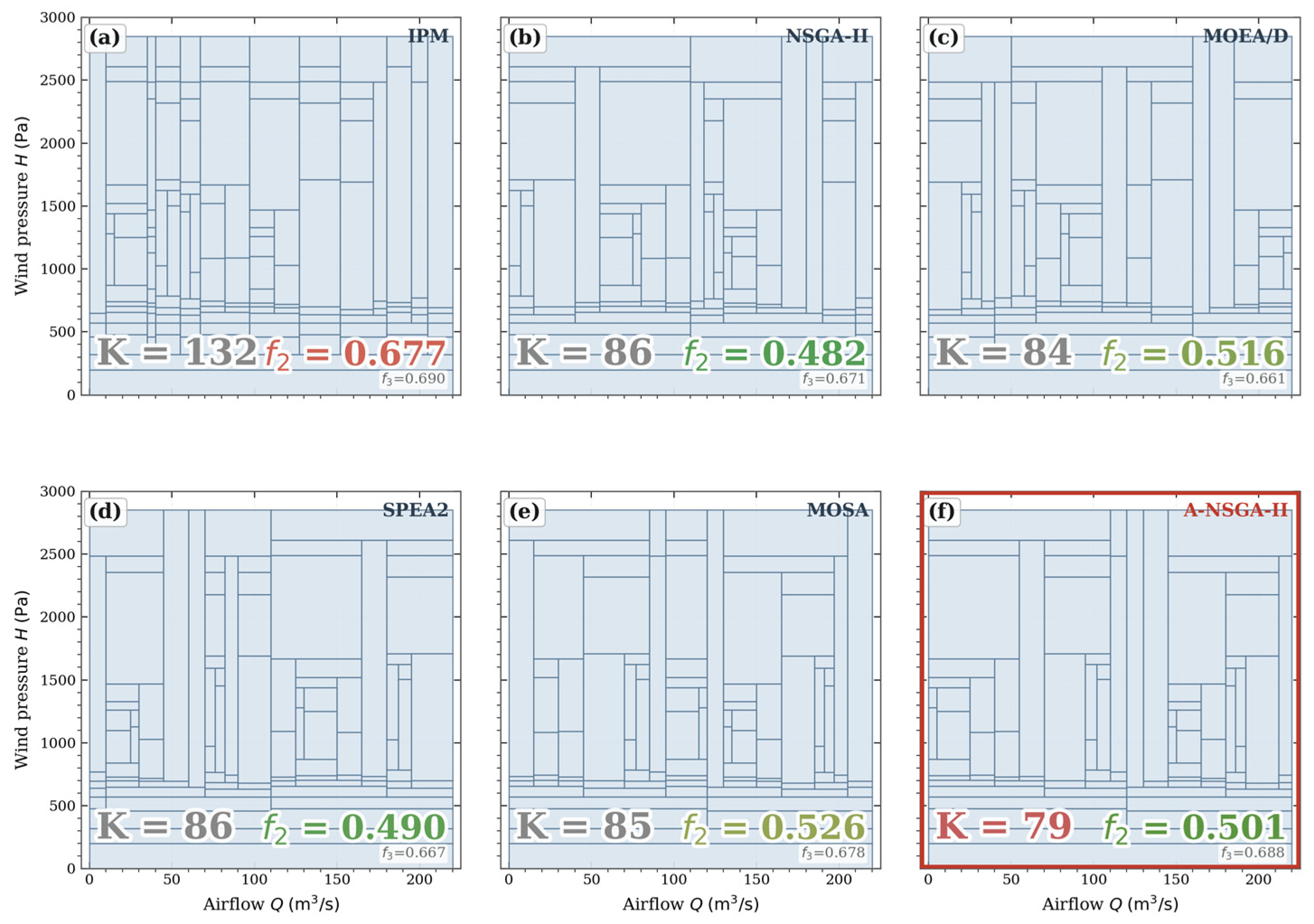
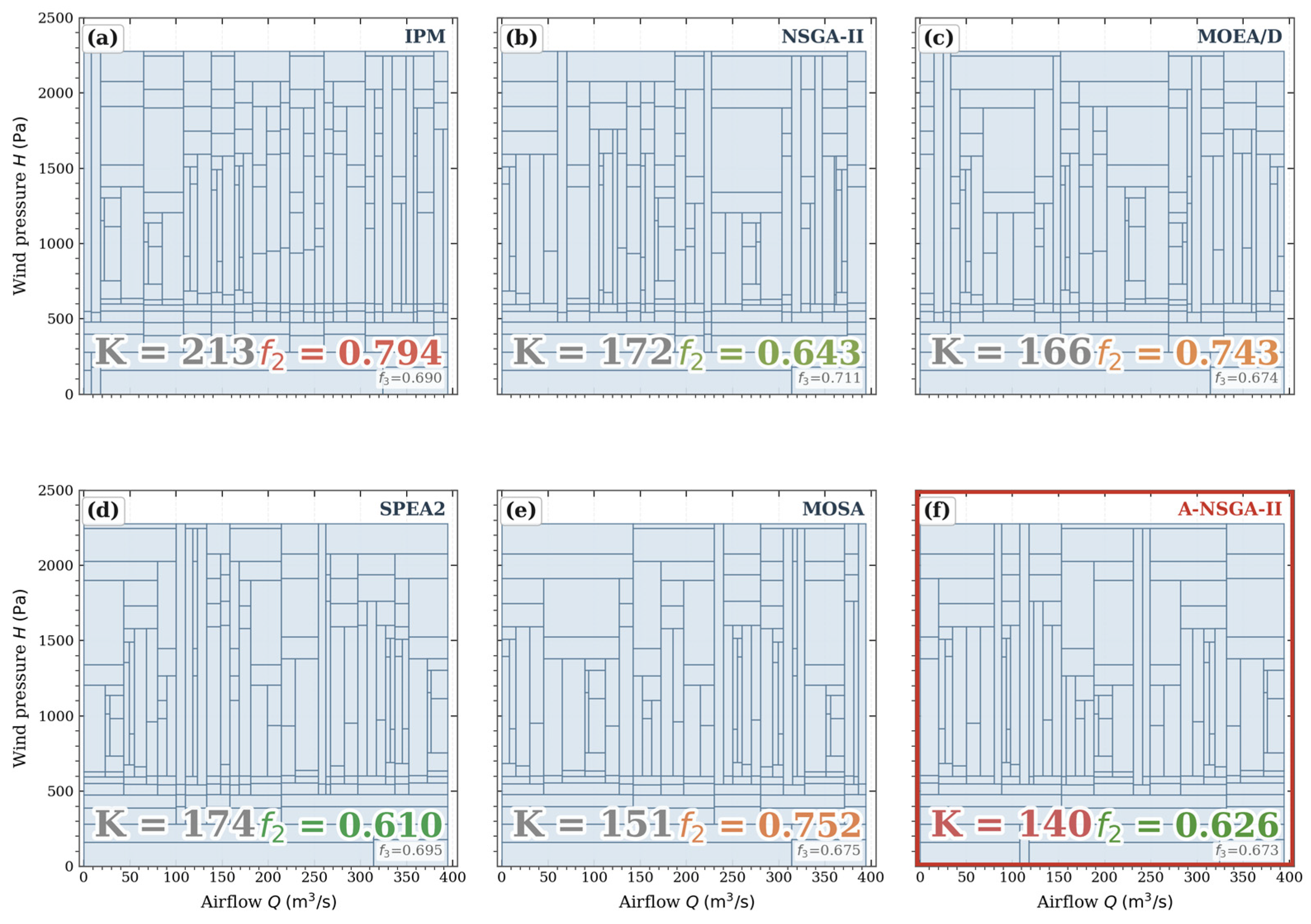
Beyond quantitative indicators, algorithmic differences are also visually apparent in the generated layouts. Figure 4 compares the Q-H graph generated by the six algorithms, each from the run whose AES is closest to the median over 30 independent trials. The IPM default ordering produces severely fragmented blocks, and although all four multi-objective algorithms achieve varying degrees of compression, A-NSGA-II yields the most compact and complete layout with the highest block-arrangement continuity, corroborating the quantitative findings in Table 3.

5.2. Pareto-Front and Multi-Objective Trade-Off Analysis

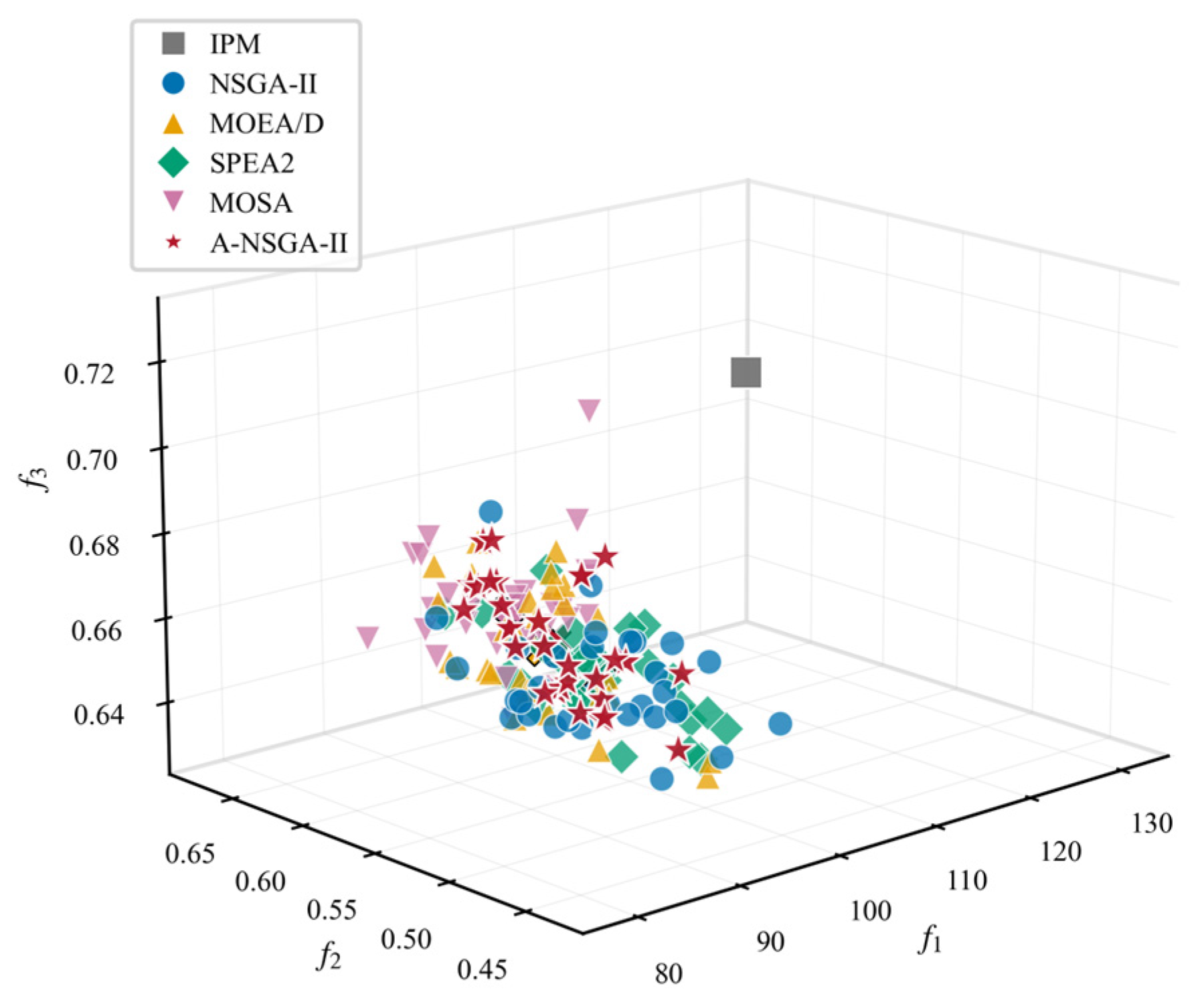
Figure 5 presents the three-dimensional distribution of the AES-recommended solutions in the objective space formed by f 1 , f 2 , and f 3 . Since all three objectives are minimised, solutions closer to the low-value region indicate better Q-H layout quality. The IPM baseline is clearly separated from the solution clouds of the optimisation algorithms, implying that the default independent-path ordering cannot provide a competitive layout. In contrast, the evolutionary algorithms shift the solutions toward lower objective values, confirming the necessity of permutation optimisation.
The distribution also reveals distinct algorithmic characteristics. The deterministic IPM baseline is separated from the optimised solutions, reflecting the limitation of the default independent-path order. NSGA-II, MOEA/D, SPEA2, and MOSA mainly overlap in the central region of the objective space, indicating comparable but relatively dispersed trade-off behaviours. By contrast, A-NSGA-II forms a more compact cluster and is generally shifted toward lower f 1 and f 2 , while maintaining comparable f 3 . This indicates better repeatability and a more stable compromise among split-block reduction, topological-spatial fidelity, and layout-fragmentation control.
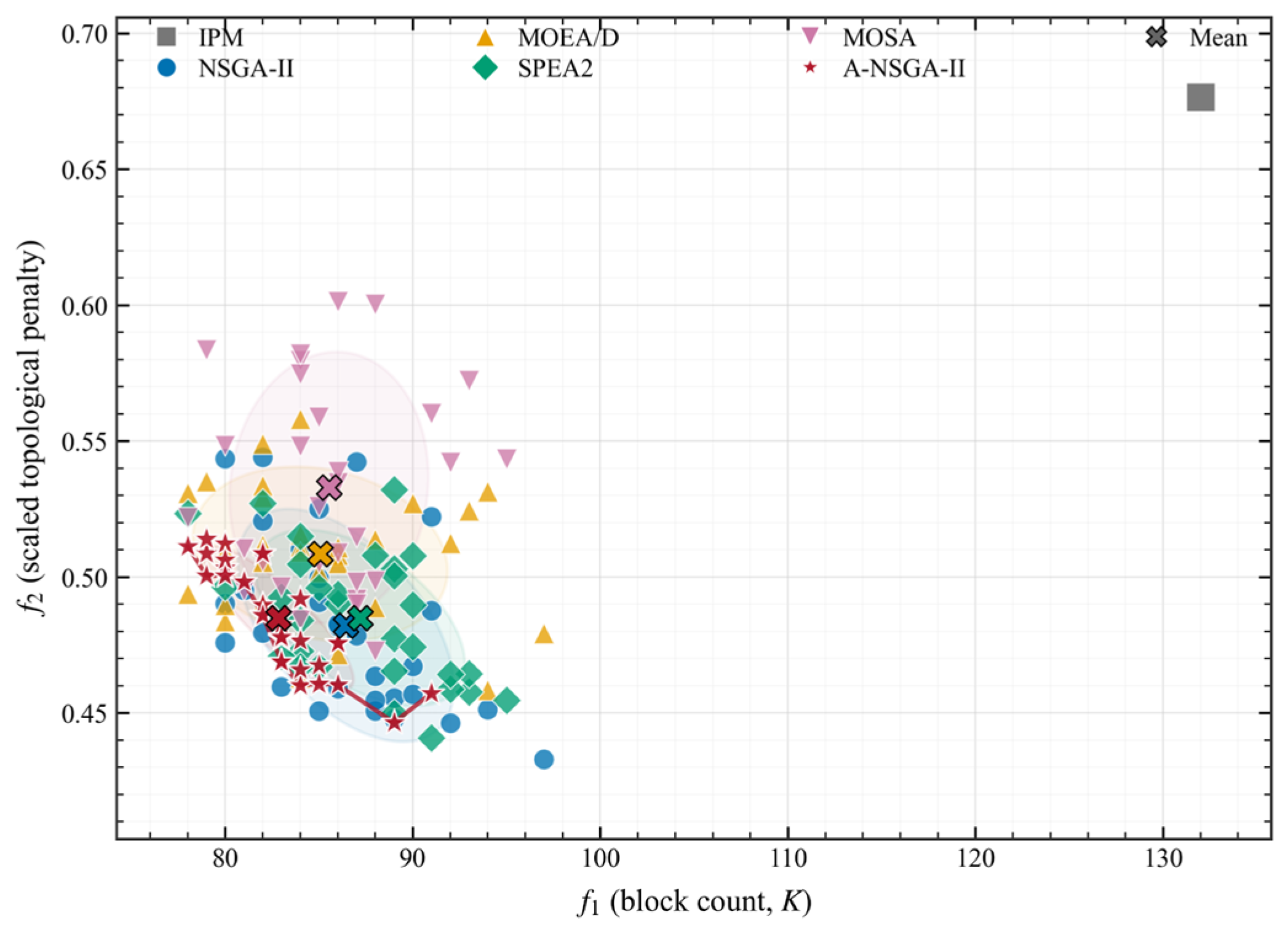
Figure 6 projects the solutions onto the f 1 , f 2 plane, illustrating the trade-off between block fragmentation and topological-spatial fidelity. The IPM baseline is clearly isolated in the high- f 1 , high- f 2 region. Compared with the more dispersed distributions of NSGA-II, MOEA/D, and SPEA2, A-NSGA-II is more compactly concentrated in the lower-left region, indicating that it more consistently achieves fewer split blocks and lower topological penalty. MOSA shows an upward shift in f 2 , further highlighting the advantage of A-NSGA-II in preserving topological-spatial adjacency.
The comparison between A-NSGA-II and NSGA-II is more informative when both the mean points and distribution ranges are considered. Although NSGA-II has a slightly lower mean f 2 , its solution cloud and shaded ellipse spread over a wider region, showing larger run-to-run fluctuation and a higher probability of producing layouts with larger block counts. By contrast, A-NSGA-II concentrates more solutions in the low- f 1 region while maintaining a similar f 2 level. Therefore, its advantage is not merely reflected by the mean value, but by a more compact and stable distribution in the objective plane. This indicates that the proposed topology-aware initialisation, adaptive discrete operators, and periodic local refinement jointly improve the robustness of the recommended layouts, yielding a more favourable engineering compromise between visual compactness and topological-spatial fidelity.

5.3. Cross-Scale Convergence and Robustness Analysis

After the comparative analysis on the primary 75-branch network, this subsection further examines whether the proposed A-NSGA-II maintains its convergence efficiency, run-to-run stability, and layout-generation capability when the network scale increases. Two networks are considered: Network-S with 75 branches and 18 independent paths, and Network-M with 112 branches and 36 independent paths. The increase in the number of independent paths substantially enlarges the permutation search space, making Network-M a more challenging case for evaluating the robustness of the proposed algorithm.
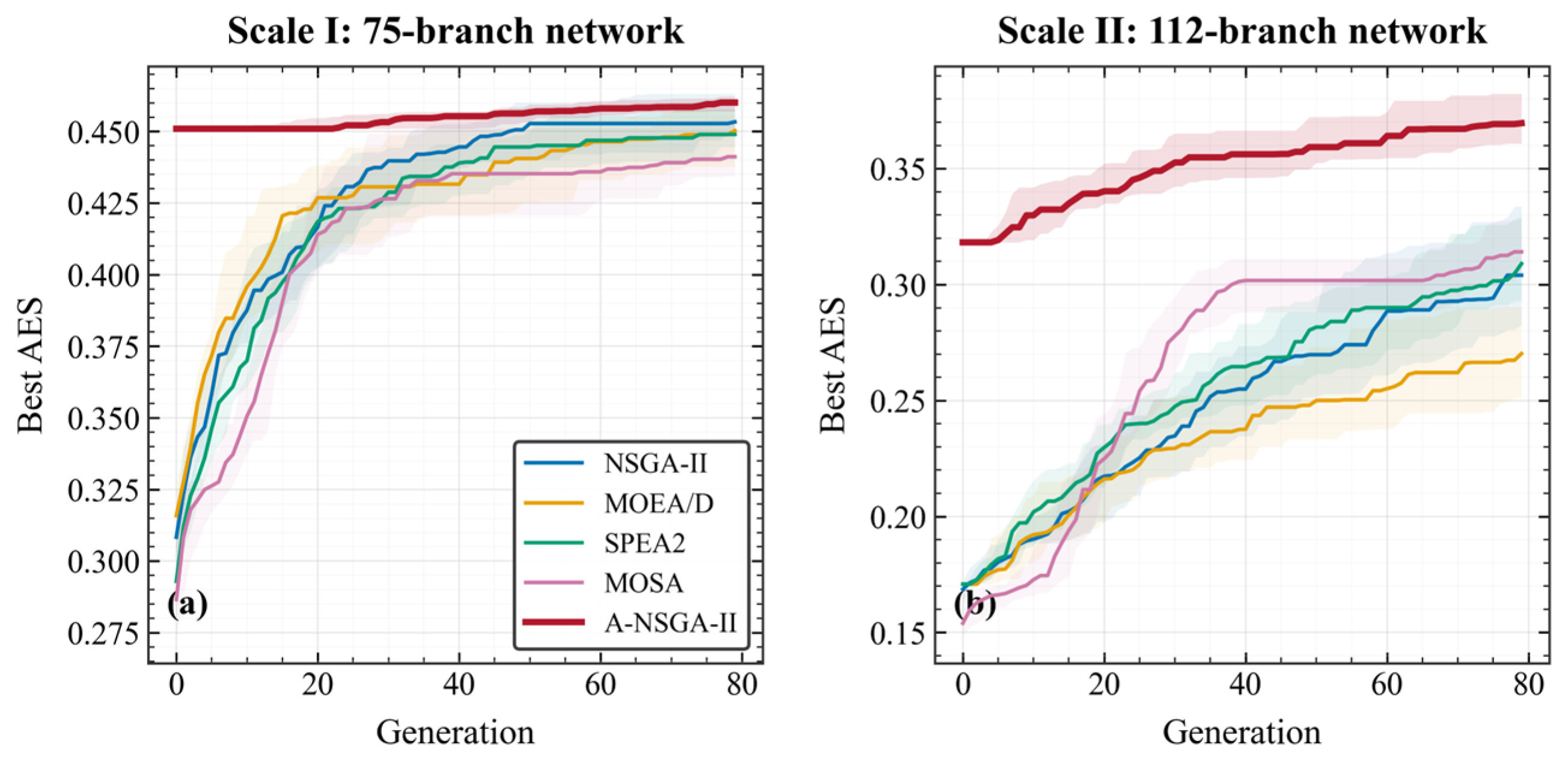
Figure 7 compares the AES convergence trajectories of the five stochastic algorithms on the two network scales. In Network-S, A-NSGA-II starts from a higher AES level and remains in the leading position throughout the evolutionary process. The curve exhibits only a mild upward trend, indicating that the topology-aware initialisation strategy already places the initial population in a high-quality region of the search space. In contrast, NSGA-II, MOEA/D, SPEA2, and MOSA require more generations to approach their terminal performance. This demonstrates that the proposed initialisation strategy effectively reduces inefficient early-stage exploration.
In Network-M, the convergence advantage of A-NSGA-II becomes more evident. As the path-permutation dimension increases, the benchmark algorithms show slower improvement and lower terminal AES values. A-NSGA-II still preserves a clear initial advantage and continues to improve during the evolutionary process, suggesting that its performance is not solely dependent on the initial population. Instead, the adaptive Lagrange-interpolated operators and periodic memetic local search continue to contribute to the subsequent refinement of candidate solutions. Therefore, the proposed framework combines high-quality initialisation with sustained evolutionary improvement, which is particularly important for larger Q-H graph generation problems.
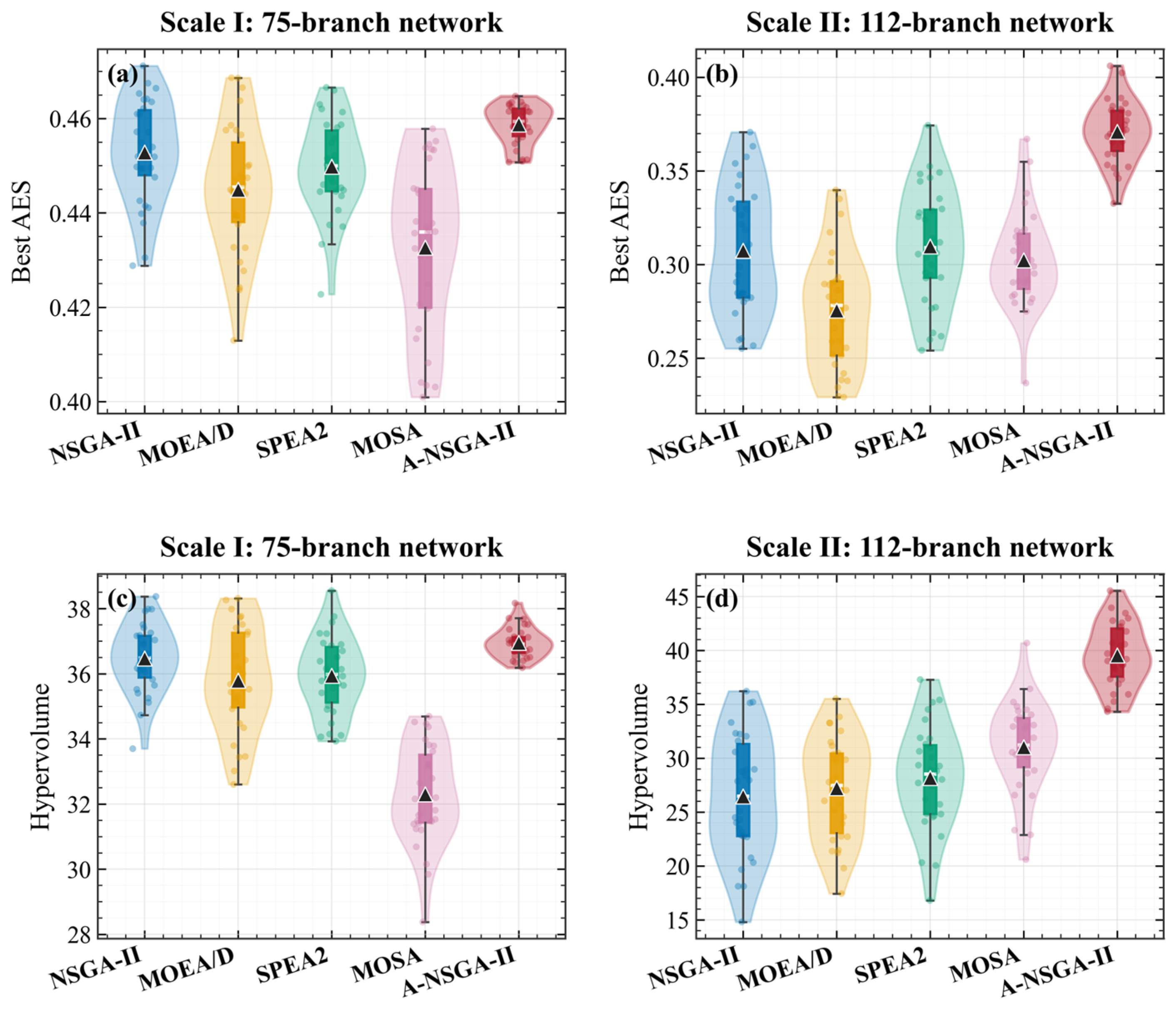
Figure 8 further compares the run-to-run distributions of AES and HV using violin plots. In Network-S, A-NSGA-II is concentrated in the upper performance region for both AES and HV, with a relatively compact distribution. Although NSGA-II, MOEA/D, and SPEA2 can obtain competitive HV values in some runs, their AES distributions are generally lower or more dispersed than that of A-NSGA-II, while MOSA shows a clear performance decline.
The distributional differences become more pronounced in Network-M. A-NSGA-II achieves the highest central values for both AES and HV and remains in the upper performance range across independent runs. In contrast, NSGA-II, MOEA/D, SPEA2, and MOSA exhibit lower central tendencies and broader dispersion, indicating weaker repeatability as the permutation dimension increases. These results suggest that the proposed topology-aware initialisation, adaptive variation, and PMLS refinement improve not only the average optimisation quality, but also the stability of the recommended solutions. From an engineering perspective, this robustness is important, because practical Q-H graph generation usually allows only one or a few optimisation runs.
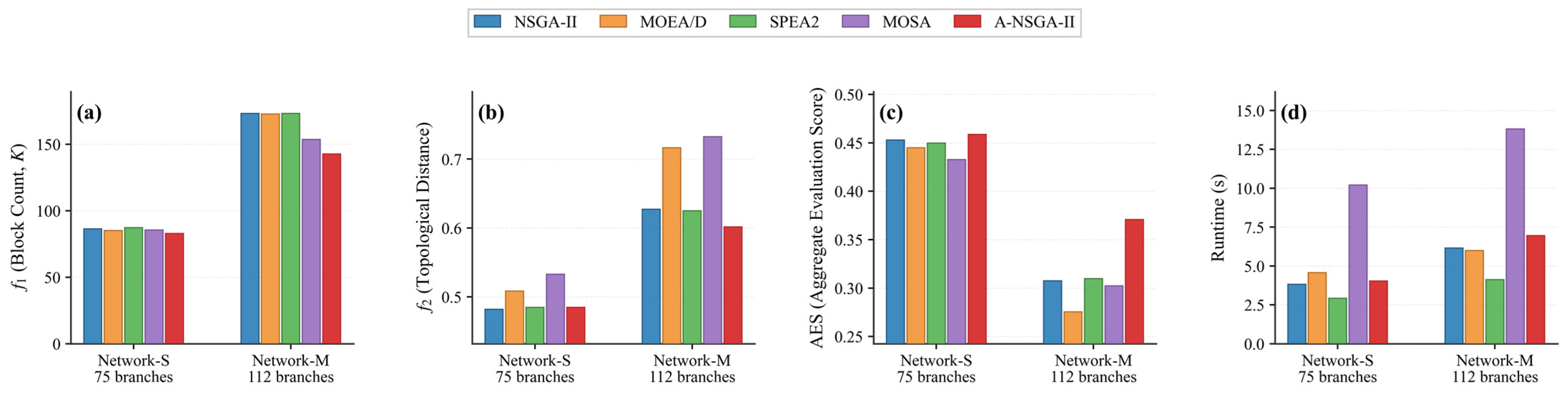
Figure 9 provides a direct cross-scale comparison of the five stochastic algorithms in terms of split-block count f 1 , topological-spatial discrepancy f 2 , AES, and runtime. Among these indicators, f 1 , f 2 , and runtime are minimisation-oriented, whereas AES is maximisation-oriented. In Network-S, A-NSGA-II obtains the lowest mean f 1 and the highest mean AES, while maintaining a competitive f 2 value. This indicates that, in the smaller network, its advantage is mainly reflected in the overall trade-off quality rather than absolute dominance in every individual metric.
In Network-M, the advantage of A-NSGA-II becomes more evident. It achieves the lowest mean f 1 , the lowest mean f 2 , and the highest mean AES among the five stochastic algorithms, suggesting that the proposed topology-aware initialisation, adaptive variation, and PMLS refinement become more beneficial as the path-permutation space expands. In terms of computational cost, A-NSGA-II is not the fastest algorithm, but its runtime remains much lower than that of MOSA and only moderately higher than the faster population-based comparators. Considering its simultaneous improvement in f 1 , f 2 , and AES, the added computational cost leads to a favourable performance–cost trade-off for quality-oriented Q-H graph generation.
The representative Q-H graphs in Figure 10 provide visual evidence consistent with the above quantitative results. For each stochastic algorithm, the solution whose AES is closest to the median over 30 independent trials is selected. In Network-S, all optimisation algorithms improve the block arrangement compared with the IPM baseline, but A-NSGA-II produces a more compact and coherent layout. In Network-M, the differences become more pronounced. The IPM baseline exhibits severe fragmentation. NSGA-II, MOEA/D, SPEA2, and MOSA improve the layout to different extents, but their graphs still contain more split blocks or weaker topological-spatial consistency. By contrast, A-NSGA-II yields the smallest split-block count, with K = 140 , while also maintaining the lowest f 2 among the compared layouts. This confirms that the numerical advantage of A-NSGA-II is reflected in the actual Q-H graph morphology.
To further verify whether the HV advantage in Network-M is statistically significant, a two-sided Wilcoxon rank-sum test is conducted between A-NSGA-II and each benchmark algorithm. The Vargha–Delaney effect size is also reported to quantify the practical magnitude of the pairwise advantage. The results are shown in Table 5.
Table 5 reports the Wilcoxon rank-sum test and Vargha–Delaney A ^ 12 effect size for HV in Network-M. A-NSGA-II shows statistically significant advantages over all four stochastic comparators at the significance level of α = 0.01; in fact, all p-values are below 10 9 , and all comparisons fall within the large-effect range. The A ^ 12 values range from 0.9644 to 0.9967, indicating that a randomly selected A-NSGA-II run has a very high probability of obtaining a larger HV than a randomly selected run of NSGA-II, MOEA/D, SPEA2, or MOSA. Compared with the results in Network-S in Table 3, the statistical evidence becomes substantially stronger as the network scale increases. For instance, the comparison with NSGA-II changes from p = 4.59 × 10 2 and A ^ 12 = 0.6500 in Network-S to 7.03 × 10 11 and A ^ 12 = 0.9900 in Network-M. This trend supports the interpretation that the proposed topology-aware initialisation, adaptive variation, and PMLS refinement provide larger marginal benefits on more complex path-permutation instances.
Overall, the results across Network-S and Network-M demonstrate that A-NSGA-II improves Q-H graph generation in three respects: it reduces block fragmentation, preserves topological-spatial fidelity, and enhances the stability of Pareto-front approximation. These advantages become more pronounced as the number of independent paths increases, confirming the scalability and engineering applicability of the proposed method for complex mine ventilation networks.

6. Discussion

The preceding results demonstrate that A-NSGA-II achieves superior optimisation performance and statistical robustness in both Network-S and Network-M. However, practical deployment of the proposed framework requires not only strong benchmark performance, but also a reliable recommendation mechanism and stable algorithmic parameter settings. In engineering applications, the Pareto front must ultimately be converted into a single Q-H graph layout, and the adopted A-NSGA-II configuration should remain effective under reasonable perturbations. Therefore, this section further examines the sensitivity of the AES preference weights and key A-NSGA-II parameters (Section 6.1) and then discusses the limitations and future research directions of the proposed method (Section 6.2).

6.1. Sensitivity Analysis

6.1.1. Sensitivity Analysis of AES Weights

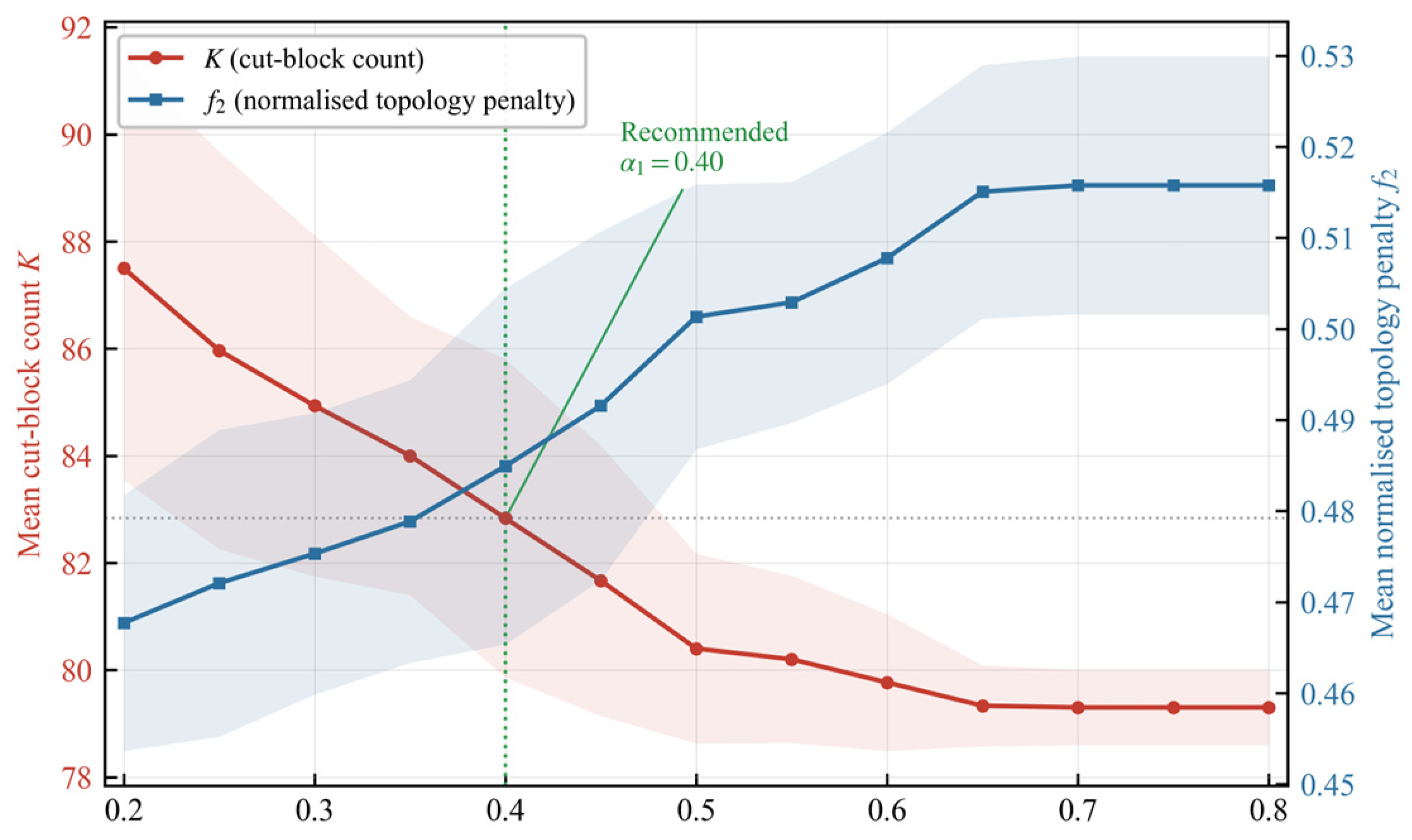
The aggregate evaluation score introduced in Section 2.3.4 depends on the preference weights α1, α2, and α3. Although the default setting (α1, α2, α3) = (0.4, 0.4, 0.2) is assigned according to the engineering semantics of equal priority between visual integrity and topological-spatial fidelity, its practical applicability still requires verification under reasonable preference perturbations. Therefore, a post hoc weight scan is performed in Network-S using the 30 A-NSGA-II Pareto fronts obtained in the comparative experiment. In the scan, α3 is fixed at 0.2, α1 varies from 0.20 to 0.80 with an interval of 0.05, and α2 = 0.8 − α1. For each weight vector, AES is recalculated on the Pareto front of each independent run, and the solution with the maximum AES is selected as the engineering recommendation. The resulting mean split-block count K and the mean normalised topology penalty f2 are shown in Figure 11.
Figure 11 reveals a clear and interpretable trade-off between the two dominant objectives. As α1 increases, the AES selector places greater emphasis on minimising the split-block count, and the mean K decreases from approximately 87.5 to approximately 79.3. Meanwhile, the mean topological-spatial discrepancy f 2 increases from approximately 0.47 to approximately 0.52. This opposite trend is consistent with the theoretical relationship between f1 and f2: improving visual compactness by reducing block fragmentation generally weakens the horizontal proximity of topologically adjacent branches. The default setting α1 = 0.40 lies within the smooth transition region of the curves.
The high-α1 region further clarifies the admissible range of AES weights. When α1 ≥ 0.70, the reduction in K becomes marginal, whereas the topology penalty remains at a relatively high level and the selection band does not contract. This indicates that excessive emphasis on f1 makes the recommendation mechanism insufficiently sensitive to differences in topological-spatial fidelity. Consequently, α1 ≥ 0.70 should be regarded as a selection-instability region rather than a generally preferable setting.
Overall, the recommended weights (0.4, 0.4, 0.2) are justified because the split-block count and topological-spatial discrepancy should be treated as co-dominant criteria, whereas layout fragmentation plays a supporting role because it can be partly mitigated through scaling, zooming, or interactive annotation. Therefore, AES should be understood not as an absolute mathematical optimum, but as an interpretable engineering preference model for selecting a practically usable Q-H layout from the Pareto front. For applications that prioritise global layout compactness, α1 may be moderately increased, but a practical upper bound of about 0.65 is suggested; when topology recovery or local diagnostic interpretation is more important, α2 should be kept comparable to or larger than α1.

6.1.2. Sensitivity Analysis of A-NSGA-II Parameters

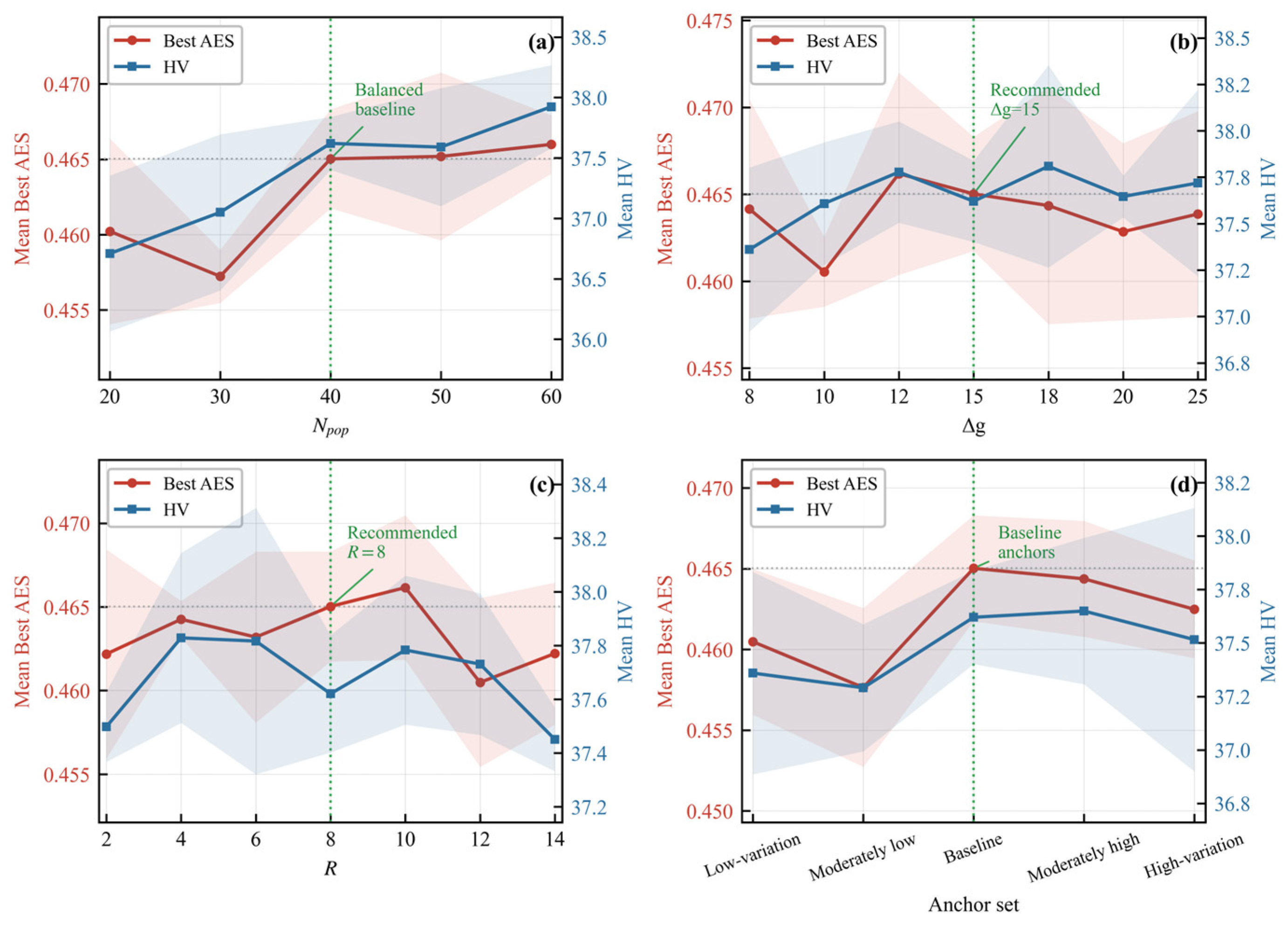
To examine whether the A-NSGA-II performance is overly dependent on the parameter settings in Table 2, a one-factor-at-a-time sensitivity analysis was conducted in Network-S. Four factors were considered: population size N p o p , PMLS triggering period Δ g , PMLS restart count R, and adaptive crossover/mutation anchor settings. The Table 2 configuration was used as the baseline. When one parameter was varied, the remaining parameters were fixed at their Table 2 values. Each configuration was tested over ten independent runs, and mean best AES and HV were recorded.
As shown in Figure 12a, the population size presents the clearest cost-quality trade-off. Increasing N p o p from 40 to 60 slightly improves best AES from 0.4650 to 0.4660 and HV from 37.6203 to 37.9235, but the runtime increases by 48.93%. Conversely, N p o p = 20 reduces runtime by 37.77%, but HV decreases by 2.42%. Therefore, N p o p = 40 is not treated as a narrowly tuned global optimum; rather, it is a stable and reasonable engineering compromise between Pareto-front quality and computational cost.
Figure 12b,c further indicate that the PMLS-related parameters are relatively stable within the tested ranges. For Δg, the settings from 12 to 25 yield similar best AES and HV values, and Δg = 15 remains inside this stable region while avoiding overly frequent local-search calls. For the restart count R, smaller values such as R = 4 and R = 6 can reduce local-search effort, whereas larger values such as R = 10 may slightly increase best AES in some runs. The adopted R = 8 keeps the local refinement sufficiently active without allowing PMLS to dominate the evolutionary search, which is consistent with the engineering role assigned to PMLS in the proposed algorithm.
Figure 12d uses the current Table 2 APC/APM values as the baseline anchor set and compares them with lower- and higher-variation perturbations. The baseline anchors achieve the highest mean best AES among the tested anchor sets and also provide the best engineering score in this group. The low-variation and moderately low settings weaken the adaptive operator’s search diversity, while the moderately high and high-variation settings do not provide consistent additional gains. This suggests that the selected APC/APM anchors are academically reasonable: they preserve a clear adaptive contrast between convergence-oriented and exploration-oriented stages, but avoid excessive operator fluctuation.
Overall, the sensitivity analysis supports the current Table 2 settings as stable, reasonable, and engineering-oriented. The results show that the adopted configuration lies in a robust performance region and provides competitive AES and HV values under a bounded objective-evaluation budget.

6.2. Limitations and Future Research Directions

The present work still has several limitations that provide directions for future research across three layers: evaluation metrics, algorithmic framework, and application scenarios. At the evaluation-metric level, the AES weights α 1 , α 2 ,   a n d   α 3 are currently specified a priori on the basis of engineering semantics. As shown in the sensitivity analysis of Section 6.1, the AES yields stable recommendations within α 1 < 0.70 ; however, the precise weight values still rely on engineering judgement and cannot fully accommodate the heterogeneous preference structures of different decision-makers. A promising direction is to develop a preference-based interactive multi-objective optimisation framework that updates the weights online through decision-maker feedback on candidate solutions. A further extension is reference-point-based preference modeling, which would generalise the representation of engineering preferences from weight vectors to preference regions within the objective space.
At the algorithmic-framework level, the three improvements proposed in this work—TAI, the Lagrange three-point interpolated adaptive operators, and PMLS—have been validated exclusively within the NSGA-II framework. These strategies are conceptually generic enhancement modules for permutation-based optimisation; the effectiveness of their transfer to other multi-objective evolutionary frameworks—and the underlying adaptation mechanisms—warrants systematic future investigation. At the application-scenario level, the present optimisation framework is designed for single-shot solution of static ventilation networks. In real-world mine ventilation operation, regulatory actions—including air-window adjustment, start-up and shutdown of auxiliary fans, and airflow reconfiguration under disaster conditions—induce dynamic changes in the ventilation regime, each generating a new Q-H graph. If a full optimisation must be re-executed at every regime switch, the computational cost is unlikely to match the real-time requirements of ventilation dispatch. A worthwhile direction is the development of fast Q-H graph update methods adapted to dynamic ventilation regimes, which would extend the present approach from single-regime static optimisation to a dynamic-optimisation framework supporting continuous regime switching, thus better serving the refined operational management of mine ventilation systems.

7. Conclusions

This paper proposes the adaptive NSGA-II framework as a multi-objective intelligent solution to the independent-path permutation problem arising in the automated generation of mine ventilation Q-H graphs. The principal contributions and conclusions are summarised as follows.
(1)
A longest-path-based nodal pressure-energy reconstruction algorithm. To address the block overlap and inversion produced by breadth-first search in networks containing diagonal branches and angle-coupled structures, the nodal pressure-energy assignment is reconstructed via a directed acyclic graph longest-path recurrence: each nodal ordinate is set to the maximum cumulative resistance among all incoming-edge paths, thereby ensuring a strictly positive vertical height for every rectangular block along the airflow direction.
(2)
A multi-objective evaluation system. Building on three complementary dimensions—the split-block count f 1 , the topological-spatial discrepancy f 2 , and the layout fragmentation f 3 —the proposed system extends Q-H drawing-quality assessment from a scalar criterion to a multi-dimensional quantitative formulation. An aggregate evaluation score is further constructed to map the Pareto-optimal set onto a single engineering-recommendation indicator, and its weight-sensitivity is verified within α 1 [0.20, 0.65].
(3)
Three permutation-specific NSGA-II enhancements. Embedded within the NSGA-II framework, the three strategies—topology-aware adjacency-guided initialisation, Lagrange three-point interpolated adaptive operators, and periodic memetic local search—operate at three complementary levels: initial-population quality, operator-probability adaptation, and Pareto-front neighbourhood refinement, respectively. The parameter-sensitivity analyses further confirm the stability and engineering rationality of the adopted parameter settings.
(4)
Cross-scale validation with scale-amplified advantage. Comparative experiments in two mine ventilation networks—Network-S (75 branches, 18 independent paths, search space 6.40 × 10 15 ) and Network-M (112 branches, 36 independent paths, search space 3.72 × 10 41 )—show that A-NSGA-II consistently achieves the lowest mean split-block count, the highest mean AES, and the highest mean hypervolume among five stochastic algorithms. Its HV standard deviation in Network-S is reduced by 56.6–71.5% relative to the four benchmarks, indicating substantially improved run-to-run stability. Moreover, the advantage of A-NSGA-II becomes more pronounced as the network scale increases: in Network-M, the Wilcoxon rank-sum test confirms significant HV superiority over all four benchmarks ( p < 10 9 ) with Vargha–Delaney A ^ 12 values approaching unity.
In summary, the coordinated enhancements at the evaluation, modelling, and algorithmic levels deliver a quantitatively grounded and algorithmically stable framework for the intelligent visualisation of complex mine ventilation networks.

Author Contributions

Conceptualisation, Z.Y. and B.Y.; methodology, B.Y.; software, L.Z.; validation, B.Y., Y.H. and C.C.; formal analysis, Y.H.; investigation, Z.Y.; resources, Z.Y.; data curation, Z.Y.; writing—original draft, J.R.; writing—review and editing, B.Y.; visualisation, L.Z.; supervision, L.Z.; project administration, C.C.; funding acquisition, Z.Y. All authors have read and agreed to the published version of the manuscript.

Funding

This research was funded by the National Natural Science Foundation of China, grant number 52074214; the “Scientists + Engineers” Team Construction Project of Qin Chuang Yuan, Shaanxi Province, grant number 2024QCY-KXJ-190; and the Key Research and Development Program of Shanxi Province, grant number 2023-YBSF-190.

Data Availability Statement

The original contributions presented in this study are included in the article. Further inquiries can be directed to the corresponding author.

Acknowledgments

The authors are grateful for the strong support from the Xi’an University of Science and Technology platform, as well as the support from other members of the Intelligent Ventilation Team.

Conflicts of Interest

The authors declare no conflicts of interest.

References

  1. Wang, C.; Wang, H.-B.; Xie, M.-Z.; Xiong, Z.-Q.; Wang, C.; Cheng, L.-P.; Zhan, S.-F. Study on the dynamic characteristics of rock surrounding a wellbore in energy storage areas during deep geothermal energy mining. PLoS ONE 2020, 15, e237823. [Google Scholar] [CrossRef] [PubMed]
  2. Semin, M.; Levin, A.; Yu, L. Stability of air flows in mine ventilation networks. Process Saf. Environ. Prot. 2019, 124, 167–171. [Google Scholar] [CrossRef]
  3. Xue, Y.; Wang, J.; Xiao, J. Bibliometric analysis and review of mine ventilation literature published between 2010 and 2023. Heliyon 2024, 10, e26133. [Google Scholar] [CrossRef] [PubMed]
  4. Semin, M.; Kormshchikov, D. Application of artificial intelligence in mine ventilation: A brief review. Front. Artif. Intell. 2024, 7, 1402555. [Google Scholar] [CrossRef] [PubMed]
  5. Zhou, X.; Dong, Q.; Xu, L.; Li, A.; Song, D.; Bai, G. Study on simulation optimization of gas drainage system based on mine ventilation network feature map. Coal Sci. Technol. 2016, 44, 68–72. [Google Scholar]
  6. Huang, H. Theory and Application of Ventilation Network Feature Graph. Saf. Coal Mines 1981, 5, 8–18. [Google Scholar]
  7. Xu, R.; Tien, J.C. Two-Dimensional Mine Characteristic Graph for Ventilation Planning. In Proceedings of the 6th US Mine Ventilation Symposium; Society for Mining, Metallurgy & Exploration Inc. (SME): Englewood, CO, USA, 1993. [Google Scholar]
  8. Wang, J.; Jia, M.; Bin, L.; Wang, L.; Zhong, D. Regulation and optimization of air quantity in a mine ventilation network with multiple fans. Arch. Min. Sci. 2022, 67, 179–193. [Google Scholar]
  9. Jia, J.; Li, B.; Ke, D.; Wu, Y.; Zhao, D.; Wang, M. Optimization of mine ventilation network feature graph. PLoS ONE 2020, 15, e242011. [Google Scholar] [CrossRef] [PubMed]
  10. Xie, L.; Wang, L. Study on optimization of mine ventilation network characteristic map based on improved GA algorithm. AIP Adv. 2023, 13, 105318. [Google Scholar] [CrossRef]
  11. Deng, L.J.; Liu, J. Study on drawing algorithm of ventilation network graph based on layer method. Comput. Eng. Appl. 2014, 34, 66–68. [Google Scholar]
  12. Deng, L.-J.; Liu, J. New approach for ventilation network graph drawing based on Sugiyama method and GA-SA algorithm. Comput. Model. New Technol. 2014, 18, 45–49. [Google Scholar]
  13. Wei, L.J.; Wang, Y.J.; Fang, Z.W. Theory and process to simplify complicated ventilation networks. J. China Univ. Min. Technol. 2010, 39, 480–483. [Google Scholar]
  14. Zhang, Z. Research on Topological Layout Algorithm of Mine Ventilation Network Diagram. In Proceedings of the 2025 6th International Conference on Computer Engineering and Application (ICCEA), Hangzhou, China, 25–27 April 2025; IEEE: Piscataway, NJ, USA, 2025. [Google Scholar]
  15. Dong, J.; Li, J.; Li, Y.; Li, B.; Cui, Y.; Zhang, Z.; Zhang, W.; Liu, J. Implementation of Core Algorithms for Automated Mine Ventilation Network Diagram Generation. IEEE Trans. Netw. Sci. Eng. 2026, 13, 6079–6105. [Google Scholar] [CrossRef]
  16. Zhao, X.; Wang, J.; Zhang, H. Automatic Generation of Mine Ventilation Network Diagrams Based on Ant Colony Algorithm. In Proceedings of the 2025 International Conference on Engineering Management and Safety Engineering (EMSE 2025); Atlantis Press: Dordrecht, The Netherlands, 2025. [Google Scholar]
  17. Wei, L.J.; Zhou, F.B.; Cheng, J.W.; Luo, X.R.; Li, X.L. Classification of structural complexity for mine ventilation networks. Complexity 2015, 21, 21–34. [Google Scholar]
  18. Zhong, D.; Wen, L.; Bi, L.; Liu, Y. An efficient and automatic simplification method for arbitrary complex networks in mine ventilation. Mathematics 2024, 12, 2815. [Google Scholar] [CrossRef]
  19. Jia, J.; Shang, W.; Liu, J.; Deng, L. Rapid equivalent simplification algorithm for complex underground mine ventilation networks. J. China Coal Soc. 2025, 50, 421–431. [Google Scholar]
  20. Wang, Z.; Zhang, Q.; Li, H.; Ishibuchi, H.; Jiao, L. On the use of two reference points in decomposition based multiobjective evolutionary algorithms. Swarm Evol. Comput. 2017, 34, 89–102. [Google Scholar] [CrossRef]
  21. Guo, J.; Qin, Y.; Wu, C.H.; Chen, Z.S. Multi-objective optimization of multimodal logistics paths: A decomposition-based approach for coordinating trucks and UAVs within the cyber-physical internet framework. Int. J. Logist. Res. Appl. 2026, 1–29. [Google Scholar] [CrossRef]
  22. Leung, M.-F.; Wang, J. A collaborative neurodynamic approach to multiobjective optimization. IEEE Trans. Neural Netw. Learn. Syst. 2018, 29, 5738–5748. [Google Scholar] [CrossRef] [PubMed]
  23. Taboada, M.; Martinez, D.; Arideh, M.; Mosquera, R. Ontology matching with large language models and prioritized depth-first search. Inf. Fusion 2025, 123, 103254. [Google Scholar] [CrossRef]
  24. Deb, K.; Pratap, A.; Agarwal, S.; Meyarivan, T. A fast and elitist multiobjective genetic algorithm: NSGA-II. IEEE Trans. Evol. Comput. 2002, 6, 182–197. [Google Scholar] [CrossRef]
  25. Patnaik, L.M.; Mandavilli, S. Adaptation in genetic algorithms. In Genetic Algorithms for Pattern Recognition; CRC Press: Boca Raton, FL, USA, 2017; pp. 45–64. [Google Scholar]
  26. Molina, D.; Lozano, M.; García-Martínez, C.; Herrera, F. Memetic algorithms for continuous optimisation based on local search chains. Evol. Comput. 2010, 18, 27–63. [Google Scholar] [CrossRef] [PubMed]
  27. Zitzler, E.; Laumanns, M.; Thiele, L. SPEA2: Improving the Strength Pareto Evolutionary Algorithm; TIK Report; ETH Zurich, Computer Engineering and Networks Laboratory: Zurich, Switzerland, 2001; Volume 103. [Google Scholar]
  28. Yannibelli, V.; Amandi, A. Hybridizing a multi-objective simulated annealing algorithm with a multi-objective evolutionary algorithm to solve a multi-objective project scheduling problem. Expert Syst. Appl. 2013, 40, 2421–2434. [Google Scholar] [CrossRef]
  29. Zhang, Q.; Li, H. MOEA/D: A multiobjective evolutionary algorithm based on decomposition. IEEE Trans. Evol. Comput. 2007, 11, 712–731. [Google Scholar] [CrossRef]
  30. Guerreiro, A.P.; Fonseca, C.M.; Paquete, L. The hypervolume indicator: Computational problems and algorithms. ACM Comput. Surv. (CSUR) 2021, 54, 119. [Google Scholar] [CrossRef]
  31. de Barros, R.S.M.; Hidalgo, J.I.G.; de Lima Cabral, D.R. Wilcoxon rank sum test drift detector. Neurocomputing 2018, 275, 1954–1963. [Google Scholar] [CrossRef]
  32. Neumann, G.; Harman, M.; Poulding, S. Transformed vargha-delaney effect size. In International Symposium on Search Based Software Engineering; Springer: Berlin/Heidelberg, Germany, 2015. [Google Scholar]
Figure 1. Comparison of nodal pressure-energy assignment methods. (a) BFS-based assignment, exhibiting vertical overlap and inversion of rectangular blocks. (b) longest-path-based reconstruction, yielding a non-overlapping vertical tessellation, the green boxes are used to highlight branches e 9 and e 10 , these two branches correspond to the red hatched overlapping block in (a).
Mathematics 14 02191 g001
Figure 2. Overall framework of the A-NSGA-II-based multi-objective intelligent generation method for mine ventilation Q-H graphs.
Mathematics 14 02191 g002
Figure 3. Topological structure of the 75-branch mine ventilation network with engineering-semantic annotations.
Mathematics 14 02191 g003
Figure 4. Comparison of representative Q-H graph generated by the six algorithms. (a) IPM default ordering; (b) NSGA-II; (c) MOEA/D; (d) SPEA2; (e) MOSA; (f) A-NSGA-II. The red frame highlights the A-NSGA-II result.
Mathematics 14 02191 g004
Figure 5. Three-dimensional objective-space distribution of AES-recommended solutions in Network-S. Each marker denotes one recommended solution from an independent run; the grey square denotes the IPM baseline.
Mathematics 14 02191 g005
Figure 6. Two-dimensional projection of the AES-recommended solutions on the f 1 , f 2 plane. Shaded ellipses indicate the distribution ranges of different algorithms, and black crosses denote the corresponding mean points.
Mathematics 14 02191 g006
Figure 7. AES convergence curves of the five stochastic algorithms on two network scales: (a) Network-S with 75 branches and 18 independent paths; (b) Network-M with 112 branches and 36 independent paths. Solid lines denote the median best AES over 30 independent trials, and shaded bands indicate the interquartile range.
Mathematics 14 02191 g007
Figure 8. Violin-plot comparison of AES and HV distributions across two network scales: (a,b) AES distributions in Network-S and Network-M; (c,d) HV distributions in Network-S and Network-M. Triangles denote mean values, boxes denote interquartile ranges, and dots represent independent runs.
Mathematics 14 02191 g008
Figure 9. Cross-scale comparison of the five stochastic algorithms in Network-S and Network-M. (a) Split-block count f 1 , where lower values indicate better visual compactness; (b) topological distance f 2 , where lower values indicate better topological-spatial fidelity; (c) aggregate evaluation score (AES), where higher values indicate better comprehensive layout quality; and (d) runtime, where lower values indicate lower computational cost. Bar heights denote means over 30 independent trials.
Mathematics 14 02191 g009
Figure 10. Representative Q–H graphs generated by the six methods on Network-M. (a) IPM default ordering; (b) NSGA-II; (c) MOEA/D; (d) SPEA2; (e) MOSA; (f) A-NSGA-II. For each algorithm, the run whose AES is closest to the median over 30 independent trials is selected. The red frame highlights the proposed A-NSGA-II result.
Mathematics 14 02191 g010
Figure 11. Sensitivity analysis of AES weights in Network-S. The red curve denotes the mean split-block count K, and the blue curve denotes the mean normalised topology penalty. Shaded bands indicate the standard deviations across independent runs; the vertical dotted line indicates the recommended setting α1 = 0.40.
Mathematics 14 02191 g011
Figure 12. Sensitivity analysis of key A-NSGA-II parameters on Network-S. (a) Effect of the population size; (b) effect of the PMLS triggering period; (c) effect of the number of local-search individuals; (d) effect of the adaptive probability-anchor set. The red curves denote the mean best AES, and the blue curves denote the mean HV. Shaded bands indicate the standard deviations over ten independent runs. The green dotted lines mark the parameter settings used in Table 2: N p o p = 40, Δ g = 15, R = 8, and the baseline anchor set. In panel (d), APC and APM denote the adaptive crossover-probability anchor vector and the adaptive mutation-probability anchor vector, respectively. The anchor-set labels represent perturbations around the Table 2 baseline anchors: low-variation, APC = (0.85, 0.70, 0.50) and APM = (0.03, 0.10, 0.20); moderately low, APC = (0.90, 0.75, 0.55) and APM = (0.04, 0.12, 0.25); baseline, APC = (0.95, 0.80, 0.60) and APM = (0.05, 0.15, 0.30); moderately high, APC = (0.95, 0.85, 0.65) and APM = (0.08, 0.18, 0.30); and high-variation, APC = (0.95, 0.90, 0.70) and APM = (0.10, 0.20, 0.30).
Mathematics 14 02191 g012
Table 1. Topological parameters of the two test networks.
Parameter75-Branch Network112-Branch Network
Nodes (m)6079
Branches (n)75112
Independent paths (p)1836
Search space (p!) 6.40 × 10 15 3.72 × 10 41
Coal working faces22
Heading working faces23
Fan shafts/sinks22
Total intake airflow (m3/s)220394
Table 2. A-NSGA-II–specific parameter settings.
ParameterSymbolValue
Population size N p o p 40
Crossover probability anchors p c 1 , p c 2 , p c 3 0.95 , 0.80 , 0.60
Mutation probability anchors p m 1 , p m 2 , p m 3 0.05 , 0.15 , 0.30
PMLS triggering period Δ g 15
Maximum generationsT80
PMLS restart countR8
Table 3. Core comparative results across 30 independent trials in Network-S (75 branches): A-NSGA-II versus four benchmark algorithms (best values in bold).
AlgorithmMean K SD ( K )Mean AESMean HVSD (HV)
NSGA-II86.434.190.452836.47531.0389
MOEA/D85.074.950.444935.79381.5837
SPEA287.204.060.449835.94351.1580
MOSA85.533.860.432632.29861.4942
A-NSGA-II82.832.920.458836.95210.4510
Table 4. Wilcoxon rank-sum test and Vargha–Delaney effect size for HV in Network-S (A-NSGA-II versus each comparator).
Comparator p -ValueSignificance 1 A ^ 12 Effect Magnitude 2
NSGA-II 4.59 × 10 2 *0.6500medium
MOEA/D 4.33 × 10 3 **0.7144large
SPEA2 1.45 × 10 4 ***0.7856large
MOSA 2.87 × 10 11 ***1.0000large
1 Significance levels: * p < 0.05; ** p < 0.01; *** p < 0.001. 2 The Vargha–Delaney effect size A ^ 12 > 0.5 indicates that A-NSGA-II is favoured. Following the conventions of Vargha and Delaney, | A ^ 12 0.5 | 0.21 is classified as large, ≥0.15 as medium, and ≥0.06 as small.
Table 5. Wilcoxon rank-sum test and Vargha–Delaney A ^ 12 effect size for HV in Network-M, comparing A-NSGA-II with each stochastic comparator.
Comparator p -ValueSignificance 1 A ^ 12 Effect Magnitude 2
NSGA-II 7.03 × 10 11 ***0.9900large
MOEA/D 3.88 × 10 11 ***0.9967large
SPEA2 9.44 × 10 11 ***0.9867large
MOSA 6.41 × 10 10 ***0.9644large
1 Significance levels: *** p < 0.001. 2 The Vargha–Delaney effect size A ^ 12 > 0.5 indicates that A-NSGA-II is favoured. Following the conventions of Vargha and Delaney, | A ^ 12 0.5 | 0.21 is classified as large, ≥0.15 as medium, and ≥0.06 as small.
Disclaimer/Publisher’s Note: The statements, opinions and data contained in all publications are solely those of the individual author(s) and contributor(s) and not of MDPI and/or the editor(s). MDPI and/or the editor(s) disclaim responsibility for any injury to people or property resulting from any ideas, methods, instructions or products referred to in the content.