Dynamic Economic–Environmental Dispatch with Generator Priority: A Machine Learning–Optimization Framework


 ,
,  and
and
Abstract
1. Introduction
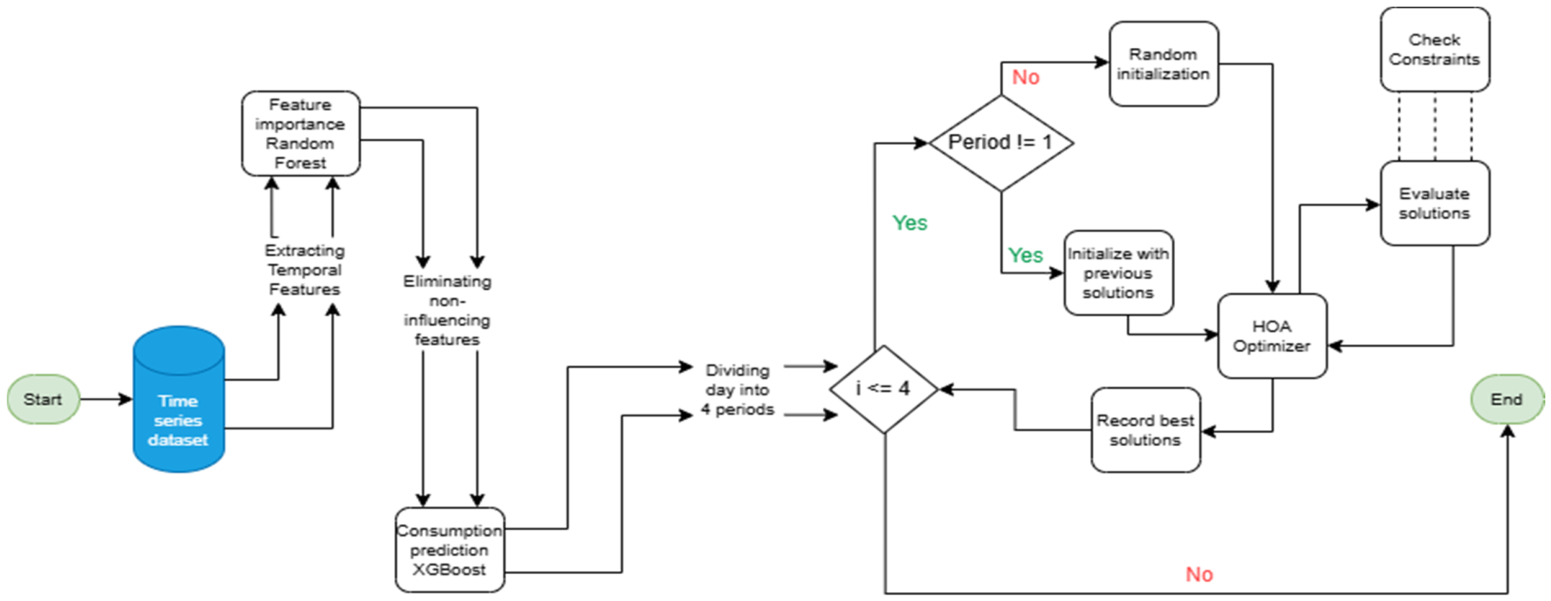
- A two-stage dynamic CEED framework integrating machine learning–based load forecasting with sequential metaheuristic optimization is proposed to address time-varying power demand conditions.
- Ramp-rate constraints and a priority-based generator dispatch mechanism are incorporated to improve operational realism and enforce hierarchical generator utilization during sequential scheduling.
- Multiple feasible dispatch solutions are generated and evaluated using economic, environmental, and operational performance indicators. A profile-based ranking mechanism is then applied to support decision-making under different operational preferences, enabling flexible selection of dispatch strategies according to stakeholder priorities.
- Unlike many existing CEED studies that focus on isolated optimization objectives or simplified operating conditions, the proposed framework integrates demand forecasting, sequential optimization, ramp-rate limitations, generator-priority rules, and multi-profile solution evaluation within a unified decision-support framework aimed at practical power-system operation.
2. Economic–Environmental Problem Formulation
2.1. Problem Overview
2.2. Electricity Consumption Variations
2.3. Mathematical Formulation
2.3.1. Fuel Cost Minimization
2.3.2. Emission Minimization
2.3.3. Constraints
Power Balance
Generator Limits
Generation Priority
- Type 1: Highest priority—always activated;
- Type 2: Activated only after all Type 1 units are at their maximum output;
- Type 3: Activated only after all Type 1 and Type 2 units are fully utilized.
2.3.4. Weighted Sum Method
2.4. Dynamic Considerations
3. Methodology
3.1. Proposed Approach
| Algorithm 1. Joint enforcement of ramp-rate and priority constraints during candidate solution evaluation. | |
| Input | Candidate power outputs, current period, previous period solution |
| 1. | Step 1: Compute ramp-aware feasible range for each unit |
| 2. | For each generating unit i: |
| 3. | Compute lower ramp bound: |
| 4. | Compute upper ramp bound: |
| 5. | End For |
| 6. | Step 2: Clip candidate outputs to ramp-aware bounds |
| 7. | For each generating unit i: |
| 8. | If candidate > upper bound: set candidate to upper bound |
| 9. | If candidate < lower bound: set candidate to lower bound |
| 10. | End For |
| 11. | Step 3: Enforce priority hierarchy |
| 12. | For each priority level k: |
| 13. | Check whether all generators with higher priority have reached their admissible maximum outputs (upper bound computed in Step 1) |
| 14. | If not satisfied: |
| 15. | Force generators of lower priority level k toward their admissible minimum outputs (lower bound computed in Step 1) |
| 16. | End For |
| 17. | Compute power balance mismatch penalty |
| 18. | Compute ramp-rate violation penalty |
| 19. | Compute generator-priority violation penalty |
| 20. | Add all penalties to the combined objective function |
| Output Feasible dispatch | |
3.2. Machine Learning for Load Pattern Analysis
3.2.1. Data
3.2.2. Electricity Consumption Pattern Analysis
3.2.3. Power Demand Prediction
3.3. Optimization Using Hippopotamus Algorithm
3.4. Dynamic Optimization Framework
- Period 1—Night: 00:00–06:00;
- Period 2—Morning: 06:00–12:00;
- Period 3—Afternoon: 12:00–18:00;
- Period 4—Evening: 18:00–24:00.
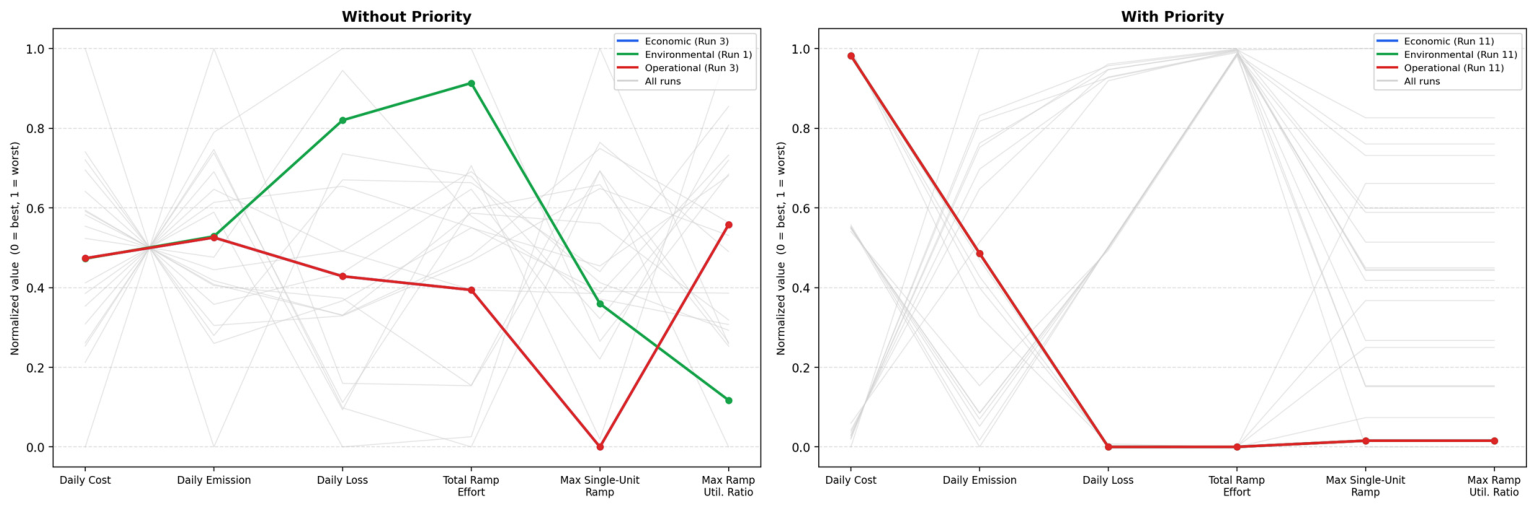
- Economic: This profile prioritizes cost minimization while still accounting for environmental impact and operational constraints;
- Environmental: This profile prioritizes emission reduction while still accounting for economic cost and operational constraints;
- Operational: This profile emphasizes system flexibility and stability by prioritizing ramp-related metrics, ensuring smoother transitions between generation levels and improved operational feasibility.
3.5. Multi-Criteria Decision-Making
4. Results and Discussion
4.1. Influential Features and Model Performance
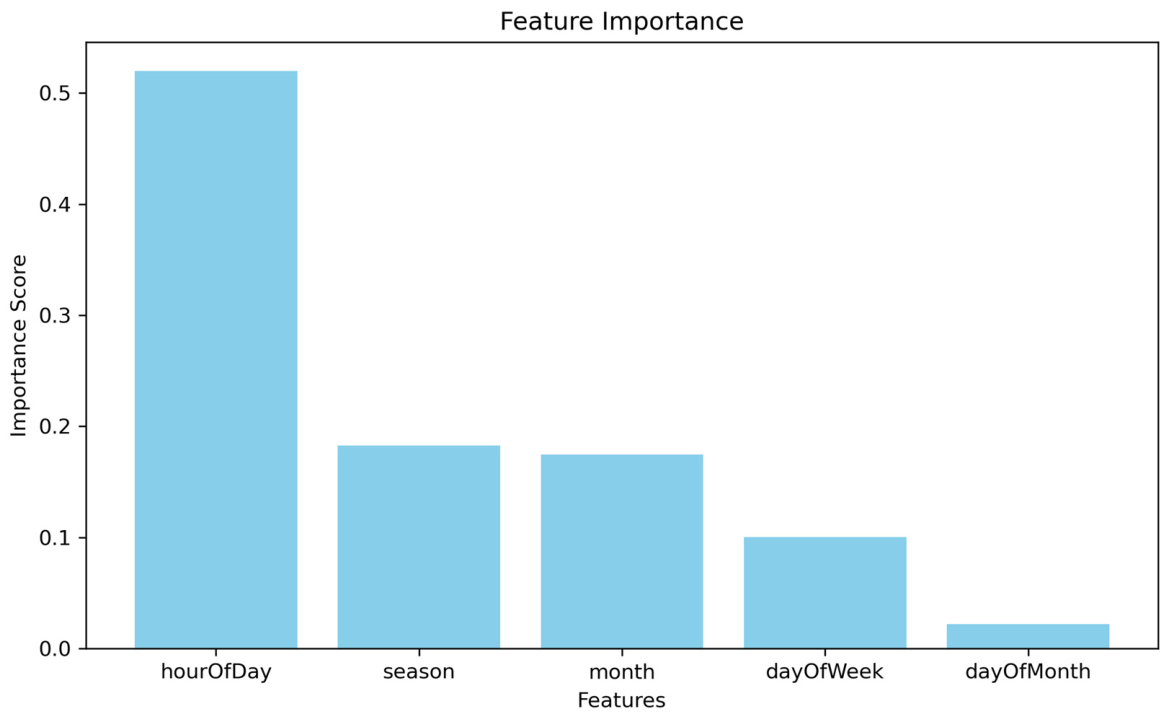
4.1.1. Feature Importance Analysis
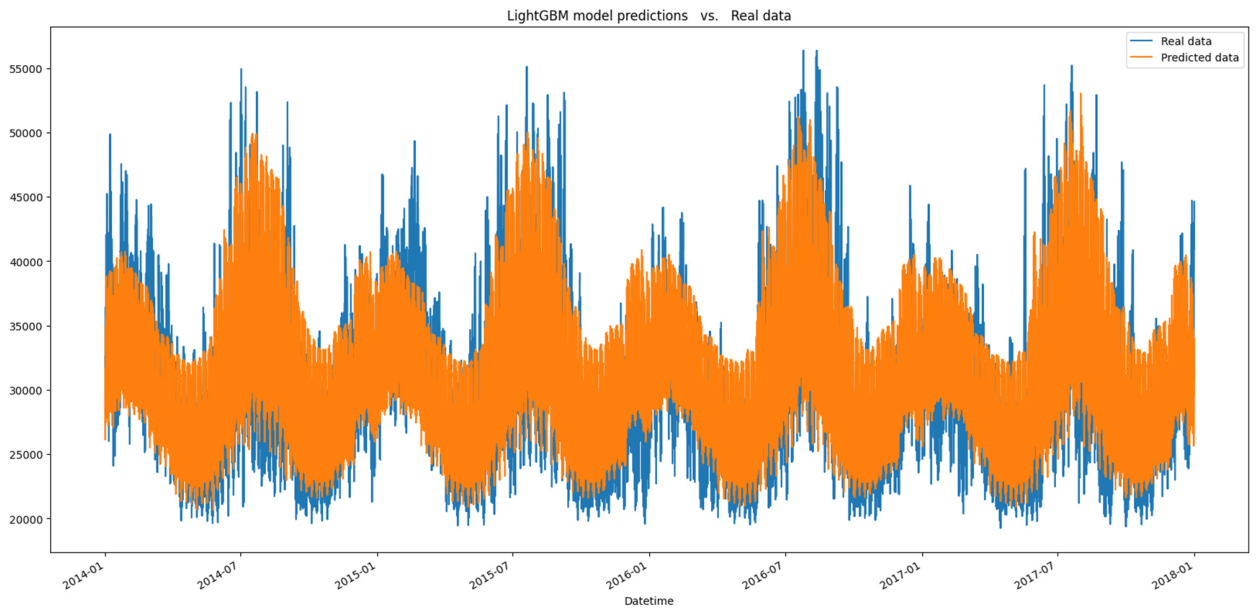
4.1.2. Consumption Forecasting
4.2. Optimization Algorithm Validation
4.2.1. IEEE 6-Unit Test System
4.2.2. IEEE 10-Unit Test System
4.3. Framework Simulation and Analysis
4.3.1. Simulation Process
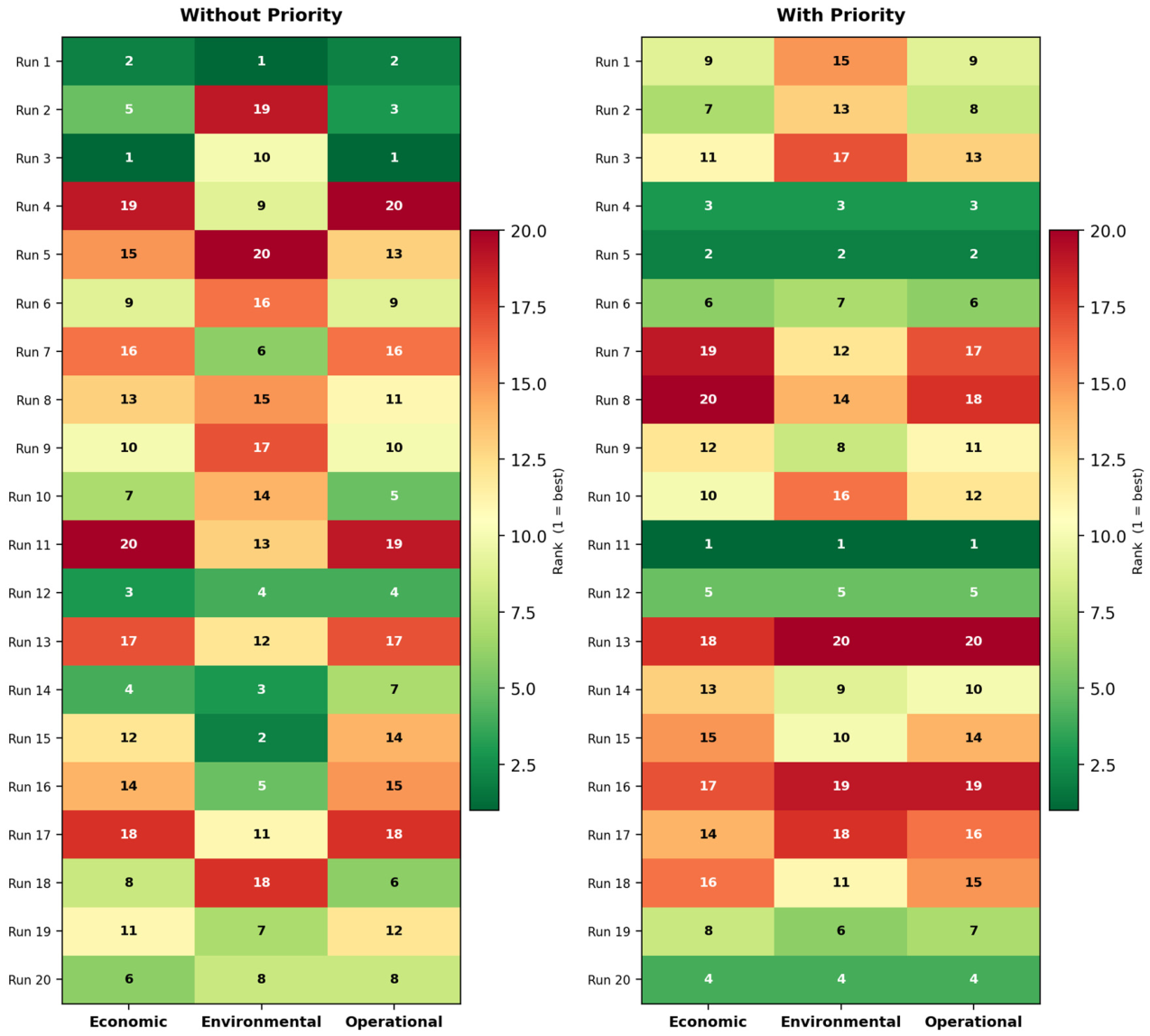
4.3.2. Optimization Solutions and Ranking
- The forecasting stage improves adaptation to temporal demand variations;
- Sequential optimization enhances inter-period continuity;
- The incorporation of generator-priority and ramp-rate constraints improves the operational realism of the proposed framework and better reflects practical power-system operation.
5. Conclusions
Author Contributions
Funding
Data Availability Statement
Acknowledgments
Conflicts of Interest
Abbreviations
| ML | Machine learning |
| DEELD | Dynamic economic–environmental load dispatch |
| CEED | Combined Economic Emission Dispatch |
| WSM | Weighted Sum Method |
| XGBoost | eXtreme Gradient Boosting |
| LightGBM | Light Gradient Boosting Machine |
| RMSE | Root Mean Squared Error |
| MAPE | Mean Absolute Percentage Error |
| HOA | Hippopotamus Optimization Algorithm |
| TOPSIS | Technique for Order of Preference by Similarity to Ideal Solution |
References
- Zhao, S.; Ma, J.; Li, D.; Zhu, Y.; Liu, L.; Sun, Z. Emission and transformation of various pollutants during coal-ammonia combustion in fluidized bed: CO/CO2/CxHy/NH3/NOx/SO2/Hg. J. Energy Inst. 2025, 123, 102257. [Google Scholar] [CrossRef]
- Farag, A.; Al-Baiyat, S.; Cheng, T. Economic load dispatch multiobjective optimization procedures using linear programming techniques. IEEE Trans. Power Syst. 1995, 10, 731–738. [Google Scholar] [CrossRef]
- Aoki, K.; Satoh, T. Economic dispatch with network security constraints using parametric quadratic programming. IEEE Trans. Power App. Syst. 1982, 101, 4548–4556. [Google Scholar] [CrossRef]
- Al-Sumait, J.S.; Al-Othman, A.K.; Sykulski, J.K. Application of pattern search method to power system valve-point economic load dispatch. Int. J. Electr. Power Energy Syst. 2007, 29, 720–730. [Google Scholar] [CrossRef]
- Abido, M.A. Environmental/economic power dispatch using multiobjective evolutionary algorithms. IEEE Trans. Power Syst. 2003, 18, 1529–1537. [Google Scholar] [CrossRef]
- Basu, M. Dynamic Economic Emission Dispatch Using Evolutionary Programming and Fuzzy Satisfying Method. Int. J. Emerg. Electr. Power Syst. 2007, 8, 1. [Google Scholar] [CrossRef]
- Palanichamy, C.; Babu, N.S. Analytical solution for combined economic and emissions dispatch. Electr. Power Syst. Res. 2008, 78, 1129–1137. [Google Scholar] [CrossRef]
- Basu, M. Combined heat and power economic emission dispatch using nondominated sorting genetic algorithm-II. Int. J. Electr. Power Energy Syst. 2013, 53, 135–141. [Google Scholar] [CrossRef]
- Abido, M.A. Multiobjective particle swarm optimization for environmental/economic dispatch problem. Electr. Power Syst. Res. 2009, 79, 1105–1113. [Google Scholar] [CrossRef]
- Aydin, D.; Özyön, S.; Yaşar, C.; Liao, T. Artificial bee colony algorithm with dynamic population size to combined economic and emission dispatch problem. Int. J. Electr. Power Energy Syst. 2014, 54, 144–153. [Google Scholar] [CrossRef]
- Chen, G.; Man, X.; Long, Y.; Zhang, Z. Application of Multi-objective New Whale Optimization Algorithm for Environment Economic Power Dispatch Problem. Eng. Lett. 2021, 29, 1–14. [Google Scholar]
- Sivasubramani, S.; Swarup, K.S. Environmental/economic dispatch using multi-objective harmony search algorithm. Electr. Power Syst. Res. 2011, 81, 1778–1785. [Google Scholar] [CrossRef]
- Dekhici, L.; Guerraiche, K.; Belkadi, K. Environmental economic power dispatch using bat algorithm with generalized fly and evolutionary boundary constraint handling scheme. Int. J. Appl. Metaheuristic Comput. 2020, 11, 171–191. [Google Scholar] [CrossRef]
- Cheng, C.; Fang, Y.; Wang, J.; Peng, C. A new multi-objective human learning algorithm for environmental-economic dispatch of power systems. Electr. Power Syst. Res. 2025, 246, 111687. [Google Scholar] [CrossRef]
- Cai, J.; Li, Q.; Li, L.; Peng, H.; Yang, Y. A hybrid CPSO–SQP method for economic dispatch considering the valve-point effects. Energy Convers. Manag. 2012, 53, 175–181. [Google Scholar] [CrossRef]
- Al-kubragyi, S.; Abdulla, S.; Ali, I.I.; Alwazni, H.; Mohsen, S. Solving the Multi-objective Economic-Emission Load Dispatch Optimization Problem Using Hybrid GWO-PSO Algorithm. Int. J. Intell. Eng. Syst. 2024, 17, 4. [Google Scholar] [CrossRef]
- Zou, D.; Li, S.; Li, Z.; Kong, X. A new global particle swarm optimization for the economic emission dispatch with or without transmission losses. Energy Convers. Manag. 2017, 139, 45–70. [Google Scholar] [CrossRef]
- Dhanalakshmi, S.; Kannan, S.; Mahadevan, K.; Baskar, S. Application of modified NSGA-II algorithm to combined economic and emission dispatch problem. Int. J. Electr. Power Energy Syst. 2011, 33, 992–1002. [Google Scholar] [CrossRef]
- Heidari, A.A.; Mirjalili, S.; Faris, H.; Aljarah, I.; Mafarja, M.; Chen, H. Harris hawks optimization: Algorithm and applications. Future Gener. Comput. Syst. 2019, 97, 849–872. [Google Scholar] [CrossRef]
- Jiang, S.; Ji, Z.; Shen, Y. A novel hybrid particle swarm optimization and gravitational search algorithm for solving economic emission load dispatch problems with various practical constraints. Int. J. Electr. Power Energy Syst. 2014, 55, 628–644. [Google Scholar] [CrossRef]
- Dos Santos Coelho, L.; Mariani, V.C. Improved differential evolution algorithms for handling economic dispatch optimization with generator constraints. Energy Convers. Manag. 2007, 48, 1631–1639. [Google Scholar] [CrossRef]
- Zhu, Z.; Wang, J.; Baloch, M.H. Dynamic economic emission dispatch using modified NSGA-II. Int. Trans. Electr. Energy Syst. 2016, 26, 2684–2698. [Google Scholar] [CrossRef]
- Zaoui, S.; Belmadani, A. Solution of combined economic and emission dispatch problems of power systems without penalty. Appl. Artif. Intell. 2022, 36, 1976092. [Google Scholar] [CrossRef]
- Madhale, K.; Jamadar, N.; Jadhav, H.T. Economic emission dispatch of power plants considering ramp rate, prohibited zones, and spinning reserve using a hybrid MOABC-NSGA-II Algorithm. Life Cycle Reliab. Saf. Eng. 2025, 14, 645–663. [Google Scholar] [CrossRef]
- Zhu, Y.; Wang, J.; Qu, B. Multi-objective economic emission dispatch considering wind power using evolutionary algorithm based on decomposition. Int. J. Electr. Power Energy Syst. 2014, 63, 434–445. [Google Scholar] [CrossRef]
- Panigrahi, B.K.; Pandi, V.R.; Das, S.; Das, S. Multiobjective fuzzy dominance based bacterial foraging algorithm to solve economic emission dispatch problem. Energy 2010, 35, 4761–4770. [Google Scholar] [CrossRef]
- Roy, P.K.; Bhui, S. Multi-objective quasi-oppositional teaching learning based optimization for economic emission load dispatch problem. Int. J. Electr. Power Energy Syst. 2013, 53, 937–948. [Google Scholar] [CrossRef]
- Raoui, H.E.; Cabrera-Cuevas, M.; Pelta, D.A. The Role of Metaheuristics as Solutions Generators. Symmetry 2021, 13, 2034. [Google Scholar] [CrossRef]
- Chen, T. XGBoost: A Scalable Tree Boosting System; Cornell University: Ithaca, NY, USA, 2016. [Google Scholar] [CrossRef]
- Ke, G.; Meng, Q.; Finley, T.; Wang, T.; Chen, W.; Ma, W.; Ye, Q.; Liu, T.Y. Lightgbm: A highly efficient gradient boosting decision tree. Adv. Neural Inf. Process. Syst. 2017, 30, 3149–3157. [Google Scholar]
- Amiri, M.H.; Hashjin, N.M.; Montazeri, M.; Mirijalili, S.; Khodadadi, N. Hippopotamus optimization algorithm: A novel nature-inspired optimization algorithm. Sci. Rep. 2024, 14, 5032. [Google Scholar] [CrossRef] [PubMed]
- Güvenc, U.; Sönmez, Y.; Duman, S.; Yörükeren, N. Combined economic and emission dispatch solution using gravitational search algorithm. Sci. Iran. 2012, 19, 1754–1762. [Google Scholar] [CrossRef]
- Basu, M. Economic environmental dispatch using multi-objective differential evolution. Appl. Soft Comput. 2011, 11, 2845–2853. [Google Scholar] [CrossRef]




| Feature | Economic | Environmental | Operational |
|---|---|---|---|
| Daily cost | 0.50 | 0.15 | 0.10 |
| Daily emissions | 0.15 | 0.50 | 0.10 |
| Daily power loss | 0.10 | 0.15 | 0.10 |
| Total ramp effort | 0.10 | 0.05 | 0.25 |
| Maximum single-unit ramp | 0.10 | 0.05 | 0.25 |
| Maximum ramp utilization ratio | 0.05 | 0.10 | 0.10 |
| Algorithm | RMSE (%) | MAPE (%) | ||
|---|---|---|---|---|
| Train | Test | Train | Test | |
| LightGBM | 8.89 | 11 | 6.42 | 9.4 |
| System | Pi,min | Pi,max | ai | bi | ci | di | ei | αi | βi | γi | ηi | δi | Ramp-Up | Ramp-Down | Priority |
|---|---|---|---|---|---|---|---|---|---|---|---|---|---|---|---|
| 6 units | 0.05 | 0.5 | 10 | 200 | 100 | 0 | 0 | 4.091 | −5.554 | 6.49 | 0.0002 | 2.857 | 0.125 | 0.225 | 2 |
| 0.05 | 0.6 | 10 | 150 | 120 | 0 | 0 | 2.543 | −6.047 | 5.638 | 0.0005 | 3.333 | 0.15 | 0.27 | 2 | |
| 0.05 | 1 | 20 | 180 | 40 | 0 | 0 | 4.258 | −5.094 | 4.586 | 0.000001 | 8 | 0.25 | 0.45 | 1 | |
| 0.05 | 1.2 | 10 | 100 | 60 | 0 | 0 | 5.326 | −3.55 | 3.38 | 0.002 | 2 | 0.3 | 0.54 | 1 | |
| 0.05 | 1 | 20 | 180 | 40 | 0 | 0 | 4.258 | −5.094 | 4.586 | 0.000001 | 8 | 0.25 | 0.45 | 3 | |
| 0.05 | 0.6 | 10 | 150 | 100 | 0 | 0 | 6.131 | −5.555 | 5.151 | 0.00001 | 6.667 | 0.15 | 0.27 | 3 |
| Units | Cost ($/h) | Emissions (ton/h) | ||||||
|---|---|---|---|---|---|---|---|---|
| NGPSO [17] | MOEA/D [25] | NSGAII-D CD-CE [18] | HOA | NGPSO [17] | MOEA/D [25] | NSGAII DCD-CE [18] | HOA | |
| 1 | 0.120969 | 0.1792 | 0.114481 | 0.1209117788 | 0.410925 | 0.4056 | 0.410092 | 0.4109207656 |
| 2 | 0.286312 | 0.3712 | 0.305732 | 0.2862958914 | 0.463667 | 0.4594 | 0.461018 | 0.4636699208 |
| 3 | 0.583557 | 0.6939 | 0.598400 | 0.5836401425 | 0.544419 | 0.5502 | 0.552875 | 0.5443709407 |
| 4 | 0.992854 | 0.5905 | 0.980202 | 0.9930130259 | 0.390374 | 0.3852 | 0.389406 | 0.3903787809 |
| 5 | 0.523970 | 0.5889 | 0.515260 | 0.5238886761 | 0.544459 | 0.5453 | 0.544660 | 0.5444589809 |
| 6 | 0.351899 | 0.4354 | 0.354635 | 0.3518123192 | 0.515485 | 0.5181 | 0.508842 | 0.5155316619 |
| PL | 0.026 | 0.023 | 0.026 | 0.026 | 0.035 | 0.035 | 0.035 | 0.035 |
| FC/E | 605.99837 | 619.53 | 608.1247 | 605.99837 | 0.194179 | 0.1942 | 0.1942 | 0.194179 |
| Units | NGPSO [17] | MOEA/D [25] | FSBF [26] | HOA |
|---|---|---|---|---|
| 1 | 0.3062424 | 0.3185 | 0.320518 | 0.3268836603 |
| 2 | 0.40415941 | 0.4101 | 0.409661 | 0.4163454821 |
| 3 | 0.55773992 | 0.5623 | 0.553204 | 0.5547911791 |
| 4 | 0.58355217 | 0.5635 | 0.565322 | 0.5442954821 |
| 5 | 0.54952711 | 0.545 | 0.540641 | 0.5488706445 |
| 6 | 0.46099483 | 0.4631 | 0.473462 | 0.4721412524 |
| FC | 623.8705 | 625.69 | 625.9332 | 627.654219 |
| E | 0.1969727 | 0.1964 | 0.1964 | 0.195953 |
| Combined | 1489.3882 | 1488.8372 | 1488.8071 | 1488.691195 |
| Units | Cost ($/h) | Emissions (ton/h) | ||||||
|---|---|---|---|---|---|---|---|---|
| NGPSO [17] | OWP-OMF [23] | QOTLBO [27] | HOA | NGPSO [17] | OWP-OMF [23] | QOTLBO [27] | HOA | |
| 1 | 55 | 55 | 55 | 55 | 55 | 55 | 55 | 55 |
| 2 | 80 | 80 | 79.9991 | 80 | 80 | 80 | 80 | 80 |
| 3 | 106.93994 | 106.8771 | 105.9616 | 106.94031 | 81.13417 | 80.9248 | 81.1261 | 81.12536 |
| 4 | 100.57627 | 100.7023 | 99.9321 | 100.57766 | 81.36374 | 81.1019 | 81.3640 | 81.41154 |
| 5 | 81.50172 | 81.5370 | 80.6424 | 81.49396 | 160 | 160 | 160 | 160 |
| 6 | 83.02089 | 82.9221 | 85.7878 | 83.02686 | 240 | 240 | 240 | 240 |
| 7 | 300 | 300 | 300 | 300 | 294.48506 | 294.5495 | 294.4790 | 294.71688 |
| 8 | 340 | 340 | 340 | 340 | 297.27010 | 297.6624 | 297.2439 | 297.47656 |
| 9 | 470 | 470 | 469.6979 | 470 | 396.76575 | 396.3406 | 396.8041 | 396.60583 |
| 10 | 470 | 470 | 469.9943 | 470 | 395.57633 | 396.0266 | 395.5788 | 395.25068 |
| PL | 87.038825 | 87.0386 | 87.01606 | 87.03880 | 81.59515 | 81.6057 | 81.59579 | 81.58685 |
| FC/E | 111,497.6308 | 111,497.6407 | 111,498 | 111,497.6308 | 3932.24327 | 3932.2538 | 3932.2 | 3932.24508 |
| Units | NGPSO [17] | QTTLBO [27] | GSA [32] | PDE [33] | HOA |
|---|---|---|---|---|---|
| 1 | 55 | 55 | 54.9992 | 54.9853 | 55 |
| 2 | 80 | 80 | 79.9586 | 79.3803 | 80 |
| 3 | 81.23982334 | 83.9202 | 79.4341 | 83.9842 | 81.572584 |
| 4 | 80.83342958 | 82.8342 | 85 | 86.5942 | 80.968975 |
| 5 | 160 | 132.0131 | 142.1063 | 144.4386 | 160 |
| 6 | 235.00879098 | 173.9880 | 166.5670 | 165.7756 | 225.177663 |
| 7 | 289.35074508 | 299.7099 | 292.8749 | 283.2122 | 291.246131 |
| 8 | 297.45422963 | 317.9684 | 313.2387 | 312.7709 | 299.405383 |
| 9 | 401.50728395 | 427.0166 | 441.1775 | 440.1135 | 404.541342 |
| 10 | 401.42752424 | 431.3955 | 428.6306 | 432.6783 | 404.108616 |
| FC | 116,179.6487 | 113,460 | 113,492.04 | 113,506.49 | 115,841.39476 |
| E | 3939.2278 | 4110.2 | 4111.4 | 4111.4 | 3951.51920 |
| Combined | 216,170.54 | 217,791.14 | 217,853.68 | 217,867.20 | 216,144.01759 |
| Period | Time Interval | Predicted PD (MW) | Predicted PD (p.u.) | Scaled PD (p.u.) |
|---|---|---|---|---|
| Night | 00:00–06:00 | 185,860.46590 | 1858.6046590 | 1.8586046590 |
| Morning | 06:00–12:00 | 226,458.64963 | 2264.5864963 | 2.2645864963 |
| Afternoon | 12:00–18:00 | 223,880.68636 | 2238.8068636 | 2.2388068636 |
| Evening | 18:00–24:00 | 233,033.66177 | 2330.3366177 | 2.3303366177 |
| Feature | Night | Morning | Afternoon | Evening | Daily (Sum/Avg/Max) |
|---|---|---|---|---|---|
| Objective features | |||||
| Fuel cost ($/h) | 417.21240 | 501.93481 | 496.43070 | 516.01399 | 1931.59190 |
| Emissions (ton/h) | 0.20495 | 0.19912 | 0.19940 | 0.19845 | 0.80192 |
| Combined ($/h) | 1317.79550 | 1376.86963 | 1372.61301 | 1388.03789 | 5455.31603 |
| Ramp features | |||||
| Max single-unit ramp (p.u) | / | 0.08536 G3 | 0.00553 G4 | 0.019262 G3 | 0.08536 |
| Total ramp effort (p.u) | / | 0.41170 | 0.02619 | 0.09296 | 0.53085 |
| Max ramp utilization ratio | / | 0.06636 G1 | 0.00264 G1 | 0.01501 G6 | 0.06636 |
| Transmission features | |||||
| Power loss (p.u) | 0.01369 | 0.01940 | 0.01899 | 0.02042 | 0.07249 |
| Loss fraction (%) | 0.73% | 0.85% | 0.84% | 0.87% | 0.82% |
| Feature | Night | Morning | Afternoon | Evening | Daily (Sum/Avg/Max) |
|---|---|---|---|---|---|
| Objective features | |||||
| Fuel cost ($/h) | 429.62212 | 521.68974 | 515.93122 | 532.71198 | 1999.95506 |
| Emissions (ton/h) | 0.27069 | 0.28812 | 0.28946 | 0.28489 | 1.13316 |
| Combined ($/h) | 1619.06662 | 1787.71284 | 1787.82447 | 1784.54579 | 6979.14972 |
| Ramp features | |||||
| Max single-unit ramp (p.u) | / | 0.24693 G4 | 0.03911 G1 | 0.05987 G2 | 0.24693 |
| Total ramp effort (p.u) | / | 0.41162 | 0.05272 | 0.09186 | 0.55619 |
| Max ramp utilization ratio | / | 0.13718 G4 | 0.02897 G1 | 0.06652 G2 | 0.13718 |
| Transmission features | |||||
| Power loss (p.u) | 0.01589 | 0.02151 | 0.02179 | 0.02212 | 0.08130 |
| Loss fraction (%) | 0.85% | 0.94% | 0.96% | 0.94% | 0.92% |
| Period | Objective | Best | Average | Worst | Std Deviation |
|---|---|---|---|---|---|
| Night | Fuel Cost | 417.16763 | 417.19242 | 417.21240 | 0.0142258 |
| Emissions | 0.2049528 | 0.2049574 | 0.2049630 | 0.0000032 | |
| Combined | 1317.79547 | 1317.79551 | 1317.79560 | 0.0000362 | |
| Power Loss | 0.0136715 | 0.0136845 | 0.0136897 | 0.0000042 | |
| Morning | Fuel Cost | 501.87451 | 501.92940 | 501.96772 | 0.0251125 |
| Emissions | 0.1991083 | 0.1991170 | 0.1991296 | 0.0000057 | |
| Combined | 1376.86932 | 1376.86942 | 1376.86965 | 0.0001062 | |
| Power Loss | 0.0193627 | 0.0193853 | 0.0194055 | 0.0000103 | |
| Afternoon | Fuel Cost | 496.41847 | 496.43660 | 496.44892 | 0.0066137 |
| Emissions | 0.1993956 | 0.1993984 | 0.1994025 | 0.0000015 | |
| Combined | 1372.61298 | 1372.61300 | 1372.61308 | 0.0000229 | |
| Power Loss | 0.0189837 | 0.0189893 | 0.0189933 | 0.0000021 | |
| Evening | Fuel Cost | 516.00566 | 516.03579 | 516.06908 | 0.0139907 |
| Emissions | 0.1984408 | 0.1984484 | 0.1984553 | 0.0000032 | |
| Combined | 1388.03782 | 1388.03790 | 1388.03802 | 0.0000486 | |
| Power Loss | 0.0204117 | 0.0204188 | 0.0204303 | 0.0000052 |
| Period | Objective | Best | Average | Worst | Std Deviation |
|---|---|---|---|---|---|
| Night | Fuel Cost | 429.60339 | 429.63399 | 429.67373 | 0.0192367 |
| Emissions | 0.2706797 | 0.2706886 | 0.2706957 | 0.0000044 | |
| Combined | 1619.06653 | 1619.06671 | 1619.06723 | 0.0002004 | |
| Power Loss | 0.0158770 | 0.0158804 | 0.0158849 | 0.0000021 | |
| Morning | Fuel Cost | 521.68973 | 521.68973 | 521.68973 | 3.5 × 10⁻⁹ |
| Emissions | 0.2881189 | 0.2881189 | 0.2881189 | 1.2 × 10⁻¹² | |
| Combined | 1787.71284 | 1787.71284 | 1787.71284 | 1.6 × 10⁻⁹ | |
| Power Loss | 0.0215142 | 0.0215142 | 0.0215142 | 0.1 × 10⁻¹² | |
| Afternoon | Fuel Cost | 515.93039 | 516.20239 | 517.01516 | 0.4691436 |
| Emissions | 0.2894546 | 0.2894597 | 0.2894746 | 0.0000086 | |
| Combined | 1787.82391 | 1788.11731 | 1788.99543 | 0.5068355 | |
| Power Loss | 0.0214642 | 0.0217093 | 0.0217916 | 0.0001415 | |
| Evening | Fuel Cost | 532.67318 | 533.47945 | 533.98663 | 0.6184252 |
| Emissions | 0.2848417 | 0.2848605 | 0.2848991 | 0.0000224 | |
| Combined | 1784.54579 | 1785.18482 | 1785.61342 | 0.5211431 | |
| Power Loss | 0.0218130 | 0.0219323 | 0.0221468 | 0.0001461 |
Disclaimer/Publisher’s Note: The statements, opinions and data contained in all publications are solely those of the individual author(s) and contributor(s) and not of MDPI and/or the editor(s). MDPI and/or the editor(s) disclaim responsibility for any injury to people or property resulting from any ideas, methods, instructions or products referred to in the content. |
© 2026 by the authors. Licensee MDPI, Basel, Switzerland. This article is an open access article distributed under the terms and conditions of the Creative Commons Attribution (CC BY) license.
Share and Cite
Fellague, A.; Dekhici, L.; Guerraiche, K.; Pelta, D.A.; Verdegay, J.L. Dynamic Economic–Environmental Dispatch with Generator Priority: A Machine Learning–Optimization Framework. Mathematics 2026, 14, 2187. https://doi.org/10.3390/math14122187
Fellague A, Dekhici L, Guerraiche K, Pelta DA, Verdegay JL. Dynamic Economic–Environmental Dispatch with Generator Priority: A Machine Learning–Optimization Framework. Mathematics. 2026; 14(12):2187. https://doi.org/10.3390/math14122187
Chicago/Turabian StyleFellague, Abdelkadir, Latifa Dekhici, Khaled Guerraiche, David A. Pelta, and José Luis Verdegay. 2026. "Dynamic Economic–Environmental Dispatch with Generator Priority: A Machine Learning–Optimization Framework" Mathematics 14, no. 12: 2187. https://doi.org/10.3390/math14122187
APA StyleFellague, A., Dekhici, L., Guerraiche, K., Pelta, D. A., & Verdegay, J. L. (2026). Dynamic Economic–Environmental Dispatch with Generator Priority: A Machine Learning–Optimization Framework. Mathematics, 14(12), 2187. https://doi.org/10.3390/math14122187