


Abstract
This paper presents a new analytical framework for studying a class of three-dimensional symmetric systems within the theory of difference equations, constituting a natural extension of structurally reducible models in one and two dimensions. Despite the classical focus on linear equations or low-dimensional systems, the problem of solving nonlinear systems with intertwined structures and interdependent delays remains largely unexplored. Drawing on recent structural developments, we define a periodic symmetric system based on three sequences interacting through fractional hyperbolic tangent-type forms and show how this structure reveals embedded linear recurrences governing the internal evolution. By exploiting symmetry and periodicity properties, we derive exact representation formulas and highlight the structural mechanisms that enable a deeper understanding of the system’s dynamic behavior, despite its nonlinear nature and the complex interlacing of its indices. This study thus contributes to the expansion of the theory of solvable nonlinear systems and provides a unified approach to high-dimensional symmetric structures. To illustrate the practical relevance of the proposed framework, a cyclic SIR-type interaction interpretation is presented, supported by numerical simulations that demonstrate the impact of parameter symmetry on the system’s dynamical behavior.
Keywords:
system of difference equations; nonlinear difference equations; product-type equations; hyperbolic cotangent-type equations; closed-form formula MSC:
39A10; 40A05
1. Introduction
The problem of determining general solutions of difference equations and their systems is a classical topic that dates back to the early eighteenth century. Over the following centuries, this subject attracted considerable attention and led to major developments in both linear and nonlinear difference equation theories. Despite the substantial progress achieved during the nineteenth century, interest in solvable difference equations declined for a long period, particularly after the theoretical framework of linear equations had been extensively developed and general methods for solving nonlinear equations proved difficult to establish. However, interest in solvable nonlinear difference equations has continued to grow through the development of rigorous analytical techniques aimed at deriving closed-form solutions and understanding the qualitative behavior of discrete dynamical systems. In recent decades, particular attention has been devoted to structural properties such as symmetry, periodicity, invariance, and reducibility, as these features often provide a natural framework for the construction of exact representation formulas and the analysis of nonlinear phenomena. Despite this rich classical heritage, the development of general methods for solving difference equations remains extremely challenging, and many nonlinear systems still resist complete analytical treatment. In recent years, increasing attention has been devoted to nonlinear difference systems combining theoretical solvability, qualitative dynamics, and applied modeling aspects. Several studies have shown that structurally organized difference systems may arise naturally in applications while still admitting rigorous analytical investigation through explicit formulas, stability analysis, and dynamical methods (see, for example, [1,2,3]). These applications have further emphasized the importance of developing rigorous analytical techniques for studying solvable difference equations and their qualitative dynamics. Over the past two decades, considerable attention has also been devoted to the study of solvable nonlinear difference equations and rational systems possessing explicit closed-form representations. Particular interest has focused on systems exhibiting symmetric, periodic, or reducible structures, since these properties often permit transformations into associated linear or product-type equations and facilitate the derivation of exact solutions. Several important studies have contributed to the analytical investigation of nonlinear difference equations and rational discrete systems from various perspectives. Early research primarily focused on the solvability and periodicity properties of rational systems. For instance, Elsayed [4] and Zhang et al. [5] examined explicit solution structures and periodic behavior in different classes of rational difference systems, thereby establishing foundational analytical techniques for the study of nonlinear recursions. Subsequent research concentrated on qualitative dynamics and asymptotic analysis. In particular, Gümüş [6] and Kara [7] investigated the global asymptotic behavior and dynamical stability of delayed and exponential-type difference systems, whereas Elsayed and El-Metwally [8,9] studied the qualitative behavior and boundedness properties of several classes of rational recursive sequences. More recently, increasing attention has been devoted to higher-dimensional nonlinear systems and the derivation of explicit closed-form solutions. Attia [10,11] developed analytical approaches for deriving exact solutions and identifying periodic structures in three-dimensional difference systems, whereas Al Salman [12] and Almoteri and Ghezal [13] established important connections between solvable nonlinear systems, generalized Fibonacci-type recursions, and transformation-based reduction methods. Further developments concerning stability analysis and higher-order rational systems can be found in [14,15,16,17,18]. Collectively, these studies highlight the growing importance of structural reduction techniques, symmetry-based analysis, and explicit solvability in the modern theory of nonlinear discrete dynamical systems. Among the notable contributions in this direction is the study presented in [19], in which the solvability of the following difference equation was theoretically investigated:
where with and . This result provides a natural generalization of the classical equation
studied by [20]. These observations indicate that Equation (2) can also be derived through an iterative process, particularly by considering the following modification of the secant method with lagged terms [21]:
By choosing the function one observes that the solvability of Equation (2) is closely related to its structural similarity to cotangent-sum equations. Moreover, under an appropriate linear change of variables, the equation reduces to a form closely resembling the sum-of-cotangent type. For several generalizations of cotangent-type systems of difference equations, we refer the reader to the recent works [20,22], and the references therein. On the other hand [23], investigated solvability issues through the analysis of a symmetric system associated with Equation (1):
where with and . This system represents an important model for understanding how symmetry can be extended from a one-dimensional equation to a structure-preserving two-dimensional system. Considerable interest has been devoted to systems with symmetric structures, highlighting the fundamental role of symmetry in the study of solvability and asymptotic behavior. This development has been followed by extensive research aimed at establishing reduction methods that relate nonlinear systems to linear or quasi-linear equations (see, for example, [24,25]). These approaches are particularly important because they provide structural reductions that make it possible to derive exact closed-form solutions even for systems with highly intertwined delays and nonlinear interactions. Among the most important methods used in this context are those that relate product-type systems to associated linear equations whose characteristic structures can be analyzed through algebraic and spectral techniques (see, for example, [26,27,28,29]). Based on these studies, it becomes natural to investigate a higher-dimensional symmetric system. These ideas have paved the way for the transition from two-dimensional to three-dimensional systems, which constitutes the primary motivation for the present study. Unlike previously studied one- and two-dimensional models, the transition to a three-dimensional cyclic structure introduces new analytical difficulties arising from the stronger interdependence between the components and the presence of coupled delayed interactions. Consequently, the derivation of exact representation formulas requires new reduction procedures and adapted transformation techniques that preserve the symmetric structure of the system.
The main contribution of the present paper is not merely the extension of previously studied lower-dimensional systems, but also the development of a new analytical reduction framework for a genuinely three-dimensional cyclic structure. Unlike the two-dimensional case, the proposed model introduces a substantially higher level of interdependence between the delayed components, leading to nontrivial cyclic couplings and nested recurrence interactions that cannot be handled by direct iteration methods alone. To overcome these difficulties, we develop adapted nonlinear transformations and recursive reduction procedures that reveal hidden product-type and linear structures governing the dynamics of the system. These reductions make it possible to derive exact representation formulas, analyze the internal recurrence mechanisms, and establish a unified analytical description of the evolution of the three interacting sequences.
Therefore, in this paper, we define a three-dimensional symmetric system through the following formulas:
where with and . This system constitutes a natural extension exhibiting a rich symmetric and periodic structure, allowing the behavior of three interlaced sequences to be studied within a unified framework. The present work aims to analyze the solvability of this system and thereby introduce a new class of solvable nonlinear systems that are not directly reducible to linear equations in a straightforward manner. It is worth noting that three-dimensional systems of this type have received relatively limited attention in the literature, despite representing a natural generalization of the two-dimensional systems extensively studied over the past two decades. The close connection between this symmetric structure and hyperbolic cotangent-type formulas provides an important foundation for deriving closed-form solution formulas, particularly when associated low-order linear recurrences arise. Previous studies suggest that systems involving only small delays i and j are among the most tractable candidates for solvability, which is consistent with the structure of the three-dimensional system considered in this work. From this perspective, the present study focuses on the theoretical solvability of the system, the construction of explicit solution formulas, and the analysis of the underlying mechanisms governing the evolution of the three interacting sequences. In addition to the theoretical development, we include an application inspired by cyclic population interactions, together with numerical simulations illustrating how the structure of the system influences its qualitative dynamical behavior.
2. Main Results on Special Configurations of System (4)
In this section, we examine several special and structurally symmetric configurations of the general three-dimensional relative difference system introduced in (4). By specifying the delay parameters according to the cases , , with , , and , the system reduces to a highly organized periodic structure. Under these configurations, each component evolves through a relative transformation governed by the preceding values of another component within the cycle. This reduction reveals a remarkable internal symmetry in which the three sequences become fully intertwined, producing a periodic and strongly coupled dynamical behavior. Owing to this symmetry, the transformed system becomes analytically reducible to a lower-complexity recurrence structure, allowing the trajectories to be represented by exact recursive formulas. Moreover, the system displays two qualitatively distinct dynamical regimes, determined by whether the parameter difference vanishes or not.
2.1. Symmetric High-Shift Configurations: and
In this subsection, we investigate a distinguished class of high-shift symmetric configurations arising as special cases of the general three-dimensional nonlinear rational system introduced in (4). These configurations, characterized by the relations and , impose a cyclic structure that tightly couples the three component sequences in a perfectly symmetric and highly constrained manner. This intrinsic symmetry significantly simplifies the dynamical behavior of the system and enables a complete analytical characterization of its solutions. In particular, when the parameters and shift indices satisfy these symmetry conditions, the general model reduces to a tractable yet nontrivial subsystem in which each component evolves cyclically from the preceding component. Despite this reduction, the resulting system retains sufficient mathematical richness to exhibit multiplicative interactions, higher-order memory effects, and explicit solvability properties. In what follows, we present and establish the main results associated with this special symmetric configuration. We begin by introducing the explicit form of the resulting three-dimensional system and distinguishing between the nondegenerate and degenerate cases.
Theorem 1.
Consider the following three-dimensional system governed by a system of nonlinear rational difference equations:
where . This system represents a special and structurally symmetric case of the general three-dimensional system introduced in (4) under a suitable choice of the shift parameters ( and ), and it admits an exact recursive representation obtained through nonlinear transformations. In the non-degenerate case where the system admits the following exact representation formulas:
where satisfies a linear difference equation described in (12). In the degenerate case where , the system reduces to a more unified form, such that each of the sequences , , can be expressed as:
where the coefficients are uniquely determined by the initial conditions and satisfy the compatibility relations:
Moreover, the coefficients are required to satisfy the following consistency conditions:
In addition, the coefficients must satisfy the following compatibility conditions:
Proof.
Assume that Then, from the system (5), we have the following relations for the sequence
By dividing each expression in the first column by its corresponding expression in the second column, the common denominators are eliminated, yielding a simplified multiplicative relation that describes the evolution of the ratios of consecutive terms for Specifically, we obtain:
Now, in order to simplify the analysis of the three-dimensional nonlinear system, we introduce auxiliary sequences via a change of variables. Specifically, we define:
It is immediately clear that, under this change of variables, the original nonlinear rational system reduces to a simpler multiplicative form in terms of the auxiliary sequences . Specifically, the system can now be expressed as:
To derive the higher-order product system associated with (7), we exploit the cyclic structure of the auxiliary relations and perform successive substitutions. Indeed, starting from , we first express and by means of the second equation of (7), and then substitute the resulting -terms using the third equation of the same system. This eliminates the intermediate variables and yields
Applying the same argument cyclically to the remaining components leads to the corresponding relations for and . Consequently, the auxiliary product system (7) can be rewritten as the following higher-order multiplicative system:
To determine the solutions of this system, it suffices to study a single representative sequence that satisfies the following higher-order multiplicative recurrence:
Let us define the numerical sequence as follows:
Using these coefficients, the higher-order multiplicative recurrence (8) can be rewritten in a compact and structured form as:
By substituting the recurrence relation (8) into the structured product form (9), we obtain a refined representation of in terms of earlier terms:
where
By induction, we can generalize the previous steps to obtain a compact and recursive representation of the sequence :
where
From the numerical sequence defined earlier (11), it follows that the first coefficient of the j-th iteration, , satisfies the linear recurrence relation:
The initial conditions for this recurrence are given by:
The linear difference Equation (12) admits a representation in terms of the roots of its characteristic equation, yielding the following form for the sequence as:
where are constants uniquely determined by the initial conditions (13), ensuring that the solution is consistent with the starting values of the sequence. The numbers are the roots of the characteristic equation: Although some characteristic roots may not admit explicit radical expressions, the obtained representation remains fully constructive and uniquely determines the solution through the spectral structure of the associated linear recurrence. Among these, is the positive solution of the quadratic equation: while the remaining roots satisfy the quartic equation By taking in (10), we obtain an explicit representation of
From the explicit expression of obtained previously, we can now reconstruct the solution of the three-dimensional system (7), in terms of the initial values , , , , , , and the exponent sequence
We also note that, according to (6), each component of the transformed sequences can be rewritten in rational form. In particular, for all , we obtain
Now, assume that Under this special parameter constraint, the system (5) takes the simplified cyclic form:
By subtracting from both sides of each equation and factoring the resulting numerators and denominators, it becomes evident that the system is equivalent, for all to
Now we introduce a change of variables by defining the auxiliary sequences that shift and invert the original ones. Specifically, for all , we set
It follows directly from the change of variables introduced in (14) that the nonlinear fractional expressions become linear recurrences when expressed in terms of the auxiliary sequences:
By combining and iterating the relations in (15), each sequence can be expressed solely in terms of its own past values. This procedure eliminates the cyclic dependence among the variables and leads to a higher-order linear recurrence. Consequently, we obtain the following linear system of difference equations:
To determine the solutions of the system obtained above, it is sufficient to study a single representative recurrence. Indeed, each of the sequences , , and satisfies the same higher-order linear relation. Therefore, the determination of the general solution reduces to solving the scalar difference equation:
This recurrence coincides with Equation (12), which completes the proof. □
Example 1.
In this example, we consider the system given in (5) with the initial conditions: To illustrate the qualitative behavior of the model, we consider two distinct parameter regimes:
- Case 1: and
- Case 2: .
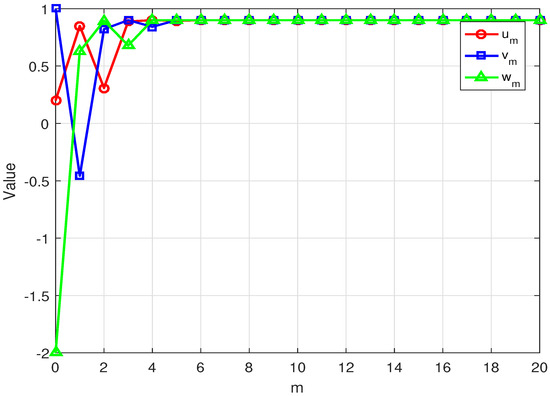
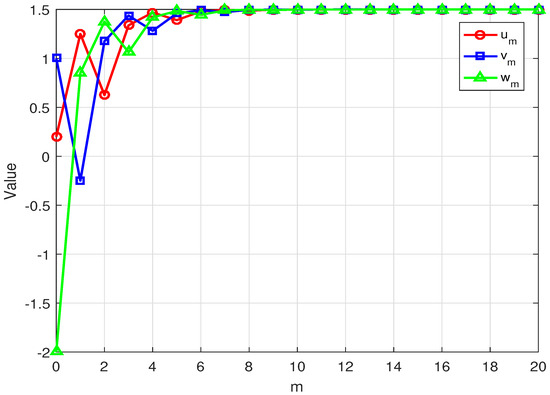
The corresponding numerical simulations and graphical representations are displayed below.
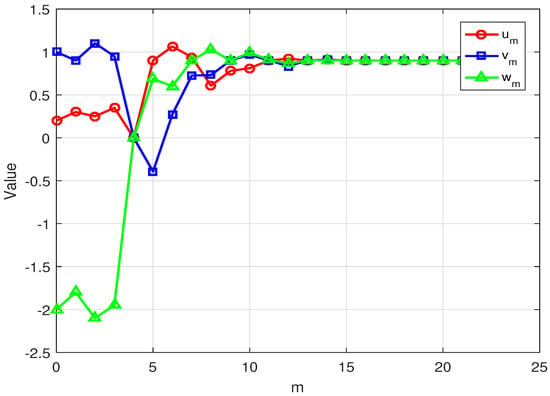
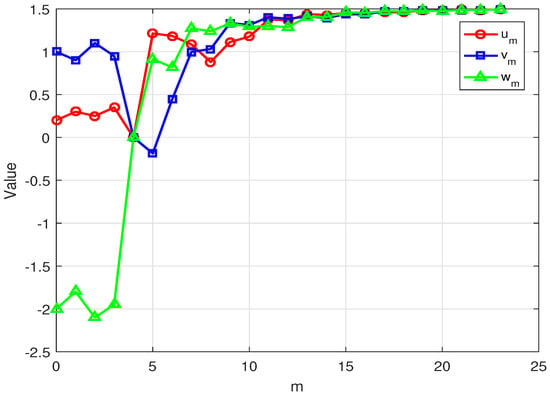
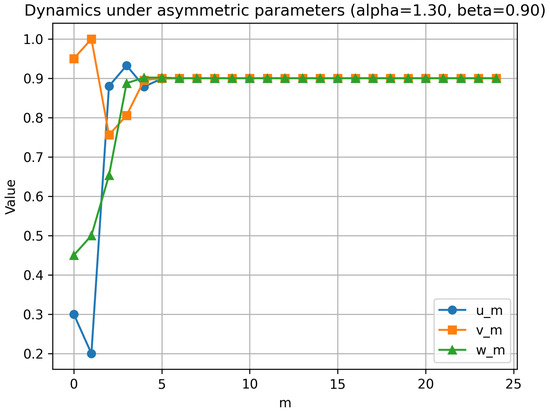
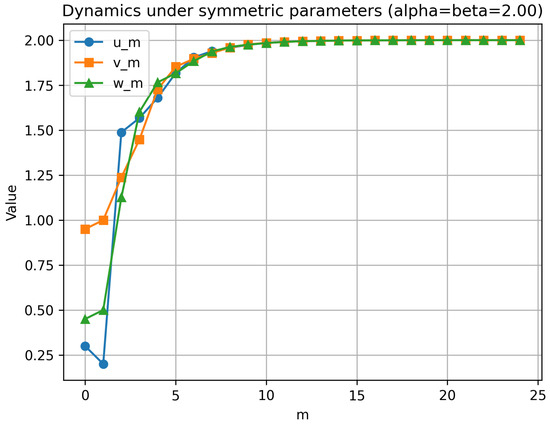
Figure 1 presents the time-series evolution of the three coupled sequences under asymmetric parameter settings. The trajectories exhibit pronounced oscillatory behavior during the initial iterations, reflecting the strong nonlinear interactions among the components. As the iteration progress, the sequences gradually stabilize, indicating the emergence of an attracting dynamical structure driven by parameter imbalance. The distinct evolution of each variable highlights the sensitivity of the model to asymmetric perturbations. In contrast, Figure 2 illustrates the case of symmetric parameter values, where the system exhibits markedly different dynamics. The trajectories converge rapidly toward a common equilibrium, demonstrating strong coherence induced by symmetry. The absence of oscillatory divergence reflects an intrinsic self-balancing mechanism within the system, consistent with the expected theoretical behavior when the governing coefficients are perfectly aligned.
Figure 1.
Dynamics of System (5) under asymmetric parameters and .
Figure 2.
Dynamics of System (5) under symmetric parameters .
Corollary 1.
Consider the special form of the three-dimensional system (4) obtained when the delay indices satisfy and . In this case, the system reduces to the following system of three coupled rational difference equations:
where , . This system is theoretically solvable. In particular, when for all , we obtain
where When the system (16) admits an explicit closed-form solution:
where and the coefficients are uniquely determined by the initial conditions.
Proof.
System (16) exhibits an interlacing index structure arising from the delays j and . To make this structure explicit, we introduce the subsequences for and With this re-indexing, the solution of this system decomposes into j independent solutions, each of which satisfies the following reduced subsystem of three rational difference equations:
for which is dynamically equivalent to the system (5). This equivalence follows directly by tracking the index shifts produced by the interlacing pattern
Thus, when the closed-form expression of the sequence can be written explicitly in terms of the initial conditions and the coefficients . More precisely, for and we obtain
When the degeneracy condition is satisfied, the nonlinear coupling in system (16) reduces to a symmetric form in which all three component sequences share identical transformed linear dynamics. Consequently, each sequence admits the same closed-form representation expressed in terms of the six characteristic roots of the associated linearized recurrence. More precisely, for and we obtain
□
Example 2.
In this example, we consider the system given in (16) with shift parameter The initial conditions are prescribed as follows:
To illustrate the qualitative dynamics of the system, we consider two distinct parameter regimes:
- Case 1: and
- Case 2: .
The corresponding numerical simulations and graphical representations are displayed below.
In Figure 3, with a shift parameter , the dynamics become considerably richer. Under asymmetric parameter settings, the delayed interactions introduce multi-step feedback, resulting in wider oscillations and slower convergence. The figure illustrates how the memory effect embedded in the system amplifies variability and strengthens the influence of earlier states, leading to more pronounced transient dynamics. In Figure 4, when the same system is simulated under symmetric parameter settings, the memory effect remains present but becomes more regulated. The variables evolve toward a stable regime, although the convergence process is still influenced by the shift structure. The interplay between symmetry and delay produces smoother transitions and suppresses strong divergence.
Figure 3.
Dynamics of System (16) with shift under asymmetric parameters , .
Figure 4.
Dynamics of System (16) with shift under symmetric parameters .
2.2. Symmetric Low-Shift and Zero-Delay Configurations: and
In this subsection, we focus on the low-shift and zero-delay configurations of the three-dimensional symmetric system defined in (4). These configurations correspond to the relations and , which impose the minimal temporal separation between the interacting components. As a result, the dynamics of the system become tightly coupled, with each sequence responding directly to the current state of another component, without any intermediate lag or extended memory effects. This zero-delay structure reveals a distinct form of symmetry compared with the high-shift configurations: instead of exhibiting interlaced periodic behavior across multiple time steps, the coupling acts instantaneously, forming a compact and highly responsive dynamical feedback loop. Despite the apparent simplicity of this setting, the evolution remains fully nonlinear and cyclic, preserving the characteristic rotational interaction among the sequences , , and . Under these conditions, the general system reduces to a particularly elegant rational recurrence in which the behavior of each component can be expressed in closed form. The direct dependency pattern allows the entire dynamics to be captured by a short-range multiplicative relation, thereby making the system analytically tractable while retaining its rich structural symmetry. In the sequel, we present the explicit formulation of the system under these configurations, derive the corresponding solution structures, and highlight the essential distinctions between the non-degenerate and degenerate cases.
Theorem 2.
Consider the following three-dimensional system governed by nonlinear rational difference equations:
where . This system constitutes a special case of the general three-dimensional model introduced in (4) under a suitable choice of the shift parameters ( and ), and it admits exact recursive representations obtained through nonlinear transformations. In the non-degenerate case, the system admits the following exact representation formulas:
In the degenerate case, the sequences , , can be expressed as:
Proof.
Assume that Then, from the system (17), the following relations hold for the sequence :
By dividing the expressions in the first column by those in the second, we eliminate the common denominators and obtain a simplified multiplicative relation describing the evolution of the ratios of consecutive terms for . Specifically, we have:
Applying the change of variables introduced in (6), the system reduces elegantly to the square form:
By combining the recursive equations, we derive an extended unclosed system of third-order difference equations:
Hence, the sequence exhibits a remarkable period-three behavior. Now, assume that Under this special parameter constraint, the system (17) simplifies to the cyclic form:
Subtracting from both sides, the system becomes:
Combining these relations leads to the unclosed linear system of difference equations:
To determine the solutions, it suffices to study a single representative recurrence. Each sequence , , and satisfies the same third-order linear relation. Therefore, the general solution reduces to solving the scalar difference equation:
Consequently, the sequence is periodic with period three, and its explicit solution is:
This completes the proof. □
Example 3.
In this example, we consider the system given in (18) with the initial conditions: To illustrate the qualitative behavior of the model, we consider two distinct parameter regimes:
- Case 1: and
- Case 2: .
The corresponding numerical simulations and graphical representations are displayed below.
For system (17), Figure 5 shows that the purely rational nonlinear interactions produce steep variations during the early stages of the trajectories, particularly under asymmetric parameter settings. The figure reflects a high sensitivity to initial conditions and coefficient imbalance. As the iterations progress, the system gradually damps these oscillations, and the variables approach bounded orbits, illustrating the regularizing effect of the rational transformation. In Figure 6, under symmetric parameter settings, the dynamics of (17) become significantly more stable. All sequences exhibit synchronized convergence, and the oscillatory envelope rapidly narrows. Symmetry again induces a strong contraction effect, steering the system toward a unified equilibrium consistent with the theoretical predictions. To further illustrate the accuracy of the derived analytical formulas, Table 1 presents the first twenty iterates corresponding to Case 1,
together with the values obtained from the exact representation formulas.
Figure 5.
Dynamics of System (17) under asymmetric parameters and .
Figure 6.
Dynamics of System (17) under symmetric parameters .
Table 1.
Comparison between the first 20 iterates of System (17) and their corresponding closed-form expressions (asymmetric parameters case).
Table 1 provides a term-by-term comparison between the numerical iterations of System (17) and the values obtained from the exact representation formulas. The close agreement across the computed terms confirms the validity of the analytical derivation and demonstrates that the obtained formulas accurately reproduce the system dynamics, even under the asymmetric parameter configuration and . Beyond the numerical agreement shown in Table 1, the derived exact representation formulas also provide a direct analytical interpretation of the observed asymptotic behavior. In particular, the convergence of the iterates toward the equilibrium value is governed by exponential-type terms involving the ratio
When this quantity remains below unity, the corresponding powers decay asymptotically, causing the trajectories to converge toward the equilibrium state. Conversely, values exceeding unity may generate divergent or structurally different asymptotic regimes. Therefore, the closed-form solutions not only validate the numerical iterations but also reveals the precise threshold mechanism controlling the long-term dynamics of the system.
Corollary 2.
Consider the special case of the three-dimensional system (4) obtained when the delay index satisfies and . In this setting, the system reduces to the following system of three coupled rational difference equations:
where , . This system is theoretically solvable. In particular, when we obtain for all
where When holds, the system (18) admits an explicit closed-form solution:
where s = 0,…, i − 1.
Proof.
System (18) exhibits an interlaced index structure induced by the delay parameter i. To make this structure explicit, we introduce the subsequences , for , and . With this re-indexing, the solution decomposes into i independent components, each satisfying the following reduced subsystems of three rational difference equations
which is dynamically equivalent to system (17). Thus, when the closed-form expression of the sequence , for and , are given by:
When , the closed-form solutions take the following form:
□
Example 4.
In this example, we consider the system given in (18) with the shift parameter The initial conditions are: To illustrate the qualitative behavior of the model, we consider two distinct parameter regimes:
- Case 1: and
- Case 2: .
The corresponding numerical simulations and graphical representations are displayed below.
In Figure 7, when applying the shift to system (18), the complexity increases since each update depends on more distant past states. Under asymmetric parameter settings, the trajectories exhibit pronounced oscillations and delayed stabilization, revealing how the increased memory depth amplifies nonlinear feedback loops. This figure highlights the combined effect of delay and parameter imbalance on the system’s evolution. Conversely, in Figure 8, when the parameters are equal, the system benefits from symmetry even in the presence of delay. Although oscillations remain due to the intrinsic structure of the model, the trajectories converge more smoothly. The system settles into a stable regime after a moderate number of iterations, demonstrating the stabilizing effect of parameter symmetry even within higher-order interactions.
Figure 7.
Dynamics of System (18) with shift under asymmetric parameters and .
Figure 8.
Dynamics of system (18) with shift under symmetric parameters .
Remark 1.
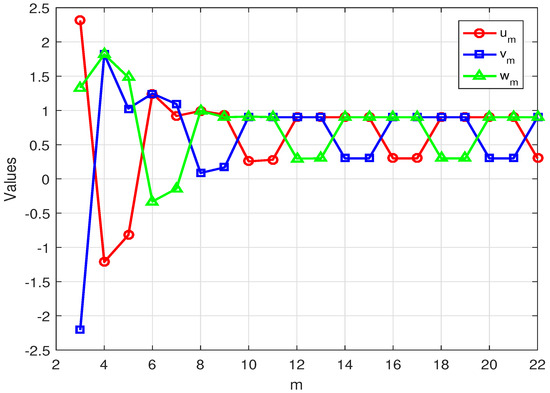
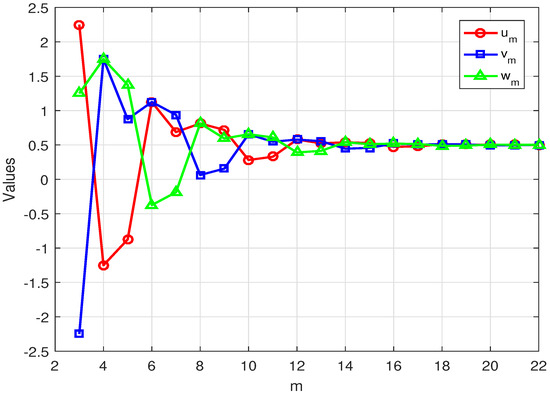
The numerical experiments presented in Figure 1, Figure 2, Figure 3, Figure 4, Figure 5, Figure 6, Figure 7 and Figure 8 reveal that the difference between the parameters and plays a fundamental role in determining both the transient and asymptotic behavior of the system. In particular, the exact representation formulas derived in this paper show that the evolution of the trajectories is governed by exponential-type factors involving ratios of the form
When the parameters are close to each other, especially in the symmetric case , the corresponding transformed factors produce strong contraction effects, leading to rapid convergence and reduced oscillatory amplitudes. By contrast, increasing the gap amplifies the imbalance in the nonlinear transformations and generally generates longer transient phases together with more pronounced oscillatory behavior before stabilization occurs. The simulations further indicate that the delay parameters intensify this effect. In higher-shift configurations, the memory structure of the system interacts with the parameter imbalance, producing wider oscillations and slower stabilization rates. Consequently, the asymptotic dynamics are not determined solely by symmetry, but also by the quantitative magnitude of the parameter separation and its interaction with the delayed recursive structure.
Remark 2.
In all the special symmetric systems considered in this paper, the recurrence relations are expressed through rational formulas whose denominators depend directly on previously generated terms. For this reason, the existence of a well-defined and continuous evolution of the sequences requires that these denominators never vanish during the iterative process. In the first and second systems, this condition translates into ensuring that the sum of each pair of consecutive terms never coincides with the critical value determined by the system parameters. In the third system, the update rules remain valid as long as none of the current values of the sequences reach the threshold at which the denominator becomes zero. A similar requirement applies to the delayed version of the system, where well-definedness depends on earlier time steps remaining away from this critical boundary. Taken together, these restrictions guarantee that the dynamics evolve without encountering singularities, ensuring that the solutions remain valid at every iteration. Such non-degeneracy conditions are essential for both the theoretical analysis of the model and the production of numerically stable simulations, as they prevent undefined behavior and preserve the structural integrity of the system throughout its evolution.
Remark 3.
If the initial conditions satisfy the symmetry condition for l then the three-dimensional nonlinear system given in (4) undergoes a structural reduction to a two-dimensional system (3). This reduction results from the imposed symmetry on the initial data, which effectively merges the dynamics of the first and third components into a single evolution. Consequently, the intrinsic dimensionality of the system decreases, simplifying the overall dynamics while preserving the essential features dictated by the governing difference equations. Under these assumptions, explicit closed-form solutions for the reduced two-dimensional system can be readily derived by specializing the general result to this particular setting. This highlights how parameter symmetry and suitable initial conditions can lead to a dimensional reduction, making the system more tractable for both theoretical analysis and numerical simulation.
Remark 4.
If we assume symmetric initial conditions for l then the three-dimensional nonlinear system (4) admits a complete structural reduction to the one-dimensional scalar recurrence (1). Under these symmetry constraints, the update equations corresponding to the three components become algebraically identical, and hence all variables evolve according to the same iteration rule at each step. Consequently, the identities for all m hold throughout the evolution, allowing the system to collapse explicitly from three dimensions to a single scalar equation. This dimensional reduction is a direct consequence of the imposed parameter symmetry and the fully symmetric initial conditions, which synchronize the dynamics of the three components into a unified evolution. As a result, the effective dimensionality of the system decreases, yielding a simpler yet mathematically faithful representation of the original model. Under these assumptions, the explicit closed-form solution of the reduced scalar recurrence follows immediately by specializing the general expression. This observation illustrates how suitable coefficient symmetries and balanced initial conditions can induce a complete dimensional collapse, thereby facilitating both theoretical investigation and numerical implementation.
2.3. Asymptotic Stability Analysis
In this section, we present a unified asymptotic stability analysis of the proposed three-dimensional rational difference system. The main objective is to complement the algebraic derivation of the exact solutions with a precise characterization of their long-term dynamical behavior. Owing to the structural symmetry of the system and the availability of explicit closed-form solutions, the stability properties can be directly inferred from the analytical expressions, without requiring a case-by-case analysis. Although the model admits several parameter configurations, including degenerate and non-degenerate cases as well as different delay structures, all such configurations reduce to a limited number of fundamental dynamical mechanisms governed by multiplicative exponential-type terms. This allows for a unified and mathematically rigorous treatment.
We first consider the non-degenerate case .
Theorem 3
(Global Asymptotic Behavior in the Non-Degenerate Case). Let be the solution of system (5) with . Then each component admits a representation involving terms of the form
If there exists at least one index such that
for the initial data involved in the solution representation, then
Similarly, if
then the trajectories exhibit divergence in the sense that the corresponding rational components grow without bound or approach depending on the direction of the transformation.
Proof.
The exact representation formulas obtained in this section show that each component is expressed as a rational transformation of powers of the form
where satisfies a linear difference equation and satisfies as . If , then
which implies that the dominant term in the closed-form expression vanishes asymptotically. Consequently, each sequence converges to the equilibrium value . The opposite case follows analogously. □
When , the system reduces to a geometric-type decay structure. In this case, the solutions satisfy expressions of the form
and therefore
Hence, the equilibrium point is globally asymptotically stable.
The above analysis shows that the stability properties of the system are fully determined by the algebraic structure of the derived solution representations. Consequently, no separate case-by-case stability analysis is required for the eight sub-configurations, as all of them arise from the same underlying exponential–rational mechanism. We further note that this type of stability behavior is not restricted to the present system. More generally, higher-dimensional rational difference systems admitting similar cyclic symmetry and closed-form representations may exhibit analogous asymptotic regimes governed by exponential-type transformations. This suggests a broader research direction toward unified stability criteria for symmetric rational dynamical systems.
Remark 5.
The explicit representations derived in this paper provide more than closed-form expressions for the solutions; they also enable a precise characterization of the dependence of the dynamics on the initial data. Since all solution components are expressed through smooth rational transformations of the initial conditions, the resulting dynamical mappings are continuous on their natural domain of definition. In particular, small perturbations in the initial values induce correspondingly small variations in the transformed quantities, which then propagate through exponential-type structures without altering the qualitative asymptotic regime of the system. Consequently, the long-term behavior of the coupled sequences remains structurally stable under sufficiently small perturbations of the initial conditions, and the global dynamical features established in this work are preserved. This highlights the robustness of the proposed model and underscores the advantage of explicit analytical solutions in studying both qualitative and quantitative properties of nonlinear rational difference systems.
Remark 6
(Threshold behavior induced by exact representations). The explicit solution formulas derived in this work reveal an intrinsic threshold mechanism governing the dynamics of the system. In particular, the quantity
acts as a critical threshold parameter that completely determines the long-term behavior of the trajectories. When this ratio lies below unity, the exponential-type terms in the solution decay to zero, forcing the system to converge toward the equilibrium state . Conversely, when the ratio exceeds unity, the same structural mechanism leads to divergence or transition toward alternative asymptotic regimes. Hence, the precise closed-form representation transforms the study of long-term dynamics into an explicit algebraic comparison, replacing qualitative stability arguments with an exact threshold criterion derived directly from the solution structure.
3. Application and Numerical Simulation
3.1. A SIR-Type Cyclic Interaction Interpretation
The proposed three-dimensional system can be interpreted in the context of interacting population dynamics. In particular, the cyclic structure of the system suggests a natural analogy with compartmental models commonly used in epidemiology, such as the susceptible–infected–recovered (SIR) framework.
To provide an intuitive interpretation, we associate the sequences with three interacting population states:
Unlike the classical SIR model, which is typically formulated using additive difference or differential equations, the system considered in this paper is governed by nonlinear rational recurrences with multiplicative interactions. As a result, the transitions between states are nonlinear but depend on the ratios and products of previous values, reflecting a more complex interaction mechanism.
The cyclic dependency
introduces a rotational flow of influence among the three populations. This structure can be interpreted as a delayed or indirect transmission mechanism, where each compartment evolves according to the state of another compartment in the previous step.
It is important to emphasize that this formulation does not aim to replace standard epidemiological models. Instead, it serves as a generalized nonlinear framework capable of capturing cyclic and multiplicative interactions that are not present in classical models.
3.2. Numerical Simulation
To illustrate the qualitative behavior of the system, we consider the special configuration given in Section 2 with the following initial conditions:
We examine two representative parameter regimes:
- Case 1 (asymmetric parameters): , ,
- Case 2 (symmetric parameters): .
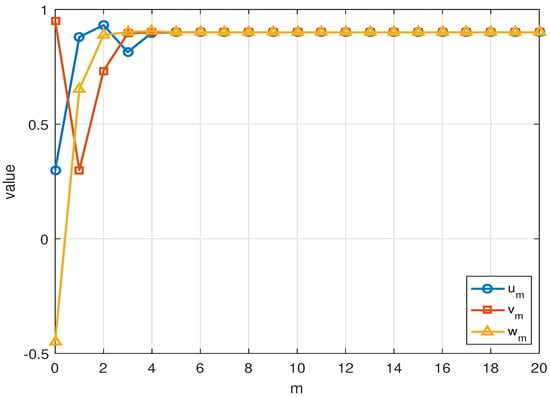
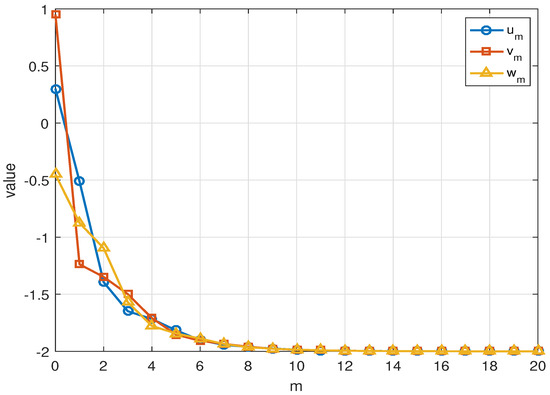
The numerical simulations are obtained by iterating the recurrence relations and plotting the sequences over a finite time horizon. The results are shown in Figure 9 and Figure 10.
Figure 9.
Dynamics of the system under asymmetric parameters.
Figure 10.
Dynamics of the system under symmetric parameters.
3.3. Discussion of the Dynamical Behavior
The numerical results reveal two distinct types of behavior depending on the parameter configuration.
In the asymmetric case, the trajectories exhibit noticeable oscillations during the initial iterations. This reflects the nonlinear and cyclic coupling between the three components, where each variable responds to the previous state of another. As the system evolves, these oscillations gradually diminish, and the sequences approach a stable regime. This behavior suggests the presence of an attracting structure driven by the imbalance between the parameters.
In contrast, when the parameters are symmetric, the system displays a more regular and coordinated behavior. The three sequences converge rapidly toward a common equilibrium, indicating a strong form of internal coherence. The absence of pronounced oscillations highlights the stabilizing effect of parameter symmetry.
From an application perspective, these results indicate that the proposed model is capable of capturing both transient fluctuations and long-term stabilization. The interplay between cyclic dependence and parameter structure plays a crucial role in determining the qualitative dynamics of the system.
Overall, this demonstrates how the theoretical framework developed in this paper can be used to model interacting populations with nonlinear and cyclic dependencies, providing a flexible alternative to classical linear interaction models.
4. Conclusions
The three-dimensional symmetric system examined in this paper represents a natural and significant extension of the well-studied one- and two-dimensional systems. From a methodological viewpoint, the paper develops a structured reduction strategy that transforms the original nonlinear cyclic system into auxiliary recurrence equations revealing its underlying algebraic structure. The resulting representation framework demonstrates how periodicity, symmetry, and delayed interactions jointly govern the evolution of the system. In contrast to previously studied lower-dimensional models, the present three-dimensional setting produces coupled recursive mechanisms that require new transformation procedures and nontrivial recurrence decompositions. Consequently, the paper provides both a new class of analytically tractable nonlinear systems and a general framework for studying higher-dimensional symmetric recurrence structures. Our analysis shows that this type of system, despite its nonlinear structure and complex delay parameters, possesses subtle structural properties that allow the derivation of associated linear equations from which explicit and complete solutions can be constructed. We also demonstrate how periodicity and internal symmetry play a fundamental role in understanding the interaction mechanisms among the three sequences. This paper thus extends the class of solvable systems and presents a unified framework linking classical and modern classes of difference equations with symmetric structures. The inclusion of a SIR-type cyclic interpretation and numerical simulations further highlights the flexibility of the model and its ability to capture a wide range of dynamical behaviors under different parameter configurations.
The results obtained in this paper naturally suggest several directions for future research closely related to the structural framework developed herein. A first important direction concerns the global stability and asymptotic behavior of the proposed three-dimensional symmetric system, particularly under different classes of delay parameters and periodic configurations. Another promising extension involves the study of analogous symmetric systems in fuzzy settings, motivated by recent developments in fuzzy difference equations and their qualitative dynamics [30,31,32,33]. Such extensions may provide further insight into how uncertainty influences the periodic and symmetric mechanisms identified in the present paper. In addition, the reduction procedures introduced in this paper may be adapted to broader classes of higher-dimensional cyclic systems possessing similar algebraic and symmetric structures. Consequently, the present study provides not only a solvable three-dimensional model, but also a structural framework capable of supporting future investigations of more general symmetric recurrence systems.
Author Contributions
Conceptualization, A.G.; Methodology, Y.A. and A.G.; Validation, Y.A.; Formal analysis, A.G.; Writing—original draft, Y.A. and A.G.; Writing—review and editing, Y.A. and A.G.; Visualization, Y.A.; Supervision, Y.A.; Funding acquisition, Y.A. All authors have read and agreed to the published version of the manuscript.
Funding
This work was supported and funded by the Deanship of Scientific Research at Imam Mohammad Ibn Saud Islamic University (IMSIU) (grant number IMSIU-DDRSP2602).
Data Availability Statement
The original contributions presented in this study are included in the article. Further inquiries can be directed to the corresponding author.
Acknowledgments
This work was supported and funded by the Deanship of Scientific Research at Imam Mohammad Ibn Saud Islamic University (IMSIU) (grant number IMSIU-DDRSP2602).
Conflicts of Interest
The authors declare no conflicts of interest.
Abbreviations
| set of non-negative integers. | |
| set of positive integers. | |
| set of integers greater than or equal to two. |
References
- Althagafi, H. Dynamics of difference systems: A mathematical study with applications to neural systems. AIMS Math. 2025, 10, 2869–2890. [Google Scholar] [CrossRef] [Scilit]
- Althagafi, H. Stability analysis of biological rhythms using three-dimensional systems of difference equations with squared terms. J. Appl. Math. Comput. 2025, 71, 3211–3232. [Google Scholar] [CrossRef] [Scilit]
- Althagafi, H. Solving a system of nonlinear difference equations with bilinear dynamics. AIMS Math. 2024, 9, 34067–34089. [Google Scholar] [CrossRef] [Scilit]
- Elsayed, E.M. On the solutions and periodicity of some rational systems of difference equations. Bull. Math. Soc. Sci. Math. Roum. 2017, 108, 159–171. [Google Scholar]
- Zhang, Y.; Yang, X.; Megson, G.M.; Evans, D.J. On the system of rational difference equations. Appl. Math. Comp. 2006, 176, 403–408. [Google Scholar]
- Gümüş, M. Global asymptotic behavior of a discrete system of difference equations with delays. Filomat 2023, 37, 251–264. [Google Scholar] [CrossRef] [Scilit]
- Kara, M. Investigation of the global dynamics of two exponential-form difference equations systems. Electron. Res. Arch. 2023, 31, 6697–6724. [Google Scholar] [CrossRef] [Scilit]
- Elsayed, E.M.; El-Metwally, H. Global behavior and periodicity of some difference equations. J. Comput. Anal. Appl. 2015, 19, 298–309. [Google Scholar]
- El-Metwally, H.; Elsayed, E.M. Qualitative behavior of some rational difference equations. J. Comput. Anal. Appl. 2016, 20, 226–236. [Google Scholar]
- Attia, N. Closed-form solutions of a new class of three-dimensional nonlinear difference equations. AIMS Math. 2025, 10, 23518–23533. [Google Scholar] [CrossRef] [Scilit]
- Attia, N. On explicit periodic solutions in three-dimensional difference systems. AIMS Math. 2025, 10, 25469–25488. [Google Scholar] [CrossRef] [Scilit]
- Al Salman, H.J. Closed-form solutions of systems of nonlinear difference equations and their connections to generalized Fibonacci numbers and related sequences. AIMS Math. 2025, 10, 25307–25328. [Google Scholar] [CrossRef] [Scilit]
- Almoteri, Y.; Ghezal, A. Solvability of three-dimensional nonlinear difference systems via transformations and generalized Fibonacci recursions. Mathematics 2025, 13, 3904. [Google Scholar] [CrossRef] [Scilit]
- Zhang, Q.; Yang, L.; Liu, J. Dynamics of a system of rational third order difference equation. Adv. Differ. Equ. 2012, 2012, 136. [Google Scholar]
- Althagafi, H.; Ghezal, A. Analytical study of nonlinear systems of higher-order difference equations: Solutions, stability, and numerical simulations. Mathematics 2024, 12, 1159. [Google Scholar] [CrossRef] [Scilit]
- Balegh, M.; Zemmouri, I. Solutions and local stability of the Jacobsthal system of difference equations. AIMS Math. 2024, 9, 3576–3591. [Google Scholar] [CrossRef] [Scilit]
- Gümüş, M.; Abo-Zeid, R. Global behavior of a rational second order difference equation. J. Appl. Math. Comput. 2020, 62, 119–133. [Google Scholar]
- Alofi, B.S. Qualitative dynamics of a higher-order rational difference equation system. J. Math. Comput. Sci. 2026, 41, 519–534. [Google Scholar]
- Stević, S.; Iričanin, B.; Kosmala, W.; Šmarda, Z. Note on theoretical and practical solvability of a class of discrete equations generalizing the hyperbolic-cotangent class. J. Inequal. Appl. 2021, 2021, 184. [Google Scholar] [CrossRef] [Scilit]
- Stević, S. New class of practically solvable systems of difference equations of hyperbolic-cotangent-type. Electron. J. Qual. Theory Differ. Equ. 2020, 2020, 89. [Google Scholar]
- Demidovich, B.P.; Maron, I.A. Computational Mathematics; Mir Publishers: Moscow, Russia, 1973. [Google Scholar]
- Stević, S. Solvability of a general class of two-dimensional hyperbolic-cotangent-type systems of difference equations. Adv. Differ. Equ. 2019, 2019, 294. [Google Scholar]
- Stević, S.; Iričanin, B.; Kosmala, W. Symmetric nonlinear solvable system of difference equations. Electron. J. Qual. Theory Differ. Equ. 2024, 2024, 1–16. [Google Scholar] [CrossRef] [Scilit]
- Elsayed, E.M.; El-Metwally, H. Stability and solutions for rational recursive sequence of order three. J. Comput. Anal. Appl. 2014, 17, 305. [Google Scholar]
- Oğul, B.; Simşek, D. Dynamical behavior of one rational fifth-order difference equation. Carpathian Math. Publ. 2023, 15, 43–51. [Google Scholar] [CrossRef] [Scilit]
- Stević, S.; Iričanin, B.; Kosmala, W. On a product-type system of difference equations of second order solvable in closed form. J. Inequal. Appl. 2015, 2015, 327. [Google Scholar] [CrossRef] [Scilit]
- Al Ghafli, A.A. Closed-form solutions of a nonlinear bidimensional difference system via generalized Fibonacci sequences. AIMS Math. 2025, 10, 26545–26567. [Google Scholar] [CrossRef] [Scilit]
- Attia, N. Global stability and co-balancing numbers in a system of rational difference equations. Electron. Res. Arch. 2024, 32, 2137–2159. [Google Scholar] [CrossRef] [Scilit]
- Stević, S. Solvable product-type system of difference equations whose associated polynomial is of the fourth order. Electron. J. Qual. Theory Differ. Equ. 2017, 2017, 1–29. [Google Scholar] [CrossRef] [Scilit]
- Balegh, M. Dynamical analysis of a system of fuzzy difference equations with power terms. Int. J. Dynam. Control 2025, 13, 364. [Google Scholar] [CrossRef] [Scilit]
- Atpinar, S.; Yazlik, Y. Qualitative behavior of exponential type of fuzzy difference equations system. J. Appl. Math. Comput. 2023, 69, 4135–4162. [Google Scholar] [CrossRef] [Scilit]
- Usman, M.; Khaliq, A.; Azeem, M.; Swaray, S.; Kallel, M. The dynamics and behavior of logarithmic type fuzzy difference equation of order two. PLoS ONE 2024, 19, e0309198. [Google Scholar] [CrossRef] [Scilit]
- Althagafi, H. Global Stability of a System of Fuzzy Difference Equations of Higher-Order. J. Appl. Math. Comput. 2025, 71, 1887–1909. [Google Scholar] [CrossRef] [Scilit]

Disclaimer/Publisher’s Note: The statements, opinions and data contained in all publications are solely those of the individual author(s) and contributor(s) and not of MDPI and/or the editor(s). MDPI and/or the editor(s) disclaim responsibility for any injury to people or property resulting from any ideas, methods, instructions or products referred to in the content. |
© 2026 by the authors. Licensee MDPI, Basel, Switzerland. This article is an open access article distributed under the terms and conditions of the Creative Commons Attribution (CC BY) license.