Article

A Stochastic Model of East Coast Fever Incorporating a Wildlife–Livestock Interface

1
Department of Mathematics and Computational Sciences, University of Zimbabwe, Mount Pleasant, Harare P.O. Box MP 167, Zimbabwe
2
Department of Mathematics and Statistics, College of Science and Technical Education, Mbeya University of Science and Technology, Mbeya P.O. Box 131, Tanzania
3
Department of Veterinary Biosciences, University of Zimbabwe, Mount Pleasant, Harare P.O. Box MP 167, Zimbabwe
4
The Program for Experimental and Theoretical Modeling, Division of Hepatology, Department of Medicine, Stritch School of Medicine, Loyola University Chicago, Maywood, IL 60153, USA
*
Authors to whom correspondence should be addressed.
Mathematics 2026, 14(12), 2054; https://doi.org/10.3390/math14122054 (registering DOI)
Submission received: 26 March 2026 / Revised: 21 May 2026 / Accepted: 4 June 2026 / Published: 9 June 2026
(This article belongs to the Section E3: Mathematical Biology)

Abstract

East Coast Fever (ECF) causes approximately one million livestock deaths annually in sub-Saharan Africa, posing a significant threat to livestock. The wildlife–livestock interface complicates disease management, as wildlife serve as reservoirs. This study developed a Continuous Time Markov Chain (CTMC) model incorporating the wildlife–livestock interface to analyze ECF dynamics. Using the Galton–Watson approximation, we assessed the probability of disease extinction following the introduction of infected hosts or vectors. The probability of disease extinction calculated from the branching process is shown to be in good agreement with the probability approximated from numerical simulations. The disease dynamics of the deterministic model and the CTMC model are compared to ascertain the effect of demographic stochasticity on ECF dynamics. Differences in model predictions and asymptotic dynamics between stochastic and deterministic models were evident. The deterministic and stochastic formulations should therefore be viewed as complementary modeling frameworks, with the deterministic model characterizing average epidemic dynamics and the CTMC model capturing the probabilistic variability and extinction behavior inherent in real transmission processes. These differences are crucial for intervention strategies earmarked to prevent outbreaks. Our analysis revealed a high probability of ECF extinction if the disease emerges from recovered carrier cattle. Finite time to ECF disease extinction is estimated using 10,000 sample paths, and it is shown that the epidemic duration is shortest if the disease is introduced by infectious cattle. The epidemic duration is longest when the disease is introduced by infectious ticks. Additionally, we observed that host interactions at the wildlife–livestock interface play a critical role in shaping ECF transmission and informing control strategies.
MSC:
92B05; 92B10; 35B40; 35K57; 35Q92; 92D30

1. Introduction

Despite the existence of therapeutic drugs and vaccines, East Coast Fever (ECF) remains one of the most devastating livestock infectious diseases in sub-Saharan Africa [1]. Recent reports suggest that since 1999, ECF has led to the deaths of over one million cattle annually, resulting in economic losses exceeding US $ 300 million [2]. The interface between livestock and wildlife, which facilitates cross-transmission of ECF, remains a significant obstacle to effective disease management in sub-Saharan Africa. Therefore, understanding parasite–host interactions within multi-host systems is critical, as wild animals serve as reservoirs of pathogens that can significantly impact domesticated animals.
Predictive mathematical models remain integral tools, capable of shedding light on mechanisms underlying the disease spread process and the design of biosecurity measures, surveillance, and other related control activities [3]. A few mathematical models have been published in recent years to investigate ECF dynamics (see, for example, [4,5,6,7,8,9,10,11,12,13] and references cited therein). Important topics that have been discussed using mathematical models include (i) the effects of livestock and wildlife interactions on ECF transmission and control dynamics [12]; (ii) the implications of intervention strategies on mitigating disease spread [5,11]; and (iii) the role of climatic conditions on ECF dynamics [9,13]. A comprehensive review of past and future perspectives on mathematical models of tick-borne pathogens is presented in [7]. Certainly, these studies have produced several useful insights into the transmission and control of ECF and have improved the existing knowledge regarding this disease.
Despite these efforts, however, the probability of ECF outbreak and extinction in pastoral and rangeland ecosystems—where livestock and wild animals mingle near water sources and grazing areas—remains poorly understood. This is mainly because, in the majority of prior studies, deterministic mathematical models (DMMs) were used to study disease transmission patterns. Specifically, in DMMs, the persistence and extinction of a disease are governed by the conditions of the reproduction number. If the reproduction number is less than one, the disease dies out, whereas persistence occurs when the reproduction number is greater than one. Relying solely on the reproduction number to determine ECF outbreaks may not be appropriate, as a small number of hosts or vectors can still introduce the disease [14]. In particular, recent findings from mathematical models suggest that (i) an outbreak of a vector-borne disease (VBD) increases with the ratio of vectors to hosts in the population [15], and (ii) transmission intensifies when the number of hosts is reduced or when there is an increase in either the vector carrying capacity or the vector biting rate [16].
Motivated by these facts, in this study, we propose a mathematical model of ECF based on a stochastic branching process that incorporates livestock and wildlife interactions. To the best of the authors’ knowledge, such a mathematical framework has yet to be proposed. With stochastic models, there is a possibility that the disease will die out before resulting in a major outbreak, even when the reproduction number is greater than one. Thus, stochastic models are capable of capturing the randomness and variability inherent in biological and ecological systems [17]. By incorporating randomness and variability, stochastic models offer insights into processes that are difficult to predict deterministically [18,19]. Stochastic models use whole numbers for each class instead of continuous values, treating state variables as discrete with continuous time. This approach makes them more realistic compared to deterministic models.
We commence our discussion in Section 2 by presenting a deterministic multi-host ECF framework. We then derive the basic reproduction number. Next, we transform the deterministic framework into a stochastic continuous-time Markov chain (CTMC) framework guided by the Galton–Watson process [20,21]. In Section 3, we present the numerical results and discussions. Specifically, we start by determining the correlation between model parameters and the reproduction number. Our goal is to identify the parameters that significantly alter the disease transmission potential. Next, we explore how the probability of extinction varies when disease prevalence is low in either the tick or host animal populations. In Section 4, we conclude our study.

2. Materials and Methods

Based on ordinary differential equations ( O D E s ) , a model describing the transmission dynamics of ECF in cattle, buffaloes and ticks is formulated.

2.1. Deterministic Model

The cattle population is stratified into three classes: susceptible cattle S C ( t ) , infectious cattle I C ( t ) , and recovered carrier cattle R C ( t ) , which carry a low level of parasitemia compared to actively infectious cattle. The total cattle population at time t is thus expressed as N C ( t ) = S C ( t ) + I C ( t ) + R C ( t ) . Similarly, the total buffalo population is partitioned into susceptible S B ( t ) , infectious I B ( t ) , and recovered carrier R B ( t ) classes, with the total buffalo population given by N B ( t ) = S B ( t ) + I B ( t ) + R B ( t ) . The tick population is categorized into susceptible adult ticks A S ( t ) and infected adult ticks A I ( t ) , with the total tick population defined as N T ( t ) = A S ( t ) + A I ( t ) . The proposed model operates under the following assumptions:
(A1).
We assume that the dynamics of the adult host populations, both cattle and buffaloes, are similar to the standard S I R model [22]. This formulation is biologically and epidemiologically justified by the natural history of Theileria parva infection [1]. When susceptible host animals are exposed to infected brown ear tick, they move from being susceptible to become infectious. This state is characterized by schizont proliferation in lymphocytes and subsequent parastemia. At this stage, they are capable of infecting feeding susceptible ticks. Animals that survive the acute infectious stage within (21–30) days move to a recovered class that represents a persistent carrier state [8,12]. Animals infected by East Coast fever do not immediately become fully susceptible again after recovery. Instead, after recovering, they develop some level of immunity that lasts for a period of time, even though it may not be permanent. Because of this biological reality, the disease dynamics of ECF cannot be represented using an S I S structure, for example, which assumes that individuals recover from infection but return directly to the susceptible class without acquiring immunity [23,24]. Instead, the model should include a recovered compartment, leading to an S I R -type structure as in [8,12].
Moreover, although ECF is associated with significant disease-induced mortality, particularly in naive populations, this is readily incorporated as an additional removal term from the infectious class without altering the fundamental S I R structure. Importantly, while transmission is tick-borne, the within-host progression in animals remains consistent with S I R dynamics, whereas the tick population is appropriately modeled using an S I structure due to the absence of recovery in ticks. This coupled S I R S I framework has been widely adopted in tick-borne disease modeling because it captures both the acute infection phase and the long-term carrier status critical for transmission persistence [8]. Consequently, the  S I R formulation provides a parsimonious yet sufficiently flexible structure that reflects the immuno-epidemiological characteristics of ECF, while supporting rigorous reproduction number derivation and optimal control analysis.
(A2).
It is assumed that disease transmission follows a mass action incidence mechanism, whereby the rate at which susceptible hosts acquire infection is proportional to the product of the number of susceptible hosts and infectious ticks. This assumption implies that the frequency of effective contacts between hosts and infected ticks increases with vector density, such that a larger infectious tick population leads to a higher transmission pressure on susceptible hosts. The force of infection from ticks to cattle is represented by λ T C = β T C A I ( t ) , where β T C is the transmission coefficient and A I ( t ) is the number of infectious adult ticks at time t. Infected cattle may recover naturally or through treatment at a rate γ C , subsequently entering the recovered class. Recovered cattle are assumed to be carriers of the disease [1,5,12]. Both cattle and wild animals die naturally at rates μ C and μ B , respectively, while disease-induced mortality occurs at rates d C for cattle and d B for buffaloes. Recruitment rates are Π C for cattle and Π B for buffaloes, maintaining their populations. The force of infection from ticks to buffaloes is similarly represented by λ T B = β T B A I ( t ) .
(A3).
We further assume that, within each species, the case fatality rate of infected hosts is, on average, the same regardless of whether the host transmitted the infection to the tick, implying no transmission-dependent variation in disease severity.
(A4).
It is assumed that there is no direct animal-to-animal or tick-to-tick transmission. The wild animal populations have birth rates equal to their natural death rates in the absence of disease, maintaining a stable population. Conversely, cattle are managed to sustain a constant population size, with their birth rate set equal to the sum of natural death and disease-induced mortality rates.
(A5).
The tick population is divided into susceptible ( A S ( t ) ) and infectious ( A I ( t ) ) adult ticks. Ticks become infected solely through biting infected host animals; there is no transovarial transmission [12]. Host choice by ticks is assumed to be random, with the proportion of ticks biting cattle versus wild animals depending on the relative host population sizes. The recruitment rate into the susceptible tick class is denoted by Π T .
(A6).
The force of infection from hosts to ticks is modeled as λ C T = β C T ( I C ( t ) + ( 1 η C ) R C ( t ) ) for cattle, and  λ B T = β B T ( I B ( t ) + ( 1 η B ) R B ( t ) ) for buffaloes, where I C and R C denote infected and recovered cattle and I B and R B denote infected and recovered buffaloes, respectively. For both hosts, recovered animals are assumed to be carriers of the pathogen [1]. Most wild buffaloes have been shown to be carriers of ECF [12], and the potential for carrier state in cattle has been debated due to differences in breeds of cattle [12]. In this study, we assume that only the Bos indicus breed of cattle is included, in which a carrier state is well established; thus we assume that all those recovered are carriers of the disease and are able to transmit the infection to ticks. Furthermore, η C ( 0 η C 1 ) represents the infectivity potential of recovered carrier cattle, and lastly, η B ( 0 η B 1 ) represents the infectivity potential of recovered carrier buffaloes.
(A7).
It is further assumed that systematic infection occurs during the blood meal, and that infection of the brown ear tick does not influence the tick’s birth or death rates.
Combining all the aforementioned assumptions and descriptions, we derive the following system of nonlinear ordinary differential equations (Equations (1)–(8)):
d S C ( t ) d t = Π C λ T C S C ( t ) μ C S C ( t ) ,
                      d I C ( t ) d t = λ T C S C ( t ) ( μ C + γ C + d C ) I C ( t ) ,
d R C ( t ) d t = γ C I C ( t ) μ C R C ( t ) ,                      
  d S B ( t ) d t = Π B λ T B S B ( t ) μ B S B ( t ) ,
                      d I B ( t ) d t = λ T B S B ( t ) ( μ B + γ B + d B ) I B ( t ) ,
d R B ( t ) d t = γ B I B ( t ) μ B R B ( t ) ,                      
                                    d A S ( t ) d t = Π T ( λ C T + λ B T ) A S ( t ) μ A A S ( t ) ,
          d A I ( t ) d t = ( λ C T + λ B T ) A S ( t ) μ A A I ( t ) ,
with initial conditions:
S C ( 0 ) > 0 ,       I C ( 0 ) > 0 ,       R C ( 0 ) > 0 ,       S B ( 0 ) > 0 , I B ( 0 ) > 0 ,       R B ( 0 ) > 0 ,       A S ( 0 ) > 0 ,       A I ( 0 ) > 0 .
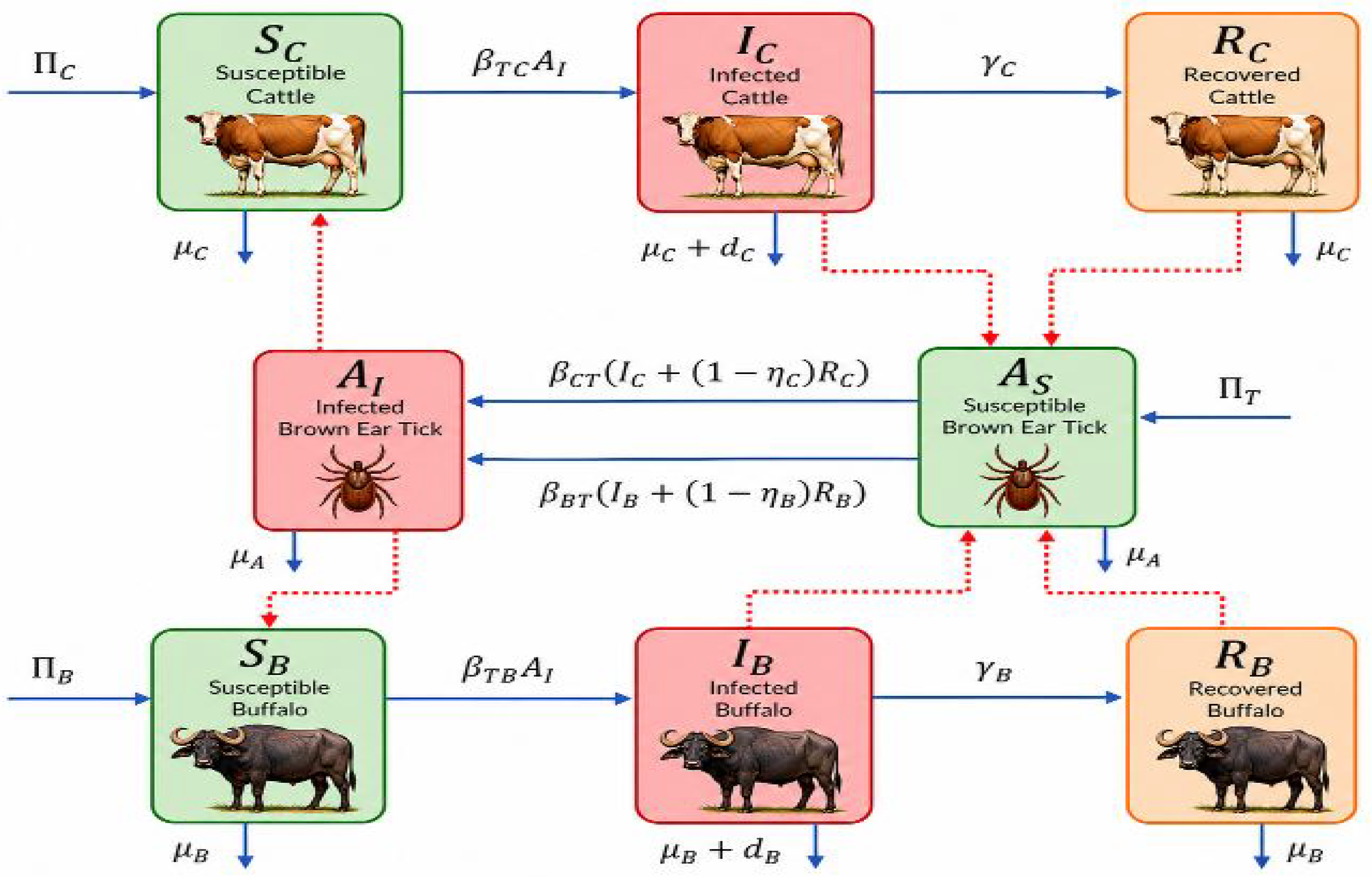
The model flow diagram is illustrated in Figure 1, and model parameters and their biological descriptions are summarized in Table 1.

The Basic Reproduction Number ( R 0 )

When the disease is not present in animals and the tick vector
  • ( I C = R C = I B = R B = A I = 0 ) , the system (1)–(8) has a disease-free equilibrium point ( D F E ) denoted by
E 0 : S C , I C , R C , S B , I B , R B , A S , A I = Π C μ C , 0 , 0 , Π B μ B , 0 , 0 , Π T μ A , 0 .
According to Diekmann et al. [25], the basic reproduction number, R 0 , is defined as the mean number of secondary infections generated by a single infected individual over the entire infectious period in a completely susceptible population. This threshold parameter is crucial for understanding disease dynamics, as it indicates whether an infection will die out ( R 0 < 1 ) or persist and potentially lead to an epidemic ( R 0 > 1 ).
In our analysis, we compute R 0 using the next-generation matrix approach, as described by Diekmann et al. [25] and Van den Driessche and Watmough [26]. This method involves constructing the matrices F and V , which represent the new infection terms and transition terms, respectively. These matrices are evaluated at the disease-free equilibrium (DFE). Specifically, the matrices are defined as follows:
F = 0 m 1 m 2 m 3 m 4 m 5 0 0 0 0 0 0 0 0 0 m 6 0 0 0 0 0 0 0 0 0 ,       and       V = μ A 0 0 0 0 0 a C 0 0 0 0 γ C μ C 0 0 0 0 0 a B 0 0 0 0 γ B μ B ,
with:
m 1 = β C T Π T μ A ,         m 2 = ( 1 η C ) β C T Π T μ A ,         m 3 = β B T Π T μ A , m 4 = β B T ( 1 η B ) Π T μ A ,         m 5 = β T C Π C μ C ,         m 6 = β T B Π B μ B , a C = γ c + μ c + d C ,         a B = γ B + μ B + d B . .
It follows that K = F V 1 and the spectral radius of K defines the reproduction number R 0 of model (1)–(8). Thus,
K = F V 1 = 0 m 1 a C + m 2 γ C a C μ C m 2 μ C m 3 a B + m 4 γ B a B μ B m 4 μ B m 5 μ A 0 0 0 0 0 0 0 0 0 m 6 μ A 0 0 0 0 0 0 0 0 0 .
Hence, the reproduction number of model (1)–(8) is:
R 0 = a C m 6 μ C ( m 3 μ B + m 4 γ B ) + a B m 5 μ B ( m 1 μ C + m 2 γ C ) a C a B μ A μ C μ B ,
Simplifying (10) by substituting (9), one gets
R 0 = R 0 C + R 0 B ,
where
R 0 C = β T C β C T Π T Π C μ A 2 μ C ( μ C + γ C + d C ) 1 + ( 1 η C ) γ C μ C , R 0 B = β B T β T B Π T Π B μ A 2 μ B ( μ B + γ B + d B ) 1 + ( 1 η B ) γ B μ B .
Our model incorporates multiple transmission routes, including cattle-to-tick, tick-to-cattle, buffalo-to-tick, and tick-to-buffalo pathways. This is supported by the presence of a square root term in the expression of the basic reproduction number, indicating that the generation of secondary cases requires two sequential transmission processes to be complete. Consequently, the basic reproduction number does not represent the number of hosts infected by a single tick; rather, it reflects the geometric mean number of secondary infections per generation across the transmission cycle. Biologically, the disease can persist only if the reproductive capacity of the host populations exceeds unity; specifically, the reproduction numbers for cattle ( R 0 C ) and buffalo ( R 0 B ) must satisfy R 0 C > 1 and R 0 B > 1 , respectively. If either falls below this threshold, the disease will eventually die out.
The term, R 0 C , represents the expected number of new infections generated through the cattle–tick–cattle cycle, where the parameter β T C is the transmission rate from infected ticks to susceptible cattle, and the parameter β C T represents the transmission rate from infected carrier cattle to susceptible ticks. The term Π C μ C corresponds to the disease-free cattle population size, and Π T μ A represents the disease-free tick population size. Since transmission requires ticks both acquiring and transmitting, the term appears effectively as Π T μ A 2 . The power of μ A arises because one factor comes from tick population density and another comes from the infectious lifespan of the tick vector. The term ( γ C + μ C + d C ) 1 is the average duration of infectiousness in cattle. Lastly, the term 1 + ( 1 η C ) γ C μ C explains the additional contribution from recovered carrier cattle, where γ C μ C represents the expected time cattle spend in the recovered carrier class relative to natural mortality and ( 1 η C ) measures the infectivity potential of carrier cattle.
Similarly, the reproduction number for buffaloes, R 0 B , represents the expected number of new infections generated through the buffalo–tick–buffalo cycle, where the parameter β T B is the transmission rate from infected ticks to susceptible buffaloes, and the parameter β B T represents the the transmission rate from infected, carrier buffaloes to susceptible ticks. The term Π B μ B corresponds to the disease-free buffalo population size, Π T μ A represents the disease-free tick population size. The term ( γ B + μ B + d B ) 1 is the average duration of infectiousness in buffaloes. Lastly, the term 1 + ( 1 η B ) γ B μ B explains the additional contribution from recovered carrier buffaloes, where γ B μ B represents the expected time buffaloes spend in the recovered carrier class relative to natural mortality and ( 1 η B ) measures the infectivity potential of carrier buffaloes.

2.2. Parameter Estimation

Due to the limited availability of epidemiological data for ECF transmission cases, parameters were estimated using biologically plausible assumptions informed by literature, cattle epidemiology, and published tick-borne disease studies. The recruitment rate of cattle Π C describes the rate at which new cattle enter the susceptible cattle population through births, purchases, or immigration. The cattle population was assumed to remain approximately constant throughout the modeling period. This assumption implies that recruitment and natural mortality occur at nearly equal rates, thereby maintaining demographic equilibrium within the cattle population over time. Under this demographic equilibrium assumption, recruitment balances natural mortality, yielding Π C = μ C N C . Thus, d C is set to zero, as in [4].
Parameter estimation for the recovery rates γ C (cattle) is typically informed by field-derived survival data, post-treatment follow-up studies, and longitudinal host vector transmission investigations in endemic East Coast fever (ECF) settings. In practice, these parameters are inferred from observed survival-to-infection ratios and the proportion of infected animals that transition beyond the acute clinical phase into a persistent asymptomatic infection [8,27]. Cattle that survive the acute phase of infection typically, within approximately 21–30 days post-infection without relapse, are classified as carriers of Theileria parva, contributing to long-term parasite maintenance in tick–host systems.
Thus, the recovery rate is commonly approximated as the inverse of the mean time to transition from clinical infection to carrier status, adjusted by the probability of survival through the acute infection period. This formulation implicitly incorporates host susceptibility, treatment efficacy, and ecological exposure to infected tick populations, and is consistent with endemic stability frameworks where sub-clinical persistence plays a central epidemiological role [23,27]. Informed by this formulation, we estimated cattle recovery rate as γ C = 1 30 0.0333333 day−1. The natural mortality rate for cattle was estimated as the inverse of their respective average life expectancies, assuming an exponential survival distribution. For cattle, an average lifespan of 4 years which yielded ( 1460 ) days was used, giving a mortality rate of μ C = 1 1460 0.0006849 day−1 [27].
Due to the limited availability of buffalo-specific epidemiological data for Theileria parva transmission, several buffalo-related parameters were estimated using biologically plausible assumptions informed by wildlife ecology, comparative cattle epidemiology, and published tick-borne disease studies. The parameters estimated include Π B , γ B , μ B , and d B . The recruitment rate of buffaloes represents the rate at which new individuals enter the susceptible buffalo population through births and immigration. Due to the absence of longitudinal buffalo demographic datasets within the study region, the buffalo population was assumed to remain approximately constant over the modeling period.
Under this demographic equilibrium assumption, recruitment balances natural mortality, yielding Π B = μ B N B . Thus, d B is set to zero, as in [4]. This assumption is commonly employed in wildlife epidemiological models when detailed birth and migration data are unavailable. The equilibrium approximation preserves long-term population stability and prevents unrealistic population growth or decline during numerical simulations. Baseline buffalo population sizes were informed by regional wildlife census reports and ecological carrying capacity estimates for protected areas within Southern Africa. The buffalo recovery rate γ B describes the rate at which infected buffaloes transition from the infectious class to the recovered or carrier class. African buffaloes typically develop persistent and predominantly subclinical infections, allowing them to maintain long-term carrier states with minimal clinical manifestations. Consequently, longer infectious periods were considered biologically realistic. Based on available ecological and epidemiological evidence, the average infectious period was assumed to lie within the range of 60–180 days. A baseline infectious period of 90 days was adopted, consistent with the prolonged carrier characteristics of African buffalo populations. The corresponding recovery rate was computed as γ B = 1 90 0.011111 day−1.
The natural mortality rate of buffaloes was estimated using average lifespan data from wildlife ecology literature. Assuming an average buffalo lifespan of 15–20 years, an average lifespan of 17 days was then used to approximate the morality rate of buffaloes as follows: μ B = 1 17 year−1. The parameter was converted into daily units consistent with the temporal scale of the model simulations to give an approximate value of μ B = 1 6205 0.00016116 day−1 [23]. Unlike cattle, African buffaloes are natural reservoir hosts of Theileria parva and generally exhibit low clinical mortality associated with infection. Consequently, empirical observations suggest that buffalo-associated infections are predominantly asymptomatic or mildly pathogenic. Due to the absence of reliable mortality data sets and the biological tolerance exhibited by buffaloes, the disease-induced mortality rate was assumed to be negligible or substantially lower than corresponding cattle mortality rates. Baseline parameter values were subsequently validated through sensitivity and uncertainty analyses to assess their influence on model dynamics and ensure epidemiological consistency. The tick parameters were derived from the work of [28,29]. Tick mortality was assumed to be higher due to shorter life cycles, with an average lifespan of approximately 40–420 days [8]. The parameters for disease transmission evolution β T C , β C T , β T B , and  β B T were obtained from [8,30,31,32]. These estimates are consistent with standard practices in epidemiological modeling. A summary of the model parameters and their baseline values is shown in Table 2.

2.3. Continuous Time Markov Chain Framework

Deterministic models provide insight into the average epidemic dynamics and threshold behavior, whereas stochastic models are important for capturing random fluctuations and extinction phenomena, particularly when the number of infected individuals is small. In this study, we present a continuous-time Markov chain (CTMC) model for the epidemiology of East Coast Fever (ECF). The CTMC model is formulated using the same epidemiological compartments and transmission mechanisms as the deterministic system for clarity and consistency. While the deterministic model describes the average behavior of the epidemic in a large population, the stochastic formulation incorporates demographic randomness and random event timing. Consequently, the CTMC model is capable of capturing extinction events and trajectory variability that are not represented in the deterministic framework. Within the CTMC model, the transition events and their corresponding rates are derived from the deterministic model, ensuring that stochastic dynamics reflect the underlying biological processes. Transition events are defined by considering recruitment and movement of individuals between compartments, particularly focusing on scenarios where there is initially only one infectious individual in a given compartment and no infectives in other infectious classes. The detailed events and their transition rates are summarized in Table 1.
Furthermore, we define the state vector Y ( t ) = [ S C , I C , R C , S B , I B , R B , A S , A I ] T , which represents the counts of susceptible, infected, and recovered individuals in the cattle (C) and buffalo (B) populations, as well as auxiliary variables A S and A I . The rates of the CTMC and the transmission dynamics between states are detailed in Table 3. For simplicity and ease of interpretation, the parameter and variable names used in the stochastic model are maintained consistent with those in the deterministic formulation, facilitating direct comparisons between the two modeling approaches.
According to Allen and van den Driessche [21], the inter-event times in a Markov process are exponentially distributed. Building on this assumption, we define the parameter λ ( Y ) , which represents the total transition rate out of the current state Y . This parameter is obtained by summing all the individual transition rates listed in Table 3. Specifically, λ ( Y ) governs the waiting time until the next transition occurs, consistent with the Markov property that the waiting times are memoryless and exponentially distributed. This formulation allows us to model the stochastic dynamics of the disease transmission process accurately, facilitating subsequent analyses of outbreak trajectories and intervention strategies.
λ ( Y ) = Π C + μ C N C + ( d C + γ C + β C T A S ) I C + β C T ( 1 η C ) A S R C     + Π B + μ B N B + ( d B + γ B + β B T A S ) I B + β B T ( 1 η B ) A S R B     + ( β T C S C + β T B S B ) A I .

2.3.1. The Multitype Branching Process

Building upon the multitype branching process approach employed by previous researchers [19,20,21], we analyze the behavior of the continuous-time Markov chain (CTMC) model at the disease-free equilibrium (DFE) point. This technique has been widely recognized for its effectiveness in estimating the probability of disease outbreak or extinction under various initial conditions [20,21]. Notably, in deterministic models, if the basic reproduction number, R 0 , exceeds unity, the disease tends to persist in the population, even if only a few individuals are initially infected [19]. Conversely, in stochastic CTMC models, the threshold R 0 > 1 indicates a non-zero probability that the disease either persists or dies out, depending on the initial infectious state [19,20,21].
In the context of multitype branching processes, we focus solely on the infectious classes that serve as sources of transmission to construct the probability generating functions (PGFs) [20,21]. The susceptible cattle, buffaloes, and adult ticks are assumed to be at the DFE, consistent with prior studies [20,21]. Guided by Lahodny and others [18], the initial susceptible populations are set as:
S C ( 0 ) = Π C μ C ,   S B ( 0 ) = Π B μ B ,   A S ( 0 ) = Π T μ A ,
where Π j and μ j denote recruitment and death rates for the respective populations. Infectious individuals of type j, denoted I j , are assumed to produce infectious individuals of type k, I k , with the offspring generated by each infectious individual being independent of others [19]. The transmission between susceptible cattle, buffaloes, and ticks is conceptualized as ’birth,’ representing new infections acquired through contact with infectious vectors or hosts.
According to Allen [20], the numbers of births and deaths are considered independent, enabling the formulation of offspring PGFs for the infectious classes. Specifically, the PGF for the infectious population I k is derived under the initial condition where a single infectious individual of type k initiates the outbreak ( I ( 0 ) = 1 ) with all other types absent ( I j = 0 , j k ). The PGF, denoted f k : [ 0 , 1 ] n [ 0 , 1 ] , is expressed as:
f k ( x 1 , x 2 , , x n ) = a 1 = 0 a 2 = 0 a n = 0 P k ( a 1 , a 2 , , a n )   x 1 a 1 x 2 a 2 x n a n ,
where P k ( a 1 , a 2 , , a n ) = Pr { Y 1 k = a 1 , Y 2 k = a 2 , , Y n k = a n } is the joint probability that a single infectious individual of type k produces a j offspring of type j and x 1 , x 2 , , x n represents probabilities of extinction for infectious classes. In our model, the function is written as
f k ( x 1 , x 2 , x 3 , x 4 , x 5 ) = a 1 = 0 a 2 = 0 a n = 0 P k ( a 1 , a 2 , a 3 , a 4 , a 5 )   x 1 a 1 x 2 a 2 , x 3 a 3 , x 4 a 4 , x 5 a 5 ,
where x 1 , x 2 , x 3 , x 4 , x 5 represent probabilities of extinction for I C ( t ) , R C ( t ) , I B ( t ) , R B ( t ) ,   A I ( t ) respectively.
The mean offspring matrix M = ( M j k ) is an n × n matrix with elements obtained by differentiating f k with respect to x j and evaluating at x j = 1 :
M j k = f k x j x 1 = x 2 = = x n = 1 .
The spectral radius ρ ( M ) is a critical parameter; if ρ ( M ) < 1 , the disease will almost surely die out ( P 0 = 1 ), with the extinction probability given by:
P 0 = lim t Pr { I ( t ) = 0 } = 1 .
If ρ ( M ) > 1 , there exists a positive probability that the disease persists, characterized by the extinction probability P 0 < 1 . This probability is determined via the smallest fixed point q = ( q 1 , q 2 , , q r ) of the PGFs:
f k ( q 1 , q 2 , , q r ) = q k ,       0 < q k < 1 ,       for   k = 1 , 2 , , r ,
and the overall extinction probability is:
P 0 = lim t Pr { I ( t ) = 0 } = q 1 k = 1 q 2 k = 2 q r k = r .
Consequently, the probability of disease persistence is 1 P 0 . This framework enables quantification of the likelihood of ECF extinction or persistence based on the initial infectious state and the reproductive potential of the pathogen within the host-vector system.

2.3.2. Stochastic Thresholds for the ECF Parasite Extinction

Numerous researchers [18,19,20,21] have described a stochastic threshold for disease extinction as a probabilistic measure that predicts the likelihood of a disease dying out within a population. In the context of a single infectious class with basic reproduction number R 0 > 1 , the probability of disease extinction following the introduction of i infectious individuals is given by 1 R 0 i . Conversely, the probability of a major outbreak is 1 1 R 0 i . However, this approach becomes inadequate when infections originate from multiple infectious classes, as is the case in our model, where ECF pathogens emerge from five infectious classes: infectious cattle, carrier cattle, infectious buffaloes, carrier buffaloes, and infectious ticks [19].
To address this complexity, we implement a multitype branching process framework to derive probability generating functions (PGFs) for secondary infections across these classes. The initial susceptible populations are set as S C ( 0 ) = Π C μ C = S C 0 , S B ( 0 ) = Π B μ B = S B 0 , and  A S ( 0 ) = Π T μ A = A S 0 . The PGFs for the infectious classes are formulated using the general equation:
f k ( x 1 , x 2 , , x n ) = a 1 = 0 a 2 = 0 a n = 0 P k ( a 1 , a 2 , , a n ) x 1 a 1 x 2 a 2 x n a n ,
evaluated at the disease-free equilibrium. For instance, when initially I C ( 0 ) = 1 , R C ( 0 ) = 0 , I B ( 0 ) = 0 , R B ( 0 ) = 0 , and  A I ( 0 ) = 0 , the PGF for I C is:
f 1 ( x 1 , x 2 , x 3 , x 4 , x 5 ) = β C T A S 0 x 1 x 5 + γ C x 2 + μ C + d C β C T A S 0 + γ C + μ C + d C ,
where β T C A S 0 β T C S C 0 + μ C + γ C + d C represents the probability that a susceptible cattle progresses to the infectious class, and  μ C + γ C + d C β C T A S 0 + μ C + γ C + d C corresponds to the probability that the infectious cattle is lost due to natural or disease-induced death.
Using this framework, PGFs for the other infectious classes are similarly derived:
f 2 ( x 1 , x 2 , x 3 , x 4 , x 5 ) = β C T ( 1 η C ) A S 0 x 2 x 5 + μ C β C T ( 1 η C ) A S 0 + μ C , f 3 ( x 1 , x 2 , x 3 , x 4 , x 5 ) = β B T A S 0 x 3 x 5 + γ B x 4 + μ B + d B β B T A S 0 + γ B + μ B + d B , f 4 ( x 1 , x 2 , x 3 , x 4 , x 5 ) = β B T ( 1 η B ) A S 0 x 4 x 5 + μ B β B T ( 1 η B ) A S 0 + μ B , f 5 ( x 1 , x 2 , x 3 , x 4 , x 5 ) = β T C S C 0 x 1 x 5 + β T B S B 0 x 3 x 5 + μ A β T C S C 0 + β T B S B 0 + μ A .
The expectation matrix M , which encodes the expected number of secondary infections produced by each class, is obtained by computing the partial derivatives of the PGFs evaluated at ( 1 , 1 , 1 , 1 , 1 ) :
M = f i x j | ( 1 , 1 , 1 , 1 , 1 ) .
The matrix M takes the form:
M = M 11 M 12 0 0 M 15 0 M 22 0 0 M 25 0 0 M 33 M 34 M 35 0 0 0 M 44 M 45 M 51 0 M 53 0 M 55 ,
where
    M 11 = β C T A S 0 β C T A S 0 + γ C + μ C + d C ,         M 12 = γ C β C T A S 0 + γ C + μ C + d C ,         M 15 = β C T A S 0 β C T A S 0 + γ C + μ C + d C ,     M 22 = μ C β C T ( 1 η C ) A S 0 + μ C ,         M 25 = β C T ( 1 η C ) A S 0 β C T ( 1 η C ) A S 0 + μ C ,         M 33 = β B T A S 0 β B T A S 0 + γ B + μ B + d B ,     M 34 = γ B β B T A S 0 + γ B + μ B + d B ,         M 35 = β B T A S 0 β B T A S 0 + γ B + μ B + d B ,         M 44 = μ B β B T ( 1 η B ) A S 0 + μ B ,     M 45 = β B T ( 1 η B ) A S 0 β B T ( 1 η B ) A S 0 + μ B ,         M 51 = β T C S C 0 β T C S C 0 + β T B S B 0 + μ A ,         M 53 = β T B S B 0 β T C S C 0 + β T B S B 0 + μ A ,     M 55 = β T C S C 0 + β T B S B 0 β T C S C 0 + β T B S B 0 + μ A .   .
The spectral radius ρ ( M ) determines the stochastic threshold: disease extinction occurs if ρ ( M ) < 1 , corresponding to the stochastic and deterministic thresholds aligning [20,21]. When the initial infectious counts are considered, the probability of disease extinction can be derived from the fixed points of the PGFs. Specifically, fixed points x = ( x 1 , x 2 , x 3 , x 4 , x 5 ) ( 0 , 1 ) 5 satisfy the system:
f i ( x 1 , x 2 , x 3 , x 4 , x 5 ) = x i ,       i = 1 , , 5 ,
which explicitly reads:
x 1 = β C T A S 0 x 1 x 5 + γ C x 2 + μ C + d C β C T A S 0 + γ C + μ C + d C , x 2 = β C T 1 η C A S 0 x 2 x 5 + μ C β C T 1 η C A S 0 + μ C , x 3 = β B T A S 0 x 3 x 5 + γ B x 4 + μ B + d B β B T A S 0 + γ B + μ B + d B , x 4 = β B T 1 η B A S 0 x 4 x 5 + μ B β B T 1 η B A S 0 + μ B , x 5 = β T C S C 0 x 1 x 5 + β T B S B 0 x 3 x 5 + μ A β T C S C 0 + β T B S B 0 + μ A .
Due to the nonlinearity of these equations, analytical solutions are generally intractable; thus, numerical methods are employed to approximate the fixed points [21]. The trivial fixed point x = ( 1 , 1 , 1 , 1 , 1 ) always exists, representing disease extinction, while other fixed points in ( 0 , 1 ) 5 exist when ρ ( M ) > 1 , indicating a potential outbreak.

3. Results and Discussions

3.1. Sensitivity Analysis of the Reproduction Number

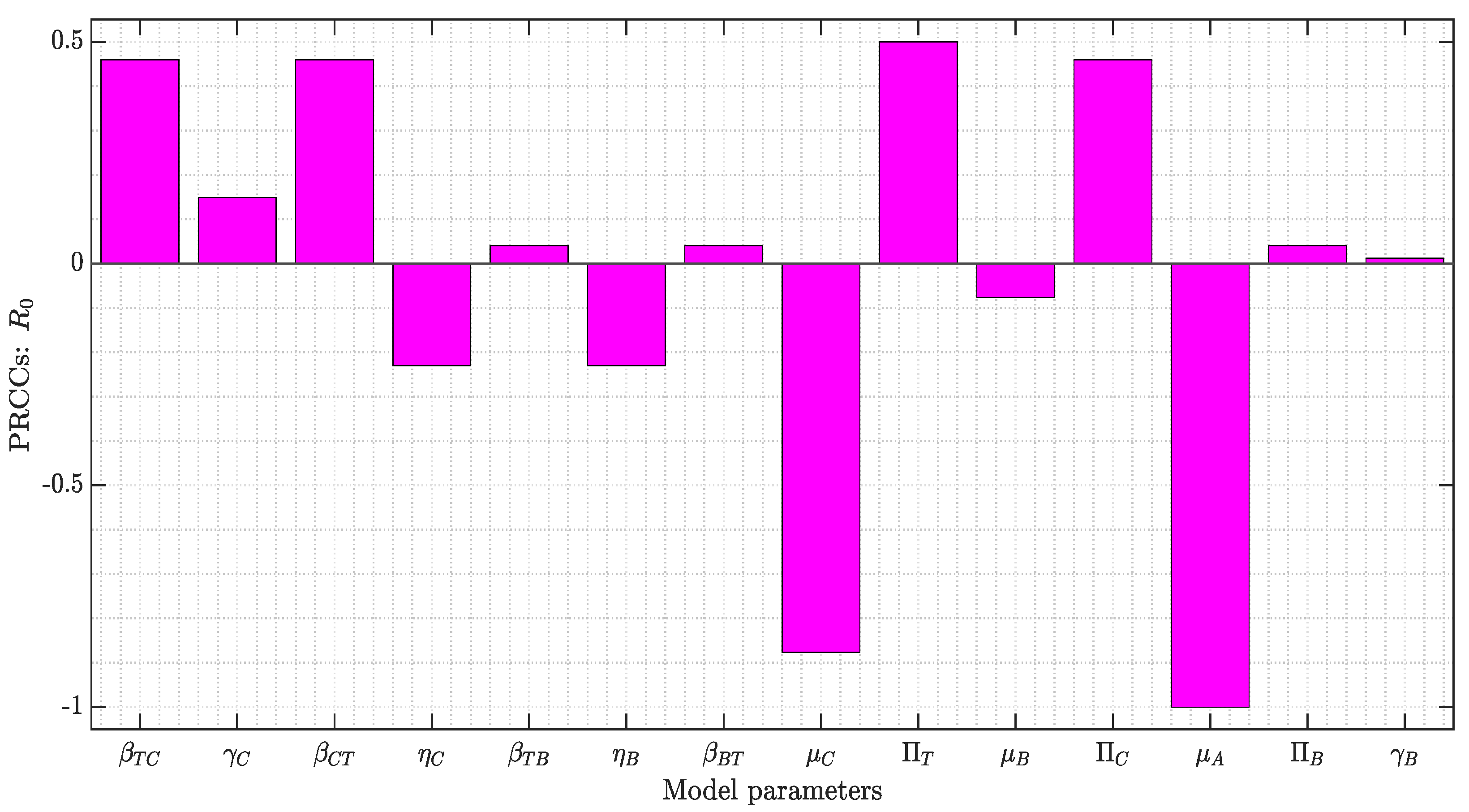
We employed the normalized forward sensitivity index to evaluate the relative importance of each parameter in the basic reproduction number, R 0 [33]. This approach allows us to assess the robustness of model predictions with respect to variations in parameter values. Baseline parameter values are provided in Table 1. The sensitivity analysis was conducted as follows: Let α i denote a parameter involved in the calculation of R 0 . Its sensitivity index is computed using the formula
Υ α i R 0 = R 0 α i × α i R 0 .
This index quantifies the proportional change in R 0 resulting from a proportional change in α i . The resulting sensitivity indices for the parameters are summarized in Table 4. A positive value indicates that an increase in the parameter, holding others constant, will lead to an increase in R 0 , signifying a direct relationship. Conversely, a negative sensitivity index suggests that increasing the parameter value will decrease R 0 , indicating an inverse relationship. This analysis provides critical insights into which parameters most significantly influence disease transmission dynamics and can inform targeted control strategies.
The results presented in Figure 2 demonstrate that the parameters β T C , β C T , Π B , β T B , β B T , Π T , Π C , Π B , and  γ B are positively correlated with the basic reproduction number, R 0 . Conversely, parameters such as μ B , μ A , μ C , η C , η B , d C , and  d B exhibit a negative correlation with R 0 . These findings suggest that effective control of ECF transmission in cattle populations should primarily focus on reducing infection rates—by limiting disease spread—and increasing tick mortality rates. Notably, a 10% increase in tick mortality corresponds to approximately a 10% reduction in R 0 , highlighting the potential impact of targeted tick control strategies. Overall, these insights emphasize the importance of integrated management approaches that address both host and vector dynamics to mitigate disease transmission effectively.

3.2. Population Level Simulation Results for the Deterministic Model

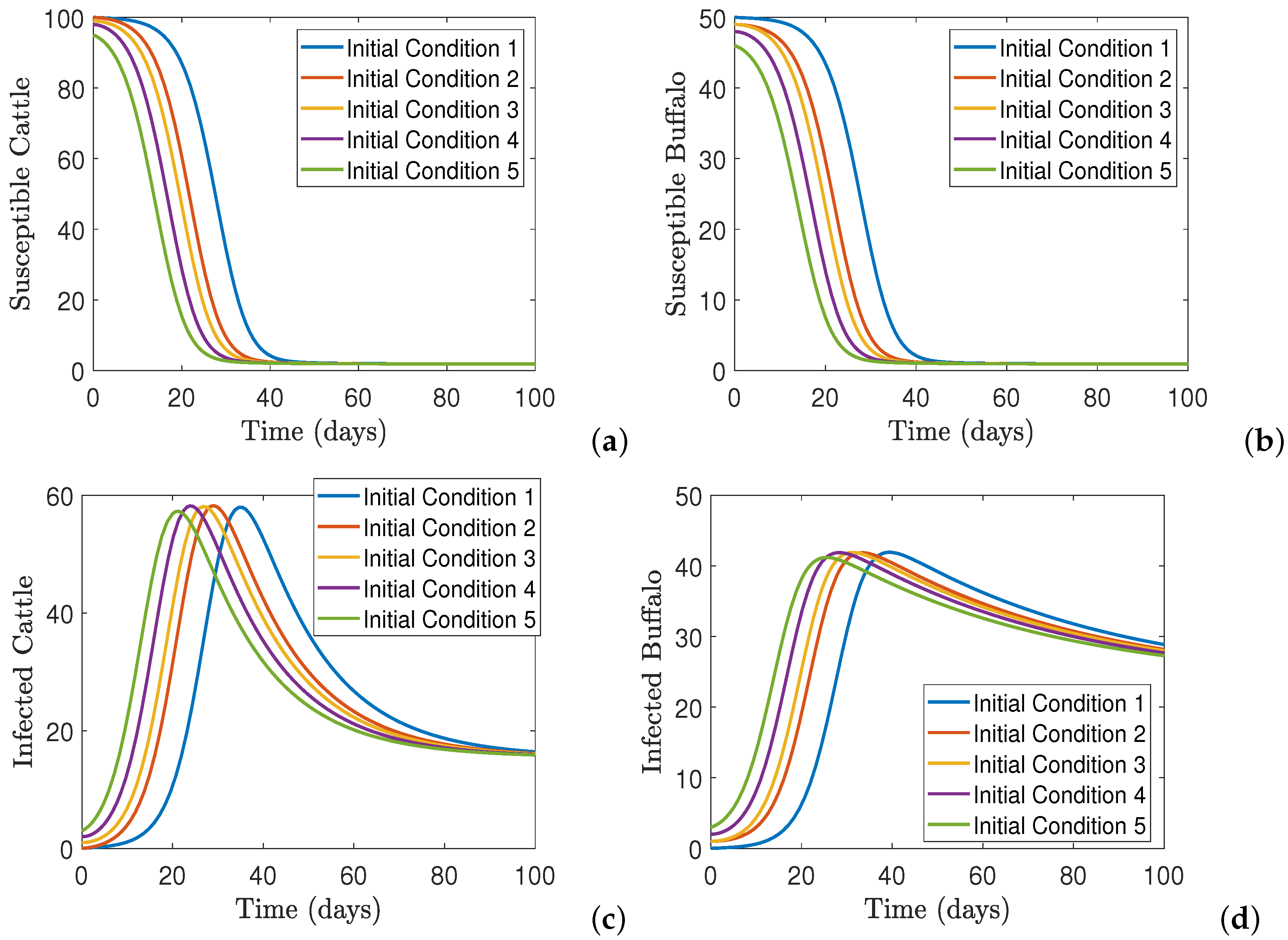
In this section, we present numerical results for the deterministic model (1)–(8). The simulations were conducted using MATLAB R2024a (The MathWorks, Natick, MA, USA). The parameter values used are listed in Table 1. The total cattle population was set at N C ( 0 ) = 100 , while the total populations for buffaloes and ticks were set at N B ( 0 ) = 50 and N T ( 0 ) = 1000 , respectively. These total populations were maintained throughout the simulations. For the infectious populations, four sets of initial conditions were considered as follows:
  • Initial condition 1: N C ( 0 ) = 100 , I C ( 0 ) = 0 , R C ( 0 ) = 0 , N B ( 0 ) = 50 , I B ( 0 ) = 0 , R B ( 0 ) = 0 , and  N T ( 0 ) = 999 , A I ( 0 ) = 1 .
  • Initial condition 2: N C ( 0 ) = 100 , I C ( 0 ) = 0 , R C ( 0 ) = 0 , N B ( 0 ) = 49 , I B ( 0 ) = 1 , R B ( 0 ) = 0 , and  N T ( 0 ) = 999 , A I ( 0 ) = 1 .
  • Initial condition 3: N C ( 0 ) = 99 , I C ( 0 ) = 1 , R C ( 0 ) = 0 , N B ( 0 ) = 49 , I B ( 0 ) = 1 , R B ( 0 ) = 0 , and  N T ( 0 ) = 999 , A I ( 0 ) = 1 .
  • Initial condition 4: N C ( 0 ) = 98 , I C ( 0 ) = 2 , R C ( 0 ) = 0 , N B ( 0 ) = 48 , I B ( 0 ) = 2 , R B ( 0 ) = 0 , and  N T ( 0 ) = 998 , A I ( 0 ) = 2 .
  • Initial condition 5: N C ( 0 ) = 95 , I C ( 0 ) = 3 , R C ( 0 ) = 2 , N B ( 0 ) = 46 , I B ( 0 ) = 3 , R B ( 0 ) = 1 , and  N T ( 0 ) = 990 , A I ( 0 ) = 10 .
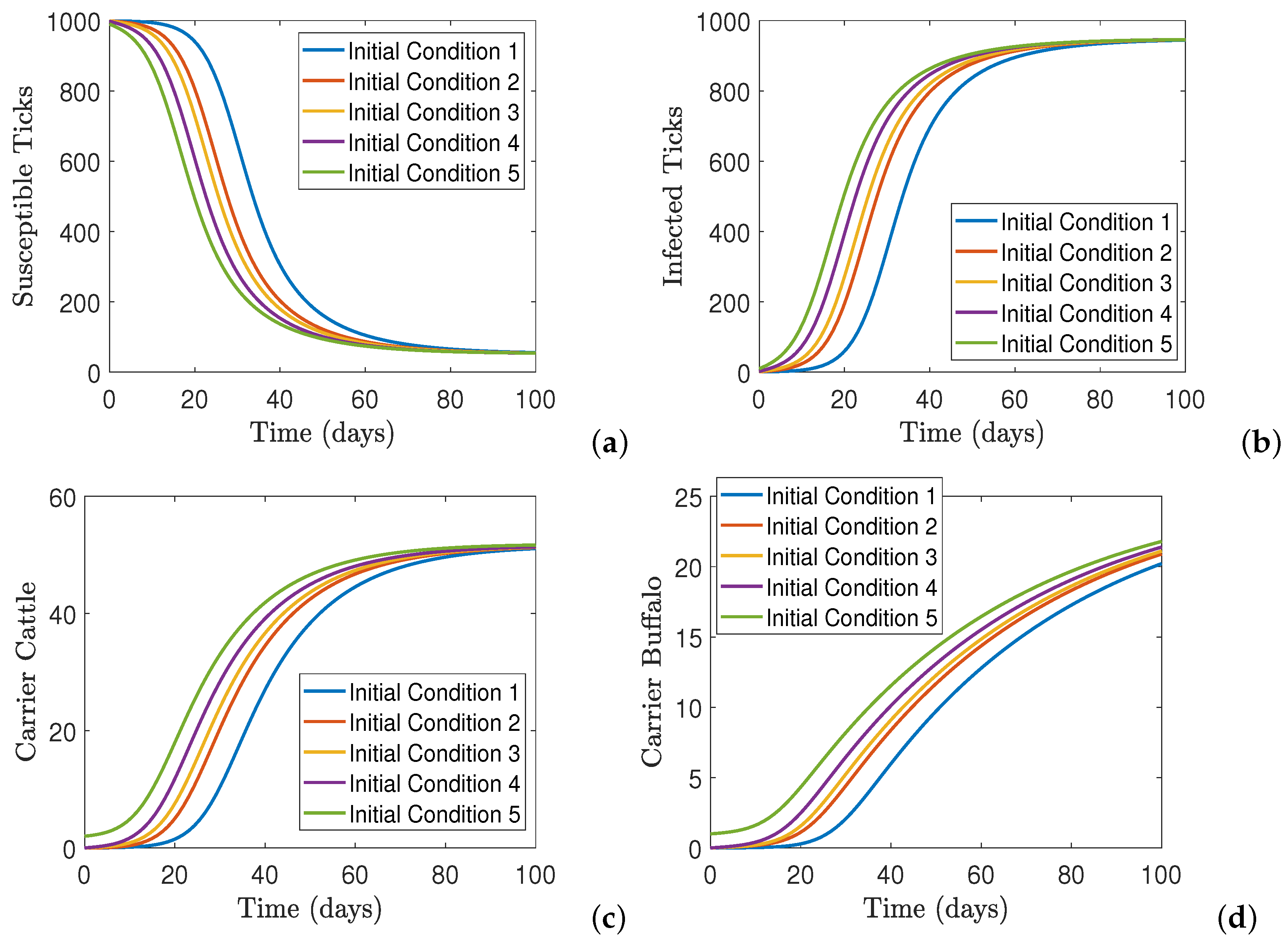
The simulation results are depicted in Figure 3 and Figure 4. The simulation results reveal an inverse relationship between susceptible and infected hosts. Specifically, the number of susceptible cattle decreases following infection events, eventually stabilizing after approximately 40 days (Figure 3a). A similar pattern is observed in susceptible buffaloes, whose numbers decline and stabilize after about 40 days, with the exact timing depending on initial conditions (Figure 3b). Conversely, the count of infected cattle initially increases, reaching a peak of approximately 59 infected individuals before declining to around 20 infected cattle (Figure 3c); thereafter, the infected cattle number stabilizes after 80 days. Infected buffaloes follow a similar trend, gradually increasing and reaching a peak after 40 days. Afterwards, the number gradually decreases and stabilizes after 60 days, again influenced by the initial conditions (Figure 3d). Overall, these dynamics suggest that as the populations of susceptible hosts diminish, the number of infected hosts rises to a peak, after which it declines slightly due to factors such as disease-induced mortality and recovery processes. These findings provide insight into the temporal progression of infection within host populations and are critical for understanding disease dynamics and informing control strategies.
Figure 4 presents the results of the deterministic model under various initial conditions. The simulations reveal that the susceptible adult tick population declines over time, eventually reaching a steady state after 60 days. Meanwhile, the infected adult tick population initially increases, reaching a peak around day 60 before stabilizing. The carrier cattle population (panel (c)) exhibits an increasing trend, stabilizing at approximately 50 carrier cattle. Similarly, the carrier buffalo population follows a comparable pattern (Figure 4b), showing a gradual increase throughout the simulation period. These findings highlight the temporal dynamics of tick infection and carrier host populations, providing insights into the progression and potential control points within the disease transmission cycle.

3.3. The CTMC Model Simulations

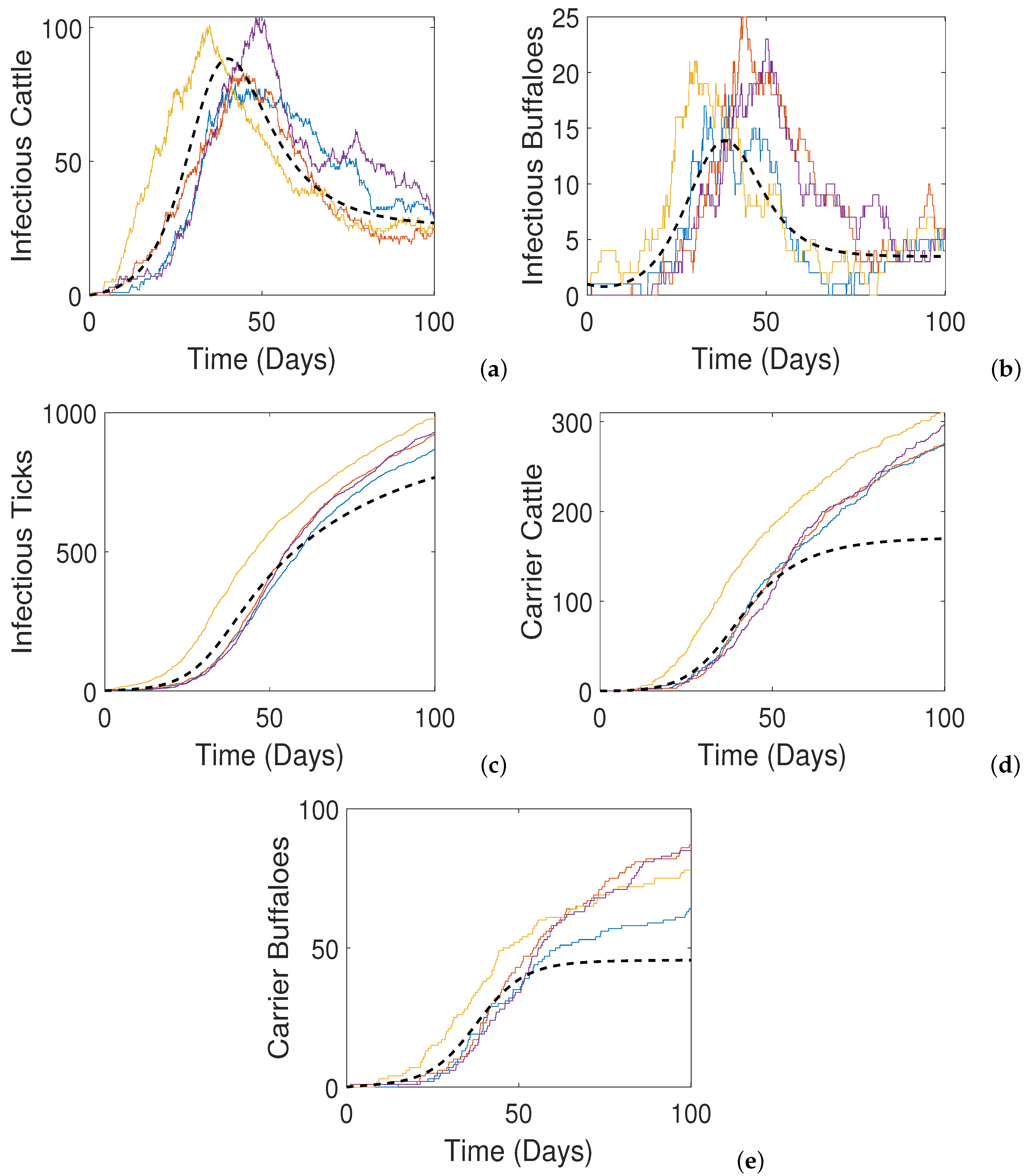
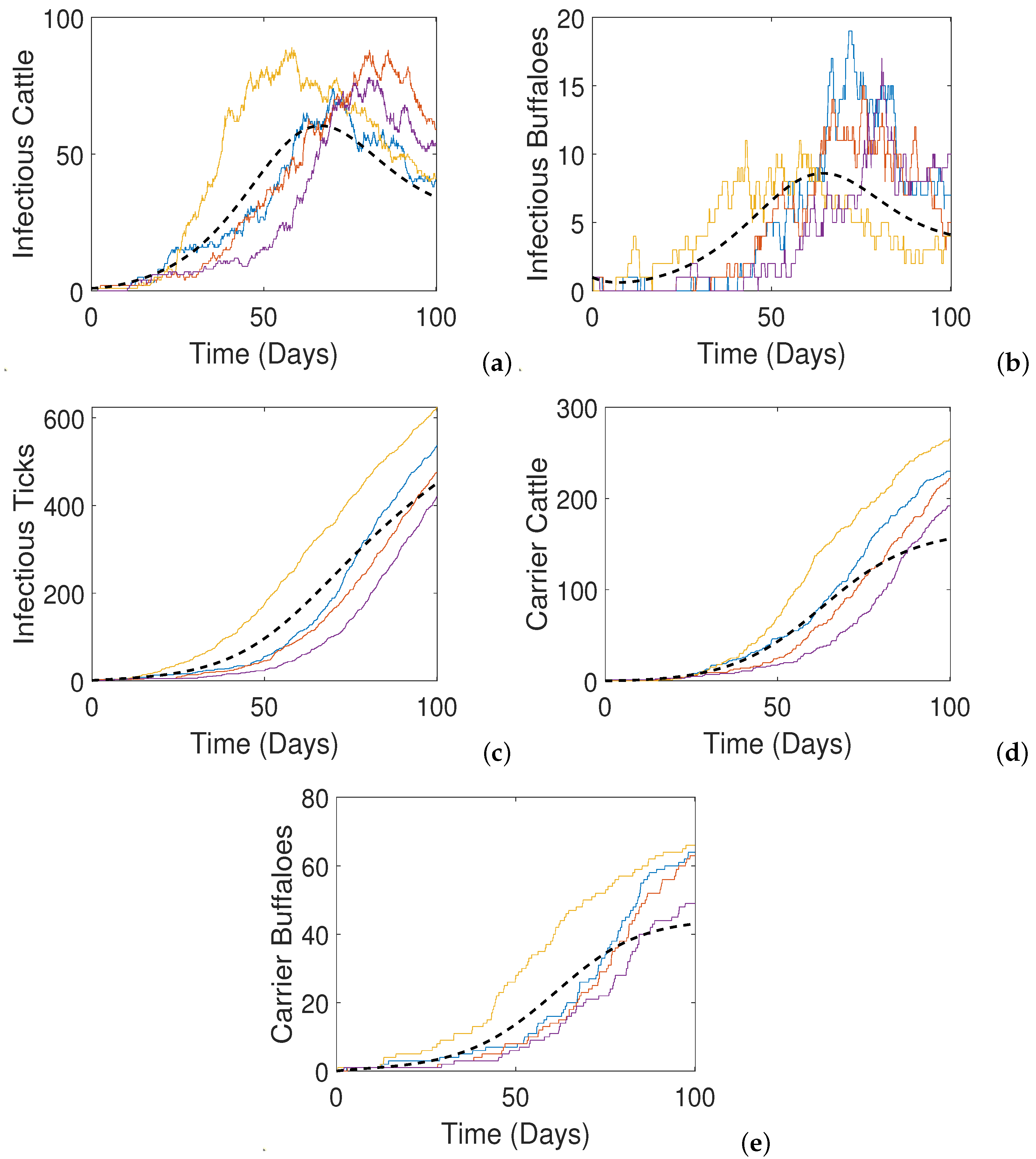
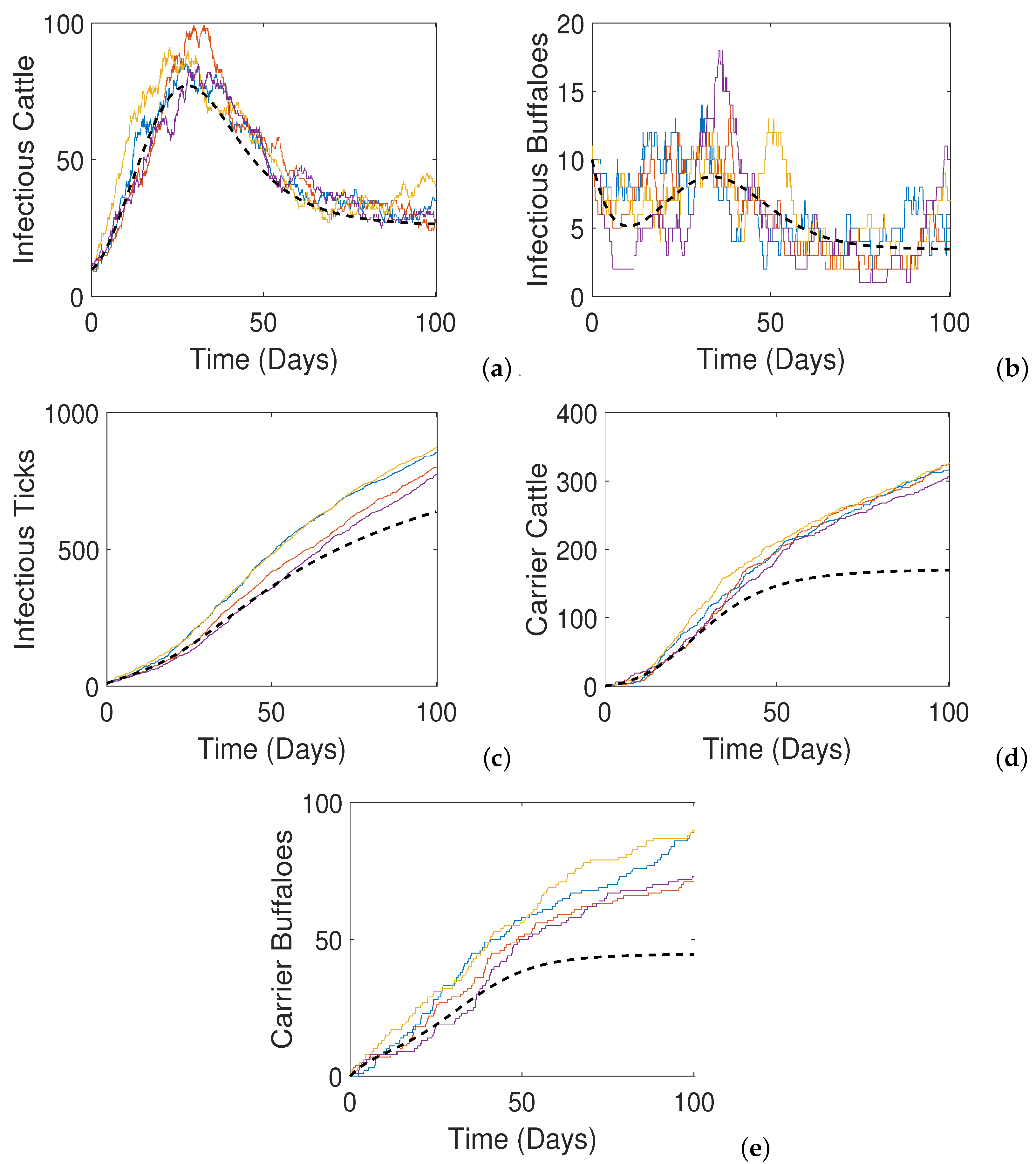
In this section, we analyze the dynamics of Epizootic Hemorrhagic Fever (ECF) using a Continuous-Time Markov Chain (CTMC) model. Throughout the simulations, the total host populations and parameter values remain constant. The initial conditions are set as follows: I C ( 0 ) = 10 , R C ( 0 ) = 5 , I B ( 0 ) = 10 , R B ( 0 ) = 5 , and  A I ( 0 ) = 10 . A total of 10,000 stochastic sample paths are generated to capture the variability inherent in the system. For comparison, deterministic numerical solutions are also computed and plotted simultaneously to illustrate the differences between stochastic and deterministic approaches.
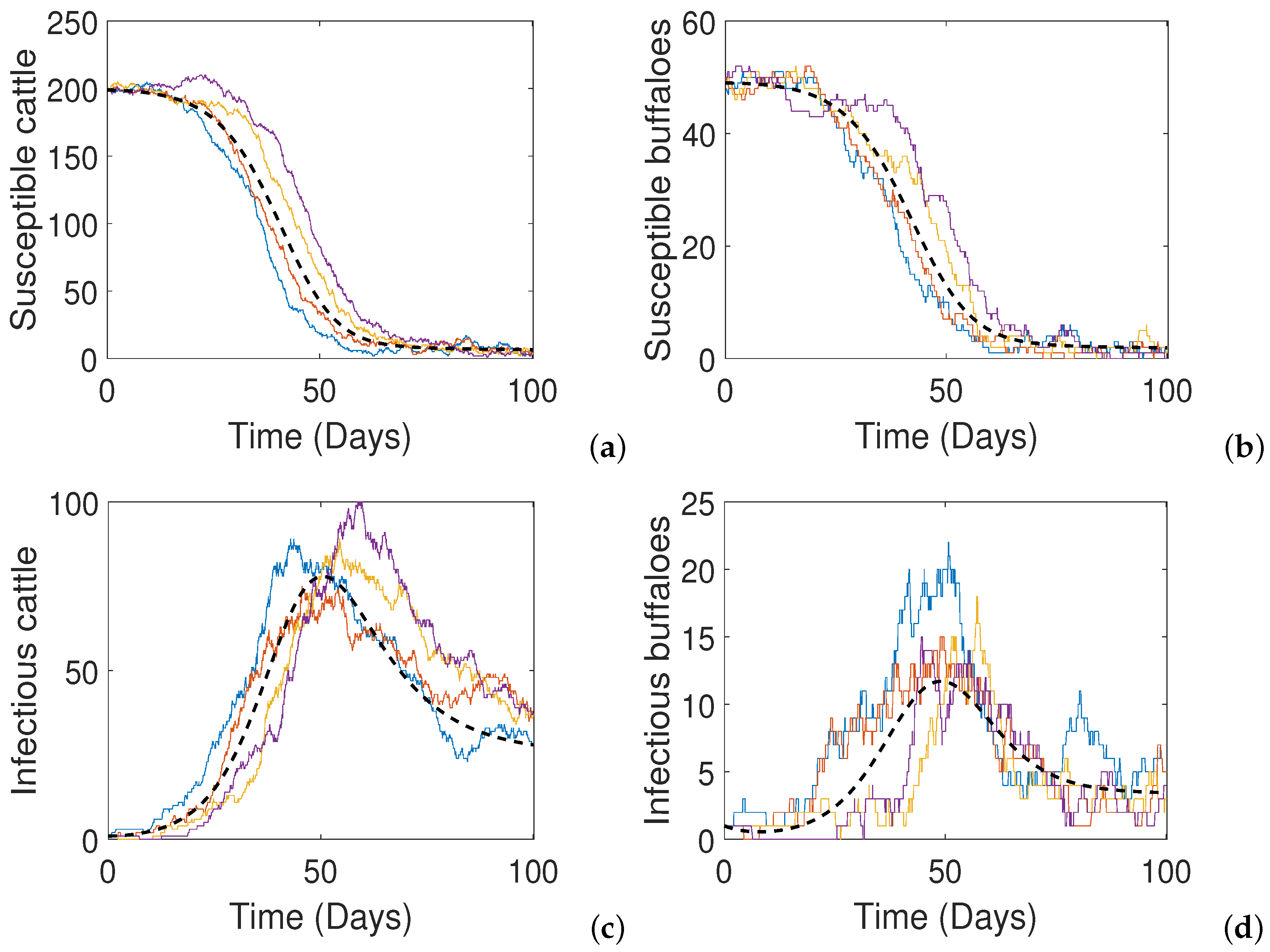
Figure 5 presents the simulation results for susceptible and infected populations of cattle and buffalo, showcasing both the stochastic CTMC model and the deterministic model. The dashed black curves represent the trajectories predicted by the deterministic model, while the solid curves depict the stochastic simulation outcomes. Specifically, plot (a) illustrates the dynamics of susceptible cattle, plot (b) shows susceptible buffalo populations, plot (c) depicts infected cattle, and plot (d) presents infected buffalo populations. These visualizations provide insights into the variability and expected trends of disease progression within the host populations, highlighting the influence of stochastic effects on disease dynamics.
Figure 5 illustrates the simulation results for both the deterministic and CTMC stochastic models, focusing on susceptible cattle and buffaloes as well as infectious cattle and buffaloes. The deterministic and stochastic trajectories exhibited close agreement for susceptible cattle and buffaloes, infectious cattle and infectious buffalo populations, indicating that the deterministic formulation adequately captured the average host infection dynamics.
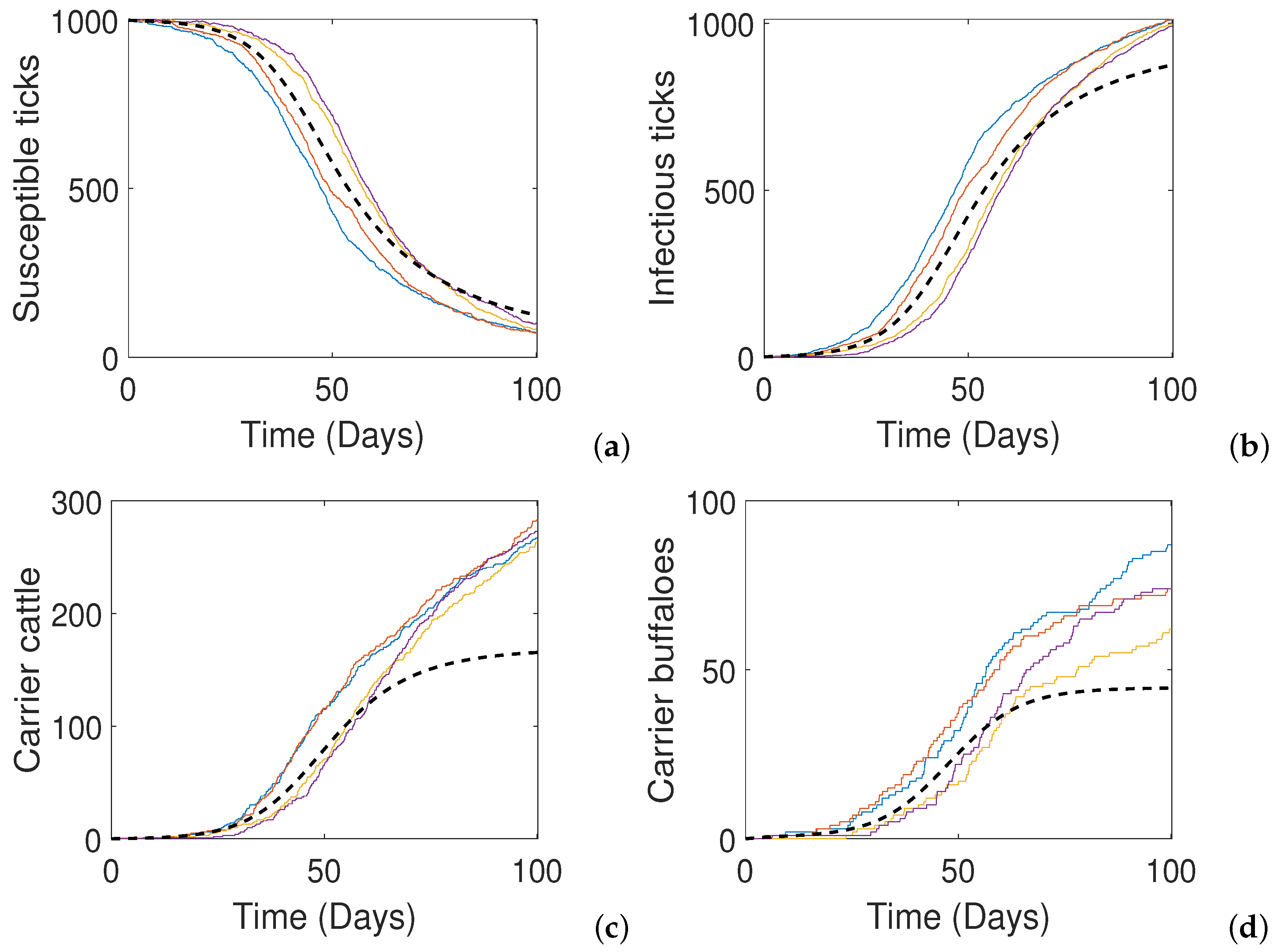
Meanwhile, Figure 6 presents the simulation results for recovered cattle and buffaloes, along with susceptible and infected ticks. The numerical simulations reveal that both the deterministic and CTMC stochastic models exhibit similar patterns, with the deterministic outputs representing the average values of disease propagation and the stochastic outputs capturing the inherent randomness of the system during the early stages of disease transmission; however, noticeable divergence emerged in the carrier cattle and carrier buffalo compartments after approximately 50 days of simulation. This behavior is attributable to the cumulative nature of the recovered carrier classes, which retain individuals over prolonged periods and therefore accumulate stochastic variability arising from random infection and recovery events. Since the carrier populations act as long-term reservoirs contributing to continued tick infection, small differences among stochastic realizations become progressively amplified over time. Furthermore, the relatively strong host-to-tick transmission rates enhance feedback interactions between hosts and vectors, thereby increasing stochastic fluctuations in the carrier compartments. The observed divergence therefore reflects the inherent demographic stochasticity associated with long-term reservoir dynamics in livestock-wildlife transmission systems and highlights limitations of deterministic models in capturing variability in persistent infection states. In deterministic models, disease outbreaks occur whenever R 0 > 1 , while disease extinction may occur when R 0 < 1 .

3.4. Probability of Disease Extinction or a Major Outbreak

Using the MATLAB fsolve function (MATLAB R2024a, The MathWorks, Natick, MA, USA), we numerically computed the disease extinction probability, P 0 , by solving the fixed-point equations of the multitype branching process given in Equation (12). The corresponding fixed point in ( 0 , 1 ) 5 was found to be ( x 1 , x 2 , x 3 , x 4 , x 5 ) = ( 0.03538 ,   0.02417 ,   0.01239 ,   0.02417 ,   0.02394 ) . To assess the accuracy of this theoretical prediction, P 0 was compared with the approximated extinction probability, P A , obtained from 10,000 sample paths of the ECF CTMC model. The quantity P A was estimated as the proportion of sample paths for which the total infected population, I C ( t ) + R C ( t ) + I B ( t ) + R B ( t ) + A I ( t ) , reached zero before the epidemic attained a predefined minimum outbreak size. As shown in Table 5, the values of P 0 and P A are in close agreement, indicating that the branching-process approximation provides an accurate estimate of the probability of disease extinction.
The results in Table 5 shows that analytical extinction probabilities derived from the probability generating function (PGF) framework were in close agreement with the stochastic CTMC estimates for all initial conditions considered. This agreement demonstrates the consistency between the theoretical branching-process approximation and the full stochastic simulation model, particularly during the early invasion phase when the number of infected individuals remains relatively small. The results also show that, for infectious individuals, P 0 is smaller if ECF disease is introduced by an infectious tick. Thus, a disease outbreak is likely if infectious ticks introduce the disease in an entirely susceptible cattle and buffalo population.
Furthermore, the probability of disease extinction is very small, indicating a high likelihood of an outbreak when infectious cattle, buffaloes, and ticks are present at the onset of the epidemic. Although a basic reproduction number satisfying R 0 > 1 implies that the disease can successfully invade the population, it does not guarantee persistence. In the CTMC model, the disease may either fade out or persist during the early stages of the epidemic. Unlike deterministic models, stochastic models permit disease extinction even when R 0 > 1 because of demographic stochasticity inherent in the transmission process. This feature represents one of the fundamental differences between deterministic and stochastic epidemic models [18,19,21]. These findings suggest that reducing tick abundance could substantially increase the likelihood of disease extinction and thereby limit ECF transmission. Consequently, intervention measures aimed at controlling tick populations, including acaricide application and pasture management strategies (habitat modification), may play an important role in ECF control, as reported by Walker et al. [12] and Chinyoka et al. [5].
Overall, the results demonstrate that extinction of East Coast fever is unlikely once infection becomes established simultaneously in hosts and vectors. The low extinction probabilities reflect the strong epidemiological coupling between cattle, buffaloes, and ticks, together with the contribution of carrier hosts to continued transmission. Furthermore, the close correspondence between the branching-process predictions and CTMC simulations validates the applicability of the PGF framework as a reliable analytical approximation for assessing early outbreak extinction dynamics in the ECF transmission system.
Figure 5 and Figure 6 illustrate disease persistence and extinction, respectively, in the CTMC model when ( R 0 > 1 ) . The deterministic and stochastic solutions are plotted on the same graphs for easy comparison.

3.5. Finite Time Extinction

Stochastic models are unique in that the finite-time to disease extinction can be estimated. This is a unique property that deterministic models do not exhibit [21]. The finite-time extinction corresponds to the time T until the number of infectious individuals asymptotically approaches zero [18,19]. The length of T depends on the initial number of infected individuals, the population size and the value of the basic reproduction number [19,21]. Table 6 illustrates the estimated finite-time extinctions for ECF, while Figure 7 shows the approximate distribution of T. The T values in Table 6 are estimated using 10,000 sample paths and the 95th percentile of end times as indicators of epidemic duration.
From Table 6, the probability of extinction is very small ( P 0 = 0.02100 ) when the disease is initiated by a infectious tick, however we note that this has the longest epidemic duration. In contrast, when the disease is initiated by infectious cattle, the probability of extinction is ( P e x t = 0.0330 ) , which is the largest but corresponds to the shortest epidemic duration. Thus, we note that the higher the probability of extinction, the shorter the epidemic duration.
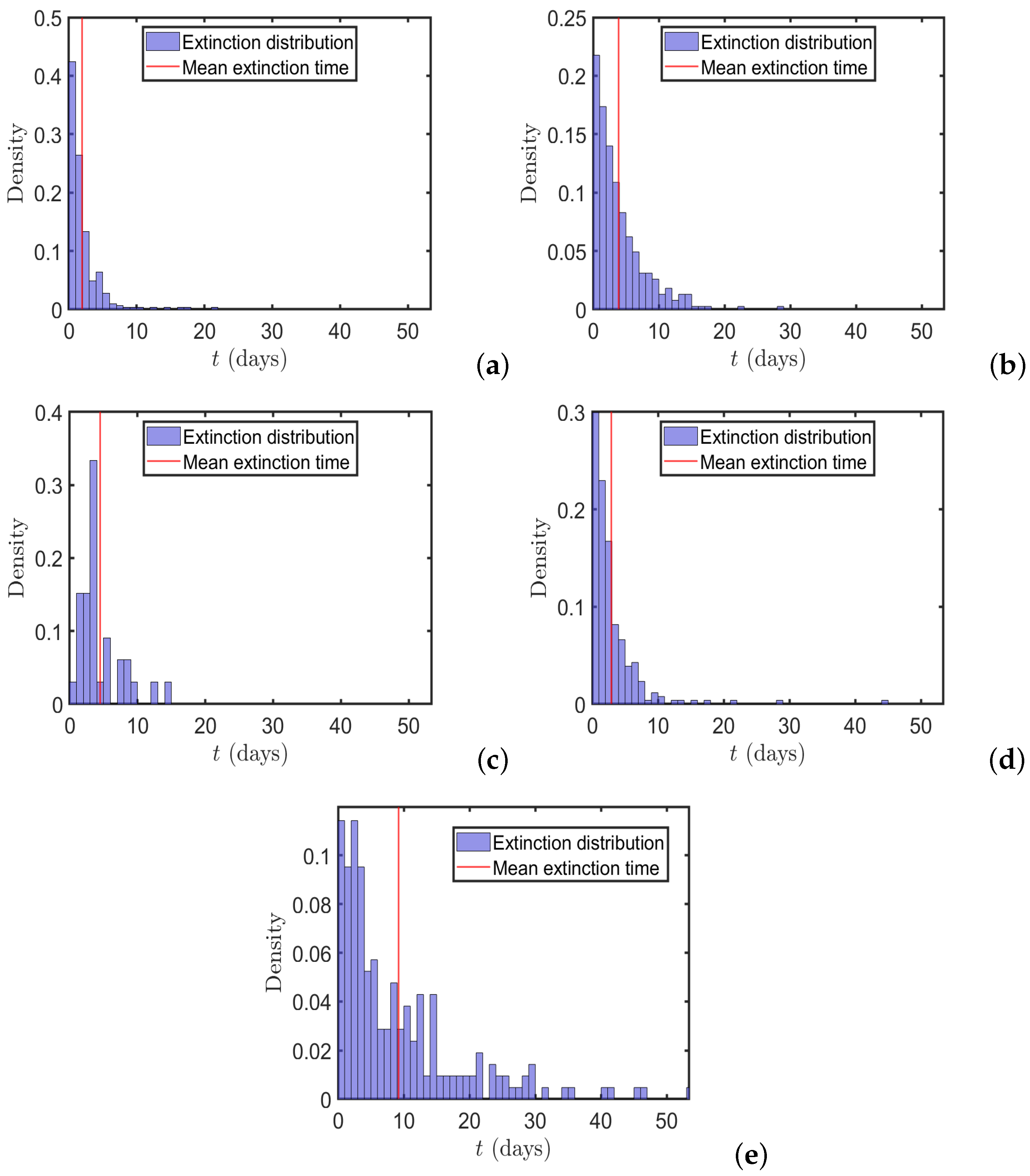
The time to extinction when any one of the infectious individuals is introduced was investigated using the Gillepie algorithm, and the results are displayed in Figure 7 as the conditional density function (pdf) of the time to extinction given that a disease extinction happens over the investigation time of 60 days. Each histogram is generated from 10,000 simulations of the CTMC model. From Figure 7a, it is very likely that the extinction occurs in the first 1.9 days when the infection is generated from one infectious cow ( I C ) . When infection is generated from one carrier cattle ( R C ) , extinction occurs in the first 3.9 days. When infection is generated from one infectious buffalo ( I B ) , extinction occurs in the first 4.5 days. When infection is generated from one carrier buffalo ( R B ) , extinction occurs in the first 2.9 days. When infection is generated from one infectious tick ( A I ) , extinction occurs in the first 9.2 days.

3.6. Effects of Demographic Parameters on the Probability of Disease Extinction or Outbreak

Demographic processes are fundamental determinants of the long-term dynamics of vector-borne diseases in host–vector systems. In stochastic settings, demographic parameters can substantially influence whether an infection persists or becomes extinct. Quantifying these effects provides important insights for the development of effective disease-control strategies, particularly those targeting host recruitment, population turnover, and vector survival. Accordingly, we examined the effects of initial population sizes, transmission rates, recovery rates, tick natural mortality rates, and host recruitment rates on the probability of disease extinction.

3.6.1. Effects of Initial Infectious Population Sizes on the Probability of Disease Extinction

In this subsection, we aim to investigate how the initial sizes of infected and recovered host populations influence the probabilities of disease extinction and outbreak. The probability of a disease outbreak is defined as the likelihood that the disease will spread extensively within the host population, while the probability of extinction reflects the likelihood that the disease will die out before causing widespread infection [21]. In addition to these probabilities, we will determine the mean outbreak size and the average time to disease extinction for various initial conditions.
This analysis will be conducted by varying the initial population sizes of infected cattle, infected buffaloes, and infected ticks across four distinct scenarios (cases 1 through 4), each characterized by increasing numbers of infected and carrier individuals among the hosts. Throughout all scenarios, the total host populations will remain constant at N C = 200 for cattle, N B = 50 for buffaloes, and N T = 1000 for ticks.
For case 1, we will calculate the probabilities of disease outbreak and extinction under the initial conditions ( S C , I C , R C , S B , I B , R B , A S , A I ) = ( N C 0 , 0 , 0 , N B 0 , 0 , 0 , N T 1 , 1 ) using the stochastic Gillespie algorithm applied to the CTMC model over a 100-day period. The results of this analysis are presented in Figure 8.
In the second, Case 2, we consider the initial conditions as follows: ( S C , I C , R C , S B , I B , R B , A S , A I ) = ( N C 0 , 0 , 0 , N B 1 , 1 , 0 , N T 1 , 1 ) . All other parameters were taken from Table 1.
In Case 3, the initial conditions were:
( S C , I C , R C , S B , I B , R B , A S , A I ) = ( N C 1 , 1 , 0 , N B 1 , 1 , 0 , N T 1 , 1 ) . All other parameters were taken from Table 1.
We further analyzed Case 4 with initial conditions described as follows:
( S C , I C , R C , S B , I B , R B , A S , A I ) = ( N C 10 , 10 , 0 , N B 10 , 10 , 0 , N T 10 , 10 ) . We want to investigate the effect of having a more infectious host on the dynamics. All other parameter values used are as given in Table 1.
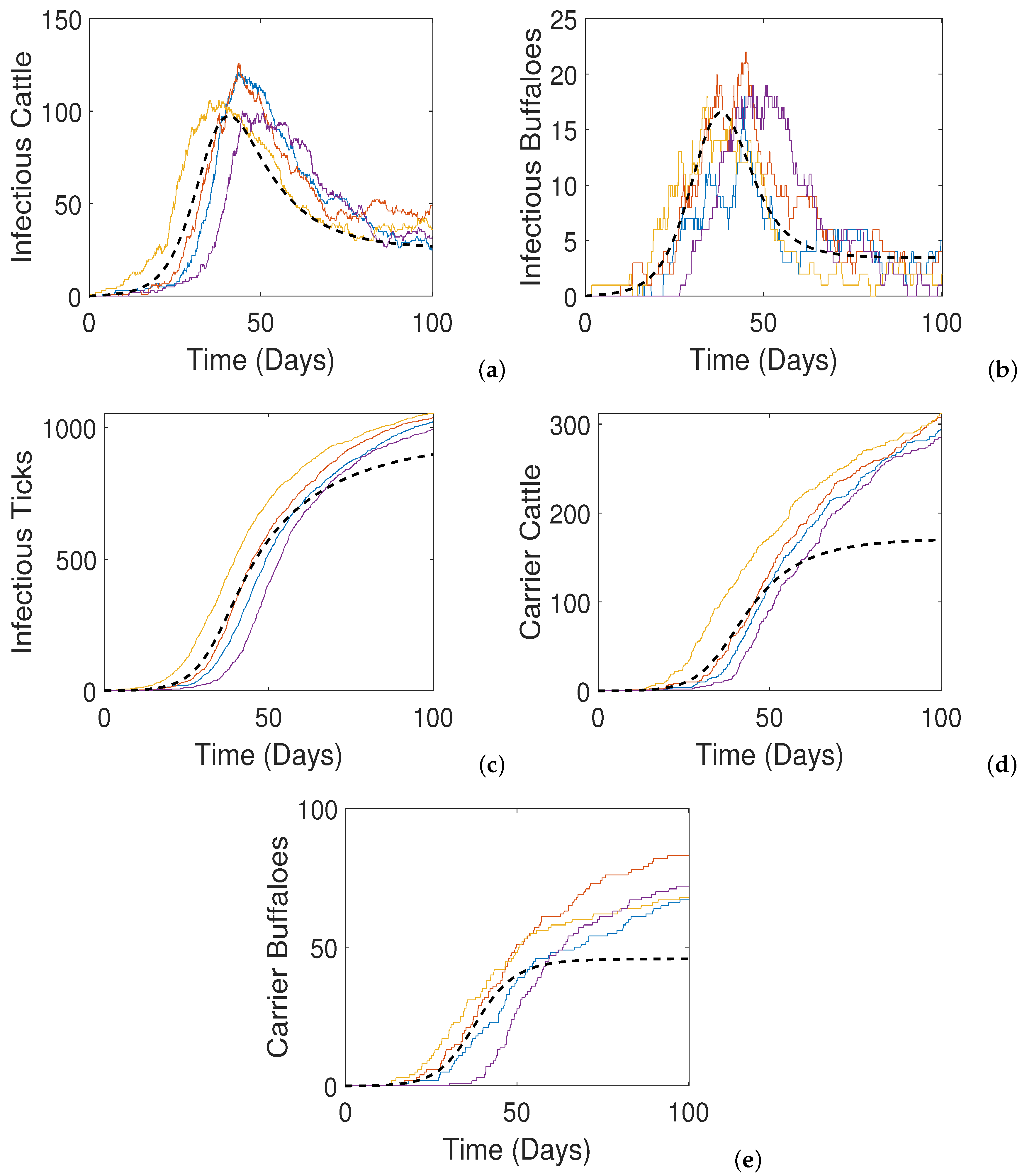
Our investigation demonstrated that all four scenarios, each with varying initial conditions, resulted in a high probability of disease outbreak. As shown in Figure 8a, both the deterministic and CTMC models predict an outbreak that persists throughout the entire observation period. This is evidenced by an initial increase in the number of infected cattle, peaking around day 50, followed by a decline and stabilization after day 60. In contrast, Figure 8b illustrates the dynamics for infected buffaloes, where the deterministic model also indicates a continuous outbreak; however, the CTMC model suggests periods of both extinction at the beginning and near the end of the observation period, with an outbreak occurring predominantly between days 30 and 60.
Furthermore, Figure 9a and Figure 9b show that both models predict an outbreak within the cattle and buffalo populations, respectively. Figure 9c illustrates the dynamics of infectious ticks and indicates that both models predict sustained transmission throughout the entire observation period. These results suggest that, under the current parameter values and initial conditions, disease extinction is highly unlikely and that disease persistence is the most probable outcome. The model dynamics further indicate that ECF is likely to spread persistently within the host–vector system, posing a significant transmission risk to cattle, buffalo, and tick populations. A similar pattern is observed in Figure 10, where the deterministic and stochastic simulations are in close agreement and consistently predict disease persistence across all panels (a–e).
In Figure 11, panels (a) and (b) show close agreement between the deterministic and stochastic models throughout the simulation period. However, in Figure 11d and Figure 11e, which represent carrier cattle and carrier buffaloes, respectively, the two models agree during the early stages of the epidemic but begin to diverge after approximately 30 days. In particular, the deterministic model increasingly deviates from the stochastic trajectories as the simulation progresses. This divergence between the deterministic and CTMC results can be attributed to demographic stochasticity and the random timing of events inherent in the CTMC framework. Because the carrier classes are generated through probabilistic transmission and recovery processes, stochastic fluctuations lead to variability around the average behavior predicted by the deterministic model.

3.6.2. Effects of Transmission Rates on the Probability of Disease Extinction or Outbreak

In this section, we investigate the impact of variations in the transmission rates between ticks and cattle—specifically, the tick-to-cattle transmission rate ( β T C ) and the cattle-to-tick transmission rate ( β C T )—on the probability of disease extinction or outbreak. Our goal is to elucidate how changes in these parameters influence the persistence and spread of the disease within both livestock and tick populations. Understanding these dynamics is essential for identifying threshold conditions that determine whether the disease will die out or become endemic, thereby informing more effective control and eradication strategies. The analysis reveals the sensitivity of disease outcomes to fluctuations in transmission rates and highlights critical parameter ranges for successful intervention. The results of this investigation are summarized in Table 7 and Table 8, providing valuable insights into the transmission thresholds and potential control points for managing ECF transmission.
Our results demonstrate that decreasing transmission rates significantly enhances the likelihood of disease extinction, whereas increasing these rates reduces the probability of elimination. This trend can be attributed to the fundamental role of transmission dynamics in disease persistence; specifically, lower transmission rates decrease the probability of ticks infecting hosts, thereby reducing overall infection prevalence within host populations. This reduction in infection prevalence diminishes the potential for sustained transmission cycles, ultimately increasing the chances of disease extinction. These findings underscore the importance of targeting transmission pathways in disease control strategies and provide valuable insights into the mechanisms governing pathogen persistence and eradication.

3.6.3. Effects of Recovery Rate of Cattle ( γ C ) and Mortality Rate of Ticks ( μ A ) on the Probability of Disease Extinction or Outbreak

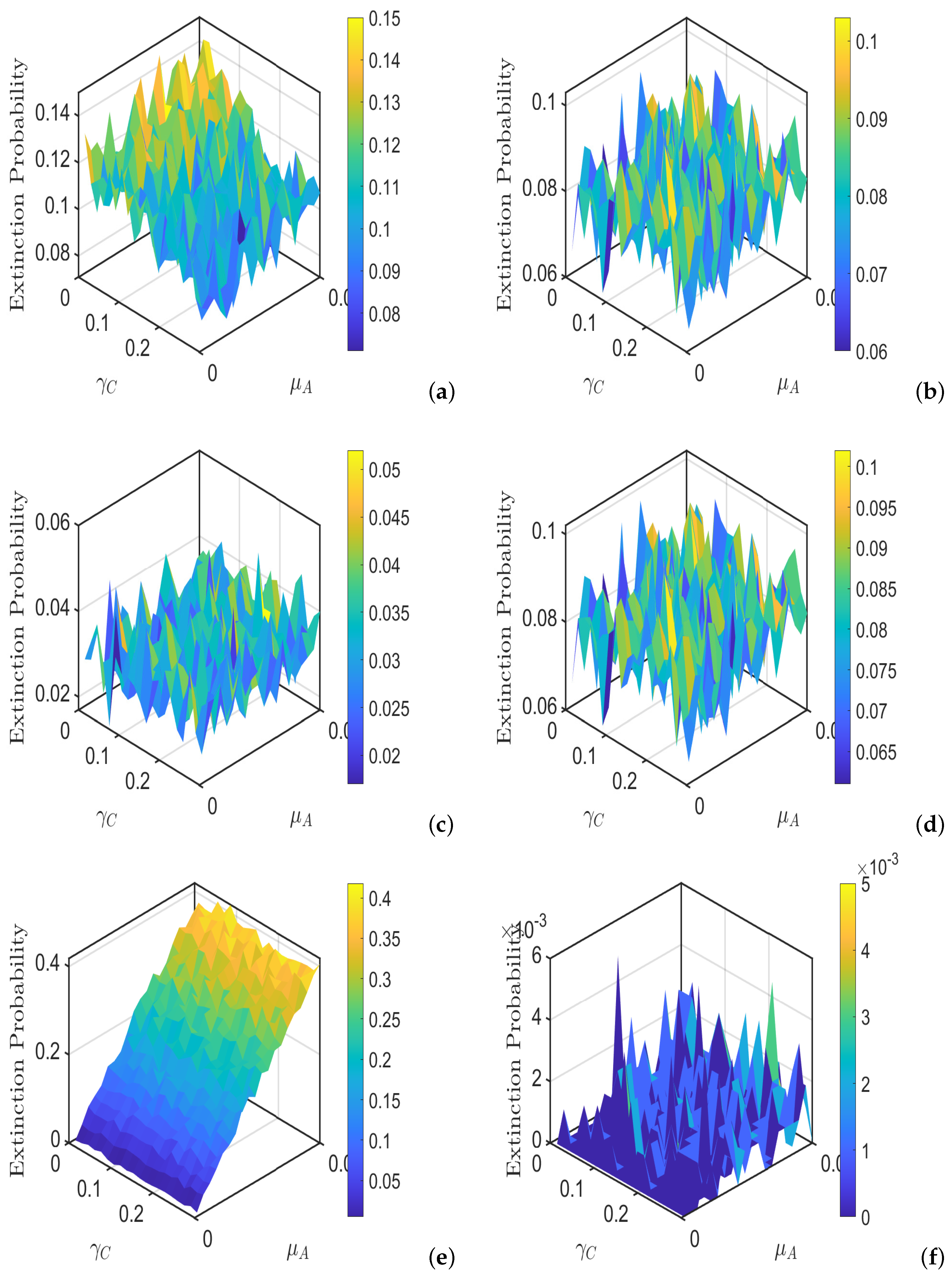
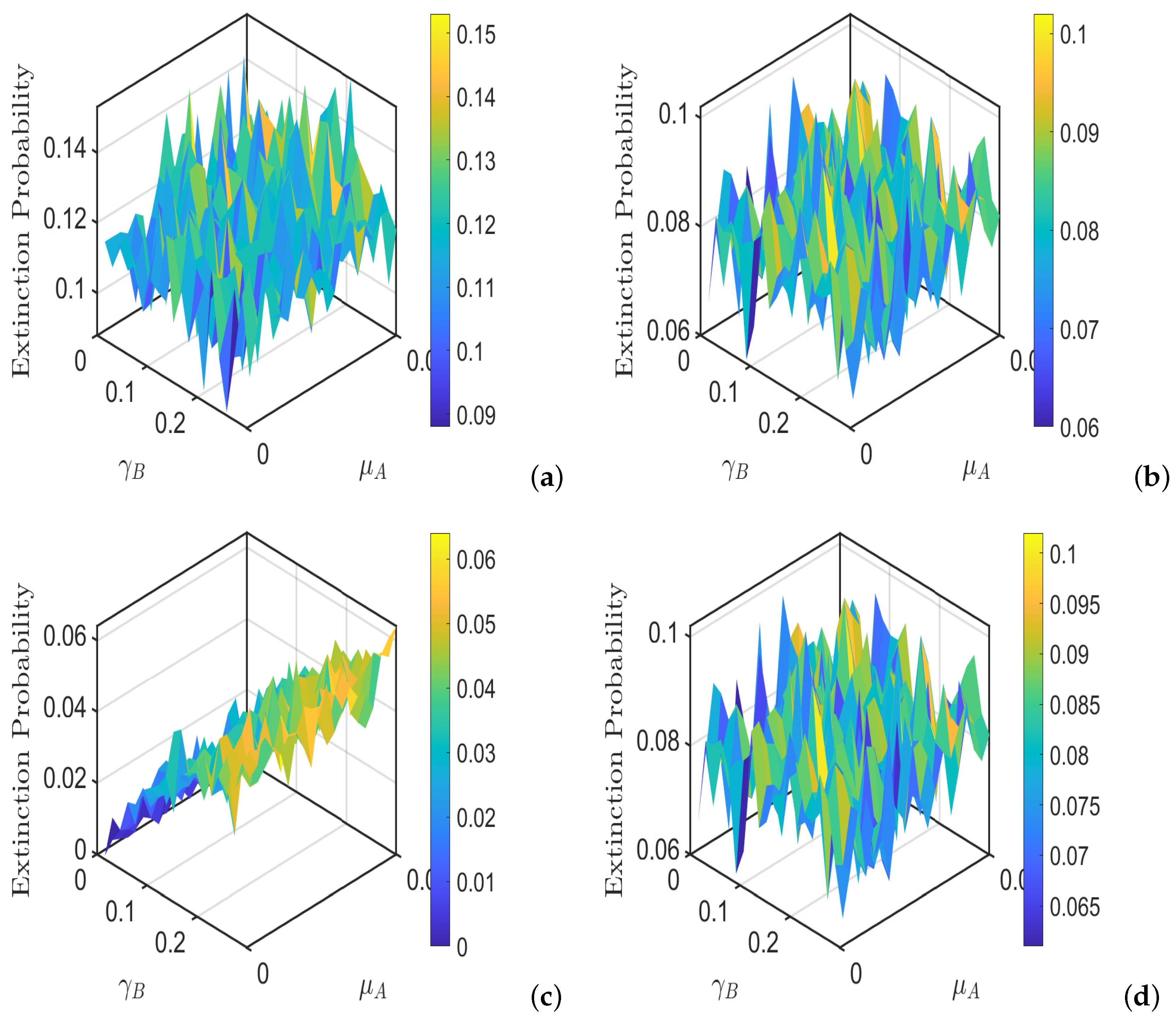
We investigated the impact of cattle recovery rates on tick mortality and their combined effect on the probability of disease extinction or outbreak. The results, illustrated in Figure 12, were derived using a branching process approximation to model the stochastic dynamics of disease transmission. Across all examined parameter ranges, a consistent pattern emerged: increasing the cattle recovery rate and tick mortality significantly decreases the probability of a disease outbreak. Conversely, higher values of these parameters substantially increase the likelihood of disease eradication. These findings suggest that interventions aimed at enhancing cattle recovery, such as effective treatment protocols, and increasing tick mortality through targeted control measures, could serve as effective strategies for controlling the spread of the disease and promoting its elimination. This underscores the importance of integrated control approaches that focus on both host recovery and vector mortality to mitigate disease persistence and outbreaks.

3.6.4. Effects of Recovery Rate of Buffaloes ( γ B ) and Mortality Rate of Ticks ( μ A ) on the Probability of Disease Extinction or Outbreak

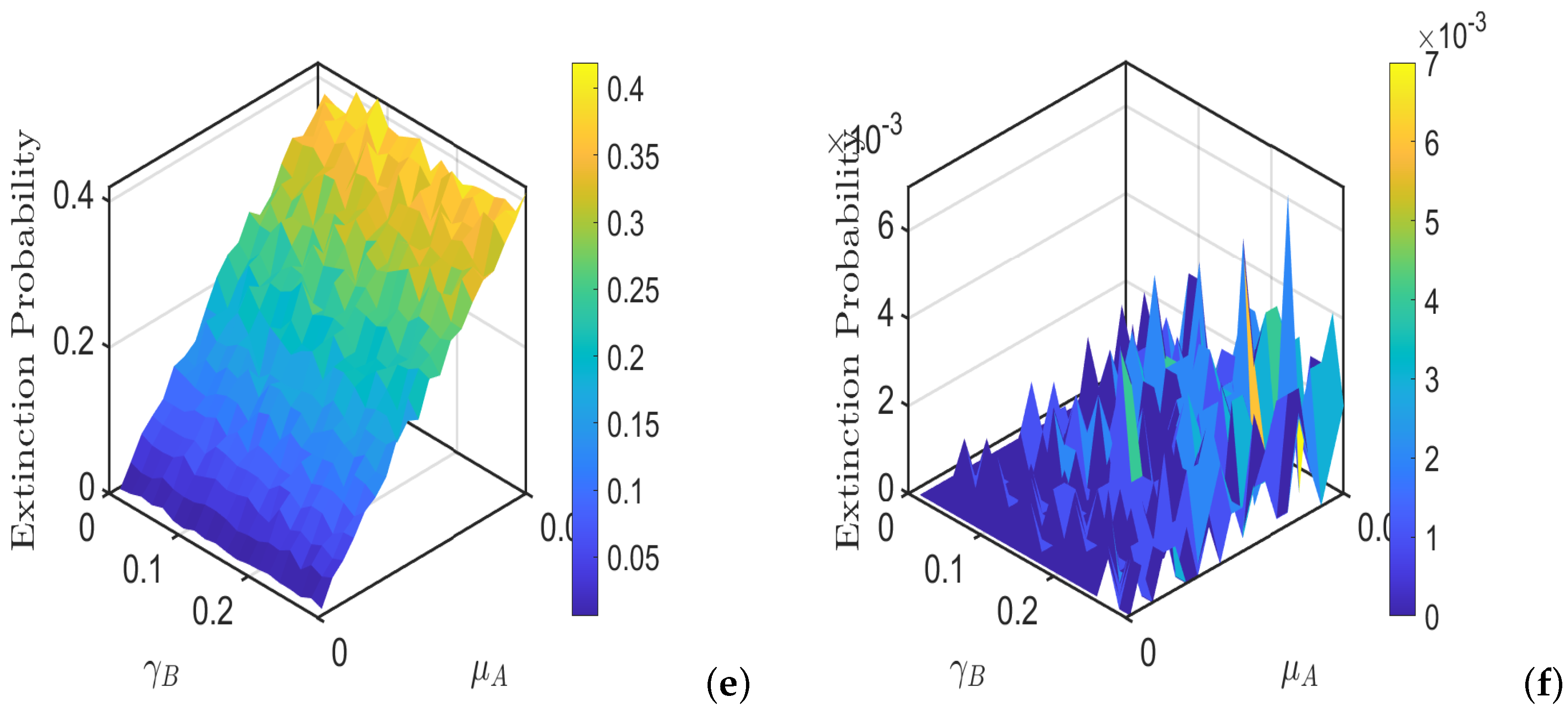
In a manner similar to Figure 12, we examined the influence of buffalo recovery on the mortality of ticks and its subsequent effect on the probability of disease extinction or outbreak. The results of this analysis are illustrated in Figure 13. Multiple initial conditions for the infectious classes were considered, and six distinct scenarios were evaluated. Consistent with the observations in Figure 12, the analysis indicates that the probability of an outbreak increases as the buffalo recovery rate ( γ B ) and the natural mortality rate of ticks ( μ A ) decrease. Furthermore, the surface plots in Figure 13 distinguish whether an outbreak is initiated by the host (buffalo or cattle) or by the tick vector. A comparison with Figure 13a–e highlights this distinction: when an outbreak is initiated by a single infected cow (Figure 13a), increasing the cattle recovery rate ( γ B ) is particularly effective in reducing the probability of an outbreak, especially when the tick mortality rate is low. Conversely, when the outbreak originates from the tick vector (Figure 13e), enhancing the tick mortality rate ( μ A ) proves to be a more effective strategy for decreasing the likelihood of disease emergence. These findings suggest that tailored control strategies may be necessary depending on the initial source of infection, emphasizing the importance of identifying the primary origin of outbreaks to optimize intervention efforts.

3.6.5. Effects of Recruitment Rates ( Π C ) and ( Π B ) on the Probability of Disease Extinction or Outbreak

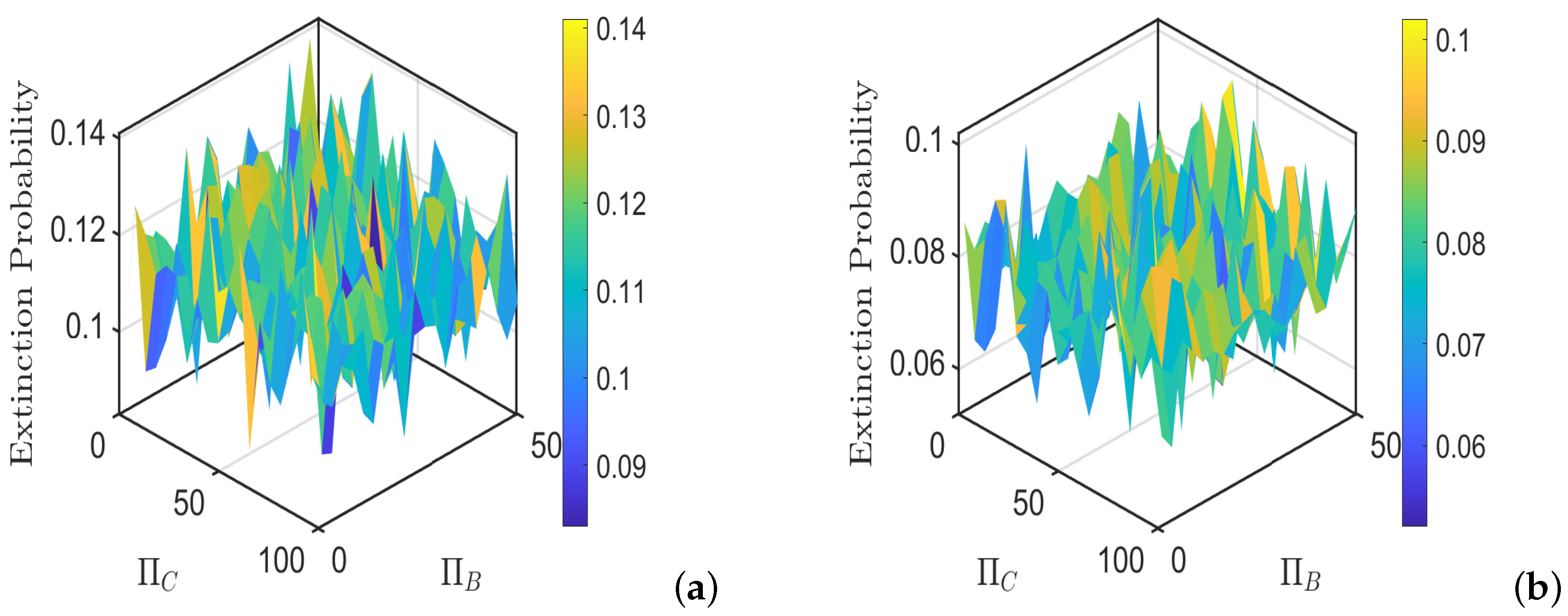
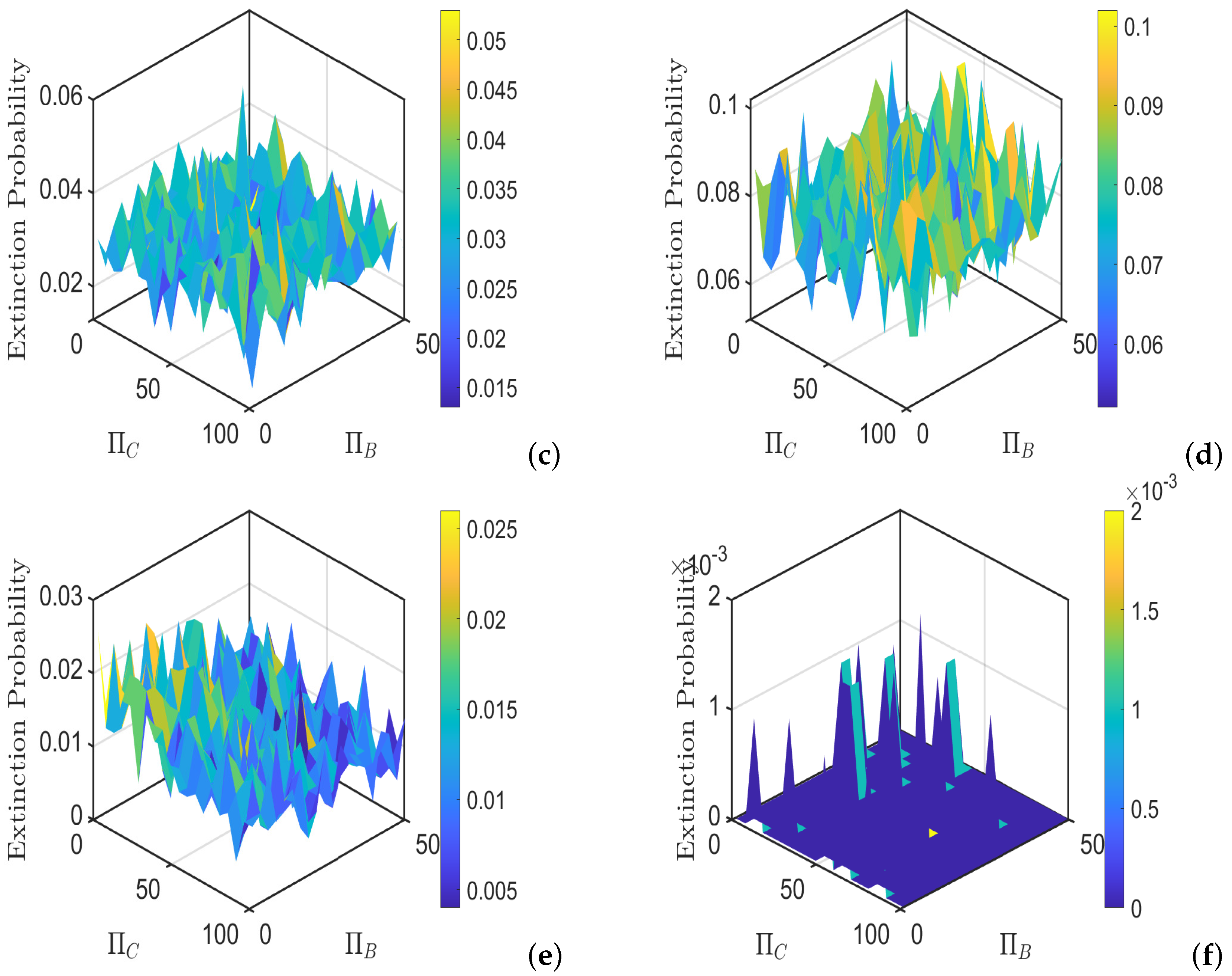
We examined the influence of recruitment rates of both cattle and buffaloes on the probability of disease extinction or outbreak. The results of this analysis are illustrated in Figure 14. Multiple initial conditions for the infectious classes were considered, and six distinct scenarios were evaluated. The results show that increasing recruitment of both hosts (cattle and buffaloes) results in lowering the probability of disease extinction and reducing recruitment of host populations increases the probability of disease extinction. This finding has important implications for the control and long-term management of East Coast fever in stochastic settings. Biologically, recruitment continuously introduces new susceptible hosts into the population, thereby sustaining the host-tick transmission cycle. Consequently, high recruitment rates enhance disease persistence, while reduced recruitment increases the likelihood of stochastic fade-out and eventual extinction of the disease. Overall, the findings suggest that sustainable control of East Coast fever requires not only reducing transmission through tick control and treatment, but also managing host population dynamics, especially the recruitment and movement of cattle and buffaloes.

4. Conclusions

This study investigated the transmission dynamics of East Coast fever (ECF) in cattle and buffalo populations within a livestock-wildlife interface, employing both deterministic differential equation models and stochastic continuous-time Markov chain (CTMC) frameworks. Initially, we calculated the basic reproduction number, R 0 , within the deterministic model and examined its relationship to key parameters, such as tick mortality rate and transmission coefficients. Consistent with prior research [5], our findings demonstrate that increasing the tick mortality rate significantly diminishes the transmission potential of ECF, highlighting its role as a critical control parameter.
Subsequently, we extended the deterministic model into a stochastic CTMC formulation, which incorporates inherent uncertainties and random fluctuations in the transmission process. This stochastic approach provides a more nuanced and realistic depiction of disease dynamics, capturing variability that deterministic models may overlook. Comparative analysis revealed that both modeling frameworks produced similar solution patterns, thereby validating the robustness of our deterministic analysis while emphasizing the stochastic model’s ability to account for randomness in outbreak trajectories.
To assess disease persistence versus extinction, we utilized the next-generation matrix approach and multitype branching process theory to compute R 0 and the spectral radius ρ ( M ) , respectively. The deterministic model predicts that ECF will tend to die out if R 0 < 1 and may result in an outbreak if R 0 > 1 . Moreover, when both R 0 < 1 and ρ ( M ) < 1 , the probability of disease extinction becomes high. Conversely, parameters exceeding these thresholds suggest a greater likelihood of disease persistence. Compared to previous deterministic models [5,6,7,8,9,10,11,12,13], our stochastic framework offers a more realistic representation of transmission dynamics in shared grazing environments. Importantly, it allows for exploration of how variations in host and vector populations, as well as transmission rates, influence outbreak or extinction probabilities—factors that deterministic models cannot adequately capture.
Our analysis further revealed that the probability of ECF outbreak or extinction is highly sensitive to host and vector population sizes, tick feeding behavior, and the mode of disease introduction. Specifically, increased tick feeding activity elevates transmission rates and consequently the risk of outbreaks, whereas reduced feeding behavior diminishes this risk. These findings are aligned with Horton and Robertson [14], who demonstrated that vector feeding rates, host abundance, and vector density critically influence disease persistence and outbreak potential in multi-host systems. Notably, we observed that the introduction of a single infected cow results in a high probability of disease extinction, whereas introductions via infected buffalo or ticks substantially lower this probability—a pattern consistent with their findings.
Despite these insights, our framework could be further refined by incorporating seasonal effects. Prior research indicates that climatic factors such as rainfall and temperature significantly influence tick population dynamics [34]. These environmental variables affect vector persistence and, consequently, disease transmission potential. Investigating seasonal variations could therefore enhance understanding of how environmental fluctuations impact the likelihood of ECF extinction or emergence, providing valuable information for optimizing timing and strategies of control interventions.

Author Contributions

Conceptualization, M.C., G.M. and S.M.; methodology, M.C., G.M. and S.M.; validation, S.M., P.J. and A.M.; formal analysis, M.C.; investigation, G.M., M.H., S.M. and P.J.; data curation, M.C.; writing—original draft, M.C., M.H., S.M. and P.J.; writing—review & editing, M.C., G.M., M.H., S.M., P.J. and A.M.; visualization, M.H. and S.M.; supervision, G.M. and S.M.; project administration, G.M.; funding acquisition, M.C., S.M. and A.M. All authors have read and agreed to the published version of the manuscript.

Funding

This research received no external funding.

Data Availability Statement

The original contributions presented in this study are included in the article. Further inquiries can be directed to the corresponding authors.

Acknowledgments

Authors are grateful to three anonymous reviewers for their invaluable comments and suggestions, which greatly improved the presentation of this paper. The views, opinions, assumptions or any other information expressed in this article are solely those of the authors. Additionally, all the authors are grateful to their respective institutions for the support during preparation of the manuscript.

Conflicts of Interest

The authors declare that they have no competing interests.

References

  1. Norval, R.A.I.; Lawrence, J.A.; Young, A.S.; Perry, B.D.; Dolan, T.T.; Scott, J. Theileria parva: Influence of vector, parasite and host relationships on the epidemiology of theileriosis in southern Africa. Parasitology 1991, 102, 347–356. [Google Scholar] [CrossRef]
  2. de la Fuente, J.; Sobrino, I.; Villar, M. Design and evaluation of vaccines for the control of the etiological agent of East Coast fever. Parasites Vectors 2024, 17, 479. [Google Scholar] [CrossRef]
  3. Gashirai, T.B.; Musekwa-Hove, S.D.; Lolika, P.O.; Mushayabasa, S. Global stability and optimal control analysis of a foot-and-mouth disease model with vaccine failure and environmental transmission. Chaos Solitons Fractals 2020, 132, 109568. [Google Scholar] [CrossRef]
  4. Gilioli, G.; Baumgärtner, J. Parameter estimation for an eco-epidemiological model of Brown Ear Tick (Rhipicephalus appendiculatus, Acari: Ixodidae) transmitted East Coast Fever in African livestock. Boll. Zool. Agrar. Bachic. 2009, 41, 21–40. Available online: https://www.cabidigitallibrary.org/doi/full/10.5555/20093205417 (accessed on 13 March 2026).
  5. Chinyoka, M.; Muchatibaya, G.; Jambwa, P.; Masocha, M.; Mushayabasa, S. Assessing the potential impact of livestock immunisation and acaricide use on controlling the spread of East Coast fever. Parasite Epidemiol. Control. 2024, 25, e00357. [Google Scholar] [CrossRef]
  6. Tardy, O.; Acheson, E.S.; Bouchard, C.; Chamberl, É.; Fortin, A.; Ogden, N.H.; Leighton, P.A. Mechanistic movement models to predict geographic range expansions of ticks and tick-borne pathogens: Case studies with Ixodes scapularis and Amblyomma americanum in eastern North America. Ticks Tick-Borne Dis. 2023, 14, 102161. [Google Scholar] [CrossRef] [PubMed]
  7. Norman, R.A.; Worton, A.J.; Gilbert, L. Past and future perspectives on mathematical models of tick-borne pathogens. Parasitology 2016, 143, 850–859. [Google Scholar] [CrossRef] [PubMed]
  8. Medley, G.F.; Perry, B.D.; Young, A.S. Preliminary analysis of the transmission dynamics of Theileria parva in eastern Africa. Parasitology 1993, 106, 251–264. [Google Scholar] [CrossRef] [PubMed]
  9. Nah, K.; Magpantay, F.M.G.; Bede-Fazekas, A.; Röst, G.; Trajer, A.J.; Wu, X.; Zhang, X.; Jianhong, W. Assessing systemic and non-systemic transmission risk of tick-borne encephalitis virus in Hungary. PLoS ONE 2019, 14, e0217206. [Google Scholar] [CrossRef] [PubMed]
  10. Gilioli, G.; Groppi, M.; Vesperoni, M.P.; Baumgärtner, J.; Gutierrez, A.P. An epidemiological model of East Coast Fever in African livestock. Ecol. Model. 2009, 220, 1652–1662. [Google Scholar] [CrossRef]
  11. Mwambi, H.G.; Baumgärtner, J.; Hadeler, K.P. Ticks and tick-borne diseases: A vector-host interaction model for the brown ear tick. Stat. Methods Med. Res. 2000, 9, 279–301. [Google Scholar]
  12. Walker, J.G.; Klein, E.Y.; Levin, S.A. Disease at the wildlife-livestock interface: Acaricide use on domestic cattle does not prevent transmission of a tick-borne pathogen with multiple hosts. Vet. Parasitol. 2014, 199, 206–214. [Google Scholar] [CrossRef]
  13. Ostfeld, R.S.; Brunner, J.L. Climate change and Ixodes tick-borne diseases of humans. Philos. Trans. R. Soc. B 2015, 370, 20140051. [Google Scholar] [CrossRef]
  14. Horton, E.B.; Robertson, S.L. A stochastic multi-host model for West Nile virus transmission. J. Biol. Dyn. 2024, 18, 2293780. [Google Scholar] [CrossRef] [PubMed]
  15. Simpson, J.E.; Hurtado, P.J.; Medlock, J.; Molaei, G.; Andreadis, T.G.; Galvani, A.P.; Diuk-Wasser, M.A. Vector host-feeding preferences drive transmission of multi-host pathogens: West Nile virus as a model system. Proc. R. Soc. B 2012, 279, 925–933. [Google Scholar] [CrossRef] [PubMed]
  16. Robertson, S.L.; Caillouët, K.A. Host stage-structured model of enzootic West Nile virus transmission to explore the effect of avian stage-dependent exposure to vectors. J. Theor. Biol. 2016, 399, 33–42. [Google Scholar] [CrossRef]
  17. Ditlevsen, S.; Samson, A. Introduction to stochastic models in biology. In Stochastic Biomathematical Models: With Applications to Neuronal Modeling; Springer: Berlin/Heidelberg, Germany, 2013; pp. 3–35. [Google Scholar]
  18. Lahodny, G.E.; Allen, L.J.S. Probability of a disease outbreak in stochastic multipatch epidemic models. Bull. Math. Biol. 2013, 75, 1157–1180. [Google Scholar] [CrossRef] [PubMed]
  19. Maliyoni, M.; Chirove, F.; Gaff, H.D.; Govinder, K.S. A stochastic tick-borne disease model: Exploring the probability of pathogen persistence. Bull. Math. Biol. 2017, 79, 1999–2021. [Google Scholar] [CrossRef]
  20. Allen, L.J.S. An introduction to stochastic epidemic models. In Mathematical Epidemiology; Springer: Berlin/Heidelberg, Germany, 2008; pp. 81–130. [Google Scholar]
  21. Allen, L.J.S.; van den Driessche, P. Relations between deterministic and stochastic thresholds for disease extinction in continuous- and discrete-time infectious disease models. Math. Biosci. 2013, 243, 99–108. [Google Scholar] [CrossRef]
  22. Kermack, W.O.; McKendrick, A.G. Contributions to the mathematical theory of epidemics—II. The problem of endemicity. Biol. Bull. 1991, 53, 57–87. [Google Scholar]
  23. Norval, R.I.; Perry, B.D.; Young, A.S. The Epidemiology of Theileriosis in Africa; Academic Press: London, UK, 1992. [Google Scholar]
  24. McKeever, D.J. Bovine immunity—A driver for diversity in Theileria parasites? Trends Parasitol. 2009, 25, 269–276. [Google Scholar] [CrossRef] [PubMed]
  25. Diekmann, O.; Heesterbeek, J.A.P.; Metz, J.A.J. On the definition and the computation of the basic reproduction ratio R0 in models for infectious diseases in heterogeneous populations. J. Math. Biol. 1990, 28, 365–382. [Google Scholar] [CrossRef]
  26. Van den Driessche, P.; Watmough, J. Reproduction numbers and sub-threshold endemic equilibria for compartmental models of disease transmission. Math. Biosci. 2002, 180, 29–48. [Google Scholar] [CrossRef]
  27. Gachohi, J.; Skilton, R.; Hansen, F.; Ngumi, P.; Kitala, P. Epidemiology of East Coast fever (Theileria parva infection) in Kenya: Past, present and the future. Parasites Vectors 2012, 5, 194. [Google Scholar] [CrossRef] [PubMed]
  28. Randolph, S.E.; Rogers, D.J. A generic population model for the African tick Rhipicephalus appendiculatus. Parasitology 1997, 115, 275–279. [Google Scholar] [CrossRef]
  29. Randolph, S.E. Tick ecology: Processes and patterns behind the epidemiological risk posed by ixodid ticks as vectors. Parasitology 2004, 129, S37–S65. [Google Scholar] [CrossRef] [PubMed]
  30. Reynolds, L.; Metz, T.; Kiptarus, J. Smallholder dairy production in Kenya. World Anim. Rev. 1996, 87, 66–73. [Google Scholar]
  31. Gitau, G.K.; Perry, B.D.; McDermott, J.J. The incidence, calf morbidity and mortality due to Theileria parva infections in smallholder dairy farms in Murang’a District, Kenya. Prev. Vet. Med. 1999, 39, 65–79. [Google Scholar] [CrossRef]
  32. Bebe, B.O.; Udo, H.M.J.; Rowlands, G.J.; Thorpe, W. Smallholder dairy systems in the Kenya highlands: Cattle population dynamics under increasing intensification. Livest. Prod. Sci. 2003, 82, 211–221. [Google Scholar] [CrossRef]
  33. Arriola, L.M.; Hyman, J.M. Being sensitive to uncertainty. Comput. Sci. Eng. 2007, 9, 10–20. [Google Scholar] [CrossRef]
  34. Ogden, N.H.; Bigras-Poulin, M.; O’Callaghan, C.J.; Barker, I.K.; Lindsay, L.R.; Maarouf, A.; Smoyer-Tomic, K.E.; Waltner-Toews, D.; Charron, D. A dynamic population model to investigate effects of climate on geographic range and seasonality of the tick Ixodes scapularis. Int. J. Parasitol. 2005, 35, 375–389. [Google Scholar] [CrossRef]
Figure 1. Schematic diagram of an East Coast fever (ECF) transmission model with carrier infectivity and host heterogeneity. Susceptible cattle ( S C ) and susceptible buffaloes ( S B ) (green) become infected through contact with infectious ticks ( A I ) (red), moving to the infectious classes ( I C ) , ( I B ) (red), and subsequently recover into carrier classes ( R C ) , ( R B ) (orange). The tick population is divided into susceptible ticks ( A S ) (green) and infectious ticks ( A I ) (red), with infection acquired from both infectious and carrier hosts. Solid blue arrows indicate transitions between compartments, while dashed red arrows represent transmission pathways between hosts and ticks. Recruitment into each population is denoted by ( Π C ) , ( Π B ) and ( Π T ) , natural mortality by ( μ C ) , ( μ B ) and ( μ A ) , and disease-induced mortality by d C and d B . Colors distinguish epidemiological states: green (susceptible), red (infectious), and orange (carrier).
Mathematics 14 02054 g001
Figure 2. Simulation results on sensitivity analysis of R 0 with respect to key model parameters.
Mathematics 14 02054 g002
Figure 3. Simulation results for susceptible and infected cattle and buffalo population, showing dynamics of the deterministic model under varying initial conditions. Initial conditions were as follows: I C ( 0 ) = 1 , R C ( 0 ) = 0 , I B ( 0 ) = 1 , R B ( 0 ) = 0 , and A I ( 0 ) = 1 . Plot (a) depicts the dynamics of susceptible cattle. Plot (b) shows the dynamics of susceptible buffaloes. Plot (c) demonstrates the dynamics of infected cattle, and lastly, plot (d) shows the dynamics of infected buffaloes.
Mathematics 14 02054 g003
Figure 4. Simulation results for susceptible ticks, infectious tick population, and carrier cattle and buffalo populations, showing dynamics for the deterministic model under varying initial conditions. Plot (a) depicts the dynamics of susceptible ticks. Plot (b) shows the dynamics of infected ticks. Plot (c) demonstrates the dynamics of carrier cattle, and lastly, plot (d) shows the dynamics of carrier buffaloes.
Mathematics 14 02054 g004
Figure 5. Simulation results for susceptible and infected cattle and buffalo population showing both the deterministic model and the stochastic model. The dashed black curves represent the population levels for the deterministic model and the solid curves represent population levels for the CTMC stochastic model. Plot (a) depicts the dynamics of susceptible cattle. Plot (b) shows the dynamics of susceptible buffaloes. Plot (c) demonstrates the dynamics of infected cattle, and lastly, plot (d) shows the dynamics of infected buffaloes.
Mathematics 14 02054 g005
Figure 6. Simulation results for carrier cattle and buffalo populations, susceptible ticks and infectious tick population showing both the deterministic model and the stochastic model. The black dashed curves represent the population levels for the deterministic model and the other curves represent population levels for the stochastic model. Plot (a) depicts the dynamics of susceptible ticks. Plot (b) shows the dynamics of infected ticks. Plot (c) demonstrates the dynamics of carrier cattle, and lastly, plot (d) shows the dynamics of carrier buffaloes.
Mathematics 14 02054 g006
Figure 7. Approximate probability distribution for the time of disease extinction T for the CTMC model when the disease is introduced by infectious cattle, carrier cattle, infectious buffalo, carrier buffalo, and an infectious tick (see histogram (a)), with initial condition ( I C ( 0 ) = 1 , R C ( 0 ) = 0 , I B ( 0 ) = 0 , R B ( 0 ) = 0 , A I ( 0 ) = 0 ) , (b) ( I C ( 0 ) = 0 , R C ( 0 ) = 1 , I B ( 0 ) = 0 , R B ( 0 ) = 0 , A I ( 0 ) = 0 ) , (c) ( I C ( 0 ) = 0 , R C ( 0 ) = 0 , I B ( 0 ) = 1 , R B ( 0 ) = 0 , A I ( 0 ) = 0 ) , (d) ( I C ( 0 ) = 0 , R C ( 0 ) = 0 , I B ( 0 ) = 0 , R B ( 0 ) = 1 , A I ( 0 ) = 0 ) , and (e) ( I C ( 0 ) = 0 , R C ( 0 ) = 0 , I B ( 0 ) = 0 , R B ( 0 ) = 0 , A I ( 0 ) = 1 ) . The probability of disease extinction P 0 and T for each graph are presented in Table 6. This histogram is generated using 10,000 sample paths. All the other parameter values are as given in Table 1.
Mathematics 14 02054 g007
Figure 8. Comparison of the deterministic model solutions (black dashed curve) and the four sample paths of the CTMC model illustrating an outbreak or extinction when the disease is initiated by a tick. The parameter values used are as given in Table 1. The initial conditions are I C ( 0 ) = R C ( 0 ) = I B ( 0 ) = R B ( 0 ) = 0 and A I ( 0 ) = 1 . The total population for host populations N C = 200 , N B = 100 and N T = 1000 . Plot (a) shows the dynamics of infected cattle ( I C ) and an outbreak is predicted that lasts for the entire period under investigation. Plot (b) shows dynamics of infected buffaloes ( I B ) , plot (c) shows the dynamics of infected ticks ( μ A ) , plot (d) shows the dynamics of carrier cattle ( R C ) , and lastly, plot (e) shows the dynamics of carrier buffaloes ( R B ) .
Mathematics 14 02054 g008
Figure 9. Comparison of the deterministic model solutions (black dashed curve) and the four sample paths of the CTMC model illustrating an outbreak or extinction when the disease is initiated by one infectious buffalo and a tick. The parameter values used are as given in Table 1. The initial conditions are I C ( 0 ) = R C ( 0 ) = R B ( 0 ) = 0 and I B ( 0 ) = A I ( 0 ) = 1 . The total population for host populations N C = 200 , N B = 100 and N T = 1000 . Plot (a) shows the dynamics of infected cattle ( I C ) . Plot (b) shows dynamics of infected buffaloes ( I B ) , plot (c) shows the dynamics of infected ticks ( A I ) , plot (d) shows the dynamics of carrier cattle ( R C ) , and lastly, plot (e) shows the dynamics of carrier buffaloes ( R B ) .
Mathematics 14 02054 g009
Figure 10. Comparison of the deterministic model solutions (black dashed curve) and the four sample paths of the CTMC model illustrating an outbreak or extinction when the disease is initiated by one infectious cattle, an infectious buffalo and a tick. The parameter values used are as given in Table 1. The initial conditions are I C ( 0 ) = I B ( 0 ) = A I ( 0 ) = 1 and R C ( 0 ) = R B ( 0 ) = 0 . The total population for host populations N C = 200 , N B = 100 and N T = 1000 . Plot (a) shows the dynamics of infected cattle ( I C ) . Plot (b) shows dynamics of infected buffaloes ( I B ) , plot (c) shows the dynamics of infected ticks ( A I ) , plot (d) shows the dynamics of carrier cattle ( R C ) , and lastly, plot (e) shows the dynamics of carrier buffaloes ( R B ) .
Mathematics 14 02054 g010
Figure 11. Comparison of the deterministic model solutions (black dashed curve) and the four sample paths of the CTMC model illustrating an outbreak or extinction when the disease is initiated by ten infectious cattle, ten infectious buffaloes and ten infectious ticks. The parameter values used are as given in Table 1. The initial conditions are I C ( 0 ) = I B ( 0 ) = A I ( 0 ) = 10 and R C ( 0 ) = R B ( 0 ) = 0 . The total population for host populations N C = 200 , N B = 100 and N T = 1000 . Plot (a) shows the dynamics of infected cattle ( I C ) . Plot (b) shows dynamics of infected buffaloes ( I B ) , plot (c) shows the dynamics of infected ticks ( A I ) , plot (d) shows the dynamics of carrier cattle ( R C ) , and lastly, plot (e) shows the dynamics of carrier buffaloes ( R B ) .
Mathematics 14 02054 g011
Figure 12. The plots show the effect of varying recovery rate γ C against tick mortality rate μ A on the probability of disease extinction. Plot (a) shows the probability of extinction with initial conditions set as ( ( I C , R C , I B , R B , A I ) = ( 1 , 0 , 0 , 0 , 0 ) ) . Plot (b) shows the probability of extinction with initial conditions ( I C , R C , I B , R B , A I ) = ( 0 , 1 , 0 , 0 , 0 ) ) , plot (c) shows the probability of extinction with initial conditions given as ( ( I C , R C , I B , R B , A I ) = ( 0 , 0 , 1 , 0 , 0 ) ) , plot (d) shows the probability of extinction with initial conditions given as ( ( I C , R C , I B , R B , A I ) = ( 0 , 0 , 0 , 1 , 0 ) ) , plot (e) shows the probability of extinction with initial conditions given as ( ( I C , R C , I B , R B , A I ) = ( 0 , 0 , 0 , 0 , 1 ) ) , and plot (f) shows the probability of extinction with initial conditions given as ( ( I C , R C , I B , R B , A I ) = ( 1 , 0 , 1 , 0 , 1 ) ) .
Mathematics 14 02054 g012
Figure 13. The plots show the effect of varying the recovery rate of buffaloes ( γ B ) against tick mortality rate ( μ A ) on the probability of disease extinction. Plot (a) shows the probability of extinction under the initial conditions ( ( I C , R C , I B , R B , A I ) = ( 1 , 0 , 0 , 0 , 0 ) ) . Plot (b) shows the probability of extinction as γ B and μ A vary with initial conditions ( ( I C , R C , I B , R B , A I ) = ( 0 , 1 , 0 , 0 , 0 ) ) . Plot (c) shows the probability of extinction with initial conditions ( ( I C , R C , I B , R B , A I ) = ( 0 , 0 , 1 , 0 , 0 ) ) . Plot (d) shows the probability of extinction under the initial conditions ( ( I C , R C , I B , R B , A I ) = ( 0 , 0 , 0 , 1 , 0 ) ) . Plot (e) shows the probability of extinction with initial conditions ( ( I C , R C , I B , R B , A I ) = ( 0 , 0 , 0 , 0 , 1 ) ) . Plot (f) shows the probability of extinction with initial conditions ( ( I C , R C , I B , R B , A I ) = ( 1 , 0 , 1 , 0 , 1 ) ) .
Mathematics 14 02054 g013aMathematics 14 02054 g013b
Figure 14. The plots show the effect of varying the recruitment rate of buffaloes ( Π B ) against recruitment rate of cattle ( Π C ) on the probability of disease extinction. Plot (a) shows the probability of extinction under the initial conditions ( ( I C , R C , I B , R B , A I ) = ( 1 , 0 , 0 , 0 , 0 ) ) . Plot (b) shows the probability of extinction as γ B and μ A vary with initial conditions ( ( I C , R C , I B , R B , A I ) = ( 0 , 1 , 0 , 0 , 0 ) ) . Plot (c) shows the probability of extinction with initial conditions ( ( I C , R C , I B , R B , A I ) = ( 0 , 0 , 1 , 0 , 0 ) ) . Plot (d) shows the probability of extinction under the initial conditions ( ( I C , R C , I B , R B , A I ) = ( 0 , 0 , 0 , 1 , 0 ) ) . Plot (e) shows the probability of extinction with initial conditions ( ( I C , R C , I B , R B , A I ) = ( 0 , 0 , 0 , 0 , 1 ) ) . Plot (f) shows the probability of extinction with initial conditions ( ( I C , R C , I B , R B , A I ) = ( 1 , 0 , 1 , 0 , 1 ) ) .
Mathematics 14 02054 g014aMathematics 14 02054 g014b
Table 1. Model parameters and their biological descriptions.
SymbolDefinitionUnits
β T C Probability of transmission from an infectious tick to a cattle and buffaloesDimensionless
β C T Probability of transmission from an infectious cattle to ticksDimensionless
β T B Probability of transmission from an infectious ticks to a susceptible buffaloesDimensionless
β B T Probability of transmission from an infectious buffaloes to a susceptible ticksDimensionless
η C Reduction of infectivity of carrier cattle compared to symptomatic cattleDimensionless
η B Reduction of infectivity of carrier buffaloes compared to symptomatic buffaloesDimensionless
μ C mortality rate of cattleDay−1
μ B mortality rate of buffaloesDay−1
μ A mortality rate of ticksDay−1
γ C Recovery rate of cattleDay−1
γ B Recovery rate of cattle, buffaloesDay−1
d C disease death rate of cattleDay−1
d B disease death rate of buffaloesDay−1
Table 2. Model parameters and their baseline values.
SymbolBaseline ValuesUnitsSource
β T C 0.0006 (0–1)Dimensionless[31]
β C T 0.0003 (0–1)Dimensionless[31]
β T B 0.0006 (0–1)Dimensionless[31]
β B T 0.0003 (0–1)Dimensionless[31]
η C 0.99 (0–1)Dimensionless[12]
η B 0.99 (0–1)Dimensionless[12]
μ C 0.0006849315 Day−1[27]
μ B 0.00016116 (15–20)Day−1[27]
μ A 0.00238095238 (100–420)Day−1[27]
γ C 0.0333333 (21–30)Day−1[27]
γ B 0.011111 (60–180)Day−1[27]
Table 3. Discrete events and transition rates for the CTMC model associated with the ODE model.
EventDescriptionState Transition ( Y ( t + Δ t ) ) Transition Rate ϕ
1Birth of S C S C S C + 1 Π C
2Death of S C S C S C 1 μ C S C
3Infection of S C ( S C , I C ) ( S C 1 , I C + 1 ) β T C S C A I
4Death of I C I C I C 1 ( μ C + d C ) I C
5Recovery of I C ( I C , R C ) ( I C 1 , R C + 1 ) γ C I C
6Death of R C R C R C 1 μ C R C
7Birth of S B S B S B + 1 Π B
8Death of S B S B S B 1 μ B S B
9Infection of S B ( S B , I B ) ( S B 1 , I B + 1 ) β T B S B A I
10Death of I B I B I B 1 ( μ B + d B ) I B
11Recovery of I B ( I B , R B ) ( I B 1 , R B + 1 ) γ B I B
12Death of R B R B R B 1 μ B R B
13Birth of A S A S A S + 1 Π T
14Death of A S A S A S 1 μ A A S
15Infection of A S by I C ( A S , A I ) ( A S 1 , A I + 1 ) β C T A S I C
16Infection of A S by R C ( A S , A I ) ( A S 1 , A I + 1 ) β C T ( 1 η C ) A S R C
17Infection of A S by I B ( A S , A I ) ( A S 1 , A I + 1 ) β B T A S I B
18Infection of A S by R B ( A S , A I ) ( A S 1 , A I + 1 ) β B T ( 1 η B ) A S R B
19Death of A I A I A I 1 μ A A I
Table 4. Sensitivity indices of R 0 with respect to the parameters.
ParameterSensitivity IndexParameterSensitivity Index
β T C + 0.459505 γ C + 0.148811
β C T + 0.459505 η C 0.230164
β T B + 0.0404952 η B 0.230164
β B T + 0.0404952 μ C 0.876473
Π T + 0.5 μ B 0.0764114
Π C + 0.459505 μ A 1
Π B + 0.0404952 γ B + 0.0122816
Table 5. Probability of disease extinction P 0 for ECF evaluated from the fixed point of the branching process and numerical approximation P A estimated from 10,000 sample paths of the CTMC model. The extinction probabilities were evaluated for different initial infectious configurations of cattle, buffaloes, carrier hosts, and infected ticks under the parameter values listed in Table 1.
I C R C I B R B A I P 0 P A
10000 0.03538 0.03300
01000 0.02417 0.03860
00100 0.01239 0.00330
00010 0.02417 0.02570
00001 0.02394 0.02100
10001 0.00085 0.00080
00101 0.00029 0.00010
10101 0.000001049 0.00000
Table 6. Finite-time extinction T for the CTMC model when the infection is introduced by infectious cattle, recovered/carrier cattle, an infectious buffalo, a carrier buffalo, and an infectious tick. T is estimated based on 10,000 sample paths and the 95th percentile of end times. Parameter values are as in Table 1 with initial total populations of hosts given as N C ( 0 ) = 100 , N B ( 0 ) = 50 , N T ( 0 ) = 1000 . The reproduction number R 0 = 7.1623 .
I C R C I B R B A I P 0 1 P 0 T(Days)
10000 0.03300 0.9670 1.9
01000 0.03860 0.9614 3.9
00100 0.00330 0.9967 4.5
00010 0.02570 0.9743 2.9
00001 0.02100 0.9790 9.2
Table 7. Probability of disease extinction ( P 0 ) estimated from 10,000 sample paths of the CTMC model, using parameter values from Table 1 with varying initial conditions.
I C R C I B R B A I 30 % ( β TC ( β TB ) = 4.137 × 10 4 ) β TC ( β TB ) = 5.591 × 10 4 + 30 % ( β TC ( β TB ) = 7.683 × 10 4 )
10000 0.0363 0.03300 0.0360
01000 0.0368 0.03860 0.0362
00100 0.0038 0.00330 0.0039
00010 0.0268 0.02570 0.0231
00001 0.0292 0.02100 0.0162
Table 8. Probability of disease extinction P 0 calculated from the numerical approximation based on 10,000 sample paths of the C T M C model. Parameter values are as in Table 1 with varying initial conditions.
I C R C I B R B A I 30 % ( β CT ( β BT ) = 5.79 × 10 4 ) β CT ( β BT ) = 8.271 × 10 4 + 30 % ( β CT ( β BT ) = 1.075 × 10 3 )
10000 0.0490 0.03300 0.0272
01000 0.0493 0.03860 0.0285
00100 0.0079 0.00330 0.0017
00010 0.0310 0.02570 0.0178
00001 0.0291 0.02100 0.0185
Disclaimer/Publisher’s Note: The statements, opinions and data contained in all publications are solely those of the individual author(s) and contributor(s) and not of MDPI and/or the editor(s). MDPI and/or the editor(s) disclaim responsibility for any injury to people or property resulting from any ideas, methods, instructions or products referred to in the content.