A Statistical Modeling and Monitoring Framework for Dynamic Processes Based on Knowledge Graph and Dissimilarity Analysis


Abstract
1. Introduction
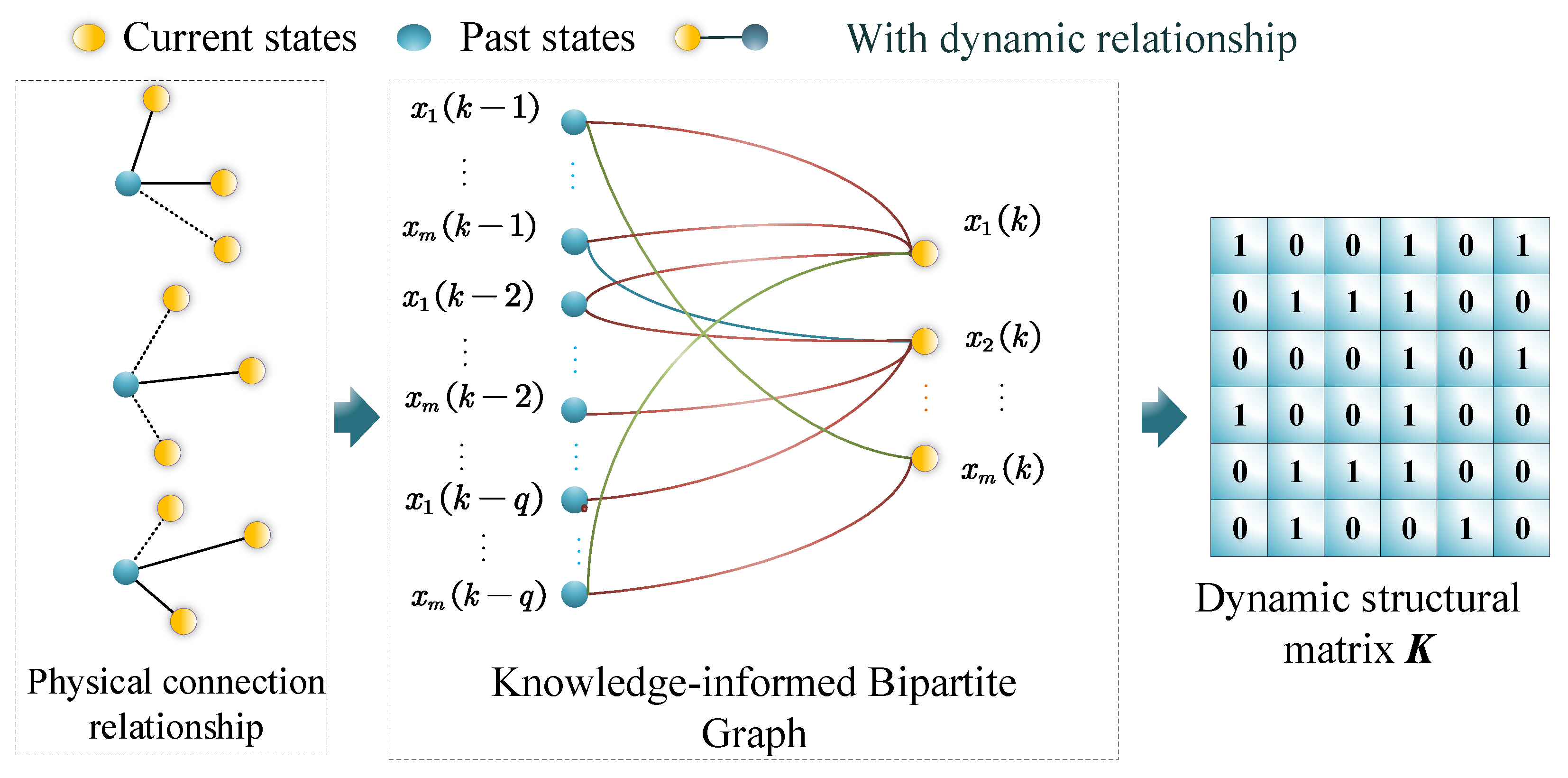
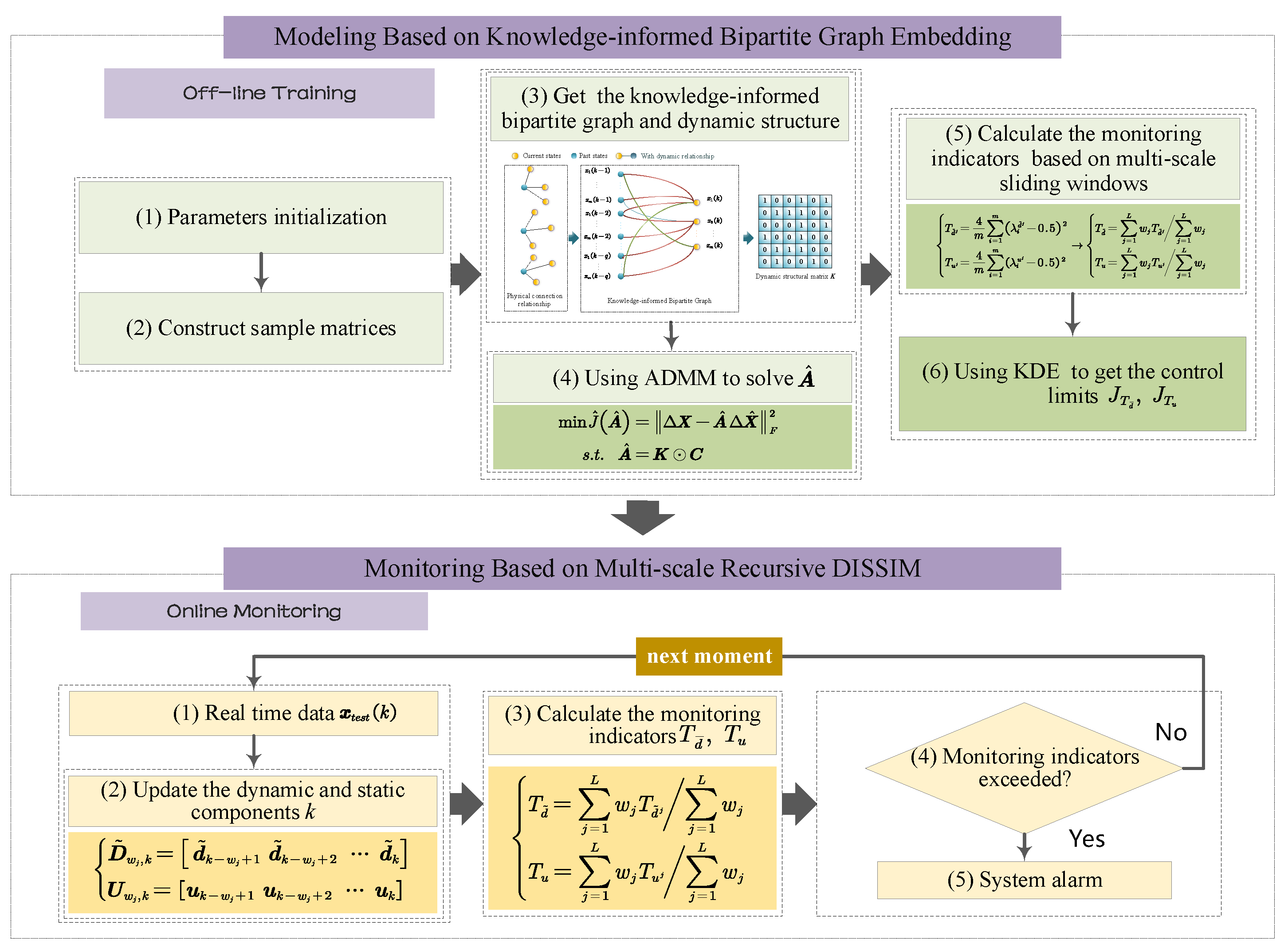
- Knowledge-informed bipartite graph modeling for dynamic processes: A novel bipartite graph-embedding framework is developed to incorporate mechanistic knowledge into data-driven modeling. This approach provides a structured and interpretable representation of dynamic relationships among process variables, thus improving modeling accuracy and enhancing physical interpretability. Unlike existing graph learning methods such as SDMEM-BG, the proposed framework allows the graph structure matrix to be flexibly constructed by integrating expert knowledge, physical connectivity, and process topology information, improving both the reliability and credibility of the learned dynamic structure.
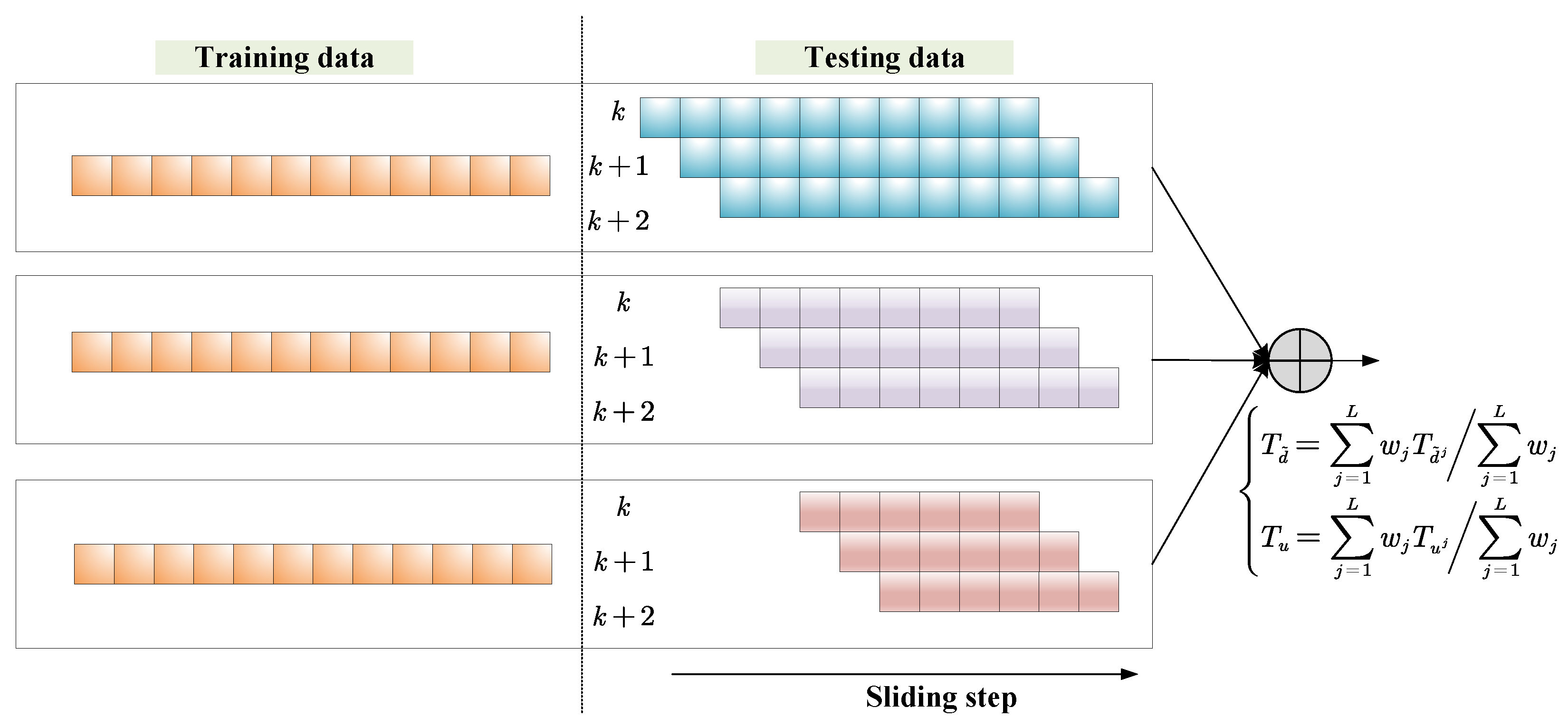
- Multi-scale recursive dissimilarity monitoring strategy: A multi-scale recursive monitoring method is proposed to address the sensitivity of conventional DISSIM-based approaches to sliding window selection. By capturing process variations across multiple temporal scales, the proposed method improves fault detection robustness while reducing computational complexity. Compared with existing single-scale recursive monitoring methods, the proposed MSSW-based strategy achieves more comprehensive characterization of dynamic process behaviors and enhances monitoring performance for complex industrial systems with multi-scale temporal dynamics.
2. Background
2.1. Dynamic Process Modeling Method Based on AR Model
2.2. Basic Principles of DISSIM Monitoring Method
3. The Proposed Method
3.1. Knowledge-Informed Bipartite Graph Embedding for Dynamic Process Modeling
- (1)
- Update matrix
- (2)
- Update matrix
- (3)
- Update matrix
| Algorithm 1 ADMM Algorithm for Solving Problem (19) |
|
3.2. Multi-Scale Recursive DISSIM Monitoring Method
3.3. Computational Complexity Analysis
4. Experimental Results and Analysis
4.1. The Numerical Example 1
- Fault 1: A change of matrix
- Fault 2: A change of matrix
- Fault 3: Changes from external disturbances
- Fault 4: A change occurs in the variance the independent variable
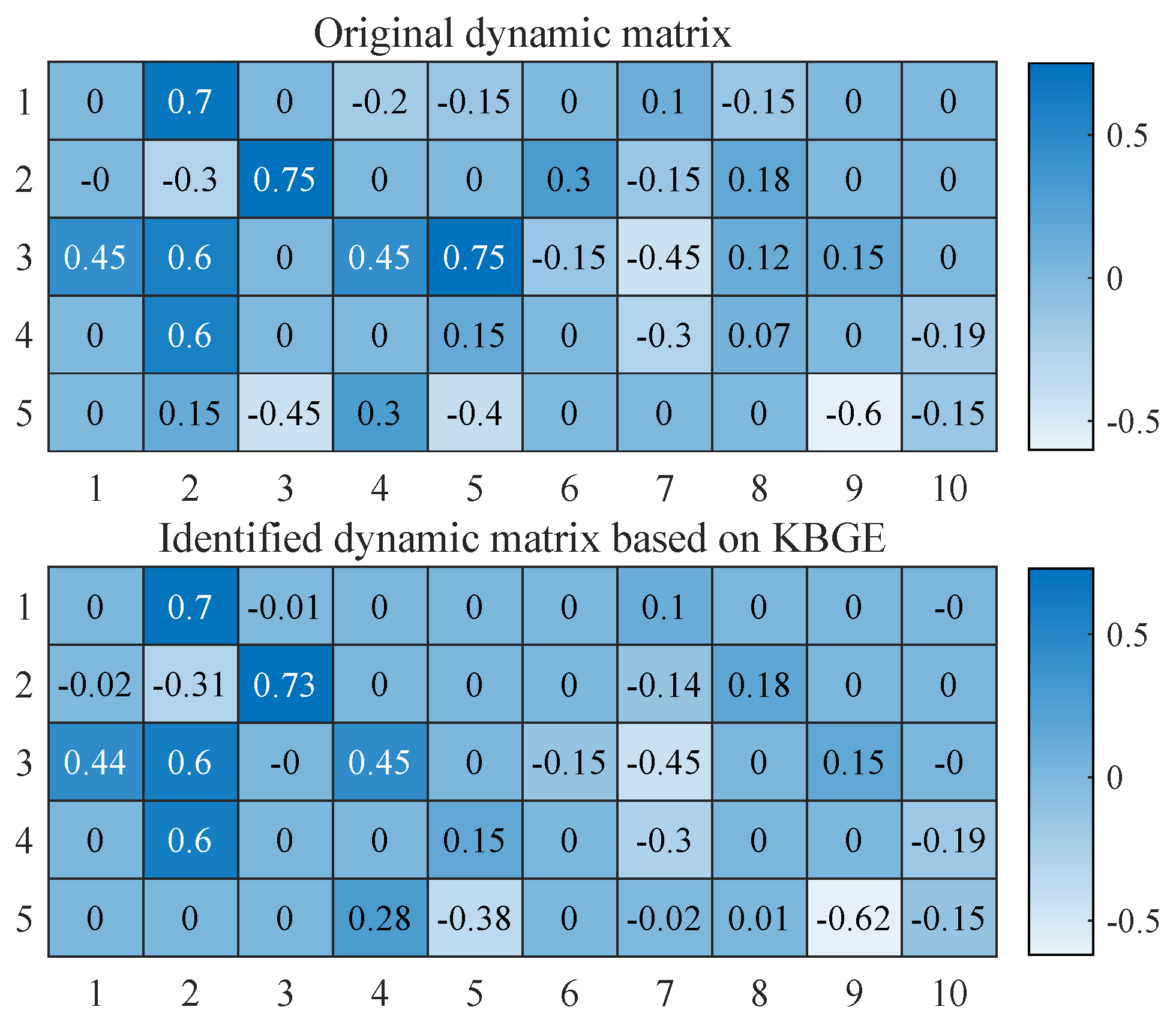
4.1.1. Basic Performance Verification
4.1.2. Ablation Experiment
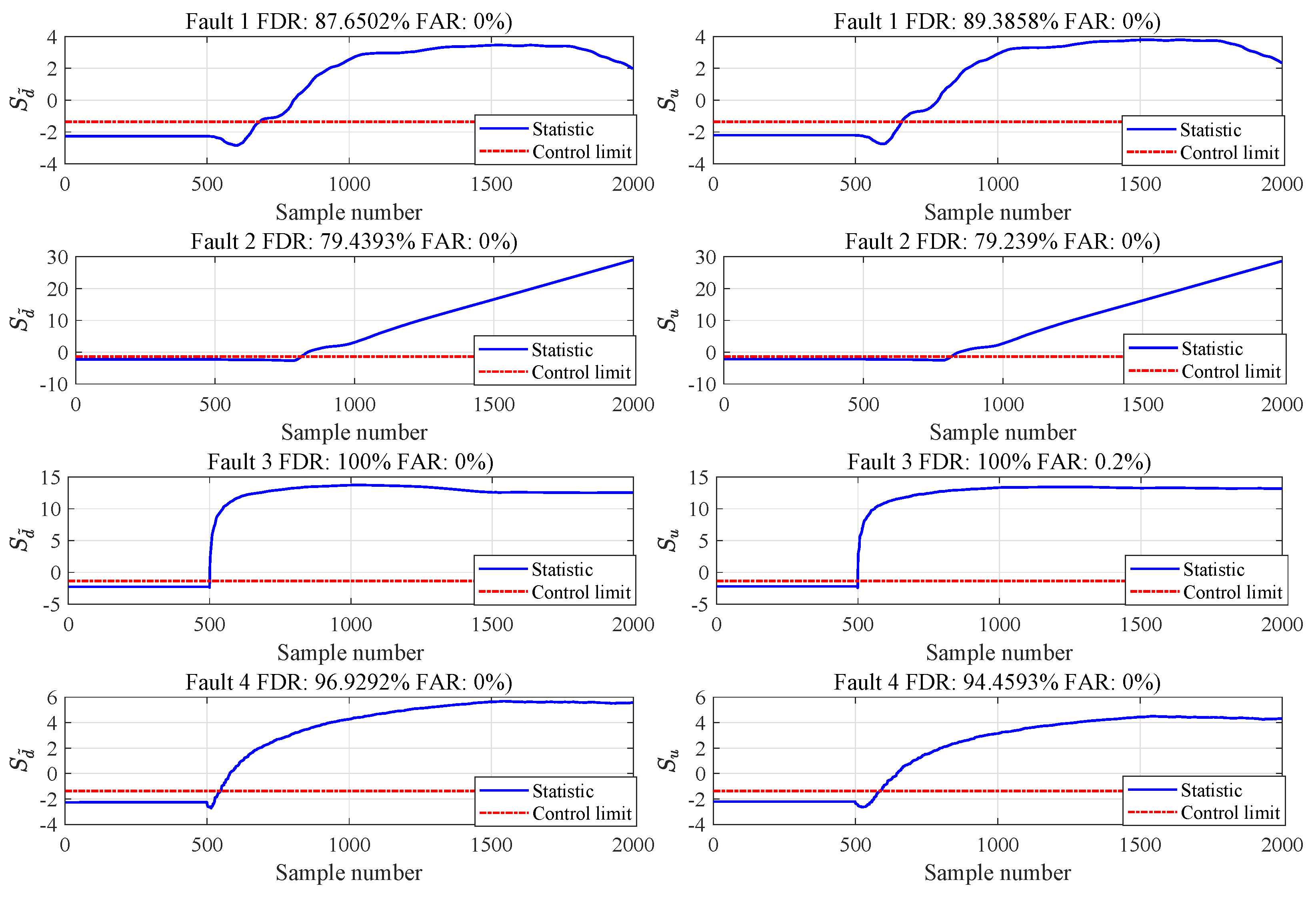
4.1.3. Verification of Fault Detection Performance
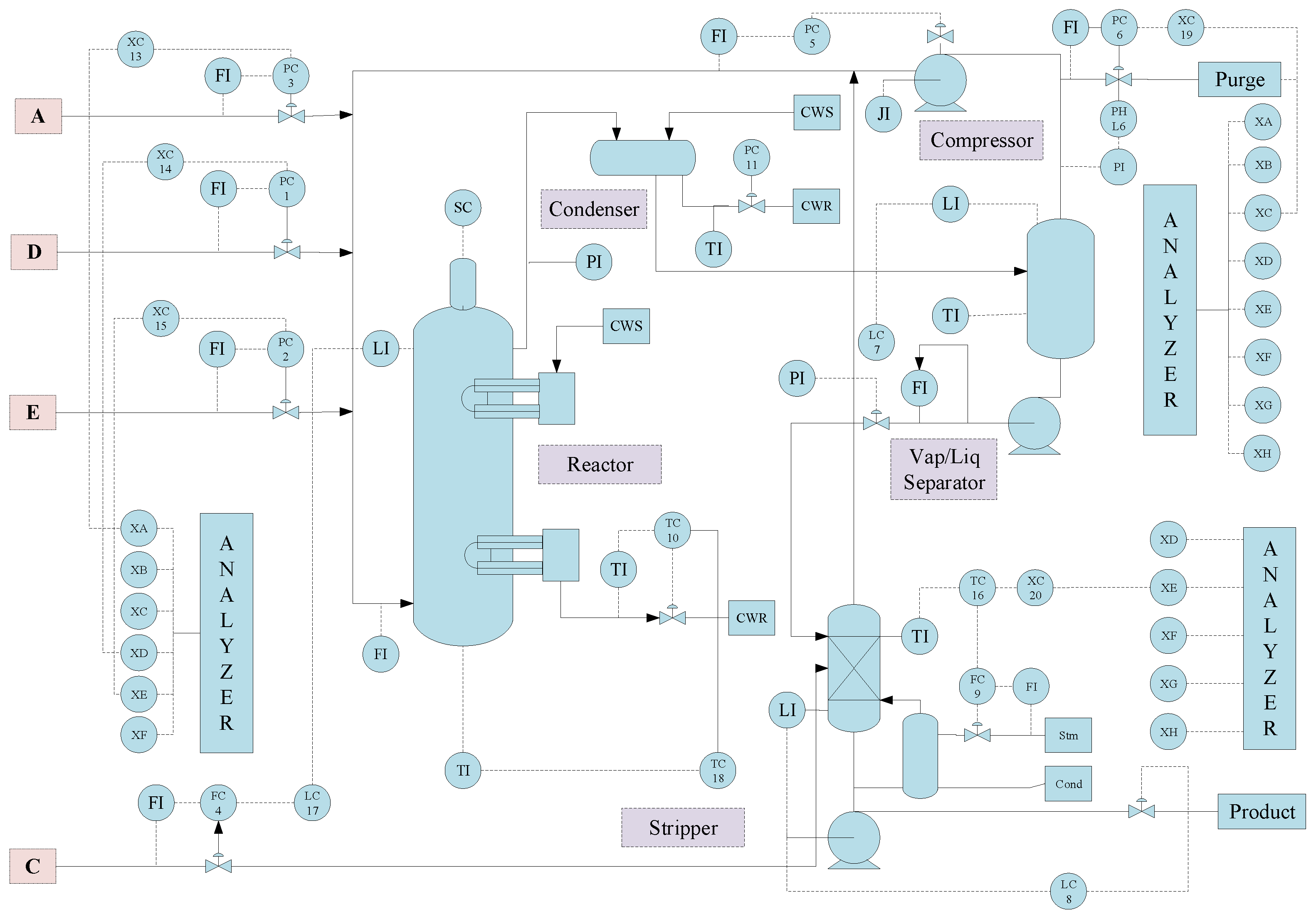
4.2. Experiments on Tennessee Eastman Process
5. Conclusions
Author Contributions
Funding
Data Availability Statement
Conflicts of Interest
Abbreviations
| DPCA | dynamic principal component analysis |
| TS-PCA | two-step principal component analysis |
| AR | autoregressive |
| DiPCA | dynamic inner principal component analysis |
| SDiPCA | sparse dynamic inner principal component analysis |
| LASSO | least absolute shrinkage and selection operator |
| DISSIM | dissimilarity analysis |
| KBGE | knowledge-informed bipartite graph embedding |
| MSSW | multi-scale sliding window |
| SDMEM-BG | sparse dynamic matrix estimation method based on bipartite graph |
| SW | sliding window |
| FDR | fault detection rate |
| FAR | false alarm rate |
References
- Wang, Y.; Si, Y.; Huang, B.; Lou, Z. Survey on the theoretical research and engineering applications of multivariate statistics process monitoring algorithms: 2008–2017. Can. J. Chem. Eng. 2018, 96, 2073–2085. [Google Scholar] [CrossRef]
- Chen, H.; Jiang, B.; Ding, S.X.; Huang, B. Data-driven fault diagnosis for traction systems in high-speed trains: A survey, challenges, and perspectives. IEEE Trans. Intell. Transp. Syst. 2022, 23, 1700–1716. [Google Scholar] [CrossRef]
- Zhao, C. Perspectives on nonstationary process monitoring in the era of industrial artificial intelligence. J. Process Control 2022, 116, 255–272. [Google Scholar] [CrossRef]
- Cheng, Y.; Liu, L.; Liao, Z.; Chen, B.; Yan, J.; Chen, Z. A novel knowledge distillation framework for bearing fault diagnosis under imbalanced samples. Struct. Health Monit. 2026. online ahead of print. [Google Scholar] [CrossRef]
- Miao, Y.; Xia, Y.; Liu, J. Remaining useful life prediction via a double convolutional attention-based CNN-GRU model. IEEE Trans. Instrum. Meas. 2025, 74, 3544313. [Google Scholar] [CrossRef]
- Zhou, P.; Zhang, R.; Xie, J.; Liu, J.; Wang, H.; Chai, T. Data-driven monitoring and diagnosing of abnormal furnace conditions in blast furnace ironmaking: An integrated PCA-ICA method. IEEE Trans. Ind. Electron. 2021, 68, 622–631. [Google Scholar] [CrossRef]
- Huang, J.; Yan, X. Quality-driven principal component analysis combined with kernel least squares for multivariate statistical process monitoring. IEEE Trans. Control Syst. Technol. 2019, 27, 2688–2695. [Google Scholar] [CrossRef]
- Wu, D.; Zhou, D.; Chen, M. Probabilistic stationary subspace analysis for monitoring nonstationary industrial processes with uncertainty. IEEE Trans. Ind. Inform. 2022, 18, 3114–3125. [Google Scholar] [CrossRef]
- Ma, X.; Wu, D.; Gao, S.; Hou, T.; Wang, Y. Autocorrelation feature analysis for dynamic process monitoring of thermal power plants. IEEE Trans. Cybern. 2023, 53, 5387–5399. [Google Scholar] [CrossRef] [PubMed]
- Yuan, X.; Wang, Y.; Yang, C.; Ge, Z.; Song, Z.; Gui, W. Weighted linear dynamic system for feature representation and soft sensor application in nonlinear dynamic industrial processes. IEEE Trans. Ind. Electron. 2018, 65, 1508–1517. [Google Scholar] [CrossRef]
- Kong, X.; Yang, Z.; Luo, J.; Li, H.; Yang, X. Extraction of reduced fault subspace based on KDICA and its application in fault diagnosis. IEEE Trans. Instrum. Meas. 2022, 71, 3505212. [Google Scholar] [CrossRef]
- Li, C.; Li, G.; Chen, X.; Zhou, P.; He, X. A multiblock kernel dynamic latent variable model for large-scale industrial process monitoring. IEEE Trans. Instrum. Meas. 2022, 71, 3529910. [Google Scholar] [CrossRef]
- Jiang, Q.; Chen, S.; Yan, X.; Kano, M.; Huang, B. Data-driven communication efficient distributed monitoring for multiunit industrial plant-wide processes. IEEE Trans. Autom. Sci. Eng. 2022, 19, 1913–1923. [Google Scholar] [CrossRef]
- Marjanovic, O.; Lennox, B.; Sandoz, D.; Smith, K.; Crofts, M. Real-time monitoring of an industrial batch process. Comput. Chem. Eng. 2006, 30, 1476–1481. [Google Scholar] [CrossRef]
- Qin, Y.; Yan, Y.; Ji, H.; Wang, Y. Recursive correlative statistical analysis method with sliding windows for incipient fault detection. IEEE Trans. Ind. Electron. 2022, 69, 4185–4194. [Google Scholar] [CrossRef]
- Ku, W.; Storer, R.H.; Georgakis, C. Disturbance detection and isolation by dynamic principal component analysis. Chemom. Intell. Lab. Syst. 1995, 30, 179–196. [Google Scholar] [CrossRef]
- Shang, J.; Chen, M. Recursive dynamic transformed component statistical analysis for fault detection in dynamic processes. IEEE Trans. Ind. Electron. 2018, 65, 578–588. [Google Scholar] [CrossRef]
- Lou, Z.; Shen, D.; Wang, Y. Two-step principal component analysis for dynamic processes monitoring. Can. J. Chem. Eng. 2018, 96, 160–170. [Google Scholar] [CrossRef]
- Ma, X.; Si, Y.; Qin, Y.; Wang, Y. Fault detection for dynamic processes based on recursive innovational component statistical analysis. IEEE Trans. Autom. Sci. Eng. 2023, 20, 310–319. [Google Scholar] [CrossRef]
- Dong, Y.; Qin, S.J. A novel dynamic PCA algorithm for dynamic data modeling and process monitoring. J. Process Control 2018, 67, 1–11. [Google Scholar] [CrossRef]
- Yan, Z.; Chen, C.-Y.; Yao, Y.; Huang, C.-C. Robust multivariate statistical process monitoring via stable principal component pursuit. Ind. Eng. Chem. Res. 2016, 55, 4011–4021. [Google Scholar] [CrossRef]
- Zhang, J.; Zhou, D.; Chen, M. Self-learning sparse PCA for multimode process monitoring. IEEE Trans. Ind. Inform. 2023, 19, 29–39. [Google Scholar] [CrossRef]
- Yu, W.; Zhao, C.; Huang, B.; Xie, M. An unsupervised fault detection and diagnosis with distribution dissimilarity and lasso penalty. IEEE Trans. Control Syst. Technol. 2023, 32, 767–779. [Google Scholar] [CrossRef]
- Sun, R.; Wang, Y.; Mou, Z.; He, K. Fault diagnosis for large-scale processes based on robust multiblock global orthogonal projections to latent structures. IEEE Trans. Autom. Sci. Eng. 2023, 20, 1972–1982. [Google Scholar] [CrossRef]
- Xiu, X.; Miao, Z.; Yang, Y.; Liu, W. Deep canonical correlation analysis using sparsity-constrained optimization for nonlinear process monitoring. IEEE Trans. Ind. Inform. 2022, 18, 6690–6699. [Google Scholar] [CrossRef]
- Zhang, J.; Chen, M.; Hong, X. Monitoring multimode nonlinear dynamic processes: An efficient sparse dynamic approach with continual learning ability. IEEE Trans. Ind. Inform. 2023, 19, 8029–8038. [Google Scholar] [CrossRef]
- Zhang, Q.; Xu, W.; Xie, L.; Su, H. Dynamic fault detection and diagnosis for alkaline water electrolyzer with variational Bayesian sparse principal component analysis. J. Process Control 2024, 135, 103173. [Google Scholar] [CrossRef]
- Mohammadi, M.; Berahmand, K.; Sadiq, S.; Khosravi, H. Knowledge tracing with a temporal hypergraph memory network. In Proceedings of the 26th International Conference on Artificial Intelligence in Education (AIED 2025), Palermo, Italy, 22–26 July 2025; Springer: Cham, Switzerland, 2025; pp. 77–85. [Google Scholar]
- Zhu, J.; Chen, X.; Yang, H.; Nie, F. Unsupervised adaptive bipartite graph embedding. IEEE Trans. Knowl. Data Eng. 2023, 35, 10514–10525. [Google Scholar] [CrossRef]
- Lin, S.; Luo, H.; Yan, Y.; Xiao, G.; Wang, H. Co-clustering on bipartite graphs for robust model fitting. IEEE Trans. Image Process. 2022, 31, 6605–6620. [Google Scholar] [CrossRef]
- Cui, M.; Wang, Y.; Guo, J.; Hou, T.; Ma, X. A Dynamic Process Modeling Method Based on Bipartite Graph and Recursive Monitoring for Catalytic Cracking Unit. IEEE Trans. Control Syst. Technol. 2025, 33, 2230–2242. [Google Scholar]
- Kano, M.; Hasebe, S.; Hashimoto, I.; Ohno, H. Statistical process monitoring based on dissimilarity of process data. AIChE J. 2002, 48, 1231–1240. [Google Scholar] [CrossRef]
- Li, T.; Han, Y.; Xu, W.; Geng, Z. Novel adaptive fault detection method based on kernel entropy component analysis integrating moving window of dissimilarity for nonlinear dynamic processes. J. Process Control 2023, 125, 1–18. [Google Scholar] [CrossRef]
- Yule, G.U. On a method of investigating periodicities in disturbed series. Philos. Trans. R. Soc. Lond. A 1927, 226, 267–298. [Google Scholar] [CrossRef]
- Boyd, S.; Parikh, N.; Chu, E.; Peleato, B.; Eckstein, J. Distributed Optimization and Statistical Learning via the Alternating Direction Method of Multipliers; Now Publishers: Norwell, MA, USA, 2011. [Google Scholar]
- Bunch, J.R.; Nielsen, C.P.; Sorensen, D.C. Rank-one modification of the symmetric eigenproblem. Numer. Math. 1978, 31, 31–48. [Google Scholar] [CrossRef]
- Lau, C.; Ghosh, K.; Hussain, M.; Hassan, C. Fault diagnosis of Tennessee Eastman process with multi-scale PCA and ANFIS. Chemom. Intell. Lab. Syst. 2013, 120, 1–14. [Google Scholar] [CrossRef]
- Xu, Y.; Shen, S.; He, Y.; Zhu, Q. A novel hybrid method integrating ICA-PCA with relevant vector machine for multivariate process monitoring. IEEE Trans. Control Syst. Technol. 2019, 27, 1780–1787. [Google Scholar] [CrossRef]
- Downs, J.; Vogel, F. A plant-wide industrial process control problem. Comput. Chem. Eng. 1993, 17, 245–255. [Google Scholar] [CrossRef]



| Methods | SDMEM-BG-SW | SDMEM-BG-MSSW | ||||||
|---|---|---|---|---|---|---|---|---|
| Indicator | ||||||||
| FDR | FAR | FDR | FAR | FDR | FAR | FDR | FAR | |
| Fault 1 | 82.78 | 0.00 | 68.42 | 0.00 | 88.25 | 0.00 | 80.84 | 0.38 |
| Fault 2 | 79.11 | 0.00 | 78.17 | 0.00 | 79.31 | 0.00 | 77.30 | 0.36 |
| Fault 3 | 100.00 | 0.00 | 100.00 | 0.20 | 100.00 | 0.00 | 100.00 | 0.38 |
| Fault 4 | 93.39 | 0.00 | 95.79 | 0.00 | 94.13 | 0.00 | 95.39 | 0.00 |
| Mean Value | 88.82 | 0.00 | 85.60 | 0.05 | 90.42 | 0.00 | 88.38 | 0.28 |
| Methods | KBGE-SW | KBGE-MSSW | ||||||
| Indicator | ||||||||
| FDR | FAR | FDR | FAR | FDR | FAR | FDR | FAR | |
| Fault 1 | 82.98 | 0.00 | 88.58 | 0.00 | 87.72 | 0.00 | 89.32 | 0.00 |
| Fault 2 | 79.17 | 0.00 | 78.84 | 0.00 | 79.44 | 0.00 | 79.24 | 0.00 |
| Fault 3 | 100.00 | 0.00 | 100.00 | 0.20 | 100.00 | 0.00 | 100.00 | 0.20 |
| Fault 4 | 96.06 | 0.00 | 93.86 | 0.00 | 96.66 | 0.00 | 94.73 | 0.00 |
| Mean Value | 89.55 | 0.00 | 90.32 | 0.05 | 90.95 | 0.00 | 90.82 | 0.05 |
| Methods | PCA | DPCA | TS-PCA | D-RPCA | ||||
|---|---|---|---|---|---|---|---|---|
| Indicator | Q | Q | Q | Q | ||||
| Fault 1 | 0.00 | 0.00 | 0.00 | 0.00 | 23.70 | 8.34 | 8.68 | 0.00 |
| Fault 2 | 8.53 | 8.27 | 15.09 | 7.74 | 75.83 | 73.77 | 66.36 | 0.00 |
| Fault 3 | 0.00 | 0.00 | 0.00 | 0.00 | 99.93 | 93.59 | 100.00 | 0.00 |
| Fault 4 | 0.00 | 0.00 | 0.00 | 0.00 | 71.63 | 64.02 | 70.29 | 0.00 |
| Mean Value | 2.13 | 2.07 | 3.77 | 1.94 | 67.77 | 59.93 | 61.33 | 0.00 |
| Methods | DiPCA | SDiPCA | SDMEM-BG-SW | KBGE-MSSW | ||||
| Indicator | Q | Q | ||||||
| Fault 1 | 27.33 | 1.07 | 27.73 | 0.87 | 82.78 | 68.42 | 87.72 | 89.32 |
| Fault 2 | 77.40 | 61.93 | 79.60 | 67.87 | 79.11 | 78.17 | 79.44 | 79.24 |
| Fault 3 | 99.80 | 77.73 | 99.87 | 86.67 | 100.00 | 100.00 | 100.00 | 100.00 |
| Fault 4 | 75.73 | 19.00 | 89.27 | 41.07 | 93.39 | 95.79 | 96.66 | 94.73 |
| Mean Value | 70.07 | 39.93 | 74.12 | 49.12 | 88.82 | 85.60 | 90.95 | 90.82 |
| Methods | TSPCA | D-RPCA | DiPCA | SDiPCA | SDMEM-BG-SW | KBGE-MSSW | ||||||
|---|---|---|---|---|---|---|---|---|---|---|---|---|
| Indicators | ||||||||||||
| fault1 | 100.00 | 100.00 | 94.12 | 99.37 | 97.38 | 99.75 | 97.38 | 99.63 | 72.43 | 99.75 | 74.19 | 99.87 |
| fault2 | 99.62 | 99.12 | 93.49 | 98.37 | 97.63 | 98.13 | 98.13 | 97.75 | 64.91 | 98.12 | 69.80 | 98.25 |
| fault3 | 16.67 | 22.18 | 1.75 | 1.38 | 4.50 | 4.63 | 5.75 | 3.88 | 6.52 | 94.74 | 0.00 | 95.49 |
| fault4 | 99.87 | 100.00 | 100.00 | 24.16 | 99.38 | 99.50 | 99.63 | 99.13 | 32.46 | 99.62 | 37.97 | 99.75 |
| fault5 | 100.00 | 100.00 | 6.88 | 23.28 | 99.75 | 99.63 | 99.75 | 99.75 | 59.65 | 100.00 | 64.54 | 100.00 |
| fault6 | 100.00 | 100.00 | 100.00 | 100.00 | 99.75 | 99.75 | 99.75 | 99.75 | 98.87 | 100.00 | 98.87 | 100.00 |
| fault7 | 99.37 | 100.00 | 99.87 | 100.00 | 99.75 | 75.88 | 99.75 | 99.50 | 98.25 | 100.00 | 85.34 | 100.00 |
| fault8 | 99.12 | 99.25 | 26.16 | 97.37 | 83.50 | 97.50 | 94.63 | 97.13 | 96.99 | 97.87 | 96.87 | 97.99 |
| fault9 | 15.54 | 17.42 | 2.13 | 0.88 | 4.13 | 3.75 | 3.75 | 3.75 | 0.00 | 85.09 | 0.00 | 87.09 |
| fault10 | 87.97 | 92.48 | 3.13 | 24.66 | 55.75 | 50.50 | 55.75 | 48.38 | 95.61 | 96.99 | 95.61 | 96.99 |
| fault11 | 82.96 | 88.85 | 76.85 | 41.55 | 75.75 | 68.00 | 75.50 | 71.25 | 96.87 | 98.87 | 96.99 | 99.00 |
| fault12 | 99.87 | 99.87 | 62.70 | 97.50 | 97.63 | 96.63 | 98.88 | 96.75 | 98.12 | 99.87 | 97.74 | 99.87 |
| fault13 | 96.24 | 96.99 | 64.33 | 94.37 | 93.63 | 95.75 | 94.38 | 95.38 | 93.73 | 95.61 | 93.73 | 95.61 |
| fault14 | 100.00 | 97.99 | 90.36 | 100.00 | 83.50 | 97.25 | 83.25 | 98.13 | 99.25 | 99.75 | 99.25 | 99.87 |
| fault15 | 19.55 | 19.42 | 1.50 | 4.88 | 4.25 | 5.13 | 2.38 | 4.13 | 11.15 | 97.37 | 8.40 | 97.12 |
| fault16 | 91.48 | 89.72 | 4.26 | 16.52 | 50.13 | 46.13 | 53.38 | 45.38 | 97.87 | 98.87 | 97.87 | 98.87 |
| fault17 | 97.87 | 98.25 | 94.74 | 79.60 | 86.88 | 96.75 | 85.63 | 96.50 | 96.87 | 97.49 | 96.74 | 97.62 |
| fault18 | 92.11 | 92.23 | 89.86 | 89.24 | 89.50 | 90.50 | 89.50 | 90.38 | 88.97 | 90.73 | 88.97 | 91.85 |
| fault19 | 77.44 | 90.23 | 8.51 | 0.88 | 28.38 | 18.25 | 29.63 | 16.75 | 94.99 | 98.62 | 95.24 | 98.62 |
| fault20 | 91.73 | 90.60 | 29.91 | 36.30 | 58.63 | 63.25 | 58.00 | 65.13 | 90.10 | 91.48 | 89.97 | 91.60 |
| fault21 | 54.76 | 57.39 | 10.01 | 31.79 | 31.13 | 23.38 | 43.00 | 27.75 | 53.88 | 90.60 | 57.02 | 90.98 |
| Mean Value | 82.01 | 83.43 | 50.50 | 55.34 | 68.61 | 68.10 | 69.89 | 69.34 | 73.69 | 96.74 | 73.58 | 96.97 |
| Methods | TSPCA | D-RPCA | DiPCA | SDiPCA | SDMEM-BG-SW | KBGE-MSSW | ||||||
|---|---|---|---|---|---|---|---|---|---|---|---|---|
| Indicators | ||||||||||||
| Mean FARs | 13.78 | 15.12 | 1.64 | 0.60 | 3.75 | 4.67 | 3.10 | 4.17 | 0.00 | 0.15 | 0.00 | 0.15 |
Disclaimer/Publisher’s Note: The statements, opinions and data contained in all publications are solely those of the individual author(s) and contributor(s) and not of MDPI and/or the editor(s). MDPI and/or the editor(s) disclaim responsibility for any injury to people or property resulting from any ideas, methods, instructions or products referred to in the content. |
© 2026 by the authors. Licensee MDPI, Basel, Switzerland. This article is an open access article distributed under the terms and conditions of the Creative Commons Attribution (CC BY) license.
Share and Cite
Hao, Y.; Zhu, S. A Statistical Modeling and Monitoring Framework for Dynamic Processes Based on Knowledge Graph and Dissimilarity Analysis. Mathematics 2026, 14, 2047. https://doi.org/10.3390/math14122047
Hao Y, Zhu S. A Statistical Modeling and Monitoring Framework for Dynamic Processes Based on Knowledge Graph and Dissimilarity Analysis. Mathematics. 2026; 14(12):2047. https://doi.org/10.3390/math14122047
Chicago/Turabian StyleHao, Yunhan, and Shanliang Zhu. 2026. "A Statistical Modeling and Monitoring Framework for Dynamic Processes Based on Knowledge Graph and Dissimilarity Analysis" Mathematics 14, no. 12: 2047. https://doi.org/10.3390/math14122047
APA StyleHao, Y., & Zhu, S. (2026). A Statistical Modeling and Monitoring Framework for Dynamic Processes Based on Knowledge Graph and Dissimilarity Analysis. Mathematics, 14(12), 2047. https://doi.org/10.3390/math14122047