Article

A Novel LOF–KNN–Bessel Approach for Optimizing and Predicting Slope Deformation Monitoring Data: A Case Study of the Shilu Iron Mine

1
School of Resources and Safety Engineering, University of Science and Technology Beijing, Beijing 100083, China
2
Beijing Key Laboratory of Urban Underground Space Engineering, University of Science and Technology Beijing, Beijing 100083, China
3
Key Laboratory of Ministry of Education for Efficient Mining and Safety of Metal Mines, University of Science and Technology Beijing, Beijing 100083, China
4
Hainan Mining Co., Ltd., Changjiang 572700, China
*
Author to whom correspondence should be addressed.
Mathematics 2026, 14(11), 2012; https://doi.org/10.3390/math14112012 (registering DOI)
Submission received: 11 May 2026 / Revised: 28 May 2026 / Accepted: 1 June 2026 / Published: 5 June 2026
(This article belongs to the Special Issue Mathematics Applied in Rock Mechanics and Mining Science)

Abstract

Slopes transitioning from open-pit to underground mining typically exhibit heterogeneous and nonlinear deformation characteristics. Under complex environmental disturbances, monitoring data are often affected by high noise and outliers, making it difficult to accurately capture critical deformation characteristics and posing challenges for landslide early warning and safety assessment. Therefore, it is necessary to develop a high-precision data optimization technique suitable for complex, high-noise monitoring time series data to improve slope stability evaluation and the robustness of prediction algorithms. Based on slope deformation monitoring data from the Hainan Shilu Iron Mine, the multi-type, nonlinear, and alternating acceleration-deceleration patterns of deformation time series data were analyzed, and the performances of multiple anomaly detection and interpolation compensation algorithms were compared. The results show that the Local Outlier Factor (LOF) and K-Nearest Neighbors (KNN) algorithms achieve better performance in processing noisy and dynamically varying time series data based on comparative evaluations of detection accuracy and interpolation error. Furthermore, a Bessel function-based denoising technique was proposed for landslide monitoring systems. This technique effectively filters high-frequency noise while preserving the main characteristics of the data and outperforms conventional methods, including the Moving Average Method (MAM), Triple Exponential Smoothing (TES), and Least Squares Method (LSM). The proposed technique, integrating LOF-based anomaly detection, KNN-based interpolation compensation, and Bessel function denoising, can effectively process slope deformation monitoring data characterized by multi-type, nonlinear, and alternating acceleration-deceleration patterns. Engineering application at the Hainan Shilu Iron Mine demonstrated that the proposed technique improves data quality and model prediction performance, providing valuable support for slope stability analysis and disaster early warning systems in slopes transitioning from open-pit to underground mining.

1. Introduction

Landslides are among the most frequent and destructive types of geological disasters worldwide. Monitoring and early warning systems for slope deformation have become the key strategies for landslide prevention globally [1,2,3]. In evaluating slope deformation and assessing landslide hazards, surface deformation indicators such as displacement and inclination angles are the most intuitive, readily obtainable, and widely utilized. However, surface monitoring equipment is often affected by various factors, including temperature fluctuations, abnormal vibrations, and positioning errors, which introduce noise into the raw deformation time series data. This noise affects the accuracy of subsequent landslide predictions [4,5]. To improve the signal-to-noise ratio, the first critical step in slope monitoring systems is to conduct anomaly detection and noise filtering on the raw deformation data. The effectiveness of these processes directly influences the accuracy of subsequent landslide early warnings [6,7]. Therefore, developing effective methods for anomaly detection and noise reduction is essential for enhancing slope deformation monitoring and strengthening geological disaster early warning systems.
Among all types of landslides, the slopes in open-pit to underground mining operations present the most complex challenges, characterized by steep terrain, heterogeneous deformation, and dynamic changes [8,9]. Additionally, slope deformation varies significantly across different monitoring zones. For example, in areas with intense underground mining disturbances, open-pit slopes often experience creeping landslides with substantial rock mass displacement and nonlinear time series deformation, characterized by alternating acceleration and deceleration. In contrast, undisturbed areas exhibit minimal or no rock mass deformation, with landslide time series data showing only minor fluctuations due to monitoring errors. Noise reduction methods for deformation time series data in slopes transitioning from open-pit to underground mining must account for these two distinct types of time series behavior while reducing abnormal fluctuations and preserving actual deformation characteristics. Consequently, noise reduction for such slopes remains a critical and challenging issue in slope monitoring and early warning research, with no targeted solutions currently available.
Current deformation monitoring systems typically use filtering and function-fitting methods to process raw data. Commonly used filtering techniques include the Moving Average Filter and the Median Filter, while function fitting methods typically involve polynomial fitting, triple exponential smoothing, and least squares approaches [10,11]. However, these conventional noise reduction methods are not specifically designed for slope deformation time series data, which leads to various limitations when directly applied to landslide data processing [12]. For example, methods such as the Moving Average Filter and Median Filter may smooth out critical features in the deformation signals, resulting in the loss of valuable information [13]. Moreover, function fitting methods often rely on specific model assumptions, which, if not aligned with the actual deformation data, can produce inaccurate results. For instance, polynomial fitting may suffer from overfitting in the presence of significant noise, while simpler fitting methods may result in underfitting, failing to accurately capture the underlying trends in slope deformation [14].
Considerable research has been conducted on optimization and prediction of slope time-series data. However, high-precision denoising and anomaly handling methods for complex non-stationary monitoring signals remain relatively limited. Li et al. [15] developed a landslide displacement monitoring and evaluation system using discrete wavelet transforms, integrating Global Positioning System (GPS) data for real-time monitoring. Shehadeh et al. [16] proposed a Slope Displacement Inspection and Management Algorithm (SDIMA) to process Global Navigation Satellite System (GNSS) data for early warning, achieving lower error compared to existing models. Yang et al. [17] improved a Logistic prediction model using Genetic and Simplex algorithms to address temporal discontinuities in multi-temporal Interferometric Synthetic Aperture Radar (InSAR) observations, thereby improving the dynamic prediction performance of monitoring time-series data. Jiang et al. [18] introduced a landslide displacement monitoring data classification method based on Temporal Convolutional Networks (TCN) and attention mechanisms. This method aims to denoise the data, capture long-term dependencies, and highlight critical features to accurately identify anomalies and reduce false alarm rates. Qiu et al. [19] demonstrated that techniques such as singular spectrum analysis, moving averages, wavelet denoising, and variational mode decomposition can smooth monitoring data, significantly enhancing the predictive accuracy of early warning models. Ikuemonisan et al. [20] applied wavelet transform with a triple exponential smoothing model for periodic analysis and prediction of InSAR-based ground subsidence data. Among these methods, singular spectrum analysis and interpolation techniques are particularly effective for data recovery and expanding sample size. These studies propose novel approaches for processing slope deformation time series data. They collectively highlight that the effectiveness of noise reduction directly impacts the accuracy of subsequent landslide prediction models. However, these methods are generally not designed for deformation monitoring time series characterized by significant nonlinearity and abnormal fluctuations.
With shallow mineral resources increasingly depleted, many mines are transitioning—or have already transitioned—from open-pit to underground mining. As underground mining activities expand, surface subsidence intensifies, and disturbance-induced fractures increase. These factors may lead to the emergence or development of large-scale landslide zones, threatening underground infrastructure and personnel safety. Therefore, monitoring and early warning for slopes transitioning from open-pit to underground mining is a key task in ensuring the safety management of these mines.
To collect displacement and inclination data from the slopes of the Hainan Shilu Iron Mine, a surface deformation monitoring system was established as part of a case study. The study focused on anomaly detection, noise reduction, filtering, and prediction of deformation data, with a comparative analysis of various algorithms. A Bessel function-based noise reduction algorithm was developed for surface deformation time series, and its feasibility was validated using a PSO-BP neural network prediction model. The findings of this study provide a robust approach to processing surface deformation data for slopes transitioning from open-pit to underground mining.
The main contributions of this study are as follows:
  • A processing approach for slope deformation time series under open-pit to underground mining conditions was proposed;
  • A LOF-based anomaly detection method and a KNN-based interpolation strategy were integrated to address nonlinear behavior and abnormal fluctuations in time series data;
  • A Bessel-based denoising method was proposed, which preserves nonlinear deformation trends while reducing abnormal fluctuations;
  • The proposed denoising method was validated using field data, and deformation time series prediction was performed based on a PSO-BP neural network model.

2. Method

2.1. Research Area

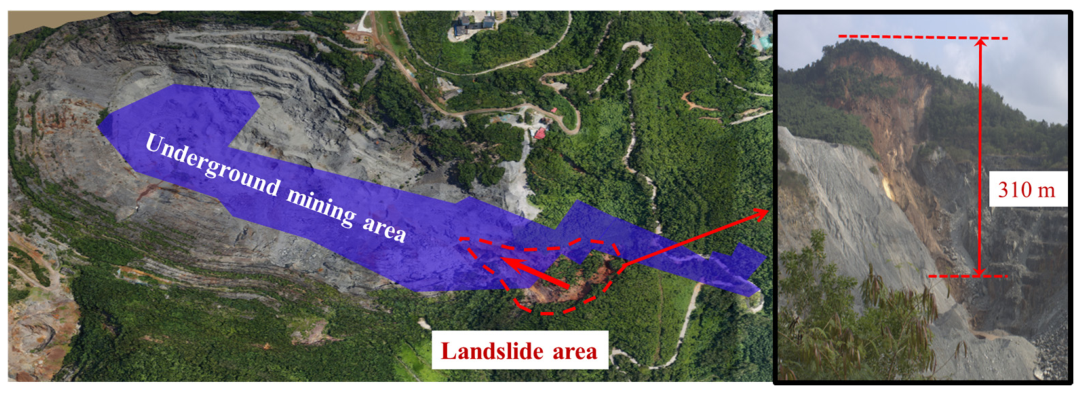
The Shilu Iron Mine is located in Shilu Town, Changjiang Li Autonomous County, in the western part of Hainan Province, China, as shown in Figure 1. The open-pit mining operations ceased in June 2018, and the mine transitioned to underground mining using the non-pillar sublevel caving method. The bottom boundary of the open pit was designed at the 0 m level, and after over six years of underground mining, the active mining level has now reached −75 m, creating a collapse zone of ore and rock extending up to 75 m in height. This mining-induced subsidence has led to significant disturbances in the surrounding area. The subsidence effects have caused varying degrees of slope instability on the eastern (Xiaoying Mountain), southern, and northern slopes of the open-pit mine. The most notable landslide area is situated on the eastern slope of Xiaoying Mountain, which continues to exhibit slow sliding. The landslide zone exceeds 300 m in height, with the movement primarily directed toward the pit bottom [21].
The geological conditions in the mining area are relatively complex, with well-developed faults, folds, and structural discontinuities. Field investigations indicate that local rock masses in the North No.1 mining area exhibit varying degrees of fracturing, and the Xiaoying Mountain slope shows evident sliding deformation characteristics controlled by bedding structures. The study area is characterized by a tropical marine monsoon climate with abundant rainfall, and groundwater mainly occurs as weathered fracture water and structural fracture water. Under the combined influence of geological structures, rainfall infiltration, and underground mining disturbances, the slope deformation process exhibits obvious nonlinear and time-dependent characteristics.
Currently, the landslide mass primarily consists of surface rock and soil, with a relatively small volume and low movement velocity, posing no immediate threat to underground mining operations. However, as mining depth and extent continue to increase, surface subsidence is expected to intensify, and the number of disturbance-induced fractures will rise. These changes may lead to the formation of large-scale landslide zones, particularly on the 300 m-high slopes. In the event of a large-scale landslide, significant potential energy would be released. The resulting impact forces could propagate through the overlying rock and roof strata, potentially affecting underground roadway rock masses and associated structures, thereby jeopardizing underground operations and personnel safety. To mitigate these risks, the mine has implemented surface deformation monitoring and early-warning systems.

2.2. Research Data and Challenge

2.2.1. Surface Deformation Monitoring System

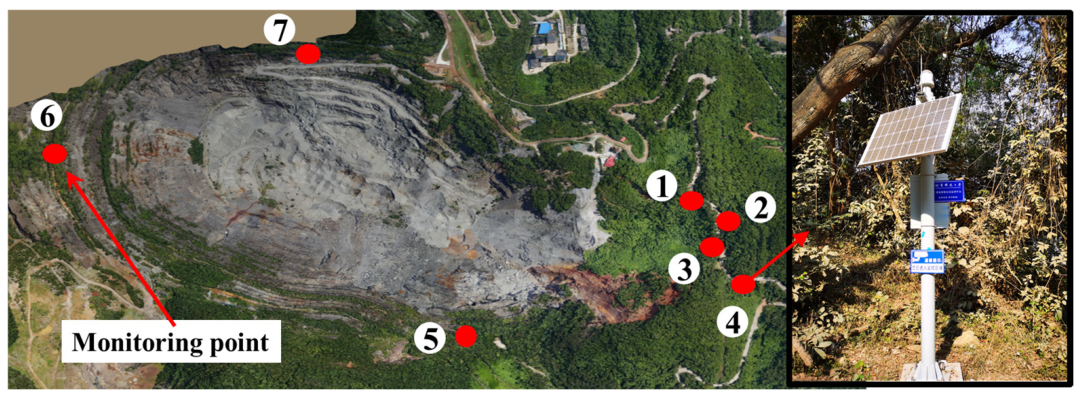
In collaboration with the Shilu Iron Mine in Hainan, our research team has conducted a study on slope stability monitoring and early warning during the open-pit to underground mining. Seven slope deformation monitoring points have been strategically installed across the open-pit mine, as shown in Figure 2. Of these, four monitoring points have been placed on the eastern slope, which has been identified as the critical area for landslide monitoring. The remaining slopes are each equipped with one monitoring point, ensuring comprehensive coverage of the mine’s stability conditions.
The slope monitoring system at the Shilu Iron Mine utilizes the Global Navigation Satellite System (GNSS) and consists of deformation monitoring equipment, a transmission network, an Internet of Things (IoT) platform, and application terminals. Devices installed on the slopes upload monitoring data every minute, including location, inclination, equipment temperature, and battery status. The monitoring platform processes this data through steps such as denoising and prediction to calculate displacement and its rates. The results are then visualized on computer terminals, enabling comprehensive analysis and real-time monitoring.

2.2.2. Characteristics of Deformation Time Series Variations

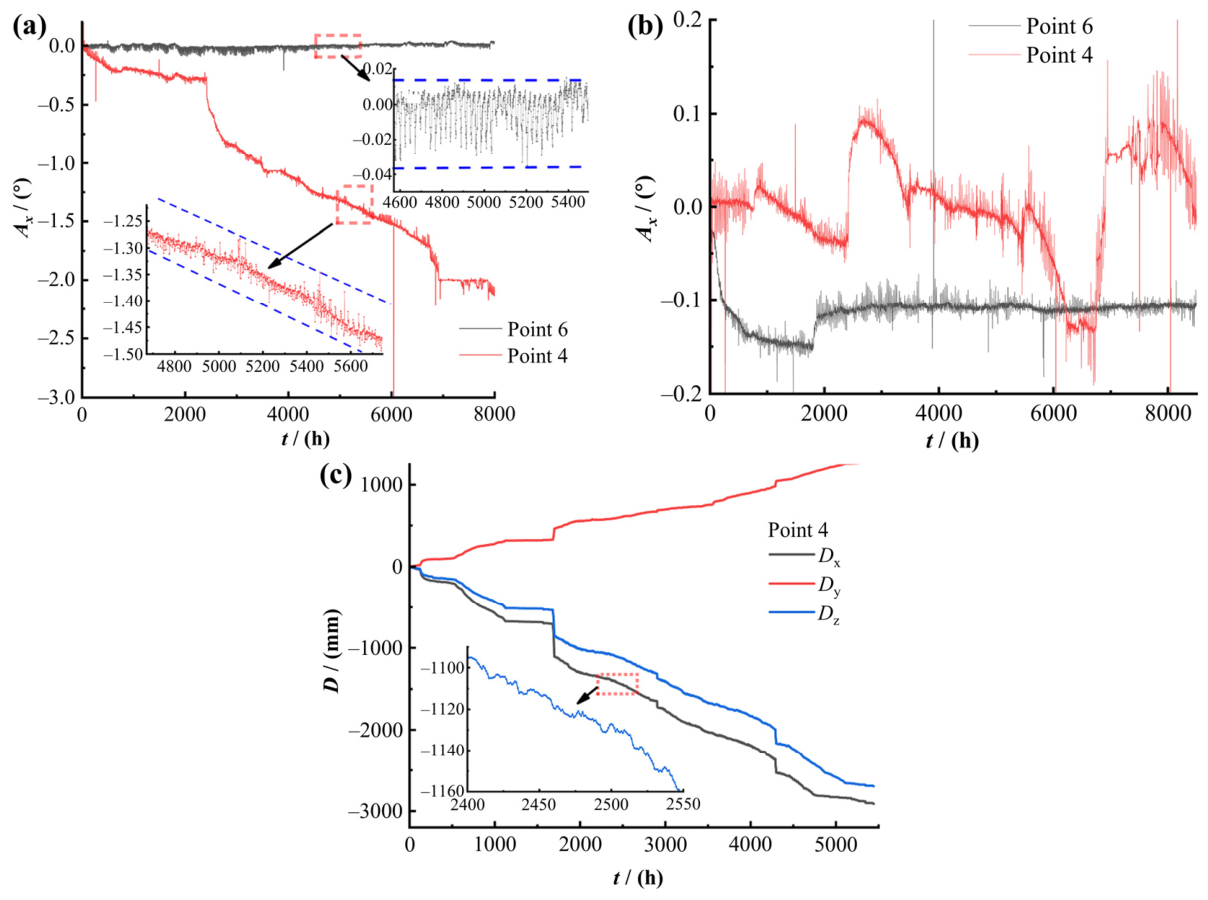
As shown in Figure 1 and Figure 2, monitoring points 1 to 4 are located on slopes influenced by underground disturbances, where surface deformation is notably significant. In contrast, monitoring points 5 to 7 are positioned on relatively stable slopes, where no substantial rock mass sliding or deformation has been observed. As a result, the deformation data from the open-pit to underground mining exhibits a range of distinct characteristics. For example, the monitoring data from points 4 and 6, prior to noise reduction, are depicted in Figure 3, which highlights the complex and dynamic variations in the deformation patterns.
The monitoring device at Point 6 measures the deformation of the western slope of the open-pit mine. This slope is relatively stable and minimally affected by underground mining activities. As a result, the inclination angle and displacement at Point 6 exhibit only slight variations. During the initial 0 to 2000 h of monitoring, the inclination angle in the Y direction decreased from 0° to −0.15°, followed by fluctuations within a narrow range. The early-stage changes are likely attributed to settling of the device’s base, while the subsequent fluctuations suggest stabilization of the base, reflecting the deformation of the slope. For this relatively stable slope, the change in monitoring indicators remained under 5% throughout the monitoring period. However, due to noise influence, the time series peak fluctuated more than 40% above the trend value, making it nearly impossible to identify the deformation trend manually. The device at Point 4 primarily monitors the stability of the eastern slope of the open-pit mine, which is affected by underground mining activities. The lower part of the slope has experienced rock collapse and failure, leading to an overall sliding movement toward the bottom of the open pit. The deformation data from Point 4 displays a clear dynamic, nonlinear variation trend, with the inclination angle in the X direction showing periods of accelerated and decelerated decline. The time series of the inclination angle in the Y direction also exhibits multiple phases of rising and falling, accompanied by changes in the rate of variation. Noise data significantly impacts the Y direction inclination time series. Compared to the time series at Point 6, the data fluctuation range is similar, with most fluctuations remaining within 0.02°. However, noise data introduced a displacement error of approximately 3.5 mm in the X direction within a short time period, which had a noticeable impact. In addition to causing changes in the time series waveform, monitoring errors also resulted in abnormal values, particularly in the inclination angle time series, where the frequency of abnormal values was high, and the magnitude of change exceeded the trend variations in the inclination angle. Such fluctuations and abnormal values are detrimental to subsequent data analysis and prediction.
The deformation indicators of the slope of open-pit to underground mining exhibit a multi-type, nonlinear variation trend, characterized by alternating periods of acceleration and deceleration. Data noise and abnormal values, primarily resulting from monitoring errors, significantly hinder the accurate assessment of landslide deformation trends and complicate subsequent predictions made by monitoring systems and management personnel. To address these challenges, a series of processing steps must be applied sequentially, including anomaly detection and removal, interpolation of missing values, and time series denoising and filtering. These processes are essential for obtaining continuous time series curves that accurately reflect the underlying deformation trends. The processed data are critical for the subsequent visualization and predictive warning of deformation indicators. However, existing algorithms for anomaly detection, interpolation, and denoising, when applied to general slope deformation time series data, encounter substantial limitations in the context of the open-pit to underground mining conditions. Therefore, there is a pressing need for the development and application of algorithms that offer higher applicability and greater accuracy to address these specific challenges.

2.3. Methodology

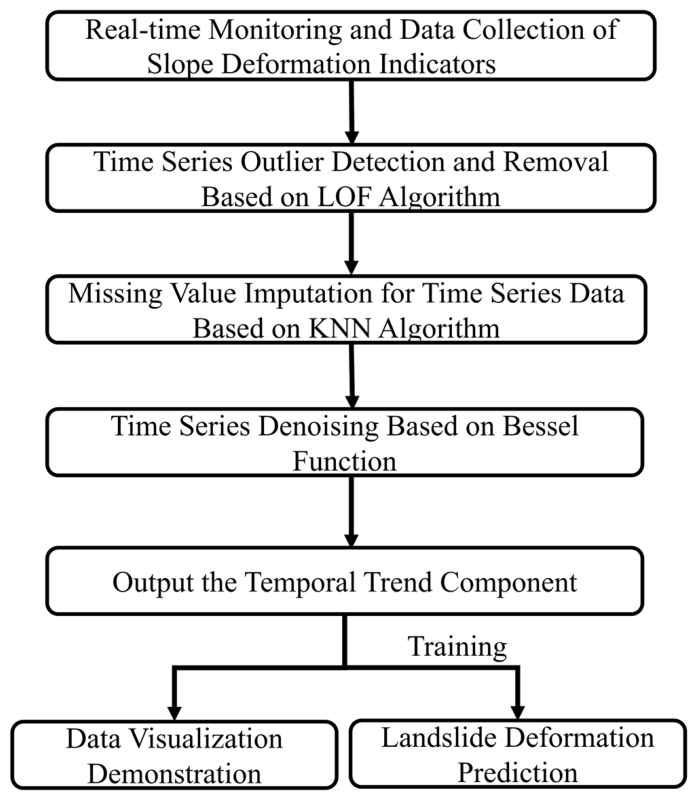
The monitoring environment of slopes is often complex and variable, particularly under the influence of external disturbances such as rainfall, vibrations from transportation vehicles, temperature fluctuations, and other factors. As a result, monitoring data are susceptible to anomalies. The time series changes in slope displacement parameters of the open-pit to underground mining exhibit significant noise, nonlinearity, and alternating acceleration and deceleration trends, which present challenges for accurate slope deformation characterization and the development of prediction systems. To address these challenges, this study compares and analyzes multiple algorithms and, in conjunction with the Bessel function, proposes a series of slope deformation time series denoising methods. These methods include outlier detection, interpolation compensation, and time series denoising processing. These approaches aim to improve the accuracy and reliability of monitoring data. To further assess the performance of the aforementioned anomaly detection and denoising methods, a deformation prediction study was conducted based on the processed time series data, as illustrated in Figure 4.
After obtaining the slope deformation data, the first step is to perform outlier detection and removal based on the LOF algorithm. Next, the KNN algorithm is used to interpolate missing values in the time series, ensuring a continuous slope deformation time series. Subsequently, Bessel function-based denoising is applied to the slope deformation time series to extract the accurate trend component of the slope deformation. This trend component can then be directly visualized to assess slope stability, serving as a key indicator for evaluating slope stability. Moreover, the trend component can be incorporated into the landslide prediction model training database, thereby enhancing prediction accuracy. A range of time-series data was used as the training dataset, and both the raw time series and the denoised time series were analyzed to compare prediction accuracy. A Particle Swarm Optimization (PSO) algorithm combined with a backpropagation (BP) neural network (PSO-BP model) was employed for prediction analysis. This method enables more precise detection of genuine deformation signals in unstable or complex environments, reducing the risk of false alarms caused by environmental factors. By significantly minimizing noise interference, the approach improves the accuracy, reliability, and response speed of the system. In turn, this enhances the prediction capabilities and decision-making support provided by the slope stability monitoring system.

3. Result and Discussion

3.1. Anomaly Detection and Missing Data Imputation

3.1.1. Anomaly Detection Based on LOF

The identification and removal of significant outliers (gross noise) in slope monitoring data represent a key challenge for the accuracy of slope early warning systems. Effectively detecting and eliminating these outliers, while ensuring that the retained data accurately reflect the deformation characteristics of the landslide, is critical for improving the precision and reliability of early warning predictions. Given the complexity of the deformation data observed in the open-pit to underground mining, a density-based anomaly detection method, such as the Local Outlier Factor (LOF), is employed. The LOF method compares the local density of a given data point to the local densities of its neighboring points. Data points that exhibit significantly lower density compared to their neighbors are considered outliers. This approach effectively identifies anomalies in datasets exhibiting complex and nonlinear deformation patterns, such as those encountered in slope monitoring during mining. By utilizing the LOF algorithm, precise and context-sensitive outlier detection is achieved, ensuring that only the data points representing genuine deformation trends are retained for further analysis.
The Local Outlier Factor (LOF) algorithm is an efficient and widely used density-based outlier detection method. It identifies outliers by calculating the local outlier degree of each data point, which is quantified by the LOF value. This value indicates the degree of anomaly of a data point relative to its local neighborhood. The LOF value is computed based on the ratio of the local density of a point to the local densities of its neighbors. A higher LOF value suggests that the point is an outlier, as it deviates significantly from the local density distribution. The LOF is calculated using Equation (1) [22].
LOF k ( p ) = q N k ( p ) l r d k ( q ) l r d k ( p ) N k ( p )
where k represents the distance to the neighborhood, Nk(p) is the set of k nearest neighbors to point p, and lrd denotes the Local Reachability Density, which measures the local density around point p.
A value of LOF closer to 1 indicates that point p is densely surrounded by its k nearest neighbors, classifying it as a normal point. In contrast, when LOF is significantly greater than 1, it implies that point p is sparsely distributed within its k nearest neighbors, thus identifying it as an outlier.
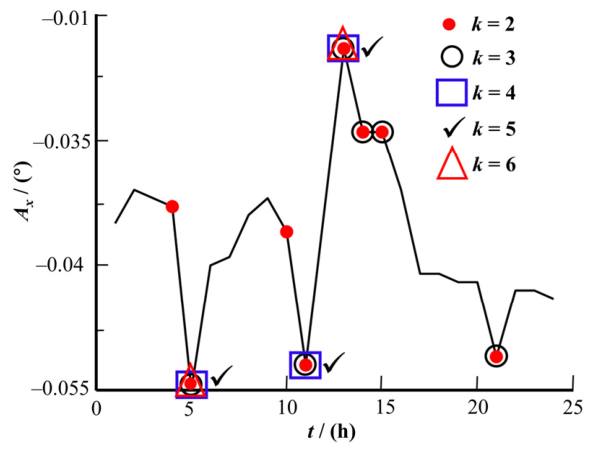
Based on the application characteristics of the LOF algorithm, the LOF value for each point is computed by varying the distance neighborhood k, with the degree of outlierness for each point being determined to assess whether it is an outlier. This approach facilitates the identification of the optimal parameter for outlier detection. As an example, the X-direction inclination angle monitoring data from monitoring point 4, recorded between 1:00 and 24:00 on 1 March 2023, is analyzed using different k values: k = 2, 3, 4, 5, 6. The outlier detection results for these various k values are presented in Figure 5.
As shown in Figure 5, when k = 2, an excessive number of normal data points during the 4th and 9th hours were incorrectly identified as outliers. When k = 3, the outlier detection performance was optimal. However, when k = 4 and k = 5, outliers during the 14th and 15th hours were not detected. With k = 6, only the outlier data points for the 5th and 13th hours were identified, whereas no outliers were detected when k = 7. Therefore, the use of k = 3 provided the most accurate outlier detection results.
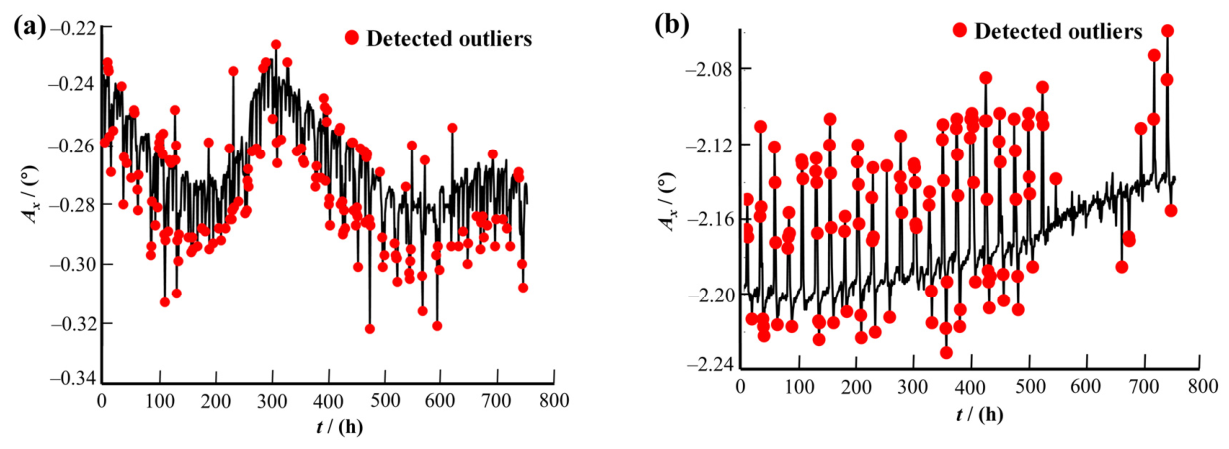
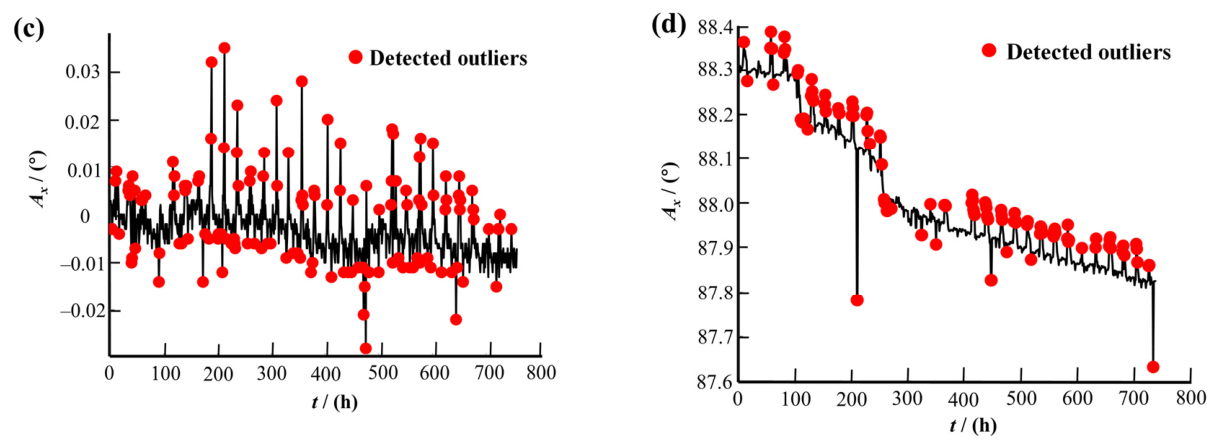
To evaluate the applicability of the LOF algorithm to complex deformation data, X-direction inclination angle monitoring data exhibiting various types of variations were selected as the research subject. Using MATLAB R2022b programming, the optimal distance neighborhood (k = 3) was set, and the LOF algorithm was applied to identify outliers. The results of the outlier detection are presented in Figure 6.
A comparison shows that, after applying the optimal distance neighborhood, the LOF algorithm effectively identifies outliers in slope deformation data. It successfully detects outlier values across different trend variations while minimizing the misidentification of normal time series data.

3.1.2. Data Interpolation and Imputation Method

After identifying and removing outliers, missing values often emerge in the local data, resulting in discontinuous deformation time series. In addition, due to limitations in device stability and signal transmission reliability, a small amount of missing data may also exist in the original monitoring records. To ensure the continuity of the time series and the reliability of subsequent prediction models, missing value imputation is required.
Common methods for time series missing value imputation include statistical methods (mean imputation, constant imputation), neighborhood-based interpolation techniques (linear interpolation, spline interpolation, conditional mean), and machine learning-based methods (linear regression, decision trees, random forests, KNN) [23,24]. Among these, mean imputation and linear interpolation are more frequently applied to slope deformation time series. Furthermore, the KNN algorithm has demonstrated advantages in filling missing values in dynamically changing time series data [25,26]. Therefore, this study employs these three methods to investigate missing value imputation in slope deformation time series and conducts a comparative analysis of their respective advantages and disadvantages to identify the optimal method.
The KNN-based imputation method was implemented using Euclidean distance to quantify similarity between samples in the time-value space. Unlike the conventional KNN setting with a fixed number of neighbors, the neighborhood in this study was defined adaptively based on the data structure: all available observations located between two adjacent missing segments were treated as the candidate neighbor set. Therefore, no fixed k value was imposed, and the effective number of neighbors varied according to the local data availability. A distance-based weighting scheme (inverse-distance weighting) was then applied for missing value estimation, where closer observations were assigned higher weights.
Under the condition of selecting the optimal parameters, the mean imputation method, linear interpolation method, and KNN algorithm were applied to fill in the missing values of the monitoring data. The imputation results are presented in Figure 7.
The data imputed using the mean imputation method exhibits a distinct linear connection between points, while the data filled with linear interpolation shows noticeable curvature compared to the mean method. Both the mean and linear interpolation imputation methods tend to concentrate data values around the peaks and valleys of the time series, thereby amplifying fluctuation errors in the original data. In contrast, the KNN algorithm effectively captures the overall trend of the time series, with imputed values closely aligning with the average values of neighboring data points. This approach better reflects the pattern of landslide monitoring data and more accurately represents the data’s evolution. Therefore, the KNN machine learning algorithm is better suited for filling missing values in the time series of slope monitoring parameters for open-pit to underground sliding-type slopes. The method can be applied to irregularly sampled data; however, its accuracy may decrease when large consecutive missing blocks occur due to reduced local information.

3.2. Deformation Time Series Denoising Based on Bessel Functions

In practical engineering, numerous scholars have applied various data processing techniques to study the denoising of slope monitoring data. Common methods include moving average, Kalman filtering, least squares method, and wavelet signal denoising, all of which have contributed to improving the accuracy of predictive warning models to varying extents. However, these methods still have significant limitations when applied to time series data with dynamic and nonlinear changes. To address this challenge, a denoising method based on Bessel functions is proposed for slope displacement time series data. This represents a novel application of the Bessel functions approach in slope engineering. The objective is to optimize the denoising effect by leveraging the characteristics of Bessel functions, facilitating more effective application in the processing of mining slope landslide monitoring data. The proposed method is essentially a basis-function expansion and curve reconstruction approach, rather than a conventional signal-processing denoising filter.

3.2.1. Bessel Functions

The Bessel functions are a special function in mathematics that serves as a solution to the Bessel equation and cannot be expressed in terms of elementary functions [27,28]. It was first introduced by the German mathematician Bessel in the context of solving problems related to the vibration of circular membranes. Since then, it has found widespread application in fields such as physics, engineering, and signal processing, particularly in wave propagation problems and those involving potential fields. Bessel functions are often used in data denoising filters due to their characteristic flat amplitude and phase response within the passband. This means that when a signal passes through a Bessel filter, its waveform experiences minimal distortion, making it ideal for applications where the preservation of the signal phase is crucial.
Fourier bases rely on periodicity assumptions and are prone to Gibbs oscillations when applied to non-periodic signals, while Chebyshev bases are sensitive to noise and may suffer from overfitting under high-order expansion conditions. In contrast, the phase flatness and oscillation attenuation characteristics of Bessel functions make them more suitable for non-stationary time series data, such as slope deformation monitoring data. In addition, important properties of Bessel functions, including recurrence relations, asymptotic expansions, and orthogonality, provide good computational stability and applicability in practical applications.
The specific form of the Bessel function can be represented either as a series or as an integral. In data denoising, the primary advantage of Bessel functions lies in their excellent smoothing properties. The first kind of Bessel function is commonly employed for this purpose, as it effectively reduces noise while preserving the overall trend of the data. The formula for the first kind of Bessel function is as follows:
J v ( x ) = k = 0 ( 1 ) k k ! Γ ( k + v + 1 ) x 2 2 k + v
where Γ is the Gamma function. v is the Bessel function order. k is the series index.
Assume a set of time series data t i , y i i = 1 N , where ti represents the time points and yi are the observed values. To fit and denoise the data using the first kind of Bessel function, we first construct the Bessel basis function matrix B, where the Jj(ti) column contains the values of the j-th order Bessel function at the time points ti.
B = J 0 ( t 1 ) J 1 ( t 1 ) J m ( t 1 ) J 0 ( t 2 ) J 1 ( t 2 ) J m ( t 2 ) J 0 ( t n ) J 1 ( t n ) J m ( t n )
Therefore, the observation vector of the time series data, y = [y1, y2, …, yn]T, can be represented as a linear combination of Bessel basis functions with noise.
y = B β + ε
where β = [β1, β2, …, βm]T is the weight coefficient vector to be determined. ε is the noise vector and does not need to be treated explicitly.
The coefficient vector β is solved using the least-squares method by minimizing the residual sum of squares:
β ^ = arg min β y B β 2
The analytical solution of the above equation is given as follows:
β ^ = B T B 1 B T y
The denoised observation vector y ^ = y ^ 1 , y ^ 2 , , y ^ m T can be calculated as follows:
y ^ = B β ^
y ^ i = j = 0 m β ^ j J j t i , i = 1 , 2 , , n

3.2.2. Method Application

The Bessel function-based noise reduction method was applied to the time series of the X-direction inclination angle at monitoring point 4 for January 2024. Concurrently, other conventional noise reduction methods—such as moving average, exponential smoothing, and the least squares method—were applied for comparison. To further assess the effectiveness of these noise reduction techniques, four performance metrics were introduced: Signal-to-Noise Ratio (SNR), Peak Signal-to-Noise Ratio (PSNR), Root Mean Square Error (RMSE), and Structural Similarity Index (SSIM), which collectively provide a quantitative evaluation of denoising performance.
The Signal-to-Noise Ratio (SNR) measures the ratio between the original signal and the noise. A higher SNR indicates better noise reduction, with a smaller noise component relative to the signal. This metric provides a quantitative measure of how well the noise has been reduced while retaining the original signal.
SNR = 10 lg i = 1 N y ( i ) 2 i = 1 N y ( i ) y ^ ( i ) 2
Here, y(i) is the original data, y ^ ( i ) is the denoised data, and N is the total number of samples in the dataset.
The Root Mean Square Error (RMSE) is defined as:
RMSE = 1 N i = 1 N ( y ( i ) y ^ ( i ) ) 2
RMSE quantifies the average deviation between the denoised signal and the original signal. A lower RMSE indicates higher denoising accuracy.
The Peak Signal-to-Noise Ratio (PSNR) is used to evaluate the ratio between the maximum signal magnitude and the reconstruction error. It is defined as:
PSNR = 20 log 10 MAX RMSE
where MAX denotes the maximum absolute value of the original signal.
The Structural Similarity Index (SSIM) was originally developed for image quality assessment, where it is used to evaluate the similarity between two signals in terms of luminance, contrast, and structural information. SSIM is a similarity metric based on local statistical features, and it has also been extended to the analysis of one-dimensional monitoring time series and other types of signals for similarity evaluation [29,30]. SSIM is employed to quantify the structural consistency between the denoised monitoring time series and the original reference series. The SSIM value ranges from 0 to 1, where values closer to 1 indicate higher structural similarity between the two signals, reflecting better preservation of the structural information of the original signal after denoising.
SSIM y , y ^ = 2 μ y μ y ^ + C 1 2 σ y y ^ + C 2 μ y 2 + μ y ^ 2 + C 1 σ y 2 + σ y ^ 2 + C 2
where μ y and μ y ^ are the mean values of the original data and the denoised data, respectively, σ y 2 and σ y ^ 2 are the variances of the original data and the denoised data, respectively, σ y y ^ is the covariance, and C 1 and C 2 are two constants used to stabilize the results.
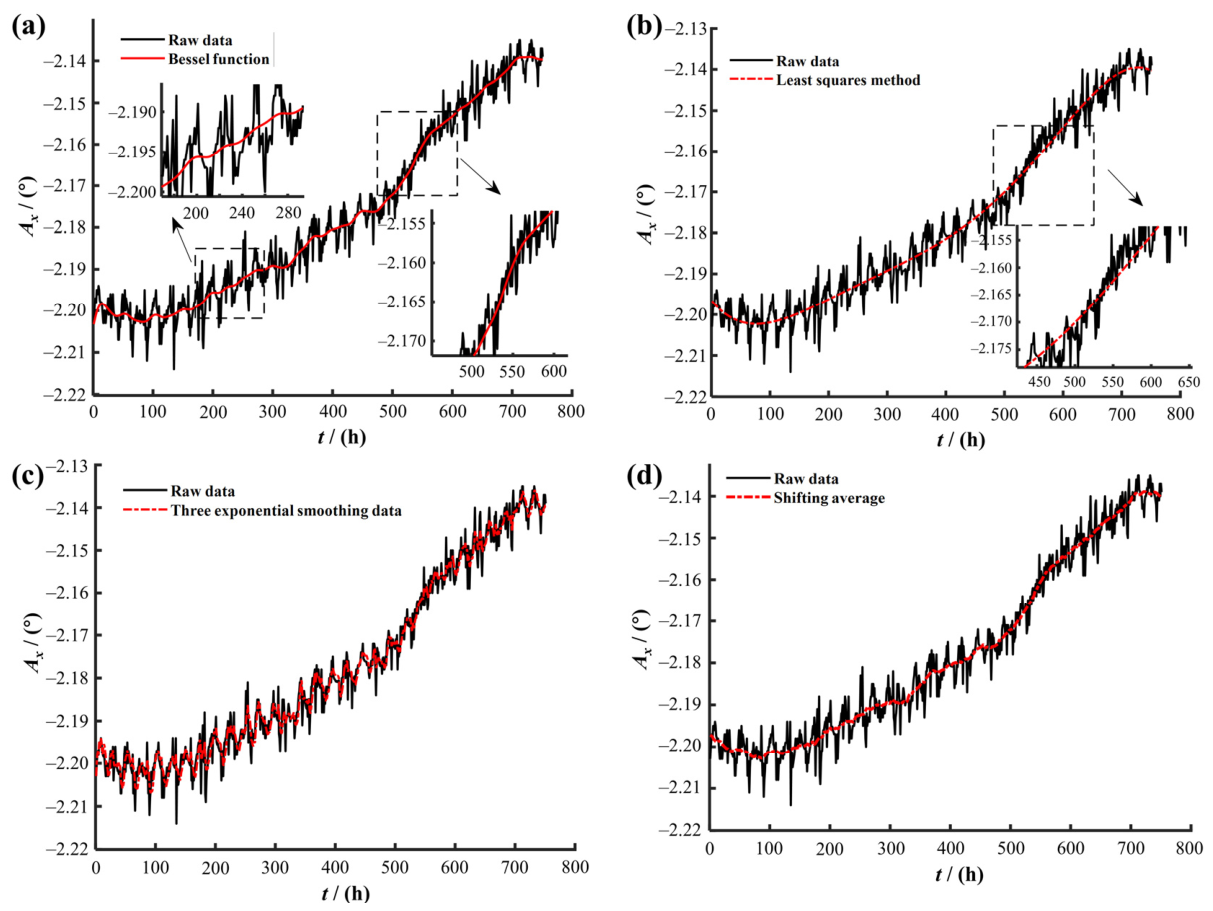
These indicators can be used in combination to assess the performance of different denoising methods, facilitating the selection of the most suitable method. By conducting comprehensive data interpretation experiments for each method, the optimal parameters for the corresponding algorithms are determined, and relevant evaluation metrics are calculated. The optimal denoising results achieved by the Moving Average Method (MAM), Triple Exponential Smoothing (TES), Least Squares Method (LSM), and Bessel Filtering Method (BFM) are shown in Figure 8, with the corresponding evaluation metrics provided in Table 1.
Among the denoising methods, the MAM is widely applicable and provides good real-time performance. The denoised curve generally follows the trend of the time series. However, it introduces a lag effect during the calculation, which slows down the data response speed, as shown in Figure 8b. The TES method uses exponentially weighted averages, and its smoothing coefficient significantly impacts the denoising effect. Determining the optimal coefficient requires experience or optimization methods, and its performance is relatively poor for time series data with significant trend changes, as shown in Figure 8c. The LSM offers a good smoothing effect but is sensitive to noise and outliers, potentially leading to overfitting and poor local fitting of the time series, as clearly shown in Figure 8d. Additionally, the computational cost of the Least Squares Method is high, especially for large-scale data and complex models, requiring careful selection of appropriate models and feature values, which increases model complexity.
In contrast, the BFM effectively filters high-frequency noise while preserving the main characteristics of the original data, without introducing observable phase shifts or distortions in the temporal evolution of the signal, as shown in Figure 8a. Furthermore, the Bessel function is computationally efficient, making it suitable for real-time processing of large-scale time series data, and is relatively robust to outliers.
Based on the comprehensive evaluation of SNR, PSNR, SSIM, and RMSE, the BFM demonstrates consistently superior performance among the compared methods. However, it should be noted that the magnitude of improvement is relatively small. For example, compared with the MAM, the SNR and PSNR increase by approximately 0.107 dB, the SSIM improves by 0.0001, and the RMSE decreases by about 0.00003°. Although these differences may not be statistically significant in a strict sense, they remain meaningful in high-precision deformation monitoring scenarios, where even small improvements in error metrics may affect downstream prediction performance. Moreover, since the RMSE values are already at a very low level (on the order of 10−3°), further reductions in absolute error, although numerically small, still contribute to improved stability and reliability of the monitoring system.
Overall, the BFM shows consistent advantages in SNR, PSNR, SSIM, and RMSE, indicating better signal fidelity, improved structural preservation, and reduced reconstruction error, without introducing noticeable distortions in trend evolution or temporal alignment. These results suggest that the BFM is an effective approach for denoising slope deformation time series data, particularly in maintaining data integrity and minimizing distortions.

3.3. Evaluation of Denoising Effects on Time Series Prediction Performance

To further assess the performance of the aforementioned anomaly detection and denoising methods, a deformation prediction application study was conducted based on these methods. The open-pit to underground mining introduces unique challenges in slope monitoring, particularly due to the dynamic and nonlinear behaviors exhibited by surface deformation time series. These time series are influenced by various factors such as mining activities, geological conditions, and environmental changes, making accurate prediction and analysis crucial for safety. For this study, a range of time series data were used as the training dataset. Both the raw time series and the denoised time series were analyzed to compare their prediction accuracy. The Particle Swarm Optimization (PSO) algorithm, which is widely used for optimization problems due to its efficiency in finding optimal solutions in high-dimensional spaces, was employed to perform the prediction analysis [31]. The goal was to evaluate the impact of the proposed anomaly detection and denoising methods on the performance of subsequent prediction models.

3.3.1. Prediction Method Based on PSO-BP

PSO-BP neural networks are a hybrid modeling approach that integrates the PSO algorithm with a backpropagation (BP) neural network. The core concept is to leverage the global search capabilities of the PSO algorithm to optimize the initial weights and biases of the BP neural network, thereby improving the convergence speed and prediction accuracy of the BP network. In this study, the PSO-BP neural network is utilized for short-term predictions of landslide monitoring data. For the design of the slope deformation prediction model, a BP neural network with three hidden layers consisting of 40, 30, and 20 neurons is employed to enhance the model’s expressive power. The slope time series data is structured as an input-output dataset, where the previous 12 time steps of deformation data are used as input, and the subsequent 12 time steps are predicted as output. The training process is configured to run for 3000 iterations, with an initial learning rate of 0.005 and a target error of 1 × 10⁻⁶. Additionally, the learning rate is dynamically adjusted during training to improve adaptability. To mitigate overfitting, L2 regularization and the Dropout mechanism are incorporated into the network, and the forward linear unit is used as the activation function. These design choices not only enhance the model’s ability to capture nonlinear relationships but also effectively reduce the risk of overfitting.
The original dataset refers to the raw data without any anomaly detection or denoising, while the trend dataset represents the data after undergoing the following preprocessing steps: anomaly detection, interpolation filling, and Bessel function-based denoising. The objective of these preprocessing steps is to eliminate outliers, fill missing values, and reduce noise, thereby allowing the true underlying trend of the time series to be extracted.

3.3.2. Prediction Results Analysis

To assess how denoising methods affect the accuracy of landslide early warning systems, three types of time series data with different noise characteristics were selected as the dataset for this study. In the model fitting and evaluation process, the dataset was divided into training and testing sets with a ratio of 9:1 based on chronological order. The testing set was strictly reserved for performance evaluation and was not involved in any stage of model training or preprocessing parameter estimation. The time series data were carefully chosen to represent various conditions in slope deformation, including:
  • Prediction results of high noise and dynamically varying time series
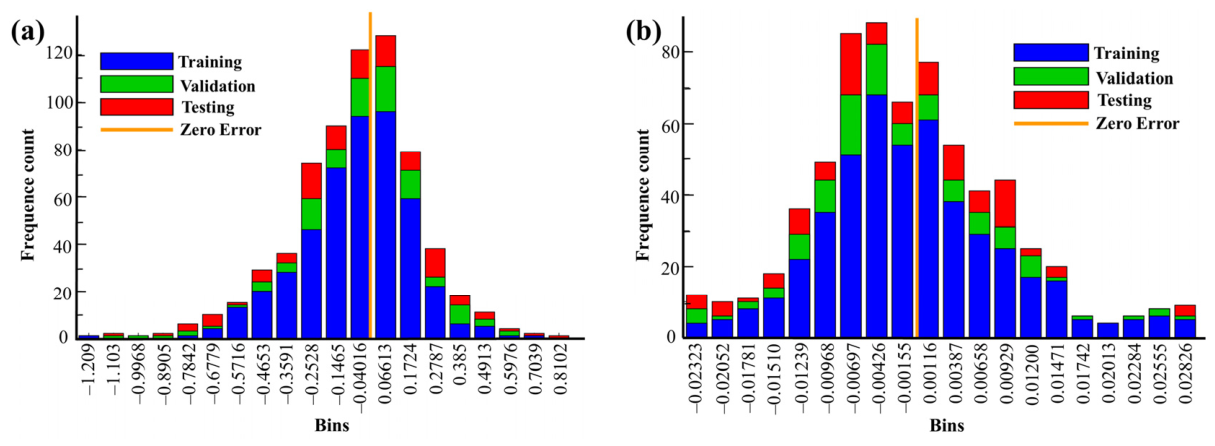
Using the displacement change data in the X-direction from January 2024 as an example, predictions were made for both the original (undenoised) data and the trend data after denoising with the Bessel function. The prediction results are shown in Figure 9, and the corresponding error histogram with 20 bins is presented in Figure 10.
By comparing the test sets in Figure 9, the following observations can be made. Original Data: In Figure 9a, where the predictions are based on the original (undenoised) data, a noticeable discrepancy exists between the predicted model output and the actual data. This is particularly evident at the peak and trough points of the time series, where the predicted values exhibit smaller fluctuations compared with the actual data. These smaller fluctuations in the predicted values are indicative of the noise present in the original data, which affects the accuracy of the prediction. In Figure 9b, the predictions based on the trend data after applying Bessel function denoising show a much better alignment with the actual data. The model’s training data shows a closer match to the real data, especially in the 0–200 h range, where the error is relatively small, approximately 0.001°. After 200 h, the predicted and actual data nearly coincide. This indicates that the denoising process has significantly reduced the noise and allowed the model to better capture the underlying trend of the deformation. The two curves closely follow each other, indicating a more accurate prediction. The comparison of the predicted data further highlights the impact of the denoising method. In Figure 10a, the prediction error for the original (undenoised) data shows considerable deviation from the actual data. The error distribution is broader and more erratic, reflecting the noise interference in the undenoised time series. In contrast, for the trend data with Bessel function denoising, as shown in Figure 10b, the prediction error is significantly smaller and more consistent. The error is concentrated around 0°, with a roughly normal distribution in both positive and negative directions. This indicates a more uniform error distribution, with values closely aligned to the true data, suggesting improved prediction accuracy and performance of the model. Conclusion: The results of the comparison clearly demonstrate the advantages of the Bessel function denoising method. By reducing the noise in the time series, the Bessel function enables more accurate predictions, with a prediction error that is smaller, more consistent, and more concentrated around zero. The trend data shows superior performance, far outperforming the original data in terms of prediction accuracy. The prediction error histogram further supports this conclusion, showing a tighter error distribution for the trend data, which indicates that the denoising method significantly enhances the model’s ability to capture the true deformation trend.
2.
Prediction results of high noise and fluctuating time series
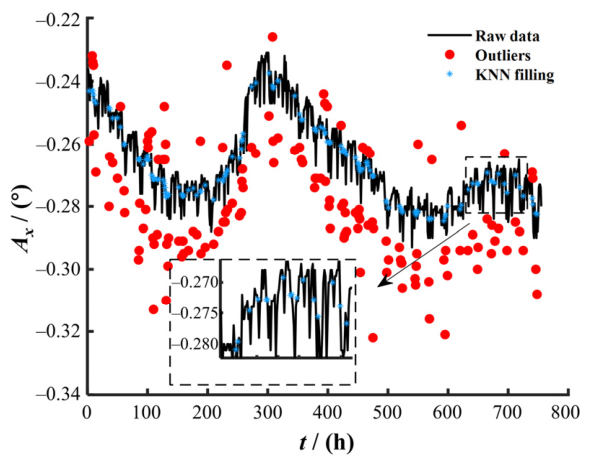
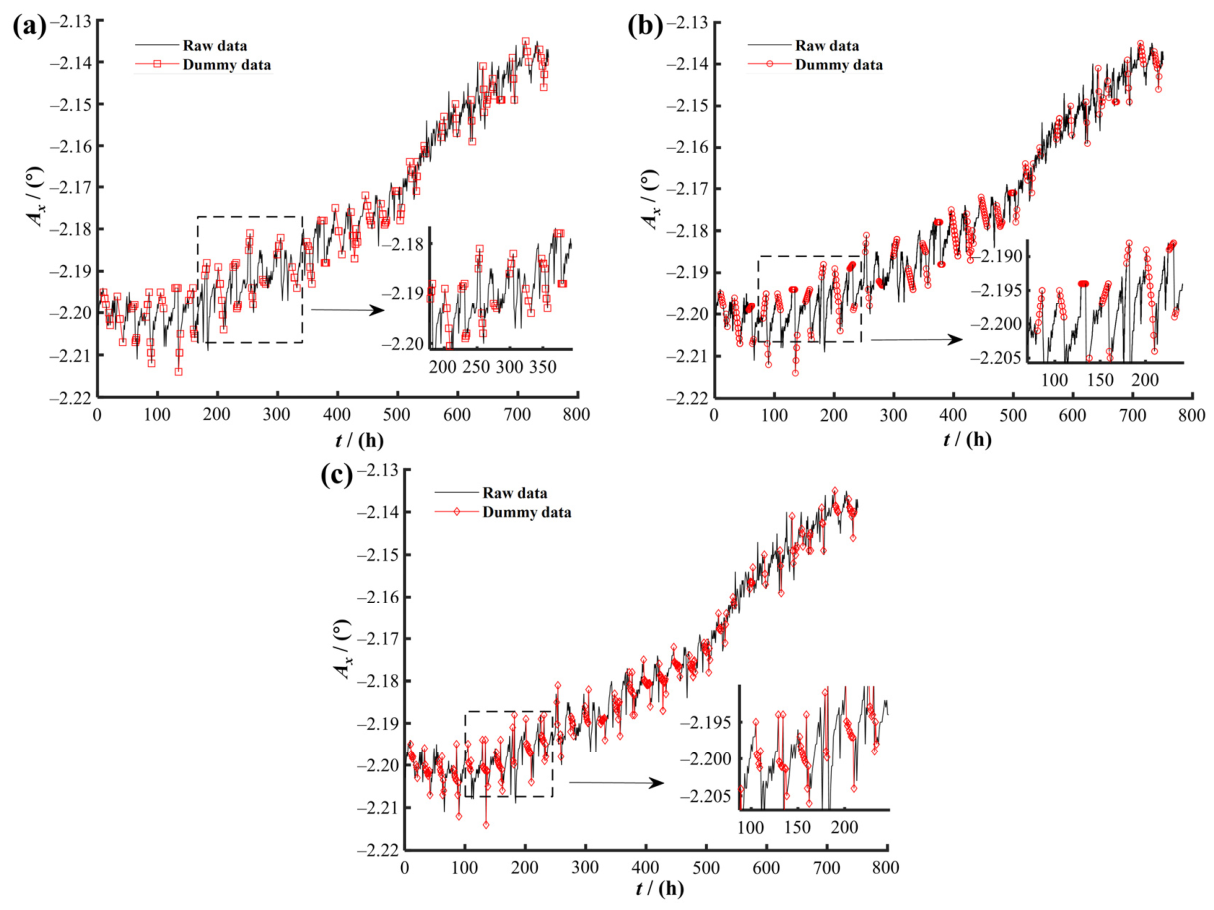
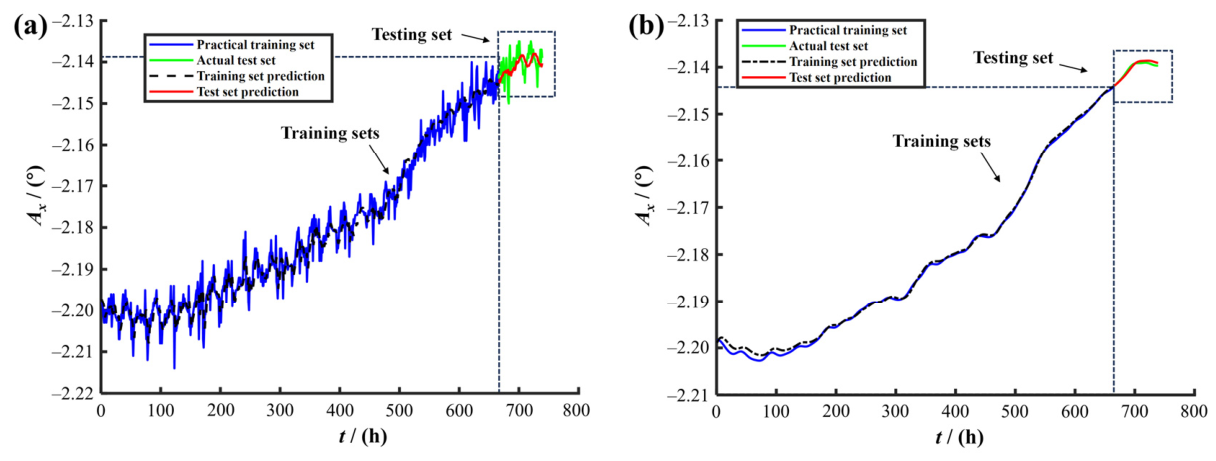
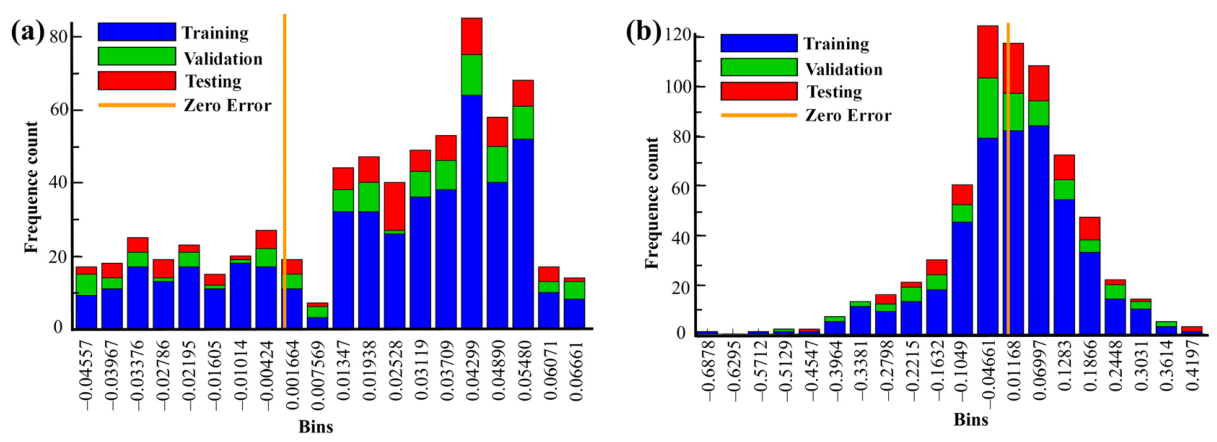
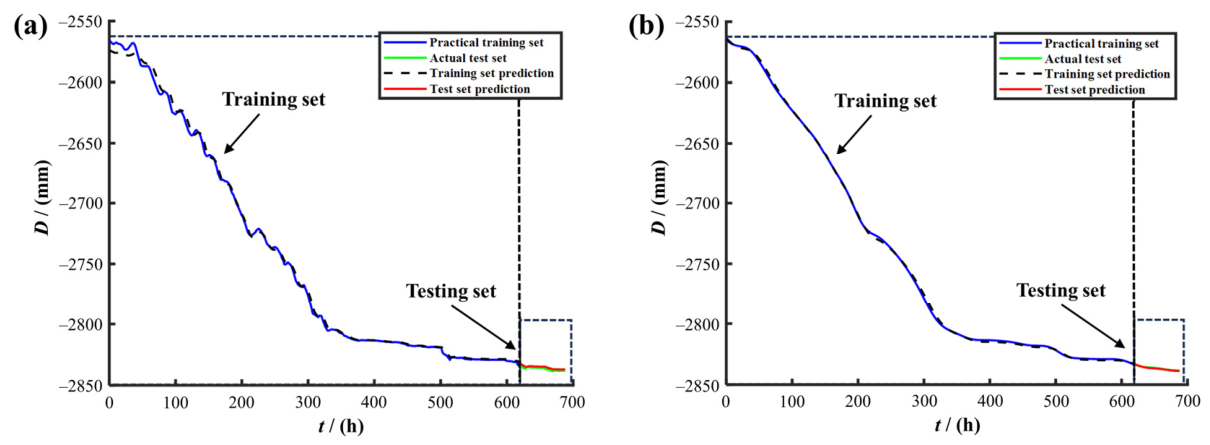
Using the X-direction inclination angle change data from the GNSS 04 monitoring point in May 2023 as an example, the data exhibits significant noise, which impacts the comparison results. To mitigate this issue, anomaly detection was performed using the LOF algorithm, followed by KNN interpolation for data preprocessing, as illustrated in Figure 11. Predictions were then made on both the original (non-denoised) data and the trend data (denoised via the Bessel function), with the results shown in Figure 12. The corresponding error histograms, divided into 20 bins, are presented in Figure 13.
High-noise, dynamically changing time series data presents a significant challenge for the PSO-BP model’s predictions. As shown in Figure 12a, the training set and prediction test set for the original data exhibit greater discrepancies with the true values, particularly at the peaks and troughs of the time series. The noise causes the predicted values to deviate noticeably from the actual data, leading to less accurate predictions. In contrast, as shown in Figure 12b, the trend data, after being denoised using the Bessel function, significantly improves the PSO-BP model’s prediction performance. The denoising process helps the model capture the underlying trend of the time series, resulting in more accurate predictions. The only noticeable deviation occurs in the training set time series between 500 and 600 h, during the trough fluctuations. This slight discrepancy indicates that while the denoising process improves the overall trend, there may still be some challenges in capturing sharp fluctuations in the data. Comparing the prediction error histograms further supports the effectiveness of the denoising approach. For the original data, the prediction errors range between −0.35° and 0.17°, with most errors concentrated between −0.25° and 0.17°. These larger error ranges reflect the impact of noise on the model’s accuracy. In contrast, for the trend data, the error values are mostly concentrated between −0.0069° and 0.0093°, indicating a much narrower and smaller error range. This reduction in error highlights the improvement in prediction accuracy after anomaly detection, interpolation compensation, and Bessel function-based denoising. The results clearly demonstrate that the denoising process significantly enhances the prediction accuracy of the PSO-BP model, allowing it to better capture the true trend of slope deformation data, even in the presence of high noise and dynamic fluctuations.
3.
Prediction results of low noise and dynamically varying time series
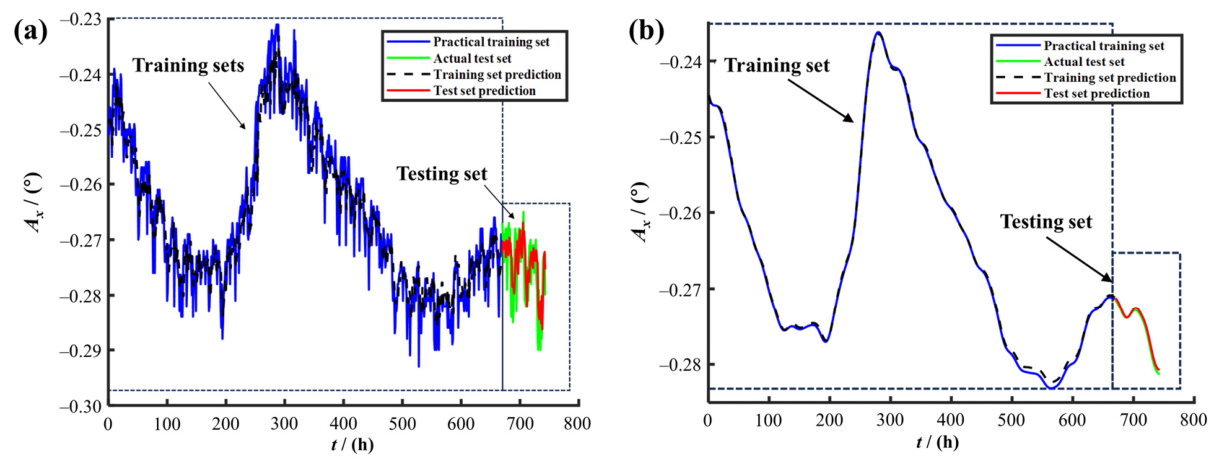
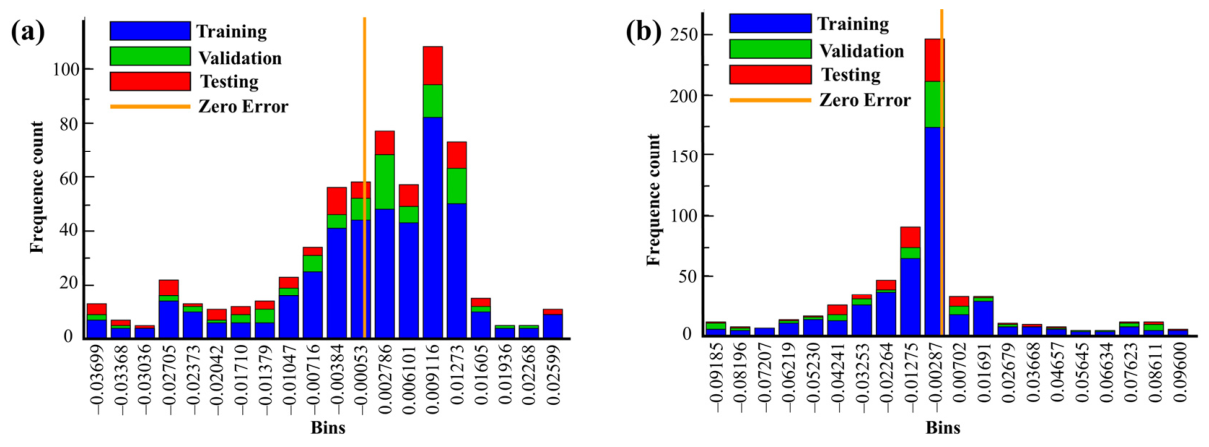
Taking the displacement variation monitoring data from January 2024 as an example, predictions were made for both the original data and the trend component decomposed based on the Bessel function, as shown in Figure 14. The prediction errors for both datasets are presented in Figure 15.
As shown in Figure 14a, during the training phase, the model’s predictions exhibit a significant deviation from the original time series, especially when the data fluctuates in the early stages of training with limited deformation data. In these initial stages, the early warning model’s output tends to diverge more from the actual values. However, as the dataset expands and more data points are accumulated, the model’s predictions gradually align more closely with the original time series. Despite this, when comparing the predicted values to the actual data, it can be observed that the predicted trend for the original data generally matches the real values, though the predicted values tend to be slightly higher than the actual values. Comparing Figure 14a,b, it is evident that the predicted values from the early warning model for the trend data (denoised using the Bessel function) match the original time series much more closely. This suggests that the denoising process helps the model better capture the true deformation trend, reducing discrepancies between predicted and actual values. In Figure 15, the errors for the original data are mostly distributed between −0.00716 mm and 0.01273 mm, reflecting a wider spread and less accuracy in the predictions. In contrast, the errors for the trend data after denoising are tightly centered around −0.00287 mm, indicating a much higher level of accuracy. This demonstrates that the Bessel function-based denoising technique improves the model’s ability to predict slope deformation more accurately by filtering out noise and capturing the underlying trend of the data. By comparing the prediction results before and after denoising under different conditions, it is found that the higher the noise level in the data, the lower the prediction accuracy when the initial deformation data is used as input. This is particularly evident for time series with alternating increases and decreases or highly dynamic variation types, where the prediction error tends to be higher due to the increased noise interference.

3.4. Limitations and Future Work

The proposed LOF–KNN–Bessel approach shows good performance in processing slope deformation time series under open-pit to underground mining conditions; however, several limitations remain.
1.
The KNN-based imputation strategy relies on local continuity between adjacent missing segments. When long consecutive missing blocks occur, the number of available neighboring observations decreases significantly, which may reduce estimation accuracy due to insufficient local information. In addition, the current study does not include comparisons with a wider range of interpolation methods, and further evaluation under different missing-data conditions is still needed;
2.
The Bessel function-based denoising method is formulated as a basis-function expansion and curve reconstruction approach. Although it preserves the overall deformation trend and does not introduce observable temporal distortion, rapid and abrupt deformation events may still be partially smoothed, leading to reduced sensitivity to short-term variations;
3.
In the prediction stage, the PSO-BP model was used as a unified prediction framework to evaluate the influence of preprocessing on downstream forecasting performance. Although identical model settings were maintained throughout the experiments, comparisons with additional baseline prediction models were not included in the present study;
4.
The current validation is based on a single mining case study, and the generalization ability under different geological conditions, monitoring systems, deformation mechanisms, and noise characteristics has not been fully examined.
Future work will focus on improving performance under sparse and irregular sampling conditions by incorporating adaptive neighborhood selection strategies and more flexible preprocessing mechanisms. In addition, multi-scale representations of the Bessel expansion may be considered to improve the representation of both global trends and local variations. Further validation across different engineering sites, monitoring environments, and deformation conditions is needed to evaluate the applicability, robustness, and generalization capability of the proposed approach.

4. Conclusions

  • Surface deformation monitoring at the Shilu Iron Mine in Hainan, China, revealed that deformation indicators of slopes transitioning from open-pit to underground mining exhibit diverse, nonlinear patterns over time, including multi-type behaviors and alternating acceleration-deceleration rates. These characteristics increase the difficulty of accurate deformation trend identification and landslide early warning. In addition, monitoring noise caused by environmental disturbances and positioning errors significantly affects the reliability of deformation analysis and prediction. Notably affects the inclination angle time series more significantly than the displacement time series, further complicating the analysis and forecasting of slope stability;
  • A comparison of multiple algorithms revealed that the Local Outlier Factor (LOF) and the K-Nearest Neighbor (KNN) algorithms outperform other methods in anomaly detection and data interpolation compensation, particularly in time series data exhibiting noise and dynamic variations. The LOF algorithm achieved the best anomaly identification performance when the neighborhood parameter was set to Nk(p) = 3. These algorithms show good applicability for anomaly identification and missing-value imputation in nonlinear and dynamically varying deformation time series;
  • A Bessel function-based denoising approach was introduced for slope deformation time series. Specifically, for the dynamic and fluctuating time series of slope indicators in open-pit to underground mining, Bessel function denoising effectively filters high-frequency noise while preserving the essential features of the original data. Compared to other methods, such as the moving average, triple exponential smoothing, and least squares techniques, the Bessel function denoising approach demonstrates superior performance in terms of signal-to-noise ratio (SNR), peak signal-to-noise ratio (PSNR), structural similarity index (SSIM), and root mean square error (RMSE). The SNR reaches 57.0744 dB, the PSNR reaches 56.9019 dB, the SSIM is 0.9938, and the RMSE is 0.00305°. The proposed approach shows good capability in preserving deformation trends while reducing high-frequency fluctuations in nonlinear monitoring data;
  • Building on the results of anomaly detection, compensation, and denoising analyses, a comprehensive LOF–KNN–Bessel approach was established for slope deformation time series under open-pit to underground mining conditions. This approach integrates anomaly detection using the LOF algorithm, interpolation compensation with the KNN algorithm, and denoising through the Bessel function. It is specifically designed to address monitoring data exhibiting multiple types, nonlinear characteristics, and alternating acceleration/deceleration trends—common in the slope deformation of open-pit to underground mining. Application of the proposed approach in the Hainan Shilu Iron Mine improves the quality of the processed deformation time series and enhances the prediction performance of the PSO-BP model. In quantitative terms, for the high-noise inclination time series, the prediction error is reduced from −0.35–0.17° (raw data) to −0.0069–0.0093° (processed data), while for the displacement time series, the error range is reduced from −0.00716–0.01273 mm to approximately −0.00287 mm. These results indicate that the proposed approach improves the reliability of deformation trend extraction and time series prediction under complex monitoring conditions. However, the current validation is mainly based on a single mining case, and further studies under different geological and monitoring conditions are still required.

Author Contributions

Conceptualization, C.M., Z.C., M.C. (Mo Chen), P.W. and M.C. (Meifeng Cai); methodology, C.M., Z.C., M.C. (Mo Chen), P.W. and M.C. (Meifeng Cai); software, C.M. and M.C. (Mo Chen); validation, C.M. and Q.M.; formal analysis, C.M. and M.C. (Mo Chen); data curation, C.M., Z.C., M.C. (Mo Chen) and L.L.; writing—original draft preparation, C.M., Z.C., M.C. (Mo Chen), Q.M., P.W., M.C. (Meifeng Cai) and L.L.; writing—review and editing, C.M., Z.C., P.W. and M.C. (Meifeng Cai). All authors have read and agreed to the published version of the manuscript.

Funding

This work was financially supported by the National Key R&D Program of China (Grant Nos. 2023YFC2907400 and 2021YFC2900500), the National Natural Science Foundation of China (Grant No. 52074020), and the Hainan Province Science and Technology Special Fund (Grant No. ZDYF2024GXJS307).

Data Availability Statement

The data presented in this study are available on request from the corresponding author due to engineering project confidentiality restrictions.

Conflicts of Interest

One of the co-authors is affiliated with Hainan Mining Co., Ltd., which provided monitoring data used in this study. The company had no involvement in the study design, data analysis, interpretation of results, or the writing of the manuscript. The authors declare that there are no competing financial or personal interests that could have influenced the work reported in this paper.

References

  1. Strzabala, K.; Cwiakala, P.; Puniach, E. Identification of landslide precursors for early warning of hazards with remote sensing. Remote Sens. 2024, 16, 2781. [Google Scholar] [CrossRef]
  2. Pecoraro, G.; Calvello, M.; Piciullo, L. Monitoring strategies for local landslide early warning systems. Landslides 2019, 16, 213–231. [Google Scholar] [CrossRef]
  3. Yu, S.H.; Lei, Q.Y.; Liu, C.; Zhang, N.; Shan, S.S.; Zeng, X.M. Application research on digital twins of urban earthquake disasters. Geomat. Nat. Hazards Risk 2023, 14, 2278274. [Google Scholar] [CrossRef]
  4. Akosah, S.; Gratchev, I.; Kim, D.H.; Ohn, S.Y. Application of artificial intelligence and remote sensing for landslide detection and prediction: Systematic review. Remote Sens. 2024, 16, 2947. [Google Scholar] [CrossRef]
  5. Binu, K.E.; Anoopkumar, L.T.; Sunil, M.; Jose, M.; Preetha, K.G. Dynamic landslide prediction, monitoring, and early warning with explainable AI: A Comprehensive approach. In Proceedings of the 2024 3rd International Conference on Applied Artificial Intelligence and Computing (ICAAIC), Salem, India, 5–7 March 2024; pp. 960–965. [Google Scholar] [CrossRef]
  6. He, X.X.; Montillet, J.P.; Fernandes, R.; Bos, M.; Yu, K.; Hua, X.H.; Jiang, W.P. Review of current GPS methodologies for producing accurate time series and their error sources. J. Geodyn. 2017, 106, 12–29. [Google Scholar] [CrossRef]
  7. Zhou, H.; Dai, K.R.; Tang, X.C.; Xiang, J.M.; Li, R.P.; Wu, M.T.; Peng, Y.R.; Li, Z.H. Time-Series InSAR with Deep-learning-based topography-dependent atmospheric delay correction for potential landslide detection. Remote Sens. 2023, 15, 5287. [Google Scholar] [CrossRef]
  8. Dintwe, T.K.M.; Sasaoka, T.; Shimada, H.; Hamanaka, A.; Moses, D.N.; Peng, M.; Fanfei, M.; Liu, S.F.; Ssebadduka, R.; Onyango, J.A. Numerical simulation of crown pillar behaviour in transition from open pit to underground mining. Geotech. Geol. Eng. 2022, 40, 2213–2229. [Google Scholar] [CrossRef]
  9. Nguyen, P.M.V.; Niedbalski, Z. Numerical modeling of open pit (OP) to underground (UG) transition in coal mining November. Stud. Geotech. Mech. 2016, 38, 35–48. [Google Scholar] [CrossRef]
  10. Zhang, L.L.; Cheng, H.; Yao, Z.S.; Wang, X.J. Application of the improved Knothe time function model in the prediction of ground mining subsidence: A case study from Heze City, Shandong Province. Appl. Sci. 2020, 10, 3147. [Google Scholar] [CrossRef]
  11. Gruszczynski, W.; Niedojadlo, Z.; Mrochen, D. Influence of model parameter uncertainties on forecasted subsidence. Acta Geodyn. Geomater. 2018, 15, 211–228. [Google Scholar] [CrossRef]
  12. Qi, X.; Hu, C.; Cao, R.L. An Improved filtering method and application of landslide deformation monitoring. Adv. Civ. Eng. 2024, 2024, 9173882. [Google Scholar] [CrossRef]
  13. Sharifi, S.; Hendry, M.T.; Macciotta, R.; Evans, T. Evaluation of filtering methods for use on high-frequency measurements of landslide displacements. Nat. Hazards Earth Syst. Sci. 2022, 22, 411–430. [Google Scholar] [CrossRef]
  14. Miao, F.S.; Wu, Y.P.; Xie, Y.H.; Li, Y.N. Prediction of landslide displacement with step-like behavior based on multialgorithm optimization and a support vector regression model. Landslides 2018, 15, 475–488. [Google Scholar] [CrossRef]
  15. Li, Y.Y.; Huang, J.S.; Jiang, S.H.; Huang, F.M.; Chang, Z.L. A web-based GPS system for displacement monitoring and failure mechanism analysis of reservoir landslide. Sci. Rep. 2017, 7, 17171. [Google Scholar] [CrossRef]
  16. Shehadeh, A.; Alshboul, O.; Almasabha, G. Slope displacement detection in construction: An automate management algorithm for disaster prevention. Expert Syst. Appl. 2024, 237, 121505. [Google Scholar] [CrossRef]
  17. Yang, Z.F.; Li, Z.W.; Zhu, J.J.; Yi, H.W.; Hu, J.; Feng, G.C. Deriving dynamic subsidence of coal mining areas using InSAR and Logistic model. Remote Sens. 2017, 9, 125. [Google Scholar] [CrossRef]
  18. Jiang, H.; Li, L. Anomaly detection for landslide displacement monitoring data based on TCN-Transformer. Acad. J. Sci. Technol. 2024, 10, 269450794. [Google Scholar] [CrossRef]
  19. Qiu, H.Z.; Chen, X.Q.; Feng, P.; Wang, R.C.; Hu, W.; Zhang, L.P.; Pasuto, A. Advancing predictive accuracy of shallow landslide using strategic data augmentation. J. Rock Mech. Geotech. Eng. 2025, 17, 4273–4287. [Google Scholar] [CrossRef]
  20. Ikuemonisan, F.E.; Ozebo, V.C.; Olatinsu, O.B. Investigation of Sentinel-1-derived land subsidence using wavelet tools and triple exponential smoothing algorithm in Lagos, Nigeria. Environ. Earth Sci. 2021, 80, 722. [Google Scholar] [CrossRef]
  21. Yuan, K.; Ma, C.; Guo, G.L.; Wang, P.T. Slope failure of Shilu metal mine transition from open-pit to underground mining under excavation disturbance. Appl. Sci. 2024, 14, 1055. [Google Scholar] [CrossRef]
  22. Breunig, M.M.; Kriegel, H.P.; Ng, R.T.; Sander, J. LOF: Identifying density-based local outliers. Sigmod Rec. 2000, 29, 93–104. [Google Scholar] [CrossRef]
  23. Ahn, H.; Sun, K.; Kim, K.P. Comparison of missing data imputation methods in time series forecasting. CMC-Comput. Mat. Contin. 2021, 70, 767–779. [Google Scholar] [CrossRef]
  24. Zainuddin, A.; Hairuddin, M.A.; Yassin, A.I.M.; Abd Latiff, Z.I.; Azhar, A. Time series data and recent imputation techniques for missing data: A Review. In Proceedings of the International Conference on Green Energy, Computing and Sustainable Technology (GECOST), Miri, Malaysia, 26–28 October 2022; pp. 346–350. [Google Scholar] [CrossRef]
  25. Cui, L.F.; Zhang, Q.Z.; Shi, Y.; Yang, L.M.; Wang, Y.X.; Wang, J.L.; Bai, C.G. A method for satellite time series anomaly detection based on fast-DTW and improved-KNN. Chin. J. Aeronaut. 2023, 36, 149–159. [Google Scholar] [CrossRef]
  26. Tavazzi, E.; Daberdaku, S.; Vasta, R.; Calvo, A.; Chiò, A.; Di Camillo, B. Exploiting mutual information for the imputation of static and dynamic mixed-type clinical data with an adaptive k-nearest neighbours approach. BMC Med. Inform. Decis. Mak. 2020, 20, 174. [Google Scholar] [CrossRef]
  27. Simos, T.E. A new explicit Bessel and Neumann fitted eighth algebraic order method for the numerical solution of the Schrodinger equation. J. Math. Chem. 2000, 27, 343–356. [Google Scholar] [CrossRef]
  28. Simos, T.E. Bessel and Neumann fitted methods for the numerical solution of the Schrodinger equation. Comput. Math. Appl. 2001, 42, 833–847. [Google Scholar] [CrossRef]
  29. Wang, Z.; Bovik, A.C.; Sheikh, H.R.; Simoncelli, E.P. Image quality assessment: From error visibility to structural similarity. IEEE Trans. Image Process. 2004, 13, 600–612. [Google Scholar] [CrossRef]
  30. Li, F.D.; Guo, Z.W.; Pan, X.P.; Liu, J.X.; Wang, Y.Y.; Gao, D.W. Deep learning with adaptive attention for seismic velocity inversion. Remote Sens. 2022, 14, 3810. [Google Scholar] [CrossRef]
  31. Kennedy, J.; Eberhart, R. Particle swarm optimization. In Proceedings of the ICNN’95—International Conference on Neural Networks, Perth, WA, Australia, 27 November–1 December 1995; pp. 1942–1948. [Google Scholar] [CrossRef]
Figure 1. Surface condition of the Shilu Iron Mine.
Mathematics 14 02012 g001
Figure 2. Slope deformation monitoring equipment.
Mathematics 14 02012 g002
Figure 3. Deformation time series data for monitoring points 4 and 6. (a) Inclination angle in the X direction. (b) Inclination angle in the Y direction. (c) Displacement.
Mathematics 14 02012 g003
Figure 4. Flowchart of slope deformation time series data processing.
Mathematics 14 02012 g004
Figure 5. Outlier identification in X-direction inclination angle time series under varying k values.
Mathematics 14 02012 g005
Figure 6. Outlier detection results under various conditions. (a) Trend with alternating acceleration and deceleration. (b) Trend with monotonic variation. (c) Trend with small amplitude variation. (d) Trend with large amplitude variation.
Mathematics 14 02012 g006aMathematics 14 02012 g006b
Figure 7. Missing value imputation. (a) Mean imputation method. (b) Linear interpolation method. (c) KNN algorithm.
Mathematics 14 02012 g007
Figure 8. Denoising effects of different methods: (a) BFM; (b) MAM; (c) TES; (d) LSM.
Mathematics 14 02012 g008
Figure 9. Comparison of prediction performance before and after denoising. (a) Original data. (b) Trend data.
Mathematics 14 02012 g009
Figure 10. Prediction error histogram with 20 bins. (a) Original data. (b) Trend data (after Bessel function denoising).
Mathematics 14 02012 g010
Figure 11. Anomaly detection and imputation process.
Mathematics 14 02012 g011
Figure 12. Prediction of high noise, dynamically changing inclination angle time series. (a) Original data. (b) Trend data.
Mathematics 14 02012 g012
Figure 13. Prediction error histogram. (a) Original data. (b) Trend data.
Mathematics 14 02012 g013
Figure 14. X-Displacement time series prediction. (a) Original data. (b) Trend data.
Mathematics 14 02012 g014
Figure 15. Displacement prediction error histogram. (a) Original data. (b) Trend data.
Mathematics 14 02012 g015
Table 1. Evaluation indices of different denoising methods under optimal conditions.
Evaluation IndexesMAMTESLSMBFM
SNR/dB56.967356.160456.451857.0744
PSNR/dB56.794855.987956.279356.9019
SSIM0.99370.99330.99370.9938
RMSE/°0.003080.003380.003270.00305
Disclaimer/Publisher’s Note: The statements, opinions and data contained in all publications are solely those of the individual author(s) and contributor(s) and not of MDPI and/or the editor(s). MDPI and/or the editor(s) disclaim responsibility for any injury to people or property resulting from any ideas, methods, instructions or products referred to in the content.