Article

Adaptive Meta-Weighting Learning Model for Financial Distress Prediction in Listed Corporations

1
School of Economics, Guangzhou College of Commerce, Guangzhou 511363, China
2
Guangdong Research Center for Digital Transformation of Micro, Small and Medium-Sized Enterprises, Guangzhou 511363, China
3
College of Science, Inner Mongolia Agricultural University, Hohhot 010018, China
*
Author to whom correspondence should be addressed.
Mathematics 2026, 14(11), 2013; https://doi.org/10.3390/math14112013 (registering DOI)
Submission received: 9 April 2026 / Revised: 28 May 2026 / Accepted: 3 June 2026 / Published: 5 June 2026
(This article belongs to the Special Issue Statistical Analysis and AI Models in the Big Data Era)

Abstract

Corporate debt crises constitute a critical source of instability in modern financial distress, rendering their early prediction essential for market regulators and investors. However, corporate debt crisis prediction is severely hindered by extreme class imbalance, as actual crisis samples are far fewer than normal ones. This issue greatly undermines the robustness and generalization ability of conventional forecasting models. To address this issue, we propose an adaptive meta weighting learning (named AMetaW) for corporate debt crisis prediction. Specifically, the model incorporates an adaptive meta weighting mechanism to alleviate class imbalance, ensuring that rare crisis samples receive sufficient attention during training. Moreover, AMetaW integrates multiple financial characteristics into a unified framework, while employing explainable machine learning techniques to reveal the heterogeneous importance of indicators across regions. Empirical analysis using firm-level data across multiple provinces in China demonstrates that: (1) AMetaW achieves superior predictive performance compared with state-of-the-art baselines under imbalanced conditions; (2) our analysis reveals that short-term benchmark interest rate, equity concentration degree, and operating profit margin are consistently the strongest predictors of debt crises; and (3) the relative importance of indicators varies across regions, with eastern firms more sensitive to equity concentration degree and cash ratio, while western firms are more exposed to risks from short-term benchmark interest rate and operating profit margin. These findings provide both methodological contributions to Corporate Debt Crises forecast model and practical insights for region-specific debt crisis prevention and offering practical guidance for group enterprises and regulators.

1. Introduction

The accumulation of corporate debt poses significant risks to the financial system and may hinder economic growth [1,2]. According to the National Bureau of Statistics, China’s private non-financial sector leverage ratio surged from 80% of its GDP in 2008 to 182% in 2020, reflecting mounting debt pressure [3]. Prominent debt crises illustrate how corporate group defaults can disrupt not only firm operations but also trigger systemic financial risks through spillover effects [4]. Given this backdrop, enhancing early warning systems for corporate debt crises has become an urgent task. Traditional credit risk assessment methods, such as rule-based scoring systems or statistical models, are gradually being supplanted by data-driven algorithmic models [5]. This shift is primarily due to the enhanced predictive accuracy and the capability to handle complex, large-scale datasets offered by these newer approaches [6]. Machine learning, a technique adept at modeling intricate complex relationships within data, has increasingly been applied in financial risk prediction and decision-making processes [7,8]. This transition reflects the urgent demand within the financial sector for more refined and precise risk assessment tools to navigate an increasingly complex market environment and an evolving debt structure.
Despite this urgency, a central challenge in forecasting corporate debt crises is data imbalance [9]. In most empirical datasets, the proportion of firms actually experiencing a debt crisis is much smaller than those that remain solvent. This class imbalance results in models that are biased toward the majority class, thereby underestimating the likelihood of crises and reducing early-warning effectiveness [10]. Conventional machine learning classifiers, such as random over/under-sampling, synthetic minority generation, class-weighted losses, or post-training threshold tuning, are prone to producing high accuracy but poor recall on rare events, which is unacceptable in crisis prediction tasks where missing early warnings could have disastrous consequences [11]. Meta-learning has been used to solve imbalanced problems. For example, meta-learning is employed to coordinate multi-source domain-class gradients for effectively solving class imbalance in unknown fault states [12]. A meta-learning with hybrid reweighting and ensemble learning is proposed to achieve highly accurate prediction of imbalanced stroke data [13]. An adaptive meta-learning few-shot model is presented to address class imbalance and evolving fraud patterns for real-time credit card fraud detection [14]. Therefore, we shift the focus from data-level correction to learning-level reweighting through meta-learning. This approach recognizes that not all training instances should contribute equally; rather, the model should prioritize learning from minority and hard-to-classify examples. By doing so, we aim to enhance out-of-sample performance on a balanced objective.
Another fundamental issue lies in regional heterogeneity. The associated indicators of corporate debt crises vary significantly across regions due to differences in financial development, industrial structures, policy environments, and governance practices [15]. For example, firms in eastern China typically face more intense competition, easier access to capital markets, and stricter governance supervision, making indicators such as equity concentration degree or cash ratio more salient in predicting distress [16]. In contrast, firms in western regions often operate under tighter credit conditions and are more sensitive to changes in the short-term benchmark interest rate or profitability ratios. Ignoring such regional heterogeneity risks oversimplifying the prediction task and reducing the generalizability of models across different contexts [17]. Despite the impressive predictive accuracy demonstrated by advanced machine learning models, they often operate as “black boxes”, generating results without revealing their decision-making processes [18]. This lack of transparency poses significant challenges for stakeholders, undermining trust in the models and rendering them unsuitable for the highly regulated financial services sector, where decisions can impact millions of lives and involve billions of dollars. For instance, the Bank of England has noted that “explainability means stakeholders are able to understand the key factors behind model-driven decisions”, while the Financial Stability Board (FSB) has expressed concern that “the lack of explainability and auditability in artificial intelligence and machine learning methods may pose macro-level risks” [19].
To address this challenge, explainable artificial intelligence (XAI) has emerged as a solution [20]. XAI encompasses a set of processes and methodologies designed to assist human users in understanding and trusting the outcomes generated by machine learning algorithms. It is crucial for establishing trust and confidence within production environments while effectively mitigating compliance, legal, security, and reputational risks associated with deployed AI systems. By providing clear insights into model decision-making processes, XAI enables developers and regulators to identify and rectify potential biases, thereby aligning with fair lending practices and anti-discrimination laws [21]. Consequently, XAI represents not only a technological advancement but also a critical requirement for responsibly deploying AI within the financial domain [22]. In this context, both predictive accuracy and explainability emerge as equally important dual objectives; although machine learning methods hold promise for enhancing performance, given their sensitive role in automated loan decisions, credit default prediction models must exhibit robust performance alongside transparency and interpretability.
Therefore, this study proposes Adaptive Meta Weighting (AMetaW) by adaptive weight learning and incorporating explainable group-level features into debt crisis prediction models. Firstly, our method operationalizes this idea as a bilevel optimization: the inner learner minimizes a weighted training loss, while a lightweight outer loop adjusts per-instance (or per-mini-batch) weights to minimize a class-balanced meta-validation loss. In practice, AMetaW (i) up-weights informative minority cases and hard majority cases that reduce future errors, (ii) down-weights noisy or distribution-specific artifacts, and (iii) adapts weights over time as the model and data distribution evolve. Unlike static class weights or resampling, the weights are data-driven and dynamic, requiring no manual calibration to regional or temporal heterogeneity. Then, AMetaW employs SHapley Additive exPlanations(SHAP) to identify where the model should focus its attention, which aligns seamlessly with the principles of explainable machine learning. Analyses based on SHAP for the reweighted model reveal how the importance of indicators varies by region, for instance, equity concentration and cash ratio are predominant in the east, whereas short-term benchmark interest rates and operating profit margins hold greater significance in the west. This approach effectively transforms a rare-event classifier into a policy-relevant, region-aware early-warning system. The main contributions are summarized as follows:
  • An adaptive bilevel optimization framework for corporate debt crisis management: We propose an adaptive meta-weighting learning model, where an inner learner minimizes a dynamically weighted training loss, and an outer loop updates instance-level weights. This enables the model to adaptively suppress noise and distribution-specific artifacts, and adjust to evolving data distributions without manual calibration for regional or temporal shifts.
  • Mechanism-oriented explainability for heterogeneous risk structures: By integrating AMetaW with interpretable methods, the framework reveals how key risk indicators and their importance vary across regions and economic contexts. It identifies distinct regional risk patterns—equity concentration and cash ratio dominate in eastern regions, while short-term benchmark rates and operating profit margins are more influential in western regions, thereby revealing region-specific risk transmission mechanisms.
  • A prescriptive, region-aware early-warning system for financial stability: The approach turns rare corporate debt crisis prediction into an adaptive, interpretable framework, enabling targeted interventions and informed debt governance to enhance the resilience and sustainability of financial systems.
The remainder of this paper is organized as follows: relevant works are summarized in Section 2. Section 3 describes the proposed framework. Following this, we conduct the experiments in Section 4. Section 5 concludes the study.

2. Related Works

2.1. Financial Distress Indicators

Financial distress prediction in listed corporations has been widely studied using machine learning. The existing literature typically builds predictive models based on firm-level financial indicators, governance structures, and macroeconomic conditions. In line with prior studies, more variables can be broadly categorized into our research. A large body of research emphasizes financial leverage and debt repayment capacity as key predictors of corporate distress [23]. Common solvency risk indicators include the interest-bearing debt ratio, interest coverage ratio, debt service cash flow ratio, and group leverage amplification level. Empirical evidence suggests that a higher interest-bearing debt ratio significantly raises distress risk, especially under tightening credit conditions [24]. Firms with weak debt servicing capacity are also more vulnerable to liquidity shocks and refinancing risks. Profitability and cash flow quality are also critical indicators of financial health. Traditional measures such as return on total assets and operating profit margin reflect a firm’s ability to generate earnings [25]. In addition, operating profit margin and profit collection rate are increasingly integrated into financial assessments to gauge the stability and reliability of firm performance. Firms exhibiting strong, consistent, and high-quality cash flows tend to face a lower risk of financial distress [26]. Liquidity indicators and asset structure are critical indicators of a firm’s short-term financial resilience [27]. Key ratios such as the cash ratio, fixed asset ratio, and goodwill level provide insights into a firm’s ability to meet near-term obligations. Firms holding illiquid or highly specialized assets may encounter heightened vulnerability during financial downturns [28].
For firms embedded in business groups, financial risks can propagate through intra-group linkages [29]. Empirical evidence indicates that the guarantee level for subsidiaries, intra-group related guarantees level, and dividend distribution to parent company level can collectively amplify systemic risk within corporate groups [30]. When an affiliated firm encounters financial distress, contagion may spread across the group via these interfirm financial dependencies, thereby increasing overall group-level vulnerability. Corporate governance mechanisms are widely recognized as critical indicators of financial stability [31]. Equity concentration degree and the proportion of independent directors significantly influence decision-making quality and risk mangement efficacy. Weak governance structures may foster excessive risk-taking, tunneling behavior, or inefficient investment, thereby increasing the probability of distress. Regulatory oversight and market discipline further shape corporate conduct and serve to mitigate governance-related risks [32]. Finally, the external environment, including short-term benchmark interest rate, and industry concentration degree, plays a crucial role in predicting financial distress and significantly affects firm performance [33].

2.2. Debt Crisis Prediction Models

The prediction of corporate debt crises, defaults, and bankruptcies has long been an important research area in accounting and finance. Early models, such as Altman’s Z-score and Merton’s option-based framework, relied on linear regression or structural models with limited explanatory variables [34]. While useful, these approaches often suffered from misspecification, inability to capture nonlinear effects, and vulnerability to multicollinearity in high-dimensional settings. Subsequent studies expanded the range of indicators by incorporating macroeconomic, corporate governance, and managerial characteristics. Nonetheless, most relied on linear regression models, which restricted predictive accuracy and failed to capture complex interactions [35]. In recent years, machine learning methods have gained prominence in financial crisis prediction [36]. For example, the authors demonstrated that advanced machine learning models, particularly Random Forest and Extremely Randomised Trees, outperform traditional econometric approaches in early financial crisis detection while offering valuable explainability [37]. A machine learning approach specifically designed for small and medium-sized enterprises enhances the accuracy of short-term bankruptcy predictions while also achieving robust long-term forecasting capabilities. This is accomplished through the utilization of comprehensive data from Italian enterprises in the context of the pandemic, thereby demonstrating its significant value in policy formulation and economic governance [38].

2.3. Imbalanced and Meta-Weighting Learning

Studies have demonstrated that these models can significantly surpass traditional statistical approaches in terms of predictive accuracy. Nevertheless, the issue of class imbalance remains unresolved. Although various sampling strategies, such as oversampling, undersampling, SMOTE, as well as cost-sensitive learning techniques, have been proposed [9]. For example, Song et al. highlight that effectively addressing class imbalance through SMOTE, combined with multi-dimensional indicators, significantly enhances the accuracy of financial distress prediction in Chinese-listed companies [39]. The integration of ensemble learning and under-sampling techniques is applied to the task of bankruptcy prediction, as bankruptcy datasets are inherently imbalanced, the experiments have demonstrated that this approach yields the most favorable results for bankruptcy classification [40].
In addition, Meta-learning-based reweighting methods can improve robustness of model without manual hyperparameter design. For example, a meta-learning method that adaptively reweights training examples by gradient direction using a small clean validation set, effectively mitigating overfitting to bias and label noise without extra hyperparameter tuning [41]. An adaptive meta-learning method that parameterizes the sample weighting function from data using a small clean meta-set, eliminating manual design and improving robustness to label noise and class imbalance [42].

2.4. Explainable Learning

Another emerging strand of research emphasizes explainable artificial intelligence (XAI) in financial applications [43]. Several studies have applied SHAP to bankruptcy prediction, highlighting leverage ratios, liquidity ratios, and profitability as key indicators [44]. Interpretability plays a crucial role in understanding and explaining the modeling of the debt crisis prediction, which aims to provide interpretable factors of the debt crisis prediction [45]. Recently, various interpretable methods have been developed and applied in the field of debt crisis prediction. For example, an interpretable machine learning framework combining EBM and Random Forest is proposed to improve credit risk prediction of China’s urban investment bonds, enhancing both accuracy and transparency to support policymakers, investors, and regulators [46]. An interpretable machine learning using Local Interpretable Model-agnostic Explanations is proposed to predict consumer financial distress, highlighting fees and interest as key factors and providing actionable prescriptions to improve financial wellbeing [18]. Furthermore, various local model-agnostic interpretable methods have been explored to elucidate specific instances, including Local Interpretable Model-agnostic Explanations (LIME) [47], and SHAP [48]. These methods prioritize transparency by providing comprehensible rules, feature importance assessments, and explanations for the predictions generated by models. By employing interpretable models, advancements in the debt crisis prediction can gain valuable insights into debt crisis decision-making processes, identify potential biases, and enhance corporate decision-making [49]. Consequently, interpretability plays a crucial role in understanding decision-making analysis within the context of the debt crisis prediction that encompasses diverse activities and processes involving the utilization of machine learning technologies, data, and information for debt crisis prediction purposes [50].

3. Materials and Methods

3.1. Data Description

To comprehensively capture the associated indicators of corporate debt crises, we construct an indicator system consisting of six major categories, each with multiple sub-indicators reflecting different aspects of financial health, governance, and external conditions. The description of indicators and sources are shown in Table 1.
It is evident from Table 1 that six indicators and eighteen sub-indicators can be presented as follows.
Financial Leverage and Debt Repayment Capacity reflects the firm’s debt burden and repayment ability, which constitute the core of debt crisis prediction. Sub-indicators include the Interest-bearing Debt Ratio, Interest Coverage Ratio, Debt Service Cash Flow Ratio, and Group Leverage Amplification Level [51]. Group leverage amplification level measures the extent to which leverage is amplified at the group level relative to consolidated leverage. Higher leverage and insufficient debt coverage capacity directly increase the likelihood of default.
Profitability and Quality of Cash Flow are essential indicators for effective debt servicing. The sub-indicators include Return on Total Assets, Operating Profit Margin, Profit Collection Rate, and Main Business Growth Rate, which collectively reflect both profitability and the stability of cash inflows [52]. Profit collection rate measures the efficiency of profit realization in cash terms. Firms with declining margins or mismatched cash flows face heightened financial fragility and increased crisis probability.
Liquidity and Asset Structure often impede a firm’s ability to respond to debt obligations. Sub-indicators include The Cash Ratio, Goodwill Level, and Fixed Asset Ratio, which measure short-term solvency, asset flexibility, and potential risk from intangible assets [53]. Goodwill level captures the proportion of goodwill in total assets, reflecting potential impairment risk. A lack of sufficient liquidity combined with a high proportion of illiquid or intangible assets indicates an elevated likelihood of financial distress.
Risk Transmission within the Group will occur in group enterprises when financial risks spread across entities through capital flows and cross-guarantees. The sub-indicators include the Guarantee Level for Subsidiaries, Intra-group Related Guarantees Level, and Dividend Distribution to Parent Company Level [54]. Guarantee level for subsidiaries measures the degree of external guarantees provided by the parent for subsidiaries. Intra-group related guarantees level captures the intensity of guarantee relationships within the corporate group. Dividend distribution to parent company level reflects the extent of profit transfer from subsidiaries to the parent company. These indicators capture how intra-group arrangements may amplify financial stress and accelerate the onset of debt crises.
Governance and Supervision determine the effectiveness of internal control and risk management. The sub-indicators include Equity Concentration Degree and Proportion of Independent Directors, which are adopted to reflect ownership structure and supervisory strength [55]. Excessive ownership concentration or insufficient independent directors may weaken oversight and exacerbate agency problems, thus increasing crisis risks.
External Environment play an important role in moderating firms’ default risks. The sub-indicators include Short-term Benchmark Interest Rate and Industry Concentration Degree [56]. Industry concentration degree reflects market structure and competitive intensity. These variables represent financing costs and competitive intensity, both of which significantly influence firms’ ability to refinance and sustain operations under stress.
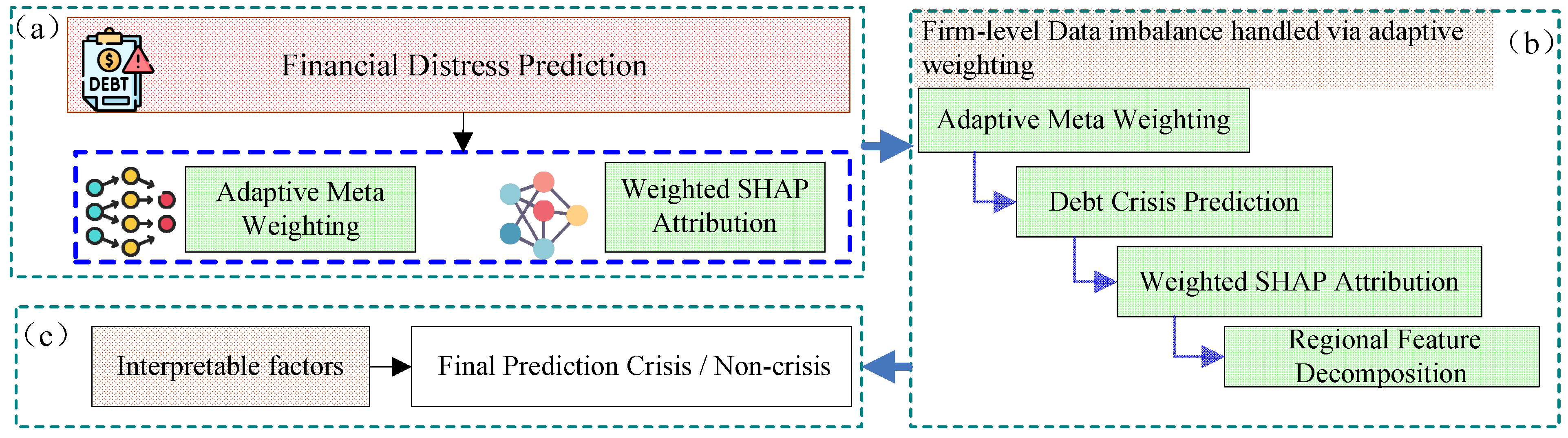
Meanwhile, Figure 1 indicates our proposed framework that consists of other key phases, including model training, adaptive meta weighting training, weighted SHAP attribution interpretable factors and results summary.
This study uses panel data spanning 2007 to 2023, consisting of 34,168 observations derived from financial information of Chinese listed companies across 12 regions and sourced from the China Stock Market & Accounting Research (CSMAR) database. The sample presents an evident class imbalance with a ratio of 1:15, including 2142 crisis events and 32,026 non-crisis events. A firm is defined as experiencing a debt crisis if it meets any of the following criteria: (1) Bankruptcy, delisting, or being specially treated (ST/*ST); (2) Involvement in debt-related lawsuits or debt restructuring; (3) Book insolvency (total liabilities exceed total assets).

3.2. Adaptive Meta Weighting

The main challenge in predicting corporate debt crises lies in the imbalanced data distribution, where crisis samples are relatively rare compared with non-crisis observations. Standard supervised learning tends to bias toward the majority class, thereby underestimating the probability of crisis events [41]. To alleviate this, we introduce an Adaptive Meta Weighting (AMetaW) mechanism, which dynamically assigns weights to training samples according to their contribution to improving model generalization.
Let the training dataset be denoted as
D = { ( x i , y i ) } i = 1 N , y i { 0 , 1 } ,
where y i = 1 indicates a debt crisis event and y i = 0 otherwise. The prediction model parameterized by θ minimizes the following weighted empirical risk:
L ( θ ) = i = 1 N w i ( ( f θ ( x i ) ; β ) , y i ) ,
where ( · ) is the loss function (e.g., cross-entropy), β is hyper-parameter, and w i is the adaptive weight for sample i.
We optimize β via a meta-learning procedure. Specifically, given a small meta-validation set D v a l , the learning objective is reformulated as a weighted bilevel optimization problem, as shown in Equation (3).
min β Δ L m e t a θ * ( β ) s . t . θ * ( β ) = arg min θ L m e t a ( θ , w ) ,
where L m e t a ( θ ) = E ( x , y ) D v a l ( f ( x , θ ; β ) , y ) .
Subsequently, the optimal model hyperparameter β is substituted into the object equation. The final optimization alternates between updating θ with weighted losses and updating w i through bilevel optimization feedback:
min θ i = 1 N w i * ( f θ ( x i ; β ) , y i ) ,
where w i * are the optimized sample learning weights.
To obtain optimized sample learning weights, we learn sample weights adaptively to obtain optimized values. Next, we update the model parameters on a batch of training data D t r a i n with temporary weights w i :
θ = θ α θ i D t r a i n w i ( f θ ( x i ; β ) , y i ) ,
where α is the inner-loop learning rate.
Then, the weights are optimized by minimizing the loss:
min w i 0 i D T r a i n w i ( f θ ( x i ; β ) , y i ) .
The gradient of the model loss with respect to the weights yields the adaptive update rule:
w i w i 1 α w i D t r a i n w i 1 ( f θ ( x i ; β ) , y i ) ,
where α is the model learning rate. To illustrate the optimization procedure of our proposed method, the detailed pseudocode of the proposed meta-learning-based sample reweighting algorithm is summarized in Algorithm 1.
Algorithm 1 Meta-learning-based Sample Reweighting
Require: Training set D t r a i n , meta-data set D v a l , learning rates α
Ensure: Optimized θ * , weights w *
 1:
Initialize model parameters θ ; initialize sample weights w i = 1 N
 2:
Compute meta-loss: L m e t a = ( x i , y i ) B v a l ( f θ ( x i ; β ) , y i ) ;
 3:
Compute meta-gradient: g i = L m e t a β i ;
 4:
Update hyperparameter: β i * β i α g i .
 5:
while not converged do
 6:
    Normalize weights: w i max ( w i , 0 ) , w i w i w i ;
 7:
    Sample mini-batch B t r a i n D t r a i n ;
 8:
    Compute weighted training loss: L t r a i n = i B t r a i n w i ( f θ ( x i ) , y i ) ;
 9:
    Inner update (temporary parameters): θ = θ α θ L t r a i n ;
10:
    Computing model loss: L t r a i n = i B t r a i n ( f θ ( x i ) , y i ) ;
11:
    Updated sample weights: w i * w i β L t r a i n w i , i B t r a i n ;
12:
    Recompute weighted training loss: L t r a i n * = i B t r a i n w i ( f θ ( x i ) , y i ) ;
13:
    Outer update (model parameters): θ * θ α θ L t r a i n * .
14:
end while
15:
return  θ * , w *

3.3. Interpretable Learning

To further interpret the predictions of AMetaW, we employ the Shapley Additive Explanations (SHAP) framework, which is grounded in cooperative game theory. Given a prediction function f : R M R over M features, the contribution of feature j to the prediction of instance x is computed as:
ϕ j ( f , x ) = S F { j } | S | ! ( M | S | 1 ) ! M ! f S { j } ( x S { j } ) f S ( x S ) ,
where F = { 1 , 2 , , M } is the full feature set, S denotes a subset of features excluding j, and f S ( x S ) is the model prediction restricted to features in S.
Unlike conventional SHAP, we incorporate the adaptive sample weights w i * learned by AMetaW into the attribution process, resulting in a weighted SHAP estimator:
ϕ ^ j ( f , x ) = 1 i = 1 N w i * i = 1 N w i * · ϕ j ( f , x i ) .
This adjustment ensures that feature attributions are not biased toward majority-class samples, but instead reflect the rebalanced learning dynamics under rare crisis events.
Furthermore, to capture regional heterogeneity, we define the region-specific SHAP contribution of feature j in region r as:
ϕ ^ j ( r ) = 1 i D r w i * i D r w i * · ϕ j ( f , x i ) ,
where D r denotes the set of firms located in region r. This decomposition reveals how feature importance varies across economic regions (e.g., Eastern, Central, Western China), providing not only a global understanding of risk factors, but also policy-relevant insights tailored to local financial environments.
By integrating meta-learned adaptive weighting with SHAP decomposition, our framework achieves two advantages:
  • It highlights the true marginal contribution of financial, governance, and macro indicators in predicting debt crises under severe class imbalance.
  • It produces region-aware explanations, showing, for instance, that equity concentration and cash ratio dominate in the East, while short-term interest rate and operating profit margin are more influential in the West.

3.4. Algorithm Analysis

The algorithm follows a bilevel optimization paradigm, where sample weights are updated to minimize validation loss while model parameters are optimized on weighted training loss. Under standard smoothness assumptions of the loss function, the alternating inner–outer updates exhibit stable convergence toward an optimum.
Compared with standard training, the method incurs additional overhead from meta-gradient computation. Specifically, each iteration requires: (1) a forward–backward pass for the inner update, (2) an additional backward pass to compute gradients of validation loss with respect to sample weights. This approximately doubles the computational cost per iteration, leading to a complexity of O(2n).

4. Experiments

4.1. Evaluation Metrics

To comprehensively assess the predictive performance of the proposed approach on imbalanced debt crisis datasets, we adopted four widely used evaluation metrics: Accuracy, Area Under the ROC Curve (AUC), PR AUC, Specificity, F1-score, and Average Precision (AP).

4.1.1. Accuracy

Accuracy measures the proportion of correctly classified samples among all test samples. It is defined as:
Accuracy = T P + T N T P + T N + F P + F N ,
where T P , T N , F P , and F N represent the number of true positives, true negatives, false positives, and false negatives, respectively.

4.1.2. Area Under the ROC Curve (AUC)

AUC evaluates the discriminative ability of a classifier by calculating the area under the Receiver Operating Characteristic (ROC) curve. Formally, it is expressed as:
AUC = 0 1 T P R ( F P R 1 ( x ) ) d x ,
where the true positive rate (TPR) and false positive rate (FPR) are defined as:
T P R = T P T P + F N , F P R = F P F P + T N .

4.1.3. F1-Score

The F1-score is the harmonic mean of precision and recall, particularly suitable for evaluating imbalanced classification tasks:
F 1 - score = 2 × Precision × Recall Precision + Recall ,
with
Precision = T P T P + F P , Recall = T P T P + F N .

4.1.4. Average Precision (AP)

AP summarizes the trade-off between precision and recall by calculating the area under the precision–recall curve:
AP = n ( R n R n 1 ) × P n ,
where P n and R n denote the precision and recall at the n-th threshold.

4.2. Performances Comparison

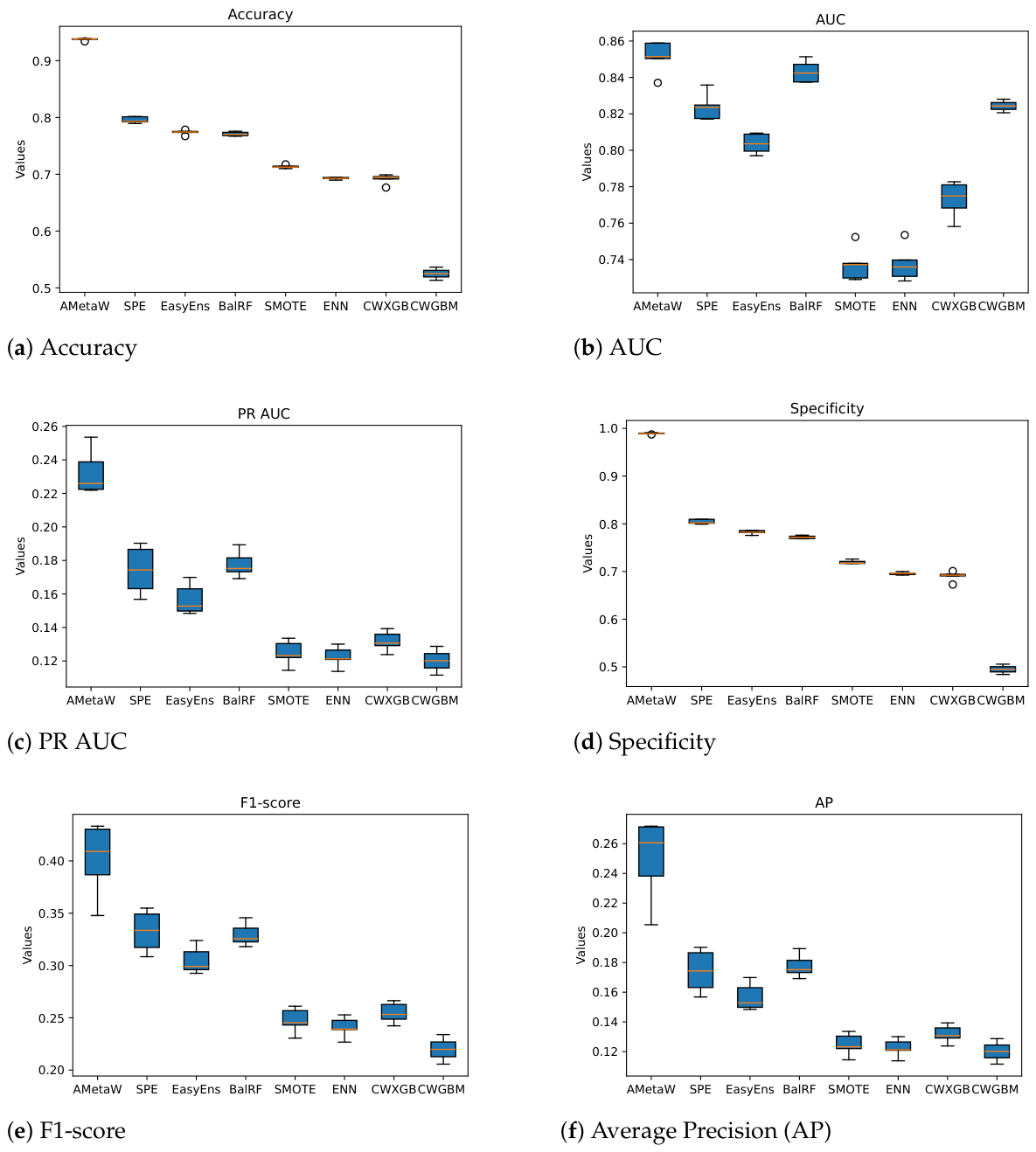
Figure 2 presents the comparative performance of the proposed AMetaW method against several baseline approaches, including Self-paced Ensemble (SPE), EasyEnsemble (EasyEns), Balanced Random Forest (BalRF), Synthetic Minority Over-Sampling Technique (SMOTE), Edited Nearest Neighbors (ENN), Class-weighted XGBoost (CWXGB), and Class-weighted LightGBM (CWGBM) [9,57], across five commonly used metrics: Accuracy, AUC, PR AUC, Specificity, F1-score, and AP.
For Accuracy, AMetaW and SPE achieved the highest values, approaching 0.94, with negligible variance across runs. In contrast, EasyEnsemble and Balanced Random Forest exhibited moderate performance with accuracies around 0.77, while SMOTE and ENN obtained the lowest accuracies, below 0.72. This indicates that AMetaW consistently delivers superior classification correctness compared to both ensemble-based and resampling-based competitors. Regarding AUC, AMetaW again demonstrated the strongest performance with a mean value of approximately 0.85 and limited variance, outperforming Balanced RF (approximately 0.84) and SPE (approximately 0.83). Other baselines, such as EasyEnsemble, SMOTE, and ENN, yielded values below 0.80, suggesting reduced discriminative capability. In terms of F1-score, AMetaW substantially outperformed all competing methods, reaching values above 0.40 with compact distributions, whereas SPE remained slightly lower at 0.38. The remaining approaches showed F1-scores below 0.35, with SMOTE and ENN performing particularly poorly (≤0.25). These results highlight AMetaW’s effectiveness in balancing precision and recall in imbalanced debt crisis prediction tasks. Finally, for AP, AMetaW maintained the highest average precision (approximately 0.25), though with slightly larger variance, followed by SPE (0.23). EasyEnsemble and Balanced RF achieved only moderate results (0.15–0.20), while SMOTE and ENN lagged significantly behind (<0.15). This further confirms the advantage of AMetaW in handling sparse positive samples. Overall, AMetaW consistently surpasses all baselines across all four evaluation metrics, not only achieving the highest predictive performance but also exhibiting lower variance across runs, thus demonstrating both effectiveness and robustness in debt crisis prediction.

4.3. Discussion

The superior performance of AMetaW across all evaluation metrics can be attributed to its adaptive meta-weighting mechanism, which effectively addresses the challenges posed by highly imbalanced debt crisis datasets. Traditional resampling techniques such as SMOTE and ENN attempt to balance class distributions by synthetically generating or eliminating samples. However, these approaches often distort the original data manifold and introduce noise, leading to degraded generalization ability. Similarly, ensemble-based methods like EasyEnsemble and Balanced RF improve robustness by aggregating multiple learners, but their uniform weighting strategies fail to capture the heterogeneous importance of different samples and features.
In contrast, AMetaW dynamically adjusts the contribution of training samples based on their informative value, allowing the model to focus more on minority class instances without overwhelming the majority class distribution. This adaptive learning paradigm ensures that the model preserves critical decision boundaries while mitigating the bias introduced by skewed data. Furthermore, the compact variance observed in the box plots demonstrates that AMetaW not only achieves higher average performance but also yields more stable predictions across repeated runs, a property essential for practical deployment in financial risk forecasting.
Taken together, these findings suggest that AMetaW provides a principled and effective solution for imbalanced learning in high-stakes financial applications, outperforming both classical resampling techniques and conventional ensemble methods by integrating adaptivity and robustness into a unified framework.

4.4. Statistical Significance Analysis

To further strengthen the empirical validity of our results, we conducted statistical significance tests to rigorously evaluate whether the performance improvements of AMetaW over baseline models are robust. Specifically, we employed pairwise Wilcoxon signed-rank tests across 20 independent experimental runs. This non-parametric test does not rely on normality assumptions and is well-suited for comparing paired model performance under repeated sampling.
Table 2 reports p-values, effect sizes (Cohen’s d), and performance differences ( Δ F1). Across all comparisons, AMetaW consistently outperforms the benchmark models with strong statistical significance (all p-values < 0.001). The corresponding Cohen’s d values indicate large to extremely large effects, confirming that the observed improvements are not only statistically reliable but also practically meaningful.
From the perspective of performance metrics, several key findings emerge: Δ F1: AMetaW achieves consistent and notable improvements in F1-score across all baselines, indicating a superior balance between precision and recall under severe class imbalance. Compared with benchmark methods, especially those relying on SPE, AMetaW effectively mitigates bias toward majority classes while maintaining stable precision.
Largest improvements: The most notable gains are observed against ENN ( Δ F1 = +0.13, d = 7.44). These results highlight the ability of AMetaW to avoid the pitfalls of over-aggressive under-sampling, which inflates recall at the expense of precision.
Robustness and Stability: The improvements are consistently observed across 20 independent runs, demonstrating the robustness of AMetaW. Unlike traditional methods that may suffer from instability due to sampling variability, our approach achieves more stable and reliable performance.
Overall, these results provide strong empirical evidence that AMetaW not only improves predictive accuracy but also delivers statistically significant and practically robust performance gains. The combination of consistent metric improvements, large effect sizes, and enhanced statistical validation substantially strengthens the methodological rigor of the study.

4.5. Interpretable Results

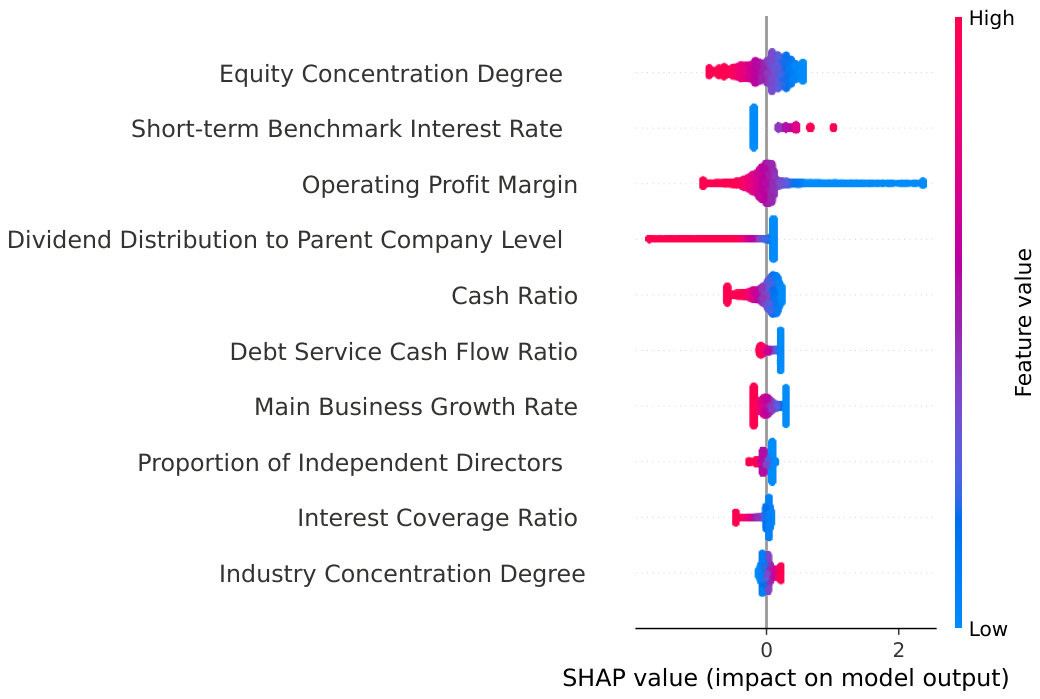
Figure 3 presents the SHAP summary plot of the top 10 most influential features for debt crisis prediction. The horizontal axis indicates the SHAP values, representing the marginal contribution of each feature to the model output. A positive SHAP value implies that the feature increases the likelihood of a debt crisis, while a negative value reduces the risk. Features are ranked vertically by their overall impact, with the most important factors at the top. The color of each point denotes the feature value (red = high, blue = low), which highlights how high or low feature values contribute differently to the prediction. The results reveal several notable patterns. For example, Equity concentration degree exerts the strongest influence: higher concentration (red points on the right) is associated with an increased probability of debt crisis, suggesting that overly concentrated ownership may undermine corporate governance and risk control. Similarly, a higher short-term benchmark interest rate raises the risk of crisis, consistent with the fact that rising borrowing costs intensify financial pressure. In contrast, operating profit margin demonstrates an opposite effect—firms with lower margins (blue points on the right) are more prone to financial distress, whereas higher profitability mitigates the risk. Other key associated indicators include dividend distribution to the parent company, where excessive payouts heighten debt vulnerability by reducing internal cash reserves, and cash ratio, where low liquidity substantially increases risk. Measures of debt-servicing capacity, such as the debt service cash flow ratio and interest coverage ratio, also play critical roles, with lower values significantly elevating the likelihood of crisis. Moreover, weak corporate governance indicators, such as a low proportion of independent directors, and poor operational performance, such as a low main business growth rate, further exacerbate financial fragility.
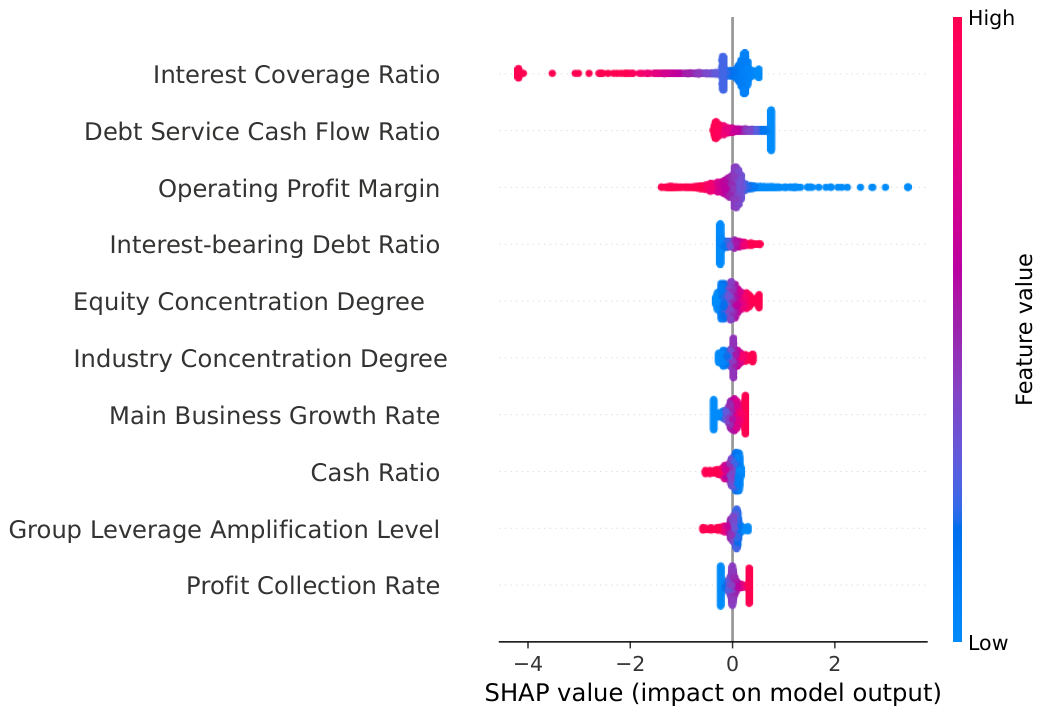
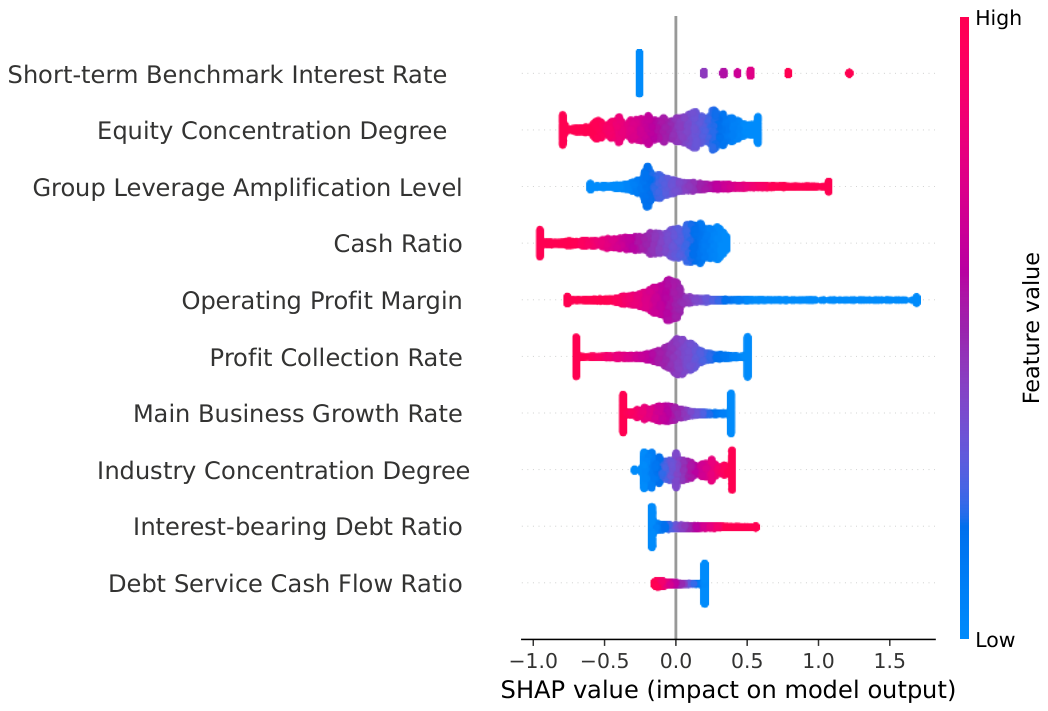
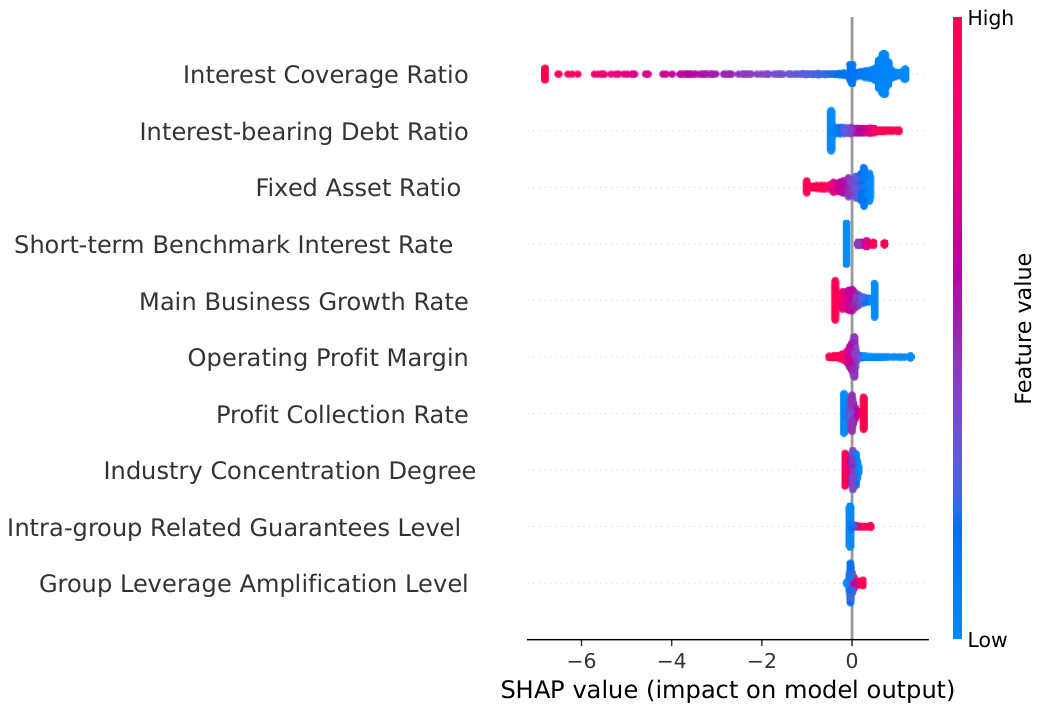
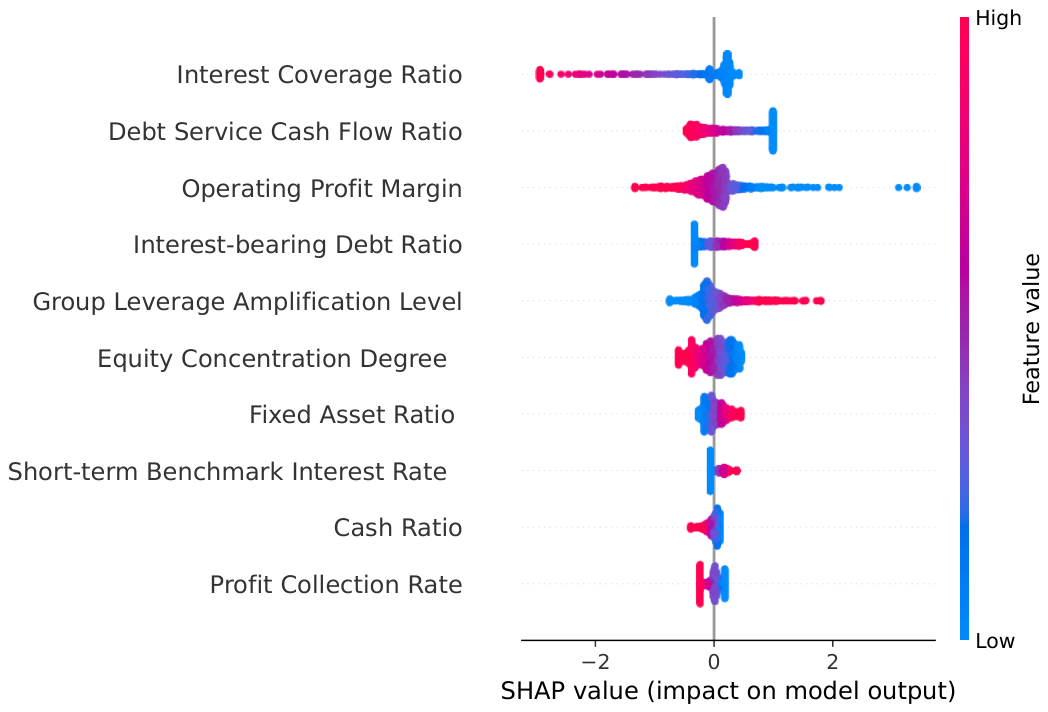
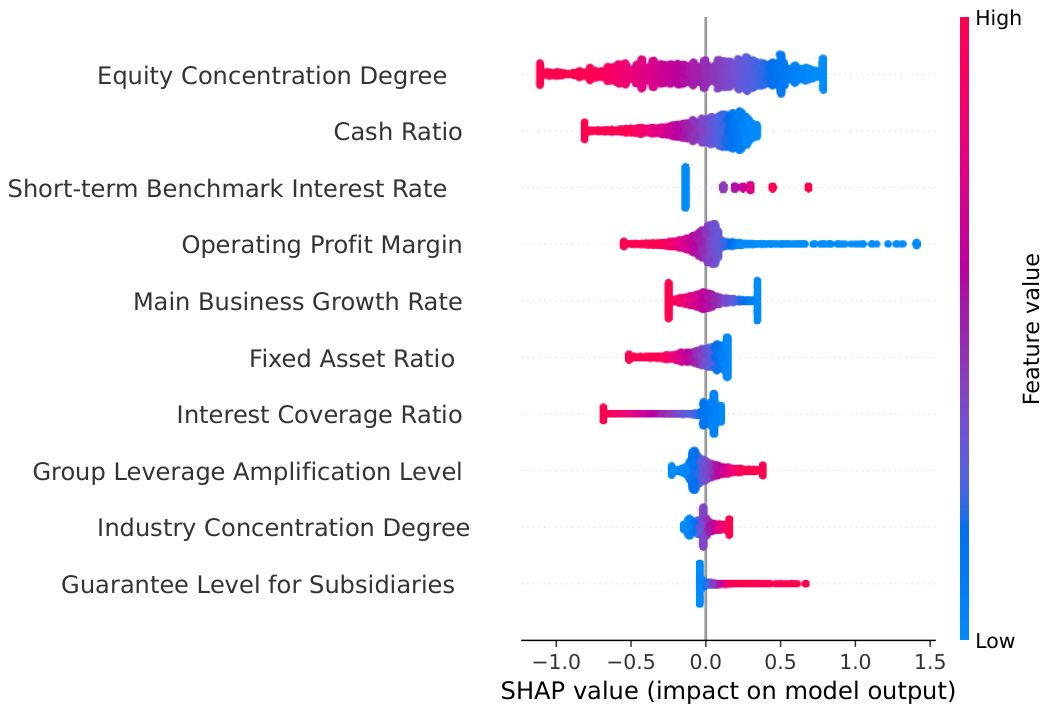
Similarly, we conducted an analysis of key indicators related to debt crises across 11 additional regions, as illustrated in Appendix A Figure A1, Figure A2, Figure A3, Figure A4, Figure A5, Figure A6, Figure A7, Figure A8, Figure A9, Figure A10 and Figure A11. Each figure provides significant insights into the subject matter. In summary, the SHAP-based explainability analysis highlights that both financial indicators (profitability, leverage, liquidity) and governance structures (ownership concentration, board independence) jointly determine the probability of a debt crisis. These findings provide interpretability to the predictive model, enabling stakeholders to identify risk indicators and design targeted interventions for crisis prevention.
Based on the above results, high-risk factors that substantially increase the probability of a corporate debt crisis include excessive equity concentration, rising short-term interest rates, elevated dividend payouts, insufficient cash reserves, narrow profit margins, and weak debt-servicing capacity. Conversely, several mitigating factors are associated with a lower likelihood of crisis, such as higher profit margins, adequate liquidity buffers, a strong interest coverage ratio, effective oversight from independent boards, and sustained growth in core business operations. The explanatory significance of these findings is further illustrated through SHAP-based visualizations, which highlight the most influential financial, governance, and macroeconomic variables, as well as the direction of their impact on debt crisis risk. Such model transparency provides valuable insights for both enterprises and regulatory authorities in developing early warning systems and proactive intervention strategies.

4.6. Comparative Analysis

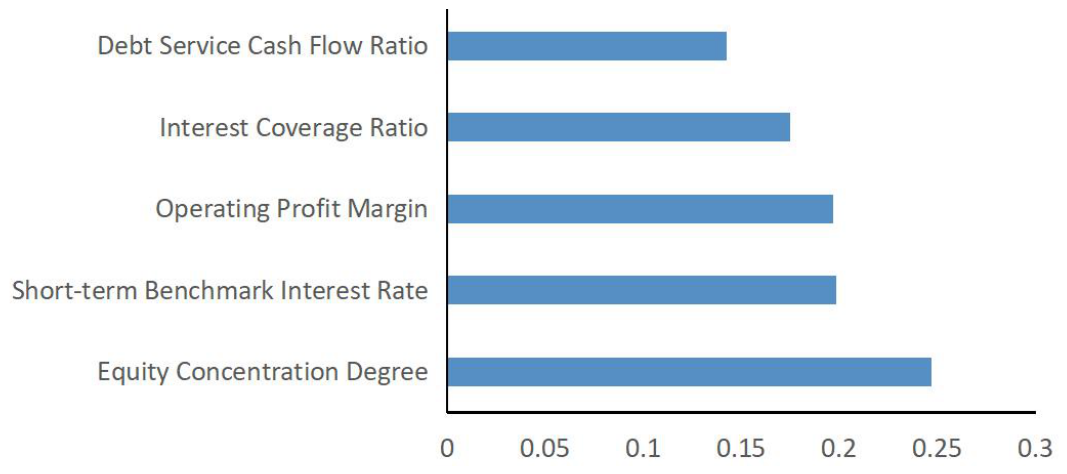
Meanwhile, we summarize the average absolute SHAP values of the top 5 features, as shown in Figure 4, which quantify their overall contribution to debt crisis prediction. Higher values indicate stronger predictive influence. The ranking is consistent with the SHAP summary plot, yet the tabular results provide a more precise statistical interpretation.
Figure 4 provides further insights into the associated risk indicators of corporate debt crisis predictions. First, the Equity Concentration Degree exhibits the highest mean absolute SHAP value (0.132), statistically confirming it as the most influential determinant. This result suggests that variations in ownership structure account for a substantial proportion of the variance in predicted crisis likelihood. Second, the Short-term Benchmark Interest Rate ranks as the second most important variable, underscoring the pivotal role of macroeconomic financing costs in shaping corporate financial vulnerability. Its relatively low standard deviation further indicates that this effect is consistently observed across different firms. Third, firm-level profitability and liquidity indicators, including the Operating Profit Margin (0.105) and the Cash Ratio (0.085), emerge as strong predictors. These results highlight the statistical relevance of maintaining sufficient operating returns and liquid resources in mitigating debt distress. Fourth, governance-related variables, such as Dividend Distribution to the Parent Company and the Proportion of Independent Directors, contribute moderately yet significantly. Their inclusion reflects the importance of governance mechanisms in alleviating financial fragility. Finally, measures of debt-servicing capacity, including the Debt Service Cash Flow Ratio and Interest Coverage Ratio, consistently display positive contributions. Lower values of these indicators are statistically associated with heightened crisis probability, confirming their essential role in debt sustainability. In summary, the SHAP analysis reveals a multidimensional risk structure wherein ownership concentration and macroeconomic conditions dominate, while profitability, liquidity, governance, and debt-servicing capacity provide complementary explanatory power. This quantitative ranking provides empirical evidence that supports the interpretability findings from the SHAP summary plot, thereby reinforcing the robustness of the explainable machine learning framework.

4.7. Regional Results Analysis

Understanding whether financial vulnerability associated risk indicators differ across regions is crucial for designing targeted policy interventions. Regional disparities in economic development, financial infrastructure, and corporate governance environments imply that firms may not be uniformly exposed to the same set of risk indicators. Hence, analyzing the regional heterogeneity of indicator importance allows us to capture the structural variations underlying corporate debt crisis risks.
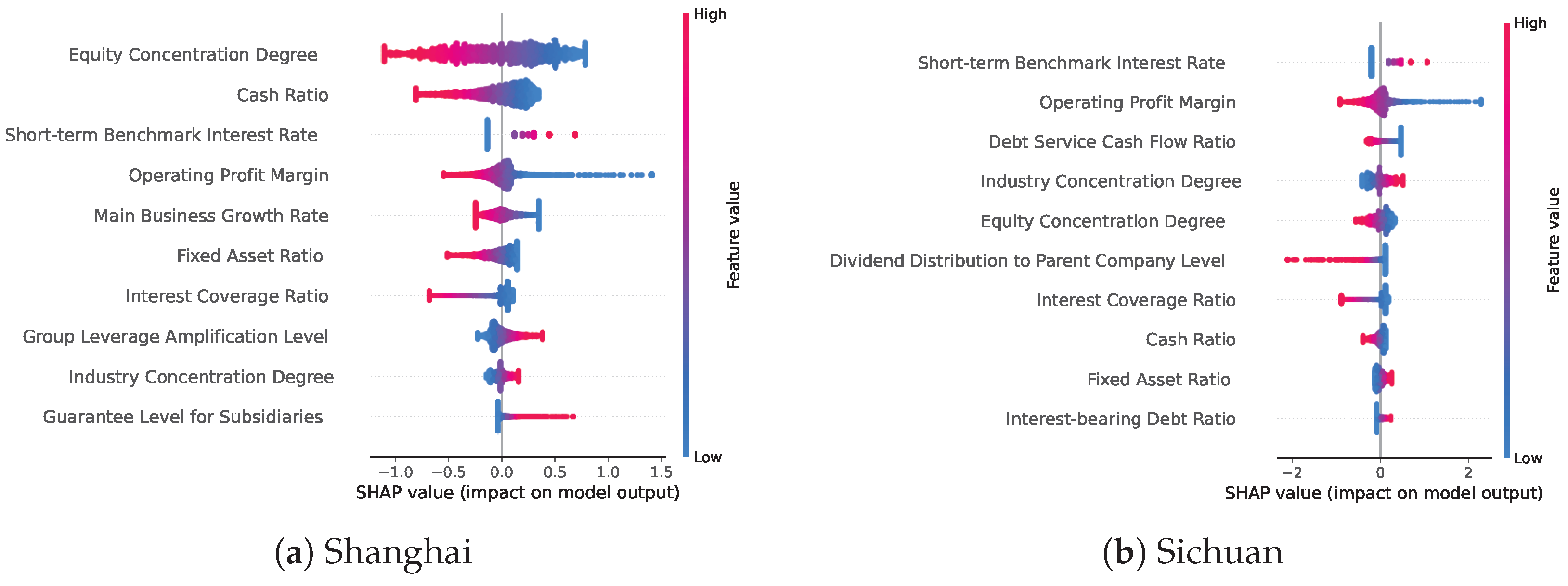
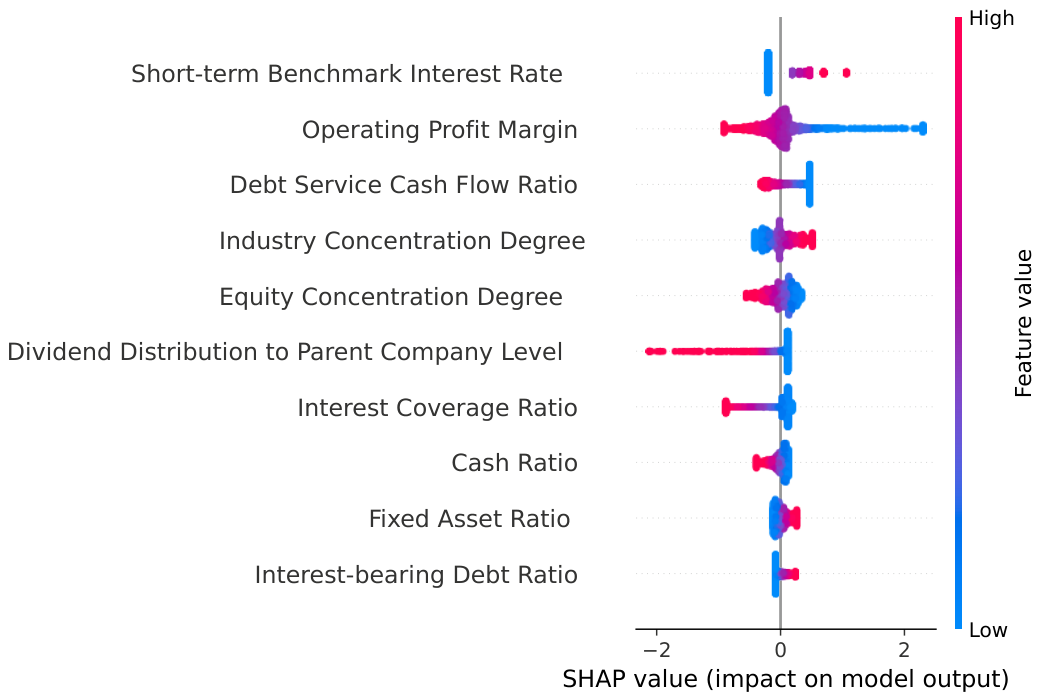
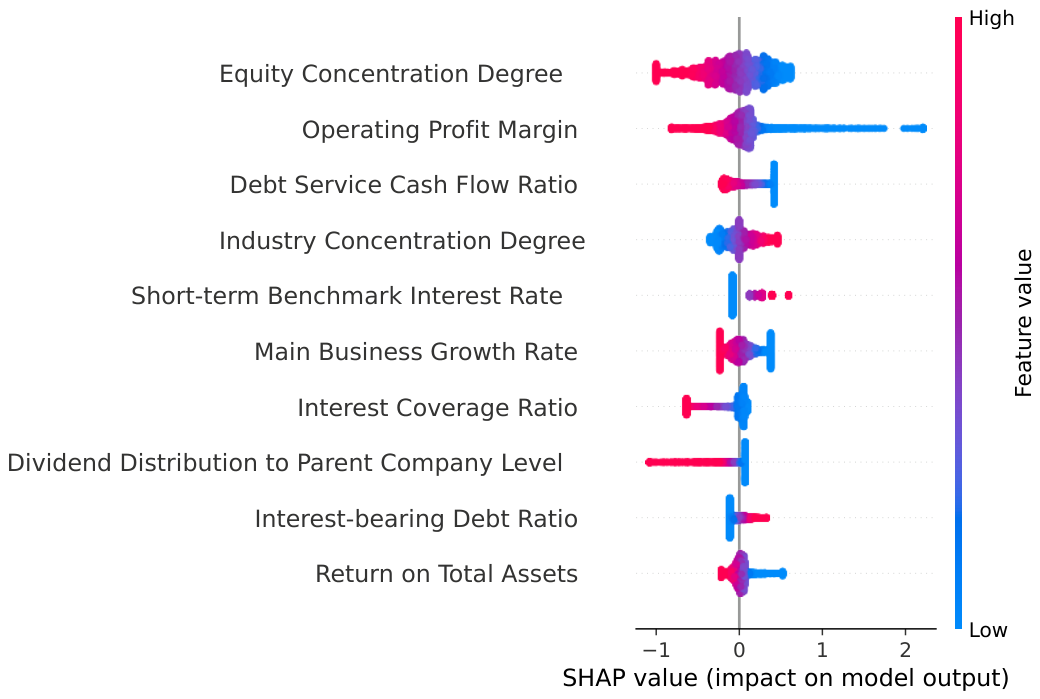
To examine this issue, we employed the interpretability of the model to conduct a regional decomposition analysis, stratifying the sample into firms located in eastern and western China, such as Shanghai and Sichuan, the results are shown in Figure 5. The SHAP values were recalculated separately for each subsample, and the relative importance of key indicators was compared across regions. This approach enables the quantification of whether specific risk factors exert consistently stronger or weaker predictive effects depending on the regional context. The results reveal significant regional heterogeneity. Firms in the eastern region are found to be more sensitive to Equity Concentration Degree and the Cash Ratio, highlighting the importance of ownership structure and liquidity management in areas with mature capital markets and diversified financing channels. In contrast, firms in the western region exhibit higher exposure to risks stemming from the Short-term Benchmark Interest Rate and Operating Profit Margin, indicating that macroeconomic financing costs and profitability constraints are dominant sources of financial fragility where financial systems are less developed and firms rely more heavily on external borrowing. Overall, these findings emphasize the necessity of adopting a region-specific perspective when evaluating corporate debt crisis vulnerability. They suggest that regulatory frameworks and policy measures should be differentiated: in the east, interventions should prioritize improving governance mechanisms and liquidity buffers, whereas in the west, greater emphasis should be placed on stabilizing financing conditions and enhancing operational efficiency.

5. Conclusions

This work proposes an adaptive meta-weighting learning (AMetaW) for the problem of corporate debt crisis prediction under severe class imbalance. By introducing a meta-learning-based sample reweighting mechanism, the proposed model dynamically adjusts the contribution of training samples, enabling more effective learning from rare but critical crisis observations. This design improves both the robustness and generalization ability of prediction models in imbalanced financial settings. Beyond performance gains, the model provides interpretable insights, which highlights the necessity of incorporating both structural heterogeneity and regional context into risk assessment. Overall, this work contributes a robust and explainable solution for corporate debt crisis prediction, offering both methodological advancement and practical value for early warning and targeted risk management. Despite these contributions, several limitations remain. For example, while the meta-weighting mechanism improves predictive performance, its computational cost may be higher than that of traditional methods. Future research could explore more efficient optimization strategies and extend the framework to multimodal data settings. In addition, incorporating causal inference may further strengthen the interpretability of model.

Author Contributions

Conceptualization, Z.C.; Methodology, Z.C.; Validation, H.H.; Formal analysis, J.Z.; Writing—original draft, Z.C. and J.Z.; Visualization, H.H.; Supervision, J.Z. All authors have read and agreed to the published version of the manuscript.

Funding

This study was supported by the Project for Scientific Research Capacity Improvement of Key Disciplines in Guangdong Province (Grant No. 2024ZDJS076), 2025 Annual Program of Jiangmen Philosophy and Social Sciences Planning (Grant No. JM2025C19), and General Project of 2025 Research Program of China Commercial Statistics Society (Grant No. 2025STY11).

Data Availability Statement

The original contributions presented in this study are included in the article. Further inquiries can be directed to the corresponding author.

Acknowledgments

The authors express their sincere gratitude to the reviewers for their constructive and invaluable feedback.

Conflicts of Interest

The authors declare no conflicts of interest.

Appendix A

Figure A1. Explainable figure in Anhui. The horizontal axis represents the magnitude of the impact of a certain feature on the occurrence of a debt crisis. The further to the right, the more likely this feature is to increase the likelihood of a debt crisis. The further to the left, the lower the risk of debt crisis due to this feature. The vertical axis is the ranking of the average influence features. The Interest Coverage Ratio, Debt Service Cash Flow Ratio, Operating Profit Margin are the top three most important characteristics.
Mathematics 14 02013 g0a1
Figure A2. Explainable figure in Beijing. The horizontal axis represents the magnitude of the impact of a certain feature on the occurrence of a debt crisis. The further to the right, the more likely this feature is to increase the likelihood of a debt crisis. The further to the left, the lower the risk of debt crisis due to this feature. The vertical axis is the ranking of the average influence features. The Short-term Benchmark Interest Rate, Equity Concentration Degree, Group Leverage Amplification Level are the top three most important characteristics.
Mathematics 14 02013 g0a2
Figure A3. Explainable figure in Fujian. The horizontal axis represents the magnitude of the impact of a certain feature on the occurrence of a debt crisis. The further to the right, the more likely this feature is to increase the likelihood of a debt crisis. The further to the left, the lower the risk of debt crisis due to this feature. The vertical axis is the ranking of the average influence features. The Interest Coverage Ratio, Interest-bearing Debt Ratio, Fixed Asset Ratio are the top three most important characteristics.
Mathematics 14 02013 g0a3
Figure A4. Explainable figure in Henan. The horizontal axis represents the magnitude of the impact of a certain feature on the occurrence of a debt crisis. The further to the right, the more likely this feature is to increase the likelihood of a debt crisis. The further to the left, the lower the risk of debt crisis due to this feature. The vertical axis is the ranking of the average influence features. The Interest Coverage Ratio, Debt Service Cash Flow Ratio, and Operating Profit Margin are the top three most important characteristics.
Mathematics 14 02013 g0a4
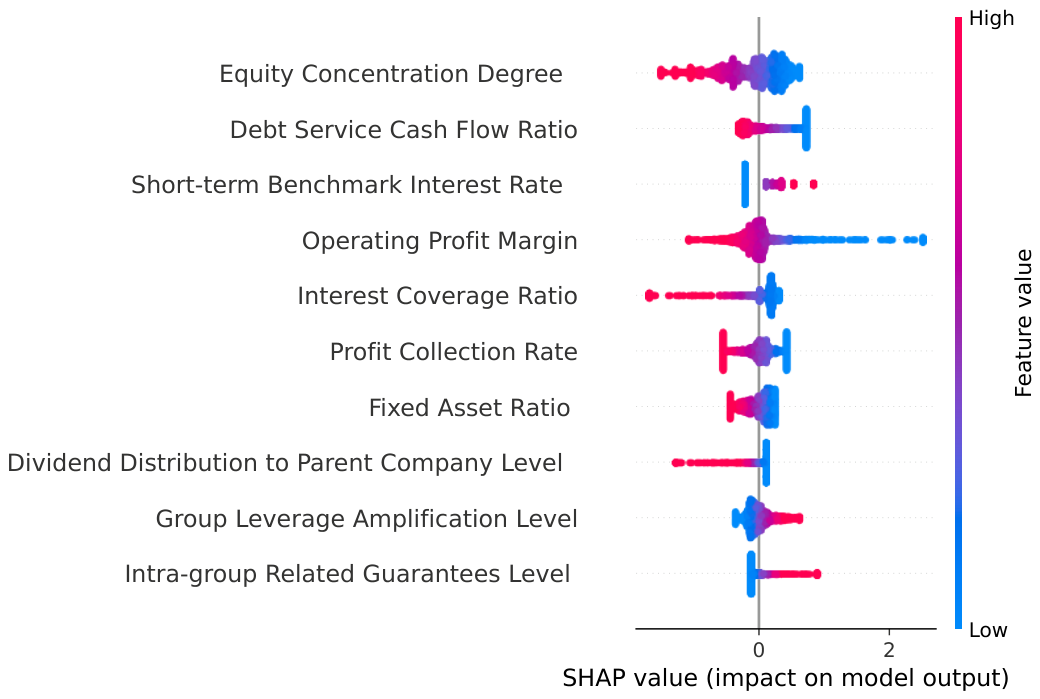
Figure A5. Explainable figure in Hubei. The horizontal axis represents the magnitude of the impact of a certain feature on the occurrence of a debt crisis. The further to the right, the more likely this feature is to increase the likelihood of a debt crisis. The further to the left, the lower the risk of debt crisis due to this feature. The vertical axis is the ranking of the average influence features. The Equity Concentration Degree, Debt Service Cash Flow Ratio, and Short-term Benchmark Interest Rate are the top three most important characteristics.
Mathematics 14 02013 g0a5
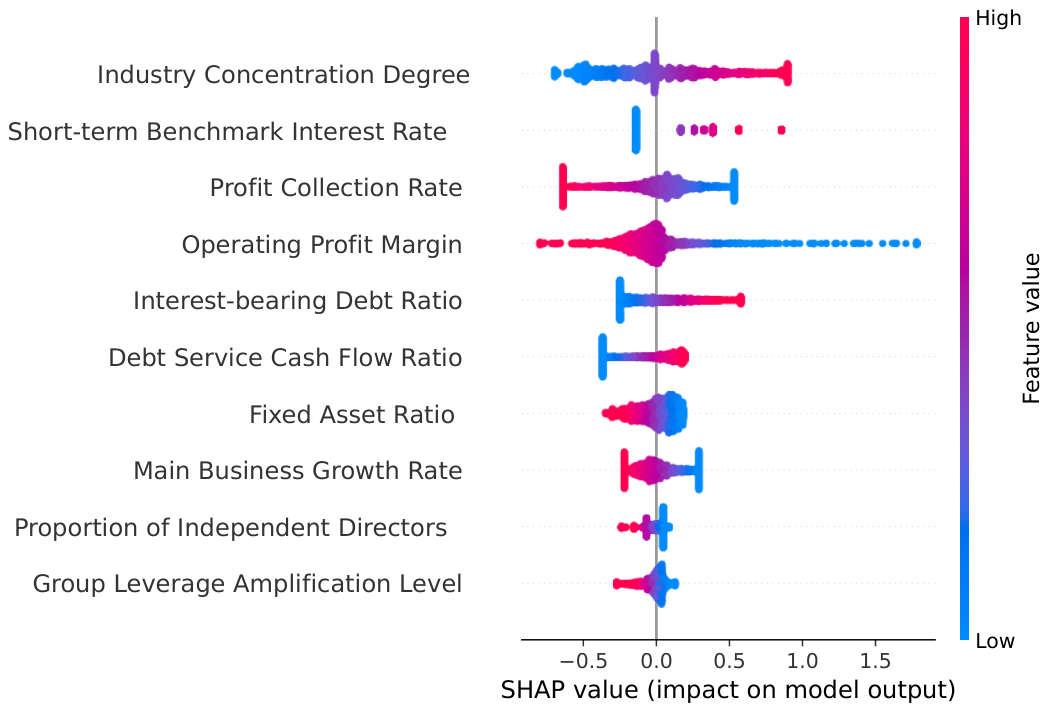
Figure A6. Explainable figure in Hunan. The horizontal axis represents the magnitude of the impact of a certain feature on the occurrence of a debt crisis. The further to the right, the more likely this feature is to increase the likelihood of a debt crisis. The further to the left, the lower the risk of debt crisis due to this feature. The vertical axis is the ranking of the average influence features. The Industry Concentration Degree, Short-term Benchmark Interest Rate, and Profit Collection Rate are the top three most important characteristics.
Mathematics 14 02013 g0a6
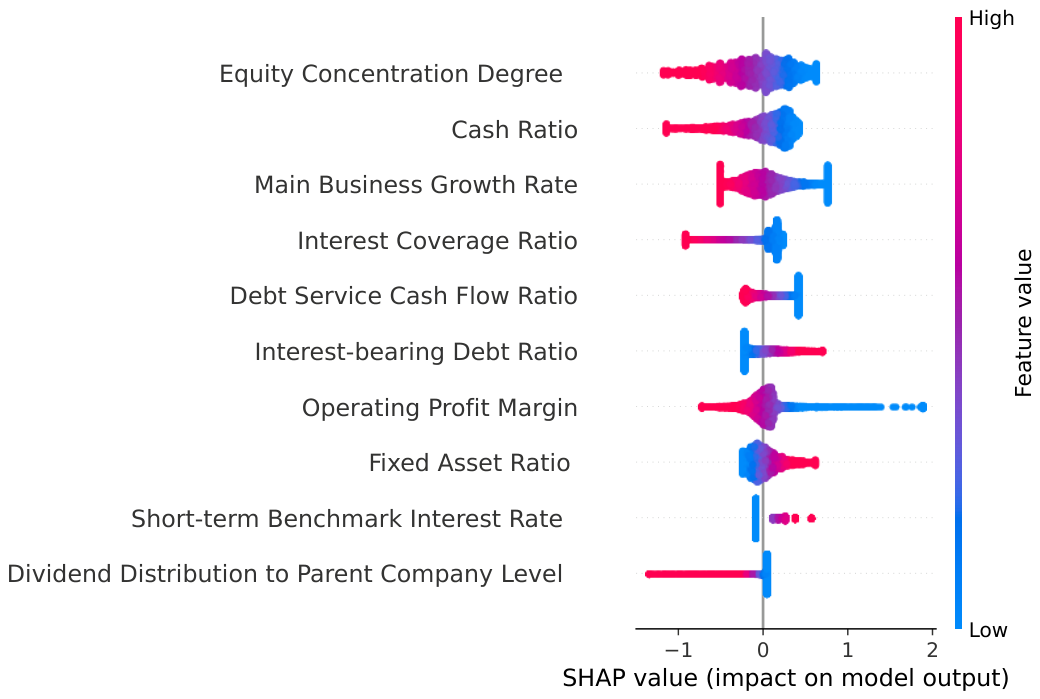
Figure A7. Explainable figure in Jiangsu. The horizontal axis represents the magnitude of the impact of a certain feature on the occurrence of a debt crisis. The further to the right, the more likely this feature is to increase the likelihood of a debt crisis. The further to the left, the lower the risk of debt crisis due to this feature. The vertical axis is the ranking of the average influence features. The Equity Concentration Degree, Cash Ratio, and Main Business Growth Rate are the top three most important characteristics.
Mathematics 14 02013 g0a7
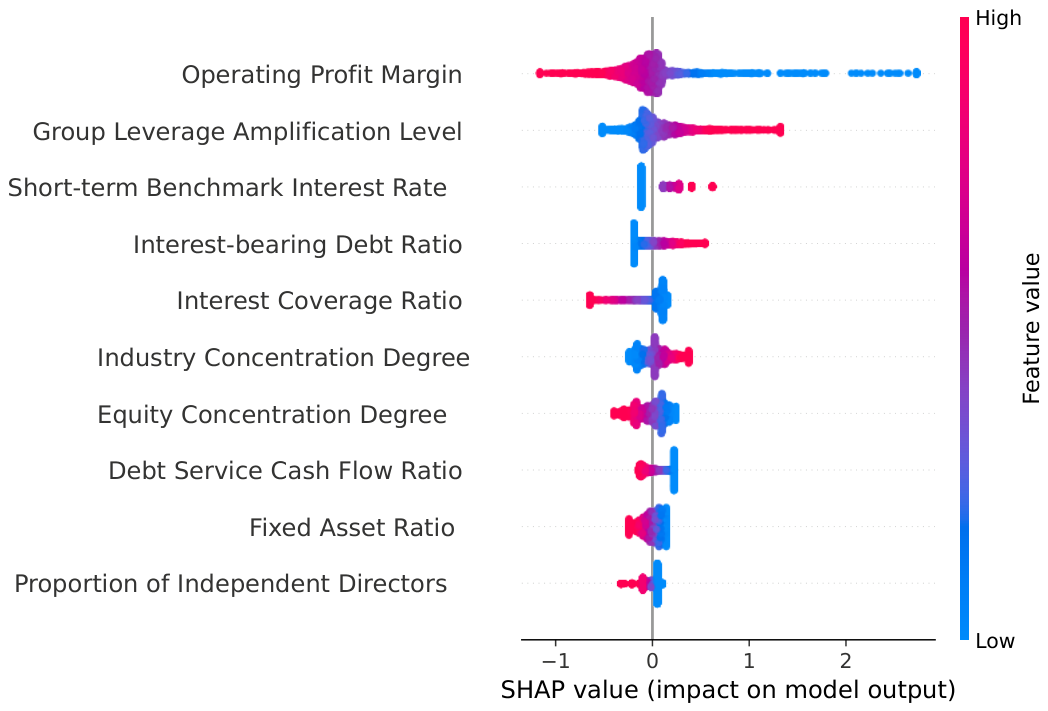
Figure A8. Explainable figure in Shandong. The horizontal axis represents the magnitude of the impact of a certain feature on the occurrence of a debt crisis. The further to the right, the more likely this feature is to increase the likelihood of a debt crisis. The further to the left, the lower the risk of debt crisis due to this feature. The vertical axis is the ranking of the average influence features. The Operating Profit Margin, Group Leverage Amplification Level, and Short-term Benchmark Interest Rate are the top three most important characteristics.
Mathematics 14 02013 g0a8
Figure A9. Explainable figure in Shanghai. The horizontal axis represents the magnitude of the impact of a certain feature on the occurrence of a debt crisis. The further to the right, the more likely this feature is to increase the likelihood of a debt crisis. The further to the left, the lower the risk of debt crisis due to this feature. The vertical axis is the ranking of the average influence features. The Equity Concentration Degree, Cash Ratio, and Short-term Benchmark Interest Rate are the top three most important characteristics.
Mathematics 14 02013 g0a9
Figure A10. Explainable figure in Sichuan. The horizontal axis represents the magnitude of the impact of a certain feature on the occurrence of a debt crisis. The further to the right, the more likely this feature is to increase the likelihood of a debt crisis. The further to the left, the lower the risk of debt crisis due to this feature. The vertical axis is the ranking of the average influence features. The Short-term Benchmark Interest Rate, Operating Profit Margin, and Debt Service Cash Flow Ratio are the top three most important characteristics.
Mathematics 14 02013 g0a10
Figure A11. Explainable figure in Zhejiang. The horizontal axis represents the magnitude of the impact of a certain feature on the occurrence of a debt crisis. The further to the right, the more likely this feature is to increase the likelihood of a debt crisis. The further to the left, the lower the risk of debt crisis due to this feature. The vertical axis is the ranking of the average influence features. The Equity Concentration Degree, Operating Profit Margin, and Debt Service Cash Flow Ratio are the top three most important characteristics.
Mathematics 14 02013 g0a11

References

  1. Huynh, J. Banking uncertainty and corporate financial constraints. Int. J. Financ. Econ. 2025, 30, 626–651. [Google Scholar] [CrossRef]
  2. Cristescu, M.P.; Brândaș, C.; Mara, D.A.; Ioana, P. Fine-Tuning and Explaining FinBERT for Sector-Specific Financial News: A Reproducible Workflow. Electronics 2025, 14, 4680. [Google Scholar] [CrossRef]
  3. Maiani, S.; Lamla, M.; Wood, G.; Ehrstein, Y. The adverse consequences of quantitative easing (QE): International capital flows and corporate debt growth in China. Socio-Econ. Rev. 2024, 22, 1995–2023. [Google Scholar] [CrossRef]
  4. Giesecke, K.; Longstaff, F.A.; Schaefer, S.; Strebulaev, I.A. Macroeconomic effects of corporate default crisis: A long-term perspective. J. Financ. Econ. 2014, 111, 297–310. [Google Scholar] [CrossRef]
  5. Shittu, A.K. Advances in AI-driven credit risk models for financial services optimization. Int. J. Multidiscip. Res. Growth Eval. 2022, 3, 660–676. [Google Scholar] [CrossRef]
  6. Karami, A.; Igbokwe, C. The impact of big data characteristics on credit risk assessment. Int. J. Data Sci. Anal. 2025, 20, 4239–4259. [Google Scholar] [CrossRef]
  7. Huh, J. Prescriptive Analytics for Sustainable Financial Systems: A Causal–Machine Learning Framework for Credit Risk Management and Targeted Marketing. Systems 2025, 14, 16. [Google Scholar] [CrossRef]
  8. Fang, Y.; Liu, Y.; Yang, Y.; Lucey, B.; Abedin, M.Z. How do Chinese urban investment bonds affect its economic resilience? Evidence from double machine learning. Res. Int. Bus. Financ. 2025, 74, 102728. [Google Scholar] [CrossRef]
  9. Wang, Q.; Zhou, Y.; Cao, Z.; Zhang, W. M2SPL: Generative multiview features with adaptive meta-self-paced sampling for class-imbalance learning. Expert Syst. Appl. 2022, 189, 115999. [Google Scholar] [CrossRef]
  10. Mao, Z.; Chen, X.; Wu, C. Reinforced Distillation Learning: Fine-Grained Imbalanced Classifier for Financial Crisis Prediction. Comput. Econ. 2025, 67, 1571–1604. [Google Scholar] [CrossRef]
  11. Hou, L.; Lu, K.; Bi, G. Predicting the credit risk of small and medium-sized enterprises in supply chain finance using machine learning algorithms. Manag. Decis. Econ. 2024, 45, 2393–2414. [Google Scholar] [CrossRef]
  12. Wang, C.; Shu, Z.; Yang, J.; Zhao, Z.; Jie, H.; Chang, Y.; Jiang, S.; See, K.Y. Learning to imbalanced open set generalize: A meta-learning framework for enhanced mechanical diagnosis. IEEE Trans. Cybern. 2025, 55, 1464–1475. [Google Scholar] [CrossRef]
  13. Abousaber, I. A novel explainable attention-based meta-learning framework for imbalanced brain stroke prediction. Sensors 2025, 25, 1739. [Google Scholar] [CrossRef] [PubMed]
  14. Mahmud, F.; Das, A.C.; Shak, M.S.; Rahman, N.; Ahmed, M.; Sayeema, A. Adaptive Few-Shot Fraud Detection: A Meta-Learning Approach. In Proceedings of the 2025 2nd International Conference on Research Methodologies in Knowledge Management, Artificial Intelligence and Telecommunication Engineering (RMKMATE); IEEE: New York, NY, USA, 2025; pp. 1–6. [Google Scholar]
  15. Bvirindi, T.C.; Inalegwu, O.I. The impact of the global financial crisis and the European sovereign debt crisis on the capital structure of firms in Europe: Do SMEs, and listed firms respond the same? Eur. J. Financ. 2024, 30, 889–913. [Google Scholar] [CrossRef]
  16. Wu, Q.; Ren, S.; Hou, Y.; Yang, Z.; Zhao, C.; Yao, X. Easing financial constraints through carbon trading. Empir. Econ. 2024, 67, 655–691. [Google Scholar] [CrossRef]
  17. Kokorin, I. Promotion of group restructuring and cross-entity liability arrangements. J. Corp. Law Stud. 2021, 21, 557–593. [Google Scholar] [CrossRef]
  18. de Waal, H.; Nyawa, S.; Wamba, S.F. Consumers’ financial distress: Prediction and prescription using interpretable machine learning. Inf. Syst. Front. 2024, 1–22. [Google Scholar] [CrossRef]
  19. Nallakaruppan, M.; Chaturvedi, H.; Grover, V.; Balusamy, B.; Jaraut, P.; Bahadur, J.; Meena, V.; Hameed, I.A. Credit risk assessment and financial decision support using explainable artificial intelligence. Risks 2024, 12, 164. [Google Scholar] [CrossRef]
  20. Monje, L.; Carrasco, R.A.; Sánchez-Montañés, M. Machine Learning XAI for Early Loan Default Prediction. Comput. Econ. 2025, 67, 4033–4062. [Google Scholar] [CrossRef]
  21. Zuroff, R.; Chapados, N. Explaining explainable AI. In Artificial Intelligence in Finance; Edward Elgar Publishing: Cheltenham, UK, 2023; pp. 19–59. [Google Scholar]
  22. Andrae, S. Fairness and bias in machine learning models for credit decisions. In Machine Learning and Modeling Techniques in Financial Data Science; IGI Global Scientific Publishing: Hershey, PA, USA, 2025; pp. 1–24. [Google Scholar]
  23. Chen, C.C.; Chen, C.D.; Lien, D. Financial distress prediction model: The effects of corporate governance indicators. J. Forecast. 2020, 39, 1238–1252. [Google Scholar] [CrossRef]
  24. Yang, Q.; Xiang, R. Structure of interest-bearing liabilities and corporate ESG performance. Int. Rev. Financ. Anal. 2025, 102, 104117. [Google Scholar] [CrossRef]
  25. Andoko, A.; Angeline, A. The Influence Of Debt To Equity Ratio, Operating Profit Margin Ratio And Operating Expense Toward Entity Income Tax Of Infrastructure, Utility And Transportation Companies Listed On The Indonesia Stock Exchange. IJOSPOL-Int. J. Soc. Policy Law 2023, 4, 58–68. [Google Scholar]
  26. Huang, J.C.; Lin, H.C.; Huang, D. The effect of operating cash flow on the likelihood and duration of survival for marginally distressed firms in Taiwan. Sustainability 2022, 14, 17024. [Google Scholar] [CrossRef]
  27. Babic, T.; Katnic, M.; Katnic, I.; Kavaric, V.; Drakic-Grgur, M. Innovation for Sustainable SMEs: How Financial Health Drives Resilience and Long-Term Performance in a Transition Economy. Sustainability 2026, 18, 1145. [Google Scholar] [CrossRef]
  28. Flammer, C.; Ioannou, I. Strategic management during the financial crisis: How firms adjust their strategic investments in response to credit market disruptions. Strateg. Manag. J. 2021, 42, 1275–1298. [Google Scholar] [CrossRef]
  29. Wang, X.; Zhai, S. Intra-group spillovers of digital innovation: Evidence from Chinese business groups’ knowledge networks. Technol. Soc. 2026, 86, 103330. [Google Scholar] [CrossRef]
  30. Fan, X.; Jin, W.; Li, Y. Impact of outward guarantees on labour employment in enterprises. Appl. Econ. 2025, 57, 9126–9142. [Google Scholar] [CrossRef]
  31. Mateev, M.; Sahyouni, A. Corporate governance mechanisms in the banking industry: Is there any interplay between ownership concentration and market competition? M. Mateev, A. Sahyouni. J. Manag. Gov. 2026, 30, 93–154. [Google Scholar] [CrossRef]
  32. Nagriwum, T.M.; Osei, A.; Wiredu, R.; Amaning, N. Walking the Tightrope of Governance and Sustainability: Strategic ESG Disclosure Under Regulatory Environment in Emerging Markets. Bus. Strategy Dev. 2026, 9, e70290. [Google Scholar] [CrossRef]
  33. Pereira, C.M.; Maia-Filho, L.F. Brazilian retail banking and the 2008 financial crisis: Were the government-controlled banks that important? J. Bank. Financ. 2013, 37, 2210–2215. [Google Scholar] [CrossRef]
  34. Rakshit, D.; Chatterjee, C.; Paul, A. Financial distress, the severity of financial distress and direction of earnings management: Evidences from Indian economy. FIIB Bus. Rev. 2024, 13, 192–207. [Google Scholar] [CrossRef]
  35. Khan, M.A.; Ali, H.; Shabbir, H.; Noor, F.; Majid, M.D. Impact of Macroeconomic Indicators on Stock Market Predictions: A Cross Country Analysis. J. Comput. Biomed. Inform. 2024, 8. [Google Scholar]
  36. Liu, L.; Chen, C.; Wang, B. Predicting financial crises with machine learning methods. J. Forecast. 2022, 41, 871–910. [Google Scholar] [CrossRef]
  37. Reimann, C. Predicting financial crises: An evaluation of machine learning algorithms and model explainability for early warning systems. Rev. Evol. Political Econ. 2024, 5, 51–83. [Google Scholar] [CrossRef]
  38. Perboli, G.; Arabnezhad, E. A Machine Learning-based DSS for mid and long-term company crisis prediction. Expert Syst. Appl. 2021, 174, 114758. [Google Scholar] [CrossRef]
  39. Song, Y.; Jiang, M.; Li, S.; Zhao, S. Class-imbalanced financial distress prediction with machine learning: Incorporating financial, management, textual, and social responsibility features into index system. J. Forecast. 2024, 43, 593–614. [Google Scholar] [CrossRef]
  40. Gnip, P.; Kanasz, R.; Zoričak, M.; Drotar, P. An experimental survey of imbalanced learning algorithms for bankruptcy prediction. Artif. Intell. Rev. 2025, 58, 104. [Google Scholar] [CrossRef]
  41. Ren, M.; Zeng, W.; Yang, B.; Urtasun, R. Learning to reweight examples for robust deep learning. In Proceedings of the International Conference on Machine Learning; PMLR: Cambridge, MA, USA; 2018, pp. 4334–4343.
  42. Shu, J.; Xie, Q.; Yi, L.; Zhao, Q.; Zhou, S.; Xu, Z.; Meng, D. Meta-weight-net: Learning an explicit mapping for sample weighting. In Proceedings of the 33rd International Conference on Neural Information Processing Systems; Advances in Neural Information Processing Systems; Curran Associates Inc.: Red Hook, NY, USA, 2019; Volume 32. [Google Scholar]
  43. Wang, D.; Zhou, Y. An innovative machine learning workflow to research China’s systemic financial crisis with SHAP value and Shapley regression. Financ. Innov. 2024, 10, 103. [Google Scholar] [CrossRef]
  44. Wang, Q. Interpretable decision-making model with uncertain weights for sustainable digital economy. Adv. Eng. Inform. 2024, 60, 102359. [Google Scholar] [CrossRef]
  45. Geng, X.; Wang, H.; Yan, L. Interpretable AI for financial risk perception: A machine learning approach to corporate crisis prediction. Financ. Res. Lett. 2026, 89, 109317. [Google Scholar] [CrossRef]
  46. Tang, P.; Wang, X.; Han, Q.; Dong, R. Predicting Credit Default Risk Crisis of Government Implicit Debt: An Interpretable Machine Learning Approach. Comput. Econ. 2025, 67, 4199–4242. [Google Scholar] [CrossRef]
  47. Li, L.H.; Sharma, A.K.; Cheng, S.T. Explainable AI based LightGBM prediction model to predict default borrower in social lending platform. Intell. Syst. Appl. 2025, 26, 200514. [Google Scholar] [CrossRef]
  48. Wang, Q. Interpretable vertical federated learning with privacy-preserving multi-source data integration for prognostic prediction. Eng. Appl. Artif. Intell. 2025, 148, 110408. [Google Scholar] [CrossRef]
  49. Tang, C.; Zhang, D.; Wang, Y. Do insider characteristics matter in opportunistic selling? Evidence from interpretable machine learning. Financ. Res. Lett. 2025, 85, 107817. [Google Scholar] [CrossRef]
  50. Sestino, A.; Kahlawi, A.; De Mauro, A. Decoding the data economy: A literature review of its impact on business, society and digital transformation. Eur. J. Innov. Manag. 2023, 28, 298–323. [Google Scholar] [CrossRef]
  51. Kumar, S.; Meher, B.K.; Kumari, P.; Birau, R.; Anand, A.; Nioata, R.M. Investigating the Effects of Financial Leverage, Net Interest Margin, Interest Coverage Ratio and Solvency Ratios on Earnings Per Share of Indian Banks. Rev. Stiint. Politice 2024, 86–98. [Google Scholar]
  52. Sheikh, S. CEO power and the likelihood of paying dividends: Effect of profitability and cash flow volatility. J. Corp. Financ. 2022, 73, 102186. [Google Scholar] [CrossRef]
  53. Thakur, O.A.; Tunde, M.B.; Noordin, B.A.A.; Alam, M.K.; Prabowo, M.A. The relationship between goodwill and capital structure and the moderating effect of financial market development. J. Econ. Financ. Adm. Sci. 2024, 29, 121–145. [Google Scholar] [CrossRef]
  54. Kilincarslan, E. The influence of board independence on dividend policy in controlling agency problems in family firms. Int. J. Account. Inf. Manag. 2021, 29, 552–582. [Google Scholar] [CrossRef]
  55. Gong, M.; Wang, Y.; Yang, X. Do independent directors restrain controlling shareholders’ tunneling? Evidence from a natural experiment in China. Econ. Model. 2021, 94, 548–559. [Google Scholar] [CrossRef]
  56. Bagh, T.; Hunjra, A.I.; Guo, Y.; Bouri, E. Corporate capital structure in BRICS economies: An integrated analysis of ESG, firm, industry, and macroeconomic determinants. Int. J. Financ. Econ. 2025, 30, 2682–2704. [Google Scholar] [CrossRef]
  57. Zhang, H.; Song, Y.; Xu, S.; He, Y.; Li, Z.; Yu, X.; Liang, Y.; Wu, W.; Wang, Y. Combining a class-weighted algorithm and machine learning models in landslide susceptibility mapping: A case study of Wanzhou section of the Three Gorges Reservoir, China. Comput. Geosci. 2022, 158, 104966. [Google Scholar] [CrossRef]
Figure 1. Our proposed learning framework, illustrates a three-stage framework for predicting corporate debt crises, aimed at enhancing predictive accuracy and providing interpretable results. (a) This stage employs Adaptive Meta Weighting to address data imbalance issues at the corporate level, thereby optimizing model performance. Additionally, Weighted SHAP Attribution is utilized to elucidate the model’s predictions. (b) Adaptive Meta Weighting addresses data imbalance before being applied to the debt crisis prediction model. The prediction results are interpreted through Weighted SHAP Attribution, which aids in understanding which factors exert the most significant influence on the predictions. Regional Feature Decomposition further refines and analyzes the roles of key features across different regions or contexts. (c) Interpretation Results outputs interpretable factors and a final prediction—either “crisis” or “non-crisis.” These interpretable factors enable users to comprehend why specific judgments were made by the model, thus providing a basis for informed decision-making goals.
Mathematics 14 02013 g001
Figure 2. Comparison of performance metrics. Box plots of different performance metrics (Accuracy, AUC, PR AUC, Specificity, F1-score, and AP) comparing our method with baselines including SPE, EasyEnsemble, BalRF, SMOTE, ENN, CWXGB, CWGBM. The x-axis denotes different algorithms, while the y-axis shows the corresponding metric values. The length of the boxplot represents the variance. When the length is shorter and compact this indicates that the deviation between results is small. A more compact boxplot indicates lower variance across runs. Therefore, the best boxplot among all algorithms is the most compact and higher. Generally, we found that the proposed method outperformed the compared methods in debt crises datasets.
Mathematics 14 02013 g002
Figure 3. Explainable figure in Guangdong. The horizontal axis represents the magnitude of the impact of a certain feature on the occurrence of a debt crisis. The further to the right (>0), the more likely this feature is to increase the likelihood of a debt crisis. The further to the left (<0), the lower the risk of debt crisis due to this feature. The vertical axis is the ranking of the average influence features. The Equity Concentration Degree, Short term Benchmark Interest Rate, and Operating Profit Margin are the top three most important characteristics.
Mathematics 14 02013 g003
Figure 4. Relative importance of key figures. The x-axis represents the mean SHAP value of each variable, obtained by taking the average of the absolute SHAP values for each feature over all observations. The results indicate that ownership structure, macro-financial conditions, and firm-level operational efficiency jointly shape the probability of debt crisis occurrence.
Mathematics 14 02013 g004
Figure 5. SHAP explanations of debt crisis prediction. The horizontal axis indicates the impact magnitude of each feature on corporate debt crisis: values to the right increase the crisis probability, while values to the left reduce it. The vertical axis lists features ranked by their average importance.
Mathematics 14 02013 g005
Table 1. Set of main and sub-criteria utilized in the case study on predicting corporate debt crises.
IndicatorSub-IndicatorExplanation
Financial Leverage and Debt Repayment CapacityInterest-bearing Debt RatioThe reflection of leverage and debt repayment
capacity constitutes the core indicators of a debt crisis.
Interest Coverage Ratio
Debt Service Cash Flow Ratio
Group Leverage Amplification Level
Profitability and Quality of Cash FlowReturn on Total AssetsLow profitability and mismatched profit cash flows
lead to heightened default risk.
Operating Profit Margin
Profit Collection Rate
Main Business Growth Rate
Liquidity and Asset StructureCash RatioInsufficient liquidity, along with goodwill or heavy
asset structures, poses potential risks for a debt crisis.
Goodwill Level
Fixed Asset Ratio
Risk Transmission within the GroupGuarantee Level for SubsidiariesCapital extraction and cross-guarantees can amplify
crisis risks, which is a distinctive characteristic
of group enterprises.
Intra-group Related Guarantees Level
Dividend Distribution to Parent Company Level
Governance and SupervisionEquity Concentration Degree
Proportion of Independent Directors
Governance structure influences supervisory
capabilities; excessive concentration of ownership
or low proportions of independent directors
may exacerbate internal control issues.
External EnvironmentShort-term Benchmark Interest Rate
Industry Concentration Degree
The macro interest rate environment and the intensity
of industry competition significantly
moderate default risk.
Table 2. Pairwise Wilcoxon test results comparing AMetaW with benchmark models.
Benchmark Modelp-ValueEffect Size Δ F1
SPE<0.0012.380.041
EasyEns<0.0013.650.066
Balanced RF<0.0012.640.047
SMOTE<0.0016.860.125
ENN<0.0017.440.130
CWXGB<0.0017.010.114
CWGBM<0.0017.980.151
Disclaimer/Publisher’s Note: The statements, opinions and data contained in all publications are solely those of the individual author(s) and contributor(s) and not of MDPI and/or the editor(s). MDPI and/or the editor(s) disclaim responsibility for any injury to people or property resulting from any ideas, methods, instructions or products referred to in the content.