Review

Blockchain-Based Data Sharing in the Internet of Vehicles: A Survey
Computer School, Beijing Information Science and Technology University, Beijing 100192, China
*
Author to whom correspondence should be addressed.
Mathematics 2026, 14(11), 1957; https://doi.org/10.3390/math14111957
Submission received: 9 March 2026 / Revised: 23 May 2026 / Accepted: 26 May 2026 / Published: 3 June 2026
(This article belongs to the Special Issue New Advances in Coding Theory and Cryptography, 3rd Edition)

Abstract

Data sharing in the Internet of Vehicles (IoV), which refers to the exchange and sharing of traffic data among vehicles and between vehicles and infrastructure, can significantly improve driving experience and enhance driving safety. By virtue of decentralization, tamper-proofing, and traceability, blockchain has been widely used in IoV data sharing, providing a reliable foundation for establishing a trusted data sharing environment. However, the integration of traditional blockchain and IoV data sharing still encounters several non-negligible challenges. This paper presents a systematic overview of blockchain-based data sharing schemes in IoV and summarizes the main challenges. We then analyze and compare existing solutions for three critical issues: low transactions per second (TPS) performance, high storage overhead, and insufficient incentives. Finally, combined with the development trends of IoV and blockchain technologies, we propose potential future research directions.

1. Introduction

The Internet of Vehicles (IoV) constitutes an innovative paradigm that employs mobile vehicles as sensing nodes in the network, supported by state-of-the-art information and communication technologies. This framework enables Vehicle-to-Everything (V2X) connectivity, supporting the seamless integration of networks among vehicles, humans, and infrastructures. The primary objective of IoV is to enhance vehicular intelligence through efficient communication and data exchange, thereby improving the safety, comfort, intelligence, and efficiency of driving experiences and transportation services [1]. Furthermore, IoV seeks to revolutionize road transportation by strengthening its safety, efficiency, and convenience, ultimately elevating the quality of public transportation services.
The rapid development of IoV has resulted in an exponential increase in the volume of diverse data generated in the automotive industry. In particular, autonomous vehicles generate massive amounts of data, with estimates indicating a rate of up to 1 GB per second from onboard sensors including cameras, radar, and Global Positioning System (GPS) [2]. In addition, vehicles are capable of cooperative data collection and sharing with a focus on mutually valuable information [3,4]. The datasets accumulated by these vehicles contain both objective and subjective components. Objective data, mainly acquired through vehicle-mounted sensors, reflects traffic-related indicators such as road conditions, weather, and parking availability. By contrast, subjective data provided by users includes personal perceptions such as evaluations of roadside facilities, restaurant reviews, and assessments of in-vehicle infrastructure services [5]. The interoperability of such data among vehicles can significantly improve the driving experience and enhance traffic safety [6,7]. For example, a vehicle that observes a traffic accident can distribute relevant information to other vehicles traveling along the same route, thus reducing the impact of the accident on subsequent traffic [8].
In open and autonomous IoV ecosystems, the intrusion of malicious users poses a severe threat to secure data sharing. For example, selfish vehicles may compete for parking spaces by falsifying parking occupancy information to mislead other participants; malicious entities may forge identities to distort real traffic conditions and intentionally route vehicles into congested areas. These behaviors seriously hinder the development and implementation of data sharing in IoV [9,10,11].
The growing maturity of blockchain technology has aroused researchers’ interest in its application potential for data sharing, especially in IoV. The decentralized, tamper-proof, and traceable characteristics of blockchain play a vital role in building a secure and trusted data sharing environment [12]. By taking vehicles and infrastructure as blockchain network nodes and adopting cryptographic mechanisms, this technology enables reliable computing, effective access control, and secure data storage among massive edge nodes, thus guaranteeing the security and privacy of data sharing in IoV [13].
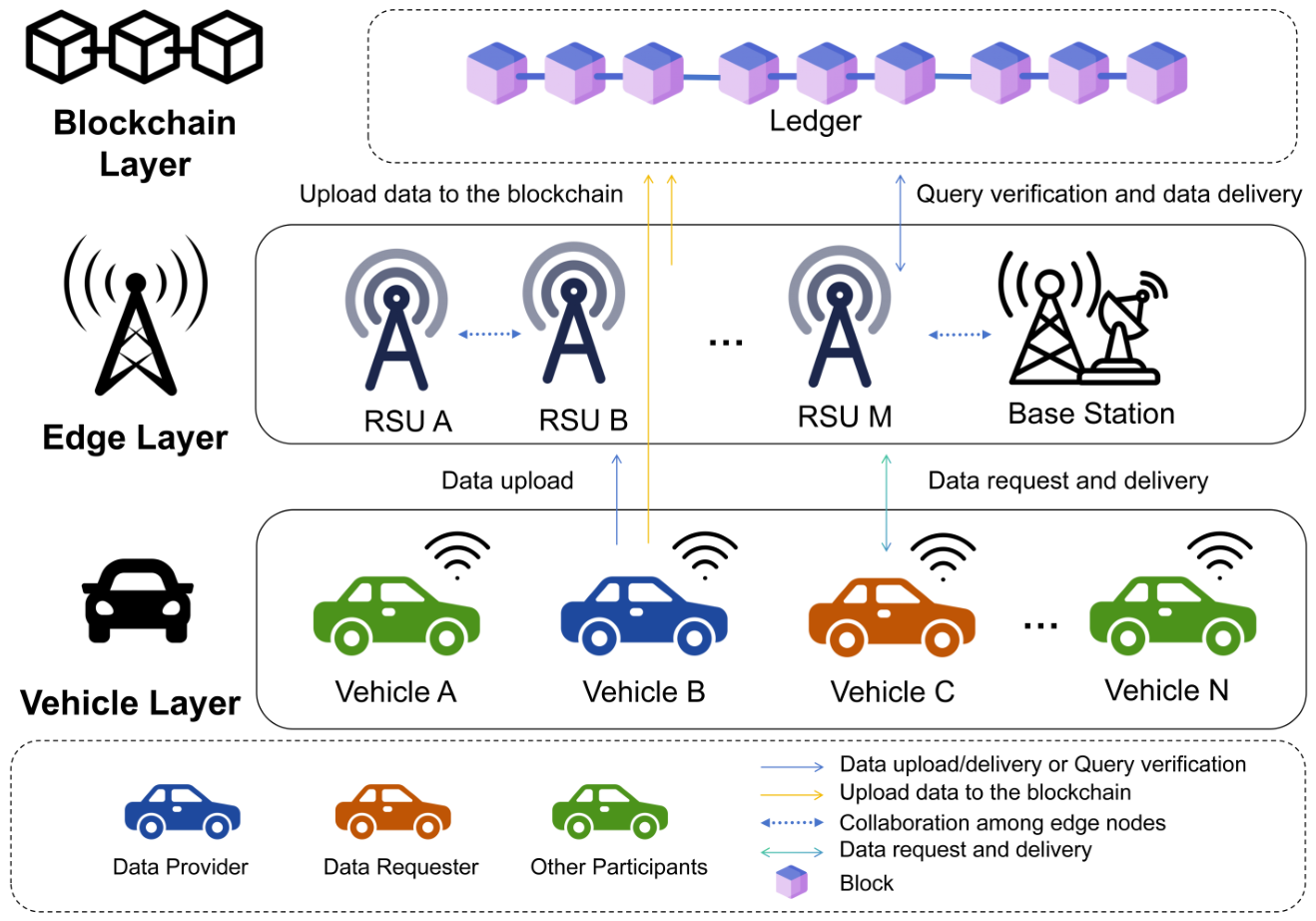
This potential is realized through the explicit layered architecture illustrated in Figure 1, which comprises three main tiers. The vehicle layer includes various types of vehicles, namely data requester vehicles, data provider vehicles, and ordinary vehicles. The edge layer covers Road Side Unit (RSUs) and base stations. The blockchain layer is a non-physical layer responsible for blockchain data storage and consensus execution. Depending on practical application scenarios, consensus nodes can be composed of RSUs and base stations, or a combination of RSUs, base stations, and vehicles. The distributed ledger records uploaded data and verification information, enabling tamper-resistant, traceable, and verifiable data sharing. This layered framework lays the foundation for analyzing the key challenges in blockchain-enabled IoV data sharing—including TPS performance, storage overhead, and incentive mechanism design—in the subsequent sections.
The integration of traditional blockchain with IoV data sharing confronts five significant challenges that hinder its practical application and sustainable development. Firstly, in terms of data security and privacy, the data sharing process involves sensitive user information and behavioral data. Protecting such private data through blockchain-enabled encryption, anonymization, and access control poses a considerable challenge [14,15]. Secondly, regarding sharing efficiency, the single-chain structure and global consensus mechanisms of traditional blockchain lead to low TPS, which fails to meet the data timeliness requirements of the sharing process [16]. Thirdly, in terms of data storage, the substantial overhead caused by redundant ledgers conflicts with the limited computational and storage resources of IoV devices. Additionally, service quality is a critical consideration; high-quality data sharing requires effective incentives to encourage user participation and the provision of high-quality data. Therefore, designing a fair incentive mechanism for both data providers and requesters is a pivotal issue [17,18]. Lastly, in terms of communication, the high mobility of vehicles complicates the maintenance of stable communication connections and network topology, making the resolution of consensus issues in IoV an urgent requirement [19,20,21].
In response to the challenges outlined above, numerous studies [22,23,24,25,26,27] have put forward targeted solutions. As summarized in Table 1, several existing surveys have extensively investigated security architectures [22,23], privacy-preserving mechanisms [24], and cross-layer interoperability [25] in blockchain-IoV integration. For instance, Mollah et al. [22] review 127 papers covering general ITS applications with security as a core theme, while Das et al. [24] specifically focus on data security and privacy in vehicular networks. Similarly, interoperability challenges across heterogeneous vehicular networks are systematically discussed in [25,27]. These dimensions, while critical, have reached a mature coverage level in the literature. In contrast, the performance–scalability–incentive triad—encompassing TPS, storage overhead, and incentive mechanisms—remains the primary bottleneck for real-world deployment yet lacks systematic, fine-grained analysis. Therefore, this survey deliberately narrows its scope to these three interdependent dimensions to provide analytical depth rather than breadth, addressing the gap between theoretical blockchain advantages and practical IoV constraints. Specifically, our contributions are threefold: (i) we systematically analyze the interdependencies among TPS, storage, and incentives, comprising three dimensions that are often optimized in isolation but are deeply coupled in practice; (ii) we propose unified classification rules (Table 2) and quantitative performance comparisons (Table 5) that enable direct cross-scheme evaluation; and (iii) we identify future research directions that explicitly address the tension among these three dimensions, rather than treating them as independent problems.
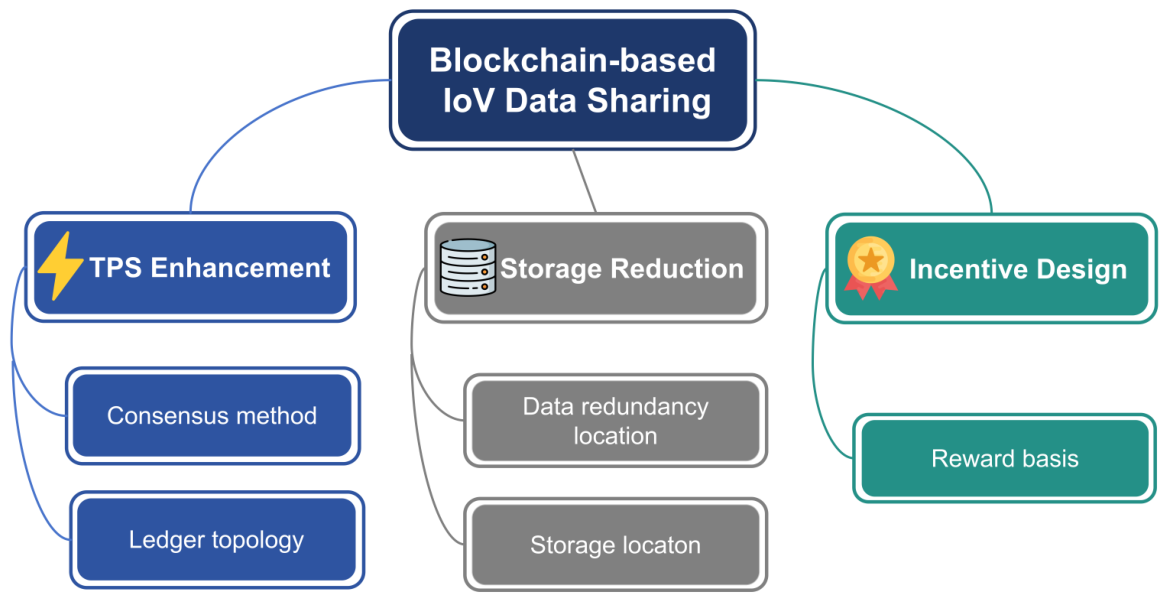
The technical routes developed to tackle these three core challenges are synthesized in Figure 2. This framework identifies three interrelated key research directions: (1) TPS improvement; (2) storage overhead optimization; and (3) incentive mechanism design, which serves as a critical component for ensuring user participation and high-quality data provision. This three-dimensional structure constitutes the core organizational framework of this survey.
Building on the aforementioned motivations, we present a comprehensive review of blockchain-based data sharing schemes for IoV. To ensure the quality, relevance, and reliability of this review, we conducted a systematic literature search guided by established Systematic Literature Review (SLR) methodologies [28,29]. A strict set of criteria was adopted for selecting the literature. The rules and standards used in the paper selection process are elaborated below.
  • Search Strategy: We searched IEEE Xplore, ACM Digital Library, and Web of Science using keywords: (“blockchain” OR “distributed ledger”) AND (“Internet of Vehicles” OR “IoV” OR “VANET” OR “vehicular network”) AND (“data sharing” OR “data exchange”).
  • Inclusion Criteria: (i) Peer-reviewed publications from 2016–2025; (ii) focus on blockchain-based data sharing in vehicular contexts; (iii) address at least one of TPS, storage, or incentive mechanisms; (iv) published in English.
  • Exclusion Criteria: (i) Pure theoretical blockchain papers without IoV application; (ii) non-blockchain IoV data sharing; (iii) duplicate or extended versions of prior work (only most comprehensive version retained).
  • Quality Assessment: Each included paper was evaluated on the following: (i) technical contribution clarity; (ii) experimental validation; (iii) IoV-specific contextualization.
In the initial search stage, the predefined search query retrieved a total of 778 primary studies from the selected digital libraries, including 245 papers from IEEE Xplore, 352 from the ACM Digital Library, and 181 from Web of Science. During the subsequent screening process, 472 papers were retained for full-text evaluation in accordance with the established inclusion and exclusion criteria. To obtain a comprehensive and representative sample of primary studies, backward and forward snowballing [30] was performed on the preliminarily selected papers. This approach enabled us to capture additional relevant publications that may have been overlooked by automated database searches. Finally, 90 primary studies satisfied all quality assessment criteria and were incorporated into this systematic survey. It is worth noting that conducting a systematic literature review involves processing a massive volume of texts. Recent advancements in generative artificial intelligence have demonstrated significant potential in streamlining this process. As highlighted by Syriani et al. [31], Large Language Models (LLMs) like ChatGPT can be highly effective in automating the screening of articles, extracting key features, and classifying primary studies, thereby reducing human bias and drastically accelerating the review process.
This review examines the current landscape and its associated challenges, synthesizes existing research with a focus on three critical aspects—low TPS, high storage overhead, and insufficient incentives—and outlines promising future research trajectories. Formal classification rules are expressed in Table 2.
The rest of this paper is organized as follows: Section 2 analyzes the challenges regarding TPS, storage, and incentive mechanisms; Section 3 summarizes and compares existing solutions with respect to TPS, storage overhead, and incentive mechanism challenges; Section 4 proposes future research directions by integrating the development trends of IoV and blockchain; Section 5 summarizes the entire paper.

2. Main Challenges in IoV Data Sharing

The application of traditional blockchain in IoV data sharing faces numerous challenges, among which low TPS, excessive storage overhead, and inadequate incentive mechanisms are the three major issues hindering its development.

2.1. TPS Challenge

Blockchain network TPS refers to the number of transactions that can be processed and added to the blockchain per second. In IoV, a large volume of time-sensitive data is continuously generated and uploaded by vehicles. Some of this data must be uploaded and shared in a timely manner to remain effective. Low TPS not only impairs the usability of the data but also may potentially lead to serious traffic accidents. Traditional blockchains are typically designed to maintain transaction records for cryptocurrencies, where data security and fairness are the core priorities. To achieve these goals, traditional blockchains adopt consensus mechanisms with high complexity, resulting in a prolonged consensus process from data generation to on-chain deployment and thus low TPS [32].
For instance, the Bitcoin network (as of Q1 2025, Bitcoin Core v27.0) maintains a 7 TPS theoretical maximum with 10 min block intervals, though practical throughput remains at 3.3–7 TPS due to transaction size variability [32,33,34]. Ethereum post-Merge (PoS, as of Dencun upgrade March 2024) achieves 15–30 TPS base layer with 12 s slot times, though rollup-centric roadmaps target 100,000+ TPS off-chain [35,36]. These figures remain orders of magnitude below IoV requirements: a single autonomous vehicle generates 1 GB/s sensor data [2]; even with aggressive filtering (0.1% on-chain), this demands >1000 TPS per vehicle for real-time sharing scenarios.
Additionally, traditional single-chain structures require confirmation of each generated data block, and the size of data blocks that can be processed within a single time frame is limited. As the number of participating vehicles increases, the data blocks generated in a single block generation interval will be unable to accommodate all the data generated during that period, leading to a higher data discard rate. If the block generation speed is significantly lower than the data generation speed, a large amount of data will have lost its timeliness by the time it is uploaded, severely undermining IoV data sharing. For example, traffic congestion caused by sudden accidents cannot be shared promptly, and the latest on-chain data obtained by other commuting vehicles may mislead them, resulting in more severe traffic congestion.

2.2. Storage Challenge

In the IoV environment, utilizing blockchain for data sharing gives rise to significant storage overhead issues, primarily stemming from three aspects. Firstly, each node must locally maintain an identical ledger to ensure data consistency and tamper resistance, resulting in ledger redundancy across different nodes. Secondly, multiple vehicles generate and upload the same type of data at the same time and location, further exacerbating redundancy within the ledger. Finally, outdated historical data remains stored on the chain, leading to unnecessary storage overhead [37]. Such storage burdens impose severe demands on the storage capacity of nodes, thereby hindering their practical application and development. For instance, in the Bitcoin network, the current ledger size has exceeded 700 GB [33], with each full node required to store a ledger of this scale, placing considerable storage pressure on the system. As the number of nodes and transactions continues to grow, the Bitcoin network will face formidable storage challenges in the future. Similarly, in IoV, the number of vehicles on the road reached 1 billion in 2010 and is projected to reach 2.5 billion by 2050 [23]. With such a large number of vehicles, the volume of data generated is bound to be enormous. As vehicular network data continues to be produced and the scale of the vehicle fleet expands, the overall storage requirements will surge due to the substantial amount of redundant data in the network, ultimately encountering hardware limitations. Thus, storage overhead in blockchain-based IoV data sharing remains a significant challenge [38].

2.3. Incentive Mechanism Challenge

Although blockchain technology provides a trustworthy and traceable framework for data sharing in Vehicle-to-Everything (V2X) networks, it still faces significant challenges in designing effective incentive mechanisms.
Firstly, the IoV environment is characterized by high node heterogeneity, including vehicles, Road Side Units (RSUs), and management centers, which differ significantly in computational capabilities, communication conditions, and participation frequency. Existing blockchain-based incentive models are largely derived from cryptocurrency systems, which assume homogeneous resource distribution and sustained node engagement—conditions well-suited for decentralized finance but not directly applicable to IoV scenarios. Vehicle nodes often lack the capacity for continuous participation in consensus processes, and their incentive expectations are unstable, leading to reduced willingness to contribute data, especially during non-critical periods or when the shared data does not bring immediate personal benefits.
Secondly, data generated in the IoV is highly time-sensitive and spatially localized. Events such as traffic congestion and accident alerts require rapid dissemination and response. If the incentive mechanism fails to accurately evaluate the urgency and value of such data, it may lead nodes to prioritize uploading content with higher immediate rewards but limited utility, while neglecting critical information that requires immediate broadcasting—ultimately compromising the overall efficiency of the network.
Moreover, existing incentive mechanisms often lack robust measures to verify data authenticity and identify redundant content. Malicious nodes may exploit this vulnerability by repeatedly submitting identical or fabricated data to maximize rewards, which not only depletes system resources but also undermines the credibility of the trust model, posing a serious threat to the stability and security of the entire IoV system.

3. Solutions to Challenges in IoV Data Sharing

In response to the aforementioned challenges related to TPS and storage overhead, existing research efforts have optimized these issues from various perspectives. This section surveys, categorizes, and summarizes the existing work, while analyzing the optimization approaches and their respective advantages and disadvantages.

3.1. Solutions for TPS Challenge

As shown in Table 3 and Table 4, to address the low TPS issue, the solutions proposed in existing research can be primarily divided into two categories: optimizing consensus mechanisms and designing novel blockchain structures.
Optimizing consensus mechanisms focuses on traditional single-chain blockchains, aiming to reduce the time consumed by consensus and thereby improve network TPS. The evolution of consensus mechanisms in IoV data sharing reflects a strategic shift from high-security, heavy-computation models to lightweight and context-aware protocols. As summarized in Table 3, while traditional PoW and PBFT offer strong consistency, their substantial computational overhead and communication complexity ( O ( n 2 ) ) render them unsuitable for the high-mobility and low-latency requirements of IoV. Consequently, subsequent research has evolved toward credit-based selection (e.g., PoTC) and hierarchical structures, which reduce the number of participating nodes in the consensus process. This evolutionary trajectory demonstrates an ongoing effort to balance the “blockchain trilemma” by prioritizing scalability and throughput without compromising the fundamental trust required for safety-critical IoV applications.
Designing novel blockchain structures aims to comprehensively optimize multiple aspects, including ledger structure, functional structure, and network structure, to enable parallel transaction processing and significantly break through the TPS bottleneck. Table 4 represents a fundamental departure from traditional linear blockchain models to meet the massive data throughput requirements of IoV. As illustrated, the structural evolution follows three primary technical trajectories: parallel processing via Sharding, asynchronous verification through Directed Acyclic Graphs (DAG), and multi-tier coordination via Hierarchical Architectures. Sharding partitions the network to multiply capacity but introduces cross-shard latency, while DAG structures eliminate block-size bottlenecks by allowing concurrent transaction attachments, fitting for asynchronous V2X messaging. Significantly, Hierarchical Architectures (e.g., Mainchain–Sidechain or Cloud–Edge–Vehicle structures) distribute the consensus load across different layers, allowing localized transactions to be processed on high-speed sub-chains while maintaining global security on the mainchain. These three approaches are not mutually exclusive; recent trends suggest a convergence toward “Hybrid-Layered” models. This evolution signifies a transition from “optimizing the protocol” to “redefining the topology”, providing a scalable backbone for high-density vehicular networks where traditional chain-based models fail to perform.

3.1.1. Optimizing Consensus Mechanisms

Initially, researchers introduced blockchain into IoV data sharing primarily to ensure data security, often adopting the secure, stable, and scalable Proof of Work (PoW) as the consensus mechanism. In references [9,69,70], the authors construct a secure and trustworthy environment for data sharing using blockchain, which leverages the PoW consensus mechanism to endow the network with higher security, stability, and scalability. However, PoW entails substantial computational resource consumption and low throughput, which are intolerable in IoV data sharing scenarios.
(1)
Lightweight PoW
Reducing the computational difficulty of the PoW consensus can effectively improve TPS. Yang et al. [39] integrate PoS with PoW by using reputation as a form of stake, and they adopt a Bayesian inference-based reputation mechanism to evaluate and manage node reputations. Nodes with higher reputations face lower computational difficulty when competing for mining rights in PoW, enabling dynamic adjustment of computational complexity, reducing overall system computation overhead, and improving transaction throughput. However, as the system runs, nodes with larger stakes may dominate mining rights over extended periods, leading to a trend of centralization and monopoly within the system.
In Refs. [40,41,42], the authors directly reduce the computational difficulty of the PoW consensus, which also significantly boosts TPS compared with traditional PoW-based blockchains, but at the cost of increased network forking risks. Furthermore, Liu et al. [40] introduce a secret sharing scheme to allow collaborative authentication of uploaded data authenticity among nodes. Yeh et al. [41] employ the Inter Planetary File System (IPFS) for auxiliary data storage and adopt searchable encryption to preserve user privacy. Dong et al. [42] propose a reputation mechanism to detect Byzantine nodes and defend against malicious behaviors that disrupt normal system operations. Although lightweight PoW consensus can effectively elevate TPS, it still incurs unnecessary computational resource waste and exacerbates network forks.
(2)
PoS
To avoid the waste of computational resources, Wang et al. [43] adopt an improved Proof of Stake (PoS) consensus mechanism, where nodes no longer compete based on computational power but instead determine the bookkeeper through voting based on their stakes. Additionally, the authors designed a contract-based incentive mechanism to encourage data sharing among nodes: nodes that frequently share high-quality data are rewarded with higher stakes. This PoS-based consensus optimization significantly improves TPS; however, it still requires a proof process to select a bookkeeper from numerous nodes, and the efficiency of block production remains insufficient to meet the actual demands of IoV data sharing scenarios. To address these issues, Wang et al. [44] proposed a hybrid PoS blockchain protocol, which adopts a two-layer architecture: the upper layer is responsible for block proposal, and the lower layer consists of a dynamically selected verification committee based on node reputation scores, responsible for voting and confirmation. This mechanism not only enhances the system’s resistance to malicious behaviors and tamper-proof capabilities but also improves transaction throughput to a certain extent, effectively overcoming the adaptability and efficiency limitations of traditional PoS in vehicular network environments.
(3)
DPoS
The Delegated Proof of Stake (DPoS) consensus mechanism achieves more efficient block production by reducing the number of nodes involved in the consensus process. Cui et al. [45] regard vehicles as network nodes and utilize 5G communication technology to forward shared data content; the blockchain only needs to store the corresponding data indexes and sharing records instead of the full data content. They introduce a reputation calculation model based on the beta distribution to quantify the reputation of vehicles, using this reputation as a stake to enhance the efficiency of the DPoS consensus mechanism, thereby increasing the overall transaction throughput (TPS). Zhang et al. [46] apply data sharing to asynchronous federated learning scenarios, adopting a Directed Acyclic Graph (DAG) ledger structure and using DPoS as the block production consensus mechanism to accelerate block confirmation speed; additionally, they use Deep Reinforcement Learning (DRL) for node selection to ensure the security of ledger data. Kang et al. [47] model the interaction between active and backup miners using contract theory. Since the DPoS consensus only selects bookkeepers from a subset of nodes, it significantly improves consensus efficiency. However, the reduction in the number of consensus nodes also increases the system’s vulnerability to attacks and leads to a trend of partial centralization and monopolization.
(4)
PBFT
The Practical Byzantine Fault Tolerance (PBFT) consensus mechanism has demonstrated excellent performance in both efficiency and security, with its primary focus on the consensus of data validation. It transforms the consensus mechanism from a proof-based model to a voting-based one, eliminating the additional time cost required to elect a bookkeeper. Luo et al. [48] adopt Ciphertext-Policy Attribute-Based Encryption (CP-ABE) to protect user privacy, leverage the IPFS for auxiliary data storage to save storage space, and utilize the PBFT consensus to achieve an efficient data storage process. Lee et al. [49] optimize PBFT based on geographical location, granting the right to record transactions to the RSU closest to the event location, thereby enhancing the authenticity of on-chain data. They also use a subjective logic model to evaluate vehicle reputation, ensuring the quality of data sharing.
While PBFT effectively improves throughput, ensuring data security remains a crucial step in the data sharing process. Zhang et al. [50] adopt an Elliptic Curve Cryptography (ECC) scheme to safeguard data security during the sharing process, while Ma et al. [51] employ zero-knowledge proofs and homomorphic encryption to achieve the same goal. A reasonable incentive mechanism can promote the quality of shared data: Chen et al. [52] design an auction-based incentive mechanism driven by data quality to encourage vehicles to provide high-quality data content. Xu et al. [53] propose the Score Grouping-PBFT (SG-PBFT) consensus algorithm, which adopts a score-based grouping mechanism to divide all nodes into consensus nodes and candidate nodes. After each round of consensus, node scores are updated, and every 50 transaction requests, the sets of consensus nodes and candidate nodes are refreshed. Compared with the traditional PBFT, SG-PBFT achieves lower communication overhead and higher throughput.
Kumar et al. [54] point out that the traditional PBFT has limitations in identifying and eliminating faulty nodes and is vulnerable to attacks targeting the primary node. To address this issue, they propose the Reputed PBFT (R-BFT) consensus mechanism, which integrates a reputation evaluation model to assess the behavior of each node during the consensus process. This approach not only improves average throughput and reduces latency but also gradually reduces the proportion of faulty nodes in the system.
Overall, the PBFT consensus mechanism provides an efficient and secure solution for data sharing in IoV. However, its multi-round voting and verification process imposes considerable communication overhead, resulting in poor scalability that fails to meet the needs of large-scale node networks.
(5)
HotStuff
HotStuff [55] is a Byzantine Fault Tolerant (BFT) consensus protocol optimized for blockchain applications, designed to significantly improve the scalability and responsiveness of traditional BFT protocols. It introduces a three-phase consensus process—Prepare, Pre-Commit, and Commit—which reduces the communication complexity during leader replacement to the linear order O(n). In addition, HotStuff supports optimistic responsiveness: once the network becomes synchronous, an honest leader can drive the protocol forward at the pace of actual network latency. The protocol also incorporates a chained pipelining mechanism, which enables parallel processing of multiple proposals and thereby substantially enhances the overall system throughput.
To address the issue of Byzantine node leader election in the traditional HotStuff consensus algorithm within IoV environments, Wang et al. [56] proposed an improved scheme based on a reputation mechanism. In this approach, node reputations are dynamically evaluated during the consensus process, primarily based on their response latency and timeout behavior. A weighted random algorithm is then employed to select the leader, thereby reducing the probability that low-reputation or potentially malicious nodes are frequently chosen as leaders. This mechanism effectively mitigates the performance bottlenecks caused by faulty leaders and improves the overall security and consensus efficiency of the system.
(6)
Trust-Based Consensus
In an environment where nodes trust each other, consensus algorithms can achieve extremely high TPS. Wang et al. [57] adopt the Ripple consensus to realize efficient data storage and employ proxy re-encryption technology to protect user privacy. Li et al. [58] utilize the Kafka consensus mechanism to enable efficient electricity exchange between vehicles, and they apply the Krill Herd Algorithm (KHA) to balance the load among vehicles. Both of these consensus mechanisms can achieve very high TPS, but they require a high degree of mutual trust among nodes. A blockchain network based on the Ripple consensus requires 80% of the nodes to be honest, while the Kafka consensus demands that all nodes be honest—requirements that are difficult to meet in an open and autonomous IoV environment.
Chen et al. [59] proposed a lightweight blockchain consensus mechanism based on Proof of Reputation (PoR). This approach dynamically assigns reputation scores to vehicle nodes by evaluating their behavioral performance in historical data interactions, transaction feedback, and response latency. These reputation scores determine the nodes’ participation weight in the consensus process. The system incorporates RSUs to provide initial trust support and implements on-chain mechanisms for real-time reputation updates and penalty measures for misbehavior. This design effectively suppresses malicious actions, enhances node cooperation, and improves the overall stability and efficiency of the system.
(7)
Tailored Consensus for IoV
Some researchers have fully leveraged the characteristics of vehicular networks to develop targeted consensus mechanisms that meet the actual scenario requirements. Lin et al. [60] capitalize on the varying degrees of vehicle participation in data sharing to establish Proof of Activity (PoA), where vehicles that actively engage in data sharing are more likely to obtain the right to mine, thereby reducing the computational overhead associated with consensus. Yang et al. [61] adopt an event-driven approach combined with Proof of Event (PoE), where nodes that first collect a threshold amount of data win the right to mine, significantly improving the efficiency of block generation.
Lin et al. [62] propose a reputation-based consensus mechanism that dynamically adjusts the computational difficulty based on the actual traffic flow, effectively balancing security, efficiency, and decentralization. To address the limitations of traditional consensus mechanisms in vehicular networks, Wang et al. introduce a hybrid consensus protocol that integrates PoW and PoS, which not only reduces computational resource consumption but also enhances the adaptability of the consensus mechanism to the dynamic changes of vehicular nodes. This protocol optimizes the bookkeeping process by introducing a weighted voting mechanism, thereby improving the overall throughput and security of the system.
(8)
Evaluation and Analysis of Consensus Mechanisms

To provide a clearer comparison of the discussed consensus optimizations, Table 5 summarizes the performance metrics of various mechanisms, focusing on their reported TPS, latency, and specific application scenarios in IoV. Table 5 reveals a fundamental tension: PoTC achieves the highest TPS (8000) and lowest latency (∼12 ms) but relies on traffic-flow conditions unique to vehicular environments, limiting its generalizability; DPoS offers high throughput (1000 TPS) at the cost of increased centralization; PBFT provides strong security guarantees with low latency but suffers from O ( n 2 ) communication overhead that limits scalability; meanwhile, lightweight PoW preserves decentralization but remains computationally wasteful. In general, consensus design for IoV must balance scalability vs. security (e.g., reducing consensus nodes improves TPS but increases vulnerability to collusion) and latency vs. decentralization (e.g., trust-based mechanisms achieve millisecond-level latency but require strong honesty assumptions).
Table 5. Quantitative performance comparison of consensus mechanisms.
MechanismTPSConsensus LatencyTolerated Malicious Node RatioApplication Scenarios
PoW15 [71]∼21 s [71]<1/2Non-real-time vehicular data anchoring
Lightweight PoW840 [42]∼5 s [42]<1/2Energy-constrained IoV consortium chains
PoS (Hybrid)70 [71]∼13 s [71]<1/4Energy-efficient IoV data sharing
DPoS1000 [71]∼3 s [71]<1/3High-throughput RSU-assisted vehicular services
PBFT200 [71]∼5 s [71]<1/3Permissioned V2I data sharing
HotStuff∼650 [56]∼450 ms [56]<1/3Scalable low-latency BFT vehicular chains
PoR1100 [72]∼4.5 s [72]<1/3Reputation-based vehicular resource sharing
PoTC8000 [62]∼12 ms [62]<1/3Traffic-aware RSU-assisted IoV data sharing

3.1.2. Novel Structures of Blockchain

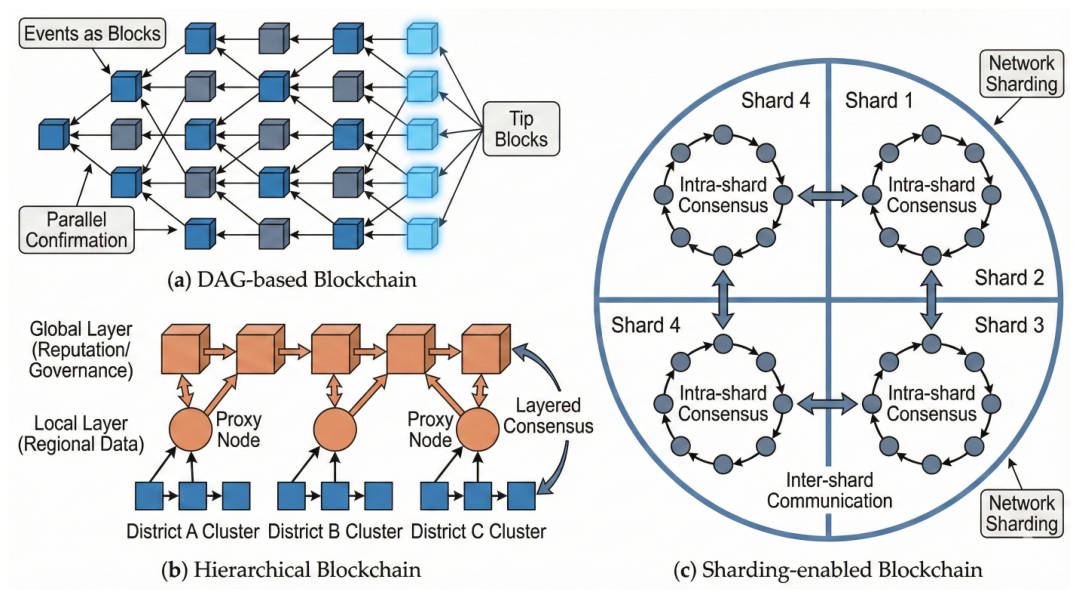
Current mainstream novel blockchain structures can be categorized into three types: DAG-based blockchains, hierarchical blockchains, and sharding-enabled blockchains. As illustrated in Figure 3, these structures transform the traditional single-chain architecture into a multi-chain parallel processing mode, which not only breaks through the TPS bottleneck of traditional blockchains but also effectively improves the overall transaction efficiency.
(1)
DAG-Based Blockchain
A DAG-based blockchain is a distributed ledger technology that adopts a DAG structure, characterized by a high degree of parallelism and scalability, which enables the simultaneous confirmation of multiple transactions. When the block generation speed exceeds the broadcasting speed, blockchain forks may occur, requiring ledger consensus to maintain system consistency. Traditional blockchain ledger consensus often achieves consensus by determining a main chain; for instance, Bitcoin adopts the longest chain rule, where the longest chain recognized by the majority of nodes is regarded as the main chain, and other blocks are discarded. Consequently, the computational power consumed to generate discarded blocks is wasted, valid events contained in these discarded blocks are lost, and attackers may tamper with the ledger by continuously gaining the right to mine. To prevent such tampering, the block production consensus must be sufficiently complex to protect the immutability of the ledger, which in turn limits the throughput of the Bitcoin network.
Some researchers attempt to simplify the block production consensus through complex ledger structures, thereby enhancing block production efficiency while strengthening ledger robustness—and DAG-based blockchains adhere to this design philosophy. Unlike traditional blockchains that use data blocks as the basic storage unit, the DAG ledger structure typically takes events as the basic unit, with each event functioning as a block. Subsequent blocks can verify the authenticity of preceding blocks and reference multiple verified blocks. The most recently generated unreferenced blocks are referred to as Tip blocks; after a certain period, blocks that do not receive sufficient votes are deemed malicious. This ledger structure design extends the blockchain ledger in a graph-like form rather than a linear chain, enabling parallel event confirmation, stronger tamper resistance, and simplified block production consensus, thus increasing system TPS [73].
In 2016, IOTA first introduced the application of a DAG structure in its proposed Tangle architecture [74], adopting a PoW consensus algorithm to defend against Sybil attacks and spam attacks. In Tangle, each new transaction must authorize and validate two previous transactions. The importance of a transaction is evaluated by calculating its weight and cumulative weight: the weight is directly proportional to the amount of PoW performed, while the cumulative weight is the sum of the transaction’s own weight and the weights of all transactions that directly or indirectly reference it. However, existing DAG-based blockchains lack explicit rules for reference prioritization, making them vulnerable to splitting attacks that disrupt block referencing and undermine consensus stability.
To address this issue, Zhang et al. [63] proposed a more stable consensus protocol, Phantasm, which aims to stabilize the ordering results during the consensus process, thereby ensuring ledger accuracy and network consistency. Yang et al. [38] constructed a DAG ledger, using a PoW with reduced computational difficulty as its block production consensus to achieve efficient data sharing, while also utilizing social attribute grouping and historical data pruning to reduce storage overhead. In DAG-based blockchains, the selection of referenced Tip blocks directly affects network throughput; Chai et al. [64] designed a reverse two-hop Tip selection algorithm to further improve the throughput of DAG-based blockchains.
(2)
Hierarchical Blockchain
Hierarchical blockchain structures divide traditional blockchains into multiple layers, where multiple nodes within a city or street region form a local blockchain network, and proxy nodes from different local blockchains constitute a global blockchain. This architecture decomposes global consensus into layered consensus processes. Since vehicles tend to prioritize data within a specific geographical range, data generated by local vehicles only requires consensus verification from local nodes before being uploaded to the chain, which effectively reduces consensus latency. By transforming the traditional single-chain structure into a multi-chain structure, multiple local blockchains enable parallel block generation, thereby significantly improving system TPS.
Lee et al. [49] partition clusters based on geographical location, where each cluster forms a local-layer blockchain to process internal traffic data, and RSUs from each cluster form a double-layer blockchain to store global vehicle reputation scores. With this design, only nodes in the local cluster participate in consensus when processing local traffic data, which greatly reduces the number of consensus nodes and further improves overall TPS. However, such location-based clustering may lead to data loss at cluster boundaries. To mitigate this issue, Dong et al. [42] perform division according to administrative or regional boundaries, where RSUs located at cluster boundaries form a double-layer blockchain network dedicated to storing boundary data, thus effectively reducing data loss.
Qin et al. [65] adopt a functional layering strategy and propose a tri-chain blockchain architecture customized for IoV scenarios, enabling efficient detection and real-time sharing of hazardous road conditions. This architecture consists of three functionally complementary sub-chains: the identity chain stores vehicle identity and reputation information; the road condition chain specializes in recording and managing hazardous event data; and the snapshot chain maintains trusted snapshots of the operating states of vehicles and RSUs. Leveraging a parallel multi-chain design, the proposed scheme significantly enhances transaction processing capability and data organization efficiency, supporting low-latency sharing and rapid response to emergency information.
The multi-chain structure of hierarchical blockchains also enables hierarchical data processing. Traffic events vary in their impact ranges according to their importance. For instance, street-level traffic congestion is only relevant to nearby road sections due to its rapidly changing nature, whereas serious road collapses or long-term construction may affect the entire city for an extended period, continuously influencing travel planning and scheduling. In response to this characteristic, Chai et al. [66] designed a hierarchical data storage scheme based on layered blockchains that stores different categories of data at corresponding levels, improving query efficiency while reducing storage overhead.
(3)
Sharding-Enabled Blockchain
Sharding technology also seeks to improve overall TPS by reducing the number of nodes involved in each consensus process. Corbett et al. [75] first introduced the concept of sharding to scale databases by partitioning nodes into multiple groups called shards. Luu et al. [76] further applied sharding to blockchains, enabling each shard to process block confirmations in parallel and thus significantly enhancing system throughput. According to different partitioning strategies, sharded blockchains can be divided into three categories: network sharding, transaction sharding, and state sharding [77].
Network sharding divides the entire peer-to-peer network into multiple independent shards, with each shard processing a subset of transactions in parallel. Since transactions across different shards can be fully independent, multiple verifications can be completed simultaneously, greatly improving overall efficiency. Transaction sharding improves transaction processing capability by splitting complete transactions into multiple sub-transactions that are processed concurrently across shards. To reduce the storage burden of requiring each node to maintain the full ledger, state sharding distributes different segments of the ledger across different nodes, so that the entire network collectively maintains a complete and consistent state. The consensus mechanism in sharded blockchains includes both intra-shard consensus and inter-shard consensus. Intra-shard consensus operates similarly to that in traditional blockchains, whereas inter-shard consensus is realized through the exchange and verification of block headers.
Zhang et al. [67] implement sharding based on geographical location. To prevent internal collusion within shards and reduce the impact of inter-shard node failures on system stability, they adopt a reputation-based intra-shard consensus scheme and vehicle-assisted inter-shard consensus to guarantee security. Wang et al. [68] adopt function-based sharding, where each shard is responsible for processing different types of transactions, and employ zero-knowledge proofs to preserve user privacy.
(4)
Evaluation and Analysis of Novel Blockchain Structures
Novel blockchain architectures fundamentally reshape the scalability–security–consistency trade-off space and deliver a more fundamental scalability solution than merely optimizing consensus mechanisms. DAG-based blockchains maximize concurrency and TPS by enabling parallel confirmation of transactions, while bringing uncertainties in tip-selection security and finality latency; hierarchical architectures leverage the geographical and functional locality of vehicular data to mitigate global consensus pressure but incur non-negligible cross-layer coordination overhead and risk potential data loss at cluster boundaries; sharding-enabled blockchains boost throughput by partitioning nodes, transactions, and states into parallel sub-networks, yet they suffer from cross-shard communication latency and complicated consistency maintenance. These architectural paradigms fit well with the distributed and dynamic features of IoV scenarios, whereas they also raise new challenges regarding DAG tip selection security, hierarchical cross-layer coordination, and sharding cross-shard communication as well as consistency maintenance. Collectively, such designs shift the system bottleneck from consensus complexity to cross-chain, cross-shard, and cross-layer coordination, suggesting that future TPS-oriented optimization should be co-designed with mobility-aware routing and dynamic topology management, and ought to pursue not only higher parallelism but also a deliberate balance among throughput, security, data consistency and mobility adaptability in practical vehicular environments.

3.2. Solutions for Storage Challenge

As shown in Table 6, current research on blockchain-based IoV data sharing, which focuses on reducing storage overhead, can be categorized into three types: reducing redundancy among node ledgers, reducing intra-ledger data redundancy, and reducing the storage of obsolete data.

3.2.1. Reducing Redundancy Among Node Ledgers

These schemes aim to reduce the volume of duplicated data stored, which can be categorized into two types: on-chain storage solutions and off-chain storage solutions.
On-chain storage solutions refer to directly storing data content on the blockchain. To reduce storage costs, such solutions primarily adopt tiered or layered storage strategies, meaning not all nodes are required to maintain a complete copy of the ledger. For instance, Zhang et al. [78] proposed a lightweight blockchain scheme that allows nodes to select the size of the ledger they retain based on their own storage capacity, avoiding unnecessary resource waste. Zhou et al. [79] designed a hierarchical node structure: infrastructure nodes act as full nodes to store the complete ledger, while vehicle nodes serve as light nodes that only retrieve data without storing the entire ledger, thereby reducing the overall storage overhead of the system. Chen et al. [59] proposed the LBDT (Lightweight Blockchain with Dual-Track) framework, which constructs a parallel chain structure consisting of key blocks and microblocks. Key blocks only record updates of node reputation scores and corresponding hash digests (smaller in size), while microblocks store complete transaction data. As lightweight nodes, vehicles only need to synchronize key blocks to complete on-chain verification and reputation management, which not only ensures the trustworthiness of the system but also improves the efficiency of resource utilization at the edge.
Off-chain storage solutions, by contrast, store data content locally on nodes rather than on the blockchain, with only data indexes uploaded to the blockchain for query and verification. Cui et al. [45] proposed storing data content locally on vehicles and uploading only data indexes to the blockchain for query purposes, using 5G base stations to achieve efficient data forwarding and avoid network congestion. This approach fundamentally resolves the problem of redundant ledger storage and significantly reduces the overall storage overhead of the system. However, it may face the risk of network congestion when querying data in high-traffic areas during peak periods. IPFS [80], a common off-chain storage technology, splits complete data content into multiple fragments and stores them locally on different nodes; when data needs to be queried, the fragments are retrieved and spliced using their hash values. This technology has been widely applied in related studies [41,47,81], where researchers use IPFS for off-chain storage, allowing the blockchain to only store index hashes, thus further reducing storage costs.

3.2.2. Reducing Intra-Ledger Data Redundancy

These solutions aim to reduce redundant storage of identical data within the ledger, thereby lowering overall storage costs. When multiple vehicles upload the same data content simultaneously at the same location, severe internal data redundancy arises within the ledger. This redundancy is further amplified as the ledger is replicated and stored across numerous nodes, resulting in unnecessary storage overhead for the system. Yuan et al. [82] adopt a cuckoo filter to screen uploaded data, preventing duplicate submissions of identical content and effectively reducing system storage overhead.

3.2.3. Reducing the Storage of Obsolete Data

These solutions focus on pruning data that has lost its value, preventing the repeated storage of obsolete data, thereby reducing storage costs. Yang et al. [38] leverage the characteristics of vehicular social networks to group vehicles based on their social attributes. Within the same group, vehicles only need to maintain the ledger for that group. Additionally, given the temporal nature of traffic data, the authors permit nodes to prune obsolete historical data according to their storage capacity.

3.2.4. Evaluation and Analysis of Storage Optimization Techniques

In summary, storage overhead reduction in blockchain-based IoV data sharing demands a careful trade-off among security, latency, and scalability, particularly under high-mobility conditions. Typical strategies including off-chain storage, lightweight indexing, and data pruning enhance scalability by reducing ledger replication and restraining long-term data growth; nevertheless, keeping only hashes or indexes on-chain may undermine security, as data availability relies on external storage nodes that are prone to unavailability or compromise. While these approaches can lower consensus latency by shrinking on-chain data size, high vehicle mobility may cause extra retrieval delays when accessing data across RSUs, edge servers, or fragmented storage nodes. Essentially, storage optimization involves three inherent tensions: security versus scalability, where off-chain solutions such as IPFS remove ledger redundancy but weaken data availability when external nodes are unreachable; latency versus storage cost, where on-chain full replication guarantees low-latency verification yet imposes excessive storage burdens on resource-constrained On-Board Units (OBUs); and auditability versus pruning, where aggressive data trimming cuts overhead but may impair the long-term traceability needed for accident forensics. By contrast, enhanced verification, broader data replication, and prolonged retention strengthen security and auditability at the expense of heavier storage pressure and higher communication overhead. Accordingly, storage optimization should not merely pursue minimal storage cost, but comprehensively balance scalable storage, low-latency access, and reliable verification in dynamic IoV environments. For practical deployment, safety-critical data such as collision alerts should prioritize on-chain full replication and retention to ensure security and low-latency access, whereas non-urgent and historical data can adopt more aggressive offloading and pruning strategies for better scalability.

3.3. Solutions for Incentive Mechanism

Incentive mechanisms for data sharing in IoV scenarios fall into three categories: value-based incentives, reputation-based incentives, and game-theoretic incentives.

3.3.1. Value-Based Incentive Mechanism

Value-based incentive mechanisms primarily rely on token-based rewards, which are automatically distributed via smart contracts upon task completion to encourage active participation in data sharing. Zhan et al. [83] introduced a Privacy-Preserving Announcement Incentive System (PIAS) tailored specifically for safety warning tasks in V2X networks. In this framework, event publishers can disseminate emergency alerts via blockchain, while nearby vehicles acting as anonymous responders submit verification data and receive token rewards in return. To safeguard responder privacy, the system adopts ring signatures and one-time addresses to effectively conceal their identities. Moreover, smart contracts automate core processes including event verification, response validation, and reward distribution, thus improving task response efficiency and alleviating the low participation issue commonly encountered in traditional anonymous communication systems.

3.3.2. Trust-Based Incentive Mechanism

In contrast to value-based incentives, reputation-based mechanisms emphasize the establishment of a long-term, integrated incentive and governance framework, using reputation scores as feedback indicators for node behavior. Du et al. [84] proposed an incentive model that replaces monetary rewards with reputation scores. In this scheme, vehicles accumulate reputation by contributing valid data or participating in consensus verification, which in turn affects their priority in block consensus and data writing. The system uses Bayesian inference to evaluate the credibility of events and adopts smart contract-based auditing and on-chain scoring mechanisms to enhance the fairness and transparency of reputation evaluation.
Kumari et al. [85] developed an adaptive reputation management framework that integrates fuzzy logic with blockchain technology. By combining direct interaction records and third-party recommendations, the system dynamically adjusts node reputation scores. These values act as access thresholds for task participation, forming an indirect incentive structure that promotes system stability in complex and dynamic environments.
To further strengthen behavioral supervision, Chen et al. [86] proposed a joint reputation-based incentive architecture that integrates a “pre-incentive and penalty” (PRP) mechanism with consensus control. In this framework, rewards are pre-allocated to high-reputation nodes prior to task execution. Final rewards or penalties—such as reputation deductions or incentive revocations—are determined according to task completion outcomes, thereby strengthening nodes’ awareness of the consequences of their behavior. Furthermore, variations in reputation scores affect nodes’ status and task assignment privileges during the consensus process, enabling a deeper integration of incentives and governance.
However, reputation-based mechanisms often rely heavily on historical behavioral data, which can lead to incentive bias in cold-start or data-sparse environments. To address the challenge of establishing communication trust among vehicles, Mukathe et al. [87] proposed an incentive model that integrates blockchain-based reputation scoring with key negotiation protocols. This approach dynamically adjusts reputation scores based on service quality, response latency, and behavioral feedback during the negotiation process, thereby enhancing communication reliability through a “reputation-as-incentive” paradigm and improving nodes’ task eligibility as well as resource allocation priorities.
Additionally, the Info-Chain framework proposed by Yan et al. [88] serves as a representative reputation-based incentive scheme. This system maps vehicle behavior during data sharing and verification processes to on-chain reputation scores, enabling adaptive adjustment of node reputation levels. Nodes with higher reputations gain higher information adoption rates and greater task response privileges, forming a behavior-driven mechanism governed by a “reputation threshold.” The framework also employs on-chain reputation tables and a multi-tiered storage architecture to improve the transparency, traceability, and robustness of reputation management against malicious attacks.

3.3.3. Game-Based Incentive Mechanism

Game-based incentive mechanisms leverage rational decision-making models and integrate game theory to design incentive allocation strategies. Such strategies optimize resource distribution while fostering honesty and system efficiency. Ma et al. [89] proposed the MTP Auction, a blockchain-augmented, auction-based incentive mechanism tailored for crowdsourced sensing tasks in V2X networks. This mechanism adopts a two-stage auction protocol combined with a key-value payment scheme to minimize the platform’s overall operational overhead. It exhibits key game-theoretic properties, including truthfulness, individual rationality, and systemic efficiency. Empirical evaluations on the Ethereum platform validate the feasibility and effectiveness of the proposed mechanism. However, its insufficient consideration of node heterogeneity and data diversity limits its adaptability across diverse V2X application scenarios.
In the field of decentralized governance, Han et al. [90] proposed a parallel information management architecture inspired by the concept of Decentralized Autonomous Organizations (DAOs). Under this framework, V2X information is divided into multiple autonomous domains, each managed by an independent DAO. Nodes are incentivized to participate in data sharing and verification through game-theoretic competition. Rewards and governance rights are allocated according to data quality and individual contributions, while smart contracts enable dynamic reputation updates and hierarchical role promotion, thus encouraging sustained node participation. This scheme integrates decentralized autonomy with flexible resource coordination.
Nevertheless, the complexity of its game-theoretic design incurs significant computational and communication overhead. Furthermore, guaranteeing fairness for nodes with low participation frequency remains a key issue to be addressed in future research and optimization.

3.3.4. Evaluation and Analysis of Incentive Mechanisms

Overall, incentive mechanisms are critical to sustaining high-quality and continuous data sharing in IoV blockchain systems, which inherently require a delicate balance between immediate participation and long-term governance. Value-based mechanisms deliver direct, immediate rewards and adapt well to task-driven and emergency data sharing scenarios, yet they tend to induce reward-oriented behavior and redundant data submissions; reputation-based (trust-based) mechanisms underpin long-term system governance by associating node credibility with subsequent service privileges and can foster sustained cooperation, while suffering from inherent limitations such as cold-start issues, reputation manipulation risks, and delayed feedback effects; game-theoretic approaches model the strategic interactions among vehicles, RSUs, and service providers to balance individual rationality and system-level efficiency, but their practical performance relies heavily on idealized rationality and complete information assumptions, accompanied by non-negligible computational overhead and potential unfairness to low-frequency participants. Therefore, future incentive design needs to integrate monetary rewards for urgent task response, reputation evolution for long-term quality assurance, data quality evaluation, and punitive constraints on malicious behavior into a unified framework, which can effectively motivate truthful, timely, and valuable data contribution and restrain malicious or low-quality participation, while maintaining low computational complexity to meet the execution capability constraints of resource-limited OBUs.

4. Prospects

Blockchain-based data sharing in vehicular networks integrates the decentralization, tamper resistance, and traceability of blockchain with distributed data sharing, establishing a trusted data sharing environment that enhances the driving experience and improves traffic safety. Nevertheless, its practical application and further development face challenges on multiple fronts. To tackle the bottlenecks concerning TPS, storage pressure, and incentive mechanism overhead, existing studies have carried out optimizations and improvements from various levels and perspectives. In accordance with the evolving trends of vehicular networks and blockchain technology, we propose several promising future research directions as follows:

4.1. TPS Enhancement

Future work on improving TPS may be undertaken in the following aspects.

4.1.1. Other Approaches to Optimize Consensus Mechanisms

Existing research on consensus mechanism optimization mainly focuses on three aspects: reducing leader election latency, decreasing the number of communication rounds required to achieve consensus, and lowering the number of participating consensus nodes. Beyond these factors, network communication delay and block size also significantly affect system TPS. Accordingly, we propose the following future research directions:
(1)
Location-Based Consensus Node Selection
Consensus mechanisms typically require a predefined percentage of the entire network to agree on a proposal, and the communication latency between nodes directly exerts a significant impact on consensus efficiency. A geographically dispersed node distribution often leads to substantial communication delays. Furthermore, given that blocks aggregate data from multiple nodes across the network, distant data may pose challenges for efficient local verification.
To address this, future research could explore location-based consensus node selection, wherein nodes within a specific geographical range collaborate to reach consensus on the data generated within that domain. This strategy aims to minimize both communication and verification latency, thereby effectively improving system throughput (TPS). However, geographically clustered nodes may exhibit higher vulnerability to adversarial attacks, which could compromise the security of the consensus process. Consequently, robust defensive mechanisms must be designed and integrated to ensure system resilience.
(2)
Block Size-Based Leader Node Selection
Improving TPS can also be realized by producing blocks with larger data capacities within a single consensus round. Owing to the heterogeneous computing and storage resources among nodes, as well as volatile communication conditions, each node may collect distinct block contents. For future research, block size could be introduced as a criterion for leader node selection. This strategy enables the aggregation of more data into a single block during block generation, thereby effectively enhancing TPS. However, this approach may induce malicious competition, where nodes attempt to secure the leadership right by filling blocks with redundant or useless data, potentially degrading the overall data quality of the system. Consequently, effective mechanisms for discrimination and validation are indispensable to mitigate this risk.

4.1.2. Optimizing Novel Blockchain Architectures

Novel blockchain architectures improve TPS by transforming the traditional single-chain architecture into multi-chain architectures. However, existing blockchains with new architectures have inherent limitations in practical applications. In response to these constraints, the following research directions are proposed:
(1)
Optimizing DAG Blockchain Verification Rules
The high parallelism of DAG-based blockchains endows them with high throughput. However, the randomness in block verification can lead to unpredictable verification times for tip blocks, which impairs efficiency. Therefore, future research could consider grouping nodes by event types, where nodes within each group are responsible for verifying the ledger data corresponding to their specific event type. This approach can prevent certain blocks from remaining unverified for extended periods, which would otherwise compromise their usability. Nevertheless, this method requires designing inter-group interaction mechanisms to avoid isolation and curb the spread of malicious activities within individual groups—risks that could undermine the security of the entire ledger.
(2)
Optimizing Inter-Shard Transaction Processing
Sharding technology enables blockchain networks to process different transactions in parallel, thereby effectively improving TPS. However, the isolation between different shards poses difficulties in cross-shard data verification and traceability, resulting in additional validation latency and potential data unreliability. Therefore, future research should focus on designing appropriate cross-shard validation mechanisms that can leverage the mobility of vehicles—allowing vehicles to move between different shards to assist in cross-shard data verification.
(3)
Optimizing Task Load in Hierarchical Blockchains
By organizing multiple clusters into independent sub-blockchains that generate blocks in parallel and upload aggregated data to a global chain, hierarchical blockchains achieve high throughput. However, the global chain typically bears a much heavier data processing load than traditional blockchains. Excessive load may prevent timely processing of all data and lead to system latency. Therefore, future research can explore load balancing across different layers, for instance by compressing data at the local chain level, along with other optimization strategies.

4.2. Reducing Storage Overhead

Future research on mitigating storage overhead can be explored from the following perspectives.

4.2.1. Editable Blockchains

Traditional blockchains are characterized by immutability, meaning data can no longer be deleted or modified once uploaded to the chain. While this ensures data security and traceability, it also introduces potential risks: expired, invalid, or erroneous data becomes extremely difficult to remove or correct. As an emerging technology, editable blockchains allow nodes to modify the content of historical blocks after verification, while preserving the integrity of the original chain structure through chameleon hashing. By enabling data updates rather than only appending new blocks, editable blockchains effectively reduce storage overhead.
However, the slow growth of block height in editable blockchains may weaken their tamper resistance. Moreover, modifications to on-chain data are highly sensitive operations that require secure and standardized procedures. Future research could embed the data editing process into the consensus mechanism, permitting modifications to designated blocks only after global consensus is reached. Meanwhile, a new block containing the complete editing record can be appended to the end of the chain. This design ensures the normal increment of block height and enables full traceability of block modification behavior.

4.2.2. Optimizing IPFS Off-Chain Storage Strategies

IPFS provides superior storage support for blockchain systems, but its retrieval efficiency can be compromised by long-distance communication that results in unstable connections. In addition, potential damage to data fragments may necessitate repair operations, further increasing query latency. Therefore, further optimization is highly necessary.

4.2.3. Data Filtering

Since identical events may be collected and uploaded by multiple vehicles, storing such redundant data incurs unnecessary storage overhead. However, indiscriminate filtering of similar events could degrade data reliability. Therefore, future research could employ reputation as a filtering criterion, retaining data submitted by higher-reputation sources. Nevertheless, this scheme may cause reputation inflation and data source monopolization, requiring a well-designed reputation mechanism to ensure fairness in the filtering process.

4.3. Evolving Incentive Mechanisms

Future research on incentive mechanisms can be further explored in the following aspects.

4.3.1. Adaptive Score-Based Incentive Allocation

Current value-based mechanisms primarily rely on static token rewards, often overlooking the dynamic attributes of vehicular data—such as urgency, accuracy, and location relevance. Future systems could adopt adaptive reward mechanisms to reflect the real-time score of node contributions. For example, data reported from congested areas or emergency scenarios could be assigned higher token incentives. This entails integrating on-chain data scoring models with off-chain context awareness. Nevertheless, safeguards must be implemented to prevent score inflation or manipulation by malicious nodes that submit artificially high-score data.

4.3.2. Trust-Centric Role Evolution and Access Control

Trust-based incentive mechanisms typically derive node reputation from historical behavior, yet seldom tie reputation to functional privileges or system governance. Future mechanisms could dynamically assign roles such as validators, relays, and committee members based on reputation scores, enabling trusted nodes to undertake greater responsibilities and obtain higher rewards. Furthermore, reputation-driven access control can restrict malicious or low-contribution nodes from participating in consensus processes or high-value tasks. A core challenge resides in designing tamper-resistant, context-aware trust evaluation metrics that evolve adaptively over time while defending against Sybil and collusion attacks.

4.3.3. Game-Theoretic Incentives Under Uncertainty

Game-based mechanisms have shown great potential in modeling node strategic behavior, yet most rely on the assumptions of perfect information and static environments. In IoV scenarios, nodes frequently experience topology changes, delayed observations, and incomplete information. Therefore, incentive mechanisms based on Bayesian games or repeated games—in which nodes continuously update strategies and learn from interactive feedback—deserve further exploration. Furthermore, integrating mechanism design with reinforcement learning can enable the system to adapt autonomously to emerging threats and behavioral patterns. Ensuring equilibrium stability and computational efficiency in such dynamic environments remains a key research challenge.

5. Conclusions

In recent years, with the growing intelligence of vehicles, enhancing driving experience and safety has emerged as a critical research focus. Data sharing plays a vital role in supporting traffic management, disaster warning, and road planning, thereby providing security guarantees for daily commuting, assisted driving, and even autonomous driving systems. Blockchain-based data sharing in IoV offers the potential to establish a secure and trustworthy data-sharing ecosystem; however, it confronts significant performance challenges.
In this work, we present the first systematic survey dedicated to the performance–scalability–incentive triad in blockchain-based IoV data sharing. Unlike existing surveys [22,23,24,25,26,27] that treat security and privacy as primary concerns, we focus on the three interdependent bottlenecks—low TPS, high storage overhead, and insufficient incentives—that currently impede practical deployment. We systematically analyze the trade-offs and couplings among these dimensions (e.g., TPS improvement may increase storage pressure; storage reduction may affect consensus latency; incentive design influences node participation and system security) and propose unified classification frameworks and quantitative comparisons that enable direct cross-scheme evaluation. We conduct a comprehensive analysis of the advantages and disadvantages of each approach, summarize their applicability, and propose potential future research directions to tackle the remaining technical challenges. As technology continues to evolve and integrate cutting-edge innovations such as artificial intelligence, more efficient data-sharing mechanisms and refined storage strategies will emerge. These advancements are expected to overcome current limitations, fully exploit the merits of blockchain, and drive the enhancement of vehicular network data interaction and the expansion of application scenarios, thereby comprehensively elevating driving experience and traffic safety.
Based on the survey findings, future research on blockchain-based IoV data sharing should shift from isolated optimization of TPS, storage overhead, and incentive mechanisms toward integrated and deployable system design that explicitly addresses their interdependencies. For example, TPS enhancement via larger blocks or more frequent consensus directly increases storage pressure and communication overhead; aggressive storage reduction through off-chain delegation may compromise on-chain verifiability and consensus latency; and incentive design affects node participation rates, which in turn determines consensus security and effective throughput. Therefore, unified benchmarks and co-optimization frameworks—rather than single-dimension improvements—are essential to bridge the gap between theoretical schemes and practical deployment. For TPS enhancement, future studies should develop mobility-aware and context-adaptive architectures, such as dynamic consensus committees and hybrid DAG–hierarchical–sharding structures, to support real-time data sharing under highly dynamic vehicular topology while maintaining security and decentralization. For storage optimization, research should move beyond simple storage reduction and focus on verifiable, sustainable data management by combining on-chain commitments, off-chain availability proofs, content-aware deduplication, and auditable pruning according to the spatiotemporal value of IoV data. For incentive mechanisms, future designs should be quality-aware, context-aware, and attack-resistant, jointly considering data freshness, authenticity, urgency, geographic relevance, and redundancy to discourage fabricated or low-value submissions.
In addition, the integration of 6G and AI should be explored as a key enabler for next-generation blockchain-based IoV data sharing. Leveraging 6G can provide ultra-low-latency and high-capacity communication support, while AI can dynamically optimize consensus committee selection, sharding boundaries, off-chain storage allocation, anomaly detection, and reputation scoring in highly dynamic vehicular environments. To illustrate such AI-enabled dynamic optimization, a typical case lies in AI-assisted dynamic sharding: rather than static geographical sharding, federated learning models running on 6G base stations can predict traffic flow evolution and proactively reshard the network—merging shards ahead of a stadium event and splitting them afterward—to minimize cross-shard transactions while balancing load. These AI/6G-enabled dynamic optimizations provide a natural way to co-optimize the TPS-storage-incentive triad in a unified manner, rather than tuning each dimension in isolation.
Currently, most research on blockchain-based data sharing in IoV concentrates on theoretical modeling and simulation validation. While a limited body of literature has preliminarily explored practical deployment challenges, including the hardware resource limitations of OBUs [26,91,92] and the interoperability conflicts across vehicle manufacturers and regional blockchain networks [93,94], such discussions remain insufficient and underexplored. These real-world application bottlenecks have not yet been systematically analyzed or well addressed. Accordingly, OBU hardware adaptation and cross-manufacturer, cross-regional blockchain interoperability represent promising research gaps, which deserve in-depth investigation in future vehicular blockchain studies.

Author Contributions

Conceptualization, Y.F. and Z.Z.; methodology, Y.S. and Z.Z.; formal analysis, Y.F., Y.S., and Z.Z.; investigation, Y.S. and Z.Z.; data curation, Y.S. and Z.Z.; writing—original draft preparation, Y.S. and Z.Z.; writing—review and editing, Y.F. and Y.G.; visualization, Y.S. and Y.G.; supervision, Y.F.; project administration, Y.F. All authors have read and agreed to the published version of the manuscript.

Funding

This research was funded by Qin Xin Talents Cultivation Program, Beijing Information Science & Technology University, grant number QXTCP C202111.

Data Availability Statement

No new data were created or analyzed in this study. Data sharing is not applicable to this article.

Conflicts of Interest

The authors declare no conflicts of interest.

References

  1. Yang, F.; Wang, S.; Li, J.; Liu, Z.; Sun, Q. An Overview of Internet of Vehicles. China Commun. 2014, 11, 1–15. [Google Scholar] [CrossRef]
  2. Xu, W.; Zhou, H.; Cheng, N.; Lyu, F.; Shi, W.; Chen, J.; Shen, X. Internet of Vehicles in Big Data Era. IEEE/CAA J. Autom. Sin. 2018, 5, 19–35. [Google Scholar] [CrossRef]
  3. Ni, J.; Zhang, A.; Lin, X.; Shen, X.S. Security, Privacy, and Fairness in Fog-Based Vehicular Crowdsensing. IEEE Commun. Mag. 2017, 55, 146–152. [Google Scholar] [CrossRef]
  4. Su, Z.; Hui, Y.; Yang, Q. The Next Generation Vehicular Networks: A Content-Centric Framework. IEEE Wirel. Commun. 2017, 24, 60–66. [Google Scholar] [CrossRef]
  5. Yang, Q.; Zhu, B.; Wu, S. An Architecture of Cloud-Assisted Information Dissemination in Vehicular Networks. IEEE Access 2016, 4, 2764–2770. [Google Scholar] [CrossRef]
  6. Bai, F.; Krishnan, H. Reliability Analysis of DSRC Wireless Communication for Vehicle Safety Applications. In Proceedings of the 2006 IEEE Intelligent Transportation Systems Conference, Toronto, ON, Canada, 17–20 September 2006; IEEE: Piscataway, NJ, USA, 2006; pp. 355–362. [Google Scholar] [CrossRef]
  7. Zhang, J.; Cui, J.; Zhong, H.; Chen, Z.; Liu, L. PA-CRT: Chinese Remainder Theorem Based Conditional Privacy-Preserving Authentication Scheme in Vehicular Ad-Hoc Networks. IEEE Trans. Dependable Secur. Comput. 2021, 18, 722–735. [Google Scholar] [CrossRef]
  8. Zhang, W.; Xi, X. The Innovation and Development of Internet of Vehicles. China Commun. 2016, 13, 122–127. [Google Scholar] [CrossRef]
  9. Kawale, R.M.; Patil, R.V.; Patil, L.V. Framework for Detecting Malicious Activity in Vehicular Ad Hoc Network. In Proceedings of the 2023 Second International Conference on Augmented Intelligence and Sustainable Systems (ICAISS), Tiruchirappalli (Trichy), Tamil Nadu, India, 23–25 August 2023; IEEE: Piscataway, NJ, USA, 2023; pp. 1407–1412. [Google Scholar] [CrossRef]
  10. Shen, J.; Zhou, T.; Lai, J.; Li, P.; Moh, S. Secure and Efficient Data Sharing in Dynamic Vehicular Networks. IEEE Internet Things J. 2020, 7, 8208–8217. [Google Scholar] [CrossRef]
  11. Sun, J.; Xiong, H.; Zhang, S.; Liu, X.; Yuan, J.; Deng, R.H. A Secure Flexible and Tampering-Resistant Data Sharing System for Vehicular Social Networks. IEEE Trans. Veh. Technol. 2020, 69, 12938–12950. [Google Scholar] [CrossRef]
  12. Yue, L.; Junqin, H.; Shengzhi, Q.; Ruijin, W. Big Data Model of Security Sharing Based on Blockchain. In Proceedings of the 2017 3rd International Conference on Big Data Computing and Communications (BIGCOM), Chengdu, China, 10–11 August 2017; IEEE: Piscataway, NJ, USA, 2017; pp. 117–121. [Google Scholar] [CrossRef]
  13. Liu, B.; Yu, X.L.; Chen, S.; Xu, X.; Zhu, L. Blockchain Based Data Integrity Service Framework for IoT Data. In Proceedings of the 2017 IEEE International Conference on Web Services (ICWS), Honolulu, HI, USA, 25–30 June 2017; IEEE: Piscataway, NJ, USA, 2017; pp. 468–475. [Google Scholar] [CrossRef]
  14. Yan, G. BlockChain Based Data Security Mechanism for Vehicular Networks. In Proceedings of the 2023 6th International Conference on Electronics Technology (ICET), Chengdu, China, 12–15 May 2023; IEEE: Piscataway, NJ, USA, 2023; pp. 658–663. [Google Scholar] [CrossRef]
  15. Kouicem, D.E.; Bouabdallah, A.; Lakhlef, H. An Efficient and Anonymous Blockchain-Based Data Sharing Scheme for Vehicular Networks. In Proceedings of the 2020 IEEE Symposium on Computers and Communications (ISCC), Rennes, France, 7–10 July 2020; IEEE: Piscataway, NJ, USA, 2020; pp. 1–6. [Google Scholar] [CrossRef]
  16. Hu, X.; Li, R.; Wang, L.; Ning, Y.; Ota, K. A Data Sharing Scheme Based on Federated Learning in IoV. IEEE Trans. Veh. Technol. 2023, 72, 11644–11656. [Google Scholar] [CrossRef]
  17. Han, X.; Li, X.; Luo, C.; Ji, H.; Zhang, H. Incentive Mechanism with the Caching Strategy for Content Sharing in Vehicular Networks. In Proceedings of the 2019 IEEE Globecom Workshops (GC Wkshps), Waikoloa, HI, USA, 9–13 December 2019; IEEE: Piscataway, NJ, USA, 2019; pp. 1–6. [Google Scholar] [CrossRef]
  18. Cai, X.; Zhou, L.; Li, F.; Fu, Y.; Zhao, P.; Li, C.; Yu, F.R. An Incentive Mechanism for Vehicular Crowdsensing with Security Protection and Data Quality Assurance. IEEE Trans. Veh. Technol. 2023, 72, 9984–9998. [Google Scholar] [CrossRef]
  19. Aslam, M.M.; Tufail, A.; Ahmed, Z.; Kalinaki, K.; Nasir, M.; Mohd Apong, R.A.A.H. Spectrum Sharing and Consensus Performance of Vehicular Networks based on Deep Multi-User Reinforcement Learning. In Proceedings of the 2023 IEEE Intl Conf on Dependable, Autonomic and Secure Computing, Intl Conf on Pervasive Intelligence and Computing, Intl Conf on Cloud and Big Data Computing, Intl Conf on Cyber Science and Technology Congress (DASC/PiCom/CBDCom/CyberSciTech), Abu Dhabi, United Arab Emirates, 14–17 November 2023; IEEE: Piscataway, NJ, USA, 2023; pp. 348–354. [Google Scholar] [CrossRef]
  20. Gao, J.; Manogaran, G.; Nguyen, T.N.; Kadry, S.; Hsu, C.H.; Kumar, P.M. A Vehicle-Consensus Information Exchange Scheme for Traffic Management in Vehicular Ad-Hoc Networks. IEEE Trans. Intell. Transp. Syst. 2022, 23, 19602–19612. [Google Scholar] [CrossRef]
  21. Cinque, E.; Wymeersch, H.; Lindberg, C.; Pratesi, M. Toward a Standard-Compliant Implementation for Consensus Algorithms in Vehicular Networks. In Proceedings of the 2018 IEEE 88th Vehicular Technology Conference (VTC-Fall), Chicago, IL, USA, 27–30 August 2018; IEEE: Piscataway, NJ, USA, 2018; pp. 1–5. [Google Scholar] [CrossRef]
  22. Mollah, M.B.; Zhao, J.; Niyato, D.; Guan, Y.L.; Yuen, C.; Sun, S.; Lam, K.Y.; Koh, L.H. Blockchain for the Internet of Vehicles Towards Intelligent Transportation Systems: A Survey. IEEE Internet Things J. 2021, 8, 4157–4185. [Google Scholar] [CrossRef]
  23. Alladi, T.; Chamola, V.; Sahu, N.; Venkatesh, V.; Goyal, A.; Guizani, M. A Comprehensive Survey on the Applications of Blockchain for Securing Vehicular Networks. IEEE Commun. Surv. Tutor. 2022, 24, 1212–1239. [Google Scholar] [CrossRef]
  24. Das, D.; Banerjee, S.; Chatterjee, P.; Ghosh, U.; Biswas, U. Blockchain for Intelligent Transportation Systems: Applications, Challenges, and Opportunities. IEEE Internet Things J. 2023, 10, 18961–18970. [Google Scholar] [CrossRef]
  25. Surapaneni, P.; Bojjagani, S.; Bharathi, V.C.; Kumar Morampudi, M.; Kumar Maurya, A.; Khurram Khan, M. A Systematic Review on Blockchain-Enabled Internet of Vehicles (BIoV): Challenges, Defenses, and Future Research Directions. IEEE Access 2024, 12, 123529–123560. [Google Scholar] [CrossRef]
  26. Narkedimilli, S.; Sathish, T.; Msahli, M.; Wahid, A. Advances in Blockchain Technology for the Internet of Vehicles: A Systematic Review. TechRxiv 2026, 2026, 1–30. [Google Scholar] [CrossRef]
  27. Gamboa-Cruzado, J.; Pineda-Delacruz, V.; Salcedo-Mera, H.; Alzamora Rivero, C.; Coveñas Lalupu, J.; Narro-Andrade, M. Blockchain and Data Management Security for Sustainable Digital Ecosystems: A Systematic Literature Review. Sustainability 2026, 18, 185. [Google Scholar] [CrossRef]
  28. Kitchenham, B.A.; Charters, S. Guidelines for Performing Systematic Literature Reviews in Software Engineering; Technical Report EBSE 2007-001; Keele University and Durham University Joint Report; Elsevier: Amsterdam, The Netherlands, 2007. [Google Scholar]
  29. Page, M.J.; McKenzie, J.E.; Bossuyt, P.M.; Boutron, I.; Hoffmann, T.C.; Mulrow, C.D.; Shamseer, L.; Tetzlaff, J.M.; Akl, E.A.; Brennan, S.E.; et al. The PRISMA 2020 Statement: An Updated Guideline for Reporting Systematic Reviews. BMJ 2021, 372, n71. [Google Scholar] [CrossRef]
  30. Hirt, J.; Nordhausen, T.; Fuerst, T.; Ewald, H.; Appenzeller-Herzog, C. Guidance on Terminology, Application, and Reporting of Citation Searching: The TARCiS Statement. BMJ 2024, 385, e078384. [Google Scholar] [CrossRef]
  31. Syriani, E.; David, I.; Kumar, G. Screening Articles for Systematic Reviews with ChatGPT. J. Comput. Lang. 2024, 80, 101287. [Google Scholar] [CrossRef]
  32. Kuzlu, M.; Pipattanasomporn, M.; Gurses, L.; Rahman, S. Performance Analysis of a Hyperledger Fabric Blockchain Framework: Throughput, Latency and Scalability. In Proceedings of the 2019 IEEE International Conference on Blockchain (Blockchain), Atlanta, GA, USA, 14–17 July 2019; IEEE: Piscataway, NJ, USA, 2019; pp. 536–540. [Google Scholar] [CrossRef]
  33. YCharts. Bitcoin Blockchain Size. Available online: https://ycharts.com/indicators/bitcoin_blockchain_size (accessed on 22 April 2026).
  34. Croman, K.; Decker, C.; Eyal, I.; Gencer, A.E.; Juels, A.; Kosba, A.; Miller, A.; Saxena, P.; Shi, E.; Gün Sirer, E.; et al. On Scaling Decentralized Blockchains. In Proceedings of the Financial Cryptography and Data Security, Christ Church, Barbados, 22–26 February 2016; Springer: Berlin/Heidelberg, Germany, 2016; pp. 106–125. [Google Scholar] [CrossRef]
  35. ChainSpect. Ethereum Scalability. Available online: https://chainspect.app/chain/ethereum (accessed on 22 April 2026).
  36. Ledger Academy. Transactions Per Second (TPS) Meaning. Available online: https://www.ledger.com/academy/glossary/transactions-per-second-tps (accessed on 22 April 2026).
  37. Dwivedi, S.K.; Amin, R.; Vollala, S. Blockchain-Based Secured IPFS-Enable Event Storage Technique With Authentication Protocol in VANET. IEEE/CAA J. Autom. Sin. 2021, 8, 1913–1922. [Google Scholar] [CrossRef]
  38. Yang, W.; Dai, X.; Xiao, J.; Jin, H. LDV: A Lightweight DAG-Based Blockchain for Vehicular Social Networks. IEEE Trans. Veh. Technol. 2020, 69, 5749–5759. [Google Scholar] [CrossRef]
  39. Yang, Z.; Yang, K.; Lei, L.; Zheng, K.; Leung, V.C.M. Blockchain-Based Decentralized Trust Management in Vehicular Networks. IEEE Internet Things J. 2019, 6, 1495–1505. [Google Scholar] [CrossRef]
  40. Liu, H.; Zhang, P.; Pu, G.; Yang, T.; Maharjan, S.; Zhang, Y. Blockchain Empowered Cooperative Authentication with Data Traceability in Vehicular Edge Computing. IEEE Trans. Veh. Technol. 2020, 69, 4221–4232. [Google Scholar] [CrossRef]
  41. Yeh, L.Y.; Shen, N.X.; Hwang, R.H. Blockchain-Based Privacy-Preserving and Sustainable Data Query Service Over 5G-VANETs. IEEE Trans. Intell. Transp. Syst. 2022, 23, 15909–15921. [Google Scholar] [CrossRef]
  42. Dong, W.; Li, Y.; Hou, R.; Lv, X.; Li, H.; Sun, B. A Blockchain-Based Hierarchical Reputation Management Scheme in Vehicular Network. In Proceedings of the 2019 IEEE Global Communications Conference (GLOBECOM), Waikoloa, HI, USA, 9–13 December 2019; IEEE: Piscataway, NJ, USA, 2019; pp. 1–6. [Google Scholar] [CrossRef]
  43. Wang, S.; Ye, D.; Huang, X.; Yu, R.; Wang, Y.; Zhang, Y. Consortium Blockchain for Secure Resource Sharing in Vehicular Edge Computing: A Contract-Based Approach. IEEE Trans. Netw. Sci. Eng. 2021, 8, 1189–1201. [Google Scholar] [CrossRef]
  44. Wang, N.; Zhou, Z.; Liu, J.; Deng, L.; Fu, J. Secure and Distributed IoV Data Sharing Scheme Based on a Hybrid PoS Blockchain Protocol. IEEE Trans. Veh. Technol. 2024, 73, 11995–12009. [Google Scholar] [CrossRef]
  45. Cui, J.; Ouyang, F.; Ying, Z.; Wei, L.; Zhong, H. Secure and Efficient Data Sharing Among Vehicles Based on Consortium Blockchain. IEEE Trans. Intell. Transp. Syst. 2022, 23, 8857–8867. [Google Scholar] [CrossRef]
  46. Lu, Y.; Huang, X.; Zhang, K.; Maharjan, S.; Zhang, Y. Blockchain Empowered Asynchronous Federated Learning for Secure Data Sharing in Internet of Vehicles. IEEE Trans. Veh. Technol. 2020, 69, 4298–4311. [Google Scholar] [CrossRef]
  47. Kang, J.; Xiong, Z.; Niyato, D.; Ye, D.; Kim, D.I.; Zhao, J. Toward Secure Blockchain-Enabled Internet of Vehicles: Optimizing Consensus Management Using Reputation and Contract Theory. IEEE Trans. Veh. Technol. 2019, 68, 2906–2920. [Google Scholar] [CrossRef]
  48. Luo, Y.; Fan, J.; Deng, C.; Li, Y.; Zheng, Y.; Ding, J. Accountable Data Sharing Scheme Based on Blockchain and SGX. In Proceedings of the 2019 International Conference on Cyber-Enabled Distributed Computing and Knowledge Discovery (CyberC), Guilin, China, 17–19 October 2019; IEEE: Piscataway, NJ, USA, 2019; pp. 9–16. [Google Scholar] [CrossRef]
  49. Lee, S.; Seo, S.H. Design of a Two Layered Blockchain-Based Reputation System in Vehicular Networks. IEEE Trans. Veh. Technol. 2022, 71, 1209–1223. [Google Scholar] [CrossRef]
  50. Zhang, X.; Chen, X. Data Security Sharing and Storage Based on a Consortium Blockchain in a Vehicular Ad-hoc Network. IEEE Access 2019, 7, 58241–58254. [Google Scholar] [CrossRef]
  51. Ma, Z.; Wang, L.; Zhao, W. Blockchain-Driven Trusted Data Sharing with Privacy Protection in IoT Sensor Network. IEEE Sens. J. 2021, 21, 25472–25479. [Google Scholar] [CrossRef]
  52. Chen, W.; Chen, Y.; Chen, X.; Zheng, Z. Toward Secure Data Sharing for the IoV: A Quality-Driven Incentive Mechanism with On-Chain and Off-Chain Guarantees. IEEE Internet Things J. 2020, 7, 1625–1640. [Google Scholar] [CrossRef]
  53. Xu, G.; Bai, H.; Xing, J.; Luo, T.; Xiong, N.N.; Cheng, X.; Liu, S.; Zheng, X. SG-PBFT: A Secure and Highly Efficient Distributed Blockchain PBFT Consensus Algorithm for Intelligent Internet of Vehicles. J. Parallel Distrib. Comput. 2022, 164, 1–11. [Google Scholar] [CrossRef]
  54. Kumar, A.; Vishwakarma, L.; Das, D. R-PBFT: A secure and intelligent consensus algorithm for Internet of vehicles. Veh. Commun. 2023, 41, 100609. [Google Scholar] [CrossRef]
  55. Yin, M.; Malkhi, D.; Reiter, M.K.; Gueta, G.G.; Abraham, I. HotStuff: BFT Consensus with Linearity and Responsiveness. In Proceedings of the 2019 ACM Symposium on Principles of Distributed Computing, Toronto, ON, Canada, 29 July–2 August 2019; PODC ’19; Association for Computing Machinery: New York, NY, USA, 2019; pp. 347–356. [Google Scholar] [CrossRef]
  56. Wang, J.; Zhou, J.; Du, X.; Zhu, J.; Li, L. A Trust Mechanism of Internet of Vehicles Based on Hotstuff Consensus Algorithm. In Proceedings of the 2023 6th International Conference on Artificial Intelligence and Big Data (ICAIBD), Chengdu, China, 26–29 May 2023; IEEE: Piscataway, NJ, USA, 2023; pp. 618–623. [Google Scholar] [CrossRef]
  57. Wang, D.; Zhang, X. Secure Data Sharing and Customized Services for Intelligent Transportation Based on a Consortium Blockchain. IEEE Access 2020, 8, 56045–56059. [Google Scholar] [CrossRef]
  58. Li, Y.; Hu, B. A Consortium Blockchain-Enabled Secure and Privacy-Preserving Optimized Charging and Discharging Trading Scheme for Electric Vehicles. IEEE Trans. Ind. Inform. 2021, 17, 1968–1977. [Google Scholar] [CrossRef]
  59. Chen, W.; Yang, W.; Xiao, M.; Xue, L.; Wang, S. LBDT: A Lightweight Blockchain-Based Data Trading Scheme in Internet of Vehicles Using Proof-of-Reputation. IEEE Trans. Mob. Comput. 2025, 24, 2800–2816. [Google Scholar] [CrossRef]
  60. Lin, C.; He, D.; Huang, X.; Kumar, N.; Choo, K.K.R. BCPPA: A Blockchain-Based Conditional Privacy-Preserving Authentication Protocol for Vehicular Ad Hoc Networks. IEEE Trans. Intell. Transp. Syst. 2021, 22, 7408–7420. [Google Scholar] [CrossRef]
  61. Yang, Y.T.; Chou, L.D.; Tseng, C.W.; Tseng, F.H.; Liu, C.C. Blockchain-Based Traffic Event Validation and Trust Verification for VANETs. IEEE Access. 2019, 7, 30868–30877. [Google Scholar] [CrossRef]
  62. Zhao, Y.; Ding, N.; Hao, Y.; Xu, L. PoTC: A Proof of Traffic-Flow Condition Consensus for Secure and Efficient Blockchain in the Internet of Vehicles. IEEE Trans. Intell. Transp. Syst. 2025, 26, 3842–3854. [Google Scholar] [CrossRef]
  63. Zhang, Z.; Liu, X.; Feng, K.; Wan, M.; Li, M.; Dong, J.; Zhu, L. Phantasm: Adaptive Scalable Mining Toward Stable BlockDAG. IEEE Trans. Serv. Comput. 2024, 17, 1084–1096. [Google Scholar] [CrossRef]
  64. Chai, H.; Leng, S.; Wu, F. Secure Knowledge Sharing in Internet of Vehicles: A DAG-Enabled Blockchain Framework. In Proceedings of the ICC 2021—IEEE International Conference on Communications, Montreal, QC, Canada, 14–23 June 2021; IEEE: Piscataway, NJ, USA, 2021; pp. 1–6. [Google Scholar] [CrossRef]
  65. Qin, H.; Tan, Y.; Chen, Y.; Ren, W.; Choo, K.K.R. TriBoDeS: A Tri-Blockchain-Based Detection and Sharing Scheme for Dangerous Road Condition Information in Internet of Vehicles. IEEE Internet Things J. 2024, 11, 3563–3577. [Google Scholar] [CrossRef]
  66. Chai, H.; Leng, S.; Zeng, M.; Liang, H. A Hierarchical Blockchain Aided Proactive Caching Scheme for Internet of Vehicles. In Proceedings of the ICC 2019—2019 IEEE International Conference on Communications (ICC), Shanghai, China, 20–24 May 2019; IEEE: Piscataway, NJ, USA, 2019; pp. 1–6. [Google Scholar] [CrossRef]
  67. Zhang, X.; Xia, W.; Cui, Q.; Tao, X.; Liu, R.P. Efficient and Trusted Data Sharing in a Sharding-Enabled Vehicular Blockchain. IEEE Netw. 2023, 37, 230–237. [Google Scholar] [CrossRef]
  68. Wang, J.; Huang, J.; Kong, L.; Chen, G.; Zhou, D.; Rodrigues, J.J.C. A Privacy-Preserving Vehicular Data Sharing Framework atop Multi-Sharding Blockchain. In Proceedings of the 2021 IEEE Global Communications Conference (GLOBECOM), Madrid, Spain, 7–11 December 2021; IEEE: Piscataway, NJ, USA, 2021; pp. 1–6. [Google Scholar] [CrossRef]
  69. Delgado-Segura, S.; Tanas, C.; Herrera-Joancomartí, J. Reputation and Reward: Two Sides of the Same Bitcoin. Sensors 2016, 16, 776. [Google Scholar] [CrossRef]
  70. Diallo, E.h.; Dib, O.; Zema, N.R.; Al Agha, K. When Proof-of-Work (PoW) Based Blockchain Meets VANET Environments. In Proceedings of the 2021 12th International Conference on Information and Communication Systems (ICICS), Valencia, Spain, 24–26 May 2021; IEEE: Piscataway, NJ, USA, 2021; pp. 336–343. [Google Scholar] [CrossRef]
  71. Ullah, A.; Ullah, Z.; Rizvi, S.S.; Shah, I.A.; Kwon, S.J. Decentralized Trust Optimization in VANETs: A Blockchain-Driven Hybrid PoS-PBFT Architecture for Enhanced Security and Energy-Efficient Communication. PLoS ONE 2025, 20, e0338618. [Google Scholar] [CrossRef]
  72. Aluko, O.; Kolonin, A. Proof-of-Reputation: An Alternative Consensus Mechanism for Blockchain Systems. arXiv 2021, arXiv:2108.03542. [Google Scholar] [CrossRef]
  73. Xu, X.; Weber, I.; Staples, M.; Zhu, L.; Bosch, J.; Bass, L.; Pautasso, C.; Rimba, P. A Taxonomy of Blockchain-Based Systems for Architecture Design. In Proceedings of the 2017 IEEE International Conference on Software Architecture (ICSA), Gothenburg, Sweden, 3–7 April 2017; IEEE: Piscataway, NJ, USA, 2017; pp. 243–252. [Google Scholar] [CrossRef]
  74. Popov, S. The Tangle. 2017. Available online: https://cointhinktank.com/upload/IOTA-2017.pdf (accessed on 22 April 2026).
  75. Corbett, J.C.; Dean, J.; Epstein, M.; Fikes, A.; Frost, C.; Furman, J.J.; Ghemawat, S.; Gubarev, A.; Heiser, C.; Hochschild, P.; et al. Spanner: Google’s Globally Distributed Database. ACM Trans. Comput. Syst. 2013, 31, 1–22. [Google Scholar] [CrossRef]
  76. Luu, L.; Narayanan, V.; Zheng, C.; Baweja, K.; Gilbert, S.; Saxena, P. A Secure Sharding Protocol For Open Blockchains. In Proceedings of the 2016 ACM SIGSAC Conference on Computer and Communications Security, Vienna, Austria, 24–28 October 2016; CCS ’16; Association for Computing Machinery: New York, NY, USA, 2016; pp. 17–30. [Google Scholar] [CrossRef]
  77. Yu, G.; Wang, X.; Yu, K.; Ni, W.; Zhang, J.A.; Liu, R.P. Survey: Sharding in Blockchains. IEEE Access 2020, 8, 14155–14181. [Google Scholar] [CrossRef]
  78. Zhang, X.; Li, R.; Hou, W.; Zhao, H. V-Lattice: A Lightweight Blockchain Architecture Based on DAG-Lattice Structure for Vehicular Ad Hoc Networks. Secur. Commun. Netw. 2021, 2021, 9942632. [Google Scholar] [CrossRef]
  79. Zhou, Y.; Cao, Z.; Dong, X.; Zhou, J. BLDSS: A Blockchain-Based Lightweight Searchable Data Sharing Scheme in Vehicular Social Networks. IEEE Internet Things J. 2023, 10, 7974–7992. [Google Scholar] [CrossRef]
  80. Benet, J. IPFS-Content Addressed, Versioned, P2P File System. arXiv 2014, arXiv:1407.3561. [Google Scholar] [CrossRef]
  81. Ye, H.; Park, S. Reliable Vehicle Data Storage Using Blockchain and IPFS. Electronics 2021, 10, 1130. [Google Scholar] [CrossRef]
  82. Yuan, M.; Xu, Y.; Zhang, C.; Tan, Y.; Wang, Y.; Ren, J.; Zhang, Y. TRUCON: Blockchain-Based Trusted Data Sharing With Congestion Control in Internet of Vehicles. IEEE Trans. Intell. Transp. Syst. 2023, 24, 3489–3500. [Google Scholar] [CrossRef]
  83. Zhan, Y.; Yang, Y.; Cheng, H.; Luo, X.; Guan, Z.; Deng, R.H. PIAS: Privacy-Preserving Incentive Announcement System Based on Blockchain for Internet of Vehicles. IEEE Trans. Serv. Comput. 2024, 17, 2762–2775. [Google Scholar] [CrossRef]
  84. Du, G.; Cao, Y.; Li, J.; Zhuang, Y.; Chen, X.; Li, Y.; Chen, J. A Blockchain-Based Trust-Value Management Approach for Secure Information Sharing in Internet of Vehicles. IEEE Internet Things J. 2024, 11, 333–344. [Google Scholar] [CrossRef]
  85. Singh, P.K.; Singh, R.; Nandi, S.K.; Ghafoor, K.Z.; Rawat, D.B.; Nandi, S. Blockchain-Based Adaptive Trust Management in Internet of Vehicles Using Smart Contract. IEEE Trans. Intell. Transp. Syst. 2021, 22, 3616–3630. [Google Scholar] [CrossRef]
  86. Chen, C.; Wang, L.; Shi, Q. Blockchain-Enabled Trust Management in Internet of Vehicles: A Joint Pre-Reward-Penalty and Consensus Approach. IEEE Internet Things J. 2025, 12, 6961–6978. [Google Scholar] [CrossRef]
  87. Mukathe, D.; Di, W.; Ahmed, W.; Worku, T. Blockchain-Powered Authenticated Key Agreement Scheme with Reputation-Incentive Mechanism for Vehicle-to-Vehicle Communication in IoV. IEEE Internet Things J. 2025, 12, 25500–25515. [Google Scholar] [CrossRef]
  88. Yan, K.; Ma, W.; Yang, Q.; Sun, S.; Wang, W. Info-Chain: Reputation-Based Blockchain for Secure Information Sharing in 6G Intelligent Transportation Systems. IEEE Internet Things J. 2024, 11, 9198–9212. [Google Scholar] [CrossRef]
  89. Ma, Z.; Wang, Y.; Li, J.; Liu, Y. A Blockchain Based Privacy-Preserving Incentive Mechanism for Internet of Vehicles in Satellite-Terrestrial Crowdsensing. In Proceedings of the 2021 7th International Conference on Computer and Communications (ICCC), Chengdu, China, 10–13 December 2021; IEEE: Piscataway, NJ, USA, 2021; pp. 2062–2067. [Google Scholar] [CrossRef]
  90. Han, S.; Bai, Y.; Zhang, T.; Chen, Y.; Tellambura, C. Parallel Management of IoV Information Enabled by Blockchain and Decentralized Autonomous Organizations. IEEE Trans. Intell. Veh. 2024, 9, 4759–4768. [Google Scholar] [CrossRef]
  91. Bowlin, E.; Khan, M.S.; Bajracharya, B.; Appasani, B.; Bizon, N. Challenges and Solutions for Vehicular Ad-Hoc Networks Based on Lightweight Blockchains. Vehicles 2023, 5, 994–1012. [Google Scholar] [CrossRef]
  92. Chen, J.; Li, T.; Huang, M. The Privacy Protection of the Internet of Vehicles Resource Transaction Details Based on Blockchain. PLoS ONE 2025, 20, e0312854. [Google Scholar] [CrossRef]
  93. Xie, Q.; Sun, Z.; Xie, Q.; Ding, Z. A Cross-Trusted Authority Authentication Protocol for Internet of Vehicles Based on Blockchain. IEEE Access 2023, 11, 97840–97851. [Google Scholar] [CrossRef]
  94. Gao, L.; Wu, C.; Yoshinaga, T.; Chen, X.; Ji, Y. Multi-Channel Blockchain Scheme for Internet of Vehicles. IEEE Open J. Comput. Soc. 2021, 2, 192–203. [Google Scholar] [CrossRef]
Figure 1. Architecture of blockchain-based IoV data sharing.
Mathematics 14 01957 g001
Figure 2. Taxonomy of technical routes for addressing TPS, storage, and incentive challenges in blockchain-based IoV data sharing.
Mathematics 14 01957 g002
Figure 3. Schematic illustrations of novel blockchain architectures: (a) DAG-based blockchain; (b) hierarchical blockchain; (c) sharding-enabled blockchain.
Mathematics 14 01957 g003
Table 1. Comparison of existing surveys.
AuthorYearCoveragePapersCore FocusTPSStorageIncentiveDifferences from This Survey
Mollah et al. [22]20212016–2020127Security, Intelligent Transportation System (ITS) application★★✩✩✩★★✩✩✩★★★✩✩Early blockchain-IoV survey; data sharing is treated as a subtopic, not the core focus.
Alladi et al. [23]20222016–2021190Cyber-security, consensus tools★★★✩✩★✩✩✩✩★★✩✩✩Focuses on vehicular network security, not dedicated IoV data-sharing efficiency, storage, or incentives.
Das et al. [24]20232017–202240Data security, privacy★★✩✩✩★★✩✩✩★✩✩✩✩Focuses on macro-level ITS 1 applications, not fine-grained IoV data-sharing bottlenecks.
Sutapaneni et al. [25]20242018–2023163Security, architecture★★★✩✩★★✩✩✩★★★✩✩Broad BIoV review; lacks detailed comparison of data-sharing throughput, storage optimization, and incentives.
Sathwik et al. [26]20262020–2025149Security, consensus protocols, privacy★★★★✩★★★✩✩★★★✩✩Broad blockchain-IoV review emphasizing emerging technologies, not dedicated IoV data-sharing bottlenecks.
Gamboa-Cruzado et al. [27]20262020–202587Data security★✩✩✩✩★★✩✩✩★✩✩✩✩Cross-domain blockchain data-security review; not IoV data-sharing specific.
This Survey20262016–202694TPS-Storage-
Incentive Triad
★★★★★★★★★★★★★★★First to systematically analyze interdependencies among three bottlenecks.
1 Intelligent Transport System.
Table 2. Formal classification rules.
DimensionClassification CriterionFormal Rule
TPS EnhancementConsensus method
PoW 1, Lightweight PoW, PoS 2, DPoS 3, PBFT 4, HotStuff, PoTC 5, etc.
Ledger topology Linear chain → Single-chain optimization;
Directed acyclic graph → DAG;
Tree/hierarchical → Hierarchical;
Partitioned subgraph → Sharding.
Storage ReductionData redundancy locationRedundancy across nodes → Tiered/light nodes;
Redundancy within ledger → Deduplication/filtering;
Temporal redundancy → Pruning/archival.
Storage locationOn-chain + full replication → Full node;
On-chain + partial → Light node;
Off-chain + on-chain index → Off-chain.
Incentive DesignReward basis Token quantity → Value-based;
Reputation score → Trust-based;
Strategic interaction outcome → Game-based.
1 PoW: Proof of Work; 2 PoS: Proof of Stake; 3 DPoS: Delegated Proof of Stake; 4 PBFT: Practical Byzantine Fault Tolerance; 5 PoTC: Proof of Traffic-Flow Condition.
Table 3. Optimized consensus mechanisms for IoV data sharing.
MethodReferenceSummary
Lightweight PoW[39,40,41,42]The computational difficulty of the PoW consensus mechanism is reduced by introducing additional indicators.
PoS[43,44]Transform the competition of computing power into a competition of rights
DPoS[45,46,47]Reduce the number of consensus participants on the basis of PoS
PBFT[48,49,50,51,52,53,54]Shift from the process of competing for the leader node to taking turns in block production, with consensus achieved through multiple rounds of voting.
HotStuff[55,56]The introduction of a three-phase commit protocol reduces communication complexity, enabling consensus achievement with linear message overhead and simplified leader change.
Trust-Based ConsensusRipple [57]; Kafka [58]; PoR [59]Efficiently achieving consensus in a mutually trusted environment of nodes
Tailored for IoVPoA [60]; PoE [61]; PoTC [62]Consensus is facilitated using unique indicators specific to IoV, such as vehicle activity and reputation
Table 4. Novel blockchain architectures for TPS enhancement.
MethodReferenceSummary
DAG BlockchainDAG ledger [38,63,64]Asynchronous block generation to improve TPS.
Hierarchical Blockchain Layered by location [49]
Layered by boundary [42]
Layered by function [65]
Layered by impact range [66]
Multiple clusters generate blocks in parallel to improve TPS.
Sharding-enabled Blockchain Sharded by location [67]
Sharded by function [68]
Dividing the network into multiple subnets reduces the number of consensus nodes and thus enhances transaction throughput (TPS).
Table 6. Classification of methods for reducing storage overhead.
SolutionStorage TypeReferenceMethod
Reducing Redundancy Among LedgersOn-chain[63,74]Tiered or layered strategies
Off-chain[42,45,49,64,65]Local storage
Reducing Intra-ledger Data RedundancyOn-chain[66]Data filtering
Reducing the Storage of Obsolete DataOn-chain[69]Data pruning
Disclaimer/Publisher’s Note: The statements, opinions and data contained in all publications are solely those of the individual author(s) and contributor(s) and not of MDPI and/or the editor(s). MDPI and/or the editor(s) disclaim responsibility for any injury to people or property resulting from any ideas, methods, instructions or products referred to in the content.