Article

Stabilization of Hybrid Stochastic McKean–Vlasov Differential Equations by Feedback Control Based on Discrete-Time State Observation


1
Department of Mathematics, Harbin University, Harbin 150086, China
2
Department of Mathematics, Heilongjiang Institute of Technology, Harbin 150050, China
3
Department of Software Engineering, Harbin University, Harbin 150086, China
*
Author to whom correspondence should be addressed.
Mathematics 2026, 14(11), 1941; https://doi.org/10.3390/math14111941
Submission received: 16 April 2026 / Revised: 22 May 2026 / Accepted: 27 May 2026 / Published: 2 June 2026
(This article belongs to the Special Issue Advanced Filtering and Control Methods for Stochastic Systems)

Abstract

This paper addresses the stabilization problem of hybrid stochastic McKean–Vlasov differential equations via a discrete-time state observation feedback control strategy. Utilizing the coupling method and particle system approximation, Itô’s formula for Markovian switching stochastic McKean–Vlasov differential equations is established. Based on the derived formula, we construct two novel Lyapunov functionals that incorporate state processes, probability distributions, and Markovian switching signals. Using the proposed Lyapunov functionals, we further analyze three stability properties of the closed-loop system, including H stability, asymptotic stability, and mean-square exponential stability. Due to the time-varying characteristics of system distributions, numerical simulation lacks fixed reference benchmarks and faces considerable difficulties. To overcome this challenge, this paper introduces a particle system approximation scheme. We further prove the exponential stability equivalence between the controlled McKean–Vlasov system and its corresponding particle system. This equivalence relation provides an effective new approach for the stability analysis of such controlled hybrid stochastic systems. Finally, an illustrative example is given to verify our theory results.

1. Introduction

It is well known that the stability property plays an important role in the automatic control of stochastic systems, and one of the most powerful techniques in the study of stochastic stability, such as moment exponential stability or almost-sure exponential stability, is the the Lyapunov functional method. We refer the reader to, for example, [1,2] and the references therein for the stability of stochastic differential equations (SDEs). In the real world, many actual SDEs are inherently unstable, and a significant research challenge lies in designing an effective control strategy to stabilize the underlying unstable system. There are many methods, for example, feedback control based on continuous-time state observation or discrete-time state observation, and delay feedback control. Since feedback control based on discrete-time state observation only requires observing the system at specific discrete time, which costs much less than continuous-time feedback control techniques, it has become an efficient control technique being widely used to stabilize unstable stochastic dynamical systems. One can check [3,4,5,6] and the references therein for the stabilization issues of SDEs.
Stochastic McKean–Vlasov differential equations (MVSDEs) (can also be referred as mean-field stochastic differential equations (MFSDEs)), the coefficients of which depend not only on state processes but also on the law, have been used to describe the asymptotic behavior of N-particle systems with mean-field interaction, where the interaction is presented by an empirical measure which converges to the law of any particle of the limit systems as N goes to infinity. And the random factors in each particle’s state processes are assumed to be independent. However, numerous models in practical applications do not meet this assumption. For example, in financial applications, the models that describe the interactions among a large number of market participants all assume that these participants are subject to some form of overall market randomness; in other words, a common random factor is applied uniformly across all entities involved. Consequently, the empirical distribution of these entities evolves stochastically in the limit, thereby introducing an additional layer of complexity that requires careful handing. We introduce MVSDEs with common noise to describe the limit of this type of particle system, where the common random factor may appear in different forms; for instance, in [7,8,9,10] it takes the form of a common Brownian motion; in [11] it takes the form of a simultaneous jump; and in [12] it takes the form of a switching diffusion. Much attention has been devoted to MVSDEs with common noise, and the reader can read [13] for their well-posedness, [14] for their propagation of chaos and [15] for their stability. To our knowledge, there are few results on stabilizing unstable McKean–Vlasov SDEs with common noise.
Inspired by the above two lines, we study the stabilization issue for unstable hybrid stochastic McKean–Vlasov differential equations (MVSDEs) driven by continuous-time Markov chains (also known as MVSDEs with Markovian switching), with the aim of designing a discrete-time state observation feedback control to stabilize controlled stochastic systems. Our results can generalize Theorem 3.4 in [16] and partly improve Theorem 5.37 in [8].
Our main contributions are as follows:
  • We establish the Itô formula for hybrid MVSDEs by employing a coupling approach and particle system approximation, avoiding dealing directly with Itô calculus in infinite-dimensional and measure-valued processes.
  • The Lyapunov functionals established in this article contain not only the state processes but also the law of the state processes and the Markov chain, while previous Lyapunov functionals used for MVSDEs only contain the state processes and their law. This is an essential feature.
  • We study two kinds of exponential stability and almost-sure asymptotic stability of MVSDEs with regime-switching by means of defining two new Itô operators.
  • The distribution itself evolves dynamically over time, making it highly challenging to simulate the distribution in the absence of a fixed reference. We establish the particle system with mean-field interaction in a common environment characterized by Markovian switching and further show the propagation of chaos, based on which we prove the stability equivalence between the MVSDE with regime-switching and the associated particle system.
With the increasing demand for mean-field system modeling, the stability analysis of MVSDEs with Markovian switching has emerged as a critical topic in control theory. Existing studies exhibit notable limitations: they suffer from high computational complexity due to the direct treatment of Itô’s calculus in infinite-dimensional spaces, and current Lyapunov functionals fail to adequately account for Markov-switching effects. Furthermore, the absence of a fixed reference for dynamic distributions complicates simulation-based verification and the lack of an established stability equivalence between controlled MVSDEs and particle systems creates a disconnect between theory and application. To address these gaps, this paper employs a coupling method and particle system approximation to establish a novel analytical framework for the stabilization control of MVSDEs. The proposed MVSDE model exhibits a multidimensional interplay with the particle system. Firstly, the particle system serves as a low-dimensional surrogate that reproduces the distributional evolution dynamics of the original system, providing a tractable approach to analyzing infinite-dimensional measure-valued processes. Secondly, the stability characteristics of the original model are fully transferable to the particle system, with a one-to-one correspondence between their stability criteria, thereby offering a low-dimensional alternative for stability verification. Furthermore, the particle system overcomes the challenge of directly simulating dynamic distributions in the original model, enabling traceable numerical validation of theoretical results. Ultimately, the established stability equivalence bridges theoretical derivation and engineering application, delivering closed-loop support for controlling mean-field systems with Markovian switching.
The rest of the paper is organized as follows. We introduce some necessary notations, lemmas and assumptions in Section 2. We confirm the well-posedness of the controlled system, establish the Itô formula for MVSDEs with Markovian switching, introduce the particle system and study the propagation of chaos in Section 3. We deal with the stability of the controlled system using discrete time feedback control and prove the stability equivalence between the controlled system and the associated particle system in Section 4. Finally, we present one example to explain the effectiveness of our control strategy in Section 5.

2. System Description and Formulation

This section presents some notions, auxiliary results, which are needed throughout this article, and describes the probabilistic framework in which we analyze MVSDEs with Markovian switching.
Notations. Let R = ( ) , + ) and R + = [ 0 , + ) . Let R m and R m × n denote the space of m-dimensional Euclidean space and the set of m × n real matrices. Let | · | denote the Euclidean norm in R m . Let C b ( R m ) denote the space of bounded and continuous functions on R m equipped with the norm | · | . Let M T denote the transpose of matrix M R m × n with m , n 1 , and let t r ( M ) denote the trace of M. Let | M | = t r ( M T M ) be the trace norm of M. Further, let P ( R m ) denote the set of all probability measures over ( R m , B ( R m ) , and B ( R m ) denote the Borel σ -field over R m . Let P 2 ( R m ) denote all probability measures having a finite second moment, that is,
P 2 ( R m ) : = μ P ( R m ) : R m | y | 2 μ ( d y ) < .
For any μ 1 , μ 2 P 2 ( R m ) , the 2-Wasserstein metric is defined as
W 2 ( μ 1 , μ 2 ) : = inf π Π ( μ 1 , μ 2 ) R m × R m | x 1 x 2 | 2 π ( d x 1 , d x 2 ) 1 2 1 2 ,
where Π ( μ 1 , μ 2 ) denotes the collection of all probability measures on R m × R m with marginals μ 1 and μ 2 . Clearly, P 2 ( R m ) is a complete separable metric space equipped with Wasserstein metric W 2 .
Probabilistic framework. Let ( Ω , F , P ) be a complete probability space, equipped with the filtrations ( F s ) s 0 satisfying the usual conditions, where the filtrations ( F s ) s 0 are defined as follows: F t = { σ ( ξ , W s , Λ ( s ) | s [ 0 , t ] ) } where
  • W t is F t -adapted standard R m Brownian motion.
  • { Λ ( t ) , t 0 } is a right-continuous Markov chain, which is independent of W t , taking values in S = { 1 , 2 , , N 0 } , N 0 < . Define generator Γ = ( λ j k ) such that for a suitable function V : R m × S R + ,
    Γ V ( y , · ) ( j ) = k S λ j k V ( y , k ) = k S , k j λ j k V ( y , k ) V ( y , j ) ,
    where λ j k 0 denotes the transition rate that is defined later.
  • ξ is F 0 -measurable R m random variable, and E | ξ | 2 < . ξ is independent of W t .
Let E be the expectation under P and L p ( Ω , F , P ; R m ) ( L p ( Ω ; R m ) for short) be the family of R m -valued random variables η with E | η | p < , p > 0 .
Lions derivative. We introduce the Lions derivative defined in [17] to denote the differentiability of functions of measures. We call a real-valued function h ( μ ) L-differentiable at μ 0 P 2 ( R m ) , if there exists a random variable ζ L 2 ( Ω ; R m ) such that its law satisfies L ζ : = P ζ 1 = μ 0 and the lifted function of h defined by H ( ζ ) : = h ( L ζ ) has Fréchet derivative H [ ζ ] at ζ . By the Riesz representation theorem, there exists a unique element D H ( ζ ) L 2 ( Ω ; R m ) satisfying H ( ζ ) ( y ) = E D H ( ζ ) , y for all y L 2 ( Ω ; R m ) . Moreover, by Theorem 6.5 in [18], there exits a measurable function μ h ( μ 0 ) : R m R m , independent of the random variable ζ used for the lifting, such that R m | μ h ( μ 0 ) ( y ) | 2 μ 0 ( d y ) < and D H ( ζ ) = μ h ( μ 0 ) ( ζ ) holds. The function μ h ( μ 0 ) is called the Lions derivative (L-derivative for short) of h at μ 0 = L ζ and μ h : P 2 ( R m ) × R m R m is defined by μ h ( v , y ) = μ h ( v ) ( y ) for any v P 2 ( R m ) and y R m . Note that μ h ( v , y ) is uniquely determined only v ( d y ) -a.e. Furthermore, some necessary spaces are defined for subsequent research. For any ( x , μ , i , t ) R m × P 2 ( R m ) × S × R + , V ( x , μ , i , t ) : R m × P 2 ( R m ) × S × R + R is twice L-differentiable at μ means that:
(i) The L-differentiable of V at μ , denoted by μ V ( x , μ , i , t ) : R m × P 2 ( R m ) × S × R + × R m R m , is bounded and Lipschitz continuous;
(ii) The partial derivative of μ V ( x , μ , i , t ) ( y ) at y, denoted by y μ V ( x , μ , i , t ) ( y ) : R m × P 2 ( R m ) × S × R + × R m R m , is bounded and Lipschitz continuous;
(iii) The L-derivative of μ V ( x , μ , i , t ) ( y ) at μ , denoted by μ 2 V ( x , μ , i , t ) ( y , z ) : R m × P 2 ( R m ) × S × R + × R m × R m R d × d , is continuous and locally bounded with y S u p p ( μ ) and ( x , μ , i , t , y , z ) with y , z S u p p ( μ ) .
Finally, we use C 2 , 2 , 1 ( R m × P 2 ( R m ) × S × R + ; R ) to denote the set of non-negative functions V : R m × P 2 ( R m ) × S × R + R which are continuously twice differentiable in x and μ and continuously once differentiable in t for each i S .
Stabilization problem. We consider MVSDEs with Markovian switching of the form
d Z ^ ( s ) = ( b ( Z ^ ( s ) , L 1 ( Z ^ ( s ) ) , Λ ( s ) ) d s + ι ( Z ^ ( s ) , L 1 ( Z ^ ( s ) ) , Λ ( s ) ) d W s , s 0 , Z ^ ( 0 ) = ξ = Z ^ 0 , Λ ( 0 ) = Λ 0 ,
where b : R m × P 2 ( R m ) × S R m , ι : R m × P 2 ( R m ) × S R m × n are measurable, W s is a standard R m Brownian motion independent of Λ ( s ) , and
P Λ ( s + Δ ) = k | Λ ( s ) = j = λ j k Δ + o ( Δ ) if j k , 1 + λ j j Δ + o ( Δ ) if j = k ,
with Δ > 0 . Here, λ j k is Borel measurable, uniformly bounded, λ j k 0 for j k and λ j j = k j λ j k for all j , k S . We assume that Z ^ 0 is defined on ( Ω , F , P ) and is F 0 -measurable. For t > 0 , denote F s Λ = σ { Λ ( v ) : 0 v s } . Given a random variable Z ^ on ( Ω , F , P ) , η s = L 1 ( Z ^ ) denotes the conditional distribution of Z ^ given F s Λ in the sense that
E f ( ζ ) | F s Λ = R m f ( x ) η s ( d x ) for any f C b ( R m ) .
For an unstable MVSDE with Markovian switching, the common practices are to design a continuous observation feedback control u ( Z ^ ( s ) , L 1 ( Z ^ ( s ) ) , Λ ( s ) ) to make the controlled system
d Z ^ ( s ) = b ( Z ^ ( s ) , L 1 ( Z ^ ( s ) ) , Λ ( s ) ) + u ( Z ^ ( s ) , L 1 ( Z ^ ( s ) ) , Λ ( s ) ) d s + ι ( Z ^ ( s ) , L 1 ( Z ^ ( s ) ) , Λ ( s ) ) d W s , s 0 , Z ^ ( 0 ) = ξ = Z ^ 0 , Λ ( 0 ) = Λ 0 ,
become stable, or to design a discrete-time observation feedback control u ( Z ^ ( σ s ) , L 1 ( Z ^ ( σ s ) ) , Λ ( s ) ) to make the controlled system
d Z ^ ( s ) = b ( Z ^ ( s ) , L 1 ( Z ^ ( s ) ) , Λ ( s ) ) + u ( Z ^ ( σ s ) , L 1 ( Z ^ ( σ s ) ) , Λ ( s ) ) d s + ι ( Z ^ ( s ) , L 1 ( Z ^ ( s ) ) , Λ ( s ) ) d W s , s 0 , Z ^ ( 0 ) = ξ = Z ^ 0 , Λ ( 0 ) = Λ 0 ,
become stable. Considering continuous observations are more expensive and sometimes impossible for the observation of discrete time, this paper applies the feedback control based on the discrete-time σ s = [ s / τ ] τ observations, where [ s / τ ] is the integer part of s / τ , and τ is the duration between two consecutive state observations.
Auxiliary lemmas and assumptions. The following lemma and assumptions are frequently used in this article.
Lemma 1
([19]). From the definition of the 2–Wasserstein metric, we have
W 2 2 ( μ 1 , μ 2 ) = inf π Π ( μ 1 , μ 2 ) R m × R m | x 1 x 2 | 2 π ( d x 1 , d x 2 ) R m × R m | x 1 x 2 | 2 d P ( X 1 , X 2 ) ( x 1 , x 1 ) = E | X 1 X 2 | 2 .
Assumption 1.
There exists a positive constant K such that for any x 1 , x 2 R m , μ 1 , μ 2 P 2 ( R m ) , and i , j S ,
| b ( x 1 , μ 1 , i ) b ( x 2 , μ 2 , j ) | 2 | ι ( x 1 , μ 1 , i ) ι ( x 2 , μ 2 , j ) | 2 | u ( x 1 , μ 1 , i ) u ( x 2 , μ 2 , j ) | 2 K | x 1 x 2 | 2 + W 2 2 ( μ 1 , μ 2 ) .
We further assume that b ( 0 , δ 0 , i ) = 0 , u ( 0 , δ 0 , i ) = 0 and ι ( 0 , δ 0 , i ) = 0 , which are required for the stability analysis in this paper. By Assumption 2, we have for any y R m , ν P 2 ( R m ) and i S ,
| b ( y , ν , i ) | 2 | ι ( y , ν , i ) | 2 | u ( y , ν , i ) | 2 2 | b ( 0 , δ 0 , i ) | 2 + | b ( y , ν , i ) b ( 0 , δ 0 , i ) | 2 2 | ι ( 0 , δ 0 , i ) | 2 + | ι ( y , ν , i ) ι ( 0 , δ 0 , i ) | 2 2 | u ( 0 , δ 0 , i ) | 2 + | u ( y , ν , i ) u ( 0 , δ 0 , i ) | 2 2 K | y | 2 + W 2 2 ( ν , δ 0 ) ,
where δ 0 denotes the Dirac measure at 0.

3. Well-Posedness, Moment Bound, Itô’s Formula and Propagation of Chaos

3.1. Existence, Uniqueness and Moment Bound

Suppose that the initial data of MVSDEs with Markovian switching (1) and (4) are Z ^ 0 with Z ^ 0 F 0 , E | Z ^ 0 | 2 < and Λ ( 0 ) = Λ 0 S . Now, we need to investigate the well-posedness of Equation (1) and controlled system (4).
Theorem 1.
Suppose b : R m × P 2 ( R m ) × S R m , ι : R m × P 2 ( R m ) × S R m × n are measurable and satisfy Assumption 1. Then, for any T > 0 and Λ S , (1) has a unique solution, and the following holds:
E sup 0 s T | Z ^ ( s ) | 2 M ,
where M : = M ( K , E | Z ^ 0 | 2 , m ) > 0 is a constant.
Proof. 
We employ the Picard iteration and stepwise estimation method, which is well known, so we only outline the main steps.
Existence. Let Z ^ 0 ( s ) = Z ^ 0 , μ s 0 = L 1 ( Z ^ 0 ) . For any n 1 , let Z ^ n ( s ) solve the SDE with Markovian switching
d Z ^ n ( s ) = b ( Z ^ n ( s ) , μ s n 1 , Λ n ( s ) ) d s + ι ( Z ^ n ( s ) , μ s n 1 , Λ n ( s ) ) d W s Z ^ 0 n = Z ^ 0 , Λ n ( 0 ) = Λ 0
and
P ( Λ n ( s + Δ ) = k | Λ n ( s ) = j ) = λ j k Δ + o ( Δ ) if j k , 1 + λ j j Δ + o ( Δ ) if j = k ,
where μ s n = L 1 ( Z ^ n ( s ) ) .
Note that n = 0 : Z ^ 0 ( s ) = ξ = Z ^ 0 is F 0 measurable; then, for any s, Z ^ 0 ( s ) is F s -measurable ( F 0 F s ), and the mapping ( s , ω ) Z ^ 0 ( s ) ( ω ) is B ( [ 0 , T ] ) F -measurable (where B is the Borel σ -algebra), so Z ^ 0 ( s ) is progressively measurable.
Suppose Z ^ n ( s ) is { F s } -progressively measurable, then we are able to draw the following conclusions:
L 1 ( Z ^ n ( s ) ) is a B ( [ 0 , T ] ) -measurable function of s (since the distribution of a progressively measurable process is measurable);
The transition rate Γ n is B ( R m ) × P ( R m ) -measurable;
The Markov chain Λ n ( s ) is { F s } -adapted (adaptability of Markov chains), and since Γ n is measurable, Λ n ( s ) is progressively measurable;
The coefficients b ( Z ^ n ( s ) , L 1 ( Z ^ n ( s ) ) , Λ n ( s ) ) and σ ( Z ^ n ( s ) , L 1 ( Z ^ n ( s ) ) , Λ n ( s ) ) are B ( [ 0 , T ] ) F -measurable, and for any s, they are F s -measurable (adapted), thus forming a progressively measurable process;
The Lebesgue integral and Itô integral of a progressively measurable process are still progressively measurable processes, so Z ^ n + 1 ( s ) is progressively measurable.
By mathematical induction, all Z ^ n ( s ) are progressively measurable.
Considering the coefficients b and σ are Lipschitz and satisfy the linear growth condition, we can get E sup 0 s T | Z ^ n ( s ) | 2 < and { Z ^ n ( s ) } is a Cauchy sequence and hence has a limit { Z ^ ( s ) } in the space C ( [ 0 , T ] ) as n , which is a solution.
Uniqueness. Suppose that ( Y 1 ( s ) , L 1 ( Y 1 ( s ) ) , Λ ( s ) ) and ( Y 2 ( s ) , L 1 ( Y 2 ( s ) ) , Λ ˜ ( s ) ) are solutions of Equation (1). If Λ ( s ) = Λ ˜ ( s ) a.s., the uniqueness follows from the Itô formula and the Gronwall inequality as well as Assumption 2. Otherwise, define τ = inf { s 0 : Λ ( s ) Λ ˜ ( s ) } . We can prove τ = a.s. The details follows from the proof of Theorem 3.3 in [20], and we omit it here. □
Compared with [20], this work introduces discrete-time state observation feedback control, extends the Itô formula and Lyapunov functionals, proposes particle system equivalence to address distribution simulation challenges, and achieves multi-type stability analysis.
Theorem 2.
Let the condition of Theorem 1 hold. Suppose u : R m × P 2 ( R m ) × S R m is measurable and satisfy Assumption 1. Then, the controlled system (4) with initial data Z ^ 0 has a unique solution Z ^ ( s ) for all s 0 and satisfies:
E sup 0 s T | Z ^ ( s ) | 2 G ,
where G : = G ( K , E | Z ^ 0 | 2 , m ) > 0 is a constant.
Proof. 
The proof is similar to that of Theorem 1, and we omit it here. □
Remark 1.
Theorems 1 and 2 focus on the autonomous systems which is a fundamental case of MVSDEs with Markovian switching. In fact, the conclusions of Theorems 1 and 2 also hold for the non-autonomous case, where the coefficients are uniformly Lipschitz continuous for s 0 ; to be exact, we can find a positive constant K (independent of s) such that for any x 1 , x 2 R m , μ 1 , μ 2 P 2 ( R m ) , i S , and s 0 ,
| b ( x 1 , μ 1 , i , s ) b ( x 2 , μ 2 , i , s ) | 2 | ι ( x 1 , μ 1 , i , s ) ι ( x 2 , μ 2 , i , s ) | 2 | u ( x 1 , μ 1 , i , s ) u ( x 2 , μ 2 , i , s ) | 2 K | x 1 x 2 | 2 + W 2 2 ( μ 1 , μ 2 ) .

3.2. The Itô Formula

This subsection establishes the essential tool, Itô’s formula, for the stability of controlled system (4). For a process ( Z ^ ( s ) , L 1 ( Z ^ ( s ) ) , Λ ( s ) ) , we need to know how a function V C 2 , 2 , 1 ( R m × P 2 ( R m ) × S ; R ) maps it into another process V ( Z ^ ( s ) , L 1 ( Z ^ ( s ) ) , Λ ( s ) ) .
Define an operator L V from R m × P 2 ( R m ) × S to R by
L V ( x , μ , i ) = x V ( x , μ , i ) b ( x , μ , i ) + R m μ V ( x , μ , i ) ( y ) b ( y , μ , i ) μ ( d y ) + 1 2 t r x x V ( x , μ , i ) ι ( x , μ , i ) ι T ( x , μ , i ) ) + 1 2 R m t r y μ V ( x , μ , i ) ( y ) ι ( y , μ , i ) ι T ( y , μ , i ) μ ( d y ) .
We present the following formula, known as the generalized Itô formula, to state how V maps ( Z ^ ( s ) , L 1 ( Z ^ ( s ) ) , Λ ( s ) ) into another process V ( Z ^ ( s ) , L 1 ( Z ^ ( s ) ) , Λ ( s ) ) .
Theorem 3.
Let V ( x , μ , i ) C 2 , 2 , 1 ( R m × P 2 ( R m ) × S ) . Then, V ( Z ^ ( s ) , L 1 ( Z ^ ( s ) ) , Λ ( s ) ) is an Itô process of the form
V ( Z ^ ( s ) , L 1 ( Z ^ ( s ) ) , Λ ( s ) ) V ( Z ^ ( 0 ) , L 1 ( Z ^ ( 0 ) ) , Λ ( 0 ) ) = 0 s L V ( Z ^ ( v ) , L 1 ( Z ^ ( v ) ) , Λ ( v ) ) + j S λ Λ ( v ) j V ( Z ^ ( v ) , L 1 ( Z ^ ( v ) ) , j ) d v + 0 s x V ( Z ^ ( v ) , L 1 ( Z ^ ( v ) ) , Λ ( v ) ) ι ( Z ^ ( v ) , L 1 ( Z ^ ( v ) ) , Λ ( v ) ) d W v + 0 s R [ V ( Z ^ ( v ) , L 1 ( Z ^ ( v ) ) , Λ ( 0 ) + Θ ( Λ ( v ) , z ) ) V ( Z ^ ( v ) , L 1 ( Z ^ ( v ) ) , Λ ( v ) ) ] p ( d v , d z )
where p ( d v , d z ) is a Poisson random measure, which is independent of the Brownian motion W t , with intensity d v × m ˜ ( d z ) , m ˜ is the Lebesgue measure on R , and the function Θ is a function from S × R to R defined by
Θ ( j , z ) = k S ( k j ) 1 T j k ( z ) , j S , z [ 0 , ) ,
and { T j k : j , k S } are consecutive, left-closed, right-open intervals of the real line, each having length λ j k . Then, it is equivalent to
d Λ ( s ) = R Θ ( Λ ( s ) , z ) p ( d s , d z ) ,
Proof. 
Assume that there exists a sequence stopping times ( τ k ) k 0 for almost every ω Ω and a finite N 0 , which satisfies τ 0 < τ 1 < τ 2 < < τ N 0 = T and τ k = T for k N 0 , such that Λ ( s ) is a random constant on every interval [ τ i , τ i + 1 ) , that is,
Λ ( s ) = Λ i = i + 1 on τ i s < τ i + 1 for i = 0 , 1 , , N 0 1 , and Λ ( s ) = Λ N 0 = Λ N 0 1 = N 0 on τ N 0 s T .
Then, on [ τ 0 , τ 1 ) , (1) simplifies to
d Z ^ ( s ) = ( b ( Z ^ ( s ) , L ( Z ^ ( s ) ) , Λ 0 ) d s + ι ( Z ^ ( s ) , L ( Z ^ ( s ) ) , Λ 0 ) d W s
with initial data Z 0 . Applying the Itô formula (see Proposition 2.9 in [21]) to V ( Z ^ ( s ) , L 1 ( Z ^ ( s ) ) , Λ ( s ) ) on the intervals [ 0 , τ 1 ) , [ τ 1 , τ 2 ) , , and [ τ N 0 , t ] , we have
V ( Z ^ ( τ 1 ) , L 1 ( Z ^ ( τ 1 ) ) , Λ ( τ 1 ) ) V ( Z ^ ( 0 ) , L 1 ( Z ^ ( 0 ) ) , Λ ( τ 0 ) ) = 0 τ 1 L V ( Z ^ ( v ) , L 1 ( Z ^ ( v ) ) , Λ ( v ) ) d v + 0 τ 1 x V ( Z ^ ( v ) , L 1 ( Z ^ ( v ) ) , Λ ( v ) ) ι ( Z ^ ( v ) , L 1 ( Z ^ ( v ) ) , Λ ( v ) ) d W v ,
V ( Z ^ ( τ 2 ) , L 1 ( Z ^ ( τ 2 ) ) , Λ ( τ 2 ) ) V ( Z ^ ( τ 1 ) , L 1 ( Z ^ ( τ 1 ) ) , Λ ( τ 1 ) ) = τ 1 τ 2 L V ( Z ^ ( v ) , L 1 ( Z ^ ( v ) ) , Λ ( v ) ) d v + τ 1 τ 2 x V ( Z ^ ( v ) , L 1 ( Z ^ ( v ) ) , Λ ( v ) ) ι ( Z ^ ( v ) , L 1 ( Z ^ ( v ) ) , Λ ( v ) ) d W v ,
V ( Z ^ ( s ) , L 1 ( Z ^ ( s ) ) , Λ ( s ) ) V ( Z ^ ( τ N 0 ) , L 1 ( Z ^ ( τ N 0 ) ) , Λ ( τ N 0 ) ) = τ N 0 s L V ( Z ^ ( v ) , L 1 ( Z ^ ( v ) ) , Λ ( v ) ) d v + τ N 0 s x V ( Z ^ ( v ) , L 1 ( Z ^ ( v ) ) , Λ ( v ) ) ι ( Z ^ ( v ) , L 1 ( Z ^ ( v ) ) , Λ ( v ) ) d W v .
Add above to get
V ( Z ^ ( s ) , L 1 ( Z ^ ( s ) ) , Λ ( s ) ) V ( Z ^ ( 0 ) , L 1 ( Z ^ ( 0 ) ) , Λ ( τ 0 ) ) = 0 s L V ( Z ^ ( v ) , L 1 ( Z ^ ( v ) ) , Λ ( v ) ) d v + 0 s x V ( Z ^ ( v ) , L 1 ( Z ^ ( v ) ) , Λ ( v ) ) ι ( Z ^ ( v ) , L 1 ( Z ^ ( v ) ) , Λ ( v ) ) d W v + k = 1 N 0 [ V ( Z ^ ( τ k ) , L 1 ( Z ^ ( τ k ) ) , Λ ( τ k ) ) V ( Z ^ ( τ k ) , L 1 ( Z ^ ( τ k ) ) , Λ ( τ k ) ) ] = 0 s L V ( Z ^ ( v ) , L 1 ( Z ^ ( v ) ) , Λ ( v ) ) d v + 0 s x V ( Z ^ ( v ) , L 1 ( Z ^ ( v ) ) , Λ ( v ) ) ι ( Z ^ ( v ) , L 1 ( Z ^ ( v ) ) , Λ ( v ) ) d W v + 0 s R [ V ( Z ( v ) , L 1 ( Z ( v ) ) , Λ ( v ) + Θ ( Λ ( v ) , z ) ) V ( Z ^ ( v ) , L 1 ( Z ^ ( v ) ) , Λ ( v ) ) ] d v × m ˜ ( d z ) + 0 s R [ V ( Z ^ ( v ) , L 1 ( Z ^ ( v ) ) , Λ ( 0 ) + Θ ( Λ ( v ) , z ) ) V ( Z ^ ( v ) , L 1 ( Z ^ ( v ) ) , Λ ( v ) ) ] μ ( d v , d z ) ,
where μ ( d v , d z ) = p ( d v , d z ) d v × m ˜ ( d z ) is a martingale measure, and Θ is a function from S × R to R defined by
Θ ( j , z ) = k S ( k j ) 1 T j k ( z ) , j S , z [ 0 , ) ,
and { T j k : j , k S } are consecutive, left-closed, right-open intervals of the real line each having length λ j k . The reader can refer to [22] for more details. Then, it is equivalent to
d Λ ( s ) = R Θ ( Λ ( s ) , z ) p ( d s , d z ) ,
Considering
R [ V ( Z ^ ( v ) , L 1 ( Z ^ ( v ) ) , Λ ( v ) + Θ ( Λ ( v ) , z ) ) V ( Z ^ ( v ) , L 1 ( Z ^ ( v ) ) , Λ ( v ) ) ] m ˜ ( d v ) = j S λ Λ ( v ) j V ( Z ^ ( v ) , L 1 ( Z ^ ( v ) ) , j ) ,
the assertion (7) is obtained. □
Remark 2.
In contrast to [21,23], based on the discrete-time state observation feedback strategy, this study considers nonlinear dynamics, stochastic disturbances and Markovian switching, which better fits complex practical engineering environments. It innovatively constructs a coupled particle system approximation framework, realizes the low-dimensional equivalent mapping of infinite-dimensional distribution dynamics, and proves the exponential stability equivalence between the controlled system and the original system, forming a closed-loop support system from theoretical derivation to engineering applications.
Following Itô’s formula (7), we define two differential operators below for future use.
Definition 1.
For V ( x , μ , i ) C 2 , 2 , 1 ( R m × P 2 ( R m ) × S ) , the Itô operator L μ : R m × P 2 ( R m ) × S R for (3) is defined as
L μ V ( Z ^ ( s ) , L 1 ( Z ^ ( s ) ) , Λ ( s ) ) = x V ( Z ^ ( s ) , L 1 ( Z ^ ( s ) ) , Λ ( s ) ) b ( Z ^ ( s ) , L 1 ( Z ^ ( s ) ) , Λ ( s ) ) + u ( Z ^ ( s ) , L 1 ( Z ^ ( s ) ) , Λ ( s ) ) + R m μ V ( Z ^ ( s ) , L 1 ( Z ^ ( s ) ) , Λ ( s ) ) ( y ) b ( y , L 1 ( Z ^ ( s ) ) , Λ ( s ) ) + u ( y , L 1 ( Z ^ ( s ) ) , Λ ( s ) ) μ s ( d y ) + 1 2 R m t r y μ V ( Z ^ ( s ) , L 1 ( Z ^ ( s ) ) , Λ ( s ) ) ( y ) ι ι T ( y , L 1 ( ( Z ^ ( s ) ) , Λ ( s ) ) ) μ s ( d y ) + 1 2 t r x x V ( Z ^ ( s ) , L 1 ( Z ^ ( s ) ) , Λ ( s ) ) ι ι T ( Z ^ ( s ) , L 1 ( Z ^ ( s ) ) , Λ ( s ) ) + j S λ Λ ( s ) j V ( Z ^ ( s ) , L 1 ( Z ^ ( s ) ) , j )
where y is a copy of Z ^ ( s ) .
Definition 2.
Let ζ and η be two random variables with distributions μ and v, respectively. Let the joint distribution of ( ζ , η ) be F ζ , η ( z , z ¯ ) . For V ( x , μ , i ) C 2 , 2 , 1 ( R m × P 2 ( R m ) × S ) , the Itô operator L μ V : R m × P 2 ( R m ) × R m × P 2 ( R m ) × S R for (4) is defined as
L μ V ( Z ^ ( s ) , L 1 ( Z ^ ( s ) ) , Z ˜ ( s ) , L 1 ( Z ˜ ( s ) ) , Λ ( s ) ) = x V ( Z ^ ( s ) , L 1 ( Z ^ ( s ) ) , Λ ( s ) ) b ( Z ^ ( s ) , L 1 ( Z ^ ( s ) ) , Λ ( s ) ) + u ( Z ˜ ( s ) , L 1 ( Z ˜ ( s ) ) , Λ ( s ) ) + R m μ V ( Z ^ ( s ) , L 1 ( Z ^ ( s ) ) , Λ ( s ) ) ( Z ^ 1 ( s ) ) b ( Z ^ 1 ( s ) , L 1 ( Z ^ ( s ) ) , Λ ( s ) ) μ s ( d Z ^ 1 ( s ) ) + R m R m μ V ( Z ^ ( s ) , L 1 ( Z ^ ( s ) ) , Λ ( s ) ) ( Z ^ 1 ( s ) ) u ( Z ˜ 1 ( s ) , L 1 ( Z ˜ ( s ) ) , Λ ( s ) ) × F ζ , η ( d Z ^ 1 ( s ) , d Z ˜ 1 ( s ) ) + 1 2 t r x x V ( Z ^ ( s ) , L 1 ( Z ^ ( s ) ) , Λ ( s ) ) ι ι T ( Z ^ ( s ) , L 1 ( Z ^ ( s ) ) , Λ ( s ) ) + j S λ Λ ( s ) j V ( Z ^ ( s ) , L 1 ( Z ^ ( s ) ) , j ) + 1 2 R m t r [ y μ V ( Z ^ ( s ) , L 1 ( Z ^ ( s ) ) , Λ ( s ) ) × ( Z ^ 1 ( s ) ) ι ι T ( Z ^ 1 ( s ) , L 1 ( Z ^ ( s ) ) , Λ ( s ) ) ] μ s ( d Z ^ 1 ( s ) )
where Z ^ 1 ( s ) and Z ˜ 1 ( s ) are copies of Z ^ ( s ) and Z ˜ ( s ) ) . Equation (14) defines Itô operator L μ V , which characterizes the instantaneous rate of change of the Lyapunov function V ( x , μ , i ) along the system trajectories. The physical interpretation of each term is as follows: the first term represents the direct contribution of the system drift and control input to the variation in V; the second and third terms characterize the distribution-dependent drift and the distribution coupling effect of the observed feedback control in the McKean–Vlasov system, respectively; the fourth term is the classical second-order diffusion correction driven by Brownian motion; the fifth term describes the jump in the Lyapunov function caused by Markovian mode switching; the sixth term is the high-order stochastic correction induced by distribution-dependent diffusion, which is specific to McKean–Vlasov systems.

3.3. Propagation of Chaos

This subsection establishes the conditional interacting particle system related to (4) and then studies the propagation of chaos. Firstly, the state of the particle k { 1 , , N ^ } in the symmetric system of N ^ SDEs with regime-switching coupling is described in a mean-field sense
d Z ^ k , N ^ ( s ) = b ( Z ^ k , N ^ ( s ) , μ s Z ^ , N ^ , Λ ( s ) ) + u ( Z ^ k , N ^ ( σ s ) , μ σ s Z ^ , N ^ , Λ ( s ) ) d s + ι ( Z ^ k , N ^ ( s ) , μ s Z ^ , N ^ , Λ ( s ) ) d W s k Z ^ k , N ^ ( 0 ) = Z ^ 0 k , Λ ( 0 ) = Λ 0
where W s 1 , W s 2 , , are independent m-dimensional Brownian motions, and for any s [ 0 , T ] , μ s Z ^ , N ^ = 1 N ^ k = 1 N ^ δ Z ^ k , N ^ ( s ) . { Λ ( s ) , s 0 } is a continuous-time Markov chain on S = { 1 , 2 , , N 0 } with N 0 < and transition rate matrix ( λ j k ) j , k S . Λ ( 0 ) = Λ 0 S . { ( W s k ) k 1 , s 0 } and { Λ ( s ) , s 0 } are mutually independent. Assume the initial value { Z ^ 0 k } k 1 is a sequence of independent identically distributed (i.i.d.) F 0 -measurable random variables.
Noting that the interacting particle system (15) can be rewritten as an R m N -dimensional classical SDE with Markovian switching, the coefficients inherit the properties in Assumption 2, and the well-posedness and moment stability up to order p > 4 are guaranteed (see, for example, [24]).
The following system of conditional noninteracting particles is introduced to study the limit behavior of the conditional interacting particle system (15)
d Z ^ k ( s ) = ( b ( Z ^ k ( s ) , L 1 ( Z ^ k ( s ) ) , Λ ( s ) ) + u ( Z ^ k ( σ s ) , L 1 ( Z ^ k ( σ s ) ) , Λ ( s ) ) ) d s + ι ( Z ^ k ( s ) , L 1 ( Z ^ k ( s ) ) , Λ ( s ) ) d W s k Z ^ k ( 0 ) = Z ^ 0 k , Λ ( 0 ) = Λ 0
for any s [ 0 , T ] and k { 1 , , N ^ } . By Proposition 2.11 in [8],
P [ L 1 ( Z ^ k ( s ) ) = L 1 ( Z ^ 1 ( s ) ) for all s [ 0 , T ] ] = 1 .
The well-posedness of (16) is given first.
Lemma 2.
Suppose b : R m × P 2 ( R m ) × S R m , ι : R m × P 2 ( R m ) × S R m × n are measurable and satisfy Assumption 1. The generator Γ is a bounded and continuous function. Then, for any T > 0 , Λ S and k { 1 , , N ^ } , (16) has a unique solution and the following holds:
E ( sup s [ 0 , T ] | Z ^ k ( s ) | p ) C
where C is a positive constant and p 2 .
Proof. 
The proof of this lemma is similar to that of Theorem 1, we omit it here. □
Given ω 0 Ω , the existence and uniqueness yields that { Z ^ k ( s , ω 0 , · ) ; k 1 } are independent identically distributed (i.i.d.). Moreover, E [ Z ^ k ( s ) ] = E [ Z ^ ( s ) ] . We impose the following assumption to present the propagation of chaos.
Assumption 2.
Let ζ and η be two random variables with distributions μ and ν, respectively. Let the joint distribution of ( ζ , η ) be F ζ , η ( z , z ¯ ) . Assume that there exists a Lyapunov function U ( x , μ , i ) C 2 , 2 , 1 ( R m × P 2 ( R m ) × S ) , which is bounded with respect to i S , such that for p 2 ,
R m R m L μ U ( Z ^ ( s ) , L 1 ( Z ^ ( s ) ) , Z ˜ ( s ) , L 1 ( Z ˜ ( s ) ) , Λ ( s ) ) F ζ , η ( d Z ^ 1 ( s ) , d Z ˜ 1 ( s ) ) b 1 R m | Z ^ ( s ) | p μ s ( d Z ^ ( s ) ) + b 2 W 2 p ( μ , v ) + b 3 R m R m | Z ^ 1 ( s ) Z ˜ 1 ( s ) | p F ζ , η ( d Z ^ 1 ( s ) , d Z ˜ 1 ( s ) ) + b 4 .
where b 1 , b 2 , b 3 , b 4 are four constants satisfying b 1 > 0 , b 2 0 , b 3 0 , b 4 0 .
Theorem 4.
Let Assumptions 1 and 2 hold. Assume that E | Z ^ 1 ( 0 ) | p ˜ 0 < for some p ˜ 0 > 4 . Then,
max 1 k N ^ E sup s [ 0 , T ] | Z ^ k , N ^ ( s ) Z ^ k ( s ) | 2 C ˜ N ^ 1 / 2 + N ^ ( p ˜ 0 2 ) / p ˜ 0 , i f m < 4 , p ˜ 0 4 , N ^ 1 / 2 log ( 1 + N ^ ) + N ^ ( p ˜ 0 2 ) / p ˜ 0 , i f m = 4 , p ˜ 0 4 , N ^ 2 / m + N ^ ( p ˜ 0 2 ) / p ˜ 0 , i f m > 4 , p ˜ 0 m / ( m 2 ) ,
and
sup s [ 0 , T ] E W 2 2 1 N ^ k = 1 N ^ δ Z ^ k , N ^ ( s ) , L 1 ( Z ^ ( s ) ) C ˜ N ^ 1 / 2 + N ^ ( p ˜ 0 2 ) / p ˜ 0 , i f m < 4 , p ˜ 0 4 , N ^ 1 / 2 log ( 1 + N ^ ) + N ^ ( p ˜ 0 2 ) / p ˜ 0 , i f m = 4 , p ˜ 0 4 , N ^ 2 / m + N ^ ( p ˜ 0 2 ) / p ˜ 0 , i f m > 4 , p ˜ 0 m / ( m 2 ) .
Proof. 
By the Burkholder–Davis–Gundy inequality and Assumptions 1 and 2, we have
E sup 0 s t | Z ^ k , N ( s ) Z ^ k ( s ) | 2 E [ sup 0 r t 0 r ( 2 Z ^ k , N ( v ) Z ^ k ( v ) , b Z ^ k , N ( v ) , μ v Z ^ , N ^ , Λ ( v ) b Z ^ k ( v ) , L 1 ( Z ^ k ( v ) ) , Λ ( v ) + u Z ^ k , N ( v ) , μ v Z ^ , N ^ , Λ ( v ) u Z ^ k ( v ) , L 1 ( Z ^ k ( v ) ) , Λ ( v ) + | ι Z ^ k , N ( v ) , μ v Z ^ , N ^ , Λ ( v ) ι Z ^ k ( v ) , L 1 ( Z ^ k ( z ) ) , Λ ( v ) | 2 ) d v + E sup 0 r t 0 r Z ^ k , N ( v ) Z ^ k ( v ) , ι Z ^ k , N ( v ) , μ v Z ^ , N ^ , Λ ( v ) ι Z ^ k ( v ) , L 1 ( Z ^ k ( v ) ) , Λ ( v ) d W v i .
Denote by
I 1 k ( r ) = 0 r ( 2 Z ^ k , N ( v ) Z ^ k ( v ) , b Z ^ k , N ( v ) , μ v Z ^ , N ^ , Λ ( v ) b Z ^ k ( v ) , L 1 ( Z ^ k ( v ) ) , Λ ( v ) + u Z k , N ( v ) , μ v Z ^ , N ^ , Λ ( v ) u Z ^ k ( v ) , L 1 ( Z ^ k ( v ) ) , Λ ( v ) + | ι Z ^ k , N ( v ) , μ v Z ^ , N ^ , Λ ( v ) ι Z ^ k ( v ) , L 1 ( Z ^ k ( v ) ) , Λ ( v ) | 2 ) d v ,
I 2 k ( r ) = 2 0 r Z ^ k , N ( v ) Z ^ k ( v ) , ι Z ^ k , N ( v ) , μ v Z ^ , N ^ , Λ ( v ) ι Z ^ k ( v ) , L 1 ( Z ^ k ( v ) ) , Λ ( v ) d W v k ,
By the elementary inequality and Assumptions 1 and 2, we have
E sup 0 r t I 1 k ( r ) E [ sup 0 r t 0 r ( 2 Z ^ k , N ( v ) Z ^ k ( v ) , b Z ^ k , N ( v ) , μ v Z ^ , N ^ , Λ ( v ) b Z ^ k ( v ) , L 1 ( Z ^ k ( v ) ) , Λ ( v ) + u Z ^ k , N ( v ) , μ v Z ^ , N ^ , Λ ( v ) u Z ^ k ( v ) , L 1 ( Z ^ k ( v ) ) , Λ ( v ) + | ι Z k , N ( v ) , μ v Z ^ , N ^ , Λ ( v ) ι Z ^ k ( v ) , L 1 ( Z ^ k ( v ) ) , Λ ( v ) | 2 ) d v K 0 t E | Z ^ k , N ( v ) Z ^ k ( v ) | 2 + W 2 2 μ v Z ^ , N ^ , L 1 ( Z ^ k ( v ) ) d v .
Combining Assumption 1 and the Cauchy–Schwarz inequality, we obtain
E sup 0 r t I 2 k ( r ) 2 E sup 0 r t 0 r | Z ^ k , N ( v ) Z ^ k ( v ) | 2 | ι Z ^ k , N ( v ) , μ v Z ^ , N ^ , Λ ( v ) ι Z ^ k ( v ) , L 1 ( Z ^ k ( v ) ) , Λ ( v ) | 2 d v 1 2 2 E sup 0 r t | Z ^ k , N ( r ) Z ^ k ( r ) | 2 0 t | ι Z ^ k , N ( v ) , μ v Z ^ , N ^ , Λ ( v ) ι Z ^ k ( v ) , L 1 ( Z ^ k ( v ) ) , Λ ( v ) | 2 d v 1 2 1 2 E sup 0 v t | Z ^ k , N ( v ) Z ^ k ( v ) | 2 + 2 K 0 t E | Z ^ k , N ( v ) Z ^ k ( v ) | 2 d + W 2 2 μ v Z ^ , N ^ , L 1 ( Z ^ k ( v ) ) d v .
Note that
1 N k = 1 N E | Z ^ k ( v ) Z ^ k , N ( v ) | 2 = E | Z ^ k ( v ) Z ^ k , N ( v ) | 2 .
By Theorem 1 in [1], we can get a constant ε N depending on d and q such that
E [ W 2 2 ( 1 N k = 1 N δ Z ^ k , N ( v ) , L 1 ( Z ^ k ( v ) ) ) ] 2 E [ W 2 2 ( 1 N k = 1 N δ Z ^ k , N ( v ) , 1 N k = 1 N δ Z ^ k ( v ) ) ] + 2 E [ W 2 2 ( 1 N k = 1 N δ Z ^ k ( v ) , L 1 ( Z ^ k ( v ) ) ) ] 2 E | 1 N i = 1 N δ Z ^ k , N ( v ) 1 N k = 1 N δ Z ^ k ( v ) | 2 + ε N 2 N k = 1 N E | Z ^ k , N ( v ) Z ^ k ( v ) | 2 + ε N 2 E | Z ^ k , N ( v ) Z ^ k ( v ) | 2 + ε N ,
where
ε N = C N ^ 1 / 2 + N ^ ( p ˜ 0 2 ) / p ˜ 0 , if m < 4 , p ˜ 0 4 , N ^ 1 / 2 log ( 1 + N ^ ) + N ^ ( p ˜ 0 2 ) / p ˜ 0 , if m = 4 , p ˜ 0 4 , N ^ 2 / d + N ^ ( p ˜ 0 2 ) / p ˜ 0 , if m > 4 , p ˜ 0 m / ( m 2 ) .
and C denotes a constant that depends on T, K, and E | ξ k | 2 .
Substituting (18)–(20) into (17) yields
E sup 0 s t | Z ^ k , N ( s ) Z ^ k ( s ) | 2 36 ( T K + 2 K ) 0 t E sup 0 v s | Z ^ k , N ( v ) Z ^ k ( v ) | 2 + ε N d s .
An application of the Gronwall inequality gives
E sup 0 s t | Z ^ k , N ( s ) Z ^ k ( s ) | 2 C ˜ ε N ,
where C ˜ is a constant dependent on T, d and q. Therefore, the first result is proved.
Substituting this bound into (20), we have
sup t [ 0 , T ] E W 2 2 1 N k = 1 N δ Z ^ k , N ( t ) , L 1 ( Z ^ ( t ) ) C ˜ ε N .
Therefore, the second result is proved. □

4. Asymptotic Stability and Exponential Stability in Mean Square

For the stability of controlled system (4), we define a Lyapunov functional on the segments Z ^ s : = { Z ^ ( s + v ) : τ v 0 } and Λ ^ s : = { Λ ( s + v ) : τ v 0 } for s 0 . Obviously, Z ^ s is an F s -adapted C ( [ τ , 0 ] ; R m ) -valued stochastic process. Let Z ^ ( s ) = Z ^ 0 for τ s 0 , L 1 ( Z ^ ( s ) ) = L 1 ( Z ^ 0 ) and Λ ( s ) = Λ 0 for τ s 0 . Let
V ( Z ^ s , L 1 ( Z ^ s ) , Λ ^ s ) = V ( Z ^ ( s ) , L 1 ( Z ^ ( s ) ) , Λ ( s ) ) + I ( s ) , s 0 ,
where V C 2 , 2 , 1 ( R m × P 2 ( R m ) × S ; R + ) , and
I ( s ) = θ s τ s v s [ τ | b ( Z ^ ( z ) , L 1 ( Z ^ ( z ) ) , Λ ( z ) ) + u ( Z ^ ( σ z ) ) , L 1 ( Z ^ ( σ z ) ) , Λ ( z ) ) | 2 + | ι ( Z ^ ( z ) , L 1 ( Z ^ ( z ) ) , Λ ( z ) ) | 2 ] d z d v ,
with θ a positive number to be defined later. Using the fundamental theory of calculus, we have
d I ( s ) = ( θ τ [ τ | b ( Z ^ ( s ) , L 1 ( Z ^ ( s ) ) , Λ ( s ) ) + u ( Z ^ ( σ s ) , L 1 ( Z ^ ( σ s ) ) , Λ ( s ) ) | 2 + | ι ( Z ^ ( s ) , L 1 ( Z ^ ( s ) ) , Λ ( s ) ) | 2 ] θ s τ s [ τ | b ( Z ^ ( v ) , L 1 ( Z ^ ( v ) ) , Λ ( v ) ) + u ( Z ^ ( σ v ) , L 1 ( Z ^ ( σ v ) ) , Λ ( v ) ) | 2 + | ι ( Z ^ ( v ) , L 1 ( Z ^ ( v ) ) , Λ ( v ) ) | 2 ] d v ) d s .
We impose an extra condition to discuss the stability.
The construction of the proposed Lyapunov function confronts three principal challenges: the treatment of time delays, the nonlocality of distribution-coupled terms, and the coupling between multi-modal switching and stochastic perturbations. Here, I ( s ) is introduced as a dedicated time-delayed integral auxiliary term. It serves to capture the system’s historical delay information and counteract the rate of change in the drift and control terms. By absorbing the fluctuating effects arising from time delays, distribution coupling, and mode switching, I ( s ) provides crucial analytical support for deriving the subsequent stability criteria.
Assumption 3.
Assume that there exist a Lyapunov function V C 2 , 2 , 1 ( R m × P 2 ( R m ) × S ) and four constants d 1 > 0 , d 2 > 0 , γ 1 > 0 , γ 2 0 such that
R m L μ V ( Z ^ ( s ) , L 1 ( Z ^ ( s ) ) , Λ ( s ) ) μ s ( d Z ^ ( s ) ) + d 1 R | x V ( Z ^ ( s ) , L 1 ( Z ^ ( s ) ) , Λ ( s ) ) | 2 μ s ( d Z ^ ( s ) ) + d 2 R | μ V ( Z ^ ( s ) , L 1 ( Z ^ ( s ) ) , Λ ( s ) ) ( y ) | 2 μ s ( d y ) γ 1 R m V ( Z ^ ( s ) , L 1 ( Z ^ ( s ) ) , Λ ( s ) ) μ s ( d Z ^ ( s ) ) + γ 2 .

4.1. Asymptotic Stabilization

The following lemma is about the asymptotic stability of the solution to Equation (4).
Lemma 3.
Let Assumptions 1 and 3 hold. Assume that there exists a positive constant c 1 such that
c 1 R m | Z ^ ( s ) | 2 μ s ( d Z ^ ( s ) ) R m V ( Z ^ ( s ) , L 1 ( Z ^ ( s ) ) , Λ ( s ) ) μ s ( d Z ^ ( s ) ) .
If τ > 0 is sufficiently small such that
d 1 c 1 24 K 2 θ τ 2 8 K 2 0 , τ < 1 4 3 K ,
then the controlled system (4) is H -stable, i.e.,
lim sup s 1 s 0 s E | Z ^ ( v ) | 2 d v γ 2 d 1 c 1 24 K 2 θ τ 2 8 K 2 .
Moreover, if γ 2 = 0 , we have
0 E | Z ^ ( s ) | 2 d s .
Proof. 
Applying the generalized Itô formula (7) to the Lyapunov functional defined by (22) yields
d V ( Z ^ s , L 1 ( Z ^ s ) , Λ ^ s ) = L V ( Z ^ s , L 1 ( Z ^ s ) , Λ ^ s ) d s + d M ( s ) , s 0 ,
where
L V ( Z ^ s , L 1 ( Z ^ s ) , Λ ^ s ) = L μ V ( Z ^ ( s ) , L 1 ( Z ^ ( s ) ) , Z ^ ( σ s ) , L 1 ( Z ^ ( σ s ) ) , Λ ( s ) ) + θ τ [ τ | b ( Z ^ ( s ) , L 1 ( Z ^ ( s ) ) , Λ ( s ) ) + u ( Z ^ ( σ s ) , L 1 ( Z ^ ( σ s ) ) , Λ ( s ) ) | 2 + | ι ( Z ^ ( s ) , L 1 ( Z ^ ( s ) ) , Λ ( s ) ) | 2 ] θ s τ s [ τ | b ( Z ^ ( v ) , L 1 ( Z ^ ( v ) ) , Λ ( v ) ) + u ( Z ^ ( σ v ) , L 1 ( Z ^ ( σ v ) ) , Λ ( v ) ) | 2 + | ι ( Z ^ ( v ) , L 1 ( Z ^ ( v ) ) , Λ ( v ) ) | 2 ] d v ,
and M ( s ) is a continuous martingale with M ( 0 ) = 0 . Considering the explicit form of M ( s ) is not relevant to this paper, we do not give its explicit form here.
Substituting (13) and (14) into (29) gives
L V ( Z ^ s , L 1 ( Z ^ s ) , Λ ^ s ) = L μ V ( Z ^ ( s ) , L 1 ( Z ^ ( s ) ) , Λ ( s ) ) x V ( Z ^ ( s ) , L 1 ( Z ^ ( s ) ) , Λ ( s ) ) u ( Z ^ ( s ) , L 1 ( Z ^ ( s ) ) , Λ ( s ) ) u ( Z ^ ( σ s ) , L 1 ( Z ^ ( σ s ) ) , Λ ( s ) ) R m R m μ V ( Z ^ ( s ) , L 1 ( Z ( s ) ) , Λ ( s ) ) ( Z ^ 1 ( s ) ) ( u ( Z ^ 1 ( s ) , L 1 ( Z ^ ( s ) ) , Λ ( s ) ) u ( Z ˜ 1 ( s ) , L 1 ( Z ^ ( σ s ) ) , Λ ( s ) ) ) F Z ^ ( s ) , Z ^ ( σ s ) ( d Z ^ 1 ( s ) , d Z ˜ 1 ( s ) ) + θ τ τ | b ( Z ^ ( s ) , L 1 ( Z ^ ( s ) ) , Λ ( s ) ) + u ( Z ^ ( σ s ) , L 1 ( Z ^ ( σ s ) ) , Λ ( s ) ) | 2 + | ι ( Z ^ ( s ) , L 1 ( Z ^ ( s ) ) , Λ ( s ) ) | 2 θ s τ s [ τ | b ( Z ^ ( v ) , L 1 ( Z ^ ( v ) ) , Λ ( v ) ) + u ( Z ^ ( σ v ) , L 1 ( Z ^ ( σ v ) ) , Λ ( v ) ) | 2 + | ι ( Z ^ ( v ) , L 1 ( Z ^ ( v ) ) , Λ ( v ) ) | 2 ] d v .
Recalling the Young inequality and Assumption 1, we have
x V ( Z ^ ( s ) , L 1 ( Z ^ ( s ) ) , Λ ( s ) ) u ( Z ^ ( s ) , L 1 ( Z ^ ( s ) ) , Λ ( s ) ) u ( Z ^ ( σ s ) , L 1 ( Z ^ ( σ s ) ) , Λ ( s ) ) d 1 | x V ( Z ^ ( s ) , L 1 ( Z ^ ( s ) ) , Λ ( s ) ) | 2 + K 2 2 d 1 | Z ^ ( s ) Z ^ ( σ s ) | 2 + K 2 2 d 1 W 2 2 L 1 ( Z ^ ( s ) ) , L 1 ( Z ^ ( σ s ) ) ,
and
R m R m μ V ( Z ^ ( s ) , L 1 ( Z ^ ( s ) ) , Λ ( s ) ) ( Z ^ 1 ( s ) ) ( u ( Z ^ 1 ( s ) , L 1 ( Z ^ ( s ) ) , Λ ( s ) ) u ( Z ˜ 1 ( s ) , L 1 ( Z ^ ( σ s ) ) , Λ ( s ) ) ) F Z ^ ( s ) , Z ^ ( σ s ) ( d Z ^ 1 ( s ) , d Z ˜ 1 ( s ) ) d 2 R | μ V ( Z ^ ( s ) , L 1 ( Z ^ ( s ) ) , Λ ( s ) ) ( Z ^ 1 ( s ) ) | 2 μ ( d Z ^ 1 ( s ) ) + K 2 2 d 2 E | Z ^ ( s ) Z ^ ( σ s ) | 2 + K 2 2 d 2 W 2 2 L 1 ( Z ^ ( s ) ) , L 1 ( Z ^ ( σ s ) ) .
Moreover, by Assumption 1, we have
θ τ [ τ | b ( Z ( s ) , L 1 ( Z ^ ( s ) ) , Λ ( s ) ) + u ( Z ^ ( σ s ) , L 1 ( Z ^ ( σ s ) ) , Λ ( s ) ) | 2 + | ι ( Z ^ ( s ) , L 1 ( Z ^ ( s ) ) , Λ ( s ) ) | 2 ] θ s τ s [ τ | b ( Z ^ ( v ) , L 1 ( Z ^ ( v ) ) , Λ ( v ) ) + u ( Z ^ ( σ v ) , L 1 ( Z ^ ( σ v ) ) , Λ ( v ) ) | 2 + | ι ( Z ^ ( v ) , L 1 ( Z ^ ( v ) ) , Λ ( v ) ) | 2 ] d v θ τ [ 4 K 2 τ | Z ^ ( s ) | 2 + W 2 2 ( L 1 ( Z ^ ( s ) ) , δ 0 ) + | Z ^ ( σ s ) | 2 + W 2 2 ( L 1 ( Z ^ ( σ s ) ) , δ 0 ) + 4 K 2 | Z ^ ( s ) | 2 + W 2 2 ( L 1 ( Z ^ ( s ) ) , δ 0 ) ] θ s τ s [ τ | b ( Z ^ ( v ) , L 1 ( Z ^ ( v ) ) , Λ ( v ) ) + u ( Z ^ ( σ v ) , L 1 ( Z ^ ( σ v ) ) , Λ ( v ) ) | 2 + | ι ( Z ^ ( v ) , L 1 ( Z ^ ( v ) ) , Λ ( v ) ) | 2 ] d v .
Substituting (31)–(33) into (30) yields
L V ( Z ^ s , L 1 ( Z ^ s ) , Λ ^ s ) L μ V ( Z ^ ( s ) , L 1 ( Z ^ ( s ) ) , Λ ( s ) ) + d 1 | x V ( Z ^ ( s ) , L 1 ( Z ^ ( s ) ) , Λ ( s ) ) | 2 + d 2 R | μ V ( Z ^ ( s ) , L 1 ( Z ^ ( s ) ) , Λ ( s ) ) ( Z ^ 1 ( s ) ) | 2 μ s ( d Z ^ 1 ( s ) ) + K 2 2 d 1 | Z ^ ( s ) Z ^ ( σ s ) | 2 + K 2 2 d 2 E | Z ^ ( s ) Z ^ ( σ s ) | 2 + K 2 2 d 1 + K 2 2 d 2 W 2 2 L 1 ( Z ^ ( s ) ) , L 1 ( Z ^ ( σ s ) ) + θ τ [ 4 K 2 τ ( | Z ^ ( s ) | 2 + W 2 2 ( L 1 ( Z ^ ( s ) ) , δ 0 ) + | Z ^ ( σ s ) | 2 + W 2 2 ( L 1 ( Z ^ ( σ s ) ) , δ 0 ) ) + 4 K 2 | Z ^ ( s ) | 2 + W 2 2 ( L 1 ( Z ^ ( s ) ) , δ 0 ) ] θ s τ s [ τ | b ( Z ^ ( v ) , L 1 ( Z ^ ( v ) ) , Λ ( v ) ) + u ( Z ^ ( σ v ) , L 1 ( Z ^ ( σ v ) ) , Λ ( v ) ) | 2 + | ι ( Z ^ ( v ) , L 1 ( Z ^ ( v ) ) , Λ ( v ) ) | 2 ] d v .
Taking the expectation on both sides of (34) and considering (5) and Assumption 3, we have
E L V ( Z ^ s , L 1 ( Z ^ s ) , Λ ^ s ) γ 3 E | Z ^ ( s ) | 2 + γ 2 + K 2 d 1 + 16 K 2 θ τ 2 + K 2 d 2 E | Z ^ ( s ) Z ^ ( σ s ) | 2 θ E s τ s [ τ | b ( Z ^ ( v ) , L 1 ( Z ^ ( v ) ) , Λ ( v ) ) + u ( Z ^ ( σ v ) , L 1 ( Z ^ ( σ v ) ) , Λ ( v ) ) | 2 + | ι ( Z ^ ( v ) , L 1 ( Z ^ ( v ) ) , Λ ( v ) ) | 2 ] d v .
where γ 3 = d 1 c 1 24 K 2 θ τ 2 8 K 2 . Noting that s τ σ s s , we have
E | Z ^ ( s ) Z ^ ( σ s ) | 2 3 σ s s ( τ | b ( Z ^ ( v ) , L 1 ( Z ^ ( v ) ) , Λ ( v ) ) + u ( Z ^ ( σ v ) , L 1 ( Z ^ ( σ v ) ) , Λ ( v ) ) | 2 + | ι ( Z ^ ( v ) , L 1 ( Z ^ ( v ) ) , Λ ( v ) ) | 2 ) d v .
Thus, we can choose θ 3 K 2 ( 1 d 1 + 1 d 2 ) 1 48 K 2 τ 2 and τ < 1 4 3 K , which together with (35) and (36) yields
E L V ( Z ^ s , L 1 ( Z ^ s ) , Λ ^ s ) γ 3 E | Z ^ ( s ) | 2 + γ 2 .
By (28), we hence have for s 0 ,
0 E [ V ( Z ^ s , L 1 ( Z ^ s ) , Λ ^ s ) ] C 2 γ 3 0 s E | Z ^ ( v ) | 2 d v + γ 2 s ,
where
C 2 = E V ( Z ^ 0 , L 1 ( Z ^ 0 ) , Λ ^ 0 ) = E V ( Z ^ ( 0 ) , L 1 ( Z ^ ( 0 ) ) , Λ 0 ) + 0.5 θ τ 2 [ τ E | b ( Z ^ ( 0 ) , L 1 ( Z ^ ( 0 ) ) , Λ 0 ) + u ( Z ^ ( 0 ) , L 1 ( Z ^ ( 0 ) ) , Λ 0 ) | 2 + E | ι ( Z ^ ( 0 ) , L 1 ( Z ^ ( 0 ) ) , Λ 0 ) | 2 ] .
Thus, (38) gives
lim sup s 1 s 0 s E | Z ^ ( v ) | 2 d v γ 2 γ 3 .
In particular, if γ 2 = 0 , the second assertion follows. □
In general, we can not infer lim s E | Z ^ ( s ) | 2 = 0 from 0 E | Z ^ ( s ) | 2 d s , but we make it possible and state it below.
Theorem 5.
Under the same conditions as in Lemma 3 with γ 2 = 0 , the solution of the controlled system (4) satisfies
lim s E | Z ^ ( s ) | 2 = 0
for any initial data Z ^ 0 R m and Λ 0 S .
Proof. 
Using the generalized Itô formula (7), we have
E | Z ^ ( s ) | 2 = E | Z ^ ( 0 ) | 2 + E 0 s ( 2 Z ^ ( v ) ( b ( Z ^ ( v ) , L 1 ( Z ^ ( v ) ) , Λ ( v ) ) + u ( Z ^ ( σ v ) , L 1 ( Z ^ ( σ v ) ) , Λ ( v ) ) ) + | ι ( Z ^ ( v ) , L 1 ( Z ^ ( v ) ) , Λ ( v ) ) | 2 ) d v , s 0 .
By Assumption 1 and Lemma 1, we can easily get
E | Z ^ ( s ) | 2 E | Z ^ ( 0 ) | 2 + C 3 0 s E | Z ^ ( v ) | 2 d v + C 4 0 s E | Z ^ ( σ v ) | 2 d v ,
where C 3 and C 4 are constants. For any s 0 , there is a unique integer k ^ 0 such that s [ k ^ τ , ( k ^ + 1 ) τ ) ; moreover, σ s = k ^ τ . It follows from (4) that
Z ^ ( s ) Z ^ ( σ s ) = k ^ τ s b ( Z ^ ( v ) , L 1 ( Z ^ ( v ) ) , Λ ( v ) ) + u ( Z ^ ( σ v ) , L 1 ( Z ^ ( σ v ) ) , Λ ( v ) ) d v + k ^ τ s ι ( Z ^ ( v ) , L 1 ( Z ^ ( v ) ) , Λ ( v ) ) d W v .
Combining Assumption 1 and (5), (40) gives
E | Z ^ ( s ) Z ^ ( σ s ) | 2 ( 6 τ + 12 ) K 2 k ^ τ s E | Z ^ ( v ) | 2 d v + 6 τ 2 K 2 E | Z ^ ( k ^ τ ) | 2 ( 6 τ + 12 ) K 2 k ^ τ s E | Z ^ ( v ) | 2 d v + 12 τ 2 K 2 E | Z ^ ( s ) | 2 + E | Z ^ ( s ) Z ^ ( k ^ τ ) | 2 .
Noting that τ < 1 4 3 K , we obtain 0 < 1 12 τ 2 K 2 < 1 and
E | Z ^ ( s ) Z ^ ( σ s ) | 2 ( 6 τ + 12 ) K 2 1 12 τ 2 K 2 k ^ τ s E | Z ^ ( v ) | 2 d v + 12 τ 2 K 2 1 12 τ 2 K 2 E | Z ^ ( s ) | 2 .
Substituting (43) into (40) gives
E | Z ^ ( s ) | 2 E | Z ^ ( 0 ) | 2 + C 5 0 s E | Z ^ ( v ) | 2 d v + C 6 0 s k ^ τ z E | Z ^ ( v ) | 2 d v d z ,
where C 5 and C 6 are constants. Note that
0 s k ^ τ z E | Z ^ ( v ) | 2 d v d z 0 s z τ z E | Z ^ ( v ) | 2 d v d z τ s E | Z ^ ( v ) | 2 v v + τ d z d v τ τ s E | Z ^ ( v ) | 2 d v ,
which together with the Gronwall inequality yields
E | Z ^ ( s ) | 2 C 7 , s 0 ,
where C 7 is a constant. For any 0 s 1 < s 2 < , by the generalized Itô formula (7), we have
E | Z ^ ( s 2 ) | 2 E | Z ^ ( s 1 ) | 2 = E s 1 s 2 ( 2 Z ^ ( z ) ( b ( Z ^ ( v ) , L 1 ( Z ^ ( v ) ) , Λ ( v ) ) + u ( Z ^ ( σ v ) , L 1 ( Z ^ ( σ v ) ) , Λ ( v ) ) ) + | ι ( Z ^ ( v ) , L 1 ( Z ^ ( v ) ) , Λ ( v ) ) | 2 ) d v .
Using Assumption 2 and (45), we can infer
| E | Z ^ ( s 2 ) | 2 E | Z ^ ( s 1 ) | 2 | C 8 ( s 2 s 1 ) ,
where C 8 is a constant. That is, E | Z ^ ( s ) | 2 is uniformly continuous in s on R + , which, together with (27), yields lim s E | Z ^ ( s ) | 2 = 0 . □
Generally, we cannot infer that lim s | Z ^ ( s ) | = 0 from lim s E | Z ^ ( s ) | 2 = 0 , but we once again make it possible and state it as the following theorem.
Theorem 6.
Under the conditions of Theorem 5, controlled system (4) satisfies
lim s Z ^ ( s ) = 0 a . s .
for all initial data Z ^ 0 R m and Λ 0 S .
Proof. 
The proof is similar to that of Theorem 3.4 in [16], so we omit the details here. □
Remark 3.
The Lyapunov functional used in Lemma 3 contains both the state process, the state distribution and the Markovian chain which make it more difficult than that used for MVSDEs in [16]. Thanks to the Itô formula (7), which is the essential tool in differentiating the Lyapunov functional, we can get the derivative of the Lyapunov functional with respect to the state process, the state distribution and the Markovian chain, and furthermore study the stability of controlled system (4). Our technique is valid for more general MVSDEs with or without the regime switching or the state distribution, see, [16], and even valid for MVSDEs with common noise where the common noise is not Markovian switching but some other random factor, see, [12].

4.2. Exponential Stability

Different types of asymptotic stability of the controlled system (4) were discussed in the previous subsection. However, these stabilities do not reveal the rate at which the solution tends to zero. Thus, we further discuss the mean-square exponential stability. We first impose the following assumption.
Assumption 4.
Assume that there exist two positive constants a 1 and a 2 , such that
a 1 R m | x | 2 μ ( d x ) R m V ( x , μ , i ) μ ( d x ) a 2 R m | x | 2 μ ( d x ) ,
for all ( x , μ , i ) R m × P 2 ( R m ) × S .
Now, we proceed to study the mean-square exponential stability of the controlled system (4).
Theorem 7.
Let Assumptions 1, 2 and 4 hold with γ 2 = 0 . Let τ be sufficiently small such that d 1 c 1 24 K 2 θ τ 2 8 K 2 > 0 . Then, the solution of controlled system (4) satisfies
E | Z ^ ( s ) | 2 a 2 a 1 e a s E | Z ^ ( 0 ) | 2 , s 0 .
Furthermore, let λ = a 4 ; then, for any s 0 , Z ^ 0 R m and Λ 0 S ,
lim sup s 1 s ln | Z ^ ( s ) | λ ,
where a > 0 is the unique root of the following equation:
2 τ a ( H 1 + τ H 2 ) e 2 a τ + ( a a 2 γ 3 ) = 0 ,
in which H 1 = 3 θ τ ( 8 K 2 τ + 8 K 2 ) + 192 θ τ 3 K 4 ( τ + 1 ) 1 12 τ 2 K 2 , H 2 = 96 θ τ K 4 ( τ + 1 ) ( τ + 2 ) 1 12 τ 2 K 2 and γ 3 = d 1 c 1 24 K 2 θ τ 2 8 K 2 .
Proof. 
Recall V ( Z ^ s , L 1 ( Z ^ s ) , Λ ^ s ) defined in (22) and apply Itô’s formula (7) to e a s V ( Z ^ s ,   L 1 ( Z ^ s ) , Λ ^ s ) ; then, we have
e a s V ( Z ^ s , L 1 ( Z ^ s ) , Λ ^ s ) V ( Z ^ 0 , L 1 ( Z ^ 0 ) , Λ ^ 0 ) = 0 s a e a v V ( Z ^ v , L 1 ( Z ^ v ) , Λ ^ v ) d v + 0 s e a v M ( v ) d v + 0 s e a v ( L μ V ( Z ^ ( v ) , L 1 ( Z ^ ( v ) ) , Λ ( v ) ) x V ( Z ^ ( v ) , L 1 ( Z ^ ( v ) ) , Λ ( v ) ) u ( Z ^ ( v ) , L 1 ( Z ^ ( v ) ) , Λ ( v ) ) u ( Z ^ ( σ v ) , L 1 ( Z ^ ( σ v ) ) , Λ ( v ) ) R m R m μ V ( Z ^ ( v ) , L 1 ( Z ^ ( v ) ) , Λ ( v ) ) ( Z ^ 1 ( v ) ) ( u ( Z ^ 1 ( v ) , L 1 ( Z ^ ( v ) ) , Λ ( v ) ) u ( Z ˜ 1 ( v ) , L 1 ( Z ^ ( σ v ) ) , Λ ( v ) ) ) F Z ^ ( v ) , Z ^ ( σ v ) ( d Z 1 ( v ) , d Z ˜ 1 ( v ) ) + θ τ τ | b ( Z ^ ( v ) , L 1 ( Z ^ ( v ) ) , Λ ( v ) ) + u ( Z ^ ( σ v ) , L 1 ( Z ^ ( σ v ) ) , Λ ( v ) ) | 2 + | ι ( Z ^ ( v ) , L 1 ( Z ^ ( v ) ) , Λ ( v ) ) | 2 θ v τ v [ τ | b ( Z ^ ( z ) , L 1 ( Z ^ ( z ) ) , Λ ( z ) ) + u ( Z ^ ( σ z ) , L 1 ( Z ^ ( σ z ) ) , Λ ( z ) ) | 2 + | ι ( Z ^ ( z ) , L 1 ( Z ^ ( z ) ) , Λ ( z ) ) | 2 ] d z ) d v .
Taking the expectation on both sides of (50) and using (37), we obtain
E [ e a s V ( Z ^ s , L 1 ( Z ^ s ) , Λ ^ s ) ] E [ V ( Z ^ 0 , L 1 ( Z ^ 0 ) , Λ ^ 0 ) ] + 0 s e a v a E [ V ( Z ^ v , L 1 ( Z ^ v ) , Λ ^ v ) ] γ 3 E | Z ^ ( v ) | 2 d v .
The definition of V ( Z ^ s , L 1 ( Z ^ s ) , Λ ^ s ) together with (46) yields
E [ V ( Z ^ s , L 1 ( Z ^ s ) , Λ ^ s ) ] a 2 E | Z ^ ( s ) | 2 + E [ I ( s ) ] .
Moreover, by (6) and (33),
E [ I ( s ) ] θ τ s τ s ( 8 K 2 τ + 8 K 2 ) E | Z ^ ( v ) | 2 + E | Z ^ ( σ v ) | 2 d v θ τ s τ s ( 8 K 2 τ + 8 K 2 ) 3 E | Z ^ ( v ) | 2 + 2 E | Z ^ ( v ) Z ^ ( σ v ) | 2 d v .
By Lemma 3, we know that E [ I ( s ) ] is bounded on s [ 0 , 2 τ ] . For s 2 τ , we get from (43) that
E [ I ( s ) ] H 1 s τ s E | Z ^ ( v ) | 2 d v + H 2 s τ s σ v v E | Z ^ ( z ) | 2 d z d v ,
where H 1 = 3 θ τ ( 8 K 2 τ + 8 K 2 ) + 192 θ τ 3 K 4 ( τ + 1 ) 1 12 τ 2 K 2 , H 2 = 96 θ τ K 4 ( τ + 1 ) ( τ + 2 ) 1 12 τ 2 K 2 . Noting that
s τ s σ v v E | Z ^ ( z ) | 2 d z d v s τ s v τ v E | Z ^ ( z ) | 2 d z d v τ s 2 τ s E | Z ^ ( v ) | 2 d v ,
we have
E [ I ( s ) ] ( H 1 + τ H 2 ) s 2 τ s E | Z ^ ( v ) | 2 d v .
For s 2 τ , by substituting (52) and (53) into (51) and considering (46) we have
a 1 e a s E | Z ^ ( s ) | 2 a 2 E | Z ^ ( 0 ) | 2 + 0 s e a v ( a a 2 γ 3 ) E | Z ^ ( v ) | 2 d v + a ( H 1 + τ H 2 ) 2 τ s e a z z 2 τ z E | Z ^ ( v ) | 2 d v d z .
Note that
2 τ s e a z z 2 τ z E | Z ^ ( v ) | 2 d v d z 0 s E | Z ^ ( z ) | 2 z z + 2 τ e a v d v d z 2 τ e 2 a τ 0 s e a z E | Z ^ ( z ) | 2 d z ,
thus,
a 1 e a s E | Z ^ ( s ) | 2 a 2 E | Z ^ ( 0 ) | 2 + 2 τ a ( H 1 + τ H 2 ) e 2 a τ + ( a a 2 γ 3 ) 0 s e a v E | Z ^ ( v ) | 2 d v ,
which together with (49) yields
a 1 e a s E | Z ^ ( s ) | 2 a 2 E | Z ^ ( 0 ) | 2 , s 2 τ .
For any s 0 , we can find a natural number k ˜ such that ( k ˜ 1 ) τ s < k ˜ τ . Thus, (55) yields
E [ sup ( k ˜ 1 ) τ s < k ˜ τ | Z ^ ( s ) | 2 ] C 9 e a ( k ˜ 1 ) τ ,
where C 9 = a 2 a 1 E | Z ^ ( 0 ) | 2 . For any ϵ > 0 , the Chebyshev inequality yields
P { ω : sup ( k ˜ 1 ) τ s < k ˜ τ | Z ^ ( s ) | 2 > e ( a + ϵ ) ( k ˜ 1 ) τ } C 9 e ϵ ( k ˜ 1 ) τ .
The Borel–Cantelli lemma yields that for almost all ω Ω , there exists a random positive integer k ˜ 0 = k ˜ 0 ( ω ) such that for arbitrarily small ϵ ,
sup ( k ˜ 1 ) τ s < k ˜ τ | Z ^ ( s ) | 2 e ( a + ϵ ) ( k ˜ 1 ) τ e a 2 ( k ˜ 1 ) τ , a s k ˜ k ˜ 0 ,
which implies
lim sup s 1 s log | Z ^ ( s ) | a 4 .
The proof is completed. □
Remark 4.
Theorems 5 and 7 show that the stochastic stabilization method based on discrete-time state observation is effective in stabilizing an unstable MVSDE with Markovian switching; what is more, the Lyapunov exponent can also be derived from the proof of Theorem 7.
Remark 5.
Due to the fact that E [ W 2 2 ( L 1 ( Z ^ ) , δ 0 ) ] E | Z ^ | 2 , Assumption 4 can be generalized to a more general form; to be precise, there exist some positive constants b 1 , b 1 , b 2 and b 2 , such that
b 1 R m | x | 2 μ ( d x ) + b 1 W 2 2 ( μ , δ 0 ) R m V ( x , μ , i ) μ ( d x ) b 2 R m | x | 2 μ ( d x ) + b 2 W 2 2 ( μ , δ 0 ) ,
for all ( x , μ , i ) R m × P 2 ( R m ) × S . Under this generalized assumption, Theorem 7 still holds. Moreover, the generalized Assumption (57) together with requiring E [ L V ( x , μ , i ) ] < 0 on some specific local trajectories also yields (47). This assertion can be viewed as the Razumikhin theorem in [25,26] for MVSDEs with Markovian switching, and the proof is similar to that of Theorem 7.
The propagation of chaos in (17) provides us with a new perspective to study the stability of controlled system (4), that is, to study the stability of the corresponding particle system. Now, we state it as the following theorem.
Theorem 8.
Under Assumptions 1–4, the solution of controlled system (4) is mean-square exponentially stable, i.e., there exists a constant l 1 > 0 such that
lim sup s 1 s log E | Z ^ ( s ) | 2 l 1
if and only if the solution of the interacting particle system (15) is mean-square exponentially stable, i.e., there exists a constant l 2 > 0 such that for any k 1
lim sup s lim N ^ 1 s log E | Z ^ k , N ^ ( s ) | 2 l 2 .
Proof. 
In fact, we have
E | Z ^ k , N ^ ( s ) | 2 2 E | Z ^ k , N ^ ( s ) Z ^ k ( s ) | 2 + 2 E | Z ^ k ( s ) | 2 , E | Z ^ k ( s ) | 2 2 E | Z ^ k , N ^ ( s ) Z ^ k ( s ) | 2 + 2 E | Z ^ k , N ^ ( s ) | 2 .
Then, it is easy to use the above two inequalities to establish the result. □
Remark 6.
MVSDEs are often used to describe the asymptotic behavior of a complex system with mean-field interaction between a large number of agents (or components), where randomness plays a crucial role. As it is difficult to get the analytical solutions of MVSDEs, numerical solutions are most commonly used in practical applications. The intricate coupling between the individual dynamics and the collective “mean-field” effect implies the behavior of individuals depends on the distribution of the entire system, and the distribution itself changes dynamically over time, which makes it extremely difficult to simulate the distribution in the absence of a fixed reference. Theorem 8 provides us with a new idea and lays a theoretical foundation for us to simulate the conditional MVSDE (1) and the controlled system (4) by simulating the corresponding interacting particle system. Thus, to proceed with the numerical simulation, we usually need two steps: (a) to approximate the law of the original conditional MVSDE (1) and controlled system (4) by the empirical distribution and construct the interacting particle system; (b) to numerically simulate the interacting particle system. The reader can refer to [27,28,29] and the references therein for the details of the numerical simulation for MVSDEs.

5. Illustrative Example

We present the following example to illustrate our theoretical results.
Example 1.
d Z ^ ( s ) = b ( Z ^ ( s ) , L 1 ( Z ^ ( s ) ) , Λ ( s ) ) d s + ι ( Z ^ ( s ) , L 1 ( Z ^ ( s ) ) , Λ ( s ) ) d W s ,
on s 0 , with initial data Z ( 0 ) = 0.5 . Here, the coefficients b and ι are defined by
b ( Z ^ ( s ) , L 1 ( Z ^ ( s ) ) , 1 ) = 0.1 Z ^ ( s ) + 0.03 R z μ ( d z ) , ι ( Z ^ ( s ) , L 1 ( Z ^ ( s ) ) , 1 ) = 0.1 Z ^ ( s ) , b ( Z ^ ( s ) , L 1 ( Z ^ ( s ) ) , 2 ) = 0.1 Z ( s ) + 0.03 R z μ ( d z ) , ι ( Z ^ ( s ) , L 1 ( Z ^ ( s ) ) , 2 ) = 0.1 Z ^ ( s ) ,
where W s is a scalar Brownian motion, and Λ ( s ) is a Markov chain on the state space S = { 1 , 2 } with the generator
Λ = 2 2 1 1 .
We can show that the coefficients are globally Lipschitz continuous. Set
V ( x , μ , i ) = 10 | x | 2 + 10 R | z | 2 μ ( d z ) .
Thus, we have μ ( R | z | 2 μ ( d z ) ) ( y ) = 2 y and
L μ V ( x , μ , 1 ) = 0.1 x + 0.03 R z μ ( d z ) 20 x + 10 ( 0.1 x ) 2 + R 0.1 y + 0.03 R z μ ( d z ) 20 y μ ( d y ) + 10 R ( 0.1 y ) 2 μ ( d y ) 2 | x | 2 + 2 R | z | 2 μ ( d z ) + 0.5 | R z μ ( d z ) | 2 , L μ V ( x , μ , 2 ) = 0.1 x + 0.03 R z μ ( d z ) 20 x + 10 ( 0.1 x ) 2 + R 0.1 y + 0.03 R z μ ( d z ) 20 y μ ( d y ) + 10 R ( 0.1 y ) 2 μ ( d y ) 2 | x | 2 + 2 R | z | 2 μ ( d z ) + 0.5 | R z μ ( d z ) | 2 .
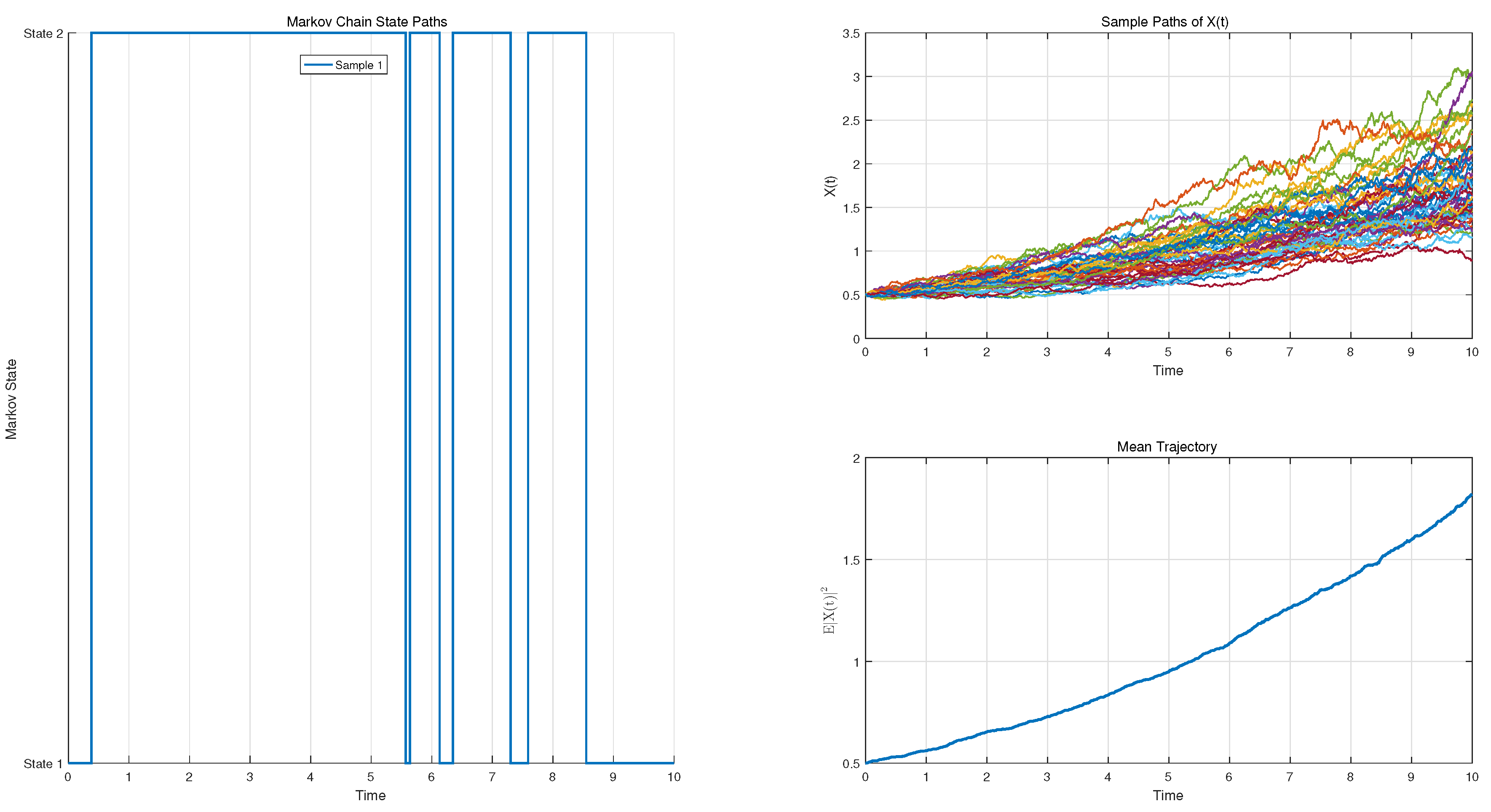
By Itô’s formula (7), we deduce that the solution of (60) is unstable in the mean-square exponential sense. It is difficult to obtain the analytic solutions of MVSDE (60) and the interacting particle system, so we used the solution of the EM method with M = 2 10 as a reference solution. We can see that system (60) is unstable (see the right figure of Figure 1), and we depict 50 sample paths of solution Z ( s ) and the sample mean of | Z ( s ) | 2 of (60) for s [ 0 , 10 ] with 50 sample points and step size τ = 0.01 . The left figure of Figure 1 describes the switching process Λ ( s ) .
We define a discrete-time feedback control function by
u ( Z ^ ( σ s ) , L 1 ( Z ^ ( σ s ) ) , 1 ) = 0.3 Z ^ ( σ s ) 0.09 R z μ ( d z ) , u ( Z ^ ( σ s ) , L 1 ( Z ^ ( σ s ) ) , 2 ) = 0.2 Z ^ ( σ s ) 0.06 R z μ ( d z ) .
Obviously, Assumption 1 holds with K = 0.3 . The corresponding controlled system under (61) is
d Z ^ ( s ) = b ( Z ^ ( s ) , L 1 ( Z ^ ( s ) ) , Λ ( s ) ) + u ( Z ^ ( σ s ) , L 1 ( Z ^ ( σ s ) ) , Λ ( s ) ) d s + ι ( Z ^ ( σ s ) , L 1 ( Z ^ ( σ s ) ) , Λ ( s ) ) d W s .
Thus, the operator L μ V ( x , μ , i ) acting on V ( x , μ , i ) associated with (62) yields
L μ V ( x , μ , 1 ) = 0.2 x 0.06 R z μ ( d z ) 20 x + 10 ( 0.1 x ) 2 + R 0.2 y 0.06 R z μ ( d z ) 20 y μ ( d y ) + 10 R ( 0.1 y ) 2 μ ( d y ) 3.8 | x | 2 4 R | z | 2 μ ( d z ) | R z μ ( d z ) | 2 , L μ V ( x , μ , 2 ) = 0.1 x 0.03 R z μ ( d z ) 20 x + 10 ( 0.1 x ) 2 + R 0.1 y 0.03 R z μ ( d z ) 20 y μ ( d y ) + 10 R ( 0.1 y ) 2 μ ( d y ) 1.9 | x | 2 2 R | z | 2 μ ( d z ) 0.6 | R z μ ( d z ) | 2 ,
and
d 1 | V x ( x , μ , i ) | 2 = 400 d 1 | x | 2 , d 2 R | μ V ( x , μ , i ) | 2 μ ( d x ) 400 d 2 R | x | 2 μ ( d x ) .
The control parameters d 1 and d 2 are selected to satisfy the negative definiteness condition stipulated in Assumption 4. Substituting the Lyapunov function V ( x , μ , i ) = 10 | x | 2 + 10 E [ | Z | 2 ] into the operator inequality
L μ V μ ( d x ) + d 1 | V x | 2 μ ( d x ) + d 2 | μ V | 2 μ ( d x ) γ V μ ( d x ) ,
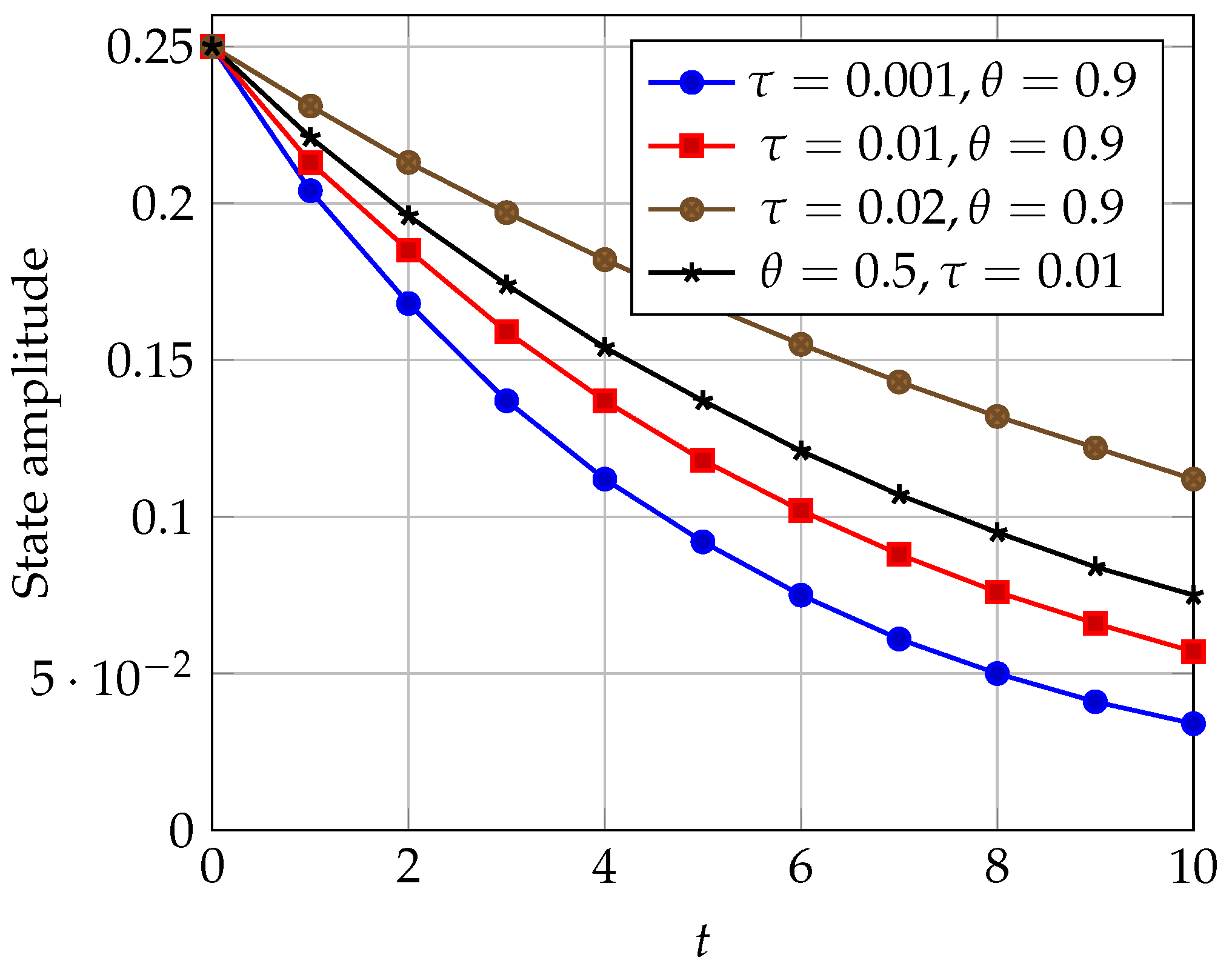
numerical evaluation yields a feasible interval of d 1 , d 2 [ 0.0001 , 0.0005 ] . The midpoint values d 1 = d 2 = 0.00025 are adopted, corresponding to a decay rate of γ = 0.18 . Furthermore, we analyzed the coupling effects between the sampling period τ and the threshold parameter θ (Figure 2). Reducing τ from 0.02 to 0.001 enhances the convergence speed by approximately 40 % , albeit at the cost of a significantly higher control update frequency. Conversely, increasing θ within [ 0.5 , 0.9 ] strengthens the system’s suppression capability against initial distribution disturbances. Balancing performance and computational cost, we selected τ = 0.01 and θ = 0.88 .
As indicated in Table 1, the system maintains mean-square stability provided d 1 , d 2 0.0012 and τ 0.015 . Instability arises when d 1 > 0.0015 due to insufficient control strength, or when τ > 0.02 owing to discrete observation lags inducing oscillations.
Choose d 1 = d 2 = 0.00025 ; thus,
R L μ V ( x , μ , i ) μ ( d x ) + d 1 R | V x ( x , μ , i ) | 2 μ ( d x ) + d 2 R | μ V ( x , μ , i ) | 2 μ ( d x ) 1.8 R V ( x , μ , i ) μ ( d x ) .
Obviously, Assumption 4 holds with γ 1 = 0.18 and γ 2 = 0 . Moreover,
100 R | x | 2 μ ( d x ) R | V ( x , μ , i ) | 2 μ ( d x ) 450 R | x | 2 μ ( d x ) .
Hence, the conditions of Lemma 3 hold. Thus, we assert that the solution of (62) is asymptotically stable in mean square. Furthermore, define U ( x , μ , i ) = | x | 6 + R | z | 6 μ ( d z ) ; then, we have
E L μ U ( Z ^ ( s ) , L 1 ( Z ^ ( s ) ) , Z ^ ( σ s ) , L 1 ( Z ^ ( σ s ) ) , Λ ( s ) ) = E [ L μ U ( Z ^ ( s ) , L 1 ( Z ^ ( s ) ) , Λ ( s ) ) x U ( Z ^ ( s ) , L 1 ( Z ^ ( s ) ) , Λ ( s ) ) × u ( Z ^ ( s ) , L 1 ( Z ^ ( s ) ) , Λ ( s ) ) u ( Z ^ ( σ s ) , L 1 ( Z ^ ( σ s ) ) , Λ ( s ) ) ] R m R m μ U ( Z ^ ( s ) , L 1 ( Z ^ ( s ) ) , Λ ( s ) ) ( Z ^ 1 ( s ) ) ( u ( Z ^ 1 ( s ) , L 1 ( Z ^ ( s ) ) , Λ ( s ) ) u ( Z ˜ 1 ( s ) , L 1 ( Z ^ ( σ s ) ) , Λ ( s ) ) ) F Z ^ ( s ) , Z ^ ( σ s ) ( d Z ^ 1 ( s ) , d Z ˜ 1 ( s ) ) .
We can choose τ = 0.01 and θ 3 0.09 80 1 48 0.09 0.0001 to have
E L μ U ( Z ^ ( s ) , L 1 ( Z ^ ( s ) ) , Z ^ ( σ s ) , L 1 ( Z ^ ( σ s ) ) , Λ ( s ) ) 180 E | Z ^ ( s ) | 6 .
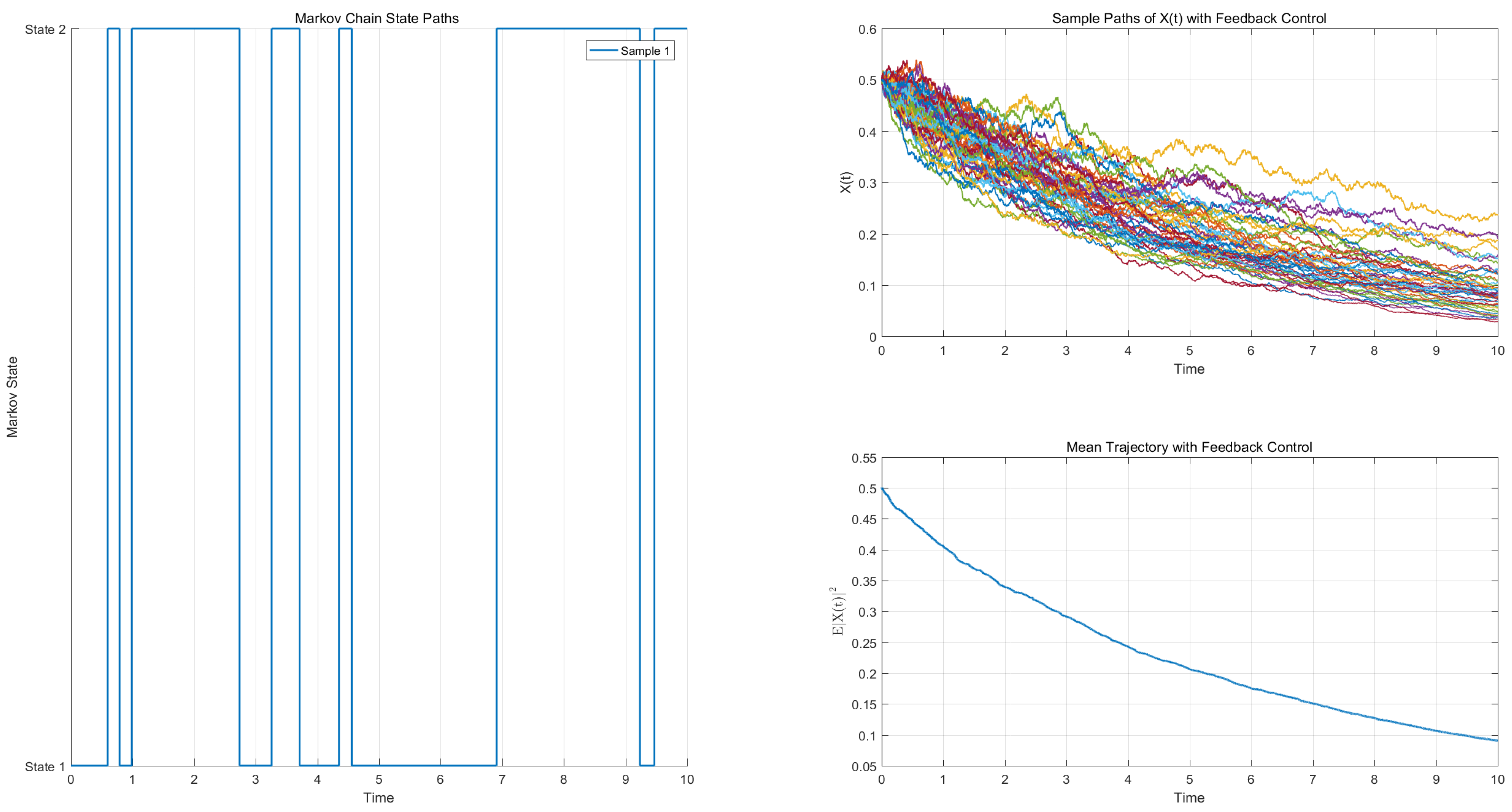
Thus, the conditions of Theorem 4 hold, and furthermore, the corresponding interacting particle system is mean-square exponentially stable. From Figure 3, we can see that system (61) is stable (see right figure of Figure 3) and we depict 50 sample paths of solution Z ( s ) and the sample mean of | Z ( s ) | 2 of (61) for s [ 0 , 10 ] with 50 sample points and step size τ = 0.01 . The left figure of Figure 3 describes the switching process Λ ( s ) .
To quantify the error induced by particle approximation, we employed the Wasserstein distance to measure the discrepancy between the empirical measure μ M and the true distribution μ . Based on [30], there exists a constant C > 0 such that for a sufficiently large number of particles M,
E W 2 ( μ M , μ ) C M .
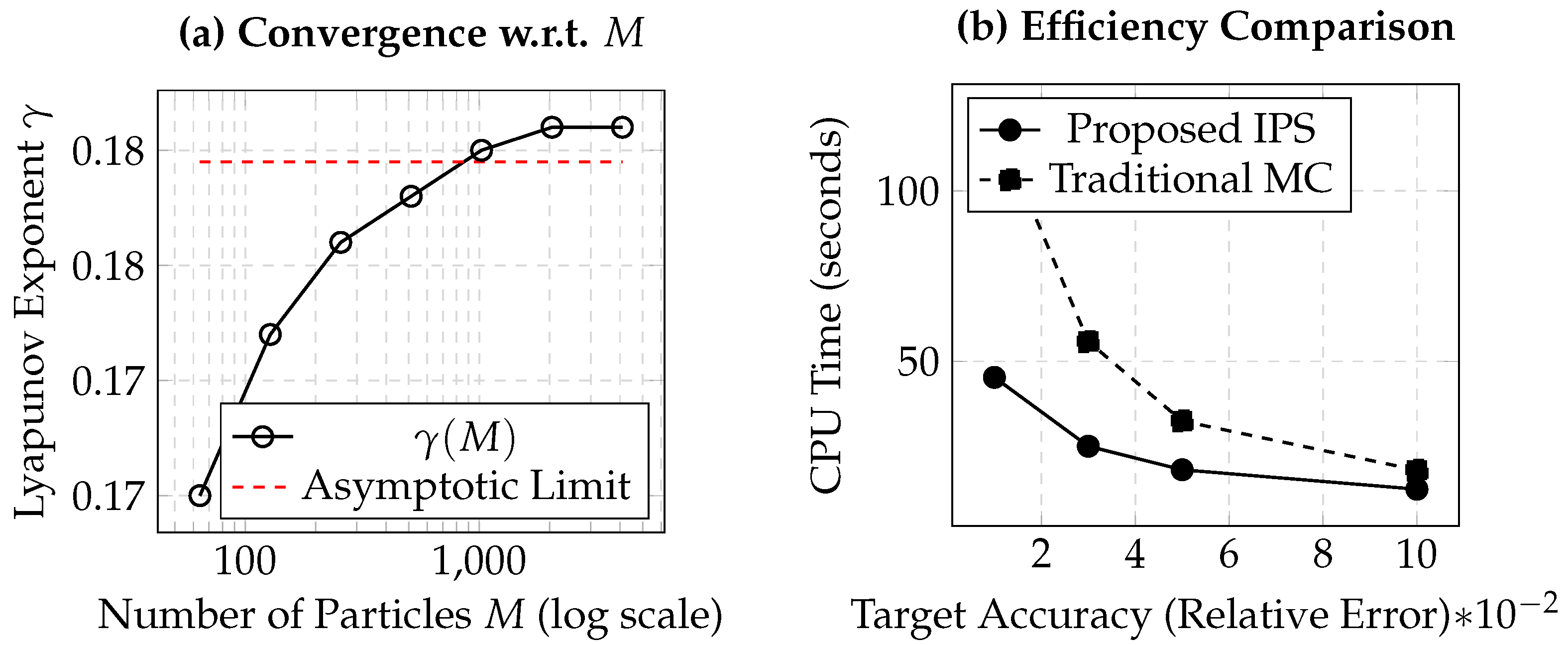
For the system under consideration, numerical validation indicates that when M = 2 10 , the relative error bound is approximately 3.1 % , which is sufficient to guarantee the reliability of the control system design (see Figure 4). As illustrated in Figure 4a, the maximum Lyapunov exponent γ gradually converges as M increases. When M 2 10 , the fluctuation in γ is less than 0.5 % , demonstrating that the particle approximation is sufficiently accurate and that further increasing computational resources does not significantly alter the stability conclusion. Furthermore, Figure 4b compares the computational efficiency of the proposed Interacting Particle System (IPS) method against the traditional Monte Carlo (MC) approach. Under the same accuracy requirement (error in γ < 5 % ), the IPS method requires only approximately 55 % of the CPU time. This efficiency gain stems from the exploitation of inter-particle interactions in IPS, which reduces the demand for sample size, thereby significantly lowering the computational burden while ensuring stability. Table 2 details the impact of the particle number M on the estimation accuracy of the Lyapunov exponent and computational efficiency.
Remark 7.
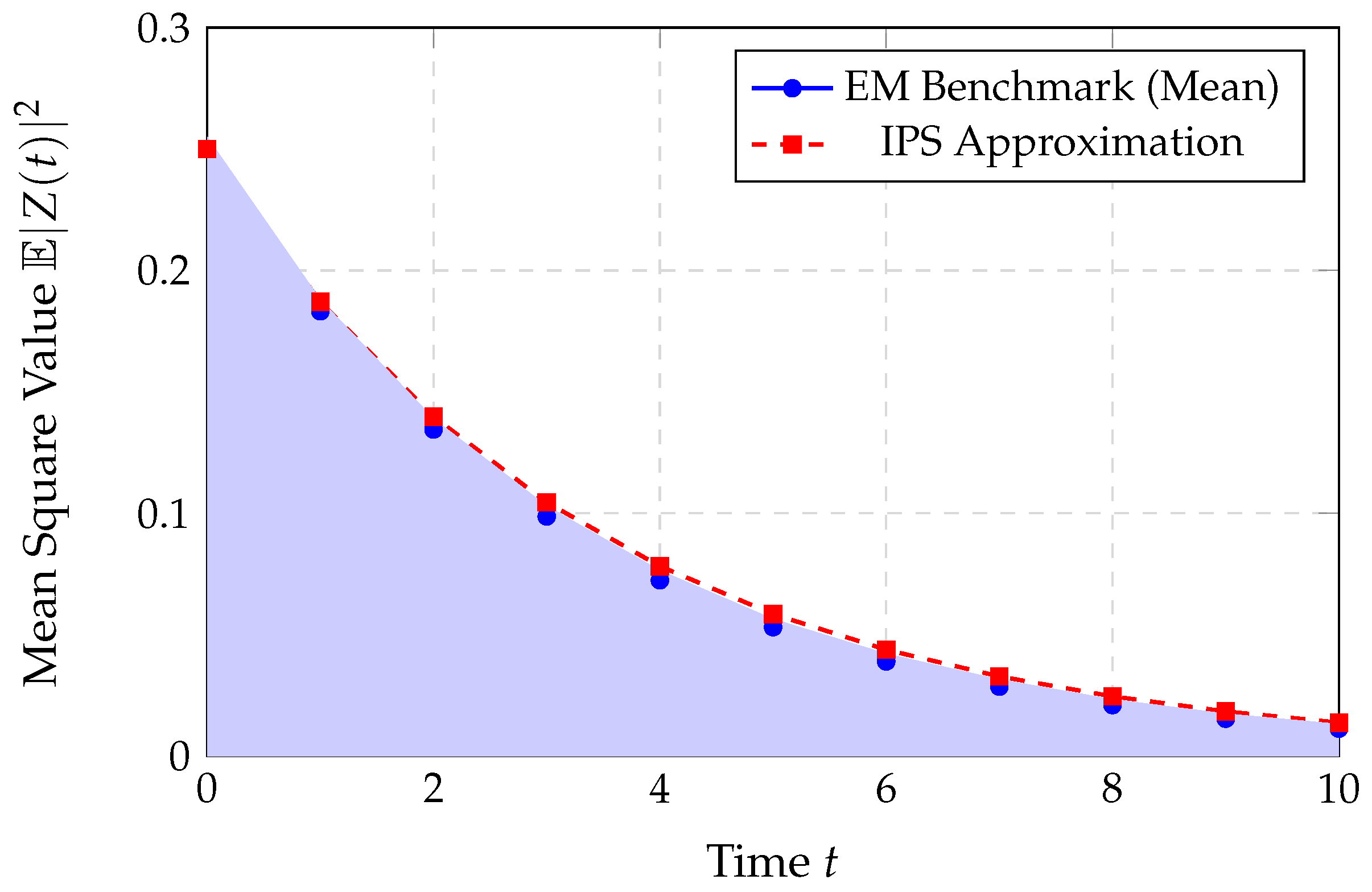
To validate the numerical fidelity of the proposed Interacting Particle System (IPS) approximation, we employed high-precision Monte Carlo simulations based on the Euler–Maruyama (EM) method as the benchmark solution. As illustrated in Figure 5, the blue solid line represents the sample mean from 104 independent trials, while the red dashed line denotes the result obtained via the IPS method. The trajectories overlap significantly, and the 95% confidence interval (blue shaded area) contracts exponentially over time, confirming the closed-loop stability. Quantitative error analysis reveals that the maximum relative error between the IPS results and the EM benchmark remains strictly below 3.5%. These results not only verify the convergence of the hybrid stochastic McKean–Vlasov model under discrete feedback control but also establish the IPS method as a highly reliable numerical proxy that preserves the stability characteristics of the original system.

6. Conclusions

In this paper, we discussed the stabilization of hybrid stochastic McKean–Vlasov differential equations by discrete-time state observation feedback control techniques. We pointed out that existing results on the stabilization of MVSDEs did not consider the impact of the common random factor. On the other hand, many physical systems are subject to frequent unpredictable structural changes, and Markovian jump systems are often used to describe such systems. Hence, there is a need to develop a new theory on stabilization by feedback control for MVSDEs with common noise where the common random factor appears in the form of a switching diffusion. In this paper, we successfully used the method of Lyapunov functionals to study this stabilization problem by discrete-time state observation feedback control. We proved that a type of unstable hybrid stochastic McKean–Vlasov equations (MVSDEs) whose coefficients satisfy some classical assumptions can be stabilized by discrete-time state observation feedback control.
Additionally, the intricate coupling between the individual dynamics and the collective “mean-field” effect implies the behavior of individuals depends on the distribution of the entire system, and the distribution itself changes dynamically over time, which makes it extremely difficult to simulate the distribution in the absence of a fixed reference. For this reason, we introduced mean-field particle systems, established the relationship between the MVSDE with Markovian switching and the corresponding particle system and proved that there was a stability equivalence between them.
Finally, we presented an example to check our theory results.

Author Contributions

P.Z.: writing, reviewing, methodology, supervision, software, validation, formal analysis, project administration and supervision. H.Y.: conceptualization, data analysis, writing—original draft preparation. K.W.: conceptualization, methodology, reviewing, formal analysis, visualization, supervision, software, validation. All authors have read and agreed to the published version of the manuscript.

Funding

This research is supported by Heilongjiang Provincial Natural Science Foundation of China, grant number PL2025A002; the Key Project of Education Science Planning in Heilongjiang Province, grant number GJB1424223, Harbin City Science and Technology Plan Project, grant number 2022ZCZJCG019; and the Heilongjiang Province Key Research and Development Plan Project, grant number JD2023SJ21.

Institutional Review Board Statement

Not applicable.

Informed Consent Statement

Not applicable.

Data Availability Statement

The original contributions presented in this study are included in the article. Further inquiries can be directed to the corresponding author.

Conflicts of Interest

The authors declare no conflicts of interest.

References

  1. Kim, E.; Kang, H.; Park, M. Numerical stability analysis of fuzzy control systems via quadratic programming and linear matrix inequalities. IEEE Trans. Syst. Man Cybern. Syst. 1999, 29, 333–346. [Google Scholar] [CrossRef]
  2. Li, X.; Mehran, K.; Bao, Z.Y. Stability analysis of discrete-time polynomial fuzzy-Mmodel-basedcontrol systems with time delay and positivity constraints through piecewise Taylor series membership functions. IEEE Trans. Syst. Man Cybern. Syst. 2021, 5, 7517–7529. [Google Scholar] [CrossRef]
  3. Guo, Y.G.; Gao, Q.; Lü, J.H.; Feng, G. Stabilization of discrete-time time-varying systems subject to unbounded distributed input delays. IEEE Trans. Syst. Man Cybern. Syst. 2024, 5, 7580–7591. [Google Scholar] [CrossRef]
  4. Gao, H.; Liu, X.; Lam, J. Stability analysis and stabilization for discrete-time fuzzy systems with time-varying delay. IEEE Trans. Syst. Man Cybern. Syst. 2009, 39, 306–317. [Google Scholar] [CrossRef]
  5. Liu, L.; Shen, Y.; Jiang, F. The almost sure asymptotic stability and pth moment asymptotic stability of nonlinear stochastic differential systems with polynomial growth. IEEE Trans. Autom. Control 2011, 56, 1985–1990. [Google Scholar] [CrossRef]
  6. Zhu, Q.X.; Zhang, Q.Y. pth moment exponential stabilisation of hybrid stochastic differential equations by feedback controls based on discrete-time state observations with a time delay. IET Control Theory Appl. 2017, 11, 1992–2003. [Google Scholar] [CrossRef]
  7. Carmona, R.; Delarue, F.; Lacker, D. Mean-field games with common noise. Ann. Probab. 2016, 44, 3740–3803. [Google Scholar] [CrossRef]
  8. Carmona, R.; Delarue, F. Probabilistic Theory of Mean-Field Games with Applications II. Probab Theory Stoch Model; Springer: Berlin/Heidelberg, Germany, 2018; Volume 84. [Google Scholar] [CrossRef]
  9. Hammersley, W.R.P.; Siška, D.; Szpruch, L. Weak existence and uniqueness for McKean-Vlasov SDEs with common noise. Ann. Probab. 2021, 49, 527–555. [Google Scholar] [CrossRef]
  10. Pham, H.; Wei, X.L. Dynamic programming for optimal control of stochastic McKean-Vlasov dynamics. SIAM J. Control Optim. 2017, 55, 1069–1101. [Google Scholar] [CrossRef]
  11. Erny, X.; Löcherbach, E.; Loukianova, D. White-noise driven conditional McKean-Vlasov limits for systems of particles with simultaneous and random jumps. Probab. Theory Relat. Fields 2022, 183, 927–990. [Google Scholar] [CrossRef]
  12. Chen, X.; Li, X.Y.; Yuan, C.G. The delay feedback control for the McKean-Vlasov stochastic differential equations with common noise. Syst. Control Lett. 2025, 196, 105993. [Google Scholar] [CrossRef]
  13. Andreis, L.; Dai Pra, P.; Fischer, M. McKean-Vlasov limit for interacting systems with simultaneous jumps. Stoch. Anal. Appl. 2018, 36, 960–995. [Google Scholar] [CrossRef]
  14. Agram, N.; Φksendal, B.; Proske, F.; Tymoshenko, O. Fokker-Planck equations for conditional McKean-Vlasov systems driven by Brownian sheets. arXiv 2023, arXiv:2412.20572. [Google Scholar] [CrossRef]
  15. Coghi, M.; Flandoli, F. Propagation of chaos for interacting particles subject to environmental noise. Ann. Appl. Probab. 2016, 26, 1407–1442. [Google Scholar] [CrossRef]
  16. Wu, H.; Hu, J.H.; Gao, S.B.; Yuan, C.G. Stabilization of stochastic McKean-Vlasov equations with feedback control based on discrete-time state observation. SIAM J. Control Optim. 2022, 60, 2884–2901. [Google Scholar] [CrossRef]
  17. Ambrosio, L.; Gigli, N.; Savaré, G. Gradient Flows in Metric Spaces and in the Space of Probability Measures, 2nd ed.; Lectures in Mathematics ETH Zürich; MR2401600; Birkhäruser: Basel, Switzerland, 2008. [Google Scholar] [CrossRef]
  18. Cardaliaguet, P. Notes on Mean-Field Games (from P.L. Lion’s Lectures at College de France). 2013. Available online: https://www.ceremade.dauphine.fr/cardalia/MFG100629 (accessed on 15 January 2025).
  19. Yuan, H.Y.; Zhu, Q.X. Stabilities of delay stochastic McKean-Vlasov equations in the G-framework. Sci. China Inf. Sci. 2025, 68, 112203. [Google Scholar] [CrossRef]
  20. Liu, Z.X.; Ma, J. Existence, uniqueness and exponential ergodicity under Lyapunov conditions for McKean-Vlasov SDEs with Markovian switching. J. Differ. Equ. 2022, 337, 138–167. [Google Scholar] [CrossRef]
  21. Ding, X.J.; Qiao, H.J. Stability for stochastic McKean-Vlasov equations with non-lipschitz coefficients. SIAM J. Control Optim. 2021, 59, 887–905. [Google Scholar] [CrossRef]
  22. Mao, X.; Yuan, C. Stochastic Differential Equations with Markovian Switching; Imperial College Press: London, UK, 2006. [Google Scholar]
  23. Wang, Z.C.; Sun, J.; Chen, J. Stability Analysis of Switched Nonlinear Systems with Multiple Time-Varying Delays. IEEE Trans. Syst. Man Cybern. Syst. 2022, 52, 3947–3956. [Google Scholar] [CrossRef]
  24. Zhao, X.Y.; Deng, F.Q. Moment stability of nonlinear stochastic systems with time-delays based on H-representation technique. IEEE Trans. Autom. Control 2014, 59, 814–819. [Google Scholar] [CrossRef]
  25. Fournier, N.; Guillin, A. On the rate of convergence in Wasserstein distance of the empirical measure. Probab. Theory Relat. Fields. 2014, 162, 707–738. [Google Scholar] [CrossRef]
  26. Huang, L.; Deng, F. Razumikhin-type theorems on stability of neutral stochastic functional differential euations. IEEE Trans. Autom. Control 2008, 53, 1718–1723. [Google Scholar] [CrossRef]
  27. Bao, J.; Reisinger, C.; Ren, P.; Stockinger, W. First-order convergence of Milstein schemes for McKean-Vlasov equations and interacting particle systems. Proc. R. Soc. A 2021, 477, 2245. [Google Scholar] [CrossRef]
  28. Ding, X.; Qiao, H. Euler-Maruyama approximations for stochastic McKean-Vlasov equations with non-Lipschitz coefficients. J. Theor. Probab. 2021, 34, 1408–1425. [Google Scholar] [CrossRef]
  29. Neelima, C.K. On explicit Milstein-type scheme for McKean-Vlasov stochastic differential equations with super-linear drift coefficient. Electron. J. Probab. 2021, 26, 1–32. [Google Scholar] [CrossRef]
  30. Borghi, G.; Pareschi, L. Wasserstein convergence rates for stochastic particle approximation of Boltzmann models. SIAM J. Numer. Anal. 2026, 64, 485–509. [Google Scholar] [CrossRef]
Figure 1. The unstable system (60).
Mathematics 14 01941 g001
Figure 2. Variation curves under different parameter combinations.
Mathematics 14 01941 g002
Figure 3. The discrete-time feedback-controlled system with τ = 0.01 .
Mathematics 14 01941 g003
Figure 4. (a) Convergence of the Lyapunov exponent γ as a function of the number of particles M. The exponent stabilizes when M 2 10 , justifying the choice in the simulation. (b) Comparison of computational efficiency. The proposed particle system method significantly outperforms traditional Monte Carlo sampling across all accuracy levels.
Mathematics 14 01941 g004
Figure 5. Comparison between the Euler–Maruyama (EM) benchmark and the Interacting Particle System (IPS) approximation. The blue solid line represents the mean trajectory from 10 4 Monte Carlo runs, while the red dashed line shows the IPS result. The shaded area denotes the 95% confidence interval. The trajectories overlap significantly, with a relative error strictly below 3.5%, confirming the high fidelity of the IPS approximation.
Mathematics 14 01941 g005
Table 1. Parameter ranges and physical meanings.
Para.Low.Upp.CriticalPhysical Meaning
d 1 0.0001 0.0012 > 0.0012 Insufficient to compensate drift
d 2 0.0001 0.0012 > 0.0012 Excess induces overdamping
τ 0 0.015 > 0.015 Long interval causes observation delay
θ 0.167 < 0.167 Too low to suppress noise
Table 2. Effect of particle number M on Lyapunov exponent estimation.
Particle Number MLyapunov Exponent γ Relative Error (%)CPU Time (s)
2 6 (64)0.1658.38.2
2 8 (256)0.1762.215.4
2 10 (1024)0.1800.025.1
2 12 (4096)0.1810.598.7
Disclaimer/Publisher’s Note: The statements, opinions and data contained in all publications are solely those of the individual author(s) and contributor(s) and not of MDPI and/or the editor(s). MDPI and/or the editor(s) disclaim responsibility for any injury to people or property resulting from any ideas, methods, instructions or products referred to in the content.