1. Introduction
The increasing penetration of renewable energy resources, the electrification of end-use sectors, and the transition toward flexible and low-carbon energy infrastructures have significantly increased interest in hybrid energy systems [
1,
2,
3]. By combining multiple primary energy sources within a single configuration, hybrid systems can improve supply security, operational flexibility, resource complementarity, and overall system resilience [
4,
5,
6,
7]. In particular, combinations involving variable renewable sources such as solar and wind are increasingly viewed as necessary components of future energy systems. However, the successful operation of such systems depends not only on the composition of the generation mix, but also on the suitability of the associated storage strategy [
8,
9,
10].
Energy storage plays a pivotal role in hybrid energy systems by mitigating intermittency, balancing temporal mismatches between supply and demand, improving reliability, and supporting decarbonization objectives [
1,
2,
3,
4,
5,
8,
9]. Nevertheless, storage requirements are not identical across all hybrid configurations. A solar–wind hybrid system, for example, may require a markedly different storage profile from a geothermal–hydropower or fossil-supported hybrid configuration. Differences in variability, controllability, environmental burden, operational continuity, and lifecycle characteristics directly affect the type and performance expectations of the storage arrangement associated with a given hybrid system [
6,
7,
11,
12,
13]. For this reason, the evaluation of hybrid alternatives from a storage-oriented perspective constitutes a multidimensional analytical problem rather than a simple technical comparison [
10,
11,
12,
13,
14,
15,
16,
17].
In this context, the assessment of hybrid energy systems cannot be reduced to a single indicator such as efficiency, cost, or emissions alone [
5,
6,
7,
10,
11,
12,
13,
14]. Instead, hybrid alternatives should be evaluated simultaneously with respect to multiple storage-related parameters that reflect technical, economic, environmental, operational, and sustainability dimensions [
11,
12,
13,
15,
16,
17]. Parameters such as energy efficiency, exergy efficiency, entropy, lifetime, cost, CO
2 emissions, recyclability, decarbonization potential, discharge duration, charge duration, power capacity, energy capacity, sustainability, and environmental impact collectively define the storage-oriented performance profile of a hybrid system. Because these criteria may interact, overlap, and occasionally conflict with one another, the resulting evaluation problem is inherently uncertain and structurally complex [
11,
12,
13,
14,
15,
16,
17].
A substantial body of literature has addressed energy system assessment through review-based comparisons and multi-criteria decision-making approaches [
6,
7,
10,
11,
12,
13,
14,
15,
16,
17]. However, most existing studies tend to focus on ranking alternatives or identifying the single most preferable technology under a given criterion structure [
11,
12,
13,
15,
16,
17]. While such approaches are useful for decision support, they may not fully capture the latent similarity structures and gradual transitions that often exist among hybrid energy system alternatives. In practice, different hybrid configurations may share partially overlapping performance profiles, which makes crisp categorization or strict ranking insufficient for representing their true structural relationships [
17,
18].
From this perspective, Fuzzy C-Means clustering offers a suitable mathematical framework for handling uncertainty, overlap, and partial similarity in multidimensional datasets [
18]. Unlike crisp classification methods, Fuzzy C-Means assigns each alternative a degree of membership to multiple clusters, thereby allowing the representation of transitional and hybridized profiles [
18,
19,
20]. This is especially relevant for hybrid energy systems, where alternatives do not always form sharply separated categories in terms of storage-related characteristics. By revealing latent similarity structures and graded memberships, fuzzy clustering can provide a more flexible and interpretable basis for comparative analysis [
18,
19,
20].
Motivated by these considerations, the present study proposes a Fuzzy C-Means-based mathematical framework for the storage-oriented evaluation of hybrid energy systems. The analysis is built on fifteen hybrid configurations formed by pairwise combinations of solar, wind, biomass, geothermal, hydropower, and fossil-based energy sources. These alternatives are evaluated using a set of storage-related parameters reflecting technical, economic, environmental, operational, and sustainability-oriented characteristics. Rather than producing a rigid ranking, the proposed framework aims to classify hybrid alternatives according to their multidimensional similarity patterns and to determine their degrees of association with different clusters.
In this respect, the study contributes to literature in three main ways. First, it shifts the analytical focus from standalone storage technologies to hybrid energy system alternatives evaluated from a storage-oriented perspective. Second, it introduces a fuzzy clustering-based classification framework capable of representing overlap and ambiguity among hybrid configurations. Third, it provides a mathematically transparent structure that may support comparative analysis, preliminary screening, and further integration with ranking or optimization models in future studies.
The remainder of this paper is organized as follows.
Section 2 reviews the relevant literature on energy storage systems, parameter-based evaluation, multi-criteria approaches, and fuzzy clustering in energy-system analysis.
Section 3 presents the materials, criteria set, dataset structure, and mathematical formulation of the proposed Fuzzy C-Means framework.
Section 4 reports and discusses the clustering results for the hybrid energy system alternatives. Finally,
Section 5 summarizes the main findings and outlines directions for future research.
2. Literature Review
2.1. Energy Storage Systems in Hybrid Energy Applications
The literature on energy storage systems (ESSs) has expanded considerably with the increasing penetration of renewable energy resources, the electrification of transportation, and the modernization of smart grids. Recent review studies show that ESS technologies span a broad spectrum, including electrochemical, mechanical, thermal, electrical, and chemical storage solutions, each characterized by different operating principles, performance ranges, maturity levels, and application domains [
1,
2,
3]. Earlier comparative studies also emphasize that storage technologies differ not only by the form in which energy is stored, but also by their suitability for short-term, medium-term, or long-term applications [
4,
5]. These technologies differ substantially in terms of specific energy, specific power, round-trip efficiency, response time, cycle life, degradation behavior, capital cost, environmental burden, geographical constraints, and scalability. As a result, ESS assessment has become inherently multidimensional and strongly application-dependent, making single-indicator comparisons insufficient for rigorous technology evaluation.
Among these technologies, battery energy storage systems (BESSs) have attracted particular attention because of their modularity, fast dynamic response, controllability, relatively high efficiency, and compatibility with distributed generation and hybrid renewable energy systems [
2,
3]. In residential, commercial, and grid-support contexts, BESSs are widely recognized as effective solutions for short- to medium-duration services such as peak shaving, renewable smoothing, voltage support, frequency regulation, backup supply, and self-consumption enhancement. Recent studies on PV-BESS and end-user hybrid installations further indicate that batteries can improve renewable energy utilization by increasing local consumption, reducing grid dependency, and supporting demand-side flexibility [
6,
7]. Nevertheless, prior studies consistently show that no storage technology can be considered universally optimal across all use cases. Technologies such as pumped hydro storage, thermal energy storage, compressed air energy storage, and hydrogen-based storage may outperform BESSs when long-duration storage, bulk energy shifting, seasonal balancing, or sector coupling becomes the primary system requirement [
1,
2,
3,
4,
5,
8].
From the perspective of hybrid energy applications, storage is not merely an add-on component but a structural element that determines overall system flexibility, dispatchability, reliability, and decarbonization performance. Hybrid systems that combine variable renewable resources often require storage configurations capable of compensating for intermittency, smoothing power fluctuations, reducing curtailment, and improving operational continuity. In this context, the storage unit interacts directly with the generation mix, load profile, grid connection conditions, and control strategy. Therefore, the suitability of a storage-oriented hybrid configuration must be evaluated not only in terms of standalone storage characteristics, but also in relation to the behavior of the combined source portfolio.
This system-level perspective is especially important because different storage technologies contribute to hybrid energy systems through different functional roles. High-power technologies, such as supercapacitors and flywheels, are more suitable for rapid power balancing and transient stability support, whereas high-energy technologies, such as pumped hydro, compressed air, hydrogen, and some battery chemistries, are more appropriate for longer-duration energy shifting. Recent work on hybrid energy storage systems also shows that combining complementary storage technologies can extend the operating range of the overall system and improve power smoothing, voltage/frequency support, load leveling, and peak shaving performance [
9]. Therefore, storage-oriented hybrid energy assessment should consider not only individual technology rankings, but also the compatibility between storage characteristics and the temporal, operational, and environmental requirements of the hybrid system. Accordingly, the evaluation of ESSs in hybrid energy applications requires a parameter-based framework that can jointly capture technical performance, economic feasibility, environmental impact, operational flexibility, and application-specific suitability. Such a framework is necessary because two storage technologies may display similar performance in one application but diverge significantly under different load patterns, renewable resource profiles, or dispatch requirements. This reinforces the need for multidimensional evaluation approaches that can compare, classify, and interpret storage-based hybrid energy configurations according to their underlying techno-economic and environmental characteristics.
2.2. Parameter-Based and Multi-Criteria Evaluation of Storage-Oriented Hybrid Systems
A major body of literature addresses this complexity by formulating ESS selection as a multi-criteria decision-making problem. Baumann et al. [
6] demonstrated that MCDA-based ESS studies have become an established research stream, particularly for grid-connected applications, but they also emphasized the substantial methodological fragmentation that persists across the field. Published studies often rely on different criteria sets, weighting procedures, normalization rules, stakeholder assumptions, and aggregation methods, which make their findings difficult to compare, replicate, or transfer across alternative applications [
5]. This observation is especially important for studies seeking to develop transparent and reusable mathematical evaluation frameworks.
Several earlier and recent studies further show that ESS assessment cannot be reduced to a single technical or economic indicator. For example, Ren and Ren [
7] developed a sustainability-oriented ranking framework for energy storage technologies under uncertainty, highlighting the need to integrate economic, technical, environmental, and performance-related criteria. Similarly, Çolak and Kaya [
14] evaluated energy storage technologies under hesitant fuzzy information and showed that fuzzy MCDM models are useful when expert judgments are incomplete, imprecise, or linguistically expressed. Such studies reinforce the view that ESS selection requires structured models capable of handling both quantitative performance data and qualitative expert-based assessments.
More recent work has reinforced this line of research. Qie et al. [
11] proposed an MCDM framework for ESS technology selection based on storage-demand characteristics and showed that the preferred technology changes depending on the underlying storage requirement scenario. Similarly, Zubiria et al. [
12] developed a fuzzy MCDM framework for selecting energy storage technologies for different grid applications and concluded that technology rankings vary significantly across service contexts and expert perspectives. Recent application-specific studies, such as Al-Abri et al. [
13], also confirm that regional conditions, grid requirements, policy priorities, and local resource structures can alter the relative suitability of ESS alternatives. These studies confirm that ESS selection is highly sensitive to use-case definition and uncertainty treatment, and that robust decision models must explicitly account for ambiguity in both criteria values and stakeholder preferences [
11,
12,
13].
At the same time, broader review studies on sustainable hybrid and decentralized energy systems indicate that MCDM approaches have become central to technology assessment because they can jointly incorporate technical feasibility, economic viability, and environmental sustainability [
15]. Reviews on hybrid renewable energy systems integrated with ESS also show that storage evaluation is increasingly connected to system-level optimization, operational flexibility, renewable penetration, emissions reduction, and cost minimization rather than technology choice alone [
16]. However, most of this literature remains oriented toward ranking alternatives rather than classifying them. In other words, the dominant output is usually an ordered list of options, even though many technologies or hybrid configurations may exhibit overlapping parameter profiles and partially similar performance structures under different operational conditions.
This limitation is important because, within the broader MCDM literature, choice, ranking, and sorting/classification are treated as distinct decision problem types [
17]. While ranking methods are useful for identifying the most preferable alternative, they may not fully reveal whether different alternatives belong to similar performance groups or share comparable techno-economic and environmental profiles. In storage-oriented hybrid energy analysis, this issue becomes particularly important because different source combinations may generate similar techno-economic and environmental patterns even when their compositions differ. Accordingly, mathematically structured, parameter-based evaluation frameworks are needed not only to compare alternatives, but also to reveal their underlying similarity structures. Such frameworks can support a more interpretable classification of hybrid energy and storage configurations by identifying groups of alternatives with comparable operational, economic, and sustainability characteristics.
2.3. Fuzzy C-Means in Energy-System Analysis
From a mathematical modeling perspective, Fuzzy C-Means (FCM) clustering offers an important alternative to purely ranking-oriented approaches. The classical work of Bezdek [
18] established FCM as a fuzzy partitioning algorithm that assigns each observation to a degree of membership to multiple clusters and generates fuzzy partitions and cluster prototypes for numerical datasets. Unlike crisp clustering methods, FCM does not force each alternative into a single, sharply bound category. Instead, it allows partial cluster memberships, which makes it particularly suitable for problems in which class boundaries are uncertain, gradual, or overlapping. Such characteristics are highly consistent with hybrid energy datasets, where multiple alternatives may share similar performance characteristics under different subsets of parameters.
Although FCM has not been widely used as a direct framework for comparative hybrid energy system classification, it has been applied in several battery-related and energy-related studies. Guo and Liu [
19] used FCM for lithium-ion battery sorting and reported that the method was feasible and practical in formation and testing processes. Likewise, Wang et al. [
20] employed a fuzzy inference system optimized by the FCM algorithm to estimate the state of function of power lithium-ion batteries and showed that the approach was effective in both simulation and experimental analysis. These studies demonstrate that FCM is not only mathematically rigorous but also practically useful in energy-oriented data processing, especially where gradual similarity structures and parameter interactions need to be represented explicitly.
Beyond these examples, clustering-based studies suggest that soft partitioning can be particularly valuable when the objective is not merely to identify the best alternative, but to reveal hidden similarity patterns, consistency groups, or transitional classes. This is highly relevant for hybrid energy systems, because alternative source combinations often display mixed operational and sustainability-related characteristics that cannot be adequately represented through strict categorical boundaries or one-dimensional rankings alone.
Hybrid energy datasets are often characterized by uncertain and overlapping class boundaries because each alternative is evaluated according to multiple criteria that may interact or conflict with one another. For example, two hybrid configurations may differ in their energy-source composition but still exhibit similar storage-related characteristics in terms of efficiency, lifetime, emissions, operational flexibility, or sustainability. Therefore, assigning each alternative to a single rigid class may oversimplify the actual structure of the dataset. Fuzzy C-Means is suitable for this context because it assigns each alternative a degree of membership to all clusters rather than forcing exclusive classification. This enables the identification of dominant profiles as well as transitional and partially overlapping alternatives. Accordingly, FCM provides a flexible mathematical basis for representing ambiguity, gradual similarity, and heterogeneous storage-oriented profiles in hybrid energy system evaluation.
Although several clustering algorithms are available in the literature, Fuzzy C-Means was selected in this study because it is particularly suitable for datasets characterized by uncertainty, overlapping relationships, and gradual transitions. Classical hard clustering methods such as k-means assign each alternative to only one cluster, which may oversimplify the multidimensional structure of hybrid energy system alternatives. In contrast, hybrid energy systems may share partial similarities across technical, economic, environmental, operational, and storage-related criteria. Hierarchical clustering can reveal similarity structures, but it does not directly provide membership degrees for each alternative. Density-based methods such as DBSCAN are more appropriate for detecting dense regions and outliers in larger spatial datasets, whereas the present study is based on a small and structured normalized decision matrix. Gaussian mixture models provide probabilistic clustering, but they require stronger distributional assumptions. Therefore, FCM was considered more appropriate for the present framework because it assigns each hybrid alternative a degree of membership to multiple clusters, enables the identification of dominant and transitional profiles, and provides an interpretable soft-classification structure for storage-oriented hybrid energy system evaluation.
The main distinction between Fuzzy C-Means (FCM) clustering and traditional crisp clustering approaches lies in how uncertainty and cluster membership are represented. In traditional crisp clustering methods such as K-Means, each alternative is assigned exclusively to a single cluster, and cluster boundaries are treated as strict and deterministic. However, in real-world hybrid energy systems, alternatives often exhibit overlapping technical, economic, environmental, operational, and storage-related characteristics. Therefore, rigid cluster boundaries may not adequately represent the multidimensional structure of such systems.
In contrast, FCM uses a fuzzy membership mechanism in which each alternative can simultaneously belong to multiple clusters with different membership degrees ranging from 0 to 1. This allows the algorithm to model gradual transitions, partial similarities, and ambiguous relationships among hybrid energy system alternatives more effectively.
Compared with traditional crisp clustering approaches, FCM provides several advantages for energy-system analysis. First, it captures uncertainty and partial belongingness among alternatives instead of enforcing strict cluster assignments. Second, it provides a more flexible representation of multidimensional energy-system structures involving overlapping or conflicting criteria. Third, it improves interpretability by showing the relative closeness of each alternative to different cluster profiles. Fourth, its iterative optimization structure updates both membership values and cluster centers until convergence is achieved. Finally, it can be effectively integrated with normalization procedures, cluster validation metrics, and PCA-based visualization techniques commonly used in energy-system evaluation.
Furthermore, compared with other clustering methods, FCM offers additional advantages for the present study. Gaussian Mixture Models generally rely on distributional assumptions, whereas FCM provides a distribution-independent fuzzy partitioning structure. Density-based methods such as DBSCAN are more suitable for spatial density-oriented datasets and may be sensitive to parameter selection. Hierarchical clustering can reveal nested similarity structures, but it does not naturally provide fuzzy membership degrees for alternatives.
Therefore, FCM was considered more appropriate for the proposed storage-oriented hybrid energy system evaluation framework because it enables a flexible, interpretable, and uncertainty-aware clustering structure for complex multi-criteria energy datasets.
2.4. Research Gap and Contribution of the Present Study
Although the literature on energy storage systems and hybrid energy system assessment has grown considerably, three important research gaps can be identified. First, most previous studies evaluate energy storage technologies as standalone alternatives rather than examining hybrid energy system configurations from a storage-oriented perspective. However, in practical applications, storage requirements are strongly influenced by the structure of the hybrid generation mix, including intermittency, controllability, environmental burden, and operational continuity.
Second, a large part of the existing literature relies on multi-criteria decision-making approaches that mainly aim to rank alternatives or identify the most preferable option. While ranking-based methods are useful for decision support, they are less effective in revealing whether different hybrid energy system alternatives share similar technical, environmental, economic, and sustainability-related profiles. In other words, such methods generally provide an ordered preference list, but they do not sufficiently explain the latent similarity structures among alternatives.
Third, hybrid energy system alternatives often have overlapping and transitional characteristics. For example, two systems may differ in their energy-source composition but still show similar storage-oriented behavior in terms of efficiency, lifetime, emissions, discharge duration, or sustainability. Therefore, assigning each alternative to a single rigid category may oversimplify the multidimensional structure of the dataset. This creates a methodological need for a soft classification framework that can represent partial similarity, uncertainty, and overlapping class boundaries.
To address these gaps, the present study proposes a Fuzzy C-Means-based mathematical framework for the storage-oriented evaluation and classification of hybrid energy system alternatives. The proposed approach differs from conventional ranking-oriented models by assigning each hybrid alternative a degree of membership to multiple clusters. This allows the identification of dominant profiles as well as transitional and partially overlapping alternatives.
The main contributions of the study are as follows. First, the study shifts the focus from standalone storage technology selection to the storage-oriented classification of hybrid energy system alternatives. Second, it develops a multidimensional evaluation structure based on technical, thermodynamic, economic, operational, environmental, and sustainability-related criteria. Third, it applies Fuzzy C-Means clustering to reveal latent similarity patterns among hybrid alternatives instead of producing only a strict ranking. Fourth, it interprets the resulting cluster centers and fuzzy memberships to identify storage-oriented profiles that may support comparative assessment, preliminary screening, and future decision-support applications.
3. Materials and Methods
3.1. Study Design and Analytical Framework
The present study is designed as a storage-oriented classification analysis of hybrid energy system alternatives. Rather than focusing on standalone energy storage technologies as isolated decision objects, the proposed framework evaluates hybrid energy configurations in terms of their storage-related performance profiles. The central premise of the study is that different hybrid energy systems exhibit different operational, environmental, and sustainability-related characteristics, and therefore require differentiated storage-oriented assessment.
In this context, the study adopts a fuzzy clustering perspective in order to identify latent similarity patterns among hybrid alternatives. Unlike conventional ranking-based methods, which aim to determine the single best alternative, the proposed framework is intended to reveal how hybrid systems are grouped according to multidimensional similarity and how strongly each alternative is associated with different clusters. This analytical structure is particularly appropriate when class boundaries are not sharply defined and when alternatives display partially overlapping characteristics.
The overall framework of the study consists of four main stages. In the first stage, a set of hybrid energy system alternatives is defined through pairwise combinations of selected primary energy sources. In the second stage, a set of storage-related evaluation parameters is specified in order to represent the technical, economic, environmental, operational, and sustainability-oriented characteristics of these alternatives. In the third stage, the decision matrix is constructed and normalized to ensure comparability among criteria measured in different units and scales. In the final stage, the Fuzzy C-Means (FCM) clustering algorithm is applied to the normalized dataset to identify cluster centers and membership degrees, which are then interpreted in terms of storage-oriented hybrid system profiles.
Accordingly, the proposed model does not seek to produce a rigid ordinal ranking. Instead, it aims to construct a mathematically transparent classification structure for hybrid energy systems based on storage-relevant parameters. In this way, the framework supports exploratory analysis, comparative interpretation, and preliminary decision support under multidimensional uncertainty.
3.2. Hybrid Energy System Alternatives
Within the methodological framework of this study, fifteen hybrid energy system alternatives were defined through pairwise combinations of selected primary energy sources as shown in
Table 1, and coded as A1–A15 for analytical consistency. The source portfolio consists of solar, wind, biomass, geothermal, hydropower, and fossil-based energy. This combination scheme was designed to incorporate both renewable–renewable and renewable–conventional configurations in order to capture a broad spectrum of operational and sustainability-related system characteristics.
These alternatives constitute the decision space of the analysis. Their inclusion provides a balanced representation of hybrid systems with varying levels of intermittency, controllability, emissions intensity, lifetime characteristics, and sustainability performance. From a storage-oriented perspective, this alternative structure is especially useful because different source combinations imply different storage requirements and performance expectations.
The fifteen hybrid energy system alternatives were not selected arbitrarily. They were generated as all possible pairwise combinations of six widely used primary energy source categories: solar, wind, biomass, geothermal, hydropower, and fossil-based energy. Mathematically, six source categories produce fifteen two-source combinations (6¦2) = 15, which provides a complete and systematic alternative set for comparative analysis.
These combinations were considered feasible at a conceptual and system-planning level because similar hybrid configurations have been widely discussed in the literature on renewable energy integration, hybrid renewable energy systems, and energy storage applications. Solar–wind, solar–biomass, wind–biomass, geothermal–hydropower, and hydropower-supported hybrid systems are commonly examined due to their complementary generation characteristics, while fossil-supported combinations are included as transitional or benchmark configurations for comparison with renewable-based systems. Therefore, the selected alternatives should be interpreted as representative storage-oriented hybrid system configurations rather than site-specific engineering designs.
The purpose of this alternative set is not to propose fifteen finalized plant designs, but to provide a structured and feasible decision space for evaluating how different source combinations may differ in terms of storage-related performance, including efficiency, lifetime, emissions, flexibility, power capacity, energy capacity, sustainability, and environmental impact.
3.3. Evaluation Criteria
To evaluate the storage-oriented profiles of the selected hybrid energy system alternatives, fourteen criteria were employed (
Table 2). These criteria were selected to represent the multidimensional nature of hybrid-system assessment from a storage perspective and to jointly reflect technical, thermodynamic, economic, operational, environmental, and sustainability-related considerations.
The criteria set includes energy efficiency, exergy efficiency, entropy, lifetime/lifespan, cost, CO2 emissions, recycling, decarbonization potential, discharge duration, charge duration, power capacity, energy capacity, sustainability, and environmental impact. Together, these indicators capture not only energy and thermodynamic performance, but also cost, lifetime, environmental burden, operational characteristics, and broader sustainability implications.
In the present study, the criteria set was structured to include both benefit-type and cost-type indicators. Energy efficiency, exergy efficiency, lifetime, recycling, decarbonization, discharge duration, power capacity, energy capacity, and sustainability were treated as benefit criteria, whereas entropy, cost, CO2 emissions, charge duration, and environmental impact were treated as cost criteria.
Since the criteria differ in unit, scale, and directional meaning, normalization is required before the clustering stage.
3.4. Construction of the Decision Matrix
Let the set of hybrid energy system alternatives be denoted by , and the set of evaluation criteria be denoted by . The initial decision matrix is then constructed as , where represents the performance value of alternative with respect to criterion .
Thus, each row of the decision matrix corresponds to one hybrid energy system alternative, and each column corresponds to one storage-related evaluation criterion. This matrix forms the mathematical basis of the analysis and allows each hybrid alternative to be represented as a parameter vector in a fourteen-dimensional feature space.
Because the criteria are measured in different units and may have either benefit-type or cost-type characteristics, the raw values cannot be directly compared. Therefore, the initial decision matrix must be transformed into a normalized matrix before applying the clustering algorithm.
The raw criterion values used to construct the decision matrix were derived from literature-based and source-based parameter estimates for the storage-oriented characteristics of the considered hybrid energy system alternatives. In assigning the values, the combined source composition of each hybrid alternative was taken into account with respect to efficiency, thermodynamic behavior, lifetime, cost, emissions, operational characteristics, and sustainability-related performance. Because some hybrid configurations share similar source properties and storage-oriented assumptions, certain alternatives exhibit identical or near-identical criterion values in the initial matrix. Accordingly, similarities in the normalized dataset should be interpreted as a consequence of the assumed structural resemblance among the corresponding hybrid configurations rather than as data duplication.
3.5. Data Normalization
Normalization is required to eliminate dimensional inconsistency among the criteria and to place all criterion values on a comparable scale. In this study, min–max normalization is adopted due to its simplicity, interpretability, and suitability for fuzzy clustering applications.
For benefit-type criteria, the normalized value is calculated as
For cost-type criteria, the normalization is performed as
In this way, all normalized values are transformed into the interval [0, 1], and higher values consistently indicate more favorable performance from the perspective of the analytical framework. After normalization, each hybrid energy alternative is represented by a standardized feature vector that can be processed within the Fuzzy C-Means algorithm.
In the present framework, entropy was treated as a cost-type indicator. Accordingly, the normalization procedure was applied so that lower raw entropy values correspond to higher normalized scores. For this reason, the entropy values reported in the normalized decision matrix and cluster-center tables should be interpreted as normalized entropy-performance scores rather than direct raw entropy magnitudes. Thus, a higher normalized entropy value indicates a comparatively more favorable thermodynamic profile.
3.6. Fuzzy C-Means Clustering Model
The Fuzzy C-Means (FCM) algorithm is employed in this study to classify hybrid energy system alternatives according to their multidimensional storage-related parameter structures. Unlike crisp clustering methods, FCM allows each alternative to belong to more than one cluster simultaneously with different degrees of membership, which makes it suitable for hybrid energy datasets characterized by overlap, gradual transitions, and partial similarity.
Let the normalized dataset be denoted by
, where each
is an
m-dimensional feature vector,
is the number of hybrid alternatives, and
is the number of evaluation criteria. For a given number of clusters
c, the FCM algorithm minimizes the following objective function:
where
denotes the membership degree of alternative
in cluster
,
is the fuzzification coefficient,
is the center of cluster
, and
is the squared Euclidean distance between observation
and cluster center
.
In Equation (3), J(
m_f) denotes the FCM objective function to be minimized, n is the number of hybrid energy system alternatives, c is the number of clusters,
m_f is the fuzzification coefficient,
uik is the membership degree of alternative i in cluster k,
ri is the normalized criterion vector of alternative i, and
vk is the center vector of cluster
k. In the present study,
n = 15, the number of evaluation criteria is 14, and the fuzzification coefficient was set to
m_f = 2. The vector
ri represents the normalized values of the fourteen criteria for each hybrid energy system alternative. The term
denotes the squared Euclidean distance between alternative
i and cluster center
k in the normalized fourteen-dimensional criterion space. Therefore, the objective function values reported in
Table 3 were obtained by applying the FCM algorithm to the normalized decision matrix until convergence was reached for each candidate cluster number.
The membership values satisfy the following constraint:
which ensures that the total degree of cluster membership for each alternative equals unity.
Given an initial membership matrix, the cluster centers are updated as follows:
and the membership degrees are updated by
The FCM procedure employed in this study is iterative rather than static. Although the normalized decision matrix remains fixed during the analysis, the membership matrix and cluster centers are updated repeatedly. Cluster centers are updated according to Equation (5), and membership degrees are recalculated according to Equation (6). This process continues until the maximum change in membership values becomes less than or equal to the predefined convergence threshold (ε = 0.005) or until the maximum number of iterations is reached. Therefore, the final cluster structure is obtained through iterative optimization of the FCM objective function.
The algorithm proceeds iteratively through alternating updates of cluster centers and membership values until convergence is achieved. In the present study, the fuzzification coefficient was set to m = 2, and the stopping criterion was defined by a convergence tolerance of 10−5. The FCM procedure was applied not as a ranking mechanism but as a soft classification tool for identifying latent similarity structures among hybrid energy system alternatives. This makes it possible to reveal dominant profiles, borderline alternatives, and overlapping cluster affiliations in the storage-oriented evaluation space.
3.7. Algorithmic Representation of the Proposed Framework
Algorithm 1 presents the step-by-step algorithmic representation of the proposed FCM-based framework.
| Algorithm 1. Step-by-step algorithmic representation of the proposed FCM-based framework |
Input:
Hybrid energy system alternatives Ai, i = 1, …, n; evaluation criteria Cj, j = 1, …, m; raw decision matrix X = [xij]; number of clusters c; fuzzification coefficient mf; convergence tolerance ε; maximum number of iterations.
Output:
Normalized decision matrix R, cluster centers V, membership matrix U, final cluster labels, and storage-oriented cluster profiles.
Step 1. Define the alternative set
Generate the hybrid energy system alternatives A1–A15 based on pairwise combinations of the selected primary energy sources.
Step 2. Define the evaluation criteria
Specify the storage-related criteria C1–C14, including technical, thermodynamic, economic, operational, environmental, and sustainability-related indicators.
Step 3. Construct the raw decision matrix
Build the initial decision matrix X = [xij], where each row represents a hybrid energy system alternative and each column represents an evaluation criterion.
Step 4. Identify criterion direction
Classify each criterion as either benefit-type or cost-type according to its desired direction of performance.
Step 5. Normalize the decision matrix
Apply min–max normalization to transform all criteria into comparable values within the interval [0ⓜ, 1]. For benefit-type criteria, higher values indicate better performance. For cost-type criteria, the normalization is reversed so that higher normalized values consistently indicate more favorable performance.
Step 6. Initialize the FCM parameters
Select the number of clusters c, set the fuzzification coefficient mf = 2, define the convergence tolerance ε, and initialize the membership matrix U.
Step 7. Update cluster centers
Calculate the cluster centers using the current membership degrees and normalized decision matrix.
Step 8. Update membership degrees
Recalculate the membership degree of each alternative for each cluster based on its distance from the updated cluster centers.
Step 9. Check convergence
Compare the updated membership matrix with the previous membership matrix. If the change is smaller than ε, stop the iteration. Otherwise, return to Step 7.
Step 10. Evaluate alternative cluster structures
Repeat the FCM procedure for different cluster numbers and compare the candidate solutions using the objective function, partition coefficient, partition entropy, and interpretability of cluster centers.
Step 11. Select the final cluster structure
Select the most meaningful cluster number by jointly considering mathematical validity indicators and the conceptual clarity of storage-oriented profiles.
Step 12. Interpret the results
Analyze the final cluster centers and fuzzy membership degrees to identify dominant, transitional, and overlapping storage-oriented hybrid energy system profiles. |
3.8. Methodological Determination of the Cluster Structure
To support the selection of an analytically meaningful partition, alternative cluster structures were compared using standard fuzzy clustering validity measures. In addition to the behavior of the objective function, the candidate solutions were evaluated in terms of the partition coefficient and partition entropy in order to assess cluster compactness, separation, and interpretability.
Table 3 summarizes the validity results obtained for different values of c. These measures were considered together with the conceptual clarity of the resulting cluster-center profiles in selecting the final clustering structure.
A critical issue in fuzzy clustering is the selection of an appropriate number of clusters. In this study, alternative clustering structures were examined in order to identify the most meaningful and analytically useful partition of the hybrid energy system alternatives. The objective was not only to reduce the value of the clustering objective function, but also to preserve interpretability and avoid unnecessary fragmentation of the decision space.
To evaluate the quality of alternative cluster structures, the objective function, Partition Coefficient, and Partition Entropy were used. The objective function measures the weighted within-cluster dispersion and is minimized during the FCM optimization process. Lower objective function values generally indicate a better numerical fit; however, this measure should not be used alone because increasing the number of clusters may artificially reduce the objective function.
The Partition Coefficient (PC) measures the degree of crispness of the fuzzy partition and is calculated as:
where
uik is the membership degree of alternative
i in cluster
k. Higher
PC values indicate stronger and clearer membership assignments.
The Partition Entropy (PE) measures the fuzziness or uncertainty of the partition and is calculated as:
Lower PE values indicate a less ambiguous and more clearly separated cluster structure. In this study, the final cluster number was not selected based on a single numerical indicator. Instead, the objective function, PC, PE, and the interpretability of the resulting cluster-center profiles were considered together.
To determine the final cluster structure, several candidate values of c were tested and comparatively evaluated in terms of partition quality and conceptual clarity. In addition to the behavior of the objective function, the resulting partitions were assessed with reference to standard fuzzy clustering quality measures, including the partition coefficient and partition entropy, together with the interpretability of the corresponding cluster-center profiles. A small number of clusters may oversimplify the structure of the dataset and mask relevant differences among hybrid alternatives, whereas an excessively large number of clusters may produce weakly separated and analytically redundant subgroups.
Based on this combined evaluation, the three-cluster structure was selected as the most appropriate configuration. The two-cluster solution produced an overly broad separation that obscured important storage-oriented distinctions among the hybrid alternatives. By contrast, cluster numbers above three resulted in a more fragmented structure without providing a corresponding gain in interpretive value. The three-cluster solution offered the most balanced representation of the dataset by distinguishing among major storage-oriented profiles while preserving analytical transparency.
Accordingly, the final analysis was conducted using three fuzzy clusters. This structure made it possible to identify stable, transitional, and variability-sensitive hybrid system profiles in a way that remained mathematically coherent and practically interpretable.
3.9. Interpretation of Fuzzy Memberships
After convergence, the FCM model produces two main outputs: cluster centers and fuzzy membership degrees. The cluster centers represent the characteristic parameter profiles of the identified groups, while the membership degrees indicate how strongly each hybrid energy system alternative is associated with each cluster.
This dual output is particularly valuable in the present context. Since hybrid energy systems may display transitional or overlapping storage-oriented profiles, crisp classification may oversimplify their structural relationships. By contrast, fuzzy memberships allow the identification of dominant clusters, borderline alternatives, and partially overlapping system behaviors. In this way, the clustering results provide a richer interpretive basis for comparing hybrid alternatives than would be possible with strict categorical assignment alone.
3.10. Workflow of the Proposed Framework
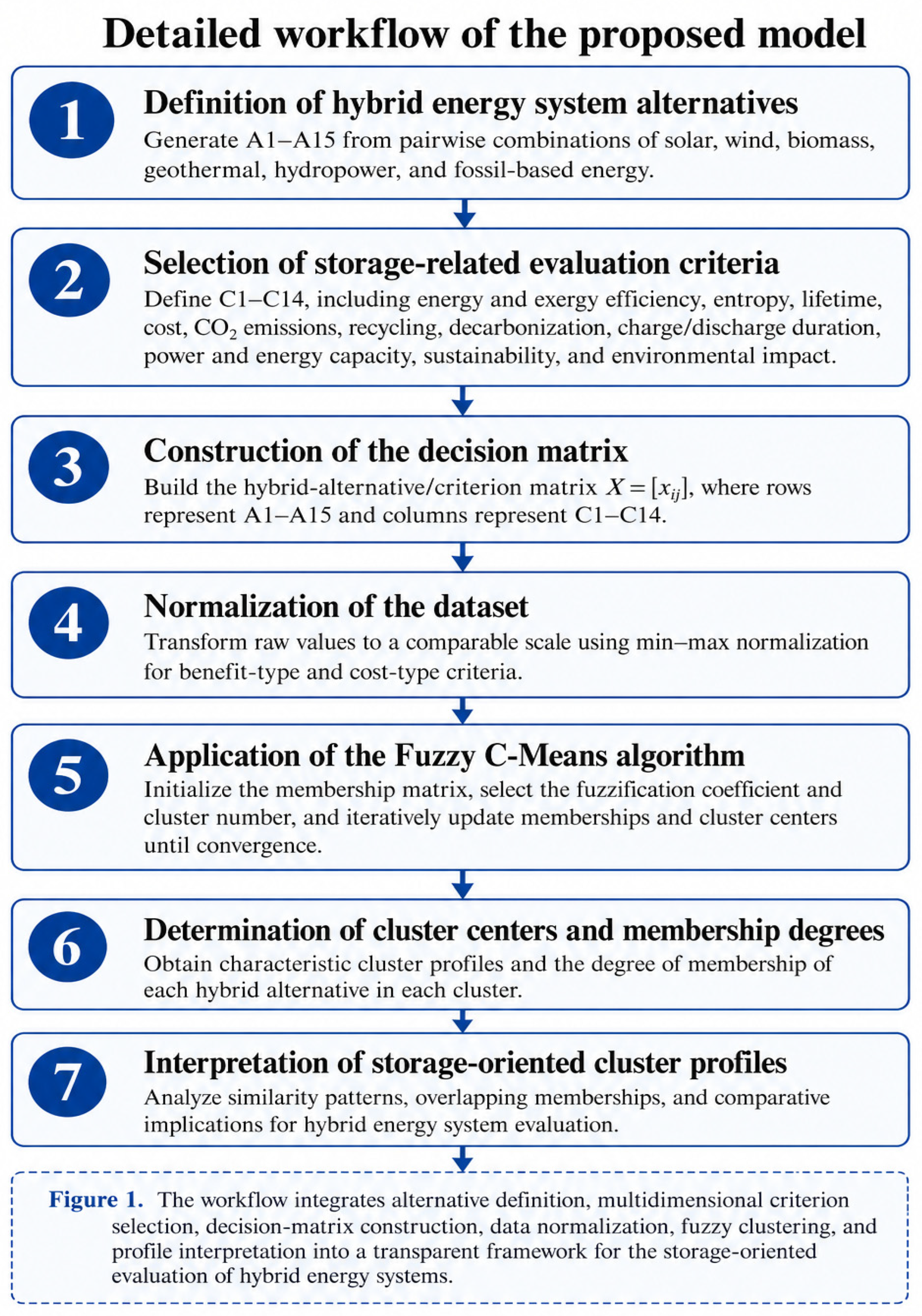
To clarify the methodological sequence of the study, the overall workflow of the proposed model is presented in
Figure 1.
The workflow includes the definition of hybrid energy system alternatives, the selection of storage-related evaluation criteria, the construction and normalization of the decision matrix, the application of the Fuzzy C-Means algorithm, the determination of cluster centers and membership degrees, and the interpretation of storage-oriented cluster profiles.
As shown in
Figure 1, the proposed methodological framework consists of a sequential and integrated workflow for the storage-oriented evaluation of hybrid energy system alternatives. First, the alternative set is established by defining fifteen pairwise hybrid combinations based on the selected primary energy sources. Second, a multidimensional evaluation structure is formed through the specification of storage-related criteria covering technical, thermodynamic, economic, environmental, operational, and sustainability-related aspects. Third, the corresponding decision matrix is constructed and normalized in order to transform heterogeneous data into a comparable analytical form. Subsequently, the normalized matrix is analyzed using the Fuzzy C-Means algorithm, which enables the computation of cluster centers and fuzzy membership degrees for each alternative. In the final stage, these outputs are interpreted to reveal latent similarity structures and overlapping cluster affiliations among the hybrid systems. Accordingly, the workflow integrates data preparation, fuzzy clustering, and result interpretation into a coherent analytical framework for the classification of hybrid energy systems from a storage-oriented perspective.
4. Results
This section presents the results of the proposed Fuzzy C-Means based framework for the storage-oriented evaluation and classification of hybrid energy system alternatives. The analysis was conducted on fifteen hybrid configurations coded as A1–A15 and evaluated with respect to fourteen criteria covering technical, thermodynamic, economic, operational, environmental, and sustainability-related dimensions. The data used in the calculations are provided in
Appendix A. After normalization of the decision matrix, the FCM algorithm was applied to identify latent similarity structures among the alternatives. The findings are discussed in terms of dataset characteristics, cluster structure, storage-oriented profile interpretation, fuzzy memberships, and their implications for hybrid-system evaluation.
4.1. Descriptive Statistics and Comparative Overview of the Normalized Dataset
The normalized decision matrix shows that the considered hybrid alternatives do not exhibit uniformly dominant profiles. Instead, each configuration combines strengths in some criteria with limitations in others, which confirms the multidimensional and application-dependent nature of storage-oriented assessment. In general, hydropower-supported combinations such as A4, A8, A11, A13, and, to a lesser extent, A15 display comparatively stronger profiles in long-lifetime, operational stability, and infrastructure-oriented criteria. By contrast, variable renewable combinations such as A1 and A6, together with fossil-supported combinations such as A5 and A9, tend to exhibit more uneven parameter structures, combining favorable energy-related behavior with weaker environmental or long-term sustainability characteristics. Mixed systems involving biomass and geothermal sources, such as A2, A3, A7, A10, A12, and A14, occupy intermediate positions and therefore appear more transitional in nature.
Table 4 reports the normalized decision matrix used in the FCM analysis.
This overall pattern justifies the use of fuzzy clustering. The alternatives do not form sharply separated groups, and several configurations appear to share partially overlapping storage-related characteristics. Accordingly, a soft classification approach is more suitable than a crisp categorical assignment.
Descriptive statistics were calculated for the normalized decision matrix in order to provide a clearer statistical overview of the dataset before fuzzy clustering (
Table 5). Since all criteria were normalized into the interval [0, 1], the mean values indicate the average relative performance of the hybrid alternatives for each criterion, while the standard deviations reflect the degree of dispersion among alternatives. The results show that discharge time and charge time have the highest mean values, whereas energy capacity and power capacity display lower average normalized scores. Relatively high standard deviations for power capacity, CO
2 emissions, recycling, lifetime, and decarbonization indicate that these criteria contribute substantially to the differentiation of hybrid energy system alternatives. Therefore, the statistical distribution of the normalized criteria supports the use of a clustering-based approach, as the alternatives exhibit heterogeneous and non-uniform performance patterns across the evaluation space.
4.2. Determination of the Cluster Structure
To determine the most meaningful cluster configuration, alternative cluster numbers were tested and compared in terms of interpretability and partition quality. The three-cluster structure was found to provide the most balanced solution. A two-cluster solution produced an overly coarse separation that masked relevant differences among hybrid configurations, whereas higher numbers of clusters led to unnecessary fragmentation and reduced interpretability. The three-cluster solution, by contrast, captured the major storage-oriented patterns among the alternatives while preserving analytical clarity. The resulting cluster-coordinate matrix is summarized in
Table 6.
From an application perspective, this result is also meaningful. The selected three-cluster structure makes it possible to distinguish between balanced transitional systems, infrastructure-oriented stable systems, and variability-sensitive or fossil-supported systems without generating excessively narrow categories.
4.3. Cluster-Center Profiles and Storage-Oriented Interpretation
The resulting cluster centers indicate that the hybrid energy alternatives can be interpreted through three distinct storage-oriented profiles. Rather than representing fixed technology labels, these clusters should be understood as characteristic parameter structures derived from the normalized dataset. For interpretive clarity, the parameter-based cluster-center profiles are presented in
Table 7.
Cluster 1 may be interpreted as a balanced transitional profile. Alternatives associated with this cluster exhibit relatively moderate values across efficiency, lifetime, cost-related, and sustainability-oriented criteria. They do not dominate the dataset in a single dimension, but instead reflect hybrid systems with intermediate and comparatively balanced performance. This pattern is particularly consistent with several biomass- and geothermal-containing configurations, which occupy a middle position between high-stability and high-variability profiles.
Cluster 2 represents a stability-oriented and infrastructure-compatible profile. It is characterized by stronger values in lifetime, operational continuity, recyclability, decarbonization-related performance, and other criteria associated with long-term system robustness. This profile is strongly aligned with hydropower-supported hybrid systems, which tend to benefit from greater controllability and durability and therefore form the most stable storage-oriented group within the dataset.
Cluster 3 may be interpreted as a variability-sensitive profile. This cluster is associated with alternatives that combine favorable energy-related behavior with weaker long-term sustainability, recyclability, or environmental characteristics. It includes both highly variable renewable combinations and fossil-supported systems, indicating that variability and carbon dependence can produce similar storage-related pressures in the multidimensional evaluation space. In this sense, the cluster reflects alternatives for which storage planning is likely to be more challenging and context dependent.
4.4. Fuzzy Membership Structure of Hybrid Energy Alternatives
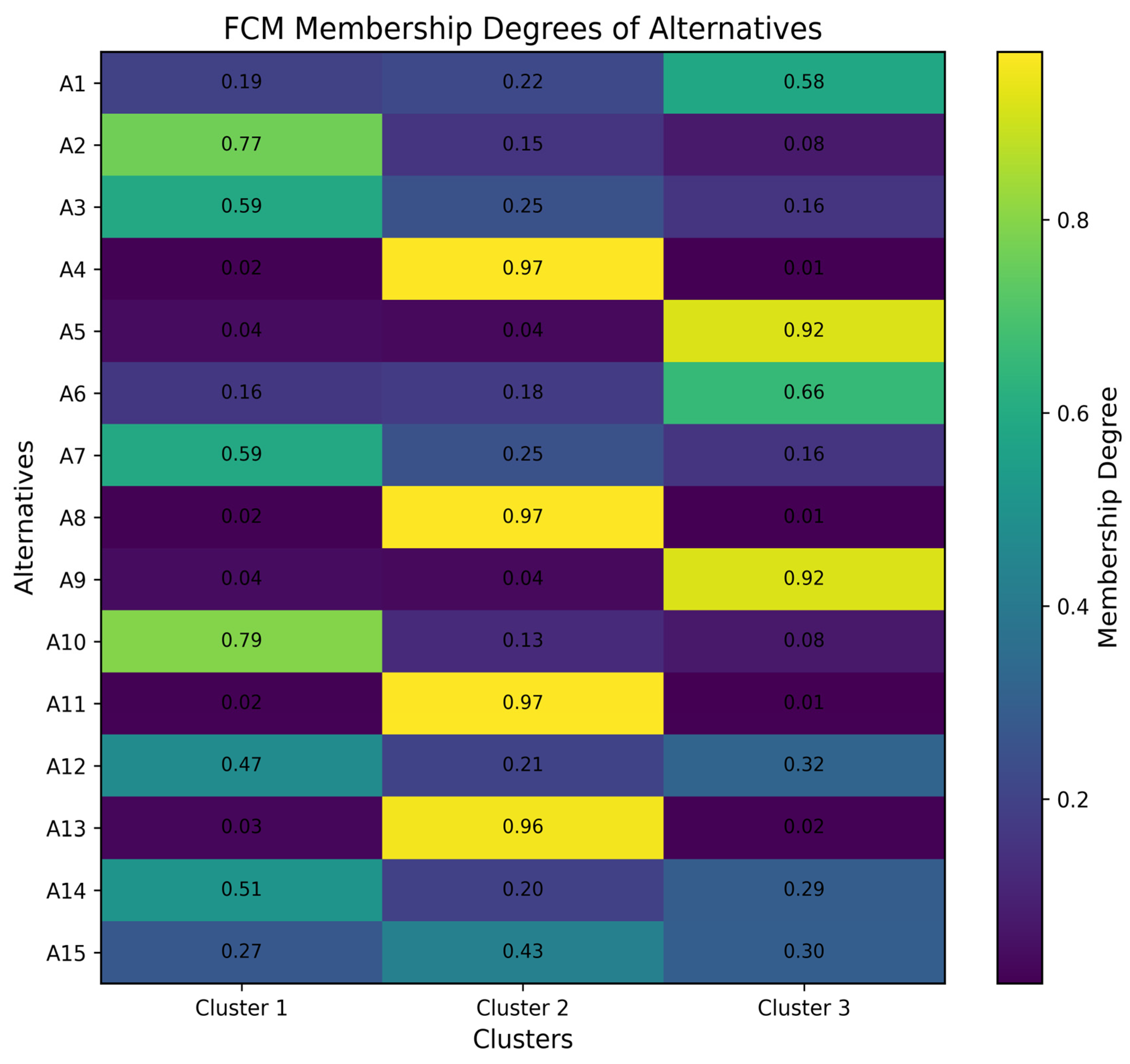
The membership results provide an important insight into how the considered hybrid systems are positioned relative to the identified storage-oriented profiles. Several alternatives display strong membership in a single cluster, while others exhibit mixed memberships that indicate transitional or overlapping characteristics. The fuzzy membership degrees of all alternatives are reported in
Table 8.
Among the alternatives, A4, A8, A11, and A13 are strongly associated with Cluster 2, which confirms that hydropower-supported hybrid configurations form the most stable and infrastructure-oriented group in the dataset. A15 also shows its strongest membership in Cluster 2, although its membership distribution is more mixed, suggesting that the fossil component partially weakens the stabilizing effect associated with hydropower.
A2, A3, A7, and A10 display dominant memberships in Cluster 1, indicating that these biomass- and geothermal-related systems are best interpreted as balanced transitional alternatives. A12 and A14 also remain closest to Cluster 1, but their weaker dominant memberships suggest that the inclusion of fossil energy increases structural ambiguity and shifts these systems toward more mixed storage-oriented behavior.
A1, A5, A6, and A9 are most strongly associated with Cluster 3. This result is particularly revealing because it shows that not only fossil-supported configurations, but also some highly variable renewable combinations, may occupy a similar storage-related profile when evaluated through multidimensional criteria. In other words, strong dependence on intermittent generation and dependence on fossil support may both generate storage-oriented structures characterized by lower overall balance and weaker sustainability alignment.
Overall, the fuzzy memberships confirm that hybrid energy systems should not be interpreted through rigid categorical boundaries. Some alternatives form relatively distinct groups, whereas others occupy intermediate positions between clusters. This is one of the principal advantages of the FCM-based framework, since it reveals graded relationships that would be hidden in a purely ranking-based or crisp classification approach.
Figure 2 provide complementary visualizations of the fuzzy cluster structure and the PCA-based projection of the hybrid alternatives.
In addition to the individual membership values, a cluster-level comparison was performed based on the dominant membership assignments (
Table 9). Cluster 1 includes six alternatives, Cluster 2 includes five alternatives, and Cluster 3 includes four alternatives. The average dominant membership degree is highest for Cluster 2, indicating that the stability-oriented and infrastructure-compatible profile is the most clearly separated group in the dataset. By contrast, Cluster 1 has a lower average dominant membership, suggesting a more transitional and internally heterogeneous structure. Cluster 3 shows strong memberships for fossil-supported and variability-sensitive alternatives but also includes renewable configurations with relatively high storage-related variability. This comparative analysis confirms that the three-cluster solution does not merely divide the alternatives into arbitrary groups but reflects statistically and conceptually distinguishable storage-oriented profiles.
The figure illustrates the relative positioning of the hybrid energy system alternatives (A1–A15) with respect to the three fuzzy clusters (C1, C2, and C3). Alternatives located closer to the center of a cluster indicate stronger association with that cluster, whereas alternatives positioned in the overlap regions reflect partial similarity and transitional membership across multiple clusters.
As shown in
Figure 2, the Venn-style Fuzzy C-Means visualization indicates that the hybrid energy system alternatives do not form sharply separated groups but instead exhibit both compact cluster structures and transitional positions. In particular, A8, A11, and A13 are located very close to the center of C2, suggesting that these alternatives constitute a relatively compact and internally similar cluster in terms of storage-oriented parameter profiles. By contrast, A9 appears as one of the most representative alternatives of C3, while A1 and A6 are positioned closer to the overlap region between C3 and the central transition area, indicating partial similarity rather than exclusive cluster association. On the C1 side, A10 and A12 are positioned closer to the cluster core, whereas A2, A3, A4, and A7 appear in more transitional locations, reflecting a less sharply bounded structure. In addition, A15 is located near the intersection of multiple clusters, especially between C2 and C3, which suggests that it has a borderline profile and shares characteristics with more than one storage-oriented cluster. Overall, the figure confirms that several hybrid energy system alternatives occupy intermediate positions rather than belonging exclusively to a single group, thereby supporting the use of Fuzzy C-Means as an appropriate method for capturing overlap, ambiguity, and multidimensional similarity in hybrid system evaluation.
4.5. Validation of the Cluster Structure
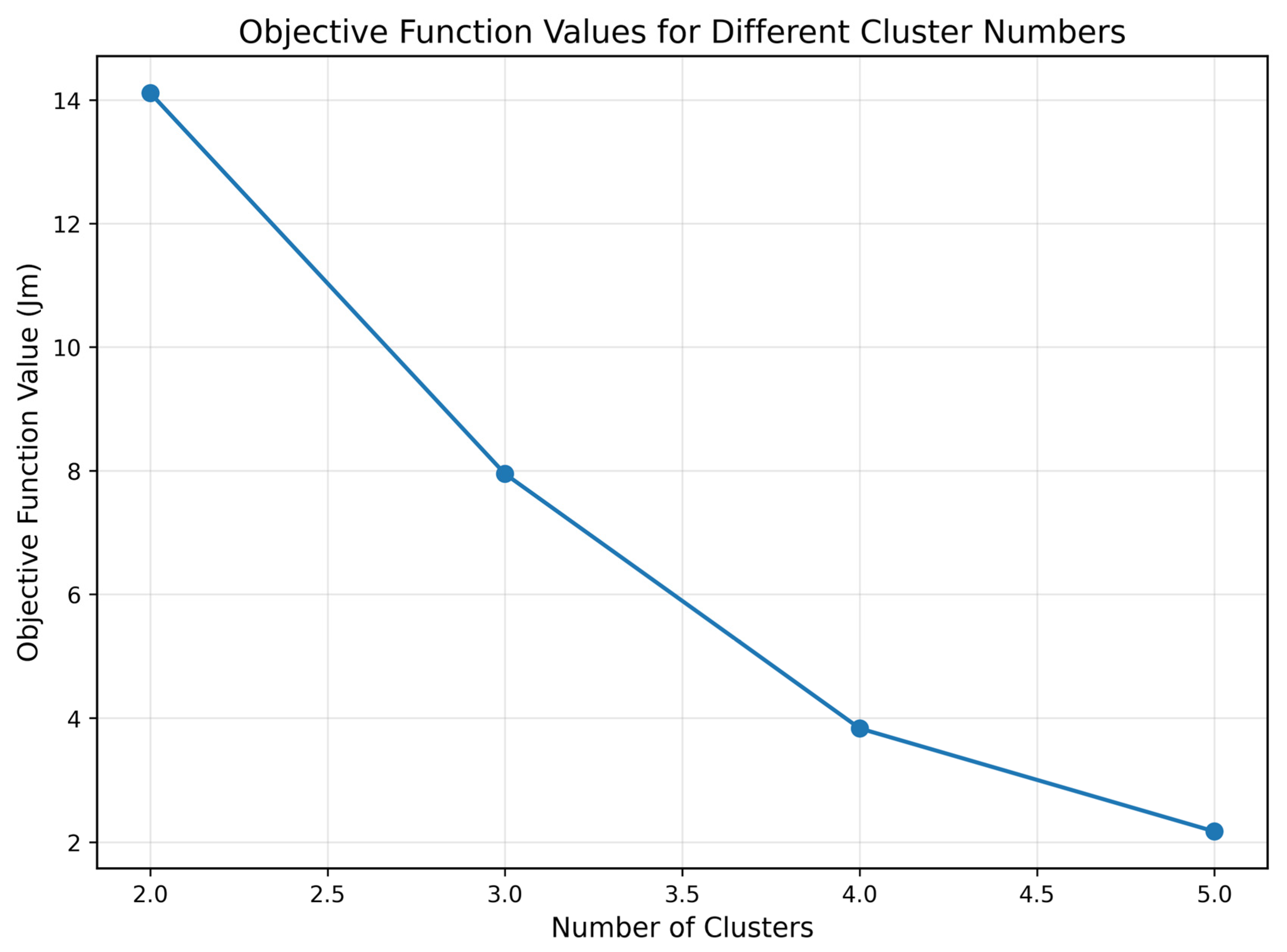
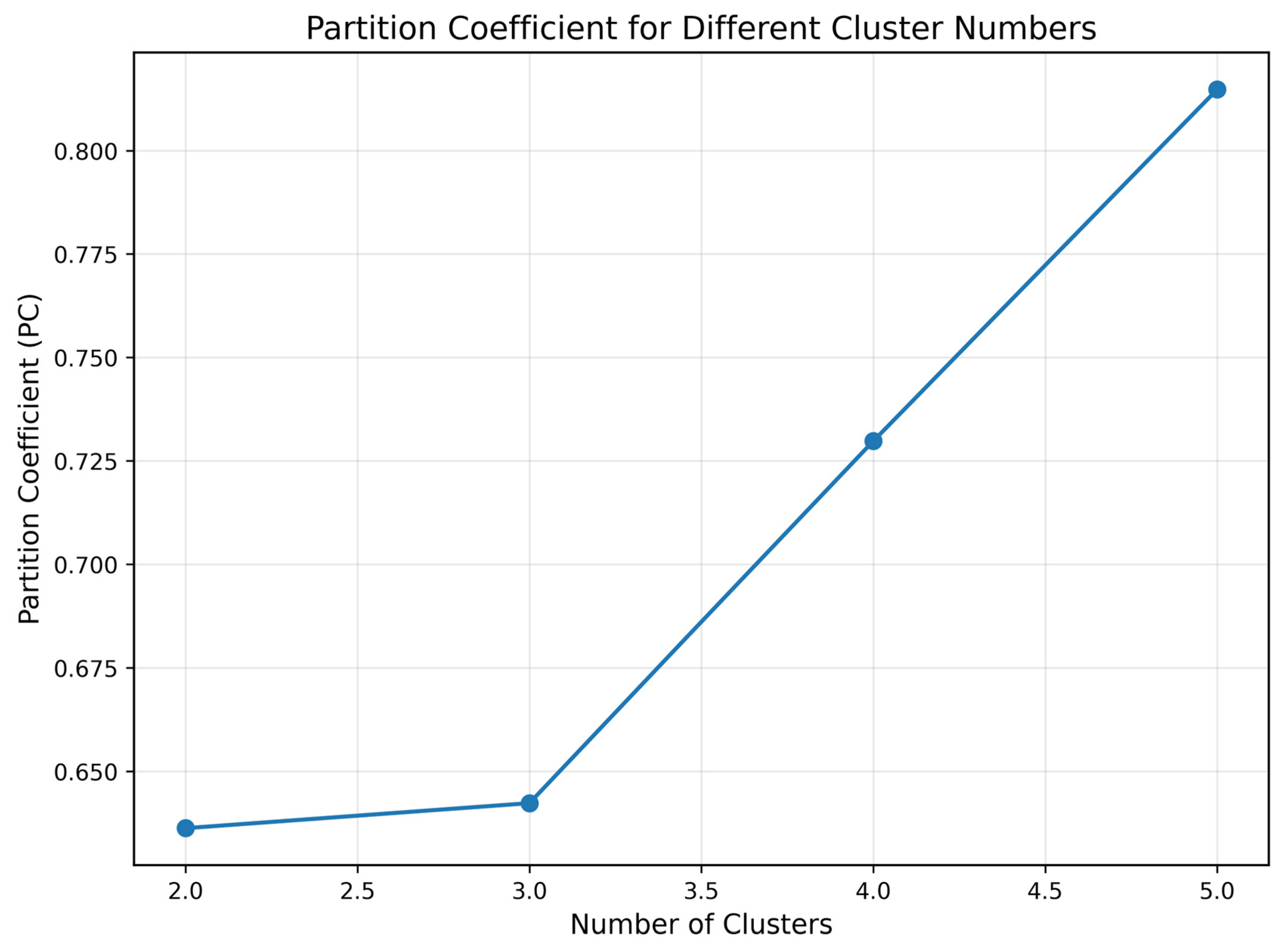
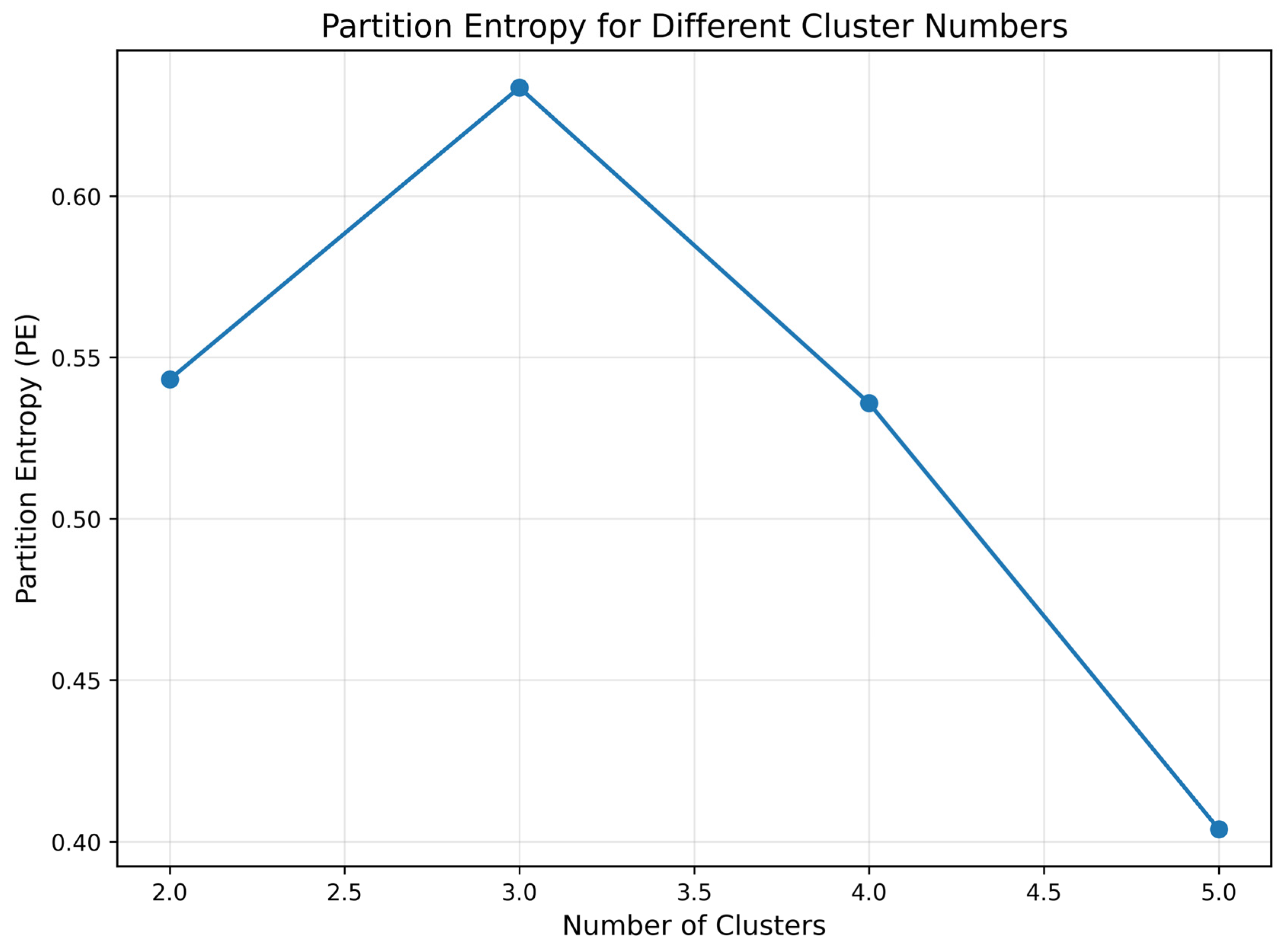
To provide a clearer visual interpretation of the cluster validity results presented in
Table 3,
Figure 3,
Figure 4 and
Figure 5 illustrate the variation in the objective function, partition coefficient, and partition entropy with respect to the number of clusters.
Figure 3 shows that the objective function
decreases monotonically as the number of clusters increases, from
at
to
at
. This behavior is expected in fuzzy clustering, since a larger number of clusters generally allows a better local fit to the dataset and reduces within-cluster dispersion. A substantial drop is observed between
and
, indicating that the three-cluster solution captures a much richer structure than the overly coarse two-cluster partition. However, the continued decline for
and
also suggests that the objective function alone cannot determine the optimal partition, because lower values may be obtained at the expense of interpretability and analytical parsimony.
As illustrated in
Figure 4, the partition coefficient increases gradually as the number of clusters rises, from 0.63635 at
to 0.81481 at
. Since higher partition coefficient values indicate sharper membership assignment and reduced overlap among clusters, this trend suggests that the partition becomes progressively crisper as additional clusters are introduced. Nevertheless, this numerical improvement should be interpreted with caution. Although the highest value is observed at
, a sharper partition does not necessarily imply a more meaningful one, because excessive subdivision may reduce the conceptual clarity of the resulting cluster structure. Therefore, the partition coefficient supports the comparison of candidate solutions but should not be used as the sole basis for cluster-number selection.
Figure 5 presents the behavior of partition entropy for alternative values of
. The entropy value increases from 0.54322 at
to
at
, and then decreases to
at
and
at
. In general, lower partition entropy indicates lower uncertainty in fuzzy memberships and thus a crisper partition. From a purely numerical perspective, the five-cluster solution yields the lowest entropy value. However, this result should be interpreted together with the other validity measures and, more importantly, with the interpretability of the resulting profiles. In the present case, the lower entropy at higher cluster numbers is associated with a more fragmented structure, which weakens the analytical usefulness of the partition for storage-oriented hybrid system evaluation.
4.6. Benchmark Comparison with K-Means Clustering
To further demonstrate the comparative performance and interpretive value of the proposed Fuzzy C-Means (FCM)-based framework, a benchmark comparison was conducted using the traditional K-Means clustering method. K-Means was selected as a crisp clustering baseline because it assigns each alternative exclusively to a single cluster, whereas FCM allows each alternative to belong to multiple clusters with different membership degrees. To ensure a consistent comparison, both methods were applied to the same normalized decision matrix using the same number of clusters (cⓜ = 3).
Since Silhouette Score, Davies–Bouldin Index, and Calinski–Harabasz Index are commonly used compactness- and separation-oriented validation metrics, they were employed to compare the general clustering performance of the two methods. For the FCM results, the dominant cluster assignment of each alternative was considered based on the highest membership degree.
As shown in
Table 10, K-Means produced slightly higher compactness-oriented performance values, with a higher Silhouette Score and Calinski–Harabasz Index, as well as a lower Davies–Bouldin Index. This result indicates that K-Means provides a somewhat more compact and clearly separated crisp partition according to these conventional validation metrics. However, this outcome should be interpreted carefully because these metrics are primarily designed to evaluate hard clustering structures.
Although K-Means performs well in terms of compactness and separation, it assigns each hybrid energy system alternative to only one cluster. Therefore, it cannot represent partial similarities, transitional positions, or overlapping characteristics among alternatives. This is a significant limitation for hybrid energy system evaluation, because such systems often exhibit mixed technical, economic, environmental, operational, and storage-related properties.
In contrast, FCM provides a fuzzy membership structure in which each hybrid energy alternative can simultaneously belong to multiple clusters with different membership degrees. This feature enables the identification of dominant profiles as well as borderline and transitional alternatives. For example, alternatives with distributed membership values can be interpreted as systems sharing characteristics with more than one storage-oriented profile, which would be hidden under a strict K-Means classification.
Therefore, although K-Means exhibited slightly stronger compactness-based validation metrics, FCM was considered more appropriate for the proposed framework. The objective of this study is not only to obtain compact clusters, but also to reveal uncertainty, overlapping relationships, and hidden similarity structures among storage-oriented hybrid energy configurations. In this respect, FCM provides greater interpretive value and a more suitable mathematical basis for the analysis of hybrid energy system alternatives.
5. Discussion
5.1. Discussion of the Main Findings
The discussion of the main findings should be interpreted on the basis of the numerical cluster-center values and fuzzy membership degrees rather than only through general system descriptions. The results show that the most storage-effective profile is represented by Cluster 2. This cluster has comparatively high normalized values for lifetime (0.9518), recycling (0.9623), decarbonization potential (0.8902), discharge time (0.9547), charge time (0.9550), power capacity (0.9262), sustainability (0.8980), and environmental impact-performance score (0.7918). These values indicate that Cluster 2 combines long-term durability, strong operational performance, and relatively favorable environmental and sustainability characteristics. Therefore, from a storage-oriented perspective, Cluster 2 can be considered the most effective and infrastructure-compatible profile among the three clusters.
The alternative-level membership values further support this interpretation. Solar + Hydropower (A4), Wind + Hydropower (A8), Biomass + Hydropower (A11), and Geothermal + Hydropower (A13) show very strong membership in Cluster 2, with membership degrees of 0.973861, 0.973861, 0.972565, and 0.957395, respectively. These high membership values indicate that hydropower-supported hybrid configurations form the clearest and most stable group in the storage-oriented evaluation space. Among these systems, A4 and A8 have the highest Cluster 2 membership values, while A13 also shows a very strong association with the same profile. Accordingly, hydropower-supported hybrid systems appear to be more effective when long lifetime, operational continuity, recyclability, decarbonization, and sustainability are jointly considered.
By contrast, Cluster 3 represents a more variability-sensitive and less balanced profile. Although this cluster has high values for energy efficiency (0.9377), exergy efficiency (0.9101), discharge time (0.9800), and charge time (0.9807), it has very low values for lifetime (0.0677), cost-performance score (0.1006), recycling (0.1033), energy capacity (0.0198), sustainability (0.3737), and environmental impact-performance score (0.3350). This means that systems assigned to Cluster 3 may show favorable short-term energy-related performance but are weaker in terms of long-term sustainability, environmental compatibility, and storage-system robustness. A5 and A9, both fossil-supported systems, have strong Cluster 3 memberships of 0.922767, while A1 and A6 also belong to Cluster 3 with membership degrees of 0.583674 and 0.655031, respectively. This result suggests that both fossil dependence and high renewable variability may generate storage-related challenges when evaluated across multiple criteria.
Cluster 1 represents a transitional and more balanced intermediate profile. It has relatively moderate values for cost-performance score (0.8909), recycling (0.7525), CO2 emission-performance score (0.7396), sustainability (0.7052), and environmental impact-performance score (0.6743), but lower values for exergy efficiency (0.1291), entropy-performance score (0.1291), and power capacity (0.0735). The systems most strongly associated with this cluster are A10 with a membership value of 0.794840 and A2 with 0.766080. A3 and A7 also belong to Cluster 1 with identical membership values of 0.593085. These results indicate that biomass- and geothermal-related configurations do not dominate the dataset, but they provide intermediate storage-oriented profiles that may be useful under planning conditions where cost, emissions, and sustainability must be balanced.
A15 deserves separate attention because it is assigned to Cluster 2 but has a relatively weak dominant membership value of 0.428737. Its memberships in Cluster 1 and Cluster 3 are also considerable, with values of 0.273599 and 0.297663, respectively. This indicates that the hydropower component improves its storage-oriented profile, but the fossil component creates ambiguity and weakens its classification as a clearly stable system. Therefore, A15 should not be interpreted as equally effective as A4, A8, A11, or A13, despite being assigned to the same dominant cluster.
Overall, the specific data show that the most effective systems are not identified through a single criterion, but through the combined interpretation of cluster-center values and fuzzy membership degrees. Based on this combined evaluation, A4, A8, A11, and A13 emerge as the most effective storage-oriented hybrid alternatives, while A5 and A9 represent the least favorable profiles due to their strong association with Cluster 3. Transitional systems such as A2, A3, A7, A10, A12, and A14 occupy intermediate positions and may be suitable in cases where balanced performance is preferred over maximum stability.
5.2. Practical Implications
From an application perspective, the proposed framework can support several decision environments. In system planning, the clustering results can help identify which hybrid configurations are structurally closer to stable, infrastructure-oriented storage profiles and which are more likely to require flexible or supplementary storage strategies. In sustainability-oriented analysis, the model can reveal how decarbonization, recycling, and environmental criteria interact with operational and efficiency-related characteristics across different hybrid combinations.
For policymakers and investors, the fuzzy membership structure offers an additional advantage. Instead of interpreting each hybrid alternative as belonging to a rigid category, decision-makers can evaluate how close a configuration is to multiple storage-oriented profiles. This may improve the flexibility of strategic decisions in contexts where energy systems are evolving rapidly and where hybrid designs must be adapted to local resource conditions, environmental constraints, and long-term infrastructure goals.
5.3. Limitations of the Present Analysis
Although the results demonstrate the usefulness of the proposed method, several limitations should be acknowledged. First, the clustering outcomes depend on the selected criteria set and the quality of the underlying data. Second, the normalization process and the selected number of clusters influence the final structure of the solution. Third, the present framework emphasizes structural similarity and classification rather than direct optimization of a final decision objective. Therefore, the model should be interpreted primarily as an exploratory and classification-oriented analytical tool.
A further limitation is that the present study considers pairwise hybrid combinations and a static parameter structure. Real-world hybrid systems may involve dynamic operation, time-dependent variability, and more complex source combinations. Future extensions of the framework could incorporate temporal data, application-specific weighting structures, or scenario-based parameter changes in order to strengthen its practical relevance.
5.4. Concluding Remarks on the Results
Overall, the results confirm that the proposed Fuzzy C-Means-based framework can identify meaningful similarity patterns among hybrid energy system alternatives and represent their overlapping characteristics through graded memberships. The obtained cluster structure is both mathematically coherent and practically interpretable from a storage-oriented perspective. These findings suggest that fuzzy clustering can provide a valuable complement to conventional hybrid-system evaluation approaches, particularly in studies where multidimensionality, uncertainty, and partial overlap among alternatives play a central role.
6. Conclusions
This study developed a Fuzzy C-Means-based mathematical framework for the storage-oriented evaluation and classification of hybrid energy system alternatives. By focusing on fifteen hybrid configurations formed through pairwise combinations of solar, wind, biomass, geothermal, hydropower, and fossil-based energy sources, the analysis demonstrated that hybrid systems can be grouped into distinct yet partially overlapping profiles when evaluated with respect to multidimensional storage-related criteria.
The results showed that the alternatives considered do not form rigidly separate categories. Instead, several hybrid configurations occupy transitional positions between clusters, which confirms the analytical value of fuzzy clustering for representing ambiguity, overlap, and graded similarity. Hydropower-supported systems were generally associated with more stable and infrastructure-compatible profiles, whereas biomass- and geothermal-related combinations tended to occupy balanced transitional positions. Fossil-supported and variability-sensitive systems displayed comparatively different membership structures, especially with respect to emissions, decarbonization, and sustainability-related indicators.
From a methodological perspective, the study contributes to literature in three main ways. First, it shifts the analytical focus from standalone storage technologies to hybrid energy system alternatives assessed from a storage-oriented perspective. Second, it shows that the Fuzzy C-Means algorithm can be effectively used to reveal latent similarity structures among hybrid configurations. Third, it provides a mathematically transparent and interpretable framework that may support preliminary screening, comparative analysis, and exploratory decision support in hybrid energy planning.
At the same time, the findings underline that the classification results depend on the selected parameter set, the normalization procedure, and the chosen cluster structure. For this reason, the proposed model should be interpreted as a complementary analytical tool rather than as a complete decision-making framework on its own. Future studies may extend the model by incorporating dynamic operating data, scenario-based weighting structures, application-specific constraints, or integrated ranking methods such as AHP, TOPSIS, VIKOR, or hybrid intelligent optimization approaches.
Overall, the proposed framework offers a useful basis for analyzing how hybrid energy systems differ in their storage-oriented characteristics and how these differences can be represented through soft classification. By capturing gradual transitions and overlapping properties among alternatives, the model contributes to a more nuanced understanding of hybrid energy system behavior and provides a foundation for future research on storage planning, system design, and low-carbon energy transition strategies.