1. Introduction
The dynamics of a compressible inviscid gas surrounding a heavy solid planet, with the gas confined between a fixed solid core and a moving vacuum free boundary, is a fundamental model in astrophysical fluid dynamics and nonlinear hyperbolic PDEs. The spherically symmetric compressible Euler equations governing this physical system take the form
where
is the density,
u is the radial velocity,
is the pressure with
and adiabatic exponent
, and is
the gravitational constant proportional to the mass of the solid core. The solid core is modeled as a point mass concentrated at the origin
, which induces the gravitational potential
. The gaseous atmosphere occupies the region
, bounded by the outer vacuum free boundary
with the physical vacuum condition
and the kinematic condition
.
The equations become degenerate at the vacuum boundary, where the density and pressure vanish, giving rise to a physical vacuum singularity that makes standard hyperbolic theory inapplicable. For such free-boundary problems, Jang and Masmoudi [
1] established the local well-posedness for the one-dimensional compressible Euler equations with physical vacuum, using weighted energy estimates and a dual variable transformation method. In three dimensions, Coutand et al. [
2] derived sharp a priori estimates for the free-boundary compressible Euler equations under the physical vacuum condition. Within the spherically symmetric setting for planetary atmospheres, Makino [
3] constructed steady-state solutions with algebraic density decay at the vacuum boundary and, using Nash–Moser iteration, obtained time-periodic solutions for the linearized problem. For the damped system, Wang [
4] proved global existence and asymptotic stability for the spherically symmetric Euler equations with a solid core, showing exponential convergence to equilibrium when
. However, the critical case
, the adiabatic index for radiative stellar atmospheres, remains unaddressed, which constitutes one of the core motivations of this work. In particular, Li and Wang [
5] investigated blow-up mechanisms for solutions with linear velocity structures via phase-plane analysis, whose methodology greatly inspires the approach undertaken in this paper. Subsequently, Huang and Wang [
6] extended such blow-up and phase-plane analysis to the Chaplygin gas Euler equations, further motivating our qualitative study on the blow-up dynamics of homogeneous linear velocity solutions. The dynamical system approach developed in [
5,
6,
7,
8] for radially symmetric self-similar solutions has greatly inspired the phase-plane qualitative analysis adopted in this paper, where the method is successfully employed to characterize the global existence and blow-up behavior of our derived solutions.
Parallel to these theoretical developments, a line of research has focused on constructing explicit solutions with special structures. For the inviscid gas model surrounding a heavy solid planet, Jiang and Dong [
9] studied the spreading rate of the free boundary and constructed an explicit self-similar solution with linear radial velocity at the critical adiabatic exponent
. The linear velocity ansatz was introduced by Yuen [
10,
11] as the key technique to construct explicit analytical solutions for fluid equations, and has since been widely adopted in the study of compressible flows with free boundaries; relevant extensions can be found in [
12,
13,
14,
15,
16,
17]. Notably, this structured linear solution form was also explored in earlier work by Liu [
18] for the damped compressible Euler equations, where explicit solutions of the form
were constructed and shown to converge, in the long-time limit, to self-similar solutions of the porous medium equation. Sideris [
19] investigated the evolution of the free boundary of an ideal fluid in contact with a vacuum. The main result shows that, under the assumptions of positive pressure and absence of singularities, the diameter of the fluid region grows linearly in time. The analysis combines geometric estimates with monotonicity formulas for the compressible Euler equations. Moreover, a family of explicit spherically symmetric self-similar global solutions is constructed, illustrating the linear expansion of the free boundary in the compressible setting. Recently, Jiang and Dong [
20] constructed a class of global analytical solutions for the vacuum free boundary problem of a viscous two-phase model with spherical symmetry and density-dependent viscosities, and using the averaged quantities method, they showed that the free boundary expands at least sublinearly and at most linearly in time. In a related direction for incompressible flows, Ershkov and Shamim [
21] developed a Riccati-type ansatz to construct non-stationary solutions of the three-dimensional Euler equations under the condition that the Bernoulli function remains constant. Their approach yields explicit time-dependent velocity fields and demonstrates the effectiveness of structured ansätze in generating analytical solutions for inviscid fluid equations, further motivating the use of linear velocity profiles in the present compressible setting.
Classical studies on gas dynamics further validate the linear velocity structure as a physically meaningful framework. Sidorov [
22] constructed two broad classes of exact solutions where velocity depends linearly on partial spatial coordinates, revealing connections to rank-three traveling vortex waves and large functional arbitrariness. Ovsyannikov [
23] proved that all isobaric gas motions decompose into uniform flows, simple waves, and double waves, revealing their group-invariant structure and characteristic properties. These results confirm that linear ansätze yield consistent, mathematically complete flow classes relevant to degenerate and free-boundary regimes.
In this paper, we prove that nontrivial solutions of the form
exist if, and only if,
, thereby establishing the necessity of this critical exponent within this class of exact solutions. We then reduce the amplitude function
to a planar autonomous system, derive a first integral, and use phase-plane analysis to establish sharp criteria for global existence and finite-time blow-up. The critical threshold separating these two regimes is given explicitly in terms of the initial data. In the global existence regime, the velocity decays to zero and the density approaches a stationary hydrostatic profile; in the blow-up regime, we provide an explicit upper bound for the blow-up time. We further derive quantitative energy estimates of the flow via Bernoulli’s head, fully characterize the asymptotic behavior of the total mechanical energy in both the global existence and finite-time blow-up regimes, and verify the physical consistency of our analytical results from the energy perspective. Our results extend the explicit self-similar solution construction in [
9] by rigorously proving the necessary and sufficient condition of the critical adiabatic exponent
, complement the stability theory of [
4] by addressing the previously unstudied critical inviscid case
, provide quantitative energy estimates for the flow via Bernoulli’s head and characterize the asymptotic behavior of total mechanical energy in both global existence and finite-time blow-up regimes, and finally establish a complete sharp threshold criterion and full classification of all solutions within this class of self-similar linear velocity fields.
The paper is organized as follows.
Section 2 establishes the necessary and sufficient condition
for the existence of linear velocity solutions and derives their general closed form.
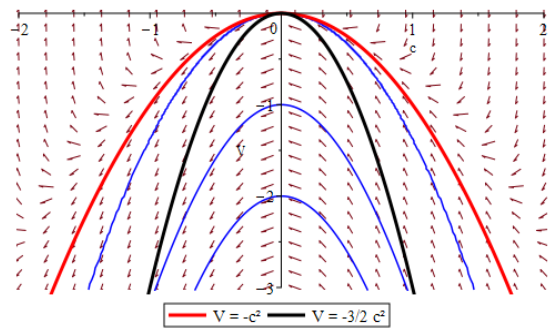
Section 3 analyzes the reduced planar dynamical system, including a first integral and invariant regions governing the flow dynamics.
Section 4 characterizes the global existence and finite-time blow-up behavior of solutions, with explicit examples illustrating both regimes.
Section 5 presents energy estimates via Bernoulli’s head and discusses astrophysical applications.
Section 6 concludes the paper with physical implications and future directions.
2. Analytical Solutions in Linear Velocity Fields
To consider the solutions of Equations (
1) and (
2), where
u is linear in
r, we make the assumption
and substitute it into (
1) to obtain
Solving the above equation for
yields
where
and
. Substituting
and (
4) into (
2), and introducing
, we have
which is equivalent to
where
. We further rewrite the above equation as
Differentiating (
7) with respect to
R gives
which holds for all
and admissible
if, and only if,
. Then, from (
7), there exists a constant
, such that
It follows from (
9) that
and
from which we obtain
where
is an integration constant. From (
10),
satisfies
It follows directly from the above analysis that
where
is defined by (
12). To ensure the nonnegativity of density, we require
for all
. Accordingly, we impose the parameter constraints
and
, which are sufficient conditions to guarantee the positivity of density. Substituting (
12) into (
14) leads to
We now explicitly determine the motion of the vacuum free boundary
. From the kinematic condition
and the linear velocity ansatz
, we obtain
which leads to
Thus, once
is known from the analysis of (
13), the free boundary evolution follows directly. Moreover, the physical vacuum condition
must be satisfied. Substituting the density expression in (
15) into
yields
Substituting (
17) into the above equation, we have
which is an implicit relation that determines
in terms of
,
, and
.
Theorem 1. Equations (
1)
and (
2)
admit nontrivial solutions of the form if, and only if, . The solutions are given by (
15)
with , where is determined by (
17)
, and are arbitrary constants satisfying (
19)
, and is determined by Equation (
13)
. Proof. We prove the desired equivalence by directly leveraging the preceding calculations, without repeating detailed substitutions. If the system admits a nontrivial solution of the form
, following the derivation leading to Equation (
8), differentiating the momentum equation with respect to
R yields a condition holding for all
. For this condition to be time-independent, the exponential factor must be constant, which requires
, i.e.,
.
Conversely, when
, we explicitly construct the solution (
15) with
governed by (
13). Substituting the linear velocity ansatz and the derived density expression into the continuity and momentum equations, we substitute all terms, combine similar items, and eliminate nonlinear coupled terms step by step. After simplification, all terms can be well canceled out, which confirms that the constructed form (
15) satisfies the original compressible Euler system (
1) and (
2). Obviously, the obtained solution is nontrivial, provided that
. □
Remark 1. The point mass solid core model adopted here is a standard framework in planetary atmosphere and stellar envelope studies. The linear velocity ansatz is perfectly suited to describing spherically symmetric self-similar flows, and is mathematically consistent with the form of the gravitational potential . This ansatz avoids the logical conflict between a finite solid core radius and the linear velocity profile, and is physically meaningful for astrophysical applications.
4. Global Existence and Blow-Up of the Analytical Solutions
Lemma 1. For any solution of system (
20)
with initial data , the following two statements hold: - (1)
The integral of over diverges: - (2)
satisfies the sharp bilateral decay estimate:which implies as .
Proof. We prove the two statements separately, all based on the dynamical properties of trajectories in . By statement (3) of Theorem 2, for , the solution is globally defined for all , with , , and as .
From system (
20), we get
and thus,
It follows that
as
as
. For
, (
23) holds immediately. For
, Equation (
26) implies
for all
t. Substituting it into system (
20) yields
, and hence,
which also implies (
23).
Moreover, by the definition of the invariant region
, we have the bilateral bound for
:
Since
for all
in
, dividing the inequality by
and rearranging gives
Integrating both sides from 0 to
t yields
Rearranging the above inequalities directly yields the sharp bilateral estimate (
24). Since both the lower and upper bounds decay at the rate
as
, the squeeze theorem implies that the solution amplitude
satisfies the asymptotic behavior
. This completes the proof. □
Remark 2. When , we obtain from Equation (
17)
that as . It indicates that the atmosphere expands indefinitely, and the free boundary moves outward without bound. Theorem 3. For arbitrary and , Equations (
1)
and (
2)
with admit the following two sets of explicit solutions: (1) The solution given byexists globally for andas ; for , it blows up at . (2) The solution given byexists globally for andas ; for , it blows up at . Proof. From the preceding derivation for
, the linear velocity ansatz
reduces the governing system to the second-order ODE (
13) for
Two special explicit solutions of (
13) are exactly
and
Substituting these two expressions of
into the general solution Formula (
15) directly yields the explicit solutions (
28) and (
29).
When , it is easy to see that is well-defined and positive for all , which guarantees the global existence of solutions. Moreover, as , which implies and . When , the denominator of vanishes at finite time and for the two cases, respectively, so that tends to and the corresponding solutions blow up in finite time. The proof is completed. □
Remark 3. For the explicit solution (
28)
with , we have , , and then , which reaches zero at , indicating complete gravitational collapse of the gas envelope. Similarly, for the explicit solution (
29)
with , we have , and substituting (
17)
into the free boundary relation yields , which contracts to zero at the blow-up time , also corresponding to the complete gravitational collapse of the gas envelope. For the general case, the free boundary contracts to a positive radius determined by the constants, which corresponds to the atmosphere collapsing onto the solid core. Theorem 4. For , the solutions in Equations (
15)
of the system (
1)
and (
2)
with satisfy the following properties: (1) When , the solution exists globally. Moreover, and are set as .
(2) When , the solution blows up in finite time . Moreover, the blow-up time satisfies when
Proof. (1) For , the condition implies . By Theorem 2 and Lemma 1, we have for all t, and with as . Consequently, and are set as .
(2) Since
, the condition
with
yields
. By the fourth statement of Theorem 2,
blows up in finite time, and hence, the solution in (
15) also blows up in finite time and
when
This completes the proof. □
Remark 4. The threshold is the critical balance between the initial gas expansion and gravitational contraction. For , the solution exists globally and converges to hydrostatic equilibrium, corresponding to a stable bound atmosphere. For , gravity dominates and the solution blows up in finite time, describing the gravitational collapse of the gas envelope.
5. Energy Estimates via Bernoulli’s Head
In this section, we derive quantitative energy estimates for the obtained analytical solutions via Bernoulli’s head of the flow, and characterize the asymptotic behavior of the total mechanical energy in both the global existence and finite-time blow-up regimes, which further verifies the physical consistency of our analytical results.
For the inviscid, barotropic, spherically symmetric compressible flow governed by (
1) and (
2), we define Bernoulli’s head, which is the total mechanical energy per unit mass of the flow, as:
where
is the specific enthalpy, and
is the gravitational potential induced by the solid core. For the polytropic equation of state with critical adiabatic index
, the specific enthalpy simplifies to:
Substituting the exact solution (
15) into (
30) and combining with the governing Equation (
10) of
, we directly obtain the following equivalent closed-form expressions of Bernoulli’s head after simplification:
We now analyze the asymptotic behavior of
in two key regimes based on the dynamical properties of
established in previous sections.
5.1. Asymptotic Behavior in the Global Existence Regime
For initial data satisfying (i.e., trajectories in the invariant region ), Theorem 2 and Lemma 1 show that for all , and as .
From the bilateral decay estimate (
24) in Lemma 1, we directly obtain the polynomial decay rates:
Substituting these into (
32), we find that all terms decay to zero as
, i.e.,
This result confirms that the total mechanical energy of the flow vanishes in the long-time limit, consistent with the asymptotic decay of the velocity field and the convergence of the density to the hydrostatic equilibrium profile (see Theorem 3 and 4). The equilibrium Bernoulli’s head satisfies
, which matches the long-time limit of
, verifying the physical consistency of our analysis.
For fixed
, the leading term of
as
is
(from (
33)). For trajectories in
,
(Theorem 2), so
grows quadratically with
r, which is physically consistent with the linear radial velocity profile
. For the explicit global solution (
28) in Theorem 3 (with
), the Bernoulli’s head reduces to a form where the kinetic energy term decays at
and the potential term decays at
, fully consistent with the general decay estimate above.
5.2. Behavior in the Finite-Time Blow-Up Regime
For initial data satisfying (i.e., trajectories in or ), Theorem 2 guarantees the existence of a finite blow-up time such that and as .
From the invariant region constraints in Theorem 2, for blow-up trajectories in
, we have the bilateral bound
for
, which directly yields the asymptotic behavior
For blow-up trajectories in
, combining the first integral of the system (Theorem 2(1)) with the invariant region constraints, we prove that
is of the same order as
near the blow-up time, and the asymptotic behavior still satisfies (
35).
For the exponential term in (
33), we have
which is strictly lower-order than the leading term
. Therefore, near the blow-up time,
is dominated by the quadratic term, and satisfies
uniformly for all
. This divergence of the total mechanical energy is physically consistent with the finite-time blow-up of the velocity gradient and the gravitational collapse of the gas flow. This asymptotic behavior is further verified by the explicit blow-up solution (
28) in Theorem 3, where the leading term of
diverges at
, matching our general asymptotic analysis.
6. Conclusions and Further Discussion
In this paper, we systematically analyze radially symmetric solutions to the compressible Euler equations with a fixed solid core and vacuum free boundary. Under the linear velocity ansatz , we rigorously prove that nontrivial solutions exist if, and only if, the adiabatic exponent satisfies , and derive the explicit density expression. This conclusion improves existing studies by clarifying the necessity of such critical exponent. The evolution of is reduced to a second-order ordinary differential equation, which is further transformed into a planar dynamical system. Via first integral and phase plane analysis, we classify the flow behaviors into three invariant regions. Solutions defined in different regions exhibit distinct dynamic properties: some exist globally and tend to steady states, while others blow up within finite time. We also obtain a sharp threshold distinguishing global existence from finite-time blow-up, together with an explicit upper bound for blow-up time. Moreover, we establish energy estimates based on Bernoulli’s head, which verifies the physical validity of the obtained solutions under both global existence and blow-up scenarios. The derived critical condition is physically reasonable, and the constructed exact solutions can clearly reflect the intrinsic flow evolution laws.
The obtained results possess certain theoretical significance and application potential in astrophysical fluid dynamics. Since accords with the physical characteristics of several typical cosmic gas media, our analytical conclusions may provide theoretical references for related atmospheric and stellar flow research. Meanwhile, these exact solutions can also act as effective benchmarks for numerical simulation verification of compressible flows with free boundaries. Future work will extend the present framework to viscous and heat-conducting gas models, and explore more general solution structures beyond the linear velocity ansatz, to further bridge the gap between mathematical analysis of hyperbolic PDEs and astrophysical flow modeling.