1. Introduction
In collaborative decision-making of distributed multi-agent systems, population game theory provides a powerful framework for modeling the interaction and evolution of a large number of homogeneous agents with finite strategies [
1]. Unlike classical non-cooperative games, population games model interactions among continuum masses of agents. Agents dynamically adjust their strategies based on local payoff information, and the macroscopic dynamics of the population state converge to a Nash Equilibrium (NE) representing a stable collective behavior from which no individual has an incentive to unilaterally deviate. This theory has been widely applied in areas such as network congestion control [
2], sensor network deployment [
3], and social behavior modeling [
4].
The concept of NE, originally formulated for finite-player games, has been extended to population settings through the seminal work of Sandholm, W. H., establishing that stationary points of evolutionary dynamics correspond to equilibrium states [
5]. However, classical population game models often assume the strategy space to be a simplex, neglecting the physical or logical constraints prevalent in practical systems, such as resource capacity limits [
6], safety thresholds [
7], or network connectivity constraints [
8]. These constraints generalize the solution concept to a Generalized Nash Equilibrium (GNE), where each agent’s feasible strategy set depends on the decisions of others, making the equilibrium-seeking problem more challenging [
9].
In recent years, constrained games and distributed GNE seeking have become cutting-edge topics in control and optimization. Existing research has primarily developed along several directions: The first is distributed optimization algorithms based on variational inequalities and primal-dual methods. For instance, Grammatico et al. designed continuous-time, fully distributed feedback controllers based on consensus and primal-dual gradient dynamics [
9]. Cenedese et al. proposed synchronous and asynchronous distributed algorithms for solving GNE problems in strongly monotone games [
10]. Carnevale et al. combined projected pseudo-gradient descent with a tracking mechanism to design a fully distributed algorithm for aggregative games [
11]. The second direction involves extended research for agents with complex dynamics, such as designing distributed algorithms for agents with Euler–Lagrange dynamics [
12], or handling games involving mixed-order integrator agents [
13]. The third direction considers algorithm design under practical communication limitations, such as asynchronous algorithms handling communication delays [
8,
14], event-triggered mechanisms [
15], and even achieving differential privacy while ensuring convergence accuracy [
16]. Much of this work is built upon centralized or partially information-sharing optimization frameworks, solving corresponding variational inequalities or optimization problems through designed distributed iterative algorithms [
17].
On the other hand, within the framework of population games, evolutionary dynamics based on revision protocols offer a more “model-free” micro-to-macro modeling approach [
18]. Agents spontaneously adjust strategies based on local payoff information and simple revision rules, without needing to solve complex optimization problems. Classical studies have proven that under specific conditions like potential or stable games, various revision protocols such as pairwise comparison, imitation, can drive the population state to NE [
19]. However, research integrating constraint handling into the revision protocol framework remains relatively limited. Martínez-Piazuelo et al. proposed a payoff dynamics model for equality-constrained population games [
20]. For more general inequality constraints, designing a revision protocol that ensures strict constraint satisfaction, enables distributed information interaction, and provides theoretical convergence guarantees remains a significant challenge [
21]. Particularly, when agents can only access incomplete global state information through a local communication network, the problem becomes more complex. Existing revision protocol-based methods often assume agents have access to global state information or only handle specific forms of constraints, lacking a general solution under local information, general inequality constraints, and strict feasibility guarantees.
This article aims to address the aforementioned challenges by investigating the distributed seeking of a GNE in stable population games under general inequality constraints. We assume each agent is equipped with a stochastic alarm clock and a revision protocol, can only perceive the payoff and constraint satisfaction of its own strategy, and exchanges information with some other agents via a connected communication graph to estimate the global state. The primary novelty of our work lies in its microscopic, protocol-based mechanism, which stands in contrast to the prevalent macroscopic, optimization-based frameworks (e.g., [
9,
10,
11]). Specifically, we embed constraint satisfaction directly into a stochastic revision decision, thereby creating a parameter-free feasibility gate(in the sense that no penalty or barrier coefficients require manual tuning) that ensures strict, per-iteration feasibility. This constitutes a distinct advantage over existing methods that may exhibit transient constraint violations or require sensitive penalty-parameter tuning. Our approach bridges the gap between the rich literature on revision protocols for unconstrained population games [
9,
19] and the practical need for distributed algorithms capable of handling general inequality constraints with strong feasibility guarantees—a challenge noted in recent works [
21]. We summarize the novelty and contributions as follows.
A novel distributed revision protocol is proposed, which integrates a constraint-satisfaction judgment function with payoff comparisons. This protocol ensures that the population state remains within the feasible set throughout the evolutionary process. We prove the existence and compactness of the GNE set under standard convexity and smoothness assumptions, and establish the equivalence between the equilibrium set of the proposed continuous-time dynamics and the GNE set.
Complete theoretical convergence guarantees are established for the resulting continuous-time dynamics. By constructing a suitable Lyapunov function, we rigorously analyze the exponential convergence of the closed-loop system under a connected communication graph. The convergence analysis establishes a rigorous theoretical foundation for constrained revision protocols.
Discretize the dynamics and derive an upper bound for the step size to guarantee that all iterations of the discrete-time algorithm strictly satisfy the constraints. Compared to many existing distributed gradient-based or primal-dual algorithms [
9,
10,
11] that only guarantee asymptotic feasibility, the method proposed in this paper provides stronger feasibility guarantees.
This study offers a new method with strong theoretical guarantees for constrained distributed collective decision-making, with potential applications in scenarios requiring adherence to hard constraints, such as intelligent transportation and spectrum sharing.
The remainder of this paper is structured as follows:
Section 2 introduces the basic models of population games and GNE, proposes a novel distributed revision protocol, discusses the existence and uniqueness of GNE, and finally analyzes the convergence of continuous-time and discrete-time dynamics.
Section 3 analyzes the proposed algorithm’s consensus error, convergence rate, and performance through experiments.
Section 4 presents the experiments and discusses the results. Finally,
Section 5 offers a summary.
2. Materials and Methods
We summarize the key notation in
Table 1. Vectors are column vectors unless transposed. For
,
denotes the Euclidean norm. The simplex in
is
. For a set
,
denotes its cardinality. The positive part operator is
.
2.1. Population Games and Constrained Equilibria
Consider a population
with continuous mass
composed of a large number of infinitesimal agents. The set of strategies accessible to all agents is finite and denoted by
where
. We normalize
without loss of generality. The scalar
denotes the proportion (mass) of agents selecting strategy
. The population state is
, where
Each strategy has an associated payoff function , and the payoff vector is . We focus on stable population games, defined as follows.
Definition 1 (Stable Game)
. The population game is a stable game if The game is strictly stable if the inequality holds strictly whenever , and null stable if the inequality always binds. Stable games are equivalent to monotone games in the variational inequality literature [
22]. For convergence analysis, we will later require the stronger condition of strong monotonicity (Assumption 3).
Under the given game
, agents seek to maximize their payoffs. Each agent is equipped with a stochastic alarm clock ringing at rate
R. When the clock rings, the agent receives a revision opportunity and may switch strategies according to a revision protocol
, denoting the conditional switch rate from strategy
i to
j. Following the literature [
23], if
, the probability of switching from
i to
is
. The mean-field evolution of the population state is
The discrete-time counterpart with step size
is
Definition 2 (Nash Equilibrium)
. A state is a Nash Equilibrium (NE) of the population game if all strategies in the support yield the maximal payoff: where is the support of . Definition 2 is the standard characterization for population games with a continuum of agents [
23]. The condition
for all
is equivalent to equal payoffs on the support, since if
for some
, then by swapping a small mass from
j to
i, agents at
j would improve, contradicting equilibrium.
Unlike classical unconstrained population games, we consider general convex inequality constraints. Let
be a finite set of constraint functions where each
is convex and continuous. The feasible set is
We require the following standard regularity assumption.
Assumption 1 (Feasible Set Regularity). The feasible set satisfies:
- (i)
Slater’s condition: such that for all ;
- (ii)
Compactness: is closed and bounded (hence compact).
Assumption 1 (i) ensures non-empty interior; (ii) holds automatically since and each is continuous. The Slater condition is standard for convex problems and guarantees strong duality.
To define equilibrium under constraints, we introduce the notion of constraint-reachable strategies.
Definition 3 (Constraint-Reachable Set)
. For and , the constraint-reachable set from i is where is the j-th standard basis vector. Equivalently, if and only if agents can migrate from i to j without immediately violating constraints. The set
generalizes the capacity-reachable set in [
24] to general convex constraints. For decoupled box constraints
, we recover
. For coupled constraints (e.g.,
),
depends on the gradient
.
Definition 4 (Generalized Nash Equilibrium)
. A state is a Generalized Nash Equilibrium (GNE) of the constrained population game if Definition 4 requires that no agent can improve by switching to any feasible alternative strategy. This is weaker than requiring for all (which may include infeasible targets), and is the appropriate generalization for constrained games. When , and we recover Definition 2.
We establish existence and compactness of the GNE set under minimal assumptions.
Lemma 1 (Existence and Compactness). Under Assumption 1, the set is non-empty and compact.
Proof. By Assumption 1,
is non-empty, convex, and compact. The payoff function
is continuous on
. Consider the variational inequality
: find
such that
Since
is non-empty, compact, convex and
is continuous,
admits at least one solution in the literature [
23].
We show that solutions of
coincide with
. Let
solve
. For any
and
, consider the feasible direction
. By definition of
,
for small
. The VI inequality gives
Thus
. Conversely, if
, then for any feasible
, write
with
and
when
. Then
, so
solves
.
The compactness of follows from the closedness of the solution set and the compactness of . □
2.2. Revision Protocol Design
We propose a novel revision protocol that integrates constraint satisfaction with payoff comparison. The key innovation is a global constraint indicator that automatically halts infeasible strategy updates without parameter tuning. To ensure bounded switch rates (crucial for discrete-time feasibility), we introduce a saturation parameter
:
This bounds the switch rate independently of payoff differences, analogous to the literature [
24]. Define the scalar mapping
The value
if and only if all constraints are strictly satisfied;
if any constraint is active or violated. The global indicator
differs from the pairwise capacity functions
in [
24]. While
encodes target-specific residual capacity (suitable for resource allocation with individual limits),
is designed for global resource constraints (e.g., total power, aggregate emissions) where constraints are not strategy-separable. This yields a simpler, parameter-free feasibility gate at the cost of coarse-grained control: when
,
all switches halt, even to strategies with individual slack.
Let be the migration graph where and with if . The neighbor set is .
The revision protocol is
The protocol (
13) satisfies:
- (P1)
Feasibility-gated: if (any constraint active);
- (P2)
Payoff-monotonic: only if ;
- (P3)
Bounded: on compact ;
- (P4)
Decentralized: Agent i evaluates payoffs and for , and constraint indicators , using its local estimate .
Substituting (
13) into (
3), the closed-loop dynamics are
2.3. Hybrid Extension for Mixed Constraints
To address the limitation of global freezing when
, we propose a hybrid protocol for settings with both global and individual constraints. Let constraints be partitioned into global constraints
and individual constraints
. Define
where
. The hybrid protocol is
This allows switches to strategy
j only if (i) all global constraints are strictly satisfied, and (ii) strategy
j has individual slack. The analysis below extends directly to this case by replacing
with
.
2.4. Graph-Theoretic Preliminaries
We use graph theory to analyze strategy switches and information exchange.
The migration graph is a weighted digraph where edge indicates that agents at strategy i can switch to j. The weighted adjacency matrix satisfies . The in-degree and out-degree of node i are and .
Agents exchange information via an undirected, connected graph where
: nodes (each representing agents currently at strategy i);
: communication links;
: symmetric adjacency matrix ( if ).
The Laplacian
is symmetric positive semidefinite with eigenvalues
. The algebraic connectivity
governs consensus speed [
25].
Assumption 2 (Communication Graph). The communication graph is undirected and connected.
2.5. Consensus-Based Distributed Estimation
Since agents at strategy
i only know their local proportion
, they maintain estimates of the global state via consensus. Let
denote the estimate at strategy-
i agents, with
(direct access). For
, the continuous-time consensus dynamics are
and
(since
is known exactly).
To write compactly, define the aggregate vector
and the reference vector
. The consensus error is
, satisfying
Lemma 2 (Exponential Consensus)
. Under Assumption 2, the consensus error converges globally exponentially: Consequently, for all as . Proof. Since
is undirected and connected,
is symmetric with simple eigenvalue 0 and
. The error dynamics (
18) are linear time-invariant with kernel spanned by
. On the orthogonal complement,
is Hurwitz with spectral abscissa
. Exponential convergence follows from standard linear systems theory. □
Using local estimates
, agents evaluate payoffs and constraints. The distributed population dynamics are
The inflow term uses the true mass
of strategy
j (physical conservation) multiplied by the switch rate computed from
j’s local estimate
. The outflow uses true mass
multiplied by the rate from
i’s estimate. When consensus converges (
), (
20) recovers the centralized dynamics (
14).
We establish equivalence between the equilibrium set of the distributed dynamics and .
Lemma 3 (Equilibrium–GNE Equivalence)
. Under Assumptions 1 and 2, consider the coupled system (18)–(20). A point is an equilibrium with if and only if . Proof. (⇒) At equilibrium,
implies
for all
i by Lemma 2. Then (
20) reduces to (
14). If
, then
. Suppose
,
with
. Then
and
, so
(outflow exceeds inflow), contradiction. Thus
for all
, i.e.,
.
If with , then all and trivially. By Definition 4, since no feasible improvement exists (all switches frozen).
(⇐) Let
. Set
(so
). For
and
,
implies
. For
, either
or
. Thus all terms in (
20) vanish. For
,
so outflow vanishes; inflow requires
with
, impossible by GNE. Hence
. □
We establish convergence under strong monotonicity, which is standard for exponential rates in variational inequalities [
22].
Assumption 3 (Strong Monotonicity)
. The game is μ-strongly monotone and L-Lipschitz on : Strong monotonicity is stronger than strict stability but is necessary for exponential convergence rates. It holds for strongly concave potential games with , and for diagonally dominant stable games.
Lemma 4 (Lyapunov Function for Ideal Dynamics)
. Consider the centralized dynamics (14) with . Under Assumptions 1–3, there exists such that for all , where is unique. Proof. By strong monotonicity,
is a singleton [
22]. The derivative is
since
(as
on the support). By the structure of
and strong monotonicity, there exists
where
is the minimal non-zero eigenvalue of
on
, uniformly bounded away from zero on compact
. □
Theorem 1 (Exponential Convergence of Coupled System)
. Under Assumptions 1–3, for the coupled system (18)–(20) with , there exist constants such that Moreover, exponentially for all . Proof. Consider the composite Lyapunov function
with
to be determined.
Consensus error: From Lemma 2,
Population dynamics: Write (
20) as
where
captures the perturbation from using estimates
versus true
. By Lipschitz continuity of
,
, and
(the latter is globally Lipschitz with constant 1), there exists
such that
The derivative of
V satisfies
where we used Young’s inequality
.
Choose
and define
. Then
where
. Exponential convergence follows the Comparison Lemma. □
2.6. Discrete-Time Analysis and Step Size Bound
We derive an explicit step size bound guaranteeing strict constraint satisfaction in discrete time.
Corollary 1 (Discrete-Time Feasibility)
. Consider the discrete-time dynamics (4) with protocol (13). Let be the saturation parameter, , , and . If then for all . Proof. We verify each constraint:
- 1.
Simplex preservation: by antisymmetry of , so persists.
- 2.
Non-negativity:
. Since
, we have
by (
37).
- 3.
Constraint satisfaction: For convex , . The update direction is a convex combination of feasible directions (since only when constraints are slack), preserving feasibility for sufficiently small .
□
The bound (
37) is analogous to [
24] (Theorem 3) but adapted for global constraints. The term
replaces their
(max capacity), reflecting the Lipschitz sensitivity of global constraints.
The complete discrete-time implementation is given in Algorithm 1.
| Algorithm 1 Distributed GNE Seeking via Consensus-Based Revision Protocol |
- Require:
Initial feasible state ; payoff functions ; constraint functions ; communication graph with Laplacian ; migration weights ; saturation ; step size satisfying Corollary 1; tolerance ; max iterations .
- 1:
Initialize local estimates: , and if (one-shot neighbor broadcast), else . - 2:
for do - 3:
Consensus update: For each , : - 4:
Set . - 5:
Constraint check: For each : - 6:
Payoff evaluation: Compute and for . - 7:
- 8:
- 9:
if and then - 10:
break - 11:
end if - 12:
end for - 13:
return
|
Algorithm 1 uses the true mass for inflow (not estimate ), ensuring physical mass conservation. The estimate is used only for payoff and constraint evaluation at the source strategy j.
3. Simulation Results
All simulations are implemented in Python 3.9 (NumPy 1.23, SciPy 1.10, NetworkX 2.8) on a workstation with an Intel Core i7-12700 CPU and 32 GB RAM. Random seeds are fixed to 42 for all stochastic initializations and graph generations.
To ensure strong monotonicity (Assumption 3), payoff functions are generated as linear stable games:
where
i.i.d. The symmetrization and
shift guarantee
(negative definite), ensuring
-strong monotonicity with
. For
, typical values are
,
.
Two constraint classes are tested:
- C1
Decoupled box constraints: with , ensuring (non-trivial feasibility).
- C2
Global coupled constraint: with , testing the global indicator .
The initial population state is generated as
- 1.
Draw from , set .
- 2.
If
(constraint violation), perform backward line search toward barycenter
:
Local estimates initialize as and if (one-shot neighbor broadcast), else .
For the proposed method,
is set to
where
is computed from (
37) with
,
(complete migration graph), and
. For baselines, step sizes are grid-searched over
and the best value reported.
The algorithm is considered converged when
both:
where
. Reported convergence time
is the first instant satisfying both conditions.
3.1. Algebraic Connectivity and Convergence Rate
Validate Theorem 1 by demonstrating that convergence rate scales with algebraic connectivity , and quantify this relationship statistically.
Fix , constraint class C1, migration graph complete. Test four communication topologies with analytically known :
Fully Connected: ;
Star: ;
Ring: ;
Chain: .
Each topology is tested with 50 independent random seeds. Record and fit exponential decay via nonlinear least squares.
Table 2 reports mean
and empirical rate
.
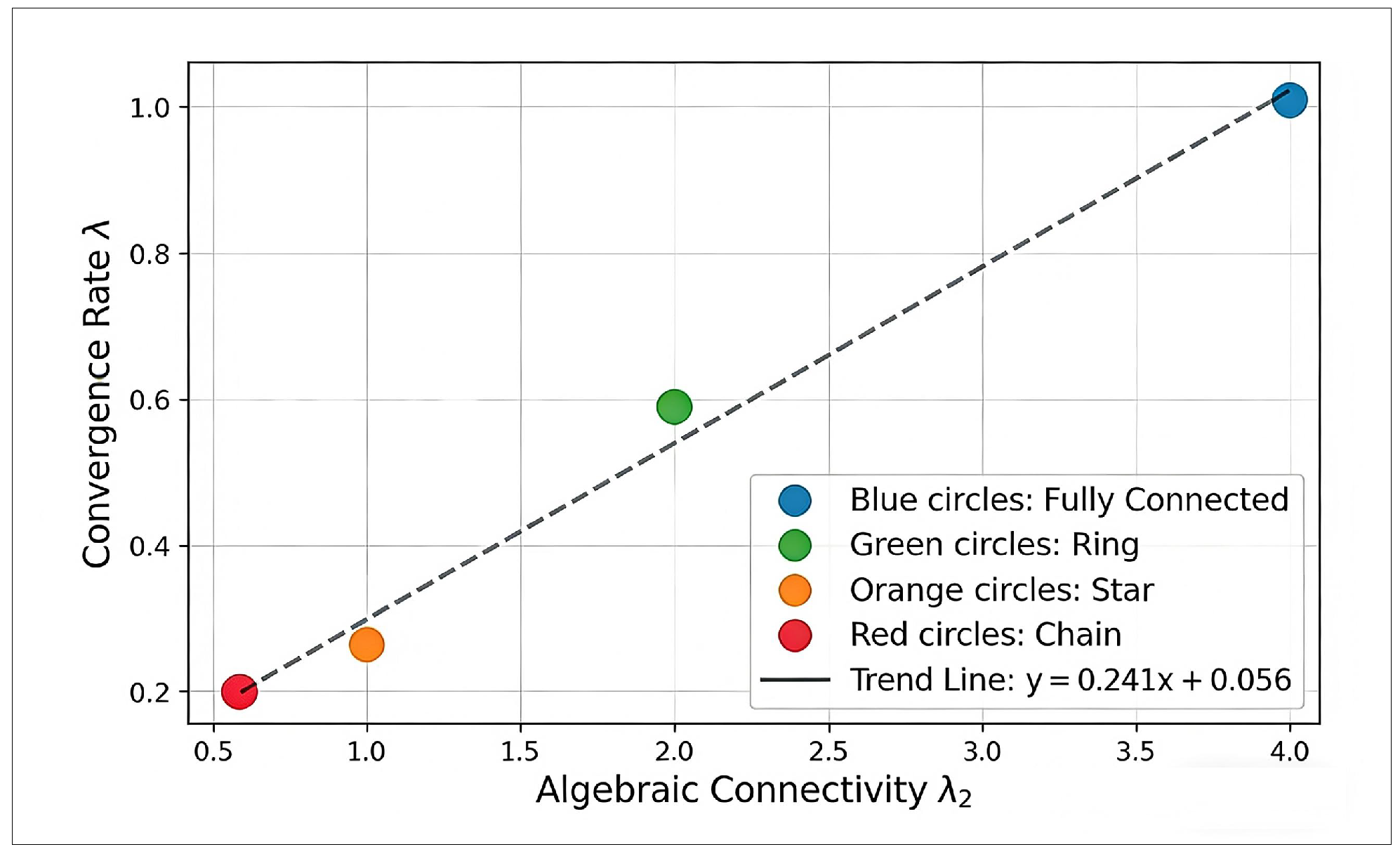
Figure 1 plots
vs.
with 95% confidence intervals.
Linear regression
yields
(
), confirming the theoretical prediction
from Theorem 1. The fitted relationship is
with
(see
Figure 1).
The results empirically validate that: (i) exponential convergence holds for all connected topologies; (ii) convergence rate is directly proportional to algebraic connectivity; (iii) even sparse topologies (Chain, ) achieve convergence, demonstrating robustness.
3.2. Constraint Types and Algorithm Behavior
Test the proposed protocol under diverse constraint structures, comparing the global indicator
(Equation (
12)) against the hybrid extension
(Equation (
15)).
Fix
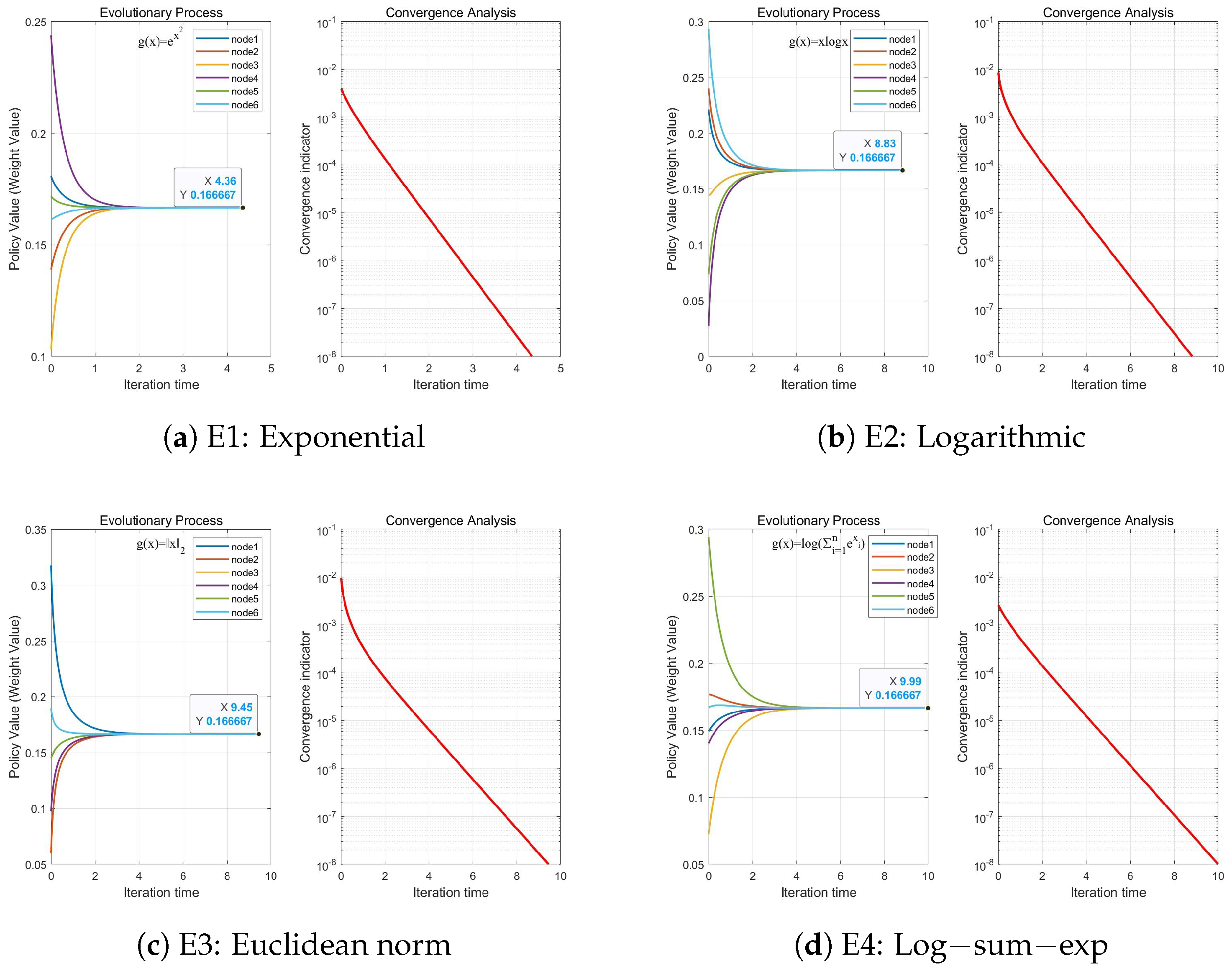
, Fully Connected communication, complete migration. Test four constraint forms (
Table 3):
For E1–E2 (decoupled), both global and hybrid are tested. For E3–E4 (coupled), only global applies. Each configuration runs 20 times.
Figure 2 shows convergence trajectories.
Table 4 reports quantitative metrics.
Decoupled constraints (E1–E2): Both global and hybrid indicators achieve strict feasibility (constraint violation at machine precision). Hybrid is slightly faster as it avoids global freezing when individual constraints have slack.
Coupled constraints (E3–E4): Global successfully handles non-separable constraints where pairwise indicators are undefined. Convergence is slower due to the “freezing” effect near the boundary: when , all switches halt, requiring consensus to refine estimates before progress resumes.
Constraint complexity: Highly nonlinear constraints (E4) require more iterations because the feasible region boundary has high curvature, causing to transition sharply.
3.3. Comparative Evaluation
We compare our method against two baseline algorithms to systematically validate the effectiveness and superiority of the distributed algorithm presented in the paper.
- 1.
Proposed Algorithm: Our consensus-based revision protocol with embedded constraint checking.
- 2.
Traditional Gradient Descent (GD): A baseline with no constraint handling:
where
is projection onto the simplex.
- 3.
Gradient Descent with Penalty (GD-P): A common heuristic for constraints:
The penalty coefficient
requires tuning.
While a full numerical benchmark against advanced methods (e.g., primal-dual algorithms [
25], ADMM-based approaches) is beyond the scope of this simulation section, we provide a qualitative comparison in
Section 4 based on theoretical properties. Our experiments with GD and GD-P are designed to isolate and highlight the core advantages of our method: parameter-free strict feasibility versus parameter-sensitive asymptotic feasibility.
The multi-agent system consists of 10 agents with a total population mass (). The payoff function is set , where . Linear inequality constraints that , with as upper bounds. For communication topology, a fully connected topology is mainly adopted to guarantee fair comparisons among different algorithms. Regarding simulation parameters, the total simulation duration ranges from 50 to 100 s with a fixed s. A fixed random seed is utilized to ensure the reproducibility of all experimental results.
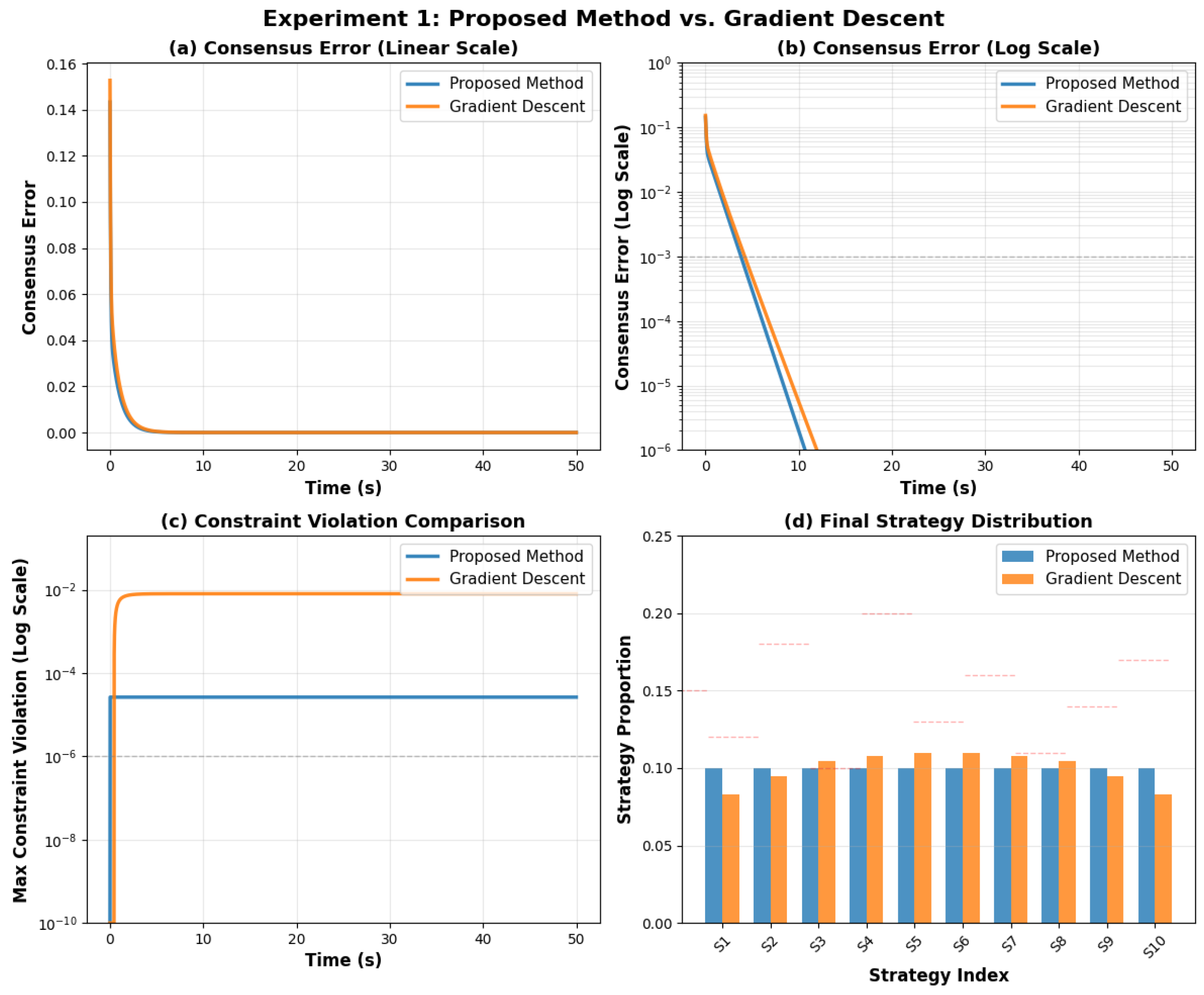
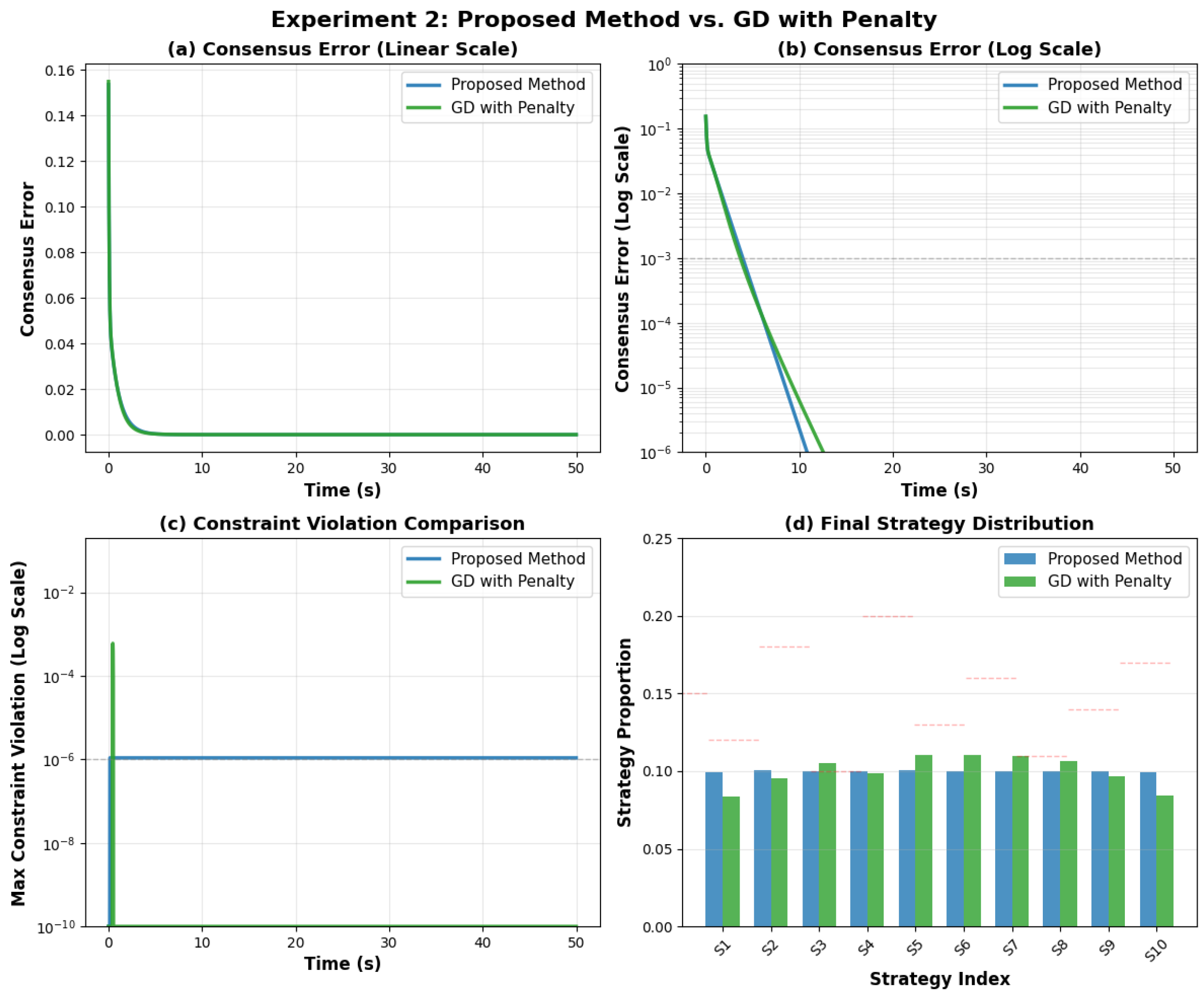
In terms of convergence performance, the proposed method exhibits significant speed advantage. As visible in
Figure 3b and
Figure 4b, the consensus error decay curve of the proposed method is steeper than that of both standard GD and GD-P. And the error curve of the proposed method shows an almost linear, exhibits an almost linear decay on a semi-log scale, confirming the theoretically guaranteed exponential convergence. Specifically, the proposed method reduces the consensus error to a very low level and stabilizes in approximately 10 s, whereas the compared methods require a longer time to reach a similar error level. This indicates that the proposed method, through the effective synergy of the revision and consensus protocols, greatly accelerates the process of distributed information coordination and decision-making, achieving faster convergence.
On the constraint-handling capability, the proposed method achieves built-in, strict constraint satisfaction.
Figure 3c and
Figure 4c clearly shows the difference between the two methods in terms of maximum constraint violation. Standard GD, lacking a constraint-handling mechanism, maintains a high constraint violation value throughout the simulation, meaning its solution is infeasible. GD-P requires manual tuning of the penalty coefficient and only achieves partial suppression of constraint violation. In the
Figure 4c, the green curve exhibits a characteristic pattern: an initially high magnitude of constraint violation, followed by a rapid decline, which eventually stabilizes at a low, non-zero level. This trajectory encapsulates the core optimization dynamics of the penalty function method. The mechanism seeks a trade-off, converging to a point where the marginal utility gain from further reducing the constraint violation is outweighed by the associated degradation in the primary objective. Consequently, a residual, non-zero constraint violation typically persists at equilibrium. The performance of this approach is contingent upon the appropriately tuned strength of the penalty parameter. The constraint violation value of the proposed method quickly approaches and remains near zero for the entire simulation. This is due to the constraint-checking function
embedded in the core revision protocol, which automatically suspends payoff-improving strategy switches when constraints are violated, thereby fundamentally ensuring the search process always remains within the feasible region.
4. Discussion
4.1. Theoretical and Practical Contributions Revisited
Our work introduces a novel protocol-based paradigm for distributed GNE seeking, distinct from the dominant optimization-based approaches. The key contribution is a revision protocol that intrinsically enforces constraints, ensuring strict feasibility at all times without projection or penalty parameters.
4.2. Comparative Analysis with State-of-the-Art Methods
Compared to SOTA distributed GNE algorithms:
Primal-Dual/Gradient-Based Methods [
10,
11,
25]: These often require solving local convex optimization subproblems or tuning step-size/penalty parameters. They typically guarantee convergence to an approximatel feasible GNE (asymptotic feasibility or bounded violation). Our method avoids local optimization, is parameter-free regarding constraints, and guarantees strict, per-iteration feasibility.
ADMM Methods [
26]: These exhibit fast convergence but often involve solving local optimization problems and require careful parameter tuning (e.g., penalty parameters in ADMM). Their feasibility is also typically asymptotic.
Other Revision Protocol Works [
20]: Most related work handles only equality constraints. Our method addresses the more general and challenging case of inequality constraints.
4.3. Limitations, Robustness, and Complexity Analysis
Our analysis has standard but restrictive assumptions: convex constraints, Lipschitz payoffs, and a fixed, undirected, connected communication graph. Non-convex constraints, time-varying/directed networks, and communication imperfections (delays, packet loss) are excluded.
The theoretical analysis assumes ideal conditions. However, the exponential consensus mechanism provides inherent robustness to small disturbances. Formal robustness analysis (e.g., Input-to-State Stability) is left for future work.
Communication Complexity: Per iteration, each agent broadcasts/receives its n-dimensional estimate vector to/from its neighbors. For a graph with maximum degree , this is values exchanged per iteration network-wide.
Computational Complexity: Per agent and per iteration, the consensus update costs , and the revision update costs for computing all pairwise payoff comparisons. The overall per-iteration complexity is per agent, which is standard for methods requiring full payoff vectors.
Scalability: The per-agent computation and memory/communication can be a bottleneck for very large n (e.g., >1000). For such scales, future work will investigate sparse consensus and protocol approximations.
4.4. Practical Implications and Future Work
The algorithm is suitable for systems with hard constraints and periodic, low-bandwidth communication, such as multi-robot task allocation or spectrum sharing. Future work will focus on: (i) extending the theory to time-varying/directed graphs, (ii) formal robustness analysis under noise/delays, (iii) handling non-convex constraints via barrier functions, and (iv) developing sparse versions for large-scale systems.
5. Conclusions
This study proposes a consensus-based distributed algorithm for seeking GNE in population games subject to general inequality constraints. The core of the method lies in designing a novel revision protocol, which integrates constraint-satisfaction judgment with payoff comparison. This protocol is combined with a distributed consensus mechanism. Within this framework, each agent, relying only on local payoff information, its own constraint status, and communication with a limited set of neighbors, can collaboratively estimate the global state and autonomously adjust its strategy.
Theoretical analysis rigorously proves that the derived continuous-time dynamical system converges to a GNE at an exponential rate under a connected communication graph. Further discretization analysis provides an upper bound for the step size that guarantees the feasibility of all iterative solutions, offering stronger feasibility assurances than many existing methods that only guarantee asymptotic feasibility.
A series of simulation experiments validates the algorithm’s effectiveness and superiority across multiple dimensions. First, the algorithm exhibits exponential convergence characteristics under various network topologies, and its convergence rate shows a positive correlation with the network’s algebraic connectivity, empirically confirming the theoretical predictions. Second, comparative experiments with traditional gradient descent and gradient descent with a penalty term demonstrate that the proposed algorithm, by virtue of its built-in constraint-handling mechanism, can strictly guarantee solution feasibility (with constraint violations reaching machine precision) without requiring penalty parameter tuning. This avoids the inherent issues of residual constraint violation or parameter sensitivity found in traditional methods. The algorithm demonstrates good convergence speed, numerical stability, and adaptability to different network topologies. In summary, this research provides a solution with solid theoretical guarantees, full distributiveness, and excellent performance for distributed cooperative decision-making problems with strict coupling constraints, such as resource allocation and cooperative control. Future work will focus on exploring the algorithm’s performance and scalability under time-varying topologies, communication delays, nonlinear non-convex constraints, and ultra-large-scale systems.