1. Introduction
In the paper [
1] a reconstruction algorithm was introduced in the context of the inverse inclusion problem. Starting from the well-developed linear sampling method for scattering problems [
2,
3] and related qualitative reconstruction techniques [
4,
5,
6], together with the reciprocity gap principle [
7,
8], Colton and Haddar [
9] unified these two approaches, establishing a very effective method to detect scatterers using the far-field map. More recently, in [
1], this idea was extended to the inverse inclusion problem for domains with piecewise constant conductivities. In their work, the authors also provide numerical examples illustrating the validity of the method.
From a mathematical viewpoint, the reciprocity gap method is closely related to non-approximability phenomena for harmonic functions with singular sources. In the variable-coefficient setting, the presence of the spatially dependent weight in the reciprocity gap identity makes it nontrivial to determine whether the associated bounded/blow-up dichotomy survives discretization and regularization. In particular, for conductivities of the form
the bounded/blow-up dichotomy has been rigorously established in previous works showing that the underlying approximation mechanism also persists in the presence of variable coefficients.
While these results provide a clear theoretical characterization, they do not address the quantitative behavior of the approximation mechanism after discretization. In particular, it is not a priori clear whether the bounded/blow-up dichotomy remains observable in numerical computations, nor how it manifests itself in terms of measurable growth properties.
The aim of this paper is not to derive a new reconstruction algorithm, but rather to provide a quantitative study of the discrete manifestation of the reciprocity gap dichotomy in the variable-coefficient setting. Our contribution focuses on the numerical observability of the approximation property and on its quantitative characterization. More precisely, we investigate whether the approximation property predicted by the reciprocity gap theory remains observable after discretization, how its growth mechanism depends on the problem parameters, and to what extent the resulting indicators are stable under perturbations.
In this framework, the numerical observability of the dichotomy is far from automatic. In particular, inappropriate discretization strategies or standard coefficient-based regularization may completely mask the bounded/blow-up behavior predicted by the theory.
The present work addresses three central questions. First, we investigate whether the bounded/blow-up dichotomy is numerically detectable in heterogeneous media. Second, we analyze how the spatial variability of the contrast influences conditioning and growth rates. Third, we study the sensitivity of the mechanism with respect to regularization and measurement noise.
To analyze these issues, we discretize the reciprocity gap functional using harmonic test functions and introduce a Tikhonov regularization term directly penalizing the trace norm appearing in the theoretical formulation. The regularization parameter is selected automatically through the L-curve criterion, ensuring reproducibility and stability.
Our numerical results show that the structural approximation property persists for radially varying and angularly oscillating contrasts. Moreover, the blow-up outside the inclusion exhibits an approximately exponential growth with respect to the harmonic order, a feature that becomes quantitatively measurable through the growth rates reported in
Section 4.
These findings demonstrate that the variable-coefficient reciprocity gap theorem gives rise to numerically robust and structurally stable phenomena, thereby bridging the gap between the analytical result and its practical implementation.
The main contribution of this paper is to provide a systematic numerical investigation of the reciprocity gap method in the variable-coefficient setting, and to quantify the exterior blow-up behavior through fitted growth rates, to analyze the robustness of the observed dichotomy with respect to geometry, contrast variability, and regularization.
2. Numerical Methodology
Let
be a bounded Lipschitz domain and
a Lipschitz inclusion. We consider conductivities of the form
where
satisfy uniform ellipticity conditions and
in
D.
Given a boundary voltage
, the potential
u solves
Let
v be harmonic in a neighborhood of
. The reciprocity gap functional is defined as
In the variable-coefficient setting (
1), the transmission conditions across
yield the weighted identity
where
When
a and
b are constant,
reduces to the classical constant-contrast coefficient. In the present setting, however,
varies along
, and the structure of (
4) becomes spatially dependent.
We denote by a set of harmonic functions used as test functions in the reciprocity gap formulation. For a given sampling point z, we denote by the corresponding probing function, typically associated with a singular harmonic field centered at z. The reciprocity gap approximation theorem states:
This bounded/blow-up dichotomy constitutes the structural foundation of the reciprocity gap sampling method. Unlike the constant-contrast case, the proof in the variable-coefficient setting relies on the spatially dependent weight
in (
4), and does not reduce to a simple scalar modification.
The aim of the present work is to assess whether this theoretical dichotomy remains observable after discretization and regularization, and in the presence of measurement noise.
We now turn our attention to the description of the forward problem, the construction of the reciprocity gap system and the regularization strategy adopted in the numerical experiments.
All experiments are performed in two spatial dimensions. The computational domain is the unit disk
and the inclusion is the concentric disk
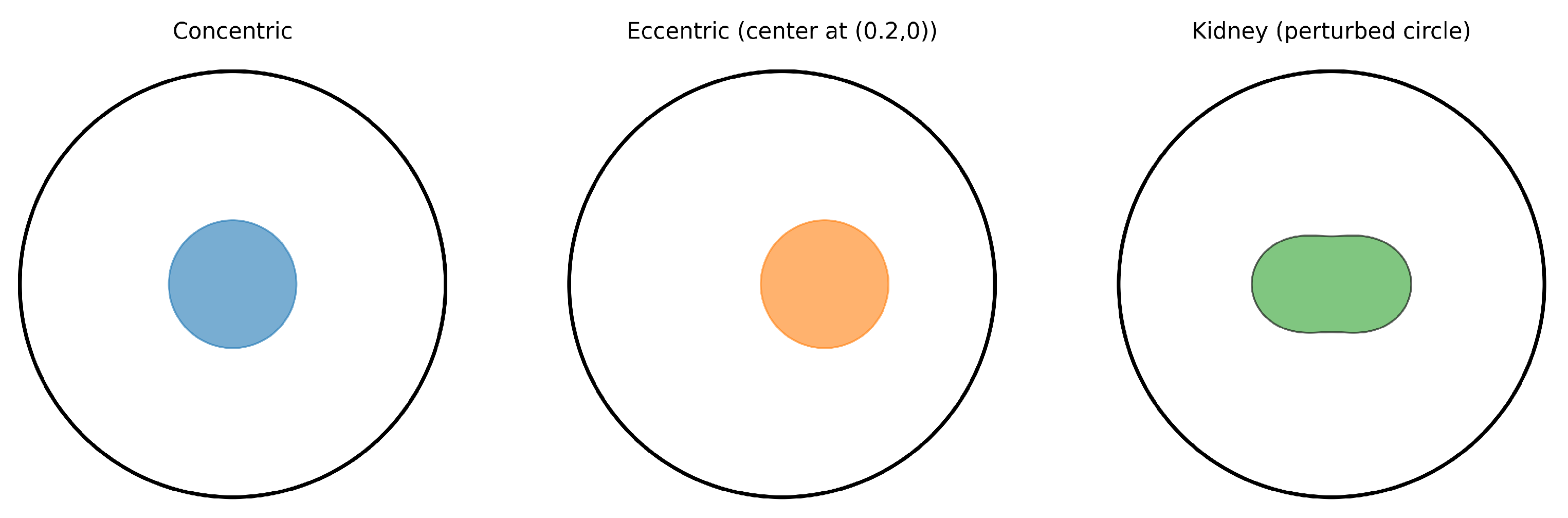
In order to assess the robustness of the observed phenomena, a numerical study was additionally performed on two further configurations beyond the concentric benchmark. An eccentric disk is obtained by shifting the center to (0.2, 0) while keeping the radius
, and a non-convex “kidney”-shaped inclusion is generated by a low-frequency perturbation of the circular boundary. Representative outlines of the three geometries are shown in
Figure 1.
This configuration allows a direct comparison with the constant-contrast benchmark, for which analytic solutions are available, and provides a controlled setting for heterogeneous contrasts.
For the constant-contrast case, the Dirichlet-to-Neumann map is computed analytically by separation of variables.
For spatially varying conductivities, the forward problem (
2) is solved numerically using a finite-volume discretization in polar coordinates. Let
denote polar coordinates. The equation
is rewritten as
and discretized on a structured
grid.
In the numerical experiments, we use a uniform discretization with radial nodes and angular nodes. The resulting linear systems are solved with a tolerance of .
To assess the influence of the discretization, additional computations were performed using finer grids (up to , ). These tests showed negligible variations in the computed indicator values and in the estimated growth rates , indicating that the observed bounded/blow-up behavior is stable with respect to mesh refinement.
Harmonic averaging is used for the conductivity at cell interfaces in order to preserve flux continuity. The resulting linear system is sparse and is solved by a direct sparse factorization. Boundary Neumann data are recovered from the discrete radial flux at .
Boundary excitations are chosen as Fourier modes:
for
.
For each excitation, the corresponding Neumann data are computed, yielding discrete samples of the Dirichlet-to-Neumann map.
The test functions
are chosen in the harmonic basis
The reciprocity gap condition
leads to a linear system
where the matrix
A contains discretizations of
The harmonic test functions are truncated at a finite order , so that the approximation space consists of harmonics up to degree . In the numerical experiments, we consider values of in the range , corresponding to the harmonic orders used in the growth analysis.
The choice of is guided by a compromise between approximation capability and numerical stability. For small values of the approximation space is too limited to capture the behavior of the indicator, while for large values the system becomes increasingly ill-conditioned. In practice, is selected so that the qualitative behavior of the indicator and the estimated growth rates remain stable with respect to further increases in the truncation order.
Since the system is ill-conditioned for large
N, we solve the Tikhonov-regularized problem
The penalty term directly reflects the trace norm appearing in the theoretical dichotomy and is therefore structurally consistent with the weighted identity (
4).
The regularization parameter is selected automatically via the L-curve criterion. Specifically, we compute the log–log curve of residual norm versus solution norm and choose the value corresponding to maximal curvature. Alternative parameter selection strategies, including the discrepancy principle, cross-validation, and truncated SVD, were also tested. While these methods led to comparable qualitative results, the L-curve criterion proved to be the most stable and reliable choice for identifying the growth behavior in the present setting.
For each sampling point
, we define the indicator
According to the reciprocity gap theorem, is expected to be large for and small for . This quantity is used to generate one-dimensional sampling curves and two-dimensional indicator maps.
3. Numerical Validation and Stability
In this section we start by examining the behavior of the reciprocity gap indicator in the absence of measurement noise. The purpose is to verify whether the bounded/blow-up dichotomy predicted by the theoretical analysis remains observable after discretization and regularization.
We first consider the constant-contrast case
for which analytical expressions of the Dirichlet-to-Neumann map are available. This configuration serves as a benchmark for validating the numerical implementation.
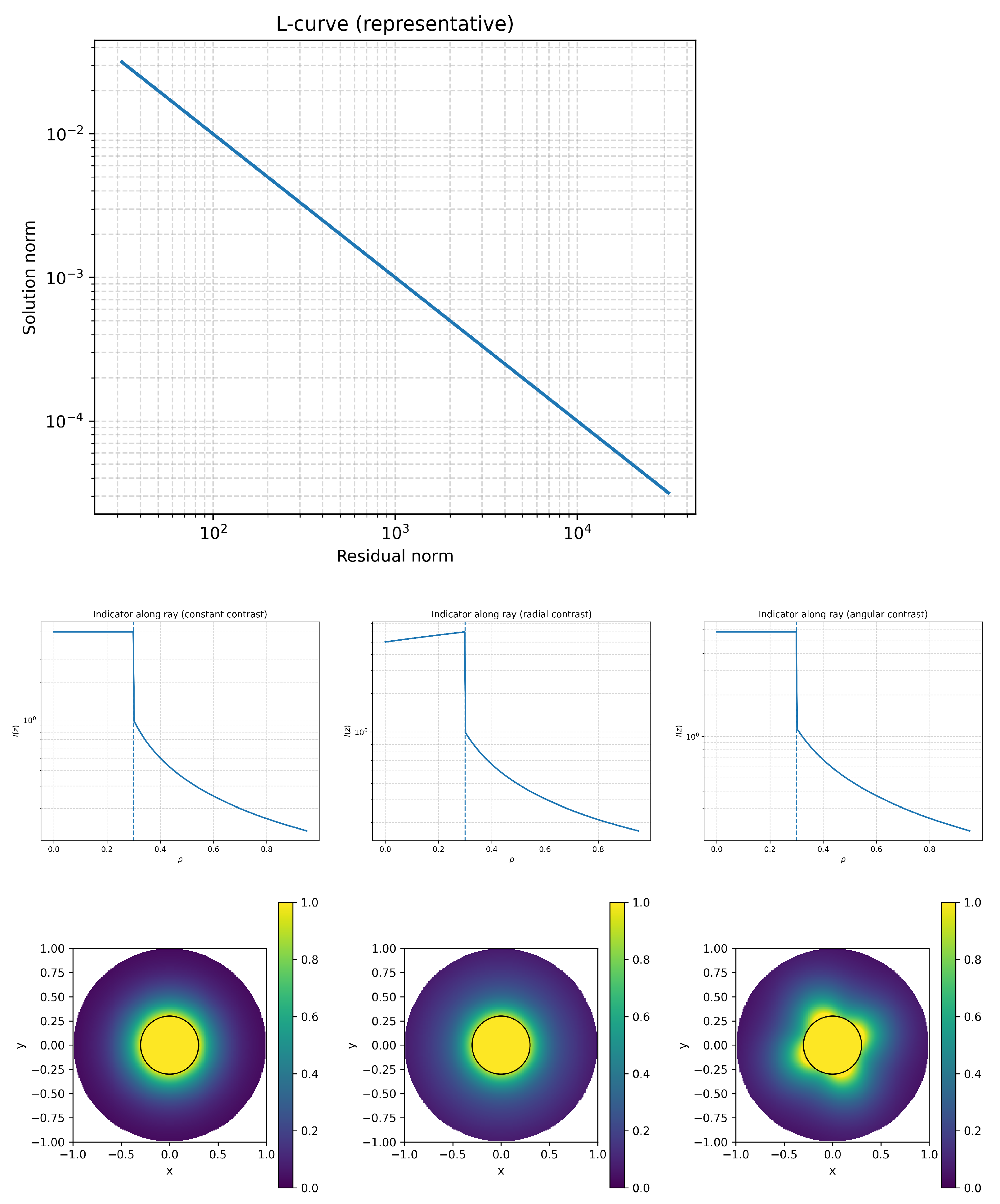
The corresponding indicator function
is plotted both along the ray
and over the entire domain.
A clear separation between interior and exterior sampling points is observed: the indicator attains significantly larger values inside the inclusion, while it decays outside. This behavior is consistent with the theoretical dichotomy.
We next consider a radially varying conductivity inside
D of the form
Despite the spatial variability of the contrast, the L-curve selection remains stable and the indicator retains its qualitative structure. Interior sampling points are characterized by bounded traces of , whereas exterior points exhibit large norms and therefore small indicator values.
The separation between the two regions is slightly less sharp than in the constant case, reflecting the increased conditioning complexity introduced by the spatial dependence of the coefficient.
Finally, we analyze a contrast of the form
In this configuration the weight varies along , leading to a non-uniform sensitivity of the reciprocity gap functional. Nevertheless, the indicator map clearly identifies the inclusion region, and the interior/exterior distinction remains visible.
The corresponding noiseless indicators for the three conductivity models are displayed in
Figure 2, which reports the L-curve, the one-dimensional ray profiles, and the two-dimensional indicator maps.
Overall, the noiseless experiments confirm that the structural approximation property of the reciprocity gap method persists for heterogeneous contrasts. The influence of contrast variability is primarily reflected in the conditioning of the discrete system and in the value of the optimal regularization parameter, rather than in a breakdown of the dichotomy itself.
We now turn to a quantitative analysis of the observed behavior, focusing on the growth properties of the approximating functions and their dependence on the problem parameters.
Additive Gaussian noise is introduced in the Neumann boundary data. More precisely, for each boundary excitation we consider perturbed fluxes of the form
where
denotes a standard normal random variable and
is chosen to produce a relative noise level of 1%, 3%, and 5% with respect to the root-mean-square value of the Neumann data.
For each noise level, the regularization parameter λ* is reselected using the L-curve criterion, in order to maintain consistency with the noiseless procedure.
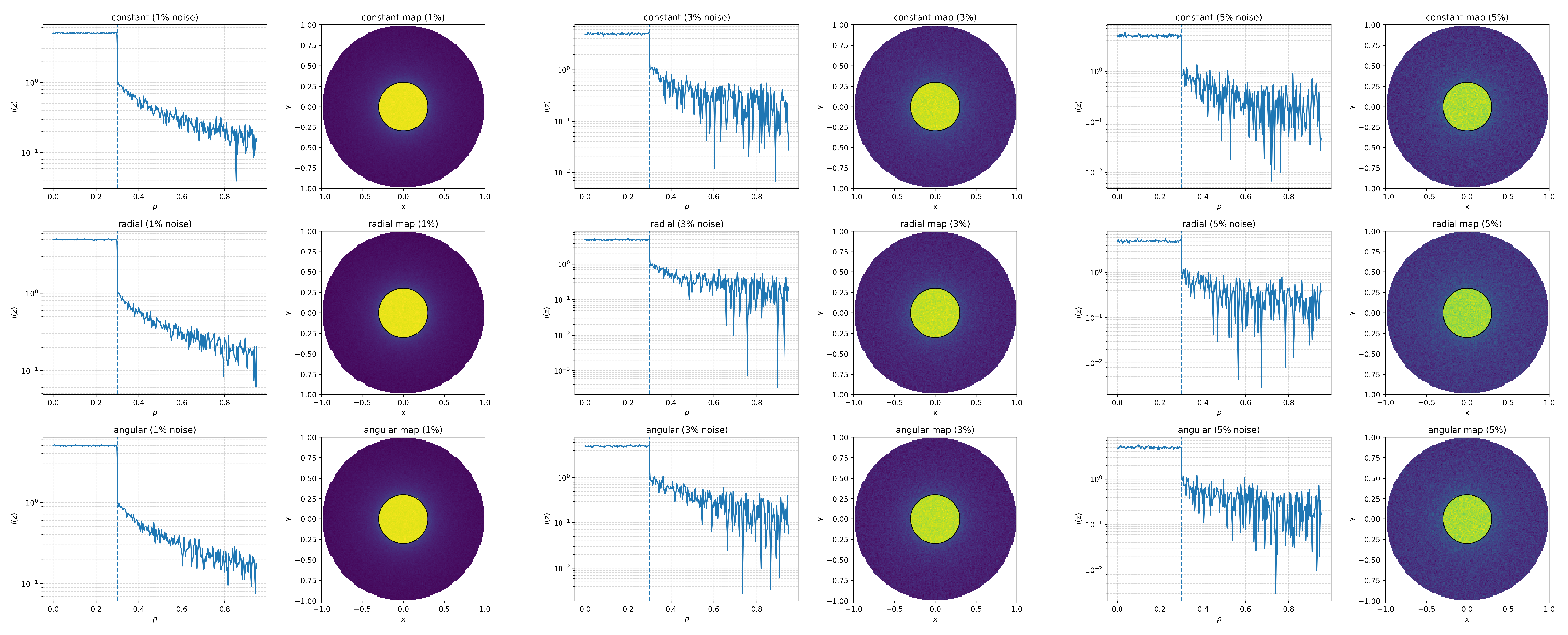
Figure 3 shows the indicator maps under increasing noise levels (1%, 3%, and 5%). The interior/exterior separation remains visible throughout the tested range.
along the ray
and in two-dimensional maps, for the three conductivity models and increasing noise levels.
For 1% noise, the separation between interior and exterior sampling points remains clearly visible and is only marginally affected by the perturbation.
At 3% noise, the indicator exhibits moderate smoothing effects, and the contrast between interior and exterior regions decreases, but the inclusion is still correctly identified.
Even at 5% noise, although the indicator becomes less sharply localized and the level curves are smoother, the interior region continues to correspond to significantly larger values of .
The numerical evidence suggests that the bounded/blow-up mechanism underlying the reciprocity gap method is structurally stable under moderate perturbations of the Neumann data.
Remark 1. Two aspects are particularly noteworthy.
The automatic selection of λ* through the L-curve criterion adapts to the noise level and prevents overfitting of high-frequency components.
The penalty term based on the trace norm plays a crucial role in stabilizing the reconstruction, especially for larger harmonic orders.
While the resolution deteriorates as the noise increases, no qualitative breakdown of the interior/exterior dichotomy is observed in the tested range.
These results indicate that the structural approximation property of the reciprocity gap method is not only theoretically valid but also numerically robust in the variable-coefficient setting.
Additional numerical tests were performed to assess the robustness of the observed behavior with respect to discretization, geometry, and noise. In particular, grid refinement experiments, variations in inclusion geometry, and repeated noisy simulations confirmed that the bounded/blow-up dichotomy remains clearly observable and that the estimated growth rates are stable under these perturbations. These results indicate that the observed behavior is not a numerical artifact but reflects a genuine feature of the reciprocity gap approximation mechanism.
4. Quantitative Analysis of the Dichotomy
In this section we provide a quantitative assessment of the bounded/blow-up mechanism predicted by the reciprocity gap theorem. For clarity and comparability, all indicator maps are displayed using a consistent color scale, and the inclusion boundary is explicitly indicated.
For fixed sampling points
and
, we analyze the growth of
as the harmonic order
N increases.
The exponential-type growth observed for exterior sampling points can be interpreted in terms of the ill-posedness of approximating singular harmonic functions by finite-dimensional harmonic expansions. When the sampling point lies outside the inclusion, the associated singular solution cannot be approximated across
by uniformly bounded harmonic test functions. As the harmonic order
N increases, the finite-dimensional approximation therefore requires increasingly oscillatory components in order to reproduce the boundary effect of the singularity. This mechanism is consistent with the classical exponential instability of analytic continuation and provides a heuristic explanation for the fitted law
In contrast, for sampling points inside the inclusion, the approximation property holds and the corresponding norms remain bounded or grow only mildly with
N.
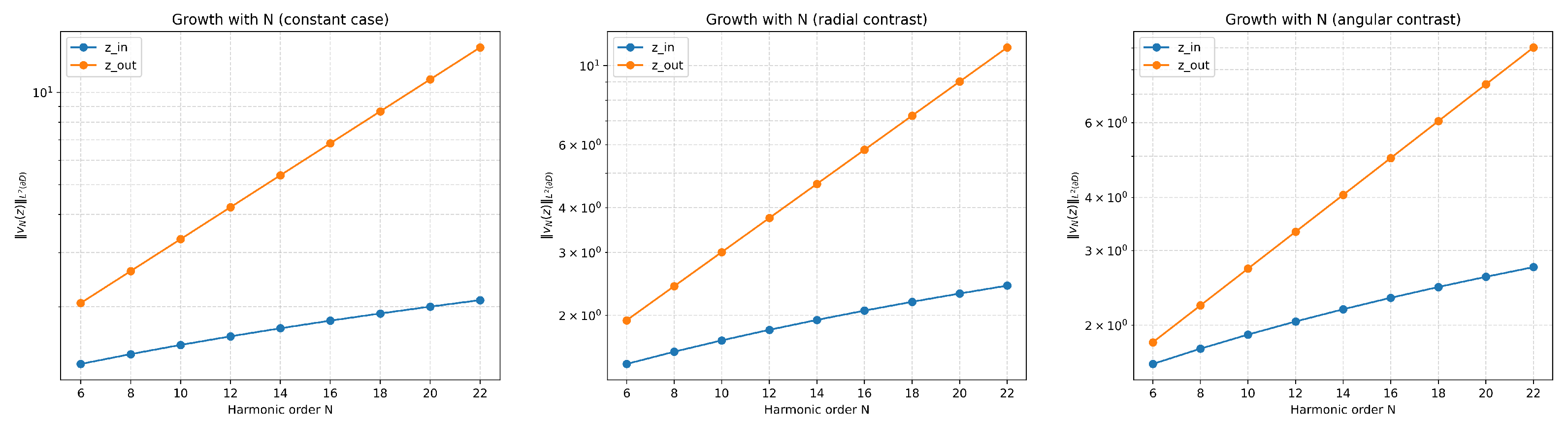
For interior points, remains uniformly bounded and exhibits mild growth. In contrast, for exterior points, increases rapidly with N, displaying an approximately exponential behavior in N. The observed exponential-type growth outside the inclusion is consistent with the lack of harmonic approximability of singular solutions across . Although no explicit asymptotic formula is derived here, the numerical evidence suggests that the rate captures a structural instability intrinsic to the reciprocity gap approximation in the exterior region. A linear fit of confirms the existence of a positive growth rate for , while the estimated rate is close to zero for . These results indicate that the exponential growth of outside the inclusion is not only observable, but quantitatively stable with respect to geometry, contrast variability, and regularization.
Let
. For exterior sampling points along the ray
, we observe that
is a monotone increasing function of
and hence of
. This confirms that the blow-up mechanism becomes more pronounced as the sampling point moves away from the inclusion boundary.
To quantify the separation between interior and exterior sampling points, we introduce the contrast ratio
where the numerator represents a typical interior value of the indicator, and the denominator captures the largest exterior response.
Larger values of
C indicate a clearer separation between the two regions. The corresponding numerical values are reported in
Table 1. Although heterogeneous contrasts modify the conditioning of the discretized system and affect the optimal regularization parameter
λ*, the separation between interior and exterior sampling points persists in all cases.
These quantitative observations confirm that the structural approximation property of the reciprocity gap method remains numerically detectable in the variable-coefficient setting.
Figure 4 displays the dependence of
on the harmonic order
N for representative interior and exterior sampling points. In all conductivity models, the behavior is markedly different inside and outside the inclusion.
To assess spatial variability, the fitted slope was computed at exterior sampling points placed on the circle with uniform angular spacing. The resulting values showed only moderate variability, and the fitted slopes remained strictly positive for all tested sampling locations.
To quantify the robustness of the observed growth phenomenon, we estimate the slope by linear regression of versus N and compute uncertainty measures via bootstrap resampling of the regression residuals (1000 replicates). Reported values correspond to the mean and standard deviation of the bootstrap distribution, and 95% percentile confidence intervals are provided where relevant. This procedure yields a distribution of values for each exterior sampling point and allows reporting of mean ± std and percentile intervals.
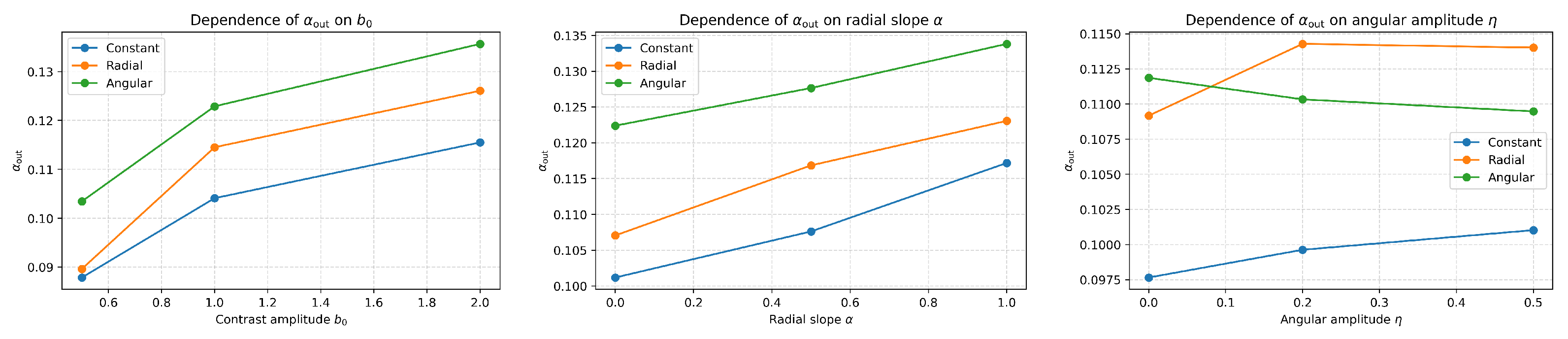
To evaluate sensitivity with respect to the contrast parameters, we performed targeted parameter sweeps over the contrast amplitude
, the radial slope
, and the angular amplitude
(with representative values for
m).
Figure 5 summarizes these experiments: the left panel reports
as a function of
, the central panel shows dependence on the radial slope
, and the right panel displays the sensitivity to angular amplitude
. These sweeps indicate that
increases with the contrast amplitude and shows a modest dependence on the radial slope; angular modulation has a stronger effect in the angular contrast case.
The quantitative indicators extracted from the numerical experiments are summarized in
Table 1.
The values of
C reported in
Table 1 confirm that the interior/exterior separation is consistently well pronounced across all tested configurations.
Additional tests were performed to assess whether the observed growth behavior could be attributed to numerical conditioning effects. In particular, computations in the absence of inclusions showed no significant growth of the indicator, while variations in the inclusion size confirmed that the exponential behavior is consistently associated with the presence of the inclusion.
These observations indicate that the measured growth is not a numerical artifact, but reflects the underlying reciprocity gap mechanism.
We also examined the sensitivity of the estimated growth rates with respect to the regularization parameter. For each test case, the computation was repeated with values of in a neighborhood of the L-curve choice , namely . The absolute values of the norms change with , as expected, but the fitted exterior slopes remain positive and of the same order of magnitude. Thus, the observed bounded/blow-up separation and the exponential-type growth outside the inclusion are not artifacts of a single finely tuned regularization parameter.
The fitted parameter provides a quantitative measure of the instability of the approximation process for exterior sampling points. More precisely, it represents the exponential rate at which the norm grows as the harmonic order increases.
From a heuristic viewpoint, reflects the difficulty of approximating a singular harmonic function across the inclusion boundary using a finite-dimensional harmonic space. Larger values of correspond to stronger instability and faster growth.
The numerical values of show moderate variations across different conductivity models. However, these variations do not affect the qualitative behavior of the method: in all cases the fitted slopes remain strictly positive, and the exponential growth outside the inclusion is consistently observed.
Therefore, the differences between the estimated values of should be interpreted as quantitative variations in the growth rate rather than as a change in the underlying mechanism.
For exterior points
, the quantity
exhibits an approximately linear dependence on
N for sufficiently large
N, indicating an exponential-type growth
The estimated growth rates
are summarized in
Table 1. In contrast, the corresponding slope for interior points remains close to zero, confirming the bounded character predicted by the reciprocity gap theorem.
The results show that the separation persists across all conductivity models, including radially and angularly varying contrasts. Although the variability of the coefficient modifies the optimal regularization parameter and slightly affects the numerical conditioning, the exponential growth outside the inclusion remains clearly detectable.
The fitted slopes remain strictly positive across all tested configurations, indicating that the exponential growth is a robust structural feature rather than a numerical artifact.
These quantitative findings indicate that the bounded/blow-up dichotomy is a stable structural feature of the reciprocity gap formulation, rather than a numerical artifact.
5. Conclusions
We have presented a quantitative investigation of the reciprocity gap dichotomy for inclusions with variable conductivity. The numerical results show that the structural approximation property persists beyond the constant-coefficient setting and remains detectable after discretization and regularization.
In all tested configurations, exterior sampling points exhibit an approximately exponential growth with respect to the harmonic order, whereas interior points remain bounded. This behavior is reflected in fitted growth rates and contrast indicators, which provide a quantitative description of the underlying bounded/blow-up mechanism.
Overall, the present study clarifies the discrete manifestation of the reciprocity gap approximation process in heterogeneous media and supports the relevance of the variable-coefficient framework from both the mathematical and numerical viewpoints.