Article

Task Scheduling Optimization in Cloud-Edge Collaborative Architecture via a Multi-Strategy Artificial Lemming Algorithm

1
Department of Materials Science and Engineering, City University of Hong Kong, Hong Kong 999077, China
2
College of Design, Hanyang University, Ansan 16588, Republic of Korea
*
Author to whom correspondence should be addressed.
Mathematics 2026, 14(10), 1659; https://doi.org/10.3390/math14101659
Submission received: 30 March 2026 / Revised: 8 May 2026 / Accepted: 12 May 2026 / Published: 13 May 2026
(This article belongs to the Special Issue AI, Machine Learning and Optimization)

Abstract

In the cloud computing environment, various heterogeneous architectures have emerged, and the cloud-edge collaborative task scheduling architecture has come into being under this background. However, the complexity of cloud-edge heterogeneous architecture significantly restricts the improvement of scheduling performance. Therefore, researchers propose solving this problem by leveraging intelligent optimization algorithms. The Artificial Lemming Algorithm has received extensive attention due to its strong robustness. However, when dealing with the problem of cloud-edge collaborative task scheduling, there are still some drawbacks, such as long system response time and unstable scheduling performance. In response to the above problems, this paper proposes a multi-strategy artificial lemming algorithm. Specifically, by coordinating high-order Chebyshev polynomials with chaotic mapping to enhance the richness of the initial population, the scheduling response time is indirectly shortened. Secondly, the Adaptive Spatial Search Mechanism is introduced to make up for the deficiencies in the exploration stage, enhance the algorithm’s exploration ability, and thereby improve the optimization effect of scheduling satisfaction. Furthermore, the Bernstein-Guided Correction Strategy is introduced to enhance the exploitation capability of the algorithm to improve the stability of cloud-edge scheduling. The experimental results demonstrate that compared with the baseline algorithms, the proposed MALA reduces the total scheduling cost by at least 3% across cloud-edge collaborative resource scheduling problems of different scales.

1. Introduction

With the continuous evolution and in-depth implementation of cloud computing technology [1], the diversified exploitation of heterogeneous computing frameworks has become a prominent feature of the iteration of computing power infrastructure, driving the transformation of computing paradigms towards distributed collaboration. Against this technological backdrop, the cloud-edge collaborative task scheduling architecture emerged [2]. Its core value lies in organically integrating high-performance computing resources in the cloud with the local storage advantages at the edge, achieving dynamic adaptation and efficient scheduling of heterogeneous software components and distributed resource pools, thereby significantly enhancing resource utilization efficiency and task execution effectiveness. However, in practical application scenarios, the optimal allocation of computing resources (in the cloud) and storage resources (at the edge) in a cloud-edge collaborative environment faces multiple challenges: on the one hand, complex factors such as resource heterogeneity, task constraints, and dynamic load changes need to be considered; On the other hand, such problems are essentially NP-Hard problems. The exponential growth characteristic of their solution space makes it difficult for traditional deterministic algorithms to obtain the global optimal solution within polynomial time. To effectively address this technical bottleneck, both the academic and industrial communities have generally shifted their research focus to intelligent optimization algorithms. Relying on their global optimization capabilities in complex solution Spaces and adaptability to multi-constraint scenarios, they provide efficient and robust solution paths for the resource allocation challenges in cloud-edge collaborative task scheduling.
The essence of the cloud-edge collaborative task scheduling architecture lies in achieving the optimal allocation and dynamic collaboration of resources between the cloud and the edge [3], ensuring that when any node receives a task set, it can quickly complete the precise matching and efficient allocation of tasks and target resources. As an efficient service carrier that directly faces market demands, the cloud-edge collaborative architecture encapsulates and abstracts the underlying technical details, enabling users to conveniently obtain services without having to deeply understand its internal operation mechanism. They only need to pay the corresponding fees to the service provider, significantly lowering the threshold for technology usage. Therefore, building an efficient scheduling scheme has dual values: on the one hand, it can ensure the optimization of service quality with the lowest user cost input, and enhance user experience and service cost-effectiveness; On the other hand, through precise matching of resource supply and demand, the idleness and redundant consumption of resources can be minimized to the greatest extent, achieving intensive utilization of computing power and storage resources, and providing support for the sustainable exploitation of the cloud-edge collaborative ecosystem. However, with the continuous surge in task scale and the constant increase in the complexity of the scheduling environment [4], the solution time of such optimization problems shows an exponential growth trend, which greatly restricts the efficiency and feasibility in practical applications.
To address the above challenges, researchers have turned their attention to intelligent optimization algorithms [5,6], taking them as the core technical approach to solving such complex scheduling problems. Compared with traditional scheduling algorithms, intelligent optimization algorithms demonstrate significant advantages in both solution efficiency and optimization quality, thanks to their global exploration ability of the solution space, adaptability to dynamic environments, and compatibility with multiple constraints. At present, many intelligent optimization algorithms and their variants have been applied to scheduling problems [7,8,9,10,11,12,13]. The Artificial Lemming Algorithm (ALA) [14], as one of the more innovative emerging algorithms in the current field of intelligent optimization, has a core principle that conducts mathematical modeling and mechanism simulation of four typical behaviors of lemmings in the natural environment. Since its proposal, this algorithm has attracted extensive attention from the academic community due to its characteristics of simple and clear structure, flexible parameter setting, and intuitive optimization logic. It has been applied and explored in multiple practical fields such as engineering optimization, resource scheduling, and path planning, demonstrating good problem adaptability and exploitation potential. However, when the artificial lemming algorithm is applied to the specific scenario of cloud-edge collaborative task scheduling, there is still room for performance optimization. Specifically, it is manifested in practical problems such as low scheduling service quality and insufficient stability of the optimization process, which restricts the actual efficiency of the algorithm in complex scheduling scenarios. In response to this situation, this paper innovatively proposes a Multi-strategy Artificial Lemming Algorithm (MALA). By improving and optimizing the core mechanism, it effectively makes up for the shortcomings of the original algorithm and provides a targeted solution to the above problems. The main contributions of this article are as follows:
(1)
A high-order Chebyshev polynomial cooperative chaotic initialization strategy is designed to enhance the diversity of the initial population. Then, an adaptive spatial search mechanism and a Bernstein-guided correction strategy are introduced, and a multi-strategy collaborative framework is proposed to combine these three components. Meanwhile, each component is tailored to address specific drawbacks of the standard ALA, including poor initial distribution, insufficient exploration, and unstable convergence.
(2)
The multi-strategy collaborative framework replaces the random initialization and the single fixed search pattern of the ALA, which helps to significantly improve the algorithm’s global exploration capability and local exploitation capability simultaneously.
(3)
This paper provides a new paradigm for designing metaheuristic algorithms specifically for cloud-edge collaborative resource scheduling, by integrating population initialization, adaptive search, and Bernstein-guided correction into an optimization loop.
(4)
The effectiveness of MALA is verified on the CEC 2022 benchmark functions and practical cloud-edge scheduling instances, and the experimental results indicate that MALA has excellent competitiveness in solving complex, large-scale scheduling problems.
The remaining chapters of this article are organized as follows: Section 2 reviews the research progress at home and abroad related to this study; Section 3 systematically expounds the overall framework, core elements, and optimization goals of cloud-edge collaborative task scheduling, and clarifies the mathematical modeling of the problem. Section 4 provides a detailed introduction to the complete architecture of MALA, the collaborative mechanisms of each strategy module, and the specific implementation steps. Section 5 quantitatively analyzes the performance indicators of the algorithm and discusses the results through comparative experiments. Section 6 summarizes the main research work, innovation points, and practical application value of this paper, and looks forward to the future research directions.

2. Related Work

The core idea of cloud-edge collaborative task scheduling lies in achieving precise matching and optimal allocation of tasks and computing resources under the premise of meeting complex constraint conditions, thereby maximizing resource utilization efficiency and ensuring the achievement of service quality goals. However, the widespread problem of resource heterogeneity in the cloud-edge environment significantly increases the difficulty of adapting tasks to resources, leading to challenges such as elevated solution space dimensions and enhanced coupling of constraint conditions in the scheduling process, further exacerbating the complexity of the scheduling problem [15].
To address the growing demand for efficient resource utilization in distributed computing environments, researchers have extensively investigated cloud-edge collaborative scheduling as a critical paradigm for balancing computational load, reducing latency, and improving system performance. This paradigm leverages the complementary strengths of cloud and edge resources to support diverse application scenarios, yet it introduces unique challenges related to heterogeneity, dynamism, multi-objective optimization, and security, driving the exploitation of targeted scheduling solutions.
Focusing on core issues of resource utilization and scheduling complexity, Zhang et al. [16] addressed the prevalent problem of low edge resource utilization by proposing a cloud-edge collaborative task scheduling method based on model segmentation. The core innovation lies in dynamically optimizing task model segmentation points via an improved multi-objective optimization algorithm, which scientifically partitions tasks into local execution and cloud offloading segments to maximize resource utilization efficiency and task execution effectiveness. Complementing this line of work, Tang et al. [17] tackled the high computational complexity of scheduling in heterogeneous environments by introducing a container-based task scheduling algorithm with a compound greedy strategy, which constructs a dynamic priority evaluation model to streamline task sequencing and resource matching, effectively reducing scheduling overhead in complex heterogeneous scenarios. To balance conflicting performance metrics, Chen et al. [18] proposed an attention-enhanced deep reinforcement learning scheduling algorithm, which adaptively focuses on key task and resource state information to autonomously optimize scheduling policies in complex scenarios. Moving beyond two-dimensional trade-offs, Wu et al. [19] addressed multi-dimensional coordination challenges—including cache ratio, computing capacity, and offloading ratio—by developing a multi-dimensional scheduling model paired with a parallel interior point-integrated branch-and-bound algorithm. Their experimental results demonstrate significant improvements in key indicators such as average task response delay, system energy consumption control, and node load balancing degree, validating the effectiveness of multi-dimensional optimization in cloud-edge scheduling.
For privacy-sensitive and resource-constrained application scenarios, Su et al. [20] addressed core challenges such as limited storage resources and intensified privacy leakage risks in intelligent healthcare multi-task scenarios by proposing a refined cloud-edge collaboration framework integrating federated learning and blockchain technology, alongside a tailored double-layer optimization scheduling model. Experimental results confirm that the scheme significantly reduces task execution delay and system power consumption while providing enhanced security, offering a secure and efficient solution for privacy-critical cloud-edge scheduling. Targeting the practical demand for real-time task allocation in heterogeneous environments, Lyu et al. [21] proposed a heuristic scheduling algorithm based on the kinship between tasks and nodes, aiming to optimize resource allocation for latency-sensitive applications with heterogeneous edge cloud servers.
Under the dual constraints of limited resources, the algorithm iteratively optimizes task-node mapping through heuristic rules to achieve accurate resource-task matching. Experimental verification demonstrates that this algorithm not only significantly improves the overall utilization efficiency of heterogeneous edge resources but also effectively satisfies the time-constraint requirements of real-time Internet of Things tasks, greatly enhancing scheduling performance and task completion rate. To tackle the dynamic balance between energy consumption and system delay in cloud-edge collaborative scenarios, Song et al. presented two optimization schemes: a joint task offloading and resource allocation algorithm, as well as a game-theory-based cloud-edge collaborative computing offloading solution [22]. On the basis of guaranteeing system stability, the proposed schemes effectively shorten task response delay, remarkably reduce the overall energy consumption, and substantially improve the comprehensive output performance.
Aiming at the optimal allocation of tasks and resources in geographically distributed server clusters, Lu et al. developed a task scheduling queue algorithm that incorporates data transmission delay awareness and server load balancing [23]. By constructing a dynamic priority queue mechanism with the core scheduling criteria of task transmission delay sensitivity and real-time server load status, this algorithm enables dynamic matching and orderly allocation of tasks and resources. To solve the problem of insufficient classification accuracy in existing cloud-edge collaborative frameworks when handling diverse workloads, Lu et al. put forward a deep-learning-integrated cloud-edge collaboration framework [24]. Meanwhile, an efficient scheduling decision-making mechanism is constructed by combining a novel adaptive mutation algorithm and a random point spacing crossover method. Experimental results illustrate that this method not only significantly enhances workload classification accuracy but also lowers the overall system energy consumption, showing favorable adaptability in complex load scenarios.
For model-partition-driven cloud-edge scheduling, Yin et al. proposed a method for multi-objective task scheduling in intelligent production lines based on cloud edge has been proposed [25]. To overcome the imbalance between execution time and edge resource waste in conventional DNN partitioning, they employed a pre-execution mechanism to extract accurate influencing factors of segmentation points and designed a multi-threaded, multi-group, multi-objective algorithm improved from NSGA-III. Regarding evolutionary multitask optimization for high-dimensional scheduling problems, Wang et al. proposed an individually guided multi-task evolutionary algorithm based on knowledge sharing and skill membership. By decomposing optimization into vertical intratask evolution and horizontal intertask knowledge transfer [26], it enhances positive knowledge transfer and suppresses negative transfer. For game-theoretic task offloading and resource allocation, Wang et al. formulated multi-user task offloading as a potential game with system utility maximization as the objective [27], considering device heterogeneity and inter-channel interference. They proposed a Game-Theory-based Particle Swarm Optimization (GTPSO) algorithm to achieve Nash equilibrium, jointly optimizing task offloading decisions and computational resource allocation. Experiments confirm that GTPSO reduces latency and energy consumption with favorable scalability to increasing user numbers. Despite these strengths, the method overlooks model-structure-aware task partitioning and underutilizes the collaborative advantages of edge-cloud distributed execution. To bridge learning, training, and resource scheduling, Doostmohammadian et al. proposed a distributed co-optimization framework for machine learning and CPU scheduling across networked data centers [28]. This work formulates a bi-objective problem that minimizes both CPU allocation cost and ML training loss under sum-preserving resource constraints. A consensus-based gradient-tracking algorithm is designed to ensure all-time resource-demand feasibility, and log-scale quantization is adopted to reduce communication overhead while mitigating quantization error. Rigorous convergence proofs are provided under time-varying topologies, even for non-convex local losses. Validated on distributed SVM, regression, and MNIST tasks, the method reduces the optimality gap by over 50%. Nevertheless, this general framework does not incorporate hierarchical cloud-edge architecture, model partitioning, or combinatorial offloading decisions, limiting its direct applicability to cloud-edge intelligent scheduling.

3. Cloud-Edge Architecture Task Scheduling Framework

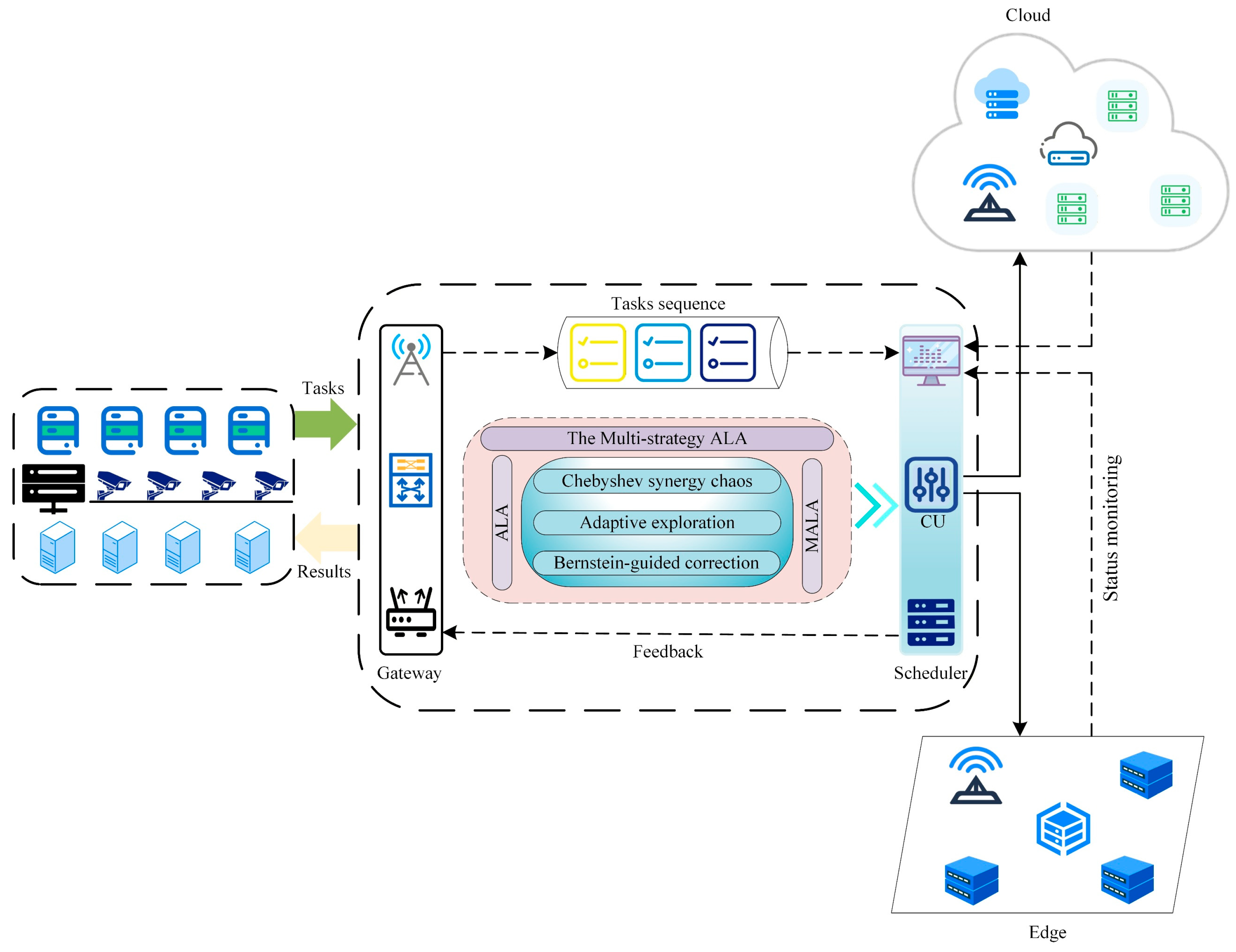
In the task scheduling system of the cloud-edge collaborative architecture, with the rapid increase in Internet of Things devices and the rapid exploitation of edge computing technology, computing tasks present characteristics such as heterogeneity and high real-time requirements. At this time, a reasonable scheduling scheme can not only improve the utilization rate of resources but also ensure the efficient execution of tasks, and its importance is becoming increasingly prominent. Therefore, how to precisely allocate computing tasks to the most suitable computing resources (cloud or edge) based on the attributes of the tasks and the status of the resources has become a key issue that urgently needs to be addressed in this field. Figure 1 shows the cloud-edge collaborative task scheduling architecture based on the multi-strategy artificial lemming algorithm. This architecture achieves efficient scheduling through the collaborative cooperation of multiple links: when the system receives computing tasks from various terminals, these tasks will be orderly included in the task queue and wait for sequential execution. This queue mechanism can effectively prevent computing resources from being burdened with excessive tasks in a short period of time, thereby preventing task blockage or execution delay caused by resource overload and laying a stable foundation for subsequent scheduling optimization. Based on the task queue, the system introduces a multi-strategy artificial lemming algorithm for scheduling optimization. This algorithm integrates the local search strategy and the global exploration strategy. It can not only make fine adjustments to the matching details of tasks and resources, but also consider the resource load balancing from an overall perspective. Through iterative calculation, a reasonable scheduling strategy that takes into account both the real-time performance of tasks and the utilization rate of resources is ultimately obtained. Immediately after, the task scheduler, as the core execution module, will, based on the optimized scheduling strategy, allocate tasks differently according to the resource characteristics of the cloud and the edge. For tasks with high real-time requirements and localized data processing, they are assigned to the edge close to the terminal to reduce transmission delay. Ultimately, the task monitor will continuously track and monitor the execution status of assigned tasks in real time, including the progress of task execution, real-time load changes in resources, and whether there are any abnormal situations. It will promptly feed the monitoring data back to the scheduling system, providing a basis for possible dynamic adjustments and ensuring the stability and reliability of the entire task scheduling process.

3.1. The Mapping of Computing Tasks and Computing Resources

This article agrees to represent computing resources with virtual machines. Suppose there is N T computing task, and its set can be represented as a vector T a s k s = T a s k 1 , T a s k 2 , , T a s k N T of 1 N T ; Suppose there is N V M virtual machine, and its set can be represented as a vector V M s = V M 1 , V M 2 , , V M N V M of 1 N V M . Based on this, the mapping relationship between tasks and virtual machines can be represented by a two-dimensional vector U of N T 1 .
U = u 1 u i u N T N T 1
Among them, u i represents u i = u i 1 , u i 2 , , u i j , u i N V M vector of 1 N V M . If the value of the second element of u i j is 1, it indicates that the i th computing task is assigned to the j th computing resource (virtual machine). Since it is stipulated that each computing task can only be mapped to a unique computing resource at the same time, let u i = 1 .
To accurately depict the actual scenarios of task scheduling under the cloud-edge collaborative architecture, this paper selects three core indicators to construct a quantitative evaluation system for scheduling performance. Firstly, customer satisfaction, as the core consideration dimension of scheduling optimization, directly reflects users’ acceptance of the task execution results. Its quantified value mainly depends on the degree of deviation between the stipulated execution time limit of the task (i.e., the maximum tolerable delay agreed upon in the service level agreement) and the actual completion time. For delay-sensitive tasks (such as real-time monitoring data processing), if the actual execution time exceeds the specified threshold, it will significantly reduce customer satisfaction. For tasks with a higher tolerance for time delay, the impact of minor time deviations on satisfaction is relatively gentle. Secondly, the optimization of the execution cost of computing resources is the key to improving the economic efficiency of scheduling. This indicator needs to comprehensively consider two factors: on the one hand, it is closely related to the data volume of the task itself. The larger the data volume, the higher the storage and transmission costs generated during the transmission and preprocessing between cloud-edge nodes. On the other hand, it depends on the processing capacity of the virtual machine. Although high-performance virtual machines can accelerate task completion, the rental cost of computing power per unit of time is usually higher. Therefore, a dynamic balance needs to be achieved between processing efficiency and resource consumption. Thirdly, time cost, as a key quantitative indicator for measuring scheduling efficiency, has multi-dimensional characteristics in its composition: The size of the task (usually represented by the amount of data or the number of instructions) determines the basic computational load. The processing speed of the virtual machine (such as the number of instructions executed per second) directly affects the computing time consumption, while the resource bandwidth between cloud-edge nodes restricts the transmission efficiency of task data. Together, these three factors determine the total time consumption of the entire process from task submission to completion, and they are the core basis for evaluating the real-time performance of scheduling strategies. Table 1 provides detailed annotations of the specific parameters involved in this model, offering a clear parameter reference for understanding and applying this scheduling architecture.

3.2. Evaluation Indicators for Cloud-Edge Coordination Task Scheduling

In the research on task scheduling in cloud-edge collaborative architecture, for specific batches of computing tasks, the core objective of researchers is to achieve global optimality in task allocation by optimizing resource allocation—that is, to maximize the completion quality of task allocation under the premise of minimizing cost input. This goal is specifically reflected in multi-dimensional optimization demands; it is necessary to minimize the task response delay of computing resources to ensure that tasks can be processed quickly. It is also necessary to pursue the minimization of the execution cost of computing tasks and enhance the economic efficiency of resource utilization. At the same time, it is necessary to maximize customer satisfaction and ensure that the service quality meets expectations. The three together constitute the core objective system of task scheduling optimization, and there is a certain trade-off relationship among them (for example, reducing costs may require sacrificing some response speed, while excessive compression of delay may lead to cost increase), and a dynamic balance needs to be achieved through collaborative optimization. Based on the scheduling performance evaluation framework established in the previous text, this paper further quantitatively characterizes the above optimization objectives: taking customer satisfaction, task execution cost, and system time cost as the key indicators to describe scheduling performance, and formally defining them through mathematical functions. Among them, Equation (2) is used to describe the customer satisfaction function, Equation (3) characterizes the task execution cost function, and Equation (4) defines the system time cost function.
S a t i s f a c t i o n = N T C N T
Here, N T C represents the number of tasks completed within the specified time.
E x e c o s t = i = 1 N T j = 1 N V M u i j C a C o s t V M j N I T i N I V M j + L o C o s t V M j I n T a s k i + O u t T a s k i
Here, C a C o s t V M j represents the computing cost of the j th computing resource, N I T i represents the number of instructions included in the i th task, and N I V M j represents the number of instructions processed per second by the j th computing resource. L o C o s t V M j represents the load cost of the j th computing resource, and I n T a s k i and O u t T a s k i respectively represent the input and output sizes of the i th computing task.
T i m e c o s t = i = 1 N T j = 1 N V M u i j N I T i N I V M j + I n T a s k i + O u t T a s k i R B V M j
where R B V M j represents the resource bandwidth of the j th computing resource. Here, this paper introduces the total system completion time as a comprehensive indicator for characterizing scheduling performance. It is defined as the total duration from the execution of the first task to the completion of the last task. This indicator directly reflects the processing efficiency of the scheduling scheme on the overall task flow and is one of the core dimensions for measuring the comprehensive performance of the system. Because the three evaluation indicators of customer satisfaction, task execution cost, and system time cost mentioned earlier have different dimensions and numerical ranges, if they are directly used in the construction of multi-objective optimization models, the incomparability among the indicators will lead to a distortion of the optimization direction.
To address the task scheduling of the varying scales, the Max-Min normalization technique is employed in this study. This strategy not only eliminates the impact of dimensional inconsistencies but also maps all objective indicators into the identical range of [0, 1]. Consequently, it ensures fair comparability across different optimization targets during the aggregation process. Furthermore, Max-Min is characterized by its minimal computational overhead, making it highly efficient for real-time cloud-edge collaborative task scheduling. More importantly, this normalization scheme guarantees numerical stability under extreme load conditions. Max-Min normalization improves numerical comparability of objectives and reduces scale imbalance.
Experimental results demonstrate that the max-min normalization technique effectively preserves the relative trend characteristics of the original data while transforming absolute numerical values into a standardized range [29,30,31]. To this end, this paper adopts the maximal-minimization method to normalize the above objective functions. After normalization processing, the task execution cost objective function is expressed by Equation (5), and the system time cost objective function is expressed by Equation (6).
E x e c o s t = 1 N T i = 1 N T j = 1 N V M u i j C a C o s t V M j N I T i N I V M j + L o C o s t V M j I n T a s k i + O u t T a s k i m a x i , j C a C o s t V M j N I T i N I V M j + L o C o s t V M j I n T a s k i + O u t T a s k i
T i m e c o s t = i = 1 N T j = 1 N V M u i j N I T i N I V M j + I n T a s k i + O u t T a s k i R B V M j m a x i , j N I T i N I V M j + I n T a s k i + O u t T a s k i R B V M j
In the cloud-edge collaborative task scheduling scenario, the core demand of researchers lies in achieving multi-objective collaborative optimization: taking maximizing customer satisfaction as the service quality benchmark, while keeping the task execution cost and time cost at the lowest level, thereby achieving an efficient, economical, and user-expected scheduling process. These three goals are both interrelated and involve certain games—for instance, excessive compression of execution costs may lead to an increase in service latency, thereby reducing customer satisfaction; However, pursuing the ultimate time efficiency may require a higher investment in computing power resources, which will push up the execution cost. Based on the three sub-objective functions normalized in the previous text, this paper integrates the above multi-dimensional demands into a unified optimization model. The overall optimization objective is shown in Equation (7).
T o l c o s t = m i n E x e c o s t + T i m e c o s t S a t i s f a c t i o n
Given that different customers may have differentiated optimization requirements for specific dimensions (for example, in some scenarios, customer satisfaction is emphasized more, while in others, execution costs are prioritized for control), this paper introduces three weight parameters α 1 , α 2 , and α 3 into the total objective function, which are respectively used to adjust the priority ratios of customer satisfaction, task execution costs, and system time costs in the global optimization. The final optimization objective function after the above parameter configuration is shown in Equation (8).
T o l c o s t = m i n α 1 E x e c o s t + α 2 T i m e c o s t α 3 S a t i s f a c t i o n

4. The Proposed Multi-Strategy Artificial Lemming Algorithm

In this section, the basic principles and core structure of the standard artificial lemming algorithm are first systematically expounded, providing a theoretical basis for the analysis of subsequent improved algorithms. Furthermore, the design motivation of the multi-strategy artificial lemming algorithm is deeply analyzed. That is, given the possible problems such as insufficient optimization accuracy and slow convergence speed of the standard algorithm in complex scheduling scenarios, the improvement direction is clarified, and its core improvement strategy is elaborated in detail.

4.1. The Original Artificial Lemming Algorithm

The inspiration of the artificial lemming algorithm comes from the ecological behavioral characteristics of lemming populations in nature. The algorithm abstractly simulates the behaviors of lemmings, such as group migration, regional foraging, and density adjustment, and constructs a computational model with adaptive optimization ability. To further enhance the optimization efficiency of the algorithm, an energy decrement mechanism is introduced. This dynamic adjustment mechanism enables the algorithm to switch autonomously between exploration and exploitation, ensuring global coverage of the solution space while enhancing the efficiency of local optimization, thereby effectively improving the algorithm’s optimization performance in complex optimization problems.
Consistent with most intelligent optimization algorithms, the initial population position parameters of ALA are randomly generated within the upper and lower bounds of the variables to be solved. The specific generation method is shown in Equation (9).
P o s i = l o + β u p l o
Here, P o s i represents the i th individual in the population, l o represents the lower bound vector for solving the problem, β represents a random number with a value between 0 and 1, and u p represents the upper bound vector for solving the problem.
Based on this, the algorithm calculates the energy coefficient E C and switches to different optimization stages. If E C > 1 , the individual position update follows Equation (11), if E C 1 , the individual position update adopts Equation (13), and the value of E C is calculated by Equation (10). This stage switching mechanism, based on energy coefficients, realizes the adaptive regulation of the algorithm exploration and exploitation process.
E C = 4 a r c t a n 1 I t e r M a x i t e r l n 1 k u
Here, I t e r represents the current number of iterations, M a x i t e r is the maximum number of iterations. a r c t a n represents the arctangent function, l n represents the logarithmic function with base e, and k u represents a random number with a value in [0, 1].
P o s i n e w = P o s b e s t + Y γ δ P o s b e s t P o s i + 1 δ P o s i P o s r 1 i f   φ   <   0.3 P o s i + Y ε P o s b e s t P o s r 2 o t h e r w i s e
Here, P o s b e s t represents the global optimal individual in the current population, and its position corresponds to the optimal solution discovered during the algorithm’s optimization process. γ is a random number that follows the standard Gaussian distribution (i.e., with a mean of 0 and a variance of 1), and δ and φ are two random numbers whose values are not equal to k u within the interval [0, 1] and are not equal to each other. P o s r 1 and P o s r 2 respectively represent two random individuals in the population that are different from the current individual P o s i and are independent of each other. The specific value of Y is determined by Equation (11).
Y = 1 i f 2 i u + 1 = 1 1 i f 2 i u + 1 = 2
Among them, i u represents a random number with a value between 0 and 1 and is not equal to either δ , φ or k u .
P o s i n e w = P o s b e s t + Y P o s i η i = 1 D P o s b e s t P o s i 2 s i n λ + c o s λ i f   ν   <   0.5 P o s b e s t + Y 0.02 G H O P 2 3 l P o s b e s t P o s i o t h e r w i s e
Among them, both η , l and ν are random numbers with values ranging from 0 to 1 and are not equal to i u , δ , k u and φ . D represents the dimension for solving the problem. s i n represents the sine function, and c o s represents the cosine function. λ is calculated by Equation (14).
λ = 2 π θ
Here, θ represents a random number with a value between 0 and 1 that is not equal to δ , φ , i u , η , k u and ν , and G H is calculated by Equation (15).
G H = 1 I t e r M a x i t e r
Here, O P is calculated by Equation (16).
O P = g a m m a 2.5 s i n 0.75 π 2 0.25 1.5 g a m m a 1.25
Here, g a m m a represents the gamma function.

4.2. Cloud-Edge Coordination Task Scheduling Based on MALA

When handling cloud-edge coordination task scheduling with standard ALA, problems such as low user satisfaction, long system response time, and unstable scheduling performance have been exposed. The reason for this lies in the fact that ALA has performance insufficiency during the process of optimizing scheduling. Therefore, this section will introduce a variety of strategies to improve the above-mentioned problems.

4.2.1. Initialization for High-Order Chebyshev Polynomial Cooperative Chaotic

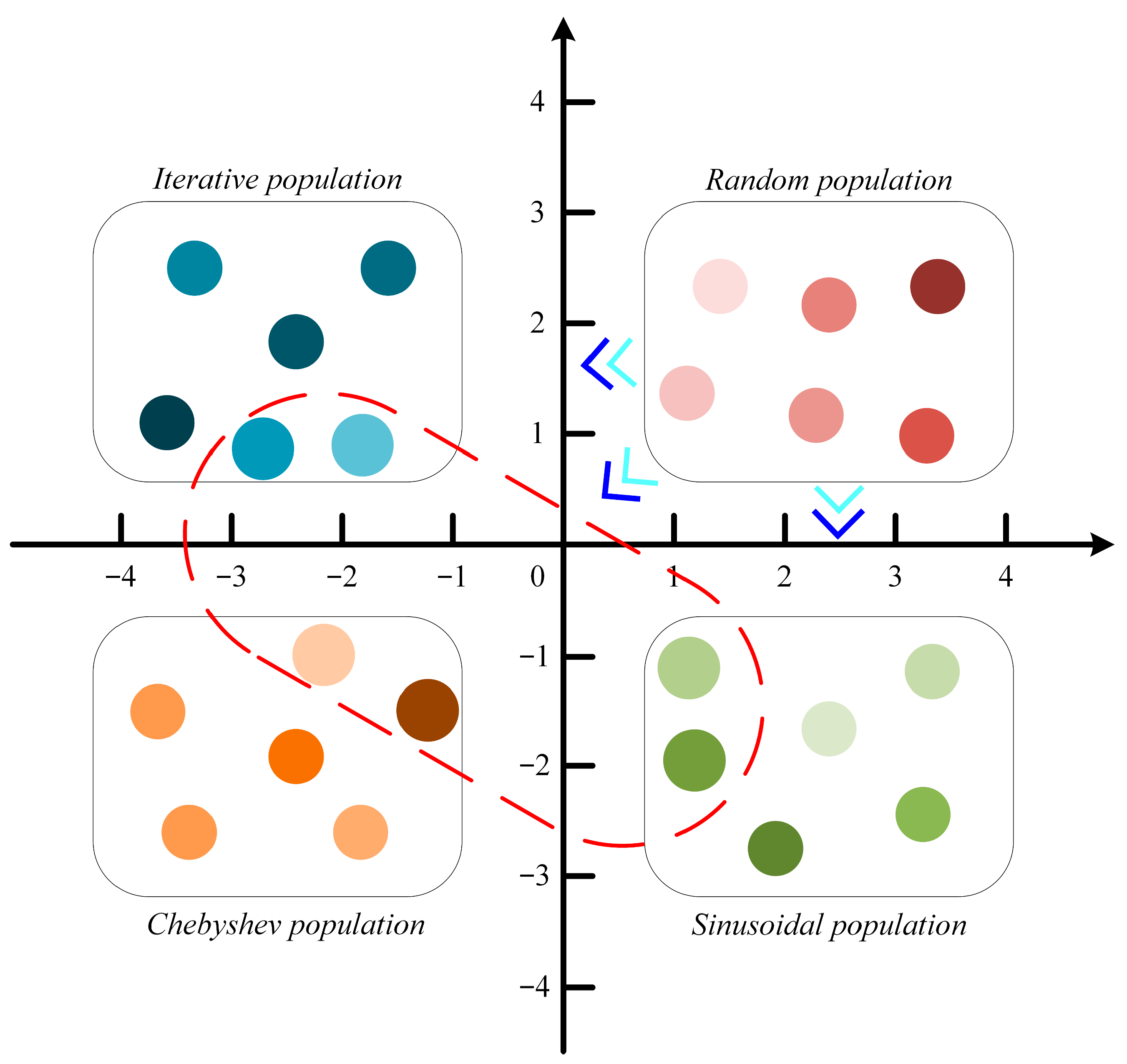
In the cloud-edge collaborative task scheduling scenario, the ALA has a significant problem of relatively long system response time. Delving into the root cause of this phenomenon, the core lies in the algorithm initialization stage. When ALA initiates cloud-edge collaborative scheduling optimization, the individual distribution density of the initial population is relatively high, and the dispersion is insufficient, which leads to the algorithm easily falling into the predicament of local optimum from the early stage of optimization. This limitation directly restricts the algorithm’s ability to explore the global optimal solution, resulting in the final generated scheduling vector being less reasonable in key dimensions such as resource matching and task priority ranking, and thereby prolongs the overall response cycle of the system. To break through this bottleneck, this section proposes to introduce a high-order Chebyshev polynomial collaborative chaotic initialization method. It effectively expands the distribution range of individuals in the solution space by applying dynamic perturbations to each individual in the standard ALA population, taking advantage of the nonlinear mapping characteristics of Chebyshev polynomials and the ergodicity of chaotic sequences. This improvement not only significantly enhances the dispersion of the initial population, enabling the algorithm to have a broader exploration perspective in the early stage of optimization, but also improves the accuracy of the final optimal solution by increasing population diversity, thereby providing support for shortening system response time and optimizing the efficiency of cloud-edge collaborative scheduling. The disturbance process is shown in Figure 2.
Multiple sets of first-order chaotic mapping values are obtained through Equation (17).
I t P o s i = s i n 0.7 π P o s i S i P o s i = 2.3 P o s i 2 s i n π P o s i C h P o s i = c o s 4 1 c o s P o s i
Here, I t P o s i represents the individual perturbed by the Iterative chaotic map, S i P o s i represents the individual perturbed by the Sinusoidal chaotic map, and C h P o s i represents the individual perturbed by the Chebyshev chaotic map.
Subsequently, calculate the value of the third-order Chebyshev polynomial by Equation (18).
C p 1 = r a n d C p 2 = 2 r a n d 2 1 C p 3 = 4 r a n d 3 3 r a n d
Among them, r a n d represents a random number with a value between 0 and 1 and not the same as the parameters in the previous text. Ultimately, the initial population of MALA is calculated by Equation (19).
M P o s i = C p 1 I t P o s i + C p 2 C h P o s i + C p 3 S i P o s i

4.2.2. Adaptive Spatial Search Mechanism

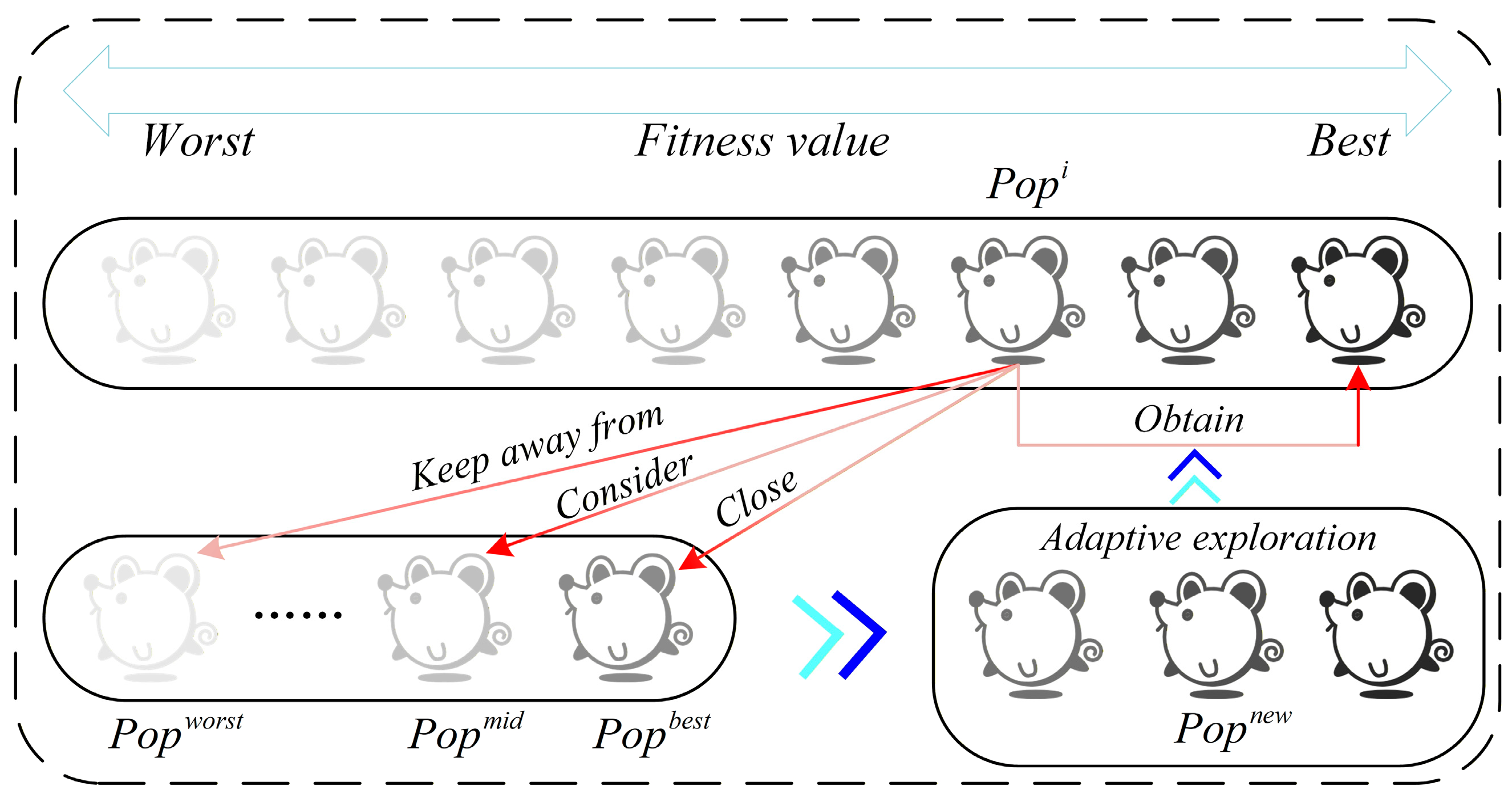
In large-scale cloud-edge collaborative task scheduling scenarios, the ALA still faces the dual challenges of high execution costs and low user satisfaction. Delving into the root cause of this issue, the core lies in the limitations of the algorithm’s own exploration capabilities. Exploration ability, as the core indicator of algorithms for mining unknown solution spaces, directly determines their efficiency in finding the global optimal solution in complex scheduling scenarios. When the exploration capability is insufficient, the algorithm finds it difficult to expand the search boundary, resulting in a low population dispersion. This not only restricts the mining of low-cost and high-satisfaction scheduling schemes but also directly affects the accuracy and practicality of the final optimal solution, thereby intensifying the contradiction between execution cost and user experience. To overcome this constraint, this section proposes introducing an adaptive spatial search mechanism to specifically enhance the exploration efficiency of ALA during the iterative process. This mechanism achieves dual guidance through dynamically generated adaptive values and direction markers. On the one hand, the adaptive value adjusts the search step size in real time according to the population distribution characteristics of the current iteration stage, ensuring that individuals conduct directional and efficient neighborhood search within the solution space and avoiding resource waste caused by blind exploration. On the other hand, direction markers combine the position information of the optimal individual, the worst individual, and the intermediate individual in the current population to provide differentiated search direction guidance for each individual. On this basis, the algorithm further drives individuals to dynamically evaluate the performance gap between themselves and the three types of reference individuals, fusing the above adaptive parameters with the gap analysis results to generate precise movement strategies and achieve the intelligent evolution of individuals in the solution space. Through this mechanism, the algorithm can continuously expand the effective search range during the iterative process, ensuring the in-depth mining of potential high-quality solutions while avoiding the trap of local optima, and ultimately significantly improving convergence accuracy. This improvement not only enhances ALA’s scheduling adaptability for large-scale cloud-edge collaborative tasks but also optimizes user satisfaction while reducing execution costs. The specific exploration process is shown in Figure 3.
First, calculate the gaps between the current individual and the optimal individual, the worst individual position, and the updated position, respectively, through Equation (20).
D i s 1 = M P o s i + M P o s b e s t D i s 2 = M P o s i M P o s w o r s t D i s 3 = M P o s i + M P o s i n e w
where M P o s i represents the i th individual, M P o s b e s t represents the current optimal individual. M P o s w o r s t represents the current worst individual, M P o s i n e w represents the individuals of the MALA population after being updated by Equation (11) or (13).
Subsequently, the intermediate individual M P o s m i d is calculated through Equation (21), as the intermediate individuals not only contain the relevant information of the optimal individuals but are also less susceptible to the influence of extreme individuals.
M P o s m i d = M P o s r 3 s o r t
Here, M P o s s o r t represents the population of the MALA population sorted in ascending order by fitness, and r 3 is calculated by Equation (22).
r 3 = i ϖ / 2
Here, i represents the current individual number of the population in MALA, and represents the upward rounding function. ϖ represents a random number with a value between 0 and 1 that the value is not equal to the above parameters.
Then, the mean individual is calculated through Equation (23).
M P o s a v e = D i s 1 + D i s 2 + D i s 3 + M P o s m i d 4
Subsequently, the parameter is calculated and updated iteratively through Equation (24). As the iteration proceeds, this adaptive parameter gradually increases, allowing MALA to automatically adjust its search behavior in a progressive manner. Benefiting from such an adaptive increment mechanism, the algorithm can still maintain strong exploration capability in the later stage of iteration, effectively preventing premature convergence and sustaining efficient global search performance.
A P = l o g 1 + e 0.005 I t e r
Here, l o g represents the logarithmic function.
Then, by combining the adaptive parameters with the mean individual, an adaptive exploration of the current position is conducted, as specifically shown in Equation (25).
M P o s a s s = M P o s i n e w + A P M P o s a v e
Ultimately, a greedy selection is made between individual M P o s a s s and Individual M P o s i n e w to ensure that the algorithm can precisely optimize during the iterative process.

4.2.3. Bernstein-Guided Correction Strategy

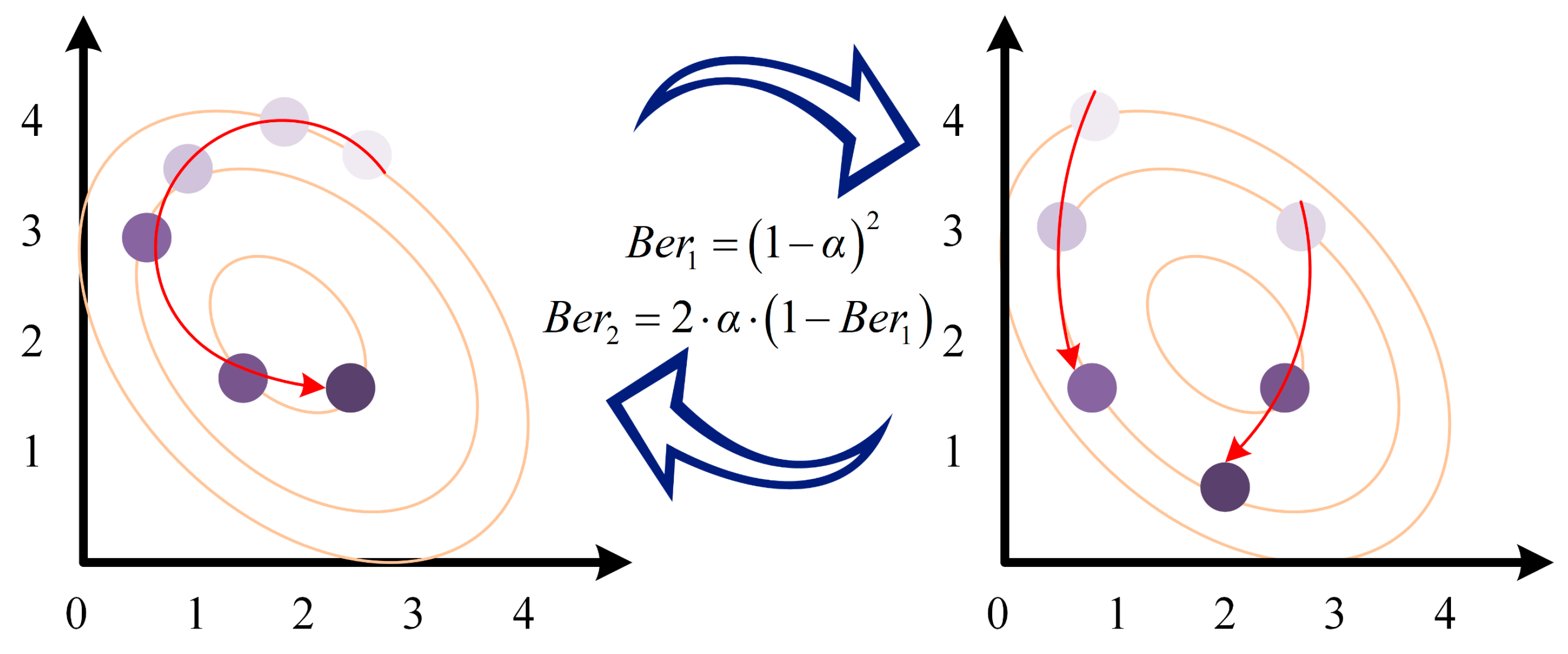
In the task scheduling scenario of the cloud-edge collaborative architecture, ALA is highly susceptible to parameter fluctuations, resulting in unstable optimization performance. This characteristic directly leads to significant instability in its handling of cloud-edge collaborative task scheduling. Delving into the root cause, this phenomenon may be closely related to the insufficiency of the standard ALA’s own exploitation capabilities during its iterative process. The strength of exploitation capabilities directly determines the efficiency and accuracy of the algorithm’s convergence to the global optimal solution. When the exploitation capability is weak, algorithms often struggle to break through the current range of optimal solutions found, easily falling into the trap of local optima. Eventually, they can only converge to non-global local optimal solutions, making it difficult to meet the high requirements for task scheduling efficiency and the rationality of resource allocation in cloud-edge collaboration scenarios. To this end, this section proposes to introduce the Bernstein-Guided Correction strategy to perform directional correction on the individuals updated in the algorithm exploitation stage. This strategy adaptively adjusts the position parameters of individuals after the exploitation stage according to the iterative process by coordinating the dynamic adjustment characteristics of Bernstein polynomials. This mechanism can significantly enhance the algorithm’s exploitation capability, enabling it to continuously optimize solutions in the later stages of iteration, thereby effectively compensating for the performance deficiencies of ALA in the cloud-edge collaborative architecture task scheduling scenario caused by insufficient exploitation capabilities. The specific implementation process of the above correction is shown in Figure 4.
First, calculate the second-order Bernstein coefficient through Equation (26).
B e r 1 = 1 ρ 2 B e r 2 = 2 σ 1 B e r 1
Among them, ρ and σ respectively represent two random numbers, both with a value range of 0 to 1, and their values are different.
Then, the position of the individual is corrected through Equation (27).
M P o s g d c = M P o s i B e r 1 B e r 2 F i t b e s t F i t i n e w M P o s i n e w
Here, F i t b e s t represents the fitness value of the optimal individual M P o s b e s t , and F i t i n e w represents the fitness value of the currently updated individual M P o s i n e w .
Ultimately, a greedy selection is made between the Bernstein-guided correction individual M P o s g d c and the updated individual M P o s i n e w .

4.2.4. The Detailed Implementation of MALA

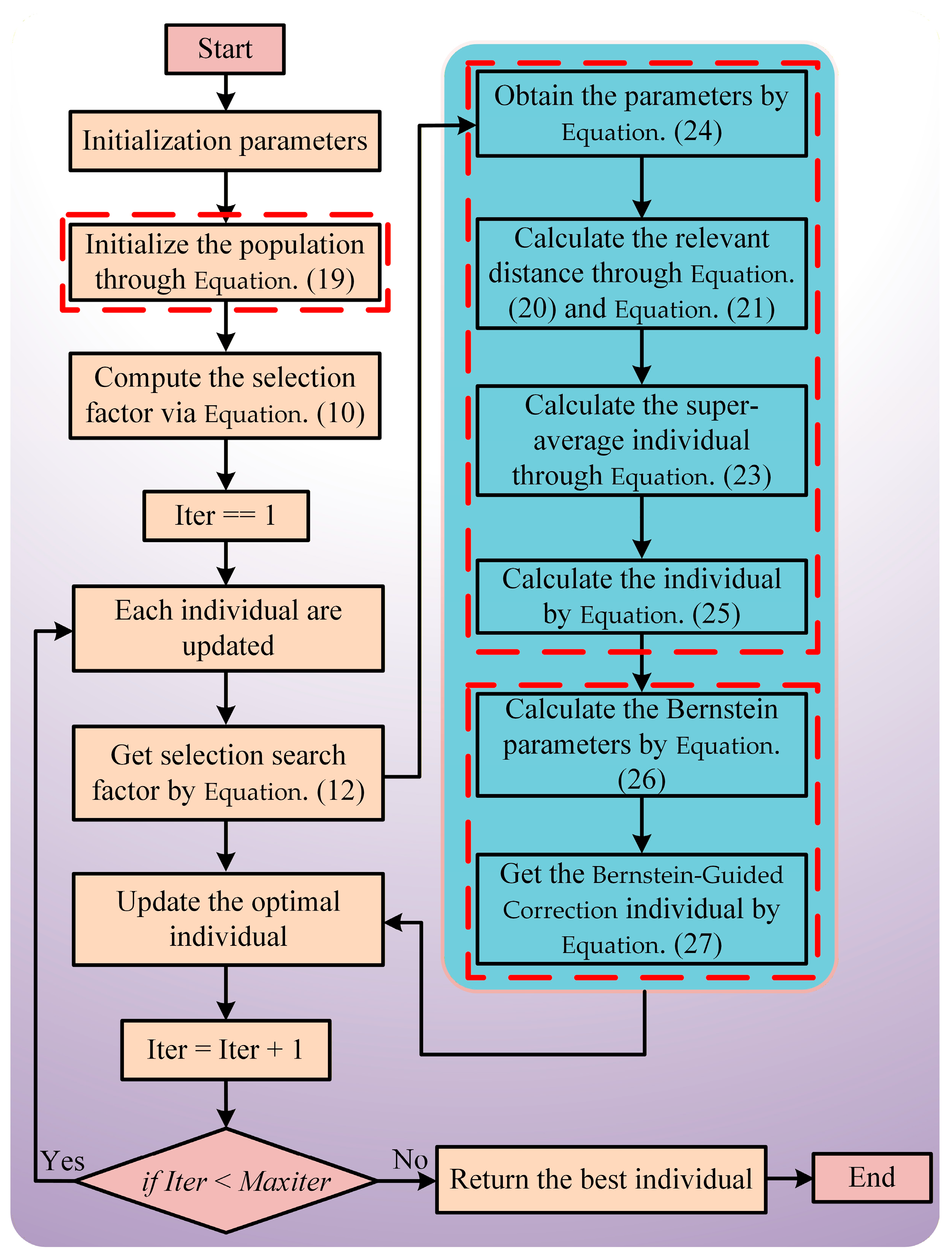
Algorithm 1 provides the pseudo-code of MALA, and Figure 5 shows the flowchart of its algorithm. The following will elaborate in detail on the implementation steps of MALA.
  • Step 1: Set up the population based on the parameters by Equation (19).
  • Step 2: Compute the selection factor and the selection search direction factor.
  • Step 3: If E C > 1 , move to Step 4; if not, move to Step 6.
  • Step 4: Update the individual according to Equation (11).
  • Step 5: Calculate the adaptive individual according to Equation (25).
  • Step 6: Update the individual according to Equation (13).
  • Step 7: Calculate the Bernstein-guided correction for the individual according to Equation (27).
  • Step 8: If I t e r < M a x i t e r the output is the optimal solution; if not, proceed to Step 3.
Algorithm 1. Pseudo-code of MALA
Input: Problem function: Fun, the bounds of the search space: l o , u p , Population size: N, Population dimension: D, Total number of iterations: Maxiter
Output: Optimal individual: MPosbest
1:   Input :   F u n ,   l o , u p , N , D , and   M a x i t e r .
2:  Initialize the population of MALA according to Equation (19).
3:   w h i l e   I t e r M a x i t e r  do
4:     Calculate   the   selection   factor   E C using Equation (10).
5:    Calculate the direction conversion factor Y using Equation (12).
6:    if  E C > 1
7:      Update the individual position through Equation (11).
8:      Calculate the adaptive individual through Equation (25).
9:       Make   a   greedy   choice   between   M P o s a s s   and   M P o s i n e w .
10:    else if  E C 1
11:      Update the individual position through Equation (13).
12:      Calculate the Bernstein-guided correction individual by Equation (27).
13:       Make   a   greedy   choice   between   M P o s g d c   and   M P o s i n e w .
14:    end if
15:    if  F i t i n e w < F i t i
16:       M P o s i = M P o s i n e w
17:    end if
18:    Update the optimal individual and the worst individual.
19:  end while
20:   Output :   M P o s b e s t

4.2.5. Computational Complexity of MALA

In this section, we analyze the time complexity and function evaluation complexity of the proposed MALA. To characterize its computational overhead, we first summarize the time complexity of the standard ALA. The ALA algorithm involves three key procedures: population initialization, position update of search agents, and fitness evaluation. The complexity of population initialization is O(N), while the position update procedure corresponds to O(Maxiter × N × D), and the fitness evaluation process is O(Maxiter × N). The overall time complexity of ALA integrates the above three components and can be simplified to the order of N × (1 + Maxiter × D + Maxiter). Although MALA embeds multiple improved strategies, it inherits the core computational framework of ALA. Hence, MALA maintains the same time complexity level as the original ALA. Regarding function evaluation consumption, MALA does not increase the evaluation count during the initialization phase. In each iteration, MALA introduces two learning strategies, each requiring one extra function evaluation. Consequently, MALA retains the same asymptotic order as ALA, but with a higher constant factor, as its total number of function evaluations is roughly three times that of ALA.

4.2.6. Convergence Analysis of the Proposed MALA

This section provides a formal theoretical analysis of the convergence property for the Multi-strategy Artificial Lemming Algorithm. By combining the three core improvements, namely high-order Chebyshev chaotic initialization, adaptive spatial search mechanism, and Bernstein-guided correction strategy, we prove that MALA can converge to the global optimal region with high probability, which theoretically supports its superior scheduling performance in cloud-edge collaborative systems.
According to the unified convergence framework of metaheuristic algorithms based on Markov chain theory, a population-based optimization algorithm can converge to the global optimum if it satisfies two conditions: (1) the algorithm can retain the current optimal individual in each iteration; (2) the algorithm can continuously explore the solution space and approach the global optimal region with a non-zero probability.
First, MALA adopts an elitist preservation strategy throughout the iterative process. In each generation, the algorithm records and retains the global optimal individual obtained so far, and the newly generated individual is updated only when its fitness value is better than the current one. Meanwhile, greedy selection is performed after the adaptive spatial search step and the Bernstein-guided correction step, which ensures that the fitness value of the population is monotonically non-decreasing or monotonically non-increasing. Therefore, the optimal value sequence of MALA forms a monotonic and bounded sequence, which converges to a certain limit value according to the monotone convergence theorem. Second, the three proposed strategies endow MALA with sufficient global exploration and local exploitation capabilities to approach the global optimum. The high-order Chebyshev polynomial cooperative chaotic initialization generates a widely distributed initial population. Compared with random initialization, this strategy improves the ergodicity and diversity of the initial individuals, so that the initial population can cover the potential optimal region with a higher probability, laying a foundation for global convergence. The adaptive spatial search mechanism dynamically adjusts the search step and direction by using the information of the optimal, worst, median, and average individuals. It expands the effective search range and prevents the algorithm from being trapped in local optima. This mechanism ensures that the algorithm still maintains a strong exploration ability in the later stage of iteration, so that the transition probability between different solution states is always greater than 0. The Bernstein-guided correction strategy performs adaptive position update based on Bernstein polynomials, which strengthens the local exploitation ability in the later stage of iteration. It helps the algorithm to refine and optimize near the potential optimal region, accelerating the convergence speed while ensuring that the algorithm can finally approach the global optimal solution.
According to the above analysis, the state transition matrix of MALA satisfies the irreducible and aperiodic properties of the Markov chain. Therefore, the population sequence of MALA will converge to the global optimal set with high probability as the number of iterations approaches infinity. The MALA proposed in this paper satisfies the basic conditions for global convergence of metaheuristic algorithms. The elitist preservation mechanism ensures the monotonic improvement of the optimal value, and the three designed strategies jointly maintain the diversity of the population and the effectiveness of search. Theoretical results show that MALA is asymptotically convergent and can converge to the global optimal solution of cloud-edge collaborative task scheduling with high probability. This conclusion provides a solid theoretical guarantee for the stability, reliability, and superiority of MALA in large-scale and high-concurrency scheduling scenarios.
Furthermore, the convergence of MALA for the cloud-edge task scheduling problem is analyzed. Let S be the finite set of all possible task-to-VM mappings (discrete and finite). The iteration of MALA forms a Markov chain M over S with a transition rule T.
Irreducibility.
We show that from any solution X in S, one can reach any other solution Y with a positive probability.
The adaptive spatial search mechanism (introduced in Section 4.2.2) uses random directional steps and random individuals. This operation can directly change one scheduling vector into another distinct vector with a non-zero probability, because the involved parameters (such as the direction factor Y and the random index r1) are random and independent.
The chaotic initialization (Section 4.2.1) further ensures that even the initial population covers all regions of S with positive probability.
Thus, for any X, Y, the transition probability P(X→Y) > 0. The chain is irreducible.
Aperiodicity.
A state is aperiodic if it can return to itself after any number of steps (the greatest common divisor of return times is 1).
In the greedy selection step (Algorithm 1, lines 15–17), if the newly generated candidate is not better than the current solution, the algorithm keeps the current solution. This creates a self-loop transition: P(X→X) > 0 for every state X.
A state with a self-loop has period 1. Because the chain is irreducible, all states share the same period. Hence the entire chain is aperiodic.
Convergence conclusion.
Therefore, under the above-mentioned assumptions, MALA can with a high probability approach the global optimal region.

5. Experimental Analysis

To verify the effectiveness of MALA in the task scheduling problem of cloud-edge collaborative architecture, this section will cover Whale Optimization Algorithm (WOA) [32], Cloud Task Scheduling Improved Whale Optimization algorithm (IWC) [33], Multi-strategy Enhanced Hiking optimization algorithm (CMOHOA) [34], and Red-billed Blue Magpie Optimizer (RBMO) [35]. ALA and Multi-Strategy Artificial Lemming Algorithm were applied to this problem for comparative experiments. The settings of the remaining parameters in the experiment were consistent with the original text, and all experiments were run under the Windows 11 operating system and MATLAB 2024b environment.
In all experiments of this section, we assume that every resource node remains continuously available throughout the entire scheduling horizon of each run. That is, no node joins, leaves, or experiences temporary failure during the execution of a given set of tasks. This static node availability assumption is adopted to isolate the algorithm’s performance under stable resource conditions, which serves as a necessary baseline before introducing dynamic disturbances.

5.1. Weight Sensitivity Analysis

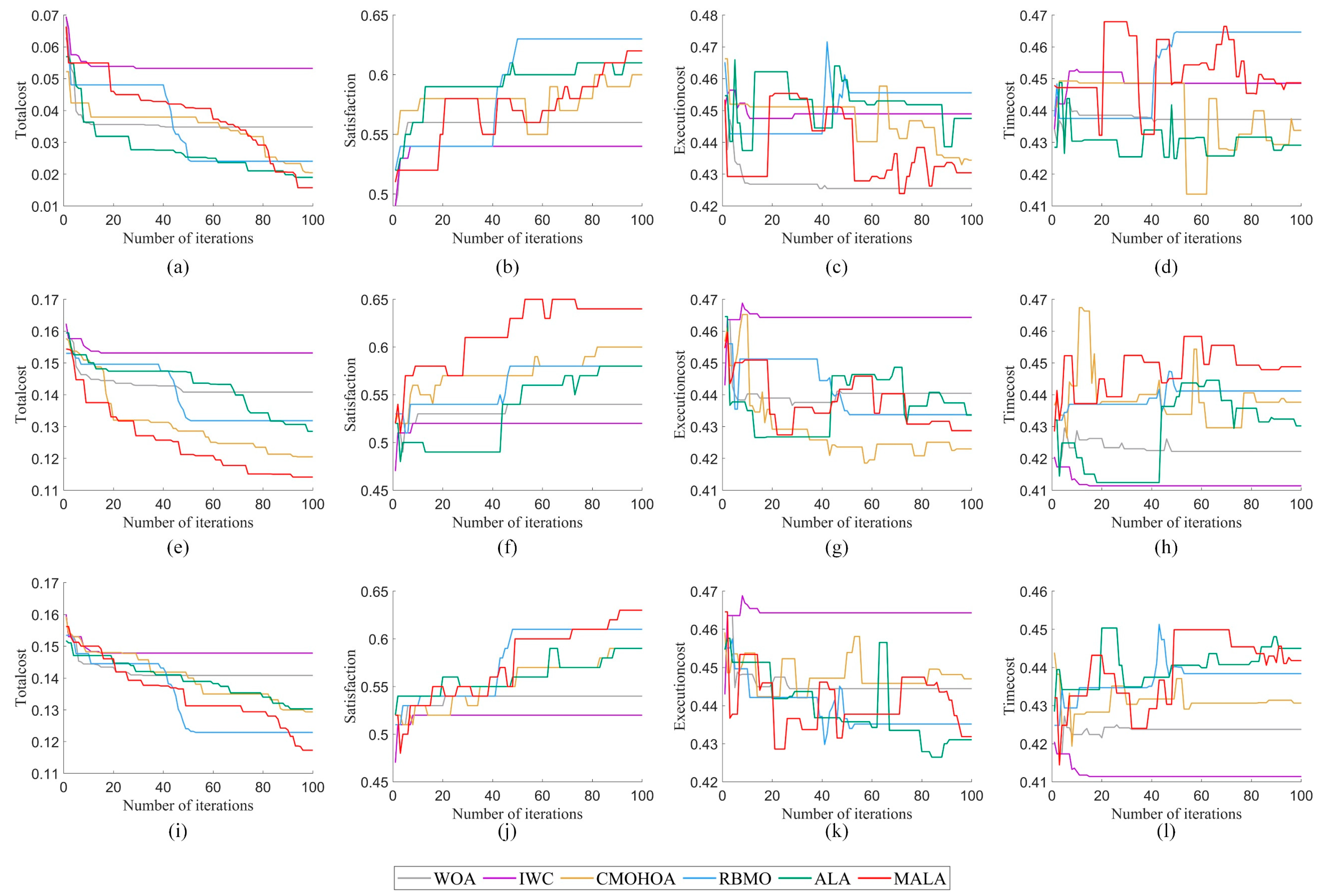
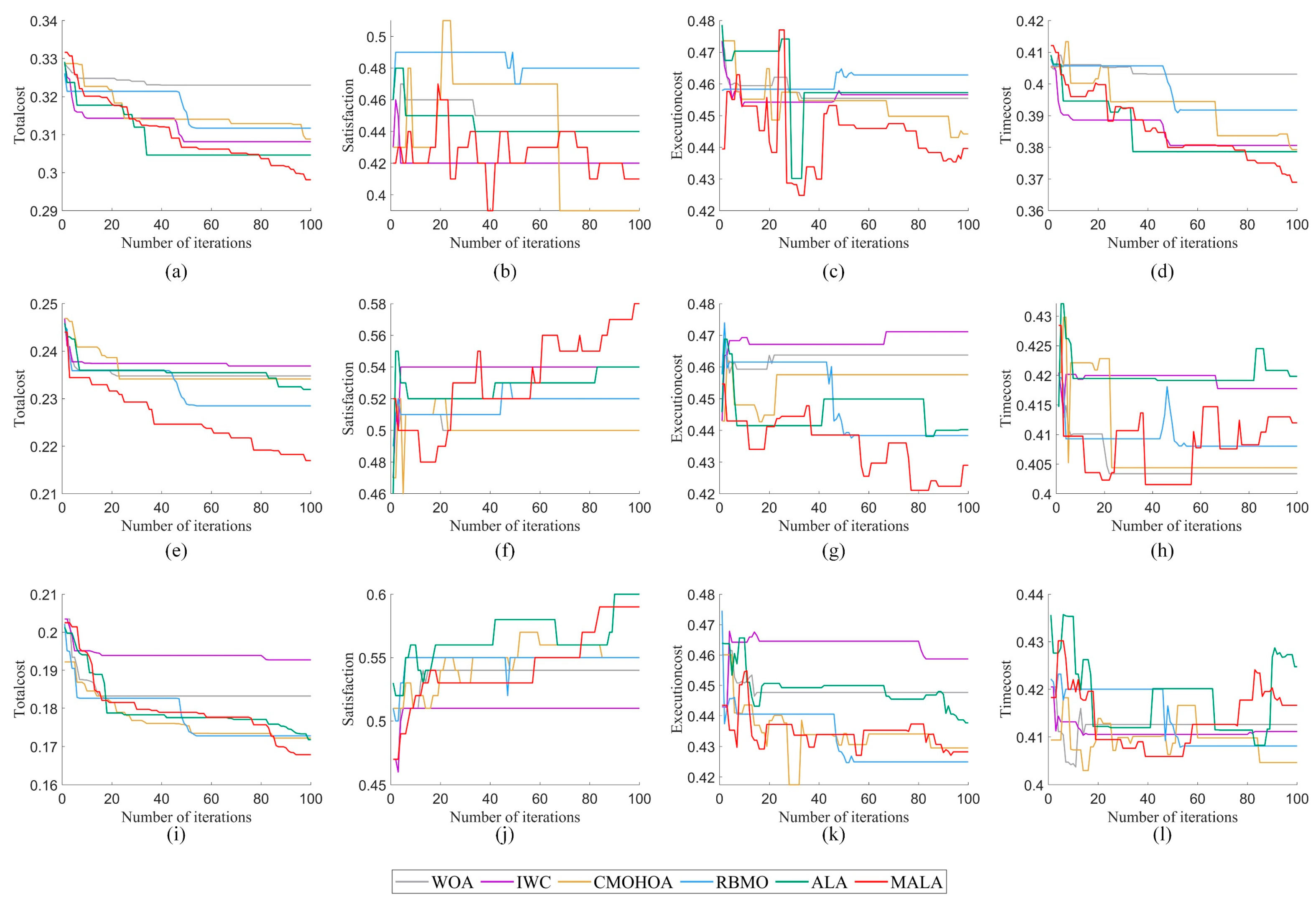
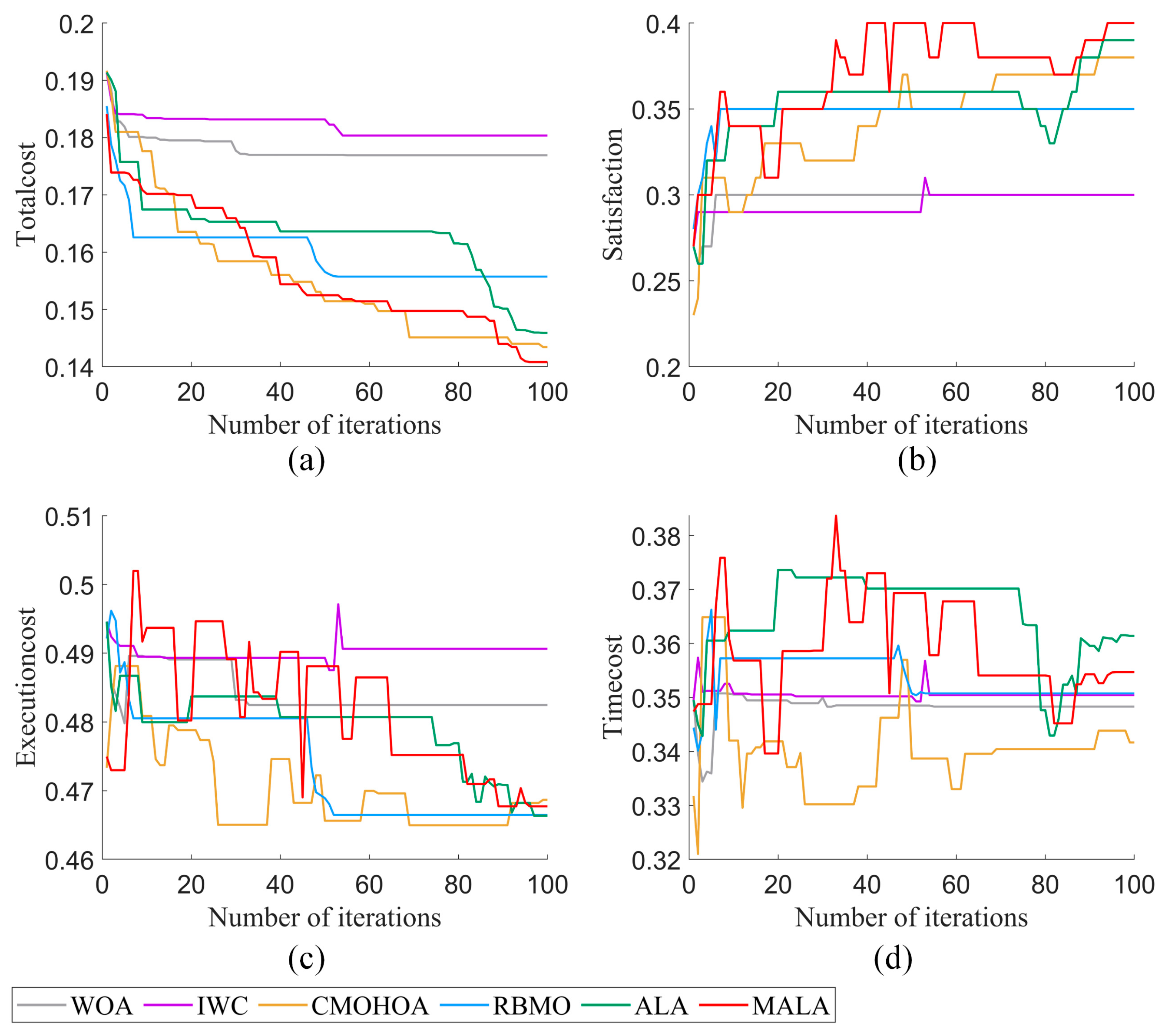
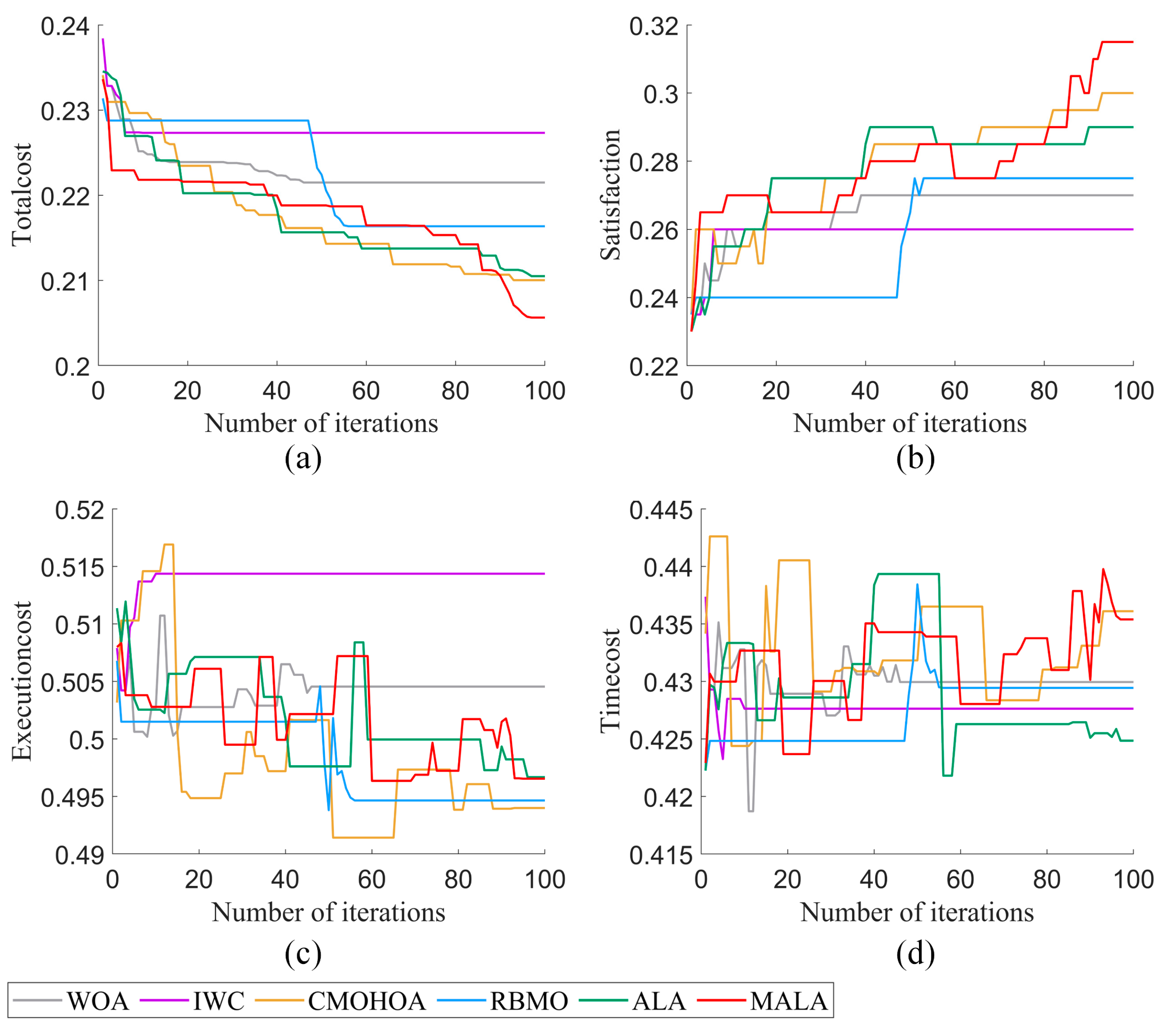
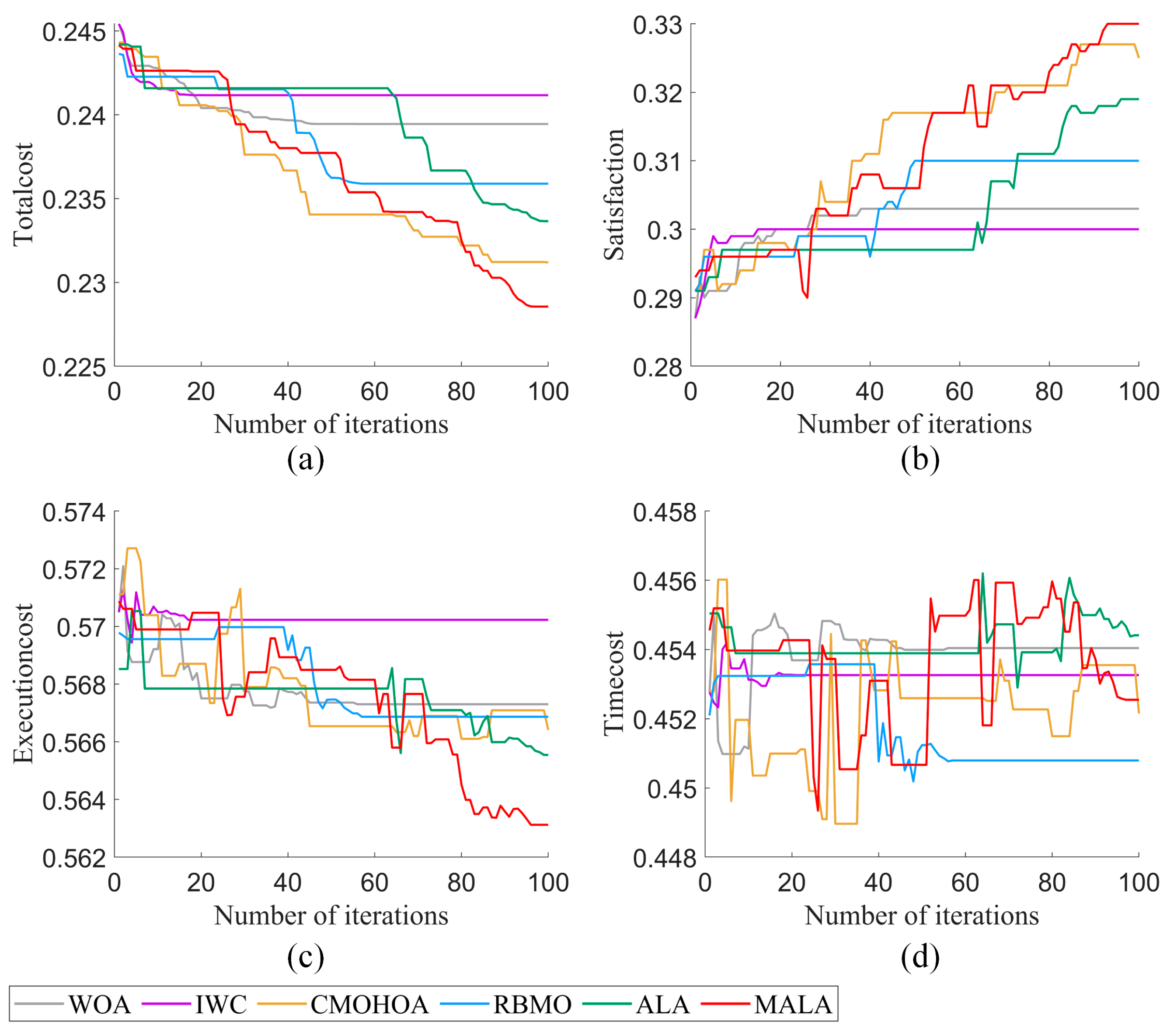
In this section, a experimental study is first conducted to investigate the impact of varying weight configurations for cloud-edge collaborative task scheduling. Recognizing that practical applications exhibit diverse user preferences and business requirements regarding the trade-offs among user satisfaction, execution cost, and time cost, six representative weight combination schemes are designed for comparative analysis. Specifically, the weight vectors are configured as follows: W1 = [0.3, 0.3, 0.4], W2 = [0.3, 0.4, 0.3], W3 = [0.4, 0.3, 0.3], W4 = [0.8, 0.1, 0.1], W5 = [0.6, 0.2, 0.2], W6 = [0.5, 0.25, 0.25]. The first three configurations (W1–W3) cover typical decision-making inclinations where one objective is moderately favored, while the latter three (W4–W6) explore scenarios where user satisfaction is given progressively higher dominance, reflecting real-world service-level agreements. In all experiments, the population size is set to 30, the maximum number of iterations to 100, and the task scale comprises 100 independent tasks to be scheduled across 40 heterogeneous resource nodes. The remaining relevant parameters are specified in Table 2. Comparative experimental results, including convergence trajectories and final optimization outcomes under different weight configurations, are presented in Figure 6 and Figure 7.
As illustrated in Figure 6a–d present the optimization results under configuration W1 = [0.3, 0.3, 0.4], where time cost is given the highest weight, simulating latency-critical applications such as real-time video analytics and industrial IoT control systems. Figure 6e–h correspond to W2 = [0.3, 0.4, 0.3], with execution cost prioritized, representing cost-sensitive workloads including large-scale data batch processing and backup operations. Figure 6i–l show the outcomes under W3 = [0.4, 0.3, 0.3], where user satisfaction is prioritized, reflecting quality-of-service-oriented scenarios such as interactive web services and remote healthcare applications. The color coding for all algorithms remains consistent across the figure: gray curves denote WOA, purple curves represent IWC, brown curves indicate CMOHOA, light blue curves correspond to RBMO, green curves signify ALA, and red curves illustrate the proposed MALA.
Across all three weight scenarios, MALA consistently outperforms the compared algorithms in both convergence speed and final optimization performance. Specifically, MALA exhibits the steepest decline in total cost during the early iterations, typically achieving near-optimal solutions within 40–60 iterations, whereas baseline algorithms such as WOA and IWC demonstrate considerably slower convergence trajectories and frequently plateau at suboptimal levels. In the time-cost-prioritized scenario (W1), MALA achieves the fourth-best time cost optimization effect among all competitors while maintaining competitive execution cost and satisfaction indicators, effectively addressing the strict delay limitations of real-time applications. Under the execution-cost-prioritized configuration (W2), MALA demonstrates the most pronounced reduction in execution cost without triggering severe deterioration in user satisfaction or time cost, underscoring its capacity to identify cost-efficient resource allocation strategies. When user satisfaction is prioritized (W3), MALA attains the highest satisfaction values while preserving reasonable control over both economic and temporal expenses, thereby ensuring a superior quality of experience for end users. A particularly noteworthy characteristic of MALA is its adaptive optimization behavior in response to weight variations. When the weight of a specific objective is increased, MALA exhibits a stronger optimization tendency toward that objective through its dynamic strategy adjustment mechanism, yet it successfully avoids causing severe degradation in other metrics. The algorithm’s inherent diversity preservation and local exploitation mechanisms enable it to navigate the complex trade-off surface among conflicting objectives without collapsing into single-objective optima. In contrast, several baseline algorithms demonstrate unstable or even poor performance under certain weight configurations. For instance, WOA frequently exhibits premature convergence in the satisfaction-prioritized scenario, failing to explore high-satisfaction regions adequately. IWC shows oscillatory behavior in execution cost optimization when time cost is prioritized, indicating its inability to adapt to changing objective preferences. CMOHOA and RBMO occasionally achieve competitive results in isolated metrics but struggle to maintain balanced performance across all objectives simultaneously. ALA, as MALA’s predecessor, shows moderate performance but lacks the strategic adaptability conferred by the multi-strategy enhancement.
As illustrated in Figure 7a–d present the optimization results under configuration W4 = [0.8, 0.1, 0.1], where user satisfaction is assigned the highest priority, simulating quality-of-service-oriented scenarios such as interactive web services, and premium content streaming, where maintaining high user experience is paramount. Figure 7e–h correspond to W5 = [0.6, 0.2, 0.2], representing a moderately satisfaction-prioritized approach that still acknowledges the importance of economic and temporal efficiency. Figure 7i–l demonstrate the outcomes under W6 = [0.5, 0.25, 0.25], reflecting a more balanced distribution where satisfaction retains slight precedence while execution cost and time cost receive proportionally increased consideration.
Across all three weight scenarios, MALA consistently outperforms the compared algorithms in both convergence speed and final optimization performance. Specifically, MALA exhibits the steepest decline in total cost during the early iterations, typically achieving near-optimal solutions within 40–60 iterations, whereas baseline algorithms such as WOA and IWC demonstrate considerably slower convergence trajectories and frequently plateau at suboptimal levels. In the satisfaction-dominated scenario (W4), MALA demonstrates the most pronounced reductions in execution cost and time cost among all competitors, rapidly converging to the lowest values for these two metrics while maintaining a moderate satisfaction level. As depicted in Figure 7b–d, MALA achieves the optimal execution cost and time cost performance, effectively minimizing operational expenses and task completion latency despite the dominant satisfaction weight. This trade-off behavior indicates that when satisfaction is heavily prioritized in the weight configuration, MALA strategically reallocates resources to suppress execution and temporal overheads, recognizing that excessive satisfaction optimization may lead to prohibitive costs in practical deployment contexts. Under the moderately prioritized configuration (W5), MALA demonstrates significant enhancement in execution cost and time cost without triggering severe deterioration in satisfaction, underscoring its capacity to identify balanced resource allocation strategies. As shown in Figure 7f–h, MALA maintains its superiority in execution cost minimization while achieving competitive time cost reduction, with satisfaction levels remaining within acceptable bounds. When a more equitable weight distribution is adopted (W6), MALA attains the most favorable aggregate performance across all three objectives, achieving optimal execution cost while simultaneously optimizing time cost and maintaining reasonable satisfaction levels. As illustrated in Figure 7i–l, this balanced configuration enables MALA to fully exploit its multi-strategy mechanisms, navigating the complex trade-off surface among conflicting objectives without collapsing into single-metric optima. Notably, under W6, MALA achieves the best execution cost performance among all algorithms while securing competitive rankings in both time cost and satisfaction, thereby ensuring superior overall system efficiency under diversified operational constraints.
A particularly noteworthy characteristic of MALA is its adaptive optimization behavior in response to weight variations. When the weight of user satisfaction is increased from W6 to W4, MALA exhibits a progressively stronger optimization tendency toward execution cost and time cost minimization through its dynamic strategy adjustment mechanism, rather than blindly pursuing satisfaction maximization. The algorithm’s inherent diversity preservation and local exploitation mechanisms enable it to identify non-intuitive yet practically valuable solutions that prioritize economic and temporal efficiency even under satisfaction-dominated configurations. This counter-intuitive behavior suggests that MALA possesses sophisticated internal trade-off assessment capabilities, recognizing that in real-world cloud-edge deployments, excessive satisfaction optimization often incurs unsustainable resource expenditures. In contrast, several baseline algorithms demonstrate unstable or even poor performance under these configurations. WOA frequently exhibits premature convergence across all scenarios, failing to explore high-performance regions adequately and settling into local optima with mediocre metrics. IWC shows pronounced oscillatory behavior in execution cost optimization when satisfaction is prioritized, indicating its inability to adapt to changing objective preferences and maintain stable economic performance. CMOHOA and RBMO occas.

5.2. Analysis of Strategy Effectiveness

Most existing studies use CEC benchmark functions to evaluate intelligent optimization algorithms. The CEC test suite covers unimodal, multimodal, hybrid, and composite problems. Accordingly, this section employs the CEC 2022 test suite for validation. First, we verify the effectiveness of the High-Order Chebyshev Polynomial Cooperative Chaotic strategy in enhancing initial population diversity. Then, we test the standard ALA, single-strategy ALA, and two-strategy ALA on CEC 2022 functions to validate the individual and synergistic effects of each improved component during iterative optimization.

5.2.1. Validation of the Effectiveness of the Initialization Strategy

To verify the effectiveness of the proposed High-Order Chebyshev Polynomial Cooperative Chaotic initialization strategy (HCPC) in improving the quality of the initial population, population diversity is introduced in this section as a quantitative metric to characterize population distribution and exploration potential. A higher population diversity indicates a larger dispersion among individuals and a wider spatial distribution, which enables the algorithm to explore a broader solution space in the subsequent iterative process, thereby enhancing the global search capability and reducing the probability of premature convergence. The definition of population diversity is given as follows.
P D I t e r = i = 1 N j = 1 D M P o s i j C M I t e r 2
Here, P D I t e r denotes the population diversity value at the I t e r iteration, and C M I t e r denotes the centroid value at the I t e r iteration, which is calculated by Equation (29).
C M I t e r = 1 D i = 1 N M P o s i j
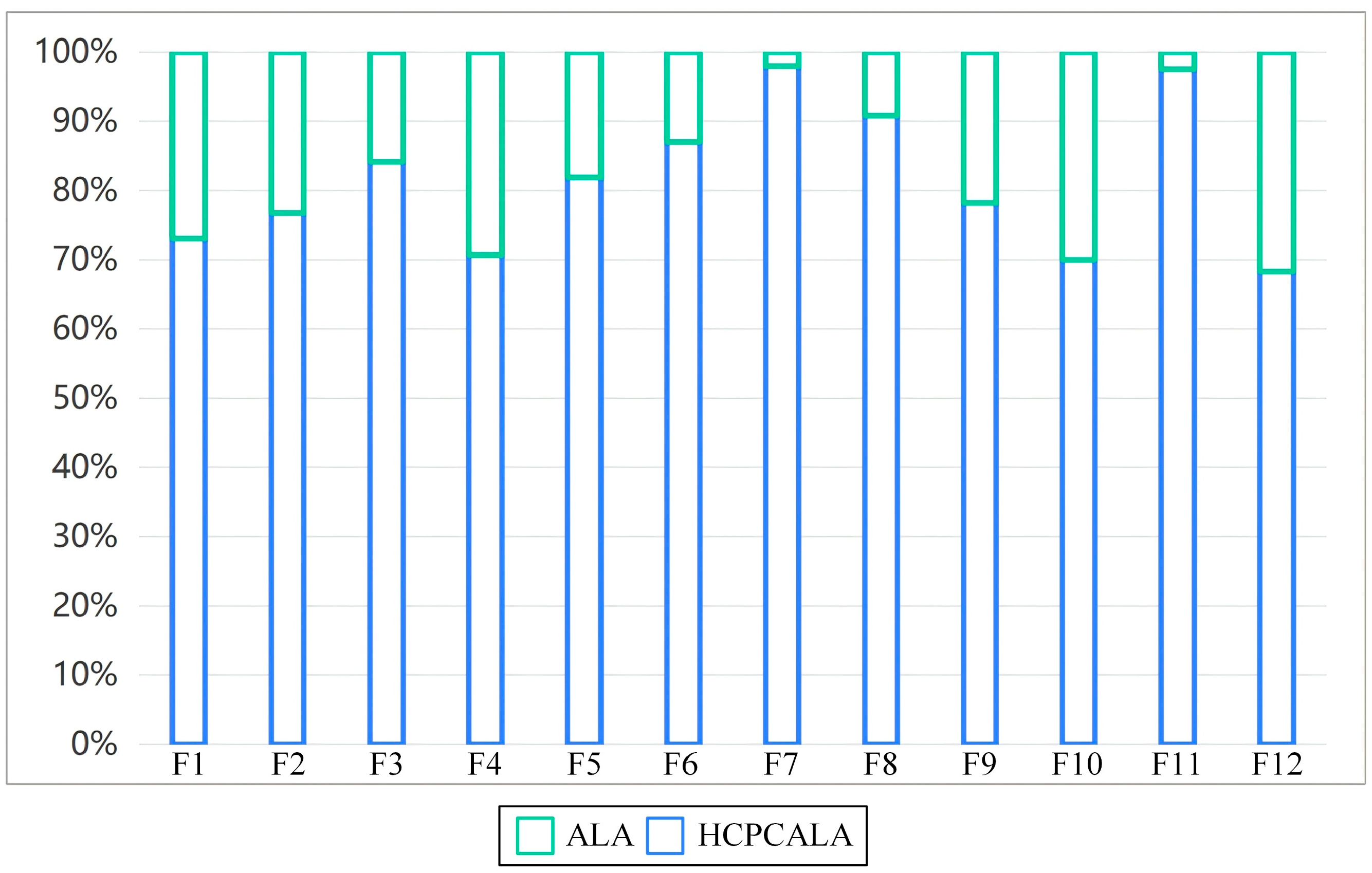
To verify the effectiveness of the proposed Initialization for the High-Order Chebyshev Polynomial Cooperative Chaotic in enhancing the diversity of the initial population, a set of comparative experiments is conducted in this section. Specifically, the standard ALA and the improved ALA, only embedded with the HCPC initialization strategy (denoted as HCPCALA), are both tested on the CEC 2022 benchmark functions. The results are exhibited in Figure 8. Detailed descriptions of the CEC 2022 test functions are listed in Table 3. In all experiments, the problem dimension is set to 20, the population size is set to 30, and the maximum number of iterations is uniformly set to 500.
The results are visualized in Figure 8 as stacked bar charts, where the blue segment represents the diversity proportion contributed by HCPCALA and the green segment corresponds to that of the standard ALA, with the total height of each bar summing to 100%.
Across the entire test suite, HCPCALA consistently exhibits a significantly higher contribution to population diversity compared to the ALA. Specifically, on functions F1–F6, F9–F10, HCPCALA accounts for more than 70% of the total diversity, with particularly prominent performance on F7 and F11, where its contribution exceeds 95%. In contrast, the diversity proportion of the ALA remains relatively low across all test cases, only reaching approximately 10% on F8 and generally staying below 30% in most scenarios. These results clearly demonstrate that the HCPC initialization strategy effectively enhances the spatial dispersion and ergodicity of the initial population, avoiding the clustering and poor coverage issues often associated with the random initialization of the standard ALA.
Such superior initial population diversity is of great practical significance for cloud-edge collaborative resource scheduling problems. In these scenarios, the solution space is typically characterized by high heterogeneity, multi-modality, and numerous local optima, making it challenging for optimization algorithms to explore the full range of feasible resource allocation strategies. The HCPCALA, with its widely distributed initial population, is able to explore a broader set of scheduling configurations from the very beginning, reducing the risk of premature convergence to suboptimal solutions. This advantage is particularly critical for large-scale, high-concurrency cloud-edge scheduling tasks, where the ability to quickly identify high-quality initial solutions can significantly improve overall optimization efficiency and the quality of final scheduling decisions. In summary, the HCPC strategy provides a solid foundation for subsequent iterative optimization by significantly boosting initial population diversity, which is a key prerequisite for achieving stable and high-performance scheduling in complex cloud-edge environments.

5.2.2. Analysis of the Effectiveness of Iterative Optimization Strategies

In this section, comprehensive comparative experiments are conducted on the CEC 2022 benchmark suite to verify the effectiveness of the proposed strategies. The compared algorithms include the standard ALA, ALA equipped with only the Adaptive Spatial Search Mechanism (denoted as ASSALA), ALA equipped with only the Bernstein-Guided Correction Strategy (denoted as BGCSALA), and ALA integrated with both strategies (denoted as HALA). In experiments, the population size is set to 30, the maximum number of iterations is set to 400, and the dimension is set to 20. The experimental results in terms of optimization accuracy are summarized in Table 4, where the bold value in each row represents the best performance among all competitors, and the last row records the average ranking (Ave rank) of each algorithm across all 12 test functions.
As can be observed from the quantitative results, the standard ALA yields the largest fitness values on all CEC 2022 test problems, indicating the weakest optimization accuracy and convergence performance. Due to insufficient global exploration and weak local exploitation capabilities, the standard ALA struggles to jump out of local optima and locate high-quality solutions efficiently, which directly limits its applicability in complex cloud-edge collaborative resource scheduling scenarios with heterogeneous resources, dynamic loads, and high-dimensional solution spaces.
Compared with the standard ALA, both ASSALA and BGCSALA achieve remarkable performance improvements. Specifically, the Adaptive Spatial Search Mechanism endows ASSALA with enhanced global exploration ability by dynamically adjusting the search step and direction, which helps the algorithm expand the search range and avoid premature convergence. Similarly, the Bernstein-Guided Correction Strategy strengthens the local exploitation ability of BGCSALA, enabling the algorithm to conduct refined search near promising regions and improve solution precision. Consequently, both ASSALA and BGCSALA outperform ALA on most test functions, and their average ranks reach 2.50 and 2.58, respectively, confirming the effectiveness of every single strategy in elevating optimization performance.
Notably, the HALA achieves the best optimization accuracy on most CEC 2022 test functions. In particular, on complex multimodal and composite functions such as F6, F7, F8, F11, and F12, HALA exhibits overwhelming advantages over the other three algorithms. More importantly, HALA achieves an average rank of 1.17, which is far superior to 3.67 (ALA), 2.50 (ASSALA), and 2.58 (BGCSALA). This fully demonstrates that the two proposed strategies are highly complementary: the adaptive spatial search mechanism expands the exploration scope to discover potential promising regions, while the Bernstein-guided correction strategy performs targeted refinement and stabilization, forming a closed-loop and efficient search mechanism.
For cloud-edge collaborative resource scheduling scenarios, such excellent optimization performance is of critical practical value. Cloud-edge scheduling problems typically involve high-dimensional, multi-constraint, and strongly coupled solution spaces, where algorithms are prone to stagnating in local optima, leading to unreasonable resource allocation, high execution cost, long time delay, and low user satisfaction. Benefiting from the collaborative mechanism of balanced exploration and exploitation, HALA can efficiently locate high-quality resource allocation schemes and reduce total scheduling cost. Therefore, the proposed HALA possesses stronger search ability, higher convergence accuracy, and better robustness, making it more suitable for solving complex, large-scale cloud-edge collaborative task scheduling problems.

5.3. Small-Scale Cloud-Edge Collaborative Task Scheduling Test

In this experiment, a standardized test scenario is constructed with 100 computing tasks and 30 heterogeneous computing resource nodes. The maximum number of iterations is set to 100 and the population size to 40 to ensure sufficient convergence and stable optimization. Detailed task and resource parameters are listed in Table 5, and the scheduling results of the compared algorithms are illustrated in Figure 9.
Since the experiments in this study mainly focus on performance optimization, equal importance is assigned to the three optimization objectives to avoid biased evaluation caused by unbalanced weight settings. Specifically, the weight parameters for user satisfaction, execution cost, and time cost are all set to one-third, respectively. In all subsequent comparative experiments, the weight parameters are kept unchanged at 1/3.
It can be observed from Figure 9a that all the algorithms involved in the comparison show a gradually increasing trend in the dimension of total cost optimization. This phenomenon directly confirms that in the cloud-edge collaborative scheduling scenario, intelligent optimization algorithms have the ability to effectively regulate and improve the scheduling process. Through the iterative optimization of the algorithm, the resource consumption and time cost in the scheduling process can be continuously compressed, verifying the practical value of the intelligent optimization method in this scenario. A further analysis of the data trend in Figure 9a reveals that among all benchmark algorithms, MALA has the most outstanding optimization performance. It has a greater reduction in total cost and a more stable convergence speed. The total cost figure has decreased by approximately 3%. This result fully demonstrates that for small-scale cloud-edge collaborative task scheduling problems, MALA, with its improved optimization mechanism, can more accurately balance task allocation and resource utilization, showing performance advantages over similar algorithms. The results in Figure 9b further confirm the potential of MALA from the perspective of satisfaction optimization. As the iterative process progresses, MALA consistently leads in the satisfaction index and remains in the optimal position until the end of the iteration. Although the standard ALA can also produce certain effects in optimizing satisfaction, there is a significant gap between its improvement range and final performance, and that of MALA. This also highlights from the side the improvement effect of MALA in meeting user needs and balancing the interests of multiple parties. At the level of cost optimization, the optimization effects of MALA and various baseline algorithms show a similar trend, indicating that there are certain commonalities in the improvement space and optimization paths of existing algorithms in this specific indicator, and MALA does not show significant differences.

5.4. Middle-Scale Cloud-Edge Collaborative Task Scheduling Test

To further verify the performance of MALA in medium-scale cloud-edge collaborative task scheduling, this section adopts experimental settings closer to real-world applications. The number of tasks is increased to 200. For experimental comparability and consistency, all parameters except task count follow those in Section 5.3. Detailed task and computing resource node parameters are listed in Table 5. Under the above configuration, MALA is compared with several algorithms, and the results are displayed in Figure 10.
It can be observed from the experimental data in Figure 10a that when the task scale increases to 200, the optimization performance of the ALA shows a significant decline. Its control ability over scheduling costs has significantly weakened, and the upward trend of the optimization curve tends to flatten, indicating that under the pressure of medium-scale tasks, the optimization mechanism of the original algorithm is difficult to effectively cope with the increase in complexity. In sharp contrast, among all the baseline algorithms, MALA still performs steadily and consistently ranks first in terms of optimization effect. Even when the number of tasks increases, when the iterative process is completed, the cloud-edge collaborative scheduling scheme generated by MALA can still keep the total cost at the lowest level. This result fully demonstrates its adaptability and stability. In the satisfaction optimization, the constraints of the scheduling scenario become more complex. However, MALA still continuously demonstrates strong optimization capabilities, and its satisfaction index remains at a relatively high level. This feature enables it to reliably meet the requirements of time-limited cloud-edge collaborative task scheduling scenarios, providing strong support for balancing task execution efficiency and user demands. In terms of implementing cost optimization, although MALA ranks third, the gap with the top two is relatively small, and it is significantly better than most other baseline algorithms. Based on the above multi-dimensional performance, it can be seen that MALA demonstrates balanced and excellent performance in terms of cost control, satisfaction improvement, and adaptability to scale changes, fully proving that it is an efficient optimization method suitable for cloud-edge collaborative task scheduling problems.

5.5. Large-Scale Cloud-Edge Collaborative Task Scheduling Test

To further explore the processing capacity of MALA in large-scale cloud-edge collaborative task scheduling scenarios, this experiment constructed a complex test environment that is closer to actual business: the number of tasks was increased to 1000 to simulate the scenario of massive concurrent tasks, while the number of computing resource nodes was increased to 50. To ensure the longitudinal comparability of the experiment, the number of iterations and the population size of this scenario strictly follow the parameter Settings in Section 5.3. In addition, to make the experimental scenarios more in line with the characteristics of real large-scale scheduling, we have improved the core parameters of tasks and computing resources. The detailed parameter configuration of the above tasks and computing resources has been sorted out in Table 6, providing a clear quantitative input basis for the experiment. Based on the above Settings, this section once again verifies the performance of MALA and each benchmark algorithm. The relevant experimental results are shown in Figure 11.
When the task scale expands to 1000, the optimization performance of ALA in cloud-edge collaborative task scheduling shows a more significant decline. Its regulatory ability over the scheduling process has been further weakened, making it difficult to cope with the complex constraints and resource competition pressure brought about by large-scale tasks. In contrast, MALA further highlights its core advantages in large-scale scheduling in this highly complex scenario, and its leading position in various performance indicators is even more prominent. It can be clearly observed from the evolution curve in Figure 11a that when the iteration reaches approximately 50 times, the optimization effects of algorithms such as IWC, WOA, and RBMO all come to a standstill, and their curves tend to flatten, indicating that these algorithms are no longer capable of mining better solutions when dealing with massive tasks. Compared with ALA, the total cost value has decreased by approximately 3.5%. Although standard ALA has not completely come to a standstill, its optimization efficiency has dropped significantly. In contrast, MALA has maintained a stable upward trend, with its optimization curve continuously extending downward. The total cost of cloud-edge collaborative task scheduling ultimately obtained is significantly lower than that of other algorithms, confirming its strong optimization resilience in large-scale scenarios. The experimental results show that, compared with other baseline algorithms, MALA can meet the prescribed time limits of various tasks to the greatest extent under more stringent task parameter constraints, providing a reliable guarantee for business continuity. In the dimension of time cost optimization, although MALA ranks third, the gap with the top two is relatively small, and it is significantly better than most baseline algorithms. It fully proves that it is an efficient optimization method that can effectively deal with cloud-edge collaborative task scheduling problems of different scales.

5.6. Evaluation of Algorithm Scalability Under Expanded Task Scales

To further strengthen the experimental rigor and fully validate the superiority of the proposed algorithm, this section conducts testing experiments under large-scale task scenarios. Considering that cloud-edge scheduling bottlenecks typically arise under heavy workloads, the number of tasks is set from 1000 to 10,000 with a step size of 1000. In the experimental setup, the population size is 50, the number of resource nodes is 70, and the maximum number of iterations is 200. Other parameters remain consistent with those in Table 7. Under these settings, comprehensive simulation experiments are performed, and the overall performance comparisons of different algorithms are shown in Figure 12.
As depicted in Figure 12, the gray curve with circle markers denotes the optimal scheduling results obtained by the WOA. The purple curve with rectangle markers represents the optimization performance of the IWC algorithm. The brown curve with triangle markers illustrates the optimal outcomes achieved by the CMOHOA. The light blue curve with diamond markers corresponds to the results generated by the RBMO algorithm. The green curve with pentagram markers shows the optimal values derived from the ALA. Meanwhile, the red curve with hexagram markers represents the optimal scheduling cost values obtained by the proposed MALA. In this figure, the horizontal axis illustrates the variation in the number of tasks, ranging from 1000 to 10,000, while the vertical axis represents the optimal comprehensive scheduling cost values achieved by each algorithm upon the completion of iterations.
As shown in Figure 12a, the total cost of all algorithms increases monotonically with the number of tasks, which is consistent with the inherent complexity of resource scheduling under growing workloads. However, significant differences in both absolute values and growth rates are observed across algorithms. MALA consistently achieves the lowest total cost across all task scales, with the slowest growth trend as the number of tasks increases. In contrast, the baseline WOA exhibits the highest total cost and the steepest increase, indicating its poor scalability in large-scale scenarios. Other algorithms, including IWC, CMOHOA, RBMO, and ALA, perform between WOA and MALA but are unable to match the cost reduction achieved by MALA, especially under high-concurrency conditions with over 6000 tasks. Regarding user satisfaction (Figure 12b), MALA maintains the highest satisfaction level throughout the entire task range, and its advantage becomes more pronounced as the workload increases. While all algorithms show an upward trend in satisfaction with task volume, the growth rate of MALA is the most favorable, demonstrating its ability to balance scheduling efficiency with user experience under heavy loads. Conversely, WOA shows the lowest and least responsive satisfaction improvement, reflecting its limited capability to optimize user-oriented objectives in large-scale scheduling. For execution cost and time cost, the performance differences are even more evident. MALA achieves the lowest values in both metrics, with significantly gentler slopes compared to other algorithms. This indicates that MALA not only reduces the absolute resource consumption and scheduling latency but also effectively mitigates the performance degradation caused by increasing task volume. WOA, on the other hand, suffers from a rapid rise in both execution and time costs, suggesting severe scalability bottlenecks when dealing with large numbers of concurrent tasks.

5.7. Verification of Scheduling Stability

To further verify the stability and robustness of MALA in the task scheduling of the cloud-edge collaborative architecture, this section designs a multi-parameter dynamic adjustment experiment. Based on this, the experiment will systematically adjust the core parameters and compare and analyze the stability differences in scheduling performance between MALA and other baseline algorithms. Specifically, the experiment selects three types of parameters that have a significant impact on the scheduling process for gradient adjustment: the first is the number of tasks, the second is the number of computing resource nodes, and the third is the number of algorithm populations. In the experiment, the basic parameter configuration of tasks and computing resources is still based on Table 5. The stability performance of each algorithm under different parameter combinations has been visually presented in Figure 13.
Figure 13 presents the total cost distribution characteristics of each algorithm when different parameters are dynamically adjusted through three sets of box plots, intuitively reflecting the stability differences in scheduling performance. Among them, Figure 13a focuses on the impact of changes in the number of tasks on stability: The experiment sets the number of tasks to gradually increase from 100 to 130, while fixing the number of computing resource nodes at 30, the total number of iterations at 100, and the algorithm population size at 40, to observe the cost stability under the fluctuation of task load. Figure 13b analyzes the dynamic adjustment of the number of computing resource nodes: The experiment gradually increases the number of resource nodes from 5 to 40, while fixing the number of tasks at 30, the total number of iterations at 100, and the population size at 40. The results show that the cost distribution of most baseline algorithms fluctuates significantly with the change in the number of resource nodes. The box of MALA remains compact all the time, with the median stably at a relatively low level. Even if the number of resource nodes changes significantly, the degree of dispersion of the cost distribution is still significantly lower than that of other algorithms. Figure 13c further explores the impact of changes in the algorithm’s population size on stability. The experiment increases the population size from 20 to 55, while fixing the number of tasks at 100, the total number of iterations at 100, and the number of computing resource nodes to match the task scale. The results clearly show that the stability defect of the standard ALA is particularly prominent in this scenario, making it difficult to maintain stable performance under different population configurations. In contrast, the cabinet of MALA always remains at a low and concentrated position, demonstrating strong adaptability to the adjustment of its own parameters. Based on the results of the three sets of experiments, it can be seen that when the task load, resource scale, or population parameters change dynamically, the baseline algorithm generally has problems with large performance fluctuations and insufficient stability. However, MALA, with its improved optimization mechanism, always maintains the dual advantages of low cost and high stability under various parameter disturbances. This feature fully demonstrates that MALA is a robust and widely adaptable cloud-edge collaborative task scheduling optimization method, capable of reliably addressing the complex demands of dynamic parameter changes in actual scenarios.
To further validate the adaptability of the proposed MALA in handling dynamic optimization scenarios with various problem scales, the indicators reflecting algorithmic performance from the experimental results in this section are listed in Table 8.
The symbol “+” denotes that the competitor is significantly better than MALA; “−” denotes that the competitor is significantly worse than MALA; “=” denotes no significant difference between the competitor and MALA. All p < 0.05 indicate statistically significant differences. As observed in Table 8, all p-values between MALA and the five baseline algorithms are far below 0.05, demonstrating that the performance advantages of MALA are statistically significant at the 95% confidence level, rather than random experimental fluctuations. According to the significance judgment rule, all comparison algorithms are marked with “−” in all scenarios, indicating that WOA, IWC, CMOHOA, RBMO, and ALA are significantly worse than MALA.
Under task scale variation, MALA shows extremely significant differences compared with WOA and IWC. Even for CMOHOA, RBMO, and the original ALA, the p-values remain at a low level, indicating that MALA maintains stable and outstanding scheduling performance when the task load increases. In the scenario of resource node variation, MALA still presents remarkably small p-values, which confirms its strong robustness against dynamic resource scales and heterogeneous node environments typical in cloud-edge systems. When the population size varies, the p-values are even lower, especially in comparison with WOA and IWC, revealing that MALA is insensitive to parameter changes and can consistently deliver reliable optimization results.
Furthermore, the significant differences between MALA and the standard ALA validate the effectiveness of the proposed multi-strategy improvements. These mechanisms effectively enhance population diversity, strengthen global exploration and local exploitation capabilities, and improve the convergence stability of the algorithm.
The evaluation metrics include the optimal value (Best), mean value (Mean), worst value (Worst), standard deviation (Std), and running time. Specifically, lower values of Best, Mean, Worst, and Std indicate better optimization performance and robustness, while shorter running time represents higher computational efficiency. In terms of optimization accuracy, MALA exhibits overwhelming advantages under all three test conditions. With the variation in task size, MALA achieves the optimal value of 0.148 and a mean value of 0.156, which are significantly lower than those of WOA, IWC, CMOHOA, RBMO, and ALA. Under different resource node scales, MALA delivers a mean value of 0.140, outperforming all comparative algorithms. Similarly, in the population size variation test, MALA obtains the minimum Best (0.138) and Mean (0.144) values. These results consistently demonstrate that MALA possesses stronger search capability and can obtain higher-quality solutions in dynamic optimization environments.
Regarding algorithm stability, MALA maintains a low standard deviation across all experimental scenarios. Concretely, the standard deviation of MALA is 0.009 in the task size test, 0.009 in the resource node size test, and 0.005 in the population size test, which are the lowest among all compared algorithms. This indicates that MALA features robust search stability and is less affected by fluctuations in problem scale and parameter configuration, thereby ensuring the reliability of optimization results. In respect of computational efficiency, MALA presents distinct advantages in running time. Under the task size condition, MALA costs only 4.189 s, which is the shortest among all algorithms. In the resource node size test, although the running time of all algorithms is prolonged to a certain extent, MALA still maintains the fastest speed (6.049 s). In the population size test, MALA completes the computation within 4.219 s, which is superior to most comparative algorithms. The above results reveal that MALA effectively reduces computational overhead while improving optimization performance.
Comprehensive comparison results illustrate that MALA outperforms WOA, IWC, CMOHOA, RBMO, and ALA in optimization accuracy, stability, and computational efficiency under different change indicators. The improved strategies adopted in MALA effectively enhance its search performance and adaptability in dynamic optimization problems, which further verifies the effectiveness and superiority of the proposed algorithm.


6. Conclusions and Future Work

This study presents a Multi-strategy Artificial Lemming Algorithm for task scheduling optimization in cloud-edge collaborative architectures. By integrating high-order Chebyshev polynomial chaotic initialization, adaptive spatial search, and Bernstein-guided correction strategies, MALA effectively addresses the issues of insufficient population diversity, weak exploration-exploitation balance, and unstable convergence existing in the standard ALA. Experimental results on CEC 2022 benchmarks confirm that MALA yields remarkably enhanced optimization accuracy and convergence speed with an average ranking of 1.17. When applied to cloud-edge scheduling scenarios with varied task scales, MALA reduces the total scheduling cost by at least 3% compared with WOA, IWC, CMOHOA, RBMO, and standard ALA, while achieving higher user satisfaction, lower execution cost, and shorter time cost simultaneously. Furthermore, MALA exhibits excellent scalability and stability amid dynamic changes in task volume, resource nodes, and population parameters. Overall, MALA is a competitive and robust scheduling optimizer and may possess promising generalization potential for practical applications.
In future work, we aim to advance cloud-edge collaborative task scheduling by refining the proposed architecture to better align with real-world scenarios through the integration of additional practical evaluation metrics and by extending the current single-objective optimization framework to multi-objective scheduling.

Author Contributions

Conceptualization, Y.Z. and J.W.; methodology, Y.Z.; software, J.W.; validation, Y.Z. and J.W.; formal analysis, Y.Z.; investigation, Y.Z.; data curation, Y.Z.; writing—original draft preparation, Y.Z.; writing—review and editing, Y.Z.; visualization, J.W.; supervision, J.W. All authors have read and agreed to the published version of the manuscript.

Funding

This project does not have any funding support.

Data Availability Statement

The original contributions presented in this study are included in the article. Further inquiries can be directed to the corresponding author.

Conflicts of Interest

The authors declare no conflicts of interest.

References

  1. Surbiryala, J.; Rong, C. Cloud Computing: History and Overview. In Proceedings of the 2019 IEEE Cloud Summit; IEEE: Washington, DC, USA, 2019; pp. 1–7. [Google Scholar]
  2. Shan, C.; Gao, R.; Han, Q.; Liu, T.; Yang, Z.; Zhang, J.; Xia, Y. KCES: A Workflow Containerization Scheduling Scheme Under Cloud-Edge Collaboration Framework. IEEE Internet Things J. 2025, 12, 2026–2042. [Google Scholar] [CrossRef]
  3. Ye, J.; Wang, C.; Chen, J.; Wan, R.; Li, X.; Sepe, A.; Tai, R. Cloud–Edge Hybrid Computing Architecture for Large-Scale Scientific Facilities Augmented with an Intelligent Scheduling System. Appl. Sci. 2023, 13, 5387. [Google Scholar] [CrossRef]
  4. Arunarani, A.R.; Manjula, D.; Sugumaran, V. Task scheduling techniques in cloud computing: A literature survey. Future Gener. Comput. Syst. 2019, 91, 407–415. [Google Scholar] [CrossRef]
  5. Yan, J.; Wang, Q.; Cheng, Y.; Su, Z.; Zhang, F.; Zhong, M.; Zhang, W. Optimized single-image super-resolution reconstruction: A multimodal approach based on reversible guidance and cyclical knowledge distillation. Eng. Appl. Artif. Intell. 2024, 133, 108496. [Google Scholar] [CrossRef]
  6. Gavvala, S.K.; Jatoth, C.; Gangadharan, G.R.; Buyya, R. QoS-Aware Cloud Service Composition Using Eagle Strategy. Future Gener. Comput. Syst. 2019, 90, 273–290. [Google Scholar] [CrossRef]
  7. Liang, Z.; Wang, X.; Lin, Q.; Chen, F.; Chen, J.; Ming, Z. A Novel Multi-Objective Co-Evolutionary Algorithm Based on Decomposition Approach. Appl. Soft Comput. 2018, 73, 50–66. [Google Scholar] [CrossRef]
  8. Kobeaga, G.; Merino, M.; Lozano, J.A. An Efficient Evolutionary Algorithm for the Orienteering Problem. Comput. Oper. Res. 2018, 90, 42–59. [Google Scholar] [CrossRef]
  9. Zhao, H.; Wang, B.; Fu, Y.; Li, N.; Gao, Z. Fixed-time adaptive fault-tolerant control of a multi-mode VTOL UAV with variable prescribed performance boundaries under random disturbances. ISA Trans. 2026, 0019-0578. [Google Scholar] [CrossRef]
  10. Wang, X.; Jiang, H.; Dong, Y.; Mu, M. Spatial-channel collaborative multi-scale graph interaction deep transfer learning for unsupervised rotating machinery fault diagnosis. Eng. Appl. Artif. Intell. 2026, 176, 114691. [Google Scholar] [CrossRef]
  11. Dulebenets, M.A. A Delayed Start Parallel Evolutionary Algorithm for Just-in-Time Truck Scheduling at a Cross-Docking Facility. Int. J. Prod. Econ. 2019, 212, 236–258. [Google Scholar] [CrossRef]
  12. Vahdani, B.; Shahramfard, S. A Truck Scheduling Problem at a Cross-Docking Facility with Mixed Service Mode Dock Doors. Eng. Comput. 2019, 36, 1977–2009. [Google Scholar] [CrossRef]
  13. Gafarov, E.; Werner, F. Two-Machine Job-Shop Scheduling with Equal Processing Times on Each Machine. Mathematics 2019, 7, 301. [Google Scholar] [CrossRef]
  14. Xiao, Y.; Cui, H.; Khurma, R.A.; Castillo, P.A. Artificial lemming algorithm: A novel bionic meta-heuristic technique for solving real-world engineering optimization problems. Artif. Intell. Rev. 2025, 58, 84. [Google Scholar] [CrossRef]
  15. Kaur, P.; Mehta, S. Resource Provisioning and Work Flow Scheduling in Clouds Using Augmented Shuffled Frog Leaping Algorithm. J. Parallel Distrib. Comput. 2017, 101, 41–50. [Google Scholar] [CrossRef]
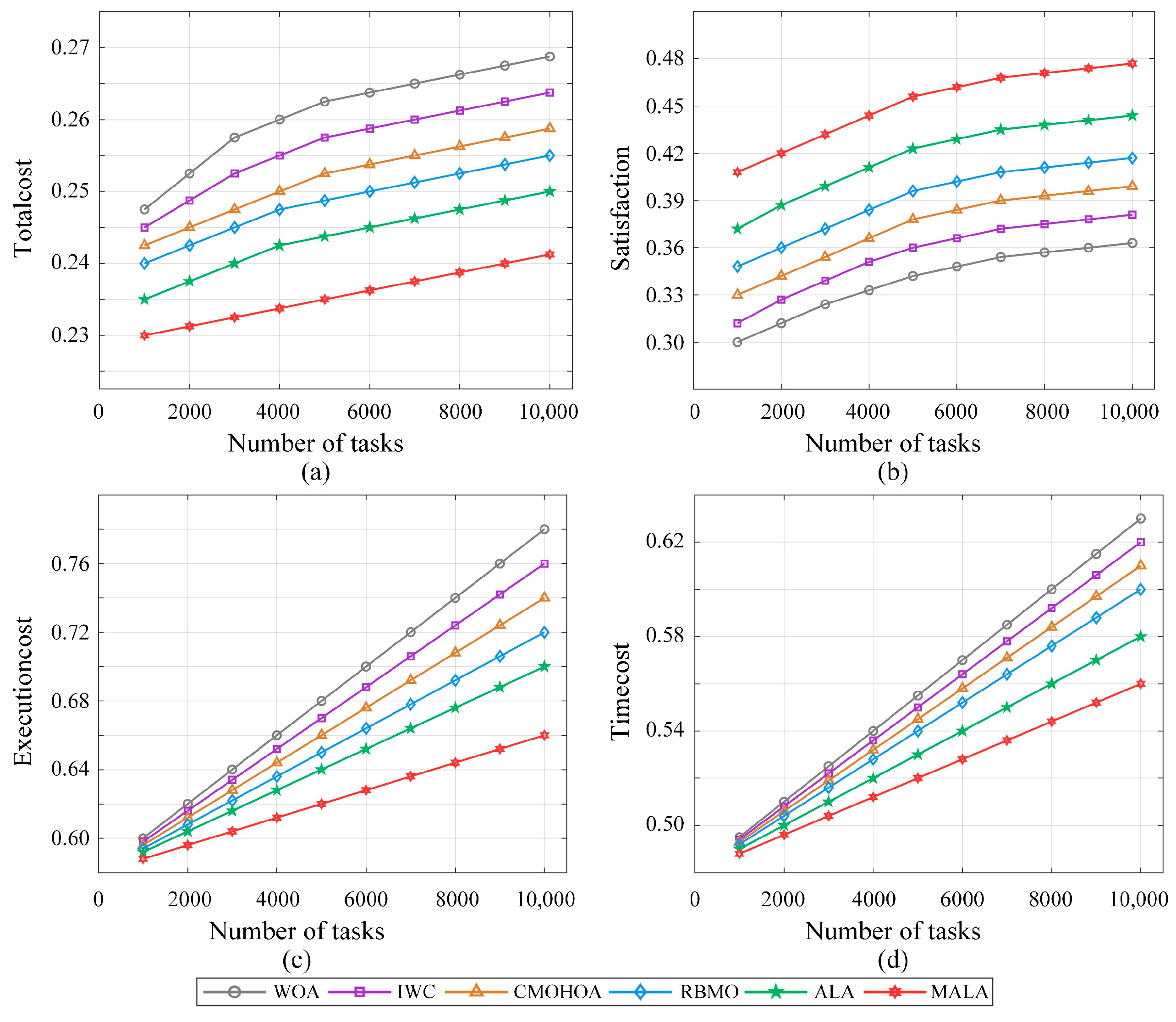
  16. Zhang, C.; Chen, J.; Li, W.; Sun, H.; Geng, Y.; Zhang, T.; Ji, M.; Fu, T. A Cloud-Edge Collaborative Task Scheduling Method Based on Model Segmentation. J. Cloud Comput. 2024, 13, 81. [Google Scholar] [CrossRef]
  17. Tang, B.; Luo, J.; Obaidat, M.S.; Vijayakumar, P. Container-Based Task Scheduling in Cloud-Edge Collaborative Environment Using Priority-Aware Greedy Strategy. Clust. Comput. 2023, 26, 3689–3705. [Google Scholar] [CrossRef]
  18. Chen, Z.; Zhang, L.; Wang, X.; Wang, K. Cloud–Edge Collaboration Task Scheduling in Cloud Manufacturing: An Attention-Based Deep Reinforcement Learning Approach. Comput. Ind. Eng. 2023, 177, 109053. [Google Scholar] [CrossRef]
  19. Wu, D.; Li, Z.; Shi, H.; Luo, P.; Ma, Y.; Liu, K. Multi-Dimensional Optimization for Collaborative Task Scheduling in Cloud-Edge-End System. Simul. Model. Pract. Theory 2025, 141, 103099. [Google Scholar] [CrossRef]
  20. Su, X.; An, L.; Cheng, Z.; Weng, Y. Cloud–Edge Collaboration-Based Bi-Level Optimal Scheduling for Intelligent Healthcare Systems. Future Gener. Comput. Syst. 2023, 141, 28–39. [Google Scholar] [CrossRef]
  21. Lyu, S.; Dai, X.; Ma, Z.; Zhou, Y.; Liu, X.; Gao, Y.; Hu, Z. A heterogeneous cloud-edge collaborative computing architecture with affinity-based workflow scheduling and resource allocation for Internet-of-Things applications. Mob. Netw. Appl. 2023, 28, 1443–1459. [Google Scholar] [CrossRef]
  22. Song, X.; Wang, Y.; Xie, Z.; Xia, L. A Cloud-Edge Collaborative Computing Task Scheduling and Resource Allocation Algorithm for Energy Internet Environment. Ksii Trans. Internet Inf. Syst. 2021, 15, 2282–2304. [Google Scholar]
  23. Lu, S.; Gu, R.; Jin, H.; Wang, L.; Li, X.; Li, J. QoS-Aware Task Scheduling in Cloud-Edge Environment. IEEE Access 2021, 9, 56496–56505. [Google Scholar] [CrossRef]
  24. Lu, Y.; Liu, L.; Panneerselvam, J.; Gu, J.; Garraghan, P.; Min, G. CECF: A DNN-Based Energy-Efficient Cloud-Edge Collaboration Framework for Intelligent Workload Scheduling in 6G-Enabled Transportation Systems. IEEE Trans. Intell. Transp. Syst. 2025, 26, 17889–17900. [Google Scholar] [CrossRef]
  25. Yin, H.; Huang, X.; Cao, E. A cloud-edge-based multi-objective task scheduling approach for smart manufacturing lines. J. Grid Comput. 2024, 22, 9. [Google Scholar] [CrossRef]
  26. Wang, X.; Kang, Q.; Zhou, M.; Fan, Z.; Albeshri, A. A knowledge sharing and individually guided evolutionary algorithm for multi-task optimization problems. Appl. Sci. 2023, 13, 602. [Google Scholar] [CrossRef]
  27. Wang, S.; Hu, Z.; Deng, Y.; Hu, L. Game-theory-based task offloading and resource scheduling in cloud-edge collaborative systems. Appl. Sci. 2022, 12, 6154. [Google Scholar] [CrossRef]
  28. Doostmohammadian, M.; Gabidullina, Z.R.; Rabiee, H.R. Machine learning and CPU (central processing unit) scheduling co-optimization over a network of computing centres. Eng. Appl. Artif. Intell. 2026, 163, 113018. [Google Scholar] [CrossRef]
  29. Pillareddy, V.R.; Karri, G.R. MONWS: Multi-objective normalization workflow scheduling for cloud computing. Appl. Sci. 2023, 13, 1101. [Google Scholar] [CrossRef]
  30. Gajera, V.; Gupta, R.; Jana, P.K. An effective multi-objective task scheduling algorithm using min-max normalization in cloud computing. In Proceedings of the 2016 2nd International Conference on Applied and Theoretical Computing and Communication Technology (iCATccT), Bangalore, India, 21–23 July 2016; pp. 812–816. [Google Scholar]
  31. Kalyan Chakravarthi, K.; Shyamala, L.; Vaidehi, V. Budget aware scheduling algorithm for workflow applications in IaaS clouds. Clust. Comput. 2020, 23, 3405–3419. [Google Scholar] [CrossRef]
  32. Mirjalili, S.; Lewis, A. The Whale Optimization Algorithm. Adv. Eng. Softw. 2016, 95, 51–67. [Google Scholar] [CrossRef]
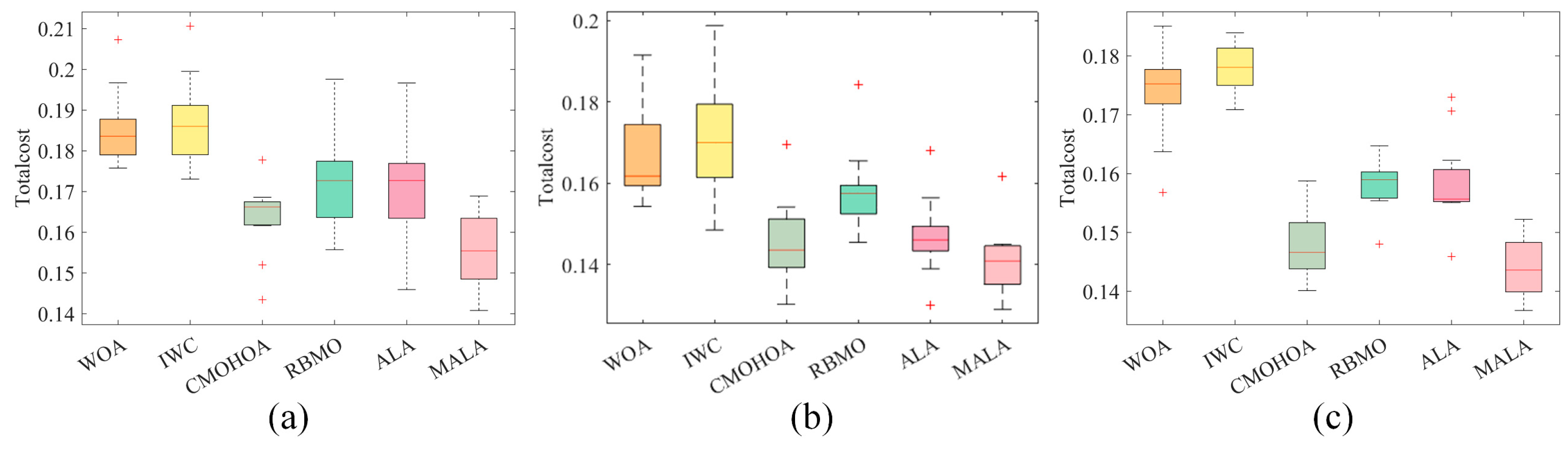
  33. Chen, X.; Cheng, L.; Liu, C.; Liu, Q.; Liu, J.; Mao, Y.; Murphy, J. A WOA-based optimization approach for task scheduling in cloud computing systems. IEEE Syst. J. 2020, 14, 3117–3128. [Google Scholar] [CrossRef]
  34. Wu, L.; Li, S.; Wu, F.; Xie, R.; Yuan, P. Multi-Strategy Enhanced Hiking Optimization Algorithm for Task Scheduling in the Cloud Environment. J. Bionic Eng. 2025, 22, 1506–1534. [Google Scholar] [CrossRef]
  35. Fu, S.; Li, K.; Huang, H.; Ma, C.; Fan, Q.; Zhu, Y. Red-Billed Blue Magpie Optimizer: A Novel Metaheuristic Algorithm for 2D/3D UAV Path Planning and Engineering Design Problems. Artif. Intell. Rev. 2024, 57, 134. [Google Scholar] [CrossRef]
Figure 1. Cloud-edge coordination task scheduling architecture.
Mathematics 14 01659 g001
Figure 2. High-order Chebyshev polynomial cooperative chaotic perturbation process.
Mathematics 14 01659 g002
Figure 3. Adaptive spatial search process.
Mathematics 14 01659 g003
Figure 4. Bernstein-guided correction process.
Mathematics 14 01659 g004
Figure 5. The MALA algorithm process.
Mathematics 14 01659 g005
Figure 6. The results of task scheduling based on different parameter weights(W1, W2, W3). (a) the total cost value when the weight is W1; (b) the satisfaction cost when the weight is W1; (c) the execution cost when the weight is W1; (d) the time cost when the weight is W1; (e) the total cost value when the weight is W2; (f) the satisfaction cost when the weight is W2; (g) the execution cost when the weight is W2; (h) the time cost when the weight is W2; (i) the total cost value when the weight is W3; (j) the satisfaction cost when the weight is W3; (k) the execution cost when the weight is W3; (l) the time cost when the weight is W3.
Mathematics 14 01659 g006
Figure 7. The results of task scheduling based on different parameter weights(W4, W5, W6). (a) the total cost value when the weight is W4; (b) the satisfaction cost when the weight is W4; (c) the execution cost when the weight is W4; (d) the time cost when the weight is W4; (e) the total cost value when the weight is W5; (f) the satisfaction cost when the weight is W5; (g) the execution cost when the weight is W5; (h) the time cost when the weight is W5; (i) the total cost value when the weight is W6; (j) the satisfaction cost when the weight is W6; (k) the execution cost when the weight is W6; (l) the time cost when the weight is W6.
Mathematics 14 01659 g007
Figure 8. Population diversity results.
Mathematics 14 01659 g008
Figure 9. The small-scale task scheduling results of the cloud-edge architecture. (a) Total cost of small-scale scheduling; (b) Satisfaction of small-scale scheduling; (c) Execution cost of small-scale scheduling; (d) Time cost of small-scale scheduling.
Mathematics 14 01659 g009
Figure 10. The middle-scale task scheduling results of the cloud-edge architecture. (a) Medium-scale scheduling total cost; (b) Medium-scale scheduling satisfaction; (c) Medium-scale scheduling execution cost; (d) Medium-scale scheduling time cost.
Mathematics 14 01659 g010
Figure 11. The large-scale task scheduling results of the cloud-edge architecture. (a) Total cost of large-scale scheduling; (b) Satisfaction of large-scale scheduling; (c) Execution cost of large-scale scheduling; (d) Time cost of large-scale scheduling.
Mathematics 14 01659 g011
Figure 12. Dynamic task quantity scheduling result. (a) Total cost of dynamic task quantity scheduling; (b) Satisfaction of dynamic task quantity scheduling; (c) Execution cost of dynamic task quantity scheduling; (d) Time cost of dynamic task quantity scheduling.
Mathematics 14 01659 g012
Figure 13. Dispatching stability box diagram. (a) Total cost of scheduling with changes in the number of tasks; (b) Total cost of scheduling with changes in the number of computing resource nodes; (c) Total cost of scheduling with changes in the total number of algorithms.
Mathematics 14 01659 g013
Table 1. The main annotations in the cloud-edge coordination architecture.
SymbolMeaning
N T Number of tasks
N V M The number of virtual machines
N I T The number of task instructions
N I V M The number of instructions processed by a virtual machine per second
I n T a s k Task input size
O u t T a s k Task output size
R B V M The resource bandwidth of the virtual machine
C a C o s t V M The computing cost of virtual machines
L o C o s t V M The load cost of virtual machines
D L T a s k The execution time stipulated in the task
Table 2. Parameters related to the weight-sensitive analysis scheduling experiment.
ParametersRange
N I T [200, 600]
I n T a s k [3000, 12,000]
O u t T a s k [30, 800]
D L T a s k [1, 4]
N I V M [7000, 12,000]
R B V M [3000, 6000]
C a C o s t V M [6, 8]
L o C o s t V M [4, 8]
Table 3. CEC2022 test questions.
IndexTypesNameValue
F1Unimodal functionShifted and full Rotated Zakharov Function300
F2Basic functionsShifted and full Rotated Rosenbrock’s Function400
F3 Shifted and full Rotated Expanded Schaffer’s f6 Function600
F4 Shifted and full Rotated Non-Continuous Rastrigin’s Function800
F5 Shifted and full Rotated Levy Function900
F6Hybrid functionsHybrid Function 1 ( N = 3 )1800
F7 Hybrid Function 2 ( N = 6 )2000
F8 Hybrid Function 3 ( N = 5 )2200
F9Composition functionsComposition Function 1 ( N = 5 )2300
F10 Composition Function 2 ( N = 4 )2400
F11 Composition Function 3 ( N = 5 )2600
F12 Composition Function 4 ( N = 6 )2700
Search range: [−100, 100]
Table 4. CEC2022 test result.
CEC2022ALAASSALABGCSALAHALA
F15.27 × 1053.19 × 1044.51 × 1043.07 × 103
F26.98 × 1046.11 × 1036.42 × 1034.98 × 103
F39.42 × 1027.51 × 1026.18 × 1025.13 × 102
F45.47 × 1025.12 × 1025.65 × 1025.04 × 102
F56.16 × 1034.91 × 1034.34 × 1034.65 × 103
F66.11 × 1095.92 × 1094.78 × 1094.12 × 109
F76.94 × 1034.75 × 1034.91 × 1033.21 × 103
F87.36 × 1057.17 × 1044.19 × 1043.99 × 104
F94.16 × 1035.95 × 1036.56 × 1034.91 × 103
F107.36 × 1036.25 × 1035.36 × 1035.18 × 103
F118.86 × 1037.13 × 1037.39 × 1034.91 × 103
F129.11 × 1037.65 × 1035.47 × 1034.78 × 103
Ave rank3.672.502.581.17
Table 5. Parameters related to tasks and computing resources in small-scale scheduling.
ParametersRange
N I T [100, 512]
I n T a s k [1000, 10,000]
O u t T a s k [10, 1000]
D L T a s k [2, 5]
N I V M [6000, 10,000]
R B V M [2000, 5000]
C a C o s t V M [5, 10]
L o C o s t V M [3, 5]
Table 6. Parameters related to tasks and computing resources in large-scale scheduling.
ParametersRange
N I T [300, 712]
I n T a s k [2000, 12,000]
O u t T a s k [100, 1100]
D L T a s k [1, 3]
N I V M [8000, 12,000]
R B V M [4000, 7000]
C a C o s t V M [6, 12]
L o C o s t V M [5, 7]
Table 7. Parameters related to dynamic task size scheduling.
ParametersRange
N I T [300, 500]
I n T a s k [2000, 10,000]
O u t T a s k [40, 700]
D L T a s k [1, 3]
N I V M [8000, 14,000]
R B V M [4000, 8000]
C a C o s t V M [7, 10]
L o C o s t V M [6, 9]
Table 8. Performance comparison of different algorithms under dynamic parameter variations.
Change IndicatorsIndexWOAIWCCMOHOARBMOALAMALA
Tasks sizeBest0.1790.1790.1620.1650.1640.148
Mean0.1860.1870.1640.1710.1720.156
Std0.0090.0110.0090.0100.0130.009
Worst0.1880.1910.1680.1690.1770.163
Wilcoxon rank sum test result1.63 × 10−11 (-)2.29 × 10⁻¹¹ (-)2.86 × 10⁻⁷ (-)5.31 × 10⁻⁷ (-)3.84 × 10⁻⁵ (-)\
Mean running time4.793 s5.734 s5.279 s4.752 s5.189 s4.189 s
Resource nodes sizeBest0.1600.1610.1400.1550.1420.152
Mean0.1660.1690.1440.1580.1470.140
Std0.0130.0130.0120.0100.0100.009
Worst0.1670.1800.1450.1600.1520.145
Wilcoxon rank sum test result1.05 × 10−11 (-)1.57 × 10⁻¹¹ (-)1.94 × 10⁻⁶ (-)6.28 × 10⁻⁷ (-)1.26 × 10⁻⁵ (-)\
Mean running time6.425 s7.528 s9.456 s7.572 s6.483 s6.049 s
Population sizeBest0.1720.1760.1440.1570.1550.138
Mean0.1730.1780.1490.1580.1580.144
Std0.0080.0040.0060.0050.0070.005
Worst0.1770.1810.1520.1620.1630.149
Wilcoxon rank sum test result7.82 × 10−12 (-)1.15 × 10⁻¹¹ (-)1.48 × 10⁻⁶ (-)3.92 × 10⁻⁷ (-)7.16 × 10⁻⁶ (-)\
Mean running time7.528 s4.496 s6.457 s7.193 s4.259 s4.219 s
Disclaimer/Publisher’s Note: The statements, opinions and data contained in all publications are solely those of the individual author(s) and contributor(s) and not of MDPI and/or the editor(s). MDPI and/or the editor(s) disclaim responsibility for any injury to people or property resulting from any ideas, methods, instructions or products referred to in the content.