Article

Discrete-Time Fourier Series Neural Network Control for Nonlinear SISO Systems: Validated in a Magnetic Levitation Model

by
Sergio Miguel Delfín-Prieto
*,
Roberto Valentín Carrillo-Serrano
*,
Ernesto Chavero-Navarrete
,
José Gabriel Ríos-Moreno
* and
Mario Trejo-Perea
Facultad de Ingeniería, Universidad Autónoma de Querétaro, Santiago de Querétaro 76010, Mexico
*
Authors to whom correspondence should be addressed.
Mathematics 2026, 14(10), 1649; https://doi.org/10.3390/math14101649
Submission received: 19 April 2026 / Revised: 7 May 2026 / Accepted: 8 May 2026 / Published: 13 May 2026

Abstract

The control of nonlinear, open-loop unstable dynamics is a prevalent engineering challenge, often benchmarked through magnetic levitation (Maglev) systems. While continuous-time adaptive neural networks are commonly used to reject disturbances, their direct digital implementation often induces closed-loop instability due to unaccounted sampling effects. To address this, this paper proposes a discrete-time Fourier Series Neural Network (FSNN) control architecture for nonlinear Single-Input Single-Output (SISO) systems that can be transformed into the Brunovsky canonical form. The parameter adaptation laws are synthesized strictly in the discrete-time domain using Lyapunov stability theory. This approach yields an explicit upper bound for the digital sampling period, ensuring a proper implementation. Furthermore, it guarantees the Uniform Ultimate Boundedness (UUB) of the tracking error in the presence of bounded unmodeled dynamics and periodic disturbances. Numerical simulations of Maglev dynamics validate the theoretical bounds, demonstrating that the FSNN controller achieves rapid learning and generates a smooth control effort. Ultimately, by eliminating the instability risks of continuous-time approximations, this methodology bridges the gap between theoretical design and digital implementation, providing a practical framework for the robust control of electromagnetic actuators and other nonlinear industrial processes.

1. Introduction

The control of nonlinear, open-loop unstable dynamical systems remains a cornerstone challenge in modern engineering. A classic and widely accepted benchmark for testing advanced nonlinear control theories is the magnetic levitation (Maglev) system. Maglev technology is fundamental to high-speed transportation, frictionless magnetic bearings, and vibration-isolation platforms [1,2,3,4,5]. However, designing robust controllers for Maglev systems is exceptionally challenging due to the inherent nonlinear electromagnetic coupling, external perturbations, and the requirement for high-speed dynamic tracking. Furthermore, the dynamic model of a single-axis Maglev can be mapped into the Brunovsky canonical form via a coordinate change [6], making it a representative for a broader class of SISO nonlinear affine systems.
Over the last few decades, numerous control strategies have been proposed to stabilize such nonlinear systems. Robust techniques, particularly Sliding Mode Control (SMC) and its higher-order variants, have been extensively applied due to their invariance to matched uncertainties [7,8,9]. Nevertheless, first-order discontinuous controllers inevitably suffer from chattering-high-frequency control switching that can severely degrade mechanical actuators and induce unmodeled resonant dynamics [10]. To alleviate these issues and handle unknown dynamics without requiring exact mathematical models, adaptive architectures and Artificial Neural Networks (ANNs) have been integrated into closed-loop control schemes [11,12,13,14,15].
Despite their success, the vast majority of adaptive neural control laws reported in the literature are synthesized and mathematically proven in the continuous-time domain. The critical drawback of this approach is that modern control implementation relies exclusively on digital microprocessors [16,17].
Discretizing a continuous-time neural controller using Euler or Runge–Kutta approximations often compromises the theoretical stability promises, leading to degraded tracking performance or closed-loop instability when the sampling period is not sufficiently small [18]. Efforts to obtain a discretization that guarantees stability have been reported in [19,20] for the Cohen–Grossberg neural network; however, no proposal is presented to determine the sampling time for the FSNN learning algorithm.
To address both the convergence and the digital implementation gap, the FSNN learning algorithm has emerged as a viable alternative. Unlike standard Multilayer Perceptrons (MLPs) that use sigmoidal activation functions prone to the vanishing gradient problem, FSNNs employ orthogonal trigonometric bases [21]. This structural advantage allows for a significantly faster parameter convergence, particularly when dealing with periodic or quasi-periodic lumped disturbances [22,23,24]. The recent literature highlights the versatility of these approaches; for instance, Fourier series methods have proven highly effective for analyzing and modeling complex multi-physical systems [25]. Additionally, the accurate analysis of involved frequencies is crucial for the effective cancellation of periodic disturbances in dynamical systems [26]. While FSNNs have been used in iterative learning and function approximation, discrete-time Lyapunov stability bounds for these networks in closed-loop control remain scarce.
The main contribution of this paper is the development and formal stability proof of the discrete-time control architecture. Although validated on the Maglev benchmark, the proposed methodology is universally applicable to any nonlinear SISO system transformable to the Brunovsky canonical form. The specific contributions of this work are threefold:
  • A discrete-time adaptive learning law is synthesized directly from Lyapunov stability theory, completely avoiding the instability pitfalls of discretizing continuous-time controllers.
  • The analysis provides a formal, deterministic upper bound on the digital sampling period T, ensuring safe physical implementation with the selected feedback gains and learning rates.
  • The scheme guarantees the UUB stability of the filtered error without requiring prior knowledge of the plant uncertainties.
The remainder of this paper is organized as follows. Section 2.1 presents the change of coordinates and the state-space modeling of the Maglev system. Section 2.2 defines the filtered error dynamics. The proposed discrete-time control and the adaptive control laws are detailed in Section 3. Section 4.1 provides the discrete-time Lyapunov stability analysis. Finally, Section 5 presents the numerical simulation results, followed by the concluding remarks in Section 6.

2. Methods

Throughout this paper, R denotes the set of real numbers, and R n represents the n-dimensional Euclidean space. The Euclidean norm of a vector x R n is denoted by x . The transpose of a matrix or vector is indicated by the superscript T, and tr ( · ) denotes the trace operation. The continuous time is denoted as t R . The discrete-time is denoted as t d , and it evolves as t d = k T , for some sample time T > 0 . For simplicity, we will use k N 0 .
To formalize the stability analysis developed in subsequent sections, the following standard definition for discrete-time systems is introduced [27]:
Definition 1
(Discrete-Time UUB). A discrete-time dynamical system with states x ( k ) is said to be Uniformly Ultimately Bounded (UUB) if there exists a compact set Ω R n and a positive constant μ > 0 such that for any initial condition x ( k 0 ) the system trajectories satisfy x ( k ) μ for all k k 0 + N , where N is a finite integer. In this context, μ represents the size of the residual neighborhood around the origin.

2.1. Magnetic Levitation System

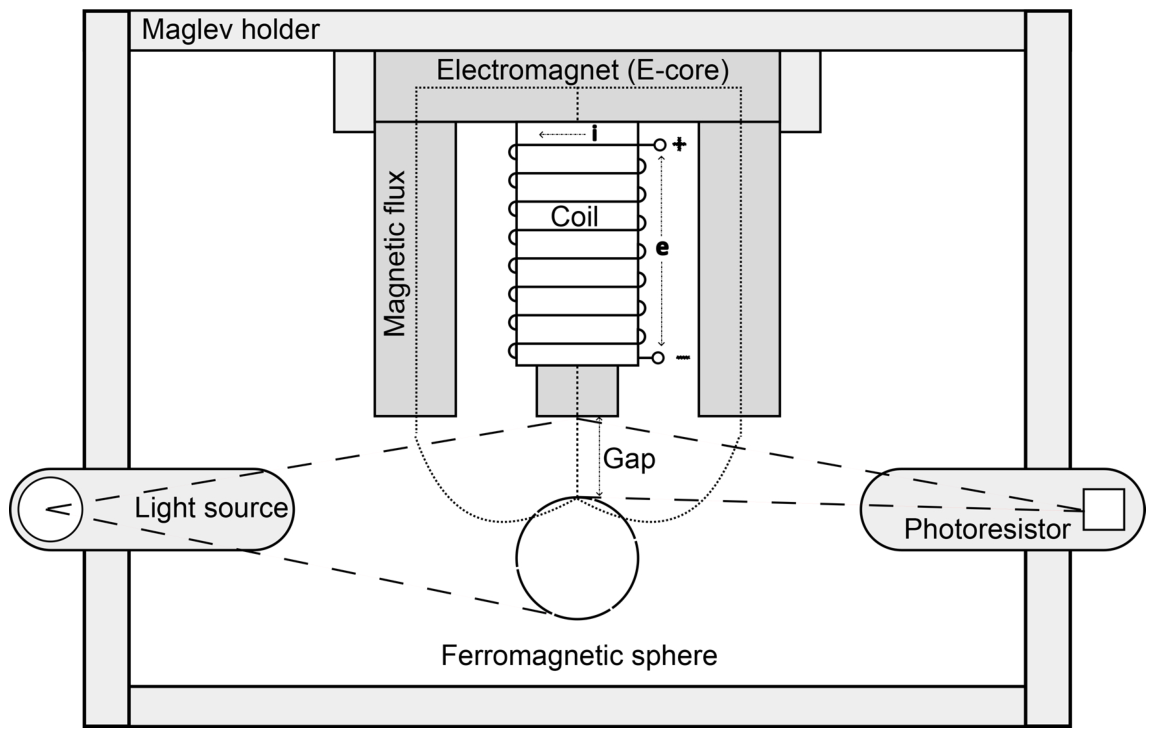
The magnetic levitation system considered in this paper consists of a ferromagnetic sphere suspended in a voltage-controlled magnetic field. Only the vertical motion is considered. The objective is to keep the sphere at a prescribed reference level. The schematic diagram of the system is shown in Figure 1.
The parameters of the dynamic model are: y Gap denotes the sphere’s position, v is the sphere’s velocity, i is the current in the coil of the electromagnet, e is the applied voltage, R is the coil’s resistance, L is the coil’s inductance, g c is the gravitational constant, C is the magnetic force constant, and m is the mass of the levitated sphere.
The inductance L is a nonlinear function of the sphere’s position y Gap . The approximation
L ( y Gap ) = L 1 + 2 C y Gap
will be used; where L 1 is a parameter of the system.
Let the states and the control input be chosen such that x 1 = y Gap , x 2 = v , x 3 = i , u = e , and x = [ x 1 x 2 x 3 ] T is the state vector. Thus, the state-space model of the magnetic levitation system can be written as [6]:
x ˙ 1 = x 2
x ˙ 2 = g c C m x 3 x 1 2
x ˙ 3 = R L x 3 + 2 C L x 2 x 3 x 1 2 + 1 L u
The state-space model defined by (2)–(4) will be used as the basis for the proposed control design.
Let x 1 d , x 2 d , and x 3 d be the desired values of x 1 , x 2 , and x 3 , respectively. Note, from (2)–(4), that the equilibrium point for the system is x e = [ x 1 e 0 x 3 e ] T , where x 3 e satisfies x 3 e = g c m C x 1 e , and x 2 d is equal to zero.
The goal of the control scheme is to drive the states x 1 , x 2 , and x 3 to their desired constant values x 1 d , x 2 d , and x 3 d , respectively.
To employ the exact feedback linearization approach proposed by Al-Muthairi and Zribi [6], a coordinate transformation is defined to map the system into a third-order Brunovsky canonical form. The new state variables z = [ z 1 , z 2 , z 3 ] T are defined by the following nonlinear change of coordinates:
z 1 = x 1 x 1 d
z 2 = x 2
z 3 = g c C m x 3 x 1 2
Remark 1.
If the transformed states z 1 , z 2 , z 3 are driven to zero as t then the original physical states will converge to their targets: x 1 x 1 d , x 2 0 , and x 3 g c m C x 1 d .
The dynamic model of the magnetic levitation system in the new coordinate space can be written as:
z ˙ 1 = z 2
z ˙ 2 = z 3
z ˙ 3 = f ( z ) + g ( z ) u
where the nonlinear drift f ( z ) and the input gain g ( z ) are given by:
f ( z ) = 2 g c z 3 1 2 C L z 1 + x 1 d z 2 z 1 + x 1 d + R L
g ( z ) = 2 L ( z 1 + x 1 d ) C m ( g c z 3 )
It should be noted that the functions f ( z ) and g ( z ) correspond in the original coordinates to the following functions, respectively:
f 1 ( x ) = 2 C m 1 2 C L x 1 x 2 x 3 2 x 1 3 + R L x 3 2 x 1 2
g 1 ( x ) = 2 C x 3 L m x 1 2
where f 1 ( x ) = f ( z ) and g 1 ( x ) = g ( z ) .
Based on this model, the design of the proposed control scheme, which utilizes a filtered error approach to ensure stability and precise tracking, will be developed in the following sections.

2.2. Filtered Error Dynamics

The primary control objective is to maintain the levitated sphere at a desired position y d . In the transformed state space, the corresponding desired equilibrium point is z d = [ 0 , 0 , 0 ] T . To achieve this, a filtered error signal, denoted as σ R , is proposed and defined directly in terms of the transformed coordinates z ( t ) :
σ ( t ) = z 3 + λ 1 z 2 + λ 2 z 1
where λ 1 , λ 2 > 0 are design coefficients chosen to guarantee the asymptotic stability of the tracking error. This is achieved by selecting these parameters such that the characteristic polynomial s 2 + λ 1 s + λ 2 associated with (15) is strictly Hurwitz.
Taking the time derivative of (15) and substituting the system dynamics (8) and (9) yields:
σ ˙ ( t ) = z ˙ 3 + λ 1 z ˙ 2 + λ 2 z ˙ 1 = f ( z ) + g ( z ) u + λ 1 z 3 + λ 2 z 2
To enforce the desired error dynamics, the nominal control law governing the applied voltage is synthesized from (16) as follows:
u = 1 g ( z ) f ( z ) λ 1 z 3 λ 2 z 2 v a u x ( t )
where v a u x R is the auxiliary control signal performed by the FSNN learning algorithm based on the filtered error σ ( t ) . This auxiliary term is designed to compensate for unmodeled dynamics and external disturbances, lumped into a perturbation term D ( t ) . It is assumed that this perturbation is strictly bounded such that D ( t ) D max , where D max > 0 is a known finite constant.
Substituting (17) into (16), the closed-loop residual dynamics are given by
σ ˙ ( t ) = v a u x ( t ) + D ( t )
The discretization of these residual dynamics with a sampling period T establishes the foundation for the stability analysis of the FSNN learning algorithm, which is presented in Section 4.1.

3. Adaptive Architecture and Control Synthesis

3.1. Fourier Series Neural Network (FSNN)

To compensate for parametric uncertainties and unmodeled external periodic disturbances in the Maglev system, a FSNN learning algorithm is employed. Unlike traditional neural networks based on sigmoidal activation functions, the FSNN uses orthogonal Fourier bases, which possess the universal approximation property [28].
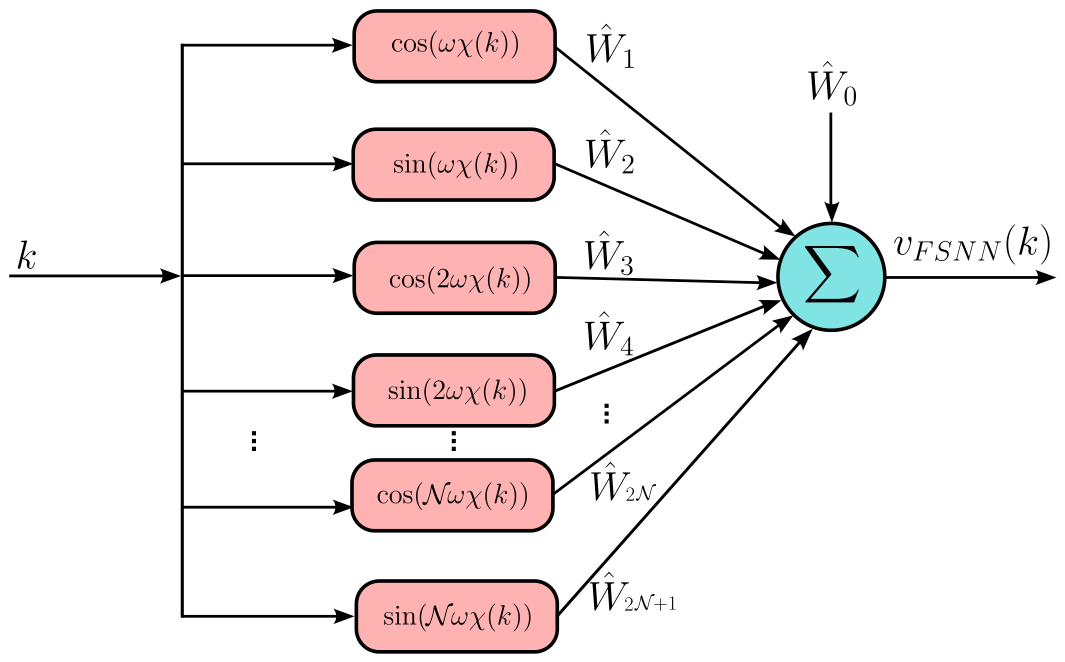
The FSNN is a Single-Hidden-Layer Feedforward Network (SLFN), as shown in Figure 2. Since the primary objective of the FSNN learning algorithm is to compensate for external periodic disturbances coupled with the system dynamics, time is explicitly selected as the input variable.
Let χ ( k ) = k T R be the network input at the discrete instant k, where T is the sampling period. The scalar output of the neural network is defined as the inner product:
v F S N N ( k ) = W ^ T ( k ) ϕ ( χ ( k ) )
where W ^ ( k ) R 2 N + 1 is the vector of estimated synaptic weights and ϕ ( χ ( k ) ) : R R 2 N + 1 is the vector of activation regressors, composed of N harmonics of the Fourier series.
The regressor vector is explicitly defined as:
ϕ ( χ ( k ) ) = 1 cos ( ω χ ( k ) ) sin ( ω χ ( k ) ) cos ( N ω χ ( k ) ) sin ( N ω χ ( k ) )
where ω = 2 π / L is the fundamental spatial frequency, with L being the expected operating domain width for the input variable.
Remark 2.
Since the sine and cosine functions are bounded between 1 and 1, the squared Euclidean norm of the regressor vector is strictly deterministic and bounded a priori by the number of harmonics N . Specifically, | | ϕ ( k ) | | 2 = 1 + n = 1 N [ cos 2 ( n ω χ ( k ) ) + sin 2 ( n ω χ ( k ) ) ] = 1 + N N . This bounded condition ( | | ϕ ( k ) | | 2 N ) is a fundamental requirement for the discrete-time stability analysis.
According to the Weierstrass Universal Approximation Theorem for trigonometric series [29], there exists a constant ideal weight vector W * such that any continuous nonlinear periodic function F ( k ) can be approximated over a compact domain with an arbitrary precision ϵ ( k ) :
F ( k ) = W * T ϕ ( χ ( k ) ) + ϵ ( k )
where ϵ ( k ) is the inherent reconstruction error of the network, strictly bounded such that | ϵ ( k ) | ϵ max for all k > 0 .
Remark 3.
On the selection of the Fourier series order N  [30]. The learning performance and robustness of the proposed FSNN are strictly dependent on a critical user-defined parameter: the number of harmonics N . A larger N theoretically allows for a more accurate representation of complex disturbance profiles; it is practically limited by the system’s physical bandwidth. High-frequency unmodeled components are naturally attenuated by the plant’s inertia, meaning that lower-frequency dynamics fundamentally dominate the tracking error. Therefore, selecting a moderate N effectively acts as a natural low-pass filter for the learning algorithm.

3.2. Auxiliary Control Law and Parameter Adaptation

To actively reject the lumped disturbances, the auxiliary control signal v a u x from (17) is synthesized using the FSNN output and a robust term:
v a u x ( t ) = K a σ ( t ) + W ^ T ( t ) ϕ ( t ) + Γ ^ ( t ) sgn ( σ ( t ) )
where K a > 0 is a stabilizing linear gain and Γ ^ ( t ) is an adaptive robust gain.
In adaptive control theory, the parameter estimation error is defined as the difference between the ideal (unknown but constant) values and the current network estimates. Let W * and Γ * denote the ideal weights and ideal robust gain, respectively. The estimation errors are defined as:
W ˜ ( t ) = W * W ^ ( t )
Γ ˜ ( t ) = Γ * Γ ^ ( t )
To ensure proper learning, the continuous-time adaptation laws for the weights and the robust gain are proposed as:
W ^ ˙ ( t ) = η W σ ( t ) ϕ ( t )
Γ ^ ˙ ( t ) = η Γ | σ ( t ) |
where η W , η Γ > 0 are the learning rates [23]. Using the Euler forward approximation, the discretization of (25) and (26) yields the discrete-time update rules:
W ^ ( k + 1 ) = W ^ ( k ) + T η W σ ( k ) ϕ ( k )
Γ ^ ( k + 1 ) = Γ ^ ( k ) + T η Γ | σ ( k ) |
Since the ideal parameters are constant ( W * ( k + 1 ) = W * ( k ) = W * ), the discrete-time dynamics of the estimation errors can be evaluated by substituting (27) into (23):
W ˜ ( k + 1 ) = W * W ^ ( k ) + T η W σ ( k ) ϕ ( k ) = W ˜ ( k ) T η W σ ( k ) ϕ ( k )
Following an analogous procedure for the robust gain, the error dynamics yield:
Γ ˜ ( k + 1 ) = Γ ˜ ( k ) T η Γ | σ ( k ) |
Consequently, the adaptation rules force the estimation errors to decrease proportionally to the filtered error σ ( k ) .

3.3. Closed-Loop Filtered Error Dynamics

The approximation capability of the FSNN learning algorithm is formally leveraged to cancel the lumped uncertainties. Consider the continuous residual dynamics σ ˙ ( t ) = v a u x ( t ) + D ( t ) . The unknown disturbance D ( t ) can be parameterized in terms of the ideal FSNN components and the ideal robust gain as:
D ( t ) = W * T ϕ ( t ) + Γ * sgn ( σ ( t ) ) + ϵ ( t )
By substituting the auxiliary control law (22) and the disturbance parameterization (31) into the residual dynamics, the closed-loop continuous equation becomes:
σ ˙ ( t ) = v a u x ( t ) + D ( t ) = K a σ ( t ) + W ^ T ( t ) ϕ ( t ) + Γ ^ ( t ) sgn ( σ ( t ) ) + W * T ϕ ( t ) + Γ * sgn ( σ ( t ) ) + ϵ ( t ) = K a σ ( t ) + W * T W ^ T ( t ) ϕ ( t ) + Γ * Γ ^ ( t ) sgn ( σ ( t ) ) + ϵ ( t ) = K a σ ( t ) + W ˜ T ( t ) ϕ ( t ) + Γ ˜ ( t ) sgn ( σ ( t ) ) + ϵ ( t )
This formulation (32) isolates the linear stabilizing term ( K a σ ) from the estimation errors ( W ˜ , Γ ˜ ), providing the structural foundation required to prove the discrete-time convergence of the algorithm using Lyapunov stability theory.
Remark 4.
On the nature of the FSNN online adaptation. It is necessary to distinguish the learning mechanism of the proposed discrete-time FSNN from data-driven artificial neural networks. Unlike machine learning architectures that require offline training phases, exhaustive datasets, and subsequent cross-validation to verify model generalization, the FSNN in this control framework operates strictly as an online adaptive compensator. The weight vector W ^ ( k ) does not attempt to memorize the global dynamics of the Maglev system. Instead, the weights are recursively adjusted at each sampling step using only the immediate previous state information (following the explicit Euler discretization). This allows the network to dynamically approximate and cancel the lumped matched uncertainties exclusively at the current operational trajectory. Consequently, the validation of this adaptive capability does not rely on traditional dataset metrics, but is guaranteed by Lyapunov stability analysis.

4. Main Results

4.1. Lyapunov Stability Analysis

While the continuous-time formulation of the adaptive control law provides an intuitive framework for uncertainty cancellation, its direct implementation on digital hardware introduces sampling effects that can degrade performance or induce instability if not formally addressed. The contribution of this paper is the formulation of the stability analysis directly in the discrete-time domain. In this section, discrete-time Lyapunov stability theory is leveraged to prove that the proposed FSNN adaptation rules guarantee the UUB stability of all closed-loop signals. Furthermore, the analysis provides an explicit, deterministic upper bound for the sampling period T to ensure safe and stable operation. These theoretical guarantees are formalized in the following theorem.
Theorem 1
(A Bound for the Sample-Time to Ensure Stability). Consider the discrete-time closed-loop filtered error dynamics, given by:
σ ( k + 1 ) = σ ( k ) + T K a σ ( k ) + W ˜ T ( k ) ϕ ( k ) + Γ ˜ ( k ) sgn ( σ ( k ) ) + ϵ ( k )
where T is the sampling period, σ ( k ) is the filtered error, ϕ ( k ) is the bounded vector of Fourier regressors satisfying | | ϕ ( k ) | | 2 N , and ϵ ( k ) is the inherent reconstruction error strictly bounded by | ϵ ( k ) | ϵ max .
Let the auxiliary control law be defined as:
v a u x ( k ) = K a σ ( k ) + W ^ T ( k ) ϕ ( k ) + Γ ^ ( k ) sgn ( σ ( k ) )
Let the discrete-time adaptation laws for the neural network weights and the robust gain be defined, respectively, by:
W ^ ( k + 1 ) = W ^ ( k ) + T η W σ ( k ) ϕ ( k )
Γ ^ ( k + 1 ) = Γ ^ ( k ) + T η Γ | σ ( k ) |
where η W > 0 and η Γ > 0 are the learning rates.
If the tuning parameters K a , η W , η Γ and the sampling period T are chosen such that they satisfy the following strict condition:
T < 2 K a 1 4 K a 2 + η W N + η Γ
then the trajectories of the closed-loop system is stable.
Proof. 
The proof of Theorem 1 is carried out as follows. Let the Lyapunov candidate function V ( k ) be composed of three positive definite terms, grouping the different control actions:
V ( k ) = V σ ( k ) + V W ˜ ( k ) + V Γ ˜ ( k )
where V σ ( k ) accounts for the filtered error energy-like, V W ˜ ( k ) represents the FSNN approximation error, and V Γ ˜ ( k ) is the robust gain estimation error. The explicit function is chosen as:
V ( k ) = 1 2 σ 2 ( k ) + 1 2 tr W ˜ T ( k ) η W 1 W ˜ ( k ) + 1 2 η Γ 1 Γ ˜ 2 ( k )
The forward difference operator Δ V ( k ) = V ( k + 1 ) V ( k ) is computed along the system trajectories. Evaluating the difference for each term individually, we begin with V σ :
Δ V σ ( k ) = V σ ( k + 1 ) V σ ( k ) = 1 2 σ 2 ( k + 1 ) 1 2 σ 2 ( k )
Recalling the closed-loop filtered error dynamics (32), its Euler discretization yields:
σ ( k + 1 ) = σ ( k ) + T σ ˙ ( k ) = σ ( k ) + T K a σ ( k ) + W ˜ T ( k ) ϕ ( k ) + Γ ˜ ( k ) sgn ( σ ( k ) ) + ϵ ( k ) = σ ( k ) + T Δ d y n ( k )
where we define Δ d y n ( k ) K a σ ( k ) + W ˜ T ( k ) ϕ ( k ) + Γ ˜ ( k ) sgn ( σ ( k ) ) + ϵ ( k ) . Applying the Cauchy–Schwarz inequality ( a + b + c + d ) 2 4 ( a 2 + b 2 + c 2 + d 2 ) , an upper bound for the squared dynamic term is established as:
Δ d y n 2 ( k ) 4 K a 2 σ 2 ( k ) + W ˜ T ( k ) 2 ϕ ( k ) 2 + Γ ˜ 2 ( k ) + ϵ 2 ( k )
Substituting (41) into (40), the difference expands to:
Δ V σ ( k ) = 1 2 σ ( k ) + T Δ d y n ( k ) 2 1 2 σ 2 ( k ) = σ ( k ) T Δ d y n ( k ) + 1 2 T 2 Δ d y n 2 ( k ) = σ ( k ) T K a σ ( k ) + W ˜ T ( k ) ϕ ( k ) + Γ ˜ ( k ) sgn ( σ ( k ) ) + ϵ ( k ) + 1 2 T 2 Δ d y n 2 ( k ) = T K a σ 2 ( k ) + T σ ( k ) W ˜ T ( k ) ϕ ( k ) + T σ ( k ) Γ ˜ ( k ) sgn ( σ ( k ) ) + T σ ( k ) ϵ ( k ) + 1 2 T 2 Δ d y n 2 ( k )
Next, the difference Δ V W ˜ ( k ) is evaluated. Using the neural network weight adaptation law (27) and its corresponding error dynamics (29), it follows that:
Δ V W ˜ ( k ) = 1 2 η W 1 tr W ˜ T ( k + 1 ) W ˜ ( k + 1 ) W ˜ T ( k ) W ˜ ( k ) = 1 2 η W 1 W ˜ ( k ) T η W σ ( k ) ϕ ( k ) 2 W ˜ ( k ) 2 = 1 2 η W 1 2 T η W W ˜ T ( k ) σ ( k ) ϕ ( k ) + T 2 η W 2 σ 2 ( k ) ϕ ( k ) 2 = T σ ( k ) W ˜ T ( k ) ϕ ( k ) + 1 2 T 2 η W σ 2 ( k ) ϕ ( k ) 2
Similarly, computing the difference Δ V Γ ˜ ( k ) using (30) yields:
Δ V Γ ˜ ( k ) = T σ ( k ) Γ ˜ ( k ) sgn σ ( k ) + 1 2 T 2 η Γ σ 2 ( k )
Combining (43), (44), and (45), the total difference Δ V ( k ) is obtained. Note that the cross terms related to the parameter estimation errors cancel out, providing:
Δ V ( k ) = T K a σ 2 ( k ) + T σ ( k ) ϵ ( k ) + 1 2 T 2 Δ d y n 2 ( k ) + 1 2 T 2 η Γ σ 2 ( k ) + 1 2 T 2 η W σ 2 ( k ) ϕ ( k ) 2 = T K a σ 2 ( k ) + T σ ( k ) ϵ ( k ) + 1 2 T 2 Δ d y n 2 ( k ) + η Γ σ 2 ( k ) + η W σ 2 ( k ) ϕ ( k ) 2
Applying the upper bound (42) to Δ d y n 2 ( k ) , the expression expands to:
Δ V ( k ) T K a σ 2 ( k ) + T σ ( k ) ϵ ( k ) + 1 2 T 2 4 K a 2 σ 2 ( k ) + 4 W ˜ T ( k ) 2 ϕ ( k ) 2 + 4 Γ ˜ 2 ( k ) + 4 ϵ 2 ( k ) + η Γ σ 2 ( k ) + η W σ 2 ( k ) ϕ ( k ) 2
To decouple the reconstruction error term, Young’s Inequality is applied such that T σ ( k ) ϵ ( k ) 1 2 T σ 2 ( k ) + 1 2 T ϵ 2 ( k ) . Thus, Δ V ( k ) is rewritten and grouped by σ 2 ( k ) :
Δ V ( k ) T K a 1 2 T 2 T 2 K a 2 1 2 T 2 η Γ 1 2 T 2 η W ϕ ( k ) 2 σ 2 ( k ) + 2 T 2 W ˜ T ( k ) 2 ϕ ( k ) 2 + 2 T 2 Γ ˜ 2 ( k ) + 1 2 T + 2 T 2 ϵ 2 ( k )
Given that the regressor vector is bounded by ϕ ( k ) 2 N (where N > 1 ), and replacing ϵ ( k ) with its bound ϵ max , the inequality is further bounded by:
Δ V ( k ) T K a 1 2 T 2 T 2 K a 2 1 2 T 2 η Γ 1 2 T 2 η W N σ 2 ( k ) + 2 T 2 W ˜ T ( k ) 2 N + 2 T 2 Γ ˜ 2 ( k ) + 1 2 T + 2 T 2 ϵ max 2
To ensure a strictly negative definite decay outside a bounded region, the coefficient multiplying σ 2 ( k ) must be strictly positive:
T K a 1 2 T 2 T 2 K a 2 1 2 T 2 η W N 1 2 T 2 η Γ > 0
Solving this inequality for the sampling period T yields the stability condition:
T < 2 K a 1 4 K a 2 + η W N + η Γ
   □
Remark 5
(Learning Rate Limit). If the learning rates ( η W or η Γ ) are significantly increased to accelerate the network convergence, the denominator grows. This physically implies that a smaller sampling period T (i.e., a faster digital processor) is required to maintain closed-loop stability.
Remark 6
(Control Gain Trade-off). Increasing the base linear gain K a increases the numerator, theoretically providing a larger stability margin in continuous time. However, the dominating 4 K a 2 term in the denominator indicates that large gains will reduce the maximum allowable sampling period T. This reflects the well-known phenomenon that high feedback gains in discrete-time systems induce instability.
Remark 7.
The selection of N must be intrinsically coupled with the sampling period T. If T is too large, the discrete-time implementation will fail to capture the fast dynamics of the filtered error σ ( k ) , leading to a breakdown of the numerical integration and potential system divergence, highlighting the critical necessity of the bounds established in Theorem 1.

4.2. Uniform Ultimate Boundedness (UUB)

Corollary 1
(Uniform Ultimate Boundedness). Provided that the stability condition derived in Theorem 1 holds, the closed-loop filtered error σ ( k ) is Uniformly Ultimately Bounded (UUB). Specifically, the error trajectories converge to an attractive, compact, and invariant set Ω defined as:
Ω = σ R : | σ | Υ max C μ
where C and Υ max are strictly positive constants determined by the system tuning parameters and physical uncertainty bounds.
Proof. 
To formally establish the UUB property, let us define the stability coefficient C from the inequality derived in Theorem 1 as:
C = T K a 1 2 T 2 T 2 K a 2 1 2 T 2 η W N 1 2 T 2 η Γ
where C > 0 strictly enforces the stability condition (37). Furthermore, let W max and Γ max denote the upper bounds of the optimal parameter estimation errors such that | | W ˜ ( k ) | | 2 W max 2 and Γ ˜ 2 ( k ) Γ max 2 . These considerations allow grouping all strictly positive residual terms into a constant bound Υ max :
Υ max = 2 T 2 W max 2 N + 2 T 2 Γ max 2 + 1 2 T + 2 T 2 ϵ max 2
By substituting these definitions into the final inequality of the Lyapunov difference (49), the expression reduces to:
Δ V ( k ) C σ 2 ( k ) + Υ max
For the Lyapunov difference to be strictly negative ( Δ V ( k ) < 0 ), the following condition must be satisfied:
C σ 2 ( k ) > Υ max | σ ( k ) | > Υ max C μ
Therefore, according to the Discrete-Time Comparison Lemma, the trajectories of the filtered error σ ( k ) converge exponentially to the attractive, compact, and invariant set Ω . Once σ ( k ) enters Ω , it will remain bounded within the theoretical limits ± μ for all future samples k, guaranteeing the Uniform Ultimate Boundedness (UUB) property of the system (33).
Consequently, the selection of the parameter adaptation laws is formally justified through the discrete-time stability analysis, ensuring that the learning dynamics minimize the discrete-time Lyapunov function outside the invariant set Ω .    □
Remark 8
(Equivalence with Gradient Descent). It is important to note that the parametric adaptation law synthesized from the Lyapunov stability analysis, Δ W ^ ( k ) = T η W σ ( k ) ϕ ( k ) , exhibits a mathematical structure identical to the Widrow–Hoff learning rule (gradient descent) used to minimize an instantaneous quadratic cost function J ( k ) = 1 2 σ 2 ( k ) . However, the derivation through the Lyapunov framework presented in this work is fundamental. The classical gradient approach provides no inherent guarantees regarding the stability of the physical closed-loop dynamics, whereas this Lyapunov-based design simultaneously ensures parametric convergence and the UUB stability.

5. Numerical Example and Discussion

To validate the effectiveness and theoretical claims of the proposed discrete-time control architecture, numerical simulations were conducted using the exact nonlinear dynamic model of the magnetic levitation system presented in Section 2.1. The overall control scheme is scheduled in the Algorithm 1.

5.1. Simulation Setup and Parameters

The physical parameters of the Maglev plant used for the simulation are defined as follows: sphere mass m = 0.05 kg, coil resistance R = 5.0 Ω , inductance constant L 1 = 0.1 H, magnetic force constant C = 0.001 N · m 2 A 2 , and gravity acceleration g c = 9.81 m s 2 .
For physical context, typical electromagnetic actuators of this class operate within an air gap of approximately 1 mm to 20 mm, and a 24 V electric transformer is commonly employed as the E-shaped iron-sheet electromagnet component, with a cross-section of approximately 80 mm × 65 mm × 52 mm [31]. While miniaturization is possible, the minimum achievable size is strictly constrained by the necessary electromagnetic force required to support the levitating mass and the coil’s thermal dissipation limits to prevent overheating during sustained operation.
Algorithm 1 Control Implementation
Require: Desired reference y d , sampling period T
Require: Control gains λ 1 , λ 2 , K a , learning rates η W , η Γ
Require: Number of harmonics N
 1:
Initialization:
 2:
Set k = 0 , t = 0
 3:
Initialize network weights W ^ ( 0 ) = 0 2 N + 1
 4:
Initialize robust gain Γ ^ ( 0 ) = 0
 5:
loop at each sampling instant k
 6:
      1. State Measurement:
 7:
      Read physical states: x 1 ( k ) , x 2 ( k ) , x 3 ( k )
 8:
      2. Coordinate Transformation:
 9:
      Compute z 1 ( k ) , z 2 ( k ) , z 3 ( k ) using Equations (5)–(7)
10:
      3. Filtered Error Computation:
11:
       σ ( k ) = z 3 ( k ) + λ 1 z 2 ( k ) + λ 2 z 1 ( k )
12:
      4. FSNN Regressor Construction:
13:
      Construct ϕ ( k ) using T , k , and N as in Equation (20)
14:
      5. Control Law Synthesis:
15:
      Evaluate nonlinear functions f ( z ) and g ( z )
16:
      Compute auxiliary control:
17:
           v a u x ( k ) = K a σ ( k ) + W ^ T ( k ) ϕ ( k ) + Γ ^ ( k ) sgn ( σ ( k ) )
18:
      Calculate applied voltage:
19:
           u ( k ) = 1 g ( z ) f ( z ) λ 1 z 3 ( k ) λ 2 z 2 ( k ) v a u x ( k )
20:
      6. Plant Actuation:
21:
      Apply voltage u ( k ) to the Maglev electromagnet
22:
      7. Parameter Adaptation (Learning):
23:
      Update weights: W ^ ( k + 1 ) = W ^ ( k ) + T η W σ ( k ) ϕ ( k )
24:
      Update gain: Γ ^ ( k + 1 ) = Γ ^ ( k ) + T η Γ | σ ( k ) |
25:
      8. Time Advance:
26:
       k k + 1
27:
end loop
The primary control objective was to stabilize the sphere while tracking a time-varying sinusoidal reference y d ( k ) = 0.005 sin ( 0.2 π k T ) + 0.01 m. The coefficients for the filtered error were selected as λ 1 = 600 and λ 2 = 6000 , ensuring a strictly Hurwitz characteristic polynomial.
For the FSNN and the adaptive laws, the tuning parameters were chosen as: linear gain K a = 400 , learning rates η W = 150 and η Γ = 20 , and N = 5 harmonics (yielding a regressor bound of N = 11 ). The discrete sampling period was set to T = 0.001 s (1 ms).
It was crucial to verify that this parameter selection satisfied the theoretical stability bound derived in Theorem 1. Evaluating the bound yielded:
T < 2 ( 400 ) 1 4 ( 400 ) 2 + ( 150 ) ( 11 ) + 20 = 799 641 , 670 0.001245 s
Since the implemented sampling period T = 0.001 < 0.001245 s, the discrete-time stability condition was strictly fulfilled. Additionally, an unknown periodic external disturbance was injected into the system to evaluate the robustness and learning capability of the neural network.

5.2. Tracking Performance and UUB Verification

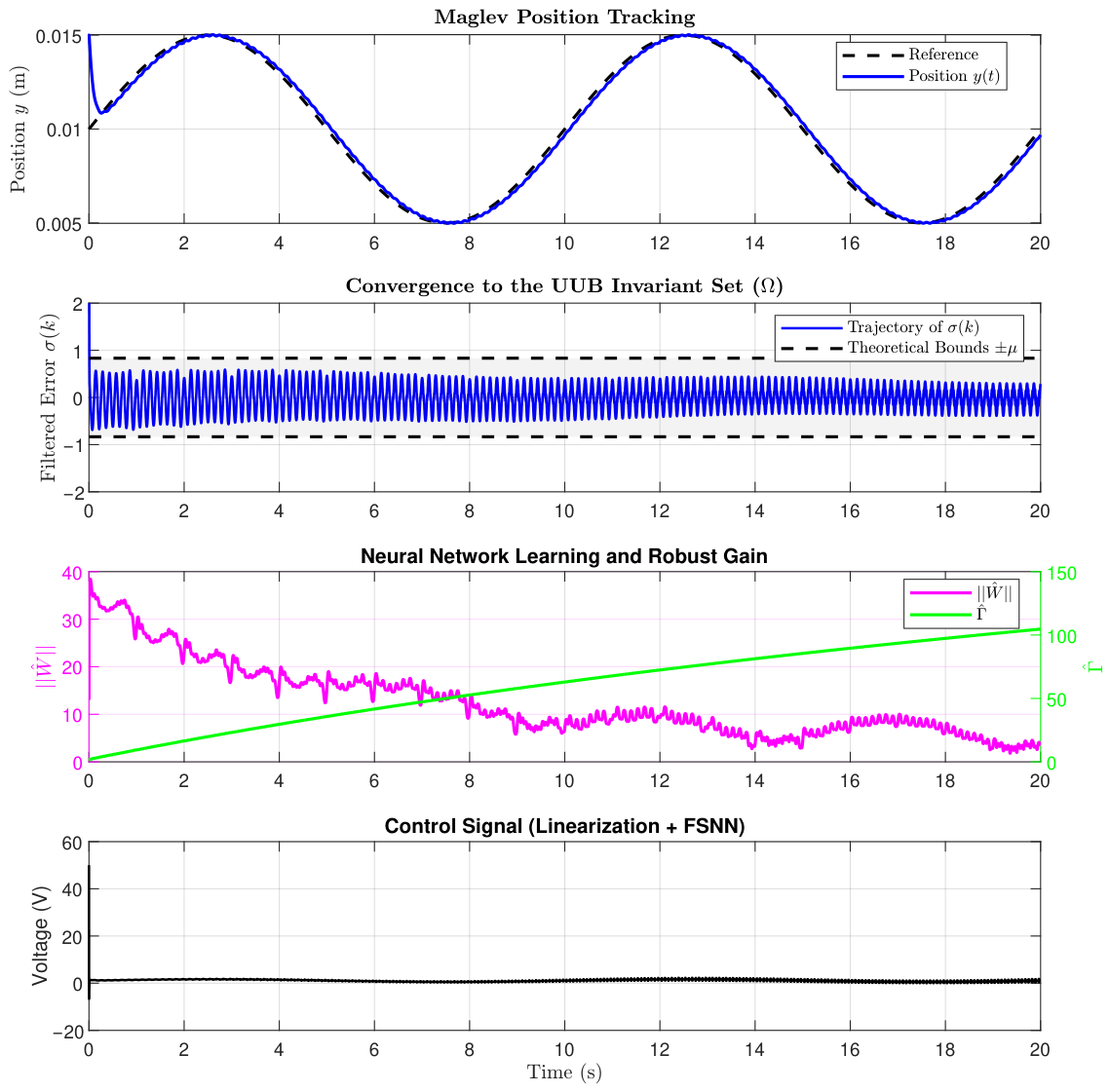
Figure 3 illustrates the comprehensive performance of the proposed FSNN controller. The top subplot displays the position tracking response of the Maglev system. The controller successfully drove the levitated sphere to track the time-varying reference y d ( k ) with negligible tracking error, effectively compensating for the highly nonlinear dynamics.
To corroborate the theoretical statements established in Section 4.1, the second subgraph of Figure 3 shows the evolution of the discrete-time filtered error σ ( k ) . As stated, the filtered error converged to the origin, overcoming the initial transient. Once it entered the theoretical invariant set Ω , the trajectory remained strictly bounded within the ultimate limits ± μ (represented by the dashed lines) for all subsequent samples. This fulfilled the UUB property according to Corollary 1.

5.3. Control Effort and Weight Adaptation

The third subplot portrays the dynamic evolution of the adaptive parameters. The FSNN synaptic weights norm W ^ ( k ) (magenta line) adapted during the transient phase. Simultaneously, the robust gain Γ ^ ( k ) monotonically integrated the absolute residual error.
Finally, the corresponding control input voltage applied to the electromagnet is depicted in the bottom subplot. The control signal remained within physically realizable limits, and it exhibits a smooth profile.

5.4. Comparison with Baseline Controllers

We performed a baseline comparison, in which two discrete-time controllers were implemented sharing the same nominal Feedback Linearization (FBL) structure. The first was a discrete classical controller, formulated by applying a PI control law over the filtered error σ ( k ) :
v p i ( k ) = K p σ ( k ) + K i j = 1 k σ ( j ) T
where K p = 550 and K i = 200 were the proportional and integral gains, respectively, and T was the sampling time.
The second baseline controller was the Super-Twisting Algorithm (STA) [32], implemented via the direct Euler discretization of its continuous-time counterpart. The STA is defined as:
v s t a ( k ) = k 1 | σ ( k ) | 1 / 2 sgn ( σ ( k ) ) + ν ( k )
ν ( k ) = ν ( k 1 ) + k 2 T sgn ( σ ( k ) )
where k 1 = 1050 and k 2 = 2000 are the switching gains, ν ( k ) is the discrete integral state of the STA, T is the sampling time, and sgn ( · ) represents the standard signum function.
To quantitatively evaluate and compare the tracking performance and robustness of the evaluated control schemes, two standard discrete-time error metrics were calculated: the Integral Absolute Error (IAE) and the Integral Square Error (ISE). These indices are computed as follows:
I A E = k = 1 N | e ( k ) | T
I S E = k = 1 N e ( k ) 2 T
where e ( k ) = y ( k ) y d ( k ) represents the position tracking error at the k-th sampling step and N is the total number of samples during the simulation time. The IAE provides a linear penalty for all errors, making it an excellent indicator of overall tracking accuracy, while the ISE heavily penalizes large transient errors, serving as a reliable measure of the controller’s ability to swiftly suppress large deviations.
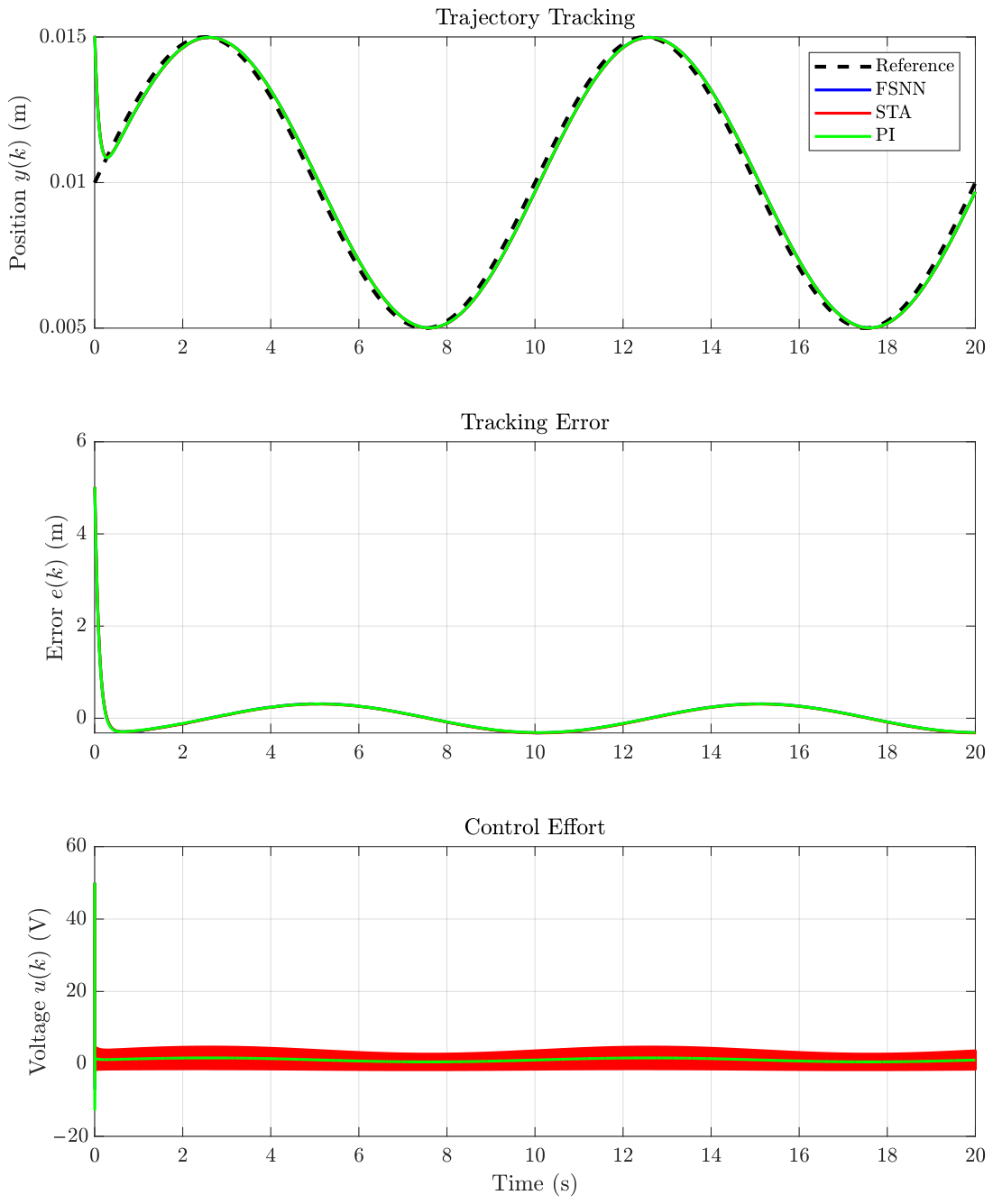
To establish a comparative baseline, the first simulation scenario depicted in Figure 4 evaluated the tracking performance of the three controllers under ideal nominal conditions. In this case, the system was free from external disturbances, and the exact parametric knowledge was available to the controllers. As detailed in Table 1, the performance metrics were similar across all the approaches, with the PI achieving a marginally lower error ( IAE = 0.004260 , ISE = 2.10 × 10 6 ).
In the absence of parametric uncertainties, the nominal Feedback Linearization (FBL) loop canceled the nonlinear dynamics. This scenario established the gains tuning for all the evaluated controllers. However, since practical Maglev implementations are inevitably subjected to unmodeled dynamics and disturbances, a second scenario was introduced to evaluate their robustness.
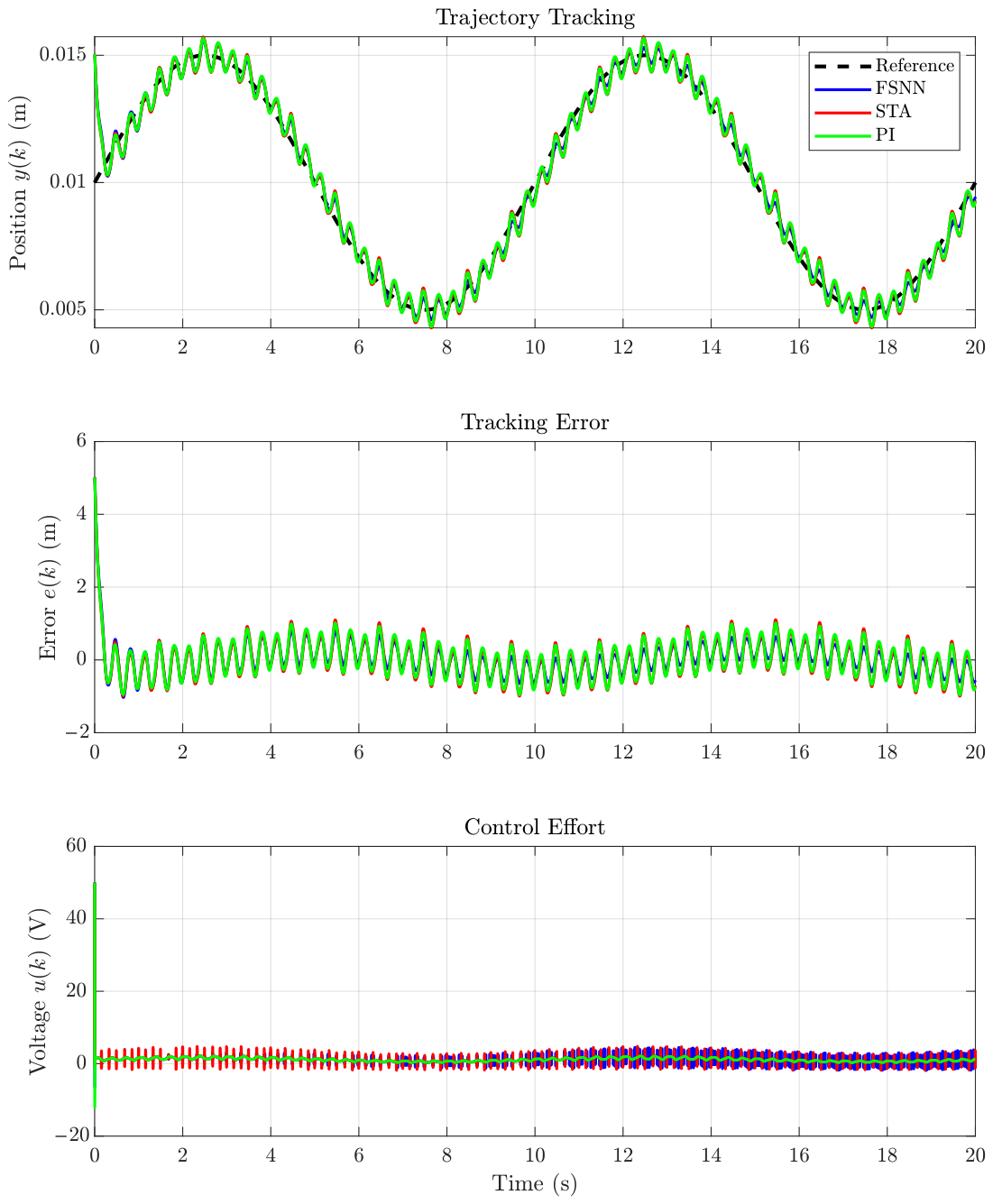
The second simulation scenario was conducted, introducing non-ideal conditions as shown in the Figure 5. To ensure an unbiased comparison, the control gains for all three methodologies (FSNN, STA, and PI) were kept strictly identical to those validated in the nominal scenario.
In this test, the Maglev system was subjected to a time-varying parametric uncertainty in the sphere’s mass, defined as m ( k ) = m 0 ( 1 + 0.25 sin ( 6 π k ) ) , representing a continuous 25 % structural variation. Additionally, the system was affected by an external force disturbance F e x t ( k ) = 0.05 sin ( 6 π k ) + 0.02 cos ( 14 π k ) and also a voltage noise V n o i s e ( k ) = 2.0 sin ( 4 π k ) . Under these conditions, the nominal Feedback Linearization (FBL) loop, which relies on the constant nominal mass m 0 , failed to cancel out the nonlinearities, injecting a significant time-varying unmodeled dynamic into the closed-loop system.
The performance metrics in Table 2 demonstrate some limitations of classical fixed-gain structures when facing dynamic uncertainties. Both the PI and the STA exhibit slight tracking accuracy. In contrast, the proposed discrete-time FSNN preserved a tracking profile, outperforming the baseline controllers with an IAE of 0.006103 and an ISE of 3.87 × 10 6 .
As corroborated by the control effort responses, the FSNN achieved this robustness. Moreover, the dynamic adaptation of the Fourier weights ( W ^ ) and the robust gain ( Γ ^ ) actively learned and compensated for the FBL mismatch and external disturbances.

5.5. Validation of the Sampling Time Bound

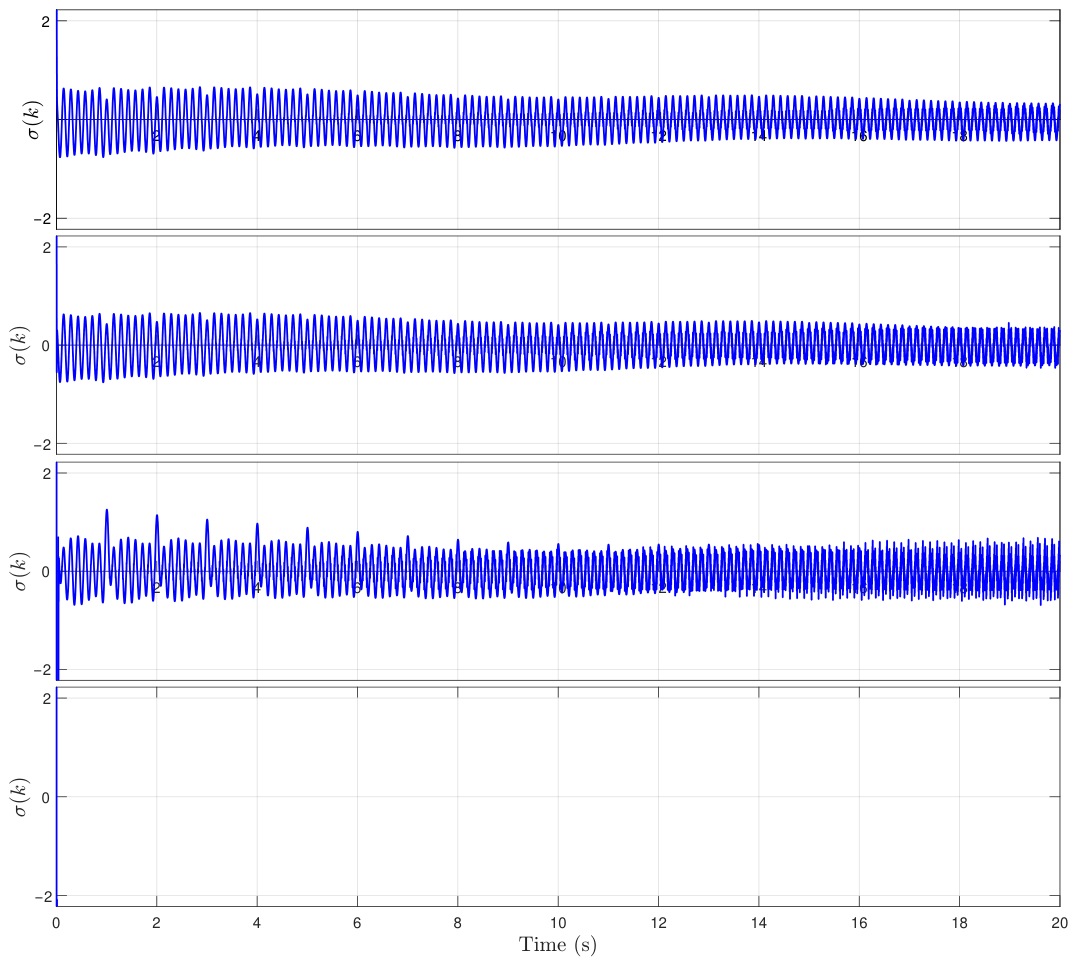
To explicitly validate the theoretical boundaries established in Theorem 1, a final simulation scenario was conducted to evaluate the stability of the closed-loop system under varying sampling times. Based on the Lyapunov analysis, the sufficient condition to guarantee UUB stability for this specific Maglev plant requires T < 1.245 ms.
Figure 6 illustrates the behavior of the filtered error surface σ ( k ) as the sampling time was progressively increased beyond the theoretical limit. As observed in the first two subplots ( T = 1.245 ms and T = 1.8675 ms), the system maintained stability. This margin highlights the inherently conservative nature of Lyapunov-based sufficient conditions. However, as T further exceeded the established bound the strict convergence guarantees provided by the Corollary 1 were lost.
At a sampling time of T = 2.490 ms ( 2 × the theoretical limit), the control action degraded significantly and σ ( k ) exhibited severe high-frequency spikes, violating the desired UUB bounds. Finally, at T = 2.6145 ms ( 2.1 × the limit) the integration step became entirely unmanageable for the fast, unstable dynamics of the Maglev, causing the discrete-time closed-loop system to completely diverge (numerical instability). These results empirically corroborate the need to calculate and respect the maximum T bound prior to implementation.

6. Conclusions

In this paper, a discrete-time Fourier Series Neural Network (FSNN) control scheme was developed and validated for a general class of nonlinear affine systems, using the magnetic levitation (Maglev) plant as a benchmark application. By directly synthesizing adaptive learning laws in the discrete-time domain using Lyapunov stability theory, this work circumvents the instability and performance degradation issues typically encountered in the digital implementation of continuous-time neural controllers.
The theoretical analysis yielded an explicit, deterministic constraint on the maximum allowable sampling period, providing a fundamental guideline for safe microprocessor-based implementation. Under this condition, the proposed architecture guarantees the UUB property of the closed-loop tracking error, bounding the unmodeled dynamics and periodic disturbances.
Numerical simulations corroborated the theoretical findings, demonstrating that the FSNN learning algorithm converges to learn the lumped uncertainties without requiring offline training. Furthermore, the orthogonal Fourier bases smooth the control effort. In addition, the discrete-time Lyapunov stability analysis presented in this work relies on the forward Euler method to synthesize explicit, causal parameter update laws.
Finally, comparative simulation against baseline discrete-time PI and STA controllers confirmed the robustness of the proposed approach. While all the controllers exhibited adequate tracking under ideal nominal conditions, the FSNN demonstrated significant precision (lower IAE and ISE metrics) and a control effort when subjected to time-varying parametric uncertainties and external disturbances. The critical necessity of the proposed framework was empirically validated: simulation scenarios showed that violating the analytically derived maximum sampling time bound results in the loss of UUB guarantees eventual system divergence. This confirms that heuristic discretization approaches are inherently unsafe for fast-dynamics unstable nonlinear systems.
Future experimental work will focus on validating the proposed discrete-time architecture on a physical Maglev testbed and extending the theoretical framework to handle MIMO underactuated systems.

Author Contributions

Conceptualization, S.M.D.-P. and R.V.C.-S.; methodology, S.M.D.-P. and R.V.C.-S.; software, S.M.D.-P.; validation, S.M.D.-P., R.V.C.-S., E.C.-N., J.G.R.-M. and M.T.-P.; formal analysis, S.M.D.-P.; investigation, S.M.D.-P., R.V.C.-S., E.C.-N., J.G.R.-M. and M.T.-P.; resources, E.C.-N., J.G.R.-M. and M.T.-P.; data curation, S.M.D.-P., R.V.C.-S., E.C.-N., J.G.R.-M. and M.T.-P.; writing—original draft preparation, S.M.D.-P.; writing—review and editing, S.M.D.-P., R.V.C.-S., E.C.-N., J.G.R.-M. and M.T.-P.; visualization, S.M.D.-P., R.V.C.-S., E.C.-N., J.G.R.-M. and M.T.-P.; supervision, S.M.D.-P., R.V.C.-S., E.C.-N., J.G.R.-M. and M.T.-P.; project administration, S.M.D.-P. and R.V.C.-S. All authors have read and agreed to the published version of the manuscript.

Funding

The authors declare that no funding was associated with this research.

Institutional Review Board Statement

Not applicable.

Informed Consent Statement

Not applicable.

Data Availability Statement

The original contributions presented in this study are included in the article. Further inquiries can be directed to the corresponding authors.

Conflicts of Interest

The authors declare no conflicts of interest.

Abbreviations

The following abbreviations are used in this manuscript:
Maglevmagnetic levitation
FSNNFourier Series Neural Network
UUBUniform Ultimate Boundedness
SISOSingle-Input Single-Output
MIMOMulti-Input Multi-Output
ANNArtificial Neural Network
SLFNSingle-Hidden-Layer Feedforward Network
PIProportional–Integral
STASuper-Twisting Algorithm
FBLFeedback Linearization
IAEIntegral Absolute Error
ISEIntegral Square Error

References

  1. Pujol-Vázquez, G.; Vargas, A.N.; Mobayen, S.; Acho, L. Semi-Active Magnetic Levitation System for Education. Appl. Sci. 2021, 11, 5330. [Google Scholar] [CrossRef]
  2. Zhou, L.; Wu, J. Magnetic Levitation Technology for Precision Motion Systems: A Review and Future Perspectives. Int. J. Autom. Technol. 2022, 16, 386–402. [Google Scholar] [CrossRef]
  3. Dai, C.; Huang, C.; Liu, X.; Li, X. Structural Design and Modeling Analysis of an Active Magnetic Levitation Vibration Isolation System. Actuators 2026, 15, 120. [Google Scholar] [CrossRef]
  4. Xiang, B.; Wu, S.; Wen, T.; Liu, H.; Peng, C. Design, Modeling, and Validation of a 0.5 kWh Flywheel Energy Storage System Using Magnetic Levitation System. Energy 2024, 308, 132867. [Google Scholar] [CrossRef]
  5. Li, F.; Sun, Y.; Xu, J.; He, Z.; Lin, G. Control Methods for Levitation System of EMS-Type Maglev Vehicles: An Overview. Energies 2023, 16, 2995. [Google Scholar] [CrossRef]
  6. Al-Muthairi, N.F.; Zribi, M. Sliding Mode Control of a Magnetic Levitation System. Math. Probl. Eng. 2004, 2004, 657503. [Google Scholar] [CrossRef]
  7. Wu, Z.; Fan, K.; Zhang, X.; Li, W. Based on Sliding Mode and Adaptive Linear Active Disturbance Rejection Control for a Magnetic Levitation System. J. Sens. 2023, 2023, 5568976. [Google Scholar] [CrossRef]
  8. Pandey, A.; Sharma, G.; Bokoro, P.N.; Kumar, R. Robust Integral Optimal Sliding Mode Control Design for Electromagnetic Levitation System with Matched Uncertainties. Mathematics 2026, 14, 229. [Google Scholar] [CrossRef]
  9. Xu, J.; Wang, W.; Chen, C.; Rong, L.; Ji, W.; Guo, Z. Reinforcement Learning-Based Super-Twisting Sliding Mode Control for Maglev Guidance System. Actuators 2026, 15, 147. [Google Scholar] [CrossRef]
  10. Norollahzadegan, M.; Ghasemi, S.; Maragheh, S.S.; Ehsani, M.; Behnamgol, V.; Barzamini, R. Maglev System Control Using a New Adaptive Super Twisting Theory. In Proceedings of the 2025 11th International Conference on Control, Decision and Information Technologies (CoDIT), Split, Croatia, 15–18 July 2025; IEEE: New York, NY, USA, 2025; pp. 1183–1188. [Google Scholar]
  11. Lewis, F.W.; Jagannathan, S.; Yesildirak, A. Neural Network Control of Robot Manipulators and Non-Linear Systems; Taylor & Francis: London, UK, 1999. [Google Scholar]
  12. Liang, Y.; Zhang, H.; Zhang, K.; Wang, R. A Novel Neural Network Discrete-Time Optimal Control Design for Nonlinear Time-Delay Systems Using Adaptive Critic Designs. Optim. Control Appl. Methods 2020, 41, 748–764. [Google Scholar] [CrossRef]
  13. Wang, D.; Zhao, M.; Ha, M.; Ren, J. Neural Optimal Tracking Control of Constrained Nonaffine Systems with a Wastewater Treatment Application. Neural Netw. 2021, 143, 121–132. [Google Scholar] [CrossRef]
  14. Tan, W.G.Y.; Xiao, M.; Wu, G.; Wu, Z. Lyapunov-Stable Neural Networks for Modelling and Control of Nonlinear Systems. Int. J. Control 2026, 99, 578–594. [Google Scholar] [CrossRef]
  15. Perrusquia, A.; Yu, W. Discrete-Time H2 Neural Control Using Reinforcement Learning. IEEE Trans. Neural Netw. Learn. Syst. 2020, 32, 4879–4889. [Google Scholar] [CrossRef]
  16. Yang, X.; Liu, D.; Wang, D.; Wei, Q. Discrete-Time Online Learning Control for a Class of Unknown Nonaffine Nonlinear Systems Using Reinforcement Learning. Neural Netw. 2014, 55, 30–41. [Google Scholar] [CrossRef] [PubMed]
  17. Liu, L.; Wang, Z.; Zhang, H. Adaptive Fault-Tolerant Tracking Control for MIMO Discrete-Time Systems via Reinforcement Learning Algorithm with Less Learning Parameters. IEEE Trans. Autom. Sci. Eng. 2016, 14, 299–313. [Google Scholar] [CrossRef]
  18. Mohamad, S.; Gopalsamy, K. Exponential stability of continuous-time and discrete-time cellular neural networks with delays. Appl. Math. Comput. 2003, 135, 17–38. [Google Scholar] [CrossRef]
  19. Xiong, W.; Cao, J. Global Exponential Stability of Discrete-Time Cohen–Grossberg Neural Networks. Neurocomputing 2005, 64, 433–446. [Google Scholar] [CrossRef]
  20. Dong, Z.; Zhang, X.; Wang, X. Global Exponential Stability of Discrete-Time Higher-Order Cohen–Grossberg Neural Networks with Time-Varying Delays, Connection Weights and Impulses. J. Frankl. Inst. 2021, 358, 5931–5950. [Google Scholar] [CrossRef]
  21. Zuo, W.; Zhu, Y.; Cai, L. Fourier-Neural-Network-Based Learning Control for a Class of Nonlinear Systems with Flexible Components. IEEE Trans. Neural Netw. 2008, 20, 139–151. [Google Scholar] [CrossRef]
  22. Espíndola-López, E.; Gómez-Espinosa, A.; Carrillo-Serrano, R.V.; Jáuregui-Correa, J.C. Fourier Series Learning Control for Torque Ripple Minimization in Permanent Magnet Synchronous Motors. Appl. Sci. 2016, 6, 254. [Google Scholar] [CrossRef]
  23. Tevera-Ruiz, A.; Sánchez-Orta, A.; Castillo, P.; Chazot, J.-D.; Muñoz-Vázquez, A.J. Adaptive Integral-Gain Controller for Robust Quadrotor Navigation with Fourier Neural Network Compensation. In Proceedings of the 2025 IEEE 64th Conference on Decision and Control (CDC), Rio de Janeiro, Brazil, 9–12 December 2025. [Google Scholar]
  24. Proakis, J.G.; Manolakis, D.K. Digital Signal Processing: Principles, Algorithms, and Applications, 3rd ed.; Prentice Hall of India: New Delhi, India, 1996. [Google Scholar]
  25. Ni, Z.; Zhao, S.; Guo, L.; Zhang, Y.; Zhang, Y.; Zhang, Y.; Yang, J. Multiphysics-Induced Nonlinear Dynamic Analysis of Perovskite Optoelectronic Devices via a Machine Learning-Assisted Constitutive Model. Appl. Math. Model. 2026, 156, 116837. [Google Scholar] [CrossRef]
  26. Sun, X.G.; Chi, W.C.; Li, J.; Wang, Y.Q. Three-Dimensional Vibration Suppression of Flexible Beams under Multi-Directional Excitations via Piezoelectric Actuators: Theoretical and Experimental Investigations. Alex. Eng. J. 2025, 129, 1039–1060. [Google Scholar] [CrossRef]
  27. Khalil, H.K. Nonlinear Systems, 3rd ed.; Prentice Hall: Upper Saddle River, NJ, USA, 2002. [Google Scholar]
  28. Rust, B. Convergence of Fourier Series; University of Chicago REU: Chicago, IL, USA, 2013. [Google Scholar]
  29. Pinkus, A. Weierstrass and Approximation Theory. J. Approx. Theory 2000, 107, 1–66. [Google Scholar] [CrossRef]
  30. Hehn, M.; D’Andrea, R. A Frequency Domain Iterative Learning Algorithm for High-Performance, Periodic Quadrocopter Maneuvers. Mechatronics 2014, 24, 954–965. [Google Scholar] [CrossRef]
  31. Hernández-Guzmán, V.M.; Silva-Ortigoza, R.; Orrante-Sakanassi, J.A. Automatic Control with Experiments, 2nd ed.; Springer: London, UK, 2024. [Google Scholar]
  32. Shtessel, Y.; Edwards, C.; Fridman, L.; Levant, A. Sliding Mode Control and Observation; Birkhäuser: New York, NY, USA, 2014. [Google Scholar]
Figure 1. Schematic diagram of the magnetic levitation system.
Mathematics 14 01649 g001
Figure 2. The architecture of the FSNN neural network.
Mathematics 14 01649 g002
Figure 3. Simulation results of the Maglev system under the proposed discrete-time FSNN control and without perturbations. From top to bottom: position tracking, filtered error convergence to the UUB set, parameters adaptation, and control input.
Mathematics 14 01649 g003
Figure 4. Simulation result comparing the proposed control law with PI and Super-Twisting controllers. In this case, no disturbance was added.
Mathematics 14 01649 g004
Figure 5. Simulation result comparing the proposed control law with PI and Super-Twisting controllers. In this case, disturbances were added.
Mathematics 14 01649 g005
Figure 6. Simulation of Maglev control considering different sampling times. From top to bottom: the σ ( k ) graph for T = 0.001245 × 1 , the σ ( k ) graph for T = 0.001245 × 1.5 , the σ ( k ) graph for T = 0.001245 × 2 , and the σ ( k ) graph for T = 0.001245 × 2.1 .
Mathematics 14 01649 g006
Table 1. Numerical values of the error performance indices for the first simulation.
Error Metrics
ControllerIAE (Absolute)ISE (Quadratic)
FSNN0.0043080.00000214
STA0.0042990.00000216
PI0.0042600.00000210
Table 2. Numerical values of the error performance indices for the second simulation.
Error Metrics
ControllerIAE (Absolute)ISE (Quadratic)
FSNN0.0061030.00000387
STA0.0081960.00000571
PI0.0082420.00000564
Disclaimer/Publisher’s Note: The statements, opinions and data contained in all publications are solely those of the individual author(s) and contributor(s) and not of MDPI and/or the editor(s). MDPI and/or the editor(s) disclaim responsibility for any injury to people or property resulting from any ideas, methods, instructions or products referred to in the content.