Article

Impulsive Fractional Boundary Value Problems via ψ- and q-Fractional Calculus

by
Chayapat Sudprasert
1,
Suphawat Asawasamrit
1,
Sotiris K. Ntouyas
2 and
Jessada Tariboon
1,*
1
Intelligent and Nonlinear Dynamic Innovations Research Center, Department of Mathematics, Faculty of Applied Science, King Mongkut’s University of Technology North Bangkok, Bangkok 10800, Thailand
2
Department of Mathematics, University of Ioannina, 45110 Ioannina, Greece
*
Author to whom correspondence should be addressed.
Mathematics 2026, 14(10), 1647; https://doi.org/10.3390/math14101647
Submission received: 29 March 2026 / Revised: 23 April 2026 / Accepted: 6 May 2026 / Published: 12 May 2026

Abstract

This paper investigates a new class of mixed impulsive fractional boundary value problems (BVPs) in which the mixing occurs both in the governing fractional differential equations—through the combined presence of ψ -Caputo and quantum (q-difference) fractional derivatives—and in the boundary conditions formulated via fractional integral constraints. By incorporating two distinct operators within the same dynamical framework, the proposed model is capable of capturing both memory effects and discrete-scale behaviors inherent in complex hybrid systems. Using the Banach contraction mapping principle and the Leray–Schauder nonlinear alternative, sufficient conditions ensuring the existence and uniqueness of solutions are established. The theoretical results unify and extend several known fractional models. Owing to its flexible structure, the proposed framework may serve as a useful mathematical tool for modeling impulsive phenomena in systems where non-local memory and scale-transition mechanisms coexist, such as in engineering, physics, and applied sciences. Finally, numerical examples are provided to illustrate the applicability and qualitative behavior of the solutions.

1. Introduction

In contemporary research, fractional differential equations have garnered significant attention due to their extensive applications across various fields of science and engineering, including fluid dynamics, signal and image processing, fractal theory, control systems, electromagnetic theory, data fitting, optics, potential theory, biology, chemistry, diffusion, and viscoelasticity [1,2,3].
Among the various fractional operator families, quantum calculus—based on the q-difference operator—occupies a distinctive position because of its natural appearance in models where the underlying process unfolds over a geometric, rather than uniform, time scale. Such settings arise in signal processing with non-uniform sampling, in population dynamics with geometrically distributed stage durations, in quantum mechanics with deformed commutation algebras, and in thermodynamics of systems obeying non-extensive statistics. The parameter q ( 0 , 1 ) controls the degree of non-uniformity: as q 1 , the q-difference and q-integral operators converge to their classical Newtonian counterparts, recovering the standard Riemann–Liouville and Caputo operators. For q strictly less than 1, the operators evaluate the function at a geometric sequence of points, endowing them with an intrinsically non-local and discrete-scale character that is not captured by any purely continuous fractional calculus.
Boundary value problems involving fractional-order operators have attracted considerable interest among researchers. Fractional derivatives and integrals introduce memory effects into the system, making the representation of physical phenomena more realistic compared to classical methods. Several scholarly works have been examined to establish the existence, uniqueness, and stability of solutions for various types of fractional boundary value problems (FBVPs) using different fractional derivatives; see the recent literature [4,5,6,7,8,9,10].
Impulsive differential equations exhibit abrupt state transitions at discrete moments and are widely utilized in various disciplines, including physics, dynamics, engineering, pharmacology, and biotechnology. These equations are broadly divided into two categories: instantaneous impulses, which cause abrupt changes within an infinitesimally short period, and non-instantaneous impulses, where the transition starts at a defined moment and continues over a finite time span; see the monographs [11,12,13] and related papers [14,15,16,17,18].
In [19], the concepts of q k -derivative and q k -integral were formally developed, together with their fundamental essential characteristics being thoroughly examined. Subsequently, ref. [20] presented new ideas in fractional quantum calculus, including the introduction of a novel q k -shifting operator. Additionally, Almeida [21] extended the definition of the Caputo fractional derivative by considering the Caputo fractional derivative of a function with respect to another function ψ and examined several pertinent properties of fractional calculus. The utility of this modernized definition of the fractional derivative is that greater accuracy in modeling can be attained by selecting an appropriate function ψ . For instance, refer to the study of fractional differential equations by using ψ -fractional derivatives as discussed in [22,23,24,25].
Recently, Niyoom et al. [26] investigated impulsive boundary value problems involving mixed fractional quantum and Hadamard derivatives. Their results established existence and uniqueness for systems combining q-difference operators with Hadamard-type fractional derivatives. The present work extends this line of research in two essential directions. First, we replace the Hadamard derivative with the more general ψ -Caputo fractional derivative, which includes the Hadamard operator as a particular case when ψ ( t ) = log t . Second, we incorporate fractional integral boundary conditions of both quantum and ψ -type, leading to a more intricate non-local structure. Therefore, the proposed problem generalizes the model studied in [26] and provides a unified framework that simultaneously covers classical Caputo, Hadamard, Katugampola, and other ψ -fractional operators. While both ψ -Caputo and q-fractional operators have been studied separately in the recent literature, the present work distinguishes itself in three essential ways. First, the two operator families act on alternating subintervals within the same impulsive system, rather than appearing as a simple superposition in a single equation. Second, the boundary conditions simultaneously involve fractional integrals of both quantum and ψ -type, creating a genuinely mixed non-local structure that has not been previously considered. Third, the explicit solution representation derived in Lemma 4, together with the computable constants Φ 1 and Φ 2 , provides a unified and verifiable framework that recovers, as special cases, the results of Niyoom et al. [26] (Hadamard and q-difference), as well as purely Caputo-based and purely Hadamard-based impulsive systems. These distinctions motivate the present study as a substantive, rather than incremental, generalization. Consequently, investigating such a mixed framework is both mathematically meaningful and necessary for modeling hybrid dynamical systems involving memory, discrete-scale effects, and impulsive perturbations.
Despite the growing literature on impulsive fractional BVPs, a precise gap remains unaddressed: no existing work considers a system in which (i) the governing fractional differential equations alternate between a Caputo-type q-difference operator and a ψ -Caputo operator on successive subintervals, and (ii) the boundary conditions simultaneously incorporate fractional integrals of both quantum and ψ -type. The interaction between the memory kernel encoded by ψ and the discrete-scale deformation captured by q, propagated across impulsive jumps, gives rise to a solution structure—described in Lemma 4 below—that cannot be obtained by specializing any single-operator framework. Motivated by this gap, we investigate the existence and uniqueness of solutions for the following mixed impulsive fractional boundary value problem (that is, mixed between fractional q-difference operators, D q i α i s i , and ψ -Caputo fractional derivatives, D β i ; ψ t i ) of the form:
( D q i α i s i u ) ( t ) = f ( t , u ( t ) ) , t [ s i , t i + 1 ) , i = 0 , 1 , 2 , . . . , m , ( D β i ; ψ t i u ) ( t ) = g ( t , u ( t ) ) , t [ t i , s i ) , i = 1 , 2 , 3 , . . . , m , u ( t i + ) = λ i u ( t i ) , u ( s i + ) = η i u ( s i ) , i = 1 , 2 , 3 , . . . , m ,
conditioned on integral boundary condition
ξ 1 u ( 0 ) + ξ 2 u ( T ) = i = 0 m a i I q i γ s i u ( t i + 1 ) + j = 1 m b j I μ ; ψ t j u ( s j ) ,
where
1.
The fractional orders satisfy 0 < α i , β j , γ , μ < 1 and the quantum parameters satisfy 0 < q i < 1 , for i = 0 , 1 , , m and j = 1 , 2 , , m .
2.
The operators D q i α i s i and D β i ; ψ t i denote the Caputo-type fractional q-difference and ψ -Caputo fractional derivatives of orders α i , β i , respectively.
3.
The operators I q i γ s i and I μ ; ψ t j denote the Riemann–Liouville–type fractional q-integral and ψ -fractional integral, respectively.
4.
The constants λ i , η i , ξ 1 , ξ 2 , a i and b j are real numbers.
5.
The sets J 1 = i = 0 m [ s i , t i + 1 ) , J 2 = j = 1 m [ t j , s j ) and J = J 1 J 2 { T } = [ 0 , T ] , where
0 = s 0 < t 1 < s 1 < t 2 < s 2 < < s m < t m + 1 = T .
The points t k and s k ( k = 1 , 2 , , m ) are the impulsive (discontinuity) points.
6.
The functions f : J 1 × R R and g : J 2 × R R are continuous.
By using the Banach contraction mapping principle and the Leray–Schauder nonlinear alternative, we establish the existence and uniqueness of solutions. Although the fractional operators recalled in Section 2 are defined for arbitrary orders, the present study focuses on the case 0 < α i , β j , γ , μ < 1 to avoid higher-order initial terms and to simplify the application of fixed-point techniques.
Remark 1.
1. The function ψ ( t ) appearing in Equations (1) and (2) provides a unified framework that encompasses several well-established fractional calculi. In particular, when ψ ( t ) = t , the problem reduces to one formulated in terms of the Caputo fractional derivative and the Riemann–Liouville fractional integral. If ψ ( t ) = log e t , the formulation corresponds to the Hadamard fractional calculus. Moreover, choosing ψ ( t ) = t ρ ρ with ρ > 0 , recovers the fractional calculus in the sense of Katugampola.
2. The parameter q acts as a bridge between local operators and difference-type (non-local) operators. Specifically, as q 1 , the fractional q -derivatives and integrals converge to the classical fractional operators associated with Newtonian calculus. In contrast, for 0 < q < 1 , the corresponding operators involve evaluations at multiple sampling points, reflecting their intrinsically non-local character and aligning with the framework of non-Newtonian calculus.
3. The boundary conditions incorporate both pointwise measurements of the unknown function at the initial and terminal points and distributed measurements expressed through both q-fractional and ψ-fractional integrals taken over the entire interval. The relative influence of each distributed measurement is controlled by the corresponding constant coefficients that multiply the integral terms.
4. The proposed mixed ψ-Caputo and q-difference framework differs conceptually from two-scale fractal derivative models commonly employed to describe anomalous diffusion and fractal media; see, for example, refs. [27,28,29], while fractal derivatives primarily emphasize scaling effects induced by complex geometrical structures, the ψ-Caputo derivative introduces a flexible memory mechanism through the auxiliary function ψ, and the q-difference operator incorporates a discrete deformation parameter that bridges continuous and non-local dynamics. Consequently, the present approach provides an alternative modeling perspective, particularly suitable for impulsive systems exhibiting hybrid memory and discrete-scale characteristics.
5. The restriction 0 < α i , β j , γ , μ < 1 is adopted throughout this paper for two reasons. First, it avoids the appearance of higher-order initial terms in the inversion formulas of Lemmas 1 and 2, which would require additional compatibility conditions on the data and substantially complicate the fixed-point analysis. Second, and more importantly, the analytical difficulty in the present setting does not arise from the order of differentiation itself, but rather from the alternating action of two structurally distinct fractional operators on successive subintervals, combined with impulsive jump conditions and mixed non-local boundary data. The derivation of the explicit representation in Lemma 4 and, in particular, the construction of the propagation factors Ω 1 ( i ) , Ω 2 ( i ) , and the boundary constant Λ constitute the core analytical challenge of the paper. Extensions to orders α i , β j ( n 1 , n ) for n 2 are conceptually straightforward but would require higher-order initial term corrections and are left for future work.
The proposed framework is not purely abstract. Several classes of real-world systems exhibit precisely the hybrid structure captured by problems (1) and (2). In viscoelastic materials subject to sudden mechanical loading, the stress–strain relationship possesses hereditary memory that is naturally described by a ψ -Caputo operator, while abrupt load applications correspond to impulsive jumps; the choice of ψ allows the analyst to match the observed memory kernel to experimental data. In epidemiological models with periodic intervention strategies—such as vaccination campaigns applied at discrete time instants—the inter-campaign dynamics may be governed by continuous fractional-order equations while the campaign periods involve discrete-scale or staged processes captured by q-difference operators. In micro-electro-mechanical systems (MEMS) oscillators with scale-dependent feedback (see [30,31,32]), fractional-order damping and discrete sampling of the feedback signal lead naturally to a mixed continuous-discrete operator structure of the type considered here. These examples illustrate that the alternating-operator, mixed-boundary framework studied in this paper reflects genuine modeling needs rather than mathematical generalization for its own sake.
To place the present contribution in a precise context, Table 1 compares the proposed framework with four closely related works across five structural dimensions. The table makes explicit the specific features that distinguish the present paper from existing studies.
The remainder of this paper is organized as follows. In Section 2, we present several preliminary definitions and essential observations. Section 3 is devoted to establishing existence and uniqueness results via Banach’s contraction principle and Leray’s nonlinear alternative. In Section 4, a representative example is provided to illustrate the applicability of the obtained results.

2. Preliminaries

This section presents fundamental concepts related to two main frameworks: quantum calculus and its fractional extensions, as well as fractional calculus with respect to another function. These two approaches provide the analytical foundation for the mixed operators considered in this study. In the classical quantum calculus introduced by Jackson, the q-derivative and q-integrals are centered at zero. However, the formulation presented in [19] generalizes the classical approach by introducing a shifted q-calculus, allowing the center of the operator to be located at an arbitrary point a. This generalization provides greater flexibility and makes the framework particularly suitable for studying phenomena defined on subintervals or problems involving piecewise structures. A brief overview of these concepts is given below. For t R + , a 0 , and 0 < q < 1 , the q-shifting operator is denoted by
Φ q a ( t ) = q t + ( 1 q ) a .
Moreover, the power of q-shifting operator is given by
Φ q k a ( t ) = q k t + ( 1 q k ) a = Φ q k 1 a ( Φ q a ( t ) ) and Φ q 0 a ( t ) = t ,
where k N 0 . The power function of ( t s ) comprising q-shifting operator can be expressed as
( t s ) q ( 0 ) a = 1 , ( t s ) q ( k ) a = i = 0 k 1 ( t Φ q i a ( s ) ) , k N { } .
Typically, if α R , this leads to
( t s ) q ( α ) a = t ( α ) i = 0 1 Φ q i a t ( s / t ) 1 Φ q α + i a t ( s / t ) .
The q-difference of a function f in the range of [ a , b ] is able to expressed in terms of the q-shifting by
D q a f ( t ) = f ( t ) f ( Φ q a ( t ) ) t Φ q a ( t ) , t a ,
and D q a f ( a ) = lim t a D q a f ( t ) .
On the other hand the q-integral of a function f in the range of [ a , b ] is stated as
I q a f ( t ) = a t f ( s ) d q a s = ( 1 q ) ( t a ) i = 0 q i f ( Φ q i a ( t ) ) , t [ a , b ] .
Specifically, we express the formulas for the Riemann–Liouville fractional q-integral and the Caputo fractional q-derivative in the range of [ a , b ] as follows.
Definition 1
(see [20]). For a function f : [ a , b ] R the Riemann–Liouville fractional q-integral of order α 0 is expressed as
( I q α a f ) ( t ) = 1 Γ q ( α ) a t ( a t Φ q a ( s ) ) q ( α 1 ) f ( s ) d q a s , α > 0 , t [ a , b ] ,
and ( I q 0 a f ) ( t ) = f ( t )
Definition 2
(see [33]). Let f : [ a , b ] R be a function that is n-times q-differentiable. The fractional q-derivative in Caputo sense of order α 0 over the interval [ a , b ] is described by
( D q α a f ) ( t ) = ( I q n α a D q n a f ) ( t ) = 1 Γ q ( n α ) a t ( a t Φ q a ( s ) ) q ( n α 1 ) D q n a f ( s ) d q a s ,
for α > 0 and ( D q 0 a f ) ( t ) = f ( t ) where n is the minimum integer not less than α and D q n a = n times D q a D q a D q a .
Lemma 1
([33]). Let n be the smallest integer with n α 0 . For t [ a , b ] , we have
I q α a D q α a f ( t ) = f ( t ) k = 0 n 1 ( t a ) k Γ q ( k + 1 ) D q k a f ( a ) .
After introducing the essential properties of fractional q-calculus, we now present the corresponding concepts from fractional calculus with respect to another function ψ , which will be employed together with quantum operators in the mixed framework considered in this paper. Let ψ C 1 ( [ a , b ] , R ) with ψ ( t ) > 0 for all t [ a , b ] .
Definition 3
(see [2]). Let α > 0 and f L 1 ( [ a , b ] , R ) . The ψ-Riemann–Liouville fractional integral of order α to a function f with respect to ψ is described by
I α ; ψ a f ( t ) = 1 Γ ( α ) a t ψ ( s ) ( ψ ( t ) ψ ( s ) ) α 1 f ( s ) d s .
Definition 4
(Almeida, [21]). Let n 1 < α < n , n N and f , ψ C n ( [ a , b ] , R ) for which ψ ( t ) > 0 for all t [ a , b ] . The ψ-Caputo fractional derivative D α ; ψ a ( · ) of order α to a function f is described by
D α ; ψ a f ( t ) = I n α ; ψ a 1 ψ ( t ) d d t n f ( t ) .
The following lemmas demonstrate the property of function composition of the Riemann–Liouville fractional integral operator with the ψ -Caputo fractional derivative.
Lemma 2
([21]). For f L ( a , b ) and α > 0 , we have
I α ; ψ a D α ; ψ a f ( t ) = f ( t ) k = 0 n 1 1 ψ ( t ) d d t k f ( a ) k ! ( ψ ( t ) ψ ( a ) ) k .
The integral formulas for power-type functions associated with both the fractional q-calculus and the ψ -fractional calculus can be found in the literature. For completeness, we recall the following results, which are available in [20] and [2], respectively.
Lemma 3.
Assume α > 0 and δ > 1 are fixed. Then we have
( i ) I q α a t a δ 1 = Γ ( δ ) Γ ( α + δ ) ( t a ) α + δ 1 ,
( i i ) I α ; ψ a ψ ( t ) ψ ( a ) δ 1 = Γ ( δ ) Γ ( α + δ ) ( ψ ( t ) ψ ( a ) ) α + δ 1 .
In the following we use the notations
Ω 1 ( i ) = k i η k λ k , Ω 2 ( i ) = k i η k k i 1 λ k + 1 , Λ = ξ 1 + ξ 2 Ω 1 ( m ) i = 0 m a i Ω 1 ( i ) t i + 1 s i γ Γ q ( γ + 1 ) j = 1 m b j Ω 2 ( j 1 ) ψ ( s j ) ψ ( t j ) μ Γ ( μ + 1 ) F k * = I q k 1 α k 1 s k 1 f * ( t k ) , G k * = I β k ; ψ t k g * ( s k ) F k u = I q k 1 α k 1 s k 1 f * ( t k ) , G k u = I β k ; ψ t k g * ( s k ) .
For the reader’s convenience, we collect in Table 2 the principal notation used throughout Section 3 and Section 4.
Throughout, empty products are taken equal to 1 and empty sums equal to 0, consistent with the convention stated after (9).

3. Main Results

In this section, we divide the analysis into two subsections dealing with the linear and nonlinear cases, respectively.

3.1. The Linear Problem

Here, we consider the special case of problem (1) and (2) where the nonlinear terms on the right-hand side reduce to linear functions.
The unique solution u has the following piece-wise structure. On each q-fractional subinterval [ s i , t i + 1 ) , the solution consists of three contributions: (a) a global boundary-correction term, proportional to Ω 1 ( i ) / Λ , which distributes the effect of the integral boundary condition (2) across the entire interval J; (b) accumulated local terms that carry forward the fractional integral contributions from all previous subintervals via the propagation factors Ω 1 ( · ) and Ω 2 ( · ) ; and (c) a local fractional integral I q i α i s i f * ( t ) that represents the direct action of the governing equation on the current subinterval. The structure on each ψ -fractional subinterval [ t i , s i ) is analogous, with the q-integral replaced by the ψ -fractional integral and the impulsive factor λ i prepended. Introducing the shorthands
F k : = I q k 1 α k 1 s k 1 f * ( t k ) , G k : = I β k ; ψ t k g * ( s k ) ,
the solution Formula (8) may be read as: the boundary-correction term involves sums of F k and G k weighted by Ω 1 and Ω 2 , balanced against the boundary coefficient ξ 2 ( T ) and the integral boundary data.
We analyze the behavior of the solutions and present several illustrative graphs.
Lemma 4.
Let f * : J 1 R and g * : J 2 R be given functions and Λ 0 . Furthermore, α i , q i , β j , γ , μ , η j , λ j , ξ 1 , ξ 2 , a i , b j , i = 0 , 1 , , m , j = 1 , 2 , , m , are the same constants as those appearing in problem (1) and (2). Then the linear boundary value problem of mixed-type quantum and ψ-Caputo fractional derivatives of the form:
( D q i α i s i u ) ( t ) = f * ( t ) , t [ s i , t i + 1 ) , i = 0 , 1 , 2 , . . . , m , ( D β i ; ψ t i u ) ( t ) = g * ( t ) , t [ t i , s i ) , i = 1 , 2 , 3 , . . . , m , u ( t i + ) = λ i u ( t i ) , u ( s i + ) = η i u ( s i ) , i = 1 , 2 , 3 , . . . , m , ξ 1 u ( 0 ) + ξ 2 u ( T ) = i = 0 m a i I q i γ s i u ( t i + 1 ) + j = 1 m b j I μ ; ψ t j u ( s j ) ,
has a unique solution u on J , presented by
u ( t ) = Ω 1 ( i ) Λ [ i = 0 m a i I q i γ s i k = 1 i + 1 Ω 1 ( i ) F k * ( t i + 1 ) + i = 0 m a i I q i γ s i k = 1 i Ω 2 ( i ) G k * ( t i + 1 ) + j = 1 m b j I μ ; ψ t j k = 1 j Ω 1 ( j 1 ) F k * ( s j ) + j = 1 m b j I μ ; ψ t j k = 1 j Ω 2 ( j 1 ) G k * ( s j ) ξ 2 k = 1 m + 1 Ω 1 ( m ) I q k 1 α k 1 s k 1 f * ( t k ) ξ 2 k = 1 m Ω 2 ( m ) I β k ; ψ t k g * ( s k ) ] + k = 1 i Ω 1 ( i ) F k * + k = 1 i Ω 2 ( i ) G k * + I q i α i s i f * ( t ) , t [ s i , t i + 1 ) , i = 0 , 1 , 2 , , m , λ i Ω 1 ( i 1 ) Λ [ i = 0 m a i I q i γ s i k = 1 i + 1 Ω 1 ( i ) F k * ( t i + 1 ) + i = 0 m a i I q i γ s i k = 1 i Ω 2 ( i ) G k * ( t i + 1 ) + j = 1 m b j I μ ; ψ t j k = 1 j Ω 1 ( j 1 ) F k * ( s j ) + j = 1 m b j I μ ; ψ t j k = 1 j Ω 2 ( j 1 ) G k * ( s j ) ξ 2 k = 1 m + 1 Ω 1 ( m ) F k * ξ 2 k = 1 m Ω 2 ( m ) G k * ] + λ i k = 1 i Ω 1 ( i 1 ) F k * + λ i k = 1 i 1 Ω 2 ( i 1 ) G k * + I β i ; ψ t i g * ( t ) , t [ t i , s i ) , i = 1 , 2 , 3 , , m ,
with a a ( · ) = 1 , a b ( · ) = 0 , if b < a .
Proof. 
To start with considering (8) and utilizing the fractional q 0 -integral of order α 0 over the interval [ s 0 , t 1 ) with t [ s 0 , t 1 ) , we obtain
I q 0 α 0 s 0 D q 0 α 0 s 0 u ( t ) = I q 0 α 0 s 0 f * t
which yields
u ( t ) = c 0 + I q 0 α 0 s 0 f * t ,
where the initial condition is defined as c 0 = u ( 0 ) .
During the second interval [ t 1 , s 1 ) , the function u ( t ) can be acquired through the fractional ψ -integral of order β 1 > 0 as
u ( t ) = u ( t 1 + ) + I β 1 ; ψ t 1 g * t .
Since u ( t 1 + ) = λ 1 u ( t 1 ) and u ( t 1 ) = c 0 + I q 0 α 0 s 0 f * t 1 , we have
u ( t ) = λ 1 c 0 + λ 1 I q 0 α 0 s 0 f * t 1 + I β 1 ; ψ t 1 g * t ,
for t [ t 1 , s 1 ) .
In the subsequent interval [ s 1 , t 2 ) , we consider the fractional q 1 -difference of the function u ( t ) . At this point, the fractional q 1 -integral of order α 1 is applied as
u ( t ) = u ( s 1 + ) + I q 1 α 1 s 1 f * t ,
which indicates, according to the impulsive condition, that
u ( t ) = λ 1 η 1 c 0 + λ 1 η 1 I q 0 α 0 s 0 f * t 1 + η 1 I β 1 ; ψ t 1 g * s 1 + I q 1 α 1 s 1 f * t .
In the fourth-th interval [ t 2 , s 2 ) we can obtain by direct computation that
u ( t ) = λ 1 η 1 λ 2 c 0 + λ 1 η 1 λ 2 I q 0 α 0 s 0 f * t 1 + η 1 λ 2 I β 1 ; ψ t 1 g * s 1 + λ 2 I q 1 α 1 s 1 f * t 2 + I β 2 ; ψ t 2 g * t .
Therefore, we can predict the solution u ( t ) of (8) by
u ( t ) = c 0 Ω 1 ( i ) + k = 1 i Ω 1 ( i ) F k * + k = 1 i Ω 2 ( i ) G k * + I q i α i s i f * ( t ) , t [ s i , t i + 1 ) , i = 0 , 1 , 2 , , m , c 0 λ i Ω 1 ( i 1 ) + λ i k = 1 i Ω 1 ( i 1 ) F k * + λ i k = 1 i 1 Ω 2 ( i 1 ) I β k ; ψ t k g * ( s k ) + I β i ; ψ t i g * ( t ) , t [ t i , s i ) , i = 1 , 2 , 3 , , m .
To assert the validity of our Formula (12), we utilize mathematical induction by placing i = 0 and i = 1 in both of the preceding and following stages of (12), respectively. Then the initial step is valid by (10) and (11). The inductive step will be demonstrated by assuming that the first part of (12) is true for i = n where t [ s n , t n + 1 ) , i.e.,
u ( t ) = c 0 Ω 1 ( n ) + k = 1 n Ω 1 ( n ) F k * + k = 1 n Ω 2 ( n ) G k * + I q n α n s n f * ( t ) .
Afterward, in the subsequent interval [ t n + 1 , s n + 1 ) , we have
u ( t ) = x ( t n + 1 + ) + I β n + 1 ; ψ t n + 1 g * t = λ n + 1 x ( t n + 1 ) + I β n + 1 ; ψ t n + 1 g * t = λ n + 1 [ c 0 Ω 1 ( n ) + k = 1 n Ω 1 ( n ) F k * + k = 1 n Ω 2 ( n ) I β k ; ψ t k g * ( s k ) + I q n α n s n f * ( t ) ] + I β n + 1 , ψ t n + 1 g * t = λ n + 1 c 0 Ω 1 ( n ) + k = 1 n + 1 Ω 1 ( n ) F k * + k = 1 n Ω 2 ( n ) G k * + I β n + 1 ; ψ t n + 1 g * t ,
which indicates that the second term of (12) is valid for t [ t n + 1 , s n + 1 ) .
Moreover, consider the scenario where the latter part of (12) is executed when i = n where t [ t n , s n ) , i.e.,
u ( t ) = c 0 λ n Ω 1 ( n 1 ) + λ n k = 1 n Ω 1 ( n 1 ) F k * + λ n k = 1 n 1 Ω 2 ( n 1 ) G k * + I β n ; ψ t n g * ( t ) .
Therefore, in the following interval [ s n , t n + 1 ) , we get
u ( t ) = u ( s n + ) + I q n α n s n f * t = η n x ( s n ) + I q n α n s n f * t = η n [ c 0 λ n Ω 1 ( n 1 ) + λ n k = 1 n Ω 1 ( n 1 ) F k * + λ n k = 1 n 1 Ω 2 ( n 1 ) G k * + I β n ; ψ t n g * ( t ) ] + I q n α n s n f * t = c 0 Ω 1 ( n ) + k = 1 n Ω 1 ( n ) F k * + k = 1 n Ω 2 ( n ) G k * + I q n α n s n f * t .
Accordingly, the beginning part of (12) is true. Thus, the formula (12) is preserved for all t [ 0 , T ] .
To utilize the boundary condition in (8) first, we embed t = T in (12) with i = m . Then, we obtain
u ( T ) = c 0 Ω 1 ( m ) + k = 1 m Ω 1 ( m ) F k * + k = 1 m Ω 2 ( m ) G k * + I q m α m s m f * ( t ) , ξ 2 u ( T ) = ξ 2 c 0 Ω 1 ( m ) + k = 1 m + 1 Ω 1 ( m ) F k * + k = 1 m Ω 2 ( m ) G k * .
Taking q-integral of order γ where t J 1 in first part (12), we get
I q i γ s i u ( t i + 1 ) = I q i γ s i c 0 Ω 1 ( i ) + k = 1 i Ω 1 ( i ) F k * + k = 1 i Ω 2 ( i ) G k * + I q i α i s i f * ( t i + 1 ) = I q i γ s i c 0 Ω 1 ( i ) + k = 1 i + 1 Ω 1 ( i ) F k * + k = 1 i Ω 2 ( i ) G k * = c 0 Ω 1 ( i ) I q i γ s i ( 1 ) ( t i + 1 ) + I q i γ s i k = 1 i + 1 Ω 1 ( i ) ( I q k 1 α k 1 s k 1 f * ) ( t k ) ( t i + 1 ) + I q i γ s i k = 1 i Ω 2 ( i ) ( I β k ; ψ t k g * ) ( s k ) ( t i + 1 ) = c 0 Ω 1 ( i ) t i + 1 s i γ Γ q ( γ + 1 ) + I q i γ s i k = 1 i + 1 Ω 1 ( i ) ( I q k 1 α k 1 s k 1 f * ) ( t k ) ( t i + 1 ) + I q i γ s i k = 1 i Ω 2 ( i ) ( I β k ; ψ t k g * ) ( s k ) ( t i + 1 ) .
Multiplying both sides by a i and summing over i = 1 to m, we have
i = 0 m a i I q i γ s i u ( t i + 1 ) = c 0 i = 0 m a i Ω 1 ( i ) t i + 1 s i γ Γ q ( γ + 1 ) + i = 0 m a i I q i γ s i k = 1 i + 1 Ω 1 ( i ) ( I q k 1 α k 1 s k 1 f * ) ( t k ) ( t i + 1 ) + i = 0 m a i I q i γ s i k = 1 i Ω 2 ( i ) ( I β k ; ψ t k g * ) ( s k ) ( t i + 1 ) .
Taking the ψ -fractional integral of order μ where t J 2 with i = j in the second part of (8), we obtain
I μ ; ψ t j u ( s j ) = I μ ; ψ t j [ c 0 λ j Ω 1 ( j 1 ) + λ j k = 1 j Ω 1 ( j 1 ) F k * + λ j k = 1 j 1 Ω 2 ( j 1 ) G k * + I β j ; ψ t j g * ( s j ) ] = I μ ; ψ t j c 0 λ j Ω 1 ( j 1 ) + λ j k = 1 j Ω 1 ( j 1 ) F k * + λ j k = 1 j Ω 2 ( j 1 ) G k * = c 0 λ j Ω 1 ( j 1 ) I μ ; ψ t j ( 1 ) ( s j ) + I μ ; ψ t j λ j k = 1 j Ω 1 ( j 1 ) F k * ( s j ) + I μ ; ψ t j λ j k = 1 j Ω 2 ( j 1 ) G k * ( s j ) = c 0 λ j Ω 1 ( j 1 ) ψ ( s j ) ψ ( t j ) μ Γ ( μ + 1 ) + I μ ; ψ t j λ j k = 1 j Ω 1 ( j 1 ) F k * ( s j ) + I μ ; ψ t j λ j k = 1 j Ω 2 ( j 1 ) G k * ( s j ) .
Multiplying both sides by b j and summing over j = 1 to m, we have
j = 1 m b j I μ ; ψ t j u ( s j ) = c 0 j = 1 m b j λ j Ω 1 ( j 1 ) ψ ( s j ) ψ ( t j ) μ Γ ( μ + 1 ) + j = 1 m b j I μ ; ψ t j λ j k = 1 j Ω 1 ( j 1 ) F k * ( s j ) + j = 1 m b j I μ ; ψ t j λ j k = 1 j Ω 2 ( j 1 ) G k * ( s j ) .
Substituting ξ 2 u ( T ) , i = 0 m a i I q i γ s i u ( t i + 1 ) and j = 1 m b j I μ ; ψ t j u ( s j ) in (8), we have
ξ 1 c 0 + ξ 2 c 0 Ω 1 ( m ) + ξ 2 k = 1 m + 1 Ω 1 ( m ) F k * + ξ 2 k = 1 m Ω 2 ( m ) G k * = c 0 i = 0 m a i Ω 1 ( i ) t i + 1 s i γ Γ q ( γ + 1 ) + i = 0 m a i I q i γ s i k = 1 i + 1 Ω 1 ( i ) ( I q k 1 α k 1 s k 1 f * ) ( t k ) ( t i + 1 ) + i = 0 m a i I q i γ s i k = 1 i Ω 2 ( i ) ( I β k ; ψ t k g * ) ( s k ) ( t i + 1 ) + c 0 j = 1 m b j λ j Ω 1 ( j 1 ) ψ ( s j ) ψ ( t j ) μ Γ ( μ + 1 ) + j = 1 m b j I μ ; ψ t j λ j k = 1 j Ω 1 ( j 1 ) F k * ( s j ) + j = 1 m b j I μ ; ψ t j λ j k = 1 j Ω 2 ( j 1 ) G k * ( s j ) ,
which culminates in
c 0 = 1 Λ [ i = 0 m a i I q i γ s i k = 1 i + 1 Ω 1 ( i ) ( I q k 1 α k 1 s k 1 f * ) ( t k ) ( t i + 1 ) + i = 0 m a i I q i γ s i k = 1 i Ω 2 ( i ) ( I β k ; ψ t k g * ) ( s k ) ( t i + 1 ) + j = 1 m b j I μ ; ψ t j λ j k = 1 j Ω 1 ( j 1 ) F k * ( s j ) + j = 1 m b j I μ ; ψ t j λ j k = 1 j Ω 2 ( j 1 ) G k * ( s j ) ξ 2 k = 1 m + 1 Ω 1 ( m ) F k * ξ 2 k = 1 m Ω 2 ( m ) G k * ] .
By using the constant c 0 , (13), into (12), we acquire a unique solution of linear boundary value problem (8). □
Let J be the interval defined in (1) and (2). For simplicity of notation, we denote by PC ( J , R ) the space of piecewise absolutely continuous functions defined by let
PC ( J , R ) = { u : J R ; u | [ s i , t i + 1 ] A C ( [ s i , t i + 1 ] ) , i = 0 , 1 , , m , u | [ t i , s i ] A C ( [ t i , s i ] ) , i = 1 , 2 , , m , u ( s k ) , u ( s k + ) exist , u ( t k ) = u ( t k ) , u ( s k ) = u ( s k ) } .
Equipped with the norm
u = sup { | u ( t ) | , t J } ,
the space PC ( J , R ) is a Banach space. In particular, each function u P C ( J , R ) is absolutely continuous on every subinterval of continuity. Therefore, the fractional operators D q i α i s i u and D β i ; ψ t i u are well defined on each subinterval.
Lemma 5.
Let u P C ( J , R ) be defined by the integral Equation (9). Then u is absolutely continuous on each subinterval [ s i , t i + 1 ] and [ t j , s j ] , i = 0 , 1 , , m , j = 1 , 2 , , m . In particular, the fractional derivatives D q i α i s i u and D β i ; ψ t i u exist and are well defined on each subinterval.
Proof. 
From (9), the function u is expressed as a finite sum of fractional integrals of continuous functions together with constants. Since fractional integral operators preserve absolute continuity, it follows that u is absolutely continuous on each subinterval. Therefore, the fractional derivatives are well defined. □
Lemma 6.
Let a function u ( t ) be defined as in (9). Then u satisfies the impulsive mixed fractional boundary value problem (8).
Proof. 
Assume that u satisfies the integral equations in (9). By Lemma 5, the function u is absolutely continuous on each subinterval. Hence, the fractional derivatives are well defined. To prove this, we divide the argument into four steps.
  • Step 1: Verification on [ s i , t i + 1 ) (the q-fractional part). Fix i { 0 , 1 , , m } and take t [ s i , t i + 1 ) . From (9), the restriction of u on [ s i , t i + 1 ) can be written in the form
    u ( t ) = C i + I q i α i s i f * ( t ) ,
    where C i is a constant (depending on i and the impulsive data). Applying the Caputo-type fractional q i -derivative D q i α i s i to both sides of above equation, we have
    D q i α i s i I q i α i s i f * ( t ) = f * ( t ) , 0 < α i < 1 ,
    and D q i α i s i ( C i ) = 0 , which lead to
    D q i α i s i u ( t ) = f * ( t ) , t [ s i , t i + 1 ) .
  • Step 2: Verification on [ t i , s i ) (the ψ -fractional part). Fix i { 1 , 2 , , m } and take t [ t i , s i ) . Now, from (9), the restriction of u on [ t i , s i ) can be shown as
    u ( t ) = D i + I β i ; ψ t i g * ( t ) ,
    where D i is a constant. Applying the ψ -Caputo fractional derivative D β i ; ψ t i to both sides, we obtain
    D β i ; ψ t i u ( t ) = g * ( t ) , t [ t i , s i ) .
  • Step 3: Impulsive conditions at t i and s i . Taking the left and right limits of the integral representation (9) at t i and s i (and using the piecewise continuity of u), we directly obtain
    u ( t i + ) = λ i u ( t i ) , u ( s i + ) = η i u ( s i ) , i = 1 , , m ,
    because the constants C i , D i in (9) were constructed exactly by propagating the solution across subintervals through the impulsive relations.
  • Step 4: Boundary condition. Evaluating the integral Equation (9) at t = T and using the definition of the constant c 0 = u ( 0 ) , we obtain a linear relation of the form
    ξ 1 u ( 0 ) + ξ 2 u ( T ) = i = 0 m a i I q i γ s i u ( t i + 1 ) + j = 1 m b j I μ ; ψ t j u ( s j )
    which is exactly the boundary condition in (8).
Combining Steps 1–4, we conclude that u satisfies (8). This completes the proof. □
The lemma established above is used to derive the integral equation equivalent to the linear fractional differential problem. For the sake of completeness, we demonstrate the applicability of the obtained result by presenting graphical illustrations based on this lemma. Additionally, we investigate the effect of varying the exponent of the given linear function. Consider the following mixed-type impulsive boundary value problem
( D q i α i s i u ) ( t ) = ( t s i ) w , t 2 i 7 , 2 i + 1 7 , i = 0 , 1 , ( D β i ; e 3 t t i u ) ( t ) = e 3 t e 3 t i v , t 2 i 1 7 , 2 i 7 , i = 1 , u ( t i + ) = 1.1 u ( t i ) , u ( s i + ) = 1.1 u ( s i ) , i = 1 ,
subject to the integral boundary condition
u ( 0 ) + u ( 3 / 7 ) = I 1 / 2 4 / 5 0 u 1 7 + I 5 / 7 4 / 5 2 / 7 u 3 7 + I 9 / 13 ; t 2 1 / 7 u 2 7 ,
with order α 0 = 1 / 2 , α 1 = 2 / 3 , β 1 = 3 / 5 and q 0 = 1 / 2 , q 1 = 5 / 7 , λ 1 = 1.1 , ξ 1 = 1 , ξ 2 = 1 , η 1 = 1.1 , a 0 = 1 , a 1 = 1 , b 1 = 1 , γ = 4 / 5 , μ = 9 / 13 and J = [ 0 , 3 / 7 ] .
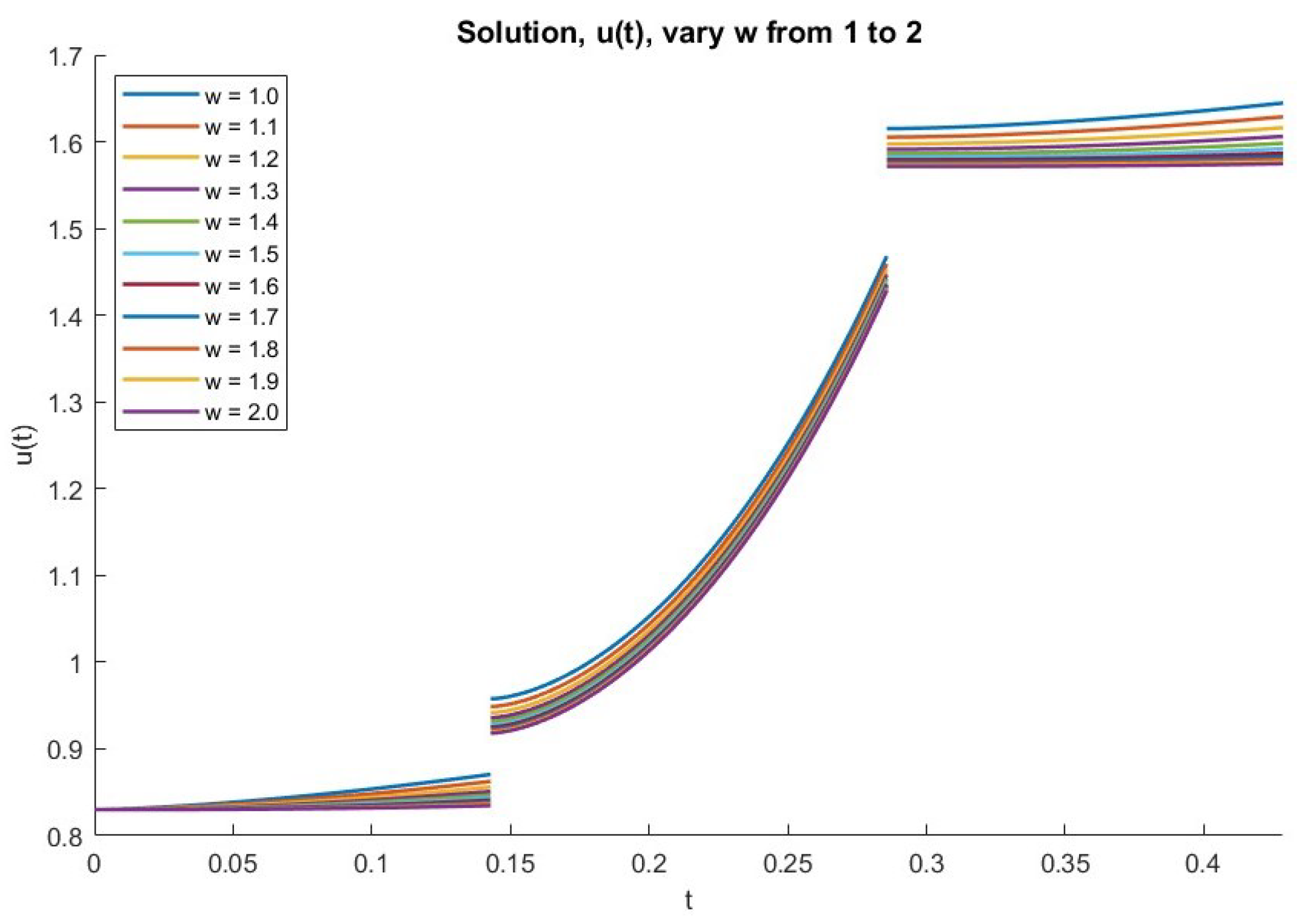
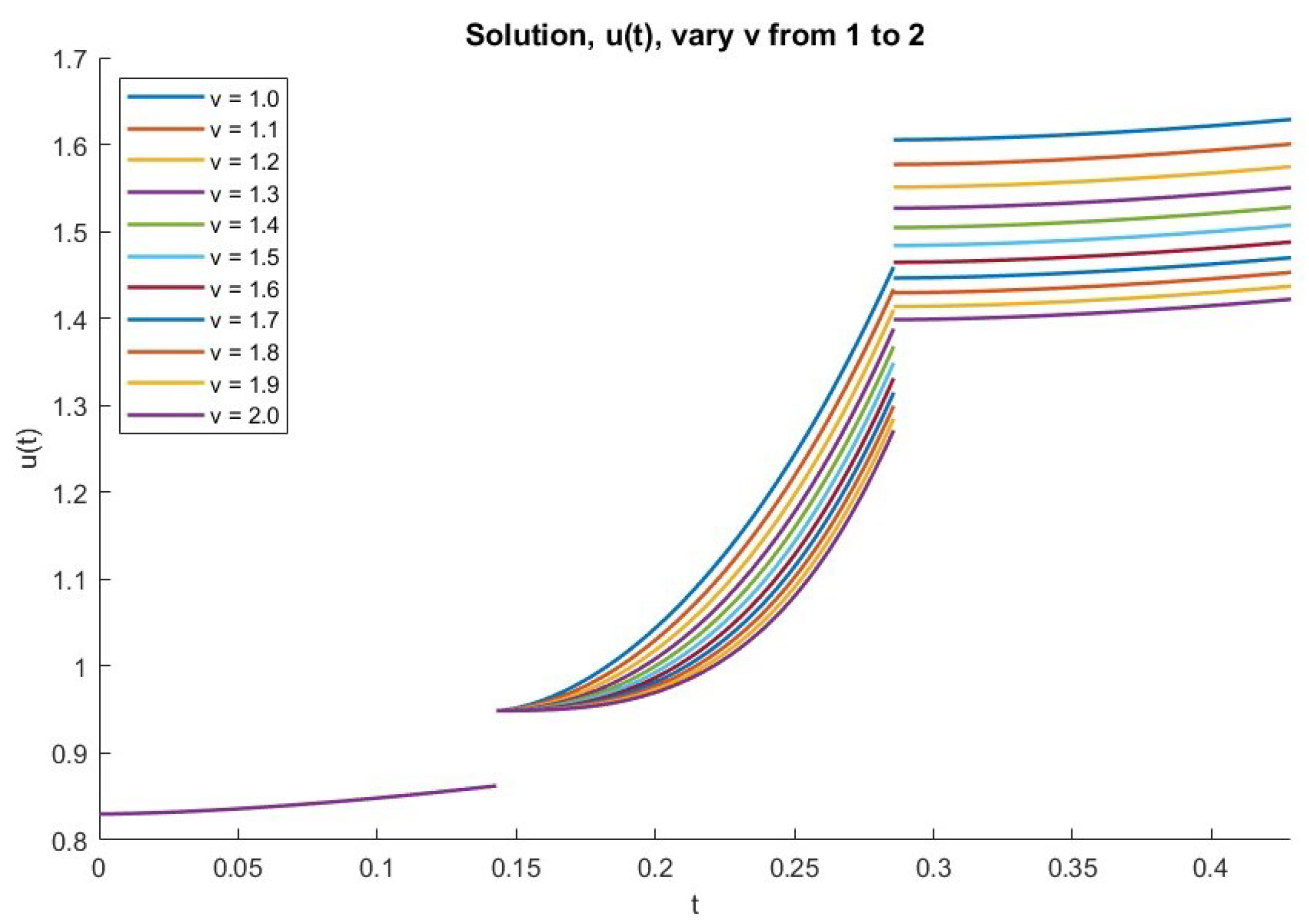
Then, the following figures illustrate the results of the problem by varying the constants w and v from 1 to 2. The figures include both an overall view and a detailed breakdown into specific intervals. Figure 1 and Figure 2 illustrate the behavior of the solutions for varying values of w and v, respectively.
The figures illustrate the behavior of solutions to impulsive fractional boundary value problems. The horizontal axis represents the variable t , while the vertical axis corresponds to the solution u ( t ) or its derivatives. The plots highlight key features of the solutions, including smooth intervals and abrupt changes induced by impulsive effects. In particular, the presence of vertical jumps indicates the occurrence of discrete impulses at specific time points, illustrating the system’s response to sudden perturbations. Moreover, comparisons among multiple curves reveal differences between numerical and analytical solutions or demonstrate the influence of varying parameter values. Overall, the results are consistent with the theoretical predictions, confirming the stability and dynamic behavior of the solutions while also indicating potential deviations that warrant further investigation.
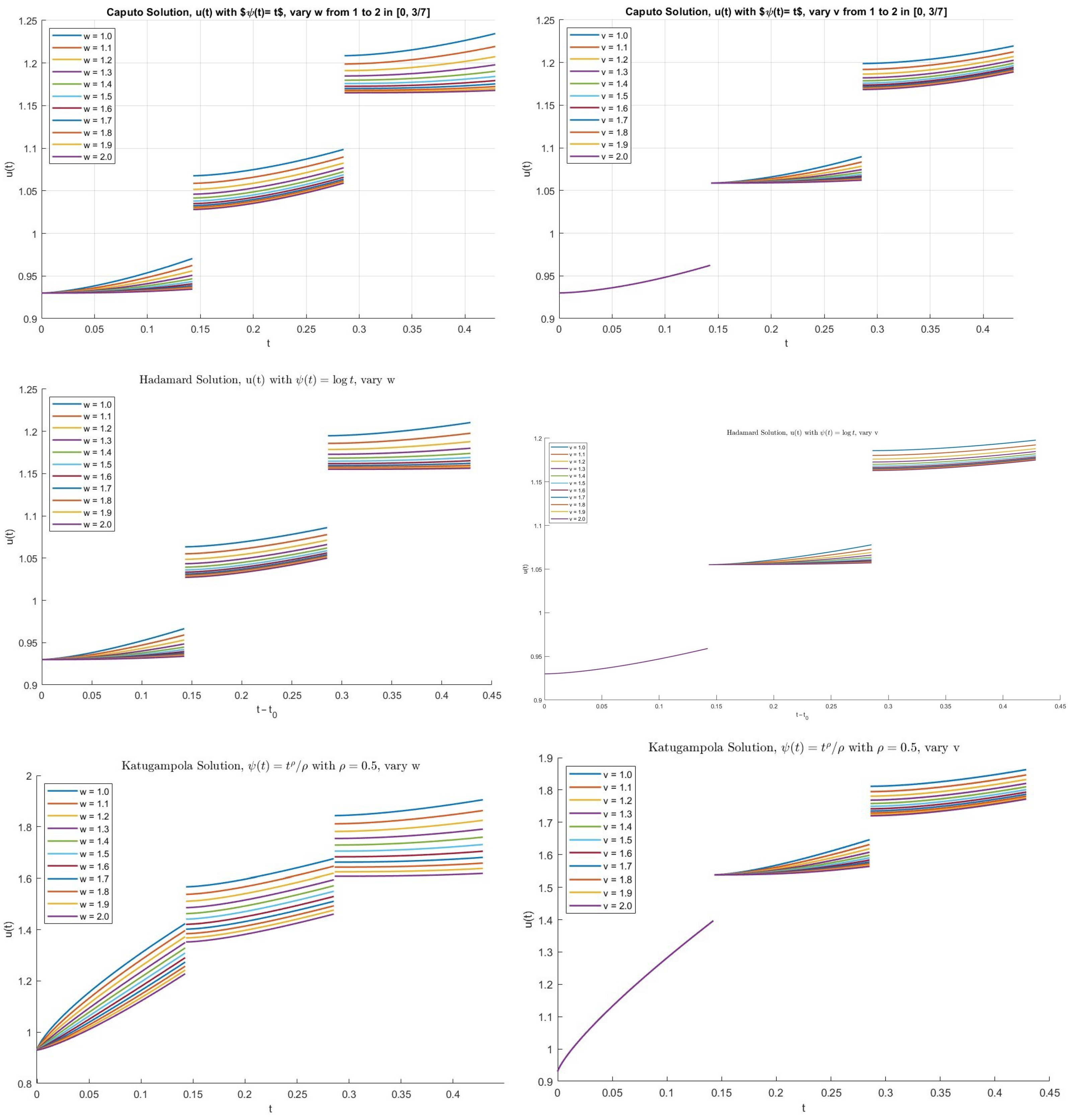
The following figures illustrate the behavior of solutions to the mixed-type impulsive fractional boundary value problem by varying the constants w and v from 1 to 2. To further investigate the influence of different fractional kernels, we compare the results across three distinct cases: the classical Caputo sense ( ψ ( t ) = t ), the Hadamard sense ( ψ ( t ) = log t ), and the Katugampola sense ( ψ ( t ) = t ρ / ρ with ρ = 0.5 ). Figure 3 compares the solution profiles under different fractional kernels.
The numerical results highlight key features of the solutions, including smooth intervals and abrupt changes induced by impulsive effects. Specifically, the presence of vertical jumps at t = 1 / 7 and t = 2 / 7 indicates the occurrence of discrete impulses, confirming the system’s response to sudden perturbations. It is observed that while the magnitude of the jumps remains consistent across all kernels, the choice of ψ ( t ) significantly dictates the curvature of the trajectories. The Caputo case exhibits steady power-law growth, whereas the Hadamard kernel shows a slower initial evolution, and the Katugampola kernel (for ρ = 0.5 ) demonstrates a sharper response. Overall, these comparisons reveal that the proposed mixed-type framework is consistent with theoretical predictions and remains robust under various fractional operator definitions, demonstrating the stability and dynamic adaptability of the solutions.

3.2. The Nonlinear Problem

In this subsection, we reformulate the nonlinear boundary value problem (1) and (2) as an operator equation. We first define an operator A : PC ( J , R ) PC ( J , R ) . Then we prove that the nonlinear problem is equivalent to the fixed point problem of the operator A , which enables us to establish the existence and uniqueness of solutions via fixed point theorems. Now, we define an operator A : PC ( J , R ) PC ( J , R ) by
A u ( t ) = Ω 1 ( i ) Λ [ i = 0 m a i I q i γ s i k = 1 i + 1 Ω 1 ( i ) F k u ( t i + 1 ) + i = 0 m a i I q i γ s i k = 1 i Ω 2 ( i ) G k u ( t i + 1 ) + j = 1 m b j I μ ; ψ t j k = 1 j Ω 1 ( j 1 ) F k u ( s j ) + j = 1 m b j I μ ; ψ t j k = 1 j Ω 2 ( j 1 ) G k u ( s j ) ξ 2 k = 1 m + 1 Ω 1 ( m ) F k u ξ 2 k = 1 m Ω 2 ( m ) G k u ] + k = 1 i Ω 1 ( i ) F k u + k = 1 i Ω 2 ( i ) G k u + I q i α i s i f u ( t ) , t [ s i , t i + 1 ) , i = 0 , 1 , 2 , , m , λ i Ω 1 ( i 1 ) Λ [ i = 0 m a i I q i γ s i k = 1 i + 1 Ω 1 ( i ) F k u ( t i + 1 ) + i = 0 m a i I q i γ s i k = 1 i Ω 2 ( i ) G k u ( t i + 1 ) + j = 1 m b j I μ ; ψ t j k = 1 j Ω 1 ( j 1 ) F k u ( s j ) + j = 1 m b j I μ ; ψ t j k = 1 j Ω 2 ( j 1 ) G k u ( s j ) ξ 2 k = 1 m + 1 Ω 1 ( m ) F k u ξ 2 k = 1 m Ω 2 ( m ) G k u ] + λ i k = 1 i Ω 1 ( i 1 ) F k u + λ i k = 1 i 1 Ω 2 ( i 1 ) G k u + I β i ; ψ t i g u ( t ) , t [ t i , s i ) , i = 1 , 2 , 3 , , m ,
where abbreviations f u ( t ) , g u ( t ) mean nonlinear functions as f u ( t ) = f ( t , u ( t ) ) and g u ( t ) = g ( t , u ( t ) ) , respectively.
Lemma 7.
A function u PC ( J , R ) is a solution of problem (1) and (2) if and only if it is a fixed point of the operator A .
Proof. 
Assume first that u PC ( J , R ) is a solution of problem (1) and (2). By applying Lemma 4 with f * ( t ) = f ( t , u ( t ) ) for t J 1 and g * ( t ) = g ( t , u ( t ) ) for t J 2 , we obtain the integral representation corresponding to u. By the definition of the operator A , this representation is exactly u = A u . Hence, u is a fixed point of A .
Conversely, assume that u PC ( J , R ) is a fixed point of A , i.e., u = A u on J . Then u satisfies the integral equation associated with problem (1) and (2). Therefore, by Lemma 6 with f * ( t ) = f ( t , u ( t ) ) and g * ( t ) = g ( t , u ( t ) ) , we conclude that u satisfies problem (1) and (2). This completes the proof. □
We emphasize that the Banach contraction mapping principle and the Leray–Schauder nonlinear alternative, employed in Theorems 1 and 3 below, are classical tools. The contribution of the present analysis lies not in these tools themselves but in two aspects of their application to the present setting. First, the operator A defined in (15) must correctly encode the full impulsive structure, including the alternating fractional operators and their interaction through the boundary conditions; its construction via Lemma 4 is nontrivial and specific to the mixed-operator framework. Second, the constants Φ 1 and Φ 2 defined in (16) provide explicit, computable sufficient conditions for the contraction and growth estimates, expressed directly in terms of the system parameters α i , β j , γ , μ , q i , λ i , η i , ξ 1 , ξ 2 , a i , b j , and the function ψ . These conditions can be verified a priori for any given configuration of the system, which is essential for practical applicability.
For computational convenience we put:
Φ 1 = | Ω 1 ( i ) | | Λ | [ i = 0 m | a i | t i + 1 s i γ Γ q i ( γ + 1 ) k = 1 i + 1 | Ω 1 ( i ) | t k s k 1 α k 1 Γ q k ( α k 1 + 1 ) + j = 1 m | b j | ψ ( s j ) ψ ( t j ) μ Γ ( μ + 1 ) k = 1 j | Ω 1 ( j 1 ) | t k s k 1 α k 1 Γ q k ( α k 1 + 1 ) + | ξ 2 | k = 1 m + 1 | Ω 1 ( m ) | t k s k 1 α k 1 Γ q k ( α k 1 + 1 ) ] + k = 1 m + 1 | Ω 1 ( m ) | t k s k 1 α k 1 Γ q k ( α k 1 + 1 ) , Φ 2 = | Ω 1 ( i ) | | Λ | [ i = 0 m | a i | t i + 1 s i γ Γ q i ( γ + 1 ) k = 1 i | Ω 2 ( i ) | ψ ( s k ) ψ ( t k ) β k Γ ( β k + 1 ) + j = 1 m | b j | ψ ( s j ) ψ ( t j ) μ Γ ( μ + 1 ) k = 1 j | Ω 2 ( j 1 ) | ψ ( s k ) ψ ( t k ) β k Γ ( β k + 1 ) + | ξ 2 | k = 1 m | Ω 2 ( m ) | ψ ( s k ) ψ ( t k ) β k Γ ( β k + 1 ) ] + k = 1 m | Ω 2 ( m ) | ψ ( s k ) ψ ( t k ) β k Γ ( β k + 1 ) .
By Lemma 7, problem (1) and (2) is equivalent to the fixed point problem for the operator A . Hence, the existence and uniqueness results follow from standard fixed point theorems, namely, the Banach contraction mapping principle and the Leray–Schauder nonlinear alternative.
Theorem 1.
Let f : J 1 × R R and g : J 2 × R R be continuous functions. In addition, we assume that:
( H 1 )
There exist constants L 1 , L 2 > 0 such that
f ( t , u ) f ( t , v ) L 1 | u v | , t J 1 and g ( t , u ) g ( t , v ) L 2 | u v | , t J 2 ,
for all u , v R
Then, the mixed-type fractional quantum and ψ-Caputo fractional impulsive boundary value problem (1) and (2) admits a unique solution on J , provided that L 1 Φ 1 + L 2 Φ 2 < 1 , where Φ 1 and Φ 2 are defined by (17).
Proof. 
Let B r be a ball of radius r > 0 , described by B r = { u PC ( J , R ) : u r } , where r fulfills
r M 1 Φ 1 + M 2 Φ 2 1 L 1 Φ 1 + L 2 Φ 2 .
We will show that A B r B r . Define M 1 = sup { | f ( t , 0 ) | , t J 1 } and M 2 = sup { | g ( t , 0 ) | , t J 2 } . For t J 1 and t J 2 , in the given sequence, we have
A u ( t ) Ω 1 ( i ) Λ [ i = 0 m a i I q i γ s i k = 1 i + 1 Ω 1 ( i ) I q k 1 α k 1 s k 1 f u ( t k ) ( t i + 1 ) + i = 0 m a i I q i γ s i k = 1 i Ω 2 ( i ) I β k ; ψ t k g u ( s k ) ( t i + 1 ) + j = 1 m b j I μ ; ψ t j k = 1 j Ω 1 ( j 1 ) I q k 1 α k 1 s k 1 f u ( t k ) ( s j ) + j = 1 m b j I μ ; ψ t j k = 1 j Ω 2 ( j 1 ) I β k ; ψ t k g u ( s k ) ( s j ) + ξ 2 k = 1 m + 1 Ω 1 ( m ) I q k 1 α k 1 s k 1 f u ( t k ) + ξ 2 k = 1 m Ω 2 ( m ) I β k ; ψ t k g u ( s k ) ] + k = 1 i Ω 1 ( i ) I q k 1 α k 1 s k 1 f u ( t k ) + k = 1 i Ω 2 ( i ) I β k ; ψ t k g u ( s k ) + I q i α i s i f u ( t ) ,
for t [ s i , t i + 1 ) , i = 0 , 1 , 2 , , m , and
A u ( t ) λ i Ω 1 ( i 1 ) Λ [ i = 0 m a i I q i γ s i k = 1 i + 1 Ω 1 ( i ) I q k 1 α k 1 s k 1 f u ( t k ) ( t i + 1 ) + i = 0 m a i I q i γ s i k = 1 i Ω 2 ( i ) I β k ; ψ t k g u ( s k ) ( t i + 1 ) + j = 1 m b j I μ ; ψ t j k = 1 j Ω 1 ( j 1 ) I q k 1 α k 1 s k 1 f u ( t k ) ( s j ) + j = 1 m b j I μ ; ψ t j k = 1 j Ω 2 ( j 1 ) I β k ; ψ t k g u ( s k ) ( s j ) + ξ 2 k = 1 m + 1 Ω 1 ( m ) I q k 1 α k 1 s k 1 f u ( t k ) + ξ 2 k = 1 m Ω 2 ( m ) I β k ; ψ t k g u ( s k ) ] + λ i k = 1 i Ω 1 ( i 1 ) I q k 1 α k 1 s k 1 f u ( t k ) + λ i k = 1 i 1 Ω 2 ( i 1 ) I β k ; ψ t k g u ( s k ) + I β i ; ψ t i g u ( t )
for t [ t i , s i ) , i = 1 , 2 , 3 , , m . From triangle inequality and ( H 1 ), we acquire | f u ( t ) | = | f ( t , u ) | | f ( t , u ) f ( t , 0 ) | + | f ( t , 0 ) | L 1 r + M 1 and | g u ( t ) | = | g ( t , u ) | | g ( t , u ) g ( t , 0 ) | + | g ( t , 0 ) | L 2 r + M 2 . As a result, we have
sup t J A u ( t ) Ω 1 ( i ) Λ [ L 1 r + M 1 i = 0 m a i I q i γ s i k = 1 i + 1 Ω 1 ( i ) I q k 1 α k 1 s k 1 ( 1 ) ( t k ) ( t i + 1 ) + L 2 r + M 2 i = 0 m a i I q i γ s i k = 1 i Ω 2 ( i ) I β k ; ψ t k ( 1 ) ( s k ) ( t i + 1 ) + L 1 r + M 1 j = 1 m b j I μ ; ψ t j k = 1 j Ω 1 ( j 1 ) I q k 1 α k 1 s k 1 ( 1 ) ( t k ) ( s j ) + L 2 r + M 2 j = 1 m b j I μ ; ψ t j k = 1 j Ω 2 ( j 1 ) I β k ; ψ t k ( 1 ) ( s k ) ( s j ) + L 1 r + M 1 ξ 2 k = 1 m + 1 Ω 1 ( m ) I q k 1 α k 1 s k 1 ( 1 ) ( t k ) + L 2 r + M 2 ξ 2 k = 1 m Ω 2 ( m ) I β k ; ψ t k ( 1 ) ( s k ) ] + L 1 r + M 1 k = 1 m Ω 1 ( m ) I q k 1 α k 1 s k 1 ( 1 ) ( t k ) + L 2 r + M 2 k = 1 m Ω 2 ( m ) I β k ; ψ t k ( 1 ) ( s k ) + L 1 r + M 1 I q m α m s m ( 1 ) ( t m + 1 ) Ω 1 ( i ) Λ [ L 1 r + M 1 i = 0 m a i t i + 1 s i γ Γ q i ( γ + 1 ) k = 1 i + 1 Ω 1 ( i ) t k s k 1 α k 1 Γ q k 1 ( α k 1 + 1 ) + L 2 r + M 2 i = 0 m a i t i + 1 s i γ Γ q i ( γ + 1 ) k = 1 i Ω 2 ( i ) ψ ( s k ) ψ ( t k ) β k Γ ( β k + 1 ) + L 1 r + M 1 j = 1 m b j ψ ( s j ) ψ ( t j ) μ Γ ( μ + 1 ) k = 1 j Ω 1 ( j 1 ) t k s k 1 α k 1 Γ q k 1 ( α k 1 + 1 ) ( s j ) + L 2 r + M 2 j = 1 m b j ψ ( s j ) ψ ( t j ) μ Γ ( μ + 1 ) k = 1 j Ω 2 ( j 1 ) ψ ( s k ) ψ ( t k ) β k Γ ( β k + 1 ) ( s j ) + L 1 r + M 1 ξ 2 k = 1 m + 1 Ω 1 ( m ) t k s k 1 α k 1 Γ q k 1 ( α k 1 + 1 ) + L 2 r + M 2 ξ 2 k = 1 m Ω 2 ( m ) ψ ( s k ) ψ ( t k ) β k Γ ( β k + 1 ) ] + L 1 r + M 1 k = 1 m + 1 Ω 1 ( m ) t k s k 1 α k 1 Γ q k 1 ( α k 1 + 1 ) + L 2 r + M 2 k = 1 m Ω 2 ( m ) ψ ( s k ) ψ ( t k ) β k Γ ( β k + 1 ) = ( L 1 r + M 1 ) Φ 1 + ( L 2 r + M 2 ) Φ 2 r .
Thus, A u r , where r satisfies the condition (18). Therefore, A B r B r is valid.
Next, we will illustrate that A is a contraction operator. Consider any u , v B r . Then we have
| A u ( t ) A v ( t ) | Ω 1 ( i ) Λ [ i = 0 m a i I q i γ s i k = 1 i + 1 Ω 1 ( i ) I q k 1 α k 1 s k 1 f u f v ( t k ) ( t i + 1 ) + i = 0 m a i I q i γ s i k = 1 i Ω 2 ( i ) I β k ; ψ t k g u g v ( s k ) ( t i + 1 ) + j = 1 m b j I μ ; ψ t j k = 1 j Ω 1 ( j 1 ) I q k 1 α k 1 s k 1 f u f v ( t k ) ( s j ) + j = 1 m b j I μ ; ψ t j k = 1 j Ω 2 ( j 1 ) I β k ; ψ t k g u g v ( s k ) ( s j ) + ξ 2 k = 1 m + 1 Ω 1 ( m ) I q k 1 α k 1 s k 1 f u f v ( t k ) + ξ 2 k = 1 m Ω 2 ( m ) I β k ; ψ t k g u g v ( s k ) ] + k = 1 i Ω 1 ( i ) I q k 1 α k 1 s k 1 f u f v ( t k ) + k = 1 i Ω 2 ( i ) I β k ; ψ t k g u g v ( s k ) + I q i α i s i f u f v ( t ) ,
for t [ s i , t i + 1 ) , i = 0 , 1 , 2 , , m , and
| A u ( t ) A v ( t ) | λ i Ω 1 ( i 1 ) Λ [ i = 0 m a i I q i γ s i k = 1 i + 1 Ω 1 ( i ) I q k 1 α k 1 s k 1 f u f v ( t k ) ( t i + 1 ) + i = 0 m a i I q i γ s i k = 1 i Ω 2 ( i ) I β k ; ψ t k g u g v ( s k ) ( t i + 1 ) + j = 1 m b j I μ ; ψ t j k = 1 j Ω 1 ( j 1 ) I q k 1 α k 1 s k 1 f u f v ( t k ) ( s j ) + j = 1 m b j I μ ; ψ t j k = 1 j Ω 2 ( j 1 ) I β k ; ψ t k g u g v ( s k ) ( s j ) + ξ 2 k = 1 m + 1 Ω 1 ( m ) I q k 1 α k 1 s k 1 f u f v ( t k ) + ξ 2 k = 1 m Ω 2 ( m ) I β k ; ψ t k g u g v ( s k ) ] + λ i k = 1 i Ω 1 ( i 1 ) I q k 1 α k 1 s k 1 f u f v ( t k ) + λ i k = 1 i 1 Ω 2 ( i 1 ) I β k ; ψ t k g u g v ( s k ) + I β i ; ψ t i g u g v ( t ) ,
for t [ t i , s i ) , i = 1 , 2 , 3 , , m . This leads to
sup t J | A u ( t ) A v ( t ) | Ω 1 ( i ) Λ [ L 1 u v i = 0 m a i I q i γ s i k = 1 i + 1 Ω 1 ( i ) I q k 1 α k 1 s k 1 ( 1 ) ( t k ) ( t i + 1 ) + L 2 u v i = 0 m a i I q i γ s i k = 1 i Ω 2 ( i ) I β k ; ψ t k ( 1 ) ( s k ) ( t i + 1 ) + L 1 u v j = 1 m b j I μ ; ψ t j k = 1 j Ω 1 ( j 1 ) I q k 1 α k 1 s k 1 ( 1 ) ( t k ) ( s j ) + L 2 u v j = 1 m b j I μ ; ψ t j k = 1 j Ω 2 ( j 1 ) I β k ; ψ t k ( 1 ) ( s k ) ( s j ) + L 1 u v ξ 2 k = 1 m + 1 Ω 1 ( m ) I q k 1 α k 1 s k 1 ( 1 ) ( t k ) + L 2 u v ξ 2 k = 1 m Ω 2 ( m ) I β k ; ψ t k ( 1 ) ( s k ) ] + L 1 u v k = 1 m + 1 Ω 1 ( m ) I q k 1 α k 1 s k 1 ( 1 ) ( t k ) + L 2 u v k = 1 m Ω 2 ( m ) I β k ; ψ t k ( 1 ) ( s k ) = L 1 Φ 1 + L 2 Φ 2 u v ,
and hence A u A v L 1 Φ 1 + L 2 Φ 2 u v . Since L 1 Φ 1 + L 2 Φ 2 < 1 , A is a contraction. Consequently, by Banach’s contraction mapping principle, the operator A has a fixed point which provides the solution of the mixed-type impulsive fractional boundary value problem (1) and (2). The proof is completed. □
The subsequent theorem of Leray-Schauder’s nonlinear alternative will be utilized to establish our existence result [34].
Theorem 2.
Given U is a Banach space, and V is a closed, convex subset of U . In addition let W be an open subset of V such that 0 W . Suppose that A : W ¯ B is a continuous, compact (that is, A ( W ¯ ) is a relatively compact subset of U ) map. Then either
( i )
A has a fixed point in W ¯ , or
( i i )
We encounter a x W (the boundary of W in V ) and ρ ( 0 , 1 ) with u = ρ A ( u ) .
Theorem 3.
Let f : J 1 × R R and g : J 2 × R R be continuous functions, satisfying the following conditions:
( H 2 )
There exist continuous and nondecreasing functions Q 1 , Q 2 : [ 0 , ) ( 0 , ) and continuous functions w i , v i : J R + , i = 1 , 2 such that
| f ( t , u ) | w 1 ( t ) Q 1 ( | u | ) + w 2 ( t ) , for each ( t , u ) J 1 × R ,
and
| g ( t , u ) | v 1 ( t ) Q 2 ( | u | ) + v 2 ( t ) , for each ( t , u ) J 2 × R .
( H 3 )
There exists a positive constant N such that
N w 1 Q 1 ( N ) + w 2 Φ 1 + v 1 Q 2 ( N ) + v 2 Φ 2 > 1 .
Then, the mixed-type fractional quantum and ψ-Caputo fractional impulsive boundary value problem (1) and (2) has at least one solution on J .
Proof. 
Define a ball B κ = { u PC ( J , R ) : u κ } . It is clearly to see that the ball B κ is a closed, convex subset of PC ( J , R ) . To utilize the result in Theorem 2, we begin by proving that A is a continuous operator. Define a convergent sequence { u n } such that { u n } u . As a result, we have
| A u n ( t ) A u ( t ) | Ω 1 ( i ) Λ [ i = 0 m a i I q i γ s i k = 1 i + 1 Ω 1 ( i ) I q k 1 α k 1 s k 1 f u n f u ( t k ) ( t i + 1 ) + i = 0 m a i I q i γ s i k = 1 i Ω 2 ( i ) I β k ; ψ t k g u n g u ( s k ) ( t i + 1 ) + j = 1 m b j I μ ; ψ t j k = 1 j Ω 1 ( j 1 ) I q k 1 α k 1 s k 1 f u n f u ( t k ) ( s j ) + j = 1 m b j I μ ; ψ t j k = 1 j Ω 2 ( j 1 ) I β k ; ψ t k g u n g u ( s k ) ( s j ) + ξ 2 k = 1 m + 1 Ω 1 ( m ) I q k 1 α k 1 s k 1 f u n f u ( t k ) + ξ 2 k = 1 m Ω 2 ( m ) I β k ; ψ t k g u n g u ( s k ) ] + k = 1 i Ω 1 ( i ) I q k 1 α k 1 s k 1 f u n f u ( t k ) + k = 1 i Ω 2 ( i ) I β k ; ψ t k g u n g u ( s k ) + I q i α i s i f u n f u ( t ) 0 ,
as n , for t [ s i , t i + 1 ) , i = 0 , 1 , 2 , , m , and
| A u n ( t ) A u ( t ) | λ i Ω 1 ( i 1 ) Λ [ i = 0 m a i I q i γ s i k = 1 i + 1 Ω 1 ( i ) I q k 1 α k 1 s k 1 f u n f u ( t k ) ( t i + 1 ) + i = 0 m a i I q i γ s i k = 1 i Ω 2 ( i ) I β k ; ψ t k g u n g u ( s k ) ( t i + 1 ) + j = 1 m b j I μ ; ψ t j k = 1 j Ω 1 ( j 1 ) I q k 1 α k 1 s k 1 f u n f u ( t k ) ( s j ) + j = 1 m b j I μ ; ψ t j k = 1 j Ω 2 ( j 1 ) I β k ; ψ t k g u n g u ( s k ) ( s j ) + ξ 2 k = 1 m + 1 Ω 1 ( m ) I q k 1 α k 1 s k 1 f u n f u ( t k ) + ξ 2 k = 1 m Ω 2 ( m ) I β k ; ψ t k g u n g u ( s k ) ] + λ i k = 1 i Ω 1 ( i 1 ) I q k 1 α k 1 s k 1 f u n f u ( t k ) + λ i k = 1 i 1 Ω 2 ( i 1 ) I β k ; ψ t k g u n g u ( s k ) + I β i ; ψ t i g u n g u ( t ) 0 , as n ,
for t [ t i , s i ) , i = 1 , 2 , 3 , , m . Thus, from the preceding inequalities, it follows that the operator A is continuous.
We proceed to prove the the compactness of the operator A . For u B κ we have
A u ( t ) Ω 1 ( i ) Λ [ w 1 Q 1 ( κ ) + w 2 i = 0 m a i I q i γ s i k = 1 i + 1 Ω 1 ( i ) I q k 1 α k 1 s k 1 ( 1 ) ( t k ) ( t i + 1 ) + v 1 Q 2 ( κ ) + v 2 i = 0 m a i I q i γ s i k = 1 i Ω 2 ( i ) I β k ; ψ t k ( 1 ) ( s k ) ( t i + 1 ) + w 1 Q 1 ( κ ) + w 2 j = 1 m b j I μ ; ψ t j k = 1 j Ω 1 ( j 1 ) I q k 1 α k 1 s k 1 ( 1 ) ( t k ) ( s j ) + v 1 Q 2 ( κ ) + v 2 j = 1 m b j I μ ; ψ t j k = 1 j Ω 2 ( j 1 ) I β k ; ψ t k ( 1 ) ( s k ) ( s j ) + w 1 Q 1 ( κ ) + w 2 ξ 2 k = 1 m + 1 Ω 1 ( m ) I q k 1 α k 1 s k 1 ( 1 ) ( t k ) + v 1 Q 2 ( κ ) + v 2 ξ 2 k = 1 m Ω 2 ( m ) I β k ; ψ t k ( 1 ) ( s k ) ] + w 1 Q 1 ( κ ) + w 2 k = 1 m Ω 1 ( m ) I q k 1 α k 1 s k 1 ( 1 ) ( t k ) + v 1 Q 2 ( κ ) + v 2 k = 1 m Ω 2 ( m ) I β k ; ψ t k ( 1 ) ( s k ) + w 1 Q 1 ( κ ) + w 2 I q m α m s m ( 1 ) ( t m + 1 ) = w 1 Q 1 ( κ ) + w 2 Φ 1 + v 1 Q 2 ( κ ) + v 2 Φ 2 : = Φ 3 .
Consequently, A u Φ 3 , and hence A ( B κ ) is uniformly bounded. To indicate the equicontinuity of the set A ( B κ ) , let t 1 , t 2 [ 0 , T ] with t 1 < t 2 . Thus, for any u B κ , we obtain
| A u ( t 2 ) A u ( t 1 ) | = I q i α i s i f ( t 2 ) I q i α i s i f ( t 1 ) = | 1 Γ q i ( α i ) s i t 2 ( t 2 Φ q i s i ( s ) ) q i ( α i 1 ) s i f ( s ) d q i s i s 1 Γ q i ( α i ) s i t 1 ( s i t 1 Φ q i s i ( s ) ) q i ( α i 1 ) f ( s ) d q i s i s | Q 1 | 1 Γ q i ( α i ) t 1 t 2 ( t 2 Φ q i s i ( s ) ) q i ( α i 1 ) s i d q i s i s 1 Γ q i ( α i ) s i t 1 ( t 2 Φ q i s i ( s ) ) q i ( α i 1 ) s i ( s i t 1 Φ q i s i ( s ) ) q i ( α i 1 ) d q i s i s | Q 1 Γ q i ( α i + 1 ) 2 ( t 2 t 1 ) α i + | ( t 2 s i ) α i ( t 1 s i ) α i | 0
as t 1 t 2 when t 1 , t 2 [ s i , t i + 1 ) , i = 0 , 1 , 2 , , m , Q 1 = w 1 Q 1 ( κ ) + w 2 and
| A u ( t 2 ) A u ( t 1 ) | = I β i ; ψ t i g ( t 1 ) I β i ; ψ t i g ( t 2 ) Q 2 Γ ( β i + 1 ) 2 ψ ( t 2 ) ψ ( t 1 ) β i + ψ ( t 2 ) ψ ( t i ) β i ψ ( t 1 ) ψ ( t i ) β i 0
as t 1 t 2 , when t 1 , t 2 [ t i , s i ) , i = 1 , 2 , 3 , , m , Q 2 = v 1 Q 2 ( κ ) + v 2 . Given that the above two inequalities converge to zero independently of u. Therefore, A ( B κ ) is equicontinuous set. We conclude that A B κ is relatively compact. Through the application of the Arzelá-Ascoli theorem, the operator A is completely continuous.
Finally, we show that the set of all solutions to equation S = ρ A u is bounded for ρ ( 0 , 1 ) .
Let u be a solution. Then, working as in the first step, we have
| u ( t ) | w 1 Q 1 ( u ) + w 2 Φ 1 + v 1 Q 2 ( u ) + v 2 Φ 2 ,
or
u w 1 Q 1 ( N ) + w 2 Φ 1 + v 1 Q 2 ( N ) + v 2 Φ 2 1 .
From the hypothesis ( H 3 ), there exists a positive constant N such that u N . We define an open subset of B κ by W = { u B κ : u < N } . We remark that 0 W and A ( W ¯ ) is a relatively compact subset of B κ . Moreover, it cannot be the case that u W such that u = ρ A u for some ρ ( 0 , 1 ) . By the application of the result in (i) of Theorem 2, the operator A has a fixed point u W ¯ which satisfies the conditions of the problem (1) and (2) on J . Then problem (1) and (2) admits at least one solution. The proof is finished. □
The existence and uniqueness results established in Theorems 1 and 3 provide a complete answer to the basic well-posedness question for problems (1) and (2). While the fixed-point arguments follow classical lines, we note that the present results open several directions for deeper theoretical development. A natural and immediate extension is the investigation of Ulam-Hyers stability, which would establish that solutions of (1) and (2) are robust to small perturbations in the data f , g , and the boundary coefficients. This type of stability is particularly relevant for impulsive systems, where the accumulated effect of small errors across multiple subintervals must be carefully controlled. A second extension concerns the limiting behavior as q 1 : by Item 2 of Remark 1, the q-fractional operators converge to their classical Riemann–Liouville counterparts, and it is of theoretical interest to establish whether the solutions of (1) and (2) converge correspondingly to solutions of a purely ψ -Caputo impulsive BVP. These questions are left as subjects of future investigation.

4. Examples

In the current section, we outline several illustrative cases that demonstrate its practical utility and theoretical importance.
Example 1.
Consider the following given mixed types of impulsive fractional boundary value problems in the form:
D i + 2 i + 3 2 i + 1 3 i + 2 2 i 5 u ( t ) = f ( t , u ( t ) ) , t 2 i 5 , 2 i + 1 5 , i = 0 , 1 , 2 , D i 3 i + 1 ; t 2 2 i 1 5 u ( t ) = g ( t , u ( t ) ) , t 2 i 1 5 , 2 i 5 , i = 1 , 2 , u 2 i 1 5 + = λ i u 2 i 1 5 , u 2 i 5 + = η i u 2 i 5 , 5 u ( 0 ) + 6 u ( 1 ) = I 2 3 7 / 11 0 u 1 5 + 2 I 3 4 7 / 11 2 5 u 3 5 + 3 I 4 5 7 / 11 4 5 u ( 1 ) + 4 I 3 / 10 ; t 2 1 5 u 2 5 + 5 I 3 / 10 ; t 2 3 5 u 4 5 .
Here, α i = ( 2 i + 1 ) / ( 3 i + 2 ) , q i = ( i + 2 ) / ( i + 3 ) , i = 0 , 1 , 2 , β i = i / ( 3 i + 1 ) , i = 1 , 2 , γ = 7 / 11 , μ = 3 / 10 , ξ 1 = 5 , ξ 2 = 6 , η 1 = 7 / 12 , η 2 = 8 / 11 , λ 1 = 9 / 10 , λ 2 = 8 / 9 , a 0 = 1 , a 1 = 2 , a 2 = 3 , b 1 = 4 , b 2 = 5 and ψ ( t ) = t 2 where t [ 2 i / 5 , ( 2 i + 1 ) / 5 ) , i = 0 , 1 , 2 , t [ ( 2 i 1 ) / 5 , 2 i / 5 ) , i = 1 , 2 , respectively.

4.1. Part (I): Unique Solution via Theorem 1

Consider the mixed-type impulsive fractional boundary value problem (20) with f and g given by
f ( t , u ) = 3 e 3 t 2 · sin u 7 ( t + 1 ) 2 + 1 7 t + 2 9 ,
g ( t , u ) = cos 2 t + π 2 8 tan 1 | u | + 3 8 t 2 + 1 4 .
From (21) and (22), it is readily verified that
| f ( t , u ) f ( t , v ) | 3 7 | u v | , | g ( t , u ) g ( t , v ) | 1 8 | u v | , u , v R ,
so that condition ( H 1 ) holds with L 1 = 3 / 7 and L 2 = 1 / 8 . Using the parameter values listed after (20), we compute
Λ = 4.1430080621 , Φ 1 = 1.8747421660 , Φ 2 = 1.5455175327 ,
which gives
L 1 Φ 1 + L 2 Φ 2 = 3 7 × 1.8747421660 + 1 8 × 1.5455175327 = 0.9966506199 < 1 .
Therefore, the hypotheses of Theorem 1 are satisfied, and problem (20) with f and g as in (21) and (22) admits a unique solution on [ 0 , 1 ] .
  • Numerical validation via fixed-point iteration. To illustrate the unique solution, we apply successive approximation to the operator A defined in (16). Starting from the initial iterate u 0 0 , we compute u n + 1 = A u n piecewise on each subinterval, evaluating the Riemann–Liouville–type fractional q-integrals and ψ -fractional integrals numerically via Gauss–Legendre quadrature adapted to the respective kernel functions. The iteration is terminated when u n + 1 u n < 10 8 .
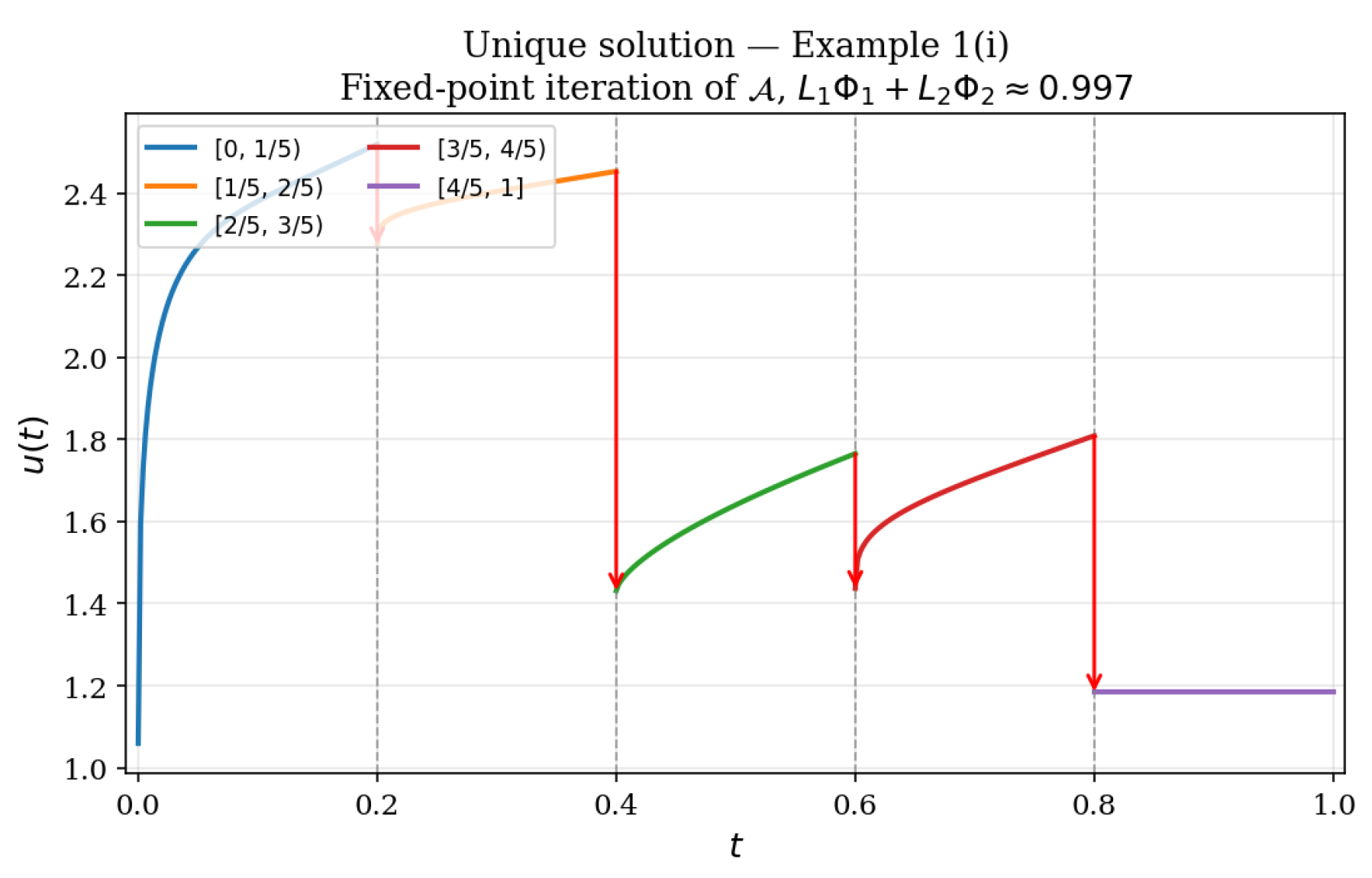
Figure 4 displays the resulting unique solution u ( t ) over the full interval [ 0 , 1 ] , obtained after convergence of the iteration. The solution exhibits smooth behavior on each subinterval of continuity and satisfies the prescribed impulsive jump conditions
u 2 i 1 5 + = λ i u 2 i 1 5 , u 2 i 5 + = η i u 2 i 5 , i = 1 , 2 ,
with λ 1 = 9 / 10 , λ 2 = 8 / 9 , η 1 = 7 / 12 , η 2 = 8 / 11 , at the impulsive points t = 1 / 5 , 2 / 5 , 3 / 5 , 4 / 5 . The vertical dashed lines mark the impulsive points, and the red arrows indicate the direction and magnitude of each jump discontinuity. The reductions at t = 2 / 5 and t = 4 / 5 (governed by η 1 = 7 / 12 < 1 and η 2 = 8 / 11 < 1 ) are visibly more pronounced than those at t = 1 / 5 and t = 3 / 5 (governed by λ 1 = 9 / 10 and λ 2 = 8 / 9 ), consistent with the magnitudes of the impulsive coefficients.
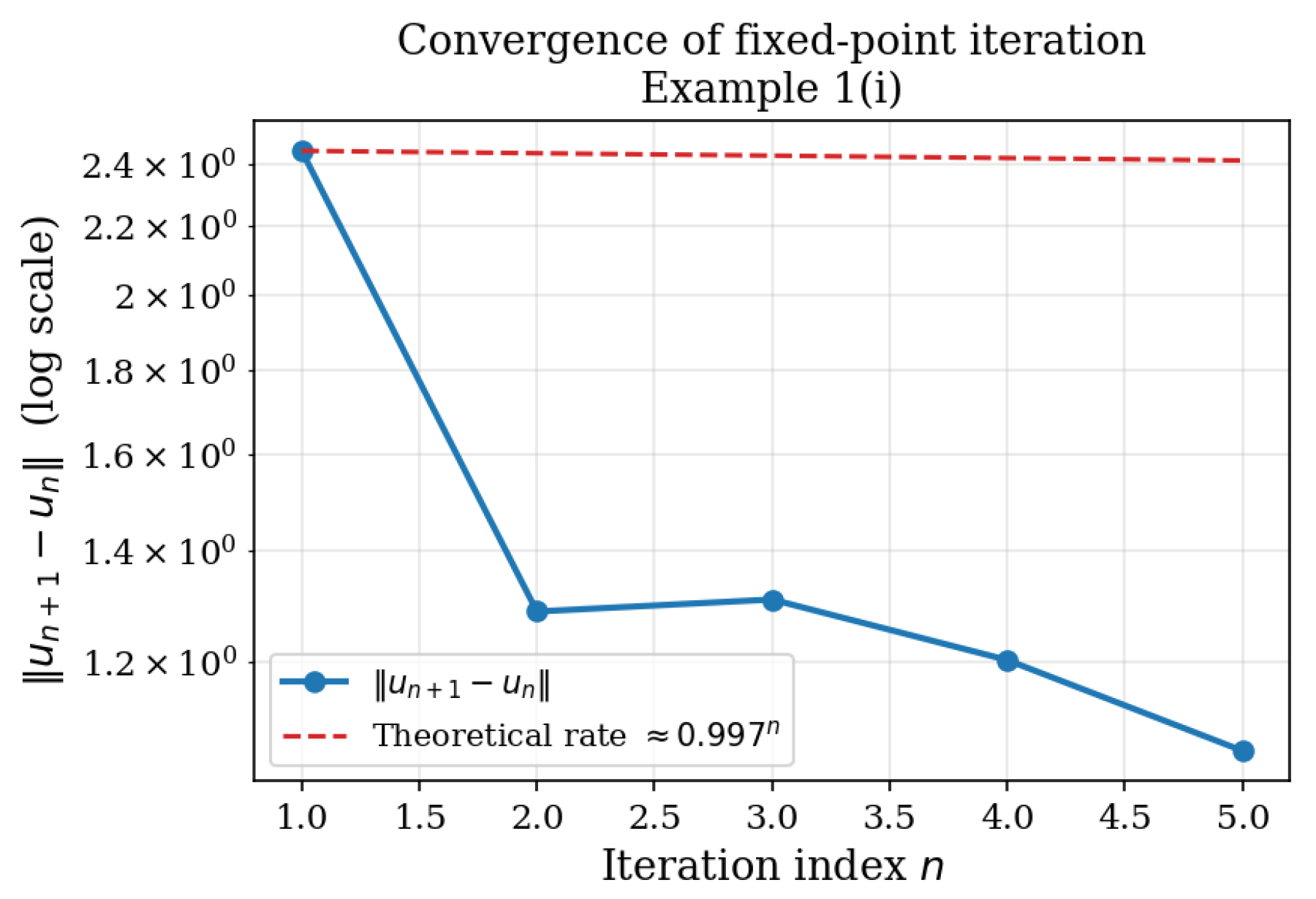
Figure 5 shows the convergence history of the successive approximations by plotting u n + 1 u n against the iteration index n on a semi-logarithmic scale. The observed decay closely follows the theoretical geometric rate ( L 1 Φ 1 + L 2 Φ 2 ) n 0 . 997 n , confirming that A is indeed a contraction on P C ( J , R ) with the contraction constant established in (23).

4.2. Part (II): Existence via Theorem 3

For part (ii), we take
f ( t , u ) = 1 t + 7 | u | 15 | u | 13 + 3 + 1 6 + t 2 10 ,
g ( t , u ) = e t 4 5 + t u 16 1 + u 14 + 1 5 + t 12 .
Since | u | 15 / ( | u | 13 + 3 ) | u | 2 for all u R , and similarly u 16 / ( 1 + u 14 ) u 2 , we obtain the pointwise bounds
| f ( t , u ) | 1 t + 7 u 2 + 1 6 + t 2 10 , | g ( t , u ) | 1 5 + t u 2 + 1 5 + t 12 .
We therefore set
w 1 ( t ) = 1 t + 7 , w 2 ( t ) = t 2 10 , Q 1 ( s ) = s 2 + 1 6 , v 1 ( t ) = e t 4 5 + t , v 2 ( t ) = t 12 , Q 2 ( s ) = s 2 + 1 5 ,
so that w 1 = 1 / 7 , w 2 = 1 / 10 , v 1 1 / 5 , and v 2 = 1 / 12 , and condition ( H 2 ) is satisfied.
  • Graphical verification of condition ( H 3 ). Define the function
Ψ ( N ) : = N w 1 Q 1 ( N ) + w 2 Φ 1 + v 1 Q 2 ( N ) + v 2 Φ 2 , N > 0 .
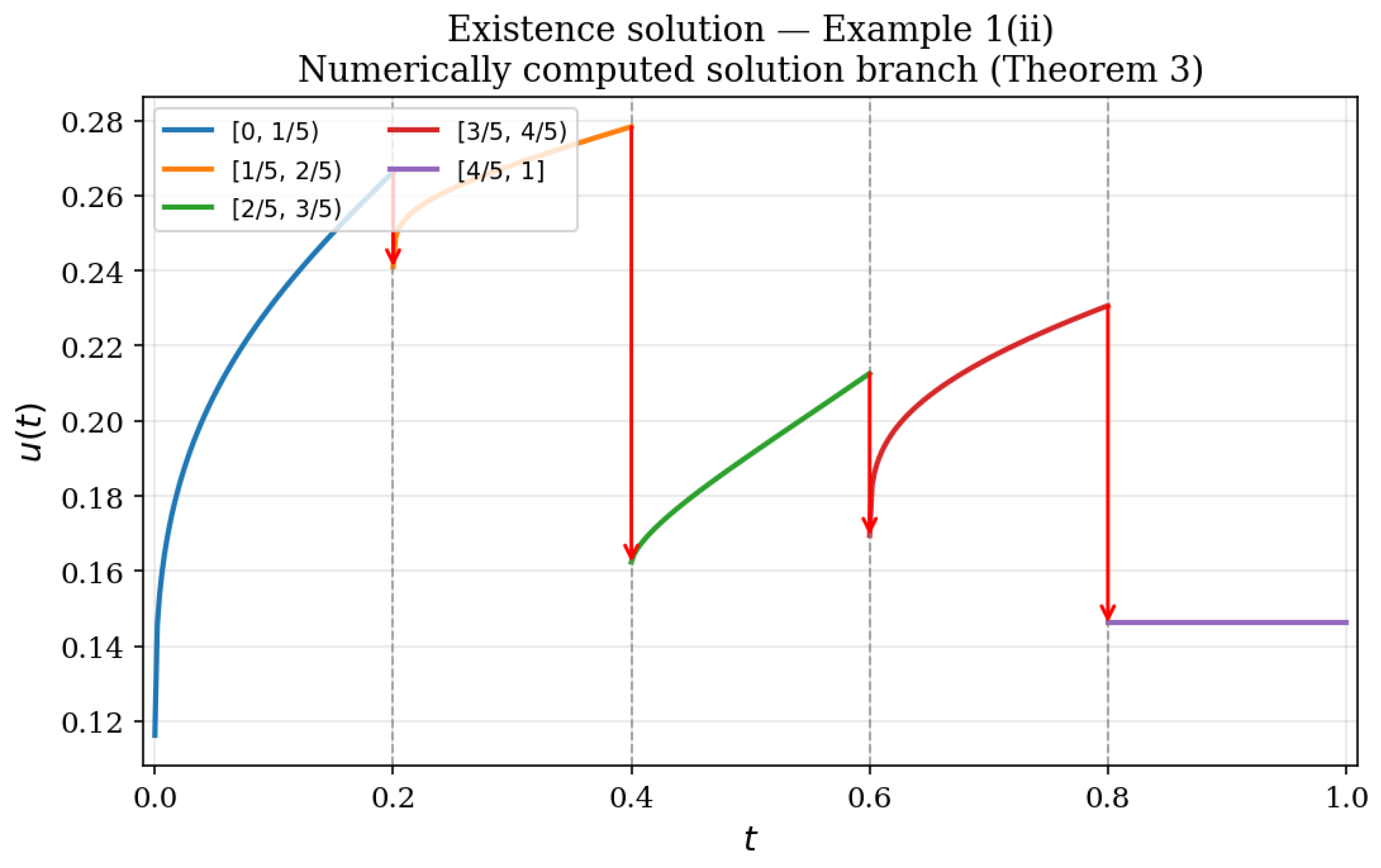
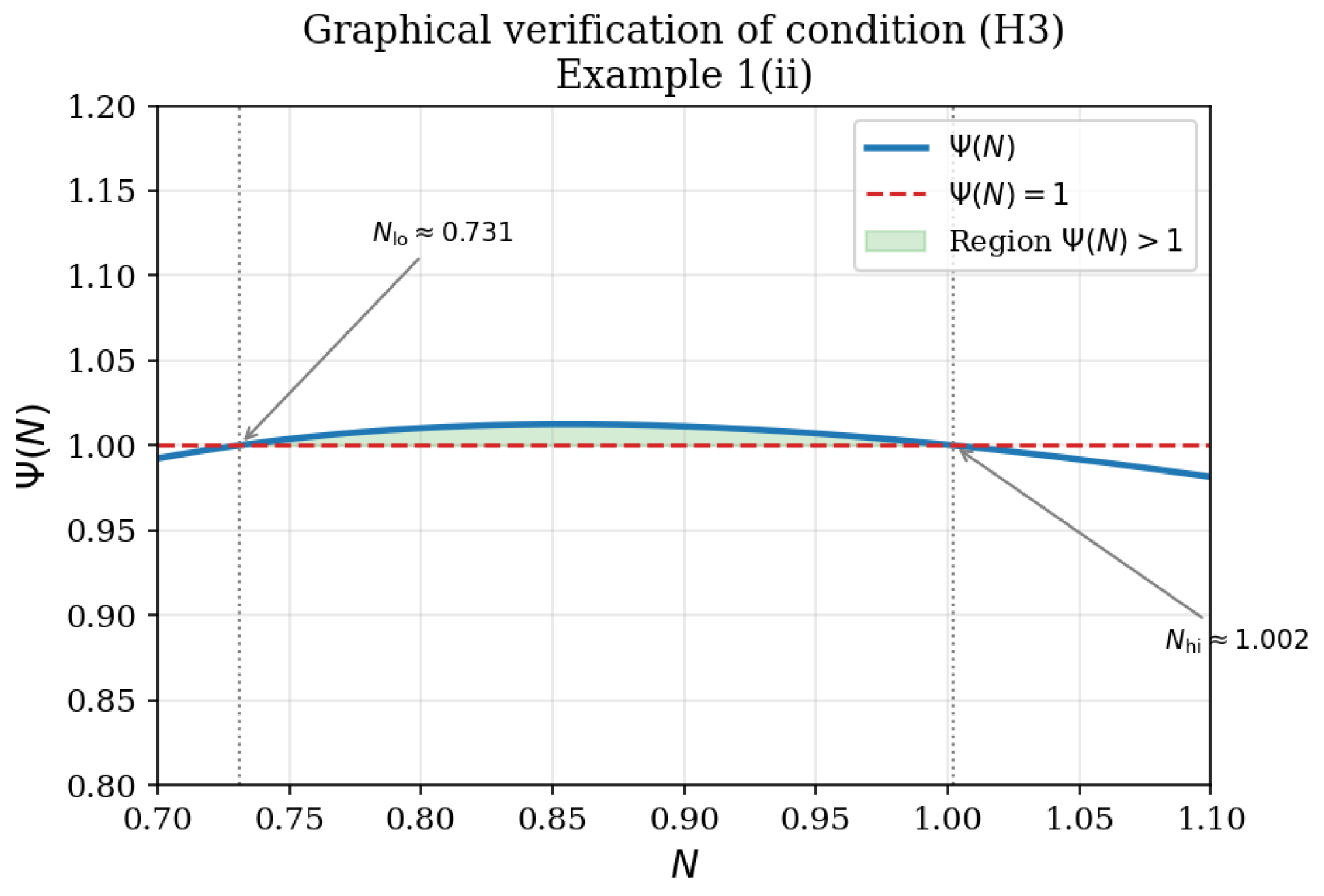
Condition ( H 3 ) requires that Ψ ( N ) > 1 for some N > 0 . Substituting the numerical values of w 1 , w 2 , v 1 , v 2 , Φ 1 , Φ 2 , a direct computation shows that Ψ ( N ) > 1 for all N ( 0.7310661415 , 1.0022649714 ) . Figure 6 displays Ψ ( N ) as a function of N over the interval [ 0 , 2.5 ] , with a horizontal reference line at Ψ = 1 . The shaded region corresponds to Ψ ( N ) > 1 , confirming graphically that condition ( H 3 ) is satisfied and that the hypotheses of Theorem 3 hold for N ( 0.731 , 1.002 ) .
Therefore, by Theorem 3, problem (20) with f and g as in (24) and (25) admits at least one solution on [ 0 , 1 ] . Figure 7 displays a numerically computed solution branch obtained by applying the successive approximation scheme initialized at u 0 0 to the operator A with the nonlinear Functions (24) and (25). The solution is piecewise smooth on each subinterval and the impulsive jump conditions are satisfied at each discontinuity point, consistent with the theoretical framework.
  • Remark on practical relevance. Although the functions f and g in both parts of Example 1 are chosen primarily to satisfy the analytical hypotheses of Theorems 1 and 3 in a transparent and verifiable way, their structural properties reflect features of genuine physical models. The bounded Lipschitz growth of f in part (i) (constant L 1 = 3 / 7 ) is consistent with saturation effects observed in viscoelastic or MEMS oscillator models [30,31,32], where the restoring force remains bounded under large deformations. The super-linear-then-saturating growth captured by Q 1 ( s ) = s 2 + 1 / 6 in part (ii) reflects the behavior of nonlinear incidence functions in epidemiological systems at moderate population sizes. The impulsive jump ratios λ i < 1 and η i < 1 model dissipative impulses, such as instantaneous energy loss at mechanical impact or an abrupt reduction in infected population following a vaccination campaign, and their cumulative effect on the solution profile is clearly visible in Figure 4 and Figure 7.

5. Conclusions

In this work, we have established well-posedness—specifically, existence and uniqueness of solutions—for a class of mixed impulsive fractional boundary value problems in which ψ -Caputo fractional derivatives and Caputo-type q-difference operators act on alternating subintervals, subject to boundary conditions involving fractional integrals of both quantum and ψ -type. The results are obtained via the Banach contraction mapping principle and the Leray–Schauder nonlinear alternative, applied to a solution operator whose construction encodes the full impulsive and non-local structure of the problem. We emphasize that the primary contributions of this paper are: (i) the derivation of an explicit integral representation (Lemma 4) for the mixed-operator linear problem, which underpins all subsequent analysis; (ii) the identification of computable sufficient conditions L 1 Φ 1 + L 2 Φ 2 < 1 and (H3) that can be verified a priori for any given parameter configuration; and (iii) the unification, within a single framework, of several previously studied fractional models—including Caputo, Hadamard, and Katugampola impulsive BVPs—as special cases.
Several important qualitative properties of the solutions established here remain to be investigated and constitute natural directions for future research. Chief among these is stability analysis: specifically, Ulam–Hyers and Ulam–Hyers–Rassias stability results, which characterize the sensitivity of solutions to perturbations in the right-hand side functions f and g in the boundary data. In the impulsive setting, such stability estimates must account for error accumulation across the jump conditions at t k and s k , which makes the analysis non-trivial and distinct from the non-impulsive case. Additionally, the qualitative behavior of solutions as the parameters q i 1 and as the function ψ is varied constitutes a form of bifurcation analysis that would clarify the transition between different modeling regimes. Controllability and optimal control problems within the present mixed-operator framework, as well as extensions to systems incorporating delays or stochastic perturbations, are further directions that the present results make accessible.
Moreover, future research directions may include the investigation of controllability and optimal control problems, as well as the extension of the present framework to systems with delays, stochastic perturbations, or variable-order fractional operators.


Author Contributions

Conceptualization, S.K.N. and J.T.; methodology, C.S., S.A., S.K.N. and J.T.; validation, C.S., S.A., S.K.N. and J.T.; formal analysis, C.S., S.A., S.K.N. and J.T.; writing—original draft preparation, C.S., S.A., S.K.N. and J.T. All authors have read and agreed to the published version of the manuscript.

Funding

The second author was financially supported by King Mongkut’s University of Technology North Bangkok under Contract No. KMUTNB-67-KNOW-29.

Data Availability Statement

No new data were created or analyzed in this study. Data sharing is not applicable to this article.

Conflicts of Interest

The authors declare no conflicts of interest.

References

  1. Podlubny, I. Fractional Differential Equations; Academic Press: San Diego, CA, USA, 1999. [Google Scholar]
  2. Kilbas, A.A.; Srivastava, H.M.; Trujillo, J.J. Theory and Applications of the Fractional Differential Equations; Elsevier: Amsterdam, The Netherlands, 2006. [Google Scholar]
  3. Sabatier, J.; Agrawal, O.P.; Machado, J.A.T. (Eds.) Advances in Fractional Calculus: Theoretical Developments and Applications in Physics and Engineering; Springer: Dordrecht, The Netherlands, 2007. [Google Scholar]
  4. Agarwal, R.P.; Hristova, S.; O’Regan, D. Boundary value problems for fractional differential equations of Caputo type and Ulam type stability: Basic concepts and study. Axioms 2023, 12, 226. [Google Scholar] [CrossRef]
  5. Marynets, K.; Pantova, D. Fractional boundary value problems with parameter-dependent and asymptotic conditions. Fractal Fract. 2025, 9, 462. [Google Scholar] [CrossRef]
  6. Batool, A.; Talib, I.; Riaz, M.B. Fractional-order boundary value problems solutions using advanced numerical technique. Partial Differ. Equ. Appl. Math. 2025, 13, 101059. [Google Scholar] [CrossRef]
  7. Al-nana, A.; Batiha, I.M.; Jebril, I.H.; Alkhazaleh, S.; Abdeljawad, T. Numerical solution of conformable fractional periodic boundary value problems by shifted Jacobi method. Int. J. Math. Eng. Manag. Sci. 2025, 10, 189–206. [Google Scholar] [CrossRef]
  8. Dimitrov, N.D.; Jonnalagadda, J.M. Existence of positive solutions for a class of nabla fractional boundary value problems. Fractal Fract. 2025, 9, 131. [Google Scholar] [CrossRef]
  9. Jonnalagadda, J.M. Existence results for solutions of nabla fractional boundary value problems with general boundary conditions. Adv. Theory Nonlinear Anal. Its Appl. 2020, 4, 29–42. [Google Scholar] [CrossRef]
  10. Chen, C.; Jia, B.; Liu, X.; Erbe, L. Existence and uniqueness theorem of the solution to a class of nonlinear nabla fractional difference system with a time delay. Mediterr. J. Math. 2018, 15, 212. [Google Scholar] [CrossRef]
  11. Samoilenko, A.M.; Perestyuk, N.A. Impulsive Differential Equations; World Scientific Publishing: Singapore, 1995. [Google Scholar]
  12. Lakshmikantham, V.; Bainov, D.D.; Simeonov, P.S. Theory of Impulsive Differential Equations; World Scientific: Singapore, 1989. [Google Scholar]
  13. Benchohra, M.; Henderson, J.; Ntouyas, S.K. Impulsive Differential Equations and Inclusions; Hindawi Publishing Corporation: New York, NY, USA, 2006. [Google Scholar]
  14. Agarwal, R.P.; Hristova, S. Boundary value problem for impulsive delay fractional differential equations with several generalized proportional Caputo fractional derivatives. Fractal Fract. 2023, 7, 396. [Google Scholar] [CrossRef]
  15. Li, Y.; Xie, J.; Mao, L. Existence of solutions for the boundary value problem of non-instantaneous impulsive fractional differential equations with p-Laplacian operator. AIMS Math. 2022, 7, 17592–17602. [Google Scholar] [CrossRef]
  16. Alruwaily, Y.; Venkatachalam, K.; El-hady, E. On some impulsive fractional integro-differential equation with anti-periodic conditions. Fractal Fract. 2024, 8, 219. [Google Scholar] [CrossRef]
  17. Maheswari, M.L.; Nandhini, R.; Sajid, M. Exploration on a class of impulsive delay integro-differential systems with fractional boundary conditions. Math. Comput. Simul. 2026, 243, 327–338. [Google Scholar] [CrossRef]
  18. Venkatachalam, K.; Batiha, B.; Almarri, B.; Kumar, M.S.; Bazighifan, O. Existence and uniqueness results of the AB-Caputo type derivative in impulsive fractional differential equations. J. Math. Comput. Sci. 2025, 39, 407–417. [Google Scholar] [CrossRef]
  19. Tariboon, J.; Ntouyas, S.K. Quantum Calculus on finite intervals and applications to impulsive difference equations. Adv. Differ. Equ. 2013, 2013, 282. [Google Scholar] [CrossRef]
  20. Tariboon, J.; Ntouyas, S.K.; Agarwal, P. New concepts of fractional quantum calculus and applications to impulsive fractional q-difference equations. Adv. Differ. Equ. 2015, 2015, 18. [Google Scholar] [CrossRef]
  21. Almeida, R. A Caputo fractional derivative of a function with respect to another function. Commun. Nonlinear Sci. Numer. Simul. 2017, 44, 460–481. [Google Scholar] [CrossRef]
  22. Kharade, J.P.; Kucche, K.D. On the impulsive implicit ψ-Hilfer fractional differential equations with delay. Math. Methods Appl. Sci. 2019, 43, 1938–1952. [Google Scholar] [CrossRef]
  23. Sousa, J.V.D.C.; De Oliveira, E.C. On the ψ-fractional integral and applications. Comput. Appl. Math. 2019, 38, 1–22. [Google Scholar]
  24. Sousa, J.V.D.C.; De Oliveira, E.C. On the ψ-Hilfer fractional derivative. Commun. Nonlinear Sci. Numer. Simul. 2018, 60, 72–91. [Google Scholar] [CrossRef]
  25. Kucche, K.D.; Mali, A.D.; Sousa, J.V. On the nonlinear ψ-Hilfer fractional differential equations. Chaos Solitons Fractals 2021, 152, 111335. [Google Scholar] [CrossRef]
  26. Niyoom, S.; Ntouyas, S.K.; Sudprasert, C.; Tariboon, J. On the mixed fractional quantum and Hadamard derivatives for impulsive boundary value problems. Open Math. 2021, 19, 1598–1611. [Google Scholar] [CrossRef]
  27. He, J.-H.; El-Dib, Y.O. A tutorial introduction to the two-scale fractal calculus and its application to the fractal Zhiber–Shabat oscillator. Fractals 2021, 29, 2150268. [Google Scholar] [CrossRef]
  28. Wei, C.-F. Two-scale transform for 2-D fractal heat equation in a fractal space. Therm. Sci. 2021, 25, 2339–2345. [Google Scholar] [CrossRef]
  29. Elías-Zúñiga, A.; Martínez-Romero, O.; Olvera-Trejo, D.; Palacios-Pineda, L.M. Using He’s two-scale fractal transform to predict the dynamic response of viscohyperelastic elastomers with fractal damping. Fractal Fract. 2025, 9, 357. [Google Scholar] [CrossRef]
  30. Tusset, A.M.; Janzen, F.C.; Rocha, R.T.; Balthazar, J.M. On an optimal control applied in MEMS oscillator with chaotic behavior including fractional order. Complexity 2018, 2018, 5817597. [Google Scholar] [CrossRef]
  31. Sierociuk, D.; Macias, M.; Markowski, K.A. Fractional-order identification of gyroscope MEMS noise under various temperature conditions. Sensors 2024, 24, 7504. [Google Scholar] [CrossRef]
  32. Ribeiro, M.A.; Balthazar, J.M.; Lenz, W.B.; Felix, J.L.P.; Litak, G.; Tusset, A.M. Fractional dynamical behavior of an elastic magneto-piezo oscillator including non-ideal motor excitation. Axioms 2022, 11, 667. [Google Scholar] [CrossRef]
  33. Ahmad, B.; Tariboon, J.; Ntouyas, S.K.; Alsulami, H.H.; Monaquel, S. Existence results for impulsive fractional q-difference equations with anti-periodic boundary conditions. Bound. Value Probl. 2016, 2016, 16. [Google Scholar] [CrossRef]
  34. Granas, A.; Dugundji, J. Fixed Point Theory; Springer: New York, NY, USA, 2003. [Google Scholar]
Figure 1. Solution profiles for varying values of w from 1 to 2 on t [ 0 , 3 / 7 ] .
Mathematics 14 01647 g001
Figure 2. Solution profiles for varying values of v from 1 to 2 on t [ 0 , 3 / 7 ] .
Mathematics 14 01647 g002
Figure 3. Comparison of solution profiles for different fractional kernels: Caputo sense ( ψ ( t ) = t ) , Hadamard sense ( ψ ( t ) = log t ) , and Katugampola sense ( ψ ( t ) = t ρ / ρ , ρ = 0.5 ) , under varying values of w and v.
Mathematics 14 01647 g003
Figure 4. Unique solution u ( t ) of problem (20) with f and g as in (21) and (22), obtained via fixed-point iteration of A . Each colored segment corresponds to a subinterval of continuity: [ 0 , 1 / 5 ) (blue), [ 1 / 5 , 2 / 5 ) (orange), [ 2 / 5 , 3 / 5 ) (green), [ 3 / 5 , 4 / 5 ) (red), [ 4 / 5 , 1 ] (purple). Vertical dashed lines mark the impulsive points t = 1 / 5 , 2 / 5 , 3 / 5 , 4 / 5 , and red arrows indicate the jump discontinuities prescribed by the impulsive conditions.
Mathematics 14 01647 g004
Figure 5. Convergence of the successive approximations u n + 1 = A u n for Example 1(i). The solid blue curve shows u n + 1 u n at each iteration on a semi-logarithmic scale. The dashed red line shows the theoretical geometric decay at rate 0 . 997 n , confirming the contraction estimate L 1 Φ 1 + L 2 Φ 2 = 0.9966506199 < 1 established in Theorem 1.
Mathematics 14 01647 g005
Figure 6. Graph of Ψ ( N ) defined in (26) versus N [ 0 , 2.5 ] for Example 1(ii). The dashed red horizontal line marks Ψ ( N ) = 1 . The green shaded region indicates where Ψ ( N ) > 1 , confirming that condition ( H 3 ) is satisfied for N ( 0.7310661415 , 1.0022649714 ) , and hence that the hypotheses of Theorem 3 hold.
Mathematics 14 01647 g006
Figure 7. A numerically computed solution branch of problem (20) with f and g as in (24) and (25), illustrating the existence result guaranteed by Theorem 3. Each colored segment corresponds to a subinterval of continuity: [ 0 , 1 / 5 ) (blue), [ 1 / 5 , 2 / 5 ) (orange), [ 2 / 5 , 3 / 5 ) (green), [ 3 / 5 , 4 / 5 ) (red), [ 4 / 5 , 1 ] (purple). Vertical dashed lines mark the impulsive points, and red arrows indicate the prescribed jump discontinuities at t = 1 / 5 , 2 / 5 , 3 / 5 , 4 / 5 .
Mathematics 14 01647 g007
Table 1. Structural comparison of the present framework with closely related works.
ReferenceFractional OperatorsImpulsesBoundary ConditionsGenerality of ψ Mixed Operators in BCs
Niyoom et al. [26]Hadamard + q-difference (alternating)YesIntegral (q-type only)Fixed ( ψ ( t ) = log t )No
Agarwal et al. [14]Generalized proportional CaputoYesTwo-point localFixedNo
Kharade & Kucche [22] ψ -HilferYesLocal (initial value)General ψ No
Ahmad et al. [33]Caputo q-differenceYesAnti-periodicFixedNo
Present work ψ -Caputo + q-difference (alternating)YesMixed q- and ψ -fractional integralGeneral ψ Yes
Notes: “Alternating” means that the two operators act on successive disjoint subintervals within the same impulsive system, rather than appearing as a superposition in a single equation. “Mixed operators in BCs” indicates whether the boundary conditions simultaneously involve fractional integrals of both q-type and ψ -type. Each entry in the table above the double rule corresponds to a special case of the present framework, recoverable by the following specializations: ref. [26]: set ψ ( t ) = log t (Hadamard calculus) and b j = 0 (no ψ -integral boundary terms); ref. [14]: set q i 1 (classical continuous limit) and b j = 0 ; ref. [22]: set q i 1 and a i = 0 (no q-integral boundary terms); ref. [33]: set ψ ( t ) = t and b j = 0 , with anti-periodic boundary coefficients ξ 1 = 1 , ξ 2 = 1 , a i = b j = 0 .
Table 2. Summary of principal notation used in this paper.
SymbolMeaning
J 1 = i = 0 m [ s i , t i + 1 ) Union of subintervals on which the Caputo-type q-difference operator acts
J 2 = j = 1 m [ t j , s j ) Union of subintervals on which the ψ -Caputo operator acts
J = J 1 J 2 { T } = [ 0 , T ] Full time interval
s i D q i α i Caputo-type fractional q i -difference operator of order α i on [ s i , t i + 1 )
t i D β i ; ψ ψ -Caputo fractional derivative of order β i on [ t i , s i )
s i I q i γ Riemann–Liouville–type fractional q i -integral of order γ
t j I μ ; ψ ψ -Riemann–Liouville fractional integral of order μ
Ω 1 ( i ) = k = 1 i η k λ k Cumulative impulsive propagation factor incorporating both jump types at t k and s k ; Ω 1 ( 0 ) = 1
Ω 2 ( i ) = k = 1 i η k k = 1 i 1 λ k + 1 Cumulative impulsive propagation factor of mixed jump type; Ω 2 ( 0 ) = 1
Λ Boundary condition determinant defined in (7); assumed nonzero throughout
Φ 1 , Φ 2 Computable Lipschitz bound constants defined in (17); appear in the contraction condition L 1 Φ 1 + L 2 Φ 2 < 1
A : P C ( J , R ) P C ( J , R ) Solution operator defined in (16); fixed points of A coincide with solutions of (1) and (2)
f u ( t ) = f ( t , u ( t ) ) Shorthand for the nonlinear term in the q-fractional equation, with u understood from context
g u ( t ) = g ( t , u ( t ) ) Shorthand for the nonlinear term in the ψ -fractional equation, with u understood from context
P C ( J , R ) Banach space of piecewise absolutely continuous functions on J, equipped with the supremum norm u = sup t J | u ( t ) |
Disclaimer/Publisher’s Note: The statements, opinions and data contained in all publications are solely those of the individual author(s) and contributor(s) and not of MDPI and/or the editor(s). MDPI and/or the editor(s) disclaim responsibility for any injury to people or property resulting from any ideas, methods, instructions or products referred to in the content.