Article

Closed-Form Pricing of European Call Options Under a Sub-Mixed Fractional Brownian Motion with Jumps via Three Pricing Approaches


1
School of Business, Ningbo University, Ningbo 315201, China
2
School of Economics, Zhejiang University of Technology, Hangzhou 310014, China
3
Collegeof Finance, Ningbo University of Finance and Economics, Ningbo 315175, China
*
Author to whom correspondence should be addressed.
These authors contributed equally to this work.
Mathematics 2026, 14(10), 1641; https://doi.org/10.3390/math14101641
Submission received: 13 April 2026 / Revised: 4 May 2026 / Accepted: 8 May 2026 / Published: 12 May 2026
(This article belongs to the Section E5: Financial Mathematics)

Abstract

The Black–Scholes model laid the mathematical foundation for modern option pricing; however, its assumptions—stationary, independent, and Gaussian returns—are frequently violated in real markets, where long-memory volatility and sudden price jumps are well-documented. Two issues remain open: (1) Few option pricing models comprehensively incorporate long-memory and jump features. (2) The equivalence of the hedging, risk-neutral, and actuarial pricing methods, well-established under the standard Black–Scholes framework, has not been examined under jump–diffusion models. To address these gaps, we developed a sub-mixed fractional Brownian motion with Jumps (smfBm-J) model that jointly captures long memory, nonstationary increments, and jumps and derives a closed-form European call option pricing formula under the smfBm-J framework, highlighting the impact of model choice on valuation in incomplete markets.

1. Introduction

1.1. Research Background and Significance

The increasing complexity of financial markets challenges traditional pricing models, which generally assume stationary independent Gaussian returns and rely on the geometric Brownian motion (gBm) model. The empirical evidence—fat-tailed distributions, volatility clustering, and price jumps—contradicts these assumptions. Early work by Mandelbrot (1963) [1] revealed variance dependence, and Engle (1982) [2] introduced ARCH for volatility clustering. Later research incorporated fractional Brownian motion (fBm) for long memory [3,4,5] and jump–diffusion models for discontinuous movements [6,7].
Option pricing theory, anchored by the Black–Scholes model, faces similar limitations. While fBm captures persistent volatility, the Poisson jump model captures sudden shifts; however, few studies integrate both features within a unified framework. Moreover, the equivalence of risk-hedging, risk-neutral, and actuarial pricing methods, valid in the classical setting, is not guaranteed under non-classical dynamics. The absence of systematic comparisons limits the theoretical understanding and practical application.
In this study, we address these gaps by developing a sub-mixed fractional Brownian motion with Jump (smfBm-J) model that incorporates long memory, nonstationary increments, and jumps—better reflecting the empirical market behavior. Within this framework, closed-form pricing formulas for European call options are derived via the three mainstream methods, enabling a comprehensive comparison of their performance and theoretical consistency in complex stochastic environments. The findings advance option pricing theory and extend the methodological scope of financial engineering.

1.2. Research Status

Modern option pricing theory is primarily built upon the Black–Scholes Model (BSM) proposed by Fischer Black and Myron Scholes (1973) [8]. By constructing a risk-free replicating portfolio, BSM provides a theoretical framework for valuing financial derivatives. Since its introduction, numerous studies have extended the BSM by relaxing its assumptions, particularly in modeling the underlying asset dynamics and developing alternative pricing methodologies.

1.2.1. Research on Underlying Asset Models

Although the BSM is theoretically rigorous, its assumptions are frequently violated in real markets. Key limitations include the assumption of constant volatility, which fails to capture volatility smiles [9], the exclusion of behavioral factors in asset pricing [10], and the neglect of sudden price jumps [11]. To address these issues, researchers have proposed enhancements to stochastic asset price models that focus on continuous and discontinuous features.
In continuous modeling, the traditional gBm assumes that increments are stationary and independent and that they follow a Gaussian distribution. However, the empirical evidence suggests the presence of self-similarity and long-range dependence in financial time series [3,4,5]. To account for such features, fBm [12] was introduced, leading to the development of pricing models based on bifractional [13] and mixed fBm [14]. To further incorporate incremental nonstationarity, Bojdecki et al. (2004) [15] proposed the sub-fractional Brownian motion (sfBm), which has received extensive empirical support [16,17,18] and has been applied to the pricing of European [19] and Asian options [20]. However, sfBm lacks the semimartingale property, potentially resulting in arbitrage opportunities. To overcome this, Charles and Mounir (2015) [21] introduced the sub-mixed fractional Brownian motion (smfBm), which possesses semimartingale characteristics when the Hurst parameter exceeds 0.75, while also exhibiting autocorrelation, long memory, and nonstationary increments. Markets driven by smfBm are theoretically complete. In recent years, several studies have explored smfBm-based option pricing, including Wang et al. (2021) [20], An and Guo (2021) [22], Yue and Shen (2024) [23], and Ma (2024) [24].
Regarding jump modeling, extensive empirical research has confirmed the presence of discontinuous jumps in asset prices (e.g., Kapadia and Zekhnini, 2019 [25]; Xu Longbing and Wu Wenbin, 2023 [26]; Zhu Fumin et al., 2024 [27]). These jumps are often attributed to discontinuous trading intervals, sudden news shocks [28], or herd behavior in high-frequency trading environments [29]. Press (1967) [30] first adopted the Poisson process to describe such jumps, and Merton (1976) [31] incorporated it into asset pricing, leading to the development of the classical jump–diffusion model, which significantly improved the model’s ability to explain volatility smiles [31,32]. Kou (2002) [33] further extended this approach by proposing the asymmetric double-exponential jump model. More recently, researchers have combined jump components with fractional structures to form hybrid models, including Poisson jump–fBm models [34], jump–mixed fBm models (e.g., Kim et al., 2019 [35]; Shokrollahi et al., 2021 [36]), and jump–sfBm models [37], providing more flexible modeling tools.

1.2.2. Research on Option Pricing Methodologies

At the methodological level, three mainstream approaches are widely used: risk-hedging, risk-neutral valuation, and actuarial methods.
The risk-hedging method (also known as delta hedging) derives option prices by constructing riskless replicating portfolios, forming the core mechanism of the BSM framework. Representative studies include Hull and White (2017) [38] and Dufera and Temesgen (2024) [39].
The risk-neutral valuation method, proposed by Harrison and Pliska (1981) [40], relies on the existence of an equivalent martingale measure (EMM) to convert pricing into expected discounted values under the risk-neutral measure. According to the first and second fundamental theorems of asset pricing [40,41], this approach requires the market to be arbitrage-free and complete. The related literature includes Carmona and Hinz (2011) [42] and Lee (2019) [43]. However, if the market contains arbitrage opportunities, is incomplete, or lacks an EMM, this method becomes invalid. In particular, the presence of extreme risks may induce jumps in asset prices, leading to the non-uniqueness of the EMMs. To address this issue, the Minimum Entropy Martingale Measure (MEMM) selects a unique martingale measure by minimizing relative entropy and is, in a financial sense, the closest to a physical measure [44,45].
Mogens and Tina (1998) [46] proposed the actuarial pricing method, which replaces the EMM with the real-world probability measure and interprets the option price as a premium for risk transfer. This method does not rely on market completeness or the absence of arbitrage, and under the gBm setting, it yields results consistent with the BSM formula. In recent years, it has been extended to option pricing under mixed fBm [41], jump–mixed fBm [36], and other complex environments.

1.2.3. Summary and Evaluation

To summarize, the existing research on asset price modeling primarily focuses on two dimensions: (i) continuous processes, which have evolved from gBm to smfBm with semimartingale, long-memory, and nonstationary features [22,23,24], and (ii) discontinuous jump processes, which have developed from basic Poisson structures into various advanced jump–diffusion models [35,36,37]. However, integrating these two characteristics into a unified modeling framework remains relatively underexplored, especially in the context of option pricing driven by smfBm-J, for which theoretical studies are still limited.
Moreover, the current literature on option pricing methodologies tends to adopt a single approach—most commonly the risk-neutral method—for model construction and formula derivation [38,39,40,41,42,43,46]. Comparative studies evaluating the consistency and divergence of different pricing methods under non-classical assumptions are scarce. This lack of comprehensive analysis constrains the theoretical generalizability and practical flexibility of option pricing models, highlighting the need for further systematic investigation.

1.3. Main Contributions

This study uses the smfBm-J as the stochastic foundation, incorporating dynamic features such as autocorrelation, long memory, nonstationarity of increments, the semimartingale property, and jump behavior, which better align with the dynamics of real financial markets. Closed-form pricing formulas for European call options are derived under the smfBm-J framework, with the main innovations reflected in the following two aspects.
First, in asset price modeling, we analyze the statistical properties of the stochastic process under the smfBm-J, deriving an adapted Itô formula, thus providing a theoretical basis for option pricing. This model captures volatility persistence and jump risks, offering a more realistic tool for asset price modeling in complex financial markets.
Second, in pricing methodology, unlike most existing studies that rely on a single method (typically risk-neutral valuation), we derive closed-form formulas under three mainstream approaches—risk hedging, risk-neutral valuation, and actuarial pricing—and compare their applicability and differences under non-classical conditions, revealing the impact of the method choice on valuation and extending option pricing theory.
The remainder of the study is organized as follows: Section 2 introduces the theoretical tools; Section 3 develops the smfBm-J properties, pricing models, and simulations; and Section 4 concludes with findings and future research directions. For the convenience of the reader, Table 1 provides a list of the main notations used throughout the article.

2. Preliminaries

2.1. Sub-Fractional Brownian Motion

Fractional Brownian motion (fBm) assumes increment stationarity, a condition often inconsistent with empirical financial data. To address this limitation, Bojdecki et al. (2004) [15] introduced the sub-fractional Brownian motion (sfBm), whose increments over non-overlapping intervals exhibit weaker correlations and whose covariance decays rapidly with increasing interval distance. These properties enable sfBm to better capture the behavior of financial time series, and its modeling advantages have been supported by substantial empirical evidence [16,17,18].
Definition 1 
(Sub-fractional Brownian motion) [15].  { ξ H ( t ) ; t R + }  is a zero-mean Gaussian process characterized by a covariance function that satisfies the following properties:
C o v [ ξ H ( t ) , ξ H ( s ) ] = t 2 H + s 2 H 1 2 [ ( t + s ) 2 H + ( t s ) 2 H ] ,             t , s R + .
Here,  H  denotes the Hurst index of the stochastic process  ξ H ( t ) .
Theorem 1 
[15]. Sub-fractional Brownian motion  { ξ H ( t ) ; t R + }  with the Hurst index  H ( 0 < H < 1 )  exhibits the following properties:
(1) 
Variance property:
V a r ( ξ H ( t ) ) = E [ ( ξ H ( t ) ) 2 ] = ( 2 2 2 H 1 ) t 2 H
(2) 
Self-similarity property:
{ ξ H ( h t ) } = d { h H ξ H ( t ) } ,     t , h R + .
Here,  = d  indicates that the two sides of the equation are equal in distribution.
(3) 
When  H ( 1 2 , 1 ) , the increments exhibit long-range dependence. That is, let
ρ n = C o v ξ H 1 , ξ H n + 1 ξ H n ;
then,  n = 1 ρ ( n ) = .
(4) 
When    H 1 2 ,  ξ H ( t )  is a non-semimartingale and non-Markov process.
From the definition and variance properties, it follows that for arbitrary t , s R + , there exists
E [ ξ H ( t ) ξ H ( s ) ] 2 = 2 2 H 1 ( t 2 H + s 2 H ) + ( t + s ) 2 H + ( t s ) 2 H .

2.2. Sub-Mixed Fractional Brownian Motion

Charles and Mounir (2015) [21] proposed the smfBm, which is based on the sfBm. This stochastic process exhibits a semimartingale property, autocorrelation, long-range dependence, and nonstationary increments when the Hurst index exceeds 3/4, thereby more closely reflecting the realistic features of financial markets.
Definition 2 
(smfBm) [21]. The sub-mixed fractional Brownian motion  { M H ( t ; α , β ) ; t R + }  with the Hurst index  H ( 0 < H < 1 )  is a centered Gaussian process formed by a linear combination of standard Brownian motion and sfBm, where
M H ( t ; α , β ) = α B ( t ) + β ξ H ( t ) .
Here,  B ( t )  is the standard Brownian motion, and  ξ H ( t )  is the sfBm with the Hurst index H; they are independent, and α and β are constants.
Theorem 2 
[21]. The smfBm  M H ( t ; α , β )  with the Hurst index  H ( 0 < H < 1 )  possesses the following properties:
(1) 
M H ( t ; α , β )  is a centered Gaussian process.
(2) 
Covariance property:
C o v [ M H ( t ; α , β ) , M H ( s ; α , β ) ]                                                       = α 2 ( t s ) + β 2 { t 2 H + s 2 H 1 2 [ ( t + s ) 2 H + | t s | 2 H ] } ,   t , s R + ,
where the symbol ∧ denotes taking the minimum value of the two.
(3) 
Variance property:
V a r ( [ M H ( t ; α , β ) ] = α 2 t + β 2 ( 2 2 2 H 1 ) t 2 H   .
(4) 
Self-similarity property:
{ M H ( h t ; α , β ) } = d { M H ( t ; α h 1 2 , β h H ) } ,       t , h R + ,
Here,  = d  indicates that the two sides of the equation are equal in distribution.
(5) 
When  H ( 1 2 , 1 )  holds, the increments exhibit long-range dependence, where
ρ n = C o v M H 1 ; α , β , M H n + 1 ; α , β M H n ; α , β ;
then,  n = 1 ρ ( n ) = .
(6) 
When  H ( 3 4 , 1 )  holds,  M H ( t ; α , β )  is a semimartingale process.

2.3. Poisson Jumps

Definition 3 
(Poisson Process) [47]. In the probability space  ( Ω , F , { F ( t ) } t 0 , Q ) , where the filtration  { F ( t ) } t 0  satisfies the usual conditions, a counting process  N ( t )  is said to be a Poisson process with rate λ, denoted as  N ( t ) P o i ( λ t ) , if it satisfies the following three conditions:
(1) 
N ( 0 ) = 0 ;
(2) 
N ( t )  has independent increments;
(3) 
For any  s 0 , τ > 0 , the increment  N ( s , τ ) = N ( s + τ ) N ( s )  satisfies
P r o N s , τ = N s + τ N s = k = λ τ k k ! e λ τ ,         k = 0,1 , 2
Definition 4 
(Compound Poisson Process) [48]. Let  Y i ( i 0 )  be independent and identically distributed random variables, and let  N ( t ) ( t 0 )  be a Poisson process with rate λ. Then, the compound Poisson process  X ( t )  is defined as
X ( t ) = i = 1 N ( t ) Y i ,
where  Y i  is independent of  N ( t ) .
The general structure of a jump–diffusion process, which encompasses continuous and discontinuous dynamics, is needed to apply the Itô formula for jump processes in our subsequent derivations.
Definition 5 
(Jump–Diffusion Process) [49]. On a filtered probability space  ( Ω , F , { F ( t ) } t 0 ,   P ) , let  B ( t )  be a Brownian motion and  J ( t )  a right-continuous pure jump process. Assume that  B ( t )  and  J ( t )  are  F ( t ) -adapted processes with independent increments, and that they are mutually independent. Then, a right-continuous stochastic process  X ( t )  is called a jump–diffusion process if it satisfies
X ( t ) = X ( 0 ) + I t o ( t ) + R ( t ) + J ( t ) ,
where  I t o ( t ) = 0 t μ ( s ) d B t  is the Itô integral, and  μ ( s )  is an  F ( s ) -adapted process with finite second moments.  R ( t ) = 0 t d s L ( s )  is the Riemann integral, and  L ( s )  is an  F ( s ) -adapted process with finite integrals. The jump size is defined by  X ( t ) = X ( t ) X ( t ) .

2.4. Minimum Entropy Martingale Measure (MEMM)

In markets with incompleteness caused by jumps, the equivalent martingale measure is not unique. The unique martingale measure can be determined using the method of minimizing the relative entropy.
Definition 6 
(Relative Entropy and Minimum Entropy Martingale Measure) [44,45]. Let  ( Ω , F , P )  be a probability space, let  M e  denote the set of all probability measures that are equivalent to  P  , and make the discounted asset price process a martingale. For any  Q M e  , the relative entropy of  Q  with respect to  P  is defined as
H ( Q | P ) = E Q [ l n d Q d P ] .
If there exists a measure  Q M e  such that
Q = a r g min Q M e H ( Q | P ) ,
then  Q  is called the Minimum Entropy Martingale Measure (MEMM).

3. Option Pricing Based on a Sub-Mixed Fractional Brownian Motion with Jump

This section derives closed-form pricing formulas for European call options under the smfBm-J framework using the risk-hedging, risk-neutral, and actuarial methods.

3.1. Comparative Analysis of Different Option Pricing Methods

The Black–Scholes option pricing model rests on two core assumptions: (i) idealized market conditions, including completeness, no arbitrage, frictionless trading (e.g., no transaction costs), continuous trading, constant risk-free rate, and no dividends, and (ii) the underlying asset price follows a standard gBm:
d S t = μ S t d t + σ S t d B t .
A review of the relevant literature shows that when the underlying asset price follows a standard gBm, the option pricing results from the three approaches coincide, leading to the following lemma:
Lemma 1 
[8,46,50]. If the price of the underlying asset    S t  follows the standard gBm, as given in Equation (14), then the pricing formula for a European call option is given by
C ( S t , t ) = S t N ( d 1 ) K e r ( T t ) N ( d 2 ) d 1 = l n S t K + ( r + 1 2 σ 2 ) ( T t ) σ T t d 2 = l n S t K + ( r 1 2 σ 2 ) ( T t ) σ T t = d 1 σ T t ,
where K is the strike price, T is the expiration date, and r is the risk-free interest rate.

3.1.1. Option Pricing Theory Under the Risk-Hedging Approach

The risk-hedging method derives the option pricing formula by constructing a risk-free portfolio and solving the PDE, i.e., forming a portfolio consisting of one European call option with value C ( S t , t ) and Δ units of the underlying asset, with a total value of
t = C ( S t , t ) + S t .
Its differential form is given by
d t = d C ( S t , t ) + d S t .
Since S t follows a Brownian motion, C ( S t , t ) cannot be expanded via a standard Taylor series, but it can be expanded using Itô’s formula.
Theorem 3 
(Itô’s Formula) [51]. If a stochastic process  X ( t )  satisfies the following Brownian motion-driven form:
d X ( t ) = F ( t ) d t + G ( t ) d B t .
where  F ( t )  and  G ( t )  are functions measurable with respect to  t , and  B t  is a standard Brownian motion, then, for any function  f ( X t , t )  that is twice continuously differentiable with respect to  X t  and  t , the following PDE holds:
d f = [ f t + f X F ( t ) + 1 2 f X X G 2 ( t ) ] d t + f X G ( t ) d B t .
The PDE of the Black–Scholes option pricing model can be obtained based on the idea of risk hedging and by applying Itô’s formula:
C t + 1 2 C S S ( σ S t ) 2 + C S S t r C r = 0 ,
The final condition of this PDE is given by
C ( S t , T ) = ( S T K ) + .
By applying the solution to the Homogeneous Heat Diffusion Equation [52], the solutions to Equations (19) and (20) can be obtained, leading to Lemma 1.

3.1.2. Option Pricing Theory Under the Risk-Neutral Approach

Compared with the risk-hedging method, the risk-neutral approach is better suited for pricing complex derivatives and remains valid under risk-averse conditions. It assumes that in a complete, arbitrage-free, and equilibrium market, there exists a unique equivalent martingale measure Q , under which the price of a European call option is given by
C ( S t , t ) = E Q [ e r ( T t ) ( S T K ) + ] ,
where all parameters have the same meanings as previously defined.
Assuming S t follows a gBm as specified in Equation (14), then S T takes the following form:
S T = S t e x p { ( μ 1 2 σ 2 ) ( T t ) + σ ( B T B t ) } .
To construct an equivalent martingale measure, the discounted asset price process must become a martingale. This is achieved by adjusting the drift term from μ to r and applying the following transformation:
B t Q = B t + μ r σ t ,
so that under the measure Q , l n S T follows a normal distribution. Substituting this into (22) yields the European call option pricing formula under standard Brownian motion in the risk-neutral framework, i.e., Lemma 1.

3.1.3. Option Pricing Theory Based on the Actuarial Approach

Unlike the risk-neutral approach, the actuarial method is based on the Expected Value Principle and discounts the stock price S T by the actual return rate μ , the strike price K by the risk-free rate r , and takes the mathematical expectation of the payoff under the real-world probability measure P , i.e.,
C ( S t , t ) = E P [ e μ ( T t ) S T e r ( T t ) K ] + ,
where μ is the expected return of S s ( t s T ) under P , defined as
E P ( S T ) = S t e μ ( T t ) .
Under the actuarial method, the actual expected return rate is used to discount S T , yielding the exercise condition for the call option:
e μ ( T t ) S T > e r ( T t ) K .
It can be shown that when the stock price process follows the standard gBm described in (14), its expected return under the real-world measure equals its drift rate, namely,
μ = μ .
Substituting (28) into (25) via the actuarial approach yields Lemma 1.

3.1.4. Discussion on the Differences in Option Pricing Methods

The risk-neutral and actuarial approaches discount the option’s future value to its present value. As shown in (22), the former discounts using the risk-free rate r and takes the expectation under the risk-neutral measure Q , whereas the latter applies different discount rates (Equation (25))—discounting S T by its actual return rate μ and K by r before taking the expectation. Since K is constant, it is equivalent under both measures. Thus, both methods discount the terminal payoff under their respective measure and take the expectation, coinciding only when the measures are equivalent—as in the standard Brownian motion model, where Girsanov’s theorem applies.
Under the risk-hedging method, a riskless portfolio consisting of one unit of the underlying asset and C S units of the option can be constructed only if the partial derivative of C ( S t , t ) with respect to S t , i.e., C S , exists. The terminal value of this portfolio is
S T C S ( S T K ) + .
The investment cost is
S t C S C ( S t , t ) .
Its return rate must equal the risk-free rate r , i.e.,
S t C S C ( S t , t ) = E Q { e r ( T t ) [ S T C S ( S T K ) + ] } .
It can be shown that when the stochastic process of S t admits equivalence between the risk-neutral Q and real-world measures P , C S exists, and S t = E Q [ e r ( T t ) S T ] , yielding pricing results identical to the other two methods.
In summary, the three option pricing methods coincide when the risk-neutral Q and real-world measures P are equivalent. This equivalence requires (i) an arbitrage-free market, where the drift adjustment in the measure change satisfies Girsanov’s theorem, allowing the asset return μ under the real-world measure P to be adjusted to the risk-free rate r , and (ii) a complete market ensuring the uniqueness of the measure Q .
Jump–diffusion models often capture the typical characteristics of “imperfect” markets. In the risk-hedging method, discontinuities from jumps make traditional dynamic hedging unable to fully eliminate risk. Under the risk-neutral approach, jumps increase the complexity of measure transformation: Girsanov’s theorem requires adjusting the jump intensity and distribution; moreover, market completeness issues arise—if the jump risk is unhedgeable, the measure Q is non-unique, leading to indeterminate pricing. Although the actuarial method is free from market constraints, the presence of jump risk premia in jump–diffusion models may cause the total expected return under the real-world measure to deviate from the risk-free rate, thereby preventing consistency with risk-neutral pricing.

3.2. A Sub-Mixed Fractional Brownian Motion with Jumps

3.2.1. A Sub-Mixed Fractional Brownian Motion with Jumps and Its Properties

The smfBm integrates long memory, semimartingality, and nonstationary increments but cannot capture price jumps, whereas the continuous part of traditional jump–diffusion models remains a standard Brownian motion. The empirical relevance of incorporating long memory and nonstationary increments has been well documented in the literature (e.g., [3,4,5,16,17,18]), and the presence of jumps in financial asset prices is also widely supported by extensive empirical evidence (e.g., [25,26,27]). Motivated by these findings, this study incorporates Poisson jumps into the smfBm framework, constructing a stochastic process of smfBm-J. A full empirical calibration of the model to real market data is an important avenue for future research, as highlighted in Section 4.2.
Definition 7 
(smfBm-J). A sub-mixed fractional Brownian motion with Jump (smfBm-J) is a stochastic process defined on a complete probability space  ( Ω , F ,   { F ( t ) } t 0 , P )  given in Definition 5, which takes the following form:
J H ( t ) = M H ( t ; α , β ) + i = 1 N t J i   ,
where  M H ( t ; α , β )  with the Hurst index  H ( 0 < H < 1 )  denotes the smfBm as defined in Definition 2.  N ( t )  is the Poisson process with rate λ, defined in Definition 4, and  J i  represents the jump amplitudes following a log-normal distribution, i.e.,  l n J i N ( μ J , σ J 2 ) . Moreover,  M H ( t ; α , β ) , N ( t )  and  J i  are mutually independent in pairs.
Remark 1 
(Probabilistic structure and well-definedness). All stochastic components of the smfBm-J process—namely, the standard Brownian motion  B ( t )  and the sub-fractional Brownian motion  ξ H ( t )  that constitute  M H ( t ; α , β )  , the Poisson process  N ( t ) , and the jump sizes  J t —are defined on the same filtered probability space  ( Ω , F ,   { F ( t ) } t 0 , P )  introduced in Definition 3. Each component is assumed to be  F ( t ) -adapted, and the mutual independence of  M H ( t ; α , β ) ,  N ( t ) , and  J t  is posited under this common filtration. By construction, the resulting process  J H ( t )  is also  F ( t ) -adapted and right-continuous and serves as a well-defined foundation for the application of the Itô formula for jump processes (Lemma 2) and the Doléans–Dade exponential (Theorem 6) in subsequent derivations.
As defined, when λ = 0 , the smfBm-J model reduces to the smfBm process; when α = 0 , it reduces to the fractional Brownian motion with jumps (sfBm-J); and when β = 0 , it reduces to the standard Brownian motion with jumps (Bm-J).
Theorem 4 
For the smfBm-J  J H ( t )  with Hurst index  H ( 0 < H < 1 )  defined in Equation (29), the following properties hold:
(1) 
Mean property:
E [ J H ( t ) ] = λ t e μ J + σ J 2 / 2 .
(2) 
Covariance property:
C o v [ J H ( t ) , J H ( s ) ] = α 2 ( t s ) + β 2 { t 2 H + s 2 H 1 2 [ ( t + s ) 2 H + | t s | 2 H ] } + λ 2 t s μ J 2
+ λ ( t s ) ( μ J 2 + σ J 2 ) ( λ t ) 2 e 2 μ J + σ J 2 .
(3) 
Variance:
V a r [ J H ( t ) ] = α 2 t + β 2 ( 2 2 2 H 1 ) t 2 H + λ t ( e 2 μ J + 2 σ J 2 2 e μ J + σ J 2 / 2 + 1 ) + λ 2 t 2 e 2 μ J + σ J 2 ( e σ J 2 1 ) .
(4) 
Self-similarity property:
{ J H ( h t ) } = d { J H ( t ; α h 1 2 , β h H ) } ,     t , h R + ,
(5) 
Long-range dependence:
  • When  H ( 1 2 , 1 ) , the increments exhibit long-range dependence, i.e.,
ρ ( n ) = C o v [ J H ( 1 ) , J H ( n + 1 ) J H ( n ) ] ;
then,  n = 1 ρ ( n ) = .
The derivation of these properties relies fundamentally on the mutual independence between the three stochastic components of the smfBm-J process, namely, the smfBm M H ( t ; α , β ) , the Poisson process N ( t ) , and the jump sizes J i , as posited in Definition 7. For instance, the mean is obtained by the linearity of expectation and the application of Wald’s equation to the compound Poisson sum. The covariance and variance expressions further exploit the independence structure: the covariance between the continuous smfBm component and the pure-jump component vanishes, while the covariance of the jump component is decomposed using the independent-increment property of the Poisson process and the log-normal moments of J i . A complete derivation of each property is provided in Appendix A.

3.2.2. Itô’s Formula for smfBm-J

To derive the Itô formula for the smfBm-J process, we first recall the general Itô–Döblin formula for jump–diffusion processes.
Theorem 5 
(Itô–Döblin Formula) [49]. Let  X ( t )  be the jump process defined in Definition 5, and let  X c ( t )  be its continuous part. Suppose  f ( t , X ( t ) )  is a function twice continuously differentiable. Then, we have
f ( X ( t ) ) f ( X ( 0 ) ) = 0 t f s d s + 0 t f X d X c ( s ) + 1 2 0 t f X X [ d X c ( s ) ] 2 + s t [ f ( X ( s ) ) f ( X ( s ) ) ] ,
where for  s [ 0 , t ] , if a jump occurs, then  f ( X ( s ) ) f ( X ( s ) ) 0 ; otherwise, it is zero.
Note that f ( X ( s ) ) f ( X ( s ) ) depends only on N s . Therefore, we define
g ( N s ) = f ( X ( s ) ) f ( X ( s ) ) ,
where g ( x ) C 2 ( R R ) is twice continuously differentiable. To incorporate the jump component into the Itô framework, we apply the following reasoning: the sum of the jump contributions can be interpreted as the integral of the change in g with respect to changes in the counting process N ( s ) . Specifically, when a jump occurs at time s, N ( s ) increases by one unit, and the corresponding change in g is g ( N s ) g ( N s ) . By applying a second-order Taylor expansion of g around N s and noting that the squared increment [ N ( s ) ] 2 equals N ( s ) (since jumps are of unit size), one can formally rewrite the sum of jumps as an integral with respect to d N s plus a compensating term involving the second derivative. This yields the following integral representation:
s t [ g ( N s ) g ( N s ) ] = 0 t g N d N s + λ 2 0 t g N N d s .
Therefore, we have
s t [ f ( X ( s ) ) f ( X ( s ) ) ] = 0 t f X X N d N s + λ 2 0 t ( f X X N ) N d s ,
where X N denotes the partial derivative of the function X ( N , s ) taken with respect to the variable N . Substituting into (30), we obtain the Itô formula for the jump process.
Lemma 2 
(Itô Formula for Jump Processes). Let  X ( t )  be the jump process defined in Definition 5, and let  X c ( t )  denote its continuous component. Assume that  f ( t , X ( t ) )  is twice continuously differentiable. Then,
f ( X ( t ) ) = f ( X ( 0 ) ) + 0 t [ f s + λ 2 ( f X X N ) N ] d s + 0 t f X d X c ( s ) + 1 2 0 t f X X [ d X c ( s ) ] 2 + 0 t f X X N d N s .
The corresponding differential form is
d f ( X t ) = ( f t + λ 2 ( f X X N ) N ) d t + f X d X t c + 1 2 f X X ( d X t c ) 2 + f X X N d N s .
The Itô formula for jump processes underpins option pricing, and solving PDE (34) further requires the Doléans–Dade exponential theorem, which will be directly applied in Lemma 3.
Theorem 6 
(Doléans–Dade Exponential) [49]. Let  X ( t )  be a right-continuous jump process. The solution to the differential equation,
d Z t , X = Z t , X d X t ,
under the initial condition  Z ( 0 , X ) = 1 , takes the form of a Doléans–Dade exponential:
Z ( t , X ) = e x p { X c ( t ) 1 2 [ X c ( t ) , X c ( t ) ] } 0 < s t [ 1 + X ( s ) ] ,
where  X c ( t )  denotes the continuous part of  X ( t ) ,  [ X c ( t ) , X c ( t ) ]  is the quadratic variation of  X c ( t ) , and  X ( s ) = X ( s ) X ( s )  represents the jump magnitude at time  s  (in case of a jump at time s).
Suppose S t is the following stochastic process driven by smfBm-J:
d S t S t = μ d t + d M H ( t ; α , β ) + ( J t 1 ) d N t ,
where μ denotes the drift, with other notations consistent with earlier definitions. M H ( t ; α , β ) , J t , and N t are mutually independent, consistent with the smfBm-J defined in Definition 7. It follows from Theorem 6 that the solution is given by the following lemma.
Lemma 3. 
If  S t  satisfies the smfBm-J process as in Equation (37), then by applying the Doléans–Dade exponential formula (Theorem 6), the solution to its SDE is given by
S t = S 0 e x p [ μ t + M H ( t ; α , β ) ( 1 2 2 H 2 ) β 2 t 2 H 1 2 α 2 t ] i = 1 N t J i .
Proof. 
Since the continuous component of S t is driven by an smfBm, its quadratic variation can be approximated by
[ X c ( t ) , X c ( t ) ] = V a r [ M H ( t ; α , β ) ] = α 2 t + β 2 ( 2 2 2 H 1 ) t 2 H .
The jump component satisfies
X ( t ) = X ( t ) X ( t ) = J t 1 .
Substituting this into the Doléans–Dade exponential yields (38).
  • This completes the proof. □
Accordingly, the Itô formula for smfBm-J (Lemma 4 below) can be derived, providing the theoretical foundation for option pricing under smfBm-J.
Lemma 4. 
Suppose that  S t  follows the smfBm-J defined in Equation (37); then, the corresponding Itô formula is given by 
d f ( S t ) = { f t + 1 2 f S S S t 2 [ α 2 + 2 H β 2 ( 2 2 2 H 1 ) t 2 H 1 + λ ( J t 1 ) 2 ] } d t + f S d S t .
Proof. 
When S t follows the smfBm-J process as defined in Equation (37), namely
d S t S t = μ d t + d M H t ; α , β + J t 1 d N t = μ d t + α d B t + β d ξ H t + J t 1 d N t ,
It follows that
d f ( S t ) = ( f t + λ 2 ( f S S N ) N ) d t + f S d S t c + 1 2 f S S ( d S t c ) 2 + f S S N d N s , S N = S t N t = S t ( J t 1 ) , f S S N = f S S t ( J t 1 ) , ( f S S N ) N = ( f S S t ( J t 1 ) ) N = f S S [ S t ( J t 1 ) ] 2 , d S t c = μ S t d t + S t d M H ( t ; α , β ) , ( d S t c ) 2 = [ μ S t d t + S t d M H ( t ; α , β ) ] 2 = S t 2 [ α 2 + 2 H β 2 ( 2 2 2 H 1 ) t 2 H 1 ] d t .
Substituting into the Itô formula for jump processes yields the Itô formula under the smfBm-J framework:
d f ( S t ) = { f t + f S S t μ + 1 2 f S S S t 2 [ α 2 + 2 H β 2 ( 2 2 2 H 1 ) t 2 H 1 + λ ( J t 1 ) 2 ] } d t + f S S t d M H ( t ; α , β ) + f S S t ( J t 1 ) d N t .
This completes the proof. □
Remark 2 
(Interpretation of the diffusion coefficient). The diffusion coefficient in Lemma 4 comprises three distinct terms, each capturing a different source of variance dynamics:
(1) 
Brownian term ( α 2 ): This constant term reflects the standard stationary volatility contributed by the Brownian motion component. It represents the baseline level of market uncertainty, analogous to the constant volatility parameter in the classical Black–Scholes framework.
(2) 
Fractional term ( 2 H β 2 ( 2 2 2 H 1 ) t 2 H 1 ): This time-dependent term arises from the sub-fractional Brownian motion. When H > 1/2, it grows with time, reflecting the long-memory property and the accumulation of persistent volatility shocks. Its time-decaying or time-increasing behavior is governed by the Hurst parameter H, providing the flexibility to capture nonstationary volatility patterns observed in financial markets.
(3) 
Jump term ( λ ( J t 1 ) 2 ): This term represents the contribution of discontinuous price jumps. It is non-zero only at jump times, accounting for the discrete sudden changes in variance induced by the arrival of new information. Its expected value  λ E [ ( J t 1 ) 2 ]  enters the expected quadratic variation and affects the option pricing PDE through the parameter δ defined in Theorem 7.
The interaction of these three components allows the smfBm-J model to simultaneously capture short-term fluctuations, long-range dependence, and jump-induced variance spikes, thereby offering a richer characterization of asset price dynamics than standard diffusion models.

3.3. Closed-Form Pricing of European Call Options Under smfBm-J

3.3.1. Closed-Form Pricing Under the Risk-Hedging Method

Under the jump–diffusion model, the risk-hedging approach faces two major challenges: (1) jumps render the option value non-differentiable in time; (2) the portfolio structure is linear, whereas the option price depends nonlinearly on the asset price, making it difficult to fully hedge the jump risks. To address these issues, this study extends the classical risk-hedging framework by integrating the previously derived Itô formula under the smfBm-J process and incorporating CAPM concepts, thereby constructing an option pricing model suitable for jump–diffusion markets. The pricing result is first presented below, followed by a detailed proof.
Theorem 7. 
Let the underlying asset price  S t  be governed by an smfBm-J, as described by Equation (37). Under the risk-hedging measure, the price of the corresponding European call option is given by
C ( S t , t ) = S t N ( d 1 ) K e r ( T t ) N ( d 2 ) d 1 = l n ( S t / K ) + ( r + α 2 2 + δ 2 ) ( T t ) β 2 ( 1 2 2 H 2 ) [ t 2 H T 2 H ] ( α 2 + δ ) ( T t ) 2 β 2 ( 1 2 2 H 2 ) [ t 2 H T 2 H ] d 2 = d 1 ( α 2 + δ ) ( T t ) 2 β 2 ( 1 2 2 H 2 ) [ t 2 H T 2 H ] δ = λ ( e 2 μ J + 2 σ J 2 2 e μ J + σ J 2 / 2 + 1 ) ,
Remark 3 
(Interpretation of δ and structural similarity to the Black–Scholes formula). The parameter  δ = λ ( e 2 μ J + 2 σ J 2 2 e μ J + σ J 2 / 2 + 1 ) = λ E [ ( J t 1 ) 2 ]  originates from the jump component and represents the expected quadratic variation per unit time attributable to jumps. Together with the Brownian and fractional variance contributions,  δ  enters the pricing PDE additively, allowing all three components to be consolidated into a single time-dependent variance term in  d 1  and  d 2 . Consequently, despite the complexity of the smfBm-J process, the pricing formula in Theorem 7 retains the classical Black–Scholes functional form. The model’s innovation lies not in the functional form but in the economic content of this modified variance structure:  d 1  and  d 2  now embed long-memory effects (through  H ), nonstationary volatility (through the time-dependent fractional term), and jump risk (through  δ ).
Proof. 
Construct a portfolio consisting of one European option with value W ( S t , t ) and ∆ units of the corresponding underlying asset, with the total value given by
t = W ( S t , t ) + S t .
The differential form is
d t = d W ( S t , t ) + d S t .
Most studies apply the Wick–Itô formula to derive d W , but the discontinuity of W t at jumps hinders its validity. Here, the Itô formula for smfBm-J is used, yielding
d W = { W t + 1 2 W S S S t 2 [ α 2 + 2 H β 2 ( 2 2 2 H 1 ) t 2 H 1 + λ ( J t 1 ) 2 ] } d t + W S d S t .
Substituting this into Equation (42), it follows that
d t = { W t + 1 2 W S S S t 2 [ α 2 + 2 H β 2 ( 2 2 2 H 1 ) t 2 H 1 + λ ( J t 1 ) 2 ] } d t + W S d S t + d S t .
When = W S , the portfolio eliminates the volatility from the continuous component, but the jump-induced risk remains unhedged. Therefore, the market based on smfBm-J asset prices is incomplete. To close the hedging argument, we adopt the classical approach of Merton (1976) [31], assuming the jump risk is entirely unsystematic—that is, the jump component represents firm-specific or diversifiable risk uncorrelated with the market portfolio. Under this assumption, the portfolio’s market beta with respect to the jump risk is zero, and by a CAPM-type argument, the expected return of the portfolio over an infinitesimal interval dt equals the risk-free rate r :
E ( d t | = W S t ) = r d t ,
Remark 4 
(Validity of the unsystematic jump risk assumption). Following Merton (1976) [31], the assumption that the jump risk is entirely unsystematic is valid when jumps arise from idiosyncratic events (e.g., firm-specific news) that can be diversified away. Under this condition, the jump risk commands no risk premium, justifying the use of the risk-free rate in (44). However, this assumption may fail for systematic jumps (e.g., market-wide shocks), where the jump risk may be priced. This limitation motivates our subsequent analysis under the risk-neutral method (Section 3.3.2), where the MEMM is employed to uniquely determine the pricing measure without requiring the unsystematic risk assumption.
  • Substituting (41) and (43) into (44), we obtain
    W t + 1 2 W S S S t 2 { α 2 + 2 H β 2 ( 2 2 2 H 1 ) t 2 H 1 + E [ λ ( J t 1 ) 2 ] } = r ( W W S S t ) .
    Since  l n J t N ( μ J , σ J 2 ) ,
    E ( J t ) = e μ J + σ J 2 / 2 , V a r ( J ) = ( e σ J 2 1 ) e 2 μ J + σ J 2 , E [ ( J t 1 ) 2 ] = V a r ( J ) + [ E ( J t ) 1 ] 2 = e 2 μ J + 2 σ J 2 2 e μ J + σ J 2 / 2 + 1 .
    Substituting (46) into (45), we obtain the PDE for option pricing under the smfBm-J framework:
    W t + r S t W S + 1 2 W S S S t 2 [ α 2 + 2 H β 2 ( 2 2 2 H 1 ) t 2 H 1 + λ ( e 2 μ J + 2 σ J 2 2 e μ J + σ J 2 / 2 + 1 ) ] r W = 0 .
In this PDE, the randomness of the option value W ( S t , t ) is driven entirely by the underlying asset S t through its first- and second-order partial derivatives, W S and W S S . The three terms inside the brackets— α 2 (Brownian motion), 2 H β 2 ( 2 2 2 H 1 ) t 2 H 1 (sub-fractional Brownian motion), and λ ( e 2 μ J + 2 σ J 2 2 e μ J + σ J 2 / 2 + 1 ) ] = δ (jump component)—correspond to the three independent sources of variance in the smfBm-J process, which enter additively. This additive structure implies that the combined effect of short-term fluctuations, long-memory persistence, and jump risk on the option price is captured through the composite diffusion coefficient.
Solving this PDE via the HHDE under European call boundary conditions proves Theorem 7, with details in the Appendix A.

3.3.2. Closed-Form Pricing Under the Risk-Neutral Method

Theorem 8. 
If the price of the underlying asset  S t  follows an smfBm-J of the form (37), then under the risk-neutral method, the value of the European call option is 
C ( S t , t ) ) = n = 0 { [ S t e ( μ + λ μ J r ) ( T t ) + n σ J 2 2 N ( d 1 ) K e r ( T t ) N ( d 2 ) ] [ λ ( T t ) ] n n ! e λ ( T t ) } d 1 = l n S t K + ( μ + 1 2 α 2 + λ μ J ) ( T t ) + β 2 ( 1 2 2 H 2 ) ( T t ) 2 H + n σ J 2 α 2 ( T t ) + β 2 ( 2 2 2 H 1 ) ( T t ) 2 H + n σ J 2 , d 2 = d 1 α 2 ( T t ) + β 2 ( 2 2 2 H 1 ) ( T t ) 2 H + n σ J 2
Proof. 
Under completeness, no-arbitrage, and equilibrium conditions, a unique risk-neutral measure Q exists such that the European call price is
C ( S t , t ) = E Q { e r ( T t ) [ S T K ] + } .
Thus, identifying Q and providing the explicit form of S T under this measure is crucial. Under Q , smfBm is a semimartingale [24], and the Poisson process is a martingale [53], ensuring the validity of smfBm-J pricing.
To transform the Poisson process under the physical measure P into a Poisson martingale under the risk-neutral measure Q , the Radon–Nikodym derivative process is used for the measure transformation:
d Q d P F t J = e x p [ 0 t l n ( η s ) d N s λ 0 t ( η s 1 ) d s ] ,
where η t > 0 represents the jump risk premium. Under the measure Q , the intensity of the Poisson process becomes λ = η t λ , and the jump magnitude is l n J i N ( μ , σ J 2 ) .
Due to the unhedgeable jump risk, the risk-neutral measure Q is not unique. This study adopts the Minimum Entropy Martingale Measure (MEMM) to determine the unique measure that minimizes the relative entropy H ( Q | P ) and is, in a financial sense, closest to the physical measure P . For a log-normal jump–diffusion process, MEMM typically results in an unchanged jump intensity ( η t = 1), with the variance in the jump magnitude remaining the same, but the mean changes (T Fujiwara, Y Miyahara, 2003 [54]; F Esche, M Schweizer, 2005 [55]; FE Benth, T Meyer-Brandis, 2010 [56]). In this study, jump risk compensation is achieved by introducing a jump adjustment factor μ J ( t ) , which adjusts the mean jump size under Q while keeping the jump intensity λ and variance σ J 2 unchanged, consistent with the MEMM selection discussed above.
Let M H and i = 1 N t l n J i λ μ J t denote the smfBm and the compensated compound Poisson process under Q , respectively. Since both are martingales under Q , the existence of a risk-neutral measure is equivalent to the condition that the stock’s expected return under Q equals the risk-free rate r ; i.e.,
d S t S t = r d t + d M H + d ( i = 1 N t l n J i λ μ J t ) ,
and S t is a martingale process. Let μ ( t ) and μ J ( t ) denote the risk compensation for the smfBm and the compensated compound Poisson process during the measure transformation, respectively, i.e.,
M H = M H ( t ; α , β ) + μ ( t ) i = 1 N t l n J i λ μ J t = ( i = 1 N t l n J i ) λ t μ J + μ J ( t ) .
Substitute this into (50) to obtain
d S t S t = r d t + d M H ( t ; α , β ) + d μ ( t ) + d [ i = 1 N t l n J i λ t μ J t + μ J ( t ) ] .
Based on Equation (38) of Lemma 3, it can be concluded that
d S t S t = [ μ 1 2 α 2 2 H ( 1 2 2 H 2 ) β 2 t 2 H 1 + λ μ J ] d t + d M H ( t ; α , β ) + d ( i = 1 N t l n J i λ t μ J t ) .
By combining (51) and (52), we obtain
μ ( t ) + μ J ( t ) = ( μ 1 2 α 2 ) t 2 H ( 1 2 2 H 2 ) β 2 t 2 H + λ t μ J r t .
Therefore, under the risk-neutral measure Q , S t can be written in terms of M H and i = 1 N t l n J i λ μ J t as
S t = S 0 e x p { M H + i = 1 N t l n J i λ μ J t + ( 2 H 1 ) ( 1 2 2 H 2 ) β 2 t 2 H + r t } .
Let
M J t = M H + i = 1 N t l n J i λ μ J t ,
i.e.,
M J t = M H ( t ; α , β ) + ( i = 1 N t l n J i ) + ( μ 1 2 α 2 ) t 2 H ( 1 2 2 H 2 ) β 2 t 2 H r t .
M J t is a martingale under the measure Q , and
S t = S 0 e x p { M J t + ( 2 H 1 1 ) ( 1 2 2 H 1 2 ) β 2 t 2 H 1 + r t } .
Therefore, the risk-neutral approach is applicable for pricing.
Given N t = n , for independent Gaussian processes M H ( t ; α , β ) and i = 1 n l n J i , we have
M J t ( N t = n ) N ( μ M J t , σ M J t 2 ) ,
where
μ M J t = ( μ 1 2 α 2 + λ μ J ) t 2 H ( 1 2 2 H 2 ) β 2 t 2 H r t σ M J t 2 = α 2 t + β 2 ( 2 2 2 H 1 ) t 2 H + n σ J 2 .
Therefore, the expression of S T can be obtained as
S T = S t e x p { M J T t + ( 2 H 1 ) ( 1 2 2 H 2 ) β 2 ( T t ) 2 H + r ( T t ) } .
The exercise condition ( S T > K ) can be expressed as
S t e x p { M J T t + ( 2 H 1 ) ( 1 2 2 H 2 ) β 2 ( T t ) 2 H + r ( T t ) } > K .
Let
Y T t = M J T t μ M J T t σ M J T t d = l n K S t ( 2 H 1 ) ( 1 2 2 H 2 ) β 2 ( T t ) 2 H r ( T t ) μ M J T t σ M J T t ,
The exercise condition can be transformed into
Y T t > d .
Substituting this into (50) yields
C ( S t , t ) = E Q { e r ( T t ) [ S t e Y T t σ M J T t + μ M J T t + ( 2 H 1 ) ( 1 2 2 H 2 ) β 2 ( T t ) 2 H + r ( T t ) K ] + } .
It can be seen that C ( S t , t ) depends only on Y T t , and when N T N t = n is given,
Y T t N ( 0,1 ) .
As previously proven, M J T t is a martingale under the risk-neutral measure Q , which can thus be used as the probability density function of Y T t . Therefore, it follows that
C ( S t , t ) = E Q [ S t e Y σ M J T t + μ M J T t + ( 2 H 1 ) ( 1 2 2 H 2 ) β 2 ( T t ) 2 H I S T K ] K e r ( T t ) E Q ( I S T K ) .
Given N T N t = n , we have
C ( S t , t | N T N t = n ) = d + S t e Y σ M J T t + μ M J T t + 2 H 1 1 2 2 H 2 β 2 T t 2 H e Y 2 2 2 π d Y K d + e r T t e Y 2 2 2 π d Y = S t e μ M J T t + σ M J T t 2 2 + ( 2 H 1 ) ( 1 2 2 H 2 ) β 2 ( T t ) 2 H N ( σ M J T t d ) K e r ( T t ) N ( d ) .
By applying Bayes’ formula, we can obtain
C ( S t , t ) = n = 0 [ C ( S t , t | N T N t = n ) P r o ( N T N t = n ) ] = n = 0 { [ S t e μ M J T t + σ M J T t 2 2 + ( 2 H 1 ) ( 1 2 2 H 2 ) β 2 ( T t ) 2 H N ( σ M J T t d ) K e r ( T t ) N ( d ) ] [ λ ( T t ) ] n n ! e λ ( T t ) } .
Since
μ M J T t = ( μ 1 2 α 2 + λ μ J ) ( T t ) 2 H ( 1 2 2 H 2 ) β 2 ( T t ) 2 H r ( T t ) σ M J T t 2 = α 2 ( T t ) + β 2 ( 2 2 2 H 1 ) ( T t ) 2 H + n σ J 2 ,
therefore,
C ( S t , t ) = n = 0 { [ S t e ( μ + λ μ J r ) ( T t ) + n σ J 2 2 N ( σ M J T t d ) K e r ( T t ) N ( d ) ] [ λ ( T t ) ] n n ! e λ ( T t ) } ,
Theorem 8 is thus proved. □
Due to the unhedgeable jump risk, the market under the smfBm-J model is incomplete. Within this framework, we implement a measure transformation using the Girsanov theorem to select the risk-neutral measure, ensuring that the asset price process satisfies the martingale condition, thereby maintaining consistency in option pricing. This approach aligns with the fundamental concept of the min-entropy martingale measure, which selects the optimal measure by minimizing uncertainty. The measure selection method employed in this paper effectively addresses the jump risk, ensuring pricing consistency and the absence of arbitrage in the market.

3.3.3. Closed-Form Pricing Under the Actuarial Method

As noted in Section 1.2.2, the actuarial approach does not rely on market completeness or the no-arbitrage assumption and is therefore applicable to the market setting driven by the smfBm–J process. In contrast to the “Bm + fBm + jump” framework of Shokrollahi and Kılıçman (2015) [57], we replace fBm with sfBm, whose increment covariance is nonstationary, thereby altering the variance structure of the asset price and the associated distributional characteristics. Under this specification, we proceed to study the actuarial pricing of European call options.
Theorem 9. 
If the underlying asset price  S t  follows an smfBm-J of the form (37), then under the actuarial method, the corresponding European call option value is
C ( S t , t ) = n = 0 { S t e x p [ ( 1 e μ J + 1 2 σ J 2 ) λ ( T t ) + n μ J 1 2 ( d 2 n σ J 2 ) + d 2 ] N ( d d ) e r ( T t ) K N ( d ) } [ λ ( T t ) ] n n ! e λ ( T t ) . d = l n K S t + [ ( e μ J + 1 2 σ J 2 1 ) λ r ] ( T t ) n μ J + 1 2 ( d 2 n σ J 2 ) d , d = α 2 ( T t ) + β 2 ( 2 2 2 H 1 ) ( T t ) 2 H + n σ J 2
Proof. 
According to Lemma 3, the expected stock price at time T given time t is
S T = S t e μ ( T t ) + M H ( T t ; α , β ) ( 1 2 2 H 2 ) β 2 ( T t ) 2 H 1 2 α 2 ( T t ) + i = 1 N T N t l n J i
Taking the expectation of S T under the physical measure P ,
E P ( S T ) = S t e μ ( T t ) ( 1 2 2 H 2 ) β 2 ( T t ) 2 H 1 2 α 2 ( T t ) E P ( e M H ( T t ; α , β ) ) E P ( i = 1 N T N t J i ) ,
where
E P ( e M H ( T t ; α , β ) ) = + e x 1 2 π σ M e x 2 2 σ M 2 d x = e σ M 2 2 + 1 2 π e z 2 2 d z = e σ M 2 2 .
σ M 2 is the variance in the smfBm-J; that is, σ M 2 = α 2 ( T t ) + β 2 ( 2 2 2 H 1 ) ( T t ) 2 H .
E P ( i = 1 N T N t J i ) = k = 0 E P ( i = 1 k J i ) P r o { N T N t = k } ) = k = 0 E P ( J i k ) E P [ [ λ ( T t ) ] k k ! e λ ( T t ) ] = e λ ( T t ) k = 0 E P [ [ e μ J + 1 2 σ J 2 λ ( T t ) ] k k ! ] = e ( e μ J + 1 2 σ J 2 1 ) λ ( T t ) .
Therefore, we obtain
E P ( S T ) = S t e μ ( T t ) + ( e μ J + 1 2 σ J 2 1 ) λ ( T t ) .
Finally, the actual expected return rate μ of S t over [ t , T ] is
μ = 1 T t l n E P ( S T ) S t = ( e μ J + 1 2 σ J 2 1 ) λ + μ .
It follows that, under the actuarial method, the expected stock return equals the sum of the continuous and jump components. As shown in Section 3.1.4, the presence of the jump component prevents the actuarial method from yielding option prices consistent with the other two approaches.
Substituting (54) into the option exercise condition yields
M H ( T t ; α , β ) + i = 1 N T N t l n J i > l n K S t + ( μ μ r + 1 2 α 2 ) ( T t ) + ( 1 2 2 H 2 ) β 2 ( T t ) 2 H ,
where
M H ( T t ; α , β ) N ( 0 , α 2 ( T t ) + β 2 ( 2 2 2 H 1 ) ( T t ) 2 H ) .
When N T N t = n , we have
i = 1 N T N t l n J i = i = 1 n l n J i N ( n μ J , n σ J 2 ) .
Based on the properties of the Gaussian distribution, for two independent Gaussian processes M H ( T t ; α , β ) and i = 1 n l n J i , we have
M H ( T t ; α , β ) + i = 1 n l n J i N ( n μ J , α 2 ( T t ) + β 2 ( 2 2 2 H 1 ) ( T t ) 2 H + n σ J 2 ) .
Let
Y ( n , T t ) = M H ( T t ; α , β ) + i = 1 n l n J i n μ J α 2 ( T t ) + β 2 ( 2 2 2 H 1 ) ( T t ) 2 H + n σ J 2 .
Then, Y ( n , T t ) N ( 0,1 ) . The exercise condition can be further expressed as
Y ( n , T t ) > d ,
where
d = l n K S t + [ ( e μ J + 1 2 σ J 2 1 ) λ r + 1 2 α 2 ] ( T t ) + ( 1 2 2 H 2 ) β 2 ( T t ) 2 H n μ J α 2 ( T t ) + β 2 ( 2 2 2 H 1 ) ( T t ) 2 H + n σ J 2 .
Substituting (54) yields
S T = S t e μ ( T t ) + Y ( n , T t ) α 2 ( T t ) + β 2 ( 2 2 2 H 1 ) ( T t ) 2 H + n σ J 2 + n μ J ( 1 2 2 H 2 ) β 2 ( T t ) 2 H 1 2 α 2 ( T t ) .
Substituting (25) yields Theorem 9. Details are given in the Appendix A. □

3.4. Numerical Example Analysis

3.4.1. Basic Assumptions

To assess the three smfBm-J–based pricing methods and the impact of the key parameters on European call options, we conducted simulations with the default parameters based on the model assumptions and the related literature (Wang et al., 2015 [58]; P. Cheng, 2023 [42]; Yue, C. and Shen, C., 2024 [23]); Guo et al., 2023 [59]):
α = 0.2 ,   β = 0.3 ,   μ = 0.03 ,   λ = 10 ,   μ J = 0.1 ,   σ J = 0.14 ,
H = 0.8 ,   S 0 = 110 ,   K = 110 ,   r = 0.03 ,   λ = 10 ,   T = 30 / 365 ,
where the interest rate r is annual, and t and T are measured in years. Since the analytical solution for European call options is derived in this study, the choice of initial values has minimal impact on the model’s reproducibility. According to Lemma 3, the asset price model under smfBm-J is
S t = S 0 e x p [ μ t + M H ( t ; α , β ) ( 1 2 2 H 2 ) β 2 t 2 H 1 2 α 2 t ] i = 1 N t J i .
To conduct numerical simulations, it is necessary to generate stochastic paths under the model, whose randomness arises from the three processes M H ( t ; α , β ) , N t , and J i . For M H ( t ; α , β ) , given parameters α and β , a Gaussian process satisfying the specific covariance structure (as defined in Theorem 2) is generated according to the definition of the smfBm:
M H ( t ; α , β ) N ( 0 , C o v M ( t , s ) ) ,
where
C o v M ( t , s ) = α 2 ( t s ) + β 2 { t 2 H + s 2 H 1 2 [ ( t + s ) 2 H + | t s | 2 H ] } .
For N t and J i , given the parameters λ , μ J , and σ J , and based on the following assumptions,
N ( t ) P o i s s o n ( λ t ) l n J i N ( μ J , σ J 2 ) ,
N t   and J i can be simulated, and the jump component i = 1 N t J i is obtained. To maintain randomness, the study generates random numbers for each time t (in the R code, the random seed is set as “set.seed(t*seed)”, where “seed” is the initial random seed). Additionally, l n J i is randomly generated based on its own normal distribution. This results in a time series of the underlying asset price S t for t ranging from 1/365 to 30/365. Substituting the above parameters and S t into the results of Section 3.3 (Theorems 7–9) yields option prices under different methods for comparative analysis.

3.4.2. Impact of Continuous Parameters

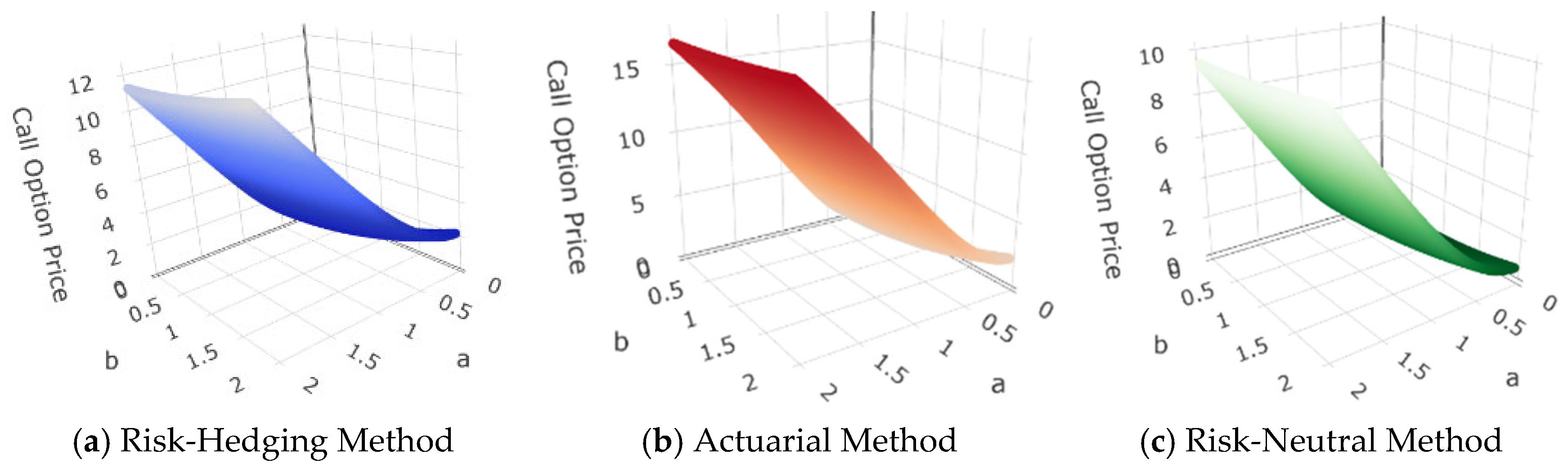
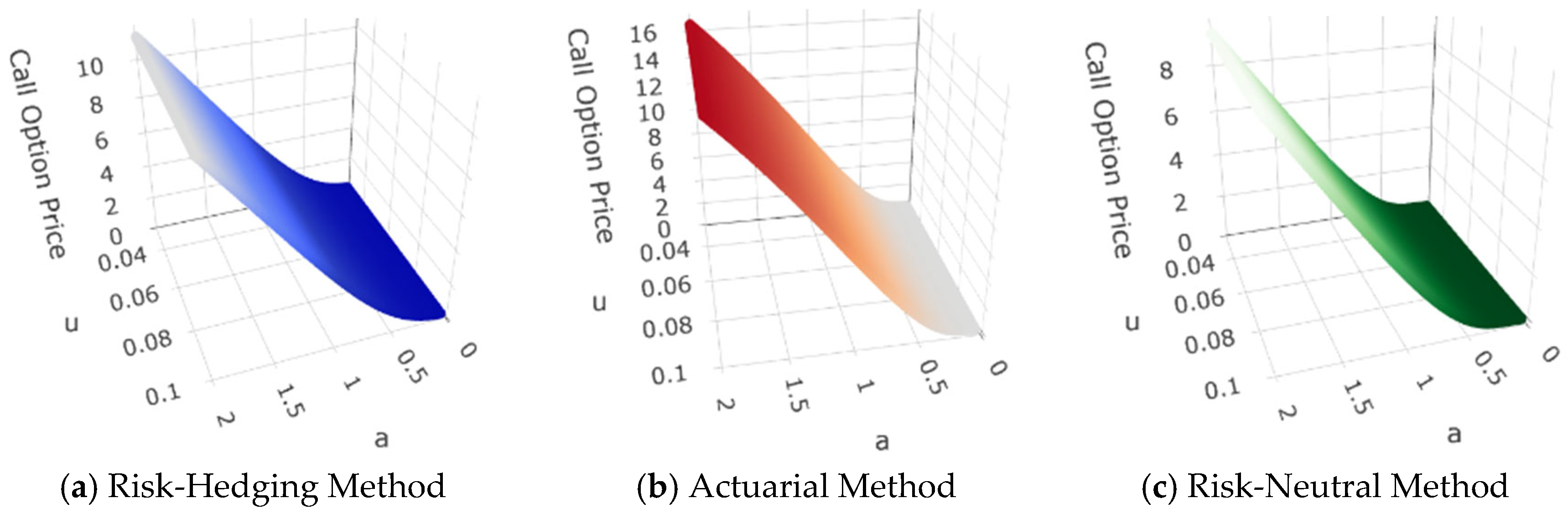
This subsection conducts numerical simulations using the continuous parameters of the stock price model (represented by μ , α , and β in Figure 1 and Figure 2) to study the impact of fluctuations in these parameters on the value of European call options under different pricing methods.
The option values derived using different methods consistently respond to fluctuations in the stock price model’s continuous parameters. Holding other factors constant, the long-memory property of the stock price model, represented by the coefficient β corresponding to sfBm (denoted as b in Figure 1), and the drift rate μ (denoted as u in Figure 2), has minimal impact on the option value. However, as the coefficient of the standard Brownian motion component α in the stock price model (represented by a in Figure 1) increases, the option value increases.
These results indicate that while the predictability of stock returns (via drift and long memory) has a limited influence, increased volatility uncertainty (captured by Brownian motion) significantly raises European call option values, consistent with classical option pricing theory.

3.4.3. Impact of Jump-Related Parameters

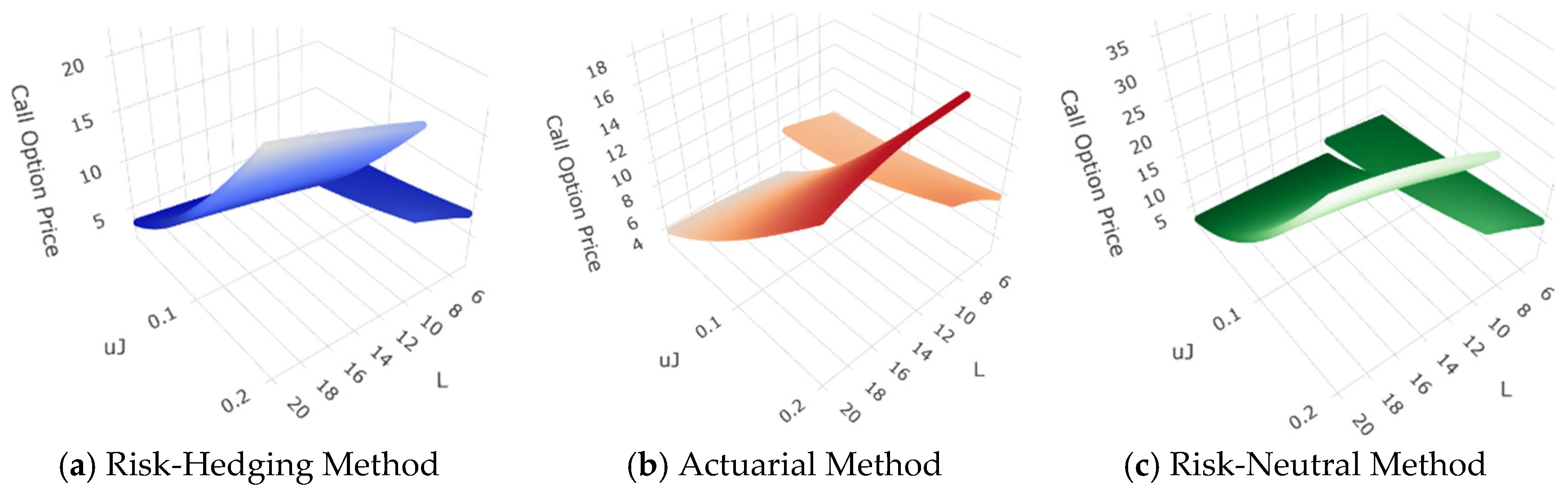
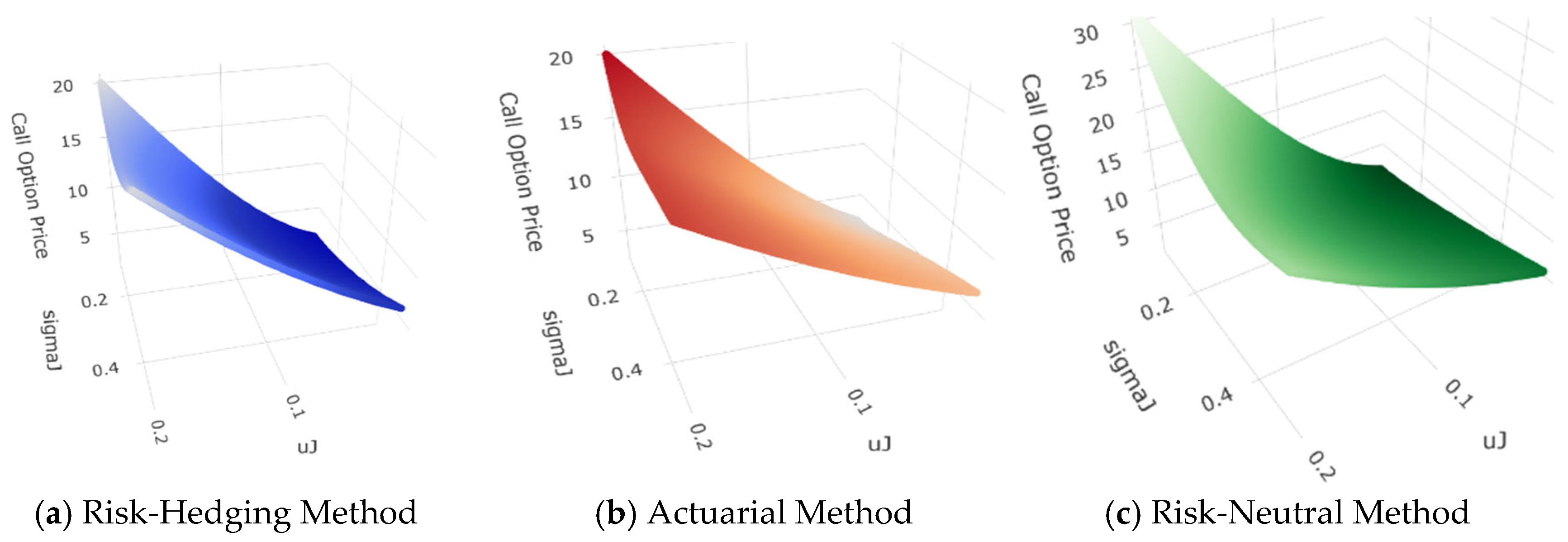
This subsection simulates numerical examples based on the jump parameters μ J , σ J , and λ ( u J , L, and s i g m a J in Figure 3 and Figure 4) in the stock price model, studying the impact of the jump parameters on the value of European call options.
The results show similar patterns across methods. For the jump amplitude parameters μ J and σ J , as μ J increases, the option value increases, meaning that the more favorable the direction of the jump for increasing the stock price, the higher the corresponding European call option value. Conversely, as σ J decreases, the option value decreases. The sensitivity of option values to the frequency of jumps is also consistent across different methods: the higher the frequency of jumps λ , the higher the option value. Moreover, a sharp change point in option value with respect to the jump frequency is observed across all three methods (approximately located at λ = 10 ). These numerical results concerning jump parameters are also broadly consistent with the fundamental characteristics of European call options.
According to the numerical simulation analysis in this section, the parameter sensitivities of the underlying asset under the smfBm-J model are generally consistent across the three option pricing methods, although some differences are evident. For instance, there are numerical differences in the option values between the methods, which are particularly pronounced under the actuarial pricing method. This phenomenon may be related to market incompleteness under the smfBm-J model, especially due to the unhedgeable jump risk, which prevents the market from fully hedging the risks induced by jumps. This result is consistent with the analysis in Section 3.1, further validating the market incompleteness under the jump–diffusion model and leading to discrepancies between the pricing methods.

4. Conclusions and Future Research Directions

4.1. Conclusions

This study addressed two open problems in option pricing theory: the lack of models that comprehensively capture multiple empirical features of asset dynamics and the unexplored relationship between pricing methodologies under non-classical stochastic processes. By introducing the smfBm-J model and deriving closed-form European call option pricing formulas under the risk-hedging, risk-neutral, and actuarial methods, we obtained the following findings:
First, the smfBm-J process provides a unified framework that simultaneously captures long memory, nonstationary increments, semimartingality, and jump risk. The derived Itô formula (Lemma 4) reveals that the variance contributions from the Brownian, fractional, and jump components enter additively, enabling a decomposition of volatility dynamics into distinct economically interpretable components. This makes the model flexible enough to accommodate diverse market conditions.
Second, the three pricing methods produce different results under the smfBm-J framework, in contrast to their well-known equivalence under the standard Black–Scholes model. The divergence is most pronounced under the actuarial method, which, unlike the risk-hedging and risk-neutral approaches, does not rely on market completeness and employs the physical expected return rather than the risk-free rate. This finding has important implications for practitioners: in incomplete markets where the jump risk cannot be fully hedged, the choice of pricing methodology directly affects the valuation, and no single method can claim universal validity. The risk-neutral method with the MEMM provides a theoretically consistent choice when jump risk premia can be adequately specified, while the actuarial method offers a practical alternative when such specification is infeasible.
Taken together, these contributions advance option pricing theory by demonstrating the feasibility and limitations of extending classical methods to complex stochastic environments. They also highlight the practical importance of methodological awareness in pricing, hedging, and risk management in markets characterized by long memory and jump risks.

4.2. Future Research Directions

This study examines option pricing under the smfBm-J framework across three mainstream methodologies, advancing jump–diffusion theory. Future work will address limitations in the jump component, which currently assumes independence between jumps and from other processes while overlooking empirical evidence of clustering and power-law behavior [60,61,62]. Incorporating power-law jumps and relaxing the independence assumption on jump amplitudes may improve the calibration, pricing accuracy, and the model’s ability to capture contagion and the propagation of systemic shocks.
Furthermore, future work could focus on the empirical calibration and validation of the proposed smfBm-J model using real market data, thereby bridging the gap between the closed-form theoretical results derived here and practical financial applications.

Author Contributions

Conceptualization, K.Z. and X.Z.; methodology, K.Z. and Y.L.; software, L.C. and P.C.; validation, K.Z. and L.C.; formal analysis, K.Z.; investigation, L.C. and Z.W.; resources, L.C.; data curation, L.C.; writing—original draft preparation, K.Z.; writing—review and editing, L.C.; visualization, X.Z.; supervision, X.Z.; project administration, X.Z.; funding acquisition, X.Z. All authors have read and agreed to the published version of the manuscript.

Funding

This research was funded by the Natural Science Foundation of Zhejiang Province (Grant No. LZ25G030002); the Soft Science Foundation of Ningbo Municipality, project titled “Research on the ‘Investment First, Equity Later’ Pathway for Science and Technology Funds” (Project No. 2025R023); the Humanities and Social Sciences Research Planning Fund of the Ministry of Education (2025), project titled “Research on the Security of the China–US Semiconductor Supply Chain: Identification of Risk Mechanisms and Evaluation of Domestic Substitution Paths” (Grant No. 25YJA790094); and the Key Project of the 2020 National Social Science Fund of China (Annual General Program), project titled “Research on Responding to International Economic Security Shocks and Improving China’s Macroeconomic Regulation System” (Grant No. 20AZD033).

Data Availability Statement

No new data were created or analyzed in this study.

Conflicts of Interest

The authors declare no conflicts of interest.

Appendix A

Proof of Theorem 4 (Property (1)). 
Since ln J t N ( μ J , σ J 2 ) , it follows from the property of the log-normal distribution that
E ( J t ) = e μ J + σ J 2 / 2 .
Hence, we obtain
E [ J H ( t ; α , β ) ] = E [ M H ( t ; α , β ) + i = 1 N t J i   ] = E [ M H ( t ; α , β ) ] + E ( i = 1 N t J i )                                                           = λ t e μ J + σ J 2 / 2 .
Proof of Theorem 4 (Property (2)). 
When ts, we have C o v [ N ( t ) , N ( s ) ] = λ ( t s ) . Therefore, it follows that
C o v [ J H ( t ; α , β ) , J H ( s ; α , β ) ] = E [ J H ( t ; α , β ) J H ( s ; α , β ) ] E [ J H ( t ; α , β ) ] E [ J H ( s ; α , β ) ] = E { [ M H ( t ; α , β ) + i = 1 N t J i ] [ M H ( s ; α , β ) + i = 1 N s J i ] } E [ J H ( t ; α , β ) ] E [ J H ( s ; α , β ) ] = E [ M H ( t ; α , β ) M H ( s ; α , β ) ] + E ( i = 1 N t J i i = 1 N s J i ) E [ J H ( t ; α , β ) ] E [ J H ( s ; α , β ) ] .
We have
E ( i = 1 N t J i i = 1 N s J i ) = λ 2 t s ( E J i ) 2 + λ ( t s ) E ( J i ) 2 = λ 2 t s μ J 2 + λ ( t s ) ( μ J 2 + σ J 2 ) .
It then follows that
C o v [ J H ( t ; α , β ) , J H ( s ; α , β ) ] = α 2 ( t s ) + β 2 { t 2 H + s 2 H 1 2 [ ( t + s ) 2 H + | t s | 2 H ] }                             + λ 2 t s μ J 2 + λ ( t s ) ( μ J 2 + σ J 2 ) ( λ t ) 2 e 2 μ J + σ J 2 ,
The derivation of the covariance formula above, together with property (3), shows that, when t = s , C o v [ N ( t ) , N ( s ) ] = V a r [ N ( t ) ] = λ t , and thus,
C o v [ J H ( t ; α , β ) , J H ( s ; α , β ) ] = V a r [ J H ( t ; α , β ) ] = E { [ J H ( t ; α , β ) ] 2 } { E [ J H ( t ; α , β ) ] } 2                                                         = E { [ M H ( t ; α , β ) + i = 1 N t J i ] 2 } { E [ J H ( t ; α , β ) ] } 2                                                         = E { [ M H ( t ; α , β ) ] 2 } + E { [ i = 1 N t J i ] 2 } { E [ J H ( t ; α , β ) ] } 2                                                         = V a r [ M H ( t ; α , β ) ] + E { [ i = 1 N t J i ] 2 } { E [ J H ( t ; α , β ) ] } 2 .
We have
E { [ i = 1 N t J i ] 2 } = λ t V a r ( J i ) + ( λ t ) 2 ( E J i ) 2 + λ t ( E J i ) 2 = λ t σ J 2 + ( λ t ) 2 μ J 2 + λ t μ J 2 .
Hence, we obtain
C o v [ J H ( t ; α , β ) , J H ( s ; α , β ) ]                                                         = α 2 t + β 2 ( 2 2 2 H 1 ) t 2 H + λ t σ J 2 + ( λ t ) 2 μ J 2 + λ t μ J 2 ( λ t ) 2 e 2 μ J + σ J 2 .
The properties (4) and (5) can be readily derived from the corresponding properties of sfBm. This completes the proof. □
Proof of Theorem 7. 
Consider a European call option; the following solves the PDE via the HHDE.
  • Let x = l n S t   ,   τ = T t ; i.e., S t = e x   ,   t = T τ . Now, define C ( x , τ ) = W ( S t , t ) , and δ = λ ( e 2 μ J + 2 σ J 2 2 e μ J + σ J 2 / 2 + 1 ) ; then, we obtain
W t = C τ W S = C x x s = C x S t W S S = C x x x s S t C x S t 2 = C x x C x S t 2 .
Substituting these into (47), we obtain
C τ + 1 2 C x [ α 2 + 2 H β 2 ( 2 2 2 H 1 ) ( T τ ) 2 H 1 + δ 2 r ] 1 2 C x x [ α 2 + 2 H β 2 ( 2 2 2 H 1 ) ( T τ ) 2 H 1 + δ ] + r C = 0 .
Let κ = 1 2 [ α 2 + 2 H β 2 ( 2 2 2 H 1 ) ( T τ ) 2 H 1 + δ ] ; then, (A1) simplifies to
C τ + ( κ r ) C x κ C x x + r C = 0 .
Next, let x 1 = x + A ( τ ) , τ 1 = B ( τ ) , C ( τ , x ) = U ( τ 1 , x 1 ) e D ( τ ) , so that
C τ = e D ( τ ) [ U x 1 A ( τ ) + U τ 1 B ( τ ) U D ( τ ) ] C x = U x 1 e D ( τ ) C x x = U x 1 x 1 e D ( τ ) .
Substitute this into (A2):
U τ 1 B ( τ ) + [ A ( τ ) + κ r ] U x 1 κ U x 1 x 1 + [ r D ( τ ) ] U = 0 .
To transform it into the HDE for solving, let the coefficients in front of U x 1 and U be zero, and make the coefficients in front of U τ 1 and U x 1 x 1 be opposites; that is,
A ( τ ) = r κ , D ( τ ) = r ,     B ( τ ) = κ ,
Now, applying the boundary conditions A ( T ) = B ( T ) = D ( T ) = 0 at T ,
A ( τ ) = 0 τ { r 1 2 [ α 2 + 2 H β 2 ( 2 2 2 H 1 ) ( T s ) 2 H 1 + δ ] } d s = [ r α 2 2 δ 2 ] τ + β 2 ( 1 2 2 H 2 ) [ ( T τ ) 2 H T 2 H ] ,
B τ = 0 τ 1 2 α 2 + 2 H β 2 2 2 2 H 1 T s 2 H 1 + δ d s                                                                                     = 1 2 [ α 2 + δ ] τ β 2 ( 1 2 2 H 2 ) [ ( T τ ) 2 H T 2 H ] ,
D ( τ ) = 0 τ r d t = r τ .
We obtain
x 1 = x + A ( τ ) = l n S t + ( r α 2 2 δ 2 ) τ + β 2 ( 1 2 2 H 2 ) [ ( T τ ) 2 H T 2 H ] τ 1 = 1 2 ( α 2 + δ ) τ β 2 ( 1 2 2 H 2 ) [ ( T τ ) 2 H T 2 H ] C ( τ , x ) = U ( τ 1   , x 1 ) e r τ .
Then, we obtain the HDE: U τ 1 = U x 1 x 1 , i.e.,
U τ 1 = 2 U x 1 2 .
According to the boundary conditions,
U ( τ 1   , x 1 ) | τ = 0 = C ( τ , x ) e D ( τ ) | τ = 0 = C ( τ , x 1 ) | τ = 0 = ( e x 1 K ) + | t = T ,
the classical solution to the corresponding HDE can be derived as follows:
U ( τ 1   , x 1 ) = + 1 2 π τ 1 e ( x 1 ς ) 2 4 τ 1 ( e ς K ) + d ς = 1 2 π τ 1 l n K + e ( x 1 ς ) 2 4 τ 1 ( e ς K ) d ς                                                                 = 1 2 π τ 1 l n K + e ( x 1 ς ) 2 4 τ 1 e ς d ς K 2 π τ 1 l n K + e ( x 1 ς ) 2 4 τ 1 d ς                                                                 = e τ 1 + x 1 N ( x 1 + 2 τ 1 l n K 2 τ 1 ) K N ( x 1 l n K 2 τ 1 ) .
Substituting the expressions for τ 1 and x 1 , we obtain
U ( τ 1   , x 1 ) = e τ 1 + x 1 N ( x 1 + 2 τ 1 l n K 2 τ 1 ) K N ( x 1 l n K 2 τ 1 ) = S t e r τ N ( l n ( S t / K ) + ( r + α 2 2 + δ 2 ) τ β 2 ( 1 2 2 H 2 ) [ ( T τ ) 2 H T 2 H ] ( α 2 + δ ) τ 2 β 2 ( 1 2 2 H 2 ) [ ( T τ ) 2 H T 2 H ] ) K N ( l n ( S t / K ) + ( r α 2 2 δ 2 ) τ + β 2 ( 1 2 2 H 2 ) [ ( T τ ) 2 H T 2 H ] ( α 2 + δ ) τ 2 β 2 ( 1 2 2 H 2 ) [ ( T τ ) 2 H T 2 H ] ) .
Finally, we obtain
C ( τ , x ) = U ( τ 1   , x 1 ) e r τ                                                             = S t N ( l n ( S t / K ) + ( r + α 2 2 + δ 2 ) τ β 2 ( 1 2 2 H 2 ) [ ( T τ ) 2 H T 2 H ] ( α 2 + δ ) τ 2 β 2 ( 1 2 2 H 2 ) [ ( T τ ) 2 H T 2 H ] )
K e r τ N ( l n ( S t / K ) + ( r α 2 2 δ 2 ) τ + β 2 ( 1 2 2 H 2 ) [ ( T τ ) 2 H T 2 H ] ( α 2 + δ ) τ 2 β 2 ( 1 2 2 H 2 ) [ ( T τ ) 2 H T 2 H ] ) ,
or
C ( S t , t ) = S t N ( d 1 ) K e r τ N ( d 2 )
d 1 = l n ( S t / K ) + ( r + α 2 2 + δ 2 ) τ β 2 ( 1 2 2 H 2 ) [ ( T τ ) 2 H T 2 H ] ( α 2 + δ ) τ 2 β 2 ( 1 2 2 H 2 ) [ ( T τ ) 2 H T 2 H ] d 2 = d 1 ( α 2 + δ ) τ 2 β 2 ( 1 2 2 H 2 ) [ ( T τ ) 2 H T 2 H ] .
This completes the proof. □
Proof of Theorem 9. 
It has been derived that
S T = S t e μ ( T t ) + Y ( n , T t ) α 2 ( T t ) + β 2 ( 2 2 2 H 1 ) ( T t ) 2 H + n σ J 2 + n μ J ( 1 2 2 H 2 ) β 2 ( T t ) 2 H 1 2 α 2 ( T t ) .
Substituting this into (25),
C ( S t , T t | N T N t = n ) = E P { [ e μ ( T t ) S T e r ( T t ) K ] I [ e μ ( T t ) S T > e r ( T t ) K ] } = d + { e μ ( T t ) S t e x p [ μ ( T t ) + Y ( n , T t )                                                         α 2 ( T t ) + β 2 ( 2 2 2 H 1 ) ( T t ) 2 H + n σ J 2 + n μ J ( 1                                                         2 2 H 2 ) β 2 ( T t ) 2 H 1 2 α 2 ( T t ) ] e r ( T t ) K } 1 2 π e Y 2 2 d Y = S t e x p [ ( 1 e μ J + 1 2 σ J 2 ) λ ( T t ) + n μ J ( 1 2 2 H 2 ) β 2 ( T t ) 2 H 1 2 α 2 ( T t ) ]                                                         d + e Y α 2 ( T t ) + β 2 ( 2 2 2 H 1 ) ( T t ) 2 H + n σ J 2 1 2 π e Y 2 2 d Y                                                         e r ( T t ) K d + 1 2 π e Y 2 2 d Y ,
where
d + e Y α 2 ( T t ) + β 2 ( 2 2 2 H 1 ) ( T t ) 2 H + n σ J 2 1 2 π e Y 2 2 d Y = e α 2 ( T t ) + β 2 ( 2 2 2 H 1 ) ( T t ) 2 H + n σ J 2 2 d + 1 2 π e ( Y α 2 ( T t ) + β 2 ( 2 2 2 H 1 ) ( T t ) 2 H + n σ J 2 ) 2 2 d Y = e α 2 ( T t ) + β 2 ( 2 2 2 H 1 ) ( T t ) 2 H + n σ J 2 2 d α 2 ( T t ) + β 2 ( 2 2 2 H 1 ) ( T t ) 2 H + n σ J 2 + 1 2 π e z 2 2 d z = e α 2 ( T t ) + β 2 ( 2 2 2 H 1 ) ( T t ) 2 H + n σ J 2 2 N ( α 2 ( T t ) + β 2 ( 2 2 2 H 1 ) ( T t ) 2 H + n σ J 2 d ) .
After substitution, we finally obtain
C ( S T , T t | N T N t = n ) = S t e x p [ ( 1 e μ J + 1 2 σ J 2 ) λ ( T t ) + n μ J ( 1 2 2 H 2 ) β 2 ( T t ) 2 H 1 2 α 2 ( T t )                                                         + α 2 ( T t ) + β 2 ( 2 2 2 H 1 ) ( T t ) 2 H + n σ J 2 2 ]                                                         N ( α 2 ( T t ) + β 2 ( 2 2 2 H 1 ) ( T t ) 2 H + n σ J 2 d ) e r ( T t ) K N ( d ) ,
where
d = l n K S t + [ ( e μ J + 1 2 σ J 2 1 ) λ r + 1 2 α 2 ] ( T t ) + ( 1 2 2 H 2 ) β 2 ( T t ) 2 H n μ J α 2 ( T t ) + β 2 ( 2 2 2 H 1 ) ( T t ) 2 H + n σ J 2 .
By applying Bayes’ formula, we can obtain
C ( S t , t ) = n = 0 [ C ( S t , T t | N T N t = n ) P r o ( N T N t = n ) ] = n = 0 { S t e x p [ ( 1 e μ J + 1 2 σ J 2 ) λ ( T t ) + n μ J ( 1 2 2 H 2 ) β 2 ( T t ) 2 H 1 2 α 2 ( T t )                                                                                                                       + α 2 ( T t ) + β 2 ( 2 2 2 H 1 ) ( T t ) 2 H + n σ J 2 2 ]                         N ( α 2 ( T t ) + β 2 ( 2 2 2 H 1 ) ( T t ) 2 H + n σ J 2 d )                                                                                         e r ( T t ) K N ( d ) } [ λ ( T t ) ] n n ! e λ ( T t )
This completes the proof. □

References

  1. Mandelbrot, B.B. The Variation of Certain Speculative Prices; Springer: Berlin/Heidelberg, Germany, 1997. [Google Scholar]
  2. Engle, R.F. Autoregressive conditional heteroscedasticity with estimates of the variance of United Kingdom inflation. Econom. J. Econom. Soc. 1982, 50, 987–1007. [Google Scholar] [CrossRef]
  3. Greene, M.T.; Fielitz, B.D. Long-term dependence in common stock returns. J. Financ. Econ. 1977, 4, 339–349. [Google Scholar] [CrossRef]
  4. Nawrocki, D. R/S analysis and long term dependence in stock market indices. Manag. Financ. 1995, 21, 78–91. [Google Scholar] [CrossRef]
  5. Drozdz, S.; Ruf, F.; Speth, J.; Wójcik, M. Imprints of log-periodic self-similarity in the stock market. Eur. Phys. J. B-Condens. Matter Complex Syst. 1999, 10, 589–593. [Google Scholar] [CrossRef]
  6. Lisha, O.; Chen, Y.; Handong, L. Empirical research on jumps in stock price in Chinese stock markets. J. Manag. Sci. China 2011, 14, 60–66. [Google Scholar]
  7. Santa-Clara, P.; Yan, S. Crashes, volatility, and the equity premium: Lessons from S&P 500 options. Rev. Econ. Stat. 2010, 92, 435–451. [Google Scholar] [CrossRef]
  8. Black, F.; Scholes, M. The pricing of options and corporate liabilities. J. Political Econ. 1973, 81, 637–654. [Google Scholar] [CrossRef]
  9. Dumas, B.; Fleming, J.; Whaley, R.E. Implied volatility functions: Empirical tests. J. Financ. 1998, 53, 2059–2106. [Google Scholar] [CrossRef]
  10. Poteshman, A.M. Underreaction, overreaction, and increasing misreaction to information in the options market. J. Financ. 2001, 56, 851–876. [Google Scholar] [CrossRef]
  11. Aït-Sahalia, Y.; Cacho-Diaz, J.; Laeven, R.J.A. Modeling financial contagion using mutually exciting jump processes. J. Financ. Econ. 2015, 117, 585–606. [Google Scholar] [CrossRef]
  12. Kolmogorov, A.N. Wienersche spiralen und einige andere interessante kurven in hilbertscen raum, cr (doklady). Acad. Sci. URSS (NS) 1940, 26, 115–118. [Google Scholar]
  13. Lei, P.; Nualart, D. A decomposition of the bifractional Brownian motion and some applications. Stat. Probabil. Lett. 2009, 79, 619–624. [Google Scholar] [CrossRef]
  14. Bender, C. An Itô formula for generalized functionals of a fractional Brownian motion with arbitrary Hurst parameter. Stoch. Proc. Appl. 2003, 104, 81–106. [Google Scholar] [CrossRef]
  15. Bojdecki, T.; Gorostiza, L.G.; Talarczyk, A. Sub-fractional Brownian motion and its relation to occupation times. Stat. Probabil. Lett. 2004, 69, 405–419. [Google Scholar] [CrossRef]
  16. Xiao, W.; Zhou, Q.; Wu, W. Arbitrage opportunities in sub-fractional Black-Scholes model. Sci. Sin. Math. 2021, 51, 1877–1894. [Google Scholar]
  17. Kuang, N.; Xie, H. Maximum likelihood estimator for the sub-fractional Brownian motion approximated by a random walk. Ann. I. Stat. Math. 2015, 67, 75–91. [Google Scholar] [CrossRef]
  18. Li, Z.; Zhou, G.; Luo, J. Stochastic delay evolution equations driven by sub-fractional Brownian motion. Adv. Differ. Equ.-NY. 2015, 2015, 48. [Google Scholar] [CrossRef]
  19. Bian, L.; Li, Z. Fuzzy simulation of European option pricing using sub-fractional Brownian motion. Chaos Solitons Fractals 2021, 145, 111442. [Google Scholar] [CrossRef]
  20. Wang, W.; Cai, G.; Tao, X. Pricing geometric asian power options in the sub-fractional brownian motion environment. Chaos Solitons Fractals 2021, 145, 110754. [Google Scholar] [CrossRef]
  21. Charles, E.-N.; Mounir, Z. On the sub-mixed fractional Brownian motion. Appl. Math.-A J. Chin. Univ. 2015, 30, 27–43. [Google Scholar] [CrossRef]
  22. An, X.; Guo, J. Pricing of Perpetual American Lookback Options Under the Sub-mixed Fractional Brownian Motion. Math. Appl. 2021, 34, 820–828. [Google Scholar] [CrossRef]
  23. Yue, C.; Shen, C. Fractal barrier option pricing under sub-mixed fractional Brownian motion with jump processes. AIMS Math. 2024, 9, 31010–31029. [Google Scholar] [CrossRef]
  24. Ma, P.; Najafi, A.; Gomez-Aguilar, J.F. Sub mixed fractional Brownian motion and its application to finance. Chaos Solitons Fractals 2024, 184, 114968. [Google Scholar] [CrossRef]
  25. Kapadia, N.; Zekhnini, M. Do idiosyncratic jumps matter? J. Financ. Econ. 2019, 131, 666–692. [Google Scholar] [CrossRef]
  26. Xu, L.; Wu, W. Over-reaction, Jump Return and A-share Momentum Strategy. Chin. J. Manag. Sci. 2023, 33, 1–15. [Google Scholar]
  27. Zhu, F.; Liu, Y.; Zheng, Z.; Liu, X. Volatility spillover and jump propagation in global equity markets under the impact of major events. J. Manag. Sci. China 2024, 12, 116–138. [Google Scholar]
  28. Duan, J.C. The GARCH option pricing model. Math. Financ. 1995, 5, 13–32. [Google Scholar] [CrossRef]
  29. Zhu, F.; Li, H.; Xu, J.; Li, H. Determinants and Pricing Effects of Short—Term Herd Behavior: An Empirical Test Based on High—Frequency Data. J. Financ. Res. 2019, 7, 191–206. [Google Scholar]
  30. Press, S.J. A compound events model for security prices. J. Bus. 1967, 40, 317–335. [Google Scholar] [CrossRef]
  31. Merton, R.C. Option pricing when underlying stock returns are discontinuous. J. Financ. Econ. 1976, 3, 125–144. [Google Scholar] [CrossRef]
  32. Guo, J.; Wang, Y.; Kang, W. Pricing European option under the generalized fractional jump-diffusion model. Fract. Calc. Appl. Anal. 2024, 27, 1917–1947. [Google Scholar] [CrossRef]
  33. Kou, S.G. A jump-diffusion model for option pricing. Manag. Sci. 2002, 48, 1086–1101. [Google Scholar] [CrossRef]
  34. Xiao, W.-L.; Zhang, W.-G.; Zhang, X.-L.; Wang, Y.-L. Pricing currency options in a fractional Brownian motion with jumps. Econ. Model. 2010, 27, 935–942. [Google Scholar] [CrossRef]
  35. Kim, K.-H.; Yun, S.; Kim, N.-U.; Ri, J.-H. Pricing formula for European currency option and exchange option in a generalized jump mixed fractional Brownian motion with time-varying coefficients. Phys. A Stat. Mech. Its Appl. 2019, 522, 215–231. [Google Scholar]
  36. Shokrollahi, F.; Ahmadian, D.; Ballestra, L.V. Actuarial strategy for pricing Asian options under a mixed fractional Brownian motion with jumps. arXiv 2021, arXiv:2105.06999. [Google Scholar] [CrossRef]
  37. Ji, B.; Tao, X.; Ji, Y. Barrier option pricing in the sub-mixed fractional brownian motion with jump environment. Fractal Fract. 2022, 6, 244. [Google Scholar] [CrossRef]
  38. Hull, J.; White, A. Optimal delta hedging for options. J. Bank. Financ. 2017, 82, 180–190. [Google Scholar]
  39. Dufera, T.T. Fractional Brownian motion in option pricing and dynamic delta hedging: Experimental simulations. N. Am. J. Econ. Financ. 2024, 69, 102017. [Google Scholar] [CrossRef]
  40. Harrison, J.; Pliska, S.R. Martingales and stochastic integrals in the theory of continuous trading. Stoch. Proc. Appl. 1981, 11, 215–260. [Google Scholar] [CrossRef]
  41. Cheng, P.; Xu, Z.; Dai, Z. Valuation of vulnerable options with stochastic corporate liabilities in a mixed fractional Brownian motion environment. Math. Financ. Econ. 2023, 17, 429–455. [Google Scholar]
  42. Carmona, R.; Hinz, J. Risk-neutral models for emission allowance prices and option valuation. Manag. Sci. 2011, 57, 1453–1468. [Google Scholar] [CrossRef]
  43. Lee, K. Risk-neutral option pricing under GARCH intensity model. arXiv 2019, arXiv:1908.05405. [Google Scholar] [CrossRef][Green Version]
  44. Frittelli, M. The minimal entropy martingale measure and the valuation problem in incomplete markets. Math. Financ. 2000, 10, 39–52. [Google Scholar] [CrossRef]
  45. Grandits, P.; Rheinländer, T. On the minimal entropy martingale measure. Ann. Probab. 2002, 30, 1003–1038. [Google Scholar] [CrossRef]
  46. Bladt, M.; Rydberg, T.H. An actuarial approach to option pricing under the physical measure and without market assumptions. Insur. Math. Econ. 1998, 22, 65–73. [Google Scholar] [CrossRef]
  47. Parzen, E. Stochastic Processes; SIAM: Philadelphia, PA, USA, 1999. [Google Scholar]
  48. Jones, P.W.; Smith, P. Stochastic Processes: An Introduction; Taylor and Francis: Abingdon, UK, 2017. [Google Scholar]
  49. Shreve, S.E. Stochastic Calculus for Finance II: Continuous-Time Models; Springer: Berlin/Heidelberg, Germany, 2004. [Google Scholar]
  50. Bingham, N.H.; Kiesel, R. Risk-Neutral Valuation: Pricing and Hedging of Financial Derivatives; Springer Science & Business Media: Berlin/Heidelberg, Germany, 2013. [Google Scholar]
  51. Itô, K. On a stochastic integral equation. Proc. Jpn. Acad. 1946, 22, 32–35. [Google Scholar] [CrossRef]
  52. Chen, J.C.; Churchill, S.W. Radiant heat transfer in packed beds. AIChE J. 1963, 9, 35–41. [Google Scholar] [CrossRef]
  53. Sato, K. Levy Process and Infinitely Divisible Distributions; Cambridge University Press: Cambridge, UK, 1999. [Google Scholar]
  54. Fujiwara, T.; Miyahara, Y. The minimal entropy martingale measures for geometric Lévy processes. Financ. Stoch. 2003, 7, 509–531. [Google Scholar] [CrossRef]
  55. Esche, F.; Schweizer, M. Minimal entropy preserves the Lévy property: How and why. Stoch. Process. Their Appl. 2005, 115, 299–327. [Google Scholar] [CrossRef]
  56. Benth, F.E.; Meyer-Brandis, T. The Density Process of the Minimal Entropy Martingale Measure in a Stochastic Volatility Model with Jumps (Reprint); Springer: Berlin/Heidelberg, Germany, 2010; pp. 1567–1575. [Google Scholar]
  57. Shokrollahi, F.; Adem, K. Actuarial approach in a mixed fractional Brownian motion with jumps environment for pricing currency option. Adv. Differ. Equ. 2015, 2015, 257. [Google Scholar] [CrossRef]
  58. Wang, X.; Zhao, Z.; Fang, X. Option pricing and portfolio hedging under the mixed hedging strategy. Phys. A Stat. Mech. Its Appl. 2015, 424, 194–206. [Google Scholar] [CrossRef]
  59. Guo, Z.; Liu, Y.; Dai, L. European option pricing under sub-fractional Brownian motion regime in discrete time. Fractal Fract. 2023, 8, 13. [Google Scholar] [CrossRef]
  60. Cao, H.; Li, H.; He, Z. Stock pricing model:Jump diffusion model of power law. J. Manag. Sci. China 2011, 20, 46–59. [Google Scholar]
  61. Barabasi, A.-L. The origin of bursts and heavy tails in human dynamics. Nature 2005, 435, 207–211. [Google Scholar] [CrossRef]
  62. Vázquez, A.; Oliveira, J.G.; Dezsö, Z.; Goh, K.-I.; Kondor, I.; Barabási, A.-L. Modeling bursts and heavy tails in human dynamics. Phys. Rev. E 2006, 73, 36127. [Google Scholar] [CrossRef] [PubMed]
Figure 1. Impact of continuous parameters ( α and β ) of the stock price model on the value of European call options under different methods.
Mathematics 14 01641 g001
Figure 2. Impact of continuous parameters ( α and μ ) of the stock price model on the value of European call options under different methods.
Mathematics 14 01641 g002
Figure 3. Impact of jump amplitude parameters ( σ J and μ J ) on the value of European call options under different methods.
Mathematics 14 01641 g003
Figure 4. Impact of jump amplitude parameters ( λ and μ J ) on the value of European call options under different methods.
Mathematics 14 01641 g004
Table 1. List of main notations used in this work.
SymbolDescription
( Ω , F , { F ( t ) } t 0 , Q ) Filtered probability space satisfying the usual conditions
P Physical probability measure
Q Risk-neutral probability measure
B ( t ) Standard Brownian motion
ξ H ( t ) Sub-fractional Brownian motion with Hurst index H
M H ( t ; α , β ) Sub-mixed fractional Brownian motion (smfBm)
N ( t ) Poisson process with intensity λ
J i Jump size, with ln J_i ∼ N(μ_J, σ_J2)
J H ( t ) smfBm with jumps (smfBm-J)
S t Underlying asset price at time t
H Hurst index, 0 < H < 1
α Weight of the Brownian motion component in smfBm
β Weight of the sfBm component in smfBm
μ Drift rate of the underlying asset
r Risk-free interest rate
σ Volatility (in the classical Black–Scholes context)
λ Jump intensity of the Poisson process
μ J Mean of the log jump size
σ J 2 Variance of the log jump size
δ Expected jump quadratic variation, δ = λ·E[(J_t−1)2]
K Strike price
T Maturity date
C ( S t , t ) European call option price at time t
N ( · ) Standard normal cumulative distribution function
Disclaimer/Publisher’s Note: The statements, opinions and data contained in all publications are solely those of the individual author(s) and contributor(s) and not of MDPI and/or the editor(s). MDPI and/or the editor(s) disclaim responsibility for any injury to people or property resulting from any ideas, methods, instructions or products referred to in the content.