3.1. Approximate Algorithm for Gamma-Type Spare Parts Utilization Rate
As the calculation method for the exponential-type spare parts utilization rate in Equation (18) is relatively simple, consideration is given to transforming the calculation problem of the Gamma-type spare parts utilization rate into that of the exponential-type spare parts through the failure rate equivalence method, thereby reducing computational complexity.
Failure rate equivalence, also referred to as
-equivalence, is based on the core principle that Gamma-type spare parts and exponential-type spare parts with failure rate
possess identical failure rates within the support mission time
, namely:
The failure rate
of a component with a lifetime distribution density function
can be calculated using equation [
18] as
. For Gamma-type spare parts, combining with Equation (3) yields:
The failure rate
of the exponential-type spare parts equivalent to the Gamma-type spare parts failure rate is calculated as:
For Gamma-type spare parts with an average lifespan of
, according to Reference [
22], when the mission support time exceeds the average lifespan, the failure rate
of its equivalent exponential spare parts is:
Based on Equations (20) and (21), the final equivalent failure rate
for Gamma-type spare parts can be calculated as:
3.2. Rationality Analysis of Gamma-Type Spare Parts Utilization Rate Approximation Algorithm
Under the given conditions of the spare parts support probability requirement and support mission time, three methods are employed to calculate and analyze the spare parts utilization rate: analytical expression, approximate calculation, and simulation analysis.
- (1)
The calculation steps for the spare parts utilization rate are as follows:
Step 1: Determine the spare parts support probability requirement , support mission time , and parameter values of the Gamma-type spare parts lifetime distribution.
Step 2: Calculate the spare parts support probability using Equation (9), and determine the spare parts configuration quantity based on .
Step 3: Calculate the failure rate of the equivalent exponential-type spare parts using Equation (22), calculate the spare parts support probability using , and determine the spare parts configuration quantity based on .
Step 4: Set the number of spare parts as , generate 10,000 groups of random numbers following the Gamma distribution using the gamrnd statement in Matlab2021 software. For each group of random numbers, calculate the sum of the array using the sum statement. Specifically, calculate the total lifetime of components and spare parts. Count the number among the 10,000 summation results that exceed the support mission time ; then, represents the support probability when the spare parts configuration quantity is specified. Determine the spare parts configuration quantity based on .
Step 5: Determine the spare parts configuration scheme .
Step 6: Combined with the spare parts configuration scheme, calculate the spare parts utilization rate using the analytical result expression (14).
Step 7: Combined with the spare parts configuration scheme, calculate the spare parts utilization rate using the approximate algorithm expression (18).
Step 8: Generate random numbers following the Gamma distribution, and calculate the cumulative sum of the array using the cumsum statement for these random numbers. Each element in the output result represents the cumulative value of the current position and all previous elements. Count the maximum value of positions in the output result that are less than mission time , thereby obtaining the number of spare parts used within mission time . If every element in the output result is greater than , then . The spare parts utilization rate in one simulation data is . Repeat 10,000 times and calculate the average value of utilization rates to obtain the simulation result of the spare parts utilization rate.
- (2)
Analysis of calculation results for Gamma-type spare parts utilization rate.
Assuming the life distribution of Gamma-type spare parts is
, the support mission time is
, and the spare parts support probability requirement
is 0.9, when the support mission time takes different values, the spare parts configuration quantity is calculated according to the steps of three types of spare parts utilization rates. The calculation results are shown in
Table 1. The definitions of N1, N2, and N3 used in
Table 1 are explained in detail within the calculation steps provided in
Section 3.2.
As shown in
Table 1, for Gamma-type spare parts under the condition of a support probability requirement of 0.9, the spare parts configuration numbers calculated using analytical expressions and simulation methods are completely identical across all considered support durations. As the spare parts configuration number is an integer, the approximation algorithm exhibits certain deviations. In
Table 1, the approximation algorithm allocates one additional spare part across four support mission times (800 h, 1100 h, 1200 h, 1500 h), indicating that the approximation algorithm is conservative, but the deviation is not significant.
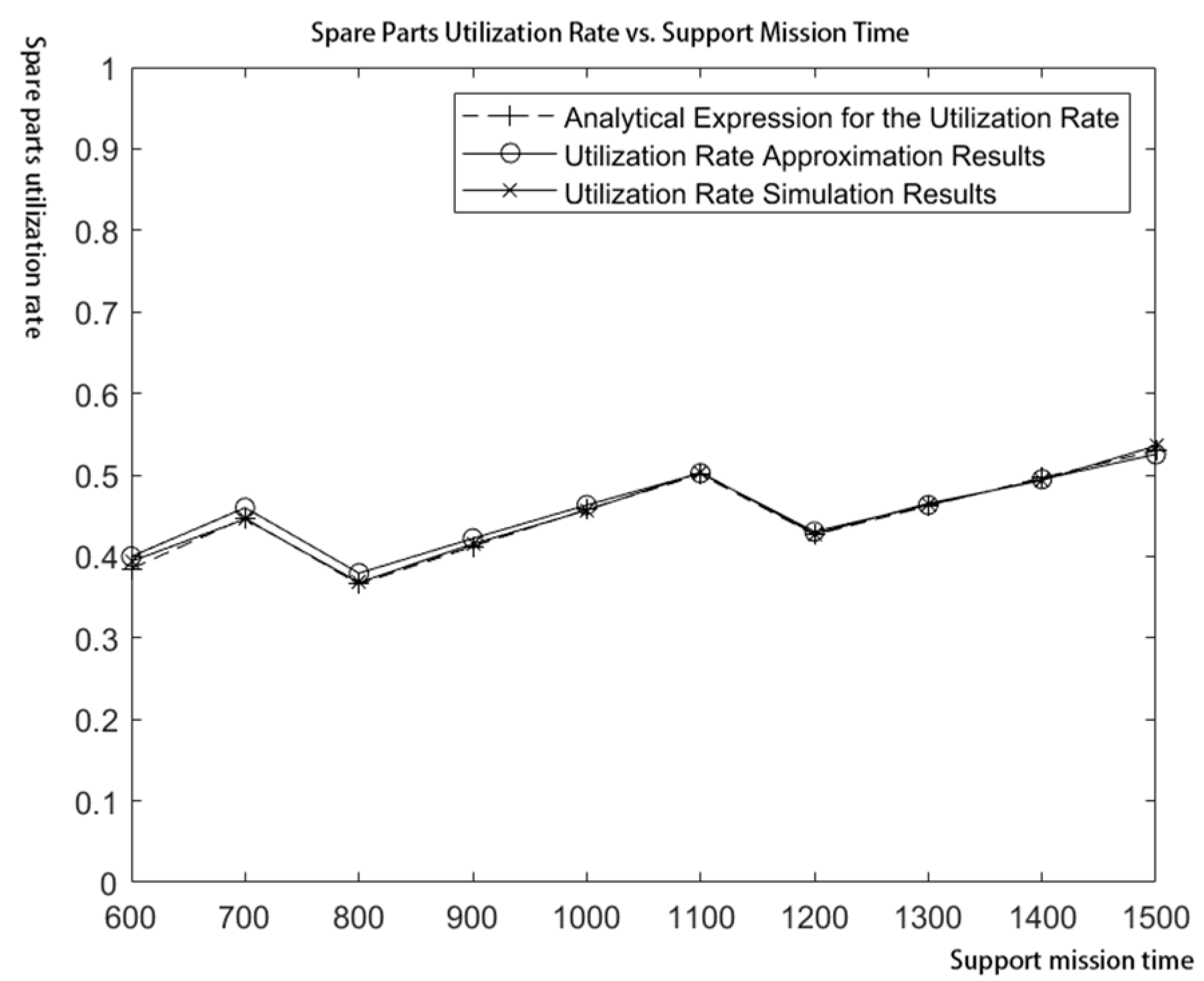
For comparison purposes, the number of spare parts obtained by the approximation algorithm was selected as the spare parts configuration scheme, and three spare parts utilization rate calculation methods were employed for computation. The utilization rate calculation results are presented in
Table 2, and the curve showing utilization rate variation with support mission time is illustrated in
Figure 1.
According to
Table 1, the errors among the three spare parts utilization rates are
,
, and
, respectively.
Given a spare parts support probability requirement
of 0.75, the method for determining the spare parts configuration scheme remains the same as when
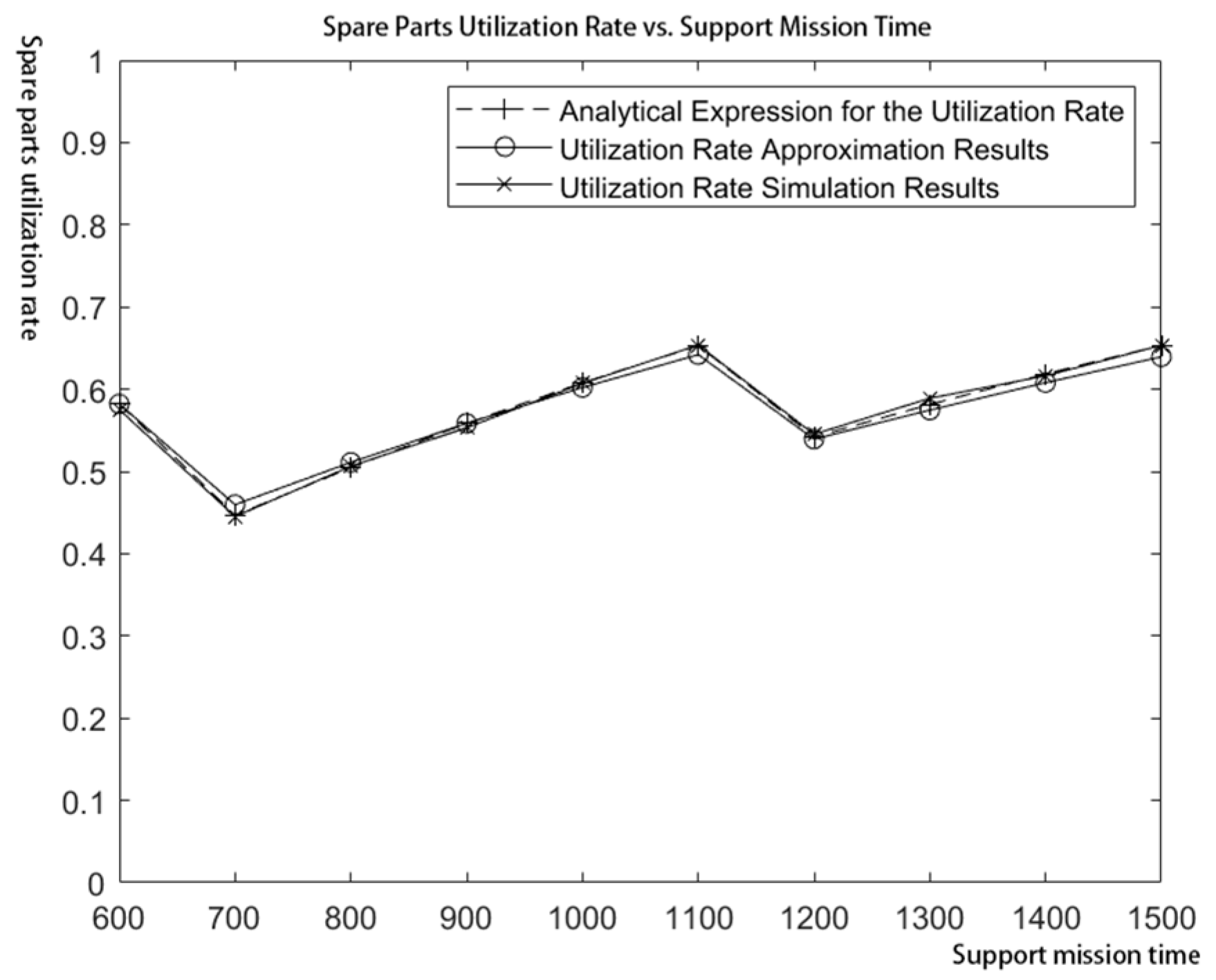
is 0.9. The calculation results of the spare parts utilization rate are shown in
Table 3, and the curve showing the variation in the utilization rate with support mission time is illustrated in
Figure 2.
As shown in
Table 3, the errors between the spare parts utilization rates are
0.0129,
0.0076, and
0.0145, respectively.
According to
Table 2 and
Table 3,
Figure 1 and
Figure 2, under given spare parts support probability requirements, the spare parts utilization rate increases in stages with the extension of support mission time. The primary reason lies in the variation in spare parts configuration quantities. When the spare parts configuration quantity remains constant, the extension of the support mission duration leads to an increase in the consumption of spare parts, thereby resulting in a concomitant rise in the utilization rate. The three calculation results of the spare parts utilization rate demonstrate high consistency, with the maximum error being 0.0148 when the support probability requirement is 0.9, and 0.0145 when the support probability requirement is 0.75, with errors at the percentage level. Therefore, it can be concluded that the analytical expression calculation method for the spare parts utilization rate is correct, and the approximate algorithm is effective in engineering practice.
3.3. Analysis of the Impact of Parameters on the Theoretical Calculation of Gamma-Type Spare Parts
The previous sections analyzed the spare parts utilization rate through analytical, approximate, and simulation calculations, discussing the convergence among these three methods. To examine the robustness of the research model, this section investigates changes in the utilization rate when parameters are varied in the theoretical calculation for Gamma-type spare parts. Using a spare part with a lifetime distribution of
as an example, and given a support mission duration
and a required spare parts support probability
of 0.9,
Table 4 presents the variation in the spare parts utilization rate when parameter
is adjusted by specific percentages while parameter
remains unchanged. Specifically, parameter
is increased or decreased by 2%, 4%, 6%, 8%, and 10% from its baseline value. The utilization rate error is defined as the maximum absolute error resulting from these variations, as shown in
Table 4.
As can be seen from
Table 4, for the given support mission times, the variation in parameter
has only a minor impact on the theoretical utilization rate, with most calculation errors remaining within 0.1. However, a support duration of 800 h exhibits relatively significant deviations caused by parameter changes. This is because the variation in the parameter leads to a change in the configured quantity, which consequently alters the utilization rate. Similarly, this phenomenon is observed in certain cases of parameter variation at support durations of 900 h, 1200 h, 1300 h, and 1400 h. Although the utilization rate error exceeds 0.1 in some instances, the majority of cases maintain an error below this threshold, demonstrating that the model is acceptable for practical engineering applications.
Similarly,
Table 5 presents the variation in the spare parts utilization rate when parameter
is adjusted by specific proportions while parameter
remains constant. Specifically, parameter
is increased or decreased by 2%, 4%, 6%, 8%, and 10% from its original value. The utilization rate error is calculated as the maximum absolute value of the errors resulting from these parameter variations, as shown in
Table 5.
As observed in
Table 5, variations in parameter
also result in only minor errors in the theoretical utilization rate for the given support mission times, with most errors remaining within 0.1. Similarly, at a support duration of 800 h, parameter variations cause relatively larger deviations, which can be attributed to the change in the configured quantity of spare parts induced by the parameter adjustment. An analogous pattern is observed under certain parameter variation scenarios at support durations of 900 h, 1200 h, 1300 h, and 1400 h. Although the utilization rate error exceeds 0.1 in some instances, the majority of cases still exhibit errors below this threshold, indicating that the model is acceptable for practical engineering applications.
3.4. Approximate Algorithm and Analysis of Weibull-Type Spare Parts Utilization Rate
In addition to Gamma-type spare parts, Weibull-type spare parts are also commonly found in marine equipment. Let the lifetime be
, and its probability density function [
17] is expressed as:
where
is referred to as the shape parameter, with
, and
is referred to as the characteristic life.
The density function expression (23) for Weibull-type spare parts cannot be used to calculate the Laplace transform expression of the density function in the same manner as the density function expression (3) for Gamma-type spare parts. Therefore, an analytical expression for the spare parts utilization rate cannot be derived as it can be for Gamma-type spare parts. For practical convenience, an approximation algorithm is employed to calculate the utilization rate of Weibull-type spare parts.
The failure rate function of Weibull-type spare parts is
, with an average life of
. By combining Equation (19) and Reference [
22], the failure rate
of the equivalent exponential-type spare parts is obtained as:
The utilization rate of Weibull-type spare parts is calculated through both simulation analysis and approximate calculation methods to verify the rationality of the approximate algorithm. The component lifetime is set as
, the support mission time is set as
, and the spare parts support probability requirement
is set to 0.9. When the support mission time takes different values, the spare parts utilization rates
and
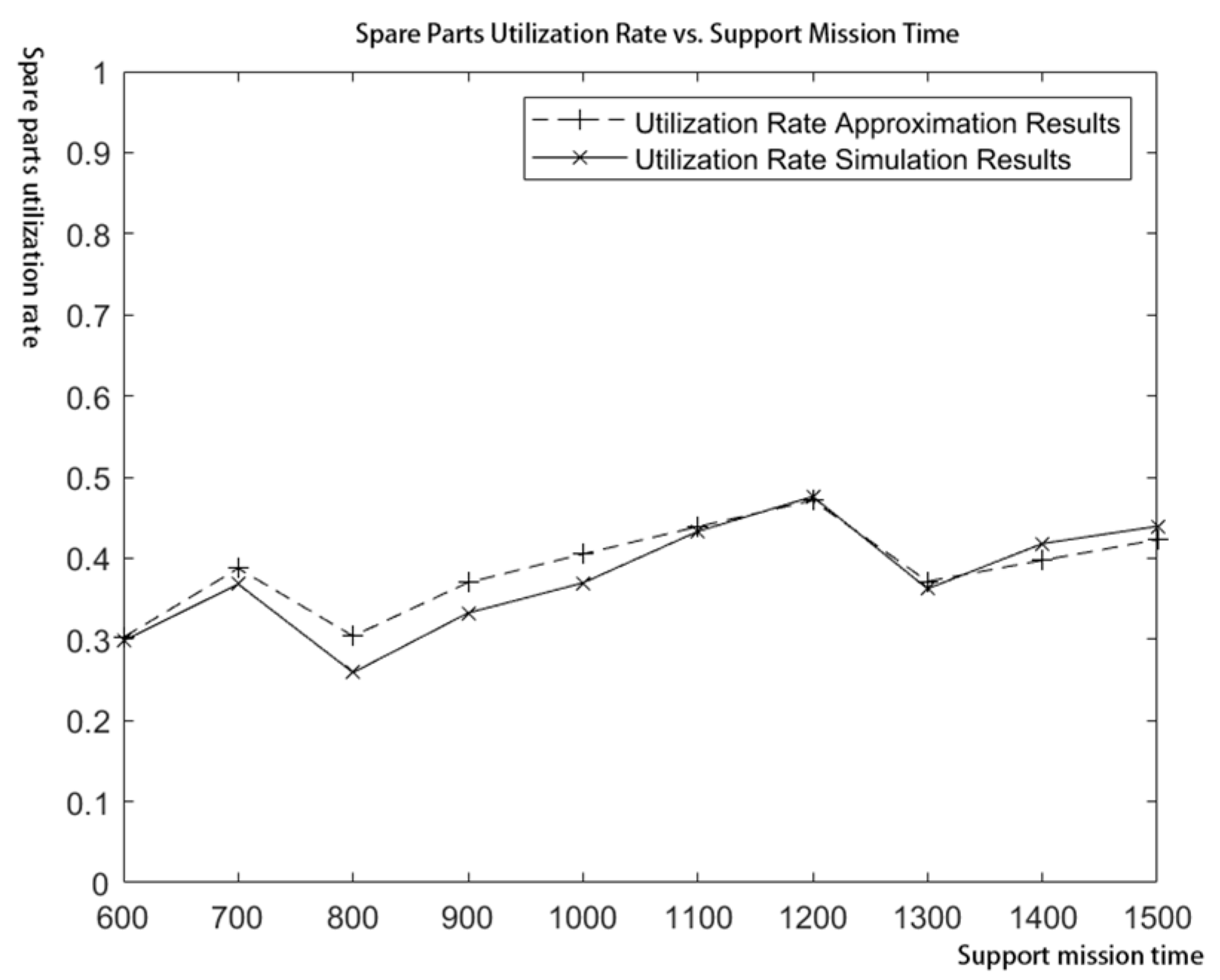
are calculated following steps similar to those used in the approximate algorithm and simulation calculation for Gamma-type spare parts. The spare parts configuration scheme is determined according to the approximate calculation method. The calculation results of the spare parts utilization rate are presented in
Table 6, and the curve showing the variation in the spare parts utilization rate with time is shown in
Figure 3.
From
Table 4, it can be observed that the error between the spare parts utilization rates is
0.045.
When the spare parts support probability requirement
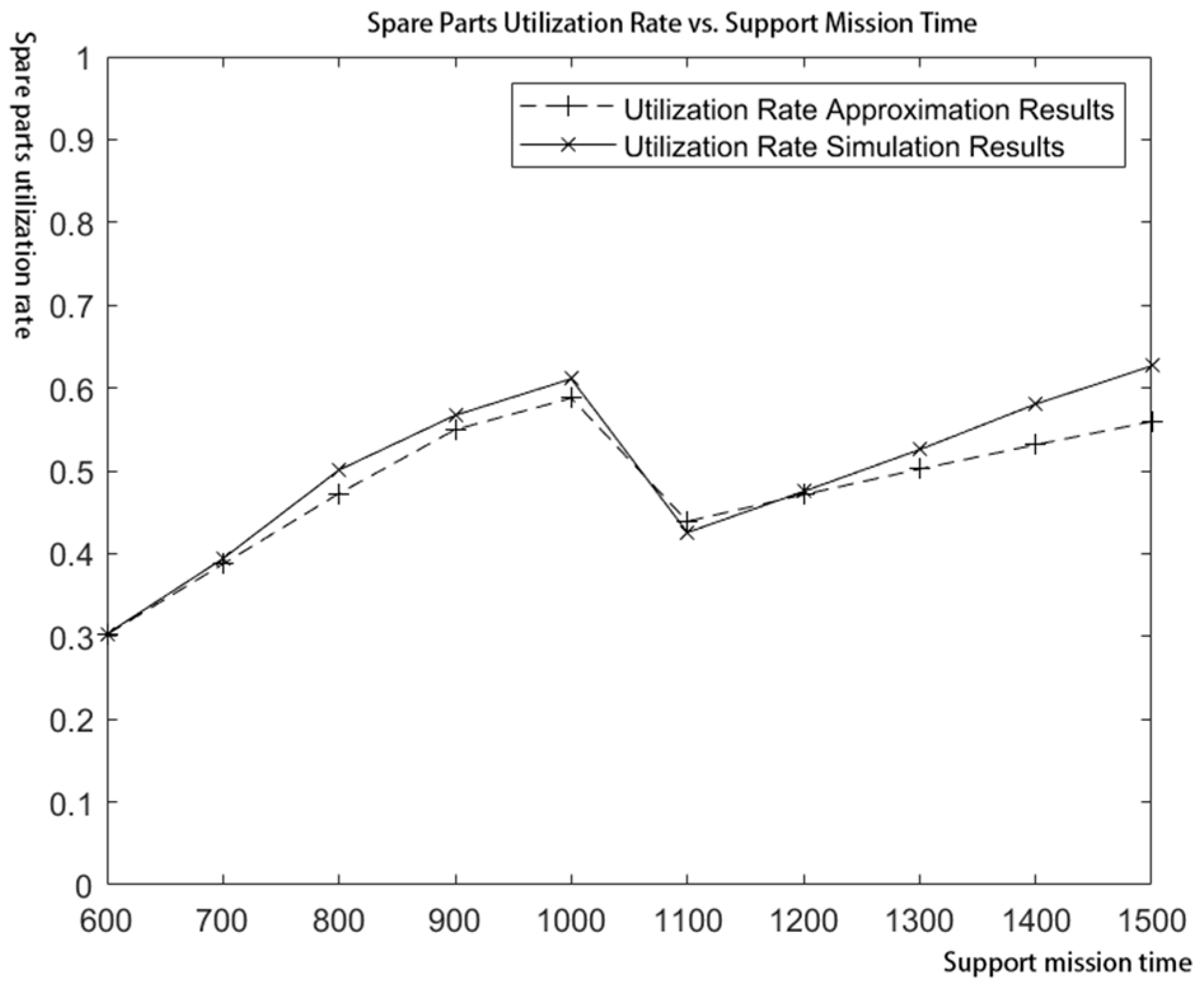
is 0.75, the calculation results of the spare parts utilization rate are shown in
Table 7, and the curve is illustrated in
Figure 4.
From
Table 5, it can be observed that the error between the spare parts utilization rates is
0.0671.
Based on
Table 4 and
Table 5, as well as
Figure 3 and
Figure 4, under the condition of a given support probability requirement, as the support mission time increases, the growth trends of the spare parts utilization rate obtained from approximate calculation and simulation results remain essentially consistent. When the spare parts support probability requirements are 0.9 and 0.75, the errors are 0.045 and 0.0671, respectively. The calculation results demonstrate high consistency, indicating that the approximate algorithm is effective.