Article

Exponentially Fitted Midpoint Scheme for a Stochastic Oscillator

1
School of Mathematics and Statistics, Shandong University of Technology, Zibo 255000, China
2
School of Mathematics and Big Data, Dezhou University, Dezhou 253023, China
*
Author to whom correspondence should be addressed.
Mathematics 2026, 14(1), 17; https://doi.org/10.3390/math14010017
Submission received: 6 November 2025 / Revised: 7 December 2025 / Accepted: 18 December 2025 / Published: 21 December 2025
(This article belongs to the Special Issue Advances in Stochastic Differential Equations and Applications)

Abstract

In this paper, we propose the exponentially fitted midpoint scheme for the stochastic oscillator. This scheme is first-order strongly convergent and it preserves symplectic. It can effectively simulate the oscillatory behavior of stochastic oscillators, and its second moment grows linearly with time. In addition, we also propose a two-parameter estimation method by analyzing the expectation and variance in the discrete scheme. Numerical experiments are given to verify effectiveness of the exponential fitting method and parameter estimation methods based on this scheme.

1. Introduction

As core modeling tools in mathematical physics, differential equation models accurately describe complex system behaviors across physics, engineering science, financial engineering, and other multidisciplinary fields [1,2]. In evaluating the advantages and disadvantages of numerical schemes, stochastic oscillators are important differential equation models [3,4,5,6,7]. Numerous studies explore the linear stochastic oscillator u ¨ ( t ) + m u ( t ) = λ W ˙ t , u ˙ t = v t , equally:
d u ( t ) = v ( t ) d t , d v ( t ) = m u ( t ) d t + λ d W ( t ) , u ( 0 ) = 1 , v ( 0 ) = 0 .
where λ and m are given real-valued parameter, and W(t) is Brownian motion. The dot means differentiation: ˙ = d d t , ¨ = d 2 d t 2 .
Proposition 1
([6]). For the Hamiltonian stochastic system given in (1), it maintains the symplectic 2-form d u ( t ) d v ( t ) . And its solution can be represented as follows:
u ( t ) = cos ( m t ) + λ m 0 t sin m ( t s ) d W ( s ) ,
v ( t ) = m s i n ( m t ) + λ 0 t cos m ( t s ) d W ( s ) .
u ( t ) exhibits oscillatory behavior. Furthermore, it also satisfies the the following condition:
E ( u ( t ) 2 + v ( t ) 2 ) = cos 2 ( m t ) + m sin 2 ( m t ) 1 m 4 m m λ 2 sin ( 2 m t ) + 1 + m 2 m λ 2 t .
The above proposition reveals that the solution phase flow of (1) is symplectic. When m = 1 , E ( u ( t ) 2 + v ( t ) 2 ) = 1 + λ 2 t ; so, the growth of its second moment exhibits a pattern of linear evolution over time. Meanwhile, its solution exhibits oscillation.
In the past decades, many numerical methods for solving stochastic differential equations have been widely studied ref. [8,9,10,11,12]. Especially, Runge–Kutta methods are widely used to solve stochastic ODEs. Based on both convergence order conditions and quadratic invariant-preserving conditions, ref. [8] constructs some stochastic Runge–Kutta schemes preserving quadratic invariants with strong and weak convergence order respectively. Ref. [9] concerns the stochastic Runge–Kutta method with high strong order for solving the Stratonovich stochastic differential equations with scalar noise. Additionally, the Euler–Maruyama method is studied in [10] for solving stochastic differential equations with G-Lévy process. Ref. [11] discusses three-stage stochastic Runge–Kutta (SRK) methods with strong order 1 for a strong solution of Stratonovich stochastic differential equations. Ref. [12] focuses on the numerical analysis of solutions to stochastic differential equations with jumps.
For the numerical methods, there is a special kind of method, namely stochastic symplectic and stochastic multi-symplectic methods [13,14,15,16,17,18]. As these references show, preserving the symplectic in a numerical way holds equal importance to the achievement of high accuracy when solving Hamiltonian systems. Ref. [13] proposes three novel stochastic multi-symplectic methods to discretize stochastic Maxwell equations in order to investigate the preservation of these properties numerically. Ref. [14] studies stochastic multi-symplectic conservation law for stochastic Hamiltonian partial differential equations, and develops a stochastic multi-symplectic method for numerically solving a kind of stochastic nonlinear Schrödinger equations. Ref. [15] discusses the symplectic integrator for the numerical solution of a kind of high order Schrödinger equation with trapped terms. Ref. [16] considers partitioned Runge–Kutta methods for Hamiltonian partial differential equations. Ref. [17] proposes the stochastic symplectic and multi-symplectic methods.
Additionally, exponentially fitted methods are also applied to solve stochastic differential equations widely (see [19,20,21,22,23,24]). In ref. [19], the exponential midpoint method is considered to have better accuracy than the traditional implicit midpoint method, which is one of the reasons why we chose this method. Ref. [20] establishes a category of embedded exponentially fitted Rosenbrock methods incorporating variable coefficients and an adaptive step size, which enables the attainment of third-order convergence. Ref. [21] presents an exponentially fitted Runge–Kutta fifth-order method with six stages. Ref. [22] studies two different exponential fitted Runge–Kutta collocation methods with fixed points and with frequency-dependent points. Ref. [23] considers the ability of numerical exponentially fitted Runge–Kutta methods to preserve certain structural properties of the flow associated with differential systems. Ref. [24] constructs exponentially fitted Runge–Kutta methods with s stages.
For stochastic differential equations, a variety of parameter estimation methods have been proposed in ref. [25,26,27,28]. Ref. [25] proposes three methods of parameter estimation based on discrete observation data for stochastic differential equations. Ref. [26] discusses the relation between maximum likelihood and quasi maximum likelihood estimation. The maximum likelihood estimation for stochastic differential equations driven by fractional Brownian motion is proposed in ref. [27]. The authors of [28] propose exponentially fitted Runge–Kutta methods that have s stages while presenting the method for estimating the parameter.
In recent years, with increasing demands for accuracy and efficiency in scientific computing, structure-preserving integrators have gained significant attention in the numerical solution of stochastic differential equations, particularly for stochastic Hamiltonian systems. Additionally, in comparison with traditional linear multistep or Runge–Kutta methods, exponentially fitted schemes can achieve superior phase and amplitude accuracy with big step sizes.
However, as the need for long-term stochastic simulation grows, many existing methods still exhibit notable limitations when applied to complex systems. Conventional stochastic integrators often overlook the geometric structure of the system, leading to non-physical phenomena such as energy drift in long-term simulations. For stochastic systems with high-frequency oscillatory behavior, traditional numerical methods typically require extremely small time steps to maintain accuracy. The exponential-fitted midpoint method effectively addresses these issues.
Accordingly, inspired by these studies, this paper intends to apply the exponentially fitted midpoint method to stochastic oscillators, investigating its numerical solution effect, strong convergence, and parameter estimation performance. Finally, several numerical experiments are presented to support our theoretical findings. This constitutes the core research motivation of this work.
The remainder of this paper is organized as follows. In Section 2, we propose the exponentially fitted midpoint scheme for stochastic oscillators, and analyze its convergence order. In Section 3, we demonstrate certain properties of this scheme. In Section 4, we present the parameter estimation of stochastic oscillator based on the numerical discrete scheme. In Section 5, numerical simulations are presented, illustrating the effectiveness of the proposed exponentially fitted midpoint scheme. Some conclusions and prospects are given in Section 6 to end this paper.

2. Exponentially Fitted Midpoint Scheme

When the one-stage exponentially fitted Runge–Kutta scheme featuring a node is applied to the deterministic first-order system y = f ( x , y ) , it yields the following:
y 1 = γ 0 y 0 + h b 1 f x 0 + c 1 h , Y 1 Y 1 = γ 1 y 0 + h a 11 f x 0 + c 1 h , Y 1
Here c 1 = 1 2 , h is the fixed step size. Enabling the scheme to be exact with respect to the linear fitting trigonometric space formed by 1 , e x p ± i ω x and symplectic [21], we obtain an exponentially fitted midpoint scheme with γ 0 = 1 , γ 1 = 1 cos 1 2 v , v = ω h , a 11 = tan 1 2 v v , b 1 = sin ( v ) v cos ( c 1 v ) ; the frequency parameter ω is a fitting parameter, equivalently:
y 1 = y 0 + 2 sin 1 2 ω h ω f x 0 + 1 2 h , y 0 + y 1 2 cos 1 2 ω h .
By using the Taylor expansion formula, the local truncation error of the exponential midpoint method can be obtained as 1 24 h 3 y ( 3 ) 3 f y y ( 2 ) + ω 2 y 3 f y y . Here y ( 2 ) = d 2 y d x 2 , y ( 3 ) = d 3 y d x 3 , f y = f y . Hence, it follows that the scheme converges with a convergence order of 2. If ω is chosen such that y ( 3 ) 3 f y y ( 2 ) + ω 2 y 3 f y y = 0 , then the scheme will be characterized by convergence of order 3 [18]. When partitioning with equidistant points, we apply exponentially fitted midpoint (denoted by EFM) scheme to (1) and obtain the following formula:
u k + 1 = u k + sin 1 2 ω h w v k + 1 + v k cos 1 2 ω h ,
v k + 1 = v k m sin 1 2 ω h ω u k + 1 + u k cos 1 2 ω h + λ 2 sin 1 2 ω h ω h Δ W k ,
where h is the temporal step-size and ω is an indeterminate variable. Meanwhile, the numerical values corresponding to u t k and v t k are represented by u k and v k , respectively.
Theorem 1.
For the linear stochastic system (1), the EFM scheme (5a,b) is convergent with root mean-square order 1.
Proof of Theorem 1. 
With respect to the linear stochastic system (1), the Euler–Maruyama scheme is convergent with root mean-square order 1, and its corresponding formula reads
u ¯ k + 1 = u ¯ k + h v ¯ k ,
v ¯ k + 1 = v ¯ k m h u ¯ k + λ Δ W k .
We suppose u ¯ k = u k , v ¯ k = v k and take into account the local truncation error of the two schemes (5a,b) and (6a,b). From the EFM scheme (5a,b), we get the following:
u k + u k + 1 = 2 u k + a b v k + v k + 1 ,
v k + v k + 1 = 2 v k m a b u k + u k + 1 + 2 λ a h Δ W k .
where a = sin 1 2 ω h ω , b = cos 1 2 ω h . Then, substitute (7a) and (7b) into (5b) and (5a) respectively. We can obtain the following:
1 + m a 2 b 2 u k + 1 = 1 m a 2 b 2 u k + 2 a b v k + 2 a 2 λ h b Δ W k ,
1 + m a 2 b 2 v k + 1 = 1 m a 2 b 2 v k 2 m a b u k + 2 λ a h Δ W k .
We can derive:
u k + 1 = b 2 m a 2 + b 2 1 m a 2 b 2 u k + 2 a b v k + 2 a 2 b λ h m a 2 + b 2 Δ W k ,
v k + 1 = b 2 m a 2 + b 2 1 m a 2 b 2 v k 2 m a b u k + 2 a b 2 λ h m a 2 + b 2 Δ W k .
Then from (6a,b) and (9a,b), we obtain the following errors:
u k + 1 u ¯ k + 1 = b 2 m a 2 m a 2 + b 2 1 u k + 2 a b m a 2 + b 2 h v k + 2 a 2 b λ h m a 2 + b 2 Δ W k ,
v k + 1 v ¯ k + 1 = b 2 m a 2 m a 2 + b 2 1 v k 2 m a b m a 2 + b 2 h m u k + λ 2 a b 2 h m a 2 + b 2 1 Δ W k .
Now, from the assumption that X k = u k , v k T and X ¯ k = u ¯ k , v ¯ k T , with (10a,b), we can derive:
E X k + 1 X ¯ k + 1 2 = b 2 m a 2 m a 2 + b 2 1 2 E u k 2 + E v k 2 + 2 a b m a 2 + b 2 h 2 m 2 E u k 2 + E v k 2 + 2 ( 1 m ) b 2 m a 2 m a 2 + b 2 1 2 a b m a 2 + b 2 h E u k E v k ,
E X k + 1 X ¯ k + 1 2 = E X k + 1 X ¯ k + 1 2 + λ 2 h 4 a 4 b 2 h 2 a 2 + b 2 2 + 2 a b 2 h a 2 + b 2 1 2 .
We perform Taylor expansion of parameter a and b (defined by ω and h) with respect to the step size h, ω is a a given constant, and express their local truncation error as a power series of h. The following result can be obtained:
a = h 2 ω 2 48 h 3 + O ( h 5 ) , b = 1 ω 2 h 2 8 + ω 4 h 4 16 × 24 + O ( h 6 ) ,
b 2 m a 2 m a 2 + b 2 1 = m 2 h 2 + m 4 m 2 ω 2 3 h 4 + O ( h 6 ) ,
2 a b m a 2 + b 2 h = m 4 + ω 2 12 h 3 + O ( h 5 ) ,
2 a b 2 h ( m a 2 + b 2 ) 1 = m 4 ω 2 24 h 2 + O ( h 4 ) .
From (11)–(16), we can get the following:
E X k + 1 X ¯ k + 1 2 = m 2 4 h 4 m 2 4 m 2 ω 2 3 h 6 + O h 8 E u k 2 + E v k 2 + m 4 + ω 2 12 2 h 6 + O h 8 m 2 E u k 2 + E v k 2 + m m 1 m 4 + ω 2 12 2 h 5 + O h 7 E u k E v k ,
E X k + 1 X ¯ k + 1 2 = E X k + 1 X ¯ k + 1 2 + λ 2 h 1 4 h 2 + ω 2 48 m 8 h 4 + ω 2 24 m 4 2 h 4 + O h 6 = λ 2 h 3 4 + m 2 4 h 4 E u k 2 + E v k 2 + O h 5 .
Then, (17) and (18) reveal that E X k + 1 X ¯ k + 1 2 = O h 3 . So, the EFM scheme (5a,b) converges to 1 in the mean-square sense. □

3. Numerical Analysis of the EFM Scheme

Theorem 2.
The EFM scheme is capable of maintaining the discrete symplectic 2-form for the system (1).
Proof of Theorem 2. 
From (7a,b), from direct computation of d u k d v k , we can derive the following:
d u k + 1 d v k + 1 = b 4 m a 2 + b 2 2 1 m a 2 b 2 d u k + 2 a b d v k 1 m a 2 b 2 d v k 2 m a b d u k .
Since d u k d u k = d v k d v k = 0 , d u k d v k = d v k d u k , the equality above implies that
d u k + 1 d v k + 1 = b 4 m a 2 + b 2 2 1 m a 2 b 2 2 d u k d v k 4 a 2 m b 2 d u k d u k = b 4 m a 2 + b 2 2 1 + m a 2 b 2 2 d u k d v k = d u k d v k .
From these calculations, we can conclude that d u k + 1 d v k + 1 = d u k d v k . So, the EFM scheme is symplectic. □
Theorem 3.
To the system (1), its numerical solution u k oscillates infinitely many times.
Proof of Theorem 3. 
From (7a,b), we can get the following:
u k = b 2 m a 2 + b 2 1 m a 2 b 2 u k 1 + 2 a b v k 1 + 2 a 2 b λ h m a 2 + b 2 Δ W k 1 ,
v k = b 2 m a 2 + b 2 1 m a 2 b 2 v k 1 2 m a b u k 1 + 2 a b 2 λ h m a 2 + b 2 Δ W k 1 .
The Formula (19) yields the following:
v k 1 = m a 2 + b 2 2 a b u k b 2 m a 2 2 a b u k 1 a λ h Δ W k 1 .
Therefore, with (19) and (21), we infer the following:
v k = b 2 m a 2 2 a b u k m a 2 + b 2 2 a b u k 1 + a λ h Δ W k 1 .
Thus, with (22) and (7a,b), we derive the following:
u k + 1 = p u k u k 1 + s k , p = 2 b 2 m a 2 m a 2 + b 2 , r k = 2 a 2 b λ h m a 2 + b 2 Δ W k + Δ W k 1 .
Employing the notations where Y k = u k + 1 , u k T , r ¯ k = r k , 0 T and
S = p 1 1 0 ,
we can derive the following:
Y k = S Y k 1 + r ¯ k = S k Y 0 + S k 1 r ¯ 1 + S k 2 r ¯ 2 + + S r ¯ k 1 + r ¯ k .
For any positive integer n, denote the following:
S n = a n b n c n d n .
From (25), we can get the following:
u k + 1 = b k + a k u 1 + a k 1 r 1 + + a 1 r k 1 + r k = b k + 1 2 a k p + φ k ,
φ k = 2 a 2 b a k λ h m a 2 + b 2 Δ W 0 + j = 1 k a k j r j .
where a 0 = 1 . From (24), the eigenvalues μ of (24) satisfy that μ 2 p μ + 1 = 0 . Regarding the expression of p, the eigenvalues are a set of conjugate complex numbers with a unit modulus value. Suppose that the eigenvalues of S are μ 1 = e i θ , μ 2 = e i θ . From the equation for the eigenvalues corresponding to (24), we can conclude that the respective eigenvectors are μ 1 , 1 T , μ 2 , 1 T and
S n = μ 1 μ 2 1 1 μ 1 n 0 0 μ 2 n μ 1 μ 2 1 1 1 = 1 μ 1 μ 2 μ 1 n + 1 μ 2 n + 1 μ 2 n μ 1 n μ 1 n μ 2 n μ 2 n 1 μ 1 n 1 .
Therefore,
b k + 1 2 a k p = 1 μ 1 μ 2 μ 2 k μ 1 k + p 2 ( μ 1 k + 1 μ 2 k + 1 ) = 1 sin θ sin k θ + p 2 sin ( k + 1 ) θ .
From (28), b k + 1 2 a k p is bounded. For φ k , from (23), we can deduce the following:
φ k = 2 a 2 b a k λ h ( m a 2 + b 2 ) Δ W 0 + j = 1 k 2 a 2 b λ h m a 2 + b 2 a k j [ Δ W j + Δ W j 1 ] = 2 a 2 b a k λ h ( m a 2 + b 2 ) Δ W 0 + j = 0 k 1 2 a 2 b λ h m a 2 + b 2 a j Δ W k j + j = 1 k 2 a 2 b a k λ h ( m a 2 + b 2 ) a j 1 Δ W k j = δ 0 Δ W k + j = 0 k δ j Δ W k j .
where
δ 0 = 2 a 2 b λ h ( m a 2 + b 2 ) , δ j = 2 a 2 b λ h ( m a 2 + b 2 ) a j + a j 1 = 2 a 2 b λ h ( m a 2 + b 2 ) 1 μ 1 μ 2 μ 1 j + 1 μ 2 j + 1 + μ 1 j μ 2 j = 2 a 2 b λ h ( m a 2 + b 2 ) sin θ sin j + 1 θ + sin ( j θ ) = 4 a 2 b λ h ( m a 2 + b 2 ) sin θ sin j + 1 2 θ cos θ 2 , j = 1 , , k .
Therefore, φ k N 0 , h j = 0 k δ j 2 . From (11) and (30), δ j is bounded. Clearly, lim j sin j + 1 2 θ 0 . Then, lim j δ j 0 . Thus,
lim k h j = 0 k δ j 2 = .
Based on the Law of the Iterated Logarithm [4], when k is sufficiently large and for arbitrary ε within the interval ε 0 , 1 , φ k will infinitely often oscillate beyond the bound
( 1 ε ) 2 h j = 0 k δ j 2 ln ln h j = 0 k δ j 2
almost certainly. From (26) and (28), it can be observed that u k exhibits a similar behavior. The analysis of this theorem is similar to the corresponding analysis in [6]. □
Theorem 4.
For the system (1) with m = 1 , its discrete second moment E u k 2 + v k 2 grows linearly with time approximately.
Proof of Theorem 4. 
From the EFM scheme (7a,b), we derive the following:
u k + 1 2 + v k + 1 2 = b 2 m a 2 2 m a 2 + b 2 2 + 4 m 2 a 2 b 2 m a 2 + b 2 2 u k 2 + 4 a 2 b 2 m a 2 + b 2 2 + b 2 m a 2 2 m a 2 + b 2 2 v k 2 + 4 a b b 2 m a 2 m a 2 + b 2 2 4 m a b b 2 m a 2 m a 2 + b 2 2 u k v k + b 2 m a 2 4 a b 4 m a b m a 2 + b 2 2 u k v k + 4 a 4 b 2 λ 2 + 4 a 2 b 4 λ 2 h 2 m a 2 + b 2 2 Δ W k 2 + 4 a 2 b λ b 2 m a 2 2 m b 2 h m a 2 + b 2 2 u k Δ W k + 4 a b 2 λ 2 a 2 + b 2 m a 2 h m a 2 + b 2 2 v k Δ W k .
For the special case, m = 1 , we can obtain the following:
u k + 1 2 + v k + 1 2 = u k 2 + v k 2 + 4 a 2 b 2 λ 2 a 2 + b 2 h 2 Δ W k 2 + 4 a b λ a 2 + b 2 h b v k a u k Δ W k .
Therefore, we get the following:
E u k + 1 2 + v k + 1 2 = E u k 2 + v k 2 + λ 2 h 4 a 2 b 2 a 2 + b 2 h 2 .
Taylor expansion (12) yields the following:
4 a 2 b 2 a 2 + b 2 h 2 = 1 ω 2 + 3 12 h 2 + O h 4 , E u k + 1 2 + v k + 1 2 = E u k 2 + v k 2 + λ 2 h 1 ω 2 + 3 12 h 2 + O h 4 .
Considering the initial condition corresponding to system (1), this implies the following:
E u k 2 + v k 2 = 1 + λ 2 t k ω 2 + 3 12 λ 2 t k h 2 + O t k h 4 .
It should be noted that from Equation (32) for the deterministic system (1) with λ = 0 , the numerical solutions satisfy the relation u k 2 + v k 2 = 1 . This implies that the phase trajectory corresponding to the numerical solutions is a circle of radius 1.

4. Parameter Estimation Methods Based on Numerical Solutions

In the present section, we present parameter estimations derived from two types of numerical discretizations of stochastic differential equations (SDEs) with unknown parameters.

4.1. Method Using the Euler–Maruyama Scheme

Take into account the SDE in (1), and let V i be denoted as the numerical solution at time t i . Given V i , with reference to (6a,b), we can conclude that the distribution of the increment is as follows:
V i + 1 V i N m ^ u i h , λ ^ 2 h .
Suppose that we have n observations V ω 1 0 , t 1 , V ω 2 0 , t 1 , …, V ω n 0 , t 1 , each emerges after evolving for a time period h, with the given initial value V 0 as its starting point. Then, according to (35), we can get the following:
1 n j = 1 n V ω j 0 , t 1 = m 1 ^ u 0 h + v 0
and
1 n 1 j = 1 n V ω j 0 , t 1 + m 1 ^ u 0 h 2 = λ ^ 1 2 h ,
from which we can obtain an estimate m ^ 1 and λ ^ 1 .
Then, we fix an arbitrary V ω k 0 , t 1 = : V 1 k 1 , , n , and observe other n values V ω 1 1 , t 2 , V ω 2 1 , t 2 , …, V ω n 1 , t 2 , each resulting from the evolving time h from the given V ω k 0 , t 1 = V 1 . Let
1 n j = 1 n V ω j 1 , t 2 = m 2 ^ u 1 h + v 1
and
1 n 1 j = 1 n V ω j 1 , t 2 + m 2 ^ u 1 h 2 = λ 2 ^ 2 h .
We obtain another estimate m ^ 2 and λ ^ 2 .
Similarly, we can successively obtain a sequence of estimates m ^ 3 , , m ^ N and λ ^ 3 , , λ ^ N . Next, we employ the average value of m ^ i , i = 1 , , N , to estimate the parameter m ^ and use the average of λ ^ i , i = 1 , , N , to estimate the parameter λ ^ . That is,
m ^ = 1 N i = 1 N m ^ i , λ ^ = 1 N i = 1 N λ ^ i .

4.2. Method Using the EFM Scheme

By applying the EFM scheme to Equation (1), with (5a,b), given V i , it is known that the distribution corresponding to the increment is as follows:
V i + 1 V i N m ˜ sin θ ω cos θ u i + u i + 1 , 4 λ ˜ 2 sin 2 θ ω 2 h .
Presently, we apply the same observation as detailed in Section 4.1. Based on (37), for the initial time interval [ t 0 , t 1 ] , we can let
1 n j = 1 n V ω j 0 , t 1 = m ˜ sin θ ω cos θ u i + u i + 1
and
1 n 1 j = 1 n V ω j 0 , t 1 + m ˜ sin θ ω cos θ u i + u i + 1 2 = 4 λ ˜ 2 sin 2 θ ω 2 h ,
from which we can obtain an estimate m ˜ 1 and λ ˜ 1 . Implementing the same process for the time intervals [ t 1 , t 2 ] , …, [ t N 1 , t N ] , we obtain a sequence of estimates m ˜ 2 , …, m ˜ N and λ ˜ 2 , …, λ ˜ N . We estimate m ˜ and λ ˜ as follows:
m ˜ = 1 N i = 1 N m ˜ i , λ ˜ = 1 N i = 1 N λ ˜ i .
Next we will make a comparison between the corresponding results of the two numerical discretization approaches based on Equation (1), respectively, numerical tests as follows.

5. Numerical Experiments

This section shows the oscillation behavior of the stochastic system (1) and the numerical results of its parameter estimation by using the EFM and Euler–Maruyama method. Theorem (1) clearly states that in the stochastic case, regardless of how ω is chosen, it fails to affect the convergence order of the EFM scheme.

5.1. The Comparison of the Numerical Solutions

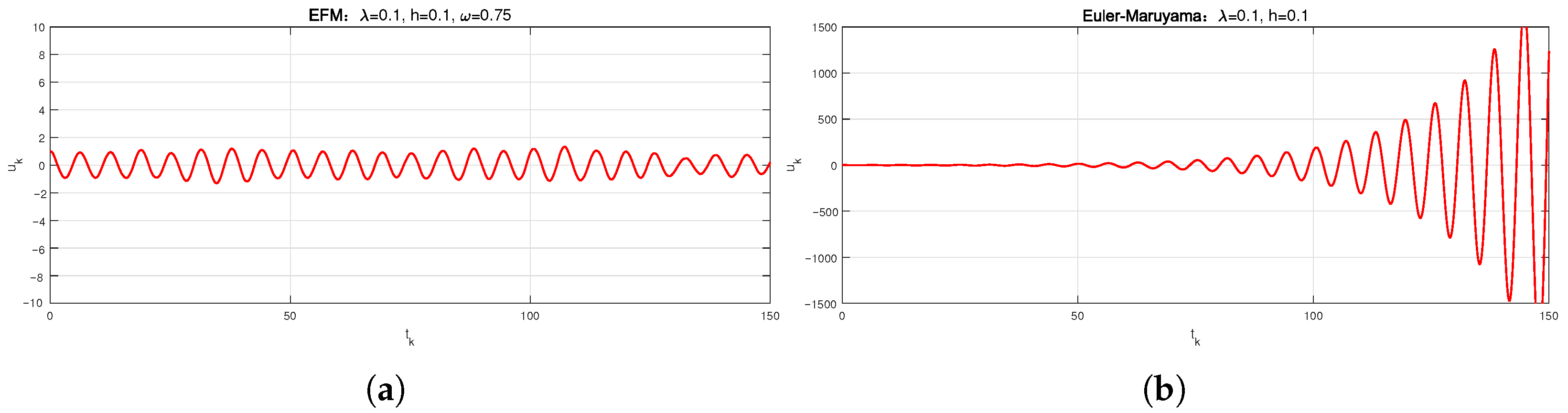
Let us examine the oscillatory behavior of the numerical solution u t over time under these two discrete schemes. We first apply T = 150 , λ = 0.1 , h = 0.1 , ω = 0.75 , m = 1 .
In Figure 1, a comparison of the oscillatory behaviors of the numerical solution obtained with two discrete schemes is shown, which reveals that the EFM can better simulate its oscillatory behavior within a finite time period.
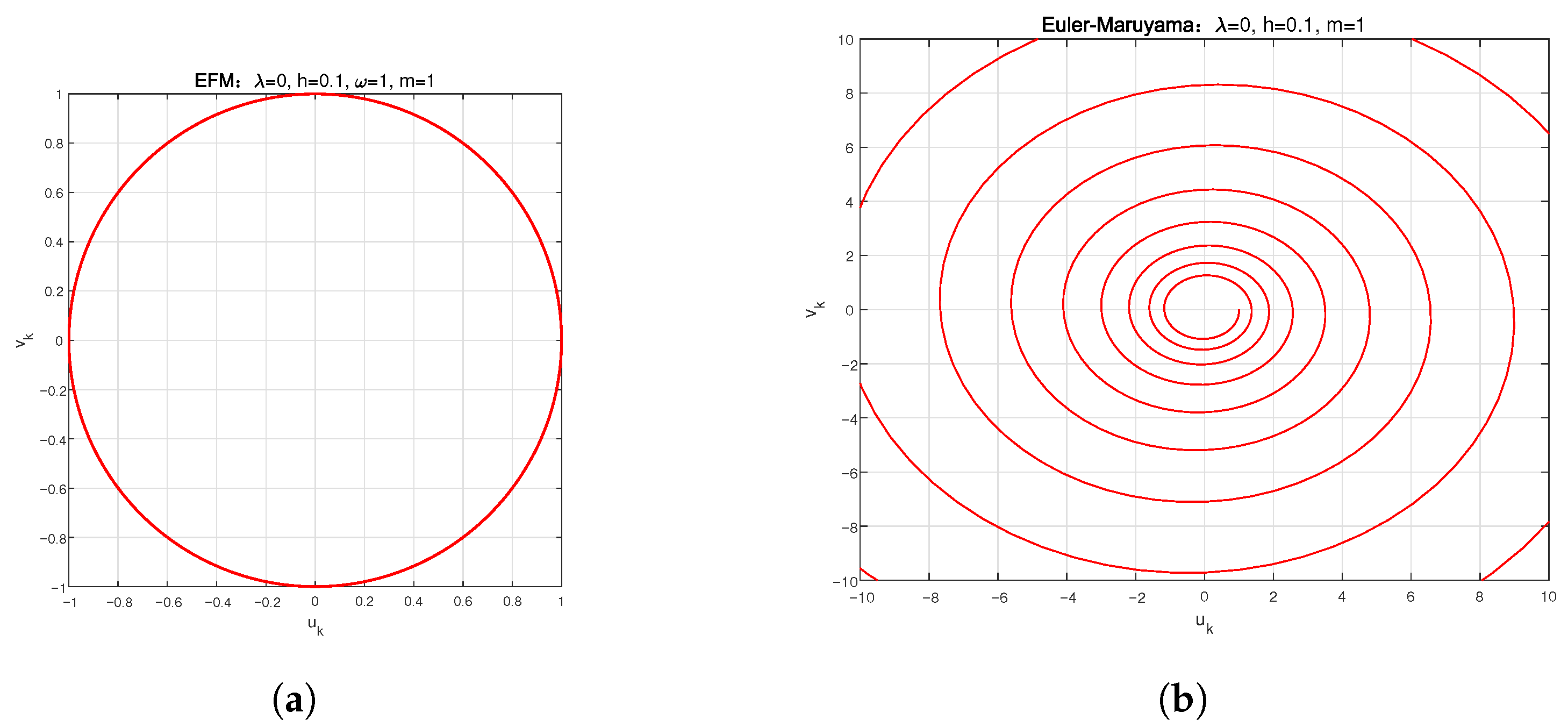
In Figure 2, we plot the phase trajectory associated with the numerical solutions; when the time step h = 0.1 , m = 1 , λ = 0 , its phase trajectory is a closed circle, satisfying u 2 ( t ) + v 2 ( t ) = 1 ; so, the EFM scheme can preserve the conservation property of the system. In contrast, the Euler–Maruyama method exhibits a divergent spiral-shaped phase trajectory, thus failing to satisfy the conservation property of the system.
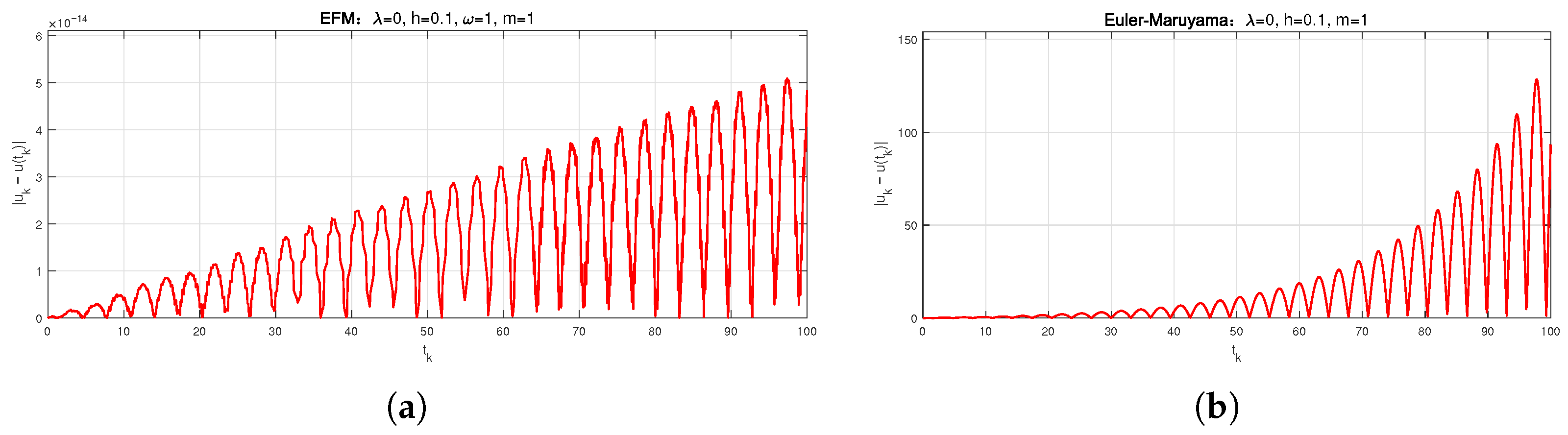
In Figure 3, under long-term calculations, the EFM scheme has a smaller error than the Euler–Maruyama scheme for deterministic cases with λ = 0 .
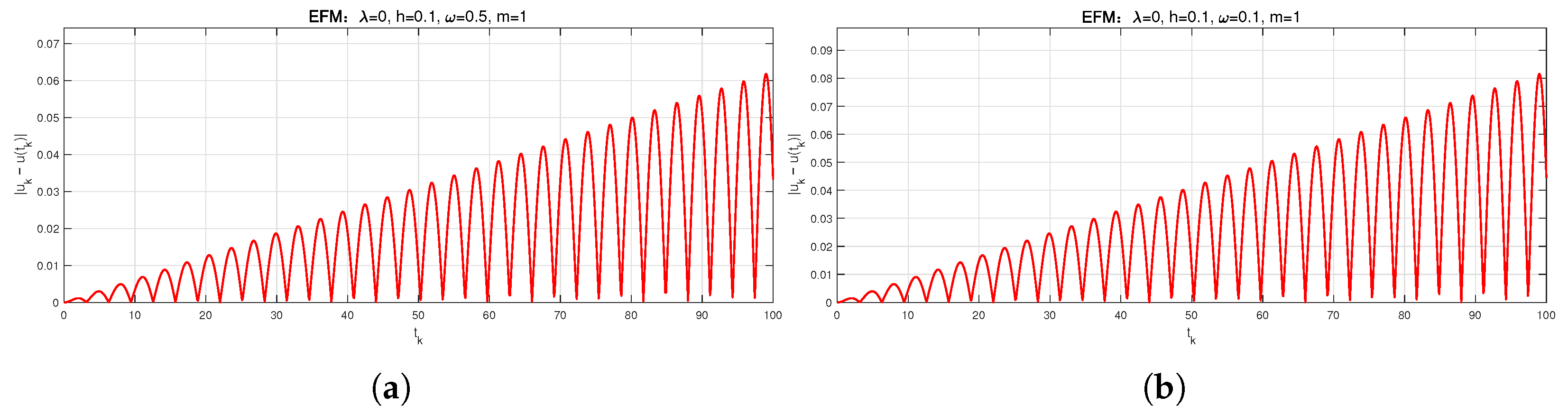
A comparison of Figure 3a and Figure 4a reveals that, for the deterministic case with λ = 0 , variations in ω have a significant impact on the error of the numerical solution under the EFM scheme.
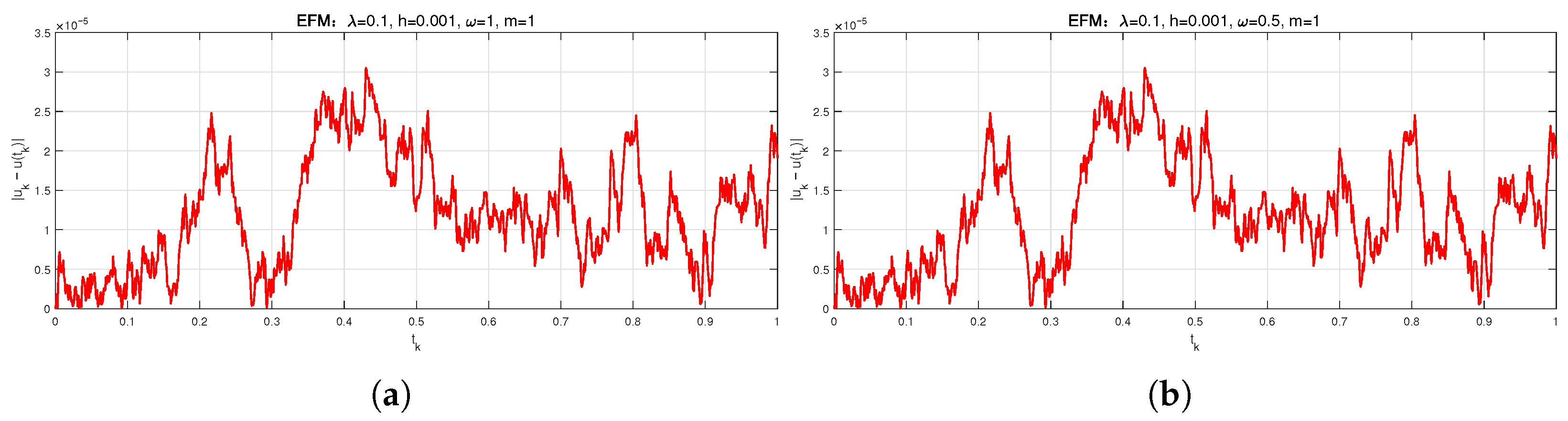
In Figure 5, for the stochastic case with λ 0 , variations in ω have a little impact on the error of the numerical solution under the EFM scheme.
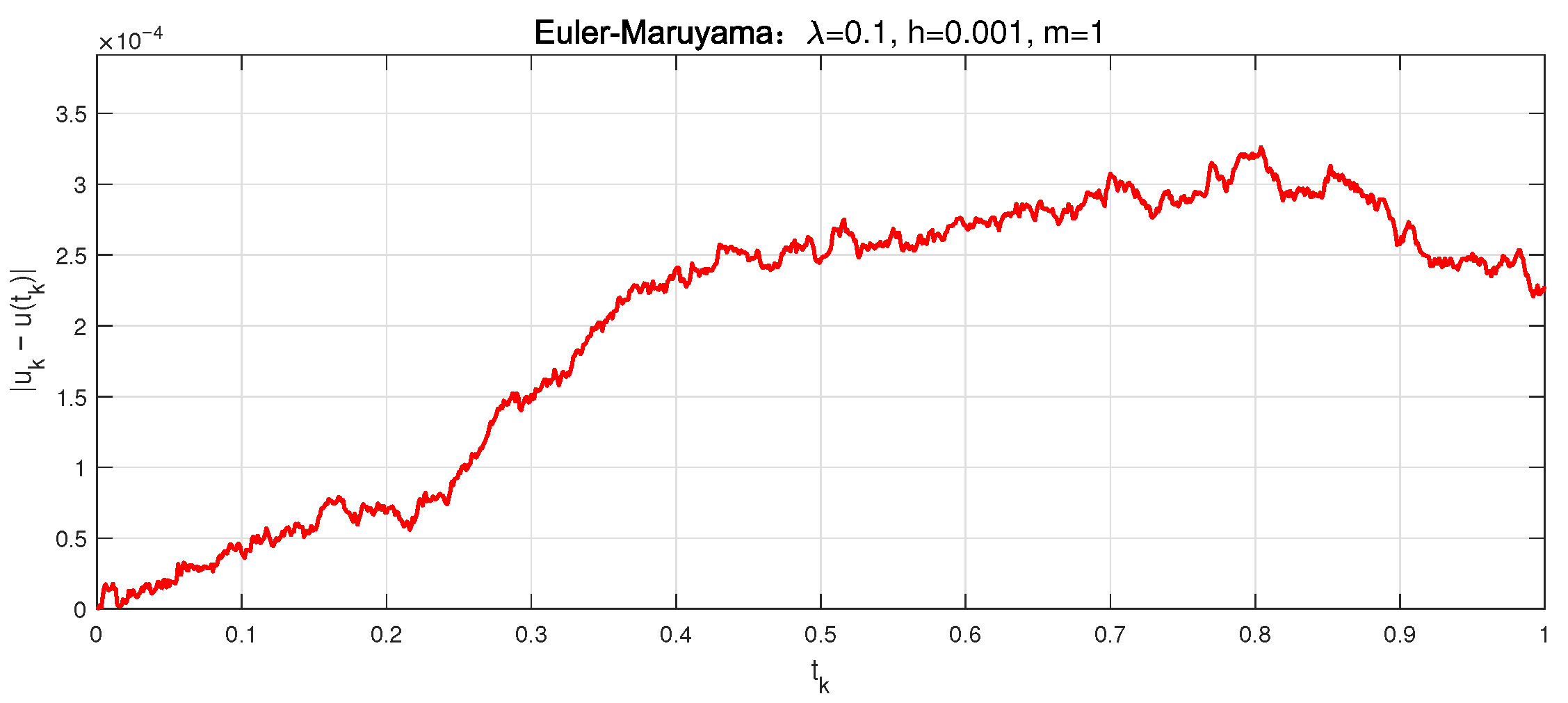
By comparing Figure 5a with Figure 6, the result shows that in stochastic case with λ 0 , the EFM scheme has fewer errors than the Euler–Maruyama scheme.
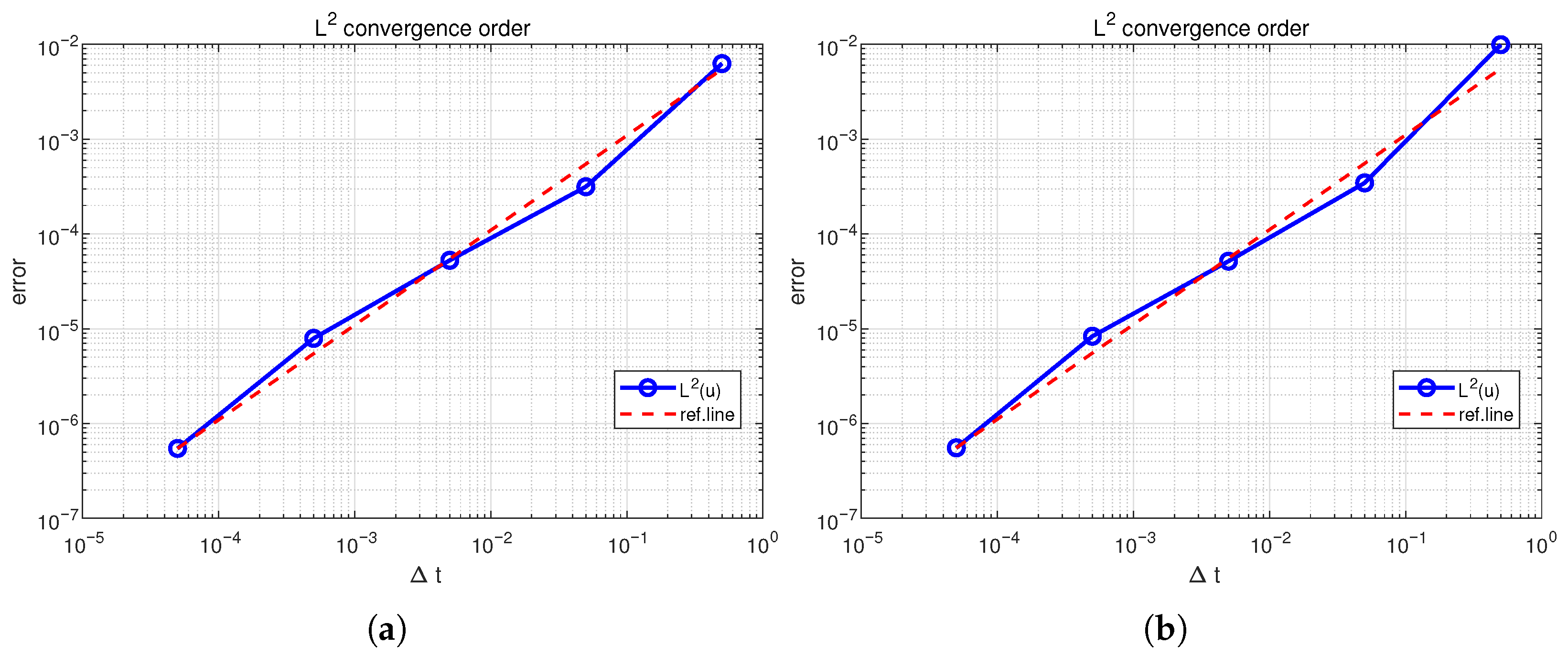
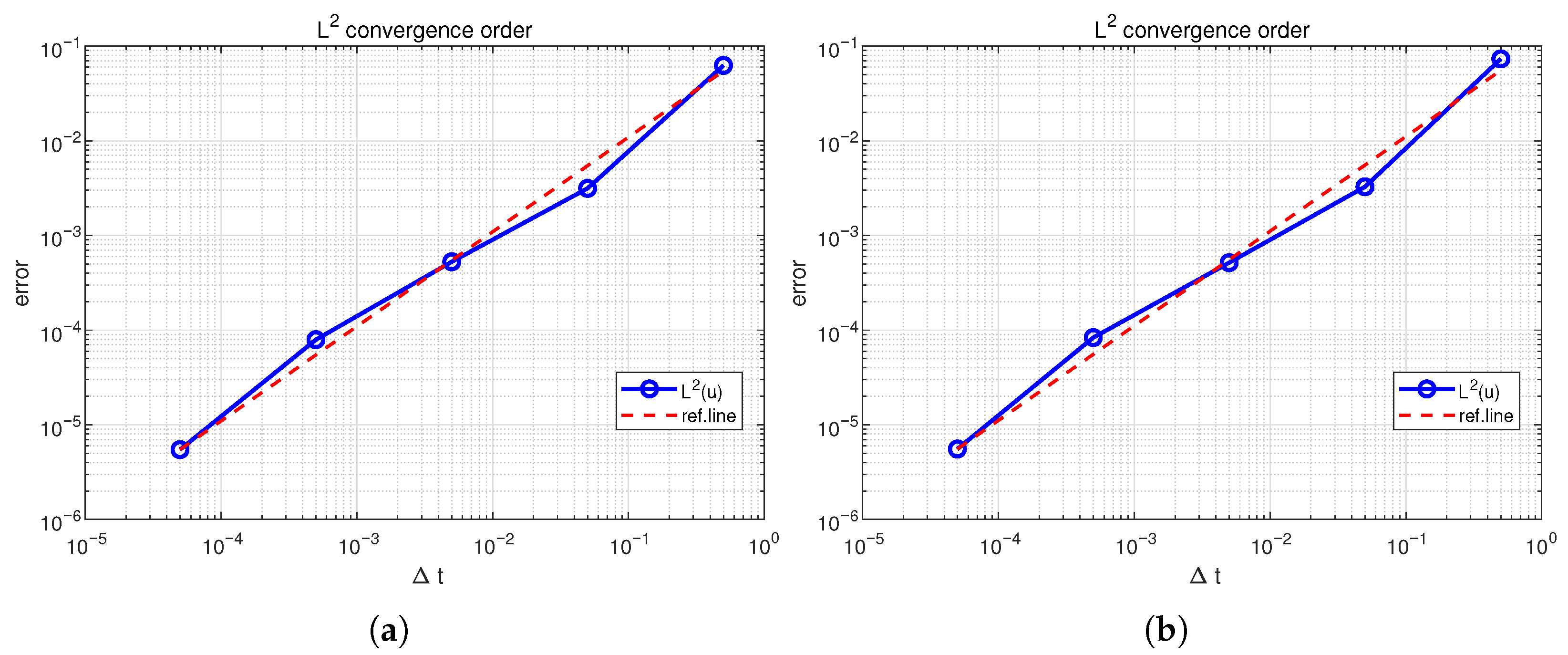
As shown in Figure 7 and Figure 8, the relationship between errors and decreasing step sizes is presented in a log-log scale. With a reference line of slope 1, the simulation results indicate that the EFM method achieves a convergence rate of order approximately 1, and the order of convergence is independent of λ and m.
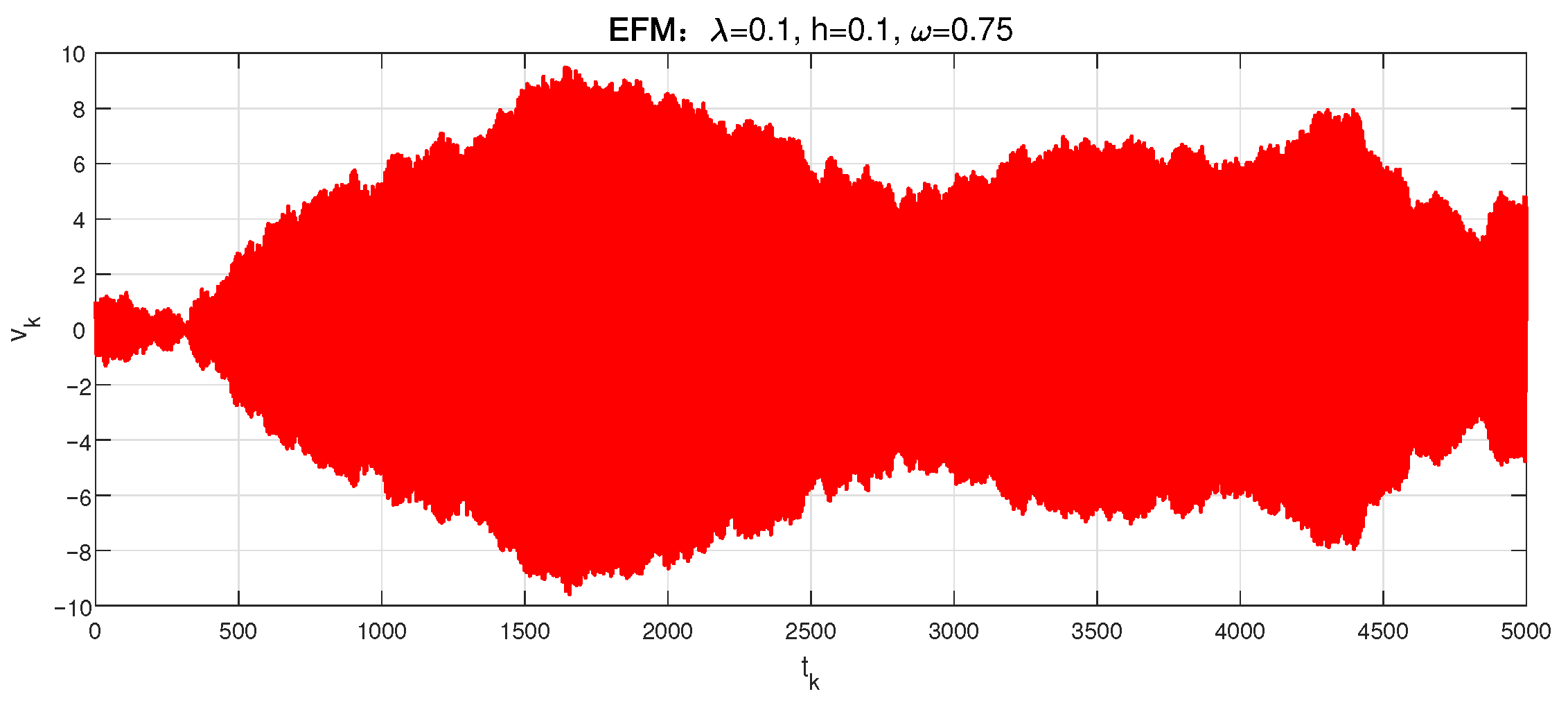
In Figure 9, we depict the temporal evolution trajectory of v ( t ) for a sample of the numerical solution with t ( 0 , 5000 ] . This verifies that the simulation of long-term oscillations remains stable.
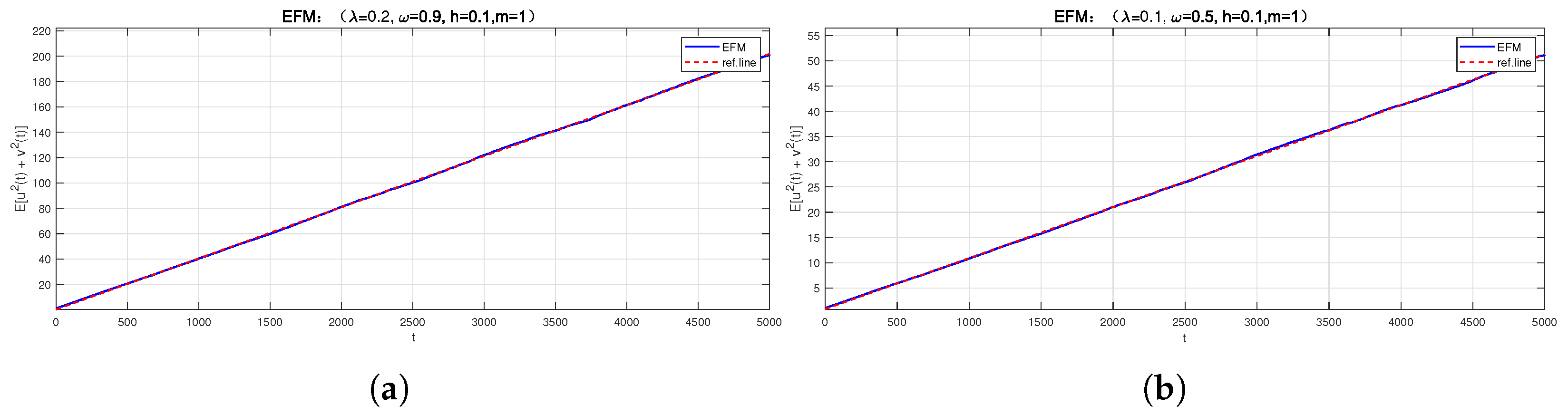
In Figure 10, we present the trajectory of temporal evolution for u 2 ( t ) + v 2 ( t ) , with respect to the sample average of the numerical solutions, for t ( 0 , 5000 ] . The reference line shows the numerical second moment linearly with time approximately. This linear growth indicates that white noise continuously injects energy into the harmonic oscillator, resulting in a steady accumulation of the system’s average energy over time. Although randomness induces instantaneous fluctuations in energy, it does not alter the asymptotic trend of deterministic growth in its expectation.

5.2. Parameter Estimation Based on the Numerical Solutions

In order to test the performance of parameter estimations based on the Euler–Maruyama and EFM schemes, we suppose m and λ will be estimated by using the above two schemes, where m is the drift parameter governing the system’s deterministic dynamics. It represents the stiffness/restoring force coefficient of the oscillator, directly influencing its natural angular frequency. A bigger value of m corresponds to a stronger tendency for the system to return to its equilibrium position. λ is the diffusion parameter (or noise intensity parameter), characterizing the statistical properties of the environmental noise. It quantifies the intensity of the white noise excitation W ˙ t . A larger value of λ indicates a more significant impact of external stochastic disturbances on the system.
We set the number of sample path observation to be M = 500 , the time step size h = 0.1 , and the results for other M and h are similar. Now, we deterine five different groups under different circumstances, and denote the estimates by the Euler–Maruyama scheme with λ ^ , m ^ and by the EFM scheme with λ ˜ , m ˜ . The otal absolute error (abbreviated to TAE) is computed by λ ^ λ 2 + m ^ m 2 and λ ˜ λ 2 + m ˜ m 2 , respectively. The numerical results are listed in the table below.
From the numerical results presented in Table 1, it can be observed that under strong perturbation scenarios, the estimation results of the Euler–Maruyama and the EFM method are comparable in level for the estimation of relatively large parameters in long-term time domains.
In Table 2, for the estimation of small parameters with strong perturbations, the TAE corresponding to the EFM method is marginally smaller, which indicates that the parameter estimation performance of EFM is modestly better.
In Table 3, when estimating small parameters with weak perturbations, the two methods show no significant difference in TAE. This indicates that the two-parameter estimation methods exhibit comparable performance.
In Table 4, when estimating large parameters with weak perturbations, the EFM has a marginally smaller TAE; so, the EFM method exhibits modestly better estimation performance than the Euler–Maruyama method.
In Table 5 and Table 6, we choose a different ω to compare the results of parameter estimation. The experimental results indicate that the variation in ω has no influence on the parameter estimation accuracy in the stochastic case.

6. Conclusions and Prospects

In this paper, by applying the EFM scheme (4) to solve the linear stochastic oscillator system (1), the symplectic EFM scheme (5a,b) can be derived. In the stochastic case, the EFM scheme possesses the convergence with mean-square order 1 regardless of the value of ω . The long-term oscillatory characteristics of the numerical solutions are effectively preserved. Meanwhile, the EFM scheme can also approximately maintain the linear growth property of the solutions.
For parameter estimation, we discretize the stochastic oscillator by using the EFM method and the Euler–Maruyama method respectively. Under different conditions, through numerical experiments, the parameter estimation of both the exponential midpoint method and the Euler method is effective and can be applied to parameter estimation for stochastic differential equations.
Finally, applying the EFM method to a class of stochastic differential equations with oscillatory solutions possesses significant theoretical significance and broad application prospects. Looking forward, we aim to extend this approach to more complex stochastic partial differential equations and refine its parameter inversion methodology.


Author Contributions

Conceptualization, Y.W., Z.L. and X.Y.; Methodology, Y.W., Z.L., X.Y. and Z.Z.; Software, Y.W., Z.L. and X.Y.; Validation, Y.W., Z.L., X.Y. and Z.Z.; Formal Analysis, Y.W., Z.L. and X.Y.; Investigation, Y.W., Z.L., X.Y. and Z.Z.; Resources, Y.W., Z.L. and X.Y.; Data Curation, Y.W., Z.L., X.Y. and Z.Z.; Writing—Original Draft, Y.W., Z.L. and X.Y.; Writing—Review and Editing, Y.W., Z.L. and X.Y.; Visualization, Y.W., Z.L. and X.Y.; Supervision, X.Y.; Project Administration, X.Y.; Funding Acquisition, X.Y. All authors have read and agreed to the published version of the manuscript.

Funding

This work is supported by the Natural Science Foundations of Shandong (Nos. ZR2024MA017, ZR2023MA062, ZR202204010001), the Science and Technology Plan Project of Dezhou (No. 2021dzkj1638) and the Research Platform Project of Dezhou University (No. 2023XKZX024).

Data Availability Statement

The original contributions presented in this study are included in this article. Further inquiries can be directed to the corresponding author.

Conflicts of Interest

The authors declare that there are no conflicts of interest in this work.

Abbreviations

The following abbreviations are used in this manuscript:
EFMExponentially fitted midpoint
TAETotal absolute error

References

  1. Gao, N.S.; Guo, X.Y.; Deng, J.; Cheng, B.; Hou, H. Elastic wave modulation of double-leaf ABH beam embedded mass oscillator. Appl. Acoust. 2021, 173, 107694. [Google Scholar] [CrossRef]
  2. Xu, X.; Li, B. Semi-global stabilization of parabolic PDE–ODE systems with input saturation. Automatica 2025, 171, 111931. [Google Scholar] [CrossRef]
  3. David, C. On the numerical discretisation of stochastic oscillators. Math. Comput. Simul. 2012, 10, 1478–1495. [Google Scholar] [CrossRef]
  4. Senosiain, M.J.; Tocino, A. A review on numerical schemes for solving a linear stochastic oscillator. BIT Numer. Math. 2015, 55, 515–529. [Google Scholar] [CrossRef]
  5. Bayram, M.; Partal, T.; Buyukoz, G.O. Numerical methods for simulation of stochastic differential equations. Adv. Differ. Equ. 2018, 2018, 17. [Google Scholar] [CrossRef]
  6. Hong, J.L.; Scherer, R.; Wang, L.J. Predictor-corrector methods for a linear stochastic oscillator with additive noise. Math. Comput. Model. 2007, 46, 738–764. [Google Scholar] [CrossRef]
  7. Zhang, C.; Gu, D.Y.; Tao, D.Y. Spectral Element Methods for Stochastic Differential Equations with Additive Noise. J. Math. Study 2018, 51, 76–88. [Google Scholar] [CrossRef]
  8. Hong, J.L.; Xu, D.S.; Wang, P. Preservation of quadratic invariants of stochastic differential equations via Runge-Kutta methods. Appl. Numer. Math. 2015, 87, 38–52. [Google Scholar]
  9. Xiao, I.G.; Tang, X. High strong order stochastic Runge-Kutta methods for Stratonovich stochastic differential equations with scalar noise. Numer. Algorithms 2016, 72, 259–296. [Google Scholar] [CrossRef]
  10. Mei, J.W.; Xin, Y.F. Numerical scheme for solving stochastic differential equations with G-Lévy process. J. Appl. Math. Phys. 2022, 10, 466–474. [Google Scholar] [CrossRef]
  11. Wang, P. Three-stage stochastic Runge–Kutta methods for stochastic differential equations. J. Comput. Appl. Math. 2008, 222, 324–332. [Google Scholar] [CrossRef]
  12. Siddiqui, M.; Eddahbi, M.; Kebiri, O. Numerical Solutions of Stochastic Differential Equations with Jumps and Measurable Drifts. Mathematics 2023, 11, 3755. [Google Scholar] [CrossRef]
  13. Chen, C.C.; Hong, J.L.; Zhang, L.Y. Preservation of physical properties of stochastic Maxwell equations with additive noise via stochastic multi-symplectic methods. J. Comput. Phys. 2016, 306, 500–519. [Google Scholar] [CrossRef]
  14. Jiang, S.S.; Wang, L.J.; Hong, J.L. Stochastic multi-symplectic integrator for stochastic Hamiltonian nonlinear Schrodinger equation. Commun. Comput. Phys. 2013, 14, 393–411. [Google Scholar] [CrossRef]
  15. Kong, L.H.; Hong, J.L.; Wang, L.J.; Fu, F. Symplectic integrator for nonlinear high order Schrödinger equation with a trapped term. J. Comput. Appl. Math. 2009, 231, 664–679. [Google Scholar] [CrossRef]
  16. Hong, J.L.; Liu, H.Y.; Sun, G. The Multi-Symplecticity of Partitioned Runge-Kutta Methods for Hamiltonian PDEs. Math. Comput. 2006, 75, 167–181. [Google Scholar] [CrossRef]
  17. Cui, J.B.; Hong, J.L.; Liu, Z.H.; Zhou, W.E. Stochastic symplectic and multi-symplectic methods for nonlinear Schrödinger equation with white noise dispersion. J. Comput. Phys. 2009, 342, 267–285. [Google Scholar] [CrossRef]
  18. Gao, R.; Hong, J.L.; Kong, L.H.; Ouyang, S.; Wang, L. Order of Convergence of Splitting Schemes for Deterministic/Stochastic Gross-Pitaevskii Equations with Rotating Angular Momentum. J. Sci. Comput. 2025, 104, 95. [Google Scholar] [CrossRef]
  19. Jahnke, T.; Kirn, M. On numerical methods for the semi-nonrelativistic limit system of the nonlinear Dirac equation. BIT Numer. Math. 2023, 63, 26. [Google Scholar] [CrossRef]
  20. Qin, T.T.; Hua, Y.C.; Zhang, M.Y. A class of adaptive exponentially fitted rosenbrock methods with variable coefficients for symmetric systems. Symmetry 2022, 14, 1708. [Google Scholar] [CrossRef]
  21. Vanden Berghe, G.; Ixaru, L.G.; De Meyer, H. Frequency determination and step-length control for exponentially-fitted Runge-Kutta methods. J. Comput. Appl. Math. 2001, 132, 95–105. [Google Scholar] [CrossRef]
  22. Vanden Berghe, G.; Van Daele, M.; Vande Vyver, H. Exponentially-fitted Runge-Kutta methods of collocation type: Fixed or variable knot points. J. Comput. Appl. Math. 2003, 159, 217–239. [Google Scholar] [CrossRef]
  23. Calvo, M.; Franco, J.M.; Montijano, J.I.; Rández, L. Structure preservation of exponentially fitted Runge-Kutta methods. J. Comput. Appl. Math. 2008, 218, 421–434. [Google Scholar] [CrossRef]
  24. Vanden Berghe, G.; De Meyer, H.; Van Daele, M.; Van Hecke, T. Exponentially fitted Runge-Kutta methods. J. Comput. Appl. Math. 2000, 125, 107–115. [Google Scholar] [CrossRef]
  25. Cai, X.R.; Wang, L.J. Some methods of parameter estimation for stochastic differential equations. J. Univ. Chin. Acad. Sci. 2017, 34, 529–537. [Google Scholar]
  26. Timmer, J. Parameter estimation in nonlinear stochastic differential equations. Chaos Solitons Fractals 2000, 11, 2571–2578. [Google Scholar] [CrossRef]
  27. Zhou, P.P.; Hou, Y.; Wei, C. Parameter Estimation for Stochastic Fractional Differential Equations. IAENG Int. J. Appl. Math. 2025, 55, 2528–2532. [Google Scholar]
  28. Wei, C. Parameter estimation for partially observed stochastic differential equations driven by fractional Brownian motion. AIMS Math. 2022, 7, 12952–12961. [Google Scholar] [CrossRef]
Figure 1. Oscillation of numerical solutions for EFM (a) and Euler–Maruyama scheme (b).
Mathematics 14 00017 g001
Figure 2. Phase trajectory of numerical solutions with EFM (a) and Euler–Maruyama scheme (b).
Mathematics 14 00017 g002
Figure 3. Errors of numerical solutions with EFM (a) and Euler–Maruyama scheme (b).
Mathematics 14 00017 g003
Figure 4. Errors of the numerical solutions of EFM scheme with ω = 0.5 (a), ω = 0.1 (b).
Mathematics 14 00017 g004
Figure 5. Errors of the numerical solutions with the EFM scheme with ω = 1 (a), ω = 0.5 (b).
Mathematics 14 00017 g005
Figure 6. Errors of the numerical solutions with the Euler–Maruyama scheme with λ = 0.1 .
Mathematics 14 00017 g006
Figure 7. Order test of EFM scheme with λ = 0.1 , m = 1 (a), λ = 0.1 , m = 0.5 (b).
Mathematics 14 00017 g007
Figure 8. Order test of EFM scheme with λ = 1 , m = 1 (a), λ = 1 , m = 0.5 (b).
Mathematics 14 00017 g008
Figure 9. Oscillation of the numerical solutions with the EFM scheme.
Mathematics 14 00017 g009
Figure 10. Approximate preservation of the linear growth property for the EFM scheme with λ = 0.2 , ω = 0.9 (a), λ = 0.1 , ω = 0.5 (b).
Mathematics 14 00017 g010
Table 1. Parameter estimation results with λ = 1 and larger m at T = 10 .
λ m λ ^ m ^ TAE λ ˜ m ˜ TAE
121.60101.83120.76980.99761.99050.0119
132.06063.02121.08180.99512.98490.0200
152.26625.09881.36500.99025.04130.0512
172.32466.97041.35420.98537.00700.0218
1102.29239.78081.51150.97819.87760.1444
Table 2. Parameter estimation results with λ = 1 and smaller m at T = 10 .
λ m λ ^ m ^ TAE λ ˜ m ˜ TAE
10.10.91800.22360.20551.00230.12790.0302
10.30.94290.44760.20471.00180.20930.0925
10.41.05910.32630.13281.00150.42780.0294
10.60.97290.76430.19131.00100.71160.1127
10.81.07630.93280.20901.00050.75350.0470
Table 3. Parameter estimation results with λ = 0.1 and smaller m at T = 10 .
λ m λ ^ m ^ TAE λ ˜ m ˜ TAE
0.10.10.08780.15420.06640.10020.13710.0373
0.10.40.09010.42500.03490.10020.38680.0134
0.10.50.09230.51440.02210.10010.49090.0092
0.10.60.09460.59160.01370.10010.59860.0015
0.10.80.09840.82350.02510.10010.81100.0110
Table 4. Parameter estimation results with λ = 0.1 and larger m at T = 10 .
λ m λ ^ m ^ TAE λ ˜ m ˜ TAE
0.120.15591.99030.06550.09981.99740.0028
0.140.30304.03250.23550.09933.97920.0215
0.150.41895.01720.33600.09904.99720.0038
0.160.54785.91920.52860.09886.01670.0179
0.170.80647.00720.71360.09857.00250.0039
Table 5. Parameter estimation results with λ = 1 and different ω at T = 10 .
λ ˜ = 1 m ˜ = 0.5 TAE λ ˜ = 1 m ˜ = 1 TAE λ ˜ = 1 m ˜ = 5 TAE
ω = 0.21.00130.73100.23231.00001.13070.13080.99025.03530.0451
ω = 0.751.00130.72870.23001.00001.21380.21390.99025.03760.0474
ω = 1.01.00130.72690.22821.00001.20270.20270.99025.04130.0512
Table 6. Parameter estimation results with λ = 0.1 and different ω at T = 10 .
λ ˜ = 0.1 m ˜ = 0.5 TAE λ ˜ = 0.1 m ˜ = 1 TAE λ ˜ = 0.1 m ˜ = 5 TAE
ω = 0.20.10010.49190.00831.10001.01120.01120.09904.99730.0037
ω = 0.750.10010.49130.00880.10001.01110.01110.09904.99720.0037
ω = 1.00.10010.49090.00920.10001.01110.01110.09904.99720.0038
Disclaimer/Publisher’s Note: The statements, opinions and data contained in all publications are solely those of the individual author(s) and contributor(s) and not of MDPI and/or the editor(s). MDPI and/or the editor(s) disclaim responsibility for any injury to people or property resulting from any ideas, methods, instructions or products referred to in the content.