Autonomous Normal–Cancer Discrimination by a LATS/pLATS-Explicit Hippo–YAP/TAZ Reaction System



Abstract
1. Introduction
2. Materials and Methods
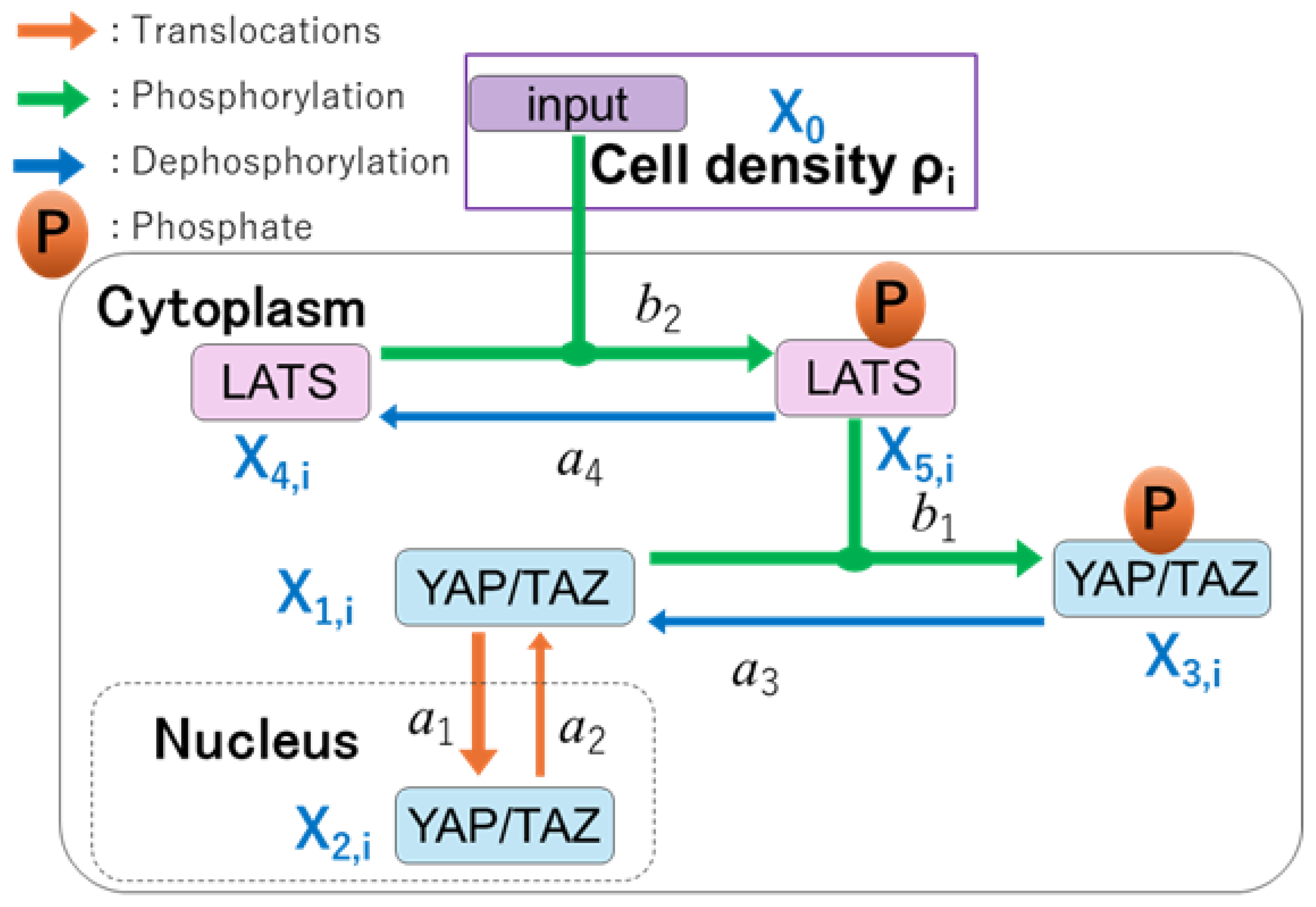
2.1. State Variables and Parameters
2.2. Reaction Equations (ODEs with Explicit LATS/pLATS Dynamics)
2.3. Modeling of Normal and Cancer Tissues and Parameter Settings
- (I)
- Local contact signalWe define as the maximum input signal transmitted to cell i from its surrounding cells. This quantity corresponds to the strength of the contact-derived signal when the local cell density is maximal. To match typical intracellular signaling molecule concentrations (0.01–1 M), we set the representative value toas in [7].
- (II)
- YAP/TAZ concentrationsThe overall scale of YAP/TAZ concentrations is chosen in the range 0.01–1 M, based on typical signaling protein levels (see, e.g., Table S1 in [10]). In the initial low-density state, YAP/TAZ preferentially localize to the nucleus rather than the cytoplasm [1]. Therefore, we set the initial cytoplasmic–nuclear concentration ratio to match the nuclear/cytoplasmic ratio of 4:1 reported by Zhang et al. [11]:The same initial values are used for normal and cancer cells.
- (III)
- LATS concentration and phosphorylated LATS concentrationThe total LATS concentration is set to based on the report by Hori et al. [12]. We assume that at when cells enter the M phase of the cell cycle, half of the total LATS is phosphorylated. Accordingly, we set
- (IV)
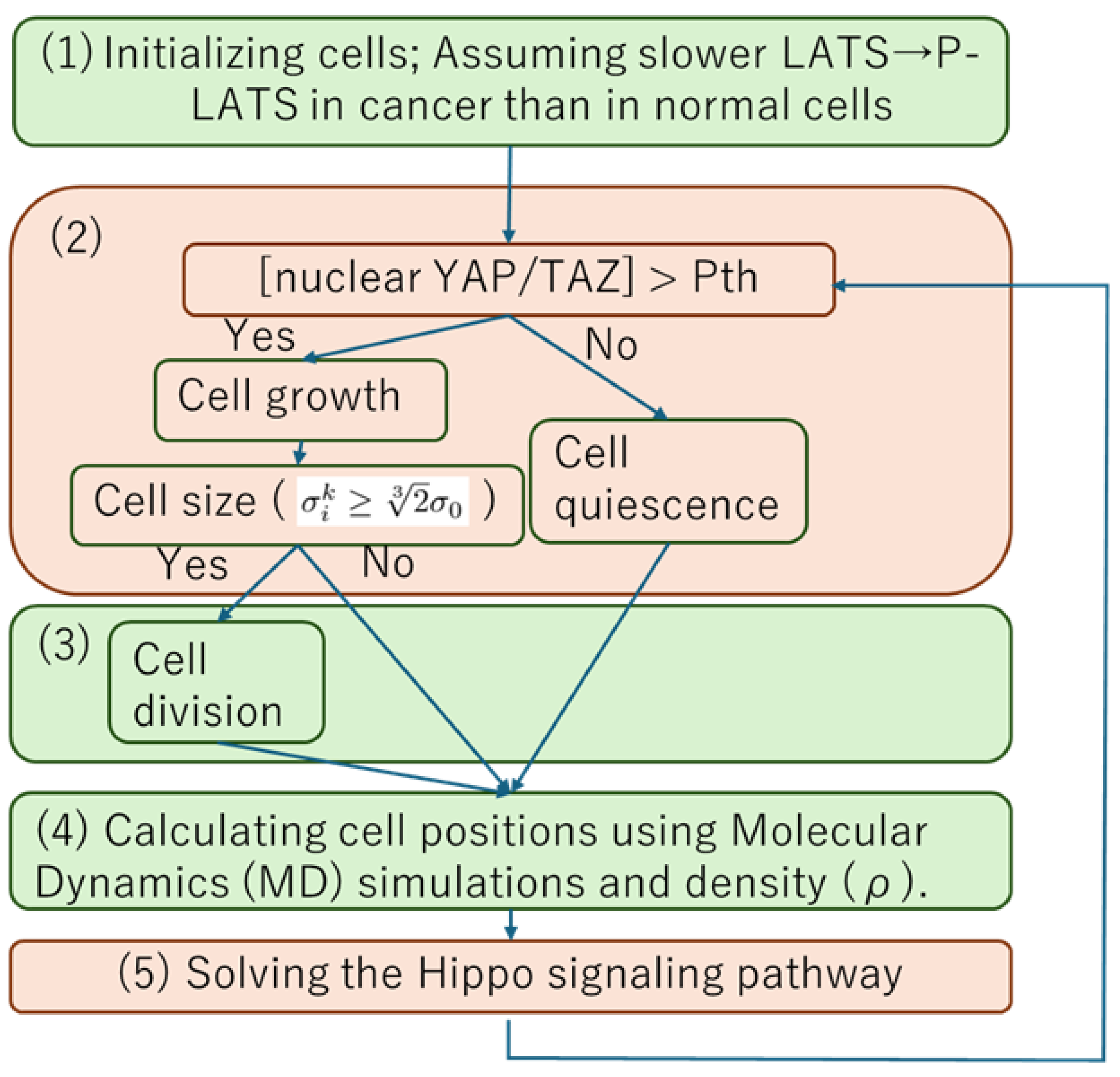
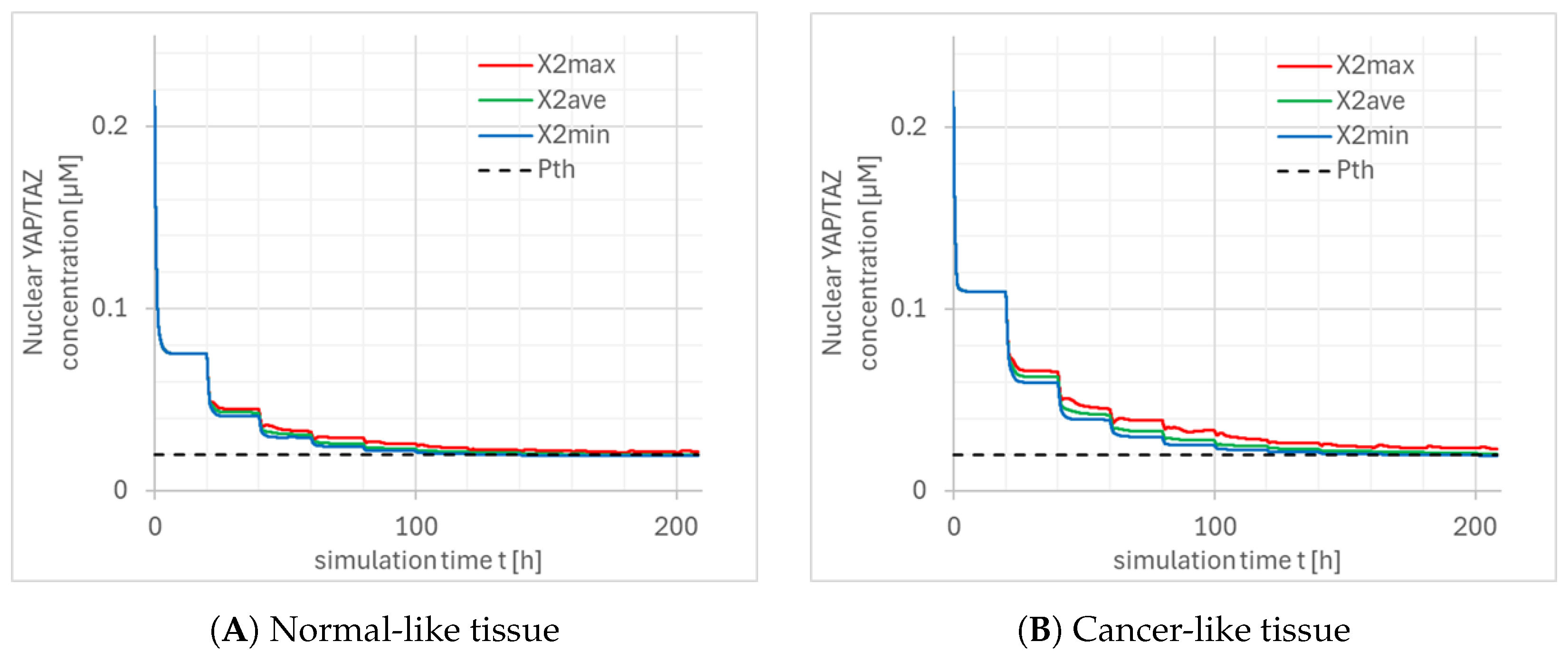
- Nuclear YAP/TAZ thresholdIt is known that expulsion of YAP from the nucleus in response to increased cell density corresponds to contact inhibition of proliferation [13]. Based on this, we introduce a proliferation threshold for the nuclear YAP/TAZ concentration:which is approximately of the initial nuclear concentration .
- (V)
- Reaction-rate coefficientsThe reaction-rate coefficients are selected from the range –, following the typical values reported in Table S2 of [14]. To reproduce the experimentally observed nuclear enrichment of YAP/TAZ [1], we set the ratio of cytoplasm-to-nucleus versus nucleus-to-cytoplasm shuttling rates asSpecifically, we chooseThese values correspond to characteristic shuttling timescales s and s (about 33 min), which fall within the broad range reported for nucleocytoplasmic transport dynamics [15,16,17] (from fast sub-minute events to slower processes) and are consistent with reported YAP/TAZ nucleocytoplasmic trafficking studies.
- (VI)
- LATS phosphorylation rateFrom the Hippo (MST2–LATS1) signaling model of Shin et al. [18], the reaction rate for LATS phosphorylation can be estimated in the range
- (VII)
- LATS dephosphorylation rateIn the model of Shin et al. [18], the reaction rate corresponding to LATS dephosphorylation is reported aswhich, when converted to SI units, becomesIn the present study, we chooseusing the same value for both normal and cancer cells.
2.4. Proliferation Gate (Cell Growth vs. Cell-Cycle Arrest via Nuclear YAP/TAZ Threshold)
2.5. Definition of Local Density and 3D-MA Simulations
2.6. Evaluation Metrics
3. Results
4. Discussion
Uncertainty of Kinetic Coefficients and Inter-Subject Variability
5. Conclusions
Supplementary Materials
Author Contributions
Funding
Data Availability Statement
Acknowledgments
Conflicts of Interest
References
- Yu, F.-X.; Zhao, B.; Guan, K.-L. The Hippo pathway in organ size control, tissue homeostasis, and cancer development. Cell 2015, 163, 811–828. [Google Scholar] [CrossRef] [PubMed]
- Zhong, Z.; Jiao, Z.; Yu, F.-X. The Hippo signaling pathway in development and regeneration. Cell Rep. 2024, 43, 113926. [Google Scholar] [CrossRef] [PubMed]
- Scott, K.E.; Fraley, S.I.; Rangamani, P. A spatial model of YAP/TAZ signaling reveals how stiffness, dimensionality, and shape contribute to emergent outcomes. Proc. Natl. Acad. Sci. USA 2021, 118, e2021571118. [Google Scholar] [CrossRef] [PubMed]
- Novev, J.K.; Heltberg, M.L.; Jensen, M.H.; Doostmohammadi, A. Spatiotemporal model of cellular mechanotransduction via Rho and YAP. Integr. Biol. 2021, 13, 197–209. [Google Scholar] [CrossRef] [PubMed]
- Jafarinia, H.; Khalilimeybodi, A.; Barrasa-Fano, J.; Fraley, S.I.; Rangamani, P.; Carlier, A. Insights gained from computational modeling of YAP/TAZ signaling for cellular mechanotransduction. Npj Syst. Biol. Appl. 2024, 10, 90. [Google Scholar] [CrossRef] [PubMed]
- Miyamura, N.; Nishina, H. Organ size regulation by Hippo-YAP/TAZ signaling pathway. Riyouiki Yuugo Rev. (Life Sci. Integr. Rev.) 2016, 5, e004. [Google Scholar] [CrossRef]
- Umegaki, T.; Moriizumi, H.; Ogushi, F.; Takekawa, M.; Suzuki, T. Multicellular MD–Hippo model with cell–cell interactions. PLoS Comput. Biol. 2024, 20, e1012536. [Google Scholar] [CrossRef] [PubMed]
- Zhao, B.; Li, L.; Wang, L.; Wang, C.-Y.; Yu, J.; Guan, K.-L. Cell detachment activates the Hippo pathway via cytoskeleton reorganization to induce anoikis. Genes Dev. 2012, 26, 54–68. [Google Scholar] [CrossRef] [PubMed]
- Rahmat, M.B.; Zhang, S.; Koh, C.-G. POPX2 is a novel LATS phosphatase that regulates the Hippo pathway. Oncotarget 2019, 10, 1525–1538. [Google Scholar] [CrossRef] [PubMed]
- Beutler, T.C.; Mark, A.E.; van Schaik, R.C.; Gerber, P.R.; van Gunsteren, W.F. Avoiding singularities and numerical instabilities in free energy calculations based on molecular simulations. Chem. Phys. Lett. 1994, 222, 529–539. [Google Scholar] [CrossRef]
- Zhang, C.; Zhu, H.; Ren, X.; Gao, B.; Cheng, B.; Liu, S.; Sha, B.; Li, Z.; Zhang, Z.; Lv, Y.; et al. Mechanics-driven nuclear localization of YAP can be reversed by N-cadherin ligation in mesenchymal stem cells. Nat. Commun. 2021, 12, 6229. [Google Scholar] [CrossRef] [PubMed]
- Hori, T.; Takaori-Kondo, A.; Kamikubo, Y.; Uchiyama, T. Molecular cloning of a novel human protein kinase, kpm, that is homologous to warts/lats, a Drosophila tumor suppressor. Oncogene 2000, 19, 3101–3109. [Google Scholar] [CrossRef] [PubMed]
- Zhao, B.; Wei, X.; Li, W.; Udan, R.S.; Yang, Q.; Kim, J.; Xie, J.; Ikenoue, T.; Yu, J.; Li, L.; et al. Inactivation of YAP oncoprotein by the Hippo pathway is involved in cell contact inhibition and tissue growth control. Genes Dev. 2007, 21, 2747–2761. [Google Scholar] [CrossRef] [PubMed]
- Aoki, K.; Yamada, M.; Kunida, K.; Yasuda, S.; Matsuda, M. Processive phosphorylation of ERK MAP kinase in mammalian cells. Proc. Natl. Acad. Sci. USA 2011, 108, 12675–12680. [Google Scholar] [CrossRef] [PubMed]
- Singer, R.H.; Grünwald, D. Multiscale dynamics in nucleocytoplasmic transport. Curr. Opin. Cell Biol. 2012, 24, 100–106. [Google Scholar] [CrossRef] [PubMed]
- Kofler, M.; Kapus, A. Nuclear Import and Export of YAP and TAZ. Cancers 2023, 15, 4956. [Google Scholar] [CrossRef] [PubMed]
- Kofler, M.; Speight, P.; Little, D.; Di Ciano-Oliveira, C.; Szászi, K.; Kapus, A. Mediated nuclear import and export of TAZ and the underlying molecular requirements. Nat. Commun. 2018, 9, 4966. [Google Scholar] [CrossRef] [PubMed]
- Shin, S.-Y.; Nguyen, L.K. Unveiling Hidden Dynamics of Hippo Signalling: A Systems Analysis. Genes 2016, 7, 44. [Google Scholar] [CrossRef] [PubMed]



| Symbol | Description |
|---|---|
| Scale of contact-derived signal | |
| Cytoplasmic YAP/TAZ concentration | |
| Nuclear YAP/TAZ concentration | |
| Phosphorylated YAP/TAZ (cytoplasmic) | |
| Non-phosphorylated LATS concentration | |
| Phosphorylated LATS (pLATS) concentration | |
| Local cell density (dimensionless) | |
| Cytoplasm → nucleus YAP/TAZ shuttling rate | |
| Nucleus → cytoplasm YAP/TAZ shuttling rate | |
| YAP/TAZ dephosphorylation rate | |
| LATS dephosphorylation rate | |
| pLATS-dependent YAP/TAZ phosphorylation rate | |
| Density-dependent LATS phosphorylation rate |
Disclaimer/Publisher’s Note: The statements, opinions and data contained in all publications are solely those of the individual author(s) and contributor(s) and not of MDPI and/or the editor(s). MDPI and/or the editor(s) disclaim responsibility for any injury to people or property resulting from any ideas, methods, instructions or products referred to in the content. |
© 2025 by the authors. Licensee MDPI, Basel, Switzerland. This article is an open access article distributed under the terms and conditions of the Creative Commons Attribution (CC BY) license.
Share and Cite
Umegaki, T.; Suzuki, T. Autonomous Normal–Cancer Discrimination by a LATS/pLATS-Explicit Hippo–YAP/TAZ Reaction System. Mathematics 2026, 14, 99. https://doi.org/10.3390/math14010099
Umegaki T, Suzuki T. Autonomous Normal–Cancer Discrimination by a LATS/pLATS-Explicit Hippo–YAP/TAZ Reaction System. Mathematics. 2026; 14(1):99. https://doi.org/10.3390/math14010099
Chicago/Turabian StyleUmegaki, Toshihito, and Takashi Suzuki. 2026. "Autonomous Normal–Cancer Discrimination by a LATS/pLATS-Explicit Hippo–YAP/TAZ Reaction System" Mathematics 14, no. 1: 99. https://doi.org/10.3390/math14010099
APA StyleUmegaki, T., & Suzuki, T. (2026). Autonomous Normal–Cancer Discrimination by a LATS/pLATS-Explicit Hippo–YAP/TAZ Reaction System. Mathematics, 14(1), 99. https://doi.org/10.3390/math14010099