


Abstract
The purpose of this paper is to construct a new fixed-point iterative scheme, called the Picard-like iterative scheme, for approximating the fixed point of a mapping that satisfies condition in the setting of a uniformly convex Banach space. We prove that this novel iterative scheme converges faster than some existing iterative schemes in the literature. Moreover, -stability and almost -stability results are proven. Furthermore, we apply our results for approximating the solution of an integral equation that models the spread of some infectious diseases. Similarly, we also applied the results for approximating the solution of the boundary value problem by embedding Green’s function in our novel method. Our results extend and generalize other existing results in the literature.
Keywords:
Picard-like iterative scheme; condition (Bγ,μ); condition (I); fixed point; boundary value problem; Green’s function; infectious diseases model; G-stability MSC:
47H09; 47H10; 47J26; 35R11; 92-10
1. Introduction
Let be a subset of a uniformly convex Banach space X. A self mapping is a mapping satisfying condition (C) on the subset , if
for all .
The mapping satisfying condition (C) was introduced by Suzuki [1] in 2008 as an extension and generalization of nonexpansive mappings. Furthermore, this class of nonlinear mappings is known to be weaker than mappings with nonexpansiveness and stronger than mappings with quasi-nonexpansiveness.
In 2011, García-Falset et al. [2] introduced a more general mapping than the Suzuki’s mappings satisfying condition (C). It was described as a mapping satisfying condition (E) or the García-Falset mapping on , and defined as
for all and . Patir et al. [3], in 2018, introduced a class of generalized two-parameter nonexpansive mapping known as mapping satisfying condition , and proved that it was wider than mappings satisfying condition (C) of Suzuki [1]. This class of mapping is defined as follows:
Definition 1
([3]). Let be a subset of a uniformly convex Banach space, X. A mapping satisfies condition if for any two elements , one can choose a and some with , such that
implies
Natural processes form the basis of understanding the world around us, encompassing phenomena such as the motion of objects, heat transfer, fluid dynamics, and more. These processes, governed by principles of motion and change, provide insights into the laws of nature and are essential for scientific and technological advancements. To describe such phenomena quantitatively, we rely on mathematical tools, with differential equations playing a central role.
Differential equations, whether ordinary or partial, of an integer or fractional order, allow us to model these processes mathematically. The classification of these equations depends on the order of the differential coefficient and the number of independent variables involved. Such equations are often accompanied by initial conditions or boundary conditions, leading to either initial value problems (IVPs) or boundary value problems (BVPs).
Once a natural phenomenon is modeled using differential equations, the next critical step is to determine its solution using appropriate mathematical methods, unlocking deeper understanding and practical applications.
Fixed-point theory is an important tool for solving differential equations, particularly for proving the existence and uniqueness of solutions, including the approximation of the solution through the use of an iterative scheme (see for example [4,5,6] and other literature). This theory revolves around the concept of obtaining a point x called the fixed point, such that for any mapping , where .
Fixed-point theory has been applied for solving several problems including BVP, which involves the use of Green’s function (see [7,8,9,10,11] and the references therein).
The objective of this work is to construct an effective fixed-point iterative scheme that performs better than some existing iterative schemes for a mapping satisfying condition in a way to generalize and extend them. We apply it for solving a third-order BVP via Green’s function with series of numerical examples and illustrations. Furthermore, we apply it for approximating the solution of an integral equation modeling the spread of certain infectious diseases with a periodic contact rate with seasonal variations.
The rest of this paper is arranged such that in Section 2, preliminary facts, definitions, and lemmas are presented. Section 3 contains the main results, which include weak and strong convergence theorems and where the stability/almost stability of the new iterative scheme are considered. In Section 4, the application of the new iterative scheme to an infectious disease model is considered. Section 5 applies a boundary value problem of the third order via Green’s function. Finally, Section 6 provides the conclusion.
2. Preliminaries
While fixed-point theory is very instrumental in proving the existence and uniqueness of solutions for differential equations transformed to an operator equation, it can also be used to approximate the solutions by using a fixed-point iterative scheme.
In 2018, Ullah and Arshad [12] introduced the M iterative scheme, as follows:
where is a real sequence in . The scheme was used to prove weak and strong convergence theorems for Suzuki-generalized nonexpansive mapping in the framework of uniformly convex Banach spaces.
Gürsoy et al. [13], in 2014, introduced an iterative scheme called the Picard-S, defined as follows:
Abbas et al. (2022) [14] constructed the AA iterative scheme, which is defined as follows:
They used this iterative scheme to approximate the fixed point of -enriched contraction mapping in the framework of Banach spaces and applied it for approximating the solution to a delay fractional differential equation.
In 2018, Ullah and Arshad [15] proposed a new iteration process called the iteration process, defined as:
The authors used this iterative scheme to approximate the fixed point of a Suzuki-generalized nonexpansive mapping in the setting of uniformly convex Banach spaces.
Recently, in 2024, Ullah et al. [16] used the iteration process (4) to approximate the fixed point of mapping, satisfying condition in the setting of Banach space.
Motiveted by the foregoing, we propose a new fixed-point iterative scheme called the Picard-like iterative scheme, as follows:
Next, we consider some definitions and lemmas that will be useful in the sequel.
Definition 2
([17,18]). Let be a nonempty closed convex subset of a Banach space X and be a bounded sequence in X. For each , we define
- (a)
- asymptotic radius of at u as a functional, defined by ,
- (b)
- asymptotic radius of relative to the set by
- (c)
- asymptotic center of relative to the set by
Definition 3
([18]). A Banach space X is said to satisfy the Opial condition [19] if, for each sequence in X, converging weakly to , we have
for all , such that .
Definition 4
([20]). A mapping with is said to satisfy condition (I) if there exists a nondecreasing function with , for , such that for all , where .
Definition 5
([21]). Let be an operator on a real Banach space X. Assume that and defines an iterative scheme that generates a sequence in . Assume, furthermore, that converges strongly to , where is the set of all fixed points of . Assume that is an arbitrary bounded sequence in X and set . Then,
- 1.
- the iterative scheme in a real Banach space X, defined by , is said to be -stable or stable with respect to if implies
- 2.
- the iterative scheme defined by is said to be almost -stable if implies that .
Lemma 1
([3]). Let be a nonempty subset of a Banach space X with an Opial condition and is a mapping satisfying condition (). If is a fixed point of , then for each ,
Lemma 2
([22]). Let X be a uniformly convex Banach space and be any sequence of numbers, such that , , for . Let and be sequences in X, such that , and for some . Then, .
Proposition 1
([3]). Let be a nonempty subset of a Banach space X. Suppose that is a mapping satisfying condition on . Then, for all and for ,
- 1.
- 2.
- at least one of the following holds:
- (i)
- (ii)
- .
The condition implies and condition implies . - 3.
Lemma 3
([23]). If is a real number and is a sequence of positive numbers, such that , then for any sequence of positive numbers, satisfying , such that .
Lemma 4
([24]). Let and be sequences of nonnegative numbers and , such that
If , then .
Lemma 5
([3]). Assume is a nonempty subset of a Banach space X endowed with the Opial property. Assume is a mapping satisfying condition . If is a sequence in X, such that
- 1.
- converges weakly to τ,
- 2.
- ,
then .
Proposition 2
([25]). Assume that is any nonempty closed subset of a Banach space and be any Fejer-monotone sequence in the set . Then, converges strongly to the point of , if and only if .
3. Main Results
3.1. Weak and Strong Convergence Theorems
Before stating the main results of this section, it suffices to state and prove the following lemmas, which will be helpful for proving the main results.
Lemma 6.
Let be a nonempty closed convex subset of a Banach space X and is a mapping satisfying condition with . Suppose is a sequence generated by the iterative scheme (5), then exists for each .
Proof.
Lemma 7.
Assume is a nonempty closed convex subset of a uniformly convex Banach space X and is a mapping satisfying condition , if is a sequence generated by the iterative scheme (5). Then, if and only if is bounded and .
Proof.
Again, by condition (2) of Proposition 1, it follows that
or
As , for , then
it follows that
That is, . As the set is singleton, then, it follows that . Hence, completing the proof. □
Suppose that and is a fixed point. Then, by Lemma 6, we have that exists and is bounded.
Let be a real value,
From (7)–(9) as in the proof of Lemma 6, together with (10), we have
and
By Lemma 1, we have that
and
Now,
Again from Lemma 1, together with (10), we have
It can immediately follow from (13) and (17) that
and we have
From (18), we also have
which follows that
and
That is,
Taking lim inf on both sides, we have
Using (11) and (21), we have
and
From (22)
With (10), (15) and (23) in sight and applying Lemma 2, it is clear that
- Conversely, assume that is bounded and . We can show that . To do that, let . Applying (3) of Proposition 1 for , ,
Theorem 1.
Proof.
By Lemma 7, clearly, is bounded. As X is a uniformly convex Banach space, then it can obviously be reflexive. From the Eberlein theorem, there exists a convergent subsequence of , such that for some (where ⇀ denotes weak convergence).
From the hypothesis of Lemma 7 and applying Lemma 5, we have that .
We want to show that is a weak limit of . We assume that is the only weak limit of , that is converges weakly to .
Suppose in the contrary that the claim does not hold, then we can construct another subsequence of and further assume that it converges to another point , such that .
As in the previous claim, it follows that, . From Lemma 6 and using the Opial condition (6) for Banach space, we have
Clearly, we obtain , which is obviously a contradiction. Hence, and the proof is complete. □
Theorem 2.
Assume is a nonempty closed and convex subset of a uniformly convex Banach space X, and suppose that is a mapping satisfying condition with . If is a sequence generated by the iterative scheme (5). Then, converges strongly to a fixed point provided that the mapping satisfies condition .
Proof.
For the fact that satisfies condition , we have that .
We are to show that is closed. To do so, we assume that is an arbitrary sequence in and it converges to some point . As by condition , we obtain
This implies that as , we have
Hence, . This follows that and, as such, . Therefore, is closed.
- By the hypothesis of Lemma 6, we have that is Fejer-monotone with respect to . Again, from Proposition 2, converges strongly to a fixed point in . □
Theorem 3.
Let be a mapping satisfying condition defined on a nonempty closed convex subset of a uniformly convex Banach space X, such that . If is a sequence generated by (5), then converges to a fixed point of if and only if .
Proof.
If the sequence converges to a fixed point , then
so that
Conversely, suppose that From Lemma 6, it is clear that
and we have
It follows that forms a decreasing sequence that is bounded below by zero and it is guaranteed that exists.
As , so is as well.
Now, it is our aim to show that is a Cauchy sequence in . Given as any arbitrary number, there exists , such that for all , we obtain
In particular,
so that there exists a such that
Hence, for , we obtain
which shows that is a Cauchy sequence in .
As is a closed subset of a Banach space X, is also a Banach space and it follows that must converge to some point .
As , which gives . Therefore, is closed and so . □
3.2. Stability and Almost Stability Results
Theorem 4.
Proof.
Set
Suppose ,
but
and
moreover,
Combining (25)–(27), we have
Putting (28) in (24)
By Lemma 3, we have .
Let be an arbitrary sequence in and let the sequence generated by the iterative scheme (5) be and it converges to a unique fixed point .
- Let . We show that if and only if
Conversely, suppose , then
Taking limit as on both sides and taking cognizance that . Hence, the fixed-point iterative scheme is stable with respect to the mapping . □
Next is the almost -stability result.
Theorem 5.
Let X, and be the same as used in Theorem 4 with being a mapping that satisfies condition for . Then the iterative scheme (5) is almost -stable.
Proof.
Let be an approximate sequence of in . Assume that the iterative scheme (5) is represented as and it converges to a fixed point and let , .
We are to prove that implies .
Let , then by (5), we obtain:
Set , then .
As , then by Lemma 4, we have . It follows that , that is, . Therefore, the proof is complete. □
3.3. Numerical Example
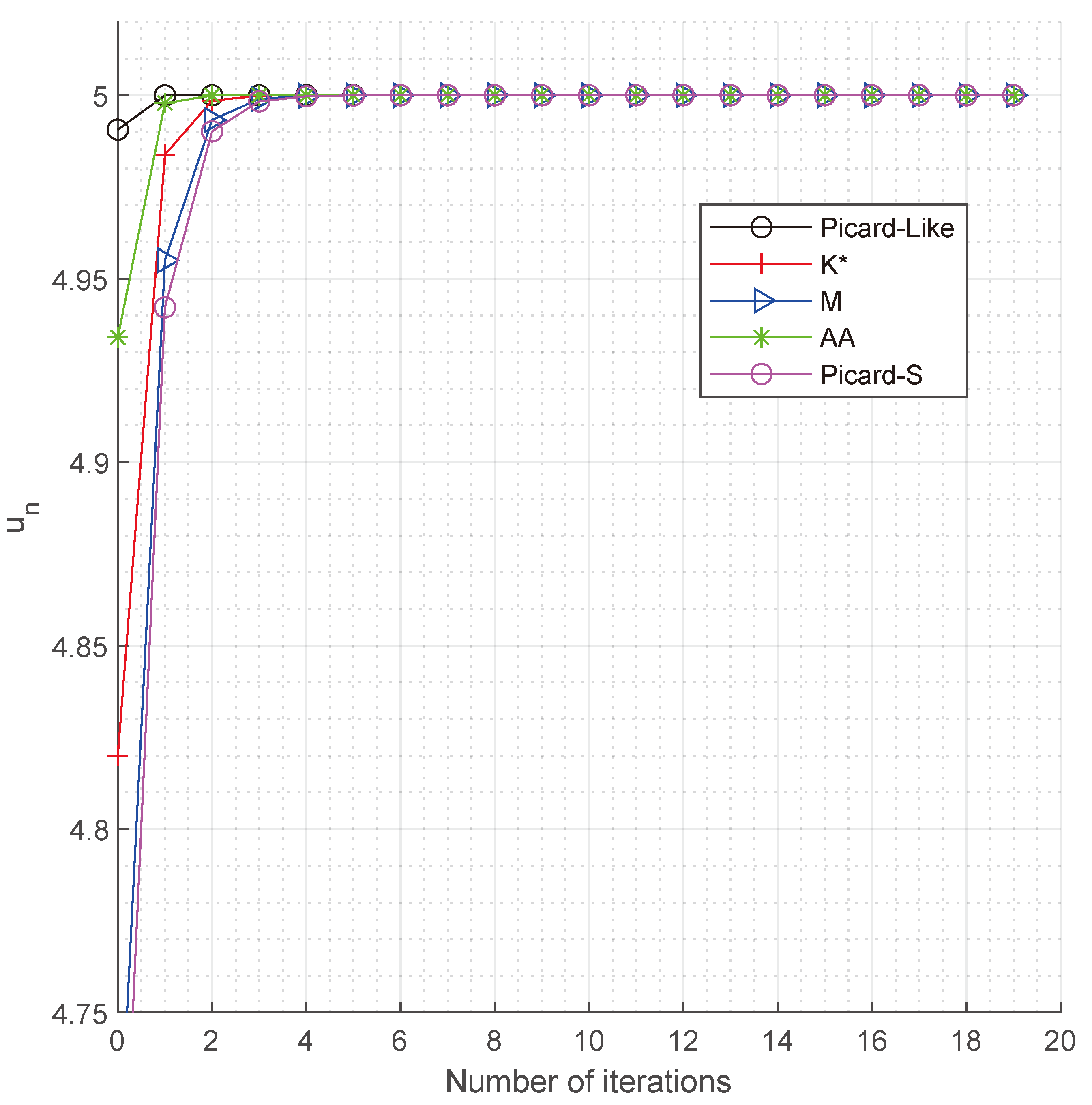
Here, we provide an example of a mapping that satisfies condition , specifically for when and . Furthermore, this example is used to compare the rate of convergence of our iterative scheme (5) with all of AA, K*, M, and Picard-S iterative schemes for . Table 1 and Figure 1 below shows a comparison of the rate of convergence of the mentioned iterative schemes with our new scheme in line with Example 1 below.
Table 1.
Comparison of speed of convergence of some iterative scheme for Example 1.
Figure 1.
Graph corresponding to Table 1.
Example 1.
Define a mapping as follows
We want to show that the mapping satisfies condition . If and , then our aim is to show that satisfies condition .
- Case A
- For , we obtain
- Case B
- For and , we obtain
- Case C
- For , we obtain
We can conclude that satisfies condition .
4. Application to Infectious Diseases Model
Mathematical models for the transmission of infectious diseases are essential tools for understanding how diseases spread within populations and for designing effective intervention strategies. These models range from simple to highly complex, depending on the disease, population structure, and the level of detail required. Some of such models include; the SIR model, SEIR model, SIS model, stochastic model, and network models. In [26,27,28], the following nonlinear integral equation
was presented to represent a model for the spread of certain infectious diseases with a periodic contact rate that varies according to season, where is the demography of the population infected (also known as the infective class) with the disease at time t, is the new infective population per unit time (i.e., ), and is period of time an individual remains infectious and continue spreading the disease.
To analyze the existence of solution of (29), let and be a Banach space with supremum norm
such that .
To continue, we define an operator by
Furthermore, f satisfies the following conditions:
- (C1)
- is continuous,
- (C2)
- , ,
- (C3)
- , .
Remark 1.
The operator (30) clearly satisfies the condition, as defined in Definition 1 for , provided that satisfies Lipschitz condition with respect to the second variable, u with a Lipschitz constant and . For the second part of the condition, one may choose (for ) and .
Theorem 6.
5. Application to Boundary Value Problem of Third Order via Green’s Function
5.1. Construction of Green’s Function
Consider a third-order boundary value problem (BVP);
for , with the following boundary conditions (BCs);
for or = . Equation (36) can be shortened to:
where is linear and the right-hand side can be written as . The right-hand side could be linear or nonlinear. For the BCs, and are constants.
If the homogeneous part of (36) (i.e., ) is solved, then three linearly independent complementary solutions and can be obtained and can subsequently be used to construct the Green’s function, which is a piecewise function defined as a linear combination of the linearly independent solutions and ; thus,
where are constants whose real values can be obtained using the following axioms;
- (A1)
- satisfies the associated boundary conditions;
- (A2)
- is continuous at , that is
- (A3)
- is continuous at , that is
- (A4)
- has jump disconttinuity at ;
If the Green function, can solve the BVP, (36), then it will satisfy the equation,
subject to the homogeneous boundary conditions
where is the Kronecker Delta.
5.2. Picard-like-Green Iterative Scheme
To construct the New Picard-like-Green iterative scheme, we embed the Green’s function in the Picard-like fixed-point iterative scheme (5).
To do this, we begin by considering the following nonlinear boundary value problem
where is linear in h, is nonlinear in h, and is a function in h that could be either linear or nonlinear.
The general solution of (40) can be expressed as , with being the complementary solution subject to the homogeneous part, of (40) with regards to the boundary conditions mentioned in axiom . Furthermore, is a particular solution of the nonhomogeneous part of (40).
Next, we define an integral operator in terms of Green’s function, and the particular solution, :
Remark 2.
Observe that the operator of Equation (41) satisfies condition , provided that:
- (a)
- the kernel, which represents the Green function is bounded,
- (b)
- L is a bounded linear operator, and
- (c)
- one can choose and for where M is a bound for (i.e., ) and , .
5.3. Convergence Analysis
We can now find the solution for the BVP via Green’s function by showing the convergence analysis of our iterative scheme, the Picard like-Green scheme (43). This can be achieved by considering the following third-order BVP;
with BCs
We obtain the Green’s function by solving the homogeneous equation . The Green’s function is given as follows:
The real values of () can be obtained by applying axioms , so that (45) becomes
Next, we redefine the Picard-like-Green iterative scheme (43) as
where the operator is defined as
The initial iterate, of (47) satisfies the equation with BCs; , and .
If we apply integration by part three times to , as it appears in (48) and keeping in mind that , we have that
Furthermore, we want to show that the operator is a contraction on the Banach space with respect to the norm
under certain conditions on . Particularly, we prove that is a Zamfirescu operator under certain conditions on .
Theorem 7.
Assume Ψ as in , satisfies the Lipschitz condition
where and are positive constants, such that
The operator is a contraction on the Banach space , and the sequence defined by (5) converges strongly to the fixed point of .
Proof.
Let , so that by (49), we have
which shows that is a contraction.
Again, we prove that the sequence generated by the Picard-like iterative scheme (5) converges strongly to the fixed point of the operator, .
As is a contraction as shown above, it is guaranteed from the Banach contraction principle that there exists a unique fixed point, of in the Banach space . Then, what is left is to show that . From (47), we have
Combining (50) and (51), we have;
Putting (54) in (52),
Combining (53) and (55), we have
Inductively,
From basic analysis, it is obvious that for , so that
Clearly, if , such that as , then , which completes the proof. □
Example 2.
Consider the equation
with BCs.
The Green’s function corresponding to the homogeneous linear part of (56), that is on the interval is
Applying the Picard-like-Green iterative scheme, as expressed in (44), we have the initial iterate as
and,
With the best choice of , our new Picard-like-Green iterative scheme performs better than other existing Green’s-function-based iterative schemes such as Picard–Green [7], Mann–Green [8], Ishikawa–Green [9], Khan–Green [29], Picard–Ishikawa–Green [30], and many more in the literature.
6. Conclusions
In this paper, our new iterative scheme (5) approximates the fixed point of mapping satisfying the condition , as shown in the main results. The scheme converges faster than some selected schemes, already existing in the literature, as shown in Example 1 which is also presented numerically in Table 1 and Figure 1. Furthermore, the Picard-like-Green iterative scheme generalizes other Green’s-function-based scheme highlighted in the work. Finally, to show the applicability of our main results, it is applied to the approximation of the solution of infectious disease models.
Author Contributions
All authors contributed equally to the writing of this paper. All authors have read and agreed to the published version of the manuscript.
Funding
This work was supported and funded by the Deanship of Scientific Research at Imam Mohammad Ibn Saud Islamic University (IMSIU) (grant number IMSIU-DDRSP2501).
Institutional Review Board Statement
This article does not contain any studies with human participants or animals performed by any of the authors.
Data Availability Statement
The original contributions presented in this study are included in the article. Further inquiries can be directed to the corresponding author.
Acknowledgments
This work was supported and funded by the Deanship of Scientific Research at Imam Mohammad Ibn Saud Islamic University (IMSIU) (grant number IMSIU-DDRSP2501).
Conflicts of Interest
The authors declare that they have no conflict of interest.
References
- Suzuki, T. Fixed point theorems and convergence theorems for some generalized nonexpansive mappings. J. Math. Appl. 2008, 340, 1088–1095. [Google Scholar] [CrossRef]
- García-Falset, J.; Llorens-Fuster, E.; Suzuki, T. Fixed point theory for a class of generalized nonexpansive mapping. J. Math. Anal. 2011, 375, 185–195. [Google Scholar] [CrossRef]
- Patir, B.; Goswami, N.; Mishra, V.N. Some results on fixed theory for a class of generalized nonexpansive mappings. Fixed Point Theory Appl. 2018, 2018, 19. [Google Scholar] [CrossRef]
- Picard, E. Memoire sur la theorie des equations aux derivees partielles et la methode des approximations successives. J. Math. Pures Appl. 1890, 6, 145–210. [Google Scholar]
- Banach, S. Sur les opérations dans les ensembles abstraits et leur application aux équations intégrales. Fundam. Math. 1922, 3, 133–181. [Google Scholar] [CrossRef]
- Krasnosel’skii, M.A. Two observations about the method of successive approximations. Usp. Mat. Nauk. 1955, 10, 123–127. [Google Scholar]
- Khuri, S.A.; Sayfy, A.; Zaveri, A. A new iteration method based on Green’s functions for the solution of PDEs. Int. J. Comput. Math. 2017, 3, 3091–3103. [Google Scholar] [CrossRef]
- Khuri, S.A.; Sayfy, A. Numerical solution of functional differential equations: A Green’s function-based iterative approach. Int. J. Comput. Math. 2018, 95, 1937–1949. [Google Scholar] [CrossRef]
- Khuri, S.A.; Louhichi, I. A new fixed point iteration method for nonlinear third-order BVPs. Int. J. Comput. Math. 2021, 98, 2220–2232. [Google Scholar] [CrossRef]
- Okeke, G.A.; Udo, A.V.; Alqahtani, R.T.; Hussain, N. A faster iterative scheme for solving nonlinear fractional differential equation of the Caputo type. AIMS Math. 2023, 8, 28488–28516. [Google Scholar] [CrossRef]
- Okeke, G.A.; Ofem, A.E.; Işik, H. A faster iterative method for solving nonlinear third-order BVPs based on Green’s function. Bound. Value Probl. 2022, 2022, 103. [Google Scholar] [CrossRef]
- Ullah, K.; Arshad, M. Numerical reckoning fixed points for Suzuki’s generalized nonexpansive mapping via new iteration process. Filomat 2018, 32, 187–196. [Google Scholar] [CrossRef]
- Gürsoy, P.; Karakaya, V. A Picard-S hybrid iteration method for solving a differential equation with retarded argument. arXiv 2014, arXiv:1403.2546v2. [Google Scholar]
- Abbas, M.; Asghar, M.W.; De la Sen, M. Approximation of the solution of delay fractional differential equation using AA-iterative scheme. Mathematics 2022, 10, 273. [Google Scholar] [CrossRef]
- Ullah, K.; Arshad, M. New three-step iteration process and fixed point approximation in Banach spaces. J. Linear Topol. Algebra 2018, 7, 87–100. [Google Scholar]
- Ullah, K.; Abbas, M.; Ahmad, J.; Ahmad, F. Approximating fixed point of operators satisfying the (Bγ,μ) condition. Iran. J. Math. Sci. Inform. 2024, 19, 135–148. [Google Scholar] [CrossRef]
- Agarwal, R.P.; O’Regan, D.; Sahu, D.R. Fixed Point Theory for Lipschitzian Type Mppings with Applications; Topological Fixed Point Theory and Its Applications; Springer: New York, NY, USA, 2009; Volume 6. [Google Scholar] [CrossRef]
- Goebel, K.; Kirk, W.A. Topics in Metric Fixed Theory; Cambridge University Press: Cambridge, UK, 1990. [Google Scholar] [CrossRef]
- Opial, Z. Weak convergence of the sequence of successive approximations for nonexpansive mapping. Bull. Am. Math. Soc. 1967, 73, 591–597. [Google Scholar] [CrossRef]
- Senter, H.F.; Dotson, W.G., Jr. Approximating fixed points of nonexpansive mappings. Proc. Am. Math. Soc. 1974, 44, 375–380. [Google Scholar] [CrossRef]
- Liu, Z.; Kang, S.M.; Cho, Y.J. Convergence and almost stability of Ishikawa iterative scheme with errors for m-accretive operators. Comput. Math. Appl. 2004, 47, 767–778. [Google Scholar] [CrossRef]
- Schu, J. Weak and strong convergence to fixed points of asymptotically nonexpansive mappings. Bull. Aust. Math. Soc. 1991, 43, 153–159. [Google Scholar] [CrossRef]
- Berinde, V. On the stability of some fixed procedure. Bul. Ştiinţ. Univ. Baia Mare Ser. B Mat.-Inform. 2002, XVIII, 7–14. [Google Scholar]
- Berinde, V. Summable almost stability of fixed point iteration procedures. Carpathian J. Math. 2003, 19, 81–88. [Google Scholar]
- Bauschke, H.H.; Combettes, P.L. Convex Analysis and Monotone Operator Theory in Hilbert Spaces; Springer: New York, NY, USA, 2011. [Google Scholar]
- Alam, K.H.; Rohen, Y.; Tomar, A. On fixed point and its application to the spread of infectious diseases model in Mvb-metric space. Math. Methods Appl. Sci. 2024, 47, 6489–6503. [Google Scholar] [CrossRef]
- Leggett, R.W.; Williams, L.R. A fixed point theorem with application to an infectious disease model. J. Math. Anal. Appl. 1980, 76, 91–97. [Google Scholar] [CrossRef]
- Zhang, S.-S.; Bian, W.-M. Fixed point indexes and its applications to nonlinear integral equations modelling infectious diseases. Appl. Math. Mech. 1989, 10, 399–406. [Google Scholar] [CrossRef]
- Ali, F.; Ali, J.; Uddin, I. A novel approach for the solution of BVPs via Green’s function and fixed point iterative method. J. Appl. Math. Comput. 2021, 66, 167–181. [Google Scholar] [CrossRef]
- Okeke, G.A.; Udo, A.V.; Rasulov, Z. A novel Picard-Ishikawa-Green’s iterative scheme for solving third order boundary value problems. Math. Meth. Appl. Sci. 2024, 47, 7255–7269. [Google Scholar] [CrossRef]
Disclaimer/Publisher’s Note: The statements, opinions and data contained in all publications are solely those of the individual author(s) and contributor(s) and not of MDPI and/or the editor(s). MDPI and/or the editor(s) disclaim responsibility for any injury to people or property resulting from any ideas, methods, instructions or products referred to in the content. |
© 2025 by the authors. Licensee MDPI, Basel, Switzerland. This article is an open access article distributed under the terms and conditions of the Creative Commons Attribution (CC BY) license (https://creativecommons.org/licenses/by/4.0/).


