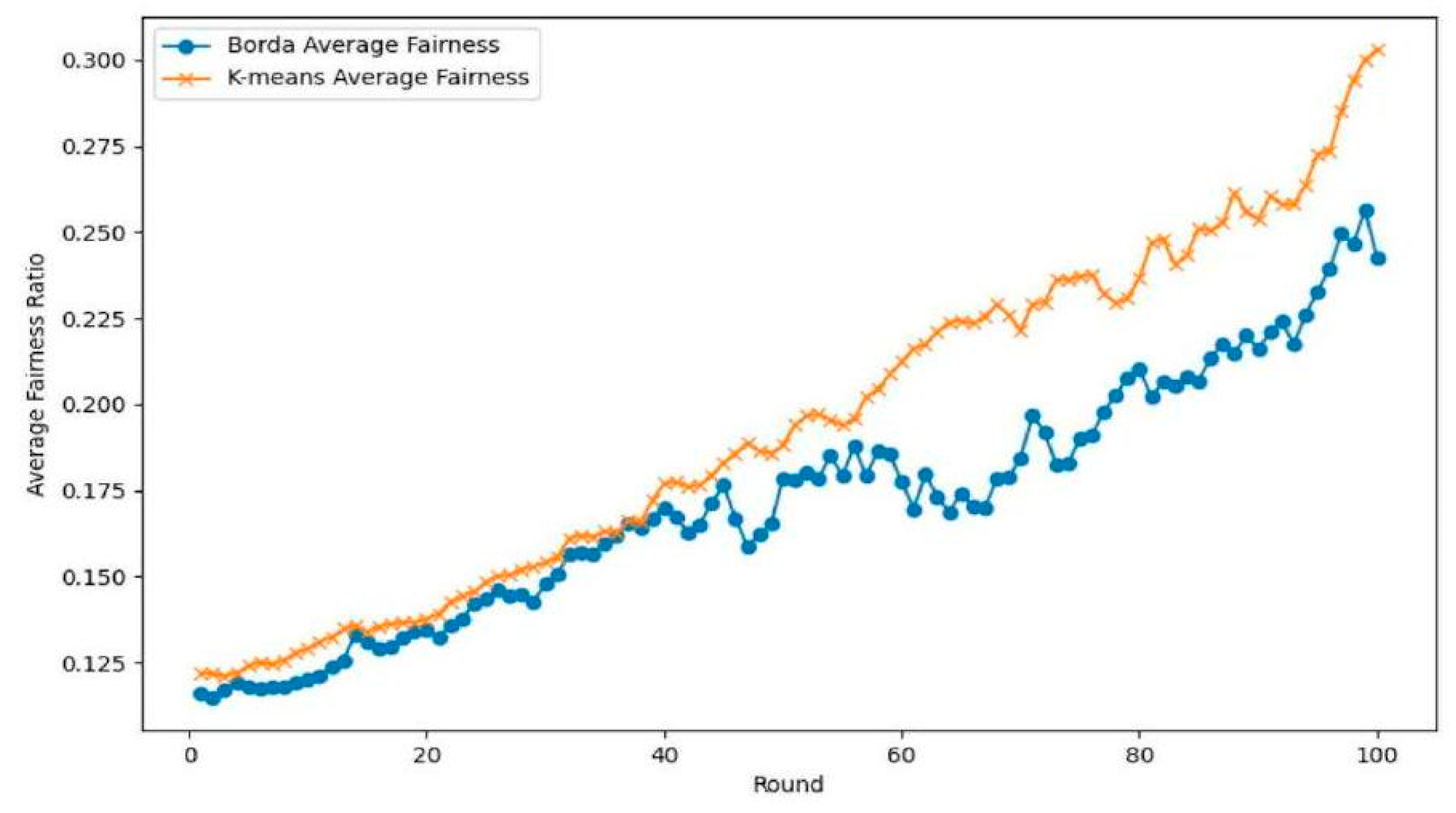
A Comparative Analysis of Fairness and Satisfaction in Multi-Agent Resource Allocation: Integrating Borda Count and K-Means Approaches with Distributive Justice Principles


Abstract
Share and Cite
Gharbi, A.; Ayari, M.; Albalawi, N.; El Touati, Y.; Klai, Z. A Comparative Analysis of Fairness and Satisfaction in Multi-Agent Resource Allocation: Integrating Borda Count and K-Means Approaches with Distributive Justice Principles. Mathematics 2025, 13, 2355. https://doi.org/10.3390/math13152355
Gharbi A, Ayari M, Albalawi N, El Touati Y, Klai Z. A Comparative Analysis of Fairness and Satisfaction in Multi-Agent Resource Allocation: Integrating Borda Count and K-Means Approaches with Distributive Justice Principles. Mathematics. 2025; 13(15):2355. https://doi.org/10.3390/math13152355
Chicago/Turabian StyleGharbi, Atef, Mohamed Ayari, Nasser Albalawi, Yamen El Touati, and Zeineb Klai. 2025. "A Comparative Analysis of Fairness and Satisfaction in Multi-Agent Resource Allocation: Integrating Borda Count and K-Means Approaches with Distributive Justice Principles" Mathematics 13, no. 15: 2355. https://doi.org/10.3390/math13152355
APA StyleGharbi, A., Ayari, M., Albalawi, N., El Touati, Y., & Klai, Z. (2025). A Comparative Analysis of Fairness and Satisfaction in Multi-Agent Resource Allocation: Integrating Borda Count and K-Means Approaches with Distributive Justice Principles. Mathematics, 13(15), 2355. https://doi.org/10.3390/math13152355