1. Introduction
A Minimal Strong Digraph (MSD) is a strong digraph in which the deletion of any arc yields a non-strongly connected digraph. In [
1,
2] a compilation of the properties properties of MDSs can be found. Additionally, in [
2] a comparative analysis between MSDs and non-directed trees, where a series of the analog properties of both types of graphs, is presented. In this sense, MSDs gain interest as a counterpart of trees in the context of directed graphs.
There are several other reasons to justify the interest in studying MSDs. One of them is the relationship between MSDs and nearly reducible
-matrices (via the adjacency matrix; see, for instance, [
3,
4]) and the non-negative inverse eigenvalue problem (see [
5]): given real numbers
, find the necessary and sufficient conditions for the existence of a non-negative matrix
A of order
n with characteristic polynomial
. The coefficients of the characteristic polynomial are closely related to the cycle structure of the weighted digraph with adjacency matrix
A by means of the theorem of the coefficients [
6], and the irreducible matricial realizations of the polynomial (which are identified with strongly connected digraphs [
3]) can easily be reduced to the class of Minimal Strong Digraphs. Hence, a better understanding of the cyclic structure of MSDs could lead to results on spectral theory.
Another goal for our work is trying to take advantage of the fact that minimality among SDs is a very restrictive condition. For instance, it is well known that the size of an MSD of order
n is bounded by
. We think that the fact that the class of MSDs is comparatively small, together with the properties obtained in [
2], pointing out relationships between the size of the longest cycle in an MSD and the number of linear vertices, could lead to finding an algorithm of polynomial complexity to find the longest cycle in an MSD. Note that finding the longest cycle on a SD is an NP-hard problem.
Our work plan is, thus, to further study the properties of MSDs that could give a better understanding of their cyclic structure, especially those having to do with bounding the length of the longest cycle (regarding the number of linear vertices, or the maximal in- or outdegree of vertices); studying whatever consequences from the spectral point of view; and finally trying to devise an efficient algorithm to find the longest cycle in an MSD. The first steps are accomplished, but we have to accept that the restrictions we obtain to bound the length of cycles in an MSD are not enough to simplify the search of the longest cycle. In fact, we prove that finding the longest cycle in an MSD is NP-hard. Nevertheless, we think that the new properties of MSDs that we are able to prove are interesting in and of themselves, insofar as they progress the way of understanding the cyclic structure of MSDs, and hence they can lead to advances in spectral theory.
The outline of the article is as follows: In
Section 2, we introduce some notations and review several results on MSDs. In
Section 3, we study the relationship between the length of the longest cycle, the number of linear vertices, and the maximal in- or outdegree of vertices. We also state some MSD properties, regarding chains and its contraction, that arise from the ear decomposition. In
Section 4, we state a bound for the coefficients of the characteristic polynomial of an MSD, extending the results of [
2]. In
Section 5, we prove that the problem of finding the longest cycle in an MSD is NP-hard. Finally, we draw some conclusions.
2. Notation and Basic Properties
In this paper, we use some concepts and basic results about graphs that are described below, in order to fix the notation [
1,
2,
7,
8,
9,
10,
11,
12,
13].
Let be a digraph. If is an arc of D, we say that u is the tail (or initial vertex) and v the head (or final vertex) of the arc, and we denote the arc by . We shall consider only directed paths and directed cycles. We shall denote by and by the order and the size of D, respectively.
In a strongly connected digraph, the indegree and the outdegree of every vertex v are greater than or equal to 1. We shall say that v is a linear vertex if it satisfies .
An arc in a digraph D is transitive if there exists another -path disjoint to the arc . A digraph is called a minimal digraph if it has no transitive arcs.
The contraction of a subdigraph consists in the reduction in the subdigraph to a unique vertex . Note that the contraction of a cycle of length q in an SD yields another SD. In such a process, vertices and q arcs are eliminated. Given a cycle , let be the vertex corresponding to after contraction. We shall denote by (respectively ). Note that (and the same with ).
Some basic properties concerning MSDs can be found in [
1,
2,
8,
14,
15].
We summarize some of them: The size of an MSD digraph
D of order
verifies
[
1]. The contraction of a cycle in an MSD preserves the minimality, that is, it produces another MSD; hence, if we contract a strongly connected subdigraph in a minimal digraph, the resulting digraph is also minimal, and each MSD of order
has at least two linear vertices.
If
is a cycle contained in an MSD
D, then the number of linear vertices of
D is greater than or equal to
. An MSD factors into a rooted spanning tree and a forest of reversed rooted trees (Theorem 20 [
2]). Finally, we will use the next result.
Lemma 1 ([
2]).
If an MSD contains a cycle , then the vertices on the cycle are linear vertices or cut points. 3. Lower Bounds of the Number of Linear Vertices of an MSD
Let D be an MSD and a cycle contained in D.
In this section, we show some results obtained through the analysis of the degree of the vertices, especially those with a high degree.
Proposition 1. Let be an MSD, λ the number of linear vertices of D, and a vertex such that v is contained in each cycle of D. Then, .
Proof. If D is a cycle, then ; therefore, , and the proof is completed.
Otherwise, let be a cycle contained in D. By definition of MSD, each arc of D is contained in at least one directed cycle of D, or else D would not be strongly connected. Since v is contained in each cycle of D, then each arc such that is contained in a cycle for . In a similar way, each arc such that is contained in a cycle for .
We shall prove that in , there must exist at least one linear vertex. Let us, in fact, suppose, by contradiction, that is not a linear vertex for . Hence, or else the arc would be transitive in D. In fact, if , since v is contained in each cycle, v is a vertex reached by walking in reverse direction from using an arc different from (such an arc exists because of ), and then a -path (not containing the arc ) can be obtained by concatenation of a -path with the arc .
Then, since and we are assuming that is not linear. Let be the vertex defined by the corresponding arc .
Now the following result will be proved for all , : and there is an arc with . To show this, the following reasoning is applied iteratively for each vertex, starting from . First, we remark that . Otherwise, the arc would be transitive in D because an -path would exist, not containing the arc . In fact, since v is contained in each cycle, v is a vertex reached walking in reverse direction from starting with an arc different from (such an arc exists since ). Also, v is a vertex reached walking from starting with the arc . Then, a -path would be obtained by concatenation of the arc with the -path, the -path, and the arc .
also holds because and, by hypothesis, is not a linear vertex. Let be the vertex defined by the arc belonging to D.
Finally, let us show that the arc is transitive. In fact, since v is contained in each cycle, v is a vertex reached walking from , starting with the arc . The -path obtained by concatenation of the arc with the -path proves that is transitive. This fact contradicts the minimality of D.
We have still to prove that the linear vertices reached for each outgoing (respectively, incoming) arc from (respectively, to) v are all different. Let and be two arcs in D. From , as we have seen, we can construct a path such that for and for , and is linear (note that k can be 1, but it must exist) as we have proved previously. Now, in a similar way, we construct a path such that for and for and is linear.
The paths and cannot rejoin after they leave v since all the indegrees of their vertices are 1. Hence, . The proof is completed. □
Proposition 2. Let be an MSD of order , a vertex of D, and λ the number of linear vertices contained in D. Then, .
Proof. If then , therefore and the proof is completed.
Otherwise, we obtain an MSD from D by the contraction of all cycles that do not contain the vertex v. Note that v is a vertex contained in each cycle of . Then, by Proposition 1 where is the number of linear vertices of . Note also that v preserves in all its incident arcs. Next we expand the cycles contracted previously. In this process, the linear vertices are maintained. Indeed, if we expand a linear vertex corresponding to a cycle of length greater than two, this fact is obvious. And, if we expand one corresponding to a cycle of length two, the result follows from Lemma 1, since for cycles of length two, the contracted vertex in will contain at least one existing linear vertex in D; hence, the number of linear vertices in D is not less than the number of linear vertices contained in . The proof is completed. □
Corollary 1. Let be an MSD, a cycle contained in D, and μ the number of linear vertices contained in D but not contained in . Then, .
Proof. If , then , and the proof is completed.
Otherwise, we obtain an MSD from D by contracting in a unique vertex . Note that the number of linear vertices of is precisely . The application of Proposition 2 then implies that and we are finished. □
As we mentioned in
Section 2, if there is a cycle
, the number of linear vertices of
D is greater than or equal to
; see [
8]. We ratify this result with a new, shorter proof, by using the previous properties.
Corollary 2. Let be an MSD of order , a cycle contained in D, and λ the number of linear vertices contained in D. Then, .
Proof. Let
be the number of linear vertices contained in
, and
the rest of linear vertices of
D. Then,
, and we know by Corollary 1 that
. Since
, we have that
and then
The proof is completed. □
As a consequence of Corollary 2, we obtain an upper bound for the maximum length of a cycle contained in an MSD.
Corollary 3. Let be an MSD of order , a cycle with maximal length l contained in D, and λ the number of linear vertices contained in D. Then, .
Proof. By Corollary 2, we know that
then
The proof is completed. □
Since every vertex contained in an MSD must be contained in at least one directed cycle, we can obtain two different bounds for the number of linear vertices, one from the vertex degree and one from the cycle length. The next result somehow combines the two aforementioned bounds.
Corollary 4. Let be an MSD of order , a directed cycle of length q contained in D, a vertex of D, , and λ the number of linear vertices contained in D. Then, Proof. As we did in the proof of Corollary 2, we call
the number of linear vertices contained in
and
the rest of linear vertices of
D. The value of
tends to be smaller, as there are more paths between the vertices contained in the cycle
. Then, for any vertex
u contained in the cycle
, we obtain the following inequality:
Combining it with Corollary 1 (
), we obtain
and finally
The proof is completed. □
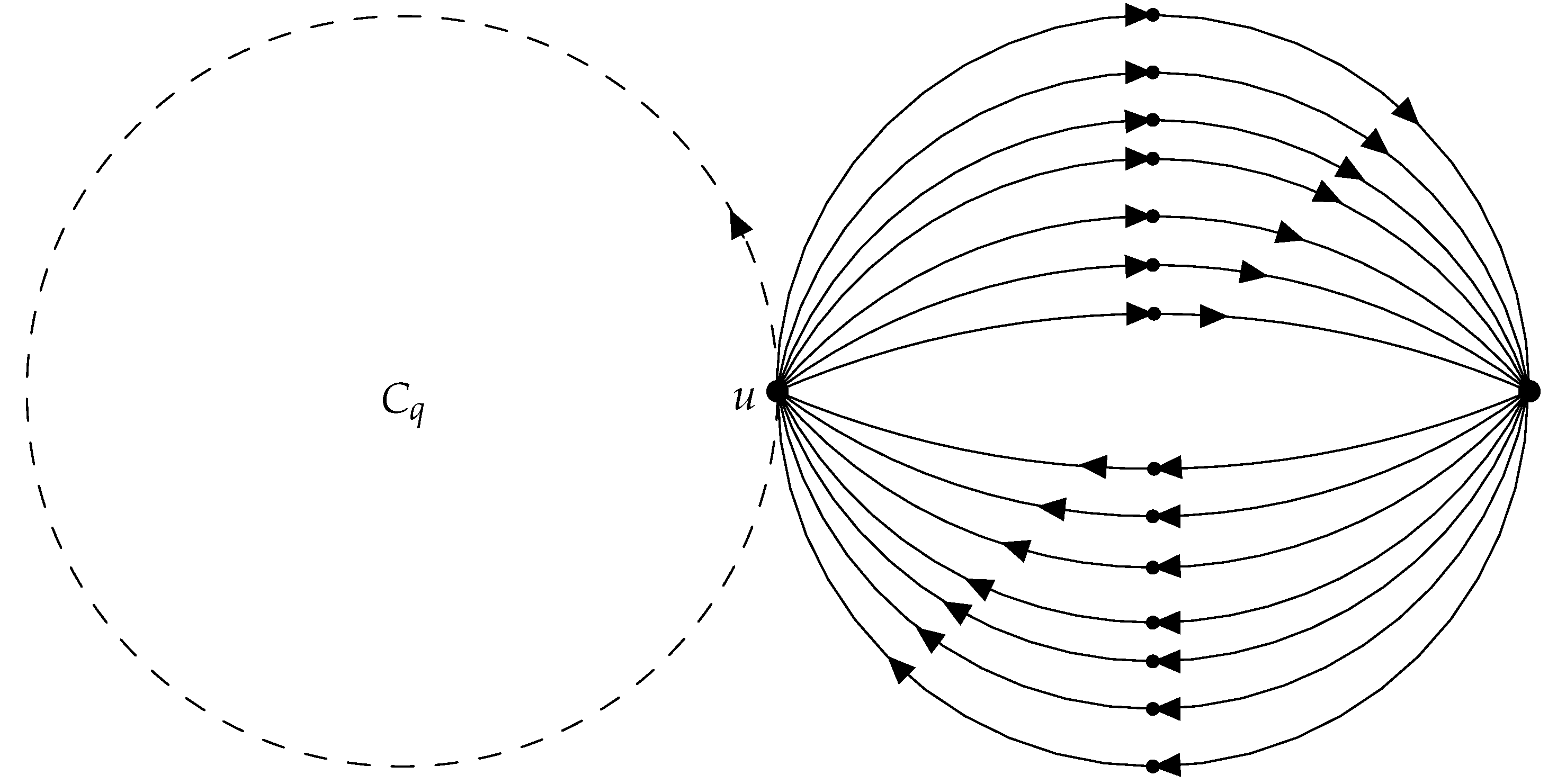
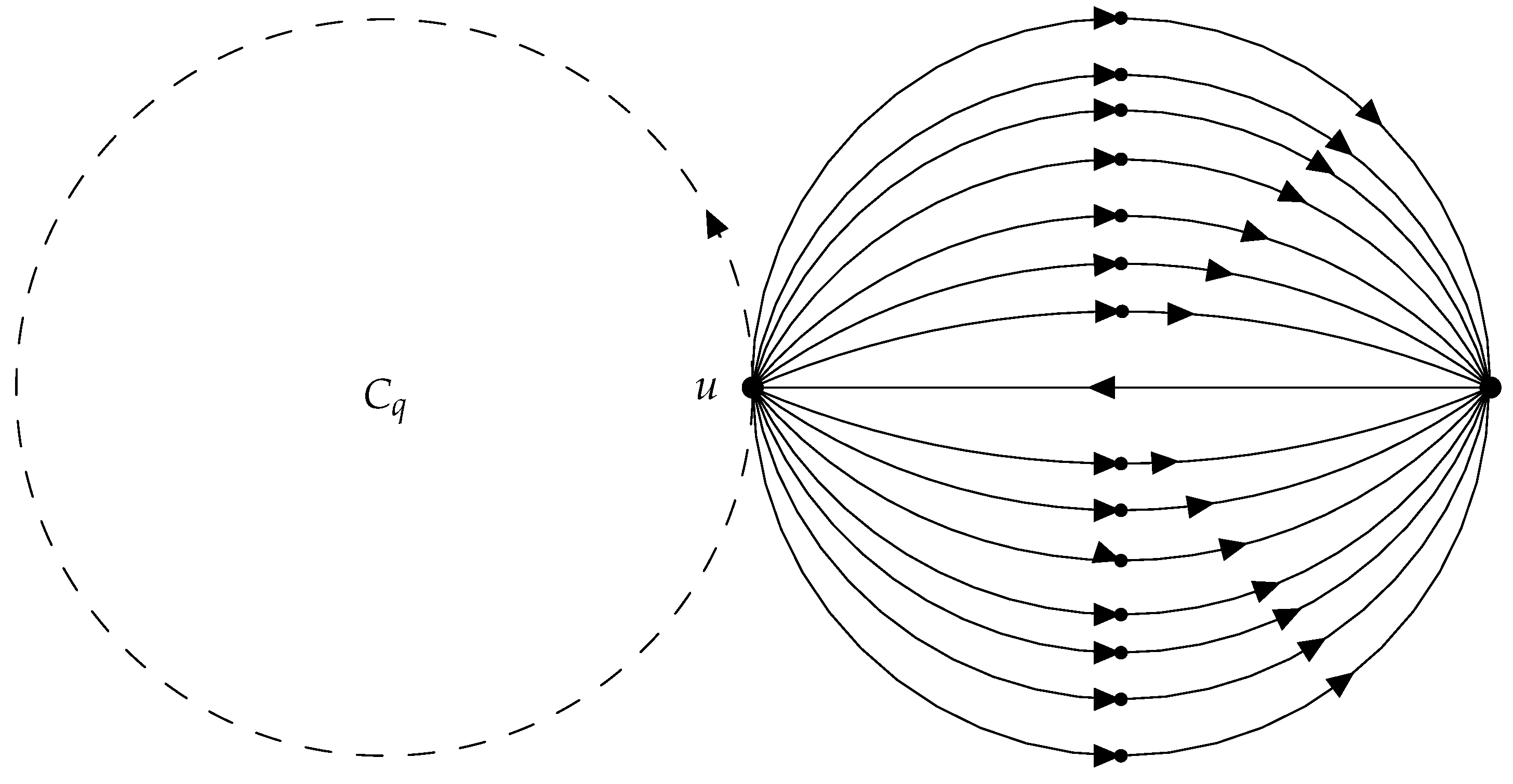
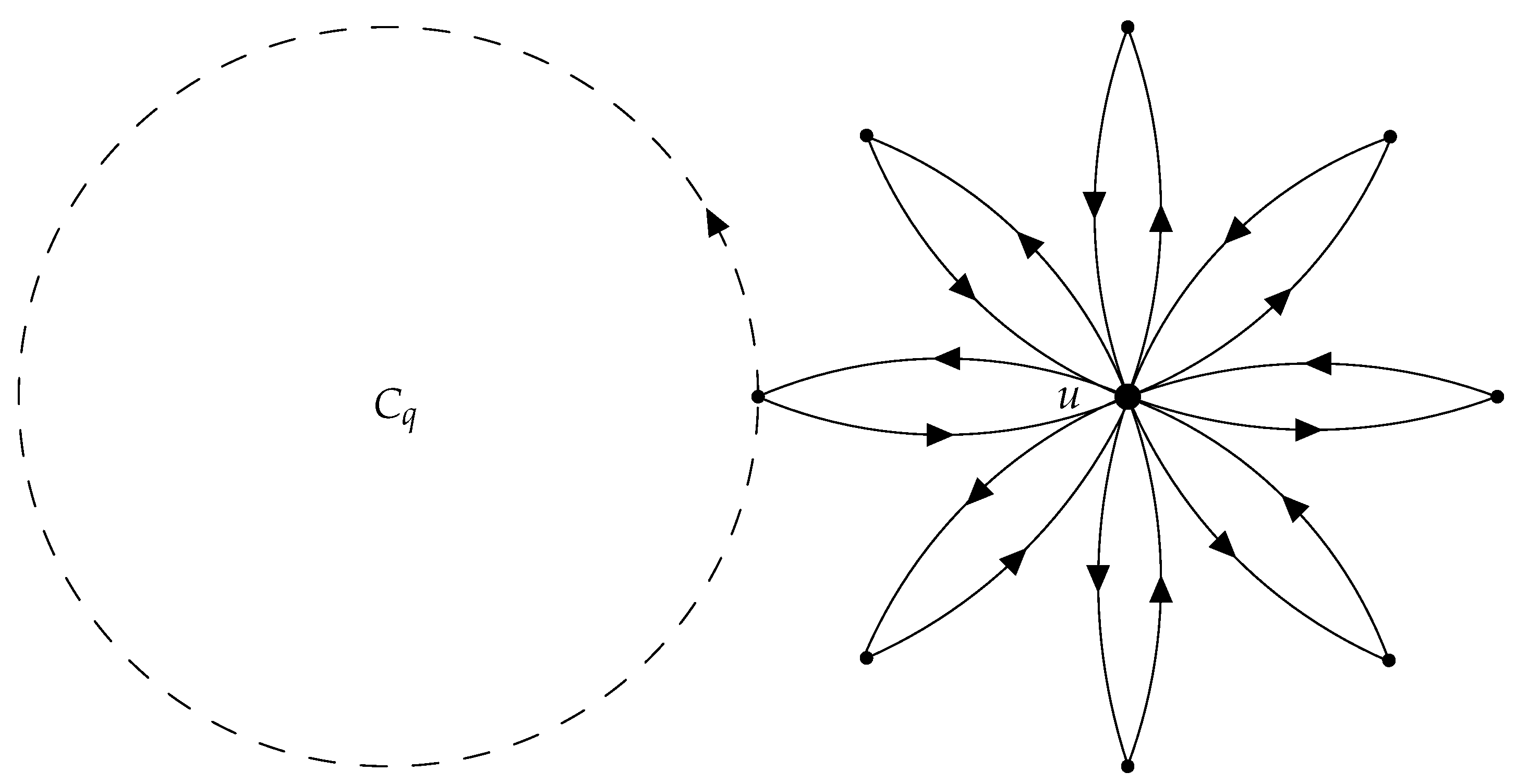
Corollary 4 can be useful when a vertex
u with a high degree is contained in the cycle
(see examples in
Figure 1 and
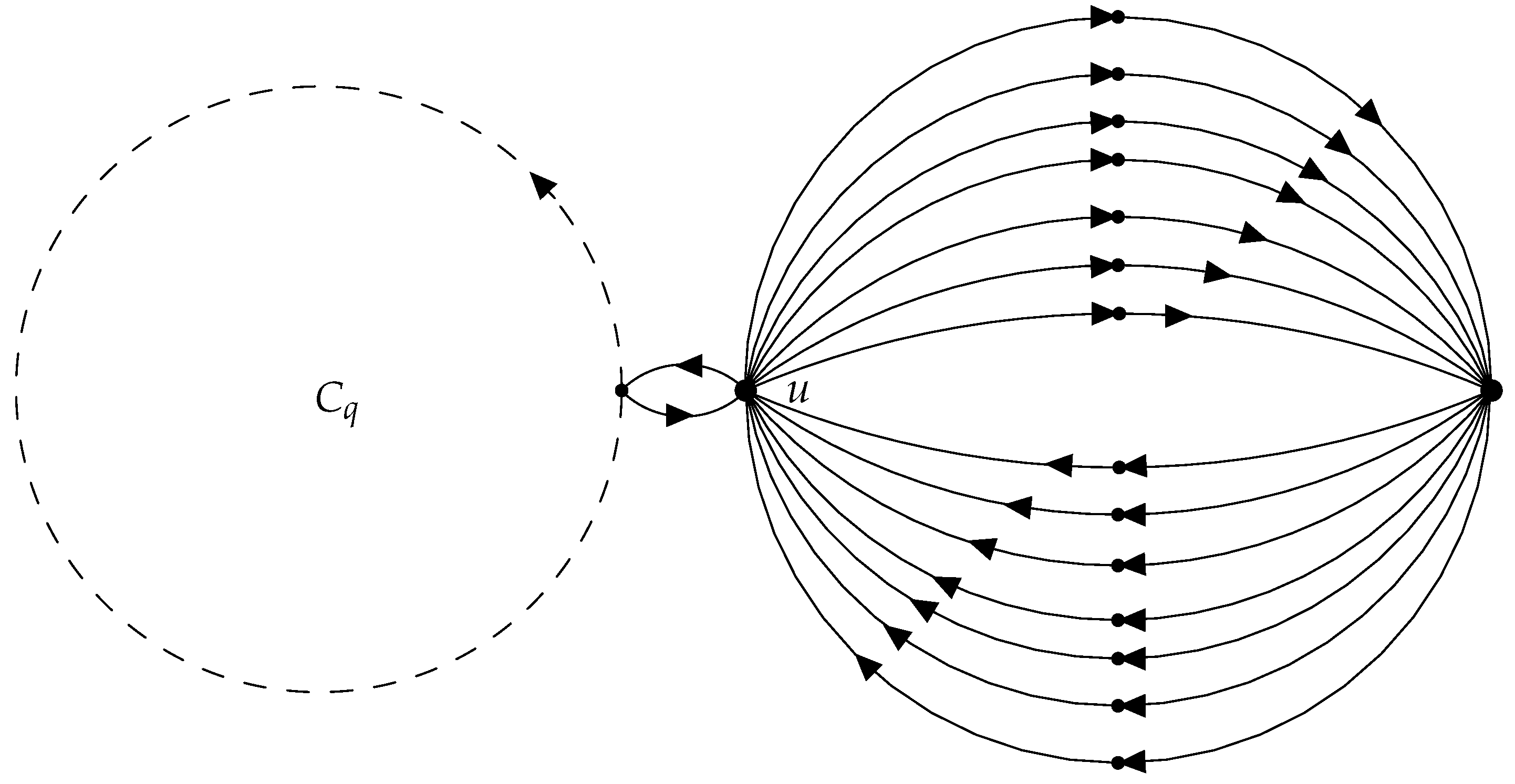
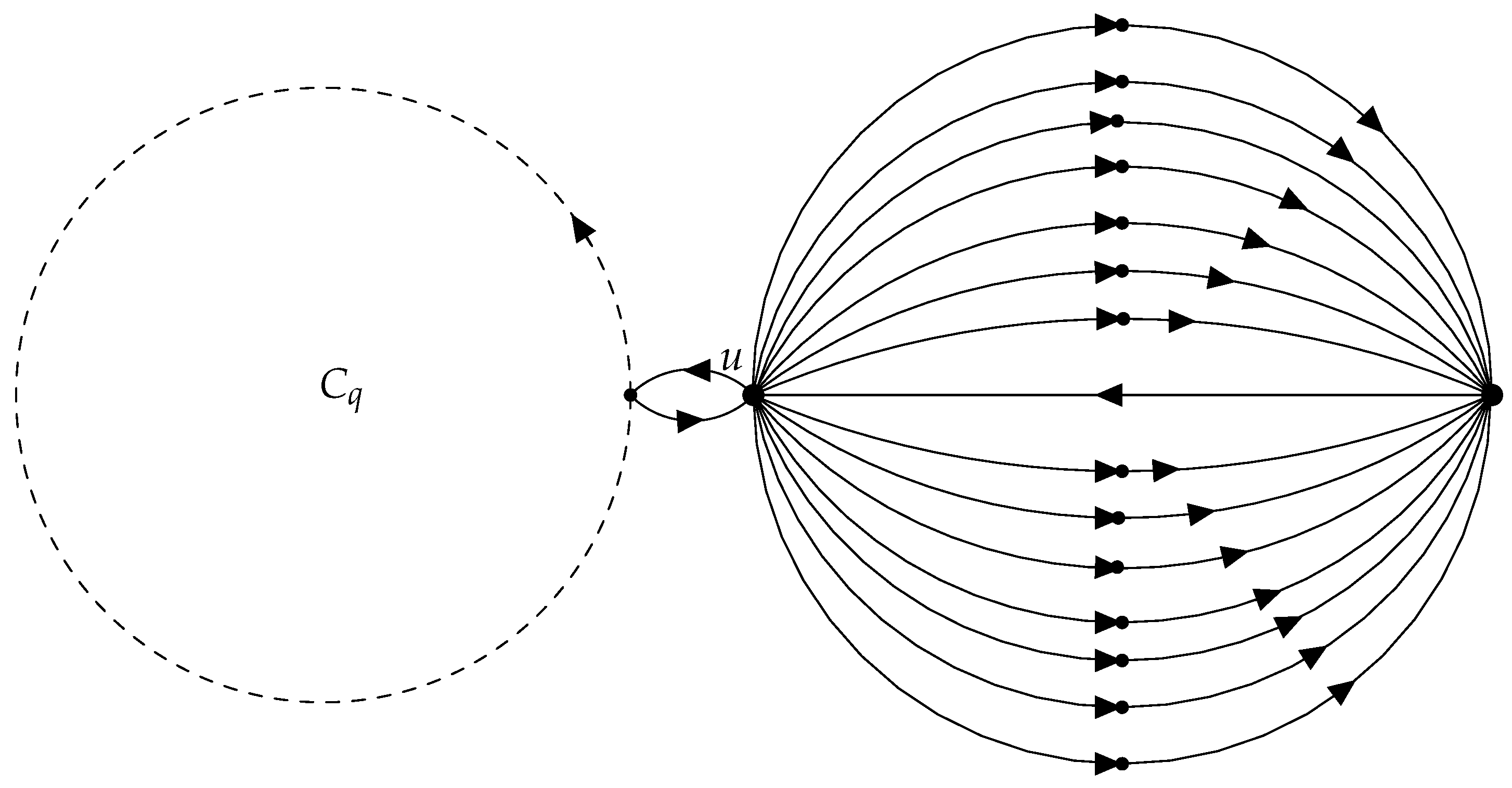
Figure 2). However, if the vertex
u is not contained in the cycle, the number of linear vertices contained in the MSD could be much higher than the number of linear vertices obtained with this bound. For instance, in the examples in
Figure 3 and
Figure 4), if
and the vertices in the cycle have degree 2 or less, the bound given by Corollary 4 would be 5, but the number of linear vertices would be at least 14; an analogous example is showed in
Figure 5.
Proposition 3. Let be an MSD, and let be a cycle of length q contained in D. Then, .
Proof. We obtain an MSD
by contraction of
in a unique vertex
, and then
and
. Hence, since
we obtain
and finally
The proof is completed. □
Other Properties of MSDs
In [
2,
14], some results about ear decomposition are proved. We use these previous results to show the next properties of MSDs.
Definition 1. Let be an MSD of order , and let be a path contained in D. We say that the -path is a chain with length l if for all .
Note that an isolated linear vertex is a chain of length 1.
Definition 2. Let be an MSD of order , let be a chain contained in D, and let be the digraph obtained from D by the elimination of the -path. We say that the -path is an external chain with length l if preserves the strong connection.
Proposition 4. Let be an MSD of order and a cycle contained in D such that . Then, in D, there exists at least one external chain.
Proof. We use the ear decomposition shown in Theorem 20 in [
2] in a similar way to how it was used in the proof of the property that affirms that an MSD factors into a rooted spanning tree and a forest of reversed rooted trees.
Let us consider an ear decomposition of D, . Since D is an MSD, each ear () contains at least one new vertex and two new arcs, with respect to and , respectively.
Then, it is clear that the last ear completes the construction of D, and is a chain of linear vertices, whose first and last vertex are joined to vertices of a minimal and strongly connected digraph . Hence, is an MSD, and therefore is an external chain of length . Trivially, we can say that if , then there is no external chain contained in D. The proof is completed. □
Note that is an MSD with vertices and arcs. Note also that if , with as a maximal length cycle contained in D, and there exists any external chain with length not contained in , then .
Proposition 5. Let be an MSD, and let -path be a chain contained in D with length . Then, the contraction of all vertices of the -path in a unique vertex preserves the minimality, that is, it produces another MSD with vertices and arcs.
Proof. Let be the digraph obtained by the contraction of all vertices of the -path in a unique vertex . Let be the number of vertices and the number of arcs of . In , all vertices of the -path are suppressed, but it contains the vertex , and then . Since for all , we have . Now, let us assume that there are transitive arcs in . If we expand , these transitive arcs would also exist in D, contradicting the minimality of D. Hence, is minimal. Since , then a vertex -path, exists also in , and contains a -path and a -path. Therefore, is strongly connected. The proof is completed. □
Proposition 6. Let be an MSD such that D is not a cycle. Then, there is not a cycle in D that contains all linear vertices of D.
Proof. Let us suppose that contains all linear vertices of D. We can obtain an MSD by contraction of in a unique vertex . We know that must contain at least two linear vertices, and at least one of them is different from . Then, it is clear that there exists at least one linear vertex that is contained in D but is not contained in . The proof is completed. □
Let D be an MSD such that D is not a cycle, and be the number of linear vertices contained in D. From the proposition above, it is trivial to see that a cycle contained in D will contain at most linear vertices of D.
5. MSD Properties Associated to Results of Algorithms Complexity
It was well known that minimality is a very strict condition in the family of strong digraphs implying, for instance, the size limitation . As we have seen in previous sections, MSDs also exhibit strong constraints on the number of linear vertices and maximum in- and outdegrees of vertices, regarding the length of the longest directed cycle. Unfortunately, these constraints are not enough to construct an efficient algorithm finding the longest cycle in an MSD.
A proof that an MSD can be converted into a directed cycle by successively eliminating external chains is given in [
16]. However, this process does not guarantee that the resulting directed cycle will have a maximum length.
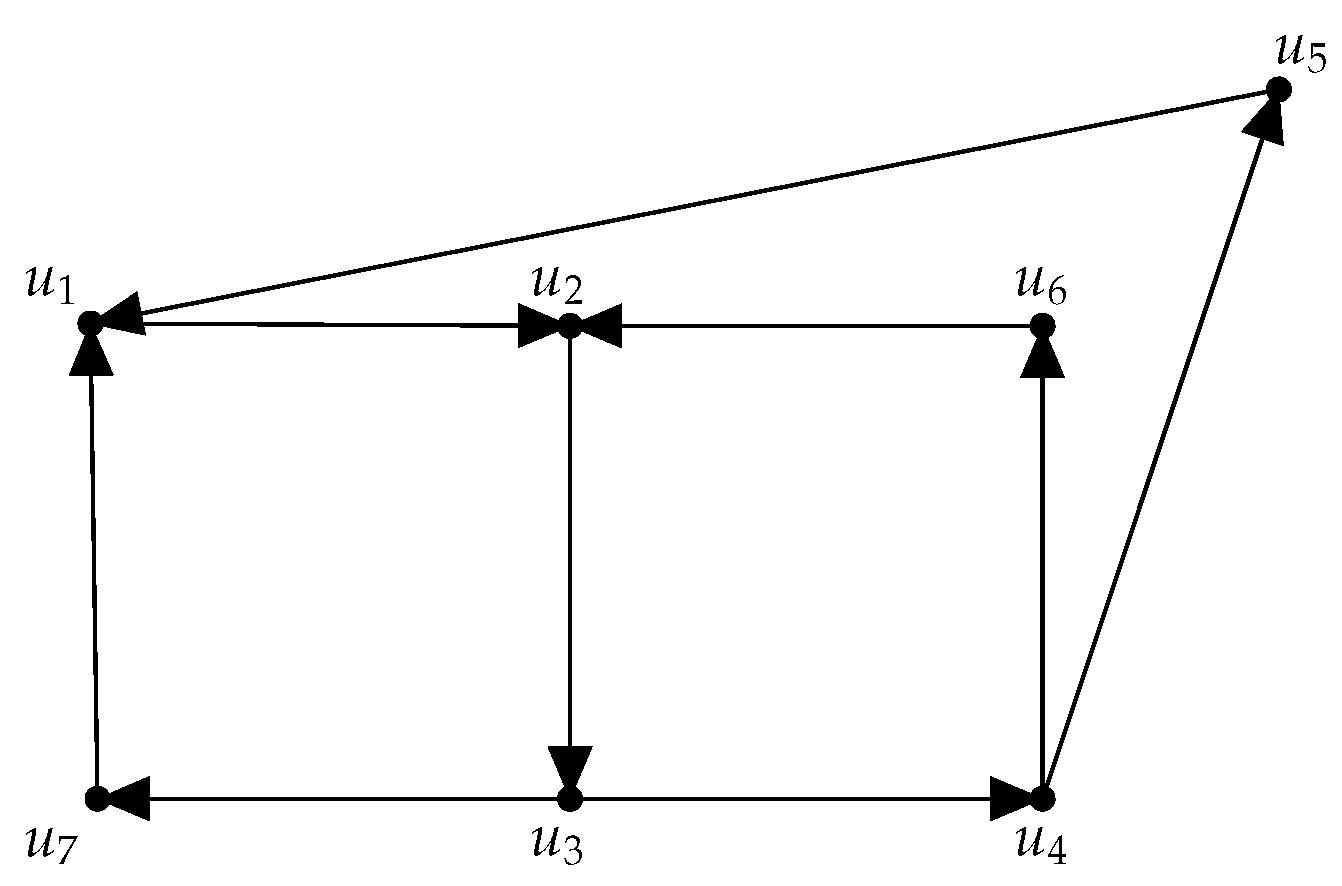
Figure 6 shows an MSD where the longest directed cycle is given by
, but this cycle will be obtained only in the case that the external chains eliminated are those formed by the
-path and
-path. Nevertheless, there is no an efficient algorithm that can determine the deletion of these chains and the non-deletion of the external chain formed by the vertex
-path because if this chain is deleted, then the longest cycle of the MSD will also have been eliminated.
Theorem 1. Computing a cycle with maximal length in an MSD is an NP-hard problem.
Proof. We can reduce the problem of computing a cycle with maximal length in a strongly connected digraph to the problem of computing a cycle with maximal length in an MSD.
Let
be a strong digraph. We can build an MSD
from
as follows. For each arc
, we add an intermediate vertex
. We thus obtain
Note that the strong connection of implies that D is trivially strongly connected. Note also that no arc of D can be transitive since every arc has a linear vertex as start- or endpoint. Hence, D is in fact an MSD.
Now, we remark that there is a one-to-one correspondence between cycles in D and cycles in : for every cycle in , a cycle arises in D, and all the cycles in D are generated in this way.
We conclude that any algorithm allowing us to compute the longest cycle of an MSD would then be able to compute the longest cycle of any SD, too. Since the problem of computing the longest cycle in a strongly connected digraph is NP-hard [
14], then the theorem is proved. □
Theorem 2. Let be an MSD. Finding a cycle contained in D with length is an NP-complete problem.
Proof. We can reduce the problem of determining if a digraph is Hamiltonian to the problem of determining if an MSD has a cycle of length .
Let be a digraph. If is strongly connected, the same procedure used in the previous proof yields an MSD (if is not strongly connected, then it cannot be Hamiltonian). The order of D verifies , and the size holds . Hence, finding a cycle in D with length would imply finding a -cycle in , that is, determining if D is Hamiltonian. Since determining whether a digraph is Hamiltonian is an NP-complete problem, the theorem is proved. □