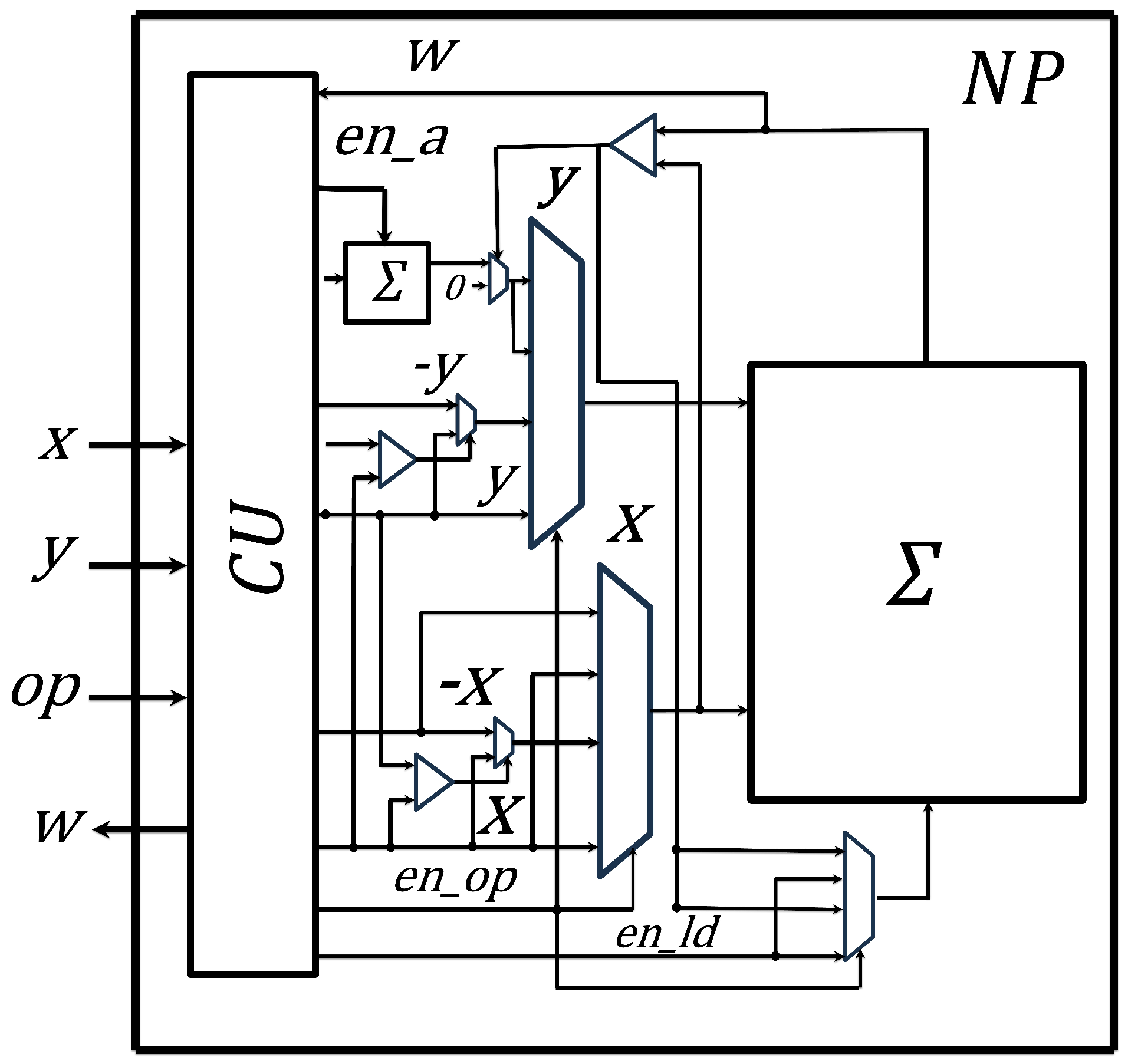
New High-Speed Arithmetic Circuits Based on Spiking Neural P Systems with Communication on Request Implemented in a Low-Area FPGA

 , , , ,
 Abstract
Share and Cite
Rangel, J.; Anides, E.; Vázquez, E.; Sanchez, G.; Avalos, J.-G.; Duchen, G.; Toscano, L.K. New High-Speed Arithmetic Circuits Based on Spiking Neural P Systems with Communication on Request Implemented in a Low-Area FPGA. Mathematics 2024, 12, 3472. https://doi.org/10.3390/math12223472
Rangel J, Anides E, Vázquez E, Sanchez G, Avalos J-G, Duchen G, Toscano LK. New High-Speed Arithmetic Circuits Based on Spiking Neural P Systems with Communication on Request Implemented in a Low-Area FPGA. Mathematics. 2024; 12(22):3472. https://doi.org/10.3390/math12223472
Chicago/Turabian StyleRangel, José, Esteban Anides, Eduardo Vázquez, Giovanny Sanchez, Juan-Gerardo Avalos, Gonzalo Duchen, and Linda K. Toscano. 2024. "New High-Speed Arithmetic Circuits Based on Spiking Neural P Systems with Communication on Request Implemented in a Low-Area FPGA" Mathematics 12, no. 22: 3472. https://doi.org/10.3390/math12223472
APA StyleRangel, J., Anides, E., Vázquez, E., Sanchez, G., Avalos, J.-G., Duchen, G., & Toscano, L. K. (2024). New High-Speed Arithmetic Circuits Based on Spiking Neural P Systems with Communication on Request Implemented in a Low-Area FPGA. Mathematics, 12(22), 3472. https://doi.org/10.3390/math12223472