Abstract
Nonlocal nonlinear Schrödinger equations are among the important models of nonlocal integrable systems. This paper aims to present a general formula for arbitrary-order breather solutions to multi-component nonlocal nonlinear Schrödinger equations by using the Hirota bilinear method. In particular, abundant wave solutions of two- and three-component nonlocal nonlinear Schrödinger equations, including periodic and mixed-wave solutions, are obtained by taking appropriate values for the involved parameters in the general solution formula. Moreover, diverse wave structures of the resulting breather and periodic wave solutions with different parameters are discussed in detail.
Keywords:
multi-component nonlocal nonlinear Schrödinger equations; Hirota bilinear method; breather solutions MSC:
35Q99; 35C99
1. Introduction
Solving the nonlinear Schrödinger (NLS) equation is a frequent subject in classical integrable systems [1,2]. Various wave solutions of the NLS equation can be obtained by using the inverse scattering transformation [3,4], the Darboux transformation [5], and the Hirota bilinear method [6]. In 2013, Ablowitz [7] and his collaborators derived a nonlocal nonlinear Schrödinger (NNLS) equation with PT symmetry, which provides a new research direction for the integrable systems, namely nonlocal integrable systems. It has been shown in [8] that a nonlocal system can be derived from the nonlocal reduction of the general AKNS system, and its soliton solution can also be constructed by the inverse scattering method, which means that the classical methods for the integrable systems can be used to study the nonlocal systems. Further studies have also proved that different nonlocal reductions from the general AKNS system lead to many new nonlocal systems with PT symmetry, such as the nonlocal Klein–Gordon equation, nonlocal modified KdV equation, and so on [9,10,11,12].
The NNLS equation introduced in [7] is
where is a complex valued function of the real variables x and t. ∗ refers to the complex conjugation. The case with is called focusing, and the case with is called defocusing. In Equation (1), for a fixed time, the nonlinear term satisfies the PT symmetry condition [11]. Following Ablowitz’s work, many achievements in integrable nonlocal systems have emerged in nonlinear mathematical physics. In [13], Equation (1) was investigated by the Darboux transformation, and, a chain of nonsingular localized wave solutions was obtained. In [14], three types of rogue waves for Equation (1) corresponding to the focusing case were derived by using the Darboux transformation. In [15], the integrability of a two-component nonlocal system with PT symmetry was studied, and the inverse scattering transformation gave its soliton solutions. In [16] Wen-Xiu Ma introduced a more generalized PT-symmetric NNLS system, namely, MNNLS equations, investigated their integrability, and presented soliton solutions employing the Riemann–Hilbert approach. Many other interesting applications and theoretical developments about PT symmetry and nonlocal integrable systems have appeared in [17,18,19,20,21,22,23].
In the following, we will consider a nonlocal multi-component system generalized from Equation (1):
where is a complex field of the real variables x and t. In the system (2), the nonlinear term contains a self-induced potential of the form , which satisfies the PT symmetry condition for a fixed time, i.e., they are invariant under the parity–time transformation .
The Hirota bilinear method is a powerful mathematical method for solving the classical integral system. In this paper, we will investigate the solutions of system (2) using the bilinear method. The current paper is organized as follows. In Section 2, we will apply the Hirota bilinear method to system (2) and present a formula for Nth-order breather solutions. In Section 3, we will discuss breather, periodic, and mixed waves of two- and three-component nonlocal nonlinear Schrödinger equations. Section 4 will give a summary of this paper.
2. Hiirota Bilinear Method for Breather Solutions
2.1. Hirota Bilinear Method
We first need the following transformations [2]:
where and are real constants, are complex functions, and is a real function. In addition, satisfies the following condition:
Through calculation, we obtain the following bilinear form of the system (5):
where Hirota’s bilinear operators and are defined by the following [6]:
To construct the Nth-order breather solutions of (2) using the bilinear method, we also need the following finite perturbation expansions for functions and :
where is a small perturbation parameter. For the Nth-order breather solutions of (2), the expansions need to stop at . Functions and , , are specified types of functions with undetermined parameters and exp.
2.2. Breather Solutions
In the following, we first construct the first- and second-order breather solutions of the system (2) and then derive its Nth-order breather solutions. The construction of the first-order breather solutions is similar to that of two soliton solutions. According to the bilinear method, we truncate (7) to and , which means that the first-order breather solutions can be obtained by taking
where , and , , , are real parameters.
Accordingly, the first-order breather solutions of (2) are given by
where satisfies Equation (4) and in (7).
To construct the second-order breather solutions of (2), we truncate the expressions in (7) to and , and take
where , and , , , are real constants.
Accordingly, we obtain the second-order breather solutions of the system (2):
where satisfies Equation (4).
It is important to note that the above processes for constructing breather solutions can be continued in the same way, i.e., one can construct third- and fourth-order breather solutions, etc. This suggests that a general formula for the Nth-order breather solutions of system (2) can be expressed. Therefore, when , we take
where
and , but , should take all possible combinations of .
Generally, for the breather wave solutions, their shapes are mainly related to n parameters . For a given n, the components are distinguished by the coefficients . Under this condition, the components can be proportional; otherwise, they cannot.
3. Examples
3.1. Breather Solutions of the Two-Component NNLS Equations
When in (2), we obtain the following two-component system:
The Hirota bilinear forms of (14) are given by
3.1.1. The First-Order Breather Solutions
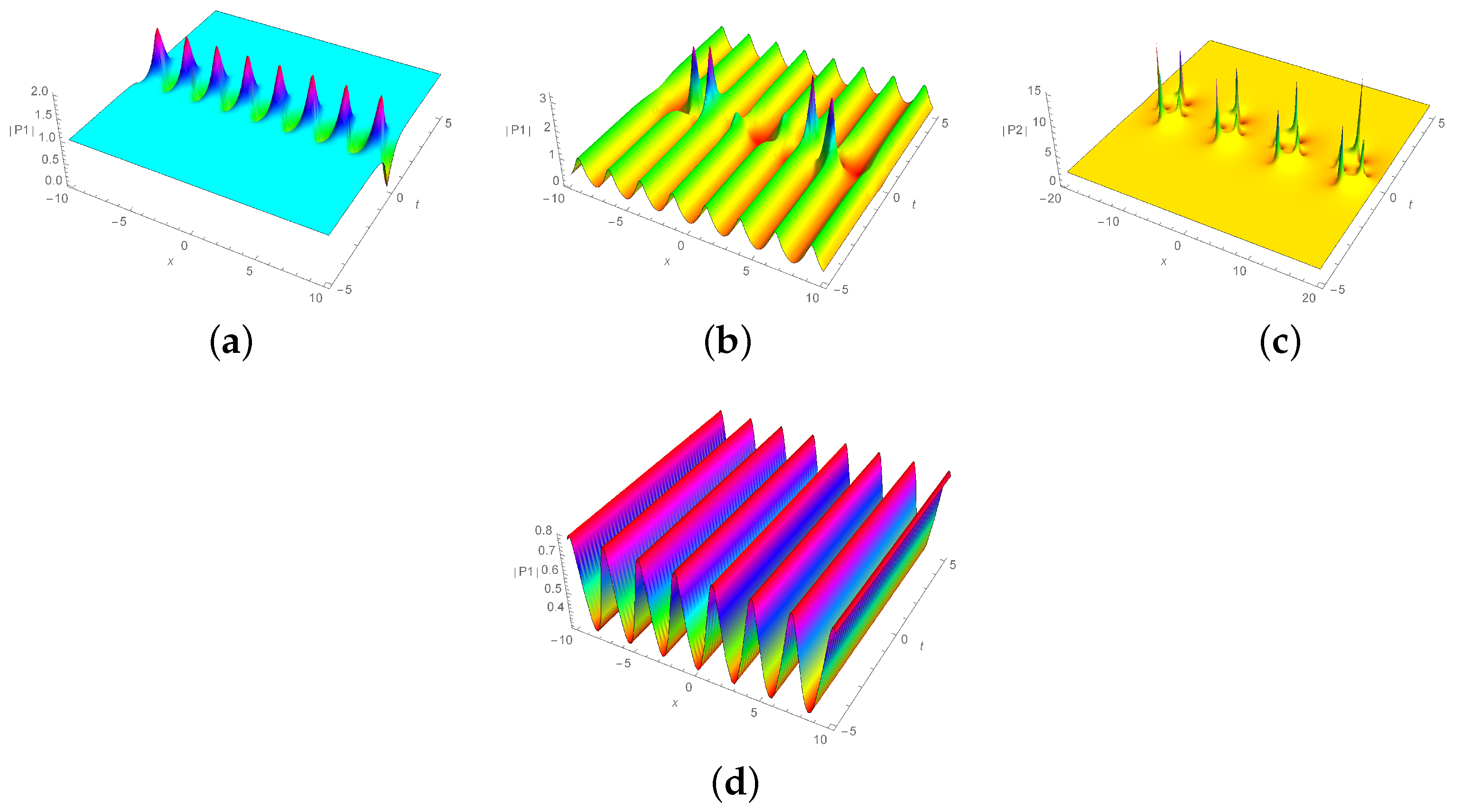
Obviously, the denominator of (16) satisfies (4). The corresponding graphs of the first-order breather solutions are shown in Figure 1 with . Figure 1a,c show the number of the peaks determined by at a fixed . Figure 1a,b show the number of peaks determined by at a fixed . In particular, is the periodic wave solution at . We find that the values of and have little effect on the changes in peak number and amplitude within a certain range, and this is also true for high-order breather wave solutions.
Figure 1.
(a) First-order breather solution with , and ; (b) first-order breather solution with , and ; (c) first-order breather solution with , and ; (d) periodic wave solution with , and .
3.1.2. The Second-Order Breather Solution
According to (11), the second-order breather solutions of (14) can be expressed as
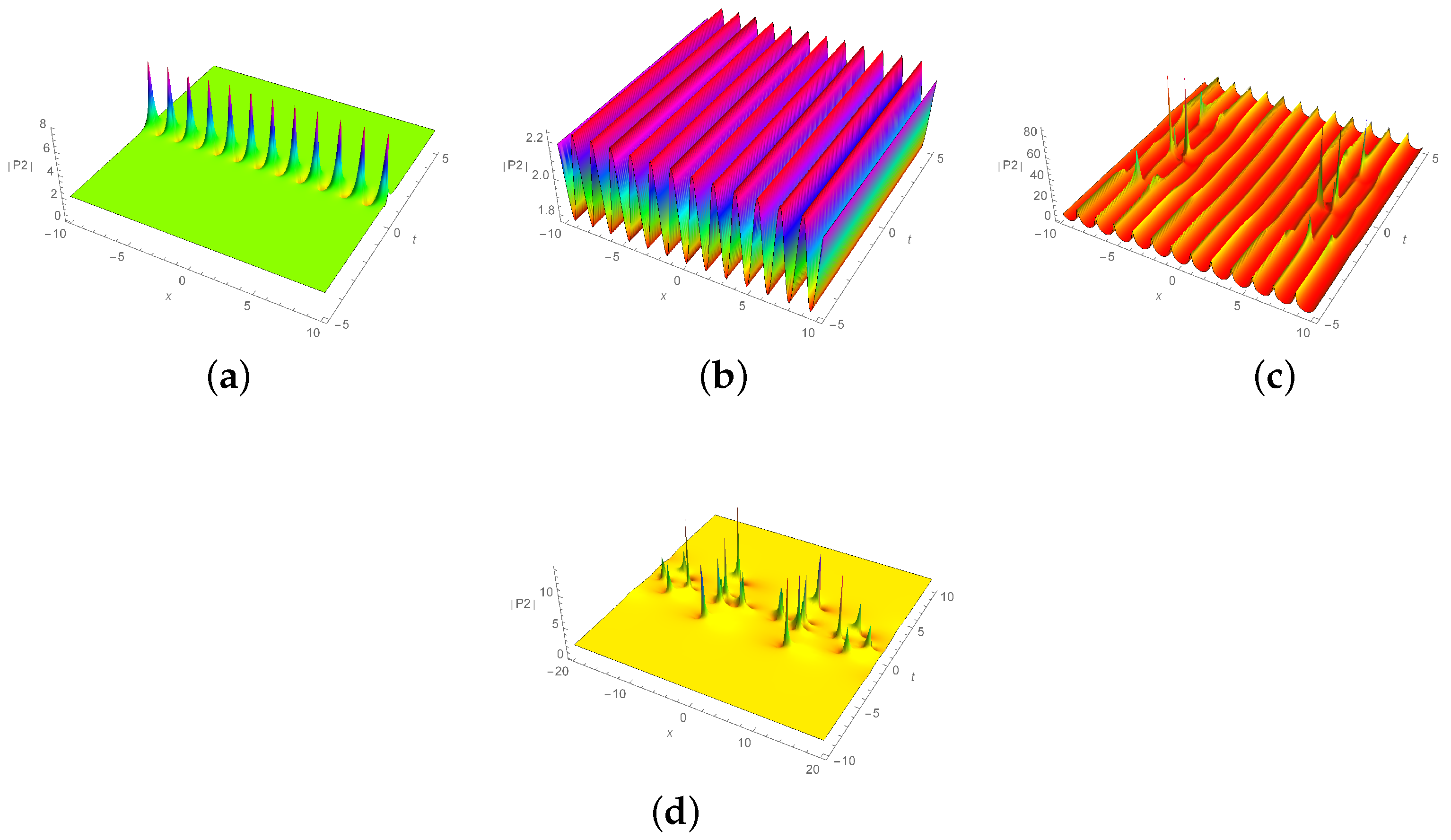
It is clear that the denominator of (17) satisfies (4). The corresponding graphs of the second-order breather solutions are shown in Figure 2 with . Taking and , the general breather solution is plotted in Figure 2a. Taking , and , the mixed-wave solution of the breather and periodic wave along the x-axis is plotted in Figure 2b. When , and , we obtain a complex mixed-wave solution , namely, a quadrangular breather wave solution (see Figure 2c). In particular, is the periodic wave solution with , and (see Figure 2d). Therefore, we find that the parameter plays an important role in the structural change of the solutions.
Figure 2.
(a) Second-order breather solution with and ; (b) mixed-wave solution with , , and ; (c) mixed-wave solution with , , and ; (d) periodic wave solution with , and .
3.1.3. The Third-Order Breather Solutions
According to (13), the third-order breather solutions of (14) can be expressed as
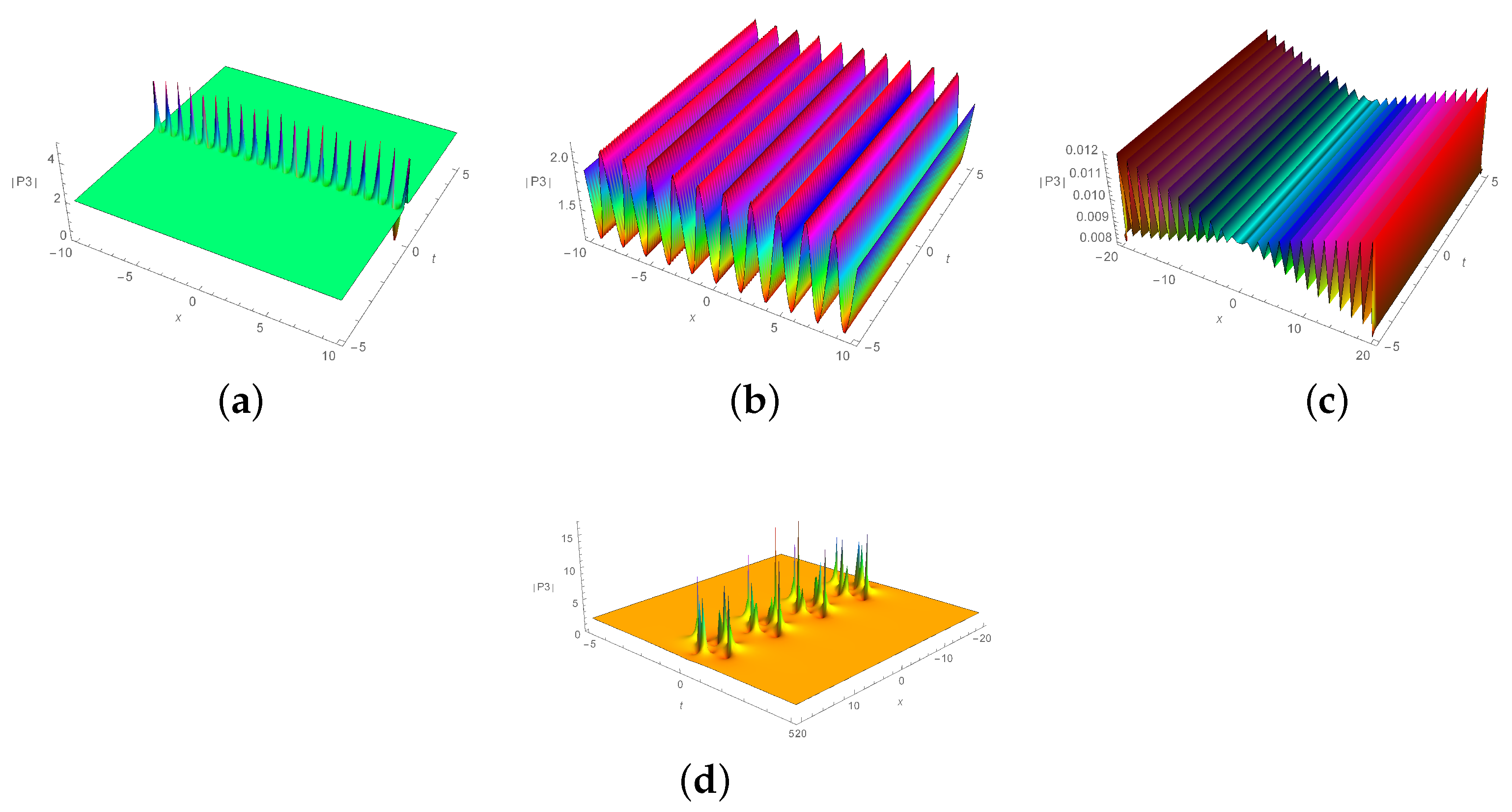
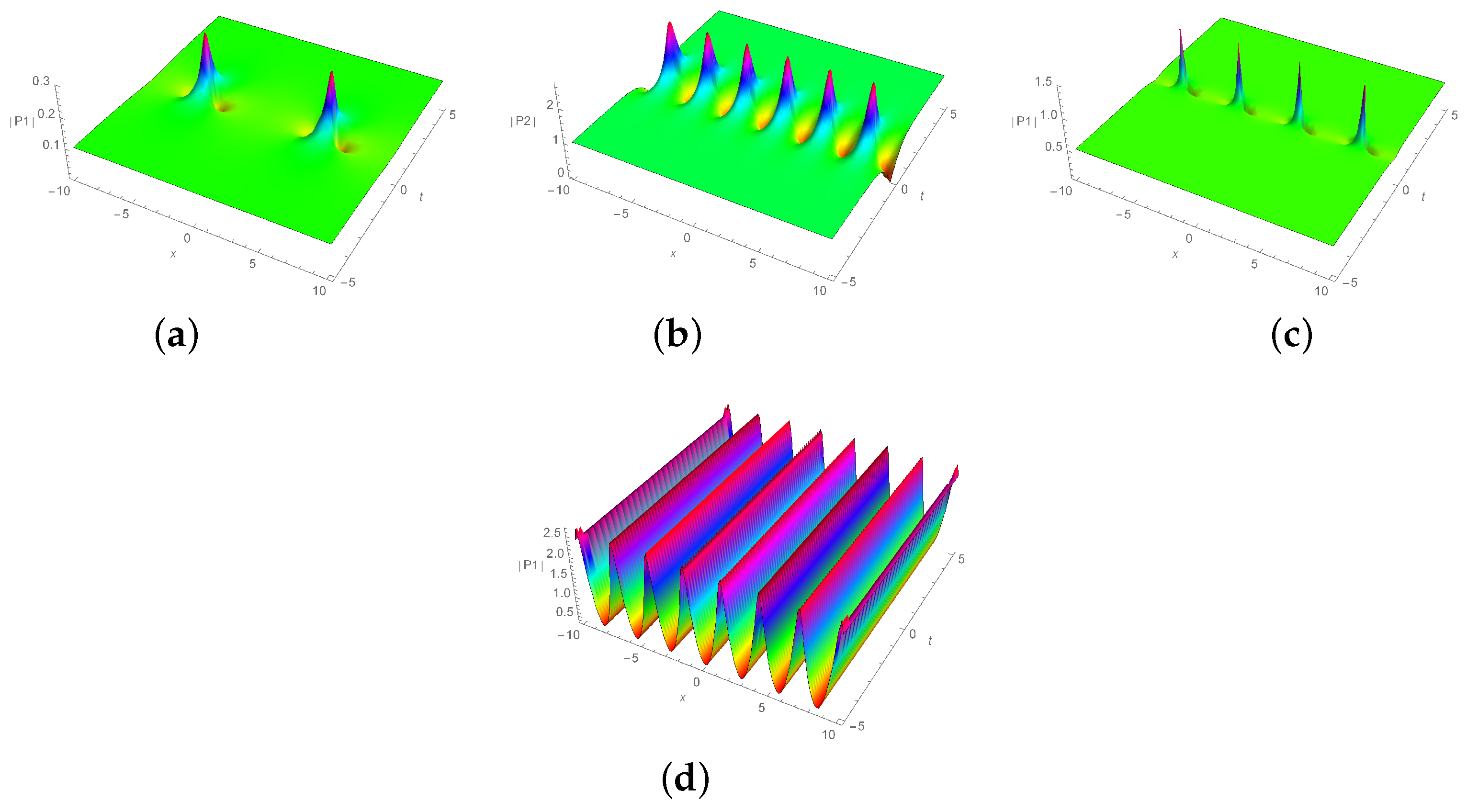
The denominator of (17) satisfies (4). The corresponding graphs of the third-order breather solutions are shown in Figure 3 with . Figure 4a shows the third-order breather solution with , , and . Figure 4b shows the periodic solution with parameters , , and along the x-axis. As shown in Figure 4a,b, the amplitude varies significantly with parameter . Taking , and , the mixed-wave solution of the solitary wave and periodic wave along the x-axis is plotted in Figure 3c. When , and , Figure 3d shows the mixed waves of four and six solitary wave packets with interleaved periods.
Figure 3.
(a) Third-order breather solution with , and ; (b) periodic wave solution with , and ; (c) mixed-wave solution with , and ; (d) mixed-wave solution with , and .
Figure 4.
(a) Third-order breather solution with and ; (b) periodic wave solution with , and ; (c) special periodic wave solution with , and ; (d) mixed-wave solution with , , and .
3.2. Breather Solutions of the Three-Component NNLS Equations
When in (2), we obtain the following three-component system:
According to (13), the third-order breather solutions of (14) can be expressed as
The denominator of (20) satisfies (4). The corresponding graphs of the third-order breather solutions are shown in Figure 4 with . We find that the structure of the solution varies depending on the parameters it contains. Figure 4a shows the third-order breather solution with and . Figure 4b shows the periodic solution with parameters , , and along the x-axis. If and in Figure 4b, we obtain a special periodic wave solution along the x-axis, as shown in Figure 4c. For appropriate values of , and , we obtain Figure 4c, which is not the case for solutions containing two parameters and or only one parameter . When and , Figure 4d shows the mixed-wave solution of six solitary wave packets with periods.
4. Conclusions
The nonlinear nonlocal Schrödinger equation and its multicomponent generalizations are important models of nonlocal integrable systems. In this paper, we have presented the Nth-order breather solutions of MNNLS equations by using the Hirota bilinear method. As the first example, the first-order, second-order, and third-order breather solutions, periodic solutions, and mixed-wave solutions of the two-component NNLS equations were illustrated. As a second example, we also illustrated the third-order breather solutions, periodic solutions, and mixed-wave solutions of the three-component NNLS equations. The dynamics of the obtained solutions were analyzed. From the graphical analysis, we found that the wave structures are mainly affected by the parameters and . In particular, every is related to the amplitude of the waves and the number of peaks. Moreover, the small difference in parameters has little effect on the wave structure. There are many notable parameters in the general expression of breather solutions of MNNLS equations. Various combinations of multi-parameters have a significant effect on the wave structure. We have only analyzed some representative combinations of parameters in general solutions. However, the results obtained in this article are relatively rich and may have potential implications for research in theoretical physics, applied mathematics, and related fields.
In our future work, we will focus on discovering new exact solutions for multi-component nonlocal Schrödinger equations that are not found in local equations [24,25,26,27]. We aim to explore and characterize these solutions, potentially revealing new insights and applications beyond those offered by localized models.
Author Contributions
Methodology, Y.-S.B.; resources, L.-N.Z.; software, Y.-S.Y.; writing—original draft, L.-N.Z.; writing—review and editing, Y.-S.B.; supervision, W.-X.M. All authors have read and agreed to the published version of the manuscript.
Funding
This work was supported by the Natural Science Foundation of Inner Mongolia No. 2023LHMS01006, by the National Natural Science Foundation of China under Grant No. 12262027, by the Fundamental research funds for the universities directly under the Inner Mongolia Autonomous Region No.JY20240042, and by the National Natural Science Foundation of China under Grant No. 12161064.
Data Availability Statement
The original contributions presented in the study are included in the article, further inquiries can be directed to the corresponding authors.
Acknowledgments
We sincerely appreciate the insightful comments and constructive suggestions provided by the editors and anonymous reviewers, which have significantly contributed to the improvement of our manuscript.
Conflicts of Interest
The authors declare no conflict of interest.
References
- Fibich, G. The Nonlinear Schrödinger Equation: Singular Solutions and Optical Collapse; Springer International Publishing: Cham, Switzerland, 2015. [Google Scholar]
- Tajiri, M.; Watanabe, Y. Breather solutions to the focusing nonlinear Schrödinger equation. Phys. Rev. E 1998, 57, 3510–3519. [Google Scholar] [CrossRef]
- Zakharov, V.E.; Shabat, A.B. Exact Theory of Two-dimensional Self-focusing and One-dimensional Self-modulation of Waves in Nonlinear Media. J. Exp. Theor. Phys. 1971, 61, 118–134. [Google Scholar]
- Zhang, X.; Chen, Y. Inverse scattering transformation for generalized nonlinear Schrödinger equation. Appl. Math. Lett. 2019, 98, 306–313. [Google Scholar] [CrossRef]
- Gu, C.; Hu, H.; Zhou, X. Darboux Transformations in Integrable Systems; Springer: Berlin/Heidelberg, Germany, 2005. [Google Scholar]
- Hirota, R. The Direct Method in Soliton Theory; Cambridge University Press: Cambridge, UK, 2004. [Google Scholar]
- Ablowitz, M.J.; Musslimani, Z.H. Integrable nonlocal nonlinear Schrödinger equation. Phys. Rev. Lett. 2013, 110, 064105. [Google Scholar] [CrossRef]
- Ablowitz, M.J.; Musslimani, Z.H. Inverse scattering transform for the integrable nonlocal nonlinear Schrödinger equation. Nonlinearity 2016, 29, 915. [Google Scholar] [CrossRef]
- Ablowitz, M.J.; Musslimani, Z.H. Integrable nonlocal asymptotic reductions of physically significant nonlinear equations. J. Phys. A Math. Theor. 2019, 52, 15LT02. [Google Scholar] [CrossRef]
- Chen, S.T.; Ma, W.X. Nonlocal reduced integrable mKdV-type equations from a vector integrable hierarchy. Mod. Phys. Lett. B 2023, 37, 2350045. [Google Scholar] [CrossRef]
- Ma, W.X. Integrable nonlocal nonlinear Schrödinger hierarchies of type (−λ*,λ) and soliton solutions. Rep. Math. Phys. 2023, 92, 19–36. [Google Scholar] [CrossRef]
- Gurses, M.; Pekcan, A. Nonlocal modified KdV equations and their soliton solutions by the Hirota method. Commun Nonlinear Sci. Numer. Simulat. 2019, 67, 427–448. [Google Scholar] [CrossRef]
- Li, M.; Xu, T. Dark and anti-dark soliton interactions in the nonlocal nonlinear Schrödinger equation with the self-induced parity-time-symmetric potential. Phys. Rev. E 2015, 91, 03320. [Google Scholar] [CrossRef]
- Yang, B.; Yang, J. Rogue waves in the nonlocal -symmetric nonlinear Schrödinger equation. Lett. Math. Phys. 2019, 109, 945–973. [Google Scholar] [CrossRef]
- Sinha, D.; Ghosh, P.K. Integrable nonlocal vector nonlinear Schrödinger equation with self-induced parity-time-symmetric potential. Phys. Lett. A 2017, 381, 124–128. [Google Scholar] [CrossRef]
- Ma, W.X. Nonlocal -symmetric integrable equations and related Riemann-Hilbert problems. Partial Differ. Equ. Appl. Math. 2021, 4, 100190. [Google Scholar] [CrossRef]
- Grahovski, G.G.; Mustafa, J.I.; Susanto, H. Nonlocal reductions of the multicomponent nonlinear Schrödinger equation on Symmetric Spaces. Theor. Math. Phys. 2018, 197, 1430–1450. [Google Scholar] [CrossRef]
- Denga, X.; Loub, S.; Zhang, D. Bilinearisation-reduction approach to the nonlocal discrete nonlinear Schrödinger equations. Appl. Math. Comput. 2018, 332, 477–483. [Google Scholar] [CrossRef]
- Chen, K.; Zhang, D. Solutions of the nonlocal nonlinear Schrödinger hierarchy via reduction. Appl. Math. Lett. 2018, 75, 82–88. [Google Scholar] [CrossRef]
- Bai, Y.S.; Zheng, L.N.; Ma, W.X. Nth-order rogue wave solutions of multicomponent nonlinear Schrödinger equations. Nonlinear Dyn. 2021, 106, 3415–3435. [Google Scholar] [CrossRef]
- Zhang, Y.; Liu, Y.; Tang, X. A general integrable three-component coupled nonlocal nonlinear Schrödinger equation. Nonlinear Dyn. 2017, 89, 2729–2738. [Google Scholar] [CrossRef]
- Li, L.; Duan, C.; Yu, F. An improved Hirota bilinear method and a new application for a nonlocal integrable complex modified Korteweg-de Vries (MKdV) equation. Phys. Lett. A 2019, 383, 1578–1582. [Google Scholar] [CrossRef]
- Smirnov, A.O.; Matveev, V.B. Finite-gap solutions of nonlocal equations in Ablowitz-Kaup-Newell-Segur hierarchy. Ufa Math. J. 2021, 13, 81–98. [Google Scholar] [CrossRef]
- Eilbeck, J.C.; Enolskii, V.Z.; Kostov, N.A. Quasiperiodic and periodic solutions for vector nonlinear Schrödinger equations. J. Math. Phys. 2000, 41, 8236. [Google Scholar] [CrossRef]
- Elgin, J.N.; Enolskii, V.Z.; Its, R.A. Effective integration of the nonlinear vector Schrödinger equation. Phys. D 2007, 225, 127–152. [Google Scholar] [CrossRef]
- Woodcock, T.; Warren, O.H.; Elgin, J.N. Genus two finite gap solutions to the vector nonlinear Schrödinger equation. J. Phys. A 2007, 40, F355–F361. [Google Scholar] [CrossRef]
- Its, A.R.; Rybin, A.V.; Sall, M.A. Exact integration of nonlinear Schrödinger equation. Theor. Math. Phys. 1988, 74, 20–32. [Google Scholar] [CrossRef]
Disclaimer/Publisher’s Note: The statements, opinions and data contained in all publications are solely those of the individual author(s) and contributor(s) and not of MDPI and/or the editor(s). MDPI and/or the editor(s) disclaim responsibility for any injury to people or property resulting from any ideas, methods, instructions or products referred to in the content. |
© 2024 by the authors. Licensee MDPI, Basel, Switzerland. This article is an open access article distributed under the terms and conditions of the Creative Commons Attribution (CC BY) license (https://creativecommons.org/licenses/by/4.0/).