Article

Simplification of Electrode Profiles for Piezoelectric Modal Sensors by Controlling Gap-Phase Length

1
Escuela de Ingeniería Industrial y Aeroespacial de Toledo, Universidad de Castilla-La Mancha, Av. Carlos III, Campus Fábrica de Armas, 45004 Toledo, Spain
2
CES Don Bosco, Universidad Complutense de Madrid, María Auxiliadora 9, 28040 Madrid, Spain
3
Geonum Group, Escuela de Ingeniería Industrial y Aeroespacial de Toledo, Universidad de Castilla-La Mancha, Av. Carlos III, Campus Fábrica de Armas, 45004 Toledo, Spain
4
Instituto de Investigación Aplicada a la Industria Aeronáutica, Escuela de Ingeniería Industrial y Aeroespacial de Toledo, Universidad de Castilla-La Mancha, Av. Carlos III, Campus Fábrica de Armas, 45004 Toledo, Spain
5
OMEVA Research Group, Escuela de Ingeniería Industrial y Aeroespacial de Toledo, Universidad de Castilla-La Mancha, Av. Carlos III, Campus Fábrica de Armas, 45004 Toledo, Spain
*
Author to whom correspondence should be addressed.
Mathematics 2024, 12(10), 1525; https://doi.org/10.3390/math12101525
Submission received: 17 April 2024 / Revised: 6 May 2024 / Accepted: 10 May 2024 / Published: 14 May 2024
(This article belongs to the Special Issue Mathematical Applications in Electrical Engineering)

Abstract

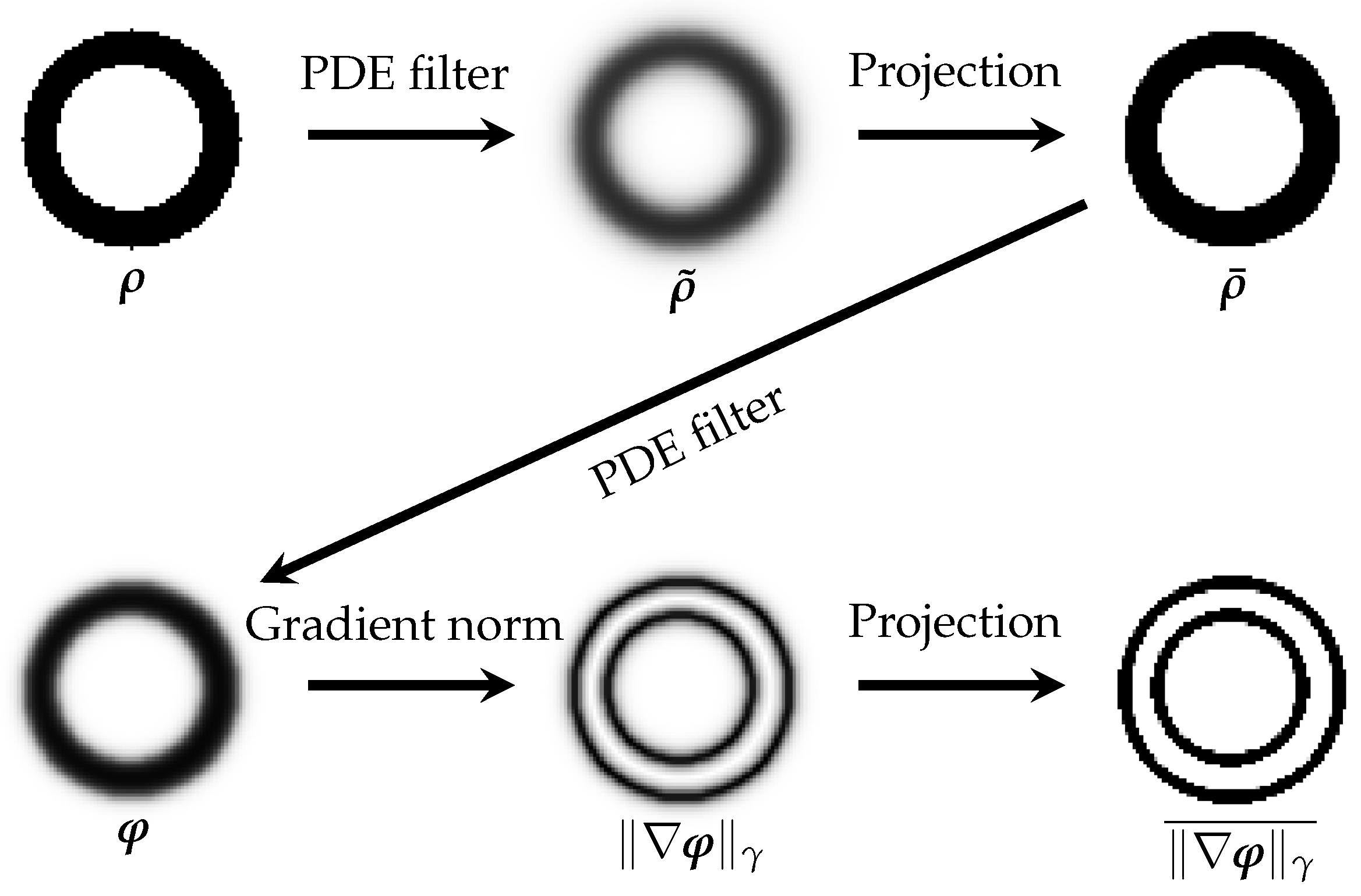
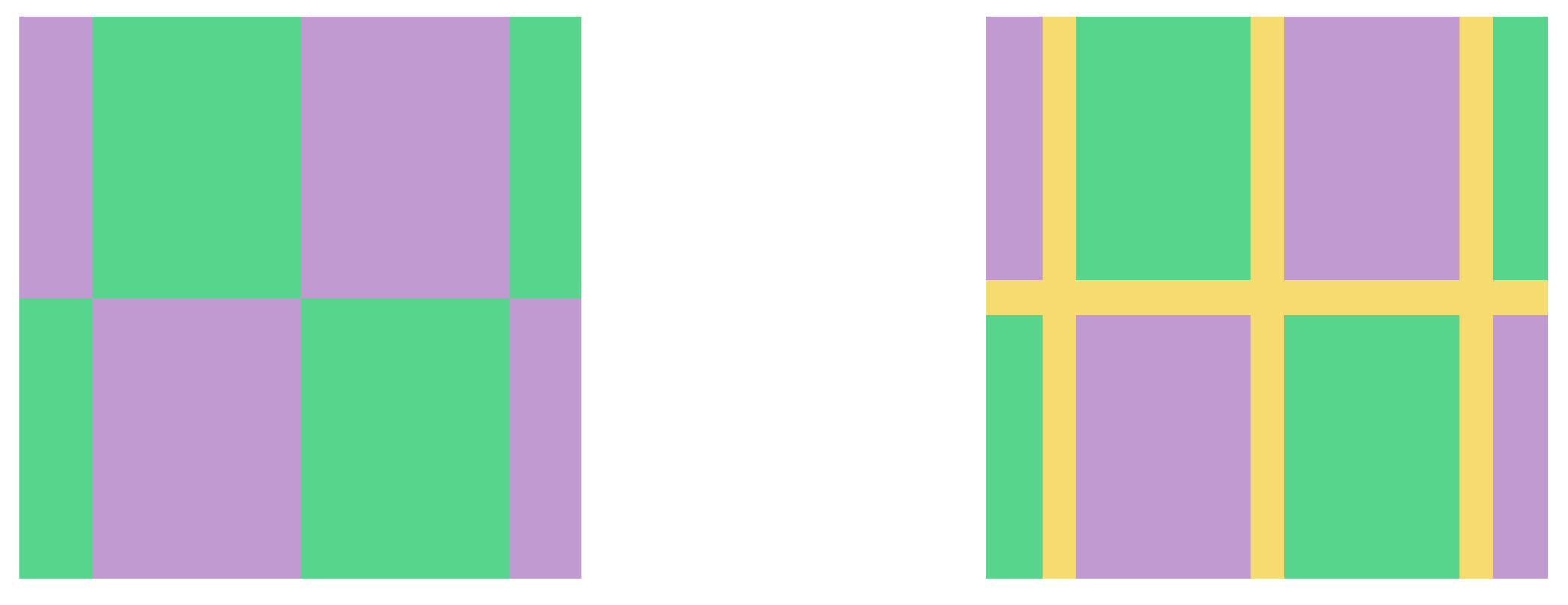
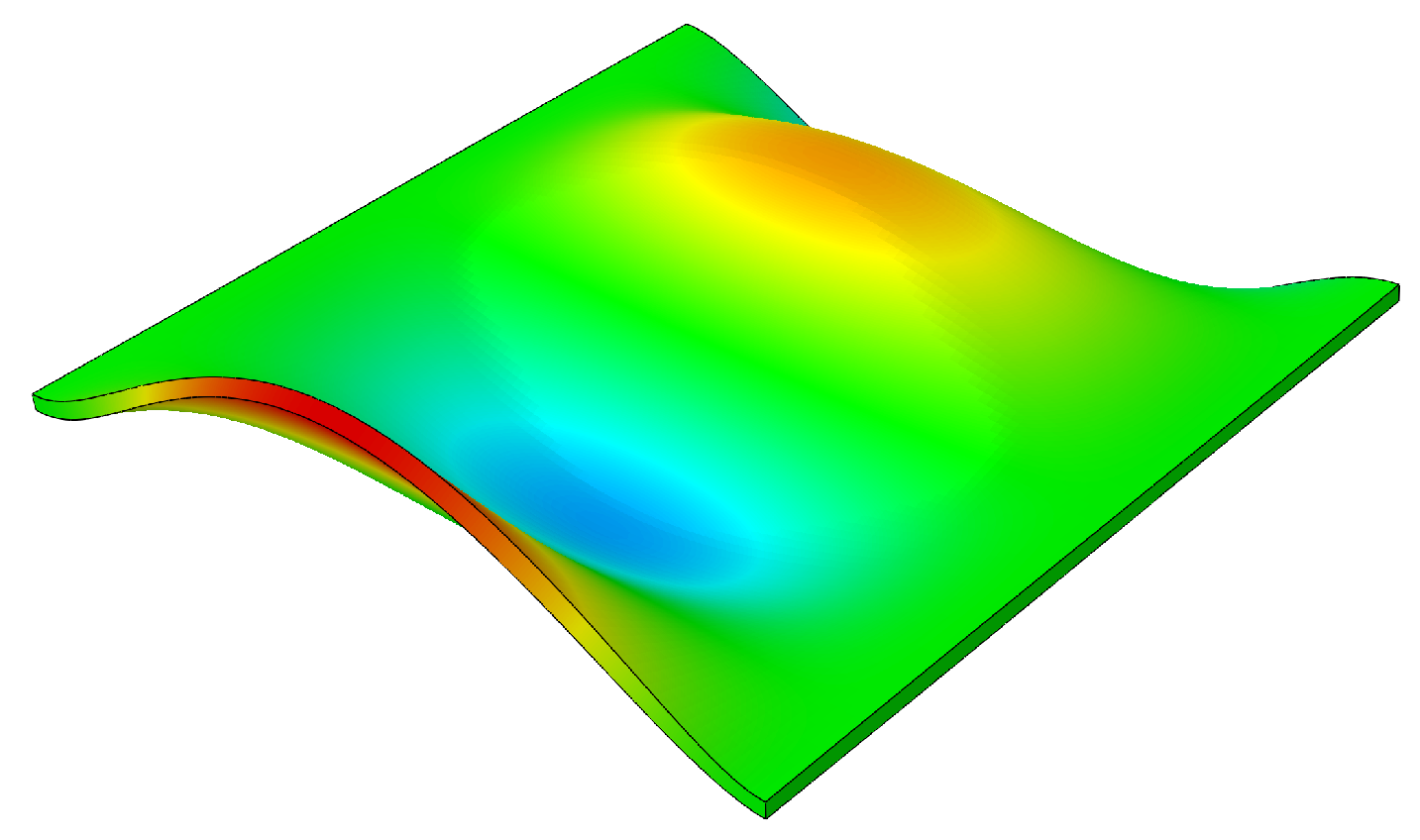
This paper presents a method to optimize and simplify the electrode profile of a piezoelectric modal sensor. At the same time that the electrode profile is optimized to maximize the charge, a null-polarity phase is introduced. This gap-phase is modeled using the normalized norm of the spatial gradient of the polarity profile along with a two-step filtering and projection technique. High-order vibration modes generate a complex polarization profile that makes the manufacturing process difficult. The novelty of the proposed method is the addition of a constraint on the length of the interface in the topology optimization problem. This constraint simplifies the optimal designs and facilitates the fabrication process. Several examples show the simplified electrode profile that maximizes the electrical charge produced by a vibration mode, while reducing the number of different polarization regions by means of the gap-length constraint.
Keywords: topology optimization; piezoelectric sensor; finite element method; material interface topology optimization; piezoelectric sensor; finite element method; material interface